Introduction
Hello sir! We need the forest (jangal) … It was God's will that we were born as Rautes in the forest. As Rautes, we cannot live happily outside of the forest. Please don't allow an arrangement in which anyone could prevent us from roaming in the forest; please convey the same message to the Prime Minister. And let him know that it comes from Main Bahadur, the headman. Otherwise, there will be no happiness for the [Raute] people (janata) … We are the people (jati) who live on forest produce and by hunting. We make and sell wooden utensils for a living. We do not need a house, nor do we need a state (rajya). Take all the other places for your states, just leave the jungle for us. Please write [in the constitution] that we are allowed to go to any forest in the country and that no one is allowed to stop us. Do not make us weep by not giving us the forest; please make us happy.Footnote 1
On 21 May 2012 Main Bahadur, a Raute headman (mukhiya), came out of the forests in the mid-western hills of Nepal and, as representative of the Raute people, spoke on the phone with the Speaker of Nepal's Constituent Assembly, Subash Nemwang. There were only seven days remaining before the Constituent Assembly—elected four years previously and already extended four times—was supposed to agree and release a new constitution. The Constituent Assembly was rightly lauded as the most representative and inclusive legislative body ever formed in Nepal. Yet many small minorities, such as the Raute, who number only 618 people according to the 2011 census, were unrepresented in it. The Raute are officially classified as one of 10 ‘endangered’ groups among the 59 Janajati or ‘indigenous nationalities’.Footnote 2 Even the forest-dwelling Raute felt the heat of contention over the future shape of Nepal and feared for their traditional rights and livelihood in the new federal framework, which was expected to divide the country into 14, 11, or six possibly ethnically named states or provinces.Footnote 3
In the event, the Constituent Assembly ran out of time and—the Supreme Court having refused permission for any further extensions—was dissolved on 27 May 2012, without being able to promulgate a new constitution. The sitting government was left in power as a caretaker and Assembly members were dismissed. The government had to try and find a way out, which took nearly 18 months of manoeuvring and—when agreement on a government of national unity could not be reached—the appointment of a ‘civilian’ government to oversee elections.Footnote 4 Those elections eventually took place in November 2013, leading to a very different configuration in the second Constituent Assembly, with the Nepali Congress (NC) and Communist Party of Nepal-Unified Marxist-Leninist (UML or in its full form: CPN-UML) as the two largest parties. The Maoists—abbreviated as UCPN(M), short for the Unified Communist Party of Nepal (Maoist)—who had won triumphantly in 2008, were comprehensively defeated in 2013 and relegated to the role of official opposition.
The main reason for the collapse of the first Constituent Assembly was its failure to reach agreement on the number, boundaries, or names of the new federal states. In 2010 its State Restructuring Committee (full title: Committee for State Restructuring and Distribution of State Power) had proposed 14 federal states, seven with ethnic names, five with geographic names, and two with combined ethnic-linguistic-geographic names. This proved controversial, partly because some of the smaller states were considered impracticable. So in 2012 a smaller High-Level State Restructuring Commission was tasked with coming up with an acceptable compromise. The majority proposal was for 10 territorial states and one non-territorial state (for Dalits); of the 10, six had ethnic names, two had geographic names, and two had mixed names. However, a minority of the Commission dissented and proposed instead six non-ethnic geographic states. The Constituent Assembly was unable to vote on either proposal and ended ignominiously without being able to vote on any form of constitution.
In order to follow the narrative that follows, it is necessary to introduce a distinction between ‘ethnic’ federalism (jātiya-sanghiyatā) and ‘identity-based’ federalism (pahicān-sahitko sanghiyatā or pahicānjanit sanghiyatā) which was first proposed by Krishna Hachhethu, professor of political science in Tribhuvan University, Kathmandu, in a series of talks and newspaper articles in 2011.Footnote 5 Ethnicity-based federalism proposes differential rights depending on one's ethnic identity, as found in Bosnia, Ethiopia, or Belgium; identity-based federalism, recommended for Nepal by both the State Restructuring Committee in 2010 and the High-Level State Restructuring Commission in 2012, advocates only that federal states or provinces should be named after the group with a historic link to the territory of the province or state. In the 2013 elections for the second Constituent Assembly, the Maoists, along with explicitly Janajati- and Madheshi-based parties, argued for ‘identity-based federalism’, having retreated from the terms ‘ethnic federalism’ and ‘ethnically based states’ which were prominent in their 2008 election manifestos. The important sociological fact, however, was and remains that this distinction between types of federalism was obscure to the vast majority of the population; even most of the political class were either ignorant of it or considered it irrelevant.Footnote 6
In the second Constituent Assembly, elected in November 2013 and sitting from January 2014, the balance of power certainly shifted away from both ‘ethnic’ and ‘identity-based’ federalism. Both dominant political parties, the NC and the UML, were, and are, hostile to ethnically named provinces. At the very last minute, in the last two days before the collapse of the first Constituent Assembly, compromises were put forward—that all states should have combined geographic-ethnic names, or even that the names of the states should be left to the new state assemblies themselves to decide—but it was too late for agreement to be reached.Footnote 7 The backlash against ideas of ‘ethnic’ federalism was a large part of the reason, along with a generalized vote against incumbents, why the Maoists did so badly in 2013. The Maoists acknowledged that they had failed to explain their position on federalism and that they lacked a clear policy on the rights and identity of the poor and labouring class of Khas-Arya people, which they believed was the ‘main reason’ for their defeat.Footnote 8
Behind these political events lie a series of movements and events and the rise of a new form of assertive ethnicity, which we attempt to describe and analyse in this article. It is hardly surprising that the dominant groups in the country, since they already had plenty of representation in the existing political parties and institutions, should have been slow to organize politically and slow to try to schematize, operationalize, and concretize particular cultural traditions as a tool of electoral politics. When the dominant culture provides the framework for the national culture,Footnote 9 it is to be expected that it would remain largely taken for granted by its bearers, not needing to be asserted or preserved. Nor is it surprising that the overwhelming bulk of scholarly attention has been on minorities and on ethnic identity formation among dominated groups, just as the construction of ‘whiteness’ only came to be studied long after marked and minority forms of identity had produced many shelves-worth of analysis.Footnote 10
The story we tell here is about how, at a politically vital conjuncture when the future shape of the state was at stake, the identity of the dominant groups could no longer be taken for granted or assumed to be a purely private matter. We describe how the Bahuns (Brahmans) and Chhetris (Kshatriyas) of Nepal were shaken out of their complacency by—as they saw it—being classified as ‘others’ and ‘denied identity’. Suddenly they became politically assertive as Bahuns and as Chhetris and began to make claims for cultural and political recognition for the first time.Footnote 11
The research on which this article is based is part of a larger project on changing Bahun and Dalit identities in western Nepal. Gellner has studied and written about ethnicity in Nepal since the 1980s, when he first came into contact with members of the Newar movement. Adhikari, a UK-based researcher and co-investigator of the abovementioned project, is himself a Bahun, originally from the Pokhara region, which (as will be described below) has a special place in this story. He is not aligned with any political party, nor is he a member or supporter of any of the organizations described or related to any of the people quoted in this article, despite sharing a surname with one of them. This article, in addition to the written sources cited, is based on in-depth interviews and observation of several events and programmes between 2009 and 2012 in rural Kaski and urban areas, mainly Pokhara and Kathmandu. These include 18 detailed interviews with key members of the organizations described, which were carried out by Adhikari; three interviews carried out jointly by both authors (in Pokhara); and three interviews carried out by Gellner (in Kathmandu), not to mention many interviews over the years with Janajati activists in Kathmandu. Since these matters are still highly controversial in the Nepali context, it is worth stressing that describing a movement and its aims, and therefore reproducing the terminology it uses, is not the same as approving of it.
Building ethnicity in the 1990s and 2000s
Nepal's nineteenth-century rulers sought to frame their diverse subjects within a broadly Hindu framework. This was formalized under Jang Bahadur, the first of the hereditary Rana prime ministers, with his Muluki Ain or country law code of 1854.Footnote 12 This complex legal hierarchy was based on Hindu law codes but supposedly inspired by the Code Napoléon following Jang Bahadur's visit to London and Paris in 1850.Footnote 13 The various castes and ethnic groups subject to the king of Nepal were slotted into one of five macro categories in a unitary hierarchy: (1) wearers of the sacred thread (tāgādhārī); (2) non-enslavable alcohol-drinkers (namāsinyā matwālī); (3) enslavable alcohol-drinkers (māsinyā matwālī); (4) water-unacceptable groups (pāni nacalne); and (5) untouchables (pāni nacalne choi chito hālnu parne).Footnote 14 Within each category there were many castes with a prescribed hierarchy between them (no distinction was made between castes and ethnic groups: all were equally jāt). It was possible for groups to move up from category (3) to (2), following exemplary service and/or petitions to the crown. Interactions—social, commensal, sexual, marital—between categories and castes were closely regulated, with particularly severe punishments for low-caste men who had relations with higher-caste women.
Following the fall of the Ranas in 1950–51 this legal framework for inter-group relations lapsed and was replaced, finally, in 1963 with a new code which made no reference to caste and assumed a body of equal citizens. However, unlike in India, no measures of positive discrimination were undertaken on behalf of those at the bottom of the hierarchy, whether Dalits (as untouchables are now called) or Janajatis (who used to be called ‘(hill) tribes’ and correspond to what are officially classed as Scheduled Tribes in India). At the same time, the Nepalese state started referring to itself as officially Hindu and upheld the right of groups to maintain their traditional customs; if high castes had it as a traditional custom to exclude certain categories of people from temples or water taps, there was little the latter could do. Unlike in India, Dalits had no recourse to law and since they had virtually no representation in the police or the law courts, and not much more in politics or the bureaucracy, they were unable to win any systematic improvements to their condition during the 30 years (between 1960–1990) of guided democracy known as the Panchayat system.Footnote 15 Janajatis, though not as severely disadvantaged as Dalits, likewise faced systematic discrimination.Footnote 16 During this period political parties were banned and the emphasis was on nation-building. Ethnic, cultural, and linguistic difference was discouraged in the public sphere, remaining largely confined to cultural activism, private performance, and folk songs played on the radio.Footnote 17
All this changed after the revolution or ‘People's Movement’, as it is known in Nepal, of 1990, which brought in a system of constitutional monarchy and a new constitution.Footnote 18 Political parties were permitted to organize (they were only banned from contesting elections if formed on a ‘communal’ basis). The public sphere was no longer tightly controlled; it opened up to all kinds of organizations on all sorts of bases. People from ethnic backgrounds affirmed that they felt as if a great weight had been lifted from their shoulders. What began in the 1990s, and gathered pace thereafter, was a dynamic process of ethnicity formation and intensification driven by the interaction of several factors: (a) activism (inspired by international examples, by Nepal's history of structural inequality, and by the experience of underground leftist activism during the Panchayat regime), which reached out to the grassroots and mobilized new community events in a rapidly urbanizing society; (b) a changing and increasingly favourable international human rights environment backed by the UN; (c) recognition and support on the part of the state; and (d) political competition and a ten-year civil war.
Initially, in 1991, just seven representative organizations of what previously would have been called tribes joined together to form the Nepal Federation of Nationalities (Nepal Janajati Mahasangh in Nepali). In 1994 a specially formed committee of intellectuals and relevant organizations, responding to the UN's declaration of a Year of Indigenous People (later extended to a Decade), decided that in the Nepalese context ‘nationality’ (Janajati) and ‘indigenous’ (ādivāsi), though not synonyms, referred to the same groups in the Nepali context.Footnote 19 It was only a decade later, in August 2003, that the name of the organization was adjusted to include the key term: it became the Nepal Federation of Indigenous Nationalities or NEFIN.Footnote 20
The term Janajati was borrowed from Hindi (where it was a neologism invented to translate the English ‘tribe’).Footnote 21 It was almost wholly unknown in Nepal before 1990 and would have been recognized only by a handful of intellectuals. Even today many people are vague or confused about its exact referent, often taking it to be a synonym for ‘low caste’ (sāno—literally ‘small’—jāt). This is in marked contrast to the term Dalit, which also came into usage in Nepal only after 1990. Everyone knows and uses the word ‘Dalit’ as the politically correct term to refer to categories (4) and (5) of the Ranas’ classification, that is, in traditional Hindu terms, to the ‘impure’ and ‘untouchable’. With ‘Dalit’—in contrast to ‘Janajati’—there is unanimous usage and no vagueness.Footnote 22 In the past those now classified as Janajati were called, and even today still sometimes refer to themselves as, matwāli (‘alcohol-drinkers’), following the Rana law code; or alternatively (a more modern usage) as ‘Mongolian’. They are sometimes referred to as ‘ethnic groups’, a colloquial usage that we also follow here, since—though clearly in a more sociological sense all hereditary groups are equally ethnic—in the popular perception, some groups (just as in the West) are more ethnic than others.
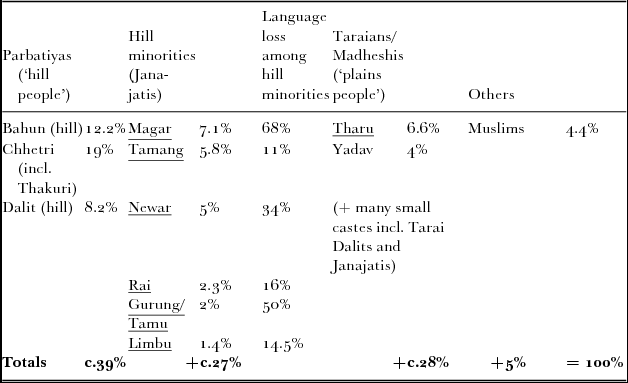
A key change that followed 1990 was that the decennial national censuses began to collect and publish information on the ‘caste or ethnic group’ of all citizens (in contrast to Indian censuses, which collect this information only for Scheduled Castes as a collective category, without counting individual castes, and for Scheduled Tribes). Before 1990 it was necessary to guess at the size of particular Nepali groups; the nearest proxy was mother tongue, but this was deceptive as so many members of Janajati groups no longer spoke their ancestral language and had adopted Nepali. After 1991 and in each subsequent decennial census the percentage make-up of the country was public knowledge, as shown in Table 1.
Population breakdown of Nepal (2011 census) (total: 26,494,504) with figures for hill minority language loss (based on 1991 census figures).

Notes: Dalits = former Untouchables; Janajatis (underlined) are mainly those who were formerly called tribes. Estimated figures for language loss are taken from Whelpton, John. 1997. ‘Political Identity in Nepal: State, Nation, and Community’. In Gellner et al., eds. Nationalism and Ethnicity in a Hindu Kingdom, p. 59. All figures and some labels are likely to be disputed. The total of all Janajatis, when Tarai Janajatis are also included, is 35.8% according to the 2011 census. The label ‘Madheshi’ is particularly disputed. Bahun and Chhetri Parbatiyas (including hill Thakuri, Dasnami, and, sometimes, Dalits) have recently (2012–13) come to be labelled ‘Khas-Arya’. For details, see Tamang, M.S., Chapgain, P.S. and Ghimire, P.K. 2014. Social Inclusion Atlas of Nepal: Ethnic and Caste Groups, Vol. 1. Kathmandu: Central Department of Sociology/Anthropology, Tribhuvan University, pp. 6–9.
The existence of precise figures enabled calculations to be made about the respective shares of positions in government, in academia, the law, the army, and so on, and to demonstrate systematic imbalances—the result, it was claimed, of structural inequality and discrimination that needed strong government action to be taken. The most pressing and obvious imbalance was the fact revealed by figures published in 2001: Bahuns and Chhetris, comprising 31.6 per cent of the population, occupied 77 per cent of the top positions in the judiciary, tertiary education, and the bureaucracy, and well over 50 per cent in most other fields, and were under-represented only in commerce and industry.Footnote 23 If one were to look at Bahuns alone (12.2 per cent of the population in 2011), the differences would be more striking still. By contrast, Janajatis (minus Newars, who, like Bahuns, have representation several times higher than their caste ratio), who were 22 per cent of the population by Neupane's calculation, had only 1.7 per cent of leading jobs in the judiciary, 1.2 per cent of leading civil service posts, and so on. These imbalances fuelled the Janajati movement and meant that that one of its main aims was to have reservations (affirmative action) imposed and other government resources to assist in overcoming ‘backwardness’.
The dominance of Bahuns in the political parties, the universities, the judiciary, and the media gave the Janajati movement the character of a strongly anti-Brahman movement, as in Tamil Nadu over a century earlier and in other parts of south India from the 1930s. The term bāhunbād or ‘Brahmanism’ entered public discourse in Nepal with the publication of Dor Bahadur Bista's book Fatalism and Development in 1991.Footnote 24 Bista, a Chhetri, was regarded as the most senior anthropologist of the country until his still-unexplained disappearance in 1995. Bista's thesis was that all backwardness in Nepal could be explained by certain fatalistic attitudes inculcated by Bahuns. The implication was that if Janajatis and, by implication, Chhetris and Dalits, and perhaps also individual Bahuns, could rid themselves of Bahun ideological hegemony, entrepreneurship and egalitarianism would flourish in Nepal. This message, dressed up in some simple ethnographic data about how Nepali interpersonal networks function, seemed to provide an instant explanation for all the frustrations faced by development professionals in Nepal. Thus, the book enjoyed an enormous success among the expatriate community. At the same time, it also provided sustenance to the Janajati movement and fed into a much wider and deeper critique launched by Janajati intellectuals, which involved a complete reassessment of Nepali history, often using the concept of internal colonialism.Footnote 25
The wider Janajati movement fed directly into campaigns by particular ethnic organizations (for example, by the Nepal Magar Sangh for Magars to return their language as ‘Magar’ and their religion as ‘Buddhism’). While many Janajati organizations had their roots in the 1980s or before, many others came into existence only after 1990 and often with the encouragement of NEFIN. The 1991 census counted 60 groups; in the 2001 census this had grown to 103 groups, and by 2011, to 125 groups. In 1996 the Ministry of Local Development commissioned a report which was prepared by a committee of six, chaired by development sociologist Professor Sant Bahadur Gurung and including three politicians, the under-secretary to the Ministry, and the well-known anthropologist and Janajati advocate Krishna Bhattachan. Although the report recommended the creation of a national foundation, the Ministry first established a National Committee for the Development of Nationalities. It drew up a list of 61 Janajati groups, but with amalgamations these quickly became 59. In February 2002, the government granted them official recognition as Janajatis, though 16 had not been included in the previous year's census.Footnote 26 In 2009 Professor Om Gurung, a senior anthropologist at Tribhuvan University, led a government-appointed committee to re-examine the official list of Janajatis; following field investigations, the committee submitted a report recommending that the list be expanded to 81 groups. However, perhaps because of its timing, the report proved to be controversial. It was shelved, and never published.
In February 2002 the National Foundation for the Development of Indigenous Nationalities (NFDIN) Act was passed. It established the official government body for Janajati issues that NEFIN activists had long been seeking. Sant Bahadur Gurung became its first head. NFDIN was tasked with supporting indigenous languages and cultures, preserving indigenous knowledge, and devising development programmes to ‘enhance the economic and social status of the poor and marginalized groups among the indigenous nationalities’.Footnote 27 The official definition of Janajati stressed their possession of a distinct language and culture, non-participation in the Hindu caste system, exclusion from the state and power, self-identification as Janajati, and inclusion on the government list.Footnote 28 Subsequent definitions also included the criterion of prior settlement.Footnote 29 While NFDIN is a government organization and therefore staffed largely by bureaucrats, and NEFIN is a campaigning activist organization recognized as the main national representative body for Janajatis, there is a considerable overlap in their aims and expertise, with concomitant exchange of personnel and ideas between the two organizations.Footnote 30
In 2003, the weak non-party government of Surya Bahadur Thapa, seeking legitimacy as well as feeling under pressure to counter the insurgent Maoists’ declaration of ethnically based autonomous states (described below), adopted the general principle that there should be reservations, as in India, for posts in the civil service. As amended in 2007, the Civil Service Act (1993) specifies that 45 per cent of posts are to be reserved for disadvantaged groups: 33 per cent for women, 27 per cent for indigenous nationalities, 22 per cent for Madheshis, 9 per cent for Dalits, 5 per cent for disabled people, and 4 per cent for the backward regions.Footnote 31 Similar policies are in place elsewhere in the public sector as well as for university places, mainly for highly competitive technical subjects. In addition, there is provision for financial support for members of ‘endangered’ Janajati groups, currently Rs 1,000 a month. Dalits and people from Karnali Zone receive Rs 500 per month Old-Age Allowance when they reach 60; all Nepalis receive it after turning 70.Footnote 32
Both NFDIN and NEFIN were successful in winning large contracts from the British Department for International Development in 2004, worth 45 million and 190 million rupees respectively. (Scandinavian countries, such as Norway and Denmark, put considerable sums into social inclusion projects as well, as did the EU.) These contracts were part of the Department's ‘Enabling State’ programme aimed at assisting in promoting good governance and social inclusion.Footnote 33 The fact that the Janajati-affiliated government office, NFDIN; the confederal body, NEFIN; and the latter's constituent ethnic organizations were able to attract such large-scale foreign funding proved controversial both within Janajati circles (Mongol National Organization graffiti attacking NEFIN could be seen for some time in 2009 in Pulchok, Patan) and beyond, once the Bahun-Chhetri movement got going.Footnote 34 Bahun-Chhetri groups accused donors of funding projects that, in the name of empowerment, in fact threatened communal harmony and Nepal's national integrity. In June 2012 they formed a task force, led by Dr Nanda Bahadur Singh on behalf of the ‘Joint Struggle Committee for National Integrity and Ethnic Goodwill’ (described further below), which submitted protest memorandums (gyāpan patra) to major donor offices and diplomatic missions in Kathmandu.
As background to these various mobilizations, it is important to note that the rise of the Janajati movement coincided with (a) the spread of the internet, (b) mass labour migration from Nepal to India, the Gulf, and Southeast Asia, and (c) the development of sizeable diaspora Nepali populations in Europe, North America, and Australia. All three processes are linked. Activists inside Nepal were and are able to draw considerable and increasing sustenance from international networks.Footnote 35 The internet has proved a valuable tool for mobilizing support and spreading activist messages. The anonymity permitted by the internet also means that there is a considerable amount of material online, some vitriolic, that has yet to be studied systematically as a source for ethnic interaction.
The role of the Maoist insurgency/civil war
The political background to the rise of ethnic politics was the Maoist ‘People's War’, otherwise known as the Maoist insurgency. Without this rupture, it is highly unlikely that the ethnic issue would have risen so fast and so high on the political agenda. In the ten years between 1996 when the war started and 2006 when a final ceasefire was declared, there were 13 different governments in Kathmandu. Even when the Congress Party won a majority, in the 1999 election, internal factional fights ensured that no government was secure or lasted longer than 14 months. After King Gyanendra dismissed Prime Minister Deuba in October 2002, there was a series of non-party governments, as the king endeavoured to turn the clock back to the officially partyless days of his father Mahendra. He succeeded only in driving the parties and the Maoists into each other's arms, ultimately ensuring the monarchy's demise. From 2001 when the Maoists’ People's Liberation Army attacked the Royal Nepal Army directly, it became increasingly clear that the Maoists rather than the government had a free run in most of the countryside, at least in the hills. In many districts the army controlled only the district headquarters.Footnote 36
The Maoists’ military success enabled them to divide the whole country into nine autonomous regions and, during the course of January and February 2004, they declared ‘people's governments’ in elaborate ceremonies which many thousands of people were forcibly made to attend. The inaugurations were filmed and put on the internet. In only one of the nine regions—that based in the centre of the country—were they unable to hold such a ceremony. Of the nine regions, six were named after the ethnic group of which they were the eponymous homelands: Magarat (Magars), Tharuwan (Tharus), Tamuwan (Gurungs), Tamsaling (Tamangs), Newa (Newars), and Kirant (Rais, Limbus, and others).Footnote 37 Less than two years later, on 25 November 2005, the Maoists signed a 12-point agreement with the Seven-Party Alliance. The Maoists agreed to respect parliamentary elections and to merge their People's Liberation Army with the national army. They then joined hands with the parties in a ‘People's Movement 2’, as it is called in Nepal, in April 2006. The king was forced to cede power, the Maoists came ‘above ground’, the 1999 parliament was reinstated, an interim constitution was agreed and promulgated, and a new parliament of nominated members was instituted to prepare for new elections. In this revolutionary situation, a great deal of radical change was achieved through Maoist (and Madheshi) pressure: the interim parliament voted—in advance of any constitution being agreed—that Nepal would be secular, that is, no longer ‘the world's only Hindu kingdom’ (18 May 2006), and that it would be a republic and federal (28 December 2007). The newly elected Constituent Assembly voted at its first meeting on 28 May 2008, with only four votes opposing, that Nepal should become a secular republic.Footnote 38
The Maoists dissolved their largely ethnically defined ‘autonomous regions’ and ‘people's governments’ on 18 January 2007. But the support that they had given to issues of Janajati rights was very influential in raising the hopes and expectations of Janajati activists. In June 2007 NEFIN held a successful two-day Nepal band or general strike, putting forward 20 demands, one of which was ratification of ILO 169, the main instrument by which internationally advocated indigenous rights are recognized as legal within nation-states. Subsequent negotiations laid the groundwork, so that, when the proposal was put to the new parliament on 22 August 2007, the Convention was ratified unopposed. Thus, Nepal became the first and so far only country in Asia to sign (from Oceania, Fiji has also signed). Subsequently, on 13 September 2007, Nepal also voted for the less binding but more radical UN Declaration on the Rights of Indigenous Peoples 2007.Footnote 39
Encouraged by steps such as these, Janajati activists had high hopes that the new constitution would institutionalize a strong form of ethnic federalism. They hoped, among other things, (1) that the different states or provinces would be named after the ethnic group whose ancestral home they were; (2) that 51 per cent of seats in the state assembly as well as the position of chief minister would be reserved for that group regardless of population size; (3) that the ‘home group’ would have prior rights (agrādhikar), for example, preferential access to natural resources within ‘their’ territory; (4) that everything except currency, foreign affairs, and defence would be devolved to the federal states; and (5) that states would have the power to tax non-locals at higher rates than locals.
These hopes of ethnic federalism were to be disappointed. By the time the constitutional committees started to do their work, ‘ethnic’ federalism was replaced with ‘identity-based’ federalism. Of the five demands or aspirations of ethnic activists, only the first, highly symbolic one, remained, and even that proved too controversial for the Bahun and Chhetri activists to accept. This distinction between the two forms of federalism was often ignored—many ethnic activists believed deliberately so—by the NC and UML.Footnote 40
Backlash: Bahuns and Chhetris seek to become indigenous
For many years Bahuns and Chhetris had paid little attention to ‘ethnic’ issues. That Janajatis should organize and campaign was perhaps natural. But the Bahuns and Chhetris did not see much connection to themselves. A maverick intellectual like Dor Bahadur Bista might imply that the Chhetris should return to their Khas identity, rather than seeing themselves as Hindu Kshatriyas. (‘Khas’ is the old name for Chhetris, and in some usages includes Bahuns also; the old name for the Nepali language is khas kurā, ‘speech of the Khas’.) Some Janajati activists, such as Keshab Man Shakya and Ang Kaji Sherpa, might encourage Chhetris to see themselves as Khas, to reject Hinduism, and to join an anti-Bahun alliance,Footnote 41 but few knew of this, and fewer still cared. This all changed as the rules for the first Constituent Assembly election became clear and the date for the first election was fixed. It was initially planned for June 2007, was put off once till November 2007, and finally took place in April 2008.
The new Constituent Assembly nearly tripled the number of representatives in parliament, from 205 to 601. The justification for this was the introduction of a mixed system of direct (first past the post) and proportional representation. First past the post seats were increased to 240 (to accommodate the increasing population of the towns and the Tarai), and there were to be 335 proportional representation seats, with a further 26 appointed by the Council of Ministers. There were complex rules for ensuring proportionality among the candidates. All parties standing in more than 30 per cent of national seatsFootnote 42 were obliged to select candidates from their proportional representation list in line with representation in the country: 50 per cent women, 13 per cent Dalits, 37.8 per cent Janajatis, 4 per cent from remote regions, 31.2 per cent Madheshis, and 30.2 per cent from ‘others’. (These percentages remained valid in 2013 as well.) Obviously, since these figures sum to well over 100 per cent, it is only possible to satisfy these conditions thanks to intersectional double or triple counting: thus, a female Dalit Madheshi can be listed under ‘women’, ‘Dalit’, and ‘Madheshi’.
The original intention in the interim constitution of 2007 was for the 30.2 per cent ‘others’ category to include minorities not covered by any of those explicitly mentioned (for example, Muslims). But it was quickly taken to constitute a quota or entitlement for the larger categories that were not Dalits, not Janajatis, and not Madheshis—in other words, for Bahuns, Chhetris, Thakuris, and Sannyasis. In 2013, Election Commission lists put ‘Khas Arya’ against the names of candidates from Bahun, Chhetri, and similar backgrounds.
Bahuns and Chhetris felt increasingly under attack and vulnerable. Reservations in the bureaucracy and army were seen as restricting their traditional avenues of employment; reservations in elections were limiting their political representation. On top of this, they became the target of aggressive political rhetoric.Footnote 43 The town of Pokhara in west Nepal, where there are large numbers of Bahuns and Chhetris, as well as Gurungs, became a focal point. According to local people, in 2006 Maoist leader Dev Gurung made a speech in Pokhara in which he declared that the country would not progress unless the ‘pointy-nosed’ people (Bahuns and Chhetris) had their noses cut off (a highly dishonouring traditional punishment) and were banished from the country. Janajati processions began to chant slogans such as ‘Send Bahuns to Kashi [Benaras, India] and Chhetris to phāsi [death by hanging]’ (alternative version: ‘Go to Kashi or face hanging’). Alarmed by such threats locally and nationwide, Bahuns and Chhetris began to organize.
Meanwhile, in the Tarai in January and February 2007, there was a massive uprising against the Maoists, against Pahadis (all hill people—Bahun-Chhetris, Janajatis, and hill Dalits—considered, here, as one), and against the Nepalese state, sparked by the killing of a young Madheshi activist by a Maoist. King Gyanendra had been overthrown and the interim constitution was about to be declared, which would set the framework for new elections and a radical new constitution, with federalism on the cards. In this context, the Madheshis finally rose up against what they saw as decades, indeed centuries, of oppression and humiliation by a Pahadi-dominated state. They took to the streets, blockaded access to the capital, and, following some shocking violence, forced the acceptance of a federal structure that would recognize Madheshi interests. Madheshi armed groups began to target hill people as a category, who consequently felt increasingly vulnerable.Footnote 44 In response a new regional movement, called the Chure-Bhawar Rastriya Ekta Samaj, developed in 2007, led by Keshav Prasad Mainali, who left the Nepali Congress to form this new party. It represented the interests of the Pahadi settlers, including Tamangs, in the central Tarai (on the southern slopes of the Chure-Bhawar hills), who were deeply threatened by the rise of the Madheshis.Footnote 45
In eastern Nepal (where there is a history of inter-ethnic tension and occasional violence)Footnote 46 anti-Bahun-Chhetri activities included even more aggressive slogans such as ‘We will cut down Bahuns and Chhetris, lick their blood, and stick them on a wall.’Footnote 47 It is claimed that many Bahun-Chhetris were induced to leave their villages by assaults and harassment both during and after the Maoist insurgency.Footnote 48 The fear of local persecution, combined with a crisis of identity at the national level as undifferentiated ‘Others’ without a designated province in the proposed federal set-up, forced Bahuns and Chhetris to think about their collective identity and to mobilize. In this context several Bahun and Chhetri organizations emerged spontaneously in different regions.
In Pokhara, the Brahman Samaj Kaski, led by a local university teacher Narayan Adhikari, was formed on 5 June 2009. Adhikari (no relation of the author) related:
During the course of the Maoists’ declaration of their Tamuwan Rajya [i.e. Gurung autonomous region] in Pokhara, Tamu [Gurung] leaders chanted slogans like ‘Brahmans to Kashi, Chhetris to phāsi [the gallows]’, and one leader made a speech saying, ‘This is our land, you are immigrants/beggars (āgantuk bhatuwā) who ruled and oppressed us. We will not rest until we have flushed you out.’ They did this even with government Ministers present. Many incidents took place in Pokhara that made Bahuns feel insecure and persecuted for being who they are. For example, at Gandaki Hospital a girl from the Tamu [Gurung] community had died [allegedly due to the doctor's negligence]. Tamu organizations organized a violent demonstration and a difficult situation was created which resulted in negotiations and one million rupees compensation being paid to the victim. Then a similar kind of death occurred; this time the patient was a girl from a poor Bahun family. However, there was nobody to support her case and seek justice. The family was helpless. This incident like many others was a stark reminder that an organization is required to safeguard the interest of people who otherwise would not receive fair treatment in an increasingly divided society.Footnote 49
In October 2009, 12 Bahun organizations from all over Nepal met in Devghat and decided to merge to form one national organization, the Brahman Samaj Nepal (BSN). It spread rapidly, forming branches in 68 of Nepal's 75 districts, omitting only the Himalayan region where few Bahuns live. The BSN claims over 200,000 members throughout Nepal, including strong representation in the east of the country. Between October 2009 and May 2012 the BSN organized many programmes, ranging from peaceful demonstrations with religious hymn-singing to more politically aggressive ‘torch’ rallies (masal julus) and general strikes (band). A torch and motorbike rally held in Pokhara on 5 February 2012 is claimed to be the largest demonstration that city has ever seen.
The main demands of the BSN were and are: (1) an end to discrimination on the basis of caste/ethnicity; (2) the removal of Bahuns from the non-indigenous ‘Others’ group and granting them recognition as mulbāsi (‘original dwellers’ or indigenous people); (3) the promotion of a reservation system based on class not caste/ethnicity; and (4) not naming federal states (provinces) after particular castes/ethnic groups. And indeed these were the main slogans chanted at BSN demonstrations: ‘Himal, Pahad, Tarai—no one is “other”’ (himal, pahād, tarai—kohi chhaina parai); ‘Register Bahuns as adivasi’ [Bahunlai ādivāsimā dartā gara]; ‘Cancel caste-based reservations’ (jātiya ārakshan khārej gara); and ‘We don't want ethnic provinces’ (jātiya rājya cāhindaina).
Several grassroots Chhetri groups merged to form larger organizations. Although relatively more Chhetris are organized and mobilized in Chhetri organizations than Bahuns in Bahun organizations, unlike the Bahuns, the Chhetris never managed to unite behind a single organization. The largest, claiming 500,000 members, and the most widely mobilized, is the Kshatree Samaj Nepal (KSN) based in Pokhara and originally led by Professor Dil Bahadur Kshetry. In response to the changing political scenario, in Kathmandu various kin-based (gotriya) Chhetri organizations federated in order to form the Khas Chhetri National Federation. However, this went through multiple splits. More effective was the Khas Kshetri Unity Society-Indigenous Nationalities (KKUS-IN). Established in 2006 and led by former UML leader Yuvaraj Karki, the KKUS-INFootnote 50 is based in Biratnagar in eastern Nepal, though it claims to have branches in 48 districts. The KKUS-IN differs fundamentally from other Chhetri groups in that it argues that Chhetris are Adivasi Janajatis; hence it revives the title ‘Khas’ in its name. KKUS-IN is in favour of identity-based federalism and seeks to have a separate Khasan State, which is rejected by KSN who argue that Chhetris are indigenous (adivasi or mulvasi) but not Janajati.Footnote 51 The latter argues for national integrity, and rejects any ethnicity-based division of Nepal. The views of KKUS-IN leaders—that Brahmanical ideology ruined the country during the 240 years of Shah-dynasty rule—were closer to those of NEFIN than to other Bahun-Chhetri groups. In fact, a large faction of the KKUS-IN, led by Durga Chapagain, which did not agree with the pursuit of Janajati status and ethnic federalism, broke away and formed a rival KKUS in 2009.
Efforts were made to unify the various Chhetri groups but without much success. An alliance named the Khas Chhetri National Front was formed in 2009 which allocated regions to different organizations, but this did not operate well. The KSN continued to grow and became dominant in terms of size and ability to pressure the government. On the 22 May 2010, KSN's agitation, in particular a relay hunger strike, culminated in negotiations with the government which reached agreement on two points: (1) there should be further study regarding the eligibility of Chhetris to be an Adivasi (but not Janajati) group; and (2) the government's reservation policy should be based on class, not ethnicity. A task force was formed, led by the KSN chairman. On 11 February 2012, at the head of a cultural procession, he submitted a 130-page report to the minister of local development Top Bahadur Rayamajhi, documenting the indigenous character of the Chhetris.
The evolution of Chhetri ethnic (caste) organizations in Nepal.

In 2012 it became clear that alliances were needed as time was running out and a new and federal constitution was—so everyone assumed—likely to be declared. Despite some differences over the question of reservations, the KSN and BSN, along with 11 smaller groups, eventually managed to forge an alliance based on two main points: (1) ethnicity-based federalism is not acceptable, and (2) the Khas-Arya community must be removed from the ‘Other’ castes category and granted full rights as indigenous peoples. The alliance of 13 groups, named the Joint Struggle Committee for National Integrity and Ethnic Goodwill (JSC-NIEG) (rastriya akhandata ra jatiya sadbhavko lagi samyukta sangharsh samiti), was formed under the leadership of KSN chairman Dil Bahadur Kshetry. The members of the alliance were: KSN, BSN, KKUS, the Thakuri Society Federation Nepal, the Nepal Dashnami Society, the Bived Mukti Progressive Society, the Dalit Jagaran Sewa Sangh, the Nepal Rajput Service Society, the Bhumihar Society, and the Nath Yogi Sampradaya. Some small Dalit groups also participated in JSC-NIEG on the grounds that Dalits too are members of the Khas-Arya family and were made stateless in the proposed federal models despite being ‘indigenous peoples’ of Nepal. However, KKUS-IN, in line with its anti-Brahman stance, did not join the alliance.
Initially the JSC-NIEG organized regional programmes and a three-day sit-in (dharna) in front of the Constituent Assembly in Kathmandu. Then, on the 10 and 11 May 2012, it organized a Kathmandu general strike and launched other regional struggle programmes. The government invited the group for dialogue, but, disappointed at the failure to implement previous agreements with KSN, the JSC-NIEG insisted on negotiating directly with Prime Minister Baburam Bhattarai, in the presence of the leaders of all major political parties. Not receiving immediate agreement, they continued the strike on 12 May, bringing business to a complete halt. To force the government to accept their conditions, the JSC-NIEG called an indefinite nationwide strike, at which point they were called in for negotiations with the government. Eventually on 17 May the government and the JSC-NIEG team signed a two-point agreement: (1) federal provinces would not be named after ethnic groups or language; if agreement could not be reached in the Constituent Assembly, naming should be decided later by provincial assemblies themselves and if that failed, it should be decided through a local referendum; (2) Bahuns, Chhetris, Thakuris, and Sanyasis should not fall into the ‘Other’ category, but they and hill Dalits should all be recognized as ‘Khas-Arya’ and as indigenous (adivasi).
As the deadline was approaching and proposals to create ethnic provinces were progressing through Constituent Assembly committees and commissions, people (mainly Bahun-Chhetris) from all over the country began to organize and protest in favour of ‘undivided regional provinces’. These included: Undivided Far West, Undivided Mid West, Lumbini Ekata Samaj, Greater Chitwan Front, Birat State, and Undivided Morang. Of these different movements, the Undivided Far West became the most prominent and influential. The indefinite shutdown organized by the struggle committee for an undivided Far West particularly targeted the Maoist proposal to include Kailali and Kanchanpur districts in the proposed Tharuhat province; there was a counter-strike organized by Tharuhat groups. Combined together the strikes lasted for 32 days; this was the longest of all the various strikes affecting the country in this period. Eventually, on 16 May, the government and the Undivided Far West group signed a four-point agreement, including an understanding to keep the nine districts of the Far West undivided.
NEFIN flatly rejected these agreements and on 20 May called for an indefinite nationwide shutdown which resulted in sporadic violence that targeted the press. On 22 May, five days after signing the agreement with JSC-NIEG, the government and NEFIN reached a nine-point agreement, one of which was the disallowing of the recognition of Parbatiya groups as indigenous which had been agreed five days earlier.Footnote 52 The KKUS-IN also protested against the placing together of all ‘Khas-Arya’ groups into one category, and called for the recognition of only the Khas-Chhetris as indigenous. On 26 May the JSC-NIEG restarted their street protests, organizing mass meetings in Kathmandu's open theatre and elsewhere. Many Bahun-Chhetris, particularly educated Bahun-Chhetris from the Kathmandu Valley who had never previously participated in such protests, joined these programmes. On 27 May, the final day by which the constitution was supposed to be agreed, supporters of both NEFIN and JSC-NIEG went to encircle the Constituent Assembly.Footnote 53 When JSC-NIEG protesters reached the site, all sides of the Constituent Assembly building had already been occupied by NEFIN supporters. The number of people on the JSC-NIEG side both exceeded the expectations of the organizers and outnumbered NEFIN protesters. Through the police, they sent a message to NEFIN leaders to vacate one part of the area next to the Constituent Assembly building, which was done. Large numbers of police were mobilized to prevent any possible clashes. The situation became tense towards evening and the security forces had to fire rubber bullets to pacify the crowd.
After three extensions of the Constituent Assembly term, on 25 November 2011 the Supreme Court agreed to a final extension and imposed a non-extendable deadline of 27 May 2012 for the completion of the new constitution. On 28 March 2012 Baburam Bhattarai's government sought a reconsideration from the Supreme Court, but it refused. On 24 May the Court issued an interim order to prevent the government from extending the Constituent Assembly. The political parties continued to hold marathon negotiation sessions but failed to reach a minimum deal. The Constituent Assembly sat all day but the Speaker failed to appear and no vote could be taken. At midnight on 27 May Bhattarai addressed the nation on television and declared the dissolution of the house. The government remained in place, but, as a caretaker government, it lacked legitimacy. Bhattarai immediately announced new elections for November 2012, but it was to be another year before they could take place.
Conclusion: ‘Branded as “others” and denied identity’
Reflecting on the results of the 2013 election in the Kathmandu Post, the well-known writer Prakash A. Raj (a Kathmandu-based Bahun from an elite family) wrote:
It must be recalled that it was [Baburam] Bhattarai who had advocated ‘priority rights’ for the ethnic groups after which the states were to be named. In fact, in none of the proposed single identity states, such as Limbuwan, Kirat, Tamsaling, Tamuwan, Magarat, Newa and Tharuwan, does the targeted group constitute more than half of the population. Unlike Prachanda, who is a demagogue, Bhattarai is a scholar with a doctorate. He must be aware of the ethnic distribution of Nepal's population. Many Maoist leaders, like leaders of mainstream parties such as the Nepali Congress and CPN-UML, belong to the Khas-Arya community, which make up a third of Nepal's population. They were branded as ‘others’ and denied identity.
As a result of the movement just before the dissolution of the first Constituent Assembly, Bhattarai's government was forced to grant the Khas-Arya the status of indigenous people. The Maoists had not granted them identity-based states even though they make up an overwhelming majority in the country's Mid and Far West. These regions are among the most backward in the country, unlike the eastern and western hills and the Kathmandu Valley. They were given geography-based states. Unlike in the first Constituent Assembly elections, the Maoists lost badly in this part of the country.Footnote 54
Raj articulates here what was asserted time and again by many ordinary Bahuns and Chhetris: ‘[we] were branded as “others” and denied identity’. It will not do for Prashant Jha to dismiss this movement as emanating from ‘the conservative elements of Nepali society’.Footnote 55 Feelings of marginalization brought thousands of Bahuns and Chhetris onto the streets in what Jha has to admit was ‘a fairly impressive demonstration’Footnote 56 and reinforced the resolve of the main political parties to stand firm against what they branded as ‘ethnic federalism’.
Raj also draws attention to the irony of the fact that Baburam Bhattarai, one of the most educated Nepali politicians, with a PhD from Jawarharlal Nehru University, himself a Bahun, had been the brains behind the Maoists’ declaration of autonomous ethnic regions. During the civil war he had been the head of the Maoists’ United Revolutionary People's Council—effectively their underground parallel government—from 2001 to 2005. The first post-conflict government, of which the Maoists were a part, had signed Nepal up to ILO 169. And yet, in 2012, as prime minister of Nepal, at the head of a Maoist-led government, Bhattarai conceded indigenous status to Bahuns and Chhetris, effectively undermining the Janajatis’ claims for special treatment (though, as we have seen, five days later he reversed this decision under pressure from NEFIN).
In 1993, when indigeneity discourses first arrived in Nepal, anthropologist Rajendra Pradhan noted that ‘indigenous peoples do not exist in Nepal; or if they do, the majority of the Nepalis are indigenous, including many of the Bahuns and Chhetris’.Footnote 57 In 1995 Krishna Bhattachan spoke of incipient Bahun and Chhetri ethnicity.Footnote 58 It took a couple of decades for political discourses to catch up with the anthropologists’ observations. In the diaspora, it is noteworthy that Bahuns have felt no need to form ethnic organizations. They are the only sizeable group to lack such organizations in the United Kingdom, in the United States, and wherever there are considerable numbers of Nepali migrants. Evidently, pan-Nepali, district-based, professional, political, Hindu, and other religious organizations provide enough of an outlet for the associational needs of diaspora Bahuns. Yet in Nepal, it became, as we have described, a pressing political necessity to organize on a caste basis.
The political parties set up by members of these Bahun and Chhetri organizations—the Akhanda Nepal Party, Rashtriya Swabhiman Party, Khas Samabesi Rastriya Party, Akhanda Sudurpaschim Party—did not do well in the 2013 elections: the Akhanda Nepal Party got one proportional representation member of parliament, the others none. However, in much of the country, the success of NC and UML, and the defeat of the Maoists, can be put down to the large swing vote of the Bahun-Chhetris to those two parties. In the first Constituent Assembly the Maoists, along with explicitly Janajati-based parties, used the language of ‘ethnic federalism’. The Maoist manifesto for the 2013 election proposed ‘identity-based federalism’ and stated that ‘the death of the first CA [Constituent Assembly] was due to the inability to dispel the disturbances/roadblocks (gatirodh) related to identity-based federalism’.Footnote 59 The UML and NC were able to brand this position ‘single-ethnicity-federalism’ (ekala-jātiya-sanghiyatā) and to claim that they stood for ‘multiple-identity-based federalism’ (bahu-pahicānmā ādhārit sanghiyatā), communal harmony, and the unity of all Nepalis.Footnote 60
The five hierarchically ordered macro categories—sacred-thread-wearer, alcohol-drinker (enslavable and non-enslavable), impure, and untouchable—into which dozens of Nepali castes and ethnic groups were classified until the 1950s—gave way, under the Panchayat regime, to a period when, officially, all were equal citizens and ascribed identities were supposedly a purely private matter. Persisting inequalities made this model untenable. What has emerged from dynamic political and cultural processes is a system of (partially overlapping) macro categories that, interestingly, also divides the country into five, though in this case there is no formal hierarchy: Khas-Arya, Janajati, Madheshi, Dalit, and Other (for example, Muslims, though at times the majority of Muslims also find themselves included under ‘Madheshi’). In such a context, it is not surprising that the ‘Khas-Arya’ group would organize and claim coveted indigenous status. The careful equivalence of ‘indigenous nationality’ (adivasi janajati) constructed by Nepal's Janajati activists in 1994 following the UN's declaration of a Year of Indigenous People had been forcibly broken apart.
If one distinguishes three levels of historical explanation—(1) the everyday or immediate, (2) the operation of ‘mid-level’ factors operating over years or decades, and (3) deep structural forces of the longue durée—then the explanation offered here for the failure of Nepal's first Constituent Assembly self-evidently belongs to the middle level. Tom Bell offers a convenient list of six everyday reasons and conspiracy theories why the Constituent Assembly collapsed, the most plausible of which is the disappearance of the Speaker so that nothing could be put to a vote.Footnote 61 The middle-level explanation-cum-narrative offered by this article has focused rather on a process of political ethnicity-building over the last 20 years, which was expressed explicitly through the organizations described and less overtly, no doubt, through many other channels as well. The pressure of Bahun-Chhetri ethnicity led the NC and UML parties to resist any compromise in the final days of the first Constituent Assembly.Footnote 62
When, in 2007, Nepal became the first Asian nation to ratify ILO 169, most MPs were largely unaware of what they were voting for. However, once the implications were realized, almost every group sought recognition as indigenous.Footnote 63 This flexibility in the definition of indigeneity makes it difficult to apply in the South Asian case, as recognized by the International Labour Organization director for India:
Article 1 of the Convention defines indigenous or tribal peoples in a very flexible manner. This is particularly relevant for countries having indigenous groups which originally migrated from other areas. This holds true for South Asian countries such as Nepal, Bangladesh and India, where in most instances it is much more difficult to make a distinction between indigenous and non-indigenous than in, let's say, Latin America where most IPs have been residing on their lands since time immemorial. An important element in the definition is self-identification. This refers to the collective right of any IP or community to decide who is and who is not a member of that group.Footnote 64
Fierce debate will continue over the coming years. Are all Nepalis indigenous or only some? Are some Nepalis more indigenous than others? Perhaps at some point hunter-gatherer groups like the Raute, with whom we began this article, will start to advance the claim that they have the foremost claim to be considered indigenous and therefore to have preferential access to what remains of the forests of Nepal. If that were to happen, it would be yet another way in which Nepal would be following developments that have occurred in India.Footnote 65