Introduction
In March 1998, the political leadership of the Arab-Palestinian citizens of IsraelFootnote 1 was looking for ways to commemorate al-Nakba (“The Disaster,” in Arabic), referring to the war of 1948, during which about 700,000 Palestinians were uprooted and hundreds of Palestinian villages were destroyed. This leadership, organized in the Follow-Up Committee (FUC), nominated a Nakba and Steadfastness Committee (NSC) chaired by the author Muhamad Ali Taha.Footnote 2 Among the Committee's several initiatives, one gained front-page headlines in the Arabic media: a call for Arab municipalities to establish memorial monuments for the Palestinian martyrs (shuhada) of 1948.Footnote 3
The decision to commemorate the Nakba provoked both explicit and implicit threats from the Israeli government. The Minister for Arab Affairs in Netanyahu's government, Moshe Katzav (elected as Israel's president in 2000), described the FUC's decision as one that was “dangerous and might damage Jewish-Arab co-existence.”Footnote 4 Minister of Interior Eli Yishai threatened to cut governmental funding of any local authorities that financed the Nakba commemoration.Footnote 5 A televised debate about the commemoration between Taha and Likud Member of Parliament Gideon Ezra (a former Chief Deputy of the General Security Service) deteriorated into name-calling and mutual shoving.Footnote 6
Taha's committee had no independent resources and no authority to implement its plans, and was wholly dependent on the cooperation of Arab local municipalities.Footnote 7 Most of the Arab municipalities that were expected to carry out the initiative avoided prioritizing the monument project or investing money from their scarce recourses. There was no public pressure on them to implement the committee's decisions, nor was there any public enthusiasm to contribute money, materials, or labor.
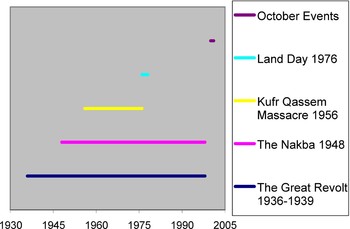
Taha expected that at least fifteen local authorities would respond to his request, in particular villages and towns where battles or massacres had taken place,Footnote 8 but by the end of September 2000, on the eve of the second Palestinian uprising that reshuffled the political cards of Arab-Jewish relations in Israel, only three municipalities had built monuments. Today only one of those three monuments, that in Kafr Kana, still stands and has gained public recognition as a commemorative site. The other two, in Shefa'amer and ‘Ailabun, failed to become pilgrimage sites or gathering points for political rallies. Indeed, local residents soon destroyed them, through a process that reflected the complicated relations between national, local, and communal allegiances in these towns. Only after the events of October 2000, during which police killed twelve Palestinian citizens, did a wave of memorial-building sweep the Palestinian towns and villages of Israel. These monuments commemorate Palestinian martyrs from different periods since 1936.
The story of the establishment, non-establishment, and destruction of these memorial monuments epitomizes dilemmas and contradictions in the production of collective memory by the Palestinian minority. “Memory,” wrote Jeffrey Olick, “occurs in public and in private, at the tops of societies and at the bottoms, as reminiscence and as commemoration, as personal testimonial and as national narrative, and each of these forms is important” (Reference Olick1999: 346). The case of Palestinian commemoration inside Israel not only illustrates the importance and relevance of these various forms and spheres, but also illuminates tensions and contradictions among them. The monuments in question have been located at the junctures of several societal tensions: One is that between the Palestinian minority and the Israeli nation-state. Another is tension between intellectual elites with a national consciousness, who aspire to make painful memories public, and larger circles of a suspicious and cautious public who prefer to keep them private. A third is between different religions and ethnic groups within Palestinian society. These tensions have combined to make the process of commemoration cautious, circuitous, and vacillating, and they have shaped how national, local, and communal allegiances relate to one another.
National, Local, and Communal Identities
The Arab-Palestinian minority in Israel is a colonized “trapped minority”: a native minority in an ethnic nation-state, whose members are formal citizens of the state but alienated from political power, while at the same time they are part of a larger ethno-national community located mostly beyond the state borders (Rabinowitz Reference Rabinowitz2001). As such, they suffer not only from diverse forms of state discrimination but also from their marginal and fragile status in both the Israeli and Palestinian spheres (Al-Haj Reference Al-Haj, Cohen and Wolfsfeld1993; Rouhana and Ghanem Reference Rouhana and Ghanem1998). We can only understand public practice of this community within the context of their need to avoid further undermining their status, in both spheres, and to navigate between different expectations of non-Israeli Palestinians and Jewish Israelis.
Previous studies have illustrated an important strategy adopted by many Arab citizens to deal with these pressures: they de-politicize their daily interactions by highlighting identities seen in Israel as apolitical. By doing so, they can avoid the potential threats attached to either an Israeli identity (which Palestinian nationalists consider subversive) or a Palestinian identity (seen by Jewish Israelis as an ‘enemy within’). These non-political belongings can be either communal-religious identities (Sa'ar Reference Sa'ar1998), communal-cultural identities (Ghanem Reference Ghanem and Rekhess1998), local identities (Sorek Reference Sorek2005), or even loyalty to a soccer team (Sorek Reference Sorek2007). The emphasis on localism and communalism, therefore, has specific instrumental aspects.
Since building monuments relates to struggles over public space, the development of local identities based on spatial distinctions is especially relevant for our discussion. Although local communities played an overriding role in defining Palestinian identity even before 1948 (Tamari Reference Tamari, Abdel-Malek and Jacobson1999: 3–4), the new political circumstances in which the Palestinian minority in Israel was trapped has strengthened the status of local identity. Under the watchful eyes of military governors, Arabs in Israel found it difficult to travel from one town to another, or to organize countrywide supra-local frameworks (Lustick Reference Lustick1980).Footnote 9 Even after military rule was removed in 1966, Arab public leaders had limited access to the state's political center, and local politics became the main sphere where they could exert power (Rosenfeld and Al-Haj Reference Rosenfeld and Al-Haj1990). The most important factor, however, is that, unlike the Jewish majority that controls the common space and landscape, Palestinians have no Arab common space outside of the Arab settlements.
Furthermore, Palestinians in Israel suffer from a lack of urban centers that are collectively recognized as symbolic or unifying cultural centers. Jerusalem as a religious-cultural center is outside their control, while the modern pre-1948 Palestinian cultural centers, Haifa and Jaffa, were destroyed in the war and are now under Israeli control and Jewish hegemony. In cultural, political, and economic terms, no Palestinian urban national center exists. Even Nazareth, the largest Arab city in Israel, has no university, national library, national book publishers, or other central institutions (Bishara Reference Bishara1998: 7–10). Therefore, almost every cultural production, and certainly those that shape space, necessarily acquires a clear local character. As I will show in what follows, sometimes this local character coincides with national identification but in other cases localism overshadows any national connotation.
Regarding martyrological commemoration, I argue that local identity is strategically mobilized in two different ways. In the Palestinian nationalist sphere, local martyrs enable residents of a particular village or town to present themselves as possessing a higher rank in the imagined hierarchy of Palestinian national importance. Therefore, against the collapse of the urban centers and many Palestinian villages in 1948, local narratives of war developed among the surviving villages that gave meaning to their survival. People in Kafr Qasim, Sakhnin, and other places formulated local myths of heroism that ascribed their non-expulsion to their unique steadfastness (Robinson Reference Robinson2003; Sorek Reference Sorek2005). This pattern is expressed in commemorative practices by the interweaving of local martyrology with the national narrative and the presentation of local martyrs' contributions to national success. For example, in certain contexts both Sakhnin and Kafr Qasim are named Balad al-Shuhada, “The Martyrs' Village,” referring, respectively, to Land Day (see below) and the 1956 massacre in Kafr Qasim.Footnote 10 Indeed, some survey analyses found positive correlation between local identification and Palestinian national identity among the Arab citizens of Israel (Amara and Schnell Reference Amara and Schnell2004; Sorek Reference Sorek2005).
Existing studies of local identity and commemoration emphasize only the co-production and mutual enhancement of local and national identities in commemorative practice. Here I will illustrate that local martyrology is sometimes strategically mobilized to distance oneself from Palestinian national identity, since many perceive it as potentially detrimental to their status as Israeli citizens. Hence, interactions with Jews tend to be accompanied by an emphasis on institutions with a clear local identity. Local Arab soccer teams and the local patriotic rites which have evolved around them are tremendously popular, in part for their potential to provide a warlike masculine and competitive pride that does not contradict “Israeliness” (Sorek Reference Sorek2003). In the same way, commemorating the dead in local rather than national contexts can reduce the potential for conflict with the majority.
The frequent emphasis of religious identities has a similar strategic purpose. The Palestinians in Israel belong to different religious communities—about 80 percent are Sunni Muslim, 10 percent are Druze,Footnote 11 and 10 percent are Christians. Although these distinctions and the conflicts related to them are older than the State of Israel, they have been sustained and nurtured by governmental authorities striving to prevent the emergence of a unified national consciousness (Lustick Reference Lustick1980). Druze men, for example, serve in the Israeli army, and their community has been an ally of the Jews since 1948. Only a small minority among the Druze in Israel define themselves as Palestinians (Amara and Schnell Reference Amara and Schnell2004). Typifying this relationship, the first memorial ever built in Israel to commemorate Arab warriors was established in 1974 in the Druze cemetery in Hurfeish for fallen Druze Israel Defense Forces (IDF) soldiers. Obviously, no one considers this a Palestinian national memorial.
The Christian Palestinians, once at the forefront of the Palestinian national struggle, have had to face several changes: an accelerated Islamization of this struggle in the West Bank and the Gaza Strip (Litvak Reference Litvak1998); the emergence and salience of the Islamic Movement inside Israel since the 1970s, which undermined the Christians' self-confidence (Tsimhoni Reference Tsimhoni and Rekhess1998); and, more specifically, the growing centrality of the Islamic Movement in shaping Palestinian national commemoration in Israel (Ben-Ze'ev and Aburaiya Reference Ben-Ze'ev and Aburaiya2004).Footnote 12 Accordingly, Amara and Schnell (Reference Amara and Schnell2004) found that Christian Arabs in Israel are much more likely than Muslims to see the term “Palestinian” as irrelevant to their identity repertoire (28 and 11 percent, respectively). The marginalization of Christians in the Palestinian sphere meets their frequent need to de-emphasize their Palestinian identity as citizens of Israel, and thus Christian identity is deployed to de-politicize social encounters with Jews (Sa'ar Reference Sa'ar1998).
Another significant internal division among Palestinians is that between Bedouin (about one fifth of the Muslims in Israel) and sedentary Arabs, which in some contexts is considered an ethnic distinction.Footnote 13 Unlike other Muslim Arabs, Bedouin men are allowed to volunteer for military service, and they have come to be viewed within Jewish Israeli society as a separate, non-Arab minority group loyal to the state (Abu-Saad, Yonah, and Kaplan Reference Abu-Saad, Yonah and Kaplan2000) or at least as “good Arabs.” Furthermore, past surveys have found Bedouins to be more ready than other Arabs to accept their ‘separate but equal’ status in the Jewish state (Smooha Reference Smooha1984). There is, however, significant difference between those Bedouins who live in the south (about two-thirds) and those who live in the north. It seems that the ‘de-Arabization project’ among the southern Bedouins failed (Abu-Saad, Yonah, and Kaplan Reference Abu-Saad, Yonah and Kaplan2000), while the Bedouins in the north have shown a greater readiness to accept the Jewish-Zionist character of the state and a weaker Palestinian identification (Ghanem Reference Ghanem and Rekhess1998). Accordingly, the northern Bedouins provide most of the IDF's Bedouin conscripts.
The field of memorial monuments has become a significant site for the intersections and negotiations of national, civic, local, and communal identities. In order to understand the political-cultural context of the monument controversies in 1998, I first explain the scarcity of memorial monuments up to that point. I then turn to the failed attempts that year to establish monuments for the Palestinian victims of the 1948 war, and the role that local and communal loyalties played in them. I then examine the wave of monuments that has swept Palestinian towns and villages in Israel since the events of October 2000.
Where is the Palestinian Memorial Monument?
Although thousands of Palestinians were killed during the 1948 war (al-'Arif Reference al-'Arif1956: 1053), no monumental representation of their memory appeared in the public space until 1983. Only in 1998 was the first memorial monument built to embed the victims of the 1948 war in the Palestinian national narrative. The absence of these dead from the collective representation of Palestinians in Israel seems paradoxical since social groups tend to valorize their victims in external struggles and translate the victimization experience into a mobilizing force, even if they are related to defeats or catastrophes (Zertal Reference Zertal1994; Zerubavel Reference Zerubavel1991). But we are not dealing here with a case of collective amnesia. The memories of the Nakba were produced in private stories, private ritualistic visits to destroyed villages, and to some extent, albeit in a very cautious ways, in the writings of authors and poets such as Emile Habibi, Tawfik Zayyad, and Hana Ibrahim. What is absent is a specific emphasis on the victims and their spatial political commemoration in the public sphere.
The legitimacy of asking why there was no Palestinian memorial monument does not stem from an assumption that commemoration is a ‘natural’ process, or from an expectation that Palestinians would ‘naturally’ adopt any European cultural form. Rather, it comes from the fact that since the mid-1930s there have always been forces within Palestinian society calling for establishment of such monuments. As early as 1936, during the Great Arab Revolt (1936–1939), the secular nationalist newspaper Filastin wrote: “In the same way the West invented a symbol of heroism and courage after the Great War, a symbol for the unknown soldier, it is advisable that the nation that is so brave in its Jihad and its heavy sacrifices would invent an eternal symbol for the unknown martyr [shahid] who fell in defense of his nation, his soul and his property.”Footnote 14 It is beyond this article's scope to outline the evolution of Palestinian martyrological practices before 1948. It is important to mention, however, that although a rich Palestinian national martyrology emerged beginning in the early 1930s,Footnote 15 at that time it did not include the establishment of memorial monuments, as desired by Filastin’s editor. Filastin identified secular martyrological monuments for national warriors with “the West.” Could that explain their long absence from the Palestinian landscape?
Although the gravestone of ‘Izz al-Din al-QassamFootnote 16 did become a site of national pilgrimage (Swedenburg Reference Swedenburg1995: 7), and many national martyrs did emerge during the 1936–1939 revolt, the practice of establishing separate memorial monuments, detached from the dead body, was not adopted among Arabs in Palestine. To a certain extent, the visits to al-Qassam's grave reverberated with local traditions of worshipping the tombs of saints in popular religion. However, those social forces preaching the adoption of national memorial monuments failed to inculcate this practice among Palestinians.
The cultural argument, however, supplies only a marginal explanation for the absence of such monuments. Even if we consider the martyr monument as ‘foreign,’ the ‘indigenization’ of foreign cultural forms was prevalent. During the first half of the twentieth century, Palestinians adopted various ideologies and institutions of European origin, from the nation-state to communism, as well as diverse cultural forms from clothing to leisure habits. Furthermore, the intensive commemoration of secular national martyrs in the short-lived Syrian kingdom of Faysal in 1919–1920 (Gelvin Reference Gelvin1998: 175–81) suggests similar commemorative practices were available in the cultural “tool kit” (Swidler Reference Swidler1986) of the region, and could have been used under conditions of political independence.
Another possible explanation for the absence of monuments is the potential meanings of commemorating a tragedy when there is still hope of reversing its consequences. During the first two decades after the Nakba, Palestinians continued to consider their tragedy as a reparable distortion of history. The poet Hana Abu Hana describes the Palestinians after the Nakba as “a people in a corridor.” Ghanem (Reference Ghanem2004) interpreted this image as an entire generational experience that she named “permanent liminality,” a transition period that never ends. This kind of reality might produce some practices of mourning, but it is certainly not a fertile soil for the production of rich commemorative practices.
By comparison, although the Holocaust still plays an important role in legitimizing Zionism (Zertal Reference Zertal2005) and in accumulating capital victimaire, Footnote 17 in the internal logic of the Zionist narrative the Holocaust is a closed chapter: the creation of the State of Israel is understood as a major “reparation” for the anomalous reality of exile and persecution. Palestinians after 1948, however, were still waiting for a major event that would change the direction of history and were not eager to commemorate their humiliation. While comparing memorial books produced by Palestinian Arabs and European Jews, Susan Slymovics concluded, “these two groups maintain dramatically opposed attitudes toward the possibility—or impossibility—of an eventual return” (1998: xiii). Compared with the relative ephemerality of the printed medium, establishing commemorative monuments would have served as a physical acknowledgement of the loss of Palestine, akin to building a grave for a missing person whose family is still waiting for their return. Therefore, death became a relatively marginal motif in the Palestinian commemoration of the Nakba. Public commemoration crystallized mainly around the expulsion, and the loss of lands, homes, and the dignity of the owners who suddenly became refugees or a subordinated minority.
Without underestimating the importance of these explanations, every political discussion of the Palestinians in Israel should first acknowledge the salience of their status as a colonized “trapped minority” and take into consideration their fragile status as citizens of Israel. While this status and the caution it requires are relevant to many contexts, they are particularly so within the sphere of national commemoration and national martyrology.
Building monuments that commemorate national martyrs is a major practice of constructing national consciousness in the modern era (Handelman and Shamgar Handelman Reference Handelman, Handelman, Ari and Bilu1997; Hoffenberg Reference Hoffenberg2001; Mayo Reference Mayo1988; Mosse Reference Mosse1990). These monuments enable the nation-state to construct space as national landscape (Handelman and Shamgar Handelman 1997), and to mobilize national identification from its citizens. By placing the hegemonic national narrative in the public space, it creates a concrete representation of its sovereignty, provides validity and legitimacy to its political claim for a territory, and mobilizes future sacrifice for the nation. Thus, a key obstacle to the erection of memorial monuments by members of minorities in nation-states is the potential that various social actors will interpret them as being part of the national set of symbols, like the national flag. A nationalist discourse assumes there is room for only one national sovereign. Since commemoration of national martyrs is so central in legitimizing national ideologies, we might interpret Palestinians building memorial monuments as their defining a certain territory as Palestinian national territory, and, thereby challenging the legitimacy of Israeli sovereignty.
Furthermore, a major discursive strategy characterizing Zionism's treatment of Palestinian Arabs has been to deny them as a population with an emotional bond with the country (Said Reference Said1992: 8–15) and a collective political consciousness (Rabinowitz Reference Rabinowitz1993). The central pillar of these attempts has been the rejection of Palestinians' collective past before 1948, since this history is perceived by state agencies as challenging the legitimacy of the State of Israel (Benvenisti Reference Benvenisti2002; Swedenburg Reference Swedenburg1995: 38–75). Many of the Palestinian villages from which residents were expelled in 1948 were destroyed, a policy that not only made return impossible but also reduced the potential for emptied villages to become memorial monuments.
The Arabs who stayed in Israel after 1948 were a defeated minority living under military rule (1948–1966), investing great efforts in mere survival on their land. With their movements highly restricted, and in a context where even “internal refugees”Footnote 18 were prevented from returning to their villages, the building of memorial monuments for war victims was both risky and very low in their immediate priorities. In addition, this population was deprived of most of its pre-war intellectual and urban elites, who were exiled. Intellectuals, in the widest sense, mediate between the cultural and political spheres and are therefore crucial for the public processing of collective traumas (Eyerman Reference Eyerman2001: 3).
This state of affairs has been gradually changing since 1956, following the massacre in Kafr Qasim. This event served as a trigger for political protest and, especially from the third year after the massacre, the annual commemorative gathering there gained a political character that was accompanied by country-wide commemorative demonstrations (Robinson Reference Robinson2003). However, although the issue was raised frequently in committees that prepared the yearly ceremonies,Footnote 19 twenty years passed before the victims were commemorated with a monument.
First Monuments
Historical evidence indicates that, while commemorating their martyrs, Palestinians in Israel have to be cautious. Not only were memorial monuments for martyrs discouraged, but even before 1948 al-Qassam's tomb was repeatedly vandalized (Furani Reference Furani1984, cited in Swedenburg Reference Swedenburg1995: 7), and severe restrictions were placed on the commemoration of the 1956 massacre in Kafr Qasim (Robinson Reference Robinson2003). During this era, the tangible threat of the military government prevented even an attempt to build a memorial. Concrete attempts to collect money and to allocate land for a monument faced opposition of the local council, with the backstage intervention of the Israeli General Security Service (Cohen, Reference Cohen2006). Even after the military government ended the hostile attitude toward Palestinian commemoration did not disappear. There have been many examples of Israeli authorities' uneasiness with Palestinian commemoration: destruction of the post-1967 war memorials in East Jerusalem (Benvenisti Reference Benvenisti1990), harassment of activists involved in building memorials in Kafr Qasem in 1976 and in Sakhnin in 1978, arrests of an activist involved in establishing a monument for the victims of the Sabra and Shatila massacre in 1982,Footnote 20 and implicit warnings to Arab municipalities by Israeli ministers after the FUC's 1998 decision to build the Nakba memorials.
Despite these and other remaining obstacles, the abolishment of the military government in 1966 expanded the means of protest and commemoration available to Palestinians in Israel. The emergence of the first Palestinian memorial monument reflects this relative increase in governmental tolerance, but it has also resulted from several larger, interrelated processes. The undeniable defeat of the Arab armies in 1967 and the subsequent vanishing hope for Palestine's liberation led to an accelerated process of politicization in which the Arab-Palestinian minority sought solutions to its predicament within the framework of the Israeli state. The emerging Palestine Liberation Organization provided a sense of pride and belonging more than any real hope for reversing history. These integrative tendencies were enhanced by comparisons Palestinians in Israel drew between their improved conditions and the status of their fellow Palestinians under Israeli occupation in the West Bank and the Gaza Strip (Bishara Reference Bishara and Bishara1999). This process was likely nurtured also by a dramatic rise in the level of education of this public.Footnote 21 This could enable development of a new educated stratum, which constituted the human potential for a political leadership with a national and civic consciousness.Footnote 22 The most notable expression of this transformation was the ability of the Palestinian citizens to organize the general strike known as Land Day.
On 30 March 1976, Palestinians in Israel took part in a popular countrywide strike and demonstrations against land confiscation. The rallies turned into violent clashes between demonstrators and Border Patrol troops who used live ammunition against them, killing six Arabs and injuring seventy. Since then, 30 March has become an annual day of commemoration and protest. The commemorative ceremonies have extolled the ability and readiness of this public to carry out, for the first time, a countrywide organized struggle for their rights, and to pay the price with blood (Yiftachel Reference Yiftachel, Ben-Ami, Peled and Spectorowski2000). Up to this point, events of political protest had always remained local.
The Land Day events broke a mental barrier and signaled a growing boldness in appropriating space for national memory. One expression of the growing collective self-confidence was the establishment of two monuments. In 1976, a memorial tablet to commemorate the 1956 Kafr Qasim massacre was established in the village and in 1978 a memorial was created in Sakhnin to commemorate the Land Day victims. In both cases, the local mayors resisted threats from state authorities and refused to halt construction.Footnote 23
Land Day, therefore, signifies both the spatial nature of Palestinian commemoration and protest against a major element that restricts its construction: land confiscation as the ultimate expression of shrinking control over public space. At the same time, the construction of the Land Day monument is a vivid example of “cautious commemoration.” Abed ‘Abdi, a young Arab artist from Haifa, was asked by the leaders of the Communist party to create a commemorative monument. ‘Abdi asked the Jewish Israeli sculptor Gershon Knispel to join him in co-creating the monument.Footnote 24 ‘Abdi invited Knispel partly because he himself had no experience in sculpturing,Footnote 25 but also because he was concerned that his work might turn the authorities against him.Footnote 26 Knispel was known for his commemorative memorial for fallen IDF soldiers, and including him in the project might convey a non-nationalist message. ‘Abdi attempted to abate the sensitivity of the Jewish majority by including a person who had participated in producing Zionist martyrology in the process of commemorating Palestinian martyrs. The involvement of this Jewish Israeli artist in a monument to commemorate the most important heroic myth in the history of the Palestinian minority is ironic. It embodies in microcosm Palestinians’ complicated status as a trapped minority, and their hesitant and cautious treatment of memorial monuments.
Another example of an early cautious initiative is the first memorial monument for the 1948 victims, built in 1983 in ‘Ailabun, an Arab village in the eastern Galilee. This monument, however, only demonstrates that, at this point, de-nationalization and de-Palestinization of the Nakba memories facilitated their representation in a public space. The monument in ‘Ailabun refers to the events of 30 October 1948, when the IDF took over this 500-person Christian village. The soldiers then executed fourteen men and expelled the other residents to Lebanon. In the subsequent days, the IDF fought against the Mawassi Bedouin tribe who were herding sheep on neighboring land. Fifteen Mawassi men were killed and the others were chased across the border into Syria (Morris Reference Morris1987).
At that point the people of ‘Ailabun took advantage of their connections with European clergy to mobilize heavy international pressure on Israel. In an unprecedented move, the Israeli government approved the return of the villagers to their homes. Later, in the 1950s, several Mawassi families who remained under Israeli control were settled in ‘Ailabun as part of a government policy to make the Bedouin population sedentary. Hence, ‘Ailabun became a mixed Christian-Bedouin village.Footnote 27
Since the massacre's first anniversary ‘Ailabun's Christian resident have conducted annual memorial ceremonies for their victims (Srour Reference Srour1998). Unlike the national rallies commemorating the Kafr Qasim massacre (Robinson Reference Robinson2003), the ‘Ailabun ceremonies maintained a local, familial, and religious character. No one raised flags, and there were no political addresses.Footnote 28
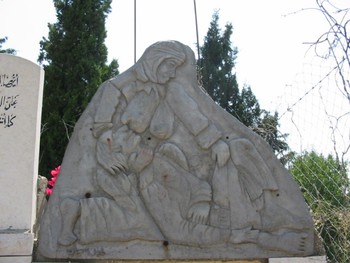
The memorial monument, established on the external wall of the cemetery (Figure 1), reflects this spirit. It was created by a young artist from the village, Naif Sam'an, trained at the Jewish-Arab club of Beit ha-Gefen in Haifa. According to Sam'an, in Beit ha-Gefen he assisted a Jewish artist in creating a memorial monument for Holocaust victims, after which he was determined to create a similar monument for the ‘Ailabun victims. In 1983 he succeeded, with a local friend's financial help.Footnote 29
Monument built in ‘Ailabun, 1983. Author's photo.

Sam'an created a metal embossment depicting a mother holding her dying son, blood pouring from his gunshot wounds. This image powerfully echoes the famous Pieta icon, one of the most familiar images in Catholic iconography, in which Mary holds Jesus after he was taken down from the cross.
The names of the Christian victims are inscribed on a marble tablet with the title “‘Ailabun's victims, 10/30/1948.” Completely absent are the heroic discourse—already detectable on the Land Day monument (Sorek Reference Sorek2002)—and any mention of the purpose of the deaths. The text does not contextualize the massacre among other events in Palestinian history as do later monuments, nor does it invoke the word “Nakba.”
My interpretation is that the emphasis on the local dimension of collective memory in ‘Ailabun is not complementary to Palestinian national identity but is rather constructed in spite of it. To a certain extent the Christian identity of the victims and their community plays a similar role: after all, it was only by making their case unique, unrelated to the fate of other Palestinians, that the people of ‘Ailabun were able to return to their homes in 1949. In ‘Ailabun's commemoration, Palestinian nationalism is absent from most central stages. Elias Srour, a local school director who wrote a book in 1998 on the memory of the victims, did not refer to the people of ‘Ailabun as “Palestinians” once in its ninety-six pages. ‘Ailabun is also the only place investigated in this study in which the martyrological chronology does not overlap with the Palestinian conventional heroic narrative, starting with the anti-colonial struggle against the British. ‘Ailabun's first martyrs, according to the memorial book, are two residents who were forcefully recruited to the Ottoman army during World War I and never returned home. This reserved attitude toward Palestinian national identity became evident in 1998 when an institutional attempt to contextualize the massacre within a Palestinian national narrative failed. Let me turn now to this case.
The Nakba Memorial Monuments
The Oslo accords signed in September 1993 had far-reaching and contradictory implications for the ways Palestinians in Israel experienced and expressed their collective identity. On one hand, many tended to believe that the Palestinian-Israeli conflict was on the verge of ending, with a solution that would enable them to live peacefully with the entanglement of identities and loyalties that had trapped them for decades. On the other hand, the accords did not include any reference to the Palestinians in Israel, and concerns were raised that they were destined for permanent marginality as second-class citizens in the Jewish state, without the support of any state. As a result, the Oslo process accelerated the growing interest in their identities as Palestinians. A central component of this process was the resurfacing of the events of 1948, including the public processing of the collective memory and concrete claims for confiscated property (Rekhess Reference Rekhess2002). The renewed interest in the 1948 war was also fueled by the wave of revisionist studies of the war by Israeli historians who legitimized a more critical approach toward Israel's responsibility for the Palestinian disaster.
The 1998 celebration of the fiftieth anniversary of the establishment of the State of Israel further fueled this process. Parallel to the anniversary preparations, and to a certain extent as a reaction to them, the FUC began to look for ways to commemorate the Nakba. The decision to establish memorial monuments was not controversial among members of the FUC or the nominated Nakba and Steadfastness Committee. However, the inability of the political and intellectual leaders to establish these memorials is evidence that this was far from true on the popular level.
‘Ailabun: The Prominence of Local, Religious, and Communal Identities
The massacre of October 1948 made the ‘Ailabun municipality one of the few that accepted the FUC's call to build a memorial monument for the Nakba victims. The charismatic mayor, Dr. Hanna Sweid, considered a new monument an opportunity to strengthen the ties between the Christian and Bedouin segments of the village by including names of all the victims on one site. Presumably, the upcoming local elections and the traditional role of Bedouin votes as their deciding factor helped spur his support of the monument.
At this point, some explanation regarding the Bedouin victims is necessary. Immediately after their deaths their bodies were buried in a cave adjacent to where they were killed. In the 1950s, the Israeli National Water Project was dug through the cave and the Mawassi people took the bones to another cave. During the 1980s, presumably influenced by the monument built to the Christian victims, the bones were moved to a common grave in the small Muslim cemetery in ‘Ailabun. A tombstone was erected that records only the date of the deaths.
The tomb of an IDF soldier from the Mawassi tribe, located several feet from this grave, is a sharp reminder of the severance of the northern Bedouins from the Palestinian national narrative. Military service in the IDF is common among ‘Ailabun's Bedouin residents, as it is among other northern Bedouin communities. The IDF is one of the rare channels of employment for Israel's Bedouins, the country's least-educated Arab population. Their distance from the mainstream Palestinian narrative is even more pronounced than that of their Christian neighbors. Thus, even though the victims' families cooperated with the municipalities in building the monument, only a handful of the Bedouin residents showed real interest in it.Footnote 30
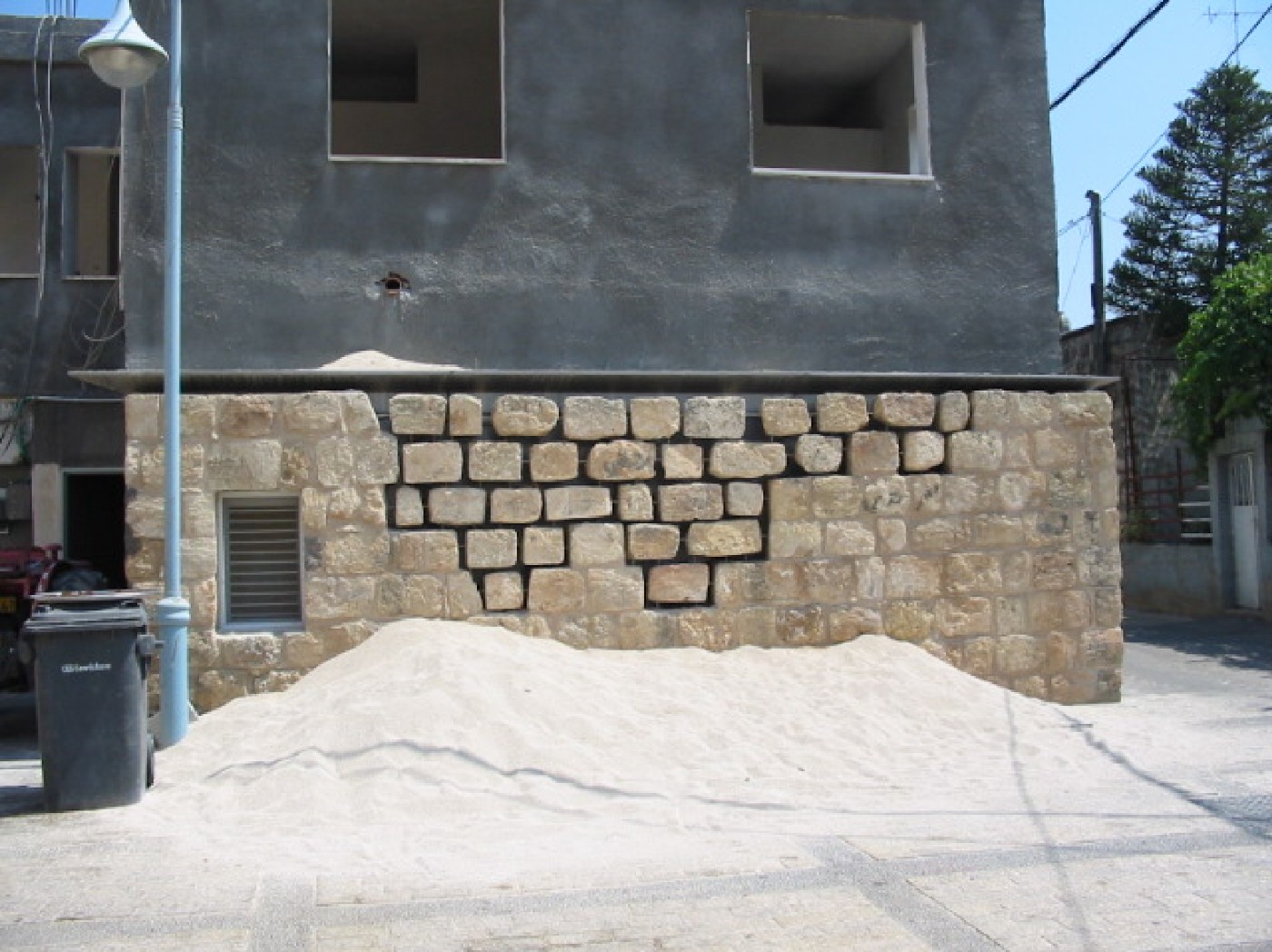
The 1998 monument was actually a reshaped brick wall near an old church where the IDF soldiers had executed some of the victims. Copper tablets bearing the victims’ names were installed on the wall. A few spotlights under the wall were supposed to illuminate it at night.
The monument was unveiled on 30 October 1998 in a ceremony commemorating the massacre's fiftieth anniversary, which included a speech by Mayor Sweid. He emphasized both the cross-communal solidarity in ‘Ailabun and the bond of the village with the Palestinian people: “In this project, we share the 50th memorial day of the Nakba with our Palestinian people, and by building the monument we confirmed the unity of ‘Ailabun.”Footnote 31 The monument's life was short and miserable. The martyrs’ names gradually disappeared and less than five years after its unveiling the monument looked like just another wall. Above it was built the new ground floor of a private Christian-owned home (Figure 2). When I visited the town in December 2006 I asked the home's owner about the monument which had once stood there. He answered bluntly: “We are Christians here. They put here names of Bedouins. Nobody wanted it so some children came and removed it. We don't want Bedouins here. Fuck them! Next thing they will start to pray here and will ask to build a mosque here.” The Bedouin residents with whom I discussed the issue were unaware the monument had been virtually effaced, since they rarely visited that area of the village. In any case, they did not seem to care.
What remained in July 2003 of the monument built in 1998 for the Nakba's victims in ‘Ailabun. Author's photo.
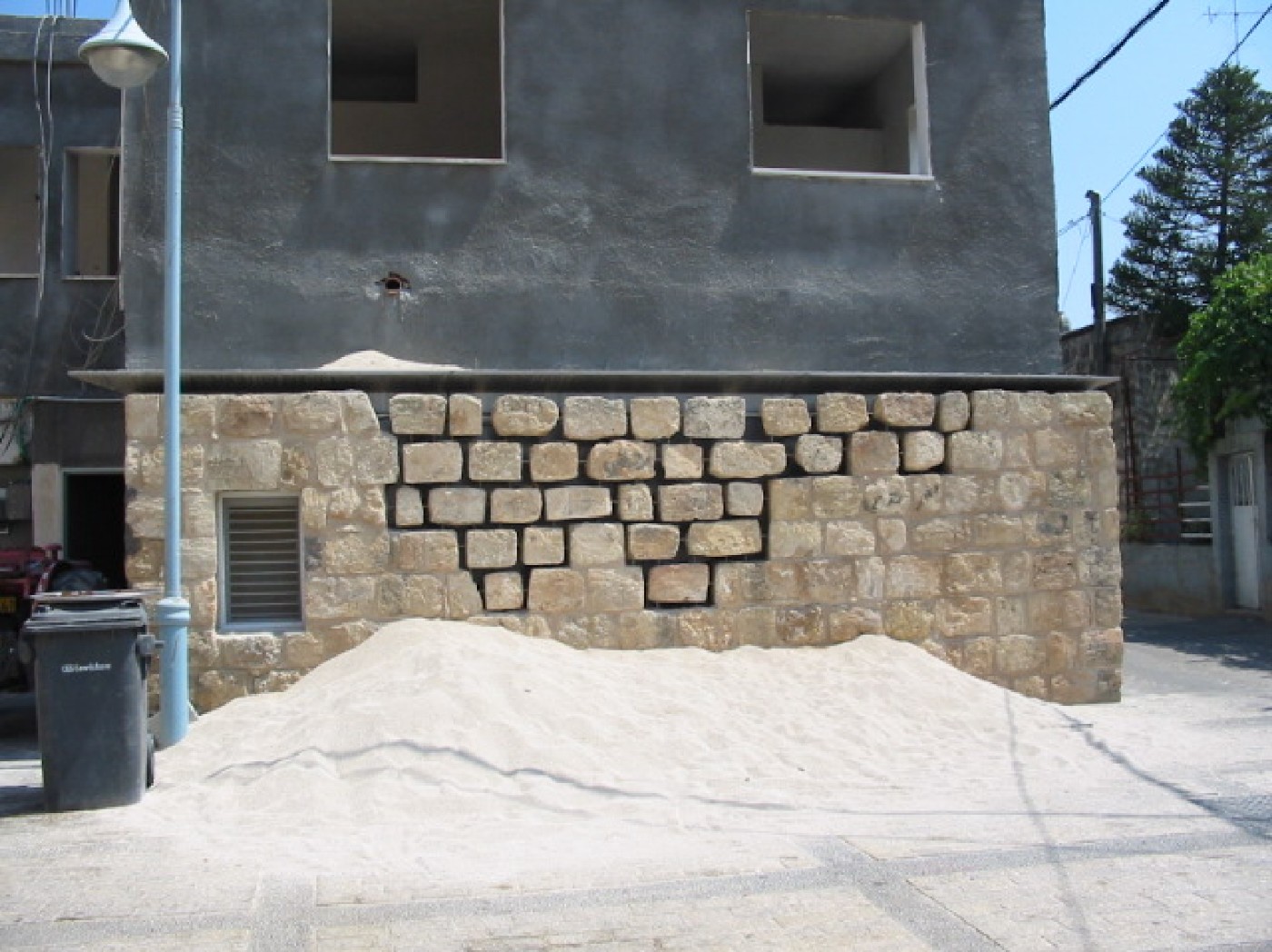
The case of ‘Ailabun sharply illustrates the gap between a political leadership which strives to promote a Palestinian nationalist discourse and the wider social circles which have no enthusiasm for it. The mayor intended to nurture a cross-communal local pride in ‘Ailabun, and this localism was supposed to be interwoven in the Palestinian national narrative. This plan was incompatible with aspirations of significant segments of the Christian population. As evidenced by Srour's book, a nurtured local identification can replace Palestinian national identity rather than enhance it. In addition, unlike the destroyed 1998 joint monument, the Christian monument from 1983 is still in good shape. It has a clear local and religious character that people do not identify with the Palestinian Nakba and it is not oriented toward the construction of a unified Palestinian identity common to Christians and Bedouin.
Shefa'amr: The Battle over the Monument
The first Arab municipality to decide to establish a Nakba memorial monument was the Muslim-Christian-Druze town of Shefa'amr. On 1 April 1998, the municipal council decided to build a monument in a traffic circle to commemorate the town's victims of the 1948 war. This was also a municipal election year. The town mayor was Abu Hatem (Ibrahim Nimer Hussein), who had ruled since 1969 and had served as the FUC chair since its establishment in 1982. Since 1983 Abu Hatem had led a coalition with members from all three religious communities (Al-Haj Reference Al-Haj1987: 76), but he faced growing dissatisfaction among Christians, who felt excluded from most positions of power.Footnote 32 He assumed (mistakenly, as it turned out) that the monument would improve his deteriorating political fortunes.Footnote 33 The municipality and the NCS published a call for Shefa'amr inhabitants to assist the project by collecting the names of victims from Shefa'amr and the neighboring villages Hawsha and Khirbat al-Kasayir, destroyed by Israeli forces in 1948.Footnote 34
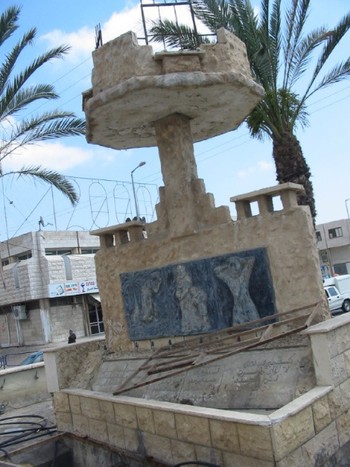
By July 1998, the monument had been erected, consisting of a vertical marble tablet with copper embossments of people wearing traditional Palestinian peasant clothing. A second marble tablet angled at the base of the main tablet bore the victims’ names. However, the monument was never even officially unveiled. In the elections, Shefa'amr's residents, fed up with Abu Hatem's three-decade-long authoritarian rule, overthrew him and elected by default the other main candidate, his son-in-law ‘Orsan Yasin. Although the ruling right-wing Zionist Likud party unofficially supported Yasin, his election reflected not an ideological shift but rather communal and familial struggles of interests. Although Muslim, like Abu Hatem, he enjoyed disproportionate support from the Christians, who found in him a suitable means for overthrowing his father-in-law.Footnote 35
After Yasin's election, his pro-Zionist line was further emphasized. It became clear that he represented the view that in order to be considered good citizens, Arabs in Israel should refrain from identifying themselves as Palestinians and should distance themselves from a Palestinian national narrative. While this perception is common among Arabs in Israel, Yasin's formulation was extreme. His aspirations to gain greater resources from the government for his city were articulated in a cynical strategy that included hanging Israeli flags near the municipality far beyond what is required by the law, making pro-Zionist declarations in the media, and actively opposing strikes organized by the FUC.Footnote 36
His main step in this context was to reshape the Nakba monument such that its commemorative national aspects would disappear. Under the (unnecessary) protection of the Israeli police, the main marble tablet was plastered over and decorated with embossments of flowers and a turret-like structure was attached to it. The small square around the monument was turned into a pool with fountains in such a way that water covered the victims’ names. Later, Yasin sarcastically explained his decision to a reporter from the Hebrew newspaper, Ha'aretz: “What do they want? That I allow an ugly tomb in front of the municipality? I made a renovation, so everyone feels good under the water.” In the same interview, he explained his instrumental political philosophy: “I had enough of the extremists. We, the moderates, will overpower them. I expect that the Prime Minister will support the moderate Arabs more significantly.”Footnote 37
Feeble protests by the monument's supporters, mainly members of the Democratic Front for Peace and Equality (DFPE)Footnote 38 and the National Democratic Assembly (NDA),Footnote 39 were ineffective, and by the following summer the site had become an unofficial bathing pool for the town's children. Later the water was removed for safety reasons and the empty pool became an improvised garbage dump (Figure 3). In the local election held in October 2003, Yasin's opponents attempted to use the monument's reshaping in their campaign, but in vain: his victory was clear cut with more than 65 percent of the votes. Once more, the communal division played an important role as Yasin received disproportionate support among the Christians and Druze.
The monument to commemorate Shefa'amr's victims of the Nakba, built in July 1998 and modified in March 1999. The picture was taken by the author in summer, 2003.

It seems that, beyond Yasin's political motivations, the transformation of the commemorative monument into a water playground or garbage dump was enabled by its feeble status among the residents. Shefa'amr's residents did not do all they could, to say the least, to defend the monument. Judging by the unassertive opposition to Yasin's actions, it is possible that this indifference reflected opposition to the former mayor who built the monument. It is more likely, however, that only a minority had adopted the FUC's view regarding the national importance of a memorial monument. ‘Abed ‘Anbetawi, the FUC secretary and a former member of the Shefa'amr municipality, who tried to organize opposition to the monument's destruction, told me: “We felt alone in the battle.” In his view, this had something to do with the collective character of Shefa'amr: “We did not have a militant opposition. The public in Shefa'amr is different from the public in Sakhnin or Umm el-Fahem. It is not a city where the nationalist atmosphere reigns.”Footnote 40 Anbetawi's complaints are clearly borne out in Ibrahim's study (Reference Ibrahim2000), which ascribes the primacy of religious allegiances over Arab-Palestinian identification in Shefa'amr to the successful ‘divide and rule’ policies of Israeli authorities.
In my visit to Shefa'amr in December 2006, I found the monument covered with commercial ads, signifying the complete failure of the attempts to construct it as a commemorative site. I asked some local residents what they knew about this monument. H., a fifty-year-old man active in the local Christian Scouts club, located 100 yards from the monument, told me: “There was a monument here for those who died a long time ago—but we should move forward, go ahead. The world is changing, people progress. There is pain, but it was a long time ago—who needs that?” Later, when several scouts and guides assembled around us, I asked them if anyone knew why the monument was built. Everyone said that they had no idea, except for M., a twenty-four-year-old student at Haifa University, who said confidently that the monument was built to commemorate the victims of October 2000, and was later distorted. Although misinformed about the monument's history, M. thought there was a need for this kind of monument, since, “Every group in society should be able to express its identity.” When I insisted that nobody had seriously resisted its distortion, he replied: “People are afraid. Although we seemingly live in a democracy, people's minds are still shaped by many years of surveillance and they prefer not to get into troubles. For example, if someone is employed by a Jewish employer he doesn't want to annoy the boss, so he distances himself from political issues.”
In August 2005, an IDF deserter killed four Shefa'amr residents in a calculated attempt to prevent the withdrawal of Israel from the Gaza Strip. Immediately after, two members of the local council demanded that a memorial monument be established to commemorate the victims.Footnote 41 This time, eager to satisfy the angry Arab public and prevent the recurrence of October 2000 events, the state authorities even participated in financing a monument. However, Mayor Yassin and the victims' families disagreed about the text that should be inscribed on it. The families, supported by the NDA municipal representative, wanted to contextualize the commemoration in the political struggle, whereas the mayor insisted on a personal and apolitical framing.Footnote 42 At the end of 2006, the monument was still only half-built, with no text. Only time will tell what the broader implications of the events of summer 2005 will be on how the Nakba is remembered in Shefa'amr.
Kafr Kana: The Successful Monument
Of the three monuments built following the FUC's call, only that at Kafr Kana has survived. It was unveiled in September 2000 a few days before the eruption of the al-Aqsa Intifada. The Kafr Kana municipality, headed by the secular NDA party, decided to build the monument at the main entrance of the village near the new mosque. Since its foundation, it has functioned as a gathering point for events with national significance: Land Day ceremonies, ceremonies to memorialize the events of October 2000, and political demonstrations like that held against the American invasion of Iraq in 2003.
The monument was built as a round plaza with a wall on its eastern side and a stone column in its center. The martyrs' names are listed on the wall. Although the secular-dominated municipality promoted the monument, the power of political Islam in Kafr Kana in 2000 was evident in its structure and content. Human figures are absent, and although two of the dead are Christians the list of names is headed by the BismAllah Islamic opening and the most famous Qur'anic verse on martyrs: “And reckon not those who are killed for Allah's way as dead; nay, they are alive… .”
Although the original intention of the FUC was to commemorate the Nakba, the monument in Kafr Kana commemorates all the martyrs of Kafr Kana since 1936. Hence, instead of taking part in constituting national memory through a common supra-local experience, Kafr Kana's municipality chose to emphasize the status of Kafr Kana in the Palestinian national experience by a multi-generational monument that binds together the dead from the rebellion of 1936–1939, the Nakba in 1948, and Land Day. After a local boy, Muhammad Khamaysi, was killed during the October 2000 event, his name was added to the list.
In this way, the monument in Kafr Kana became the first multi-generational memorial. It was preceded by a multi-generational exhibition of martyrs in Sakhnin that has been held every Land Day since 1999 (Sorek Reference Sorek2005) and by memorial books produced in several villages in the Galilee. This characteristic of the Kafr Kana monument is especially interesting since multi-generational commemorations are widespread in Israeli Jewish society. In Israel there are more than 300 such monuments, and they are particularly common in Jewish rural settlements where the proximity between the dead and the commemorators is high (Shamir Reference Shamir1996: 147–48). Indeed, like the ‘Ailabun monument's creator, the person who initiated the Kafr Kana monument, Mayor Wasil Taha, argues that he was inspired by Zionist memorial monuments.Footnote 43
Following October 2000
During late September and early October 2000, with the beginning of the Palestinian uprising, the flames spread inside the 1967 Green Line and the country witnessed a wave of demonstrations, stone-throwing, blocked roads, and police gunfire against demonstrators. Inside Israel, the police killed thirteen Arab-Palestinians (twelve of them Israeli citizens); two of the victims were killed when a frenzied Jewish mob stormed down from Upper Nazareth and attacked the eastern neighborhood of Nazareth, after which the police intervened by opening fire against the Arabs.
The memorial monuments of the post-October 2000 period have little in common with one another. Most were built on the initiative of the municipalities, but some victims’ families initiated. Most of them project a religious Islamic tone, which is compatible with the growing importance of Islam as an element of Arab political identity in Israel, and with the Islamic spirit of the second Intifada. This tendency is expressed in the religious texts inscribed on the monument, the lack of human figures, and in figurative elements such as an iconic statue of the Dome of the Rock mosque. A monument built in the village of ‘Arabeh, by contrast, has a human sculpture in its center and no Qur'anic verses.Footnote 44
In almost every locality, controversies regarding who should be commemorated preceded the building of a monument. Should it commemorate only the local victims of October 2000? Should it mention all the local victims in history? Or should it commemorate all thirteen Arab youngsters killed in Israel in October 2000? The victims’ families tended to prefer to contextualize their sons' deaths in the al-Aqsa Intifada together with the other Arab citizens killed in the same events, while municipalities tended to prefer the multi-generational local pattern highlighting the historical sacrifice made by their town or village. Some did adopt the multi-generational model of Kafr Kana, and seem to have used the commemoration of October's victims to compensate for the local ‘memory deficit.’ This was an opportunity to commemorate all the locality's dead from conflict-related events. One example is the monument built by the Kafr Manda municipality that mentions all local martyrs from 1936 through Hasan Bushnak, who died in October 2000. In contrast, a private memorial monument built by the Bushnak family at the junction where their son was killed refers to all thirteen martyrs of October 2000.
In Sakhnin it was decided after some controversy to commemorate the thirteen martyrs together, partly because Land Day martyrs already had their monument and the other dead from 1948 and 1936–1939 are commemorated by an annual memorial exhibition. The caution in Sakhnin was reflected in the gap between the height of the monument according to the initial plan, which might have reflected a spontaneous anger (105 feet) and its final height (less than 10 feet).Footnote 45 The monument in ‘Arabeh commemorates all thirteen victims of October, as well as the village's victims since 1936, and other Palestinians killed in ‘Arabeh as part of the conflict. In Kafr Kana, the name of Muhamad Khamaysi was added to the central monument but the family also initiated a separate monument on the site of his killing dedicated to their son, “The martyr of the al-Aqsa Intifada.” Only in one locality, Umm al-Fahm, were the local victims of October 2000 commemorated alone.
The two patterns, the diachronic local commemoration and the synchronic supra-local commemoration, do not necessarily represent a deep ideological schism. Nevertheless, the fact that most of the monuments followed the synchronic supra-local pattern and mentioned the thirteen victims of October 2000 revealed the exceptional status of the Arabs in Israel as a ‘trapped minority,’ since this practice compresses the geographical space of the Palestinians in Israel into the monuments and marks them as belonging to one distinct destiny. Although during the same period, between 28 September and 8 October 2000, an additional sixty-four Palestinians were killed in the West Bank and the Gaza Strip, the monuments ignore them and mention only those Palestinians who were killed inside Israel. Even the familial monuments commemorating Hassan Bushnak in Kafr Manda, which refer to the victims as martyrs who died in the “Al-Aqsa” battle (indicating solidarity with the uprising of the Palestinians in the West Bank and Gaza Strip), mention only the thirteen ‘Israeli’ victims.
Identity Strategies as Caution Measures
The mobilization of local and communal allegiances is a strategy to cope with particular political circumstances. The idea that expressions of identity can be instrumentally deployed at the collective level as a political strategy is common in the study of social movements. These studies pay attention to the dialectic between the emphasis of differences from the majority versus similarities with the majority, with any specific location on this continuum reflecting different levels of organization and access to the polity (Bernstein Reference Bernstein1997). By commemorating Palestinian martyrs, the FUC leaders, who lack access to the polity, aspired to highlight differences in collective memories from the Jewish majority in order to pursue political self-empowerment. While this strategy fits the above-mentioned model, the mobilization of localism and communalism is a completely different type of ‘identity as strategy.’ These affiliations have been mobilized as cautious measures to deal with the state's opposition to Palestinian national commemoration and as counter-measures to the FUC strategy, which could have led to confrontation with the state and the Jewish majority. In the terms of Rogers Brubaker (Reference Brubaker2004: 13), social categories such as “Christians in ‘Ailabun” or “Bedouin” were transformed into groups in a way that diminished the “groupness” of the category “Palestinians” and hindered the ‘group making’ project of this category. These communal allegiances, therefore, both explain the partial failure of the memorial monument project and, at the same time, their mobilization is a byproduct of the need to be cautious.
Cautious commemoration represents a wider set of strategies implemented by Arab-Palestinians in Israel. It is not a coincidence that the titles of books written about this population frequently reflect a quest for a delicate balance: Emil Habibi's famous novel The Pessoptimist, or Sleeping on a Wire, David Grossman's book about the Palestinians in Israel. The realm of memorial monuments, however, requires exceptional caution because of the particular sensitivity of the state and the Jewish majority to Palestinian commemoration. This high sensitivity can be explained by the implied responsibility that this commemoration conveys, and the questioning of the state's legitimacy inherent in this responsibility.
Regarding the first element, Israel is not unique in its sensitivity to minority martyrological commemorations that emphasize state responsibilities for atrocities against minority members. One relevant example is the French government's active repression of attempts to commemorate the massacre of Algerian demonstrators that took place in Paris in October 1961. In the years following the massacre, French police interrupted public commemorative events like the screening of an underground documentary movie which included related testimonies (Einaudi Reference Einaudi1991: 274). Therefore, stories of the massacre were first transmitted mainly through family memories and were gradually constructed as a “narrative of resistance” by the North African immigrants only from the late 1970s (House Reference House2001).
Even then, the massacre's memory was not spatially carved until October 1991 when the association “Au Nom de la Mémoire” established a memorial pillar at the Bezons bridge (Nordmann and Vidal Reference Nordmann, Vidal and Grandmaison2001). This pillar was later removed by the local authority of Val-d'Oise, which signified the ongoing refusal of the French state to recognize its responsibility for the crime (Einaudi Reference Einaudi2001: 14). Accordingly, not even one official lieu de mémoire (Nora Reference Nora1996) was dedicated to the victims until October 2001, when a memorial plaque was inaugurated by the municipality of Paris at one of the massacre's major sites (Jelen Reference Jelen2002). Though no representative of the French government attended the ceremony, this time the plaque was not removed. In Algeria, by contrast, martyrs of the Algerian independence war (1954–1962) are extensively commemorated by monuments, although ironically many of these are old French memorial monuments, appropriated and redesigned (Benslama Reference Benslama1995).
Nevertheless, some minority memorial monuments in Israel, like the Land Day monument in Sakhnin and the post-October 2000 memorials, did survive and gained public status as memorials. An interesting theoretical question is: under which circumstances do monuments become sites of national mobilization, or fail to do so?
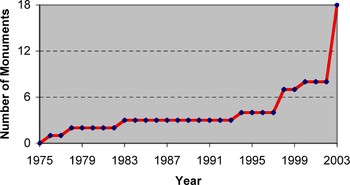
One important factor is timing, or more precisely, the proximity of a triggering event that overrides caution. The Kafr Qassem massacre in 1956 was followed by a wave of political commemoration, which was intensive but still did not result in permanent occupation of the public space. Land Day in 1976 resulted in the first wave of memorial monuments, with three built over the next six years. The October 2000 events had the strongest effect: Between 1948 and September 2000, the Palestinians in Israel had established no more than eight memorial monuments for their dead, and two of them did not survive as memorials. But during the three years following the killing of the thirteen Palestinians inside Israel that October, ten monuments were built (Figure 4).Footnote 46 In addition, the time elapsed between deaths and the foundation of memorial monuments shrunk to minimum. The dead of 1936 waited sixty-two years for a monument (when the names of a few were inscribed on the Kafr Kana monument); the dead of Kafr Qasim were commemorated after twenty years; the Land Day victims after two years; and it took only one year for the October 2000 victims to be monumentalized (Figure 5). Later, the decision to establish a monument to commemorate the victims of the August 2005 Shefa'amr attack was made days after the event.
Accumulative frequency of monuments for martyrs built by Palestinian citizens of Israel.

Time difference between the event and the establishment of the first monument to commemorate it.

This quantitative transformation indicates two processes: first, the memorial monument has been gradually added to the cultural “tool kit” of the Palestinians in Israel. Second, and more important, is the shocking effect of October 2000. Yiftachel (Reference Yiftachel, Ben-Ami, Peled and Spectorowski2000) and Robinson (Reference Robinson, Makdisi and Silverstein2006) show that commemoration among Arabs in Israel is also an important form of political protest. This protest, as I have shown in several examples, was restrained not only directly by the state but also by self-imposed barriers, and many of the latter were removed by the political earthquake of that October. The unbearable ease with which demonstrators were killed and the indifferent reaction of the frightened Jewish public to the police brutality invoked popular frustration and a growing awareness of the fragility of the civil and political rights of Arabs in Israel.
Suddenly, the risk taken by nationalizing public space seemed less frightening. In the past, people were hesitant to establish monuments because they feared the Jewish majority might perceive them as a threat, but after 2000, monuments became a necessary form of protest because they were considered defiant. October 2000 accelerated the crystallization of distinct versions of Palestinian national consciousness and reduced the gap between intellectuals and the wider public concerning this issue. One expression of this process was a growing popular recognition of a standard set of symbols of national identity, which includes carving the memory of national martyrs into the public space. Significantly, there is no central monument—every municipality commemorated its own martyrs, while a few monuments mentioned also the other twelve dead. Nevertheless, the post-October 2000 monuments are clear examples of parallel productions of local and national pride.
The killings of October 2000 intersected with the growing recognition among the intellectual elites of the political role of collective memory. The adoption of the monument form is related to an increasing realization that writing history is a political practice, and that the production of specific lieux de mémoire controlled by the minority can be a potent strategy for pursuing its struggle. This recognition has been expressed in a proliferation of historical writings by Palestinians in Israel since the early 1990s, and in the establishment of a research institute in Haifa (Mada al-Carmel—The Arab Center for Applied Social Research) that dedicates special attention to historical research aimed at constructing a Palestinian historical narrative.Footnote 47 Especially since 1998, books, studies, and press articles about the expulsion and destruction have mushroomed. People have commemorated Nakba day, 15 May, with public rallies and organized pilgrimages to the ruined villages. They have also exhibited a readiness to initiate political struggles to preserve historical Palestinian sites.Footnote 48
A second major common feature that distinguishes the successful monuments is that they were built in towns that had post-1948 martyrs, and the monuments are not dedicated exclusively to 1948. The monuments in Kafr Qasim (for the massacre of 1956), Sakhnin (for Land Day and October 2000), and in ‘Arabeh and Kafr Kana (for all local martyrs) still stand and even serve as gathering points for commemorative ceremonies. Nonetheless, some self-censorship continues. Most municipalities have not adopted the FUC initiative to establish “Nakba memorials,” and the two monuments built especially for the victims of the Nakba no longer exist. The extreme case is that of ‘Ailabun, where the ‘national’ memorial for the victims of 1948 was effaced within a few years, while the ‘religious’ monument is respected and remains in good shape. As mentioned earlier, the Nakba commemoration project has been successful in some realms. Therefore, the failure of the Nakba monuments stands in contrast to both memorial monuments for other events and other forms of the Nakba's commemoration.
I suggest that many Palestinians are more cautious about commemorating Nakba, especially by spatially carving its memory in their own backyards, because Jewish Israelis are particularly sensitive to the event's memory. Unlike the other events I have discussed, since 2000 only commemorations of the Nakba have continued to evoke tangible threats by Israeli authorities. In 2001, for example, the Minister of National Infrastructure, Avigdor Liberman, instructed the ministry's functionaries to avoid any contact with public figures who participated in Nakba commemorations.Footnote 49
This sensitivity is related to the fact that commemorating the Nakba puts in question the legitimacy of the state's existence. Most Jewish Israelis remembered the 1948 war as “the war of independence,” as a constitutive redemptive moment. They commemorate it as a heroic defensive fight of a small and poorly armed community who, with their backs against the wall, defeated seven Arab armies against all odds. The remembrance of the expulsion, however, “continues to hover in the twilight zone between the conscious and unconscious, between repression and recognition” (Shapira Reference Shapira2000). Commemorating the Nakba interferes with this present/absent status. It is a reminder that it was not just the ‘the war’ that established the Jewish state; only the uprooting of 700,000 Palestinians enabled the creation of a stable Jewish majority. Those who mourn this same event can be interpreted as questioning the legitimacy of state sovereignty. In this regard, Walid Sadek, an Arab Member of Parliament of the Zionist liberal Meretz party, said that while he did not oppose commemorating the Nakba, he was concerned about the “timing,” referring to the implicit linkage between such commemorations and the fiftieth anniversary of Israel's independence.Footnote 50
This Israeli sensitivity to the Nakba commemorations is similar to that of the Turkish state to commemorations of the Armenian genocide. There is still a tiny Armenian minority in Turkey (about 70,000 people), but of about 140 memorial monuments built in twenty-five countries to commemorate the Armenian genocide, not one is found in Turkey.Footnote 51 In both Israel and Turkey the authorities deny the state's responsibility for the collective tragedy of the minority. In both cases, as well, this denial is fundamental to the legitimacy of the state. The expulsion of the Palestinians was necessary for the establishment of a Jewish state, and the elimination of ethno-religious minorities was necessary for the establishment of a relatively homogenous ethnic Turkish nation-state (Akcam Reference Akcam2004: 150). Israeli sensitivity, however, has another crucial element that does not exist in Turkey—the anxiety of reversibility. The commemoration of the Nakba is related to the most sensitive controversy over the right of return for the Palestinian refugees, and Zionists consider that to recognize this right would mean the end of the Jewish state.
Finally, the caution of Palestinians is linked to the medium of the martyrological monument itself. Commemoration of the fallen soldier and other conflict-related dead is central to Israeli national identity (Shamir Reference Shamir1996), and Israel likely has the world's highest ratio of monuments per victim (Segev Reference Segev1990). Jews have built most of them to commemorate their victims in the Arab-Israeli conflict. Since Israeli Jews utilize monuments as objects that legitimize and validate Israeli sovereignty (Handelman and Shamgar Handelman 1997), and as the ultimate spatial representation of patriotism, the use of monuments by Palestinians to commemorate their victims is deemed threatening, and the authorities react accordingly.
The intellectual elite who promoted the commemoration project were partly motivated by a desire to question the legitimacy of the State of Israel. Among wider circles of citizens, however, this same questioning played an inhibiting role, since they feared there would be negative repercussions for their rights. Significantly, even in those contexts where Palestinian belonging is emphasized, it is done simultaneously with a reminder of the Israeli citizenship of the victims: The identity of those commemorated in Palestinian monuments in Israel draws the geographical boundaries of a national minority. This minority is consistent in distinguishing itself not only from the Jewish majority of society but also in maintaining its distinct identity within the Palestinian collectivity. This pattern is common to all monumental commemorations of Arabs in Israel, which have never referred to Palestinians killed beyond Israel's borders. The significance of this phenomenon is two-fold. First, the culture of martyrological commemoration among Palestinians in Israel is connected to the emergence of an ethno-regional identity with strong affinity to the Palestinian struggle outside Israel but with distinct characteristics and agendas. This emergence can be traced back to the annual Land Day commemoration (Yiftachel Reference Yiftachel, Ben-Ami, Peled and Spectorowski2000), and it gained further momentum after October 2000.
Second, Palestinian commemoration inside Israel is part of a dialogue between the Arab minority and the Jewish majority. Muhammad ‘Ali Taha, the Nakba and Steadfastness Committee chair, unambiguously stated that the Nakba commemoration project aimed to target both Palestinian and Jewish Israeli audiences.Footnote 52 In light of the importance given to memorial monuments within the Zionist ethos, monument building is considered a means of communication that Israeli Jews might understand. A former mayor of one of the towns where a monument was built to commemorate a local martyr told me explicitly that he sees it as a message to the Israeli authorities: “Look what you have done, you cannot escape from responsibility.”Footnote 53 While Israel denies its responsibility for Palestinian suffering, when the victims are Israeli citizens, the denial becomes more complicated, since it contradicts both Israel's claim to sovereignty and its aspiration of being considered a liberal democracy.
 (Yerushala'im—'ir ha-metim; Jerusalem's city of the dead). Jerusalem: Keter (Hebrew).
 (Al-khitab al-siayasi al-mutabawar wa-dirasat ukhra; The ruptured political discourse and other studies). Ramallah: Muwatin (Arabic),
 (Ha-'arvim be-yisrael—'iyunim be-siah politi shasu'a; The Arabs in Israel: reading a fragmented political discourse). In,
 (Bein ha-ani la-anahnu; Between the ‘me’ and the ‘us’). Jerusalem: Van Leer Institute, Ha-kibbutz Ha-meuchad (Hebrew).
 (Avarim Tovim; Good Arabs), Jerusalem: Keter and Ivrit.
 (Shulaim be-hevra shulit: ha-yihudiut ha-beduit; Margins in a marginal society: the uniqueness of the Bedouin society). In,
 (Ha-'arvim ba-politika ha-yisraelit: dilemot shel zehut; The Arabs in the Israeli politic: dilemmas of identity). Tel-Aviv: Tel-Aviv University, Moshe Dayan Center (Hebrew).
 (Tafkidam u-ma'amadam shel intelectualim falastinim be-yisrael; The role and status of Palestinian intellectuals in Israel). Ph.D. thesis, Hebrew University of Jerusalem (Hebrew).
 (Nostalgia mizrahit—eich hafchu ha-falastinim le-'arviyei yisrael; Oriental nostalgia—how the Palestinians became ‘the Arabs of Israel’)
 (Ha-'arvim be-yisrael le-ahar tahlich oslo: localizatsia shel ha-maavak ha-leumi; The Arabs in Israel following the Oslo process: localization of the national struggle)
 (Bein ha-sulha ve-ha-andarta: hashpa'at tevah kfar qasem ‘al ha-historya ve-hazehut shel ha-yishuv; Between the Sulha and the monument: the influence of the Kafr-Qasem massacre on the history and identity of the town). In,
 (Kfar qasem—eiru'im ve-mitos; Kafr Kassem—myth and history). Tel Aviv: Hakibbutz Hameuchad,
 (Ma ‘osotha-andartaot ba-leilot; What do the monuments do in the nights?). Ha'aretz, 27 Apr. (Hebrew).
 (Hantsaha ve-zikaron: darka shel ha-hevra ha-yisraelit be-’itsuv nofei ha-zikaron; Commemoration and memory: the path of Israeli society in shaping landscapes of memory).
 (Ha-notsrim be-yisrael: bein dat le-politika; The Christians in Israel: between religion and politics). In,
 (Ha-me'unim ve-ha-kdoshim: kinuna shel martyrologya leumit; The tortured and the martyrs: the establishing of a national martyrology)