INTRODUCTION
In the highland and mid-altitude areas of Ethiopia, crop and livestock production are the major components of the farming system. Though these components compete for resources, they also may complement each other. In these areas natural pasture and crop residues are the major and widely available feeds. In the highlands of Ethiopia, while use of grazing lands as feed resources declined due to their use for crop production and settlement, use of crop residues has increased (Benin et al., Reference Benin, Ehui and Pender2003). According to studies conducted in the mixed crop livestock farming system of Ethiopia, the total annual contribution of crop residues in livestock feed is between 61% and 76 % of the total annual livestock feed supply (Belay, Reference Belay2009; Bogale, Reference Bogale2004). However, crop residues, especially cereals, have a very poor feeding value with poor metabolisable energy, negligible available protein and are seriously deficient in mineral and vitamins (Lulseged and Jamal, Reference Lulseged and Jamal1999). In Ethiopia commercial concentrates and industrial by-products are mostly inaccessible and/or quite expensive for the smallholder farmers, but home-grown multipurpose forage legumes could be one option to be used as cheap sources of protein in livestock production in the mixed crop–livestock farming system of Ethiopia.
Lupin is one of the potential multipurpose crops to be utilised as a home-grown cheap protein source in the developing world because of its low agronomic requirement. Even though bitter white lupin is a traditional old crop in Ethiopia, sweet lupins are new for the country. Lupins are known for their high protein value in human food and livestock feed. However, it has limitations associated with its alkaloid content (Wink, Reference Wink and Waterman1993, Reference Wink, Fattorusso and Taglialatela-Scafati2008). The major anti-nutritional factors in lupin are quinolizidine alkaloids, which are responsible for the bitter taste in lupin, and human and animal toxicity because they act as neurotoxins. Alkaloids are responsible for the bitter taste, lower palatability and toxicity in lupin seed and forage (Vilarino and Ravetta, Reference Vilarino and Ravetta2007; Zulak et al., Reference Zulak, Liscombe, Ashihara, Facchini, Crozier, Clifford and Ashihara2006). In bitter cultivars, the alkaloid contents range between 0.5% and 6% and in sweet cultivars it is less than 0.02% (Wink, Reference Wink, Fattorusso and Taglialatela-Scafati2008).
The potential of a given feed to support a target livestock production type and level can be predicted by determining the chemical composition of that feed (van Soest, Reference Van Soest1994). In addition to the beneficiary nutrient fractions, knowing the amount of the alkaloid content of lupins is very important because the chemical composition of crops can be affected by the growing environmental conditions such as soil type, temperature and water availability. An experiment conducted by the proponents of this study on sweet lupins in Ethiopia showed that sweet annual lupins are adaptive and productive in the traditional lupin growing areas of the country (Yeheyis et al., Reference Yeheyis, Kijora, van Santen and Peters2012). The same authors reported a forage dry matter (DM) yield of up to 4.5 t/ha from sweet white lupin (Lupinus albus L.) and seed yield of up to 5.4 t/ha from sweet blue lupin (Lupinus angustifolius L.). However, their nutritional value under Ethiopian conditions was not known. Hence, in addition to studying about the adaptability of sweet lupins, information about the crude protein, amino acid and alkaloid contents is essential. Thus, this study was conducted with the objective of evaluating the crude protein, amino acid and alkaloid contents of different sweet annual lupin cultivars, namely blue lupin, white lupin and yellow lupin (Lupinus luteus L.) grown in four different traditional lupin growing locations of Ethiopia.
MATERIALS AND METHODS
Description of growing areas
Lupins were grown in four locations, namely Merawi (11.27°N, 37.56°E), Finoteselam (10.84 °N, 37.36 °E), Kossober-1 and Kossober-2 (10.85 °N, 36.80 °E) in north-western Ethiopia. The altitude for Merawi and Finoteselam testing sites is 2095 and 1935 metres above sea level (m.a.s.l.), respectively, and these sites were assumed to represent the mid-altitude (relatively warm) traditional lupin growing areas. The altitude for Kossober-1 and Kossober-2 testing sites is 2610 m.a.s.l. and were assumed to represent the high-altitude (relatively cold) traditional lupin growing areas. The mean maximum and minimum daily temperature in the mid-altitude testing sites is 29 °C and 11 °C, respectively. The mean maximum and minimum daily temperature in the high-altitude testing sites is 22 °C and 10 °C, respectively. The Food and Agriculture Organisation of the United Nations (FAO) classification soil type for Merawi and Finoteselam was a Nitosol whereas in Kossober it was an Acrisol. The soil pH at Merawi, Finoteselam and Kossober was 4.8, 5.3 and 4.8, respectively. The total annual rainfall (mm) from a 10-year data in Merawi, Finoteselam and Kossober is 1602, 1189 and 2348, respectively.
Planting and experimental design
Growing of lupins was done from June 2009 to January 2010. For the experiment, a total of 16 annual lupin cultivars of three species (white, blue and yellow lupins) were used. The cultivars used were white lupin cultivars (Local Landrace, Fortuna, Feodora, L-1082, L-1057, AU-Alpha, AU-Homer), blue lupin cultivars (Bora, Boregine, Borlu, Boruta, Haags Blaue, Probor, Sanabor, Vitabor) and yellow lupin cultivar (Bornal). Except white Local Landrace and AU-Homer, all fourteen cultivars were sweet cultivars. White Local was included as a local check and the seed was purchased from local markets of the respective testing sites. Fortuna and Feodora seeds were obtained from Südwestdeutsche Saatzucht, Germany. The seed source for L-1082, L-1057, AU-Alpha, AU-Homer was Auburn University, Alabama, USA. For all blue lupin cultivars and yellow Bornal the seed source was Saatzucht Steinach GmbH, Germany. The 16 cultivars were arranged and planted in a randomised complete block design (RCBD) with three replications in all four testing sites. The plot size was 1.2 × 4 m. Spacing was 7 cm between plants and 30 cm between rows, giving a target plant density of 48 plants/m2. In all testing sites, planting was done at the beginning of the main rainy season from 2–15 July 2009. Planting was done by hand on a well-prepared seedbed and fertiliser was not applied. Weeding was done manually twice, at seedling and just before flowering stages.
Sampling and sample processing
Each plot was divided in half crosswise with an effective plot size of 1.2 × 2 m. One-half was used for forage sampling and the other for seed sampling. Forage sampling was done when the plants reached around 50% flowering stage and seed sampling at maturity. In both the cases the sampling was done from the middle two rows excluding the border rows. Forage samples were dried in a forced air oven at 65 °C till constant weight for DM determination. The seed samples were air-dried till constant weight. After drying, both the forage and seed samples were ground using a hammer mill to pass through a 1-mm stainless steel sieve. The ground forage and seed samples were kept in a tightly closed plastic bottle at room temperature for further chemical composition analyses.
Chemical composition analyses
Crude protein (CP) content of the forage and seeds of the different lupin cultivars from the different locations were determined using the Near-Infrared Reflectance Spectroscopy (NIRS) method. During NIRS analyses of both forage and seed samples the measurements were done using NIR-spectrometer model DA7200. Initially spectra were collected from the ground forage and seed samples. During spectra collection each ground sample was put in cups in duplicate and scanned using the spectrometer. The developed spectra of the samples were stored in one file. Based on the collected spectra 40 samples from the forage and 51 samples from the seed were selected for crude protein analysis using wet chemical analyses for calibration and validation according to the procedures described by Association of Official Analytical Chemists (AOAC, 1990). By using the collected spectra and the results of the wet chemical analysis calibration equations were developed and validation was done. Using Unscrambler software a regression model was developed between NIR spectra and the crude protein analysis result. On the basis of this regression, model prediction of the crude protein content of all the forage and seed samples was done.
The alkaloid content of the samples was determined by capillary GLC and GLC-MS according to the procedures described by Wink et al. (Reference Wink, Meißner and Witte1995). First the ground samples were homogenised in 0.5 N HCl solution. This homogenate solution was adjusted to pH 12 with 6 N aqueous NaOH solution. Then from this solution the alkaloids were extracted by a solid phase extraction method and analysed by Gas Chromatography-Mass Spectrometry (GLC-MS). Individual quinolizidine alkaloids were identified by their informative mass spectra and authentic reference compounds. Lupanine was used as an external standard for quantification (Wink, Reference Wink and Waterman1993; Wink et al., Reference Wink, Meißner and Witte1995). Analysis of the amino acid profiles was done according to the procedures described by Naumann and Bassler (Reference Naumann and Bassler1997). The analyser used was Biochrom 20 amino acid analyser. During the analysis, hydrolysis was done by diluted HCl and the quantity of the amino acids in the hydrolysate was determined by ion exchange chromatography using amino acid analyser (high pressure liquid chromatography). The values of all chemical composition parameters are expressed on DM basis.
Data analysis
The collected data were subjected to analysis of variance using mixed model procedures as implemented in SAS version 9.2.2 (2003) PROC GLIMMIX, where location, cultivar and the two-way interaction were fixed effects. The sole random effect was block (location). R-side modelling was used to account for heterogeneous variances among species and/or locations and provide for an adequate residual variance structure based on a Corrected Akaike's Information Criterion (AICC). Because the location × cultivar interaction was a significant source of variation for all traits (p < 0.0001), the eight contrasts of interests among cultivars were assessed for each location using the LSMESTIMATE statement in the above-named procedure; the simulation option (α = 0.10) was used to account for the inflation in the Type-I error when making several comparisons from the same body of data. For the contrast analysis, the groups contrasted were Local (Local Landrace only), white (white lupin cultivars Fortuna, Feodora, L-1082, L-1057, AU-Alpha, AU-Homer), blue (blue lupin cultivars Bora, Boregine, Borlu, Boruta, Haags Blaue, Probor, Sanabor, Vitabor), yellow (Bornal only), AU-determinate (L-1082, L-1057), AU-indeterminate (sweet AU-Alpha, bitter AU-Homer) and other-indeterminates (Fortuna, Feodora). Due to lack of enough data, statistical analysis was not done for alkaloid content and amino acid profile results.
RESULTS
The locations where the study was conducted had variations in temperature, rainfall and soil type. Thus, the location × cultivar interaction effect was analysed for the crude protein content of the forage and seed samples. The result showed that the interaction effect observed between cultivar and location for the crude protein content was significant (p ≤ 0.0001).
Forage crude protein content
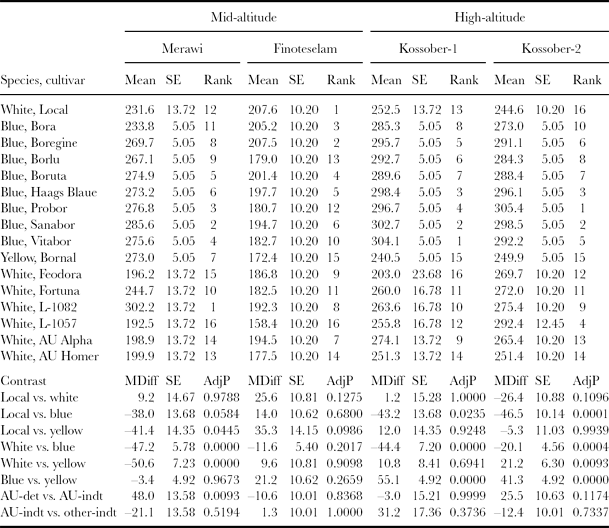
In terms of the forage crude protein content among all locations, blue entry (Probor) had the highest forage crude protein content at Kossber-2, exceeding the Local Landrace by 60 g/kg (Table 1). At Kossober-1 almost similar difference was observed in the forage crude protein content between blue Vitabor (with the highest crude protein content) and the Local Landrace. However, in the mid-altitude locations the Local Landrace at Finoteselam and white L-1082 at Merawi had the highest crude protein content. Among all locations the forage crude protein content was low for most cultivars at Finoteselam. Compared with the yellow entry and white group, the Local Landrace had similar (p ≥ 0.0986) forage crude protein content at all locations except at Merawi, where the yellow entry had significantly higher (p = 0.0445) crude protein content than the Local Landrace. As a whole, the crude protein content from blue entries was quite good compared with the other entries within location. At all locations the blue entries had either similar (p ≥ 0.0584) or significantly higher (p ≤ 0.0235) forage crude protein content than the Local Landrace, white group and yellow entry. The sole yellow entry had similar forage crude protein content as the white group at Finoteselam and Kossober-1 locations but had significantly higher crude protein content at Merawi and the opposite was true at Kossober-2. The forage crude protein content was not significantly different for all determinate and indeterminate groups and their possible pair-wise contrasts at all locations except at Merawi, where L-1082 had the highest crude protein content, which resulted in the AU-determinate group having significantly higher crude protein content than the AU-indeterminate group.
Least square means and contrast estimates for forage crude protein (g/kg DM) from laboratory evaluation of seven white, eight blue and one yellow annual lupin accessions at four locations (Merawi, Finoteselam, Kossober-1 and Kossober-2) in Ethiopia.
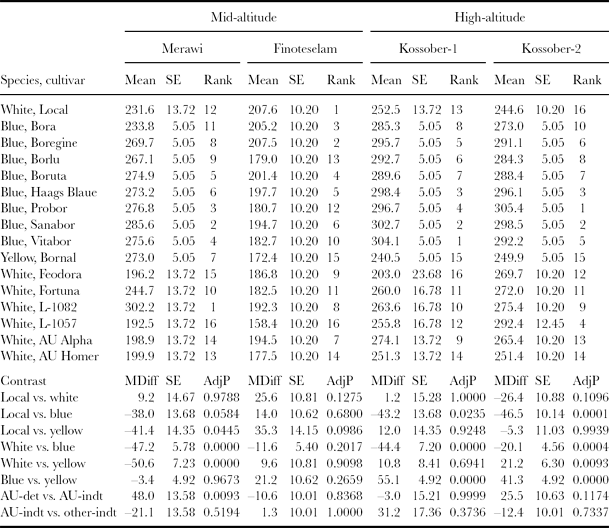
AU-det: AU-determinate; AU-indt: AU-indeterminate; other-indt: other-indeterminates; Mdiff: LS mean difference; SE: standard error.
Forage alkaloid content
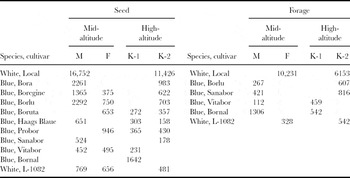
Due to the high cost of analysis, alkaloid analysis was done for few selected forage samples. At the mid-altitude locations among the forage samples analysed, the bitter Local Landrace had the highest forage alkaloid content (10,231 mg/kg DM) and the sweet blue Vitabor entry had the lowest alkaloid content (112 mg/kg DM) (Table 4). Among the sweet entries blue Bornal had the highest forage alkaloid content exceeding the sweet Vitabor entry by 1194 mg/kg DM. Similarly, at the high-altitude locations the Local Landrace and the sweet Vitabor entry had the highest (6153 mg/kg DM) and the lowest (459 mg/kg DM) forage alkaloid content, respectively. The range between the highest and the lowest forage alkaloid content among the sweet entries (357 mg/kg DM) was much lower than the observed range at the mid-altitude locations. Generally, except for the Local Landrace and blue Bornal, the forage alkaloid content was higher for the samples from the high-altitude locations than for those from the mid-altitude locations.
Seed crude protein content
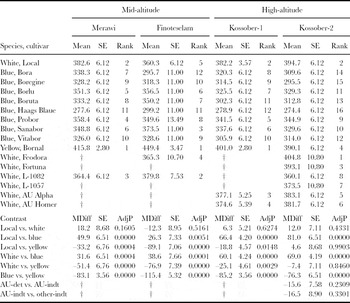
Except at Kossober-2, there was no complete data for all entries of the white group. Thus, this could be the limitation of the contrast analyses involving the white group entries. Seed crude protein content ranged between 274 g/kg and 449 g/kg DM at Kossober-2 from Haags Blaue entry and at Finoteselam from yellow entry, respectively (Table 2). Except at Kossober-2, where Feodora had the highest crude protein content, the sole yellow entry had the highest crude protein content at other three locations. Among all entries, Haags Blaue had the lowest seed crude protein content at all locations. As a group, compared with the Local Landrace, white and blue entries, the sole yellow entry had significantly higher (p ≤ 0.0148) seed crude protein content at all locations except at Kossober-2, where it had similar (p = 0.8460) crude protein content as white entries. Similar (p ≥ 0.1605) seed crude protein content was observed between the Local Landrace and white entries across all locations. Even though the overall seed crude protein content for blue group was consistent at all locations, they had significantly lower (p ≤ 0.0051) crude protein content than the Local Landrace, white group and yellow entry.
Least square means and contrast estimates for seed crude protein (g/kg DM) from laboratory evaluation of seven white, eight blue and one yellow annual lupin accessions at four locations (Merawi, Finoteselam, Kossober-1 and Kossober-2) in Ethiopia.

† No data; AU-det: AU-determinate; AU-indt: AU-indeterminate; other-indt: other-indeterminates; Mdiff: LS mean difference; SE: standard error.
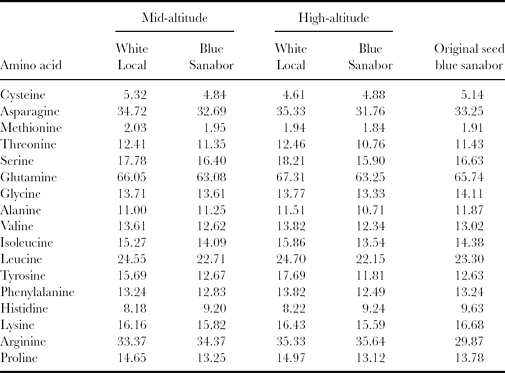
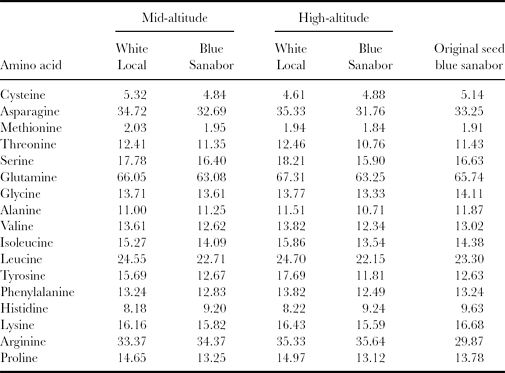
Similar to the alkaloid content, amino acid profile analysis was done for selected lupin samples. The analysis was done for the Local Landrace and blue Sanabor seed samples at both altitudes and for the original blue Sanabor seed (Table 3). The Local Landrace and blue Sanabor seeds grown in Ethiopia had relatively similar amino acid profile except for Tyrosine, where blue Sanabor, including the original seed, had lower Tyrosine than the Local Landrace. The original Sanabor seed and the Ethiopian-grown Local Landrace and blue Sanabor also had similar amino acid profile except for Arginine, where the original Sanabor seed had lower than the Ethiopian-grown seeds.
Amino acid profile (g/kg DM) of the original blue Sanabor seed, and the Ethiopia-grown white Local and blue Sanabor.
Seed alkaloid content
Similar to the forage samples, alkaloid analysis was done for selected seed samples. The seed alkaloid content ranged between 178 mg/kg and 16,752 mg/kg DM (Table 4). The bitter Local Landrace had the highest seed alkaloid content at both altitudes. However, the magnitude of the seed alkaloid content was very high at the mid-altitude location (Merawi). The sweet blue entries Boregine at Finoiteselam and Sanabor at Kossober-2 had the lowest seed alkaloid content at the mid- and high-altitude locations, respectively. Among all samples analyzed at both altitudes, the sweet blue Sanabor had the lowest (178 mg/kg DM) seed alkaloid content and among the sweet entries at both altitudes, blue Borlu had the highest (2,292 mg/kg DM) seed alkaloid content. Compared with the other sweet seed samples analysed, blue entries Bora (2261 mg/kg DM) and Borlu (2292 mg/kg DM) had exceptionally higher seed alkaloid content. Unlike to the forage alkaloid content, the overall seed alkaloid content was higher at the mid-altitude locations than at the high-altitude locations.
Forage and seed alkaloid contents (mg/kg DM) from laboratory evaluation of selected white, blue and yellow annual lupin accessions at four locations (Merawi, Finoteselam, Kossober-1 and Kossober-2) in Ethiopia.

M: Merawi; F: Finoteselam; K-1: Kossober-1; K-2: Kossober-2.
DISCUSSION
Forage crude protein and alkaloid contents
One limitation of this study was that altitude and soil type are confounded. Hence, the observed location × cultivar interaction effect for different variables (forage and seed crude protein contents) may not be necessarily due to the difference in altitude among locations alone. The forage crude protein content in this study from all cultivars at all locations varied between 158 g/kg DM (from white L-1057) and 305 g/kg DM (from blue Probor). The results of this study are much higher than reported by Bruno-Soares and Vaz (Reference Bruno-Soares, Vaz, van Santen, Wink, Weissmann and Roemer1999), who reported the maximum forage crude protein contents of 142 and 167 g/kg DM from white and blue lupins at pod stage sampling, respectively. The discrepancy in these two results could be associated with differences in stage of sampling and cultivars used. Similarly, Bhardwaj et al. (Reference Bhardwaj, Starner and van Santen2010) reported a mean forage crude protein content of 187 g/kg DM, which is lower than the crude protein content reported in this study from most white entries. However, the forage crude protein content from yellow lupin reported by Bruno-Soares et al. (Reference Bruno-Soares, Campos-Andrada, Falcao, Cunha and Hill1999) with a range of 180 to 220 g/kg DM is in line with the range of forage crude protein content of yellow lupin, 172 to 273 g/kg DM reported in this study. The relatively lower forage crude protein content for most of the cultivars in the mid-altitude testing sites, especially at Finoteselam, could be associated with the relatively lower rainfall and higher temperature of the study sites. According to Norton and Poppi (Reference Norton, Poppi, D'Mello and Devendra1995), higher temperature and lower rainfall during vegetative phase generally increase fibre content and decrease digestibility and nutrient contents of the plant parts by largely decreasing the soluble carbohydrate content of the plant tissues.
The forage alkaloid content of the bitter Local Landrace found in this study was much higher than the one report by Vilarino et al. (Reference Vilarino, Maregianni, Grass, Leicach and Ravetta2005) (2700 mg/kg DM). However, the range values of the forage alkaloid content observed for the sweet blue, white and yellow entries was in line with other similar studies (Bruno-Soares and Vaz, Reference Bruno-Soares, Vaz, van Santen, Wink, Weissmann and Roemer1999; Bruno-Soares et al., Reference Bruno-Soares, Campos-Andrada, Falcao, Cunha and Hill1999; Maknickiene and Asakaviciute, Reference Maknickiene and Asakaviciute2010).
Seed crude protein, amino acid and alkaloid contents
The crude protein content is the most important nutrient component in lupin species because the crop is valued for its high crude protein content. In this study yellow lupin had the highest seed crude protein content among the four entry groups followed by all white entries, including the Local Landrace. Blue entries had the lower seed crude protein content. Wasilewko and Buraczewska (Reference Wasilewko and Buraczewska1999) in their experiment on these three lupin species reported that yellow lupin had the highest crude protein content followed by white and blue lupin. Gross (Reference Gross and Twardowski1988) also reported similar order in the seed crude protein content among the three annual lupin species. In addition to the trend, the crude protein content of each species in this study was similar with the reports by Bruno-Soares et al. (Reference Bruno-Soares, Campos-Andrada, Falcao, Cunha and Hill1999), Erbas et al. (Reference Erbas, Certel and Uslu2005), Flis et al. (Reference Flis, Zdunczyk, Juskiewicz, van Santen, Wink, Weissmann and Roemer1999), Roth-Maier (Reference Roth-Maier, van Santen, Wink, Weissmann and Roemer1999) and Sujak et al. (Reference Sujak, Kotlarz and Strobel2006). Though blue entries had lower crude protein content, the lowest seed crude protein content obtained in this study (274 g/kg DM) from blue Haags Blaue is still favourable for use as a protein supplement in livestock feed and human food. In addition to this, the higher seed-yielding potential of most blue entries, according to the study conducted by the proponents of this study, coupled with their reasonably good seed crude protein content makes the sweet blue species appropriate for further production and use in the study area.
The amount of the individual amino acids in both species in this study was in line with other similar studies (Campos-Andrada et al., Reference Campos-Andrada, Santana, Felgueiras, Mimoso, Empis, van Santen, Wink, Weissmann and Roemer1999; Gilbert and Acamovic, Reference Gilbert, Acamovic, van Santen, Wink, Weissmann and Roemer1999). In addition, the amount of the essential amino acids profile in this study fulfils the requirements of the ideal protein. According to Cole and Van Lunen (Reference Cole, Van Lunen and D'Mello1994), the appropriate balance of essential amino acids in the ideal protein would be as follows: lysine, 100; methionine + cysteine, 50; threonine, 65–67; tryptophan, 18; isoleucine, 50; leucine, 100; histidine, 33; phenylalanine + tyrosine, 100 and valine, 70. The relatively good balance of the essential amino acids is very important for the use of sweet lupin seeds as home-grown protein supplement feed in poultry production in Ethiopia.
Just as important as the crude protein content in lupin seeds is the alkaloid content because it limits use of the crop as livestock feed and/or human food. The alkaloid content presented in this study might not be conclusive due to lack of replications. Nevertheless, the results show the difference in alkaloid content between bitter and sweet cultivars and the variations within sweet cultivars. The seed alkaloid content for the Local Landrace in this study was in agreement with the report by the proponents of this study (Yeheyis et al., Reference Yeheyis, Kijora, Wink and Peters2011), who reported an alkaloid content of 11,700 mg/kg and 14,300 mg/kg DM from the Local Landrace seeds sampled from mid- and high-altitude lupin growing areas, respectively. The seed alkaloid contents of most sweet entries in this study were in agreement with similar studies (Bruno-Soares et al., Reference Bruno-Soares, Campos-Andrada, Falcao, Cunha and Hill1999; Gdala et al, Reference Gdala, Smulikowska, Zdunczyk, Pastuszewska, van Santen, Wink, Weissmann and Roemer1999). However, the maximum alkaloid content from sweet lupins in this study (2292 mg/kg DM) was much higher than the maximum alkaloid content (720 mg/kg DM) reported by the same authors. The overall mean seed alkaloid content was higher at the mid-altitude (2067 mg/kg DM) than the high-altitude (1297 mg/kg DM). A similar result was obtained with bitter lupins from the Rocky Mountain lupin (L. argenteus Pursh), in which alkaloid contents were negatively correlated with altitude (Carey and Wink, Reference Carey and Wink1994). In addition, it could be associated with differences in the amount of rainfall and length of growing season in the two altitude areas. According to Christiansen et al. (Reference Christiansen, Jornsgard, Buskov and Olsen1997), moisture stress during the vegetative phase increases seed alkaloid content in lupin. In this study the high-altitude study areas (Kossober-1 and Kossober-2) receive larger annual rainfall and have longer growing season than the mid-altitude study areas (Merawi and Finoteselam).
In general, compared with the bitter varieties, sweet annual lupin varieties are sensitive to biotic factors because of their relatively low alkaloid content, which serves as one of their defense mechanisms. Alkaloids are very important for the well being of lupin plant by serving as chemical defence against herbivores and pests. Some alkaloids also have antibacterial, antiviral and antifungal behaviours (Wink, Reference Wink, Fattorusso and Taglialatela-Scafati2008). The successful establishment, growth and yield performance of sweet lupins in Ethiopia (Yeheyis et al., Reference Yeheyis, Kijora, van Santen and Peters2012), where the biotic and abiotic stresses on crops are relatively high, shows the wide adaptation potential of sweet lupins and the possibility to use these crops as protein source in Ethiopia. However, as this study is the first on sweet lupins in Ethiopia, their susceptibility to insects and pests in further production process in the country has to be assessed. In addition, there has to be a further study on the stability of alkaloid contents of sweet lupins under different soil types of the traditional lupin growing areas in Ethiopia. According to Gremigni et al. (Reference Gremigni, Hamblin, Harris and Cowling2003) phosphorus and potassium deficiency and their interaction in the soil has an impact on the seed alkaloid content in narrow-leafed lupins.
Though there are inter- and intra-species variations in nutrient composition, sweet lupin entries in general had relatively high nutritive values at all locations. The relatively good nutrient balance, reasonably higher yield performance (Yeheyis et al., Reference Yeheyis, Kijora, van Santen and Peters2012) and higher crude protein content of sweet lupins grown in Ethiopia show the possibility to use sweet lupin forage and seeds as cheap home-grown protein source for the small-scale livestock producers in the country. In addition, sweet lupin seeds could be used as protein source ingredients for the feed industry in the country. However, laboratory evaluation of nutrient composition alone cannot be an adequate indicator of nutritive value, since the availability of different nutrients to the animal body is affected by the extent of digestibility of the nutrients in the animal body. Thus, for more reliable information the laboratory results in this study need to be supported by animal evaluation studies using the forage and seeds of sweet lupins in the traditional lupin growing areas of Ethiopia.
CONCLUSIONS AND RECOMMENDATIONS
According to the results of this study, sweet lupin cultivars evaluated in this study had very good nutritional value. There were variations in chemical composition among entries within and across locations. The very lower alkaloid content of sweet lupins coupled with their relatively better forage and seed crude protein content gives them advantages over bitter genotypes in the study area for further production and use in livestock feed and human food. The big within location alkaloid content difference observed among sweet entries depicts the need for further in-depth study on alkaloid content of sweet lupins. Based on the laboratory evaluation, sweet lupin forage and seed can be used as home-grown protein source in livestock feed and human food. However, for more reliable information the laboratory results need to be verified by animal and human evaluations of the crop.
Acknowledgement
The first author would like to acknowledge the Deutscher Akademischer Austausch-Dienst (DAAD) for a PhD scholarship award. We are grateful to Mr. Tamiru, Tefera, Mesfin, Wubet, Jemal and Cherinet, staff members of Amhara Regional Agricultural Research Institute (ARARI), Ethiopia, for their help during planting, sampling and sample processing. Special thanks go to Mrs. Krause, Mrs. Heller and Mrs. Sarsour for their unreserved efforts in helping us in the whole laboratory analysis work. We would like to thank also the ARARI's Rural Capacity Building Project, Ethiopia and the Eastern and Southern Africa Partnership Program (ESAPP), Switzerland, for their financial support in the fieldwork. Our special thanks go to Vater und Sohn Eiselen Foundation for the financial support, and A. Backhaus and F. Sporer (IPMB Heidelberg) for the technical support to conduct the alkaloid analysis.