



1. Introduction
The past two decades have witnessed a revolution in exoplanetary science, with thousands of planets discovered around stars of diverse spectral types. A significant fraction of these planets orbit M dwarfs, which represent nearly 70-75% of the stellar population in the Galaxy. Their low luminosities mean that the habitable zones (HZs), defined as the region where liquid water can exist on a planetary surface, lie very close to the host star (Shields et al. Reference Shields, Ballard and Johnson2016). Consequently, planets in the HZ of M dwarfs are subjected to intense stellar magnetic activity. These systems offer several advantages for habitability studies, including more frequent transits, favorable star-to-planet radius ratios for atmospheric characterization, and longer-lived habitable zones due to the stars’ extended lifespans (Gale & Wandel Reference Gale and Wandel2017).
However, M-dwarf stars present unique challenges to planetary habitability, particularly through their heightened stellar activity compared to G-type stars like our Sun (Segura et al. Reference Segura, Walkowicz, Meadows, Kasting and Hawley2010). On the one hand, energetic flares, coronal mass ejections (CMEs), and strong winds may erode planetary atmospheres or create hostile surface environments (Tilley et al. Reference Tilley, Segura, Meadows, Hawley and Davenport2019). On the other hand, flares also generate ultraviolet (UV) photons that can drive prebiotic chemical reactions, potentially facilitating the emergence of life in otherwise UV-deficient environments (Rimmer et al. Reference Rimmer, Thompson, Xu, Russell, Green, Ritson, Sutherland and Queloz2021). This duality makes stellar activity central to the discussion of habitability. Understanding how different atmospheric compositions respond to these radiation environments is crucial for assessing the habitability potential of M-dwarf planetary systems.
This study examines two contrasting M-dwarf planetary systems: TOI-700, hosting the Earth-sized planet TOI-700 d in its habitable zone (HZ) (Rodriguez et al. Reference Rodriguez2020; Gilbert et al. Reference Gilbert, Vanderburg and Rodriguez2023) and characterized as a relatively quiet M-dwarf, and TRAPPIST-1 with three planets in the HZ (Gillon et al. Reference Gillon, Triaud and Demory2017), which experiences frequent stellar flares approximately every 28 hours. By modeling various atmospheric compositions and their responses to different UV radiation levels, we investigate how stellar activity influences surface conditions and the potential for life to develop and persist.
The research addresses several key questions:
-
• How do different atmospheric compositions shield planetary surfaces from harmful UV radiation?
-
• What is the impact of stellar flares on atmospheric chemistry and surface habitability?
-
• What are the implications for detecting biosignatures in these atmospheres?
Through comprehensive atmospheric modeling and spectral analysis, this study provides insights into the complex relationship between stellar activity and planetary habitability, with significant implications for future exoplanet characterization missions.
2. Stellar Activity and Its Dual Role
Magnetic activity in late-type stars is powered by dynamos, which consequences are varied: starspots trace magnetic flux emergence at the surface; flares and CMEs release stored magnetic energy into the stellar atmosphere; and stellar winds transport mass and angular momentum throughout the planetary system. From a planetary perspective, these manifestations can be harmful (Airapetian et al. Reference Airapetian, Glocer and Khazanov2017). High-energy particles associated with flares can destroy atmospheric ozone by producing odd-nitrogen and odd-hydrogen species (Segura et al. Reference Segura, Walkowicz, Meadows, Kasting and Hawley2010). Frequent CMEs may strip significant fractions of an atmosphere (Nishioka et al. Reference Nishioka, Seki and Sakata2023), especially if the planet lacks a strong magnetic field. Stellar winds exert continuous pressure, shaping planetary magnetospheres and driving non-thermal escape.
Yet, the same activity can be beneficial. Photochemistry in prebiotic pathways, such as the synthesis of ribonucleotides or amino acid precursors, requires near-ultraviolet photons (Rimmer et al. Reference Rimmer, Thompson, Xu, Russell, Green, Ritson, Sutherland and Queloz2021). Around late M dwarfs, the quiescent UV flux is too low to support these reactions. In such cases, flares may provide the necessary intermittent bursts of radiation. The interplay of destructive and constructive roles of stellar activity is therefore subtle, and must be assessed with detailed models that consider atmospheric composition, shielding mechanisms, and biological resilience.
2.1. Protective Factors for Life
Whether flare and particle fluxes compromise or enable habitability depends strongly on planetary protection. Modern Earth illustrates how an ozone layer can block most harmful UVC and a substantial fraction of UVB radiation. For planets with oxygen-poor but methane-rich atmospheres, photochemical hazes can scatter and absorb UV, attenuating surface flux by up to 97%. Oceans provide another refuge: a few meters of water reduce UV levels drastically (Estrela & Valio Reference Estrela and Valio2018), while still permitting photosynthesis in the photic zone. Thus, assessing the survival and potential evolution of life requires not only stellar input spectra but also planetary context.
3. Research Methodology
Our modeling framework combines stellar flare spectra, radiative transfer, and photochemical evolution. Flares were scaled from observed events on active M dwarfs such as AD Leo (Hawley & Pettersen Reference Hawley and Pettersen1991). We adopted two main atmospheric models: an Archean-like scenario dominated by nitrogen and carbon dioxide with no ozone layer, and a modern Earth-like composition including oxygen, ozone, water vapor, and trace gases (Estrela et al. Reference Estrela, Palit and Valio2020).
To evaluate biological impact, we used two microbial proxies. Deinococcus radiodurans, one of the most radiation-resistant organisms known, represents an upper bound for survival under high-UV conditions. Escherichia coli, with typical sensitivity to UV, represents more fragile life. For both cases we calculated the biologically effective irradiance at the surface and within oceans. Additionally, we used the Planetary Spectrum Generator to synthesize transmission spectra for comparison with observational capabilities.
3.1. Atmospheric Modeling
To investigate the impact of stellar activity on planetary atmospheres, we employed the 1D Photochemical Model coupled to the ATMOS Climate model (Arney et al. Reference Arney, Domagal-Goldman and Meadows2016) for TOI-700 d and the two-stream radiative transfer code (Ranjan et al. Reference Ranjan, Wordsworth and Sasselov2017) for the TRAPPIST-1 planets. This integrated modeling approach allowed us to simulate both Archean (early Earth-like) and modern Earth-like atmospheres under varying conditions of stellar radiation and atmospheric pressure. The model accounts for key photochemical reactions, radiative transfer processes, and climate feedback mechanisms that determine atmospheric composition and structure.
The ATMOS photochemical model calculates the production and loss rates of atmospheric species through hundreds of chemical reactions, while the climate component computes the resulting temperature profile based on radiative-convective equilibrium. This coupled approach ensures self-consistency between atmospheric composition and thermal structure. We systematically varied two key parameters to explore a range of potential atmospheric states:
-
(1) Atmospheric Pressure: Simulations were conducted at surface pressures of 0.5, 1.0, 2.0, and 4.0 bar to investigate how atmospheric density affects UV shielding, temperature profiles, and surface conditions.
-
(2) UV Flux Scenarios: Two distinct UV radiation environments were modeled:
-
– Quiescent state (
 $f_{UV} = 1$
): Representing the baseline UV emission from the host star;
-
– Flare event (
$f_{UV} = 10$
): Simulating a tenfold increase in UV radiation during stellar flares.
-


These parameter variations allowed us to explore 8 distinct atmospheric scenarios (4 pressure levels
 $\times$
2 UV flux conditions) for both Archean and modern Earth-like compositions, resulting in a comprehensive assessment of potential habitability conditions.
3.2. Habitability Assessment
To evaluate the potential for surface habitability, we analyzed three critical factors:
-
(1) Surface Temperature: We determined whether surface temperatures remained within the range compatible with liquid water (273-373 K), a fundamental requirement for life as we know it.
-
(2) UV Shielding: We quantified the effectiveness of different atmospheric compositions in attenuating harmful UV radiation reaching the planetary surface.
-
(3) Biologically Effective Irradiance: We calculated the radiation doses that model organisms would experience over their generation periods, using the two reference microorganisms. Survival thresholds were established based on laboratory studies, with 10% survival rates corresponding to radiation doses of 553 J/m
$^2$
for D. radiodurans and 22.6 J/m
$^2$
for E. coli (Gascón et al. Reference Gascón, Oubiña, Pérez-Lezaun and Urmeneta1995).


3.3. Spectral Analysis
To assess the detectability of atmospheric features and potential biosignatures, we generated transmission spectra using the Planetary Spectrum Generator (Villanueva et al. Reference Villanueva, Smith, Protopapa, Faggi and Mandell2018). These synthetic spectra simulate observations that might be obtained by current and future space telescopes, allowing us to evaluate which atmospheric components would be detectable and under what conditions.
The spectral analysis focused particularly on key biosignature gases such as methane (CH
 $_4$
), oxygen (O
 $_2$
), and carbon dioxide (CO
 $_2$
), as well as the impact of atmospheric haze on spectral features. This approach provides insights into both the habitability of these worlds and our ability to characterize them through remote observations.
4. Results for TRAPPIST-1 system
TRAPPIST-1 is an ultracool dwarf with seven Earth-sized planets, three of which reside in the habitable zone (Gillon et al. Reference Gillon, Triaud and Demory2017). Observations with the K2 mission revealed 42 flares in less than 80 days (Vida et al. Reference Vida, Kővári, Pál, Oláh and Kriskovics2017), with energies up to
 $10^{33}$
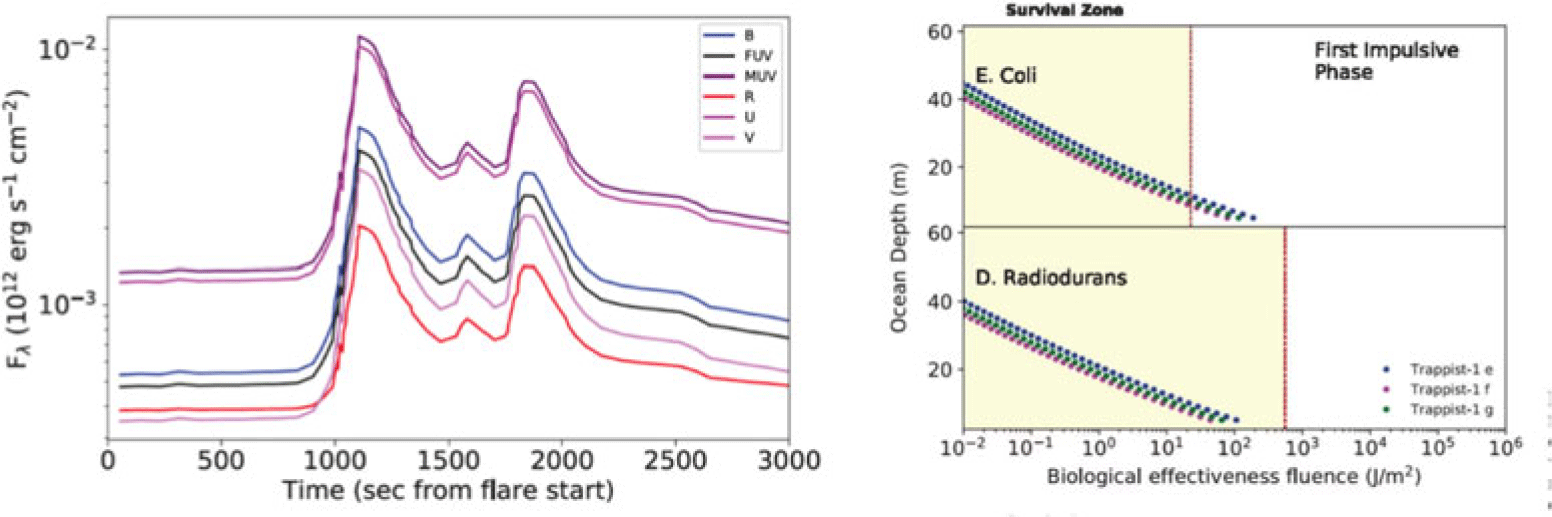
erg. One such event, that lasted for 72 min (Figure 1, left panel), was comparable in energy to the Carrington solar flare of 1859 (Carrington Reference Carrington1859).
Left: Estimated mean fluxes of the Trappist-1 flare in various K2 wavelength ranges. Right: Biologically effective irradiance for the bacteria with depth in an Archean ocean present in Trappist-1 e, f, and g. The red vertical line represents the threshold for finding life determined by the maximum UV flux for 10% survival of E. coli and of D. radiodurans. From Estrela et al. (Reference Estrela, Palit and Valio2020).

Figure 1 Long description
Panel A: A line graph shows the estimated mean fluxes of the Trappist-1 flare in various K2 wavelength ranges. The x-axis represents time in seconds from the flare start, and the y-axis represents flux in units of 10^12 erg s^-1 cm^-2. Different lines represent different wavelength ranges: B, FUV, MUV, R, U, and V. The graph shows peaks and variations in flux over time for each wavelength range. Panel B: A line graph illustrates biologically effective irradiance for bacteria with depth in an ocean present in Trappist-1 e, f, and g. The x-axis represents biological effectiveness fluence in J/m^2, and the y-axis represents ocean depth in meters. The graph includes a survival zone for E. Coli and D. Radiodurans, with a red vertical line indicating the threshold for finding life determined by the maximum UV flux for 10% survival of E. coli and D. radiodurans.
Our models show that these flares dramatically enhance the stellar UV output, increasing top-of-atmosphere fluxes by orders of magnitude. For planets with Archean-like atmospheres, surface radiation during flares becomes lethal for UV-sensitive organisms, although resistant microbes might survive on outer HZ planets or beneath modest ocean depths (8-11 m), as shown in the right panel of Figure 1. Modern atmospheres fare better: ozone layers reduce surface flux sufficiently to allow survival, though repeated proton events could deplete ozone reservoirs. Importantly, the same flares supply UV photons that may drive prebiotic chemistry, suggesting a paradoxical role in which activity both threatens and enables life.
4.1. Impact of Consecutive Flares
Flare impacts reveals a potentially significant underestimation in previous studies that focused on single flare events. For planets orbiting active M-dwarfs like TRAPPIST-1, where flares occur approximately every 28 hours, the cumulative effect on atmospheric chemistry could be substantial and long-lasting (Tilley et al. Reference Tilley, Segura, Meadows, Hawley and Davenport2019).
While a single flare without energetic particle enhancement would allow the ozone layer to recover in about 30 hours, a large flare with associated energetic particles could deplete the ozone layer for approximately 30 years (Estrela et al. Reference Estrela, Palit and Valio2020). Given the frequency of flares in the TRAPPIST-1 system, this suggests that ozone depletion could be significant and persistent, creating challenging conditions for surface life.
This cumulative impact highlights the importance of considering flare frequency, not just intensity, when assessing the habitability of planets around active M-dwarf stars. The reality of TRAPPIST-1 planets likely involves a continuous state of atmospheric response to repeated stellar activity, rather than isolated recovery periods following discrete events.
4.2. Magnetic Field Protection
A strong planetary magnetic field could potentially shield the atmosphere from the impacts of enhanced proton flux associated with superflares. However, the requirements for such protection are substantial: TRAPPIST-1 habitable zone planets would need magnetic fields of approximately
 $10 - 10^3$
gauss, compared to Earth’s magnetosphere of only about 0.5 gauss.
Such strong fields would be necessary due to the high magnetic pressure exerted by the host star. Without these robust magnetic fields, the atmospheres of these planets would be more vulnerable to erosion from repeated flaring events, potentially compromising their long-term habitability. This finding emphasizes the importance of considering planetary magnetic fields in habitability assessments, particularly for planets orbiting active stars with frequent flaring activity.
5. Results for TOI-700 system
TOI-700 is a mid-M dwarf with four known planets, two of them in the habitable zone (Gilbert et al. Reference Gilbert, Barclay and Schlieder2020, Reference Gilbert, Vanderburg and Rodriguez2023). Unlike TRAPPIST-1, this star exhibits relatively low activity. X-ray fluxes are modest and flare frequency is low. Consequently, atmospheric escape and ozone destruction are less severe. Photochemical simulations for TOI-700 planets with pressures between 0.5 and 4 bar indicate that stable climates can be maintained, with surface temperatures between 278 and 306 K. Archean-like atmospheres rich in methane produce hazes that substantially reduce surface UV flux, while modern atmospheres develop ozone layers that efficiently shield organisms.
All simulated atmospheric scenarios maintained surface temperatures compatible with liquid water, ranging from approximately 278K (5
 $^\circ$
C) in the modern Earth-like model to 306K (33
 $^\circ$
C) in the Archean model with 4 bar pressure and low UV flux (Sumida et al. Reference Sumida, Estrela and Valio2025). This temperature range is well within the limits for known life forms and would allow for stable bodies of liquid water on the planetary surface.
The results indicate that atmospheric pressure plays a significant role in determining surface temperature, with higher pressure scenarios generally resulting in warmer conditions due to enhanced greenhouse effects. This relationship between atmospheric pressure and surface temperature suggests that planets with denser atmospheres might maintain habitable conditions even at greater distances from their host stars.
5.1. Atmospheric Composition Profiles
Our simulations revealed significant differences in atmospheric composition between Archean and modern Earth-like atmospheres, with UV flux levels strongly influencing the vertical distribution of key molecular species. In Archean scenarios, methane concentration was approximately
 $10^3$
times higher than in modern Earth-like atmospheres, with both showing exponential decreases with altitude under high UV conditions (Sumida et al. Reference Sumida, Estrela and Valio2025).
The photochemical pathways differed substantially between the two atmospheric types. In low-UV Archean atmospheres, haze formation dominated the photochemistry, creating thick layers of organic particles that effectively scattered and absorbed incoming radiation (Arney et al. Reference Arney, Domagal-Goldman and Meadows2016; Meadows et al. Reference Meadows, Arney and Schwieterman2018). In contrast, high-UV modern atmospheres developed significant ozone production as the primary UV-shielding mechanism, forming a protective layer in the upper atmosphere similar to Earth’s ozone layer. These distinct photochemical regimes demonstrate that multiple evolutionary pathways can lead to effective UV protection, depending on the initial atmospheric composition and the stellar radiation environment.
5.2. UV Radiation and Surface Protection
Our analysis revealed two distinct mechanisms providing effective UV shielding at the planetary surface:
-
• Haze Protection in Archean Atmospheres: In the Archean scenarios with low UV flux (
$f_{UV} = 1$
), thick organic haze layers formed from methane photochemistry provided exceptional UV shielding, reducing surface UV flux by approximately 97% compared to a planet without haze. This protection mechanism is particularly effective at shorter wavelengths where biological damage is most severe. -
• Ozone Protection in Modern Atmospheres: In modern Earth-like atmospheres with high UV flux (
$f_{UV} = 10$
), significant ozone formation created a protective band in the 200-320 nm range, effectively attenuating biologically damaging UV radiation. This mechanism mirrors Earth’s ozone layer, which developed after the rise of oxygen-producing photosynthesis.


In both cases, higher atmospheric pressure enhanced UV protection by increasing the column density of absorbing and scattering molecules. These findings demonstrate that multiple photochemical pathways can lead to effective UV shielding, offering alternative routes to surface habitability depending on atmospheric composition and stellar conditions.
5.3. Biological Implications
Based on biologically effective irradiance calculations, the only scenario that failed to sustain bacterial survival across all pressures was the Archean atmosphere under high UV conditions (
 $f_{UV} = 10$
), where radiation levels exceeded tolerance thresholds for both test organisms. The radiation-resistant bacterium D. radiodurans showed potential survival in most scenarios, while the more sensitive E. coli demonstrated viability primarily in modern Earth-like atmospheres with sufficient ozone protection or in Archean atmospheres with extensive haze formation under low UV conditions. These results suggest that microbial life could potentially develop and persist on planets orbiting M-dwarf stars, provided they maintain appropriate atmospheric compositions that offer sufficient UV protection. The findings also highlight the importance of considering both atmospheric chemistry and biological tolerance limits when assessing exoplanet habitability.
5.4. Transmission Spectra and Biosignature Detection
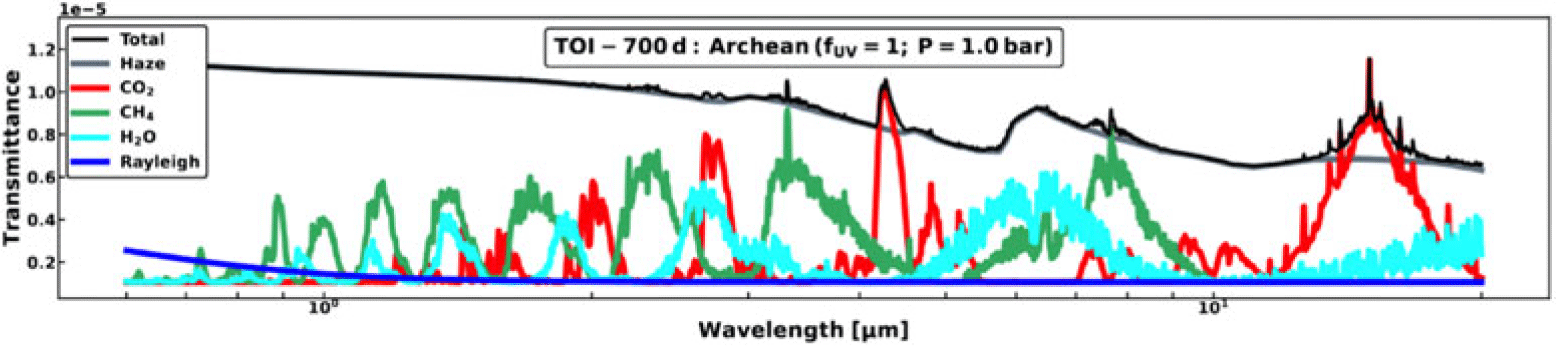
The transmission spectra generated from our atmospheric models revealed significant differences in the detectability of key molecular features (Figure 2). In Archean atmospheres, haze particles obscured spectral features at shorter wavelengths, potentially masking biosignatures like CH
 $_4$
and O
 $_2$
. This creates a paradoxical situation where the same atmospheric features that enhance surface habitability (by providing UV protection) may also make detecting signs of life more challenging.
TOI-700 d Archean atmosphere’s transmission spectra for the most abundant molecules, with
 $f_\mathrm{UV}$
=1 and 1.0 bar pressure. The combined contribution is depicted by the black line Sumida et al. (Reference Sumida, Estrela and Valio2025).

Carbon dioxide features remained prominent in all scenarios regardless of abundance, making CO
 $_2$
a reliable atmospheric marker for remote characterization. Ozone absorption bands became prominent only with sufficient UV flux in Earth-like atmospheres, providing a potential indicator of high UV environments. The spectral analysis also revealed practical detection limitations, with spectral line contrasts peaking at less than 15 parts per million and current instrumental noise (e.g., from JWST) ranging from 10-20 ppm at 1
 $\sigma$
. These constraints highlight the technical challenges in definitively characterizing the atmospheres of Earth-sized planets around M-dwarf stars with current technology (Suissa et al. Reference Suissa, Mandell, Wolf, Villanueva, Fauchez and Kopparapu2020).
Our results highlight the complex dual role that atmospheric haze plays in habitability and detection:
-
(1) UV Protection: Haze provides exceptional shielding against harmful UV radiation, potentially enhancing surface habitability by reducing biologically damaging radiation.
-
(2) Biosignature Masking: Thick haze layers can obscure key spectral features, making it difficult to detect important biosignature gases like CH
$_4$
, CO
$_2$
, and O
$_2$
through transmission spectroscopy. -
(3) Atmospheric Signal Enhancement: Despite masking specific features, haze increases overall atmospheric detectability by enhancing scattering and transit depth.


This interplay creates what we term the “habitability-detectability paradox”: the same atmospheric features that make a planet more habitable may also make detecting signs of life more challenging. This paradox has important implications for observation strategies and interpretation of exoplanet atmospheric data.
6. Discussion and Conclusions
The comparison between TRAPPIST-1 (Estrela et al. Reference Estrela, Palit and Valio2020) and TOI-700 (Sumida et al. Reference Sumida, Estrela and Valio2025) illustrates the diversity of planetary environments around M dwarfs. In TRAPPIST-1, frequent and energetic flares continuously challenge atmospheric integrity and biological survival, yet may also have provided the UV flux necessary for the origin of life. In TOI-700, the quiescent stellar spectrum reduces atmospheric stress but also limits opportunities for flare-driven prebiotic chemistry.
Our comprehensive analysis of TOI-700 d, an Earth-sized exoplanet in the habitable zone of a relatively quiet M-dwarf star, provides encouraging results for its potential habitability. The planet’s position in a less active stellar system compared to TRAPPIST-1 suggests it may avoid the most severe consequences of stellar activity. The modeled surface temperatures (278-306K) across all atmospheric scenarios remain compatible with liquid water, a fundamental requirement for life as we know it. Additionally, the UV reduction of up to 97% in haze-rich atmospheres suggests that even with limited ozone production, the planet could maintain surface conditions amenable to microbial life. These findings position TOI-700 d as a compelling target for future atmospheric characterization missions, representing a potentially more favorable environment for habitability than planets orbiting more active M-dwarf stars.
These results emphasize that habitability is not a binary property but rather a balance between competing factors. Protective mechanisms, such as ozone layers, photochemical hazes, and oceans, are essential in mediating the effects of stellar activity. Moreover, the dual role of flares complicates the interpretation of biosignatures: while they can erode atmospheres, they may also catalyze the very processes that produce detectable gases.
This study provided a comprehensive assessment of how stellar activity impacts the habitability of exoplanets orbiting M-dwarf stars, with particular focus on the effects of UV radiation and flare events on atmospheric chemistry and surface conditions. Our key findings include:
-
(1) Stellar activity around M dwarfs exerts both destructive and constructive influences on habitability.
-
(2) The survival of life depends on atmospheric shielding and the presence of refuges such as oceans.
-
(3) Prebiotic chemistry may benefit from flare-induced UV, particularly on worlds with otherwise insufficient near-UV flux.
-
(4) The detectability of biosignatures is strongly affected by hazes and by the interplay of flare-driven photochemistry and atmospheric loss.
Despite the challenges posed by stellar activity, our results suggest that habitable conditions could exist on planets orbiting M-dwarf stars through various atmospheric adaptation mechanisms. Oceans may provide additional protection for life, with resistant bacteria potentially surviving at the surface and more sensitive organisms at depths of approximately 10 meters even without an ozone layer.
Future work should integrate multi-wavelength monitoring of host stars with coupled atmosphere-ocean-biogeochemistry models. Only by connecting stellar variability to planetary responses can we refine our criteria for habitability.
Acknowledgements
We acknowledge support from CNPq and FAPESP. Part of this research was carried out at JPL/Caltech under contract with NASA.
 fUV


