


Migration is a fundamental aspect of the human experience. More than just the physical movement of people across geographic space, modern migration is interwoven with broader processes, such as demographic shifts, changing agricultural strategies, urbanization, and transformations of gender roles and language practices (Kearney Reference Kearney1986). Archaeologists have long recognized migration as a driver of cultural change, affecting both migrant and local communities in diverse ways (Anthony Reference Anthony1990; Cameron Reference Cameron1995; Van Dommelen Reference Van Dommelen2014). Migrant–local interactions may foster cooperation and cultural integration, generating new or hybrid cultural practices. Alternatively, they may lead to competition, conflict, and even cultural replacement (Burmeister Reference Burmeister2000; Cabana and Clark Reference Cabana and Clark2011). When migrants maintain connections to their place of origin across multiple generations, they form diasporic communities that create identities rooted in shared heritage while continually adapting to new cultural contexts (Clifford Reference Clifford1994; Safran Reference Safran1991).
A central theme in the archaeological research on migration is how to trace and evaluate its cultural impacts in the archaeological record. Material culture has served as the primary evidence for tracking such transformations (Burmeister Reference Burmeister2000). Among material remains, ceramics represent one of the most durable and ubiquitous sources of evidence for tracing the presence of past human groups and the dynamics of cultural integration and transformation. For instance, in the American Southwest, Clark (Reference Clark, Cabana and Clark2011) observed that ancestral Puebloan immigrants in the Lower San Pedro Valley integrated into local communities so thoroughly that their distinctive corrugated pottery disappeared, suggesting little impact from the migrant group. In contrast, the Kayenta migrants retained their decorated ceramic tradition after relocation, ultimately forming a new diasporic identity that transformed both migrant and local groups. In historical contexts, Brighton’s (Reference Brighton2005, Reference Brighton2011) analyses of Irish immigrants in New York demonstrates that a shift in tableware use—from Irish forms to American styles—reflected not only changes in dining practices but also efforts to assimilate and reframe stigmatized ethnic identities.
Although ceramics can reflect cultural expression, they may not always be taken as direct indicators of any prescribed cultural identity or culinary practice (Silliman Reference Silliman2005). In certain contexts, migrants may retain familiar ceramic forms while adapting them to new functions suited to new environments. For example, Tang and colleagues (Reference Tang, Wang, Liu and Chen2023) examined the migration of the Neolithic Yangshao culture from the Yellow River region to the Northeastern Sichuan Highland (ca. 5000 BP). Although these migrants continued to make Yangshao-style painted pottery, they repurposed these vessels to process local wild roots and grasses, shifting away from the millet-based subsistence strategies of their homeland. In this case, the continuity in ceramic style masked a significant subsistence shift in daily practice, reflecting adaptation to the challenging ecological conditions of the Tibetan Plateau.
Conversely, the appearance of new or foreign material culture does not always signal cultural change, especially in contexts of unequal power dynamics. In colonial North America, for instance, Indigenous communities often adopted colonial objects in ways that reinforced traditional practices. At the Russian colony of Fort Ross, Indigenous people used European- and Asian-style ceramics not for food preparation or serving but as raw materials to craft native-style ornaments such as bead blanks (Lightfoot et al. Reference Lightfoot, Martinez and Schiff1998). In such cases, new material forms were integrated into local cultural practices in ways that reinforced, rather than replaced, Indigenous identity. These examples demonstrate the importance of examining not only ceramic typology but also the practical uses and social contexts of material culture.
This article examines the transnational lives of Chinese migrant communities during the mid-nineteenth and early twentieth centuries through the lens of one specific category of material culture: Chinese brown-glazed stoneware (CBGS). Manufactured in Guangdong, China, and exported globally, CBGS vessels were durable utilitarian wares commonly found in both migrant home villages and overseas diaspora communities. Their frequent appearance at diaspora sites has often been interpreted as evidence of cultural continuity, taken to suggest that Chinese migrants maintained their culinary and domestic traditions with little change (Collins Reference Collins1987; Diehl et al. Reference Diehl, Waters and Thiel1998; Greenwood Reference Greenwood1996; but see Voss et al. Reference Voss, Kennedy, Tan and Ng2018; Yang and Hellmann Reference Yang and Hellmann1998). However, such interpretations have typically relied on ceramic typologies without investigating how these vessels were used.
This study offers a new perspective by applying microfossil residue analysis to CBGS vessels from both a migrant home village in China and diaspora sites in California. Building on previous applications of microfossil methods to Chinese diaspora contexts, including dental calculus analysis of pig husbandry practices in Los Angeles Chinatown (Wang et al. Reference Wang, Ng and Serrao-Leiva2024), our research extends that approach to ceramic vessels. An examination of what these vessels once contained reveals the varied and context-specific ways in which CBGS was used across the Pacific. Rather than signifying cultural continuity, these vessels reflect adaptive strategies through which migrants experimented with new ingredients in both urban and rural settings abroad, while their families back home coped with the challenges of a precarious agrarian economy. By tracing their diverse functions, this study contributes to broader discussions of diaspora, adaptation, and the role of everyday objects in shaping transnational lives.
Rethinking Ceramics and Foodways in Chinese Diaspora Studies
In the nineteenth century, more than 2.5 million people left southern China for destinations around the world, forming one of the largest population movements in modern history (Hsu Reference Hsu2000; Pan Reference Pan1999). Most of these migrants came from the Siyi region in Guangdong, which includes the counties of Taishan (called Xinning before 1914), Xinhui, Kaiping, and Enping; many settled in the United States. These migrants left behind home villages afflicted by war—including the British Opium Wars (1839–1842, 1856–1860) and Punti-Hakka Wars (1855–1867), as well as recurrent floods and famines. In search of new opportunities, many arrived in California to work in mining, railroad construction, agriculture, and service industries (Chan Reference Chan1986; Chang Reference Chang2019; Takaki Reference Takaki1998:31–42). This transnational migration was accompanied by a sustained flow of goods. Import-export companies like jinshanzhuang, or “Gold Mountain” firms, facilitated the movement of Chinese goods across the Pacific, supplying Chinese-run stores throughout the United States with foodstuffs and daily necessities (Hsu Reference Hsu2000:34). These networks enabled migrants to maintain familiar material practices and cultivate a sense of “home away from home.”
On arriving in the United States in the late nineteenth century, Chinese migrants faced exclusionary laws, racial violence, and discriminatory stereotypes. White working-class laborers saw them as a threat to their economic livelihoods, portraying them as unfair competitors in labor markets. Anti-Chinese sentiment became so widespread that it culminated in the passage of the Chinese Exclusion Act of 1882. Early historical accounts often portrayed Chinese diaspora communities as perpetual foreigners living in insular and segregated enclaves with limited interaction with non-Chinese peoples and cultures (Nordhoff Reference Nordhoff1973 [1873]; Spier Reference Spier1958a).
Perhaps reflecting these historical realities, early archaeological research on Chinese diaspora sites in the United States often focused on issues of acculturation (Orser Reference Orser2004:86). Influenced by mid-twentieth-century social science models (e.g., Barth Reference Barth1969; Herskovits Reference Herskovits1938), researchers sought to evaluate the extent to which Chinese migrants assimilated into host societies. Within this framework, food-related material culture such as ceramics, as well as food remains, including animal bone and plant materials, were frequently treated as direct indicators of cultural continuity or change. Items like rice, pork, and Chinese wares were associated with Chinese “tradition,” whereas wheat, beef, and Euro-American wares were taken to signal Western influence or assimilation (Collins Reference Collins1987; Diehl et al. Reference Diehl, Waters and Thiel1998; Greenwood Reference Greenwood1996). Although this approach foregrounded important questions of identity and cultural practice, it has been criticized for oversimplifying the complexity of Chinese foodways and relying on a binary model of tradition versus acculturation (Cummings et al. Reference Cummings, Voss, Yu and Kováčik2014; Kennedy Reference Kennedy2016). More recent scholarship has emphasized the need for comparative data from migrants’ home villages in the Siyi region—an ecologically diverse area that supported a range of subsistence strategies—and recognition of the heterogeneous and adaptive strategies that Chinese migrants used to navigate life in the United States (Fong Reference Fong2013; Li Reference Li2006; Marks Reference Marks1998; Praetzellis and Praetzellis Reference Praetzellis and Praetzellis1997; Voss Reference Voss2005).
To move beyond the limitations of the acculturation paradigm, this research adopts a transnational framework. Transnational approaches emphasize the agency of individuals, communities, and businesses operating across national boundaries, shaping and being shaped by social and material transformations in both home and host contexts (Basch et al. Reference Basch, Schiller and Blanc1994; Bauböck and Faist Reference Bauböck and Faist2010; Hannerz Reference Hannerz1996). In Chinese diaspora studies, researchers have begun to examine comparative data from migrants’ home villages, particularly in the Siyi region of Guangdong. Australian researchers have examined remittance landscapes in the home villages of Zhongshan and their transnational connections to Australia (Byrne Reference Byrne2022; Byrne et al. Reference Byrne, Ang and Mar2023; Cheng Reference Cheng2022; Williams Reference Williams2018). The Cangdong Village Project (CVP) was the first transnational project to use multidisciplinary approaches to study material culture from a migrant’s home village in Kaiping County, Guangdong (Tan et al. Reference Tan, Voss and Kennedy2019; Voss et al. Reference Voss, Kennedy, Tan and Ng2018). Similarly, Laura W. Ng’s (Reference Ng, Rose and Kennedy2020, Reference Ng2021) research has examined the transnational connections between Chinese communities in San Bernardino and Riverside Chinatowns in inland Southern California and a diasporically connected home village in Taishan County, Guangdong. Collectively, these studies demonstrate the potential of transnational research to reveal how Chinese migrants and their home communities maintained, adapted, or transformed their cultural practices in response to the lived experiences and consequences of migration.
This study compares microfossil residues from CBGS sherds recovered from deposits dating from 1875 to 1927 at Cangdong Village, which has been occupied for about 740 years, with those from two contemporaneous Chinese diaspora settlements in California: San Bernardino Chinatown (1878–1941) and Summit Camp (1865–1869) at Donner Pass. By analyzing how CBGS vessels were used across these settings, this research highlights the internal diversity of food practices within Chinese communities across the Pacific. In doing so, it challenges long-standing assumptions of cultural homogeneity and static notions of “tradition” that have shaped interpretations of nineteenth-century Chinese migrant experiences.
Pots across the Pacific
From the mid-nineteenth to the early twentieth centuries, large volumes of Chinese goods, ranging from foodstuffs to domestic utensils, were shipped from Hong Kong and Guangzhou to North America. Among the most common durable containers used in this transpacific trade were CBGS vessels. Manufactured in Guangdong, these utilitarian wares were widely distributed in migrants’ home villages and overseas Chinese communities (Choy Reference Choy2014; Voss Reference Voss2016). CBGS vessels are frequently recovered in studies of Chinese diaspora sites yet have received limited scholarly attention, perhaps because of their coarse appearance compared to more decorated porcelains or the logistical challenges posed by their abundance and the limited funding available for analysis (Brott Reference Brott1987). Ethnographic and historical sources suggest that CBGS vessels were highly versatile. They were used to store grains, tea, pickled vegetables, medicinal herbs, soy sauce, wine, and vinegar and could also serve to collect rainwater or to prepare food (Yang and Hellmann Reference Yang and Hellmann1998). Given their ubiquity and presumed food-related uses, CBGS vessels offer a promising lens for examining everyday foodways across transnational Chinese communities. This study focuses on three sites where CBGS sherds were recovered in substantial quantities and are suitable for comparative microfossil residue analysis (Figure 1).
Geographic locations of Cangdong Village in Guangdong, China, and Donner Summit Camp and San Bernardino Chinatown in California. (Cangdong Village photo courtesy of the Cangdong Village Project; San Bernardino Chinatown photo courtesy of the San Bernardino Historical Society; Donner Pass Summit Camp photo courtesy of the Donner Summit Historical Society). (Color online)

Figure 1 Long description
A Pacific-centered locator map with a satellite-style basemap. China is on the left side and the western United States is on the right side, with the Pacific Ocean between them. Three labeled locations are marked with pin symbols. One pin marks Cangdong Village in Guangdong, China. Two pins mark Donner Summit Camp and San Bernardino Chinatown in California. Three inset photos appear along the top. Each inset photo is connected by a callout line to one of the pinned locations on the map.
Cangdong Village, located in Kaiping County, was founded approximately 740 years ago and had more than 400 residents by the early nineteenth century. By the early twentieth century, out-migration had reduced the population to around 50–60 residents (Tan Reference Tan2013). In 2016 and 2017, the CVP team conducted surface surveys and subsurface testing in the open areas between buildings, uncovering samples of material culture dating to the Late Qing (1875–1912) and Early Republic (1912–1927), which correspond to periods during and immediately after major overseas Chinese migrations (Voss et al. Reference Voss, Kennedy and Tan2019). Because of the acidic soil, macrobotanical preservation was poor, yielding mainly charcoal fragments and a small number of seeds, including rice and winter melon (Popper Reference Popper, Voss, Kennedy and Jinhua Tan2019). This limited preservation prompted the use of microfossil methods to explore historical foodways in this home village.
San Bernardino Chinatown (1878–1941) was a historic Chinese community located 60 miles east of Los Angeles. Immigration records indicate that many Chinatown residents and store owners came from Taishan County in Guangdong (Ng Reference Ng2021:97–98). At its height, the community was a thriving Chinatown with more than a hundred residents, who were engaged in various occupations, including operating laundries, growing and marketing vegetables, and working in restaurants, in hotels, and on farms. The community later declined as many of its buildings were demolished to make way for city development projects, eventually leading to its destruction in the 1940s (Costello et al. Reference Costello, Hallaran and Warren2004, Reference Costello, Hallaran, Warren and Akin2008; Ng Reference Ng2021). Excavations that were focused on the backyards of Chinatown residences uncovered features such as privies, roasting pits, and other storage and refuse structures, yielding thousands of artifacts. Macrobotanical analysis recovered primarily small fruit seeds, including blackberry, grape, fig, tomato, and elderberry, and smaller quantities of cereal crops such as wheat and beans. Interestingly, rice was not recovered, which led researchers to interpret this community as being “more acculturated” than other Chinatowns (Popper and Martin Reference Popper, Martin, Costello, Hallaran and Warren2004).
In contrast to the urban settlement of San Bernardino, Summit Camp (1865–1869) was a Chinese transcontinental railroad labor camp occupied during the construction of the Donner Summit tunnels. Located at an elevation of about 7,000 feet at the crest of Donner Pass in the Sierra Nevada, it was one of the largest and oldest labor camps associated with the construction of the first transcontinental railroad and was recently designated a National Historic Landmark (National Park Service 2024). According to historical accounts, the Chinese laborers working on these railroad projects were primarily young “farm boys” recruited from Guangdong by the Central Pacific Railroad (Chang Reference Chang2019:15–37; Griswold Reference Griswold1962:117–118). In 1969, Summit Camp became the first Chinese diaspora settlement in North America to be investigated by archaeologists and has since been the subject of multiple studies (Baxter and Allen Reference Baxter and Allen2015; for an overview, see Chace and Evans Reference Chace and Evans2015). Macrobotanical analyses from the site identified local foodstuffs such as bearberry and elderberry, as well as possible imported plants including rice, legumes, and possibly barley (Puseman and Cummings Reference Puseman and Cummings2008).
Comparisons of CBGS vessels at these three sites reveal both similarities and differences. The vessel forms recovered from diaspora sites in North America are also represented in the CBGS assemblage from Cangdong Village, suggesting that migrants used familiar material culture to create a sense of home. Nevertheless, the Cangdong Village assemblage contains a wider variety of vessel forms, sizes, paste compositions, and surface treatments than those found in diaspora sites. This suggests that the material culture of diasporic Chinese communities was shaped not only by migrants’ choices but also by the selective export strategies of intermediary commercial agencies such as jinshanzhuang (Hsu Reference Hsu2000; Voss et al. Reference Voss, Kennedy, Tan and Ng2018).
Analyzing Microfossil Residues from CBGS
CBGS vessels are especially well suited for microfossil analysis because of their porous, often unglazed interior surfaces. When used to store food and liquids, microscopic particles such as starch granules, phytoliths, and diatoms can become embedded within the ceramic matrix. After burial, some of these particles may remain preserved within the pores of the fabric, providing insights into past plant use, storage practices, and local environmental conditions.
For this study, we analyzed microfossil residues from a total of 24 CBGS sherds (Figure 2; Tables 1 and 2), primarily from medium to large storage containers. As the first application of microfossil analysis to material culture associated with the Chinese diaspora, our initial goal was to assess the feasibility of this method and determine whether diagnostic microfossils could be recovered from CBGS. Sample selection was therefore guided by their preservation potential and visible evidence of use. Sherds were chosen based on the presence of surface residues (e.g., possible food crusts or charred deposits) and of porous, coarse, and unglazed interior surfaces conducive to microfossil retention. Because the quantity and condition of CBGS varied across sites, the final sample includes 13 sherds from Cangdong Village, seven from San Bernardino Chinatown, and four from Summit Camp. Given the uneven and relatively small sample sizes, comparisons between sites are mainly qualitative, aimed at identifying general patterns of vessel use, rather than statistical significance.
Ceramic samples analyzed for microfossil residues from Cangdong Village Project (CVP), San Bernardino Chinatown (SB), and Donner Summit Camp (DS). (Color online)

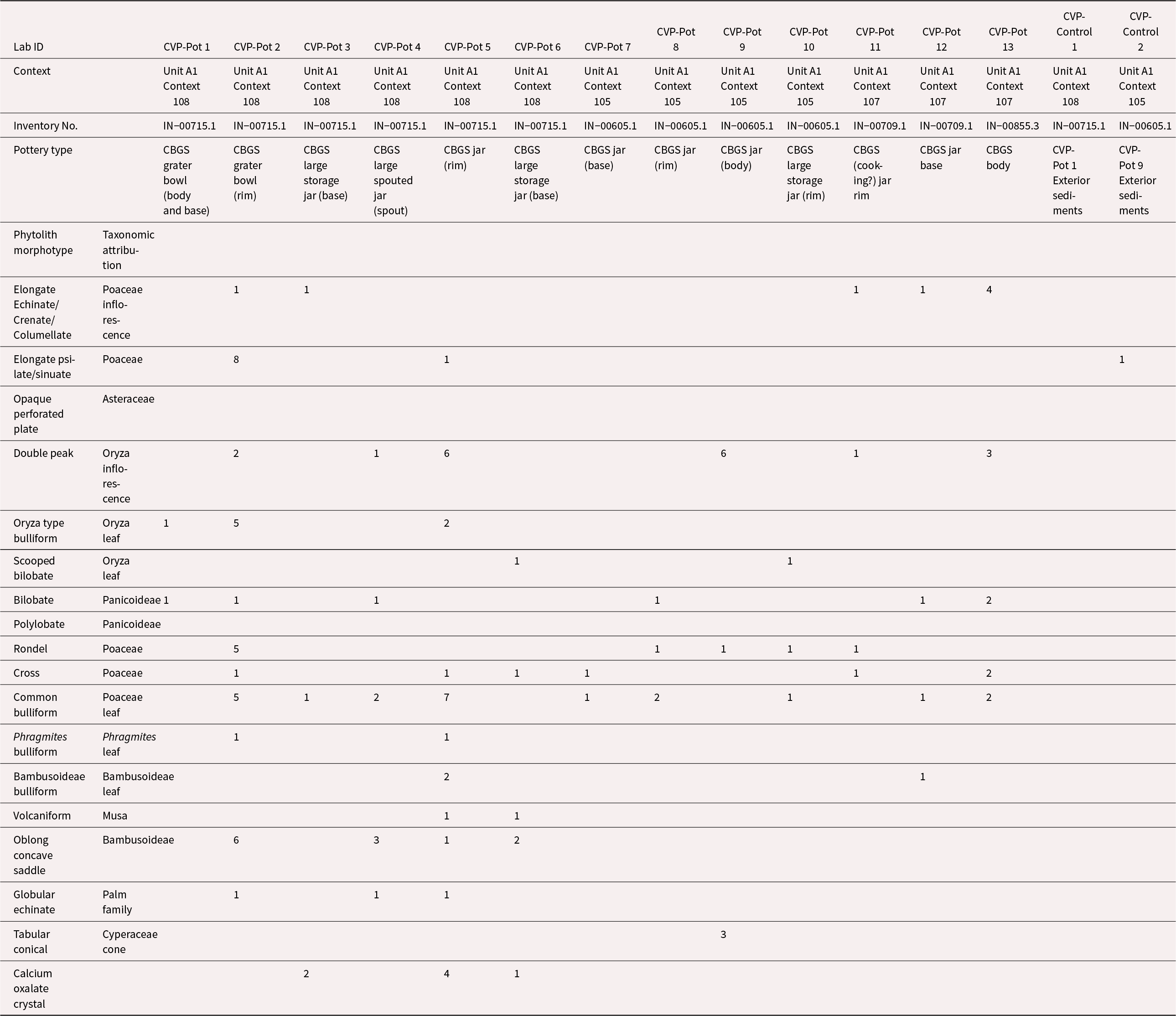
Microfossil Ceramic Residue Data from Cangdong Village Project (CVP).

Table 1 Long description
The table lists phytolith morphotype counts and taxonomic attributions from residues on 13 ceramic samples and 2 exterior-sediment controls, alongside each sample’s context, inventory number, and pottery type. Rice indicators are common: Oryza inflorescence “double peak” occurs in Pot 2 (2), Pot 4 (1), Pot 5 (6), Pot 9 (6), Pot 11 (1), and Pot 13 (3), and Oryza bulliform leaf types occur in Pot 1 (1), Pot 2 (5), and Pot 5 (2), with scooped bilobate Oryza leaf in Pot 6 (1) and Pot 10 (1). General grass and leaf phytoliths are also frequent, especially in Pot 2, including elongate psilate (8), rondel (5), cross (1), and common bulliform (5), while Pot 5 has high common bulliform (7) plus additional grass types. Panicoideae bilobate phytoliths appear at low levels across several pots, including Pot 1 (1), Pot 2 (1), Pot 4 (1), Pot 8 (1), Pot 12 (1), and Pot 13 (2). Less common taxa include Bambusoideae bulliform in Pot 5 (2) and Pot 12 (1), Bambusoideae saddles in Pots 2, 4, 5, and 6, Musa volcaniform in Pots 5 and 6, palm globular echinate in Pots 2, 4, and 5, and Cyperaceae cone tabular conical in Pot 9 (3). Calcium oxalate crystals are recorded in Pot 3 (2), Pot 5 (4), and Pot 6 (1). Controls show minimal material, with only one elongate psilate count in Control 2 and no other listed phytolith morphotypes, suggesting most phytolith signals are associated with vessel residues rather than surrounding sediments.
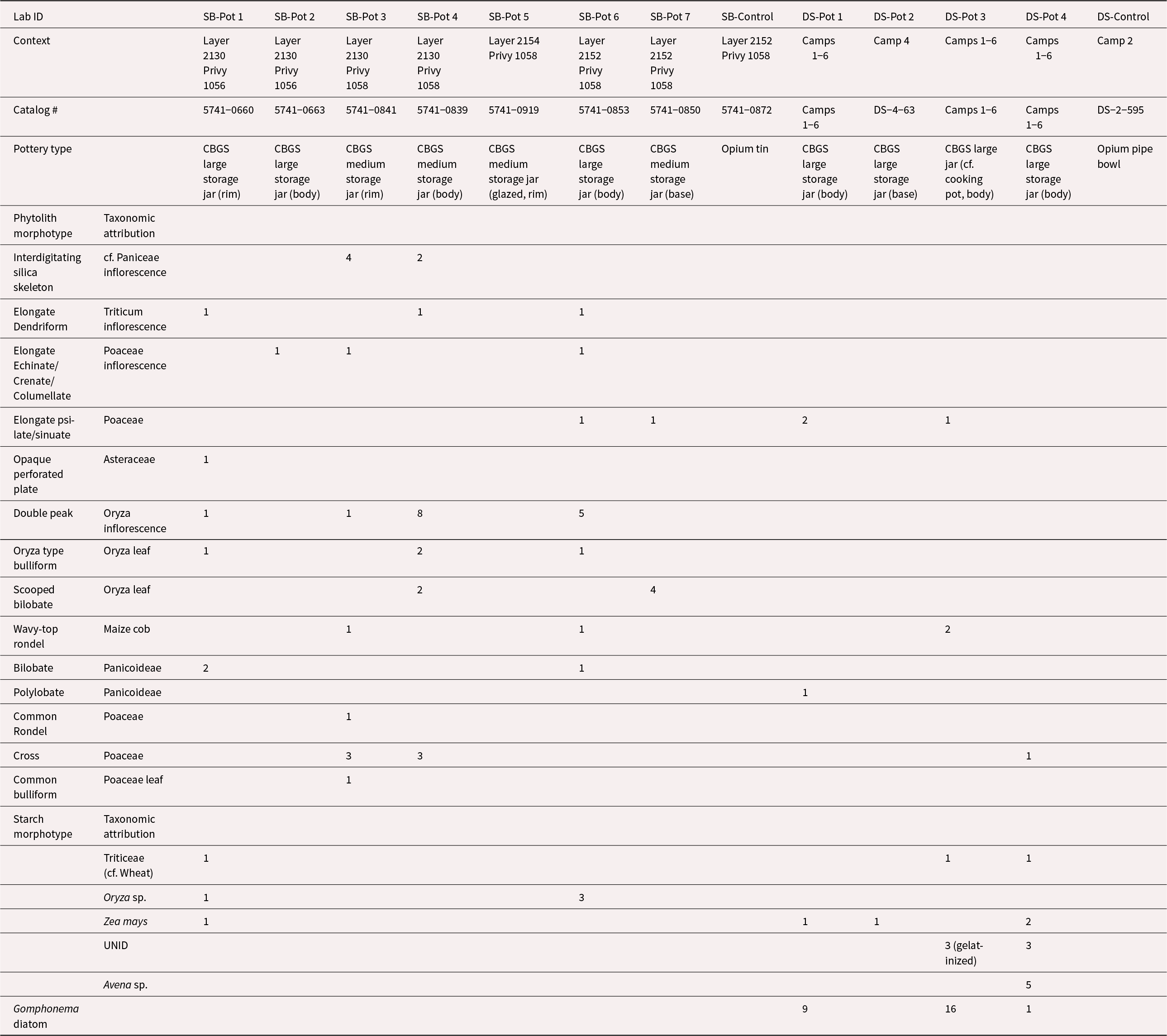
Microfossil Ceramic Residue Data from San Bernardino Chinatown (SB) and Donner Pass Summit Camp (DS).

Table 2 Long description
The table lists counts of identified phytolith, starch, and diatom microfossils recovered from residues in individual ceramic vessels and controls from two sites, with each column tied to a lab ID, context, catalog number, and pottery type. San Bernadino pots contain multiple rice indicators, including double peak and bulliform forms, with the strongest concentration in SB Pot 4 and additional rice starch in SB Pot 6. Wheat-related phytoliths appear at low levels in SB Pot 1, SB Pot 4, and SB Pot 6, and wheat starch occurs in SB Pot 1 and in Donner Pass Pots 3 and 4. Maize signals are limited but present, including a maize cob phytolith in SB Pot 3 and SB Pot 6, and maize starch in SB Pot 1 and in Donner Pass Pots 1, 2, and 4. Donner Pass samples stand out for aquatic diatoms: Gomphonema is abundant in DS Pot 1 and DS Pot 3 and present at low levels in DS Pot 4, while it is absent from the listed San Bernadino samples. Oat starch is only reported in DS Pot 4, and unidentified starch includes gelatinized grains in DS Pot 3, suggesting processing that altered starch structure. Controls are included (an opium tin at San Bernadino and an opium pipe bowl at Donner Pass) and show no reported microfossil counts in this table, but absence here may reflect reporting limits rather than confirmed absence in the residues.
In addition, microfossil residue analysis generally cannot reconstruct the complete use history of individual pots or determine the sequence of functional changes over time, although in some cases it may provide clues to shifts in vessel use. Instead, the method identifies residues preserved within the ceramic matrix and therefore provides evidence of substances that have been stored or processed in the vessels. Although this pilot study offers only a partial view of CBGS use across Guangdong and California, it demonstrates the analytical potential of microfossil analysis for historical ceramics and lays the groundwork for future research based on more systematically sampled assemblages in transnational contexts.
The 13 sherds from Cangdong Village are all from Zone A, unit A1 (Contexts 105, 107, 108) and dated to between 1875 and 1927. Located in a public area in the northeastern end of the village, this unit contained primarily domestic refuse, including large amounts of tableware ceramics, brown-glazed stoneware sherds, and small fragments of rice florets (Voss et al. Reference Voss, Kennedy and Tan2019). We also analyzed seven CBGS sherds from San Bernardino Chinatown, recovered from two privy deposits (Cut 1056 and Cut 1058; Costello et al. Reference Costello, Hallaran and Warren2004:5.111–5.131). Privy 1056, located south of the Wong Nim property line, had a terminus post quem of 1870s. It was then replaced by Privy 1058, dated to 1900–1910. Both privies contained large quantities of domestic refuse, including ceramics and animal bones. In addition, we analyzed four sherds from Summit Camp, derived from a surface collection made by Paul Chace and William Evans in the 1960s (Chace and Evans Reference Chace and Evans2015). The full collection includes nearly 6,000 artifacts distributed over 12 locations, most of which likely represent habitation locations, with CBGS sherds being the most common material culture (Molenda Reference Molenda2019). Among our samples, one was from Evans Camp 4 (“China Garden”), a sparse and diffuse scatter of Chinese ceramics. The other three sherds came from mixed collections labeled “Camps 1–6,” which lack precise provenience but represent an assemblage lumped together from the six camp locations.
To evaluate the possibility of contamination from postdepositional or curation processes, we analyzed four controls. The control samples were collected from sediments attached to the exterior surfaces of the ceramics or from artifacts unrelated to food. Residue and control sample collection took place at local storage facilities, including the Institute of Overseas Chinese and Area Studies at Wuyi University, the San Bernardino County Museum, and the Chinese Historical Society of Southern California. Laboratory processing for microfossils took place at Dartmouth College and the Zhejiang Provincial Institute of Archaeology and Cultural Relics, following an established protocol (Wang et al. Reference Wang, Liu, Ball, Yu, Li and Xing2016). Microfossil examination and identification were conducted at Dartmouth College using a Zeiss Axioscope 5 microscope at 400× magnification. The identification of starches and phytoliths was based on comparison with Wang’s modern reference collection, which includes more than 1,100 specimens. The control samples yielded only mineral crystals, pollen, and one psilate elongate phytolith commonly found in grasses but none of the diagnostic microfossils observed in the residue samples, suggesting a low possibility of contamination.
Similar Pots, Different Plants
The microfossil assemblages from Cangdong Village consist primarily of phytoliths and calcium oxalate crystals; no starch granules were recovered (Table 1). This absence is likely related either to the vessels’ original functions or to the poor preservation conditions caused by the site’s acidic soils. The phytolith data suggest that these pots once contained rice, as indicated by the presence of double-peak phytoliths from rice husks and bulliform and scooped bilobate phytoliths from rice leaves (Figure 3:1–3). The assemblage is dominated by phytoliths from leafy plants typical of the local subtropical environment, including globular echinate phytoliths from palm (Arecaceae) leaves (Figure 3:4–5), bulliforms from reed (Phragmites) leaves (Figure 3:6), Bambusoideae bulliforms and oblong concave saddles from bamboo-family leaves (Figure 3:7–8), volcaniform phytoliths from Musa sp. (banana family) leaves (Figure 3:9), and tabular conical phytoliths from Cyperaceae cones (sedge family; Figure 3:10). As discussed later, some of these phytoliths may be related to food consumption, whereas others may be associated with food preparation, food storage, or medicinal purposes. The calcium oxalate crystals are octahedral in shape (Figure 3:12) and are commonly derived from plant leaves and roots, especially from spinach leaves and taro (Ishii and Takiyama Reference Ishii and Takiyama1989). Such crystals are also known as “beer stones,” because they form as precipitates during fermentation processes, including the brewing of Chinese rice alcohol (huangjiu; Xie et al. Reference Xie, Shen, Hu, Ruan and Wang2011).
Microfossils from Cangdong Village ceramic residues: (1) double peak (rice husk); (2) Oryza bulliform (rice leaf); (3) scooped phytolith (rice leaf); (4) small globular echinate (palm); (5) large globular echinate (palm); (6) Phragmites bulliform (reed leaf); (7) Bambusoideae bulliforms (bamboo leaf); (8) oblong concave saddle (bamboo leaf); (9) volcaniform (Musa sp.); (10) tabular conical (sedge); (11) phytolith and microcharcoal; (12) calcium oxalate crystal (scale bar: 20 µm).

In contrast, the CBGS sherds from San Bernardino Chinatown and Summit Camp reveal markedly different microfossil assemblages. Samples from these diaspora sites contain a broader range of cereal crops. In addition to rice (Figure 4:1), the phytolith assemblages include dendriforms from Triticum sp. (cf. wheat) husks (Figure 4:2); wavy-top rondels and type-1 crosses from Zea mays (maize/corn) cobs and leaves (Figure 4:3–4); interdigitate types from Panicoideae grasses (Figure 4:5), most likely from millets; and Asteraceae platelets from the sunflower family (Figure 4:6). The phytolith identifications are further corroborated by starch granules from these pots, including Triticeae sp. (cf. wheat), rice, maize, and Avena sp. (cf. oat) (Figure 4:7–10). Notably, the diaspora assemblages lacked the subtropical leafy plants identified at Cangdong, such as palm, reed, sedge, or banana leaf phytoliths. This absence likely reflects both environmental differences, particularly the limited availability of subtropical plants in California’s temperate ecosystems, and functional shifts in vessel use. In diaspora contexts, CBGS vessels may have been used more often for storing and preparing cereal-based foods, in contrast to the greater emphasis on leafy plants in the home village.
Microfossils from San Bernardino Chinatown and Donner Summit Camp ceramic residues; (1) double-peak phytolith (rice husk); (2) dendriform phytolith (cf. Triticum sp.); (3,) type-1 cross phytolith; (4) cf. wavy-top rondel; (5) interdigitate-type phytolith (Panicoideae inflorescence); (6) Asteraceae platelet phytolith; (7) rice starch; (8) Triticeae (cf. wheat) starch; (9) maize starch; (10) Avena sp. (cf. oat) starch; (11 and 12) Gomphonema diatoms (scale bar: 20 µm). (Color online)

In addition, CBGS sherds from Summit Camp also revealed Gomphonema diatoms (Figure 4:11–12), a type of freshwater algae native to the Sierra Nevada Mountains (Stancheva et al. Reference Stancheva, Sheath and Kociolek2016). Diatoms are single-celled algae with silica cell walls that inhabit aquatic habitats and are often used as environmental indicators. Their presence suggests that some stoneware vessels were used to store local freshwater or aquatic resources from nearby mountain streams or lakes, such as fish or other catches. This finding reflects localized resource use and the functional flexibility of CBGS vessels in railroad labor camp settings.
Taken together, the residue data reveal a clear contrast in vessel use. At Cangdong Village, CBGS vessels were associated with leafy materials, possibly vegetables, medicinal herbs, or other plant-based preparations, reflecting a subtropical agrarian lifestyle. In contrast, diaspora vessels were more frequently associated with cereal grains, reflecting adaptation to new environmental and economic conditions. Although these microfossils capture only a fragment of past foodways, this comparative evidence moves us beyond static notions of Chinese “tradition,” showing how similar material forms were flexibly repurposed across contexts. As discussed in the following sections, these adaptive practices emerged as Chinese communities navigated both the precarious agrarian conditions of nineteenth-century Guangdong and the opportunities and constraints of California’s market-driven food economy.
Precarious Agrarian Life in Nineteenth-Century Guangdong
The nineteenth and early twentieth centuries witnessed significant shifts in agricultural practices in migrants’ home villages. One notable change was the growing commercialization of agriculture. Beginning in the eighteenth century, large portions of arable land had been converted from rice paddies to cash crops, such as sugarcane, tea, mulberry trees for silk production, and fish ponds for aquaculture. The scale of sugarcane cultivation was particularly notable. As the scholar and poet Li Tiaoyuan (Reference Li1777) wrote in Notes on Nanyue, sugarcane fields appeared “as widespread as rice paddies, stretching endlessly like a sea of reeds.”
Although commercialization created new economic opportunities, it also displaced subsistence farming, leading to a growing reliance on imported rice over time. Initially, this shift did not trigger a food crisis, but by the mid-nineteenth century, rising population densities and limited arable land contributed to periodic rice shortages (Marks Reference Marks1998:308). This situation was especially pronounced in Kaiping County, the location of Cangdong Village and a main migrant-sending region. Characterized by hilly and rocky terrain, Kaiping produced only limited quantities of grain, sufficient for only partial local consumption (Ke and Wang Reference Ke and Wang1823). Although the lower-lying river valleys and delta regions were able to increase output through double cropping with rice–wheat or rice–rice rotations, the strategy was not viable in upland areas like Kaiping because of climatic and topographic constraints (Marks Reference Marks1998:283). As a result, some households likely turned to alternative root crops, such as sweet potatoes, to supplement their diets (Chan Reference Chan1986:19–20; Chen Reference Chen and Lasker1940; Johnson Reference Johnson, Sheridan and Salaff1984). These environmental and demographic pressures strained an already fragile agrarian economy, exacerbated local conflicts, and contributed to waves of emigration during this period.
Microfossil residue evidence from CBGS storage vessels supports this broader picture of grain stress experienced in migrants’ home villages. Among the 13 CBGS vessels analyzed from Cangdong, six (46%) contained cereal seed phytoliths, relatively fewer than those in California diaspora sites (72.3%). This disparity suggests more limited cereal access in Cangdong compared to diaspora communities. Historical records corroborate this pattern. The Taishan County Gazetteer (the county was renamed from Xinning in 1914) from the Guangxu and Xuantong periods (1875–1911) records repeated rice crises caused by natural disasters and agricultural failures, describing “flooded fields,” “destroyed rice fields,” “poor harvests,” “soaring rice prices,” and “famine” (Taishan Municipal Archives 2000:25). The 1893 Xinning Gazetteer further captures the structural nature of these shortages, noting the paradox that, despite increasing remittances from abroad, many families remained rice insecure: “The fields are poor and infertile, and labor is uneven. The annual grain supply for each person lasts only half a year; for the rest of the year, they rely on imported foreign rice. It is truly worrisome that when ships occasionally get disrupted, cooking fires immediately go out” (He and Lin Reference He and Lin1893; Taishan Municipal Archives 2000:85). In summary, rice shortages were a structural condition in many home villages, persisting even during the height of overseas migration and remittance flows.
Despite limited access to grains, residents of Cangdong Village appear to have made extensive use of local botanical resources, particularly leafy and woody plants from the bamboo, banana, palm, and sedge families, which are common in Guangdong’s subtropical environment. As early as the eighteenth century, the writer Qu Dajun (Reference Qu1678) described the region as the “land of bananas” (bajiao zhiguo), noting that many villagers relied on banana cultivation for their livelihood. The banana plant was also highly versatile: its roots were consumed as vegetables, its fruits were dried or made into cakes, and its fibers were processed into cloth (Li Reference Li1777). Palm species such as fishtail palms (Caryota sp.) and rattan palms (Calamus sp.) were also widespread across the region (Flora of China Editorial Committee 2026; Henderson Reference Henderson2009). Their starchy pith was processed into foods as early as 5,000 years ago, predating the region’s adoption of rice agriculture (Yang et al. Reference Yang, Barton, Wan, Li, Ma, Li, Zhang and Wei2013). Palm leaves were commonly used in Chinese medicine, often boiled into soups to treat coughs and bleeding, and palm seeds were sometimes consumed as a snack food (Griffiths Reference Griffiths1992; Song Reference Song1999). Bamboo leaves, which appeared most frequently in the CBGS microfossil assemblage, also served multiple purposes. They were widely used to wrap glutinous rice dumplings and applied medicinally to treat insect bites and skin irritation (Qu Reference Qu1678:vol. 12, vol. 14). Sedges, particularly their roots, known as xiangfu in Chinese medicine, were extensively used in southern China as herbal remedies to aid digestion and strengthen blood circulation, especially in treatments related to women’s health (Lan Reference Lan1959 [fifteenth century]:vol. 1). The presence of microfossils from these plants suggests that CBGS vessels in Cangdong were used not only for food storage but also for processing and preparing local medicinal plants. These practices reflected the villagers’ ecological knowledge and flexible use of available resources to sustain daily life.
In addition to identifying plant food contents, one pot in particular shows functional differences in CBGS use between home and diaspora contexts. A spouted jar from Cangdong Village (CVP-Pot 4), made from unglazed, coarse, and porous paste, shows light charcoal staining on its interior surface, suggesting its use for cooking or boiling. Residue analysis further supports this interpretation, revealing micro-charcoal fragments and brown-stained phytoliths consistent with heat exposure (Parr Reference Parr2006; see Figure 3:11). The sample also contains common bulliform phytoliths from grass leaves and leaf phytoliths from palm and bamboo families, suggesting that the vessel may have been used to boil water, brew tea, or prepare herbal medicines. In contrast, similarly shaped, glazed, spouted jars from North American diaspora sites are typically associated with condiments such as soy sauce, oil, or vinegar (Yang and Hellmann Reference Yang and Hellmann1998). This comparison illustrates how similar vessel forms could be adapted to different needs depending on their cultural and environmental contexts.
Grains of Adaptation: Cereal Diversity in Diaspora Foodways
CBGS vessels from San Bernardino Chinatown yielded microfossil evidence for multiple cereal grains, including rice, Triticum (cf. wheat), millet, and maize. Many of these cereals have also been identified at other Chinese diaspora settlements in California, particularly at the Market Street Chinatown in San Jose (Cummings et al. Reference Cummings, Voss, Yu and Kováčik2014). Among these cereals, rice was the most ubiquitous, with its phytolith or starch residues present in four of seven analyzed pots. Rice consumed by Chinatown residents was imported primarily from China and Hawaii (Chan Reference Chan1986:82); toward the later occupation of the community, it may have been increasingly sourced from local farms. Early twentieth-century newspaper reports documented Chinese farmers establishing successful rice farms in the Sacramento Valley and surrounding areas, leasing hundreds of acres to support regional rice supply (Sacramento Daily Union 1914; San Luis Obispo Tribune 1912). These developments indicate that rice remained culturally central to Chinese migrant communities and possibly became increasingly accessible through both transpacific trade and domestic agricultural networks.
The presence of wheat, maize, and millet in the San Bernardino assemblage reflects Chinese migrants’ adaptation to their new economic and ecological contexts by diversifying their diets through local markets. Although none of these cereals were entirely foreign to Chinese migrants, they were less common in the Siyi region’s diets compared to rice and tuber-based staples. Wheat, for instance, was grown in limited parts of Guangdong, but because of the region’s warm, humid environment with little frost or snow, locally produced wheat flour was often considered of poor quality and mildly toxic. Qing Dynasty records note that Cantonese people did not consume wheat in large quantities, although they occasionally made wheat-based foods such as noodles, steamed buns, dumplings, and pastries, especially when hosting guests from northern China (Qu Reference Qu1678:vol. 14). In contrast, mid-nineteenth-century California was home to one of the largest wheat industries in the United States, producing surpluses for both domestic use and export (Meissner Reference Meissner1997). This local abundance likely encouraged Chinese migrants to adopt wheat more fully into their diets, transforming what had once been a marginal food in their homeland into a staple in diaspora communities.
Millet and maize followed a similar trajectory of adaptation. Although a major staple in northern China, millet was largely absent from southern Chinese home village diets. Historical accounts even note that the locals were so unfamiliar with the grain that they often “could not distinguish between shǔ [broomcorn millet] and jì [foxtail millet]” (Qu Reference Qu1678:vol. 14). Maize, too, had little culinary significance in Guangdong, but in California, it had been cultivated since the Spanish colonial period (Bancroft Reference Bancroft1963; Hendry Reference Hendry1931). The presence of maize cob and leaf phytoliths, as well as starch granules, in CBGS vessels suggests that Chinese migrants incorporated maize, perhaps as ground flour or whole kernels, into their meals as they adapted to available local grains.
Microfossil residues from CBGS sherds at Donner Summit Camp, although based on a small sample size, offer additional insights into the adaptive strategies of Chinese railroad workers living in this remote setting. In such isolated locations, Chinese foodstuffs and other goods were delivered through a transnational supply network managed by firms like jinshanzhuang and then transported to various stores, many of which were managed by the railroad companies (Chang Reference Chang2019:111; Hsu Reference Hsu2000:34; Nordhoff Reference Nordhoff1973 [1873]:190). A previous macrobotanical study confirmed the consumption of rice at the site (Puseman and Cummings Reference Puseman and Cummings2008), but our microfossil analyses expand this picture by identifying residues of wheat, maize, and oats that were not previously documented at Summit Camp.
The inclusion of non-rice cereals likely reflects both economic and logistical considerations. Rice appears to have been a highly valued item in the Chinese worker camps. A bill of sale from a Chinese store in Calaveras County in 1865, for instance, listed rice at $6 a sack compared to a sack of wheat flour that cost only $1.50 (Chan Reference Chan1986:84). In a resource-constrained environment, Chinese railroad workers likely turned to more affordable and accessible grains to supplement rice in their daily meals.
In contrast to the CBGS sherds from San Bernardino Chinatown, which yielded no evidence of diatoms and therefore suggest a primary use for storing dry goods, the residues from CBGS sherds at Donner Summit contained abundant Gomphonema diatoms, freshwater species native to the Sierra Nevada region (Stancheva et al. Reference Stancheva, Sheath and Kociolek2016). The presence of these diatoms suggests several possible scenarios for vessel use in this remote railroad camp. One possibility is that Chinese workers used the vessels to collect and store water from nearby streams or lakes for drinking or tea preparation (Spier Reference Spier1958a:133). This interpretation is supported by Alfred Hart’s historical photograph titled “Tea Carrier,” which shows a Chinese worker carrying a ceramic container—likely a CBGS vessel—suspended from a shoulder pole. Such vessels were likely repurposed from their original use as foodstuff containers shipped from China.
Another possibility is that the vessels were used for storing local aquatic foods. Chinese workers reportedly introduced catfish into a nearby lake to maintain a local supply of fresh fish (Baxter and Allen Reference Baxter and Allen2015). If these vessels were used to clean, store, or prepare fish, diatom residues may have been deposited during these activities. Additional microfossil evidence from one vessel further supports the multifunctional role for CBGS in this context. Analysis of DS-Pot 3, a coarse, medium-sized jar with visible charcoal staining on its interior surface, revealed a combination of diatoms, cooked starch granules, and one Triticeae starch grain likely from wheat. This residue profile suggests that the vessel was used for heating or cooking food, potentially a porridge or soup. Together, this functional flexibility demonstrates how Chinese railroad workers actively engaged with their surroundings and repurposed familiar material forms to navigate unfamiliar terrains.
Conclusions: Rethinking Continuity and Adaptation through Diasporic Ceramics
By tracing the diverse uses of a single category of pottery, Chinese brown-glazed stoneware, across both the home village of Cangdong in Guangdong and diaspora settlements in California, this study reveals the flexible and adaptive ways in which migrants navigated new environments. This transnational comparison leads to two main conclusions.
First, it showcases the importance of food localization in Chinese migration (Tan Reference Tan2011). Early ethnographic accounts (e.g., Nordhoff Reference Nordhoff1973 [1873]; Spier Reference Spier1958a, Reference Spier1958b) often emphasized the insularity of Chinese food practices, portraying Chinese migrants as a culturally isolated group that relied exclusively on Chinese stores and imported goods. The microfossil evidence presented here, however, tells a different story. The presence of grains such as maize, wheat, oats, and millets—many of which were rare or absent in the migrants’ home villages—challenges the long-standing assumptions that Chinese migrants simply “continued to eat their customary foods despite emigration to a foreign land” (Spier Reference Spier1958a:79). Instead, the findings indicate migrants’ engagement with new agricultural landscapes and local food markets. This dietary flexibility is in line with patterns observed in zooarchaeological studies, which show that migrants in diaspora communities made use of local meats, fish, and wild fauna alongside imported Chinese foods (Kennedy Reference Kennedy2015). Migrating from the humid, subtropical climate of southern China to the drier temperate environments of California, migrants made strategic choices that allowed them to maintain aspects of Chinese cuisine while incorporating new ingredients and foodways.
Second, the study moves beyond the limitations of acculturation models in researching historic and contemporary diaspora communities. For decades, the absence of comparative data from Chinese home villages led to a simplified binary: Chinese goods in diaspora contexts signaled cultural continuity, whereas local, Western-style materials were taken as evidence of assimilation. The results of this transnational study challenge that assumption by showing an alternative scenario: CBGS vessels, although manufactured in China, did not carry with them a fixed cultural script. In Guangdong, they may have been used for storing rice or leafy greens or preparing medicinal herbs. In California, the same vessels were repurposed to process local dryland grains, cook wheat porridges or soup, and brew tea and other ingredients using local aquatic resources.
Although these vessels helped migrants create a sense of “home away from home,” they also served as flexible tools for navigating unfamiliar social and environmental conditions in both urban and rural settings. In this context, CBGS was not simply a symbol of continuity but also was a medium that materialized the migrants’ capacity to adapt and change. Both Chinese migrants and their families in Guangdong can be understood as social agents actively navigating opportunities and constraints of their worlds (Silliman Reference Silliman2001). Migrants in California engaged with new market economies, unfamiliar food resources, and racialized forms of exclusion, while families in Guangdong confronted challenges of a precarious agrarian landscape with new opportunities created through overseas connections. In both settings, everyday objects like Chinese brown-glazed stoneware functioned as flexible material tools through which people negotiated adaptation, memory, and new ways of living.
Overall, the study contributes to migration research by demonstrating that material culture alone cannot serve as a direct representation of cultural identity, and in particular, the continuity of material culture does not necessarily reflect the continuity of cultural practices. Migration is not only a process of displacement but also a driver of change, shaped by the agency of migrants and the cultural, economic, and ecological conditions they encounter. Although this study focuses on plant-related microfossils, it is important to note that other foodstuffs, such as meat, fish, and cooking condiments, may have played equally important roles in migrant diets, although they do not preserve the types of microfossils examined here. We hope this research encourages further transnational, multidisciplinary studies to better understand the dynamics of cultural change in migration.
Acknowledgments
We thank Tamara Serrao-Leiva (San Bernardino County Museum), Eugene Moy (Chinese Historical Society of Southern California), and Yunfei Zheng (Zhejiang Provincial Institute of Cultural Relics and Archaeology) for their assistance in microfossil sample collection and processing. We thank R. Scott Baxter (Pacific Legacy) for providing information regarding Summit Camp. The Cangdong Village Project is a cooperative research program of the Guangdong Provincial Institute of Cultural Relics and Archaeology; the Institute of Overseas Chinese and Area Studies at Wuyi University in Jiangmen City, Guangdong Province; and the Stanford Archaeology Center at Stanford University.
Funding Statement
This work was supported by a gift to the Stanford Archaeology Center from Mrs. Min Kwan Kwaan, a Faculty Research Grant from the Nelson A. Rockefeller Center at Dartmouth College (to Wang), and a Faculty Competitive Grant from Grinnell College (to Ng). Funding for the Cangdong Village Project was provided by Wuyi University (Institute of Overseas Chinese and Area Studies); Stanford University (Office of International Affairs, Institute for Research in the Social Sciences, Freeman Spogli Institute China Fund, Lang Fund for Environmental Anthropology, Department of Anthropology, Stanford Archaeology Center, and the UPS Fund); and the Wenner-Gren Foundation for Anthropological Research.
Data Availability Statement
The ceramics analyzed in this study are curated at the San Bernardino County Museum (San Bernardino Chinatown ceramics), the Chinese Historical Society of Southern California (Summit Camp ceramics), and the Institute of Overseas Chinese and Area Studies of Wuyi University (Cangdong Village Project ceramics). Microfossil samples are stored in Wang’s lab at Dartmouth College. All other original data are included in this article. ChatGPT (version 5.2) was used to assist with reference formatting and abstract translation.
Competing Interests
The authors declare none.




 Open access

