INTRODUCTION
We are fortunate to participate in this series of published commentaries that emphasize the potential impact of bilingualism on measures of cognitive status. The constructive commentaries by Bialystok and Craik (this issue) and Acevedo and Lowenstein (this issue) are certain to inform further research in this area. Undoubtedly, future work will be strengthened by increasing sample sizes, generalizing findings to other languages, and accessing additional information related to immersion experience, place of education, and other ethno-cultural variables. We urge future investigators to consider the full continuum of bilingualism by testing low- and high-proficiency bilinguals in both languages, because this will lead to a better understanding of how bilingualism affects test performance, and because currently we simply do not know who should qualify as “bilingual” (which type of bilinguals will show which effects on test performance).
Balanced Bilingualism or Proficiency in the Non-Dominant Language?
We found that bilinguals who named similar numbers of pictures in English and in Spanish obtained higher naming scores if credited for naming pictures in either language, and lower naming scores in their dominant language than less balanced bilinguals. Most of our balanced bilinguals (80%) were Spanish-dominant. A question of great interest is: will the findings generalize to bilinguals of other language combinations, and who are English-dominant (we had only two balanced English-dominant bilinguals)?
The reduction in dominant-language BNT scores among balanced bilinguals resembles similar bilingual disadvantages reported in other studies, which focused on other types of bilinguals (e.g., English-dominant bilinguals in Gollan & Acenas, 2004; and Hebrew-English, Tagalog-English, and French-English bilinguals in Gollan & Silverberg, 2001; Gollan & Acenas, 2004; Roberts et al., 2002 respectively). This result therefore seems likely to apply beyond Spanish-dominant bilinguals and we do not discuss this further. A more open question, however, is will the either-language scoring method increase naming scores (relative to dominant-language scores) in bilinguals who are not dominant in the language of immersion (Bialystok & Craik, this issue), and to what extent balance is critical rather than proficiency in the nondominant language (Acevedo & Lowenstein, this issue).
We originally focused on the correlation between balance (dominant minus nondominant) and the degree to which crediting pictures named in either language improved scores (the either-minus-dominant benefit). However, Acevedo and Lowenstein (this issue), and our exploratory analyses (see last paragraph of the results section; Gollan et al., this issue) imply that proficiency in the non-dominant language may be more critical than balance for defining “bilingual.” Supporting this idea, there was a significant correlation between non-dominant language naming scores and the either-minus-dominant benefit r = .46, p = .01. Although this correlation is smaller than that which used balance as a predictor (see Fig. 2 in Gollan et al., this issue: r = −.67, p < .01), circularity may have strengthened the correlations shown in Figure 2 (dominant language scores were entered into X and Y axes). In contrast, there is no circularity in Acevedo and Lowenstein's suggestion to instead use “nondominant language” scores to predict which bilinguals will benefit from the either-language scoring procedure.
Both commentaries also questioned if the results depended specifically on knowledge of Spanish; some of the BNT items are culturally inappropriate for Spanish speakers (e.g., wreath). To address this concern we repeated our analyses considering only BNT items that are the same in the English and Spanish versions of the BNT, leaving out 12 items with no Spanish-naming norms (Allegri et al., 1997) and four additional items that appeared to be slightly different across languages (i.e., hanger, escalator, scroll, tongs were translated as perch, stairway, parchment, and tweezers; Allegri et al., 1997).
Importantly, we obtained the same results. Balanced [paired-t(9) = 4.12, SE = .56, p < .01] but not unbalanced bilinguals [paired-t(9) = 1.50, SE = .13, p = .17] demonstrated stronger naming scores using the either-language than the dominant language scoring methods (see Table 1). These analyses suggest that the reported results are not solely because of Spanish-dominant bilinguals' lack of knowledge about specific items (e.g., pretzel, in Spanish).
Mean (M) and standard deviation (SD) of either-language versus dominant-language scores in balanced (n =10) versus unbalanced (n = 10) bilinguals using only BNT items (n = 44) that are not biased against Spanish

Cognate Effects
We reported that all bilinguals showed a “cognate advantage” in the nondominant language, and balanced bilinguals showed the advantage also in their dominant language. Following prior accounts (Costa et al., 2000; Costa et al., 2005; de Groot et al., 2002; Gollan & Acenas, 2004) we assumed that cognate effects on the BNT should be attributed to transfer between languages. Because bilinguals may sometimes be assessed only in their dominant language, the possibility that cognate status may affect dominant-language naming scores is important. Our data suggest that cognate status will affect untimed picture naming in the dominant language only when there is sufficient proficiency in the nondominant language to have an effect on the dominant language (see also van Hell & Dijkstra, 2002 for similar discussion using Dutch-English-French trilinguals).
In their commentary Bialystok and Craik suggested that long-term priming from the dominant to the nondominant language may have artificially enhanced the cognate advantage in the nondominant language (we tested all participants in their dominant language first instead of counterbalancing the language of testing). However, several other studies in which such long-term priming was not possible also documented stronger cognate effects in the nondominant language. For example, Catalan-Spanish bilinguals showed faster picture naming times for cognates than for noncognates particularly when tested in Spanish, their nondominant language (Costa et al., 2000). Similarly, Dutch-English bilinguals showed faster lexical decision times for cognates than for noncognates but only when they were tested in English, their nondominant language (de Groot et al., 2002). Similar findings were reported in other studies as well (Gollan & Acenas, 2004; Gollan et al., 1997; Roberts & Deslauriers, 1999).
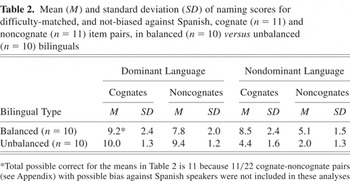
In their commentary Acevedo and Lowenstein suggest that cognate effects should be viewed as “tentative” and may be specific to Spanish naming. Before attributing cognate effects to bilingualism it is important to demonstrate that monolinguals are not affected by cognate status (as demonstrated in Costa et al., 2000; Gollan & Acenas, 2004). In this study we used item number (for English) and published norms (for Spanish; Allegri et al., 1997) to match cognates and noncognates for difficulty. We reported that five pairs had to be excluded from the Spanish cognate/noncognate matching because they were absent from the Allegri et al. (1997) norms. Acevedo and Lowenstein correctly pointed out that in fact 8/22 of the matched pairs should have been excluded from this analysis.1
When we rechecked the Allegri et al., (1997) paper we discovered what appear to be some minor errors in their norms. Four of their items (pencil sharpener, octopus, snail, and accordion) are listed as being named correctly by 98.8% of participants in Table 3 but by 99.8% participants in Table 4.
Mean (M) and standard deviation (SD) of naming scores for difficulty-matched, and not-biased against Spanish, cognate (n = 11) and noncognate (n = 11) item pairs, in balanced (n = 10) versus unbalanced (n = 10) bilinguals

This discussion highlights the fact that the BNT was not designed to be used with Spanish speakers. In future work it would be more convincing to test whether English-dominant balanced bilinguals show cognate effects in English (for which it is easier to match cognates and noncognates for difficulty). Because cognate effects have been reported in other studies with cognitively intact bilinguals (Costa et al., 2000; Gollan & Acenas, 2004) and in bilinguals with aphasia (Kohnert, 2004; Roberts & Deslauriers, 1999) we suggest that cognate effects should be considered when testing individuals who may be bilingual.
Paradoxically, the relative absence of cognate pairs in the BNT in some language combinations may turn out to be equally important as cognate effects themselves. Bilinguals who speak languages with fewer cognate pairs may be more affected by their bilingual status (i.e., may have lower naming scores) than bilinguals who speak languages with many cognates. In the absence of cognates bilinguals need to work harder in that they must learn a greater number of completely different translation equivalents (i.e., noncognates).
CONCLUSION
A challenge for neuropsychologists is to discover if bilingualism affects standardized test performance in additional ways, and to determine how to classify people as bilingual or monolingual. The questions raised in the commentaries highlight the important fact that bilingualism does not emerge in a vacuum; cultural factors are correlated with bilingualism. Because immersion may lead to “mandatory” proficiency in the nondominant language (Bialystok & Craik, this issue), it is particularly important to assess both languages when the dominant language is not English. Although English-dominant bilinguals in the United States are less likely to become proficient in a non-English language, it is premature to simply assume that they should not be tested as bilinguals. We suggest that the bilingual effects we reported on the BNT did not depend on knowledge of Spanish in particular, will likely generalize to other language combinations, and possibly even to English-dominant balanced bilinguals. Until more is known about this topic we strongly encourage cognitive evaluation in both languages if there is even a remote possibility that the person should be classified as bilingual.
ACKNOWLEDGMENTS
This research was supported by Career Development Award DC00191 from NIDCD to Tamar H. Gollan, and by NIH/NIA grant P50 AG05131 to the University of California. The information in this manuscript and the manuscript itself are new and original. These findings are not currently under review by any other publication, nor have they been published elsewhere, either electronically or in print. The authors have nothing to disclose regarding relationships that could be interpreted as a conflict of interest.