International research has investigated best practices in education and its long-lasting effects on learning and behavior (e.g., Bierman, Domitrovich et al., Reference Bierman, Domitrovich, Nix, Gest, Welsh, Greenberg and Gill2008; Bierman, Nix, Greenberg, Blair, & Domitrovich, Reference Bierman, Domitrovich, Nix, Gest, Welsh, Greenberg and Gill2008; Riggs, Greenberg, Kusché, & Pentz, Reference Riggs, Greenberg, Kusch and Pentz2006), including, more recently, a large focus on intervention programs to promote the development of executive functions EF in children (e.g., Barnett et al., Reference Barnett, Jung, Yarosz, Thomas, Hornbeck, Stechuk and Burns2008; Blair & Diamond, Reference Blair and Diamond2008; Bodrova & Leong, Reference Bodrova and Leong2007, Dawson & Guare, Reference Dawson and Guare2010; Diamond, Barnett, Thomas, & Munro, Reference Diamond, Barnett, Thomas and Munro2007; Diamond & Lee, Reference Diamond and Lee2011; Meltzer, Reference Meltzer2010; Rosário, Núñes, & González-Pienda, Reference Rosário, Costa, Mourão, Chaleta, Grácio, Núñez and González-Pienda2007). The results from these inquiries have been promising. However, such studies are concentrated in North America and Europe, and no research has been published in more socioeconomically disadvantaged contexts, as is the reality of most underdeveloped or developing countries, such as (but not limited to) those in Latin America.
In practice, this lack of studies in such disadvantaged countries can be seen as incoherence because children from more unfortunate contexts more often have poor EF (Diamond et al., Reference Diamond, Barnett, Thomas and Munro2007) and could benefit from this type of intervention. That is, in addition to culture (Lahat, Todd, Mahy, Lau, & Zelazo, Reference Lahat, Todd, Mahy, Lau and Zelazo2010), socioeconomic status (Hook, Lawson, & Farah, Reference Hook, Lawson, Farah, Tremblay, Boivin and Peters2013; Noble, Norman, & Farah, Reference Noble, Norman and Farah2005) has been revealed as a variable that can affect EF development. These abilities in such children need to be promoted. This is the context in which we performed this pilot study, with the objective to investigate the efficacy of an intervention program to promote EF in children from a more disadvantaged socioeconomic context in one public elementary school in Brazil.
What Are Executive Functions? Why Promote Them?
EF support the control and regulation of behavior, cognition, and emotion. The three main components of EF are working memory (the ability to hold information in mind and operate on them), cognitive flexibility (the ability to change perspective or attentional focus), and inhibition (the ability to resist an automatic or impulsive response or attend to distractors) (Diamond, Reference Diamond2013; Diamond et al., Reference Diamond, Barnett, Thomas and Munro2007; Miyake, Friedman, Emerson, Witzki, & Howerter, Reference Miyake, Friedman, Emerson, Witzki and Howerter2000). Planning, problem solving, and emotional regulation are considered higher-level or complex EF (Dawson & Guare, Reference Dawson and Guare2010; Meltzer, Reference Meltzer2010). These skills are relevant for learning (Bodrova & Leong, Reference Bodrova and Leong2007 , Duckworth, Akerman, Macgregor, Salter, & Vorhaus, Reference Duckworth, Akerman, Macgregor, Salter and Vorhaus2009), school readiness (Bierman, Greenberg et al., Reference Bierman, Domitrovich, Nix, Gest, Welsh, Greenberg and Gill2008), academic performance (Capovilla & Dias, Reference Capovilla and Dias2008), socio-emotional development, self-concept, and a sense of self-efficacy (Duckworth et al., Reference Duckworth, Akerman, Macgregor, Salter and Vorhaus2009; Riggs, Jahromi, Razza, Dillworth-Bart, & Mueller, Reference Riggs, Greenberg, Kusch and Pentz2006). EF development starts early, approximately 12 months of age, and continues until adolescence or early adulthood (Best & Miller, Reference Best and Miller2010; see Dias & Seabra, Reference Dias and Seabra2013 for a review). Despite this long-term path, evidence suggests faster development, with greater age effect, between 5 to 7 years of age, and slower development after this age range (Best, Miller, & Naglieri, Reference Best, Miller and Naglieri2011).
Recently, there has been an increasing international emphasis on early interventions that promote the development of EF in preschoolers and children in the first years of elementary school (Barnett et al., Reference Barnett, Jung, Yarosz, Thomas, Hornbeck, Stechuk and Burns2008; Bierman, Domitrovich et al., Reference Bierman, Domitrovich, Nix, Gest, Welsh, Greenberg and Gill2008; Blair & Diamond, Reference Blair and Diamond2008; Bodrova & Leong, Reference Bodrova and Leong2007, Diamond et al., Reference Diamond, Barnett, Thomas and Munro2007; Diamond & Lee, Reference Diamond and Lee2011; Riggs, Greenberg et al., Reference Riggs, Greenberg, Kusch and Pentz2006; Rosário, Núñes, & González-Pienda, Reference Rosário, Costa, Mourão, Chaleta, Grácio, Núñez and González-Pienda2007), such as Tools of the Mind curricula (Barnett et al., Reference Barnett, Jung, Yarosz, Thomas, Hornbeck, Stechuk and Burns2008; Diamond et al., Reference Diamond, Barnett, Thomas and Munro2007) and the Sarilhos do Amarelo (Rosário, Costa et al., Reference Rosário, Costa, Mourão, Chaleta, Grácio, Núñez and González-Pienda2007) program, in addition to some proposals for older children in elementary school as well, and there is evidence that these interventions provide benefits in terms of EF and academic performance (Dawson & Guare, Reference Dawson and Guare2010; Meltzer, Reference Meltzer2010).
Evidence from Riggs, Greenberg et al. (Reference Riggs, Greenberg, Kusch and Pentz2006) also corroborates these findings. The study reveals that children aged 7 to 9 years old participating in PATHS (Promoting Alternative Thinking Strategies) experienced gains in inhibitory control and verbal fluency. Moreover, children in PATHS classes demonstrated fewer behavioral problems in a 1-year follow-up, and this result was mediated by inhibitory control. PATHS has an emphasis on EF; it attempts to promote the development of strategies for self-control, including verbal mediation and inhibitory control. The study of Riggs, Greenberg et al. was one of the first to demonstrate the possibility of an early program to promote EF in children. The authors argue that, in addition to verbal and emotional abilities, social-emotional programs should explicitly address EF.
The increasing emphasis in early EF interventions may be due to the preventive potential of these interventions in terms of social and behavioral problems, such as substance addiction and psychiatric diagnoses, including Conduct Disorder and Attention Deficit and Hyperactivity Disorder - ADHD (Dawson & Guare, Reference Dawson and Guare2010; Diamond et al., Reference Diamond, Barnett, Thomas and Munro2007). According to an important recent paper (Moffitt et al., Reference Moffitt, Arseneault, Belsky, Dickson, Hancox, Harrington and Caspi2011), children with poor EF at 3–11 years of age tend to have more health problems, earn less, and commit more crimes 30 years later. The authors conclude that interventions that produce even small improvements in EFs could promote beneficial shifts in health (including mental health) and social indices.
This emphasis, however, has not been observed in Brazil and other Latin America countries, where intervention programs promoting EF are not generally available and studies examining this issue have only begun to be conducted. In fact, there has been no focus on the study of ‘‘best practices’’ curricula, including research-based curriculum and teaching strategies, at least in Brazil.
As reviewed by Bierman, Domitrovich et al. (Reference Bierman, Domitrovich, Nix, Gest, Welsh, Greenberg and Gill2008), some evidence suggests that early programs can have strong and long-lived effects on the learning and behavior of children from socioeconomically disadvantaged contexts. In this sense, because students of Brazilian public schools tend to have low socioeconomic statuses (see Participants section) and given that lower-income children have disproportionately poor EF (Diamond et al., Reference Diamond, Barnett, Thomas and Munro2007), interventions may be especially important for children’s development in these countries. To date, one study shows that EF intervention can be effective in promoting such skills in 5-years-old Brazilian preschoolers (Dias & Seabra, submitted), but evidence about children in elementary is lacking. In addition, it is important to consider that preschool is not universalized in some developing or underdeveloped countries. The objective of the current study is, in an exploratory way, to investigate the efficacy of an intervention program to promote EF in first-grade children, which was conducted by teachers in a classroom context in one Brazilian public school.
Methods
Participants
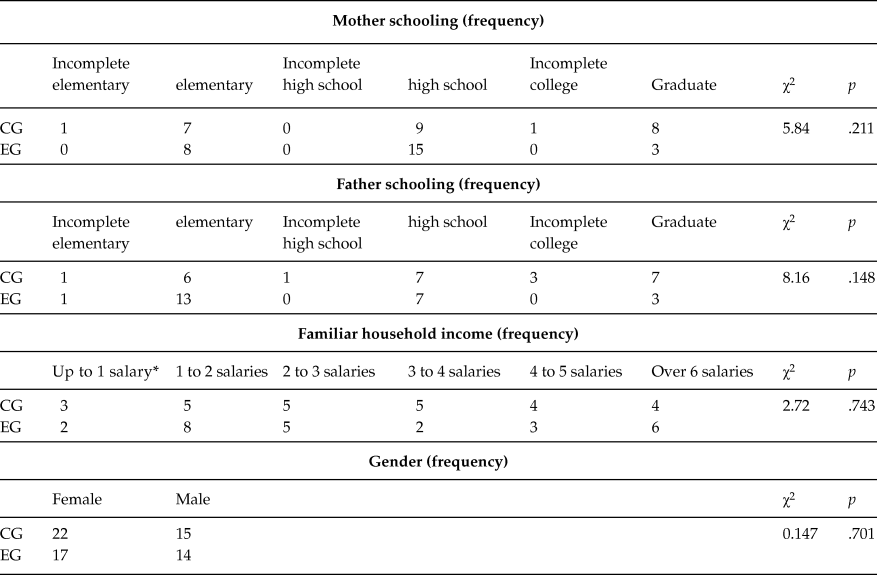
Data are reported for 68 children. All of the children were students from five first-grade classes at a public elementary school in the city of Barueri, São Paulo, Brazil. Their average age was 6.03 years (SD = 0.17). Students at this school came from homes with medium-low socioeconomic statuses (53.8% of families’ household income was < $930, and 80.8% of families’ household income was < $1,550), and approximately 20% of the students’ parents had college degrees (Table 1). Two classes composed the Experimental Group (EG), and three classes composed the Control Group (CG). Teachers (and their classes) were designated to the groups by random assignment by the school principal. The EG was composed of 31 children (45.6%), with a mean age of 6.07 (SD = 0.25) years; the CG had 37 children (54.4%), with a mean age of 6.0 (SD < .01) years.
EG and CG Comparison: Mother and Father Schooling, Familial Household Income, and Gender

Note: CG = Control group. EG = Experimental group.
* One salary in Brazil is equivalent to approximately US $339.00.
The EG and CG were equivalent with regard to the schooling of the mothers and fathers, familial household income, gender, the number of siblings, the period of schooling, the period in the present school, and the assiduity in the school year, measured by the attendance at the end of the school year (Tables 1 and 2). Because we did not find any differences between groups in terms of SES (income, parents schooling) or individual (gender, assiduity) variables, we assumed baseline equivalence between groups and did not control these aspects in our next analyses. The fact that our groups were at the same school (with children coming from the same neighborhood) also helped to control for SES and demographic characteristics. None of the children in our sample had mental disabilities according to the administration of the Columbia Mental Maturity Scale.
EG and CG Comparison: Number of Siblings, Period of Schooling, Period in the Present School, and Assiduity in the School Year

Note: CG = Control group. EG = Experimental group.
Materials
The Brazilian EF program: Intervention Program for Self-regulation and Executive Functions
The Intervention Program for Self-regulation and Executive Functions, or the PIAFEx (Dias & Seabra, Reference Dias and Seabra2013), was developed based on the programs and theoretical appointments of Bodrova and Leong (Reference Bodrova and Leong2007), Dawson and Guare (Reference Dawson and Guare2010), Meltzer (Reference Meltzer2010), and Rosario, Nunes, and González-Pienda (2007). It constitutes a set of activities designed to stimulate and promote the development of EF and self-regulation. Beyond the program activities, children experience different situations in which they can learn how to use EF to organize their own behavior to solve problems and plan their actions in their daily activities.
The PIAFEx has four essential components promoting executive skills that permeate the conduct of all activities: (1) Teacher-child/class interaction – Some types of interaction should be preferred to others to promote self-regulation and autonomy. For example, the teacher should question rather than directly intervene when children have difficulty with a task. Teachers are instructed to gradually pass control and responsibility for performing tasks from themselves (external control) to the child (self-regulation); (2) External mediators – These are tools that help children perform tasks. Mediators can be objects, pictures or any external and tangible accessories that help behavioral and mental processes. For example, a teacher may encourage children to make checklists before starting a task, which will help children’s memory processes; (3) Private speech – This includes audible speech that does not have a communicative purpose, as it is directed to the speaker but can be used to promote self-regulation. During private speech, children repeat or say to themselves what they must do to solve a problem or to finish a multistep task as if they are giving themselves a command to remember or organize what should be done; and (4) Encouraging heteroregulation – This includes children's attempts to regulate the behavior of others. They perform this behavior after they identify that a classmate is failing to meet certain demands. This process helps the child who receives the regulation to remember the task and how to proceed. At the same time, the child who performs the regulation can internalize the rule; that is, he/she may be able to apply it on his/her own behavior in the future. It is important to stimulate and exercise heteroregulation processes, given that these precede self-regulation.
The second, third, and fourth essential aspects are strategies that can be used during various tasks throughout the school routine. These strategies provide external support for children with regard to controlling and regulating their behavior, emotions, and thoughts. The use of these strategies should be encouraged given that, over time, these processes are internalized. Following their internalization, these supplements are no longer required.
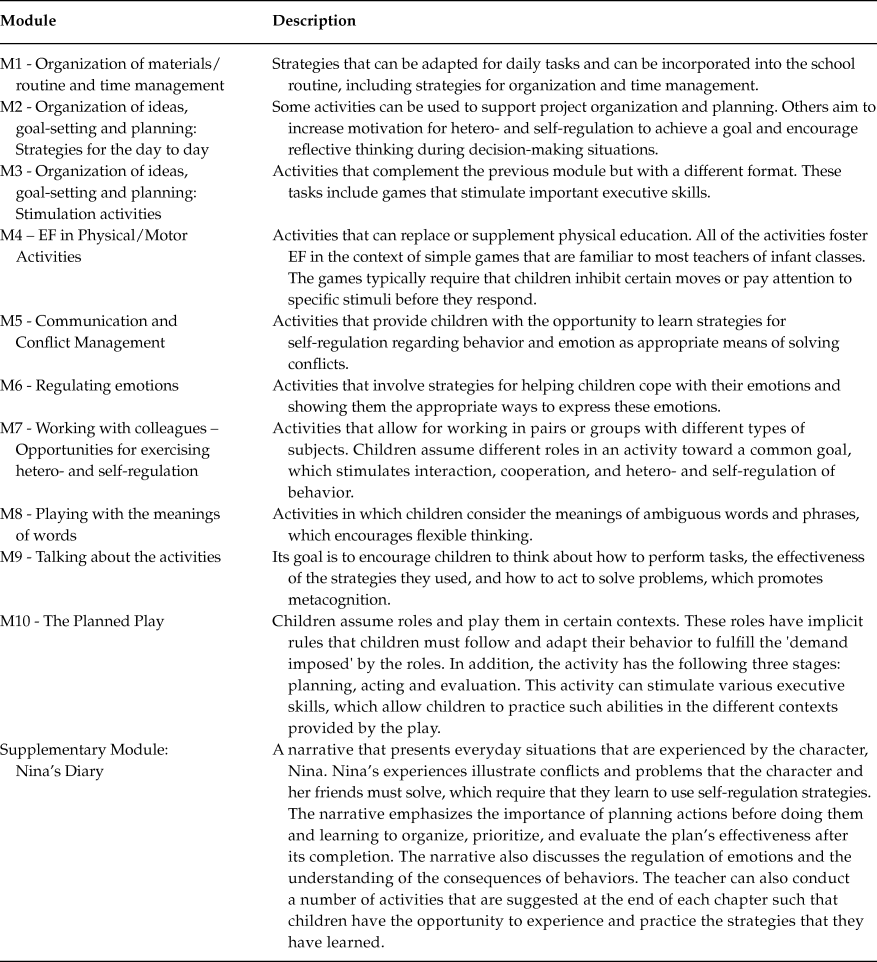
Based on these four essential aspects, the PIAFEx has 43 structured activities, divided into 10 basic modules, and a supplementary module, as summarized in Table 3. Figure 1 illustrates some examples of activities, including the use of mediators and cooperation with colleagues toward a common goal.
Description of the PIAFEx modules (based on Dias & Seabra, Reference Dias and Seabra2013)

In some activities, children have specific roles. They need to learn to respect the rules and collaborate to work toward a common goal. Mediators can be used as support for children’s performance (First picture: the child is planning and drawing a building with blocks / Second picture: the child is building something following the plan of his colleague / Third picture: children are engaged in a reading activity; the ‘ear’ figure is a mediator; the child with the ‘ear’ must listen to the story).

Although some activities are configured more like strategies (e.g., timing, routines, and organizers), most of them are playful. Many were designed to work in peers or larger groups and use low-cost materials, which allow them to be implemented in public schools. The PIAFEx’s introduction includes a brief explanation of the concepts of self-regulation and EF and covers a number of considerations regarding why it is important to promote these skills so that teachers can contextualize and provide information about the work they are performing. At the end of the program, there is a model of a simulated schedule that has suggestions related to the distribution and frequency with which the activities in each module should be conducted. Importantly, the concept that underlies the PIAFEx is the promotion of executive skills and self-regulation as a result of intentional practice, which is provided through an educational approach and with interactions that require these skills.
Instruments for pretest and posttest assessment
Our pretest and posttests included EF performance tests and scales for teachers and parents. The measures included the following:
Trail Making Test for Preschoolers (Espy & Cwik, Reference Espy and Cwik2004)
This test assesses cognitive flexibility and has two conditions, parts A and B. In part A, a sheet is shown, with five dogs of different sizes. The dogs should be organized in order of size, beginning with the “baby” and ending with the “father”. In part B, a sheet with five dogs and five bones with the respective sizes of the figures of dogs is presented. Children should match the dogs with their appropriate bones in order of size by connecting them alternately. We measured children’s ‘sequences’ score in condition B, i.e., the number of items correctly connected in a sequence (range from 0 to 10). The test was administered individually, and there is no time limit for completing this task. Brazilian studies revealed good psychometric features for the test, with evidence of validity by developmental changes, relation with other EF abilities, and TDAH symptoms (Seabra & Dias, Reference Seabra and Dias2012; Trevisan, Reference Trevisan2010).
Cancellation Attention Test (CAT) (Montiel & Seabra, Reference Montiel and Seabra2012)
This test assesses selective attention in a visual search task. It has three matrices (parts 1 to 3) with different types of stimuli (geometrical shapes). Children have to identify the targets using the cancellation paradigm in a fixed time (one minute). Parts 1 and 2 assess selective attention, and part 3 assesses selective and alternating attention. The test was administered individually and we used the number of hits (range from 0 to 50 in Part 1; 0 – 7 in Part 2; and 0 – 52 in part 3) and errors for our analysis in each part of the test. The instrument is available in Brazil, with studies corroborating its validity in children samples (Dias, Menezes, & Seabra, Reference Dias, Menezes and Seabra2013; Dias & Seabra, Reference Dias and Seabra2012; Montiel & Seabra, Reference Montiel and Seabra2012).
Semantic Stroop Test (Berwid, Kera, Santra, Bender, & Halperin, Reference Berwid, Kera, Santra, Bender and Halperin2005; Brocki & Bohlin, Reference Brocki and Bohlin2006)
The Semantic Stroop test assesses inhibitory control and is based on the Stroop paradigm (Assef, Capovilla, & Capovilla, Reference Assef, Capovilla and Capovilla2007), but, instead of words, the semantic version presents pairs of images (i.e., sun-moon; girl-boy). In the first part of the test, children had to name the images, whereas in the second part, they had to name the opposite images. This test is computerized and was administered individually. Accuracy (score range from 0 to 16) and reaction time during each part were recorded. The Brazilian version presented appropriate validity in children samples (Pazeto, Seabra, & Dias, Reference Pazeto, Dias and Seabra2014; Trevisan, Reference Trevisan2010).
Go NoGo Task (Strauss, Sherman, & Spreen, Reference Strauss, Sherman and Spreen2006)
This test assesses sustained attention and inhibitory control. It is computerized and uses a touch screen monitor. The test consists of white background screens on which red or blue squares are shown. Children should press a button only when the stimulus shown (i.e., the square) is red. They should not respond when the presented stimulus is blue. In the first part of the test, the target stimuli correspond to 25% of the items, presented at a speed of 1,200 milliseconds. In the second part, target stimuli account for 75% of the items, which are presented at a speed of 800 milliseconds (if no answer was chosen, the test screen changed automatically after some ms, presenting the next stimulus). The test was administered individually. We consider a total measure, namely, the average performance in parts 1 and 2. We measured children’s scores in target items (i.e., when children should answer the target/go item) and non-target items (i.e., when children should wait and not answer the non-target/no-go item). We also used a total index from the average of their performance in target and non-target items. All of the measures are means within a range of 0 to 1. Evidence of validity was found in a sample of Brazilian by Trevisan (Reference Trevisan2010).
Simon Task (ST) (Davidson, Amso, Anderson, & Diamond, Reference Davidson, Amso, Anderson and Diamond2006)
The test has three parts. In part 1, figures of a butterfly and a frog were presented on the screen, and children are asked to press the corresponding button, which had either the figure of a butterfly or a frog on it. In part 2, arrows are presented on the screen, and children have to press the button on the side to which the arrow is pointing, which is independent of where on the screen the arrow actually is. Parts 1 and 2 assess inhibitory control. In part 3, striped or gray spheres are presented on the screen. Children have to press the button on the same side of the presented stimulus if the sphere is striped, but, if the sphere is gray, children are asked to press the button on the opposite side of the screen. Part 3 measures both inhibition and working memory. There are congruent and incongruent items for each part of the test. The test was administered individually using a touch screen monitor. Overall speed and accuracy (ranging from 0 to 2, corresponding to the sum of the mean scores in the congruent and incongruent items) were recorded, as well as the difference in speed and accuracy (ranging from -1 to 1) on congruent versus incongruent trials (i.e., interference, corresponding to the difference in the mean scores in the incongruent and congruent items). Evidence of validity was found in a sample of Brazilian children by Trevisan (Reference Trevisan2010).
Childhood Executive Functioning Inventory (CHEXI) (Thorell & Nyberg, Reference Thorell and Nyberg2008; Trevisan, Dias, Menezes, & Seabra, 2012)
CHEXI was developed to assess executive functioning in children with ADHD. This instrument has 26 items, each of which is scored on a Likert scale with five levels (definitely false, false, partially true, true, and definitely true). Items are grouped into the following four subscales: Working memory (ranging from 11 to 55), Planning (ranging from 4 to 20), Inhibitory control (ranging from 6 to 30), and Self-regulation (ranging from 5 to 25). The CHEXI items focus specifically on behaviors related to executive skills and not on the symptoms of ADHD. This instrument was completed by teachers and parents and provides a more functional, albeit subjective, measure of EF. The scores for each scale correspond to the level of difficulty that children have in that domain. We used the scores in each subscale and the total score (the sum of the others). CHEXI was translated and adapted to Portuguese. The Brazilian version showed appropriate psychometric features (Trevisan et al., 2012).
Strengths and Difficulties Questionnaire (SDQ) (Goodman, Reference Goodman1997; Stivanin, Scheuer, & Assumpção Jr., Reference Stivanin, Scheuer and Assumpção2008)
The SDQ is a scale that can be used to track the mental health problems of children aged 4 to 16 years. The scale was originally developed by Goodman (Reference Goodman1997) and has been translated and adapted to Portuguese. The Brazilian version shows evidence of validity (Stivanin et al., Reference Stivanin, Scheuer and Assumpção2008). The scale has 25 items, each of which is scored on a Likert scale with three levels (false, more or less true, and true). The scale covers five areas, Emotional Symptoms, Conduct Problems, Hyperactivity, Peer Problems, and Prosocial Behavior. In each area, scores range from 0 to 10. For Prosocial Behavior, a higher scores mean greater ability; for all other areas, a larger scores means greater difficulty. The questionnaire was completed by parents and teachers.
Columbia Mental Maturity Scale (CMMS)
The CMMS evaluates the general nonverbal reasoning abilities of children with ages between three years, six months and nine years, 11 months (Alves & Duarte, Reference Alves and Duarte2001). The test has 92 planks, each with 3–5 pictures. Children must point out which stimulus is different or does not match the others. To accomplish this task, children need to find the rule of organization for the figures so that they can eliminate only one picture. The Brazilian version of the test has acceptable reliability and validity indices. In the present study, this measure of reasoning was used to identify children with intellectual problems.
Procedure
The Ethics Research Committee approved this project. A consent form was sent to the School Board of Directors and to students’ parents to obtain their consent to perform the research.
The research was conducted according to the following three steps: a pretest, an intervention, and a posttest. In the pretest, all children were assessed using the Trail Making Test for Preschoolers, the Cancellation Attention Test, the Semantic Stroop Test, the Go NoGo Task, and the Simon Task, with the CMMS used to screen for reasoning. The assessment occurred in a room at the school across six individual sessions, with a duration of approximately 15 minutes for each session and an interval of five days between sessions. Teachers and parents completed the Childhood Executive Functioning Inventory and the Strengths and Difficulties Questionnaire. After the pretest assessment, teachers from two classes received training with regard to the intervention program. Their classes constituted the Experimental Group (EG). Three other teachers’ classes comprised the Control Group (CG), and their classes remained unchanged.
The training for the EG teachers consisted of three meetings totaling approximately 6 hours in time. The first meeting aimed to present the results of research and show the efficacy of EF classroom interventions. In the second meeting, the concept of EF and the importance of these abilities in learning and day-to-day functioning were explained. In the last meeting, the PIAFEx was presented and explained. All modules were discussed, and the importance of the teachers' attitudes in promoting EF development in their students was emphasized.
Teachers received a copy of the PIAFEx with all activities and instructions to implement them. There was also a weekly calendar with the modules that should be performed each day, from which teachers could choose any activity within each module. The EG teachers conducted the activities daily with their students, supervised by the author. The supervision sessions were performed by the first author twice a week. They included observations in the classroom and, after that, a meeting with each teacher to discuss doubts and schedule next activities. This phase of the research lasted approximately three and a half months (in this period, there were 24 meetings with EG teachers) and was followed by the posttest assessment, in which the same procedure used for the pretest was repeated (except that the CMMS was not administered). It is important to note that all of the materials used in the intervention were donated by the researchers and could be used by all of the teachers and students.
To control the fidelity of implementation of the PIAFEx by the EG teachers, a psychologist who did not know the EG and CG division performed an observation in all classes. Observation sessions in each class happened two times in the period of the intervention, and each lasted 4 hours. To systematize this process, we developed an observation protocol in which the observer could score how much the activity proposed by the teacher, as well as the teacher’s posture/behavior in class, promoted EF. For this protocol, for each topic in a list of teachers’ activities and behaviors that could promote EF, the observer could score 0 (the teacher does not use or execute it), 1 (the teacher uses or executes it, but not frequently/consistently) or 2 (the teacher uses or executes it frequently/consistently). A hypothetical index for each group was computed considering the scores of each teacher in the observation protocol. This index was considered in terms of percentage of adherence to the procedure.
Statistical Analyses
First, descriptive analyses were performed to compare teachers’ (CG x EG) adherence to the procedure, using the scores for teachers in the observation protocol. After, an analysis of covariance (ANCOVA) was performed for each measure (posttest measures) to determine any group effects on the performances. The group (CG x EG) was used as the independent variable, and the previous performance in each measure (pretest measures) was used as the covariant (to control possible previous differences between groups), as suggested by Dancey and Reidy (Reference Dancey and Reidy2006). As a result, ANCOVAs were performed for each measure independently. For all of the tests, eta squares were used to estimate the size of the effect (ES small – from .0099; medium – from .0588; and high – from .1379). Eta square can be understood on a percentage basis, i.e., the percent of the variance in a dependent variable explained by the variance in an independent variable (Dattalo, Reference Dattalo2008). The level of confidence was set at .05 for all of the comparisons. Significant results are presented in bold.
Results
Firstly, we compared the EG and CG teachers in terms of the adherence to the intervention procedure. As expected, teachers in the EG showed higher scores than colleagues in the CG. We conducted covariance analyses examining any group (EG vs. CG) effect on posttest results while controlling for children’s pretest performances. These results are presented in Table 4.
Descriptive Statistics (pretest) and Descriptive Statistics that are Corrected by Ancova (posttest) for Children’s Performances on Each Measurement with F and p Values for the Experimental (EG) and Control (CG) Groups (controlling for pretest performance)

Note: CG = Control group. EG = Experimental group. RT = Reaction time.
* when children should wait and not answer in the Go NoGo Task.
** when children should answer in the Go NoGo Task.
*** interference score or RT: incongruent – congruent items for each part of the Simon Task.
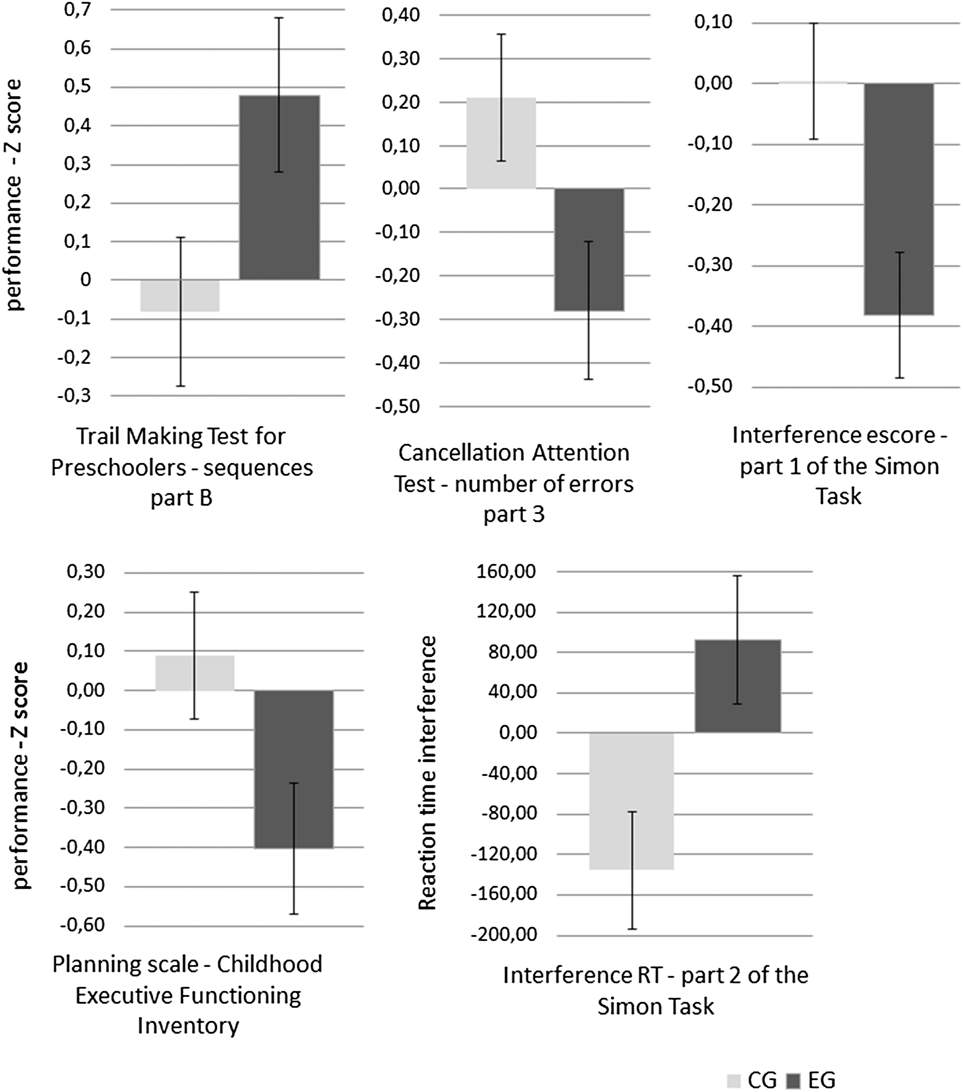
We found that children in the EG had significantly better scores on part B of the Trails test, fewer errors on part 3 of the CAT, and less difficulty with planning according to teacher and parental reports on the CHEXI and suffered less from interference (score) on part 1 of the Simon task than those in the CG. That is, the EG children performed almost as well on incongruent items as they did on congruent items. In addition, the EG showed higher interference reaction times in part 2 of the Simon task, meaning that EG children expend more time on incongruent items in this part of the test (Figure 2). In sum, the results suggest that the EG outperformed the CG on flexibility, attention and inhibition tests and in planning, measured with a functional scale.
The EG children performed significantly better (p < .05) than their peers in the CG on measures of cognitive flexibility (Trails, part B) and selective and alternating attention (CAT). They also suffered less from the interference effect in terms of score (part 1 – Simon task) and presented higher interference RT (part 2 – Simon task). The EG children were better rated on a measure of planning, as reported by teachers and parents on the CHEXI (in the CHEXI, a higher score suggests greater difficulties, so a lower score is better).

Discussion
The EG children had gains in EF tasks, especially when the executive demands were greater (as in part B of the Trail Making Test for Preschoolers and part 3 of the Cancellation Attention Test), consistent with what has been observed in previous studies (such as Diamond et al., Reference Diamond, Barnett, Thomas and Munro2007). For the posttest, the EG children seemed to have the ability to adjust themselves to the higher degree of difficulty for the incongruent items, increasing the reaction time so as not to decrease performance (for example in the Simon Task, in which the EG had a higher score of interference and higher reaction time interference than the CG).
Beyond the gains in the performance tests, teachers and parents rated the EG children as significantly better in planning their activities in school and at home compared with the CG in the CHEXI. Therefore, the intervention produced some gains that were revealed in situations other than those used in the intervention, which suggests that the effects can be extended to daily tasks and behaviors, as reported by parents and teachers. Thus, consistent with previous research (Barnett et al., Reference Barnett, Jung, Yarosz, Thomas, Hornbeck, Stechuk and Burns2008; Dawson & Guare, Reference Dawson and Guare2010; Diamond et al., Reference Diamond, Barnett, Thomas and Munro2007; Meltzer, Reference Meltzer2010; Meltzer & Basho, Reference Meltzer, Basho and Meltzer2010, Riggs, Greenberg et al., Reference Riggs, Greenberg, Kusch and Pentz2006; Rosario et al., Reference Rosário, Costa, Mourão, Chaleta, Grácio, Núñez and González-Pienda2007), the current study showed that it is possible to develop and engage executive processes in the classroom. It was important that the CG continued with their regular educational activities so that the EG was not compared to a group with no stimulation. This fact further reinforces the results shown here because it suggests that the PIAFEx could complement regular curriculum, helping teachers to stimulate children’s executive skills. Therefore, the PIAFEx overlaps with the development that is normally promoted by regular classroom curriculum. This conclusion is consistent with findings from PIAFEx intervention with preschoolers (Dias & Seabra, submitted).
The results of the present study also support the findings of Diamond and Lee (Reference Diamond and Lee2011) regarding the effectiveness of complementary programs, such as the PIAFEx, in the promotion of EF. In general, the effects of these types of interventions seem larger and more generalizable compared to the effects of cognitive training, given that these interventions address EF more broadly than cognitive training does (Diamond, Reference Diamond2013; Diamond & Lee, Reference Diamond and Lee2011). Similar to other programs presented by Diamond and Lee, the children in the EG in the current study showed better performances on inhibitory control and cognitive flexibility than those in the CG. Moreover, the current paper extends the findings of Rosario, Costa et al. (2007), who found that 5-year-old children who participated in the ‘Sarilhos do Amarelo’ (Yellow Confusions) program were able to use the strategies that they learned in the program during other activities, although these other activities also occurred in a classroom context. In addition, the current study controlled for children’s performance on the pretest during the analysis of the intervention effect, whereas, in the study by Diamond et al. (Reference Diamond, Barnett, Thomas and Munro2007), a pretest was not performed, which is an important strength with regard to the results of our study.
Given the importance of EF for academic success and learning (Bodrova & Leong, Reference Bodrova and Leong2007; Dawson & Guare, Reference Dawson and Guare2010; Meltzer, Reference Meltzer2010), their role in arithmetic and reading skills (Cutting, Materek, Cole, Levine, & Mahone, Reference Cutting, Materek, Cole, Levine and Mahone2009; Raghubar, Barnes, & Hecht, Reference Raghubar, Barnes and Hecht2010), and their influence on individuals’ adaptive functioning and problem solving throughout life (Diamond et al., Reference Diamond, Barnett, Thomas and Munro2007; Rosario et al., Reference Rosário, Núñes and González-Pienda2007), it is important to offer effective interventions that can contribute to the promotion of these skills. It is possible that the gains promoted by the implementation of the PIAFEx have repercussions in other areas and skills, including learning, behavior and mental health indices, such as the presence of indicators of inattention and hyperactivity. Studies are currently being designed to investigate these issues. The hypothesis that the effects of the intervention will extend to other areas and skills is supported by previous literature (Bierman, Domitrovich et al., Reference Bierman, Domitrovich, Nix, Gest, Welsh, Greenberg and Gill2008; Moffitt et al., Reference Moffitt, Arseneault, Belsky, Dickson, Hancox, Harrington and Caspi2011; Riggs, Greenberg et al., Reference Riggs, Greenberg, Kusch and Pentz2006) and is theoretically consistent with the argument that children who are able to focus their attention, inhibit any disruptive behaviors and mentally manipulate information can benefit from increased EF skills when learning new information and inhibiting inappropriate behavior. Consistent with the conclusion of Diamond and Lee (Reference Diamond and Lee2011), even small gains in EF skills can promote substantial changes in the distribution of results and produce important changes in the rates of learning, health and behavior. In this sense, authors agree that prevention programs should also address EF (Riggs, Greenberg et al., Reference Riggs, Greenberg, Kusch and Pentz2006). The PIAFEx proved to be a promising tool that can complement a regular curriculum at the beginning of elementary school to address EF.
It is important to highlight the preventive feature of this intervention. Because childhood, specifically between 5 to 7 years of age, is a period with faster development of EF (Best et al., Reference Best, Miller and Naglieri2011), one could hypothesized that it could also be an important period for interventions that could support and drive EF development, before, perhaps, more sizable deficits can accumulate in this area. As children advance in grade school, activities increase in complexity and there is increasing demand on EF. If these skills are not appropriated developed, children will experience difficulties and failures, which can lead to behavior problems, school dropouts, demotivation and even depression and anxiety (Dawson & Guare, Reference Dawson and Guare2010). In this sense, it would be helpful to address EF and support their development from the early stages of elementary school or even in preschool.
Another important aspect of this study pertains to our specific low socioeconomic conditions because children in lower socioeconomic classes tend to have poorer EF (Diamond et al., Reference Diamond, Barnett, Thomas and Munro2007). Given the lack of studies on EF programs in Latin America and underdeveloped countries in general, we hold that developing a program to promote EF in our children could be an important area of research and practice in Brazil and countries that share similar educational and socioeconomic problems. In this context, we tested the PIAFEx and shared some promising results in this paper.
Despite these satisfactory results, it is also worth noting that some measures did not reflect any effect from the intervention, which suggests that the intervention’s intensity or duration may have been insufficient for generating greater gains or, perhaps, some measures may not be sensitive to the intervention effects. Possibly, in agreement with the study of Diamond et al. (Reference Diamond, Barnett, Thomas and Munro2007), teachers need a longer period of time to grasp the principles of intervention for it to become effective. This fact provides even greater relevance to the results of the PIAFEx intervention, given that it lasted approximately three and a half months, and promising results were evident in the children’s performances. An increase in the duration of the intervention may lead to observable gains in the more complex parts of the Simon Task and other measures. This question should be investigated in future studies.
The Intervention Program for Self-regulation and Executive Functions (PIAFEx) was effective for improving some EF in first-grade children. Interestingly, improvements in performance were detected in situations that differed from those provided in the classroom intervention. The preventive potential of this intervention with regard to behavioral problems and mental health should be investigated using a longitudinal approach. The low socioeconomic status of students at Brazilian public schools and the evidence that lower-income children have poor EF highlight the importance of these findings. It may be possible to improve children’s EF in Brazilian public schools with an intervention that is conducted by teachers and at a low cost.
A limitation of our study was the short duration of the intervention. However, even in this short duration, we found very encouraging results. Therefore, a longer duration for this intervention may lead to even greater improvements. A second limitation is the absence of an ‘active’ control group, i.e., a control group that received a program that differed from just ‘business as usual’. A third limitation is that the researchers who designed this intervention also evaluated its effectiveness. In the future, it would be good to have an independent evaluation during which the testers were unaware of the groups in which the children were placed. The fourth limitation is the small sample size. In addition, children were clustered within classrooms, and we do not control for teacher variables. Future research should take these factors into account.
By contrast, the strengths of the current study are its control for children’s performance before the intervention with the pretest assessment and the use of multiple, diverse assessment measures. Another potential issue refers to our choice for individual ANCOVAs, instead of a MANOVA. We assume that multiple comparisons can increase the chance of error, but our study was exploratory and we choose to look at each variable individually while controlling for its previous performance. Future studies can consider different approaches to the data.
To date, we do not have a tool to promote EF development in Brazilian children (or in Latin America or other developing countries). The PIAFEx can be easily implemented in the classroom at little or no cost, and it may prove to be a useful tool to help teachers improve the EF of their students. Promoting EF during preschool or first-grade of elementary school could prepare students for the increasing challenges of society. In this sense, our study is a first and important step to expand this area of research to more disadvantaged contexts.
This article is based on the first author’s Doctorate thesis (FAPESP scholarship) FAPESP (NMD); CNPq (AGS).