Implications
This study provides novel information on the effect of string and perch provision on welfare-related parameters in commercial broiler chickens. The results of this study suggest that these stimuli are used by broiler chickens and that suspended string has the potential to positively affect the leg health of broilers. However, birds provided with string and perches (observed outside the direct vicinity of these enrichment stimuli) showed reduced activity levels in later weeks. This highlights the need for further research investigating the ‘real world’ implications of the provision of different types of environmental enrichment to be carried out on commercial farms.
Introduction
Lameness adversely affects economic returns within the poultry industry (Su et al., Reference Su, Sorensen and Kestin1999), particularly through contributing to increased culling rates and mortality. Lame birds also self-select more food containing the painkiller carprofen than non-lame birds, suggesting that the condition is associated with pain and is therefore an animal welfare issue (Danbury et al., Reference Danbury, Weeks, Chambers, Waterman-Pearson and Kestin2000). Artificial selection for increased feed conversion and rapid growth rate appears to be a salient factor in the development of lameness in commercial broiler chickens (Kestin et al., Reference Kestin, Knowles, Tinch and Gregory1992; Fanatico et al., Reference Fanatico, Pillai, Hestor, Falcone, Mench, Owens and Emmert2008). This may be through direct effects of rapid growth on bone health (see Julian, Reference Julian1998; Olkowski et al., Reference Olkowski, Laarveld, Wojnarowicz, Chirino-Trejo, Chapman, Wysokinski and Quaroni2011), and/or though indirect effects of genetic selection strategies on behaviour. Research shows that fast growing broilers are extremely inactive and may spend up to 80% of their time lying down (Weeks et al., Reference Weeks, Danbury, Davies, Hunt and Kestin2000). This lack of activity has been linked with abnormal bone development and leg conformation (Kestin et al., Reference Kestin, Knowles, Tinch and Gregory1992; Reiter and Bessei, Reference Reiter and Bessei1998a and Reference Reiter and Bessei1998b), and may therefore also negatively impact on the walking ability of birds. In addition, the presence of contact dermatitis lesions may also adversely affect the movement of birds (Harms and Simpson, 1975; Hester, 1994).
Environmental enrichment has been posited as a way in which activity levels may be increased, and lameness reduced, in commercial flocks of fast growing broiler chickens (e.g. Kells et al., Reference Kells, Dawkins and Borja2001; Bailie et al., Reference Bailie, Ball and O’Connell2013). Mounting and dismounting perches, and the act of perching itself, may exercise the broiler musculoskeletal system in a different way from standing and walking, and may therefore strengthen legs. Indeed, Bizeray et al. (Reference Bizeray, Estevez, Leterrier and Faure2002) found a tendency towards improved morphology of the tibia when broiler chickens were required to traverse barriers to access feeders. They hypothesized that the physical activity associated with perching on, and stepping on to and over these barriers contributed to this effect. Perching may also reduce the amount of time birds spend in contact with wet litter, and may therefore reduce the incidence or severity of contact dermatitis lesions (Su et al., Reference Su, Sorensen and Kestin2000). Activity levels may also be increased and leg health improved by stimulating exploratory behaviour through providing pecking devices. McAdie et al. (Reference McAdie, Keeling, Blokhuis and Jones2005) found that laying hen chicks showed sustained interest in string when provided as a pecking device; however, the usefulness of string as a source of environmental enrichment for commercially housed broiler chickens does not appear to have been fully evaluated. In addition to potential effects on leg health, environmental enrichment has also been shown to exert positive effects on the psychological welfare of farm animals (Newberry, Reference Newberry1995). In particular it has been suggested as a way to reduce fear in a number of species, including poultry (Jones, Reference Jones1996).
The aim of this study was to investigate the effects of providing enrichment in the form of perches and string on activity levels, leg health and fearfulness in commercial broiler chickens. This research was conducted using chickens housed with access to natural light and straw bales. Previous research demonstrated welfare benefits associated with providing these types of environmental enrichment (Bailie et al., Reference Bailie, Ball and O’Connell2013), and the objective of the current study was to determine if further benefits could be achieved by additional modifications to the environment. We hypothesised that both perches and string would independently increase activity levels, and reduce levels of lameness and fearfulness. We also hypothesised that there would be a cumulative effect of string and perches on these parameters. The study also aimed to gain a better understanding of levels of use of perches and strings by commercially housed broiler chickens.
Material and methods
Animals, husbandry and housing
A total of 368 000 Ross 308 broiler chickens obtained from one breeding company (Aviagen Ltd, UK) were used in this experiment, which took place in Northern Ireland between February and August 2011. Approximately 23 000 mixed-sex birds were placed in each experimental house ‘as hatched’. The total floor area/house available to the birds was ~1324 m2 resulting in an approximate initial stocking rate of 17 birds/m2. Approximately half of the birds were removed for slaughter after day 30 of the production cycle, and the remaining birds were removed between days 32 and 42. Stocking densities did not exceed 30 kg/m2 at any stage of the production cycle.
Temperature, ventilation, feeding regimes, feed sources and blends were identical between houses. The ventilation system consisted of ceiling fans and flaps, which could be opened and closed along the two long sides of each house in response to the humidity and temperature (which were recorded by four sensors). Fans and flaps operated automatically in the event that humidity fell outside the optimum range of 55 to 60% and if temperature reached 5° above or below the optimum for each week. Large gas pan heaters were placed in two uniform lines down the length of all houses and the temperature within all houses was 33°C at day 1, and dropped 2° each week until day 21 of the rearing cycle.
All birds had access to natural light from day 4 of the rearing cycle. This was provided through 46 windows/house (measuring 220 cm wide×60 cm high) that were located at a height of 1.5 m along the length of the two ‘long’ sides of the house. Windows comprised double glazed, toughened glass. These windows were shuttered for the first 4 days of the rearing cycle and during the dark period of the artificial lighting regime. The hours of darkness supplied for the birds rose by 1 h/day from 1 h at a day old, to 6 h at 7 days old. This regime was then maintained from 7 until 28 days old. From 29 days old, hours of darkness were gradually reduced by 1 h each day to 1 h by 33 days old. One hour of darkness was then maintained until the end of the rearing cycle. The dark period was between 2300 and 0500 h. Both lights and shutters were automatically controlled using timers.
Artificial light was provided by 2 rows of 24 horizontally suspended fluorescent strip lights running parallel to each other along the length of each house. Rows were placed 8 m from the nearest wall and suspended 12 m from the floor of the house. Lights comprised 1.2 m low frequency T8 tubes emitting 3000 lumens each (F40w/29-530/RS warm white energy rating B; Disano Illuminazione UK Ltd, Doncaster, UK). Identical light fittings were used in all houses (4 ft Disano Hybro 951 IP65 fitting, Disano Illuminazione UK Ltd) and were suspended from the ceiling by a pulley system.
A total of 30 straw bales, comprising short chopped straw wrapped in plastic, each measuring 800×400×400 mm, were supplied in each house from day 10 of the rearing cycle. These were dispersed as evenly as possible throughout the house. Bedding comprised of wood shavings and was placed in the house before the birds arrived. A total of 66 kg of wood shavings were supplied per thousand birds. In addition, sawdust was added to specific areas of the houses when deemed necessary by the farmer. Birds were fed on an ad libitum basis and received three different commercially available diets across the production cycle. All drinkers were of the nipple variety and included cups.
Treatments and experimental design
The effects of provision of perches (P) and string (S) on the welfare of broiler chickens was assessed in 2×2 factorial design study. A total of 24 perches were distributed as evenly as possibly throughout the house in the P treatment. Each perch was manufactured by the commercial supplier of the birds and consisted of a long horizontal, wooden beam (300×5×5 cm) with a rounded upper edge resting on two supports at either end (15 cm high) (Supplementary Figure S1). In the string treatment, 24 pieces of thin white nylon rope (60×10 mm) were supplied. Each piece of string was tied at its mid-point to the wire above each of the four feeder lines. Six pieces of string in total were tied to each feeder line at approximately even intervals (Supplementary Figure S2). The wire was positioned 33 cm above the litter at the beginning of the rearing cycle and was gradually raised to a maximum height of ~50 cm above the litter (as feeders were raised to encourage growing birds to feed in a standing position). The ends of the string may therefore have been situated between 3 and 20 cm above the litter at different points in the rearing cycle depending on the growth rate of the birds. The number of enrichment items provided was based on the RSPCA Freedom Foods scheme, which requires a minimum of ‘one pecking object and 2 m of perching space per 1000 birds’ in addition to the provision of straw bales and natural light (RSPCA, 2013).
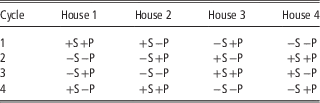
Four houses were selected for this study, giving two matched pairs of houses on a single commercial farm. Pair 1 comprised Houses 1 and 2, and Pair 2 comprised Houses 3 and 4. All four houses were of an identical rectangular design, orientation and number of windows, with the exception that Houses 1 and 2 had a central doorway and Houses 3 and 4 had doors that were offset to either the right (House 3) or the left (House 4). As the birds used were part of the normal commercial enterprises of the company, the number of replications was limited. However, each treatment was replicated four times (Table 1). All four houses were matched exactly for number of chicks placed and strain of bird. The date when chicks were placed and removed was matched exactly for all four houses, except for Replicate 3. Owing to a logistical problem, Houses 1 and 2 were stocked 1 day earlier than Houses 3 and 4. In order to counteract any confounding effects, all measures were taken on the same day after placement (and thus 1 day apart between the two pairs of houses) in this replicate.
Replication of treatments across cycles and houses

+S=provided with S; −S=no access to string; +P=provided with perches; −P=no access to perches.
Measurements
Behavioural observations
Behaviour was assessed during 2 days each week between weeks 3 and 5 of the rearing cycle. Observations of general activity levels and fearfulness were made on day 1, and use of enrichment was assessed on day 2. All behavioural observations were taken between the hours of 0900 and 1800 and began ~4 h after the end of the dark period. The house shape was mapped and virtually divided into 36 equal size quadrants. Quadrants in which all behavioural, leg health and environmental measures were carried out were preselected using a random number table. A different set was chosen for each house each week.
Activity levels
Two video cameras on tripods were employed to record behaviours in the two pairs of houses simultaneously. One camera was alternated between the houses within each pair every two observations. Video recordings for scan sampling were taken within six quadrants per house per week as detailed in the study by Bailie et al. (Reference Bailie, Ball and O’Connell2013). Quarters that were selected for recordings did not contain strings, perches or straw bales in order to ascertain whether or not the presence of enrichment affected general, non-enrichment-related, activity levels. The first 5 min of film was cut from all videos in order to ensure a settling period had been imposed after the exit of the researcher from the house. Instantaneous scan sampling for each 10 min clip involved recording both the total number of birds and the numbers of birds lying, standing and engaging in locomotion (walking or running) within the full frame of the video recording at 120 s intervals.
Fearfulness
Fearfulness was assessed by recording the flight distance of birds and their response to a novel object. Flight distance scoring was performed in 10 quadrants, selected using a random number table, in each house once a week after video recordings were completed. A square piece of Perspex, measuring 30×30 cm, with an ‘x’ drawn in the middle, was held up at arm’s length at the edge of the selected quadrant. The bird observed closest to the ‘x’ was tested for flight distance. The experimenter ensured that selected birds were not tightly packed within a group before approaching. The approach consisted of slowly walking towards the bird at a constant speed. At the point when the selected bird retreated, the approximate distance (in centimetres) between the experimenter and the bird was recorded using a standard measure as a guide.
A novel object was also presented in one randomly selected quadrant in each house each week. The experimenter gently placed the novel object upright among the birds and walked to a distance of ~4 m away. Observations were taken from a standing position on top of a straw bale. The latency of the first bird to approach and contact the object after it had been placed on the ground was measured using a stop watch. If no bird approached the object within 5 min a maximum latency of 300 s was recorded and the test was terminated. The number of birds that made contact with the object in the 60 s following the first contact with the object was also recorded, along with the number of birds within 50 cm of the object at 300 s. Three different novel objects were presented within each treatment each week in the following order; a child’s yellow plastic chair (30×30×70 cm), a red gardening basket (or ‘trug’) (40×60 cm diameter) and a blue storage container to keep items cool (or a ‘cool box’) (30×50×60 cm). The same novel object was presented in all houses during the same week throughout all cycles.
Use of enrichment
A video camera placed on a tripod was used to record behaviour directed towards enrichment. Perch recordings took place during the following time periods: 0900 to 1000 h, 1100 to 1200 h, 1300 to 1400 h and 1500 to 1600 h. String recordings took place on the same day during the following time periods: 1000 to 1100 h, 1200 to 1300 h, 1400 to 1500 h and 1600 to 1700 h.
During these times one perch or piece of string was filmed for a 30 min period in each of the two houses provided with these enrichments. Two perches or pieces of string from centre quadrants and two from edge quadrants were filmed in each house each day in order to balance any effects of enrichment location. During later analysis, the first 5 min of each recording was disregarded in order to allow a settling period for the birds. The total number of times the perch or string was used by any bird was recorded, along with the duration of each bout, during the remaining 25 min. Bouts beginning before the 25 min observation window or ending after this period were disregarded in the analysis of both duration and frequency of perching and pecking as their duration could not be accurately ascertained. Data comprising the start and end times of each bout of perching and pecking were also used to deduce the number of bouts that overlapped (i.e. each bout that had a start time before the end time of a previous bout, resulting in more than one animal using the enrichment simultaneously). The number of overlapping bouts was then calculated as a percentage of the total number of bouts. Bouts beginning before the 25 min observation window and ending after this period were included in this analysis.
Leg health
Leg health was assessed using a latency to lie test (Weeks et al., Reference Weeks, Knowles, Gordon, Kerr, Peyton and Tillbrook2002; Berg and Sanotra, 2003) and spontaneous gait scoring. Each assessment was performed in 25 randomly selected quadrants following behavioural measures in each house on day 1 of each week. One bird was randomly selected from each quadrant each week for gait scoring, and one bird for latency to lie testing, which was carried out as in the study by Bailie et al. (Reference Bailie, Ball and O’Connell2013). Gait was scored on a scale of 0 to 5 where 0=normal movement and 5=unable to walk (Kestin et al., Reference Kestin, Knowles, Tinch and Gregory1992). Measures of leg health were carried out within one house before moving on to a second house, and the first house used in observations was alternated weekly. The number of birds culled for leg problems by day 30 of the rearing cycle was recorded for each cycle in each house using company records. The incidences of podo dermatitis and hock burn at slaughter were recorded by slaughterhouse staff as in the study by Bailie et al. (Reference Bailie, Ball and O’Connell2013).
Environmental parameters
Light intensity (lux) values and UV wavelengths (µW/cm²) were recorded immediately following behavioural observations from the centre of the six quadrants videoed for activity levels and from the area beside filmed perches and strings in each house each week using a light meter (Digital lux meter LX1010B; Handsun Co. Ltd, Shanghai, China) and a UV meter (UV-340 meter; Lutron Electronic Enterprise Co. Ltd, Taipei, Taiwan) as in the study by Bailie et al. (Reference Bailie, Ball and O’Connell2013). Daily temperature and humidity levels were taken from farm records.
Productivity and mortality
The number of birds culled for reasons other than leg problems and of mortalities by day 30 of the rearing cycle, and the cumulative percentage of dead birds by this point, were recorded for each cycle in each house using company records. Slaughter weights were taken from farm records at thinning and clearing. The farmer culled as normal throughout the study.
Statistical analysis
Data were analysed using SPSS (v20). Owing to a problem with the video recordings of perches and string, data for one of the four observations were missing from cycle two week 5 for usage of both types of enrichment. All treatments were balanced across houses during the four replications, and analysis was carried out as for a balanced Latin square design. A histogram of the residuals was plotted for each variable each week and was scrutinised for normality. Residuals were also subjected to statistical testing for normality using the Shapiro–Wilk test. Data for light intensity and UV recorded in the vicinity of enrichment stimuli, the cumulative percentage of dead birds at day 30 of the rearing cycle, bout lengths of pecking at string and bout lengths of perching were subjected to a log10 transformation in order to achieve a normal distribution. Data containing zero values had 0.5 added to each value before transformation. The means of normally distributed transformed and untransformed data were compared using ANOVA with ‘cycle’ and ‘house’ as blocking factors. Normally distributed data on behaviour and leg health, collected during weeks 3, 4 and 5 of the rearing cycle, were compared using ANOVA with ‘string×perches×week’ as treatment factors and significant differences between weeks were ascertained using Tukey HSD post hoc tests. Normally distributed data on the use of string were analysed using perches×week as treatment factors, and data on the use of perches were analysed using ‘string×week’ as treatment factors. For each measure, average values per treatment, week and replicate were used as experimental units, and all main and interactive effects were determined in analysis. Normally distributed data collected from farm records were analysed using ANOVA with ‘string×perches’ as treatment factors. Average values per treatment and replicate were used as experimental units, and all main and interactive effects were determined in analysis. Back transformed means, with 0.5 removed from each value where appropriate, are presented in the results section. Root mean square error (RMSE) values are presented for ANOVA data and were calculated by taking the square root of error mean square values. However, data from a small number of measures remained non-normally distributed following transformation; therefore a Kruskal–Wallis test was used to compare ranked means of treatment groups.
Results
Environmental parameters
There were no significant differences between treatments in light intensity (+S 62.9, −S 63.9, P=0.88; +P 61.0, −P 65.8, RMSE 23.24 lux, P=0.48) or UV wavelengths (+S 3.4, −S 3.3, P=0.73; +P 3.3, −P 3.4, RMSE 1.23 µW/cm², P=0.64). There was also no significant difference in the light intensity that birds from the +P and −P treatments were exposed to in the vicinity of string (+P 79.5, −P 69.7, RMSE 0.31 lux, P=0.59) and in the UV content of light near strings (+P 4.3, −P 3.8, RMSE 0.28 µW/cm², P=0.88). There was no significant difference in the light intensity that birds from the +S and −S treatments were exposed to in the vicinity of perches (+S 67.3, −S 54.6, RMSE 0.28 lux, P=0.08) or in the UV content of light near perches (+S 3.3, −S 2.6, RMSE 0.28 µW/cm², P=0.12).
Behaviour
Group scans
On average there were 83 (±25) birds present in each scan observation. Provision of string had no significant main effect on the percentage of birds observed lying (+S 77.4, −S 78.4, RMSE 3.99%, P=0.40) and standing (+S 22.6, −S 21.7, RMSE 3.99%, P=0.40). Provision of perches had no significant main effect on the percentage of birds observed in locomotion (+P 3.5, −P 3.5, RMSE 0.77%, P=0.82). However, there was an interaction between perches and age in the percentage of birds observed lying (week 3 +P 77.0, −P 80.9, week 4 +P 79.5, −P 75.2, week 5 +P 78.4, −P 76.2, RMSE 3.99%, P=0.02) and standing (week 3 +P 23.0, −P 19.1, week 4 +P 20.5, −P 24.8, week 5 +P 21.6, −P 23.8, RMSE 3.99%, P=0.02), with the presence of perches leading to a decrease in lying behaviour in week 3 and an increase in weeks 4 and 5. There was an interaction between string and bird age in the percentage of birds observed in locomotion (week 3 +S 4.9, −S 3.9, week 4 +S 3.3, −S 3.7, week 5 +S 2.6, −S 2.8, RMSE 0.77%, P=0.04); with the presence of string leading to an increase in locomotion in week 3 but not in weeks 4 and 5.
Flight distance
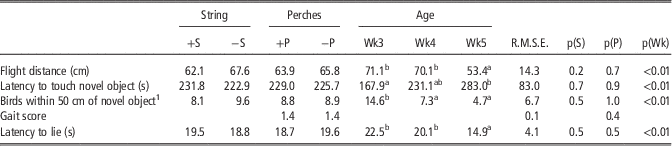
Provision of string and perches had no significant effect on the flight distance of birds. However, there was a significant effect of age on flight distance, with average flight distance decreasing across weeks (Table 2).
Main effects of string, perches and bird age on normally distributed measures of fearfulness and leg health recorded during weeks 3, 4 and 5 of the rearing cycle

+/−S=presence or absence of string; +/−P=presence or absence of perches for all behaviours (d.f. 1, 47).
Means are presented for each treatment. Data not represented here are subject to an interaction effect. Data analysed by ANOVA with ‘String×Perches×Week’ as a treatment factor and ‘Cycle’ and ‘House’ as blocking factors.
a,bMeans in the same row with a different superscript differ significantly.
1 Number of birds within 50 cm of novel object at 300 s.
Reaction to a novel object
Neither the provision of string or perches had a significant effect on the latency to touch a novel object or on the number of birds clustered within 50 cm of the object at 300 s (Table 2). There was no significant effect of string or perches on the number of birds that touched the object within 60 s of the first touch occurring (ranked means: +S 25.4, −S 23.6, χ²(1, n=48) 0.25, P=0.62; ranked means: +P 24.6, −P 24.6, χ²(1, n=48) 0.00, P=0.95). Age had a significant effect on the latency to touch a novel object, on the number of birds within 50 cm of the novel object at 300 s (Table 2), and on the number of birds to touch the object within 60 s of the first touch occurring (ranked means: week 3 32.4, week 4 20.9, week 5 20.2, χ²(1, n=48) 10.26, P=0.01). Birds gathered near the novel object in smaller numbers as they aged, and fewer birds approached and touched the object in the 60 s before the first bird making contact.
Use of strings
On average, there were 19.2 (±14.08) individual bouts of pecking at string per 25 min observation, and the average pecking bout lasted 4.2 s (±2.0). The percentage of bouts of pecking that overlapped with at least one other previous bout of pecking ranged from 0 to 20% across all observations, with an average value of 3.4%.
Provision of perches had no significant effect on the average frequency of string pecking per 25 min observation (ranked means: +P 46.0, −P 50.1, χ²(1, n=95) 0.52, P=47), or on the percentage of bouts of string pecking where more than one bird was involved (ranked means: +P 45.9, −P 50.1, χ²(1, n=95) 0.70, P=40). Provision of perches had no significant effect on the average length of pecking bouts (+P 4.3, −P 4.2, RMSE 0.2 s, P=57).
There was a significant effect of age on the frequency of string pecking per observation (week 3 64. 7, week 4 48.4, week 5 30.4, χ²(1, n=95) 24.36, P<0.01, and on the percentage of bouts of pecking that overlapped with at least one other bout, with birds tending to peck less frequently, and exhibiting fewer overlapping bouts of pecking with age (ranked means: week 3 59.4, week 4 46.3, week 5 38.0, χ²(1, n=95) 12.58, P<0.01). However, age had no significant effect on the average length of pecking bouts (week 3 4.2, week 4 3.9, week 5 4.6, RMSE 0.2 s, P=73).
Use of perches
On average, there were 15.1 (±13.6) bouts of perching per 25 min observation, with an average perching bout lasting 117.4 s (±92.7). The percentage of bouts of perching that overlapped with at least one other previous bout of perching ranged from 0 to 100% across all observations, with an average value of 65.4%.
Provision of string had no significant effect on the average frequency of perching per observation (+S 13.8, −S 16.2, RMSE 9.06, P=0.20) or on average bout length (+S 110.1, −S 111.3, RMSE 0.35 s, P=0.31). Provision of string also had no significant effect on the percentage of perching bouts that overlapped with at least one other (+S 73.5, −S 70.2, RMSE 30.87%, P=0.61).
The frequency of perching per 25 min observation increased with age and peaked during week 5 (week 3 4.1, week 4 16.8, week 5 24.2, RMSE 9.06, P<0.01). Age also affected bout lengths of perching, which increased from weeks 3 to 4 and decreased slightly from week 4 to 5 (week 3 85.2, week 4 124.9, week 5 123.0, RMSE 0.35, P<0.01). There was also a significant increase with age in the percentage of bouts of perching that overlapped with at least one other bout (week 3 43.5, week 4 80.7, week 5 91.3, RMSE 30.87%, P<0.01).
Leg health
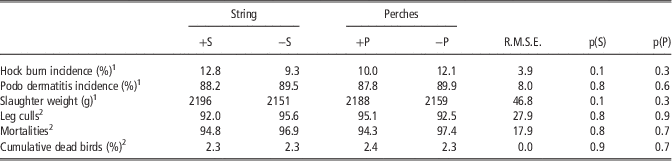
Neither the provision of string or perches had a significant main effect on gait scores (Table 2). There was, however, an interaction between age and string on average gait scores, with +S birds displaying lower gait scores than −S birds during weeks 3 and 5 but not during week 4 (week 3: +S 0.7, −S 0.9, week 4: +S 1.5, −S 1.4, week 5: +S 1.9, −S 2.0, RMSE 0.13, P=0.05). There was no significant effect of string or perches on latency to lie; however, there was a significant effect of age on this parameter (Table 2), with latency to lie decreasing across weeks. Treatment had no effect on the numbers of leg culls recorded between days 1 and 30 of the rearing cycle or on the total incidence of hock burn and podo dermatitis recorded during thinning and clearing (Table 3).
Main effects of string and perches on normally distributed measures of leg health, productivity and mortality taken from farm records

+/−S=presence or absence of string; +/−P=presence or absence of perches for all measures (d.f. 1, 15).
Means are presented for each treatment. Data analysed by ANOVA with ‘String×Perches’ as a treatment factor and ‘Cycle’ and ‘House’ as blocking factors.
1 Recorded at thinning and slaughter.
2 Recorded at day 30 of the rearing cycle.
Culls, mortalities and productivity
Treatment had no significant effect on mortalities and the cumulative percentage of dead birds recorded between days 1 and 30 of the rearing cycle, or on the average slaughter weight of birds recorded during thinning and clearing (Table 3). Treatment also had no significant effect on numbers of culled birds recorded between days 1 and 30 of the rearing cycle (ranked means: +S 8.4, −S 8.6, χ²(1, n=16)=0.01, P=0.92, ranked means: +P=8.7, −P=8.3, χ²(1, n=16)=0.03, P=0.88).
Discussion
Although layer chicks have been shown to be interested in, and peck at, bunches of string (Jones et al., Reference Jones, Carmichael and Rayner2000), this did not appear to be the case in previous research conducted under experimental conditions with broiler chickens (Arnould et al., Reference Arnould, Bizeray, Faure and Leterrier2004). However, results of the current study suggest that the chickens were interested in string, with a bout of pecking occurring approximately every 78 s at each piece of string. The fact that strings were presented close to feeders possibly increased the number of birds in the vicinity of them and may have increased usage. Unfortunately the methodology employed did not allow for the identification of individual birds. Therefore, it is possible that the use of string by certain individuals remained low; as in previous studies (Arnould et al., Reference Arnould, Bizeray, Faure and Leterrier2004).
The frequency of string pecking declined with age, while bout lengths remained consistent throughout the rearing cycle. This reduced frequency may have been due to increased difficulty in standing experienced with age; this was also reflected in reduced latency to lie times across weeks. Only ~4% of pecking bouts involved two or more birds, which may suggest a lack of social facilitation in the elicitation of this behaviour. However, this may simply reflect the short bout lengths of string pecking, at ~4 s on average, or difficulty in large numbers of birds accessing lengths of string simultaneously.
Previous research has assessed levels of usage of perches through instantaneous scan sampling (i.e. Le Martrenchar et al., Reference Martrenchar, Huonnic, Cotte, Boilletot and Morisse2000; Van et al., Reference Le Van, Estevez and Stricklin2000; Pettit-Riley and Estevez, Reference Pettit-Riley and Estevez2001), which leads to difficulties in making comparisons with this study. However, perches appeared to be used frequently in the current study, with a bout of perching occurring approximately every 99 s on each perch. The design of the perches within this study, in particular the low height at which the horizontal perching bar was placed above the ground (Davies and Weeks, Reference Davies and Weeks1995), may have facilitated easy access. The increase in the frequency of perching with age agrees with the results of previous research (Le Van et al., Reference Le Van, Estevez and Stricklin2000) and was probably owing to the increase in ease with which birds could access perches as they grew.
The average bout length of perching was short at just under 2 min. Genetic selection for rapid weight gain and increased breast size (Corr et al., Reference Corr, Gentle, McCorquodale and Bennett2003) may change the centre of gravity of birds and negatively affect the birds’ ability to balance on a perch and thus lead to short perching bouts. In addition to this, skeletal abnormalities of the legs and feet and associated lameness among commercial flocks (Kestin et al., Reference Kestin, Knowles, Tinch and Gregory1992) may negatively affect the ability of broiler chickens to remain on perches. This may be due to either mechanical reasons, such as structural deformities of the feet inhibiting birds’ ability to grip the perch, or the pain this may cause in chronically lame birds (Danbury et al., Reference Danbury, Weeks, Chambers, Waterman-Pearson and Kestin2000). Over 65% of the bouts of perching involved two or more birds on the perch. This may reflect a high level of social facilitation or motivation to perch within commercial broiler flocks, along with a perch design that enabled access by a number of birds at the same time.
The provision of string and perches had no significant main effect on activity levels recorded out of the vicinity of these enrichments. However, there was an interaction between perches and age in the percentage of birds observed lying. The percentage of +P birds observed lying was higher compared with −P birds during weeks 4 and 5. This supports the finding that birds supplied with ramps and barriers spend more time sitting than control birds (Bessei, Reference Bessei1992b). Past research has suggested that birds approaching feeders and drinkers disturb other individuals in the vicinity, which leads to increased activity levels in those areas (Arnould and Faure, Reference Arnould and Faure2004). A similar effect may have taken place in areas furnished with perches. This may have led to a potential decrease in local stocking density and in bird ‘jostling’ or disturbances in other areas (Hall, Reference Hall2001), increasing opportunities for undisturbed resting. The increased activity involved in mounting and dismounting perches may have also made birds tired and more prone to resting. There was also an interaction between string and age in the percentage of birds observed in locomotion, with a greater percentage of −S birds than +S birds observed in locomotion during weeks 4 and 5 of the rearing cycle. As with the provision of perches, the reduced activity observed in +S birds in areas of the house away from enrichment stimuli may have been because of increased activity taking place in the vicinity of strings.
Light intensity and UV content have both been shown to influence the activity levels of broiler chickens (Newberry et al., Reference Newberry, Hunt and Gardiner1988; Maddocks et al., Reference Maddocks, Cuthill, Goldsmith and Sherwin2001). This study was performed in windowed houses, resulting in possible variation in light intensity and UV wavelengths within houses. However, all houses were supplied with identical artificial lighting in addition to windows, treatments were randomised among houses during each cycle, and no significant differences in light intensity or UV wavelengths were recorded between treatment groups. Therefore, it is unlikely that minor variations in these factors were sufficient to affect activity levels.
Provision of string and perches had no significant effect on measures of fearfulness. This may have reflected individual differences in access to enrichment stimuli within houses. A greater degree of interaction with enrichment stimuli may have resulted in less fearful birds, whereas limited or no interaction may have produced more fearful birds (Jones and Waddington, Reference Jones and Waddington1992). Birds appeared to display a reduced flight distance with age but conversely took longer to approach and make contact with a novel object. The results of these tests may perhaps reflect limitations in bird mobility with age (e.g. Kestin et al., Reference Kestin, Knowles, Tinch and Gregory1992) rather than an increase or decrease in fearfulness. This is supported by the fact that latency to lie times significantly decreased across weeks. The propensity of younger birds to gather in greater numbers around objects than older birds echoes the results of past research (Kells et al., Reference Kells, Dawkins and Borja2001; Bailie et al., Reference Bailie, Ball and O’Connell2013).
Previous studies have shown mixed effects of perches and barriers on leg health, with several studies reporting no effect of perches on gait score (e.g. Bessei, Reference Bessei1992b; Su et al., Reference Su, Sorensen and Kestin2000). The provision of perches had no effect on any measures of leg health recorded within this study. Owing to constraints on time and labour, gait and latency to lie were scored in only 0.1% of the population of birds studied. However, this sample size highlighted significant age effects in both gait score and latency to lie measures in this study, and significant environmental enrichment effects in these measures in previous research (Bailie et al., Reference Bailie, Ball and O’Connell2013). Although string exerted no main effects on leg health, there was an interaction between string and age on average gait scores. Birds provided with string displayed slightly improved walking ability during weeks 3 and 5 of the rearing cycle. The increase in walking ability may have been linked to the increase in locomotion observed in birds provided with string during week 3 of the rearing cycle. This corresponds with suggestions that selection for more mobile chicks has the potential to reduce the occurrence of leg abnormalities later in the rearing cycle (Bizeray et al., Reference Bizeray, Leterrier, Constantin, Picard and Faure2000). However, although statistically significant, the difference in locomotion score between treatments was numerically small. This, coupled with a lack of effect on latency to lie behaviour, suggests that the effects of string provision on leg health were not strong. In line with the results of previous studies (e.g. Simsek et al., Reference Simsek, Dalkilic, Ciftci, Cerci and Bahsi2009), culls performed for reasons other than leg problems, mortality rates and slaughter weights were unaffected by the provision of string and perches, indicating that the provision of these types of enrichments in these amounts had no negative effects on productivity.
In conclusion, the results of this study confirm that broiler chickens housed in commercial windowed houses use perches and string when they are provided. The level of usage observed suggests that these enrichments were attractive to birds and thus had welfare benefits. However, further investigation of the nature of usage by individual birds is needed. The provision of string and perches exerted no significant main effects on the measures of bird activity, leg health or fearfulness employed within this study. An interaction between string and week suggested a beneficial effect of string provision on gait score in certain weeks of the cycle. However, this effect was numerically small and was not accompanied by a reduction in latency to lie times. It strongly suggests though that further research into the leg health effects of providing different types and levels of pecking devices to commercial broiler chickens is warranted. Interactions between week and both types of enrichment suggested a reduction in activity levels (recorded away from the enrichment) during later weeks of the cycle when enrichment was provided. The reason for this is not clear and an assessment of the effects of enrichment on overall levels of activity (both in the vicinity of and away from enrichment items) would be useful in future studies. The provision of perches did not appear to be an effective tool to improve leg health under the ‘real world’ conditions used in this study. It is clear that careful consideration needs to be given to their design and layout if this is the key goal in their provision within windowed houses.
Acknowledgements
This research project was funded by the Department of Agriculture and Rural Development in Northern Ireland. The authors also wish to thank Moy Park Ltd for allowing access to their farms and for their support and advice throughout the project.
Supplementary material
To view supplementary material for this article, please visit http://dx.doi.org/10.1017/S1751731114002821