INTRODUCTION
The Afro-Portuguese ivories are sophisticated ivory carvings made in the late fifteenth and early sixteenth century by artists in West Africa for sale to the early Portuguese travellers to the region. What can we learn about the presence of these ivory carvings in eighteenth-century Europe from the records of English antiquarians of that period? It has hitherto escaped recognition that such records are a neglected, albeit unwitting, source for the history of African art in that they help us to bridge the gap between the arrival in Europe, in the first half of the sixteenth century, of works of art such as the Afro-Portuguese ivories and their later re-appearance in nineteenth-century museum lists and private collections. Art historian Ezio Bassani has summarised what can be gleaned from the earliest records of royal and princely cabinets of curiosities and wunderkammern, but it is striking how often he admits that the identification of particular objects known today with those described in those records is no more than probable, or that the provenance of other objects in this or that pre-1800 collection is a matter of reasonable conjecture, even a strong probability, but not an assured factFootnote 1. Anything that would help to put these conjectures on a surer footing and extend our knowledge of the history of particular works of African art is, therefore, worth attention.
THE IVORIES AND ENGLISH ANTIQUARIANS
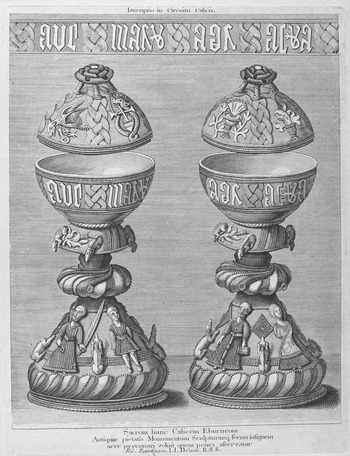
One eighteenth-century English antiquarian mentioned by Bassani and William Fagg was Richard Rawlinson (1690–1755). Fagg used an engraving of an Afro-Portuguese ivory saltcellar belonging to Rawlinson in the flyleaves of Afro Portuguese Ivories.Footnote 2 Its present whereabouts are unknown. In Bassani and Fagg’s Reference Bassani and Fagg1988 catalogue raisonné the engraving was said (wrongly) to be from one of Rawlinson’s books.Footnote 3 In fact, Rawlinson had the engraving made to show at a meeting of the Society of Antiquaries of London held in November 1731, and a copy of the engraving remains to this day in the Society’s Library (fig 1). Presumably, Rawlinson’s intention was to seek the opinions of Fellows present about the age and place of origin of what he described as an ‘antient ivory cup’.Footnote 4 If so, the minutes of the meeting on this occasion tell us nothing about the discussion. Fortunately, around the same time he sent another copy of the engraving to a fellow antiquary Thomas Hearne (1678–1735) and, in recording his thoughts about it, Hearne was remarkably perceptive:
December 11, 1731. Dr Rawlinson hath got an old Ivory Chalice, which he hath had ingraved, and he hath given a copy thereof to me. There is an inscription around it, viz. AVE MARIA GRACIA. I do not take it to be so old as perhaps some may. I have seen much such figures and such Inscriptions on the covers of old printed & written books about the time of Henry vii & Henry viii. I say figures, because besides the Inscription there are the figures of St Peter, the V. Mary, & of dogs. And such figures as I have seen on the covers of books exceed this, wch seems to me to be of foreign work.Footnote 5
Engraving made for Richard Rawlinson of an Afro-Portuguese ivory saltcellar and sent by him to a meeting of the Society of Antiquaries of London held on 4 November 1731. The saltcellar’s subsequent history and present whereabouts are unknown. SAL, Instrumenta Ecclesiastica 18. Drawing: Courtesy of the Society of Antiquaries of London.

Hearne was right, then, both about the age of the object and about its being ‘foreign work’. We can excuse his not recognising that the piece was African. Hybrid works of art are notoriously difficult to place; and eighteenth-century scholars had few opportunities to view authentic examples of African ivory carving for the purposes of comparison.
Few opportunities, but they did occur. Seven years after the meeting at which Rawlinson’s engraving was considered by the Society of Antiquaries, Rawlinson sent another object, possibly African, for the attention of its Fellows:
an ivory horn of a very considerable length with divers carvings upon it, together with a letter desiring it to be shewn to the Society, in order to have their opinions about it.Footnote 6
On viewing the horn, Martin Folkes, the then vice-president of the Society, announced that he owned a similar ivory horn that he would bring to the next meeting for the Fellows to compare the two with one another.Footnote 7 This he duly did, on 11 January 1739. Folkes’ horn is described in the minutes as having:
several figures of animals, particularly a crocodile & circopithecus [monkey] engraved in relievo … pretty much of the same form with that lately sent to the Society by Doctor Rawlinson.Footnote 8
The details are scanty. Once again, frustratingly, we learn nothing about the discussion that took place, except, apparently, that the Fellows agreed that the two horns were very alike. But the description of Folkes’ horn as having a crocodile and monkey carved in relief on its surface – exotic animals with links to Africa – points to it being African, even if it does not enable us to identify with certainty which part of Africa it might have come from. And if Rawlinson’s ivory horn with ‘divers carvings on it’ was ‘pretty much of the same form’, then it might also have come from Africa. With hindsight, and in the light of our much wider knowledge of such objects, we are able to make a connection that the antiquaries present were unable to make for themselves.
This was not simple blindness on their part. The English antiquarian movement of the eighteenth century was concerned primarily with the ‘antiquities and history of this kingdom’ (that is, Great Britain).Footnote 9 It laid the foundations for that history by providing new scholarly editions of old texts, in hunting out, preserving and interpreting ancient documents, and in the critical study of historical artefacts, while in the process giving birth to the new discipline of archaeology. Ivory carvings were for the most part viewed through a medievalist lens. This explains Rawlinson’s identification of his saltcellar as an ‘ancient ivory chalice’; and why Hearne thought he might be swimming against the tide in taking it to be no more than two hundred years old. Horns, especially, whether of ivory or some other material, were seen as ancient symbols of authority. They were taken to be charter horns from a period before written records, witnessing to the granting by royalty of the ownership of lands or privileges – and, if they were hunting horns, probably marking the wardenship of royal forests.Footnote 10 An African horn as such held no particular interest for the English antiquarian.
There were exceptions. Sir Hans Sloane (1660–1752) was one of the original Fellows of the Society of Antiquaries. His collections, purchased by the nation, provided the foundation for the British Museum. But Sloane was much more than an antiquarian; in the list of Miscellanies completed before his death are several African items, including some that were made of ivory:
44 An ivory hollow case for the penis. It is used in Guinea by the Negros when they travel in the woods putting the penis into it & it into their girdles to keep that part from being hurt by thorns.
590 A bracelet wt rattles to it cut out of the elephant’s tooth worn upon the arm.
591 Another [bracelet].
723 An ivory hunting horn or trumpet such as Wormius’ aureum cornu [golden horn].
763 An ivory horn.
1425 A trumpet us’d in Congo in war, ivory wt the Lacerta [s]quamosa [scaly lizard] carved on it.
2021 A trumpet in Guinea used by the inhabitants of an elephant’s tooth on which are engraved the lacerta squammosa, an elephant, Hippopotamus, Lion, goat & unicorn, a hare beaver & duck, a sword on a boar’s head, a dragon & some plants. This was afterwards turned to a drinking cup with these lines, drinke you this & thinke no scorne allthough the cup be much like a horne 1599 fines. From Ireland by Mr Adams.Footnote 11
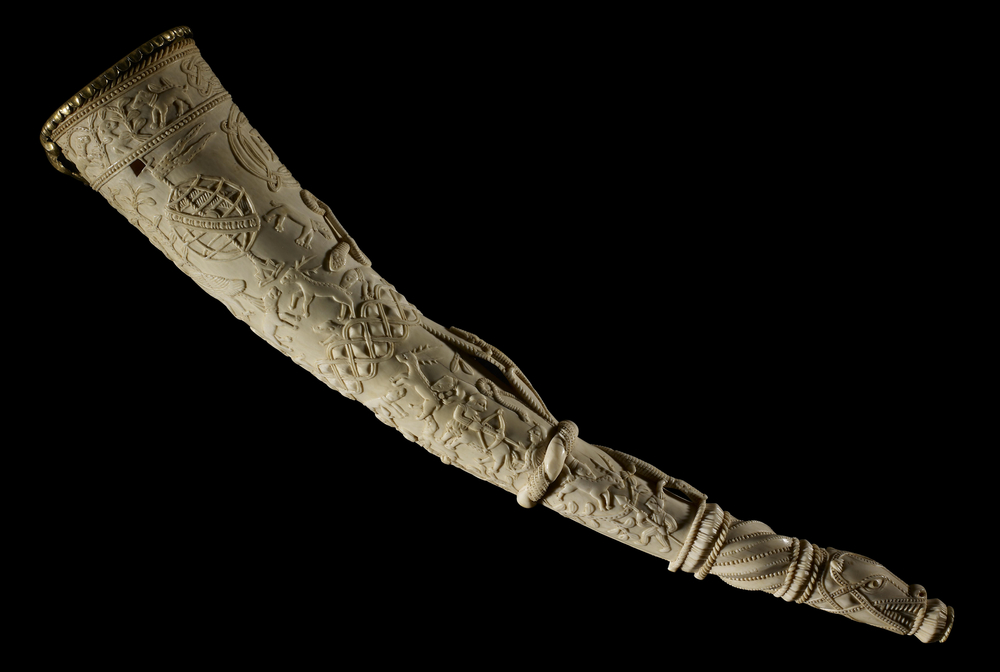
Of these, items 590, 591, 723 and 2021 can be located today in the collections of the British Museum. The two ivory bracelets [590, 591] have been identified as originating from Owo in Nigeria. Item 723 (fig 2), although not said to be African, is almost certainly the Afro-Portuguese oliphant registered by the museum as Af1979,01.3156, since the latter bears a marked resemblance to two Afro-Portuguese horns illustrated in Worm’s Danicorum Monumentorum Libri Sex Footnote 12 that formerly belonged to the Medici family in Florence. Item 2021, the ivory trumpet converted to a drinking horn, the subject of an earlier article,Footnote 13 is one of a group of horns that Ezio Bassani has attributed to the Calabar region of Nigeria, although it has been modified after its arrival in Europe to serve as a drinking vessel and with additional animal figures excavated in the ivory to give it the superficial appearance of an Afro-Portuguese hunting horn.Footnote 14 Of the remaining items, Bassani thinks that item 1425 from the description is unlikely to be from Congo, as there are no examples of Congo oliphants with lizards/crocodiles carved on them, but that it might be, like item 2021, from Calabar. Its present fate is unknown.Footnote 15 As for item 763 described only as ‘an ivory horn’, its description is too vague for us to be sure whether it was African or not.
Afro-Portuguese oliphant formerly in the collection of Sir Hans Sloane and numbered 723 among his Miscellanies. British Museum inv. no. Af1979,01.3156. Photograph: Courtesy of the Trustees of the British Museum.

TWO AFRO-PORTUGUESE IVORIES: A RE-ASSESSMENT
We now come to two Afro-Portuguese works whose history pre-1800 we are now able say something significantly more about than was available to Bassani and Fagg when they compiled their Reference Bassani and Fagg1988 catalogue raisonné. The first is an oliphant, now in the National Gallery of Australia (NGA). The second is an Afro-Portuguese saltcellar, now in the British Museum.
The oliphant
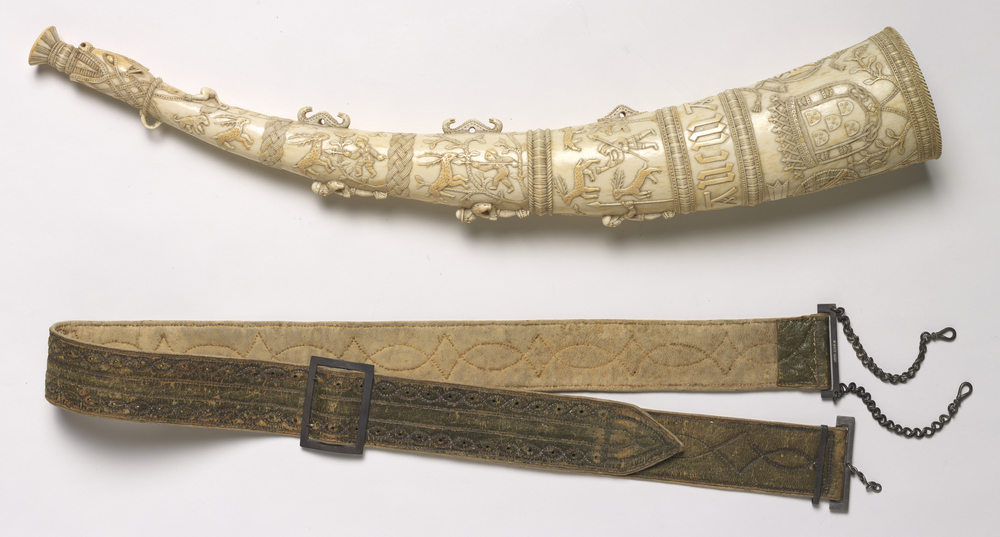
The oliphant was formerly in the possession of the Spencer family in England. It is one of a small group of ivory hunting horns attributed by Bassani and Fagg to an anonymous ‘Master of the Arms of Castile and Aragon’ (fig 3) because these items are carved with the heraldic arms of Portugal and those of Isabella of Castile and Ferdinand of Aragon (together with the words Tanto monta, which formed part of Isabella and Ferdinand’s motto); their marriage in October 1469 united the kingdoms of Castile and Aragon and laid the foundations of the modern Spanish state. It has come to be referred to (for example, on the NGA websiteFootnote 16) as the ‘Drumond Castle Oliphant’ for reasons which, as we shall see, do not bear close scrutiny.
Afro-Portuguese oliphant by the Master of the Arms of Castile and Aragon, now in the NGA. Formerly in the possession of Edward Harley, 2nd Earl of Oxford; Nathaniel Curzon, 1st Lord Scarsdale; George Ashby; and the Spencer family. Acc. No. NGA 79.2148.A-B. Photograph: Courtesy of the National Gallery of Australia.

Spencer family tradition has it that their Afro-Portuguese hunting horn was given in 1802 to George John Spencer, 2nd Earl Spencer (1758–1834), by a George Ashby of Naseby, about whom nothing more was known. This was the information gleaned by the Portuguese scholar Mario de Sampayo Ribeiro for his Reference de Sampayo Ribeiro1964 article ‘O Olifante de Drumond-Castle’,Footnote 17 and it is duly repeated by Bassani and Fagg. There is, however, a source closer to the time of this transaction in an 1822 description of the library at Althorp, the Spencer family home: ‘To the left, on quitting [the library], is hung up a curious old hunting horn of ivory, of the execution of the xvith century, and of foreign workmanship, presented to his Lordship by George Ashby, Esq. of Haselbeach, in Northamptonshire.’Footnote 18 The apparent discrepancy between ‘George Ashby of Naseby’ and ‘George Ashby, Esq. of Haselbeach’ need not detain us: Naseby and Haselbeach (or Haselbech, as it is now generally written) are villages in Northamptonshire only a mile or so apart. What has escaped attention, however, is that George Ashby left a will, in which the gift to the 2nd Earl Spencer of his ivory hunting horn is explicitly recorded.
In gratitude for the kind attentions which I have received upon all occasions from The Right Honourable Earl Spencer I request his Lordship’s acceptance of a much admired Antique hunting horn curiously engraved with a number of Emblematical figures in Basso relievo on the Tusk of the Walrus or Sea horse [sic] which was given to me by The Right Honourable Lord Scarsdale [Nathaniel Curzon, 1st Lord Scarsdale].Footnote 19
The reference to ‘Emblematical figures in Basso relievo’ is clearly a reference to the heraldic arms of Portugal and Spain mentioned above. The so-called ‘Tusk of the Walrus or Seahorse’ is actually an elephant tusk, but that is an easy mistake to make: they are very similar in shape and appearance. The new information is that before the horn came into Ashby’s possession it had previously belonged to Nathaniel Curzon, 1st Lord Scarsdale (1726–1804). Lord Scarsdale was a prominent Tory politician. He was also a patron of the arts and a collector who employed the architect Robert Adam FSA (1728–92) to rebuild his family home at Kedleston in Derbyshire in the grandiose Palladian style to house his collection of paintings and sculpture. The ivory horn was presumably part of this collection at some point, but the records of the collection are incomplete and, so far as one can discover, make no mention of an ivory hunting horn; nor do we know what the relations were between Lord Scarsdale and George Ashby and how Scarsdale came to give the horn to Ashby.
What is known is that earlier in the century what is almost certainly the same hunting horn belonged to the noted bibliophile and art collector Edward Harley (1689–1741), 2nd Earl of Oxford and Earl Mortimer, the son of Robert Harley (1661–1724), 1st Earl of Oxford and Earl Mortimer, Lord High Treasurer between 1711 and 1714. The evidence for this lies in the minutes of the Society of Antiquaries of London for 21 March 1734.
Mr Vertue brought a very fine Horn of Ivory most curiously carved with figures representing Hunting, The arms of Spain and Portugal, AVE MARYA – Tanto môta, O.P., belonging to the Earl of Oxford. The arms of Jerusalem. Its length two feet four inches. Its widest circumference near 12 inches.Footnote 20
The ‘Mr Vertue’ mentioned was George Vertue (1684–1756), a Fellow of the Society and its official engraver. In the 1720s and 1730s he carried out a series of commissioned drawings and engravings for the 2nd Earl of Oxford and sometimes acted as his art agent and travelling companion. The description of the earl’s ivory horn is detailed: it is carved with hunting figures, the arms of Spain and Portugal, the words ‘Ave Marya’ and ‘Tanto monta’, and the Cross of the Order of Christ [mis]identified as ‘the arms of Jerusalem’ – which unmistakably link it to Afro-Portuguese oliphants carved by the ‘Master of the Arms of Castile and Aragon’. Also, the dimensions of the horn exactly match those of the Curzon/Ashby/Spencer oliphant now in the NGA. It does not seem far-fetched, therefore, to conclude that they are one and the same; even if, for the moment, we cannot explain how the 2nd Earl of Oxford’s ivory horn later came to find its way into the possession of Lord Scarsdale.
This is perhaps the place to deal with the suggestion made in NGA’s publicity material that the horn could have been brought to England earlier by Philip ii of Spain (r. 1556–98) when he arrived to marry his second wife, Mary i of England, in 1554. We should couple that with a critical look at the name ‘Drumond Castle Oliphant’, which the NGA also uses when referring to the horn. The currency of that name seems to have originated in de Sampayo Ribeiro’s Reference de Sampayo Ribeiro1964 article ‘O Olifante de Drumond-Castle’. However, de Sampayo Ribeiro was drawing upon a book by an Englishman, Arthur James Hipkins, published seventy-six years earlier,Footnote 21 in which there is a fine illustration of the oliphant. Hipkins provided a brief account of the instrument on the page facing the illustration.Footnote 22 He noted that it belonged to the 2nd Earl Spencer and that it was assumed to be the work of West African carvers for the Portuguese. Hipkins speculated that the presence of the royal arms of Portugal and Spain might link the horn to the marriage, in 1543, of Philip ii of Spain to his first wife, Maria Manuela, daughter of John iii, King of Portugal, and that, following her death in 1545, Philip may have brought it to England in 1554 when he came to marry Mary Tudor. Then, significantly, Hipkins mentions Drummond [sic] Castle; but – and the point is worth stressing – only in the context of listing different uses of horns in general:
Horns were blown to give alarm in circumstances of danger, to announce the arrival of visitors of distinction, and, as Mr McIntyre North informs us respecting the horn in Drummond Castle, for summoning the household and guests to dinner.Footnote 23
Hipkins does not say that the horn in Drummond Castle and Earl Spencer’s oliphant were one and the same. Drummond Castle (note the double ‘m’) is in Perthshire, Scotland. The Spencer family has never owned, nor had any association with, Drummond Castle. The castle was formerly, as the name implies, in the possession of the Drummonds, an ancient Scottish family. Following the dying out of the male line in the early nineteenth century, it passed through the female line to the family of Willoughby de Eresby. Lady Nancy Jane Marie Heathcote-Drummond-Willoughby, 28th Baroness Willoughby de Eresby, continues to live there to the present day.
The clear meaning of what Hipkins is saying here is that horns, such as Earl Spencer’s, were used for different purposes and that one of those purposes, exemplified by the (quite different) horn in Drummond Castle, was to call the household and guests to dinner. Confirmation of this is given in the work by ‘Mr McIntyre North’ (C N McIntyre North) to which Hipkins refers, Book of the Club of True Highlanders; this has a drawing of a ‘dinner horn, Drummond Castle’ (plate xxix).Footnote 24 It is clearly not the Spencer oliphant, as it has no elaborate ornamentation, royal coats of arms or Latin mottoes; nor is it even ivory. However, it is described as ‘a natural [undecorated? Highland cattle?] horn’, which was used at Drummond Castle until the middle of the sixteenth century to signal the service of dinner to the inmates.Footnote 25
The identification of the Spencer oliphant with the horn in Drummond Castle is thus based on a misreading of what Hipkins said. But whose misreading? Here one is inclined to exonerate de Sampayo Ribeiro. For his knowledge of Hipkins’ book was gained, he tells us, at second hand from Adalbert Svoboda’s work, Illustrierte Musikgeschichte. Svoboda reproduces Hipkins’ illustration of the oliphant and summarises his account of it as follows:
This oliphant belonged to Earl Spencer and came to Drumond [sic] Castle, where in times of danger it sounded warning or alarm calls, or announced the arrival of distinguished guests, in order finally to call the household to dinner.Footnote 26
In other words, it was Svoboda who got the name of Drummond Castle wrong and misread Hipkins as saying that Earl Spencer’s oliphant and the horn in Drummond Castle were one and the same.
Finally, what evidence is there that the Spencer oliphant may have been brought to England by Philip ii of Spain? According to the NGA website,Footnote 27 there was a ‘paper sticker’ apparently found inside the mouthpiece of the oliphant that refers to Philip’s marriage to Maria, daughter of the King of Portugal. The sticker is described as ‘very old and hardly legible’. But this piece of paper could hardly have been inside the mouthpiece in 1734 when the oliphant was exhibited to the Society of Antiquaries of London, or its presence and what it said would surely have been alluded to. At best, therefore, the writing on the paper can only be the conjecture of some later eighteenth-century scholar about the horn’s origins. As such, it may have furnished Hipkins with the basis for the historical account in his book, but this hardly counts as primary evidence of its truth. Significantly, de Sampayo Ribeiro does not take up the suggestion that the horn’s ornamentation refers to this marriage between Philip ii of Spain and the Infanta Maria. Instead, he argues that the particular versions of the royal arms shown on the horn indicate that, if it did commemorate a marriage between the royal families of Portugal and Spain, it was most likely to be one of the two marriages between Manuel i of Portugal and the two daughters of Ferdinand and Isabella: Isabella of Aragon, in 1497; and Maria of Aragon, in 1500. Thus, that the oliphant should be dated to the closing years of the fifteenth century. This dating is now widely accepted, although, as some scholars have spotted, the version of the Portuguese royal arms carved on two of the horns indicates that Manuel was not yet king and so the arms must therefore relate to some link between the two royal houses before 1495. However, the point of substance here is that, if it were not Philip ii’s 1543 marriage that was being celebrated in the design of the horn but a much earlier treaty between Spain and Portugal, then there is no reason to suppose that Philip had anything to do with its arrival in England.
The saltcellar
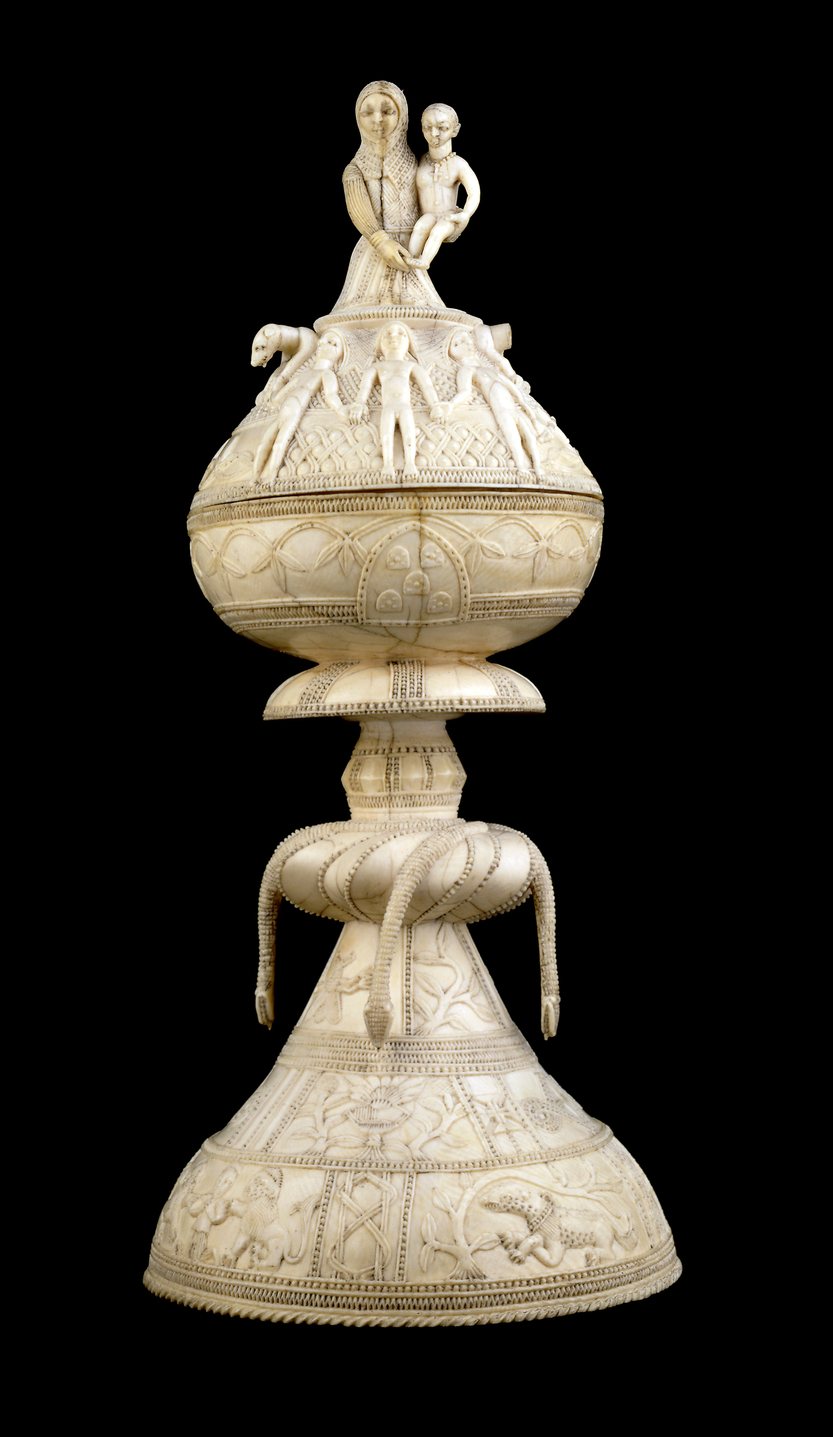
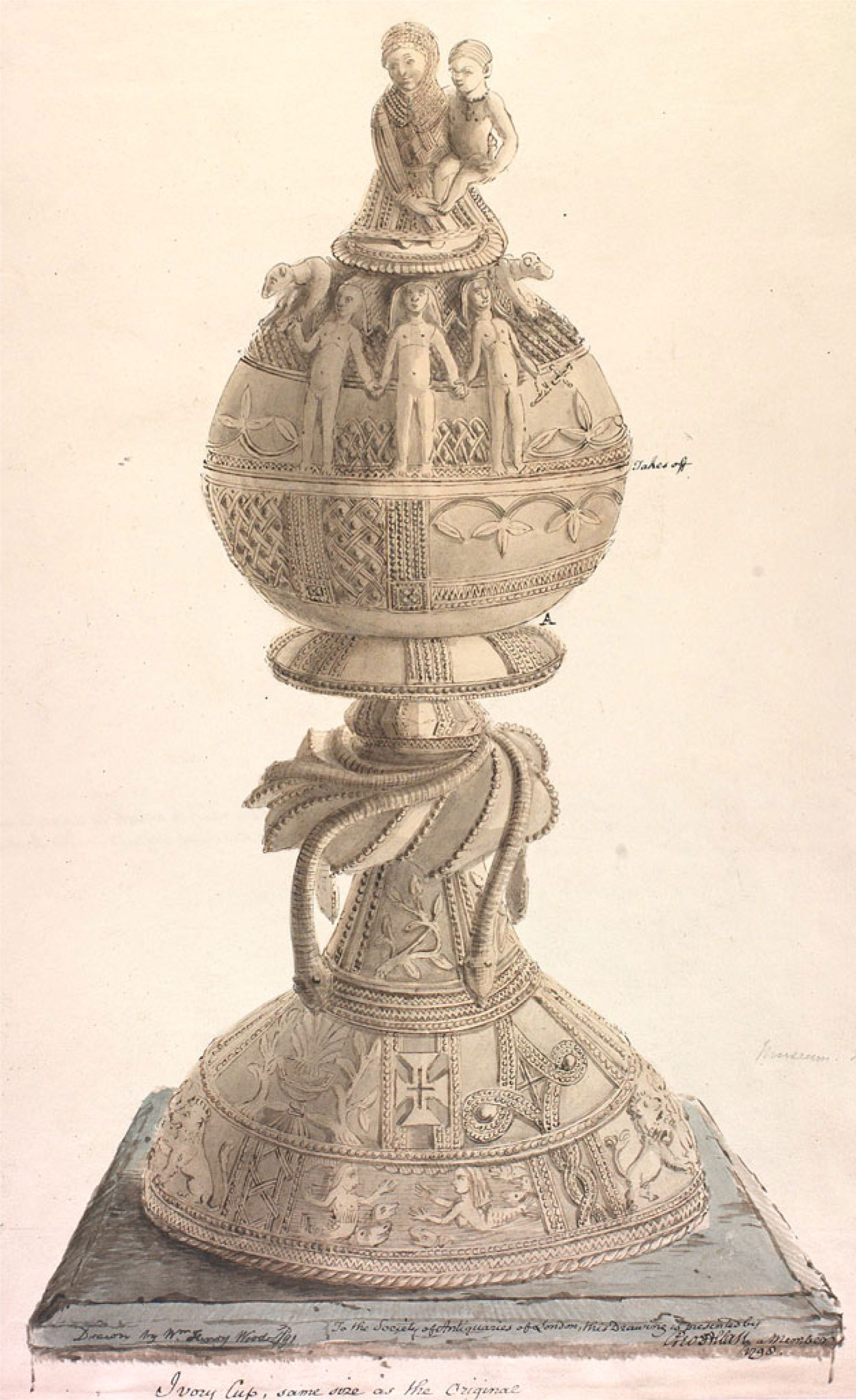
The second work to be discussed is an Afro-Portuguese saltcellar that was formerly in the possession of the Society of Antiquaries of Newcastle, and which was first loaned and then sold by the Society to the British Museum. The piece had earlier formed part of the collections of George Allan of Darlington (1736–1800), who was a Fellow of the Society of Antiquaries of London. It has several of what seem to be specifically Judaeo-Christian features: on the lid has been carved a female figure and child that may represent the Madonna with the baby Jesus; below them are three figures holding hands, possibly representing the three children in the fiery furnace;Footnote 28 and on the base there is another kneeling figure (Daniel perhaps?) flanked by lions (fig 4). Attached to the saltcellar are the remains of a vellum label with three wax seals and words that are now illegible, but which, from a 1820s transcription, appear to be the names of those whose seals were attached and a partly obliterated Latin sentence.Footnote 29
Afro-Portuguese ivory saltcellar formerly in the collection of George Allan of Darlington and the Society of Antiquaries of Newcastle. Note the figures of (most likely) Madonna and child on the lid and what may be the Three Holy Children in the fiery furnace from the Book of Daniel. British Museum inv. no. Af1981,35.1.a-b. Photograph: Courtesy of the Trustees of the British Museum.

It is this label that holds the key to the saltcellar’s history. In 1798, shortly before his death, Allan had a drawing made of the saltcellar by William Henry Wood for the Society of Antiquaries of London and the drawing survives to this day in the Society’s Library (fig 5). It is noted on the drawing that (fig 6): ‘At A the bottom of the Cup, a twisted Silken Cord is tied, (white, yellow blue & red) to which is appendant a vellum Label in the form below, with 3 small Seals thereon in red wax, but much defaced – The Inscription on the Label is also nearly obliterated.’ There is a sketch of the label itself with its three seals and the original writing, which appears to read: ‘Johannes y[?] Jehovah D Nicolaus Ulbasig [?] D Joannes Ernestus Schefflar D De Examine hujus poculi mereatur nostrum testimonium. 1520.’ It is further stated that within the cup was a paper: ‘Examined by James Parsons MD And[rew] Coltee Ducarel LLD And[rew] Gifford DD Aug. 17, 1755.’
Drawing of the Afro-Portuguese ivory saltcellar (Ill. 4) commissioned in 1798 by George Allan from William Henry Wood for the Society of Antiquaries of London. SAL, Utensils and Furniture 10. Drawing: Courtesy of the Society of Antiquaries of London.

William Henry Wood’s 1798 drawing of the vellum label with three wax seals attached to George Allan’s Afro-Portuguese ivory saltcellar. It appears to record an examination of the saltcellar carried out in 1520 by three named savants. Also mentioned is a paper found within the bowl of the saltcellar commemorating a later examination of the saltcellar in 1755 by three named Fellows of the Society of Antiquaries of London. SAL, Utensils and Furniture 10. Drawing: Courtesy of the Society of Antiquaries of London.

First, the parchment label. The Latin text translates thus: ‘it is worth [having] our testimony of the examination of this cup.’ The label with its three wax seals – presumably of the three persons named – would seem to be the testimony referred to, and 1520 the year in which the examination took place. The date is worth noting. Although there are references to ivory saltcellars, horns and spoons in the Portuguese customs records of 1504–5,Footnote 30 and there is iconographic evidence in the coats of arms and mottoes carved on individual Afro-Portuguese saltcellars and horns that points to their having been made between 1490 and 1540,Footnote 31 the year 1520 is the earliest date we have for the presence in Europe of any particular Afro-Portuguese ivory – preceding the records of the Afro-Portuguese ivory spoons in the possession of the Medici family in Florence by some forty years. The identity of the savants who examined the saltcellar has still to be determined, but their names (see above) sound German and suggest that the examination took place in a part of German-speaking central Europe. What is more, the ‘D’ after the names, which might reasonably be assumed to be an abbreviation of ‘Doctor’, can also be used to mean ‘Dantiscanus’ or ‘citizen of Danzig’, formerly a German-speaking Hanseatic port on the Baltic (now the Polish city of Gdansk).Footnote 32
There is not the same difficulty in identifying the persons who carried out the second examination of the saltcellar in August 1755. James Parsons, Andrew Coltee Ducarel and Andrew Gifford were all prominent Fellows of the Society of Antiquaries of London, but there is nothing in the minutes of the Society for 1755 to suggest that the examination took place at one of its meetings or under its auspices. Hence, it must have been a private consultation. Since, like their predecessors, they simply recorded their names and the date, we do not know what conclusions, if any, they came to about the saltcellar. Nor do we know in whose possession the saltcellar was at this time.
The owner was perhaps Richard Bateman. In 1774 ‘Mr Christie’ auctioned the contents of Bateman’s museum in Windsor and they included ‘[Lot] 74. An ivory chalice antique carving authenticated in 1520 as being then very ancient’, which must, one would think, be a description of the Allan saltcellar.Footnote 33 One saw in the case of Rawlinson that it was natural for antiquarians at this time, with their medievalist mind-set, to suppose that Afro-Portuguese saltcellars were chalices or communion vessels from that earlier period of English history. Bateman himself, under the influence of Horace Walpole, had converted his house at Windsor into a beacon of the Gothic Revival and filled it with medieval (or rather, what were thought to be medieval) antiques. It would be an extraordinary coincidence if a second object fitting the description of an ‘ivory chalice’ had been ‘authenticated in 1520 as being then very ancient’ and it not refer to the label on the Allan saltcellar certifying that it had been examined by the three German savants in that year.
However, there is a further, surely clinching, piece of evidence. The preceding item in the Bateman auction, Lot 73, was ‘a crozier of Seabrook Abbot of Gloucester 1457, taken out of his coffin’. There is a crozier formerly in the Allan collection that has inscribed on the staff: ‘This crozier was found 1741, in the coffin of Thomas Seabrook, chosen Abbot of Gloucester in 1450. He died in 1457. It was given to the Abbey of Old Windsor [Bateman’s home where he had his museum] by Dr Milles, Dean of Exeter, in 1764.’ In other words, Allan’s collection contained at least one object purchased at the auction of Richard Bateman’s museum in Reference Bateman1774. That is powerful, albeit circumstantial, evidence that Allan’s Afro-Portuguese saltcellar – which, as we have seen, fits perfectly the description of the ‘ivory chalice’ that was the very next item in that sale – was purchased at the same time. At the same time, but not necessarily by George Allan himself. For Allan acquired the collections of another northern antiquarian and naturalist, Marmaduke Tunstall, at the latter’s death in 1791; J D Cowen, quite independently, has argued that it was probably Tunstall – a Yorkshireman, but at that time living in the south – who bought Abbot Seabrook’s crozier at the auction of Bateman’s museum in Reference Bateman1774.Footnote 34 If that is so, then it was probably also Tunstall who bid for the ‘ivory chalice’, and Allan acquired it with the rest of Tunstall’s collections in 1791.
CONCLUSIONS
From this all too brief survey of African ivory sculptures, as found in the eighteenth-century records of English antiquarians such as the Society of Antiquaries of London, we are given a fascinating glimpse into the history of the Afro-Portuguese ivories and into the history of collecting. Such records can be a fertile and productive resource for historians of Afro-Portuguese ivories, especially in relation to bridging the gap in knowledge about their arrival in Europe. Quite naturally, English antiquarians viewed the Afro-Portuguese ivories through the prism of their own peculiarly European viewpoint, assuming ivory saltcellars to be medieval chalices. Also, it is clear that such antiquarian records raise questions for researchers with regard to identifying particular pieces. Admittedly, some questions remain unanswered – for example, the fate of Rawlinson’s saltcellar and the identity of the European savants who examined the Allan saltcellar in 1520. However, these only serve to give a sharper focus and urgency for research into these matters and into the presence of such ivories in the earlier collections of European savants and princely treasure chambers.
ABBREVIATIONS AND BIBLIOGRAPHY
Abbreviations
- NGA
National Gallery of Australia, Canberra
- SAL
Society of Antiquaries of London