Introduction
Tobacco use is the foremost preventable cause of death in the world, which will kill more than 8 million individuals annually by 2030, if current trends persist (World Health Organisation, 2012). Nevertheless, smoking cessation is met with high failure rates due to the inability to cope with nicotine withdrawal symptoms such as anxiety, fatigue, weight gain, and mood disorders (Aveyard & West, Reference Aveyard and West2007). Tobacco smoking is a complex, multidimensional addiction that is highly individualistic. Researchers have approached tobacco control from multiple domains, including physiological, psychological, and behavioural. The evaluation of smoking behaviour, which is integral to smoking cessation research and interventions, also mirrors this degree of complexity.
A variety of subjective and objective methods exist to characterise smoking behaviour, each differing in accuracy, reproducibility, and practicality (Frederiksen, Miller, & Peterson, Reference Frederiksen, Miller and Peterson1977). Subjective methods of measurement, such as self-report, are practical for population studies and are low in cost and participant burden, but responses can be influenced by cultural factors, social desirability, recall bias, and reactivity (Bowling, Reference Bowling2006; Tomlin, Pinney, Buncher, McKay & Brown, Reference Tomlin, Pinney, Buncher, McKay and Brown1998). Responses can also be inaccurate as they depend heavily on recall and discrimination of the target behaviour (i.e., smoking). A case in point is the misclassification of smoking a few puffs as negligible compared to smoking an entire cigarette. Finally, self-report is not capable of providing biologically meaningful information.
Multiple biomarkers exist to categorise smoking status, and these are considerably more accurate than self-report questionnaires. Perhaps the most notable method is expired carbon monoxide (CO) breath levels which provide an immediate and non-invasive estimate of smoking behaviour using relatively inexpensive infrastructure. Studies have reported that CO is also a function of environmental pollution (including traffic and second-hand smoke; Joumard, Chiron, Vidon, Maurin, & Rouzioux, Reference Joumard, Chiron, Vidon, Maurin and Rouzioux1981), occupational exposure (Middleton & Morice, Reference Middleton and Morice2000), hyperventilation (Vesley et al., Reference Vesley, Takeuchi and Rucker1999), substantial physical activity (Middleton & Morice, Reference Middleton and Morice2000), smoking other substances (e.g., marijuana; Moolchan et al., Reference Moolchan, Zimmerman, Sehnert, Zimmerman, Huestis and Epstein2005), and numerous inflammatory lung diseases (Hovarth et al., Reference Hovarth, Loukides, Wodehouse, Kharitonov, Cole and Barnes1998; Zayasu et al., Reference Zayasu, Sekizawa, Okinaga, Yamaya, Ohrui and Sasaki1997). Ultimately, this may lead to false positives and negatives and poses challenges as this widely accepted and feasible tool is not representative solely of smoking tobacco behaviour. Conversely, collection of biological fluids can provide a more objective indication of smoking behaviour from the analysis of nicotine, cotinine, or thiocyanate. These analyses are often obtrusive, costly, and require additional resources for administration.
Although the aforementioned methods have been useful to assess smoking abstinence and rates of relapse, they are limited in providing detailed information with respect to how someone interacts with a cigarette. For instance, two individuals may consume identical tobacco brands or an equal number of cigarettes on a daily basis, yet exhibit discernible differences in the manner in which the cigarettes are smoked. In fact, individuals can compensate or adjust multiple dimensions of how they smoke a cigarette, including the quantity, capacity, and speed of their puffs (Benowitz, Reference Benowitz2001). These features interact to produce detrimental repercussions to health (Djordjevic, Stellman, & Zang, 2000). Hence, shortfalls associated with subjective and biological measurements of smoking behaviour could be overcome by evaluating the interface between smoker and cigarette.
Smoking topography provides a representation of the physical attributes of smoking behaviour and is an emerging outcome of interest. It can be subjectively or objectively measured by quantifying variables such as interpuff interval, puff duration, and number of puffs per cigarette. Besides dissecting how an individual comes into contact with a cigarette, exposure to carbon monoxide (Zacny, Stitzer, Brown, Yingling, & Griffiths, Reference Zacny, Stitzer, Brown, Yingling and Griffiths1987) and carcinogenic toxins (Djordjevic, Hoffmann, & Hoffman, Reference Zacny, Stitzer, Brown, Yingling and Griffiths1997) can be established from smoking topography. Finally, it provides a glimpse into the rewarding and reinforcing effects of nicotine which drives tobacco smoking. Thus, the analysis of smoking topographical indices is integral to the comprehensive understanding of this addictive behaviour and in establishing the harm from smoking − both of which have clinical implications (Perkins, Karelitz, Giedgowd, & Conklin, Reference Perkins, Karelitz, Giedgowd and Conklin2011).
Early work approached the study of smoking topography with behavioural techniques. Self-report has seldom been utilised to quantify the manner in which cigarettes are smoked. Shahab and colleagues (Shahab et al., Reference Shahab, West and McNeill2008) evaluated the reliability and validity of self-report by comparing it to both machine-determined smoking topography and nicotine uptake by cotinine analysis. They found that smokers have better judgement regarding the time spent between puffs and the number of puffs, but limited acuity of puff intensity and depth, when compared to more objective measures of smoking behaviour (Shahab, West, & McNeill, Reference Shahab, Hammond, O'Connor, Cummings, Borland, King and McNeill2008). For large samples or population studies, the assessment of smoking topography through self-report would vastly improve feasibility, but current self-report measures are limited in utility and warrant more attention.
Prior to the advent of topography apparatuses, observation in the lab setting and natural environment provided a crude indication of smoking topography. For example, the use of videotapes and timers and unobtrusive surveillance may measure puff count and total smoking duration, but not indices such as interpuff interval and puff volume. Another indirect measure of smoking topography includes cigarette weighing, before and after smoking, as an estimate of the quantity of tobacco smoked and elements that entered the smoker's system (June et al., Reference June, Hammond, Sjödin, Li, Romanoff and O'Connor2011).
The evolution of more objective smoking topography instruments has transpired over the last 30 years. Pneumotachographs (Zacny et al., Reference Zacny, Stitzer, Brown, Yingling and Griffiths1987), pressure transducers (Ossip-Klein, Martin, Lomax, Prue, & Davis, Reference Ossip-Klein, Martin, Lomax, Prue and Davis1983), portable recorders (Hatsukami, Morgan, Pickens, & Champagne, Reference Hatsukami, Morgan, Pickens and Champagne1990), flowmeters (Ahijevych, Gillespie, Demirci, & Jagadeesh, Reference Ahijevych, Gillespie, Demirci and Jagadeesh1996), and puff analysers (Sutton, Russell, Iyer, Feyerabend, & Saloojee, Reference Sutton, Russell, Iyer, Feyerabend and Saloojee1982) have been previously utilised.
More recently, a portable, computerised device (Clinical Research Support System (CReSS) Pocket; Plowshare Technologies®, Borgwalt, KC. Inc., Virginia, USA) has been developed to quantify smoking topography. Compared to fixed systems, such as earlier instruments and the CReSS Desktop, the CReSS Pocket affords the acquisition of behavioural data in the smoker's natural setting, thereby improving ecological validity. Participants should be afforded proper instruction and the opportunity to become familiar with the smoking topography device to ensure accurate data collection. This battery-powered, hand-held unit has an orifice flow meter mouthpiece, which produces a pressure drop when a puff is taken. This is converted to a flow velocity from which many of the topography indices are derived. The CReSS Pocket computes puff count and time to first puff, but also puff volume and duration (length of time for each puff), interpuff interval (amount of time between puffs), and peak and average velocity for each puff.
Evaluation of smoking topography devices has been conducted under different conditions. Lee and colleagues (Lee, Malson, Waters, Moolchan, & Pickworth, Reference Lee, Malson, Waters, Moolchan and Pickworth2003) reported that smoking behaviour is not influenced by smoking through a mouthpiece and that the CReSS system provides a valid and reliable measure of topography. Furthermore, smoking topography data varied slightly between conventional mouthpiece-free video recordings, or using a desktop or portable computerised device. Given these findings and the utility of this outcome measure, it is to no surprise that smoking topography has been examined in diverse contexts.
Numerous studies have observed inter-individual variability in smoking topography as a function of demographic factors. Namely, smoking topography indices are affected by sex (Eissenberg, Adams, Riggins III, & Likness, Reference Eissenberg, Adams, Riggins and Likness1999), personality (Lombardo & Carreno, Reference Lombardo and Carreno1987), stress level (Lombardo & Carreno, Reference Lombardo and Carreno1987), nicotine yield (Djordjevic et al., 2000), cigarette type (menthol versus non-menthol; Ahijevych & Parsley, Reference Ahijevych and Parsley1999), ethnicity (Ahijevych et al., Reference Ahijevych, Gillespie, Demirci and Jagadeesh1996), and body mass index (Blendy et al., Reference Blendy, Strasser, Walters, Perkins, Patterson, Berkowitz and Lerman2005). Researchers have also integrated the study of smoking topography across various disciplines and populations: adolescents (Moolchan et al., Reference Moolchan, Parzynski, Jaszyna-Gasior, Collins, Leff and Zimmerman2009), nicotine metabolism (Strasser, Malaiyandi, Hoffmann, Tyndale, & Lerman, Reference Strasser, Malaiyandi, Hoffmann, Tyndale and Lerman2007), smokers with schizophrenia (Tidey, Rohsenow, Kaplan, & Swift, Reference Tidey, Rohsenow, Kaplan and Swift2005), physical activity (Faulkner, Arbour-Nicitopoulous, & Hsin, Reference Faulkner, Arbour-Nicitopoulous and Hsin2010), abstinence (Kolonen, Tuomisto, Puustinen, & Airaksinen, Reference Kolonen, Tuomisto, Puustinen and Airaksinen1992), and smoking cessation (Strasser, Pickworth, Patterson, & Lerman, Reference Strasser, Pickworth, Patterson and Lerman2004). Undeniably, the measurement of smoking topography is becoming more pervasive in the literature.
Equally important to the objective measurement of outcome measures such as smoking topography, is the sound and consistent interpretation and reduction of data. The data output from the CReSS software is exhaustive. Depending on the research question, the data are extrapolated for each smoking topography variable essentially by taking the mean, in some way or another, of the puffs. This comprises data reduction; the process of reducing, or minimizing, the data set by averaging the data points in the collection. Surprisingly, definitive protocols and justification for the treatment of smoking topography data has not been established in the literature. This shortcoming in the literature is of concern. Different methodological decisions may have considerable implications for study findings, and the translation of this information to stakeholders. Therefore, the objective of this study was to first systematically review the published literature to identify reported CReSS smoking topography familiarisation procedures and instructions to participants, and data reduction and exclusion techniques. Second, to examine the impact of different techniques on outcome measures, a secondary data analysis was conducted where data reduction techniques were applied to an existing smoking topography dataset collected using the CReSS Pocket.
Methods
Systematic review
Search and selection strategy
A review was performed using MEDLINE, PubMed, and Scopus electronic databases. Manuscripts published in the English language between January 2001 (availability of the CReSS technology) and September 2012 were identified by searching the following terms: smoking topography, puff topography, and CReSS. Annual conference abstracts of the Society for Research on Nicotine and Tobacco were not hand-searched to eliminate unnecessary bias, as it is customary to exclude data reduction details from conference abstracts due to word limitation.
Inclusion and exclusion criteria
Studies were included in the review if the CReSS Pocket (portable smoking topography device) was employed for data collection. The Methods sections were reviewed for each manuscript obtained from the search. Corresponding authors were contacted if it was unclear what type of smoking topography instrument was used. If a response was not garnered, the manuscript was excluded from the review. There were no exclusion criteria based on study design, objectives or population.
Synthesis and comparative analysis
The following characteristics were extracted from each manuscript for comparison: sample size, research objective, smoking topography measures, participant familiarisation, and data exclusion and data reduction techniques. Corresponding authors were contacted if it was unclear whether an opportunity for participant familiarisation was provided or what data exclusion and data reduction techniques were exercised. Only the data reduction techniques were subsequently applied to an existing data set.
Search results
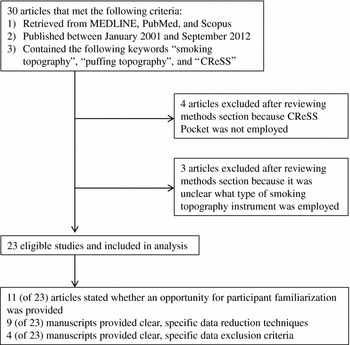
The search of the most common databases yielded 30 manuscripts (Figure 1). Characteristics of interest from these manuscripts are presented in Table 1. Of these, 23 studies utilised the CReSS Pocket for smoking topography measurement. Reasons for exclusion are included in Figure 1.
Summary of studies conducted using the CReSS Pocket to measure smoking topography

[CPD = cigarettes per day; ICI = intercigarette interval; IPI = interpuff interval; RIP = reduced ignition propensity]
a. Only average cigarettes use per week were provided.
b. Twelve cannabis cigarettes during each nine-hour cannabis access over the study period but participants reported on average using cannabis four times a day.
c. Based on 155 respondents.
d. The number of participants that completed all three waves.
e. This study used already available topography measures from another study (Hammond et al., Reference Hammond, Fong, Cummings and Hyland2005). For the purpose of this study, only total puff volume was of interest.
f. Based on 28 participants; four participants were excluded from analysis because they did not acquire knowledge of contingency during conditioning and demonstrated no conditioning effects.
1. Unless otherwise stated, ‘total volume’ is for per cigarette
2. N/A indicates that the authors have not been informed of the information, and not necessarily no instructions were given or data was not reduced and/or excluded.
Flow diagram of search retrieval process and results

Description of included studies and data reduction techniques found
In general, sample sizes were small. Broad research themes surrounding the use of the CReSS Pocket included nicotine yields of various cigarette brands, reliability and validity of smoking topography measurement, and the application of smoking topography as a measure of interest in specific populations.
From the studies retained (n = 23), specific data reduction and exclusion criteria were provided in nine (Hammond, Fong, Cummings, & Hyland, Reference Hammond, Fong, Cummings and Hyland2005; King, McNamara, Conrad, & Cao, Reference King, McNamara, Conrad and Cao2009; McKee et al., Reference McKee, Krishnan-Sarin, Shi, Mase and O'Malley2006; McKee et al., Reference McKee, Sinha, Weinberger, Sofuoglu, Harrison, Lavery and Wanzer2011; O'Connor et al., Reference O'Connor, Kozlowski, Hammond, Vance, Stitt and Cummings2007; Perkins et al., 2011; Shahab et al., Reference Shahab, West and McNeill2008; Veilleux et al., Reference Veilleux, Kassel, Heinz, Braun, Wardle, Greenstein and Conrad2011; Williams et al., Reference Williams, Gandhi, Lub, Kumara, Steinberg, Cottler and Benowitz2011) and four (Grainge, Shahab, Hammond, O'Connor, & McNeill, Reference Grainge, Shahab, Hammond, O'Connor and McNeill2009; McClure, Stitzer, & Vandrey, Reference McClure, Stitzer and Vandrey2012; Muhammad-Kah et al., Reference Muhammad-Kah, Liang, Frost-Pineda, Mendes, Roethig and Sarkar2011; Williams et al., Reference Williams, Gandhi, Lub, Kumara, Steinberg, Cottler and Benowitz2011) manuscripts, respectively. It was clearly stated in 11 (Blank, Disharoon, & Eissenberg, Reference Blank, Disharoon and Eissenberg2009; Faulkner et al., Reference Faulkner, Arbour-Nicitopoulous and Hsin2010; Grainge et al., Reference Grainge, Shahab, Hammond, O'Connor and McNeill2009; Hammond et al., Reference Hammond, Fong, Cummings and Hyland2005; Hogarth, Dickinson, & Duka, Reference Hogarth, Dickinson and Duka2010; June et al., Reference June, Hammond, Sjödin, Li, Romanoff and O'Connor2011; June, Norton, Rees, & O'Connor, Reference June, Norton, Rees and O'Connor2012; Matsumoto et al., Reference Matsumoto, Inaba, Yamaguchi, Endo, Hammond and Uchiyama2013; McKee et al., Reference McKee, Krishnan-Sarin, Shi, Mase and O'Malley2006; Veilleux et al., Reference Veilleux, Kassel, Heinz, Braun, Wardle, Greenstein and Conrad2011; Williams et al., Reference Williams, Gandhi, Lub, Kumara, Steinberg, Cottler and Benowitz2011) manuscripts that an opportunity for familiarisation and instructions for the CReSS Pocket were provided to participants. Authors of manuscripts with vague descriptions of data reduction and exclusion criteria and provision of familiarisation were contacted by e-mail and/or telephone for further clarification. After contacting these individuals, explanations regarding data reduction, exclusion criteria, and familiarisation were provided for nine (Ashare et al., Reference Ashare, Tang, Mesaros, Blair, Leone and Strasser2012; Blank et al., Reference Blank, Disharoon and Eissenberg2009; Faulkner et al., Reference Faulkner, Arbour-Nicitopoulous and Hsin2010; Grainge et al., Reference Grainge, Shahab, Hammond, O'Connor and McNeill2009; June et al., Reference June, Hammond, Sjödin, Li, Romanoff and O'Connor2011; June et al., Reference June, Norton, Rees and O'Connor2012; McClure et al., Reference McClure, Stitzer and Vandrey2012; Muhammad-Kah et al., Reference Muhammad-Kah, Liang, Frost-Pineda, Mendes, Roethig and Sarkar2011; O'Connor et al., Reference O'Connor, Rees, Norton, Cummings, Connolly and Alpert2010; Rees, Wayne, & Connolly, Reference Rees, Wayne and Connolly2008), 12 (Ashare et al., Reference Ashare, Tang, Mesaros, Blair, Leone and Strasser2012; Blank et al., Reference Blank, Disharoon and Eissenberg2009; Faulkner et al., Reference Faulkner, Arbour-Nicitopoulous and Hsin2010; June et al., Reference June, Hammond, Sjödin, Li, Romanoff and O'Connor2011; June et al., Reference June, Norton, Rees and O'Connor2012; King et al., Reference King, McNamara, Conrad and Cao2009; O'Connor et al., Reference O'Connor, Kozlowski, Hammond, Vance, Stitt and Cummings2007; O'Connor et al., Reference O'Connor, Rees, Norton, Cummings, Connolly and Alpert2010; Perkins et al., 2011; Rees et al., Reference Rees, Wayne and Connolly2008; Shahab et al., Reference Shahab, West and McNeill2008) and 10 (Ashare et al., Reference Ashare, Tang, Mesaros, Blair, Leone and Strasser2012; Hammond et al., Reference Hammond, Fong, Cummings, O'Connor, Giovino and McNeill2006; King et al., Reference King, McNamara, Conrad and Cao2009; McClure et al., Reference McClure, Stitzer and Vandrey2012; O'Connor et al., Reference O'Connor, Kozlowski, Hammond, Vance, Stitt and Cummings2007; O'Connor et al., Reference O'Connor, Rees, Norton, Cummings, Connolly and Alpert2010; Perkins et al., 2011; Rees et al., Reference Rees, Wayne and Connolly2008; Shahab et al., Reference Shahab, West and McNeill2008; Shahab et al., Reference Shahab, West and McNeill2008) manuscripts, respectively. For a small proportion of manuscripts, corresponding authors were contacted for additional information regarding data reduction (n = 4; Hammond et al., Reference Hammond, Fong, Cummings, O'Connor, Giovino and McNeill2006; Hogarth et al., Reference Hogarth, Dickinson and Duka2010; Matsumoto et al., Reference Matsumoto, Inaba, Yamaguchi, Endo, Hammond and Uchiyama2013; Muhammad-Kah et al., Reference Muhammad-Kah, Liang, Frost-Pineda, Mendes, Roethig and Sarkar2011), exclusion criteria (n = 8; Hammond et al., Reference Hammond, Fong, Cummings and Hyland2005; Hammond et al., Reference Hammond, Fong, Cummings, O'Connor, Giovino and McNeill2006; Hogarth et al., Reference Hogarth, Dickinson and Duka2010; Matsumoto et al., Reference Matsumoto, Inaba, Yamaguchi, Endo, Hammond and Uchiyama2013; McKee et al., Reference McKee, Krishnan-Sarin, Shi, Mase and O'Malley2006; McKee et al., Reference McKee, Sinha, Weinberger, Sofuoglu, Harrison, Lavery and Wanzer2011; Muhammad-Kah et al., Reference Muhammad-Kah, Liang, Frost-Pineda, Mendes, Roethig and Sarkar2011; Veilleux et al., Reference Veilleux, Kassel, Heinz, Braun, Wardle, Greenstein and Conrad2011), or familiarisation with the device (n = 1; McKee et al., Reference McKee, Sinha, Weinberger, Sofuoglu, Harrison, Lavery and Wanzer2011).
The following four methods of data reduction were observed from the review: (1) average of all puffs (including the first and last puffs); (2) average of all puffs after excluding the first and last three puffs; (3) average of all puffs after excluding the first and last puff; and (4) average of the first five artifact-free puffs, after excluding the first and last puff. The manuscript that employed the latter method did not define an artifact-free puff, so for the purpose of this study, the first five puffs were averaged after excluding the first puff. Another method was found which involved the sum of each smoking topography variable across all puffs. This technique is out of the scope of this manuscript as it pertains to the measurement of cumulative exposure to toxic by-products from the combustion of tobacco.
Testing for differences between data reduction techniques
Smoking topography data were collected using the CReSS Pocket from individuals participating in acute and long-term smoking cessation research studies at the University of Western Ontario (n = 169) and the University of Toronto (n = 24). Participants were familiarised and instructed on the proper use of the device and asked to smoke a cigarette (of their preferred brand) outside of the laboratory building.
Data were analysed using repeated measures analysis of variance (ANOVA). Although the number of puffs is itself a variable of interest for smoking behaviour research, supplementary analyses were conducted. Smoking topography data is reduced as a function of the number of puffs produced by the individual. Hence, repeated measures ANCOVAs were conducted on these data, controlling for number of puffs. A number of assumptions for ANCOVA were checked for violation. The assumption of sphericity, or homogeneity (equality) in the variation between the data reduction techniques, was not met. As a result, the Greenhouse-Geisser correction was used. The Greenhouse-Geisser correction is considered a conservative method to correct for the degrees of freedom of the F statistic. The level of significance was accepted at p < .05 for all statistical tests (53). Data were analysed using SPSS for Windows version 20 (IBM, United States).
Results
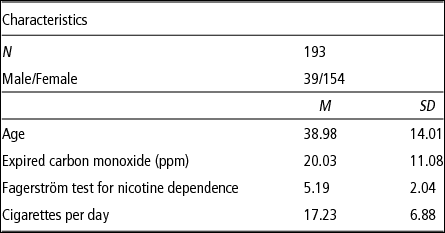
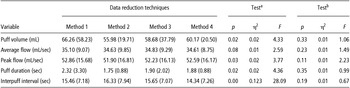
Characteristics of the participants, from whom smoking topography data were obtained, appear in Table 2. Descriptive statistics for each smoking topography variable, according to each data reduction method described above, are presented in Table 3.
Demographic characteristics of participants
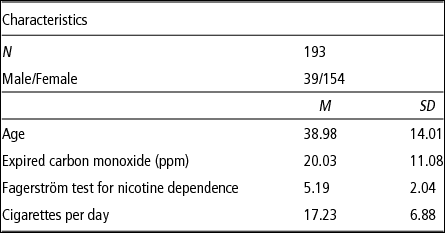
ppm, parts per million.
Tests of comparisons between four methods of data reduction for smoking topography indices

Mean (SD).
a Repeated measure ANOVAs for data reduction method.
b Repeated measure ANCOVAs for data reduction method, controlling for number of puffs.
There were statistically significant differences between all techniques for puff volume, peak flow, puff duration, and interpuff interval (Table 3). Average flow was not significantly different between reduction techniques.
After adjusting for number of puffs, there was no significant difference between techniques for puff volume, average flow, peak flow, puff duration, and interpuff interval (Table 3).
Discussion
The purpose of this study was twofold. A review of the literature was conducted to synthesise reported data reduction and exclusion techniques. Previously collected smoking topography data were subjected to these data reduction techniques in order to understand the impact of different techniques on outcome measures. The current study is the first to demonstrate that ambiguous reporting of participant familiarisation, and data exclusion and reduction techniques is common in the literature. Furthermore, this study provides initial evidence that significant differences exist between the various data reduction techniques, which were attenuated after adjusting for number of puffs. Explanations and implications for the observed findings in this study, as well as recommendations, are provided below and should be considered regardless of smoking topography apparatus.
Despite the large number of studies utilising the CReSS Pocket to collect smoking topography data, there is variation in the techniques employed to reduce data. Our review yielded four methods of smoking topography data reduction, which differed significantly from one another for all topography variables, except average flow, when applied to a data set. These findings should caution researchers that methodological decisions, such as these, will alter study findings.
The majority of studies (Ashare et al., Reference Ashare, Tang, Mesaros, Blair, Leone and Strasser2012; Blank et al., Reference Blank, Disharoon and Eissenberg2009; Grainge et al., Reference Grainge, Shahab, Hammond, O'Connor and McNeill2009; Hammond et al., Reference Hammond, Fong, Cummings and Hyland2005; June et al., Reference June, Hammond, Sjödin, Li, Romanoff and O'Connor2011; June et al., Reference June, Norton, Rees and O'Connor2012; McClure et al., Reference McClure, Stitzer and Vandrey2012; McKee et al., Reference McKee, Krishnan-Sarin, Shi, Mase and O'Malley2006; McKee et al., Reference McKee, Sinha, Weinberger, Sofuoglu, Harrison, Lavery and Wanzer2011; O'Connor et al., Reference O'Connor, Kozlowski, Hammond, Vance, Stitt and Cummings2007; O'Connor et al., Reference O'Connor, Rees, Norton, Cummings, Connolly and Alpert2010; Perkins et al., 2011; Rees et al., Reference Rees, Wayne and Connolly2008; Shahab et al., Reference Shahab, West and McNeill2008; Veilleux et al., Reference Veilleux, Kassel, Heinz, Braun, Wardle, Greenstein and Conrad2011; Williams et al., Reference Williams, Gandhi, Lub, Kumara, Steinberg, Cottler and Benowitz2011) took an average of all puffs collected. This method offers the most complete representation of smoking behaviour and exposure to harmful elements of tobacco smoke, but is intolerant to the incorrect use of the device. To explain, participants are instructed to ignite the cigarette before placing the cigarette into the CReSS Pocket and upon finishing smoking, remove the cigarette from the device prior to extinguishing it. The outcome from improper use is such that the first puff may be much higher in volume to facilitate lighting. Extinction of the cigarette while inserted in the CReSS Pocket would also produce the recording of inadvertent puffs. This method of data reduction would include these faulty puffs, leading to a distorted measurement of smoking behaviour. Interestingly, this method of data reduction was associated with the highest mean scores for the majority of smoking topography indices (puff volume, average flow, and puff duration).
Another study (Faulkner et al., Reference Faulkner, Arbour-Nicitopoulous and Hsin2010) took an average of all puffs collected, after excluding the first and last three puffs. This method is problematic for collecting topography data among individuals who take only several puffs while using the device. Upon removing the first and last three puffs, reduced data may only reflect the mean of one or two puffs, which is not a sound representation of smoking behaviour or exposure to carbon monoxide and carcinogenic toxins. Moreover, this method of data reduction was associated with the greatest variability for the majority of smoking topography indices (average flow, peak flow, interpuff interval).
The third reduction technique, which is established in CReSS Desktop protocols and now emerging for the CReSS Pocket (Schneider Dissertation, Reference Schneider2012), involves the mean of all puffs except the first and last. Compared to the first method, this technique is the second most conservative and representative. Since it necessitates the exclusion of the first and last puff, artifacts from poor participant compliance are reduced, providing a clearer depiction of smoking behaviour.
Finally, one study (Aung, Pickworth, & Moolchan, Reference Aung, Pickworth and Moolchan2004) obtained topography data by averaging the five representative artifact-free puffs after excluding the first and last puffs of the cigarette. However, the authors did not provide criteria for an artifact-free puff. Analogous to the second reduction technique, this method is unfavourable in cases where data for many puffs are collected as it is providing grounds for the loss of meaningful information.
From the discussion of the various methods of reducing smoking topography indices, it is unmistakable that the number of puffs has a bearing on the impact of each reduction technique on the data. For this reason, number of puffs was used as a covariate, as it is a key factor differentiating the four methods. In the supplementary analyses, significant differences were attenuated for all topography variables. The implications of these findings to research are dependent on the sample. If one's sample is heterogeneous, or the data set is highly variable between participants, for puff count, then adjusting for number of puffs as a covariate will yield comparable results regardless of the reduction technique. If one's sample is homogeneous, or variability is minimal between participants, for puff count, then the researcher must deliberate on which technique to employ.
Recommendations
Although objectively-measured smoking topography has been used as a primary outcome measure for over a decade, there is no evidence-based direction for researchers regarding data treatment. Overall, it is the authors’ recommendation that the third method is the most sensible technique. By taking the average of all puffs except the first and last, this data reduction technique affords a thorough appreciation of smoking behaviour, but is also forgiving to inevitable misuse of the device. Furthermore, the variability in the data is conservative, compared to the first and second methods. There is, of course, one caveat to this recommendation, which is contingent upon the nature of the research. For instance, if toxicant exposure is of interest, then total puff duration and volume are better suited to address this research issue than mean puff duration and volume. Likewise, if the initial interaction between smoker and cigarette is relevant, one may be better suited to examine the first puff for smoking topography parameters, rather than the mean.
Study limitations
While this review sought to consolidate studies according to prospectively defined inclusion criteria and provided clear, reproducible methodology, this review did not explore grey literature such as dissertations or conference abstracts. Additionally, a limited number of databases were searched. However, it is likely that researchers interested in how to analyse smoking topography data would first consult the databases we searched. Attempts were made to contact authors regarding missing information but not all responded. Accordingly, some studies were excluded from the review. Finally, the literature review and application of data reduction techniques to data pertained to the CReSS Pocket. Nonetheless, the findings are relevant and extension to other smoking topography devices should be cogitated.
Conclusion
Despite these limitations, this review highlights the inconsistency in the literature regarding the disclosure of methodological practices surrounding smoking topography. Moreover, for the first time, researchers are made aware of the significant differences that exist between reduction techniques and the impact of adjusting for puff count. From these findings, evidence-based recommendations are made. Ultimately, greater transparency and attention are needed in reporting data reduction techniques and consideration should be given by researchers to the potential impact of methodological decisions on study findings.
Acknowledgements
None.
Financial Support
This study was supported by the Canadian Cancer Society Research Institute (P.I. Dr. Harry Prapavessis, Grant # 019876) and the Ontario Tobacco Research Unit (Ashley Studentship for Research in Tobacco Control to the first and second authors). The Exercise and Health Psychology Laboratory, where this work was conducted, is supported by a Canadian Foundation Innovation infrastructure grant awarded to Harry Prapavessis.
Conflict of Interest
None.
Ethical Standards
The authors assert that all procedures contributing to this work comply with the ethical standards of the relevant national and institutional committees on human experimentation and with the Helsinki Declaration of 1975, as revised in 2008.