INTRODUCTION
The livestock sector contributes significantly to the national economy of Ethiopia. However, production per animal is extremely low. The average milk yield per lactation for the indigenous cows ranges from 494 to 850 kg under optimum on-station management (EARO 1999).
To meet the ever-increasing demand for milk and milk products in Ethiopia, genetic improvement of the indigenous cattle has been proposed as one of the options. Focusing on crossbreeding as a quick way of increasing milk production, it has been practiced for the last 50 years but with little success. The crossbreeding work in Ethiopia, unfortunately, was not based on a clearly defined breeding policy with regard to the level of exotic inheritance and the breed type to be used. Data collected for a long time on crossbreeding studies by different institutions have not been systematically analysed and documented to obtain a sound and sustainable breeding programme. Indeed, a limited number of studies compared indigenous cattle breeds with their contemporary crosses for productive and reproductive performances in Ethiopia (IAR 1982; Kiwuwa et al. Reference Kiwuwa, Trail, Kurtu, Getachew, Anderson and Durkin1983; Haile-Mariam et al. Reference Haile-Mariam, Banjaw, Gebre-Meskel and Ketema1993; Negussie et al. Reference Negussie, Brännäng, Banjaw and Rottmann1998; Demeke et al. Reference Demeke, Neser and Schoeman2004a, Reference Demeke, Neser and Schoemanb). Some workers (Haile-Mariam et al. Reference Haile-Mariam, Banjaw, Gebre-Meskel and Ketema1993; Demeke et al. Reference Demeke, Neser and Schoeman2004a, Reference Demeke, Neser and Schoemana) have also estimated genetic parameters for the productive and reproductive traits. Accurate estimation of breed additive and non-additive effects and separation into their causal components is essential for the design of a breeding programme which would fully exploit the value of crossbreeding (Cunningham & Syrstad Reference Cunningham and Syrstad1987). In Ethiopia, however, there is only one report (Demeke et al. Reference Demeke, Neser and Schoeman2004a) on these crossbreeding parameters in reproduction traits. It could, therefore, be noted that there is a scarcity of documented information on crossbreeding to base sound and sustainable breeding programmes on. The current study, therefore, was carried out with the following objectives: (i) to study the reproductive performance of Ethiopian Boran and their crosses with Holstein Friesian in central Ethiopia; (ii) to estimate genetic parameters in the herd; and (iii) to estimate crossbreeding parameters in Ethiopian Boran–Holstein Friesian crosses.
MATERIALS AND METHODS
Source of data
Data for the study were collected from experimental dairy cattle herds of Ethiopian Boran and Ethiopian Boran–Holstein Friesian crossbred cattle maintained at the Debre Zeit Research Station of the International Livestock Research Institute (ILRI) and at the Holeta Agricultural Research Centre of the Ethiopian Institute of Agricultural Research (EIAR). Data from 15 years (1990–2004) were used for the study.
Description of the farms
The Debre Zeit Research Station of the ILRI is located on the outskirts of the town of Debre Zeit, about 50 km south-east of Addis Ababa, in the Ethiopian highlands (9°N and 39°E), at an altitude of c. 1850 m asl. Average annual rainfall in the Debre Zeit area is c. 866 mm. The annual average temperature is 18·7°C and the average monthly relative humidity is 52·4%.
The Holeta Agricultural Research Centre is located 45 km west of Addis Ababa (38·5°E and 9·8°N, 2400 m asl). It is situated in the central highlands of Ethiopia. The average annual rainfall is c. 1200 mm.
Animal management practices
The cattle in Debre Zeit farm were not grazed because of tick infestation problems. Thus, they were all stall-fed. Clean water, hay and mineral lick were provided ad libitum. Additionally, animals had free access to teff (Eragrostis tef) straw. The animals were supplemented with concentrate mixture composed of wheat bran, noug seed cake (Guizotia abyssinica, also widely known as niger) and molasses, based on milk production, twice a day. All calves were weighed at birth and allowed to suckle their dams for the first 24 h in order to obtain colostrum, after which they were moved to individual calf pens for bucket feeding (3 litres milk/day) until weaning (57 days). Milking was done by hand twice a day (05:00 h and 17:00 h). Culling was based on production (low producers), age (old age) and health problems. Disease control was maintained through combined health management practices that included vaccination for the major diseases (Black Quarter, Anthrax, Contagious Bovine Pleuro Pneumonia, Pasteurellosis and Foot and Mouth Disease), regular deworming (every 6 months) and treatment as diseases occurred.
The herd at Holeta was grazed on natural pasture for about 8 h during daytime. At night all animals were housed and supplemented with natural pasture hay conserved from part of the grazing area. Except for the lactating cows, which were supplemented with approximately 3–4 kg of concentrate at each milking, the animals received no regular concentrate supplement. Occasionally, during the long-dry period and based on the condition of the animals, dry and young stocks were supplemented with an unspecified amount of concentrate. All animals had free access to clean water. Cows and heifers were all reared in a similar environment with fairly constant management. All calves were weighed at birth and allowed to suckle their dams for the first 24 h in order to obtain colostrum, after which they were moved to individual calf pens for bucket feeding until weaning at 90 days of age. Each calf was fed a fixed total of 260 kg of whole milk during the pre-weaning period. Weaned calves were kept indoors until the age of 6 months, during which time they were fed ad lib on natural pasture hay and supplemented with approximately 1 kg/day/animal of concentrate composed of 300 g wheat bran/kg concentrate, 320 g wheat middlings/kg concentrate, 370 g noug seedcake (Guizotia abyssinica)/kg concentrate and 10 g salt/kg concentrate. At 6 months of age, all animals were grazed as a group on natural pastures for about 8 h a day and supplemented with conserved natural pasture hay at night.
In both herds cows were bred using AI, and there were no heat induction and/or synchronization protocols.
Data analysis
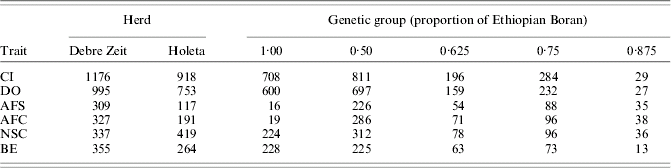
The total number of records available for the analysis after editing is summarized in Table 1. Traits studied were: calving interval (CI, days between two consecutive calvings), days open (DO, period in days between calving and successful service), age at first service (AFS), age at first calving (AFC), number of services per first conception (NSC) and breeding efficiency (BE, as defined by Wilcox et al. Reference Wilcox, Pfau and Bartlett1957)
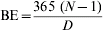
where N=total number of calving, D=total number of days from first to last calving.
Number of records available
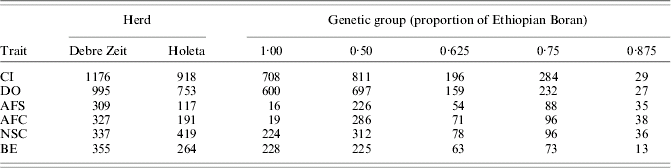
CI=calving interval; DO=days open; AFS=age at first service; AFC=age at first calving; NSC=number of services per first conception; BE=breeding efficiency.
The statistical analysis involved three steps: first, least squares analysis was carried out to compare the different genotypes and examine other fixed effects (SAS 2002). The fixed effects fitted were: genotype (five classes: Ethiopian Boran, 0·50, 0·625, 0·75 and 0·875 of Holstein Friesian inheritance); birth/calving period (year group) (five classes: 1990–92, 1993–95, 1996–98, 1999–2001, 2002–04); cow parity (five classes: 1, 2, 3, 4 and 5+); birth/calving season, grouped into three classes based on the pattern of annual rainfall distribution in the area (November–February: dry period; March–June: light rains and July–October: main rainy season); and herd (two classes: Debre Zeit and Holeta). Cow parity was not fitted for AFS, AFC, NSC and BE. The two-way interactions of effects were also fitted in the final models when found to be significant (P<0·05) in the preliminary analysis. However, the results of the interaction effects are not presented. The Tukey Kramer test was used to separate least squares means with more than two levels. In the preliminary analysis, year effect was fitted individually. However, there was no consistent or meaningful variation over the years. As a result, year was grouped into periods in line with trends in management of the herds.
Secondly, (co)variance components and the resulting genetic and phenotypic parameters (heritability, genetic correlations and repeatability) were estimated using the Derivative-Free Restricted Maximum Likelihood (DFREML) computer package of Meyer (Reference Meyer1998). Two datasets (Ethiopian Boran and crosses) were used for this analysis. Univariate analysis was undertaken for each trait within each dataset for estimation of heritability and repeatability, whereas genetic correlations were estimated using bivariate analysis. For CI and DO, a repeatability animal model was fitted, where direct additive effects plus permanent environmental effect due to repeated records per cow were fitted as random effects. For the other traits (AFS, AFC, NSC and BE), however, direct additive effect was the only random effect fitted. The fixed effects fitted in the least squares analysis were fitted for crosses but genotype had four classes (0·50, 0·625, 0·75 and 0·875 of Holstein Friesian inheritance). For Ethiopian Boran, all fixed effects except genotype were fitted. The convergence criterion for the variance component estimates was 10−7. A maximum of 900 iterations were carried out for the convergence.
Thirdly, multiple regression analysis (SAS 2002) was used to estimate crossbreeding parameters. For the regression analysis, coefficients of expected breed content and heterozygosity in the cow were fitted as covariates to obtain estimates of the individual additive (g iF), individual heterosis (h iBF) and maternal heterosis (h mBF) effects using similar procedures to those of Hirooka & Bhuiyan (Reference Hirooka and Bhuiyan1995) and Kahi et al. (Reference Kahi, Mackinnon, Thorpe, Baker and Njubi1995). Expected heterozygosity with respect to the genes of two breeds was calculated as the expected proportion of genes from the sire and dam which differed with respect to the two breeds. For example, the expected heterozygosity with respect to genes of the Ethiopian Boran (B) and Holstein Friesian (F), h iBF, was calculated as (g sB×g dF)+(g sF×g dB) where gB and gF indicate proportions of genes coming from Ethiopian Boran and Holstein Friesian and the superscripts ‘s’ and ‘d’ denote that the genes come from the sire and dam, respectively. Similarly, expected heterozygosity with respect to two breeds was calculated for the genotype of the dam of cow and was denoted as h mBF. Breed additive effects of, for example, F were calculated using the following formula: h iF=½(g sF+g dF). The breed additive effects for Holstein Friesian were estimated as deviations from the Ethiopian Boran. Thus, the full model included effects of g iF, h iBF and h mBF as well as fixed effects described in the least squares analysis except genetic group.
RESULTS
Fixed effects and genotype comparisons
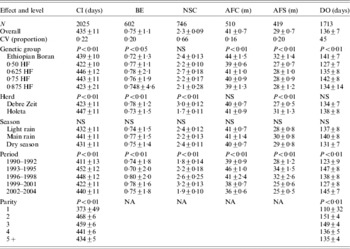
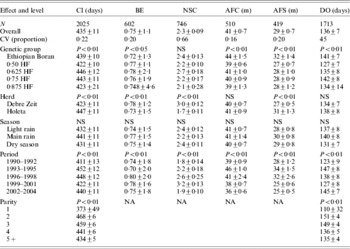
Least squares means and standard errors for genotype comparisons and effects of non-genetic factors on reproduction traits are summarized in Table 2. The differences between the genetic groups in reproduction traits were marked. Ethiopian Boran had longer CI (P<0·01), lower BE (P<0·05), delayed AFS and AFC (P<0·01) and longer DO (P<0·01) compared with all the crosses. However, there was no significant difference (P>0·05) in NSC among the genetic groups. Ethiopian Boran had 17 days longer CI, 5·5% lower BE and were 4·4 months older at AFC compared with the 0·50 crosses. Comparisons between the crosses revealed that CI and DO were shorter for 0·50 and 0·875 crosses compared with the 0·75 cross; otherwise there was no clear-cut superiority of any of the genetic groups. Given the low number of observations in the 0·875 crosses, the results of this particular group need to be cautiously viewed.
Least squares means (±s.e.) for effects of genetic group (HF, Holstein Friesian), herd, period, season and parity on reproduction traits: calving interval (CI), days open (DO), age at first service (AFS), age at first calving (AFC), number of services per first conception (NSC) and breeding efficiency (BE)
NS, non significant; NA, not applicable.
Cows from the two herds (Debre Zeit and Holeta) did not differ (P>0·05) in AFC and DO. But the Holeta herd had longer (P<0·01) CI, poorer (P<0·01) BE, longer (P<0·01) AFS compared with the Debre Zeit herd. On the contrary, the Holeta herd had fewer (P<0·01) NSC. Season of birth/calving had no significant (P>0·05) effect on all reproductive traits.
The reproductive performance of the dairy cows over the periods showed no consistent pattern. However, during the second period (1993–95), cows had poor reproductive performance compared with other periods. It was also observed that cows during the fourth period (1999–2001) were relatively better in their reproductive performance compared with other periods. Cows that calved for the first time had shorter (P<0·01) CI and DO compared with those in other parities. However, cows on their second parity had the longest (P<0·01) CI and DO, after which there was a declining trend to the 5+ parities.
Genetic parameters
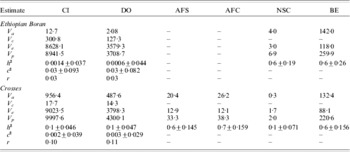
Table 3 shows variance components and parameter estimates for reproductive traits. Heritabilities were not estimated for AFS and AFC in Ethiopian Boran because of a smaller dataset. Heritability values of CI estimated for Ethiopian Boran and crosses were 0·0014±0·037 (P>0·05) and 0·1±0·046 (P<0·05), respectively. The values of DO for the Ethiopian Boran and crosses were 0·0006±0·044 (P>0·05) and 0·1±0·047 (P<0·05), respectively. Heritability values of AFS and AFC for crosses were all high and significantly different from zero (P<0·01). The values were estimated at 0·6±0·145 and 0·7±0·159 for AFS and AFC, respectively. NSC had heritability estimates of 0·6±0·187 and 0·1±0·071 for Ethiopian Boran and crosses, respectively. Heritability estimates of BE for the different genetic groups were all high and significantly (P<0·01) different from zero. The values for Ethiopian Boran and crosses were 0·6±0·260 and 0·6±0·156, respectively.
Estimates of variance components, heritabilities (h2±s.e.), cow effects (c2±s.e.) and repeatabilities (r) for reproductive traits

V a, additive genetic variance; V c, permanent environmental variance; V e, residual variance and V p is phenotypic variance.
Repeatability estimates of CI and DO for Ethiopian Boran were 0·03 and 0·03, respectively. The corresponding estimates for crosses were 0·10 and 0·11, respectively.
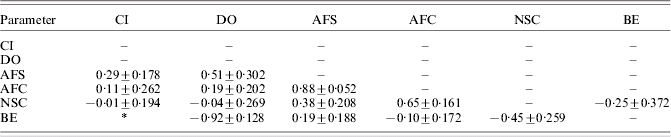
Genetic correlations between the traits were not estimated for Ethiopian Boran, except between BE and NSC. This was due to small data size and very low heritability. AFS had non-significant (P>0·05) genetic correlations with CI and DO (Table 4). However, the genetic correlations of AFS with AFC (0·88±0·052) was, as expected, very strong and highly significant (P<0·01). AFC also had significant genetic correlations with NSC (0·65±0·161). BE is genetically negatively correlated with DO.
Genetic correlations (and s.e.) between reproduction traits for Ethiopian Boran (above diagonal) and their crosses (below diagonal)
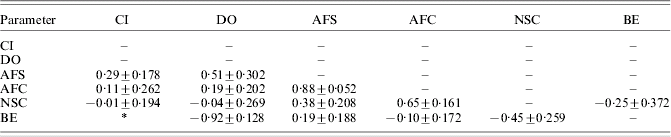
* Converged towards −1.
Crossbreeding parameters
Estimates of direct additive and heterotic effects on reproductive traits are presented in Table 5. The additive breed differences between Ethiopian Boran and Holstein Friesian for CI, DO, NSC and BE were not significant (P>0·05). These estimates are also associated with large standard errors. On the other hand, the estimates for additive direct effects for AFS and AFC were negative and significant (P<0·01). The estimates were −7±2·1 and −7±2·8 months, respectively. None of the maternal heterotic effects for reproduction traits were significant (P>0·05) except for AFC, for which positive (2·9 months) and significant (P<0·05) estimates were obtained. The individual heterosis values were also not significant (P>0·05) for CI, DO, NSC and BE. However, significant (P<0·01) estimates for AFS and AFC (P<0·05) were recorded.
Estimates of breed additiveFootnote *(giF), individual heterosis (hiBF) and maternal heterosis (hmBF) for reproductive performance traits

NS, non significant.
* Additive values are presented as deviations from the Ethiopian Boran.
DISCUSSION
The results of differences in reproduction performance between Ethiopian Boran and the crosses are comparable with those obtained for local cattle and their crosses in Ethiopia (IAR 1982; Kiwuwa et al. Reference Kiwuwa, Trail, Kurtu, Getachew, Anderson and Durkin1983; Haile-Mariam et al. Reference Haile-Mariam, Banjaw, Gebre-Meskel and Ketema1993; Negussie et al. Reference Negussie, Brännäng, Banjaw and Rottmann1998; Demeke et al. Reference Demeke, Neser and Schoeman2004a). For crossbred cows of Friesian and Jersey with Arsi or mixed Zebu, Kiwuwa et al. (Reference Kiwuwa, Trail, Kurtu, Getachew, Anderson and Durkin1983) and Negussie et al. (Reference Negussie, Brännäng, Banjaw and Rottmann1998) reported relatively early AFC (29–34 months) and fewer DO (70–108 days), but similar CI (393–468 days) compared with the results of the present study. Similarly, compared with the current findings, Haile-Mariam et al. (Reference Haile-Mariam, Banjaw, Gebre-Meskel and Ketema1993) also reported early AFC for F1 (32±0·2 months) and 0·75 Friesian–Ethiopian Boran crosses (33±0·9 months). Their estimates for AFC for Ethiopian Boran heifers (45 months) and CI for both Ethiopian Boran and crossbred cows were, however, similar to current estimates. Thus, the more advanced AFC obtained in the current study compared with the previous studies indicated the potential that could be exploited by merely improving management.
The result that the genetic groups did not differ in NSC is consistent with reports in the literature (McDowell et al. Reference McDowell, Velasco, Van Vleck, Johnson, Brandt, Hollon and McDaniel1974; Rege et al. Reference Rege, Aboagye, Akah and Ahunu1994). It has been shown that nutrition (Galina & Arthur Reference Galina and Arthur1989) and inseminator effects (Busch & Furstenberg Reference Busch and Furstenberg1984) are more important contributors to the variation in NSC than genotype.
Comparison among the crosses revealed no clear-cut superiority of any genetic group except for CI and DO, which were shorter for 0·50 and 0·875 crosses compared with the 0·75 crosses. Several workers reported that as the exotic blood level increased, reproductive performance deteriorated. In this regard, De Vaccaro (Reference De Vaccaro1973) reported that the efficiency of high-grades of crossbreeds is generally inferior to that of first crosses and differences of about 40–60 days in the length of CI between grades seem to be common. Similarly, Haile-Mariam & Goshu (Reference Haile-Mariam and Goshu1987) reported a CI for Fogera crosses with 0·75 of Friesian inheritance 210–days longer than those with 0·50 Friesian inheritance. However, the fact that the 0·875 crosses performed better than the 0·75 level could be associated with a small sample size for the 0·875 crosses.
Herd differences as measured by reproductive traits are not consistent and could be a reflection of differences in management of the two herds. Literature reports on the effect of farm on reproductive performance are variable. For instance, Jadhav (Reference Jadhav1990) in Holstein Friesian×Sahiwal cross and Ballewar (Reference Ballewar2003) in Frieswal cattle have reported significant effects of farm on DO and CI. However, Mudgal et al. (Reference Mudgal, Taylor and Singh1986) did not observed significant effect of farm on DO.
Season had no significant effect on all reproduction traits. Negussie et al. (Reference Negussie, Brännäng, Banjaw and Rottmann1998, Reference Negussie, Brännäng and Rottmann1999) working on Arsi, Zebu and their crosses with Holstein Friesian and Jersey found the season of birth/calving had no significant effect on reproductive traits. However, other authors have reported a significant influence of the season of birth/calving on some traits: Albero (Reference Albero1983) and Haile-Mariam et al. (Reference Haile-Mariam, Banjaw, Gebre-Meskel and Ketema1993) on NSC; Haile-Mariam et al. (Reference Haile-Mariam, Banjaw, Gebre-Meskel and Ketema1993) on AFC and CI. As stated earlier, the herd in Debre Zeit farm was not grazed and thus it was expected that the influence of season would be insignificant. However, looking at the lack of significant interaction between season and herd, it could be inferred that season did not have a considerable influence on reproductive performance under the grazing condition either.
Under tropical conditions the effect of period (year group) on reproductive performance is commonly noted (e.g. Kiwuwa et al. Reference Kiwuwa, Trail, Kurtu, Getachew, Anderson and Durkin1983; Haile-Mariam et al. Reference Haile-Mariam, Banjaw, Gebre-Meskel and Ketema1993; Negussie et al. Reference Negussie, Brännäng, Banjaw and Rottmann1998; Demeke et al. Reference Demeke, Neser and Schoeman2004a). In many of the studies, however, the trend of influence was irregular and not similar for all traits. This inter-annual variation in reproductive traits may indicate a failure to maintain a uniform reproductive management over years.
The declining trend for CI and DO after the second parity could be attributed to selective culling of repeat breeders and retaining those with short intervals. The observed direction of influence for cow parity on reproductive traits is in general agreement with the results reported for indigenous and crossbred cows in Ethiopia (e.g. Albero Reference Albero1983; Kiwuwa et al. Reference Kiwuwa, Trail, Kurtu, Getachew, Anderson and Durkin1983; Haile-Mariam et al. Reference Haile-Mariam, Banjaw, Gebre-Meskel and Ketema1993; Negussie et al. Reference Negussie, Brännäng, Banjaw and Rottmann1998; Demeke et al. Reference Demeke, Neser and Schoeman2004a).
Heritability values for CI in both genetic groups were lower but within the range of estimates reported in the literature for tropical dairy cattle (e.g. Mackinnon et al. Reference Mackinnon, Thorpe and Baker1996; Lobo et al. Reference Lobo, Madalena and Vieira2000; Demeke et al. Reference Demeke, Neser and Schoeman2004a). The low heritability for CI indicated that improvement in this trait could primarily be achieved genetically through crossbreeding or by improving herd reproductive management practices. The heritability estimates for AFS and AFC in crosses and that of BE in both genetic groups were much higher than the literature reports (e.g. Lobo et al. Reference Lobo, Madalena and Vieira2000; Singh & Gurnani Reference Singh and Gurnani2004) and indicate that there is a potential for improvement of these traits through selection within each genetic group.
Comparison between the genetic groups (Ethiopian Boran v. crosses) for heritability estimates of reproduction traits did not follow a strict trend. For example, NSC heritability was larger in Ethiopian Boran. For the remaining traits, the values were higher in crosses. Because of a relatively weak selection and thus broader genetic base in Ethiopian Boran than in crosses, a large additive genetic variance is expected in the former. However, the heritability estimates recorded do not support this proposition. Indeed, in their review of available literature on genetic parameters of dairy cattle for tropical region, Lobo et al. (Reference Lobo, Madalena and Vieira2000) found that BE was the only reproductive trait affected by genetic group, the estimate for local breeds being slightly higher than that for crossbreds, whereas that in European breeds did not differ significantly from these two.
Many of the genetic correlations between reproduction traits were not significant and unexpected. It was also noted that the standard errors for many of the correlations are rather high and might have resulted in non-significance of correlations.
Repeatability estimates of CI and DO for both Ethiopian Boran and crosses were much lower but are within the limits often quoted (Rege Reference Rege1991; Demeke et al. Reference Demeke, Neser and Schoeman2004a). This indicates that an animal evaluation for these reproduction traits based on repeated observations is more reliable than evaluation on a single observation. The lower repeatability estimate for these traits could be due to higher influences of specific environmental effects on a given record that may inflate the variability of within-animal records. Therefore, through repeated measure of the trait, it is possible to reduce specific environmental variance and maximize precision for any animal evaluation.
The additive breed differences between Ethiopian Boran and Holstein Friesian for CI, DO, NSC and BE were not significant. Despite the magnitude of differences seen (e.g. 40 days for CI) they were not significant, which may indicate the large within-group variation for these traits. However, in general agreement with the current results, several studies reported non-significant differences for CI, DO and NSC between European dairy breeds and tropical indigenous cattle in tropical environments (e.g. Teodoro et al. Reference Teodoro, Lemos, Barbosa and Madalena1984; Rege et al. Reference Rege, Aboagye, Akah and Ahunu1994, Demeke et al. Reference Demeke, Neser and Schoeman2004a). Cunningham & Syrstad (Reference Cunningham and Syrstad1987), however, reported small differences for CI between tropical and European breeds using data from 13 projects in the tropics. The estimate for the breed difference in CI for Friesian (–6 to −22 days) from Sahiwal was rather small but significant and indicated that for this trait differences between these two breeds were not very high under the conditions of the lowland tropics of Kenya (Kahi et al. Reference Kahi, Thorpe, Nitter and Baker2000). The estimates for additive direct effects for AFS and AFC, on the other hand, were negative and significant. It has been indicated by several reports that when Bos taurus dairy breeds are crossed with tropical indigenous breeds, the crossbreds exhibit a reduction in AFC as a result of the additive genetic contributions of dairy breeds or heterosis or both (Cunningham & Syrstad Reference Cunningham and Syrstad1987; Sharma & Pirchner Reference Sharma and Pirchner1991; Rege et al. Reference Rege, Aboagye, Akah and Ahunu1994; Demeke et al. Reference Demeke, Neser and Schoeman2004a). Results of the present study are in agreement with the above reports. The significant heterosis value, particularly for AFC, is consistent with reports in the literature (Sharma & Pirchner Reference Sharma and Pirchner1991; Kahi et al. Reference Kahi, Thorpe, Nitter and Baker2000; Demeke et al. Reference Demeke, Neser and Schoeman2004a). In full agreement with the present study, no heterosis in crossing Bos taurus dairy breeds with Bos indicus cattle was found for CI, DO and NSC in Africa (Rege et al. Reference Rege, Aboagye, Akah and Ahunu1994), for NSC in Brazil (Teodoro et al. Reference Teodoro, Lemos, Barbosa and Madalena1984) and for CI in Brazil (Madalena et al. Reference Madalena, Teodoro, Lemos, Monteiro and Barbosa1990).
CONCLUSIONS
Ethiopian Boran was found to have poor reproductive performance compared with the crosses. Crossbreeding has, however, improved the reproductive performance of the Ethiopian Boran. Comparisons among the crosses did not reveal a clear-cut superiority of any of the genetic groups. Breed additive differences between Ethiopian Boran and crosses were non significant except for AFS and AFC. Heterotic effects were also non significant (except for AFS and AFC). Heritability estimates were generally medium to high except for CI and DO. Therefore, improved herd reproductive management practice and within-breed selection could substantially improve the reproductive performance of the indigenous Ethiopian breed. Use of crossbreds is also advised under such production system. However, as the level of management achievable under most smallholder conditions in Ethiopia is rather unfavourable to higher exotic inheritance levels, 0·50 Holstein Friesian inheritance should be used.
We sincerely thank ILRI and EIAR for provision of data. The senior author wishes to thank the Jimma University for granting him study leave and ILRI for research facilities.