Culex pipiens Linnaeus, known to feed primarily on birds, is the main enzootic vector for West Nile virus (WNV) in eastern North America and has been proposed as a contributing bridge vector (Apperson et al. Reference Apperson, Hassan, Harrison, Savage, Aspen and Farajollahi2004; Turell et al. Reference Turell, Dohm, Sardelis, O'Guinn, Andreadis and Blow2005). However, feeding behaviour is not uniform across its range. Molaei and Andreadis (Reference Molaei and Andreadis2006) looked at feeding patterns in Connecticut and found that 93% of C. pipiens had fed on birds. Apperson et al. (Reference Apperson, Hassan, Harrison, Savage, Aspen and Farajollahi2004) studied host preferences of mosquitoes in the states of New York and New Jersey, United States of America. They found that 38% of C. pipiens in New Jersey had fed on a mammal host, with 10% of these having fed on a human. In contrast, none of the 19 C. pipiens tested had fed on a mammal in New York State. Gingrich and Williams (Reference Gingrich and Williams2005) showed that C. pipiens from Delaware, United States of America did not show any significant difference in their feeding preference between birds and mammals. In the Washington, District of Columbia, and Maryland areas, researchers noted a sevenfold feeding shift from birds to humans during late summer and early fall (Kilpatrick et al. Reference Kilpatrick, Kramer, Jones, Marra and Daszak2006). The current study was designed to determine whether C. pipiens is attracted to human hosts in the Niagara Region of southern Ontario where WNV has become endemic. Aedes vexans (Meigen) was also analysed in the study as a comparison mosquito because it is believed to primarily feed on mammals and is found at lower elevations (Wood et al. Reference Wood, Dang and Ellis1979; Anderson et al. Reference Anderson, Andreadis, Main, Ferrandino and Vossbrinck2006).
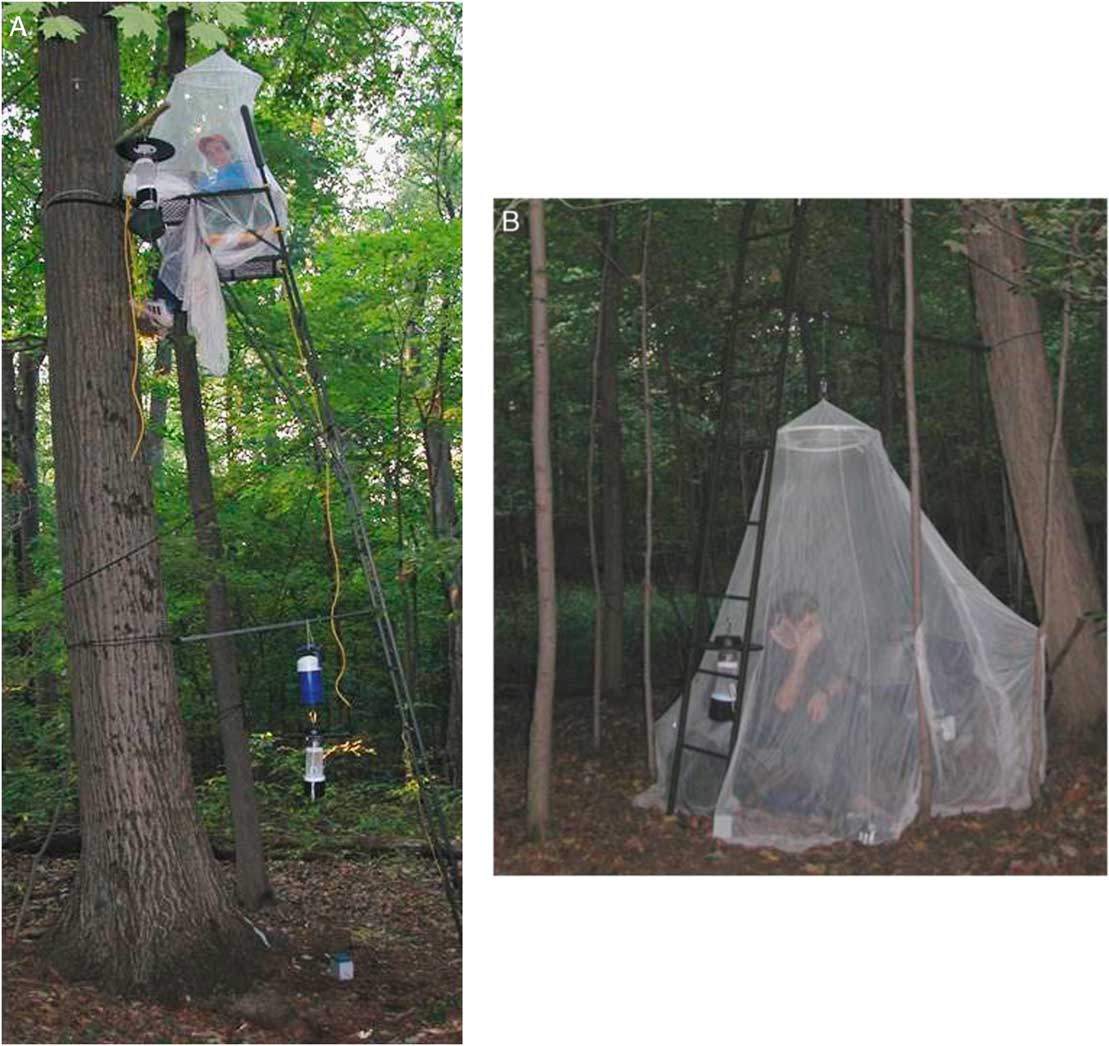
The study was conducted in a 17.23 ha Carolinian woodlot in the Niagara Region of Ontario, Canada, as described in Russell and Hunter (Reference Russell and Hunter2005), from 31 May to 12 October 2005. Four trees were selected at random within the woodlot. At each tree a 5-m tree stand was erected (StrongBuilt® Basic 15′ Ladder, Waterproof, Louisiana, USA). From each tree a Centers for Disease Control (CDC) miniature light-trap with light source disabled (Model 512, John W. Hock Company, Gainesville, Florida, USA) was hung at heights of ∼1.5 m and ∼5 m for a total of eight traps per night. Traps that were placed next to a human host were labelled as human-baited traps, and those without a human host, were CO2-baited control traps (Fig. 1).
Experimental setup with human hosts placed at either 1.5 m or 5 m elevations. CDC miniature light traps (no CO2, no light) were used for the human-baited traps and CDC miniature light traps (CO2, no light) were used for the control traps. (A, left) The person is at the 5 m elevation (in a tree stand) and the control trap is at the 1.5 m elevation and (B, right) the person is at the 1.5 m elevation. CDC, Centers for Disease Control.

The four humans used in this study were male and included three paid assistants and the first author. All humans were between the ages of 21 and 27 years with a similar body build. During trapping times, all individuals wore similar coloured clothing and ate similar meals in an effort to standardise their mosquito attraction cues.
There were two trapping days every week for the duration of the study. Trapping occurred from 2 hours before sunrise to 1 hour after sunrise, and from 1 hour before sunset to 2 hours after sunset. These times coincided with C. pipiens crepuscular activity and, therefore, the period when humans were most likely to be exposed to attack (Clements Reference Clements1999). The actual times for sunrise and sunset shifted throughout the season, and trapping times were adjusted accordingly.
Each week the human hosts were assigned, at random, to one of the four trees. Two humans were then randomly assigned to sit at the 5 m elevation for the first night (Fig. 1A), although the other two humans sat at ground level (Fig. 1B). For the second night of trapping each week, the humans switched to the opposite elevation at their assigned tree.
The season was divided into three trapping periods (Early, Middle, and Late). The Early period was from calendar weeks 23 to 28 (29 May to 9 July 2005), the Middle period was from calendar weeks 29 to 34 (10 July to 20 August 2005), and the Late period was from calendar weeks 35 to 42 (21 August to 15 October 2005).
Trapped insects were placed in a −20°C freezer for ∼30 minutes to kill all captured insects. Once killed, insects were sorted and all nonmosquitoes were removed and discarded. The mosquitoes were then identified to species using the identification keys of Wood et al. (Reference Wood, Dang and Ellis1979); a subsample of the identified mosquitoes was also barcoded as in Cywinska et al. (Reference Cywinska, Hunter and Hebert2006).
The average number of mosquitoes captured per period was calculated using the number of females collected over the 12 trap nights (two trap nights per week). To determine if there was a difference in the average number of mosquitoes caught among trap types, elevations, and trees, data were analysed using a three-way ANOVA. Due to the nonnormality of the data, the three-way ANOVA was conducted using a randomisation program with repeated measures. The lines of code for the randomisation were developed using Microsoft C++ software (Microsoft Corporation, Redmond, Washington, USA). Although this program can be used for nonnormal data it does not allow for a post hoc test. Therefore, the data were also run in a standard three-way ANOVA with a post hoc Tukey test applied to the subject variables using Sigma Stat (Systat Software Inc., San Jose, California, USA). Because the randomisation program and the standard three-way ANOVA produced the same level of significance, the standard test was used with its post hoc Tukey test to detect where differences lay.
Over the entire season, 7866 mosquitoes were captured in 320 trap catches. Culex pipiens and A. vexans accounted for 14.8% and 19.8% of the total trap catch, respectively. Eleven additional taxa belonging to genus Ochlerotatus Lynch Arribálzaga accounted for 53.2% of the other mosquitoes collected. The most common of these, in descending order of abundance, were Ochlerotatus stimulans (Walker) (23.6% of total), Ochlerotatus trivittatus (Coquillett) (3.2% of total), Ochlerotatus canadensis (Theobald) (1.2% of total), and Ochlerotatus triseriatus (Say) (1.0% of total). Coquillettidia perturbans (Walker) made up 9.4% of the total, whereas Anopheles Meigen spp. comprised only 1.8% of the total, with the majority being Anopheles quadrimaculatus Say (1.2% of total).
There were more C. pipiens captured at the 5 m elevation than at the 1.5 m elevation for all three periods (Early period F 1,94 = 14.51, P < 0.001; Middle period F 1,94 = 25.75, P < 0.001; Late period F 1,94 = 7.01, P = 0.009). There was no significant interaction between human hosts and trees (Early period F 3,94 = 2.32, P = 0.081; Middle period F 3,94 = 1.30, P = 0.280; Late period F 3,94 = 1.14, P = 0.336).
At the 1.5 m elevation, for all three periods, C. pipiens was equally attracted to both the human-baited and control traps (post hoc Tukey: Early period P = 0.923; Middle period P = 0.782; Late period P > 0.05) (Table 1). At the 5 m elevation, C. pipiens was equally attracted to both the human-baited and control traps for the Late period only (P > 0.05), with significantly more captured in the control traps for the Early (P < 0.001) and Middle (P = 0.006) periods (Table 1).
Effect of trap type (human baited, control) on numbers (mean ± SD) of Culex pipiens and Aedes vexans captured during three time periods (Early: weeks 23–28, Middle: weeks 29–34, Late: weeks 35–42), and at two heights (1.5 m and 5 m).

For each time period, within row values followed by the same letter do not differ (P > 0.05).
This study has shown that the bird-biting mosquito, C. pipiens, is attracted to human hosts, whereas relatively few A. vexans, known human pests, were collected from the human-baited traps. Although the C. pipiens captured at the 5 m elevation had a significantly higher attraction to control traps in the Early and Middle periods, there was equal attraction between the two trap types during the Late period and for the entire season at the 1.5 m elevation. Culex pipiens attraction to humans at the 1.5 m elevation suggests that they will probably bite a human host throughout the season (see also Hamer et al. Reference Hamer, Kitron, Goldberg, Brawn, Loss and Ruiz2009). Because humans are more likely to be exposed to C. pipiens at the 1.5 m elevation, and C. pipiens mosquitoes in Niagara were equally attracted to both trap types all season, it is possible that some humans came into contact with a WNV-infected C. pipiens mosquito during the Late period.
Although several studies on C. pipiens have shown a temporal shift towards mammalian blood meals near the end of the season, our studies of host attraction in southern Ontario do not show the same pattern. Kilpatrick et al. (Reference Kilpatrick, Kramer, Jones, Marra and Daszak2006) found a late-summer feeding shift in C. pipiens from their preferred avian hosts to humans. This shift in feeding preference also coincided with a rise in WNV human cases (Kilpatrick et al. Reference Kilpatrick, Kramer, Jones, Marra and Daszak2006). In another study, the period of human cases paralleled virus isolation from mosquitoes during early September (Andreadis et al. Reference Andreadis, Anderson, Vossbrinck and Main2004). However, for C. pipiens within the Niagara Region, there does not appear to be a shift in host attraction at the lower elevation. Although C. pipiens is attracted to humans throughout the season at the lower elevation, the lack of human cases early in the season is merely a function of low levels of circulating WNV in the environment.
Finding the majority of C. pipiens at higher elevation and greater abundance during the Middle period was expected (Main et al. Reference Main, Tonn, Randall and Anderson1966; Mitchell and Rockett Reference Mitchell and Rockett1979; Novak et al. Reference Novak, Peloquin and Rohrer1981; Mitchell Reference Mitchell1982; Russell and Hunter Reference Russell and Hunter2005). The C. pipiens population typically does not peak until the middle of June to the middle of July, which corresponds to the Middle period (weeks 29 to 34) of the current study (Madder et al. Reference Madder, Surgeoner and Helson1983; Kilpatrick et al. Reference Kilpatrick, Kramer, Jones, Marra and Daszak2006).
Using human hosts for mosquito attractant studies gives an accurate representation of the natural host-seeking behaviour of C. pipiens within the Niagara region. Kilpatrick et al. (Reference Kilpatrick, Kramer, Campbell, Alleyne, Dobson and Daszak2005) did a risk assessment of WNV from mosquitoes in New York State, United States of America (Suffolk and Rockland counties) and found that C. pipiens and Culex restuans Theobald could be responsible for up to 80% of the human WNV infections. With the C. pipiens at the lower elevation being equally attracted to humans and control traps all season, and C. pipiens being the primary enzootic vector for WNV, it is very likely that C. pipiens is also a major bridge vector of WNV in southern Ontario as has been suggested in Illinois (Hamer et al. Reference Hamer, Kitron, Goldberg, Brawn, Loss and Ruiz2009), Connecticut (Andreadis et al. Reference Andreadis, Anderson, Vossbrinck and Main2004), and New York (Kulasekera et al. Reference Kulasekera, Kramer, Nasci, Mostashari, Cherry and Trock2001).
Acknowledgements
This study was supported by a Natural Sciences and Engineering Research Council of Canada (NSERC) Post-Graduate Scholarship – Doctoral scholarship to C. Russell and by an NSERC Discovery grant to F.F. Hunter. The authors thank Chris Jackson, Kenneth Groves, and Brad Baker for their field assistance; Jean Richardson for statistical assistance; and David Cole of Cytec Inc. (Niagara Falls, Ontario, Canada) for allowing us to conduct the study on one of their properties.