Introduction
Huntington's disease (HD) is an autosomal dominant degenerative disease of the basal ganglia. It presents with disparate symptoms including neurological, neurocognitive and neuropsychiatric manifestations (1–3). The main motor problems include choreiform movements, impaired balance, dysarthria and dysphagia. The neuropsychiatric presentations usually include dementia, irritability, apathy, affective disorders and psychosis (4,5).
Irritability is a common symptom of HD. It has been described in up to 50% of people with HD (6,7) Irritability has devastating consequences causing considerable distress to the patient, carers and sometimes to the professionals involved in their care. Yet, it remains one of the most ill-understood symptoms, which is just beginning to be systematically studied (Reference Craig, Hietanen, Markova and Berrios8). Irritability is argued as a separate mood state with an inner subjective component and an outer objective component (Reference Snaith and Taylor9). Irritability of a patient may be observed by others (outward) or experienced subjectively (inward). Irritability has also been reported as a state of poor control over temper which usually results in irascible verbal or behavioural outbursts or can be present without observed manifestations (Reference Snaith and Taylor9).
There is emerging evidence for increasing ‘irritability' and ‘cynical hostility' in presymptomatic gene carriers before the onset of the clinical symptoms (Reference Kirkwood, Siemers, Viken, Hodes, Conneally, Christian and Foroud10). The psychiatric profiles of HD gene carriers and non-carriers have been compared (Reference Berrios, Wagle, Markova, Wagle, Rosser and Hodges11). The gene carriers were found to have significantly worse recognition memory and scored higher in measures of irritability than controls.
Three clusters of behavioural and affective symptoms in HD have been distinguished using factor analysis (Reference Craufurd, Thompson and Snowden6): apathy, depression and irritability. Although, the ‘apathy factor' was highly correlated with the duration of illness, no such relationship was observed for the depression and irritability factors. Another study (Reference Paulsen, Ready, Hamilton, Mega and Cummings4) found a statistically significant moderate positive correlation between anxiety and irritability domains as measured on the neuropsychiatric inventory (NPI) (Reference Cummings, Mega, Gray, Rosenberg-Thompson, Carusi and Gornbein12) in HD. They also found a negative correlation between irritability and cognitive dysfunction as measured by the Mini Mental State Examination (MMSE) (Reference Folstein, Folstein and McHugh13) and Mattis Dementia Rating Scale (DRS) (Reference Monsch, Bondi and Salmon14). A negative correlation was also found between irritability and chorea [measured by Unified Huntington's Disease Rating Scale (UHDRS)].
Neuropsychiatric profiles of patients with a hyperkinetic movement disorder such as HD were compared with a hypokinetic disease such as Progressive Supra-nuclear Palsy (PSP) (Reference Litvan, Paulsen, Mega and Cummings15). Although there was no difference between the total NPI scores, patients with HD exhibited significantly more agitation, irritability and anxiety, whereas patients with PSP exhibited more apathy. On correlation analysis of their results the authors found that in patients with HD irritability was significantly associated with anxiety and depression. There was no correlation between chorea and any specific behaviour.
The relationship between irritability and other prominent manifestations of HD such as mood symptoms, cognition and motor symptoms remains unclear and needs further investigation. A better understanding of the associations of irritability will be a step towards understanding the aetiology of this distressing symptom. This could guide the development of effective management strategies. HD is a disease of the basal ganglion, which has extensive cortical and sub-cortical connections. Basal ganglion is considered to play an important part in complex cognitive processes including the working memory, generative behaviours and the ability to establish and shift from one topic to another. Impairments in these executive functions are likely to affect various aspects of emotional and behavioural control. For instance, regulatory functions of the dorsolateral subcortical circuit such as generating and shifting may alter the appropriate expression of frustration resulting in apparent irritability and agitation. Hence, it is hypothesised that the expression of irritability in HD would be associated with impairment of executive functions. It is also hypothesised that there would be a significant association with depression, anxiety and motor symptoms, but this relationship may not be as significant as that between irritability and cognitive dysfunction.
Methods
Consecutive patients with genetically confirmed HD and their carers were prospectively recruited from the regional HD neuropsychiatry service by the consultant responsible. All the patients were clinically assessed for their capacity to consent and were included if they provided informed consent, and if they were found to have basic cognitive abilities based on consultant's clinical assessment to be able to fill in the proposed questionnaires and to undertake the assessment. Informed consent was also obtained from the primary carers.
The cross-sectional assessment involved interview of the patients by the interviewer and administration of the Behavioural Assessment of Dysexecutive Syndrome (BADS) (Reference Wilson, Alderman, Burgess, Emslie and Evans16), the Montgomery and Asberg Depression Rating Scale (MADRS) (Reference Montgomery and Asberg17) and the Motor component of UHDRS (Reference Kieburtz18). Subsequently patients were asked to fill in two self-reported questionnaires: irritability, depression and anxiety scale (IDA) (Reference Snaith, Constantopoulos, Jardine and McGuffin19) and State Trait Anxiety Inventory (Reference Speilberger, Gorsuch and Lushene20). Patients' primary carers were asked to fill in Burns Irritability Scale (Reference Burns, Folstein, Brandt and Folstein21). The interviewers were blinded to the patients' clinical condition and to their medication.
Motor component of UHDRS is a commonly used specific instrument to measure motor features of HD. MADRS was used as it is a commonly used objective measure of depression which is not affected by the misperceptions of the patients' view of their own physical illness. It measures only a few somatic features of anxiety and depression and is therefore not biased in those who suffer from physical illness. IDA was used to measure subjective irritable mood at a fixed point in time whereas Burns Irritability Scale was used to measure objective carer-rated irritability. BADS is a commonly used and sensitive measure of executive functions that assesses capacities that are normally exercised in everyday living. STAI is a commonly used measure of both state anxiety (cross-sectional anxiety intensity) and trait anxiety (relatively stable anxiety proneness).
The sample size calculation showed that a 0.050 two-tailed Fisher's Z test of the Pearson correlation coefficient p = 0.50, will have 80% power to detect a p = 0.80 when the sample size is 30. Statistical analysis was carried out using SPSS version 10, Chicago, Illinois. Mean and standard deviation were calculated for scores of all the instruments used. Spearman rank correlation coefficients were calculated to examine the association of irritability in HD with dysexecutive syndrome, depression, anxiety and movement disorder.
Ethical approval for this study was obtained from the South Birmingham Local Research Ethics Committee.
Results
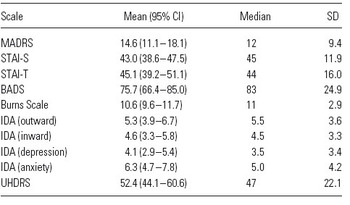
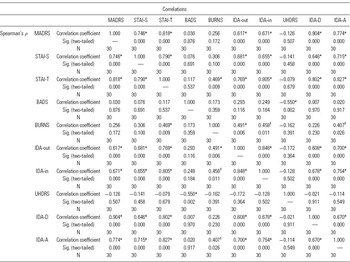
Forty patients and their carers were approached, of whom 35 patients consented to participate. Full assessments were conducted successfully with 30 patients and carers. Of the 30 subjects 14 were females and 16 were males. The ages ranged between 29 and 72 years. The mean age of the subjects was 49.17 years with a standard deviation of 9.88. The median age of the subjects was 50.5. Table 1 describes mean scores with standard deviation on all the scales used. Table 2 outlines the correlation coefficients between various variables studied.
Mean scores on various scales used

Correlation of scores on various scales used in the study

* Correlation is significant at the 0.01 level (two-tailed).
† Correlation is significant at the 0.05 level (two-tailed).
Outward irritability scale scores were significantly positively associated with patients' MADRS scores (Spearman ρ = 0.62, p≤ 0.001), with patients' STAI – state anxiety scores (Spearman ρ = 0.68, p≤ 0.001) and also with patients' STAI – trait anxiety scores (Spearman ρ = 0.79, p≤ 0.001). The IDA inward irritability scale scores were significantly positively associated with patients' MADRS scores (Spearman ρ = 0.67, p≤ 0.001), STAI – state anxiety scores (Spearman ρ = 0.66, p≤ 0.001) and with patients' STAI – trait anxiety scores (Spearman ρ = 0.80, p≤ 0.001).
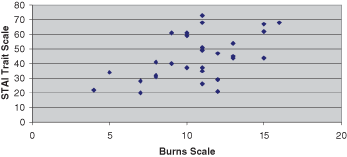
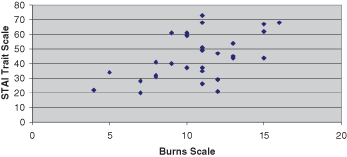
Burns Irritability Scale scores were positively associated with patients' STAI – trait anxiety scale scores (Spearman ρ = 0.47, p = 0.006) (Fig. 1), with patients' IDA outward irritability scale scores (Spearman ρ = 0.49, p = 0.006), and with IDA inward irritability scale scores (Spearman ρ = 0.80, p = 0.011) and also with patients' IDA scale scores (Spearman ρ = 0.41, p = 0.026).
Relationship between scores on Burns Irritability Scale and Trait Anxiety Scale.
Discussion
The study shows that irritability in HD has a significant association with anxiety and depression. This is consistent with a previous study (Reference Litvan, Paulsen, Mega and Cummings15) which showed correlation between NPI domains of irritability anxiety and depression in HD subjects. However, there was variation in the level and significance of association based on the nature of irritability (self-rated or carer-rated), type of anxiety (state or trait) and depression. The depression scores on MADRS were significantly correlated with the irritability scores on the self-rating scales (IDA-inward and IDA-outward) but not with the observer (carer)-rated irritability scale (Burns Scale). This may suggest either a role of depressed subjects' negative cognitive bias making them more prone to rate themselves overly irritable or bias of carers who may not recognise irritability as a problem in patients of HD who have depression. Given that with in the two self-rating scales the inward irritability scale showed more correlation with MADRS, it is also possible that irritability in depressed subjects is more self-directed and perhaps less apparent to the carers reducing chances of both the above biases.
Self-rated scales as well as the carer-rated scales of irritability used in the study showed statistically significant positive correlations with the trait anxiety scale. This appears to be the main new finding of this study. The carer-rated irritability scale (Burns Scale) did not show any significant correlation with state anxiety scale. It is also interesting to note that though the IDA outward and inward irritability scales measure the irritability in the preceding 48 h and the Burns Scale is an assessment of irritability since the onset of the symptoms HD, both scales showed significant correlation with STAI trait anxiety scale. From the results it is clear that it is the trait anxiety, which is much more consistently related to irritability than any other variables hypothesised in the study. On the basis of these results it can be hypothesised that the patients with HD who have underlying anxiety proneness are predisposed to irritability. Reasons for this association are unclear and it remains to be seen whether such association is specific to HD population or is a more general association between the state anxiety and irritability.
Contrary to our hypothesis, there was no significant association between irritability and dysexecutive syndrome. This appears counterintuitive given that one of the reasons for irritability in basal ganglia disorders (like HD) is considered to be the development of rigidity of thinking (Reference Rosenblatt and Leroi22). This may cause patients to perseverate relentlessly on a particular desire or idea, resulting in outbursts when perceived needs were not met. Moreover, it is also considered that, as a patient's cognitive function declines progressively in HD he/she may find it difficult to perform the functions they used perform, leading to frustration, which may be expressed as irritability. However, interestingly, finding of this study is consistent with couple of other studies reporting no correlation between irritability in HD with global cognitive functions (Reference Paulsen, Ready, Hamilton, Mega and Cummings4,Reference Thompson, Snowden, Craufurd and Neary23). This suggests that irritability is not just a function of frustration or psychological reaction to executive dysfunction. The underlying pathophysiology of irritability may also involve pathways independent to ones involved in cognitive processing.
There was a negative correlation between the scores on all the irritability scales and the motor impairment scale of UHDRS, which means if a patient had more motor impairment he was less likely to be irritable or vice versa. A previous study (Reference Thompson, Snowden, Craufurd and Neary23) found no correlation between the score on the irritability scale (Problem Behaviours Assessment for Huntington's Disease (PBA–HD) Irritability subscale) and the scores on UHDRS (motor impairment). A negative correlation between irritability and chorea as measured by UHDRS was found (Reference Paulsen, Ready, Hamilton, Mega and Cummings4). Hence this finding is consistent with the existing literature. There appears to be no straightforward explanation for this negative correlation. From a closer look at the scores it is apparent that the majority of patients in the sample do not suffer from severe motor impairment. This will exclude the possibility for an argument that the patients in the sample may be suffering from so severe a physical impairment or bed ridden that they may express no irritable feelings. Hence, irritability may be an independent neuropsychiatric manifestation of HD very much like psychosis or cognitive decline; independent of motor manifestations.
The strong association of irritability with trait anxiety and to some extent with state anxiety and depression may suggest that irritability is related to with the behavioural and affective symptoms (which by nature are fluctuating and non-progressive) rather than the progressive symptoms cognitive and motor symptoms of HD. Therefore, it can be hypothesised that irritability is not linearly related to the disease progression and hence cannot be considered as a predictor of disease progression in HD. The absence of a correlation with cognitive impairment and motor symptoms should not be interpreted as evidence that depression and irritability are unrelated to the underlying organic processes of HD.
The study has a few limitations. It is a cross-sectional study without a control group which limits the conclusions that can be drawn regarding the relationship between irritability and trait anxiety. It remains unclear whether such correlation is specific to HD. The sample consisted of patients willing to cooperate, able to give informed consent and those with reasonable cognitive abilities to be able to fill in the questionnaires and to undertake the assessment. Therefore, patients at the severe end of the spectrum of the disease were essentially excluded from the study. It can also be assumed that the patients who cooperated with the study were usually those who were less irritable. However given the rare nature of the disease and the consent issues it was practically difficult to recruit patients in to this study on a totally random basis. The patients in this study were at different stages in the course of the disease and the duration of their illness was varied.
It is likely that the study results may have been influenced by these factors. However the focus of this study was not to establish prevalence of irritability in patients with HD, but on the correlations and comparisons of irritability with other predominant symptoms within the patients with HD. However, on a positive note, the study was not restricted to a highly selective population such as psychiatric hospital inpatients or patients referred for a psychiatric assessment consisted of patient attending regional HD service from a varied background.
Conclusions
The main new finding of this study is the apparent association between trait anxiety and irritability, which to our knowledge has not yet been reported. This needs further replication in larger and more methodological robust studies with a control group. If these findings can be replicated and enough evidence accumulates in that direction, premorbid trait anxiety can serve as a predictor for irritability in HD. Replication of no correlation between irritability and cognitive or motor manifestations of HD, despite its counterintuitive feel, indicates that irritability is relatively independent of cognitive and motor aspects of the disease and possibly disease severity or progression.