Introduction
Cerceris fumipennis Say (Hymenoptera: Crabronidae), the only species of buprestid-hunting Crabronidae in eastern North America, occurs throughout the continental United States of America east of the Rockies as well as southern Ontario and Québec, Canada. Nesting in open areas with hard-packed sandy soil, this solitary wasp provisions its subterranean nest almost exclusively with adult metallic wood-boring beetles (Coleoptera: Buprestidae). Marshall et al. (Reference Marshall, Paiero and Buck2005) suggested that “…nest sites of C. fumipennis could be used as efficient sampling stations for species of Agrilus Curtis in eastern North America, probably including the pest species Agrilus planipennis”. This method of using a predatory species to survey for cryptic target taxa (native or invasive) has since been termed “biological surveillance” or “biosurveillance” (Careless et al. Reference Careless, Marshall, Gill, Appleton, Favrin and Kimoto2009; Rutledge et al. Reference Rutledge, Hellman, Teerling and Fierke2011; Nalepa et al. Reference Nalepa, Teerling, Rutledge, Swink and Arellano2012; Swink et al. Reference Swink, Paiero and Nalepa2012; Rutledge et al. Reference Rutledge, Fierke, Careless and Worthley2013).
Effective and efficient surveillance tools for Buprestidae are needed in North America because of threats to forest health posed by A. planipennis Fairmaire (the emerald ash borer or “EAB”) (Poland and McCullough Reference Poland and McCullough2006; Marshall et al. Reference Marshall, Storer, Fraser and Mastro2010), Agrilus auroguttatus Shaeffer (Lopez and Hoddle Reference Lopez and Hoddle2011), Agrilus sulcicollis Lacordaire (Jendek and Grebennikov Reference Jendek and Grebennikov2009), Agrilus prionurus Chevrolat (Wellso and Jackman Reference Wellso and Jackman2006) as well as species with potential for future invasion such as Agrilus biguttatus (Fabricius) (Kimoto and Duthie-Holt Reference Kimoto and Duthie-Holt2006), Agrilus viridis (Linnaeus) (Corte et al. Reference Corte, Moraglio and Tavella2009), Phaenops cyanea (Fabricius) (Wermelinger et al. Reference Wermelinger, Rigling, Schneider Mathis and Dobbertin2008), Melanophila picta (Pallas), and Poecilonota variolosa (Paykull) (Kezheng Reference Kezheng1996). With well over half a million km2 of quarantine zones stretching across 15 states and two provinces, infestations of the destructive EAB continue to spread (United States Department of Agriculture 2013). Originally from eastern Asia, EAB was first detected in North America in 2002. Since its discovery near Detroit, Michigan, United States of America, the beetle has spread across the eastern United States of America and southern Canada (United States Department of Agriculture 2013) with increasingly devastating impact on the health of eastern North America's native ash (Fraxinus Linnaeus (Oleaceae) species) trees. Infestations of this beetle ultimately lead to the death of the host tree, so that in large parts of southwestern Ontario, Canada and southern Michigan, United States of America, the once-dominant mature ash trees are all but gone (Lyons et al. Reference Lyons, Caister, de Groot, Hamilton, Marchant and Scarr2007; Anulewicz et al. Reference Anulewicz, McCullough, Cappaert and Poland2008; Marshall et al. Reference Marshall, Storer, Fraser and Mastro2010). After the decline of native elms, ash species (particularly green ash, Fraxinus pennsylvanica Marshall) have become the dominant trees planted in our urban environments (Lyons et al. Reference Lyons, Caister, de Groot, Hamilton, Marchant and Scarr2007). Thus, EAB also has a significant effect on urban canopies resulting in costly removal of hazardous trees. Ash trees in the urban and rural forests of the United States of America are valued at $282 billion (United States Department of Agriculture-Forest Service 2009).
Successful management requires effective early detection tools because once trees show signs of dieback the infestation is often well established and there is little that can be done to control the pest (Marchant Reference Marchant2007). Early infestations of EAB are difficult to detect because the adult beetles are often active high in the canopy and larvae feed (and pupate) below the bark (Cappaert et al. Reference Cappaert, McCullough, Poland and Siegert2005; Lyons et al. Reference Lyons, Caister, de Groot, Hamilton, Marchant and Scarr2007; United States Department of Agriculture-Animal and Plant Health Inspection Service 2011). Although a variety of detection methods are currently employed and pheromone-baited sticky traps have improved considerably since 2002 (Crook and Mastro Reference Crook and Mastro2010; Ryall et al. Reference Ryall, Silk, Mayo, Crook, Khrimian and Cossé2012), each survey method has limitations (Marshall et al. Reference Marshall, Paiero and Buck2005; Marshall et al. Reference Marshall, Storer, Fraser and Mastro2010; Ryall et al. Reference Ryall, Fidgen and Turgeon2011). “Biological surveillance” with C. fumipennis is a potentially useful addition to this arsenal of detection techniques.
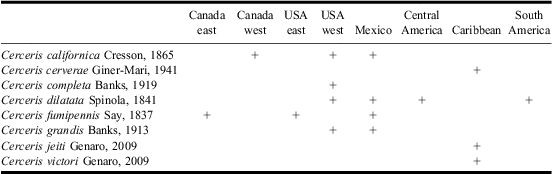
Cerceris fumipennis is the only one of the eight New World buprestid-hunting Cerceris Latreille species found in eastern North America (east of the Rocky Mountains). The remaining seven are found west of the Rockies (southern British Columbia, Canada to California, United States of America), the Caribbean, and from Texas, United States of America south to northern South America (Table 1). While these species are not as well known as C. fumipennis, each appears to have similar nesting and foraging behaviour and might serve as biosurveillance tools within their respective regions (Scullen Reference Scullen1965, Krombein Reference Krombein1979).
Distribution of Cerceris fumipennis and other buprestid-hunting Cerceris (“Group II Cerceris”) in the New World (Scullen Reference Scullen1965; Scullen and Wold Reference Scullen and Wold1969; Evans Reference Evans1971; Scullen Reference Scullen1972; Ferguson Reference Ferguson1983; Amarante Reference Amarante2002; Buck Reference Buck2004; Genaro Reference Genaro2009).

We here provide an assessment of the potential of C. fumipennis as a buprestid-monitoring tool, based on the following three biological attributes: (i) accessibility – is the wasp geographically, physically, temporally, and behaviorally accessible? (ii) Productivity – does the wasp rapidly collect an adequate diversity of prey, including scarce taxa? (iii) Sustainability – can C. fumipennis tolerate use by human monitors? All of these attributes are required if this wasp is to be a practical biosurveillance tool.
Methods
Assessment of accessibility
Accessibility of C. fumipennis as a monitoring tool depends upon when, (seasonally) the wasp is active, where (in terms both of species distribution and the occurrence of local populations) it is found in usable numbers, and how many colonies and nests are available at each site. These factors were assessed through records of sightings, recent observations of activity, and a search for suitable patches of habitat.
Assessment of productivity
In order for C. fumipennis to serve as a useful buprestid-monitoring tool it must provision its nest with the target species at a rate that matches or exceeds the rate at which the target could be collected by other means, such as hand collecting.
To quantify the wasp's productivity, nine observers with a combined total of 231 field days (2006–2009), observed the wasp's daily behaviour at C. fumipennis colonies in Florida, United States of America (three colonies), Maryland, United States of America (one colony) and Ontario, Canada (four colonies). Each colony was monitored for duration of foraging flights (n = 134 wasps), the rate of beetle (prey) capture (n = 134 wasps), and prey species composition (n > 3500 prey buprestid specimens inspected). Observations were made between 9 AM–6 PM on “fair-weather-days” (i.e., days with less than two hours of rainfall; wasps are not active when it is raining).
We also estimated the foraging radius of the species (the maximum distance a wasp will travel from the nest to collect buprestid prey) using mark/recapture (n = 24 wasps). Twenty-four nest-provisioning wasps were collected from a Florida colony at 11 AM, then relocated and simultaneously released at 1, 2, and 3 km from the colony. Eight wasps were released from each site and all subsequent incidences of wasps successfully returning to their nests were monitored until sundown. Female wasps typically spend the nights in their burrows so it was assumed that if a wasp did not return to the burrow before sundown it had been released beyond its natural foraging radius.
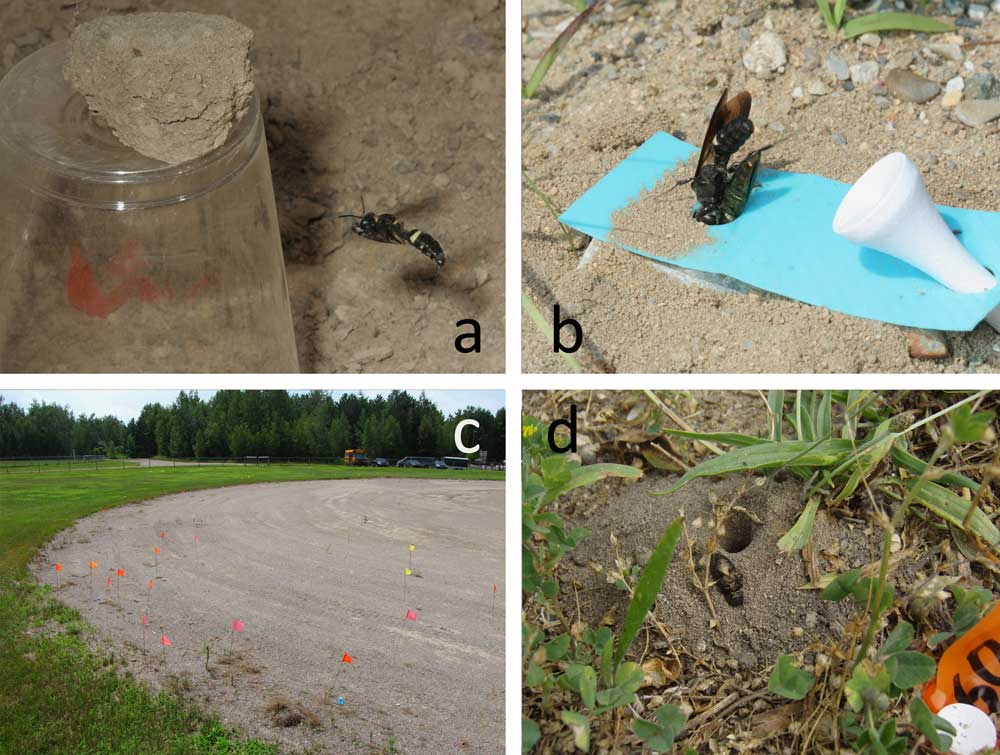
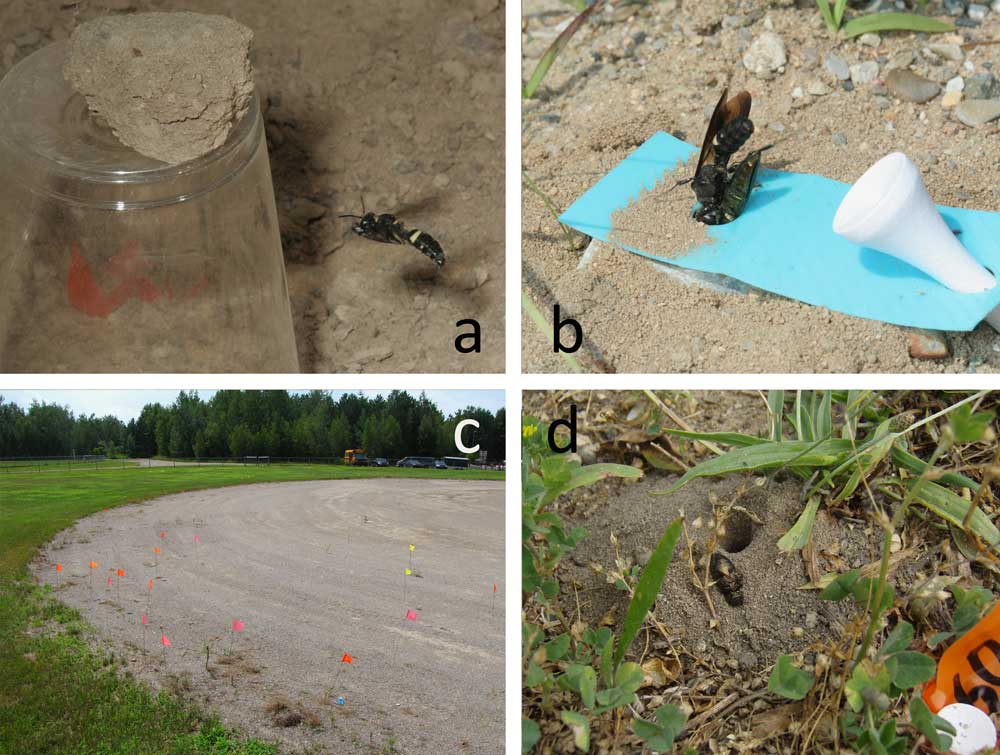
To quantify productivity and to assess the wasp's sustainability as a buprestid-monitoring tool, prey-laden wasps were intercepted and actively “robbed” of their prey. One way of doing this was to place a clear plastic cup over each nest entrance to control the flow of beetles into the nest, allowing a human monitor to observe wasps attempting to exit or enter the nest. Returning C. fumipennis females are typically blocked by the cup long enough to determine if they are carrying EAB or other buprestid species (Fig. 1A). Gently tipping the cup to one side allows the female wasp to then enter or exit her nest.
(A) The nest of this female Cerceris fumipennis has been covered with a clear plastic cup. This delays the wasp's entrance into its nest and gives an observer time to identify the species of beetle carried by the wasp. (B) This female Cerceris fumipennis returning with prey (Agrilus planipennis) is unable to pass through the collar's hole to her nest. Once a human observer has identified the prey the collar is shifted to one side and the wasp is allowed to enter with her prey. (C) This low-maintenance ball diamond in Cowansville, Québec, Canada supported a colony of nearly 70 Cerceris fumipennis nests in July 2010. While not always located at ball-diamonds, each known C. fumipennis colony is similarly exposed to direct sunlight, has compacted sandy soil, and is barren or sparely vegetated. Photo by Matt Ireland. (D) A typical Cerceris fumipennis nest entrance with old tumulus (excavated soil) around the opening – see golf tee in lower left for relative scale. A dropped specimen of A. acornis (Say) lies abandoned on the tumulus. The quantity of vegetation around the nest entrance can vary; many “ball-diamond colonies” having no vegetation.
Clear plastic cups are widely employed by researchers who work with solitary wasps and the cups are considered to have no significant effect on the wasps’ provisioning behaviour (Evans and Hook Reference Evans and Hook1982; Hook Reference Hook1987; McCorquodale Reference McCorquodale1989; Alexander and Asis Reference Alexander and Asis1997). The metallic green EAB adults are so distinctive they can be quickly identified while still in the grasp of a C. fumipennis hovering beside a cup. Use of plastic cups requires constant attention because a returning wasp with prey will hover only briefly before attempting to dig under the cup. Of greater concern is the delayed release of a wasp exiting its nest. On sunny days, the air temperature inside the cup can become lethal to the female wasp; instead of retreating back down its burrow the confused wasp, left under the cup for more than a minute, overheats and dies. This can be ameliorated by ventilating the cup's top with screening, but it remains a serious drawback to the use of plastic cups.
An alternative to the plastic cup is a collar (tab with a small hole) placed over the nest entrance (Fig. 1B). These “nest collars” are easily made by cutting plastic (placemat) or cardboard (file-card) into 2 cm × 4 cm rectangle tabs, then using a standard hole-punch to make a hole at either end of the tab. The tab (nest collar) is held in place over the nest entrance with a golf tee, or small stone if the ground is too hard. The collar's “hole” diameter is large enough to allow wasps without prey to move through (in and out of the nest) uninterrupted, but small enough to prevent passage of both wasp and prey. Arriving prey-laden female wasps buzz and claw at the collar's opening, advertising the presence of a paralysed beetle that can be visually identified before the collar is moved to one side to allow the wasp to pass with her prey into the nest. Once the female wasp has entered her nest, the collar is repositioned over the nest entrance.
These nest collars avoid the overheating hazards associated with cups and each collar requires one quarter of the maintenance and attention of a cup (they only have to be tended when wasps return with prey). Nest collars are a viable alternative to the cup, but have two drawbacks. First, the collars allow wasps to exit the nest unnoticed by a human observer. This is an issue if the observer is attempting to calculate the duration of a foraging flight since such calculations require the observer to know what time a wasp left its nest. Second, wasps carrying very small Agrilus can pass through the collar unimpeded. These two drawbacks are minor in comparison to the risk of overheating presented by the cup.
The current preferred method when using the collar is to place the hole slightly askew over the burrow entrance thus temporarily delaying even wasps with small prey. This collar technique is used until such time as EAB is detected. Once the nest has been provisioned with an EAB, the nest can be cupped and the wasp's flight activity monitored more closely.
Assessment of sustainability
To be useful as a monitoring tool, C. fumipennis must tolerate some level of interference and prey inspection. Nest excavation (to examine the buprestid prey that has been collected by a wasp) is an unsustainable monitoring method because it results in destruction of the solitary wasp nest and failure of all brood cells (Evans Reference Evans1971; Kurczewski and Miller Reference Kurczewski and Miller1984; Fabre Reference Fabre2001). Though identification of prey as it is being carried into the nest is also problematic. To avoid kleptoparasites, particularly miltogrammine flies (Diptera: Sarcophagidae) that are attempting to oviposit or larviposit on the beetle prey, the wasps enter their nests quickly and make it difficult to reliably identify beetle prey to species. Using a nest cup or collar can temporarily delay beetle-laden wasps but often the prey-laden wasp needs to be caught and its prey inspected by hand. Unfortunately, this level of harassment (catch and removal of prey) might negatively influence the wasp's subsequent foraging behaviour and her nest fidelity.
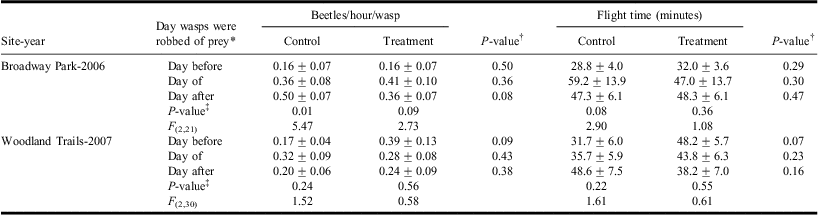
The most involved form of prey inspection requires the human observer to catch the female wasp as it returns to its burrow, deprive it of its buprestid prey and release it physically unharmed to continue to forage and provision its nest. To assess the sustainability of this sort of interference, two treatment groups of female C. fumipennis were regularly deprived of prey (robbed) as they returned to their nests and compared with control groups at the same colonies. This comparison was repeated twice at two distinct colonies: the Broadway Park Colony, Windsor, Ontario, Canada, 18–20 July 2006 and the Woodland Trails Colony, Campbellville Ontario, Canada, 31 July–2 August 2007. The duration of foraging flight (minutes) and rate of capture (beetles/hour) were compared between the treatment and control groups. Wasps in both the treatment and control groups were monitored for a full day prior to the day of treatment (day 1), and a full day subsequent to treatment (day 3).
Statistical analysis
The variation in wasp foraging rates and flight times among observation days was tested using separate one-way analyses of variances (ANOVAs) for each site and group of wasps, i.e., treatment and control. Mean foraging rate and flight times were compared between treatment and control groups for each site and day of observation using separate t-tests. The t-tests and one-way ANOVAs, were performed using the data package in Microsoft Office Excel 2003, Redmond, Washington, United States of America. We assigned a statistical significance of P < 0.05 to each test. Standard errors are reported for all means.
Results and discussion
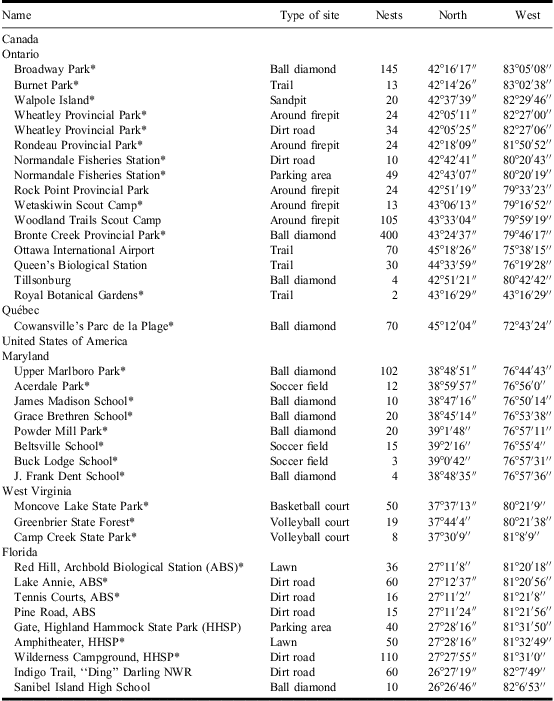
Using the protocols described above, the practicality of using C. fumipennis as a monitoring tool was assessed through observations made between 2006 and 2010 at the following 37 colonies in eastern North America (Table 2). Each of the criteria – accessibility, productivity, and sustainability – is addressed in the subsections below.
Cerceris fumipennis colonies monitored during 2006–2010.

*Indicates that a colony's soil particle composition and moisture content was quantified (see Results subheading – Physical accessibility).
Accessibility
Geographical accessibility
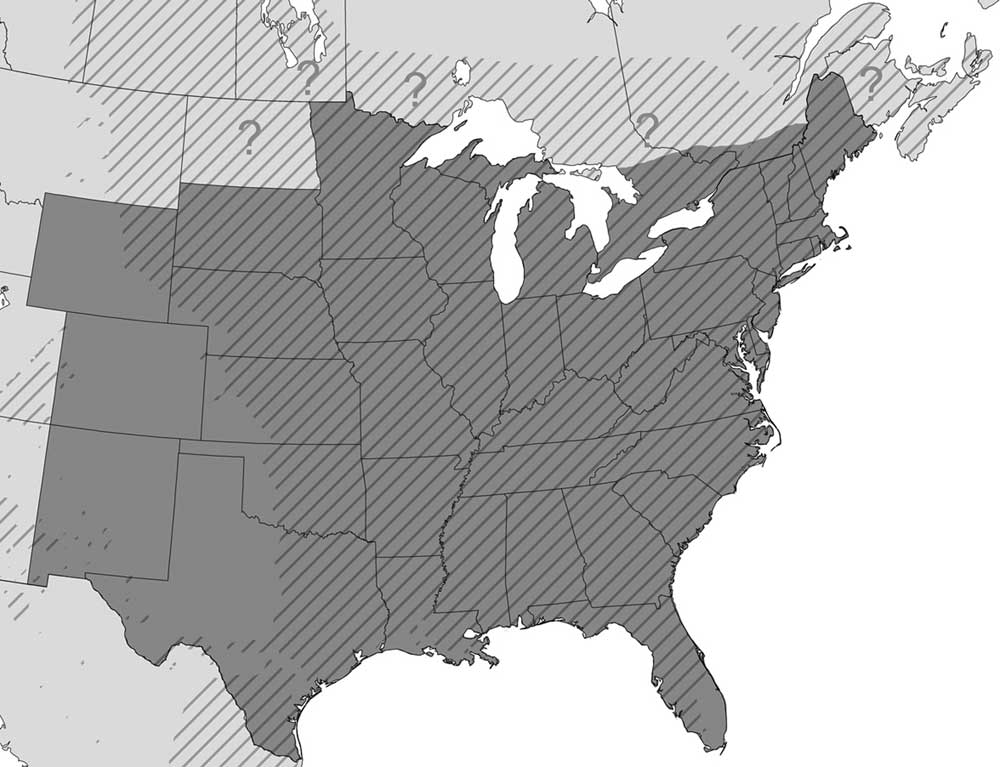
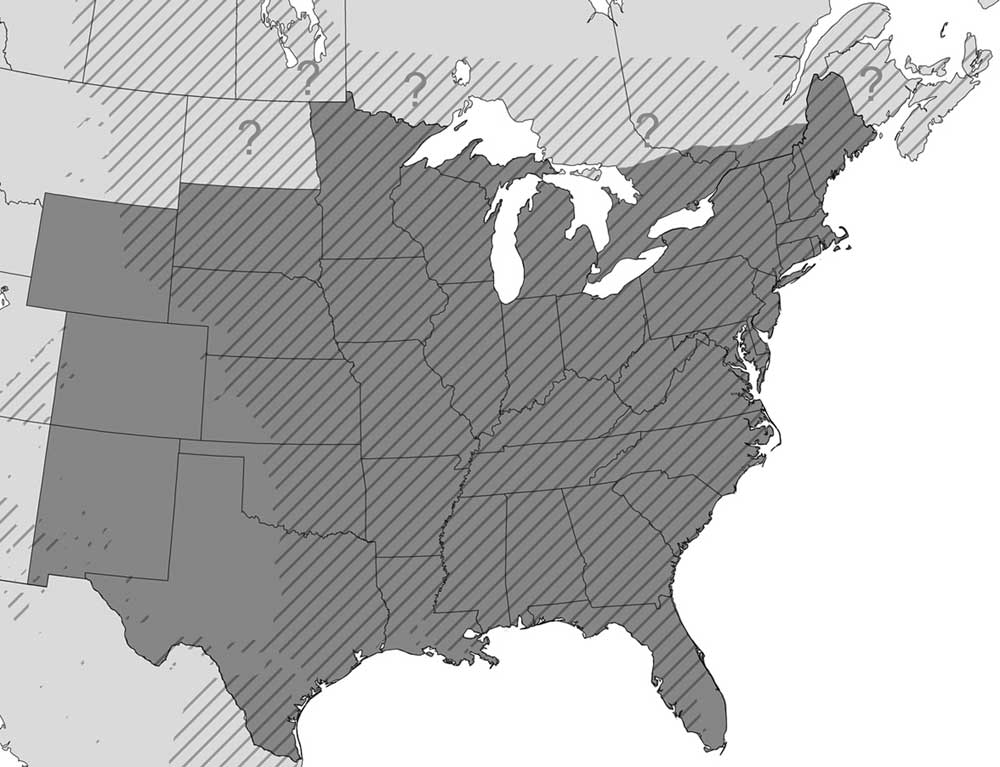
The wasp's northern limits remain uncertain but it seems likely that it occurs in Canada's Maritime Provinces (it is common in southern Maine, United States of America). It may also be in southern Manitoba, Canada as a wasp was collected in Kittson County, Minnesota, United States of America near the Manitoba border in August 1939 (specimen in the University of Minnesota Insect Collection, St. Paul, Minnesota). Cerceris fumipennis is also known from a single British Columbia, Canada record near Lytton (Scullen Reference Scullen1965) (specimen in the Kansas Natural History Museum, Lawrence, Kansas), but this species is otherwise unknown from western North America – Cerceris californica Cresson is the counterpart of C. fumipennis in western Canada. The broad distribution of C. fumipennis (Fig. 2) renders it geographically available to monitor Buprestidae in North America's eastern forest south of the boreal forest (eastern United States of America and southern Ontario and Québec, Canada).
The known distribution of Cerceris fumipennis is marked in green. Question marks indicate areas where the species is expected but not yet recorded. See www.cerceris.info/pdflist.html for a list of pre-2006 specimen records (Scullen Reference Scullen1965; Evans Reference Evans1971; Buck Reference Buck2004; Careless et al. Reference Careless, Marshall, Gill, Appleton, Favrin and Kimoto2009; Careless Reference Careless2010; Rutledge et al. Reference Rutledge, Hellman, Teerling and Fierke2011). Hatching indicates distribution of the six Fraxinus species found in eastern North America. Fraxinus is the only known host of Agrilus planipennis (emerald ash borer, EAB) in North America.
Physical accessibility
Cerceris fumipennis nests in loose “colonies” (aggregations of independent burrows) of 2–500 nests located in open areas of hard-packed sandy soils and sparse herbaceous vegetation (Cartwright Reference Cartwright1931; Evans Reference Evans1971; Kurczewski and Miller Reference Kurczewski and Miller1984). These colonies are found at sun-baked, human-disturbed sites such as old baseball diamonds, trampled earth around campground fire pits, parking areas, and well-worn trails in close proximity to wooded habitat suitable for buprestid beetles (Fig. 1C) (Grossbeck Reference Grossbeck1912; Rau Reference Rau1922; Evans Reference Evans1971; Evans and Rubink Reference Evans and Rubink1978; Kurczewski and Miller Reference Kurczewski and Miller1984; Hook and Evans Reference Hook and Evans1991; Mueller et al. Reference Mueller, Warneke, Grafe and Ode1992; Buck Reference Buck2004; Marshall et al. Reference Marshall, Paiero and Buck2005; Nalepa et al. Reference Nalepa, Teerling, Rutledge, Swink and Arellano2012). Evans (Reference Evans1971) describes the preferred soil types for Cerceris colonies as: “fine-grained sand, friable sand, or hard-packed sandy clay or gravel…”. Soil particle analysis, using a hydrometer and the methodology outlined in Globe (2005) at 28 sites in eastern North America (Table 2), identified the soils of the colonies as 78% (±2%) sand, 8% (±1%) clay, 14% (±1%) silt. Average flight season soil moisture content (a minimum of two days after a rainfall of >3 mm) was 8.9% (± 0.3%) water.
In addition to the conspicuous abiotic characteristics, C. fumipennis nesting sites are often shared by a variety of Crabronidae, Sphecidae, and Anthophila bees, many of which are more abundant or conspicuous than Cerceris. These ground-nesting Hymenoptera can be helpful in guiding researchers to potential C. fumipennis colonies. For example, C. fumipennis nests in the colony described by Cartwright (Reference Cartwright1931) were outnumbered by nests of two other crabronid species, Stictia carolina (Fabricius) and Bicyrtes quadrifasciata (Say). Evans (Reference Evans1971) found C. fumipennis on an Indiana, United States of America baseball diamond while he was studying Bembix nubilipennis Cresson, and he found a C. fumipennis colony at Highland Hammock State Park, Florida while he worked with S. carolina and Bembix texana Cresson. Bembix Fabricius, Astata Latreille, and Philanthus Fabricius species often nest among C. fumipennis (Evans Reference Evans1971; Careless Reference Careless2009b). The burrow entrances of most ground nesting Hymenoptera species are unique (O'Neill Reference O'Neill2001), so once a site is found, C. fumipennis nests can be distinguished from other taxa.
Each female C. fumipennis excavates and maintains a subterranean nest with a main tunnel up to 22 cm deep. She then digs a side tunnel off the bottom of the main tunnel and serially provisions the end (a brood cell) with paralysed beetles (Evans Reference Evans1971; Hook and Evans Reference Hook and Evans1991). Once the brood cell is provisioned, a single egg is laid, the cell is sealed off, and the access tunnel is backfilled. The wasp then excavates in another direction, off the same main tunnel, using the nest like this for weeks or months as she provisions multiple brood cells. These active nests typically have a small circular mound of earth (tumulus 2–6 cm in circumference and 1–2 cm high, Fig. 1D) surrounding the visible entrance to the burrow (a main tunnel, running perpendicular to the soil surface). Burrow diameter varies between 0.4 and 0.7 cm, seemingly correlated with variation in wasp body size but often appearing to be just large enough to accommodate a pencil. Unlike some species of digger wasps (Bembix or Ammophila Kirby), which habitually close and conceal the nest entrance when away foraging for prey, C. fumipennis leave the burrow open and make no effort to disperse the tumulus or obscure its entrance. Nests of C. fumipennis are thus readily recognisable.
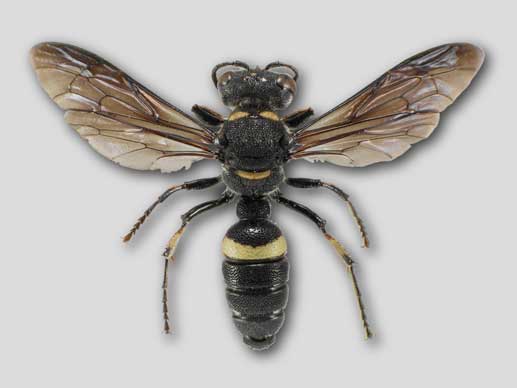
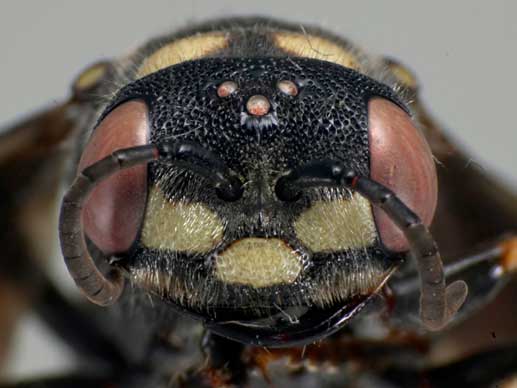
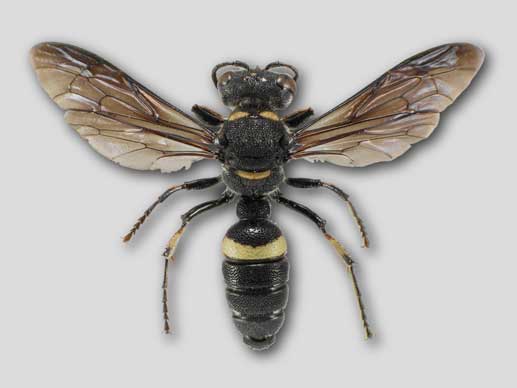
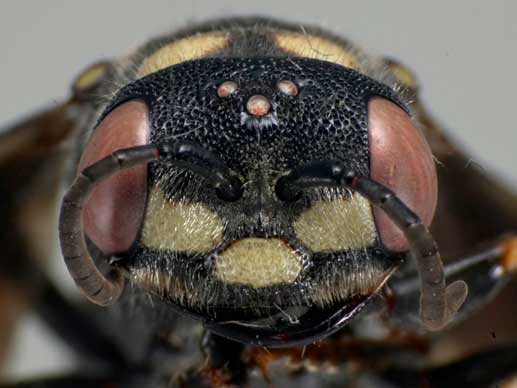
These unique characters (ground nesting in sandy soil, in close proximity to humans, association with other crabronids, and conspicuous burrow entrances) when combined with the female wasp's distinctive physical appearance (Figs. 3, 4), help make it practical to recognise and repeatedly locate perennial wasp colonies and inspect prey. Guidelines for finding new C. fumipennis colonies are outlined in Careless et al. (Reference Careless, Marshall, Gill, Appleton, Favrin and Kimoto2009); also see Nalepa et al. (Reference Nalepa, Teerling, Rutledge, Swink and Arellano2012) and Carrier and Jackson (Reference Carrier and Jackson2012).
Conspicuous field marks of a female Cerceris fumipennis: predominantly black with a single yellow/cream-coloured band across the abdomen, smoky blue/brown wings and a somewhat inflated abdomen.
Conspicuous facial markings of a female Cerceris fumipennis: black with a chevron of three large yellow/cream-coloured rectangles across the frons (area between the eye and below the antenna). The eyes and ocelli of a live specimen are black. No other eastern North American wasp has these facial markings.
Temporal accessibility
Adult wasps emerge across most of the northeastern range during the same short period in late June or early July, with newly emerged female wasps immediately excavating new nests and beginning to forage soon thereafter. Among these populations, the cessation of foraging and nest provisioning occurs five or six weeks after emergence – though cool weather may prolong the season and extreme hot and dry weather may curtail the season (Byers Reference Byers1978; Willmer Reference Willmer1985). The wasps remain active, flying to and from the nests, for a subsequent one to two weeks. Ants, spiders, birds, raccoons, and humans have all been observed killing/preying-upon adult C. fumipennis, but those wasps that do not succumb to predation will ultimately backfill their nest and then die of exposure as they guard the depressions that mark the former nest entrances.
The duration of flight season (five to eight weeks) is similar across the distribution of the species but populations living further south in the United States of America emerge earlier in the year: late March in southern Florida (Mueller et al. Reference Mueller, Warneke, Grafe and Ode1992), early May in Texas (Hook and Evans Reference Hook and Evans1991), mid-May in coastal North Carolina (Nalepa Reference Nalepa2010; Nalepa and Swink Reference Nalepa and Swink2011a), mid-June in Maryland (Careless Reference Careless2009a), and starting in late June or early July in Ontario, Canada (Careless Reference Careless2009b). The south Florida population is considered bivoltine, as may be some of the C. fumipennis populations in other Gulf Coast States (Evans Reference Evans1971; Mueller et al. Reference Mueller, Warneke, Grafe and Ode1992).
The flight season of EAB in eastern North America begins approximately one month prior to that of C. fumipennis, with each region's peak beetle emergence (United States Department of Agriculture-Animal and Plant Health Inspection Service 2011) occurring one to two weeks before the wasps commence foraging. Naturally established populations of wasps are not available at the start of EAB's flight season but the two species do overlap for the first month of the wasp's foraging period.
Behavioural accessibility
Unlike social wasps, crabronid wasps rarely use their sting to attack humans in defense of their nests. Some species (Bembix species, for example) will sting when handled but C. fumipennis shows no inclination to sting even when handled roughly. The wasps will bite with their mandibles, vibrate, and push with their pygidial plate but of the >150 volunteers and researchers who have handled the wasps (over the last six years), at hundreds of colonies across eastern North America, we know of no instance of someone being stung by C. fumipennis. This species is apparently safe to handle, even by “citizen scientists” (volunteers) assisting with biosurveillance as part of the Waspwatcher Program (Rutledge et al. Reference Rutledge, Fierke, Careless and Worthley2013).
Productivity
Prey diversity
The study of this wasp as a biosurveillance tool emerged from an initial interest in using C. fumipennis to assist with a general insect survey of Rondeau Provincial Park, Ontario, Canada (Marshall et al. Reference Marshall, Paiero and Buck2005). Many authors have commented on the great diversity of Buprestidae taken by C. fumipennis and prior to 2006, C. fumipennis was known to provision its nests with 70 recognised species of Buprestidae as well as periodically preying upon Neochlamisus bebbianae Brown (Coleoptera: Chrysomelidae) (Scullen Reference Scullen1965; Kirk Reference Kirk1970; Evans Reference Evans1971; Krombein Reference Krombein1979; Kurczewski and Miller Reference Kurczewski and Miller1984; Hook and Evans Reference Hook and Evans1991; Mueller et al. Reference Mueller, Warneke, Grafe and Ode1992).
Since 2006, 31 further species of buprestid prey have been recorded, including two introduced species, EAB and Chrysobothris tranquebarica (Gmelin), an Australian species detected in southern Florida (Paiero et al. Reference Paiero, Jackson, Jewiss-Gaines, Kimoto, Gill and Marshall2012). Rutledge et al. (Reference Rutledge, Hellman, Teerling and Fierke2011) also provided records of an additional five species of non-Buprestidae taken as prey (not including the previously known N. bebbianae). This brings the total diversity of beetles predated by C. fumipennis to 107 species – the highest diversity of prey for any North American Crabronidae (101 species of Buprestidae, three species of Chrysomelidae, two species of Cerambycidae, and one species of Scarabaeidae).
We have observed C. fumipennis to provision its nests with large numbers of EAB. At times these invasive species comprise the majority of buprestid prey collected by a colony. In 2007, a single wasp spent 10 days provisioning her nest (Windsor, Ontario, Canada) with a total of 22 Buprestidae – 19 of which were EAB. Similarly in July 2009, wasps, from three mobile C. fumipennis nests in Norfolk County, Ontario, collected 66 EAB in two days; collecting no other species of Buprestidae during that period. Brood cells excavated at Windsor and Walpole Island colonies (Ontario) each contained between five and seven EAB. In addition, individual C. fumipennis previously unfamiliar with EAB will recognise and promptly provision with EAB when they are encountered. For example, in 2008, wasps from the EAB-free Bronte Creek Provincial Park (Ontario) were transplanted (via mobile nest) to an area adjacent to a known EAB infestation (in Toronto, Ontario). Within four hours of arriving on site these transplanted wasps began provisioning their nests with EAB (Careless Reference Careless2008; Careless Reference Careless2009b). In 2012, as part of the Waspwatcher Program, monitored C. fumipennis colonies provided the first records of EAB for Connecticut, United States of America (Rutledge et al. Reference Rutledge, Fierke, Careless and Worthley2013).
Rate of capture
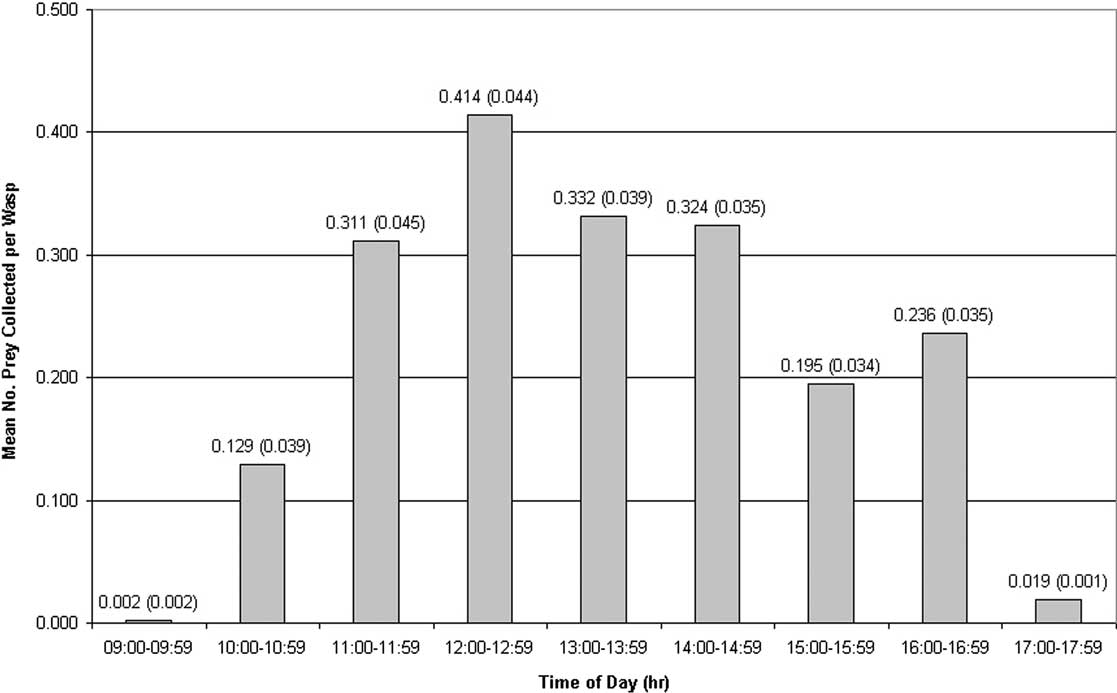
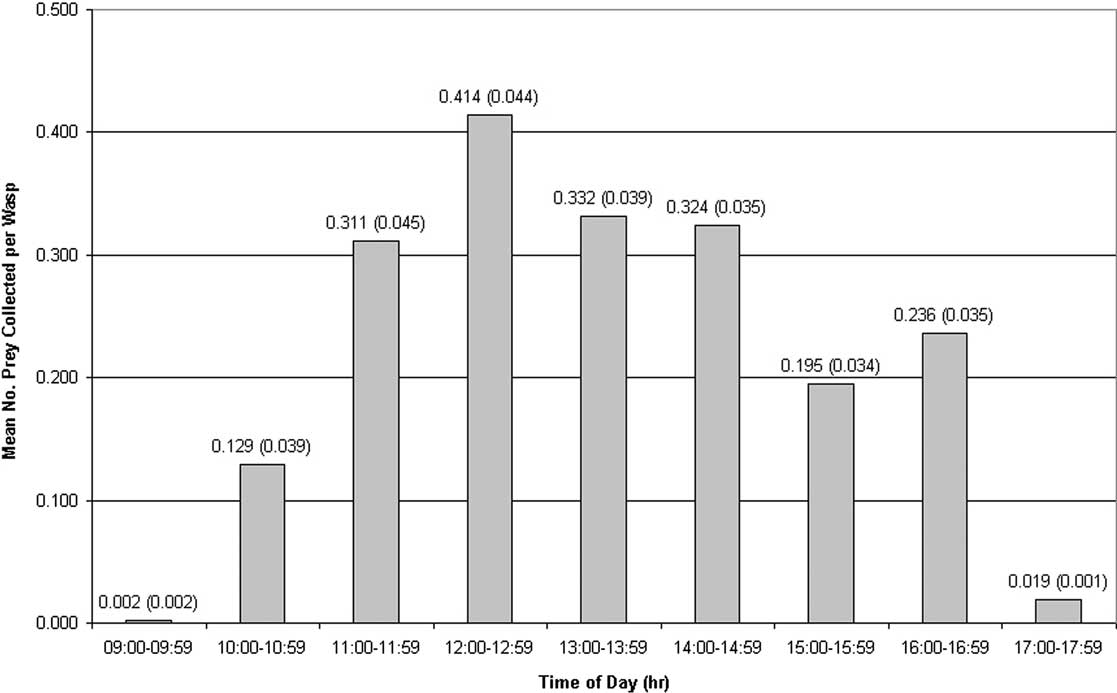
Most successful foraging flights were completed between 11:00 AM and 5:00 PM (Fig. 5). Thus, optimal biosurveillance at a C. fumipennis colony would require the human observer to be at the colony during that six-hour window. Individual wasps completed an average of four flights/day (4.21 ± 0.96, n = 51 days), and an average of two flights/day (1.83 ± 0.60, n = 65) result in prey procurement. An average sized colony of 30 nests could collect an average of 55 buprestids per day.
Average number of successful foraging flights (Cerceris fumipennis returning with prey) per hour (±SE) at a medium size colony of 30 nests. This figure depicts a compilation of records from 78 wasps at eight colonies observed from 9 AM–6 PM over 43 days (2006–2009).
Cerceris fumipennis daily foraging success varied both among individuals in a colony and between days at a colony. Individual wasp activity seems to vary based upon the phase of nest construction. Often no beetles are collected on days when the wasp is excavating a new brood cell, but 1–14 beetles may be brought in on days when the wasp is provisioning the completed cell. Foraging activity of an entire Cerceris colony can also be influenced by weather conditions; cool weather or rain will suspend foraging (Byers Reference Byers1978; Willmer Reference Willmer1985; Alexander and Asis Reference Alexander and Asis1997).
Under fair weather conditions the wasps appeared to be more productive for collecting Buprestidae than hand collecting. Samples of ∼50 beetles per site from eight monitored colonies (each with >25 nests) in Ontario, Maryland, and Florida included an average of 11 species of Buprestidae per day (six hours) of sampling. Simultaneously, hand collection of Buprestidae at four of the above eight sites yielded 4–15 specimens, including two to five species, per six hour day. The hand-collected specimens included only species readily found within reach of a human observer where they can be caught using a sweep net, beating sheet or by hand, and are thus mostly species that feed on flowers and shrubs. These results suggest an average-sized wasp colony (30 nests) can sample buprestids more effectively than a human surveyor operating without the aid of the wasps (Careless Reference Careless2009a).
Sensitivity
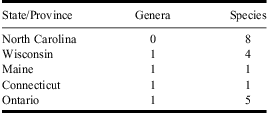
Sampling at C. fumipennis colonies has routinely yielded new state, provincial and national buprestid species records (Nalepa and Swink Reference Nalepa and Swink2011b; Swink et al. Reference Swink, Paiero and Nalepa2012). Monitoring with the wasps for Buprestidae in Ontario since 2004 has added one new Canadian generic record, Actenodes Dejean, and five new Canadian species records, Actenodes acornis (Say), Actenodes simi Fisher, Agrilus granulatus (Say), Agrilus quadriguttatus Gory, and Dicerca asperata (Laporte and Gory) (the Dicerca lepida LeConte reported in Marshall et al. Reference Marshall, Paiero and Buck2005 has since been re-identified as an aberrant D. asperata; D. lepida has not yet been recorded in Canada). These new Canadian records are likely native species that had gone unnoticed in the past due to low population density and/or a tendency to inhabit inaccessible locations in the forest canopy. Cerceris fumipennis has provided similar new state records across the eastern United States of America (Table 3).
New state and provincial records of Buprestidae discovered through monitoring naturally established Cerceris fumipennis colonies.

Given this success in locating low-density populations of native Buprestidae, it is not surprising that C. fumipennis has proven to be an effective tool for detecting EAB. During field trials in 2008 and 2009, mobile colonies of C. fumipennis detected populations of EAB at sites with no visual signs of EAB infestation and on one occasion the wasps detected EAB at a site where the United States Department of Agriculture-issued purple prism traps did not capture EAB (Careless Reference Careless2009b).
Foraging radius
All eight of the marked C. fumipennis released at 1 km returned promptly to their nests. Two of the eight wasps released at the 2 km site returned and none of the eight wasps released 3 km from the colony returned before sundown.
Foraging C. fumipennis females are quick to depart the colony and soon disappear into the forested landscape. Wasps returning with prey appear to approach the nests from downwind, a direction that does not necessarily indicate the foraging location. Once away from the colony the wasps’ route is nearly untraceable, but maximum foraging distance can be estimated by determining the distance at which a released wasp can no longer find its way back to the nest (the “point of no return”). Collett and Collett (Reference Collett and Collett2002) conclude that wasps navigate via the use of landmarks and may travel from one visible landmark to the next (in a zig-zag pattern), as they move across the landscape. So, if a relocated wasp (released by researchers, at a distance from its nest) is unable to make its way back to the nest, then this might suggest the individual was not familiar with any of the landmarks visible from the release site. The lost wasp may not have previously travelled on its own to the release location before, and researchers may have now released it beyond its natural foraging radius. By releasing individual C. fumipennis at set distances from the nest it was possible to identify at what distance the majority of wasps failed to return. This value becomes the “point of no return”. A distance just less than that of this point of no return is then considered the maximum foraging radius of a species. Similar work was done by Fabre (Reference Fabre2001) and Prezoto and Gobbie (Reference Prezoto and Gobbi2005) when estimating the foraging range of Cerceris tuberculata (Villers) and Polistes simillimus Zikan, respectively. So, it appears that effective foraging radius of the Florida colony of C. fumipennis was < 2 km. Further trials are needed to identify a statistically significant average for the species rather than an estimate from just a single colony.
Sustainability
Tolerance to harassment
Robbed wasps flew away from the colony upon their release but returned to their nest about 13 minutes later (13.36 ± 0.66 minutes, n = 42 flights), usually without prey. The wasp then hesitantly re-approached and entered the burrow spending about 13 minutes in the nest (12.51 ± 4.16 minutes, n = 7 flights) before departing on another foray.
The two separate trials in 2006 (n = 16 wasps) and 2007 (n = 22 wasps) also indicated no significant difference between treatment groups and control groups in quantity of beetles collected per hour or the duration of flight times during the day of treatment (t-test; P > 0.05). Variation was high within one of the control groups but there was no significant difference between treatments and control groups. All other groups of wasps showed no significant difference between pre-treatment, treatment, and post-treatment periods in either beetle capture rates or duration of foraging flights (one-way ANOVA; Table 4). Thus, selective prey removal can be repeated time and time again apparently without altering the wasp's provisioning behaviour.
Mean (±SE) foraging rate (beetles captured per hour per wasp) and duration of foraging flights (minutes) of Cerceris fumipennis wasps observed at two different colonies in Canada.

All wasps were observed for three consecutive days: 18–20 July 2006 at Broadway Park and 31 July–2 August 2007 at Woodland Trails. On the second day observation, wasps in the treatment group were robbed of prey.
*Wasps were observed the day of prey deprivation as well as the day before and the day after.
†Comparison-wise probability of t-tests comparing means of treatment versus control groups for each site and day of observation.
‡ANOVA testing for effect of day of observation on mean foraging rates and flight times for each separate site and group of wasps.
Work with many sphecids (Evans Reference Evans1971; Byers Reference Byers1978; Alexander and Asis Reference Alexander and Asis1997; O'Neill Reference O'Neill2001) suggests that most wasps at first behave erratically subsequent to disturbance but eventually continue provisioning their nests at rates equal to those prior to the interception event. If C. fumipennis is to serve as a sustainable biosurveillance tool, this activity (robbing of their prey) must not significantly affect the wasps’ subsequent foraging behaviour. If the wasps had responded by either abandoning the nests or reducing their capture rate, prey interception would be considered an unsustainable form of monitoring. Instead, C. fumipennis showed more behavioural variation within groups and between days than between treatment and control groups.
While the wasps are behaviourally capable of sustaining this level of harassment on the short term, it is probably prudent to place the majority of stolen/inspected prey back into each wasp's respective nest. The intercepted prey feeds the next season's population of C. fumipennis and is required by the wasps if the colony is to remain a sustainable monitoring tool for subsequent years. Only a representative sample should be taken from the colony; all other intercepted prey can simply be dropped down the entrance of an active burrow where they will be incorporated into the brood cells currently under construction. The wasp's behaviour of accepting and ovipositing onto fresh beetle prey set beside or dropped into the burrow's entrance was regularly observed (and confirmed via nest excavation) while rearing C. fumipennis in captivity in Florida and Ontario.
Conclusions
While C. fumipennis is not specific enough in its prey choice to control EAB populations, it is sensitive enough to detect low-density populations of EAB (hence its value to “biosurveillance”, rather than “biocontrol”). The wasp meets all the following criteria required for such a biosurveillance tool.
Cerceris fumipennis is accessible. It has a broad distribution including parts of eastern North America that require EAB monitoring. It has a tendency to nest in conspicuous locations close to human activity in disturbed areas of hard-packed sandy soils like ball diamonds, its flight season overlaps with the latter two-thirds of EAB's flight season (coincident with the flight season of most native Buprestidae) and it is easily and safely handled.
This native ground-nesting wasp is also sufficiently productive in its foraging to meet our monitoring needs. It provisions its nest with a broad diversity of buprestid prey, including invasive species such as EAB, and an average-sized colony collects a greater number and diversity of Buprestidae than could be collected by hand during the same period. The wasps are capable of finding and provisioning with species of Buprestidae that would be otherwise overlooked using conventional collecting methodology.
Perhaps most importantly, the wasps can be a sustainable monitoring tool; they continue to forage and provision their nests with buprestid beetles even after being relieved of prey. Use of a nest collar minimises impact on the wasps, and beetles that have been collected and inspected can be returned to their respective wasps once field identification has been made.
Cerceris fumipennis can be used as a biosurveillance tool for monitoring both native and invasive species of Buprestidae. Interest in C. fumipennis has now spilled over from the Marshall et al. (Reference Marshall, Paiero and Buck2005) paper and fuels a broad C. fumipennis research community in Canada and the United States of America. This working group now operates in 22 States and Provinces, training WaspWatcher volunteers, monitoring a network of ∼300 colonies, inspecting thousands of buprestid specimens, and expanding research into various aspects of C. fumipennis natural history. Work is also being done to develop artificial mobile nests that can be moved wherever they are needed – such that foraging females would be capable of surveying areas (rural and urban) well beyond the reach of the local naturally established colonies (see Careless Reference Careless2009b). The goal is to galvanise researchers and citizen scientists into a sustainable C. fumipennis biosurveillance network capable of using mobile and naturally established colonies across eastern North America.
Acknowledgements
Assistance with field observations was provided by members of the University of Guelph's Insect Systematics Lab: Matthias Buck, Steve Paiero, Brenna Wells, Matt Ireland, Raymond McCarthy, Dave Cheung, and Morgan Jackson. Gard Otis University of Guelph provided valuable advice. Logistical and financial support in Canada came from Linda DeVerno, Rob Favrin, Ken Marchant, Erin Bullas-Appleton, Wendy Deevy-Laviolette, and Troy Kimoto of the Canadian Food Inspection Agency. Land managers in Ontario have kindly hosted and participated in our field work: Clint Jacobs (Walpole Island), Paul Pratt and Marc Edwards (City of Windsor), Lesley Hymers and Diane Bloomfield (St. Lawrence Cement), Paul Malcomson (Normandale Fisheries Station), Ross Hart, Jim Wigle, Sandy Dobbyn, Dave Boddington, Greg Kocot, Jill VanNiekerk, and Dolf Dejong (Ontario Parks). In the United States of America this project was supported by: Colleen Teerling (Maine Department of Forestry), Dennis Souto, Michael Bohne, Vic Mastro, Jim Cane, Richard Reardon, Glenn Rosenholm, and Richard Turcotte (United States Department of Agriculture), Christine Nalepa and Whitney Swink (North Carolina Department of Agriculture), Stuart and Sheryl Byerly (Clearview Farms), Dick Bean (Maryland Department of Agriculture) Laura Connelly (Prince George's County Department of Parks and Recreation), Claire Rutledge (Connecticut Agricultural Experiment Station), Melissa Fierke (State University of New York), Laura Miller (West Virginia Department of Agriculture), Merrie Parr, Mark Deyrup (Archbold Biological Station), Terry Hingtgen (Florida State Parks), Joyce Mazourek (United States Fish and Wildlife Service) and Renee Pinski (Wisconsin Department of Natural Resources). Jean-François Landry (Agriculture and Agri-Food Canada, Ottawa) kindly provided the French abstract. All photos are by Philip Careless unless otherwise noted. Figure 2 was produced by Morgan Jackson.