In both 2016 and 2020, social media platforms like Twitter and Facebook were flooded with messages, which argued that the Democratic Party and its presidential candidates, Hillary Clinton in 2016 and Joe Biden in 2020, were using African Americans for their votes without providing any solutions for systematic racial inequality.Footnote 1 While the veracity of these statements is debatable, these messages were crafted to appear accurate to the average voter and were often presented by ostensibly non-partisan sources (Kreiss Reference Kreiss2019). Unlike traditional campaign messages designed to persuade, these messages focused on demobilizing African Americans by highlighting that their preferred party did not care about them in a highly racially polarized context (Reny, et al. Reference Reny, Valenzuela and Collingwood2020). We label such messages, which are framed to denigrate a politician or political entity to a particular group, as negative targeted messages.
While several studies have explored how voters react to negative information about their party and its representatives, most research in this area focuses on negative attacks from opposing political candidates (Ansolabehere et al. Reference Ansolabehere1994; Finkel and Geer Reference Finkel and Geer1998; Geer Reference Geer2006; Kahn and Kenney Reference Kahn and Kenney1999). Moreover, the few studies that explore negative targeted messaging about voters' preferred party or elected official concentrate on how this information influences persuasion rather than its effect on turnout (McIlwain and Caliendo Reference McIlwain and Caliendo2011; Mendelberg Reference Mendelberg2001; Valentino et al. Reference Valentino, Hutchings and White2002). This study builds on previous research by exploring whether negative messages targeted at particular segments of the population from ostensibly credible sources depress voter turnout. Moreover, the study will empirically explore why this information is effective at demobilizing voters.
To assess these questions, we focus on African Americans in the United States. Blacks make an ideal case study to explore the demobilization effects of negative targeted messaging for at least three reasons. First, Blacks display high levels of group consciousness, which makes them more sensitive to claims that are targeted toward their group (Dawson Reference Dawson1994; Tate Reference Tate1994). Secondly, and along the same lines, social pressure within Blacks social networks makes them more likely to respond to messages on racial issues (White and Laird Reference White, Laird and Princeton University Press.2020). Thirdly, given that Blacks were largely the focus of negative messaging meant to demobilize in the 2016 presidential campaign and appear to be targets in future elections as well,Footnote 2 our exploration of Black political behavior has real-world implications.
We explore whether Blacks are less likely to vote when a non-partisan source calls their preferred party racist. Using research on campaign messaging and mobilization, we argue that African Americans will become less participatory when presented with information that their preferred political party is unwelcoming to Blacks because it decreases perceptions that the party is sympathetic to their racial group. To test our hypothesis, we implement an experiment on a nationally representative sample of Americans in a YouGov panel. We find that when presented with evidence that Blacks' preferred political party harbors racist attitudes, Black voter enthusiasm drops significantly. Whites and Latinx respondents do not react similarly to the same stimulus. We attribute this null finding to greater variation in experiences around race and nationality for LatinxsFootnote 3 and our limited sample size of this population.
After finding support for our hypothesis, we further explore why negative targeted messages demobilize Black voters. Using the same experimental data and average causal mediation analysis, we show that when Blacks are presented with evidence that their party holds racist attitudes, they are less likely to believe it cares about them. We also show that perceptions of party empathy are strongly correlated with voter enthusiasm for Blacks. As a result, the decline in perceptions of empathy that comes from negative targeted messaging is a substantial reason why Blacks who receive the racism message decrease their political participation. Overall, our results have important implications for campaigns and racial/ethnic political behavior. Targeted demobilization efforts presented by what are (or appear to be) objective sources can be effective at decreasing a group's turnout. However, parties are not helpless in defending against such information. In fact, they may be able to counter this negative messaging with evidence of outreach to minority communities to improve perceptions of empathy.
Negative Messaging and Turnout
There has been a significant amount of debate on the extent to which negative messaging boosts or deters political participation. While most of this research focuses on negative campaign appeals from opposing political candidates, these studies provide insight into how voters respond to negative messages about their preferred political party from objective sources. Some of the earliest work on negative messaging was conducted by Ansolabehere et al. (Reference Ansolabehere1994), who used experiments and real-world data to demonstrate that the propensity to vote declines as people are exposed to a large number of attack advertisements. Ansolabehere et al. (Reference Ansolabehere1994) and Ansolabehere and Iyengar (Reference Ansolabehere and Iyengar1995) argued that individuals, and particularly independents, were less likely to vote in environments where politicians were confrontational. Hostile messaging violates social norms regarding acceptable social conduct, which triggers a negative emotional response (Krumhuber et al. Reference Krumhuber2018). This negative response may produce a decreased feeling of efficacy as well as avoidance behaviors that ultimately decrease turnout (Malloy and Pearson-Merkowitz Reference Malloy and Pearson-Merkowitz2016; Mann, et al. Reference Mann, Arceneaux and Nickerson2020).
Conversely, a significant amount of research suggests that negative messages may mobilize potential voters. Kahn and Kenney (Reference Kahn and Kenney1999) and Finkel and Geer (Reference Finkel and Geer1998) both demonstrate that turnout increases with the number of negative advertisements (see also Barton, Castillo and Petrie Reference Barton, Castillo and Petrie2016; Freedman and Goldstein Reference Freedman and Goldstein1999; Geer Reference Geer2006, Wattenberg and Brians Reference Wattenberg and Brians1999). These studies argue that negative advertising can mobilize voters because negative messages are more easily recalled. Moreover, attack messages are more effective at heightening emotions such as enthusiasm and fear, which are tied to turnout (Finkel and Geer Reference Finkel and Geer1998; Kahn and Kenney Reference Kahn and Kenney1999).
More recent studies demonstrate that the effect of negative messaging on turnout is likely conditional. Krupnikov (Reference Krupnikov2011), for example, demonstrates that negative messaging is most effective when one is more certain about their preferred candidate. In these cases, when individuals hear that their preferred candidate is flawed in some fundamental way, they have very few alternatives. They are unlikely to select the candidate they originally opposed. So for many, the most viable option is to not vote when their preferred candidate is presented as flawed. This is partly driven by individuals' status quo bias, where they prefer to withdraw rather than switch sides when cross-pressured between their initial positions and new options (Bowler and Donovan Reference Donovan and Bowler1998; Dyck and Pearson-Merkowitz Reference Dyck and Pearson-Merkowitz2019). This withdrawal manifests itself in significantly lower turnout (Mutz Reference Mutz2002).
The effectiveness of negative messaging on altering behaviors is generally contingent on perceptions of the messenger. Mattes and Redlawsk (Reference Mattes and Redlawsk2014) indicate that individuals evaluate the quality of information and the means by which it is delivered. Negative information from political actors may be recognized as being biased and thus treated with a degree of skepticism (See also Fridkin, Kenney and Wintersieck Reference Fridkin, Kenney and Wintersieck2015). Yet negative messaging from a source perceived as unbiased may maximize the effectiveness of this information in demobilizing individuals.
These studies provide useful information on how voters may react to negative messaging about their preferred party when it is targeted at their group. When messaging highlights political actors’ weaknesses on an issue that is perceived to be important to a particular group, we expect the targeted group to become less likely to vote. We also expect the impact of this information to depend on the number of available alternatives and the perceived credibility of the messenger. We anticipate that negative information about one's preferred party from credible sources may be particularly demobilizing for groups with fewer alternative choices in elections.
Blacks, Negative Messaging and Turnout
Based on this research, we believe that Blacks in the United States will be particularly susceptible to negative claims about their preferred political party. Blacks tend to have higher levels of group consciousness than other racial/ethnic groups (Dawson Reference Dawson1994; Masuoka Reference Masuoka2006; Tate Reference Tate1994) and are one of the most, if not the most, politically homogeneous groups in the American electorate (Dawson Reference Dawson1994; Sides, Tesler and Vavreck Reference Sides2019; Tate Reference Tate1994). Due to high levels of group consciousness and political cohesion, Blacks may be more responsive to messaging that has implications for their group (Collingwood Reference Collingwood2020; White Reference White2007). For example, claims of racism within a particular party are likely to command a nearly universal negative response from African Americans (Dawson Reference Dawson1994). By contrast, some women do not react negatively to claims of sexism (Clatterbaugh Reference Clatterbaugh2018) and a sizeable number of Latinxs minimize the existence and impact of racism in the United States (Alamillo Reference Alamillo2019) or are sympathetic to messages that portray a different Latinx subgroup in a negative light (see Huddy and Virtanen Reference Huddy and Virtanen1995 or Hickel et al. Reference Hickel2021). Given their prominent place in American politics, we expect that negative messaging targeted at Blacks may be effective at demobilizing this population.
Krupnikov (Reference Krupnikov2011) finds that negative messaging is most effective when voters have already made up their minds about their preferred party or candidate. As a result of the process of Southern realignment, Blacks have almost universally supported the Democratic Party in recent years (Frymer Reference Frymer1999; Hood et al. Reference Hood2014). Black electoral support for the Democratic presidential nominee has been over 85 per cent for every election in the past 30 years. High levels of support for the Democratic Party among Blacks is partly driven by perceptions that the Republican Party is hostile toward their political interests (Frymer Reference Frymer1999; Philpot Reference Philpot2009; Rigueur Reference Rigueur2015). Frymer (Reference Frymer1999) and Tate (Reference Tate2010) both argue that even as the Democratic Party's focus shifted to non-racial issues in the 1980s and 1990s, Blacks as a group largely remained supportive of the Democratic Party. Despite perceived apathy from the Democratic Party, Blacks remained loyal because they had no alternative, as third parties rarely succeed in the United States and the Republican Party was not viewed as a suitable home (Hood et al. Reference Hood2014; Philpot Reference Philpot2009; Tate Reference Tate2010). Given that Blacks generally perceive the Democratic Party as their only viable choice, negative information about the party leaves the only option to abstain from voting.
Perceptions that the Republican Party is not a suitable alternative may be heightened during a period in which the party's standard bearer, President Donald Trump, was accused of making numerous racially regressive remarks, including labeling majority-Black countries ‘shithole’ countries,Footnote 4 calling majority-Black districts ‘rat infested’Footnote 5 and declaring in a tweet that four congressional representatives of color should go back where they came from (Alamillo Reference Alamillo2019). In this context, it seems that Blacks concerned about advancing their racial group's interest would feel especially demoralized if Trump's opponents were perceived as holding similar racial attitudes.
This may make information that portrays Democrats as racist especially potent in dissuading Blacks from participating in politics. African Americans have long felt that the Republican Party was not a suitable home (Frymer Reference Frymer1999; Hood et al. Reference Hood2014; Philpot Reference Philpot2009), but have found a safe haven in the Democratic Party. While Democrats have not always been vocal advocates of African-American interests, the party often makes both symbolic and substantive outreach to this group (Collingwood Reference Collingwood2020; Philpot Reference Philpot2009; Stout and Garcia Reference Stout and Garcia2015). This outreach often leads Blacks to believe that the Democratic Party and their politicians care about them and their interests (Stout Reference Stout2018). However, if Blacks are presented with evidence that the party is hostile to their group, then we expect this sense of perceived empathy to dissipate. Blacks may instead view the Democratic Party as being uncaring and taking their votes for granted if it is accused of racially biased behavior. The response to the perception that neither of the two major parties cares about Blacks should lead many African Americans to be less enthusiastic about voting. Based on this research, we hypothesize:
Hypothesis 1: When Blacks are presented with evidence that their preferred party is racist, they will be significantly less likely to express enthusiasm about participating in politics.
Data and Methods
To test our hypothesis, we commissioned a nationally representative experiment through YouGov. A total of 1,500 respondents completed an online survey including 962 White respondents, 180 Black respondents and 235 Latinx respondentsFootnote 6. The first part of the survey included questions about respondents' partisanship to determine whether they would be shown an article mentioning that elected officials from their party hold high or low levels of racial prejudice. To maximize the effect of the treatment, we wanted to present respondents' information about their preferred political party.
To accomplish this, we first asked respondents ‘Generally speaking, do you think of yourself as a…?’ (possible responses were ‘Democrat’, ‘Republican’, ‘Independent’ or ‘Other Political Party’. Nearly two-thirds (65 per cent) of respondents identified as either Democrat or Republican. To further sort independents, we asked respondents who they voted for in 2016 and 2012. The vast majority of the 536 respondents who did not identify with either major political party voted for Democrats consistently or Republicans consistently (66 per cent); we classified these individuals as preferring the Democratic or Republican Party, respectively. This process of dividing partisans helps us identify those who are tied to a political party but are not interested in being labeled a partisan (See Klar and Krupnikov Reference Klar and Krupnikov2016; Smidt Reference Smidt2017).
For the remaining 12 per cent of our sample, we first assigned individuals who voted for the independent in one race and the Democrat or Republican in the other race into the party they supported most in 2012 or 2016. For the 6 per cent of the sample that selected an independent candidate in both elections or split their vote in 2016 and 2012, we asked them whether they felt closer to Democrats or Republicans and assigned them to this party. While we present the results with all respondents, additional estimates (reported in the Appendix) demonstrate that the results presented below are consistent if we only include partisan identifiers or only independents who consistently support one party's candidate in presidential elections.
After respondents were assigned to the appropriate party, they were asked to read an article from a fictional local newspaper, the Springfield Herald (see the Appendix for the article). Mattes and Redlawsk (Reference Mattes and Redlawsk2014) indicate that people are able to identify negative campaign materials and treat them with caution. The newspaper treatment differs from a campaign advertisement in that it is presented as being an objective non-partisan outlet. We made the paper appear as authentic as possible.Footnote 7 We selected the city ‘Springfield’ because it is a ubiquitous town name and ‘Herald’ because it is associated with information delivery.Footnote 8 Additionally, the language (excepting the treatment itself) used in the newspaper was objective – mimicking the preferred and expected style of newspapers (see Schudson Reference Schudson2001). To further enhance realism and minimize motivated reasoning, the survey mentions two independently collected polls conducted by MSNBC and Fox News which show that either a few or most party officials provided racially conservative responses. By mentioning two polls from media sources on opposite ends of the political spectrum, we hope to prevent respondents from engaging in partisan-motivated reasoning (Bolsen, Druckman and Cook Reference Bolsen2014).
The title of the newspaper article was ‘Polls Reveal that Few\Most Democrat\Republican Officials Hold Racist Views’. For both Democrats and Republicans, the main treatment consisted of whether they were randomly presented with the article that claimed that most or few of their preferred party officials held racist views. See Table 1 for a summary of the treatments.
Once respondents received the treatment and answered a few questions about the articles, they were asked how likely they were to vote in the 2020 presidential election (1 = Extremely Unlikely; 7 = Extremely Likely). We use this voter enthusiasm measure as our dependent variable. Political participation is affected by a person's emotional response to the wider environment, and enthusiasm shapes voting behavior (Valentino et al. Reference Valentino2011). Additionally, senior Gallup Pollster Frank Newport argued that ‘voting enthusiasm generally relates to the eventual election outcome in midterm and presidential election years’ (Newport Reference Newport and Newport2012, 430). Campbell (Reference Campbell1987) would agree and indicates that where a candidate or campaign is able to generate enthusiasm, individuals are more motivated to vote. While voter enthusiasm alone cannot completely explain variation in voting behavior (see Fowler Reference Fowler2015), it is a significant predictor of turnout (Hill Reference Hill2014; Lecheler, Schuck and de Vreese Reference Lecheler, Schuck and de Vreese2013).
Results
Figure 1 presents the mean scores on the voter enthusiasm scale for Black, White and Latinx respondents who received the high or low racism articles. The figure also provides 95 per cent confidence intervals for each treatment group. Cumming and Finch (Reference Cumming and Finch2005) note that inferences about statistical significance can be made by taking the difference between the point estimate (that is, the mean) and the upper/lower limit of the 95 per cent confidence interval for either of the two comparison samples and assess the overlapping percentage of the other's confidence interval. If the confidence interval between one of the two independent samples overlaps with fewer than half of the other's distance between the point estimate and the upper/lower limit of this group's confidence interval, it is reasonably certain that a t-test would be statistically significant at the 0.05 level. For ease of interpretation, we also include t-tests below Figure 1 that compare each of the treatment groups by the respondents’ race.
Average enthusiasm to vote in the 2020 presidential election, by racism treatment (A) all respondents and (B) is for Democratic respondents only
Note: voter enthusiasm rated on 7-point scale (1 = very low, 7 = very high). Averages presented with point estimates and 95 per cent confidence intervals. Model A: Black N = 177, White N = 958, Latinx N = 232. Model B: Black N = 146, White N = 450, Latinx N = 154. Each point and confidence interval is derived from a separate OLS regression. Model A: Black low racism-Black high racism Diff = −0.71, p = 0.01, White low racism-White high racism Diff = 0.12, p = 0.25, Latinx low racism-Latinx high racism Diff = −0.29, p = 0.33. Model B: Black low racism-Black high racism Diff = −0.73, p = 0.02, White low racism-White high racism Diff = 0.05, p = 0.72, Latinx low racism-Latinx high racism Diff = −0.37, p = 0.36.

Figure 1 is presented separately for all respondents in the sample and for those who were assigned the Democratic Party treatment. We estimate the models separately for individuals linked to the Democratic Party because Blacks are disproportionately Democratic. Moreover, given that we expect that Blacks who are tied to the Democratic Party will be most affected by negative targeted messages, we focus more on this group of voters. Finally, there were not enough Blacks who were associated with the Republican Party in our sample to complete a meaningful analysis of this group.Footnote 9 Nonetheless, we include in the Appendix a separate analysis demonstrating that Black, White and Latinx respondents do not respond to claims of racism within their party when they align with the Republicans.
Overall, we find no evidence that reports of high or low levels of racism within one's preferred political party depress or increase White or Latinx turnout regardless of their partisan preferences. White voters were extremely motivated to vote in 2020: average scores in both conditions were over 6 on the 7-point scale. It is not surprising that our treatment does not significantly affect White voter enthusiasm. While an increasing number of Whites have demonstrated concern for racial inequality in the past few years (Sides, Tesler and Vavreck Reference Sides2019), few are directly impacted by racism or racism toward racial/ethnic minorities.
Latinxs appear to be much less motivated to vote than Whites. In Figures 1A and 1B and in both conditions, Latinxs express a score of 5.5 or less on the 7-point voter enthusiasm scale. Latinx enthusiasm to vote is lower in the high-racism treatment, but this difference is not statistically significant based on a two-sample t-test in either Figure 1A or 1B. There are several reasons why Latinx respondents may not have significantly responded to the racism treatment. Latinx individuals are less likely than African Americans to display high levels of group consciousness. and often display lower levels of ethnic-based policy preferences (Masuoka Reference Masuoka2006; Sanchez, Masuoka and Abrams Reference Sanchez, Masuoka and Abrams2019). Moreover, Latinx is a pan-ethnicity that includes a variety of different national origin groups and races (DeSipio Reference DeSipio1998; Garcia-Bedolla and Hosam Reference Garcia-Bedolla and Hosam2021). This may partially explain the results. In addition, the Latinx community may include individuals who seek to disassociate themselves from social groups perceived as having low social status (Hickel et al. Reference Hickel2021) and consequently are prone to adopt the social attitudes of American Whites (see Garcia-Rios, Pedraza and Wilcox-Archuleta Reference Garcia-Rios, Pedraza and Wilcox-Archuleta2019). It is also worth noting that many Latinx immigrants to the United States are often highly educatedFootnote 10 and may have been part of dominant or high-status social groups in their home countries. Many Latin and South American countries have their own histories of anti-Black racial discrimination (see van Dijk Reference van Dijk2009 for an overview). As a result, a sizeable number of Latinxs may be less inclined to think about racism as being central to determining their political behavior. Moreover, this diversity in group consciousness often leads to different reactions to claims of prejudice based on Latinxs' race, perceived social status, nationality and nativity status (Hickel et al. Reference Hickel2021; Masuoka Reference Masuoka2006; Pedraza Reference Pedraza2014).
Given the greater diversity in ethnic and racial identification among Latinxs and their different reactions to racism, it is possible that while the average Latinx respondent appears not to significantly react to claims of racism, some groups may be more responsive than others. There is some evidence of this: in both Figures 1A and 1B, Latinxs who received the high-racism treatment report lower average levels of enthusiasm to vote, but because of the greater variance in scores for Latinxs, the wider confidence intervals make these differences statistically insignificant.
Unlike Whites and Latinxs, African Americans appear to respond negatively to claims that their party holds racial biases in both the model that includes all Black respondents and the one that only includes Blacks associated with the Democratic Party. For the all Black respondents model, Black enthusiasm to vote in the 2020 presidential election is 0.7 points lower on a 7-point scale when they are told that most of their preferred party's officials hold racist views (5.39) than co-racial individuals who are told that only a few members of their party are racially biased (6.09). This represents a 10 per cent drop in our 7-point voter enthusiasm scale. For the Black Democrats only model, Black turnout decreases by 0.73 points when respondents are presented with evidence that leadership within the Democratic Party is racially biased. Both differences are substantial and statistically significant based on a two-sample t-test. Moreover, given that the vast majority of Blacks are associated with the Democratic Party, it is not surprising that the results from the ‘all respondent’ model and the ‘Democratic respondents’ model are so similar.Footnote 11
Why Claims of Racism Demobilize African-American Voters in the Absence of Diversity
The previous analysis demonstrates that Blacks were responsive to claims of racism against their preferred political party. In the theory section, we argued that one of the main reasons why African Americans would be demobilized by hearing that their party officials display high levels of racism is that they will perceive the party as being unsympathetic toward them. When Blacks perceive one party, most likely the Democratic Party, as being uncaring, they lack an alternative as the Republican Party is generally perceived as being hostile to Black interests (Philpot Reference Philpot2009; Stout and Garcia Reference Stout and Garcia2015). However, even Black Republicans may feel demoralized when their party is labeled as being racially biased. When Blacks are presented with information that their preferred party views their racial group poorly, they may feel less cared for and become less likely to vote. This suggests that perceptions of party empathy may explain why negative targeted messages around racism drive down Black political enthusiasm.
To test this theory empirically, we employ mediation analysis using the program ‘mediation’ in R (Imai et al. Reference Imai2011) and a question on our survey that asks ‘How much do you agree with the following statement ‘The [Democratic/Republican] Party cares about people like me’ (1 = Strongly Disagree; 7 = Strongly Agree). Respondents were only asked about the party they preferred.
For our purposes, the mediation approach explores how much of the effect of the high-racism treatment (X) on voter enthusiasm (Y) can be explained by changes in perceptions that the respondent's preferred party cares for them (Z) after reading the treatment. The mediation analysis proposed by Imai et al. (Reference Imai2011) uses two ordinary least squares (OLS) regression models to estimate mediation effects. The first model predicts perceptions of party empathy (that is, the mediator) using the racism article treatment as the main independent variable. The second regression model predicts the respondent's enthusiasm to vote (that is, the dependent variable) using the party racism treatment along with perceptions of the party's empathy as predictors.
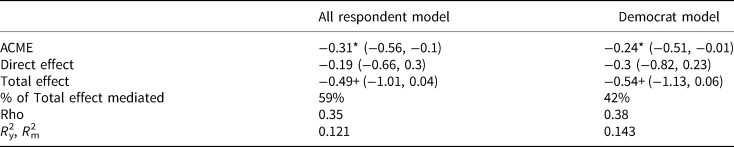
Based on these regression models and counterfactual analyses, the mediation analysis provides four main estimates of interest. The first is the average causal mediation estimate (ACME). For our purposes, the ACME estimates the amount of the relationship between the racism treatment and the respondent's likelihood of voting that can be attributed to changes in perceptions of party empathy that come from the article. Secondly, the model presents the average direct effect, which is the portion of the relationship between the racism article and higher levels of turnout that cannot be attributed to changes in party empathy from the treatment. Thirdly, the models present the total effect, which is simply the effect of the racism article treatment on the voter enthusiasm scale. Finally, the model presents the percent mediated, which is the ACME divided by the total effect. In essence, this demonstrates the percentage of the relationship between the high-racism treatment article and voter enthusiasm that can be tied to perceptions of party empathy.
Green, Ha and Bullock (Reference Green2010) note that standard mediation approaches overestimate the importance of the mediator due to omitted variable bias. This bias is particularly problematic if key pre- or post-treatment variables that affect both the mediator and the outcome are omitted (Baron and Kenny Reference Baron and Kenny1986, Green, Ha, and Bullock Reference Green2010). While the randomness of our experiment resulted in no significant differences across several critical variables, in our mediation models we control for gender, age, income and education to ensure complete balance across these variables. Even with these controls, however, it is impossible to ever fully know if key variables are omitted from the model. However, Imai et al. (Reference Imai2011) design a sensitivity analysis that estimates how large an omitted variable's effect on the mediator would have to be for the mediation effect to be zero.
So while mediation analysis results must always be interpreted with caution, the measures that Imai et al. (Reference Imai2011) suggest accompany the mediation analysis provide readers with some information about the influence an omitted variable would have to have on the mediator and the dependent variable to render the mediation effect of party empathy zero. The first of these estimates, rho (ρ), measures how large the correlation between the error term in the model for the mediator and the error term in the outcome model would have to be for the mediation effect to be zero. Similarly, the product of R 2's measure (R 2y, R 2m) examines how much of the variance an omitted variable would have to explain in the mediator (that is, R 2m) multiplied by how much of the variance the omitted variable would have to explain in the dependent variable (that is, R 2y) for the mediation effect of interest to be zero. Higher scores on both of these measures indicate robust results.
Table 2 presents the results from two mediation analyses for African-American respondents only. The first is estimated for all African-American respondents in our sample and the second is estimated for African-American respondents who are aligned with the Democratic Party. The results provide empirical support for our theoretical expectations. When Black respondents are told their party officials are racist, they display significantly lower levels of turnout. Much of the depression in voter enthusiasm across both the ‘all respondent’ (59 per cent) and ‘Democratic Party’ models (42 per cent) can be attributed to the decline in empathy that comes from reading that one's preferred party officials hold racist attitudes. The larger mediating effect identified in the ‘all respondent’ model is partly driven by those in the ‘Democratic Party’ model's voter enthusiasm being more depressed by the treatment. The results suggest that hearing information that one's party is racially biased leads to a significant decrease in perceptions of party empathy, which then reduces voter enthusiasm.
Polls reveal that Few\Most Democrat\Republican Officials Hold Racist Views

Average causal mediation analysis estimating the effect of perception of party empathy on the relationship between the party racism treatment and Black voter enthusiasm

+ Significant at 0.10, * Significant at 0.05
The results for the rho and the R 2 measure presented in Table 2 indicate that an omitted variable would have to have a strong effect on both perceptions of party empathy and voter enthusiasm for the estimated mediation effects to be zero. For the combined trait scale, the rho measure is greater than 0.3 for both the ‘all respondent’ model (0.35) and the ‘Democratic Party’ model (0.38). The R 2 measure, which is more easily interpretable, ranges from 0.12 for the ‘all respondent’ model to 0.14 for the ‘Democratic Party’ model. This measure suggests that the product of an omitted variable's explanatory power on the mediator and the outcome would have to be either 0.12 or 0.14, depending on the model, for our mediation effect to be zero. In other words, the omitted variable would have to explain about 37 per cent of the variation in the mediator (that is R 2 = 0.37) and the same amount of variation in the dependent variable for the mediation effect to be zero in the ‘Democratic Party’ model and 35 per cent (that is R 2 = 0.35) for the ‘all respondent’ model. No variable included in the model, including education, age or gender, is close to this threshold. In fact, the combination of all of these variables along with the treatment would not reach this threshold. As a result, we are confident that an omitted variable is unlikely to alter our mediation results.
Conclusion
Most political experts agree that the focus on demobilizing and polarizing segments of the electorate will continue to grow in the near future.Footnote 12 Whether that information is selectively presented in a misleading fashion, fabricatedFootnote 13 or truthful, political actors are likely to do more to present negative targeted messages in hopes of demobilizing politically cohesive segments of the population. For example, the New York Times reported that political actors are using faux-local newspapers to present misinformation to persuade the electorate. While these media sources are politically biased, they present as being local and objective reporters of the news similar to our treatment.Footnote 14 This study demonstrates that negative targeted information from such sources leads groups to question whether their preferred party cares about them and drives down political enthusiasm.
This appears to be particularly true for groups like African Americans that have high levels of group consciousness and few viable political alternatives when their preferred party, the Democratic Party, is portrayed as antagonistic toward their views. While we found that all Blacks responded negatively to claims of racism within their party, much of this effect is tied to Blacks who are associated with the Democratic Party. When Black respondents' preferred party was described as racist, their enthusiasm to vote dropped by more than two-thirds of a point on a seven-point scale.
The results have significant implications for the future of American politics. While many recent campaigns have focused on a mobilization strategy that energizes a targeted group of voters (Panagopoulos Reference Panagopoulos2016), this study demonstrates that a demobilization tactic that causes voters to question their preferred party's positions about issues they care about can be effective when the information is presented as being non-partisan. Moreover, we find that it is especially effective for groups like African Americans that have high levels of group consciousness and few alternatives. A similar strategy used on Christian Evangelicals could plausibly get them to question the morality of their preferred party/candidate, thus driving down turnout.
We did not include a control condition in our experiment (no presentation of a newspaper article). However, we suspect our results would be similar if we had used this comparison rather than the low-racism treatment as the baseline. Some may argue that higher levels of turnout in our analysis are driven by increases in Blacks' enthusiasm to vote when presented with evidence that their preferred party has low levels of racism. We believe this is not the case, and that our results are instead driven by Black turnout being depressed when presented with evidence of high levels of racism reported in their preferred party for several reasons. First, most Blacks view the Democratic Party as favorable and as caring for the Black community (Genforward,Footnote 15 2018 CCES). As a result, news that the Democratic Party is not racist is more likely to be the status quo than Blacks viewing the party as racially biased. Secondly, numerous pre-election polls show that Blacks, on average, shared the same levels of enthusiasm to vote as Whites in 2020.Footnote 16 This mirrors our finding in Figure 1, as Blacks were equally as likely as Whites to express enthusiasm to vote in 2020 when presented with the low-racism treatment. It was only when Blacks were presented with the high-racism treatment that they lagged behind Whites in voter enthusiasm, signaling that this information depresses Black turnout. In combination, we are confident that our results are driven by the high-racism article depressing Black turnout rather than the low-racism article increasing Blacks’ enthusiasm to vote. However, future research could further assess our findings using a baseline-no information control.
This study advances our understanding of negative targeted messages, particularly around African Americans. However, more work on this topic is necessary. First, and most importantly given the rise of misinformation in the current political context, future research should explore ways in which political candidates and parties can counteract negative targeted information. Our study suggests that the effectiveness of these appeals in demobilizing Black turnout is linked to their ability to get Blacks to believe their preferred party does not care about them. As a result, parties and politicians have to find ways to counter perceptions of such a lack of empathy if they want to increase Black political participation. Fortunately, recent research demonstrates that political actors can boost perceptions of empathy and possibly guard against negative targeted messages by demonstrating diversity within their political party (Stout Reference Stout2018), promoting connections between political actors and the Black community (Wamble Reference Wamble2018) or advocating policies that are targeted at under-represented groups (Collingwood Reference Collingwood2020). These actions may make it more difficult to convince Blacks that their preferred political party does not care about them and may render such negative targeted messages ineffective. We have preliminary evidence to suggest that the presence of candidates of color can mitigate negative targeted messages. However, the small number of African Americans in each treatment group when disaggregated by two forms of treatment, race and partisanship precludes us from making definitive claims (see the Appendix).
Secondly, while this study uses an experimental analysis, future research may complement this study with real-world data to assess the external validity of this analysis. While the combination of negative targeted messages on Blacks and lower levels of African-American turnout in 2016 provide some support for the external validity of our experiment, more work should be done in the future using either observational studies or a field experiment.
Thirdly, it is also worth considering the nature of the experiment itself. A fictional newspaper was used as the treatment to maximize mundane realism and control out the impact of partisanship by presenting objective information. This demonstrated the existence of a phenomena that affects the voting behavior of African Americans. However, campaigns will continue to engage in negative advertisements, and they are likely to attempt to demotivate voters by targeting specific groups. This study did not explicitly test the effect of negative targeted messages in the form of political advertisements. Future research should thus explore whether these can trigger the same effect as negative information presented as being unbiased. Likewise, more work should be done to explore which groups are the most susceptible to negative targeted attacks. We expect groups with high levels of group consciousness and few alternatives to experience the largest decline in turnout when their preferred political parties are tarnished. As a result, we may find that young single women, religious conservatives and the LGBTQ community are susceptible to negative targeted messages. In addition, future research should consider the issue of intersectionality and political knowledge to determine whether demotivational effects are enhanced or reduced for certain segments of the Black population.
Fourthly, more work should be done to test the longevity of these effects. Our experiments show that Black enthusiasm to vote declined after African Americans read information that their preferred party holds racist views. However, much work on this topic demonstrates that the effect of negative messaging dissipates over time (see Krupnikov Reference Krupnikov2011; Sigelman and Kugler Reference Sigelman and Kugler2003). Future work should explore if the same attrition effects occur with negative targeted messaging.
Fifthly, future research should explore whether some Latinx groups are more responsive to claims of racism within their preferred party than others. We found that claims of racial discrimination did not significantly depress enthusiasm to vote for the average Latinx individual. However, it is possible that a larger data set of Latinxs might find that some racial groups, national origin groups and/or generation groups within this pan-ethnicity may react more strongly to claims of racism within their preferred political party. While more work on this topic is necessary, this study provides important information about how targeted negative messaging can influence turnout.
Supplementary material
Online appendices are available at https://doi.org/10.1017/S0007123421000338.
Data availability statement
Data replication sets are available in Harvard Dataverse at: https://doi.org/10.7910/DVN/RYIERX.
Acknowledgements
The authors would like to thank the anonymous reviewers for their helpful comments. The study was made possible by the Russell Sage Foundation (grant no. 1807–07074).