


Introduction
Chronic renal disease (CRD) can be considered as one of the major health problems with an estimated prevalence of 13.4% worldwide. Many people with this disease have progressed to end-stage renal disease (ESRD) and will undergo haemodialysis (Hill et al., Reference Hill, Fatoba, Oke, Hirst, O’Callaghan, Lasserson and Hobbs2016). In Iran, statistics show an increasing trend of the disease, with an estimated growth of 22.6% per year (Kiani et al., Reference Kiani, Bagheri, Tara, Hoseini, Hashtarkhani and Tara2018). Haemodialysis is a stressful process which can lead to depression, anxiety, sleep disorder, fatigue, weakness, reduced daily activities, etc. (Ibrahim et al., Reference Ibrahim, Hazzan, Mathew, Sakhiya, Zhang, Halinski and Fishbane2018).
Sleep disturbance, including insomnia, is one of the most common dialysis-related problems. Some studies have reported its prevalence to be over 75% (Mirghaed et al., Reference Mirghaed, Sepehrian, Rakhshan and Gorji2019). Insomnia increases the risk of depression and anxiety, and reduces the ability to cope with stress (Anwar and Mahmud, Reference Anwar and Mahmud2018). Conversely, sleep problems are much more prevalent among individuals with depression and anxiety disorders (Geoffroy et al., Reference Geoffroy, Hoertel, Etain, Bellivier, Delorme, Limosin and Peyre2018; Ramsawh et al., Reference Ramsawh, Stein, Belik, Jacobi and Sareen2009). Thus, in a vicious cycle, anxiety and depression lead to sleep problems, on one hand, and, on the other hand, sleep problems lead to anxiety and depression.
Gerogianni et al. (Reference Gerogianni, Babatsikou, Polikandrioti and Grapsa2019) have reported the prevalence of anxiety and depression in hemodialysis patients to be 45% and 26.6%, respectively. Longitudinal studies have demonstrated that for patients on haemodialysis, those who had a clinician diagnosis of depression have higher rates of hospitalization days with higher rates of dialysis withdrawal and mortality (Hedayati et al., Reference Hedayati, Bosworth, Briley, Sloane, Pieper, Kimmel and Szczech2008; McDade-Montez et al., Reference McDade-Montez, Christensen, Cvengros and Lawton2006). Lower quality of life (Cukor et al., Reference Cukor, Ver Halen and Fruchter2013), dialysis initiation or death (Loosman et al., Reference Loosman, Rottier, Honig and Siegert2015) are evidently associated with anxiety disorder in haemodialysis patients with chronic kidney disease. Early identification and remission or improvements of distress symptoms, including depression, anxiety and general emotional well-being, have been a long-standing treatment goal by the nephrology community when taking into account the high prevalence and dire consequences of depression and anxiety (K/DOQI Workgroup, 2005).
Cognitive behavioural group therapy for insomnia (CBGT-I)
One of the most important factors affecting the psychological status of patients with chronic renal failure is how to cope with the disease and the stresses arising therefrom. Medication discrepancies are common in CRD, affecting the majority of patients. Also, as medication count is high among patients with CRD/ESRD, adherence to pharmacological treatments may be more problematic in this population. Moreover, there are concerns as to whether anti-depressant, benzodiazepines, hypnotic drugs and their side-effects can be well tolerated (Ibrahim et al., Reference Ibrahim, Hazzan, Mathew, Sakhiya, Zhang, Halinski and Fishbane2018; Pagel and Parnes, Reference Pagel and Parnes2001; Palmer et al., Reference Palmer, Natale, Ruospo, Saglimbene, Rabindranath, Craig and Strippoli2016). So, non-pharmacological behavioural methods are used which may also have therapeutic benefit (Ibrahim et al., Reference Ibrahim, Hazzan, Mathew, Sakhiya, Zhang, Halinski and Fishbane2018; Pagel and Parnes, Reference Pagel and Parnes2001). Furthermore, concerns against use of medication for insomnia are so important that international guidelines universally recommend CBT as the first-line treatment, not only because of the safety concerns about medication, but also because it leads to longer-term benefits to sleep compared with the use of medication (Qaseem et al., Reference Qaseem, Kansagara, Forciea, Cooke and Denberg2016; Wilson et al., Reference Wilson, Anderson, Baldwin, Dijk, Espie, Espie, Gringras, Krystal, Nutt, Selsick and Sharpley2019).
Cognitive behavioural therapy for insomnia (CBT-I) is a tailored, structured, short-term, and evidence-based approach that consists of various strategies, including sleep restriction and compression, stimulus control, sleep hygiene, cognitive restructuring, and relaxation training. The connection between the way we think, the things we do, and how we sleep is the focus of exploration for CBT-I. The treatment tests thoughts and feelings about sleep in order to gauge their accuracy in addition to evaluating behaviours based on their ability to promote sleep. After CBT-I, up to 70 to 80% of the patients with primary insomnia spent less time to fall asleep, more time spent asleep, and reduced waking after sleep onset (Qaseem et al., Reference Qaseem, Kansagara, Forciea, Cooke and Denberg2016; Trauer et al., Reference Trauer, Qian, Doyle, Rajaratnam and Cunnington2015). In a randomized controlled trial, CBT-I compared with pharmacotherapy led to the greatest changes in sleep-onset latency and sleep efficiency while maintaining therapeutic gains at long-term follow-up (Jacobs et al., Reference Jacobs, Pace-Schott, Stickgold and Otto2004). In a blinded, randomized, split-plot experimental study on 107 patients with insomnia and depression, participants were randomized to one of three groups: anti-depressant + CBT-I (4 sessions), CBT-I + placebo pill, and anti-depressant + 4-session sleep hygiene control, and while all groups improved on measures of depression and self-reported sleeping after treatment, only the CBT-I groups improved on objective sleep, whereas sleep worsened for those in the anti-depressant + 4-session sleep hygiene group (Carney et al., Reference Carney, Edinger, Kuchibhatla, Lachowski, Bogouslavsky, Krystal and Shapiro2017). Chen et al. (Reference Chen, Cheng, Pan, Chiu, Hsu, Pai and Wu2011) in a study on 72 sleep-disturbed haemodialysis patients showed that tri-weekly CBT-I compared with sleep hygiene education significantly improves sleep quality, depression, anxiety and fatigue. The high-sensitive C-reactive protein, IL-18, and oxidized low-density lipoprotein levels also significantly declined with CBT-I in comparison with the control group. In another study on 103 maintenance haemodialysis, the scores of somatization in the following categories were significantly lower in the CBT (sleep-related behaviour modification and progressive muscle relaxation) group compared with the control group: depression, anxiety, hostility, total sleep quality, subjective sleep quality, sleep latency, sleep duration, habitual sleep efficiency, sleep disturbance, hypnotics, and daytime dysfunction (Hou et al., Reference Hou, Hu, Liang and Mo2014).
One way to increase the availability of treatment is to offer group therapy, which can be more cost-effective as it allows a larger number of patients to be treated at the same time (Tucker and Oei, Reference Tucker and Oei2007). A relatively less studied approach to CBT-I which is called CBGTI gives precedence to group formats due to their perceived advantages in many types of psychotherapy, including cognitive behavioural therapies (Bieling et al., Reference Bieling, McCabe and Antony2006; Yalom and Leszcz, Reference Yalom and Leszcz2005). In a randomized controlled trial study by Jansson and Linton (Reference Jansson and Linton2005) on patients seeking care for insomnia, more participants in the CBGT-I than self-help information package made meaningful improvements in sleep onset latency, time awake after sleep onset, and sleep efficiency at the 1-year follow-up.
Research questions
CBT-I and CBGT-I are effective for sleep disturbance, depression and anxiety in many different samples. This can be particularly important in cases (such as haemodialysis patients) where sleeping and anti-depressant medications are not ideal (e.g. due to contraindications, cost, or treatment resistance) (Cunningham and Shapiro, Reference Cunningham and Shapiro2018); however, it seems that these approaches have not been well studied in haemodialysis patients. This study was performed to determine the effectiveness of CBGT-I on patients undergoing haemodialysis looking to propose a better therapeutic approach to healthcare for these individuals. As such, the question is whether CBGT-I compared with a control group can improve the sleep quality, depression, anxiety and general psychological health in patients with ESRD and poor sleep quality, clinical depression and clinical anxiety.
Method
Background of the study
The current study was a parallel randomized controlled trial. It was approved by the National Ethics Committee of Neyshabur Islamic Azad University (approval reference no. IR.IAU.NEYSHABUR.REC.1397.020) and, prior to the start of the study, it was registered as prospective research with Iranian Randomized Clinical Trials (reference no. IRCT20171219037967N1). Clinician-rated outcome assessments were administered by an individual who was not involved in the treatment of participants.
Inclusion and exclusion criteria
The research inclusion criteria were the experience of ESRD, having undergone haemodialysis for at least 3 months, a minimum of diploma education, voluntary participation in the study, age ≥20 years, PSQI score ≥5, BDI-II score ≥15, BAI score ≥8, GHQ-28 score ≥7, and failure to receive a simultaneous psychological treatment at the time of research. The exclusion criteria were having acute psychotic symptoms or suicide attempts in the beginning or through the treatment, mental disability, and failure to complete research.
Participants and sample
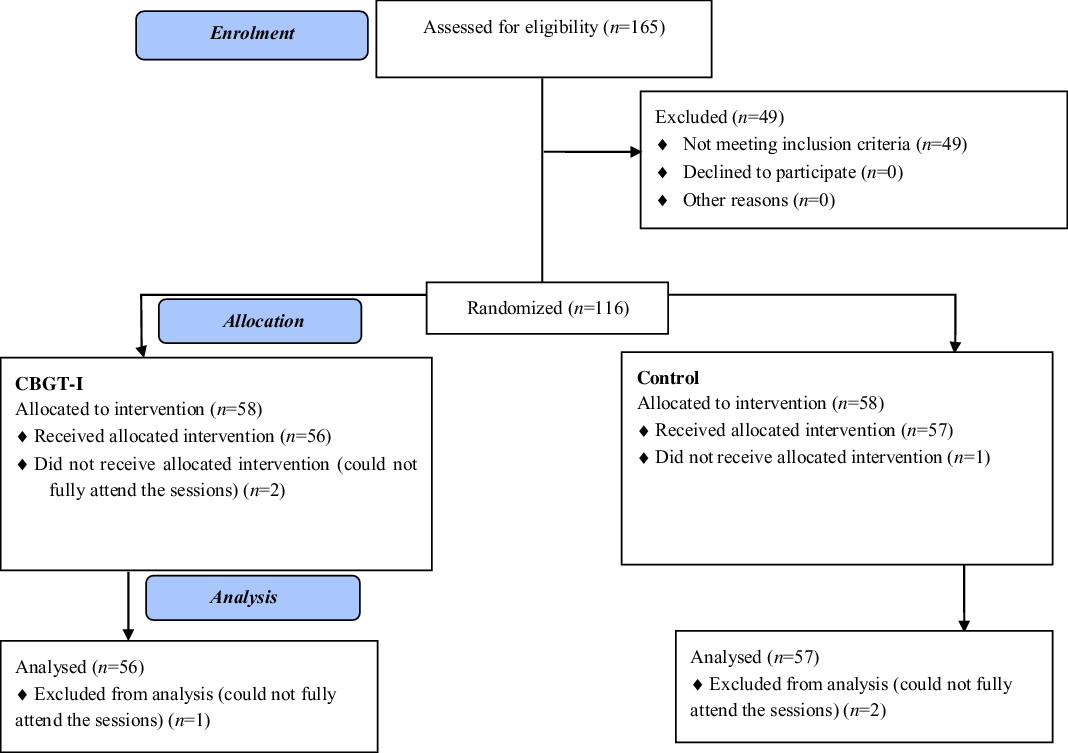
All participants were recruited from the haemodialysis ward in Mashhad from April 2019 to March 2020; the researcher selected only patients who met the inclusion criteria. A CONSORT diagram which illustrates the participant flow throughout the study is presented in Fig. 1. Of the patients introduced to the researchers for participating in the study (n=165), 27 patients due to PSQI score <5, BDI-II score <15, BAI score <8 or GHQ-28 score <7, 10 patients due to acute renal failure, six patients due to haemodialysis less than 3 months, two patients due to receiving other psychotherapies, one patient because of mental disability, two patients due to acute psychotic symptoms and one patient because of suicide attempt were excluded from the research. Ultimately, 116 patients who met the inclusion criteria were randomly assigned to two groups. Randomization was based on permutation block. Accordingly, 58 blocks were allocated to the individuals, each containing one person from the intervention group and one person from the control group. A general practitioner who was blind to the study objectives prepared the randomization.
Consolidated Standards of Reporting Trials (CONSORT) diagram illustrating the flow of participants through the study.

During CBGT-I sessions, two subjects were not able to complete the sessions, each for a different reason, one due to inability to follow the timetable of treatment sessions (30-year-old single man with 5-year history of haemodialysis) and one patient refused to participate after two sessions for unknown reasons (27-year-old women with 1-year history of haemodialysis). Also, one subject in the control group was excluded from the research due to his child’s illness and his declining to continue the research project (41-year-old married man with 3-year history of haemodialysis).
Procedure
All participants responded to the PSQI, BDI-II, BAI and GHQ-28 in the pre-test and post-test. Furthermore, CGI, CSQ and WAI-S were completed at post-treatment by the experimental group. Reviews were made to all the participant questionnaires to make sure they have been completed accurately.
Experimental group participants received group intervention during nine sessions of 90 minutes on a weekly basis, but the control group did not receive this intervention until the end of the treatment phase. The control group members were told that they should wait for approximately 3 months to receive CBGT-I. After that, they could use this treatment service provided by the therapist if they were willing.
Instruments
Except for self-rating questionnaires, all assessments were performed by a clinical psychologist who did not attend CBGT-I. PSQI was the primary outcome and other measures were the secondary outcomes.
Pittsburgh Sleep Quality Index (PSQI; Buysse et al., Reference Buysse, Reynolds, Monk, Berman and Kupfer1989)
The PSQI is a 19-question, self-rated questionnaire which assesses sleep quality and disturbances and has seven domains which include: subjective sleep quality, sleep latency, sleep duration, habitual sleep efficiency, sleep disturbances, use of sleep medication, and daytime dysfunction. Scores less than 5 represent desired sleep quality, and scores of 5 and higher indicate sleep disorder (Buysse et al., Reference Buysse, Reynolds, Monk, Berman and Kupfer1989). The validity of the PSQI has been investigated in different studies (Shochat et al., Reference Shochat, Tzischinsky, Oksenberg and Peled2007). Backhaus et al. (Reference Backhaus, Junghanns, Broocks, Riemann and Hohagen2002) reported the reliability level of PSQI in individuals with first insomnia to be 0.85 through Cronbach’s alpha method and 0.87 through the test–retest method. Its reliability in a sample of 40 Iranian patients with chronic insomnia was estimated to be 0.87 (Khaledipaveh et al., Reference Khaledipaveh, Khazaie, Salari and Maazinezhad2018). In the present study, the reliability of this questionnaire was calculated to be 0.83, using Cronbach’s alpha method.
Beck Depression Inventory-II (BDI-II; Beck et al., Reference Beck, Steer and Brown1996)
The BDI-II is a 21-item self-report instrument for measuring the severity of depression based on a 4-point scale with a possible total score between 0 and 63. The reliability and validity of the BDI-II have been well established, with a test–retest reliability coefficient of 0.93 and internal reliability of 0.86 (Beck et al., Reference Beck, Steer and Brown1996). A test–retest reliability of .91 was found in a sample of 109 Iranian nurses working in critical care units (Mogharab et al., Reference Mogharab, Nateghi, Shamaie-Zavareh and Sharifzadeh2016). In the present study, Cronbach’s alpha was calculated to be 0.92.
Beck Anxiety Inventory (BAI; Beck et al., Reference Beck, Epstein, Brown and Steer1988)
The BAI is a 21-item scale that measures the severity of anxiety. Ratings are obtained on a 4-point scale with a possible total score between 0 and 63 (Beck et al., Reference Beck, Epstein, Brown and Steer1988). The BAI has shown the coefficient of 0.75 for the test–retest reliability after 1 week and 0.87 for internal consistency (Beck and Steer, Reference Beck and Steer1991). In an Iranian study, its reliability in a sample of 250 out-patients with various medical complaints was estimated to be 0.85 through the test–retest method (Afkham-Ebrahimi et al., Reference Afkham-Ebrahimi, Rasoulian, Taherifar and Zare2010). In the present study, Cronbach’s alpha was calculated to be 0.83.
General Health Questionnaire (GHQ-28; Goldberg et al., Reference Goldberg, Rickels, Downing and Hesbacher1976)
The GHQ-28 is one of the most validated questionnaires to screen for emotional distress and possible psychiatric morbidity. Two main concerns are identified by measuring psychological wellbeing/general psychological health through the GHQ-28: (1) the inability to carry out normal functions; and (2) the appearance of new and distressing phenomena. Here, a lower score indicates better psychological wellbeing and mental health status. Through factor analysis, the GHQ-28 has been divided into four subscales: somatic symptoms, anxiety and insomnia, social dysfunction, and severe depression (Goldberg et al., Reference Goldberg, Rickels, Downing and Hesbacher1976). Cronbach’s α coefficient was 0.92 for the total scale (Ignatyev et al., Reference Ignatyev, Assimov, Aichberger, Ivens, Mir, Dochshanov and Mundt2012). In an Iranian study, its reliability was estimated to be 0.81 through the test–retest method (Gohari et al., Reference Gohari, Sajadi, Azvantash and Khavarghazalani2020). Quek et al. (Reference Quek, Low, Razack and Loh2001) showed that a short form of GHQ is suitable, reliable, valid and sensitive to clinical change in urological disorders. In the present study, Cronbach’s alpha for GHQ-28 was calculated to be 0.86.
Clinical Global Impression Scale (CGI; Guy, Reference Guy1976)
The CGI rating scale is a clinician-administered measure of symptom severity, treatment response and the efficacy of treatments in clinical trials for many psychological disorders (Diefenbach et al., Reference Diefenbach, Tolin, Hannan, Maltby and Crocetto2006). The CGI has three subscales: severity of illness, global improvement, and efficacy index. We used the global improvement subscale of the CGI at the end of CBGT-I. A score of 1 in the improvement subscale of CGI indicates an improvement in subjects as a result of the treatment; clients report more improvement as the score approaches 1 and they report less improvement in the treatment as the score approaches 7. High internal consistency was demonstrated by a kappa statistic of 0.971 and Cronbach’s alpha of 0.998 (Targum et al., Reference Targum, Hassman, Pinho and Fava2012). Its reliability in a sample of 36 Iranian patients was estimated to be 0.94 through the Cronbach’s α method (Shareh et al., Reference Shareh, Ghodsi and Keramati2022). In the present study, Cronbach’s alpha was calculated to be 0.98.
Client Satisfaction Questionnaire (CSQ, Larsen et al., Reference Larsen, Attkisson, Hargreaves and Nguyen1979)
The CSQ has eight questions and is one of a limited number of standardized satisfaction measures used widely across mental health services (Kelly et al., Reference Kelly, Kyngdon, Ingram, Deane, Baker and Osborne2018). The internal consistency coefficient of this scale based on Cronbach’s alpha ranged from 0.83 to 0.94 (Attkisson and Zwick, Reference Attkisson and Zwick1982). Reliability of CSQ in a sample of 23 patients with obsessive-compulsive disorder calculated to be 0.93 through the Cronbach’s alpha method and 0.89 through the test–retest method (Shareh, Reference Shareh2014). In the present study, Cronbach’s α was calculated to be 0.91.
Working Alliance Inventory-Short Form (WAI-S; Tracey and Kokotovic, Reference Tracey and Kokotovic1989)
The WAI-S is a reliable, valid and widely used tool for measuring therapeutic alliance. It is a 12-item instrument scored on a 7-point Likert scale (Smits et al., Reference Smits, Luyckx, Smits, Stinckens and Claes2015). A meta-analytic review estimated that the test–retest reliability was approximately 0.73 (Martin et al., Reference Martin, Garske and Davis2000). Its reliability in a sample of 36 Iranian patients was estimated to be 0.88 through the Cronbach’s α method (Shareh et al., Reference Shareh, Ghodsi and Keramati2022). In the present study, Cronbach’s α of the whole inventory was calculated to be 0.89.
Treatment and therapists
The present study consisted of two groups of 58 patients who met the inclusion criteria. Both groups received dialysis treatments in parallel. In the experimental group, patients attended the CBGT-I sessions when they were out of haemodialysis. There were eight concurrent intervention groups. The range number of participants in each group was n=7–9. Nine 90-minute group sessions of CBGT-I were conducted weekly by a licensed clinical psychologist with extensive specialized training in group, CBT, CBGT, CBT-I and CBGT-I therapy models (with more than 3700 hours of academic training, including courses, theory, clinical practice for 10 years, and weekly supervisions). Therapeutic sessions were held in a separate room from the haemodialysis ward, which was coordinated by the head of the department who was involved in the research directly but was informed to the aims of the study. To monitor the accuracy of treatment implementation and fidelity of the intervention and to reduce therapeutic drift, the psychotherapist received regular individual supervision from another psychologist specialized in CBGT-I (an Associate Professor of Clinical Psychology). Not being involved in the research directly and not communicating with the patients, he just checked the records of each session and related activities with the patients and provided feedback to the therapists after each session throughout the study period.
While participants in the control group suffered from sleep problems, depression and anxiety, there were no group sessions for them to undergo psychotherapy with regard to these problems. The control group received psychoeducation consultation in a group format which consisted of providing general guidelines about the haemodialysis treatment and emotional support for the patients’ psychological suffering, related to the disease and medical treatment complications. In other words, they enjoyed the benefits of sharing their suffering in a group and talking to a psychologist. Another psychologist, different from the one who conducted the CBGT-I and unaware of the patients’ allocation in addition to the study objectives, was in charge of this process. During the following 3 months, this psychological care was provided whenever necessary to guarantee the patients’ rights of assistance. No other type of psychological care was administered to the patients throughout the research period.
Organization of the CBGT-I program
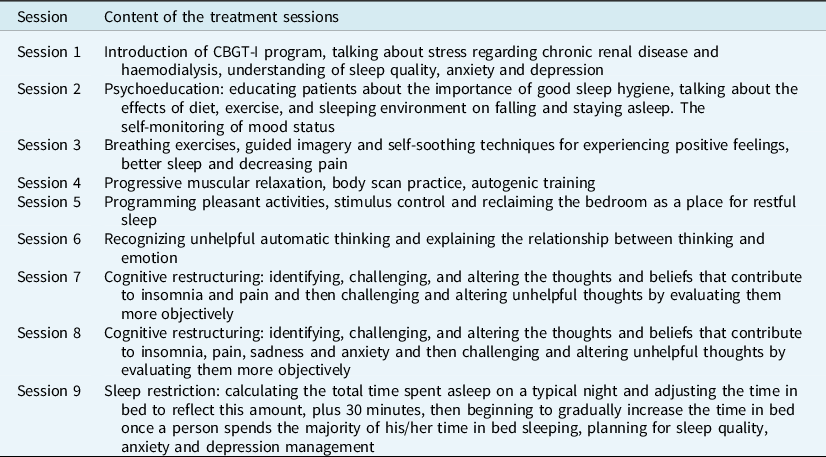
The content of CBGT-I sessions was taken from the book Cognitive Behavioral Therapy for Chronic Illness and Disability (Taylor, Reference Taylor2009) and also from the latest research work done in this field (Chen et al., Reference Chen, Cheng, Pan, Chiu, Hsu, Pai and Wu2011; Ng et al., Reference Ng, Tang, Chan, Tran, Ho, Tam and Ho2019; Paardekooper et al., Reference Paardekooper, Thayer, Miller, Nikpour and Gascoigne2020; Pigeon, Reference Pigeon2010). The summary of the content of the treatment sessions is given in Table 1.
The summary of treatment sessions

Data analyses
One-way analysis of covariance (ANCOVA) was employed to compare the differences between CBGT-I and control groups. ANCOVA with the pre-treatment value as a covariate and the post-treatment values as dependent variables was used to account for the difference in the effectiveness of the treatment depending on pre-treatment severity. As four significance comparison tests were conducted, a Bonferroni correction was applied leading to an adjusted alpha of 0.012. The desired alpha-level must be divided by the number of comparisons in order to obtain a p-value for determining significance level in Bonferroni correction. To calculate the effect size, partial eta squared (η2=SSeffect/SSeffect+SSerror) was provided. A general guideline for interpreting η2 based on Stevens (Reference Stevens2002) is as follows: small (0.01), medium (0.06) and large (0.14). No power analysis was conducted prior to data collection.
Results
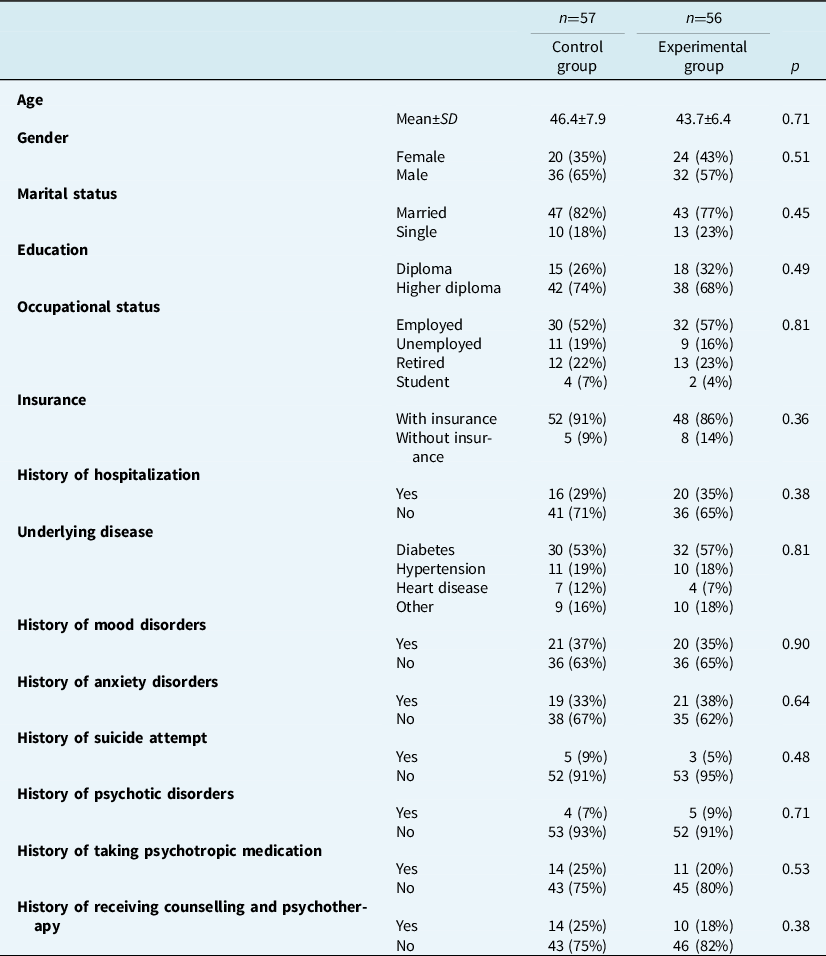
Almost all participants were present until the end of the study. None of the patients in the intervention group discontinued because of a CBGT-I adverse effect. Participant characteristics are given in Table 2. The mean age was 43.7±6.4 years in the experimental group and 46.4±7.9 years in the control group. Forty-four participants were female (39%) and 69 participants were male (61%). Eighty-eight participants had diabetes mellitus as the main underlying disease. Other underlying conditions were hypertension, heart disease or other causes. Although most of the participants had combined medical diseases including hypertension, diabetes, cerebrovascular disease, and coronary artery disease, their overall physical states were stable during CBGT-I. In terms of demographic characteristics, the results of t-test (for age) and χ2 showed that homogeneity between groups has been achieved (p>.05) (Table 2).
Participant characteristics

The rate of CGI scores in the experimental group varied between 1 and 5 (mean=1.92, SD=1.18), indicating that participants showed notable improvements post-treatment. Also, satisfaction with the protocol, as indicated by the CSQ, was high (mean=29.66, SD=2.08, range=26–33). The mean WAI-S score was 5.93 (SD=0.90, range=5–7), which indicates a good therapeutic relationship (Table 3).
Patient’s satisfaction, improvement and therapeutic relationship after CBGT-I

CSQ, Client Satisfaction Questionnaire; CGI, Clinical Global Improvement Scale; WAI-S, Working Alliance Inventory-Short Form.
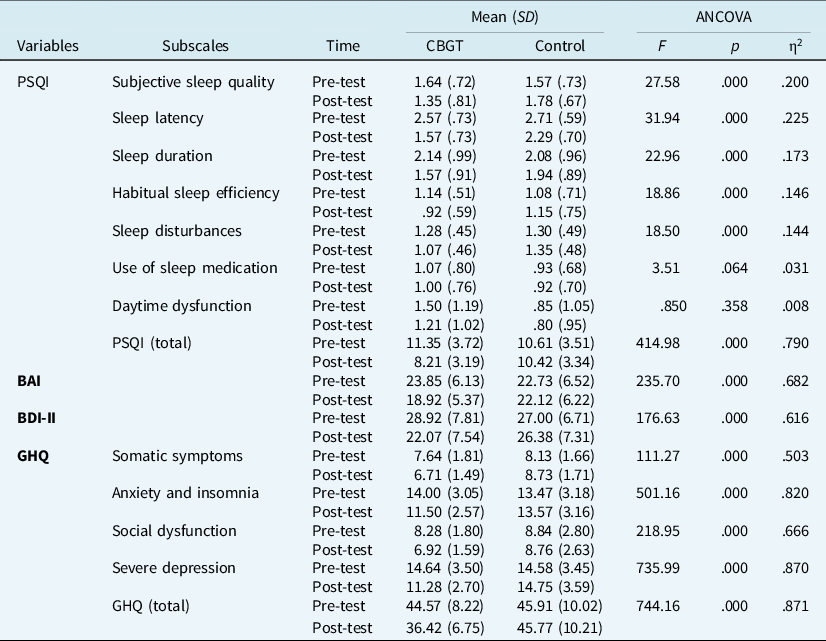
Descriptive statistics show that the mean scores of experimental groups in depression, anxiety, general psychological health and sleep quality are lower than those of the control group in the post-test (Table 4). To perform ANCOVA test, in addition to the interval scale of the variable’s measurement, normal distribution of variables (Kolmogorov–Smirnov Z=.859–1.79, all p>.05) and homogeneity of variances (Levine’s test F=1.36–3.02, all p>.05) was also confirmed.
Descriptive statistics and univariate analysis of covariance results to examine intergroup differences in cognitive behavioural group therapy and control groups

PSQI, Pittsburgh’s Sleep Quality Index; BAI, Beck Anxiety Inventory; BDI-II, Beck Depression Inventory-II; GHQ, General Health Questionnaire; CBGT, cognitive behavioural group therapy; SD, standard deviation; η2, effect size.
Table 4 shows that CBGT-I compared with control group leads to improvement in sleep quality (F 1,110=414.98, p<.001, effect size of 0.79), decrease in depression (F 1,110=176.63, p<.001, effect size of 0.61), decrease in anxiety (F 1,110=235.70, p<.001, effect size of 0.68), and improvement in general psychological health (F 1,110=744.16, p<.001, effect size of 0.87). The observed power for all tests was 1. The corrected p-values for determining significance level in Bonferroni correction were less than 0.012, which gave rise to the conclusion that the differences in all outcome measures were significant. According to the results of Table 4, the mean of the experimental group after the implementation of CBGT-I has changed in the components considered in sleep quality (from 11.35 to 8.21), depression (from 28.92 to 22.07), anxiety (from 23.85 to 18.92) and general psychological health (from 44.57 to 36.42).
Regarding the subscales of PSQI, the CBGT-I group, compared with the control group, had better performance in the post-test in dimensions including subjective sleep quality, sleep latency, sleep duration, habitual sleep efficiency, and sleep disturbances (all p<.001). For components of daytime dysfunction and the use of sleep medication, the results showed that there is no significant differences between CBGT-I and control groups. Also, the CBGT-I group had better performance than the control group in the post-test in all subscales of GHQ including somatic symptoms, anxiety and insomnia, social dysfunction and severe depression (all p<.001).
Discussion
Based on the results of CSQ and CGI, it seems that this treatment has been well accepted by patients undergoing haemodialysis and has had good effects on them. In addition, the WAI-S score indicates a good therapeutic alliance. The therapeutic alliance is a strong predictor of psychotherapy or counselling client outcome (Ardito and Rabellino, Reference Ardito and Rabellino2011).
According to the main findings of the present study, compared with the control group, CBGT-I positively improved sleep quality, depression, anxiety and general psychological health of haemodialysis patients. Among the patients who received CBGT-I, 54% improvement in sleep quality, 36% improvement in depressive symptoms, 41% improvement in anxiety symptoms, and 39% improvement in general psychological health were reported.
It is noteworthy to say, while there are differences between the treatment and control group post-intervention, the mean score of both groups remained higher than the cut-off point across both groups even after treatment for: sleep disorder (based on PSQI scores), general psychological health problems (based on GHQ-28 scores), in the ‘moderate’ range for depression (based on BDI-II scores) and anxiety (based on BAI scores).
CBGT-I for sleep quality
The findings of this study showed that CBGT-I improved the total score of sleep quality and its dimensions including subjective sleep quality, sleep latency, sleep duration, habitual sleep efficiency and sleep disturbances in haemodialysis patients and it has not affected other dimensions. Based on these findings, we can conclude that CBGT-I reduces the effects of insomnia. Multiple studies show that by conducting CBT-I, 70 to 80% of patients with primary insomnia experience less time to fall asleep, more time spent asleep, and reduced waking after sleep onset (Trauer et al., Reference Trauer, Qian, Doyle, Rajaratnam and Cunnington2015). Our findings are in line with the study of Chen et al. (Reference Chen, Cheng, Pan, Chiu, Hsu, Pai and Wu2011) on 72 sleep-disturbed haemodialysis patients showing that tri-weekly CBT-I compared with sleep hygiene education is more effective for correcting disorganized sleep patterns, and for reducing inflammation and oxidative stress in haemodialysis patients. The results of our study are consistent with the results of the study of Hou et al. (Reference Hou, Hu, Liang and Mo2014) on 103 maintenance haemodialysis patients, concluding a type of CBT (sleep-related behaviour modification and progressive muscle relaxation) improves mental state and sleep quality of haemodialysis patients with insomnia. However, the type and frequency of treatment used in our study (9-session CBGT-I) is somewhat different from the research of Chen et al. (Reference Chen, Cheng, Pan, Chiu, Hsu, Pai and Wu2011) and Hou et al. (Reference Hou, Hu, Liang and Mo2014). In a randomized controlled trial study by Jansson and Linton (Reference Jansson and Linton2005) comparing the effects of CBGT-I and a self-help information package in patients with insomnia, significantly more participants in the CBGT-I met criteria at the 1-year follow-up for clinically meaningful improvements in sleep onset latency, time awake after sleep onset, and sleep efficiency. Although diverging from Jansson and Linton study, we conducted CBGT-I on a special sample (haemodialysis patients) with no follow-up, and the results of our study in line with Jansson and Linton study indicated that the CBGT-I is more effective than the control group in improving sleep. However, Jansson and Linton compared CBGT-I with a self-help information package while we compared CBGT-I with a psychoeducation consultation group.
The results of our study are consistent with the study by Jacobs et al. (Reference Jacobs, Pace-Schott, Stickgold and Otto2004) who suggested that in most measures, CBT-I was the most effective sleep intervention; it produced the greatest changes in sleep-onset latency and sleep efficiency, yielded the largest number of normal sleepers after treatment, and maintained therapeutic gains at long-term follow-up. In that study, pharmacotherapy produced only moderate improvements during drug administration and returned measures toward baseline after drug use discontinuation. A study by Morin et al. (Reference Morin, Blais and Savard2002) suggested that both cognitive behavioural and pharmacological treatments increased the total sleep duration by 15% after 4 weeks, but only the cognitive behavioural interventions maintained their effect after 9 weeks. Also, a systematic review showed that CBT-I is more effective than benzodiazepine and non-benzodiazepine drugs in the treatment of insomnia in the long term (Mitchell et al., Reference Mitchell, Gehrman, Perlis and Umscheid2012).
For components of daytime dysfunction and the use of sleep medication (from the PSQI), the results showed that CBGT-I did not affect these components. In explaining the result, it can be said that the consumption of various types of analgesics and sedative regulators, blood glucose control drugs, blood pressure medication and so on that the patient uses daily for improvement of multiple physical symptoms associated with haemodialysis, drug tolerance and overlapping their effects cause insomnia and, therefore, the patient’s inability to reduce daily problems and reduce the use of sleep medication (Ibrahim et al., Reference Ibrahim, Hazzan, Mathew, Sakhiya, Zhang, Halinski and Fishbane2018). Also due to the wide range of side-effects induced by haemodialysis on other body organs, deep pain caused by connecting the haemodialysis device to the patient’s arteries, the strain of the continuation of haemodialysis on the patient, the physical weakness due to the complications of the disease and the disintegration of the electrolyte order blood biochemistry, therapeutic intervention probably did not have a significant effect on these components (Hawamdeh et al., Reference Hawamdeh, Almari, Almutairi and Dator2017).
Additionally, the results showed that the patients’ sleep quality in the control group has not decreased over time, which indicates that sleep problems are serious in haemodialysis patients, and emphasizes the importance of interventions such as CBGT-I to improve sleep quality.
CBGT-I for depression and anxiety
Results of the present study demonstrate that CBGT-I was effective in depression and anxiety of haemodialysis patients. This is somewhat consistent with the findings obtained by Duarte et al. (Reference Duarte, Miyazaki, Blay and Sesso2009) which showed that CBGT is an effective treatment for major depression in haemodialysis patients. In their study, after 3 months of intervention (12 CBGT sessions) and after 9 months of follow-up, the intervention group had significant improvements compared with the control group (received the usual treatment offered in the dialysis unit) in the average scores of the BDI and in quality-of-life dimensions. It seems that the methods, processes and results of our study are relatively similar to this study, but in Duarte et al. study, the rate of improvement in depression (based on BDI score) was about 3 points higher in the intervention group (probably due to more treatment sessions and more focused treatment on depression in the Duarte et al. study) and our study results were not followed up. The findings of our study are similar to those of Carney et al. (Reference Carney, Edinger, Kuchibhatla, Lachowski, Bogouslavsky, Krystal and Shapiro2017), Cunningham and Shapiro (Reference Cunningham and Shapiro2018) and Behenck et al. (Reference Behenck, Wesner, Guimaraes, Manfro, Dreher and Heldt2021). Carney et al. (Reference Carney, Edinger, Kuchibhatla, Lachowski, Bogouslavsky, Krystal and Shapiro2017) showed that CBT-I + anti-depressant medication improved depression and objective and subjective sleep. Cunningham and Shapiro (Reference Cunningham and Shapiro2018) in a systematic review concluded that CBT-I and CBGT-I are effective in treating sleep disturbances associated with depression.
In explaining the results, it can be mentioned that CBGT and CBGT-I improve a person’s hope by improving beliefs and teaching mental imagery, rational thinking, and relaxation techniques through increasing efficiency and self-efficacy. Use of the cognitive behavioural model and its positive effect on reducing stress, anxiety, depression and hopelessness have shown this method to be an appropriate technique to improve the mental health of haemodialysis patients (Chen et al., Reference Chen, Cheng, Pan, Chiu, Hsu, Pai and Wu2011).
CBGT-I for general psychological health
The data analysis of our study demonstrated that the intervention has been effective in improving the general psychological health of the participants. Although few studies have evaluated the effectiveness of CBT-I and CBGT-I in general psychological health, there are many studies that show CBT and CBGT are effective in improving general psychological health (Henriksson et al., Reference Henriksson, Anclair and Hiltunen2016; Sohn et al., Reference Sohn, Oh, Choi, Song, Lim, Lee and Lim2018). It seems that improving negative psychological symptoms such as depression and reducing individual stress can lead to increased hope and improves one’s attitude towards illness, future and self; as a result, the person will feel more satisfied and relaxed. Individual and group-based CBT and CBT-I treatments prepare the ground for people to recognize their own irrational thoughts and causes reduction in depression and anxiety by providing solutions (Picariello et al., Reference Picariello, Moss-Morris, Macdougall, Norton, Da Silva-Gane, Farrington and Chilcot2018; Qaseem et al., Reference Qaseem, Kansagara, Forciea, Cooke and Denberg2016; Trauer et al., Reference Trauer, Qian, Doyle, Rajaratnam and Cunnington2015). In CBT/CBGT, patients change the content of negative thoughts about the disease through recognizing and challenging cognitive errors and doing behavioural experiments. In addition, it is said that changing thoughts could help in emotional development, adoption, and flexibility through the experience of positive feelings and attention to bright aspects of life. Having a balanced attitude and view towards life, which is achieved through CBT/CBT-I and CBGT/CBGT-I, may be a contributing factor in these positive outcomes (Espie et al., Reference Espie, Emsley, Kyle, Gordon, Drake, Siriwardena, Cape, Ong, Sheaves, Foster, Freeman, Costa-Font, Marsden and Luik2019; Paardekooper et al., Reference Paardekooper, Thayer, Miller, Nikpour and Gascoigne2020; Valsaraj et al., Reference Valsaraj, Bhat and Latha2016).
Limitation
Although our CBGT-I program was feasible and effective, some limitations existed. First, the sample was limited to those who have ESRD, sleep disturbance, clinical depression, and clinical anxiety. This limits the generalizability of the findings. Second, we did not include drop-outs in our analysis. So, there may be some limitations because the analyses conducted do not adhere to the ‘intention to treat’ principle. However, it is very unlikely that the results of this study substantially differ from the results of the analysis that adheres to the principle of ‘intention to treat’ as only three participants (two in the CBGT-I group and one in the control group) were excluded from analyses. Third, we did not carry out a longitudinal follow-up and therefore could not confirm the long-term effect. In the future, a randomized controlled study with a larger and more representative ESRD sample and long-term observation will be needed to support the results of the present study. Also, the effectiveness of CBGT-I can be evaluated on outcomes such as cognitive flexibility, metacognitions, etc., which are factors that may play a role in depression, anxiety and sleep problems. This evaluation can identify factors that CBGT-I may improve sleep problems, depression, anxiety and general psychological health by affecting these factors.
Conclusion
The results of this study show the favourable effects of CBGT-I on improving sleep quality, depression, anxiety and general psychological health in haemodialysis patients. Given the increasing prevalence of ESRD and the high prevalence of sleep disturbances as well as depression and anxiety in haemodialysis patients, it is recommended that health organizations highlight the efficacy of this method and increase access to it. By doing so, it is hoped that more patients will receive effective and appropriate treatment of insomnia, depression and anxiety in order to improve their mental health and quality of life.
Data availability statement
Data are not publicly available due to privacy and ethical restrictions.
Acknowledgements
We express our great appreciation to all officials and those involved in the adoption and implementation of this research project and also all nurses in the haemodialysis ward, patients and their families who helped us in conducting this study.
Author contributions
Hossein Shareh: Conceptualization (lead), Data curation (supporting), Formal analysis (lead), Investigation (supporting), Methodology (lead), Project administration (lead), Resources (supporting), Software (supporting), Supervision (lead), Validation (lead), Visualization (lead), Writing – original draft (lead), Writing – review & editing (lead); Morteza Hasheminik: Data curation (equal), Investigation (equal), Project administration (equal), Resources (equal), Writing – original draft (equal); Mehdi Jamalinik: Conceptualization (equal), Data curation (equal), Investigation (equal), Project administration (equal), Resources (equal), Writing – original draft (equal).
Financial support
This research received no specific grant from any funding agency, commercial or not-for-profit sectors.
Conflict of interest
The author declare none.
Ethical standards
All the research meets ethical guidelines, including adherence to the legal requirements of the study country. Also, in this study the provisions of the Declaration of Helsinki were respected. Some of the ethical issues considered in this study were: explanation of the study objectives and obtaining the written informed consent of the study participants, the right to withdraw from the study, absence of any physical or psychological harm to participants, answering the participants questions and making results available if desired.




Comments
No Comments have been published for this article.