Introduction
Cognitive heterogeneity in schizophrenia
Cognitive impairments are a central aspect of schizophrenia spectrum disorders and have been repeatedly linked to poorer functioning and quality of life among patients (Green, Reference Green2016; Tan, Rossell, & Lee, Reference Tan, Rossell and Lee2020b; Tan, Thomas, & Rossell, Reference Tan, Thomas and Rossell2014; Tolman & Kurtz, Reference Tolman and Kurtz2012). More recently, there is growing recognition that cognitive impairment severity varies among patients, ranging from broad deficits to performance at levels similar to healthy samples. Cluster analyses have been consistently employed in the endeavour to classify patients by cognitive impairment severity and depending on the cognitive domains being investigated and the statistical methodology employed, between two and five clusters or groups emerge (see Carruthers, Van Rheenen, Gurvich, Sumner, and Rossell, Reference Carruthers, Van Rheenen, Gurvich, Sumner and Rossell2019b for a review). The identification of cognitive subgroups within schizophrenia spectrum disorders is empirically and theoretically driven and facilitates an appreciation of the heterogeneity of cognitive deficits in a way that continuous variables do not. Furthermore, cognitive clusters may guide the delivery of effective treatment strategies as we gain a better understanding of cognition-enhancing interventions. Overall, there is consensus for the existence of three broad groups: relatively intact, intermediately impaired and severely impaired (Carruthers et al., Reference Carruthers, Van Rheenen, Gurvich, Sumner and Rossell2019b).
Previous characterisation of cognitive heterogeneity in schizophrenia has revealed differences in symptoms across the identified groups. The most common finding is for increased negative symptoms among the most cognitively compromised group (Carruthers et al., Reference Carruthers, Gurvich, Meyer, Bousman, Everall, Neill and Rossell2019a; Lewandowski, Baker, McCarthy, Norris, & Öngür, Reference Lewandowski, Baker, McCarthy, Norris and Öngür2018; Sauvé, Malla, Joober, Brodeur, & Lepage, Reference Sauvé, Malla, Joober, Brodeur and Lepage2018; Wells et al., Reference White and Stern2015), with some evidence for increased positive symptoms (Lewandowski et al., Reference Lewandowski, Baker, McCarthy, Norris and Öngür2018; Sauvé et al., Reference Sauvé, Malla, Joober, Brodeur and Lepage2018) as well as overall symptomatology compared to the cognitively intact group (Van Rheenen et al., Reference Van Rheenen, Lewandowski, Tan, Ospina, Ongur, Neill and Burdick2017). It should be noted that differences in symptom profiles have not been observed across all cognitive subclusters in schizophrenia (Gilbert et al., Reference Gilbert, Merette, Jomphe, Emond, Rouleau, Bouchard and Maziade2014; Van Rheenen et al., Reference Van Rheenen, Lewandowski, Tan, Ospina, Ongur, Neill and Burdick2017), with significant symptom differences being absent between the cognitively impaired subclusters (e.g. selective v. general cognitive impairment). Further, cognitively compromised schizophrenia patients have been shown to have a lower premorbid intelligence quotient (IQ) (Lewandowski et al., Reference Lewandowski, Baker, McCarthy, Norris and Öngür2018; Van Rheenen et al., Reference Van Rheenen, Lewandowski, Tan, Ospina, Ongur, Neill and Burdick2017), poorer socio-occupational functioning and premorbid functioning (Wells et al., Reference White and Stern2015), and may be more susceptible to poorer long-term outcomes (Gilbert et al., Reference Gilbert, Merette, Jomphe, Emond, Rouleau, Bouchard and Maziade2014). Relating clinical and developmental characteristics to cognitive clusters is a relatively recent field of research, and further investigation is required.
The vast majority of current cognitive clustering work has occurred in chronic populations, with relatively few cognitive heterogeneity studies in first-episode psychosis (FEP). Published FEP studies to date have reported both three (Sauvé et al., Reference Sauvé, Malla, Joober, Brodeur and Lepage2018; Uren, Cotton, Killackey, Saling, & Allott, Reference Uren, Cotton, Killackey, Saling and Allott2017) and four (Reser, Allott, Killackey, Farhall, & Cotton, Reference Reser, Allott, Killackey, Farhall and Cotton2015) cluster cognitive structures. In all cases, relatively intact and severely impaired groups were identified. Sauvé et al. (Reference Sauvé, Malla, Joober, Brodeur and Lepage2018) and Uren et al. (Reference Uren, Cotton, Killackey, Saling and Allott2017) also identified a single intermediate impairment cluster, while Reser et al. (Reference Reser, Allott, Killackey, Farhall and Cotton2015) reported two intermediately impaired groups that differed on measures of attention, working memory and visual recognition memory. Different FEP cognitive clusters were characterised by differing levels of premorbid intelligence and negative symptoms (Reser et al., Reference Reser, Allott, Killackey, Farhall and Cotton2015; Uren et al., Reference Uren, Cotton, Killackey, Saling and Allott2017), with decreasing cognitive function related to poorer levels of daily functioning (Holthausen et al., Reference Holthausen, Wiersma, Sitskoorn, Hijman, Dingemans, Schene and van den Bosch2002; Uren et al., Reference Uren, Cotton, Killackey, Saling and Allott2017), even six months post-assessment (Uren et al., Reference Uren, Cotton, Killackey, Saling and Allott2017).
Factors affecting cognitive function
The limited number of cognitive heterogeneity studies in FEP requires extension and replication, notably to aid in improving the characterisation of cognitive impairment in FEP. A key factor that has yet to be clarified is the role of premorbid functioning in the prediction of future cognitive impairment in schizophrenia. Poor premorbid social and work adjustment has been observed in the most cognitively compromised schizophrenia patients (Wells et al., Reference White and Stern2015); however, such studies have often been limited to periods close or just prior to symptom onset. The relationship between adjustment in the developmental years and future cognitive impairment is still unclear. For example, reduced educational duration and attainment and premorbid intelligence are common among individuals with schizophrenia and have been related to the age of illness onset (Chen, Selvendra, Stewart, & Castle, Reference Chen, Selvendra, Stewart and Castle2018; Neill et al., Reference Neill, Tan, Toh, Selvendra, Morgan, Rossell and Castle2020) as well as some cognitive impairments (Bucci et al., Reference Bucci, Galderisi, Mucci, Rossi, Rocca, Bertolino and Maj2018; Lee et al., Reference Lee, Rizzo, Altshuler, Glahn, Miklowitz, Sugar and Green2017), but are yet to be investigated in relation to a broad range of cognitive domains.
The current study
In light of these issues, the present study sought to identify cognitive clusters in a group of FEP patients using cluster analysis and to further investigate their relationships with both symptoms and premorbid developmental adjustment factors. Based on previous work, we hypothesised that two to four clusters would emerge, with at least one cognitively intact and one generally impaired cluster. We predicted significant differences in demographic and clinical features, notably years of education, premorbid IQ and negative symptoms, between the clusters. We also expected significant differences between the clusters on premorbid developmental adjustment domains. We used a premorbid adjustment assessment that allowed separation of early scholastic v. social development to determine whether they differed in their association with cognitive impairment after psychosis onset.
Method
Participants
Data was obtained from 105 participants (56 schizophrenia, 13 schizoaffective disorder, depressed type and 36 schizophreniform disorder) in the University of California Los Angeles (UCLA) Aftercare Research Program, an outpatient clinic for recent-onset schizophrenia spectrum disorders. All participants had a DSM-IV (American Psychiatric Association, 1994) diagnosis of schizophreniform, schizophrenia, or schizoaffective disorder, depressed subtype based on SCID interview (First, Spitzer, Gibbon, & Williams, Reference First, Spitzer, Gibbon and Williams2001). They were aged between 18 and 45 years, had stable outpatient status, with no medication changes in the month prior to assessment. Participants with a history of neurological disorder, significant head injury, or substance or alcohol abuse or dependence in the last six months were excluded. All patients were taking oral risperidone at the time of assessment (Subotnik et al., Reference Subotnik, Casaus, Ventura, Luo, Hellemann, Gretchen-Doorly and Nuechterlein2015) and were being assessed at the baseline point of a randomised clinical trial of cognitive remediation and long-acting v. oral risperidone (Nuechterlein et al., Reference Nuechterlein, Ventura, Subotnik, Gretchen-Doorly, Turner, Casaus and Medalia2020). Informed consent was obtained from all patients. All assessments were completed ~3 months after entry into the outpatient UCLA Aftercare Research Program.
Measures
Cognition and premorbid intelligence
A modified beta version of the MATRICS consensus cognitive battery (MCCB; Nuechterlein et al., Reference Nuechterlein, Green, Kern, Baade, Barch, Cohen and Marder2008) was used. This consisted of 16 tests assessing seven cognitive domains administered by certified testers. These are briefly described in Table 1. Each cognitive domain was represented by at least two tests. While the original MCCB beta version consisted of 20 tests, 4 were excluded due to concerns regarding practicality, psychometrics and redundancy (crossover with other included measures). Periodic checks on test administration and scoring practices were conducted for ongoing quality assurance. Premorbid intelligence was assessed using the Wechsler test of adult reading (WTAR; Wechsler, Reference Wells, Swaminathan, Sundram, Weinberg, Bruggemann, Jacomb and Weickert2001).
Descriptions of the 16 MCCB beta version tests and means and standard deviations of raw scores of participants (N = 105)

BACS, Brief assessment of cognition in schizophrenia; CPT, Continuous performance test; WMS, Wechsler memory scale; NAB, neuropsychological assessment battery; WAIS, Wechsler adult intelligence scale; MSCEIT, Mayer–Salovey–Caruso emotional intelligence test.
a Included in the final 10-test MCCB.
Premorbid adjustment
The premorbid adjustment scale (PAS; Cannon-Spoor, Potkin, & Wyatt, Reference Cannon-Spoor, Potkin and Wyatt1982) is a widely used retrospective scale, conducted via semi-structured interview, to assess social and academic functioning in the years prior to psychotic symptom onset. In total, four time periods are covered: childhood (age: 5–11 years), early adolescence (age: 12–15 years), late adolescence (age: 16–18 years) and adulthood (age: ≥19 years). Five functioning domains were covered including sociability and withdrawal, peer relationships, scholastic performance, adaptation to school and social−sexual aspects of life. Academic items are excluded in adulthood, as are social−sexual aspects of childhood. Items are rated on a scale from 0 to 6, with higher scores reflecting poorer adjustment. A total score for each domain by time period was calculated. To account for the potential influence of active psychosis, the adulthood PAS data were excluded here due to possible validity issues (Van Mastrigt & Addington, Reference Van Mastrigt and Addington2002).
Symptoms and demographics
The 24-item expanded brief psychiatric rating scale (BPRS; Ventura et al., Reference Ventura, Lukoff, Nuechterlein, Liberman, Green and Shaner1993) was used to assess current symptoms. The BPRS for the two-week period covering the period of MCCB administration was used. Five symptom domain scores were calculated including affect, negative, positive, activation and disorganisation (Shafer, Dazzi, & Ventura, Reference Shafer, Dazzi and Ventura2017), as well as a total score summing these together. Basic demographic and clinical information such as age, years of education, age of psychosis onset and medication dose were also collected.
Data preparation and statistical analysis
Prior to analysis, data was screened for missing variables and univariate and multivariate normality. Missing data was minimal (2.68% of data points) and were imputed using the expectation-maximisation algorithm. Normality was assessed using the Shapiro–Wilks test and examination of skewness/kurtosis values. All non-normal variables were log transformed. To standardise the scale of measurement, z-scores were calculated for all 16 individual tests (based on the 105 patient participants here, not relative to healthy control norms) that were used for the cluster analyses. All statistical analysis was conducted using IBM SPSS Statistics version 26.
Hierarchical cluster analysis with Ward's method and squared Euclidean distance was employed, with collaborative inspection of the agglomeration schedule/scree plot and dendrogram used to determine the initial number of clusters. This was confirmed by discriminant function analysis. A k-means iterative partitioning technique was subsequently used to optimise the retained clusters, with initial partitions in the k-means solution defined using the cluster means obtained from the initial clustering procedure. The stability of the cluster solution was evaluated through split-sample (random 80 and 70% samples), abridged (social cognition excluded) and alternate method (average linkage) replication via Cohen's κ analysis. To clarify any observed impairment severity within identified clusters, an overall composite T-score for the ten tasks contained within the final MCCB was calculated for each cluster using the MCCB Computer Scoring Program, which compares performance to community norms (Nuechterlein & Green, Reference Nuechterlein and Green2006). Identified clusters were also compared on demographic, clinical and PAS variables using analysis of variance and chi-square tests (χ2) as applicable. Cohen's d and Cramer's V were chosen as measures of effect size for the post hoc pairwise comparisons and χ2 analyses, respectively. Bonferroni correction was employed to account for multiple comparisons (α = 0.002).
Results
Exploration of the data revealed no extreme outliers in any of the measures, and only TMT-A time to completion scores were found to be non-normal. These were consequently log transformed and reverse scored to align with the directionality of the other measures (i.e. increasing score = better performance).
Cluster analysis
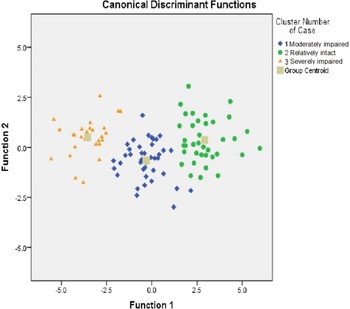
Examination of the agglomeration schedule, scree plot and dendrogram revealed a three-cluster solution (Fig. 1; online Supplementary Material S1), with substantial to almost perfect agreement over multiple design iterations required to validate the final clustering solution obtained (see Table 2). The discriminant plot of the final k-means solution indicated relatively cohesive clusters with three distinct centroids (Fig. 2). Examination of the MCCB overall composite T scores based on community norms revealed the mean score of one cluster was within 1 s.d. of the mean of the healthy community sample (M = 50.00, s.d. = 10.00), one cluster was >2 s.d.s below the mean and the final cluster was >3 s.d.s below the mean (online Supplementary Material S2).
Comparison of cognitive performance for the three emergent clusters, based on z-scores derived from the FEP patient sample.
Note: This figure reflects the mean z-scores for each cluster on cognitive tasks and domains calculated using only scores from the 105 patients in this study. Comparison of overall cognitive impairment severity of the clusters to normative levels is presented in ‘Cluster analysis’ section. TMT-A, trail-making test A; BACS SC, brief assessment of cognition in schizophrenia symbol coding; CPT-IP, continuous performance test-identical pairs; 3–7 CPT, 3–7 continuous performance test; BACS DS, brief assessment of cognition in schizophrenia digit sequencing; WMS-III SS, Wechsler memory scale spatial span; LNS, letter-number span; HVLT-R, Hopkins verbal learning test revised; NAB DLM, neuropsychological assessment battery daily living memory; BVMT-R, brief visual memory test revised; NAB SL, neuropsychological assessment battery shape learning; NAB MAZES, neuropsychological assessment battery Mazes; WAIS-III BD, Wechsler adult intelligence scale block design; MSCEIT ME, Mayer–Salovey–Caruso emotional intelligence test managing emotions; MSCEIT PE, Mayer–Salovey–Caruso emotional intelligence test perceiving emotions.

k-means cluster solution discriminant plot.

Percentage agreement and κ coefficient scores between final cluster solution and cluster replications

a Excluding social cognition tasks.
Cluster 1 emerged as the moderately impaired cluster with significant performance differences in both directions compared to both other clusters on 12 tasks (see online Supplementary Material S2 for detailed comparisons). Cluster 2 emerged as the relatively intact cluster, outperforming the other clusters on all measures except the 3–7 Continuous Performance Test and the Mayer–Salovey–Caruso emotional intelligence test perceiving emotions task, where their scores was not significantly different from the moderately impaired cluster but were significantly better than the remaining cluster. Cluster 3 emerged as the severely impaired cluster, with significantly poorer performance on all tasks compared to the relatively intact cluster and on 14 tasks compared to the moderately impaired cluster (no significant differences were observed in Fluency and Mazes performance).
Demographic, clinical and premorbid adjustment comparisons
As seen in Table 3, among demographic variables, significant differences were observed between the clusters for years of education. The relatively intact cluster had significantly more years of education than the moderately impaired (d = 0.71) and severely impaired (d = 1.20) clusters, which did not significantly differ from each other. Similarly, as might be expected for clusters based on current cognitive performance, estimated premorbid IQ based on the WTAR was significantly higher for the relatively intact cluster compared to the other two (d = 1.34–1.40). No significant differences were observed for age, gender, age of illness onset, medication dose or on any of the BPRS symptom domain or BPRS total scores.
Comparison of demographic, clinical and premorbid adjustment variables between cognitive performance clusters

WTAR, Wechsler test of adult reading; MCCB, MATRICS consensus cognitive battery; CPZE, chlorpromazine equivalent; BPRS, brief psychiatric rating scale; PAS, premorbid adjustment scale.
A χ2 for gender, all other test statistics are F values. p values in bold are significant post-Bonferroni correction.
Note: Post hoc contrasts reported only for significant main effects. The significance of these is just to highlight the significant results (bold) and the variable sub-categories (italics).
Significant differences between the clusters were observed for premorbid scholastic performance across all three developmental periods: childhood, early adolescence and late adolescence. In all these, the relatively intact cluster had significantly better performance than both the moderately impaired (d = 0.66–0.85) and severely impaired (d = 1.02–1.44) clusters, which did not significantly differ from each other. No significant differences were observed for the other premorbid adjustment domains: sociability and withdrawal, peer relationships, adaptation to school and socio-sexual life aspects.
Discussion
The present study sought to explore cognitive heterogeneity in FEP patients and potential associated differences in symptoms and premorbid developmental adjustment domains. Aligned with our first hypothesis, three distinct cognitive performance clusters were identified: relatively intact, moderately impaired and severely impaired. The second hypothesis was partially supported, with significant group differences observed for years of education and premorbid IQ, but not for any symptom severity measures. Our third hypothesis was supported, with significant differences in childhood, early adolescent and late adolescent scholastic performance observed between the clusters.
Cognitive heterogeneity and related factors in FEP
Our findings are aligned with previous work demonstrating three distinct cognitive clusters in FEP (Sauvé et al., Reference Sauvé, Malla, Joober, Brodeur and Lepage2018; Uren et al., Reference Uren, Cotton, Killackey, Saling and Allott2017). The resultant clusters were characterised by relatively intact (Cluster 2), moderately impaired (Cluster 1) and severely impaired (Cluster 3) cognitive performance, supporting the presence of cognitive heterogeneity in FEP and the notion of a continuum of cognitive functioning (Béchard-Evans, Iyer, Lepage, Joober, & Malla, Reference Béchard-Evans, Iyer, Lepage, Joober and Malla2010). The resultant three cluster structure also mirrors that observed in chronic/multi-episode schizophrenia (Ammari, Heinrichs, & Miles, Reference Ammari, Heinrichs and Miles2010; Sauvé et al., Reference Sauvé, Malla, Joober, Brodeur and Lepage2018; Van Rheenen et al., Reference Van Rheenen, Lewandowski, Tan, Ospina, Ongur, Neill and Burdick2017), which is broadly aligned with evidence that cognitive impairment severity in schizophrenia is generally consistent post-onset (Hoff, Svetina, Shields, Stewart, & DeLisi, Reference Hoff, Svetina, Shields, Stewart and DeLisi2005; Tan, Neill, Tomlinson, & Rossell, Reference Tan, Neill, Tomlinson and Rossell2020a). Notably, cluster sizes as a proportion of the overall sample in the current study – severely impaired (26%), moderately impaired (39%) and relatively intact (35%) – are roughly comparable to the only three-cluster solution FEP study (Uren et al., Reference Uren, Cotton, Killackey, Saling and Allott2017) which reported an 18% severely impaired, 53% moderately impaired and 29% relative intact split. Both studies had the highest percentage of participants in the moderately impaired cluster, and the least in the severely impaired cluster. Circumscribed impairments in specific domains were not apparent between the cognitive performance clusters emerging here, with largely quantitative but not qualitative differences between them.
FEP patients in the relatively intact cluster had significantly more years of education and higher premorbid IQ than those in either the moderately impaired or severely impaired clusters. Our findings are largely consistent with previous work in both FEP (Reser et al., Reference Reser, Allott, Killackey, Farhall and Cotton2015; Uren et al., Reference Uren, Cotton, Killackey, Saling and Allott2017) and chronic samples (Lewandowski et al., Reference Lewandowski, Baker, McCarthy, Norris and Öngür2018; Van Rheenen et al., Reference Van Rheenen, Lewandowski, Tan, Ospina, Ongur, Neill and Burdick2017). This suggests a general continuity of cognitive functioning over time, such that better premorbid cognitive ability (estimated premorbid IQ) is associated with higher levels of education and better overall cognitive function (MCCB performance) after psychosis onset. This also aligns with evidence that reduced educational success is related to poorer cognitive function (Lee et al., Reference Lee, Rizzo, Altshuler, Glahn, Miklowitz, Sugar and Green2017) and longitudinal work reporting that lower school scores at age 16 and lower education at age 34 predicted greater cognitive decline in schizophrenia (Rannikko et al., Reference Rannikko, Murray, Juola, Salo, Haapea, Miettunen and Jääskeläinen2015). Different cognitive clusters do not appear to be associated with current age, gender, age of illness onset or current medication dosage.
Unexpectedly, no significant differences were observed between the clusters on measures of current symptom severity. This contradicts both previous FEP-specific work (Reser et al., Reference Reser, Allott, Killackey, Farhall and Cotton2015; Uren et al., Reference Uren, Cotton, Killackey, Saling and Allott2017), and also chronic and combined group studies (Carruthers et al., Reference Carruthers, Gurvich, Meyer, Bousman, Everall, Neill and Rossell2019a; Sauvé et al., Reference Sauvé, Malla, Joober, Brodeur and Lepage2018; Van Rheenen et al., Reference Van Rheenen, Lewandowski, Tan, Ospina, Ongur, Neill and Burdick2017; Wells et al., Reference White and Stern2015), although aligning with notions that cognitive function and schizophrenia symptoms are distinct (Thomas et al., Reference Thomas, Rossell, Tan, Neill, Van Rheenen, Carruthers and Gurvich2019). One possible explanation may involve the lower overall levels of symptom severity within the current FEP sample, who were all stable outpatients. Indeed, our symptom severity scores were lower than those reported in the other FEP cognitive clustering studies (Reser et al., Reference Reser, Allott, Killackey, Farhall and Cotton2015; Uren et al., Reference Uren, Cotton, Killackey, Saling and Allott2017). Additionally, negative symptoms are more prominent in later illness stages (Stahl, Reference Stahl2004), suggesting they would be more easily detected among cognitive cluster members in chronic schizophrenia samples. FEP has also been associated with less severe negative symptoms and broad symptom volatility (Malla & Payne, Reference Malla and Payne2005).
The current age and age of illness onset of our sample were comparable to other FEP studies (Reser et al., Reference Reser, Allott, Killackey, Farhall and Cotton2015; Uren et al., Reference Uren, Cotton, Killackey, Saling and Allott2017), so discrepancies with previous literature are less likely to be due to age or situational factors around onset. Additionally, while we used the BPRS to assess negative symptoms compared to the Scale for the Assessment of Negative Symptoms (SANS; Andreasen, Reference Andreasen1984) in the other FEP studies, these two measures have been shown to be highly correlated (Czobor, Bitter, & Volavka, Reference Czobor, Bitter and Volavka1991) so the choice of measure is unlikely to have been consequential here. Relatedly, both previous studies assessed positive symptoms using the BPRS as we did, finding no significant differences either with similar levels of symptom severity to our current sample. It is notable that our patients were assessed around 3 months after outpatient clinic entry while the other FEP studies conducted assessments between 1 and 18 months post-service entry (Killackey et al., Reference Killackey, Allott, Cotton, Jackson, Scutella, Tseng and McGorry2013). This temporal variation in assessment periods may be responsible for some discrepancies between the studies, particularly given the aforementioned symptom volatility during FEP (Malla & Payne, Reference Malla and Payne2005).
This study considered five domains of premorbid developmental adjustment: sociability and withdrawal, peer relationships, scholastic performance, adaptation to school and social−sexual life aspects. Only scholastic performance across all three developmental periods (childhood, early adolescence and late adolescence) was significantly better in the relatively intact cluster when compared to the moderate and severely impaired clusters, which did not differ from each other. This mirrors and extends our current findings with years of education by demonstrating that it is not only duration but also relative educational achievement/success during the developmental period, even as early as childhood, that relates to future cognitive function. It also extends the findings of Rannikko et al. (Reference Rannikko, Murray, Juola, Salo, Haapea, Miettunen and Jääskeläinen2015) by demonstrating the added relevance of scholastic performance in childhood and early adolescence, in addition to late adolescence, to future cognitive functioning in schizophrenia. Educational opportunities are curtailed by the earlier onset of psychotic symptoms in schizophrenia (Hakulinen et al., Reference Hakulinen, McGrath, Timmerman, Skipper, Mortensen, Pedersen and Agerbo2019), which may have contributed to the relationship to the late adolescent scholastic performance observed here; however, our conclusions are strengthened by the fact that age of onset does not differ between the resultant clusters in the current study. Thus, the observed differences in scholastic performance and educational duration here are not attributable to the onset of psychosis.
Although there is some indication that other premorbid adjustment domains (e.g. adolescent adaptation to school) might also differ between cognitive clusters, these were not significant after Bonferroni correction. Consequently, our findings suggest that premorbid educational performance factors relate to future cognitive performance more clearly than premorbid social factors. This relative specificity of associations to the domain of premorbid educational performance suggests that early social development may be more related to other features of later schizophrenia, rather than to cognitive impairment.
Limitations and future directions
These findings should be considered with some caveats. First, we were unable to independently verify participant responses to the PAS. Second, while our use of the MCCB overall composite T scores provided a reasonable estimation of the degree of cognitive impairment or intactness in the emergent clusters, the inclusion of a demographically matched healthy control group in future analyses would be beneficial. Third, resultant clusters are largely dependent on the cognitive measures chosen. While our final cluster structure aligns with the general consensus for three cognitive clusters (Carruthers et al., Reference Carruthers, Van Rheenen, Gurvich, Sumner and Rossell2019b), replication is still required. A notable point relates to the effects of antipsychotic medication dose on cognitive performance (Faber, Smid, Van Gool, Wiersma, & Van Den Bosch, Reference Faber, Smid, Van Gool, Wiersma and Van Den Bosch2012; Takeuchi et al., Reference Takeuchi, Suzuki, Remington, Bies, Abe, Graff-Guerrero and Uchida2013). While the groups here did not significantly differ on medication dose, future studies should consider investigating this issue to elucidate whether resultant clusters are influenced by antipsychotic medication dose or whether cognitive impairment severity influences the choice of antipsychotic dosage.
In summary, this is the first study to explore the relationship between premorbid adjustment over several developmental periods and statistically derived cognitive clusters in FEP. The findings confirm cognitive heterogeneity in FEP, with the resultant three clusters showing differences in years of education, premorbid IQ and developmental scholastic performance. FEP patients with relatively intact cognitive performance were more likely to have spent more time, and performed better, in school and have higher premorbid IQ compared to FEP patients with moderate or severe cognitive impairment. Furthermore, the better educational functioning of the group with relatively intact cognition after psychosis onset was evident even in childhood. Future studies should continue advancing the study of cognitive heterogeneity in FEP and premorbid factors that may contribute to it.
Supplementary material
The supplementary material for this article can be found at https://doi.org/10.1017/S0033291721000738
Acknowledgements
The authors would like to thank Denise D Abcede, MA, for helping to collate the data. We also thank the patients who have generously agreed to participate in this study. We gratefully acknowledge the assistance of the UCLA Aftercare Research Program research assistants and clinical staff.
Financial support
This work was supported by NIMH research grant R01 MH037705 (KHN, PI) and Center grant P50 MH066286 (KHN, PI). EJT and SLR are in receipt of Early Career (GNT1142424) and Senior Research (GNT1154651) fellowships, respectively, from the National Health & Medical Research Council of Australia.
Conflict of interest
KHN is an officer of MATRICS Assessment Inc., the non-profit publisher of the MCCB, but does not receive any financial remuneration for his roles. KLS has received research funding from Janssen Scientific Affairs, LLC, and Genentech Inc., through grants to KHN and JV.KLS has received funding from Alkermes Inc., and from Janssen Scientific Affairs, LLC through grants to KHN and JV. Dr KLS has received research funding from Alkermes and served as a consultant to Alkermes Inc., Medincell Inc., and Teva Pharmaceutical USA Inc., and has been on the speaker's bureaus for Janssen Canada and Otsuka America Pharmaceutical Inc. J.V has received funding from Genentech Inc. (C4-150335). He has served as a consultant to Brain Plasticity Inc. and Boehringer-Ingelheim GmbH. KHN has received research grants from Janssen Scientific Affairs (R092670SCH4005; RIS-NAP-4009), Genentech (ML28264), and Posit Science (BPI-1000-11) and has been a consultant to Astellas, Genentech, Janssen, Medincell, Otsuka, Takeda and Teva. All other authors declare they have no conflicts of interest.
Ethical standards
The authors assert that all procedures contributing to this work comply with the ethical standards of the relevant national and institutional committees on human experimentation and with the Helsinki Declaration of 1975, as revised in 2008.