Sibilant weakening in Spanish is a chief phonological characteristic of dialects such as those of Andalusia, Central America, the Caribbean, and the Southern Cone, and has traditionally been described by researchers within a tripartite system, rendering three perceived allophones for a given phonological /s/: [s], representing retention of the sibilant; [h], representing retention of glottal spreading but elimination of oral constriction; and [Ø], representing full deletion. Because /s/ weakening is most pervasive in syllable-final position, the vast majority of studies focus exclusively on coda weakening. However, this phenomenon also occurs in the syllable onset in some dialects of Spanish. The present study examines onset weakening in the Spanish of El Salvador, a dialect in which this understudied phenomenon is particularly advanced (Lipski, Reference Lipski2000). Furthermore, Salvadoran Spanish proves an excellent vehicle for analysis because of the variation it displays in syllable-onset position beyond a traditional tripartite conception.
In an impressionistic study of eight speakers from the capital, San Salvador, Lipski (Reference Lipski1984) found that, while /s/ never deletes entirely in onset position, it is most often produced as the aspirate [h] in word-medial position in atonic syllables as in /kasa/ [ˈka.ha] ‘house’, and least often in word-initial position in tonic syllables as in /siglo/ [ˈsig.lo] ‘century’. The prevalence of onset weakening in Salvadoran Spanish has also been alluded to by other authors including Geoffroy Rivas (Reference Geoffroy Rivas1975), Hoffman (Reference Hoffman2001), and Aaron and Hernández (Reference Aaron, Hernández, Potowski and Cameron2007).
In addition to the tripartite system of allophones, the use of a voiceless fricative that is perceptually similarFootnote 1 (but not articulatorily identical) to interdental [θ] has been observed in the speech of some Salvadorans (Canfield, Reference Canfield1981; Hualde, Reference Hualde2005; Lipski, Reference Lipski1994). Brogan (Reference Brogan2018) used acoustic and sociophonetic evidence to argue that this sound is the result of gestural undershoot, which Chitoran, Hualde, and Niculescu (Reference Chitoran, Hualde, Niculescu, Vasilescu and Barbu-Mititelu2016:2) described as occurring when “the [articulatory] target is not fully achieved, but rather approximated. This means that an active articulator (e.g., the tongue, the lips) begins its movement toward the target location (e.g., the teeth or the palate) but does not achieve the degree of constriction specified for it.” This sound, which we refer to as Salvadoran [sθ], is situated on an acoustic continuum between the sibilant [s] and the aspirate [h] and represents an intermediate realization of gradient /s/ lenition that Brogan (Reference Brogan2018) explained within an effort-based framework (cf. Kirchner, Reference Kirchner1998, Reference Kirchner, Hayes, Kirchner and Steriade2004). In a later section, we will define the acoustic properties of [sθ] in our data set and use these measures to further justify the placement of this sound on an /s/ weakening continuum.
A secondary aim of this study is to compare and contrast empirical methods for analyzing gradient phonological phenomena. While /s/ weakening has traditionally been documented in segmental terms (Alba, Reference Alba and Valencia1982; Brown & Torres Cacoullos, Reference Brown and Torres Cacoullos2002, Reference Brown and Torres Cacoullos2003; Brown & Brown, Reference Brown, Brown, File-Muriel and Orozco2012; Carvalho, Reference Carvalho2006; Cedergren, Reference Cedergren1973; Cepeda, Reference Cepeda1990; Chappell, Reference Chappell2013; Dohotaru, Reference Dohotaru1998; Lafford, Reference Lafford1982; Lipski, Reference Lipski1984, Reference Lipski1986; Lynch, Reference Lynch2009; Ma & Herasimchuk, Reference Ma, Herasimchuk, Fishman, Cooper and Ma Newman1971; Terrell, Reference Terrell1977; Valdivieso & Magaña, Reference Valdivieso and Magaña1991; among others), arguments against the traditional tripartite system stem from both practical and theoretical considerations. A chief concern, for example, is the difficulty of representing a ternary variable via statistical analysis. Many scholars such as Lynch (Reference Lynch2009) choose to collapse the weakened allophones [h] and [Ø] and report effects on only the presence versus absence of sibilance. Such models have continually posed a challenge for researchers who treat as binary a variable that is not dichotomous in nature. Additionally, theoretical critiques of the segmental approach hinge on the fact that /s/ weakening, like other lenition processes, is a gradient phenomenon falling on an acoustic continuum, with a canonical sibilant representing one extreme and phonetic zero representing the other. In an effort to promote the use of instrumental measures over categorical labels, several recent papers on /s/ weakening have shown that linguistic factors also condition variation along continuous acoustic dimensions (Erker, Reference Erker2010; File-Muriel & Brown, Reference File-Muriel and Brown2011; Univaso, Soler, & Gurlekian, Reference Univaso, Martínez Soler and Gurlekian2014; among others).
In the present study, we challenge the adequacy of approaches that are exclusively instrumental, whose results, we argue, may be obscured by coarticulatory effects unrelated to the phonological process of weakening and that fail to capture important social information associated with segmental categories. We illustrate these issues by first examining how linguistic and social predictors account for duration and center of gravity of /s/. We then compare the explanatory adequacy of this approach to the results of an ordinal logistic regression that embraces the utility of both segmental and acoustic information.
INSTRUMENTAL APPROACHES TO /S/ WEAKENING
Central to the argument in favor of using instrumental acoustic measures to analyze /s/ weakening is the consideration of consonant lenition as a gradient phonological phenomenon. Kirchner (Reference Kirchner, Hayes, Kirchner and Steriade2004:313; original emphasis) wrote that a “unified characterisation of … ‘weakening’ has been a vexed question of phonological theory; but the core idea, as applied to consonants, is some reduction of constriction degree or duration.” In a segmental account of /s/ weakening, for example, we can say that [h] is weak as compared to [s], as it has a reduced degree of constriction and often a shorter duration (for example, see Erker, Reference Erker2010:21). Given these notions of consonant lenition, recent instrumental approaches to /s/ weakening have sought to quantify the process using acoustic measures that reflect both degree of constriction and consonant duration.
Two such measures are spectral center of gravity (COG) and duration. COG is a measure of the average frequency of fricative energy and can be calculated by the equation COG = ∑fI/∑I, where I is amplitude (in dB) and f is frequency (in Hz) (Erker, Reference Erker2010:13). In other words, this weighted average is calculated by multiplying values for amplitude in a given spectral slice by the frequencies at which they occur, summing those products, and then dividing that value by the total sum of amplitudes. The two key components of this equation, amplitude and frequency, are crucial measures in differentiating fricatives. A tighter constriction results in a higher amplitude of turbulent air passing through a smaller space (Johnson, Reference Johnson2012). Additionally, Johnson (Reference Johnson2012:156) noted that the articulation of [s] is characterized by “airflow past the teeth [that] produces periodic vortices in the airflow which contribute high-frequency components to the spectrum of [s].” Within this framework, a fricative's COG should be a good measure of the degree of constriction achieved in its production and has, in fact, been shown to correlate well with articulatory properties (Tabain, Reference Tabain2001).
A reduction in frication duration, a temporal measure, is another potential indicator of weakening. Within an effort-based approach, the articulation of [s] is particularly difficult “due to the action of antagonistic muscles that is required to hold the articulator in place. (Strident consonants like s require particular precision to achieve their characteristic strong turbulence.)” (Zuraw, Reference Zuraw and Minkova2009:8). Without enough time to execute a gesture precise enough to produce strong turbulence, gestural undershoot and subsequent weakening may occur.
Previous studies of /s/ weakening have shown that acoustic variation in the data is systematic. Minnick Fox (Reference Minnick Fox2006), for example, showed that word frequency and other usage-based factors are good predictors of variation in COG and duration of /s/. File-Muriel and Brown (Reference File-Muriel and Brown2011) reported that linguistic factors frequently associated with /s/ lenition significantly affect measures of duration, COG, and percentage of voicelessness, further finding a decrease in all three measures at slower speech rates and in word-final position.
Erker (Reference Erker2010) explicitly compared the efficacy of segmental and instrumental approaches. In his account of /s/ weakening by Dominican Spanish speakers in New York, Erker argued that segmental approaches obscure systematic patterns of lenition for a number of reasons. First, the descriptive adequacy of segmental approaches is diminished by both the presence of within-category variation (e.g., two tokens categorized as [s] may be quite dissimilar acoustically) and the fact that temporal and spectral weakening are not perfectly correlated (e.g., tokens labeled as [s] are significantly shorter when they appear before a following consonant as opposed to a vowel, yet there is no significant difference in COG). Erker ran two types of statistical models on his data, a binary logistic regression following the traditional segmental approach and two linear regression analyses using continuous measures of frication duration and COG as dependent variables, and claimed that the continuous analyses accounted for almost three times more variance than the categorical one when taking identical predictors into account. With these results, Erker argued that the continuous models are a more comprehensive reflection of patterns in the data. Furthermore, as both File-Muriel and Brown (Reference File-Muriel and Brown2011) and Erker (Reference Erker2010) discussed, instrumental measures of weakening are not perfectly correlated: different phonological environments may favor or disfavor one dimension of weakening over another, providing information that is “impossible to capture using traditional IPA categories, which collapse all relevant acoustic cues into several categorical labels” (File-Muriel & Brown, Reference File-Muriel and Brown2011:240).
However, it is important to acknowledge the possible shortcomings of instrumental analyses, including the difficulty of disentangling articulatory mechanisms of speech production—which often have an effect on temporal or spectral characteristics of fricatives—from weakening. Carney and Moll (Reference Carney and Moll1971), for instance, found that anticipatory articulation before a following high vowel results in a higher tongue body for /s/, the effects of which can be seen in the acoustic signal. Similarly, in a study of coarticulation effects on fricatives, Tabain (Reference Tabain2001) showed that /s/ has a lower spectral peak in the context of rounding by comparing electropalatographic recordings of various consonant-vowel tokens. Tabain's results are consistent with those of Shadle and Scully (Reference Shadle and Scully1995), who suggested that [u] has a strong acoustic effect on alveolar fricatives because the lip rounding of [u] causes a whistle-like sound source. Such coarticulatory effects on the acoustic dimensions of /s/ pose problems for the instrumental study of /s/ weakening. While an instrumental approach might reveal that /s/ appears “weaker” before rounded vowels, for example, this systematic variation is not necessarily the result of lenition. In this sense, instrumental approaches to /s/ weakening likely do reveal patterns obscured by segmental representations, but these patterns are not always meaningful in the context of phonological weakening.
We feel it is important to acknowledge that the line between “phonetic” and “phonological” is not clear cut. Rather, authors such as Campos-Astorkiza (Reference Campos-Astorkiza, Côte, Mathieu and Poplack2014) made a compelling case that phonological processes such as assimilation derive from phonetic conditions related to gestural magnitude and timing. Within this framework, it could be argued that coarticulation, that is, increased gestural overlap resulting from shorter and/or less distinct gestures, is in fact a type of weakening. What we are arguing here, in contrast, is that coarticulatory effects may sometimes affect acoustic measures in ways that are not meaningful or informative for phonology. For example, the whistle-like sound produced by a rounded vowel might lower the spectral COG of the /s/ in solo /solo/ ‘only’, leading us to mistakenly conclude that this /s/ is quantitatively “weaker” than the /s/ in sala /sala/ ‘living room’ or silla /siʝa/ ‘chair’.
Furthermore, while segmental accounts have been criticized for imposing discrete categories on outputs that are inherently continuous, there may be some merit to associating tokens of /s/ with perceptual categories. Previous work has shown that different allophones of [s] have discrete social or indexical meanings for listeners. For instance, Carvalho (Reference Carvalho2006) demonstrated that coda aspiration is prestigious in a border Uruguayan community, as it is associated with high-status Montevideo speakers. That is, her study showed that naïve speakers and listeners differentiate among allophones of /s/ and assign indexical meaning to these uses. Walker, García, Cortés, and Campbell-Kibler (Reference Walker, García, Cortés and Campbell-Kibler2014) showed that Puerto Rican and Mexican Spanish listeners rate speakers differently based on the allophone of word-medial coda /s/ used in stimuli, attributing more status to the sibilant [s] variant for both Mexican and Puerto Rican speakers. In other words, segments have social meaning.
Given the pros and cons of segmental and instrumental methods alike, this paper proposes an approach to analyzing /s/ weakening that acknowledges the gradient nature of consonant lenition as well as the importance of both segmental categories and the acoustic measures that define them. Before describing this approach, we briefly review the pertinent literature the linguistic and social factors known to condition /s/ weakening in other dialects.
LITERATURE REVIEW
Linguistic constraints on onset /s/ weakening
The preceding segment has consistently been identified as a crucial linguistic predictor. In a study of Chihuahuan Spanish, Brown and Torres Cacoullos (Reference Brown and Torres Cacoullos2002, Reference Brown and Torres Cacoullos2003) found that preceding nonhigh vowels favor weakening significantly more than their counterparts and that /s/ is retained most frequently after a preceding consonant. Both Brown (Reference Brown2005) and Brown and Brown (Reference Brown, Brown, File-Muriel and Orozco2012) found identical results in New Mexico and Cali, Colombia, respectively. These results are unsurprising given that sibilant /s/ requires tight oral constriction and a high tongue body, both of which are more difficult to achieve when flanked by more open segments such as nonhigh vowels. The nature of the segment that follows /s/ is also a predictor of weakening, although the effect in the Chihuahua data (Brown & Torres Cacoullos, Reference Brown and Torres Cacoullos2002, Reference Brown and Torres Cacoullos2003) is not statistically significant. As is the case with the preceding segment, a nonhigh vowel following /s/ favors weakening. Taken together, these results suggest that intervocalic position is the most favorable for onset /s/ weakening, particularly when one or both vowels are nonhigh.
Whether /s/ occurs word-initially or word-medially has also been shown to condition rates of /s/ weakening. Brown and Torres Cacoullos (Reference Brown and Torres Cacoullos2002, Reference Brown and Torres Cacoullos2003) and Brown (Reference Brown2005) found higher rates of weakening in word-medial position than in word-initial position in Mexican varieties, while Brown and Brown (Reference Brown, Brown, File-Muriel and Orozco2012) reported that /s/ is reduced to [h] or [Ø] significantly more frequently in word-initial position in Cali. Furthermore, in both sets of studies, surrounding stress is important in conditioning patterns of onset weakening, with /s/ weakening more in an atonic syllable than a tonic one.
In addition to these more widely attested predictors, Brown and Brown (Reference Brown, Brown, File-Muriel and Orozco2012) also found that rates of /s/ weakening are positively correlated with both word length and frequency. That is, longer and more frequent words favor weakening over their shorter and less frequent counterparts. The authors cited Terrell (Reference Terrell1979:609) in claiming that “the danger of misunderstanding increases” when /s/ is reduced in a shorter word and therefore “some effort (unconscious) is made to preserve the phonetic substance of monosyllabic words.” In a similar vein, the preservation of “phonetic substance” in less frequent words may serve to avoid confusion.
Social constraints on onset /s/ weakening
The extensive body of literature on syllable-final /s/ weakening has consistently identified a number of social factors that predict its occurrence in coda position.Footnote 2 Speaker sex is an important predictor of /s/ weakening in dialects including the Dominican Republic (Alba, Reference Alba and Valencia1982), Puerto Rico (López Morales, Reference López Morales1983), Chile (Cepeda, Reference Cepeda1995; Poblete, Reference Poblete1995), and Colombia (Lafford, Reference Lafford, Núñez Cedeño, Páez Urdaneta and Guitart1986). These studies showed that men reduce /s/ at significantly higher rates than women do; this finding is consistent with Labov's (Reference Labov2001:261–293) assertion that men are more likely to use the nonstandard variant when linguistic variation is both stable and has reached the level of consciousness within the speech community.
Across dialects of Spanish, age has often been selected as a conditioning factor for coda /s/ weakening, although the direction of these results has been inconsistent. While some studies have found that younger speakers weaken /s/ to [h] and [Ø] more frequently than older speakers do (e.g., Alba, Reference Alba1990; Poblete, Reference Poblete1995), suggesting innovation away from the prestige variant, others have found the opposite. For instance, Lynch (Reference Lynch2009) found that young Cuban Spanish speakers in Miami are more likely than their older counterparts to maintain /s/. He hypothesized that /s/ weakening is associated with more recently arrived Cuban immigrants, from whom these younger speakers wish to diverge.
A rural-urban division is exemplified in accounts of /s/ weakening in Panama (Cedergren, Reference Cedergren1973; Robe, Reference Robe1960) and Puerto Rico (López Morales, Reference López Morales1983). Cedergren (Reference Cedergren1973), for example, found that both urban and rural speakers in the Panama City region engage in high rates of /s/ weakening, yet pattern differently with respect to their preferred variants. Such differences indicate that rural and urban speakers in Latin America, despite living in close geographical proximity, often pertain to different speech communities within their respective dialectal regions.
Finally, both education and socioeconomic status—which are inextricably linked—have been identified as important predictors of /s/ weakening. Speakers with higher levels of education may be more cognizant of (or simply have more exposure to) a linguistic standard. This is particularly pertinent in El Salvador, a country in which, until 1992, over a quarter of the population was illiterate (though this number has decreased in recent years [World Bank Group, 2018]). Indeed, studies such as Dohotaru's (Reference Dohotaru1998) account of coda /s/ weakening in Havana reveal that sibilance retention is highest among the most educated Cubans and deletion is most prevalent among the least educated.
The factors discussed so far, with the exception of lexical frequency and word length, will be taken as independent variables in each of our analyses of onset /s/ weakening in El Salvador. The following section details our methodology.
METHODOLOGY
In the present study, we examine the explanatory power of the following linguistic and social factors on patterns of onset /s/ weakening among 72 speakers of Salvadoran Spanish: preceding and following phonological segment, syllable stress, age, gender, education, and rural versus urban place of origin. Additionally, we investigate the effect of the speaker's region of origin. Participants come from three regions within El Salvador: western, central, and eastern. This division is consistent with how the regions are divided for statistical purposes by the national government (Dirección General de Estadística y Censos, 2013) and reflects the hypothesis that the speech in the capital of San Salvador (central region) represents the national dialectal standard and should therefore be treated as discrete from other regions. Furthermore, the contemporary linguistic atlas of El Salvador by Azcúnaga López (Reference Azcúnaga López and Quesada Pacheco2010) identifies the eastern zone as a unique dialectal region based on a number of phonological features. Consistent with these findings, information obtained both in sociolinguistic interviews and in personal conversations between the first author and Salvadorans in the community revealed pervasive stereotypes associated with the speech of those from the eastern region.
We selected the largest city within the western, central, and eastern regions (Santa Ana, San Salvador, and San Miguel, respectively) from which to sample urban participants, while rural participants were sampled from rural areas within the departmentFootnote 3 in which the city was located (also termed Santa Ana, San Salvador, and San Miguel). Given that the migration of rural Salvadorans to urban areas has increased in recent years in the wake of the civil war and intense gang violence, city-dwelling participants were only considered “urban” if they were born in the city in which they currently lived and had not resided elsewhere for more than six months.
Participants and procedure
Participants for this study were 72 speakers of Salvadoran Spanish residing in El Salvador who were recruited via random and snowball sampling in August and September 2015 and balanced for region, rural versus urban origin, age, and gender, as illustrated in Table 1.
Participant demographics

Age groups for the present study were established based on Eckert's (Reference Eckert and Coulmas1996) emic approach, which relies on shared experiences such as social, political, and historical events to group speakers. Such an approach hinges on the idea that significant life experiences not only play a role in shaping identity but are also at the crux of social changes that are linked to linguistic innovation and change. This approach was deemed most appropriate given the effects of sociopolitical turmoil that began with the Salvadoran Civil War in the late 1970s and continue today in the form of widespread gang violence (Pedraza Fariña, Miller, & Cavallaro, Reference Pedraza Fariña, Miller and Cavallaro2010). The two age groups in this study—those who were older than 41 at the time of recruitment and those between 18 and 40 years of age—represent Salvadorans born before and after the war, respectively. As explained by our participants, crucial societal changes such as the mass migration of young men to North America and the subsequent formation of transnational families, have created an important generational division.
For reasons of feasibility, participants were not balanced for level of education. Instead, those who were determined to have met other demographic criteria were asked to disclose the highest level of education they had completed. Answers ranged from no primary education (n = 8) to a university degree (n = 9), with most speakers (n = 55) reporting a range of primary and secondary education. Participants were subsequently divided into two meaningful groups: one comprised those with some secondary education and higher (n = 39) and another comprised those with less than secondary education (n = 33). These groups were delineated based on information regarding literacy achievements and economic opportunities afforded by particular educational milestones, which was elicited in sociolinguistic interviews and further corroborated by the first's author's contacts in the community.
Informants participated in an informal interview with the first author lasting approximately 45 min. Topics of conversation included the Salvadoran educational system, sociopolitical and economic issues affecting the country, migration, and language attitudes. Specifically, speakers were asked about their impressions of who in El Salvador spoke differently from them and their attitudes toward those speakers. All participants were recorded using an Olympus LS-14 Linear PCM recorder digitized at 44.1 kHz and a 16-bit sampling rate with an attached Audiotechnica ATR 3350 lapel microphone. All recordings took place in quiet environments at participants’ homes, local universities, or community centers.
Segmentation and coding
Beginning 20 min into each recording, the waveform and spectrogram of the first 100 occurrences of phonological /s/ were segmented in Praat (Boersma & Weenink, Reference Boersma and Weenink2017) by the first author, based on the following procedure. Fricative tokens of /s/ were identified by the presence of turbulent airflow, represented by random noise in the spectrogram and aperiodicity in the waveform, and were segmented on an interval tier. If evidence of a fricative moment was entirely absent, the transition between segments flanking phonological /s/ was marked on a point tier and the token was coded as a deletion. Only onset /s/ was included in the present analysis, rendering a total of 3682 tokens of onset /s/ with each participant contributing an average of 51 tokens to the corpus. To minimize transcriber bias, coding of 10% of the data was confirmed by the second author at an agreement rate of 95%.
It should be noted that, in addition to [sθ], [h], and [Ø], the voiced allophones [z] and [ɦ] are also prevalent in Salvadoran Spanish (Brogan, Reference Brogan2018). While obstruent voicing is considered to be a manifestation of lenition in which reduced glottal opening results in greater voicing (Keating, Reference Keating, Harrington and Tabain2006), the present study is concerned with weakening related to reduction and/or loss of the oral gesture. Voicing, contrastingly, involves “an adjustment in laryngeal specification rather than reduction of constriction” (Kirchner, Reference Kirchner, Hayes, Kirchner and Steriade2004:313) and is therefore excluded from our framework. Transcribed tokens of [z] were therefore grouped with sibilant [s], and tokens of voiced [ɦ] were included with [h].
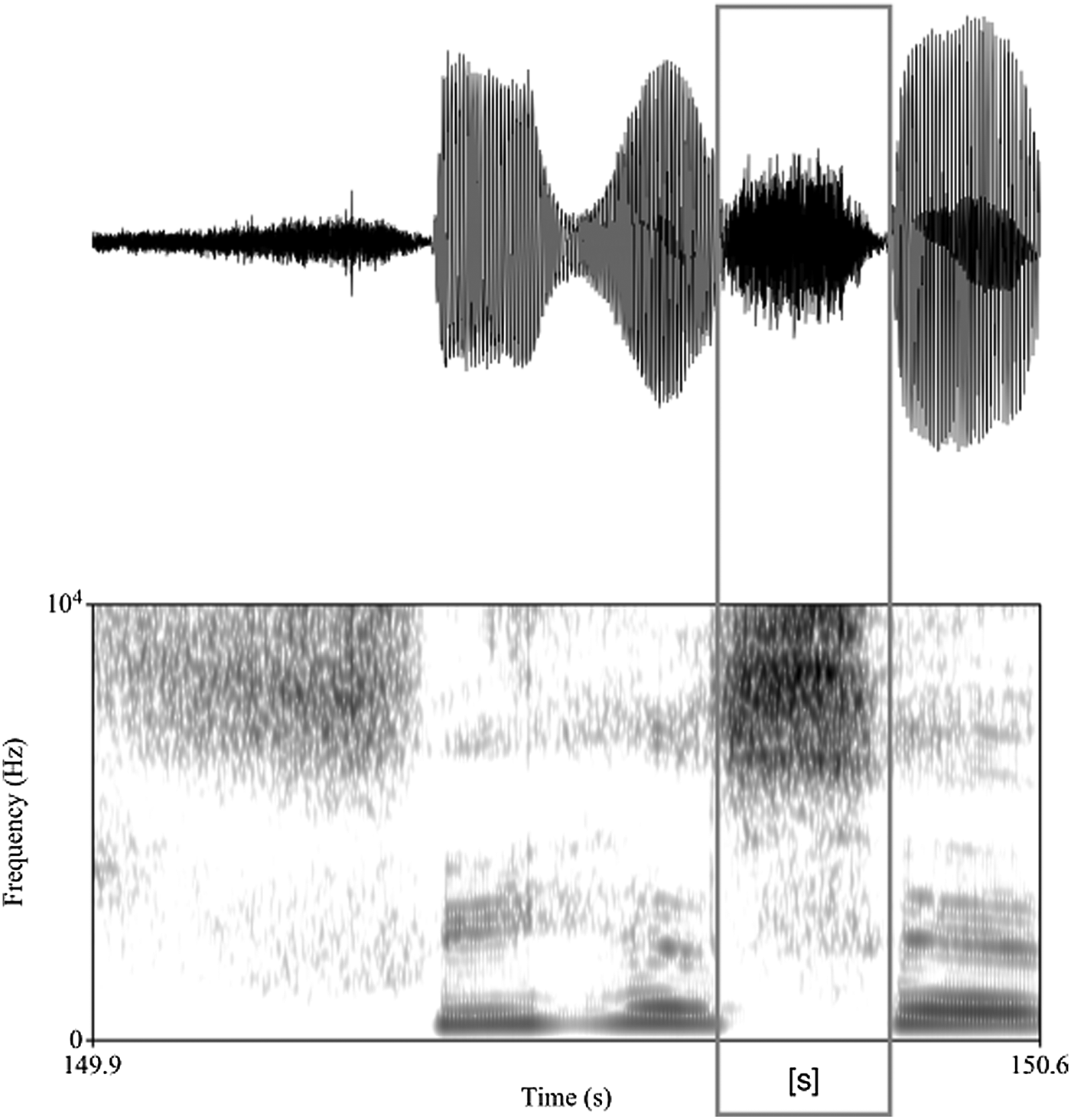
All tokens were coded for the linguistic and extralinguistic variables of interest as well as perceived allophone, which was determined via a series of acoustic criteria useful for differentiating fricatives (see Johnson, Reference Johnson2012:152–162). Sibilants were identified by the presence of fricative noise at high frequencies and amplitudes, produced by turbulent airflow through a tight oral constriction near the front of the vocal tract. Figure 1 shows a sample waveform and spectrogram of [s] in order to illustrate these criteria.
Spectrogram and waveform of [s] in fíjese [ˈfi.xe.se] ‘look’, produced by a younger woman from an urban community in Santa Ana.

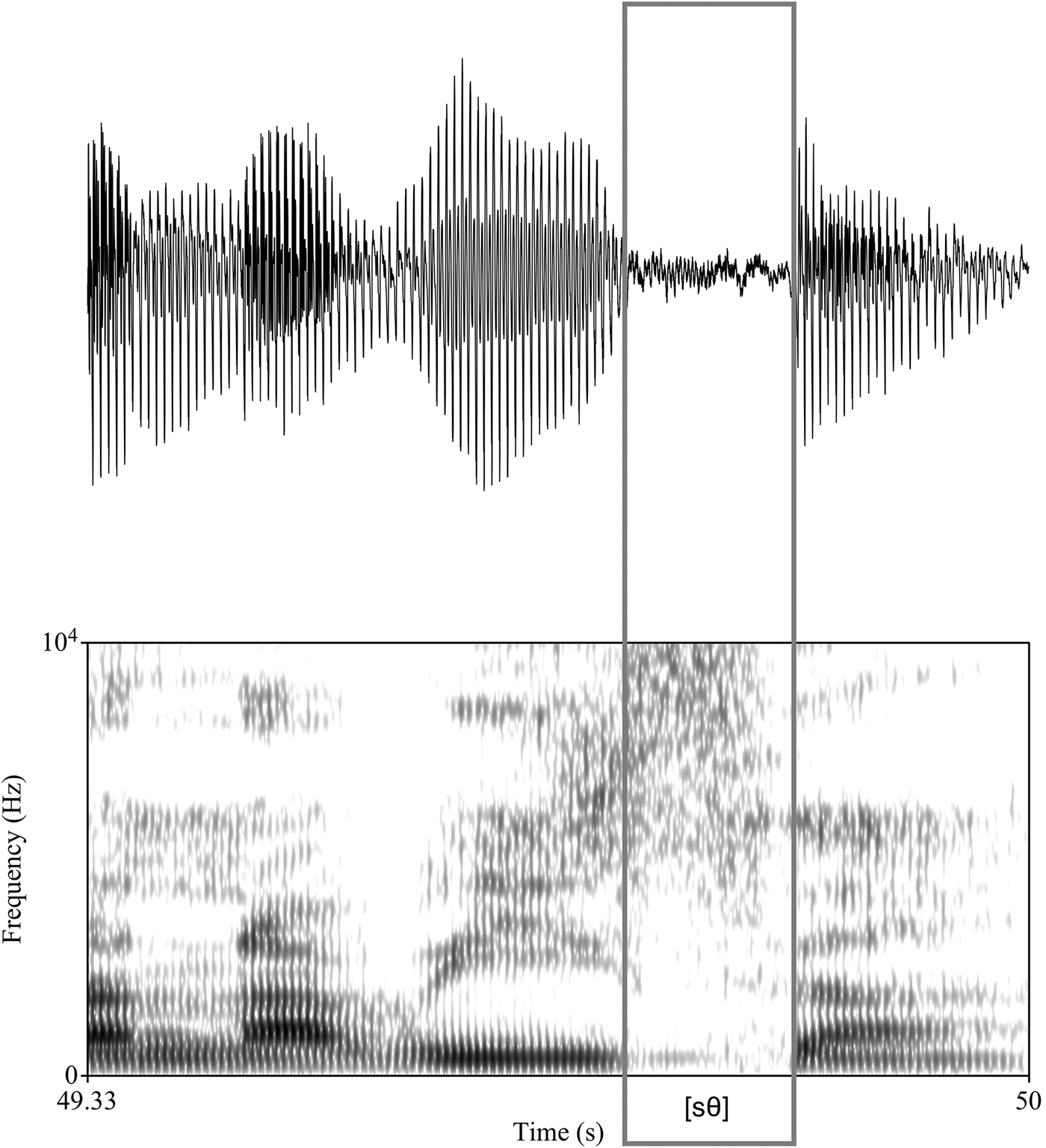
Tokens of [sθ] were identified based on the assertion that this sound results from some amount of gestural undershoot of /s/ (Brogan, Reference Brogan2018). We therefore expected tokens of [sθ] to have lower observed amplitude, due to the relaxation of the constriction between the tongue and the alveolar ridge as well as the slight separation of the upper and lower teeth created by the postdental position of the tongue. Similarly, we expected the frequencies of [sθ] to decrease as compared to [s], as the absence of obstruction by the upper and lower teeth results in a longer front cavity, resulting in lower resonant frequencies (Johnson, Reference Johnson2012:157). Figure 2 shows a token of [sθ], characterized by fricative noise that is lower in both frequency and amplitude than its sibilant counterparts.
Spectrogram and waveform of [sθ] in una visa [u.naˈβi.sθa] ‘a visa’, produced by a younger woman from a rural community in San Miguel.

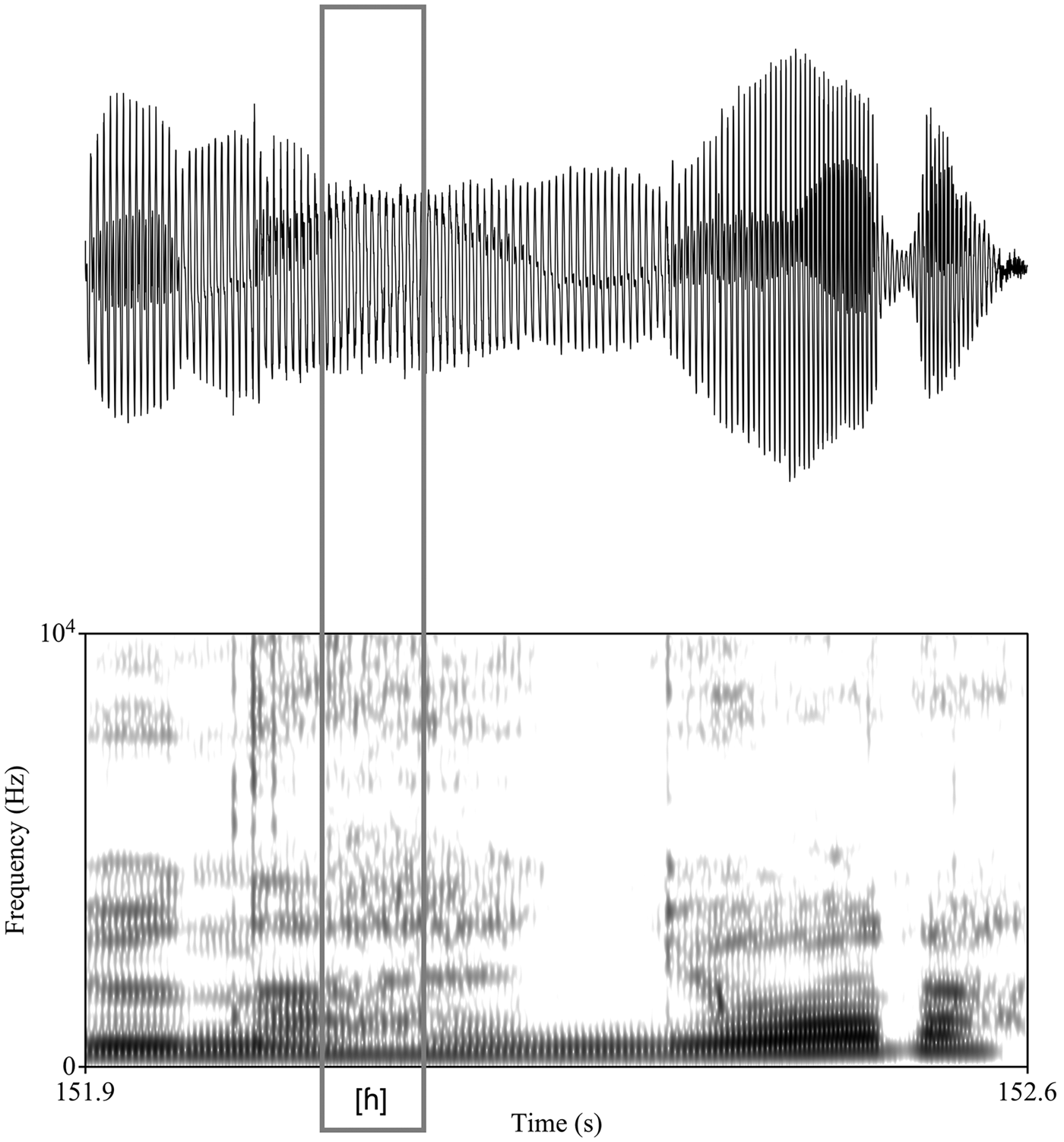
Finally, tokens of the glottal fricative were distinguished from other fricative allophones by an absence of high-frequency noise and the presence of formants similar to those of neighboring vowels. To segment [h]/[ɦ], we relied on aperiodicity in the waveform as well as the relative strength of formants visible in the spectrogram, both of which are key differentiators between glottal fricatives and vowels. These characteristics are illustrated in Figure 3.
Spectrogram and waveform of [ɦ] in una señora [u.na.ɦeˈɲo.ɾa] ‘a woman’, produced by a younger woman from a rural community in San Miguel.

Our first set of analyses of Salvadoran onset /s/ weakening examined the effect of predictors on the continuous measures of COG and duration. In an effort to capture the noise component of the fricative while excluding glottal pulsing, we ran a Hann low pass-band filter to eliminate frequencies below 750 Hz for all nonzero tokens following File-Muriel and Brown (Reference File-Muriel and Brown2011). Duration and COG measurements were then extracted using a script developed by Lars Hinrichs (Department of English, University of Texas, Austin) that measures COG at three points: one quarter, one half, and three quarters of the way through the segment. Following Erker (Reference Erker2010, personal communication), we then took the mean of these three measures as our continuous COG-dependent variable.
While other authors (cf. File-Muriel & Brown, Reference File-Muriel and Brown2011) included the additional measure of percent voicelessness in their analyses, we chose to exclude this correlate because the present study is exclusively concerned with weakening of the oral gesture required to produce the sibilant /s/. Furthermore, File-Muriel and Brown (Reference File-Muriel and Brown2011) found that percentage of voicelessness is the least informative measure when predicting acoustic variation based on linguistic factors that affect lenition.
Our second set of analyses mapped these acoustic measures onto perceived allophones to construct an ordered scale reflecting the gradient process of weakening.
Ordinal modeling
The fundamental goal of this approach is to capture the gradient nature of /s/ weakening and the importance of acoustic information while preserving potentially meaningful segmental distinctions. Crucially, this approach is able to represent gradience without relying entirely on instrumental measures that may be affected by articulatory factors unrelated to weakening.
An ordinal approach lends itself well to statistical analysis that can account for outcome variables that have more than two levels. These levels must have a natural or hierarchical order, though the exact distance between the categories is unknown (Norušis, Reference Norušis2012:69). For instance, outcome variables in an ordinal regression might be “small, medium, and large,” or students’ grades on a scale from A to F. In terms of the present data, we consider the allophones of /s/ to fall into four clusters on a phonetic/phonological constriction scale from most constricted (full sibilance) to least constricted (complete deletion). This approach also enables us to account for observed Salvadoran allophones that are not included in the traditional tripartite system.
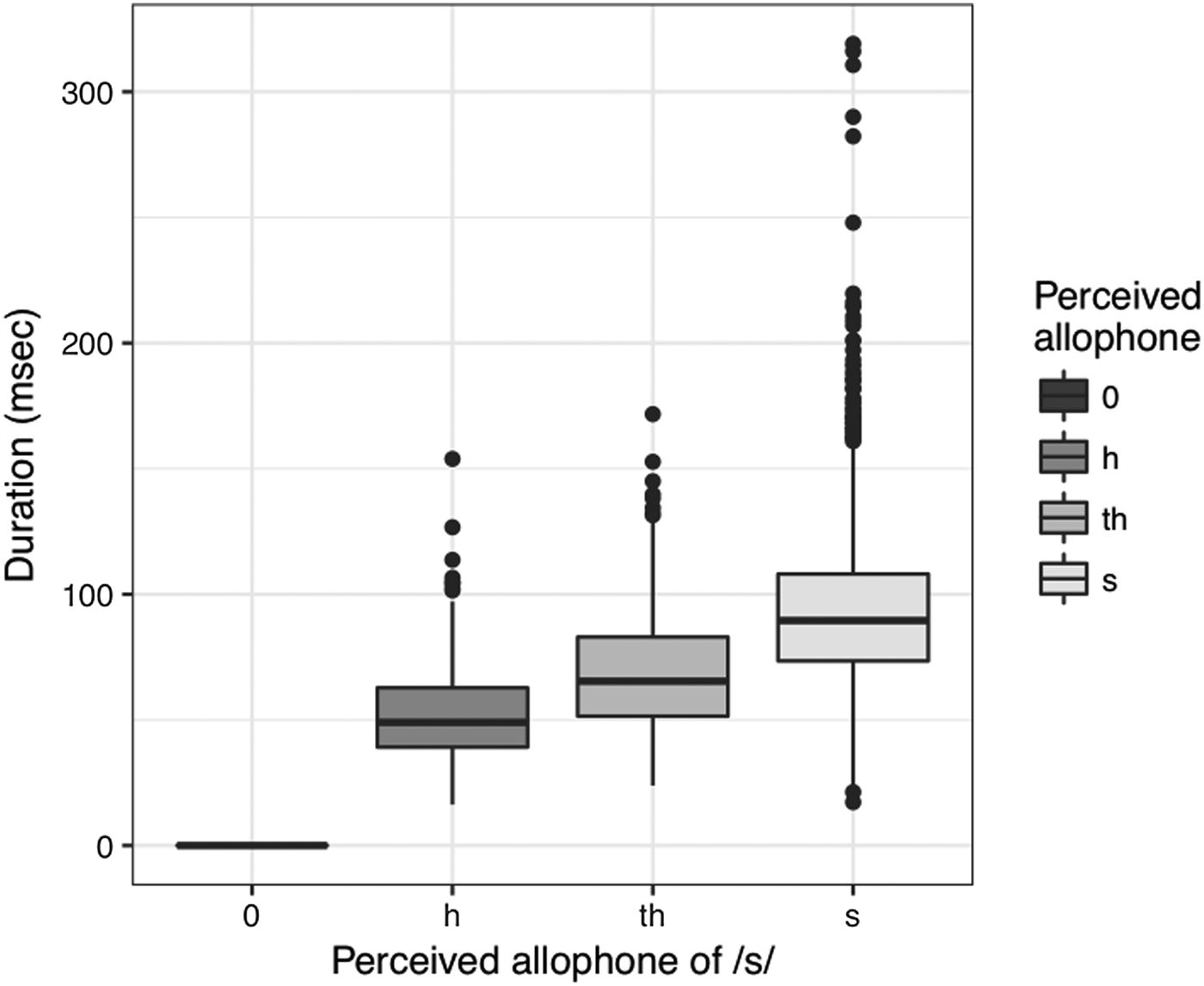
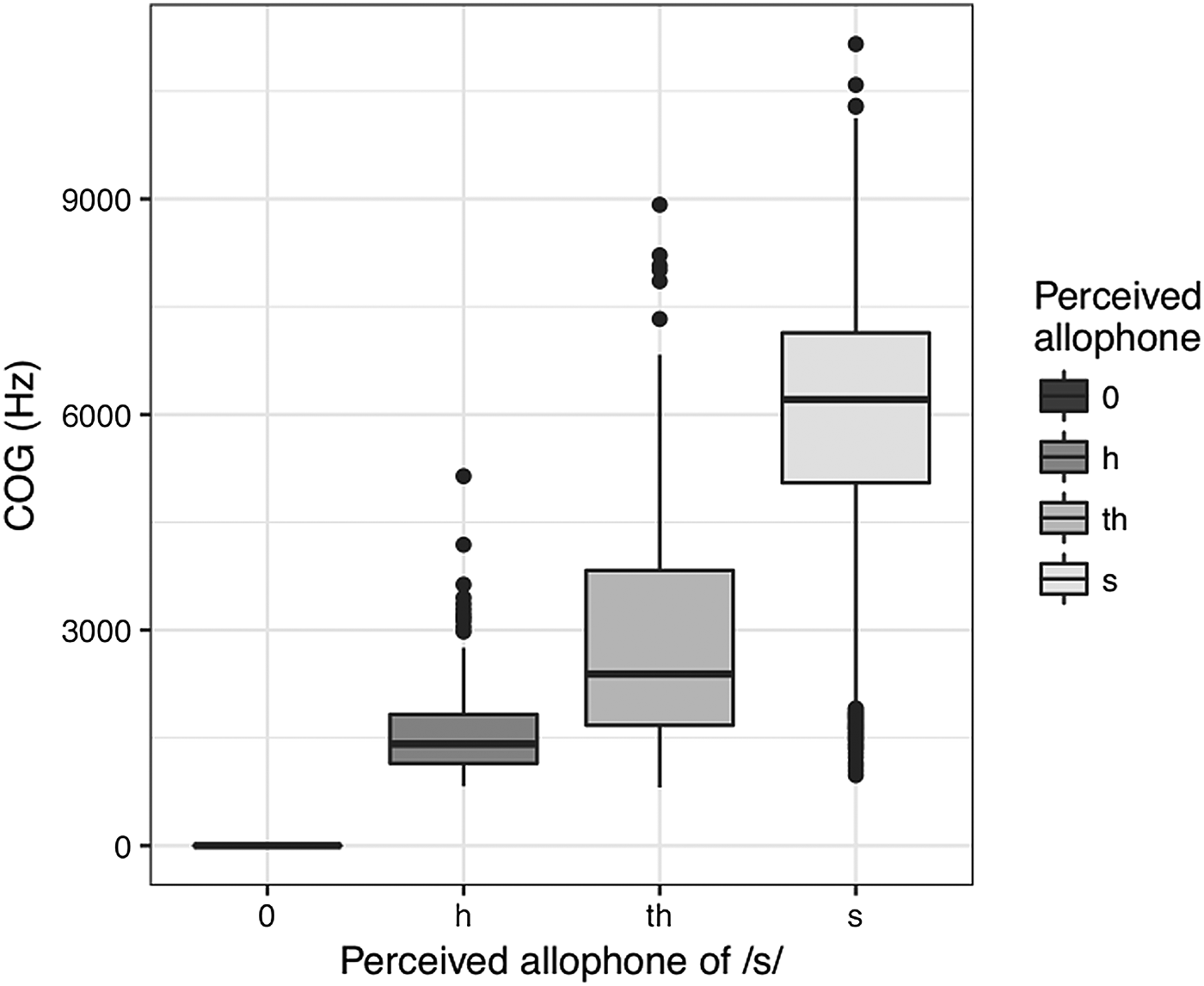
To determine the ordering of the remaining two variants, [h] and [sθ], within the scale anchored by [s] and [Ø], we plotted perceived allophone by the two continuous factors of duration and COG, shown in Figures 4 and 5. As readers will note, [h] has a shorter duration and a lower COG than [sθ] does. We therefore posit that the hierarchy of /s/ weakening is ordered in the following manner (Figure 6).
Perceived allophone of /s/ by duration (msec).

Perceived allophone of /s/ by COG (Hz).

Hierarchical ordering of transcribed allophones of /s/.

A coding schema for ordinal logistic regression faithfully represents the phonological process of weakening in that the endpoints of the scale are fixed, while the intermediate points may not be equidistant from one another as can be observed in Figures 4 and 5. Again, the crucial component of this scale is the ordering. We code our outcome variable for this regression using the scale shown in Figure 6, coding [s] as 0, [sθ] as 1, [h] as 2, and deletion as 3.
Again, the coding of perceived allophones for this data relies not only on authors’ perceptions, but also acoustic information as observed in spectrograms in Praat. Additionally, by utilizing continuous measures to determine the ordered levels for the allophones, we have aimed to operationalize and provide a replicable process for ordering of gradient phenomena.
Statistical analysis
To accurately compare the linear and ordinal analyses, we fed identical predictors and their interactions into each model. Categorical social predictors included region, urban versus rural place of origin, age group, gender, and education. Based on a combination of observations made during data collection as well as data visualization, we chose to include an interaction of region by origin. Generally, while rural and urban speakers in the San Miguel region weaken onset /s/ at similar rates, urban speakers in both Santa Ana and San Salvador are less likely to weaken /s/ than their rural counterparts.
Categorical linguistic predictors included word position (word-initial or word-medial), preceding segment, following segment, and tonicity (coded as pretonic, tonic, and posttonic). We binned preceding segment into phonological categories of pause, consonant, and vowel according to height. Based on the premise that more open flanking segments condition weakening (Kirchner, Reference Kirchner, Hayes, Kirchner and Steriade2004:323), we chose to include /i/ and /u/ vowels in the “high vowel” predictor category, mid vowels /e/ and /o/ in the “mid vowel” category, and /a/ alone in the “low vowel” category, anticipating that low vowels would favor weakening. These same three bins of “high vowel,” “mid vowel,” and “low vowel” were also used as the levels for the following segment predictor, and we categorized glides /j/ and /w/ as following consonants. Finally, all of the models included a random effect for speaker (in which each participant contributes their own random intercept).
In total, 3684 observations were included in the analyses. In the following sections, we present and compare the results of three models: two linear and one ordinal logistic.
RESULTS
Analysis 1. Linear models of /s/-weakening: Duration
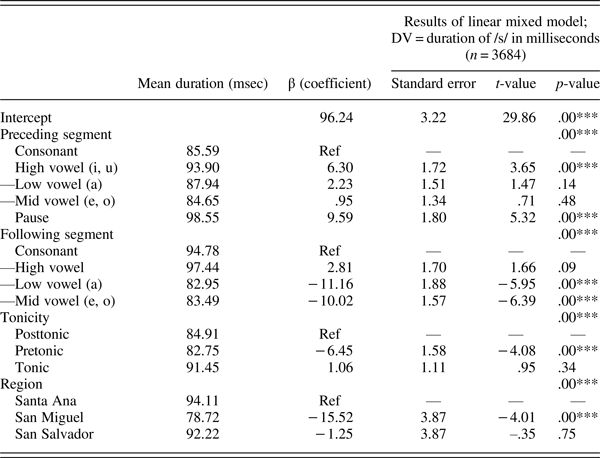
To determine what factors affect /s/ duration, and to what degree, we conducted a linear mixed-effects model (lmer) using the lme4 package (Bates, Maechler, Bolker, & Walker, Reference Bates, Maechler, Bolker and Walker2015) in R (R Core Team, 2015). All figures were created using the ggplot2 package (Wickham, Reference Wickham2009). Table 2 shows the best fit results of the first linear model, and the p-values shown for each predictor were obtained via likelihood ratio tests.
Linear mixed model results: Duration

***p < .001. Dashes indicate reference level of variable.
The only social predictor selected by this model as significant was region, while linguistic predictors of preceding segment, following segment, and tonicity were all included in this model. We used simple effects tests as described in Bretz, Hothorn, and Westfall (Reference Bretz, Hothorn and Westfall2011:108–111) via the glht function in the multcomp package (Hothorn, Bretz, & Westfall, Reference Hothorn, Bretz and Westfall2008) to determine the differences between the various levels of the categorical predictor variables. The duration of /s/ is longest when preceded by a pause, but is not significantly longer than an /s/ preceded by a high vowel. In other words, the /s/s in su /#su/ ‘his/her/their’ and hice /ise/ ‘I did’ do not significantly differ in duration, but are significantly longer than an /s/ following a consonant as in bolsa /bolsa/ ‘bag’, a mid vowel as in eso /eso/ ‘that’, and a low vowel as in así /asi/ ‘that way’. We expected a longer duration of /s/ following a pause (in utterance-initial position) due to studies that have shown that sounds at the initial edges of domains are more likely to be strengthened (Fougeron, Reference Fougeron1999; Ito, Reference Ito1986; Keating, Reference Keating, Harrington and Tabain2006; Turk, Satsuki, & Suguhara, Reference Turk, Satsuki, Suguhara, Sudhoff, Lenertová, Meyer, Pappert, Augurzky, Mleinek, Richter and Schließer2006; Wightman, Shattuck-Hufnagel, Ostendorf, & Price, Reference Wightman, Shattuck-Hufnagel, Ostendorf and Price1992). Contrastingly, while we would perhaps expect a shortening of /s/ to occur given that /i/ and /u/ are also high vowels, facilitating articulatory overlap, this is only true for realizations of /s/ categorized as [s], since neither [h] nor [Ø] require oral constriction. Therefore, it is possible that realizations of [s] are, in fact, shorter after high vowels, but this reality is obscured because /s/ was seldom deleted after /i/ and /u/ in our data. As a result, the overall mean duration of /s/ following /i/ and /u/ is deceptively high.
Similarly, duration of /s/ is affected by the following segment. Specifically, a following low or mid vowel (as in casa /kasa/ ‘house’ or son /son/ ‘they are’) is associated with a significant shortening of an onset /s/ as compared to an /s/ before a high vowel or a consonant (as in casi /kasi/ ‘almost’, or suelo /swelo/ ‘floor’).
Interestingly, the onset /s/ of a tonic syllable and of a posttonic syllable do not significantly differ in duration, but both are significantly longer than the /s/ of a pretonic syllable. That is, the onset /s/ in hicimos /isimos/ ‘we did’ and the /s/ in interesa /inteɾesa/ ‘interests’ have approximately the same duration, while the /s/ in presidente /pɾesidente/ ‘president’ is significantly shorter.
Finally, according to the model, duration of /s/ differs according to region of origin of the speaker. Specifically, speakers in San Miguel produce their onset /s/ as significantly shorter than speakers in both Santa Ana and San Salvador. In other words, this model demonstrates that San Miguel speakers are more likely to produce shortened onset /s/s, which is conceived of as weakening in instrumental approaches.
Via the use of the rand function from the lmerTest package (Kuznetsova, Brockhoff, & Christensen, Reference Kuznetsova, Brockhoff and Christensen2017), we see that the random effect of participant is statistically significant (χ2(1) = 556, p < .001). This tells us that there is high variability across each participants’ production of /s/ duration, suggesting that there are other important but unknown explanatory variables that contribute to each subject's different production of /s/ (Seltman, Reference Seltman2015:372).
In sum, this linear model revealed that the linguistic predictors of surrounding segment and tonicity condition onset /s/ duration in this dialect, and /s/ duration is also conditioned by region of origin of the speaker. No other differences in duration were found based on the social predictors of age, gender, or rural versus urban place of origin.
Analysis 2. Linear models of /s/ -weakening: COG
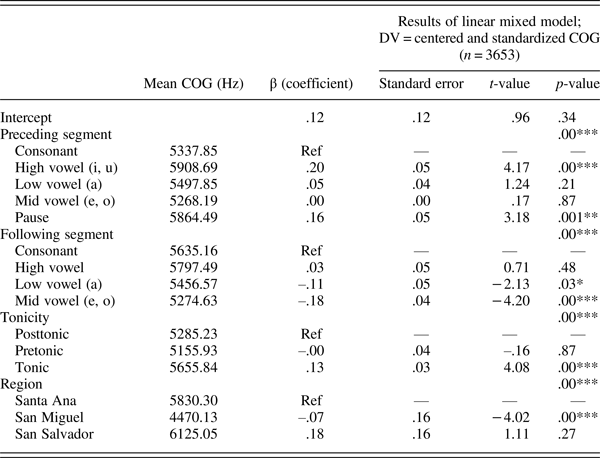
To examine weakening as reduction in constriction, we excluded 31 deletions of onset /s/ from the data set, since these have an undefined COG (following Erker, Reference Erker2010), leaving 3653 observations. Additionally, to account for anatomical differences between men and women, the dependent variable for this model is centered and scaled COG based on speaker sex. The best model fit for this data was again one that included only the predictors of preceding and following segment, tonicity, and region of speaker origin, in Table 3.
Linear mixed model results: COG

*p < .05; **p < . 01; ***p < . 001. Dashes indicate reference level of variable.
The same predictors condition onset /s/ COG as onset /s/ duration, though the simple effects tests reveal some differences among the predictor levels. Again, in reference to the preceding segment, the highest centers of gravity are found when an onset /s/ is in utterance-initial position and when it follows a high vowel. A preceding low vowel, consonant, and mid vowel all have significantly lower centers of gravity than the preceding high vowel and pause, but there are no significant differences found among this group. In other words, onset /s/ in sintió /sintjo/ ‘she/he felt’ has a significantly higher center of gravity than onset /s/ in sacar /sakar/ ‘to take out’. Again, utterance-initial strengthening is expected. Though to our knowledge no study has previously demonstrated a correlation between a preceding high vowel and fricative COG, we assume based on previous findings that a high vowel's COG raises the onset /s/ COG due to coarticulation. For instance, Carney and Moll (Reference Carney and Moll1971) and Soli (Reference Soli1981) have shown that when a fricative segment in English is followed by a high vowel, the fricative has a higher COG.
As in the duration model, an /s/ followed by a mid or low vowel has a significantly lower center of gravity than an /s/ followed by a high vowel or a consonant. For example, the /s/ in hacer /aser/ ‘to do/make’ is significantly shorter than the /s/ in sí /si/ ‘yes’ when taking all other factors into account.
The model also showed that the onset /s/ in a tonic syllable has a significantly higher center of gravity than an onset /s/ in either a pretonic or posttonic syllable. Unlike the duration model, which showed no difference in duration between a tonic /s/ and a posttonic /s/, the onset /s/ in hicimos /isimos/ ‘we did’ is shown to have a significantly higher center of gravity than both the /s/ in interesa /inteɾesa/ ‘interests’ and the /s/ in presidente /pɾesidente/ ‘president’.
Finally, as in the duration model, speakers in the San Miguel region are significantly more likely to produce onset /s/ with a lower center of gravity than speakers in both other regions. Additionally, as in the duration model, the random effect of participant was found to be a significant conditioner of variance across participants via an analysis of random effects (χ2(1) = 1281, p < .001).
In sum, the linear model taking standardized COG values as its dependent variable revealed that COG lowering is conditioned by the identity of the segment preceding and following onset /s/, whether onset /s/ is in a stressed syllable, and what region of El Salvador the speaker is from. This model did not reveal any significant differences in COG based on the age, gender, education, or rural versus urban origin of the speaker.
Summary: Linear models
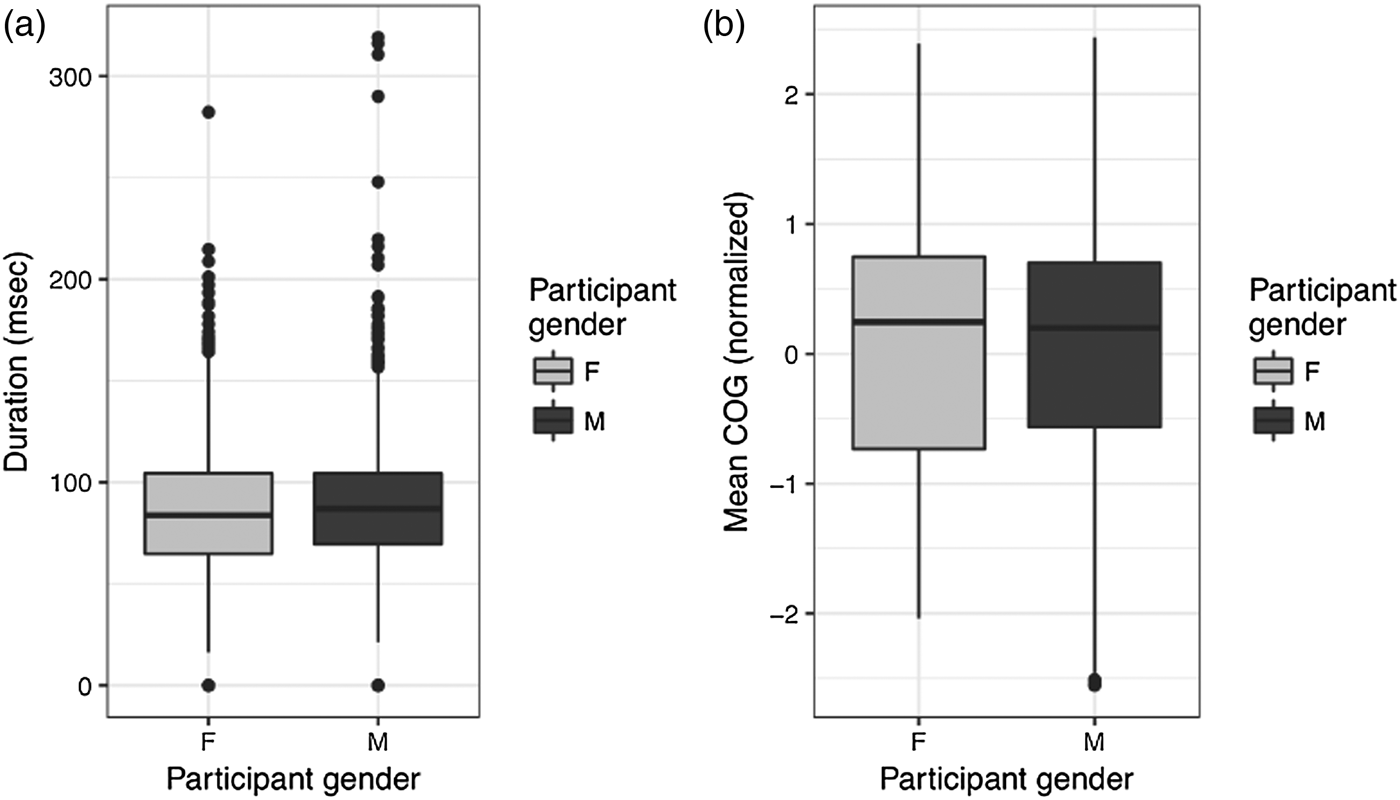
Thus far, we have identified the linguistic and social factors that condition duration and COG of onset /s/ in El Salvador. Both models found that linguistic predictors of flanking segments and stress affected acoustic correlates of onset /s/ weakening, and that speakers in the San Miguel region produce their onset /s/ with significantly shorter duration and lower COG. Neither linear model revealed age, gender, education, or rural versus urban place of origin to condition either acoustic measure. However, because the linear analyses rely on comparisons of means, potential differences attributable to demographic factors may have been obscured. For instance, consider Figures 7 and 8. According to Figure 7, there is no difference in how men and women produce onset /s/ according to the measures of duration and COG.
Onset /s/ production according to instrumental measures and speaker gender.

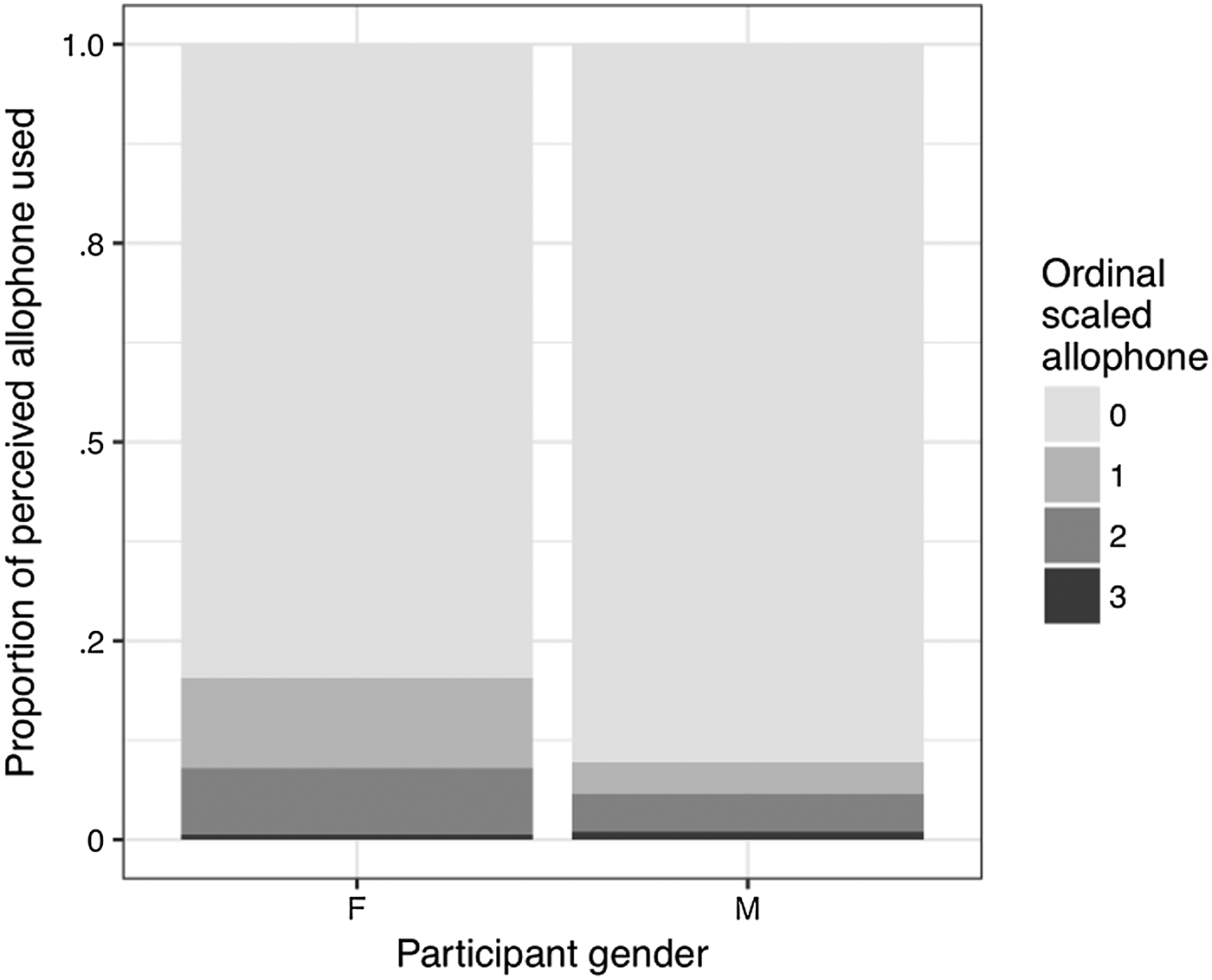
Onset /s/ production according to perceptual allophones and speaker gender.

According to Figure 8, however, when comparing production of onset /s/ via perceived allophone, we see that men are more likely to use standard overt [s] as compared to women. Women, on the other hand, are more likely to use [sθ] and [h] in onset position, allophones that we posit may be associated with a social stigma. Neither of the linear models accounted for these distinctions.
Additionally, allophonic variation of /s/ has been shown to have social meaning in other dialects of Spanish, and we hypothesize that the same holds true for this dialect. Using an exclusively instrumental analysis to examine variation of onset /s/ in this paper therefore obscures the potential social meaning of onset /s/ weakening in El Salvador.
In light of the discussion thus far, we present the ordinal logistic analysis of the same data that unites what we know about weakening (in this case, as loss of gesture or degree of constriction and reduction in duration) with what we know about how continuous acoustic measures are mapped onto speech segments.
Analysis 3. Ordinal modeling of /s/ weakening
Whereas a binary regression compares level 0 to level 1 with no assumptions about their ordering relationship, the ordinal regression treats all of these levels as dichotomous comparisons. In other words, an ordinal regression with four levels of the outcome variable can be interpreted as a grouping of three comparisons:
- (1)
Level 0 as compared to levels 1, 2, and 3
Levels 0 and 1 compared to levels 2 and 3
Levels 0, 1, and 2 compared to level 3
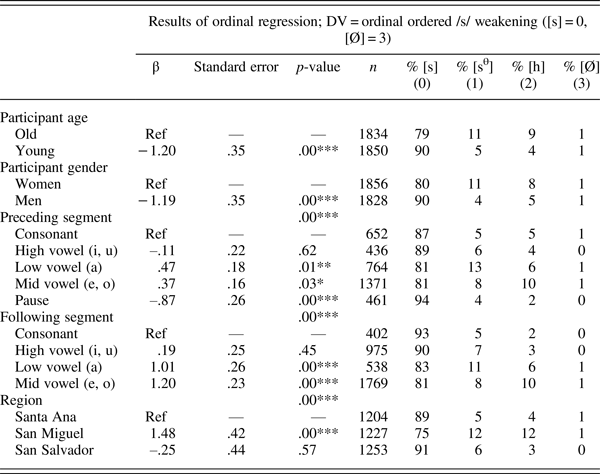
Therefore, if the coefficient is positive, the outcome can be conceived of as moving up on the scale of weakening (from 0 → 3, or from a more complex gesture to a less complex, weaker gesture). That is, this regression calculates the odds of being in a progressively weaker category, assuming that 0 is the strongest, most constricted /s/, and 3 is the weakest, least constricted /s/. The model first calculates the odds of being an overt sibilant [s] as compared to any weakened version; then sibilant [s] and [sθ] as compared to [h] and [Ø]; then finally [s], [sθ], and [h] as compared to [Ø]. The coefficient in Table 4 provides a combination of the proportional odds of each of these outcomes, so these can be interpreted in the same way as a logistic regression (that is, exponentiating the coefficient to determine the proportional log odds of a one-unit change). A positive coefficient indicates increased odds of being in a significantly weaker category, or moving up on the scale from constricted → less constricted. A negative coefficient indicates increased odds of being in a lower category, or more constricted.
Ordinal regression results

*p < .05; **p < .01; ***p < . 001. Dashes indicate reference level of variable.
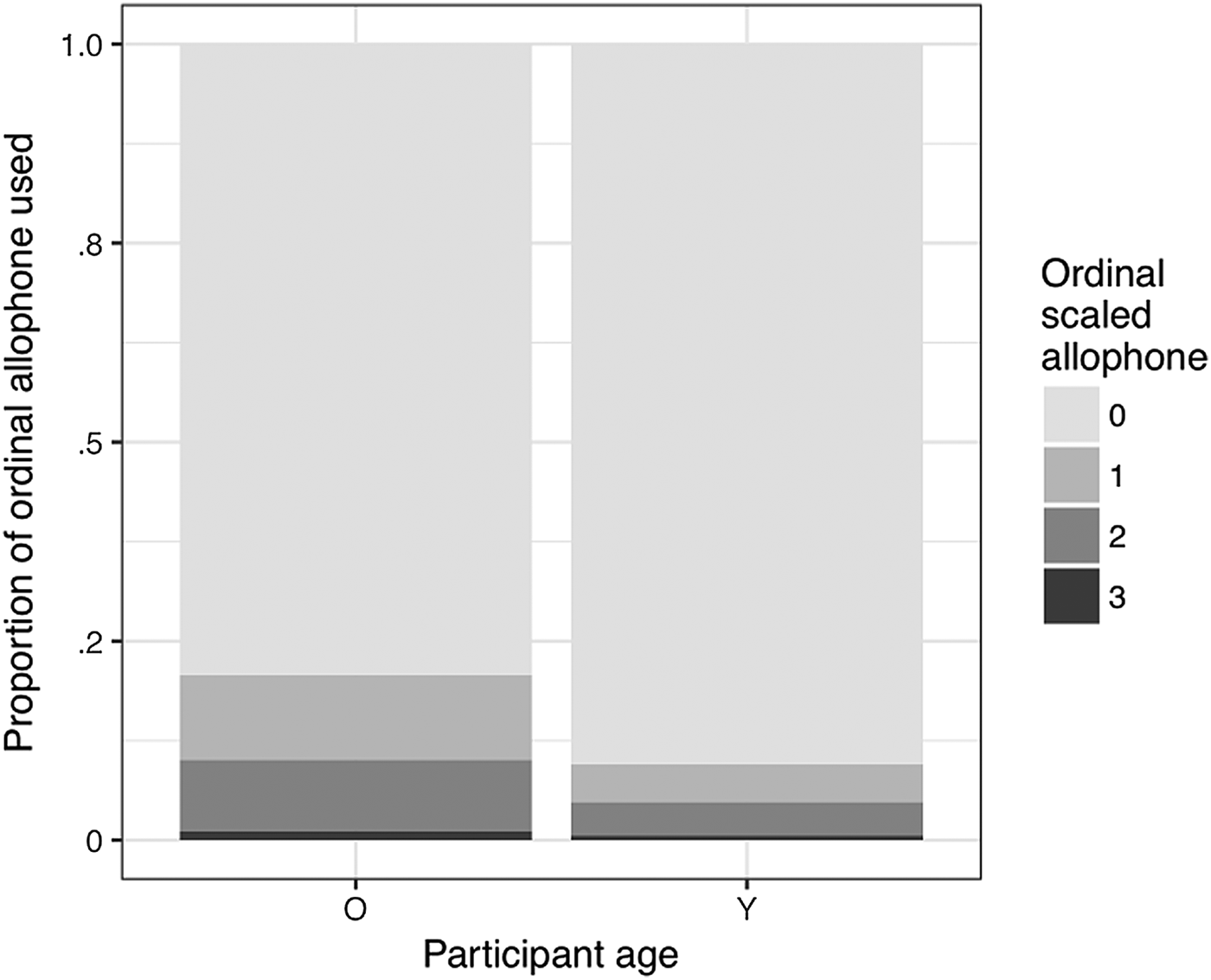
To model this analysis, we use here a proportional odds model (cumulative link mixed model, clmm) from the ordinal package in R (Christensen, Reference Christensen2015), including all of the predictors used in the logistic model and a random effect of participant. Table 4 shows the results of the best fit ordinal logistic regression. As in a logistic regression, for a one-unit increase of a predictor (or a change from one level of a categorical variable to another), the odds of weakening are the exponentiated coefficient, or the proportional odds ratio. For instance, the model shows a coefficient for the predictor age:Young to be −1.20. The negative coefficient tells us that young speakers are more likely to produce /s/ as lower on the scale, or as more constricted, than older speakers. Calculating eß, or exponentiating −1.20 using the exp() code in R, returns a value of .3. Therefore, a young person is about 30% less likely to weaken onset /s/ as compared with an older person. This effect can be visualized in Figure 9.
Effect of age on ordinal onset /s/ weakening.

As can be observed, overall, younger speakers are significantly less likely to use weakened allophones of onset /s/ than older speakers. This points to a standardizing effect as a potential change in progress, as proposed by Brogan (Reference Brogan2018), whereby use of a voiceless sibilant [s] as onset /s/ in El Salvador is perceived by younger speakers as prestigious, perhaps due to the many Salvadorans returning from the United States following sustained contact with majority Mexican Spanish speakers (Parodi, Reference Parodi, Colombo and Soler2005, Reference Parodi and Butragueño2011), as well as the potential standardization effects of globalization on a dialect that has been historically isolated. If this hypothesis is correct, this could be a case of linguistic change from above (cf. Labov, Reference Labov2001:81–83), which often represents borrowings from other speech communities that were deemed prestigious.
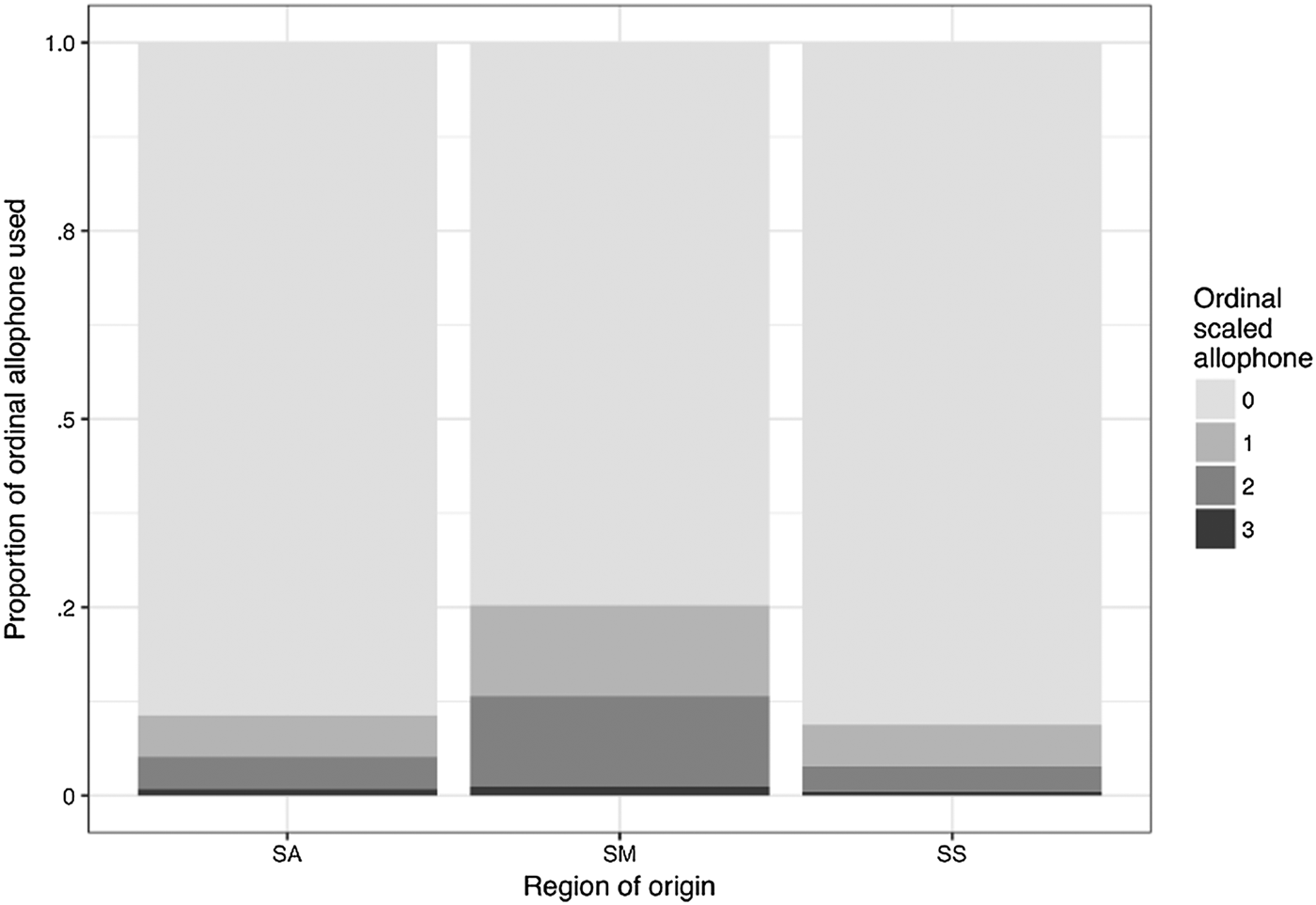
Providing further evidence that this may be a change from above, speakers from the region of San Miguel are nearly 4.5 times more likely to reduce their onset /s/ than are speakers from the more prestigious Santa Ana and San Salvador regions (p < .001). This effect can be visualized in Figure 10.
Effect of region of origin on onset /s/ weakening on the ordinal scale.

In other words, onset /s/ reduction is indexed with lower social status. According to Brogan (Reference Brogan2018), onset /s/ reduction in the stigmatized San Miguel region is unsurprising given that speakers throughout the San Miguel region are considered by themselves and by the other participants to be uneducated and low class.
Unlike previous studies of changes in progress in which young women typically lead the change (cf. Labov, Reference Labov2001:261–293), in this study we find that women are about 30% more likely to weaken onset /s/ than men are (p < .001). In other changes from above (cf. Labov, Reference Labov2001:261–293), women have been found to use the more standard variant, but here, it is men using the more prestigious sibilant [s] variant, exemplifying fewer instances of onset /s/ weakening. We posit that this is due to the increased movement of men as compared to women between El Salvador and the United States, as attested throughout the sociolinguistic interviews. Salvadoran informants overwhelmingly reported having more male than female family members and friends in the United States. (Given the difficulty of accounting for undocumented individuals in official documentation, these observations are difficult to corroborate, but in 2008, of all the Salvadoran foreign-born legal permanent residents in the United States, over 60% were men [Terrazas, Reference Terrazas2009]). The United States is a site of rich dialect contact, and many Salvadorans in the United States come into contact with speakers of Mexican Spanish and other more prestigious /s/-retaining dialects, resulting in dialectal accommodation over time (Parodi, Reference Parodi, Colombo and Soler2005, Reference Parodi and Butragueño2011). If these speakers return to El Salvador or maintain transnational relationships with friends and family, these dialectal changes might permeate particular speech communities in the home country.
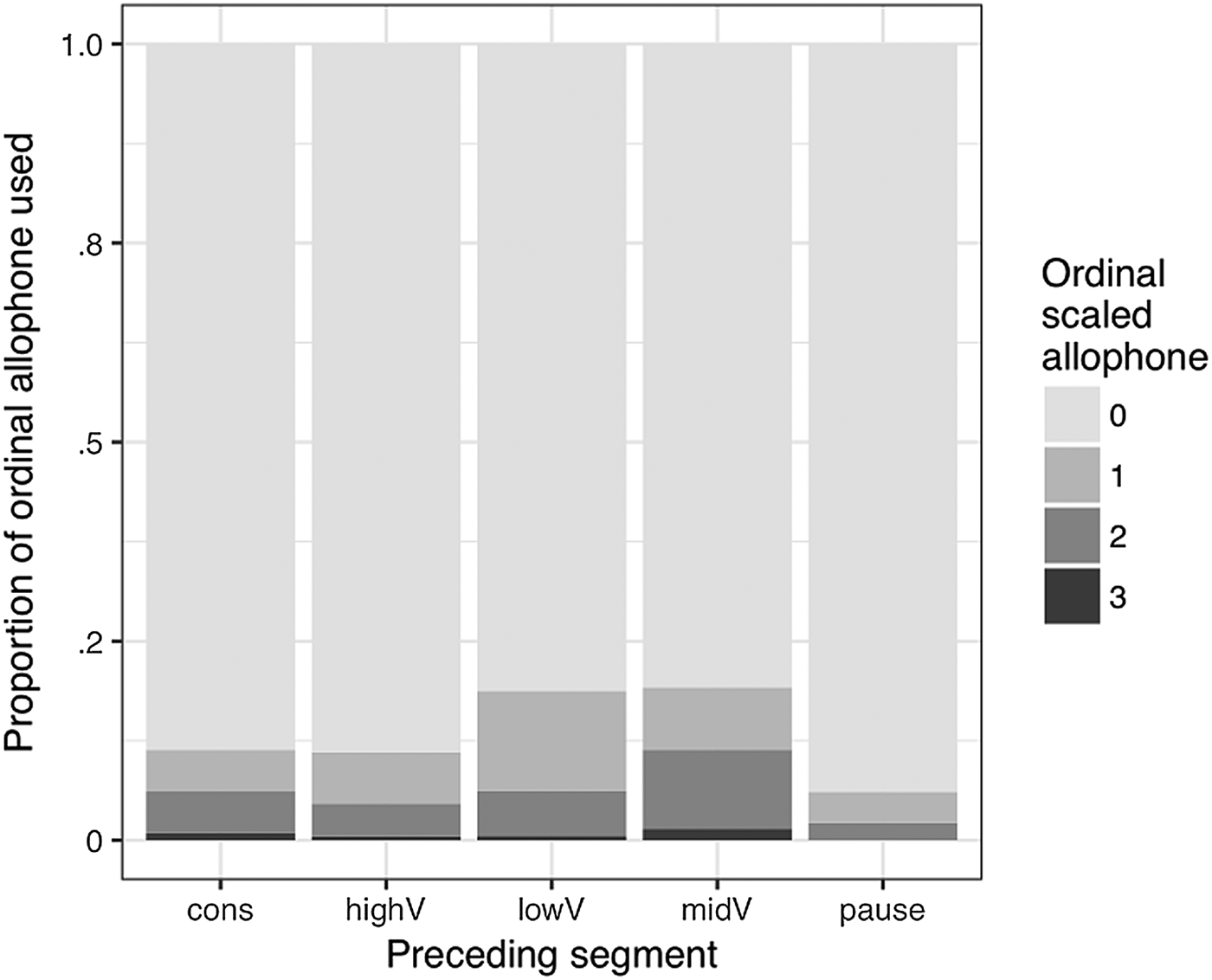
Turning now to linguistic predictors, this model finds that onset /s/ is most likely to be strongest in utterance-initial position, shown in Figure 11. This aligns with the findings of the continuous models presented in this paper. However, the linear models also showed that there were no significant differences in either duration or COG between a preceding pause and a preceding high vowel. In this ordinal model, however, we do not find the same effect. Rather, an utterance-initial /s/ is most likely to be strong, whereas a preceding high vowel and a preceding consonant occasion onset /s/ weakening at about twice the rate of a preceding pause, while an onset /s/ following low or mid vowels is most likely to weaken. This demonstrates that the apparent strengthening effect of a preceding high vowel observed in the linear models may be overstated.
Main effect of preceding segment on onset /s/ weakening on the ordinal scale.

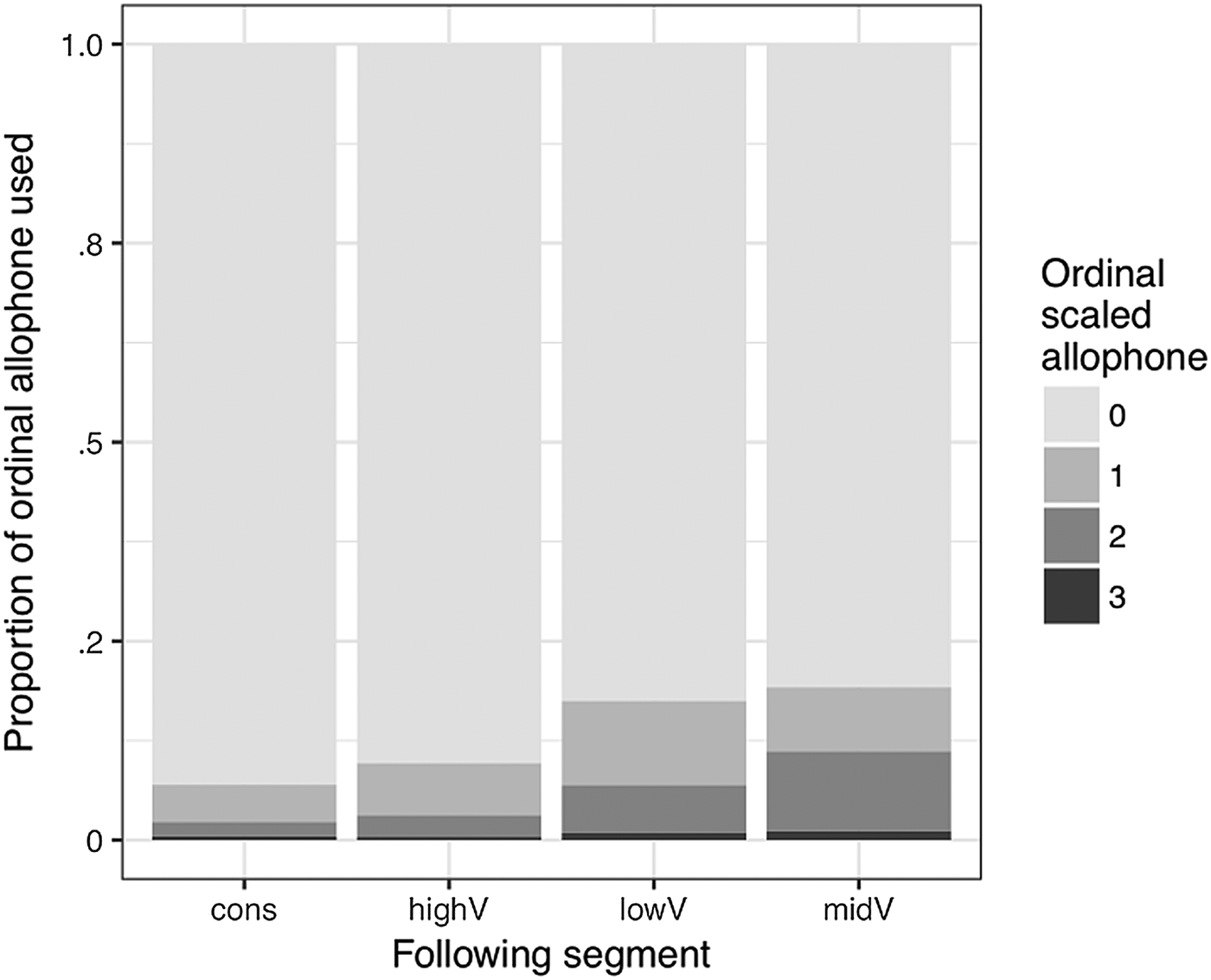
The results of the following segment predictor align perfectly with those of the two linear models. That is, an onset /s/ is more likely to be retained when followed by a consonant or a high vowel and significantly more likely to weaken when followed by a low or mid vowel as seen in Figure 12.
Main effect of following segment on onset /s/ weakening on the ordinal scale.

Unlike the linear models, the ordinal model did not select tonicity to be a significant conditioning factor for onset /s/ weakening, leading us to wonder whether the strengthening effect of stress is less related to phonological weakening and more to factors of prosodic prominence.
Summary: Ordinal logistic regression
The ordinal regression statistically verifies the hypotheses made on the basis of data exploration, demonstrating that onset /s/ weakening is associated with older speakers, women, and speakers from the region of San Miguel. We therefore posit that a standardization is taking place, led by young men residing in regions outside of San Miguel.
The most evident shortfall of the ordinal logistic regression (and indeed, any analysis that categorizes this segment) is the a priori segmentation and categorization of the allophones of /s/. However, as discussed, listeners have been shown to be sensitive to this allophonic variation.
Additionally, this type of model more closely adheres to the phonological weakening process: there is a weakening scale between the strongest, most complex segment, and the weakest, least complex segment, or, in this case, phonetic zero. Crucially, while the levels must be ranked in some natural order, the distance between each level is not clearly defined in an ordinal regression. This configuration closely mirrors the theoretical characteristics of /s/ weakening: while a given phonetic realization can be defined as weaker or stronger than another, the “distance” between the two outcomes is difficult to quantify. In other words, is it the case that the distance between [s] and [sθ] is the same as that between [sθ] and [h]? Additional studies using articulatory imaging technology would be required to further investigate this line of inquiry, though interspeaker and intra-allophone variation may render this an impossible question to answer. This theoretical consideration is extremely important. While it would be possible to convert the ordinal variable into an interval variable and simply run the analysis as a linear regression or mixed model, which is easier to interpret, this model would assume equal distance between each level on the 0 to 3 scale.
Additionally, the levels of the dependent variable were assigned by taking into consideration both theoretical conceptions of weakening as well as acoustic correlates that may reflect this phonological process: reduction in duration and lowering of COG. Future studies of sibilant weakening may benefit from this procedure, particularly for researchers of gradient phenomena that tend to cluster in more than two allophonic groups, as is the case for /s/ weakening in Spanish. That is, the ordinal logistic regression enables us to account for the importance of multiple perceptual categories.
CONCLUSION
In this paper, we have contributed new information regarding the social and linguistic conditioners of /s/ weakening in both an understudied dialect of Spanish and an understudied prosodic position. Furthermore, this paper has proposed an approach to /s/ weakening that is both theoretically and practically sound. An ordinal approach treats weakening as a gradient process in which a given output is “weaker” or “stronger” relative to another. Additionally, the procedure used to determine the ordering of allophones from 0 to 3 in the ordinal model acknowledges the importance of acoustic parameters in constructing a speaker/hearer's notion of what a segment is without relying on them exclusively. Perhaps most importantly, this approach is equipped to capture important social distinctions in onset /s/ production that may be obscured by linear models. This method is particularly well equipped to analyze weakening of Salvadoran onset /s/, which shows variation beyond a traditional tripartite system. We have demonstrated that onset /s/ weakening is associated with older, rural, women, and speakers from a stigmatized region of El Salvador and posited that young men are leading a change toward standardization of /s/ production. This process, which unites the phonetic and phonological aspects of weakening with a recognition of the importance of social indices, presents a potential approach for analyzing other gradient phonological phenomena.