Introduction
Cooperation between governments has attracted substantial attention from political scientists. A particular instance in which academic interest has increased noticeably since the early 1990s has been cooperation between European Union (EU) member states in matters of defence (Howorth, Reference Howorth2007; Jones, Reference Jones2007; Mérand, Reference Mérand2008). Almost 40 years after the abortive attempt to establish the European Defence Community, the Treaty on European Union (TEU) contained the first official reference to the progressive framing of a common European defence policy and encouraged member states to supplement this path with economic cooperation in the field of armaments.
European defence cooperation was thus to consist of two processes that would not have to be simultaneous, but have been considered complementary. The first concerns the political coordination of foreign policies among governments, whereas the second appertains to matters of economic cooperation in armaments research, development, production, standardization, procurement, or trade. However, while the political path has caught the academic limelight, economic aspects of that coordination have been neglected. This imbalance stands in need of redress for two reasons. First, an unprecedented consolidation of defence industries within and across national borders over the past 15 years has been accompanied by the emergence of a complex landscape of formalized intergovernmental fora (Schmitt, Reference Schmitt2003: 12).Footnote 1 While the former has represented a fundamental reorganization of the supply side, the latter is nothing less than a concerted effort to restructure the demand side of defence (Törnqvist, Reference Törnqvist2001). Second, the drive towards political cooperation has been inevitably linked to cooperation on armaments from the start, without which its benefits would not be fully realized. However, EU member states have responded differently to opportunities for restructuring the demand side. The question this study attempts to answer is why they have done so.
It has become a truism among political scientists that international phenomena cannot be fully comprehended without combining conditions found at the domestic and international level (Putnam, Reference Putnam1988; Evans, Reference Evans1993; Moravcsik, Reference Moravcsik1997). This observation is specifically true for armaments cooperation, a policy domain that straddles the traditional demarcation line between the ‘high politics’ of security and the ‘low politics’ of economics (Taylor, Reference Taylor1990; Liberman, Reference Liberman1996; Mörth and Britz, Reference Mörth and Britz2004). Moravcsik (Reference Moravcsik1993a, Reference Moravcsikb), Kapstein (Reference Kapstein1991), Kocs (Reference Kocs1995), Taylor (Reference Taylor1982) and Tucker (Reference Tucker1991), for instance, show how international cooperation has been shaped by ‘competing imperatives’ in conflicts of interest between governments and firms. In contrast, Legro (Reference Legro1996), Mawdsley (Reference Mawdsley2000), and Mörth and Britz (Reference Mörth and Britz2004) imply that any analysis of the interest formation process preceding intergovernmental cooperation is incomplete without allowing for the influence of culture. These authors illustrate that combinations of conditions can provide a fuller explanation, but they disagree about their composition and weighting.Footnote 2
Instead of narrow pre-selection, an alternative strategy is to associate a wider set of perspectives with the outcome, and let the empirics identify which single condition, or combination of conditions, fits the data best (cf. Koenig-Archibugi, Reference Koenig-Archibugi2004). As Wendt stresses in this regard, ‘Realism does not have a monopoly on the ugly and brutal side of international life’, so ‘treating ideas and material conditions as separate but inevitably linked phenomena is a way of disentangling their respective effects’ (Wendt, Reference Wendt1995: 76; Reference Wendt2000: 167). In like manner, Mearsheimer (Reference Mearsheimer1990) holds that when the omission of Realist variables is corrected, liberal reasoning will collapse. There are two decisive advantages in using a more eclectic approach. First, the risk of omitting potentially important conditions that fall outside the realm of a single paradigm is reduced, which may lead to what econometricians call omitted-variable bias and psychologists refer to as confirmation bias.Footnote 3 Although competing theories are often included, these do not always stand on an impartial analytical footing. As Checkel (Reference Checkel2008: 120) puts it, ‘[i]f they are honest, most scholars will admit to having favourite theories’. Such treatments, however, are akin in effect to creating confirmation bias.Footnote 4 Second, the possibility that different models can be combined opens up the space for distinct, combinatorial pathways to one and the same outcome, a situation referred to as ‘equifinality’, ‘substitutability’, or ‘multiple conjunctural causation’ (Ragin, Reference Ragin2000: 104; George and Bennett, Reference George and Bennett2005: 157; Starr, Reference Starr2005: 358; Goertz, Reference Goertz2006: 63).Footnote 5
This study contributes to the literature on armaments cooperation between European governments. It answers the question of which condition, or combination of conditions, may help explain variation in the rate of formal governmental membership in fora of armaments cooperation between 1996 and 2006. The explanatory side of the equation consists of six models (1) that balance different paradigms and therefore reduce the risk of bias, (2) whose respective conditions capture state-level characteristics, and (3) that are not mutually exclusive.
Scholars who underline the importance of domestic culture for international cooperation cite the degree to which a country is federalist in character (e.g. Jachtenfuchs, Reference Jachtenfuchs2002; Wagner, Reference Wagner2002; Risse, Reference Risse2005; Rittberger, Reference Rittberger2005), an argument summarized under the constitutional-culture model. The homogeneity-trust model argues that cooperation may also be brought about by social interaction (e.g. Adler and Barnett, Reference Adler and Barnett1996; Wendt, Reference Wendt1999; Tonra, Reference Tonra2003; King, Reference King2005). In contradistinction, Realists have emphasized the relative positionality of states in an international system that informs their policy decisions. Under the power-differential model, position affects the propensity to cooperate or not (e.g. Art, Reference Art1996; Jervis, Reference Jervis2005; Walt, Reference Walt2005). The security-dependence model extends the argument by pointing out that national power capabilities are nugatory for a state’s security if they are largely sustained by imported resources. This creates a potentially threatening situation in which disruptions open up windows of vulnerability (e.g. Grieco, Reference Grieco1988; Huntington, Reference Huntington1993; Waltz, Reference Waltz2000). When scholarship emphasizes groups of actors in the domestic arena, in contrast, the focus of attention is on their respective influence on the policymaking process. While the policy-responsiveness model argues that government policy is a function of domestic public opinion (e.g. Page and Shapiro, Reference Page and Shapiro1983; Erikson et al., Reference Erikson, MacKuen and Stimson2002; Eichenberg and Stoll, Reference Eichenberg and Stoll2003), the market-competition model stresses the role of business (e.g. Moravcsik, Reference Moravcsik1993a, Reference Moravcsikb; Domhoff, Reference Domhoff2002; Jacobs and Page, Reference Jacobs and Page2005).
Fuzzy-set qualitative comparative analysis (QCA) represents an appropriate method for implementing the approach laid out above, for reasons that will become clearer in the methodological section. But most importantly, from the viewpoint of theory-building, it allows the data to determine the combination that accounts best for the connection between conditions and outcome.
The article is structured around five sections. First, the outcome condition is introduced. Second, the six models are constructed in sufficient detail, and their operationalisation subsequently laid out in the third section. Fourth, the logic of fuzzy-set QCA is explained more fully, as it differs from traditional methods for hypothesis testing. And fifth, the results are presented, analyzed, and interpreted, followed by the conclusions.
Intergovernmental armaments cooperation
Even though post-war cooperative defence initiatives date back to the 1950s, the TEU marked the first time that official reference was made to the progressive framing of a truly common European defence policy. After the way had been cleared at St. Malo in 1998, the European Security and Defence Policy (ESDP) emerged.Footnote 6 One of the most important elements in this process was defined as capability improvement through cooperation on armaments in order to make available the equipment necessary to fulfil the kind of missions envisaged by the Petersberg Tasks, and further specified in the Helsinki Headline Goal of 1999, the European Capabilities Action Plan of 2001, the 2010 Headline Goal of 2004, and the Capability Development Plan of 2008. The European Commission was in no doubt about the military benefits of such a course of action, particularly against the backdrop of contracting defence budgets, but also cautioned that the ‘anachronic fragmentation of the defence markets in Europe’ may lead to ‘massive job losses and the disappearance of technological skills […]’ (European Commission, 1996: 3, 29). Cooperation reduces the wasteful duplication of overheads, such as research and testing, it generates economies of scale and learning, and thus contributes to the competitiveness of Europe’s defence technological and industrial base.Footnote 7 From an operational and economic perspective, the arguments in favour of armaments cooperation were therefore compelling (cf. Lorell and Lowell, Reference Lorell and Lowell1995).
The TEU left the production, trade, and procurement of military goods and services almost entirely in the hands of national governments. Article 346 of the Lisbon Treaty (ex article 296 TEC), which codifies the exemption of armaments-related issues from the rules of the Common Market, is still regularly invoked (European Commission, 2007; Hartley, Reference Hartley2008). Nonetheless, on the supply side, the consolidation of defence industries increasingly shifted from domestic to cross-border activity during the 1990s, thereby promoting rationalization and integration on a European scale. On the demand side, governments have not only been cooperating on specific projects, but also have more generally aimed at putting joint procurement procedures, R&D, and technical as well as legislative harmonization on a durable basis beyond individual equipment programmes.
In conjunction with Italy and Germany, France and the United Kingom established the Organisation Conjointe de Coopération en Matière d’Armement (OCCAR) in November 1996, following a Franco-German declaration in 1993 stating their intention to form a structure for administering collaborative defence equipment programmes (Hartley, Reference Hartley2006: 475). As OCCAR is a legal entity, it can sign contracts with industry on behalf of governments. Currently, seven projects are being managed, including the six-nation A400M airlift transport, the Franco-Italian Frégate Européenne Multi-Missions, and the German-Dutch Boxer armoured utility vehicle.
Another example of intergovernmental cooperation was the Letter of Intent (LoI), which was established by the Defence Ministers of France, Germany, Spain, Italy, Sweden, and the United Kingdom in July 1998. Initially, its main aim was to lay out the general basis for the restructuring of the West European defence industry, but later the emphasis shifted to the formulation of concrete measures for harmonizing military equipment, improving security of supply, increasing cooperation on research, and reducing legislative impediments (Mawdsley, Reference Mawdsley2008).
Other fora have a clear regional focus in addition to a functional one. In November 1994, Denmark, Sweden, Finland, and Norway established the Nordic Armaments Cooperation Agreement (NORDAC), which facilitates cooperative projects between their naval, land, and air forces in order to achieve financial, technical, and industrial benefits.Footnote 8 The brief description of these three examples shows that armaments cooperation has not been confined to the ambit of EU treaties, and that the dimensions along which their expected benefits can be aligned are economic rather than political.
Common to all fora is the objective to achieve these benefits for their members. Even though conflicts over their distribution may impede practical effectiveness and lead to allocative inefficiency, participation, because it is of very low public visibility, testifies to governments’ genuine intent to create practical collective gains rather than to join in political acts of rhetorical magniloquence. The fact that rates of membership vary thus begs the question as to why some governments have exhibited a propensity to enter into cooperation while others have stayed out. What factors account for this uneven pattern across Western Europe?
Theoretical approaches and causal conditions
The following section introduces six explanatory approaches. The arguments of the constitutional-culture model and the homogeneity-trust model follow a Constructivist pattern. In contrast, Realist thinking in international relations lies at the core of the power-differential model and the security-dependence model. Liberal accounts have been shaped by debates about the influence of public opinion on government policy under the policy-responsiveness model, and industrial interests under the market-competition model.
Constitutional culture
A number of works on European integration direct attention to a factor that draws on assumptions about the national collective identity of states. In the opinion of scholars espousing this perspective, a country’s willingness to engage in projects of European cooperation can be understood as a function of its domestic constitutional tradition with respect to its embrace of federalist structures. Tracing the historical evolution of the European Parliament, Rittberger (Reference Rittberger2005) shows that the inter-state haggling over the complexion and functions of the nascent European institutions was influenced by national constitutional traditions, an argument Wagner (Reference Wagner2002) extends to the 1990s. Similarly, Hooghe and Marks (Reference Hooghe and Marks2001: 157) find that the attitudes of Commission officials towards the issue of European governance can be predicted with some confidence based on the degree to which the country they come from has a federalist tradition. So, even officials exposed to environments in which the effect of national constitutional socialization should be expected to decrease in relevance seem to retain much of their initial mindset. Bulmer (Reference Bulmer1997) examines the degree to which Germany’s federalist system has structured the EU’s system of governance. The practice of solving domestic problems through power-sharing mechanisms has to a large degree informed German policy on European integration, which itself has become remarkably congruent with German federalist structures in many respects, the author holds. Risse (Reference Risse2005: 304) addresses Wiener’s (Reference Wiener2003) critique of Constructivism’s awkward relationship with defence and security issues by arguing that states with a federalist tradition are more willing to communitarize foreign and defence policies, courtesy of their inherent preparedness to share sovereignty, and prefer cooperation to unilateralism. There is no reason to suspect that this logic should not be applicable to cooperation on armaments. Based on the constitutional culture model, it is hypothesized that:
Hypothesis 1: EU member states with a tradition of federalist political authority show a high rate of membership in cooperative armaments fora.
Homogeneity and trust
Constructivist arguments on European integration have often been supported by literature on socialization, behavioural adaptation, and group formation, be it in the case of states (Wendt, Reference Wendt2000), officials (Hooghe and Marks, Reference Hooghe and Marks2001), or national representatives (Lewis, Reference Lewis2005). They share the feature of ‘a social process through which agent properties and preferences change as a result of interaction’ (Checkel and Moravcsik, Reference Checkel and Moravcsik2001: 220). Social interaction is related to behaviour because it entails a process of mutual convergence within groups of actors (Wendt, Reference Wendt1999: 82).
According to Aronson et al. (Reference Aronson, Wilson and Akert2007: 272), a group consists of ‘two or more people who interact and are interdependent in the sense that their needs and goals cause them to influence each other’.Footnote 9 There is a particular characteristic present in groups that unites its members – homogeneity. This phenomenon has two facets to it, the first of which antedates group formation, so that what Feld (Reference Feld1982) has referred to as ‘specific foci’ bring together preferentially homogeneous sets of people with similar ‘needs’. These needs may be founded on common characteristics or interests. The other facet then accompanies and post-dates it. Groups, once established, operate in such a way that further homogenization is encouraged. Hence, not only does an initial similarity in preferential homogeneity already exist prior to group formation, but the group consolidation process itself further amplifies tendencies towards more similarity (Levine and Moreland, Reference Levine and Moreland1990: 597).
Sometimes, the focus of the group is functionally rather than preferentially determined, so that the group formation process rests on the achievement of a common ‘goal’. When individuals form a group or an existing group depends on the help of another group to complete a task, then this process increases cohesiveness between their members (Mullen and Copper, Reference Mullen and Copper1994).
Members of preferential groups benefit from a similarity-trust advantage as a result of norm congruence. In contrast, trust towards outsiders will only be developed if they are found to be either preferentially or functionally homogeneous and do not stand in competitive interdependence. Trust is understood as the ‘willingness to rely on another’s actions in a situation involving the risk of opportunism’ (Williams, Reference Williams2001: 378), based on expectations of the helpfulness, or at least harmlessness, of others’ behaviour (Gambetta, Reference Gambetta1988). These expectations lead to assessments of outsiders’ ability and integrity, which will be more favourable if they are found to be either preferentially or functionally homogeneous (Williams, Reference Williams2001). Ability is simply the ‘group of skills, competencies, and characteristics that enable a party to have influence within some specific domain’, whereas integrity is the trustee’s adherence ‘to a set of principles that the trustor finds acceptable’ (Mayer et al., Reference Mayer, Davis and Schoorman1995: 717, 719).
Transposed from social psychology and organization science to the discipline of political science, Tonra (Reference Tonra2003) and King (Reference King2005) suggest that the Common Foreign and Security Policy (CFSP) and the ESDP, respectively, be regarded as regimes that induce a convergence of expectations between the actors involved and a process that lets parties assess others’ ability and integrity. The same holds true for the economic side of defence cooperation. The Swedish Ministry of Defence (2004: 19), for instance, only wants to enter into cooperation with ‘the most important countries as regards the international skills we need for our equipment supply’, while the UK Ministry of Defence (2005: 45) emphasizes mutual understanding and trust. Others, such as Adler and Barnett (Reference Adler and Barnett1996), resuscitate the concept of ‘security communities’, which are characterized by a process of face-to-face interaction, a core of shared values and beliefs, and reciprocity. The ‘thickness’ of this process leads to the convergence of identity and behaviour via the number of interactions – the quantitative channel – as well as the intensity and duration of the interaction – the qualitative channel – so that ‘shared identities […] will produce a desire for military cooperation’ (Adler and Barnett, Reference Adler and Barnett1996: 94). Based on the homogeneity-trust model, it is hypothesized that:
Hypothesis 2: EU member states with high levels of preferential or functional homogeneity also show a high rate of membership in cooperative armaments fora.
Power differentials
Realism is often regarded as the touchstone of International Relations, the yardstick against which all competing theories must be measured at one point or another in order to pass muster (Waltz, Reference Waltz2000). For Realists, the fundamental goal of states is their survival through the prevention of relative declines in capabilities (Grieco, Reference Grieco1988: 498; Mearsheimer, Reference Mearsheimer2001: 46), as they can never be sure whether today’s friend will not be tomorrow’s enemy (Waltz, Reference Waltz1959: 188). To this end, balancing and bandwagoning provide strategic policy options.
Balancing Theory has experienced a revival over the course of the 1990s, albeit in ‘softer’ versions de-emphasizing open military confrontation and armed conflict (e.g. Posen, Reference Posen2006). Art (Reference Art2006: 183) defines balancing as ‘behaviour designed to create a better range of outcomes for a state vis-à-vis another state or coalition of states by adding to the power assets at its disposal, in an attempt to offset or diminish the advantages enjoyed by that other state or coalition’. Put differently, the process of balancing describes an (concerted) attempt by a weaker state (a group of weaker states) to prevent a rising power from assuming sole leadership, or of preventing a state that is already riding the crest of unipolarity from becoming a hegemon (Paul, Reference Paul2004: 2). The emergence of European security and defence cooperation has provided a particularly fertile ground. Scholars espousing this perspective interpret the drive towards cooperation in defence within Europe as a manifestation of balancing on the part of the larger states against the United States (Art, Reference Art2004, Reference Art2006; Layne, Reference Layne2003, Reference Layne2006).
The concept of bandwagoning completes the picture. Following Walt (Reference Walt2005: 183), it is the tendency of a state to ally with rather than against the dominant side. Countries that are relatively close to each other in terms of power capabilities are more likely to balance, whereas countries whose differential is relatively large are more likely to bandwagon with the most powerful state to whose strength they feel attracted (Walt, Reference Walt1985: 7).
Mearsheimer (Reference Mearsheimer1990), Art (Reference Art1996), and Jervis (Reference Jervis2005) suggest that small European states will seek to retain the security umbrella of the United States that has brought stability and peace to them. The weak states prefer to bandwagon with the United States rather than to team up with large European ones because not only have the Americans proven their benign intent over the course of the Cold War, but also the contribution of capabilities they could make to the balancing states does not off-set the gap that would still persist. The characteristic positionality of European states in relation to their neighbours and the United States should thus determine the willingness to cooperate or not. With regards to political cooperation, some quantitative evidence for this logic has been presented by Koenig-Archibugi (Reference Koenig-Archibugi2004). Based on the power-differential model, it is hypothesized that:
Hypothesis 3: EU member states with a low power differential in relation to the United States show a high rate of membership in cooperative armaments fora.
Security and dependence
The modern idea that economic interdependence fosters peace and understanding between states is often traced back to the works by Kant and Reiss ([1795]Reference Kant and Reiss1970) and John Stuart Mill ([1865]Reference Mill2007). However, Realists have often cast doubt on the direct existence of such a causal arrow (Waltz, Reference Waltz2000; Mearsheimer, Reference Mearsheimer2001). In fact, economic interdependence as a condition should enter the equation only once the provision and maintenance of power capabilities is sustained by sources generated through economic ties. Gains from trade interdependence are weighed against the disadvantages resulting from economic dependence, a situation that has often been referred to as the ‘autarky-efficiency dilemma’ (Moravcsik, Reference Moravcsik1991). It is argued that states would always prefer to be less dependent if their relative capabilities were not negatively affected (Waltz, Reference Waltz2000: 15). But states that are relatively independent economically are, Ceteris paribus, in a stronger position regarding the pursuit of their core interests than others (Huntington, Reference Huntington1993). As Waltz (Reference Waltz2008: 204) notes, ‘[s]tates, if they can afford to, shy away from becoming excessively dependent on goods and resources that may be denied them in crises and wars’. Independence assumes especial salience with regard to security-related goods, as evidenced by the position of the UK Ministry of Defence (2005: 7), which aims to ‘tell industry very clearly where, to maintain our national security and keep the sovereign ability to use our Armed Forces in the way we choose, we need particular industrial capabilities in the UK […]’.
Drawing on historical case studies, Papayoanou (Reference Papayoanou1997), for example, specifies the circumstances under which the degree of trade interdependence influences the capacity of state leaders to mobilize economic and political resources so as to counter perceived threats emanating from emerging powers. The author finds that economic interdependence has played a central role. When status-quo powers had strong economic ties with emerging powers, the risk of aggression by the latter was much more likely than when ties had been weak. Mearsheimer (Reference Mearsheimer1990: 45) points out that at the height of the oil crisis of 1973/4, US politicians seriously discussed seizing Arab oil fields by force of arms. At that time, the United States feared a significant decline in its capabilities due to its energy dependence. On the same note, the author maintains that the EU could only become increasingly economically interdependent because the US security umbrella allowed them to do so. From this perspective, peace and cooperation were not caused by growing interdependence, though that may superficially appear to be the case.
The security effects of trade dependence have also been examined by economists. Skaperdas and Syropoulos (Reference Skaperdas and Syropoulos2001) show that trade can have a negative security externality that outweighs its gains (cf. Gowa, Reference Gowa1989: 1246), and argue in conclusion that ‘[t]rade and economic interdependence can help resolve conflict, but it is naive and scientifically inappropriate to think that they are sufficient by themselves to do so’ (Skaperdas and Syropoulos, Reference Skaperdas and Syropoulos2001: 357). According to Realist logic, states that do not expose themselves to high levels of general economic dependence would be even less inclined to cooperate on armaments. Conversely, active traders do not seem to fear associated losses in their sovereign ability to use military capabilities, or simply cannot afford to act otherwise. Based on the security-dependence model, it is hypothesized that:
Hypothesis 4: EU member states with a high degree of import dependence show a high rate of membership in cooperative armaments fora.
Policy responsiveness
Although public opinion has often been presumed and found to be a determining factor of government behaviour in democratic representation research (cf. Burstein, Reference Burstein2003), its role in the domain of foreign policy is still an area of heated debate (Holsti, Reference Holsti2004; Aldrich et al., Reference Aldrich, Gelpi, Feaver, Reifler and Sharp2006; Baum and Potter, Reference Baum and Potter2008). Irrespective of the domain, the quality of democracy is often judged on the basis of how closely the policy output of governments matches the wishes of the majority of voters.
In one of the most comprehensive studies, Page and Shapiro (Reference Page and Shapiro1983) draw on data containing 357 instances of significant change in the policy preferences of US voters between 1935 and 1979. They find that large and sustained changes in public opinion, particularly on salient issues, did effectuate changes in policy at the local, state, and federal levels. Similar conclusions are reflected in the results of Monroe (Reference Monroe1979, Reference Monroe1998). Opinion-policy consistency exists in about two-thirds of cases considered, with the highest level in foreign policy.
Nincic (Reference Nincic1990) and Risse (Reference Risse1991) investigate the extent to which the United States, France, Germany, and Japan, respectively, reacted to the Soviet Union’s foreign policy during the Cold War. Both authors also discover cycles of political behaviour that are in line with shifts in public opinion, but Risse (Reference Risse1991: 510) adds that the precise effect was conditioned by domestic constitutional structures as the intervening variable, a causal combination likewise alluded to by Soroka and Wlezien (Reference Soroka and Wlezien2005). More specifically, Hartley and Russett (Reference Hartley and Russett1992), and Bartels (Reference Bartels1991) find that US military spending is linked to public demands. A sizeable effect is also found by Wlezien (Reference Wlezien2004), Soroka and Wlezien (Reference Soroka and Wlezien2005) in the case of the United Kingdom, and by Eichenberg and Stoll (Reference Eichenberg and Stoll2003) in relation to the United Kingdom, France, and Germany.
Kernic et al. (Reference Kernic, Callaghan and Manigart2002: 21) hold that researchers have not yet given sufficient attention to the influence of public opinion on matters of security and defence integration in Europe. This neglect has been unwarranted, as ‘public opinion represents a strategic variable of primary importance’ (Kernic et al., Reference Kernic, Callaghan and Manigart2002: 39). Defence is an important and expensive public good. The opinion of voters, who are also funding the defence budget in their capacity as taxpayers, may therefore have an impact on the armament policies of their governments. At least with respect to the ESDP, Eichenberg (Reference Eichenberg2000: 174) concludes that ‘European leaders are acting in a way that has long been consistent with domestic opinion’. Based on the policy-responsiveness model, it is hypothesized that:
Hypothesis 5: EU member states with high public support rates for European defence cooperation show a high rate of membership in cooperative armaments fora.
Markets and competition
Drawing on data collected from 1974 through 2002, Jacobs and Page (Reference Jacobs and Page2005) find evidence that in the United States, the influence of the public on defence policy is dwarfed by that of business. When it comes to business interests in relation to defence cooperation between EU member states, the literature on European integration has, however, as yet been rather silent.
In general, states have two main options in the procurement of military capabilities. First, they can purchase equipment externally. Those European countries that are members of NATO have imported between 20% and 32% of their defence equipment from the United States between 1987 and 1999 (Kapstein, Reference Kapstein2002: 147). Portugal and Greece possess only a very weak arms industry and therefore have to import major systems from abroad (Barros, Reference Barros2002). In export markets, global competition between large defence companies is intense because many primary systems are so expensive that only a few companies are able to develop them at a competitive cost, and buyer countries often require immense offsets for large-scale purchases.Footnote 10 US firms in particular have gained much ground in comparison to their European rivals in this respect, not least because early consolidation developments in the 1990s have given them a post-Cold War first-mover advantage (Hayward, Reference Hayward2001; Crollen, Reference Crollen2003; Schmitt, Reference Schmitt2003). However, export markets are key to the survival of European producers (Moravcsik, Reference Moravcsik1993a, Reference Moravcsikb; Neal and Taylor, Reference Neal and Taylor2001).
Second, countries can procure the material they need domestically, and this is still standard practice in most large European countries (Cornu, Reference Cornu2001: 71; Keohane and Valasek, Reference Keohane and Valasek2008: 36). Due to security reasons, balance of payments considerations, and concerns about technological advantage, governments want to retain a say in the activities of national armaments producers. At the same time, they have an interest in their national champions being able to create export opportunities for their products, thereby increasing capital investment at home and lowering the cost of maintaining indigenous capabilities. This presupposes that the country possesses a sizeable, and therefore internationally competitive, defence industry. From an economic viewpoint, the creation of export opportunities through cooperation is thus a win-win situation for governments and armaments companies. All national markets in Europe without exception are too small to generate adequate economies of scale (James, Reference James2001: 102). As a result, the consolidation process within the European defence industry has been driven by the desire for size (Schmitt, Reference Schmitt2000: 26–28). Firms are increasingly trying to capture foreign market shares by acquisitions that either integrate their operations vertically, thereby increasing technological expertise and revenue through the internalization of profitable subsystems, or horizontally, so as to enhance the transferability of managerial skills and the differentiation of products (Hayward, Reference Hayward2001: 120). Given governments’ stakes in their defence technological and industrial base, cooperation on armaments provides a way to facilitate this process in the pursuit of collective benefits from cross-border consolidation. Based on the market-competition model, it is hypothesized that:
Hypothesis 6: EU member states with a highly competitive domestic defence technological and industrial base show a high rate of membership in cooperative armaments fora.
This section has presented the six hypotheses to be tested. While each was formulated in such a way as to let their respective causal conditions explain the outcome individually, combinations of conditions are not precluded. On the contrary, conjunctural rather than individual causation is expected.
Operationalization and data sources
Some of the conditions that operationalize the hypotheses derived from the six models have become widely accepted. Others, however, have only recently been introduced to the discipline or have not yet been applied in this context. Condition labels are given in parentheses.Footnote 11
Membership rate (membership)
The outcome condition is a monadic count of membership in formal intergovernmental agreements on armaments cooperation. In order to qualify as an instance under this definition, the agreement’s main purpose had to be economic rather than political. This includes the standardization of military equipment, joint research, development and production activities, joint procurement mechanisms, trade-related legal harmonization, or any combination thereof. The agreements included are the European Air Group, the European Defence Agency, LoI, NORDAC, OCCAR, the Western European Armaments Group, and the Western European Armaments Organisation.
Constitutional-culture model (federalism)
The constitutional culture model uses the Regional Authority Index in order to measure the degree to which a country’s domestic constitutional setup is federalist in character (Hooghe et al., Reference Hooghe, Marks and Schakel2008; Marks et al., Reference Marks, Hooghe and Schakel2008). It is derived from eight competencies of regional government, namely institutional depth, policy scope, fiscal autonomy, representation, law-making, executive control, fiscal control, and constitutional reform.
Homogeneity-trust model (homogeneity)
Constructivists have often been criticized for a lack of transparent measures. As ‘Constructivists regard international structures to be social structures’ (Ruggie, Reference Ruggie1998: 879), participation in multinational military missions should operationalize such a structure transparently. States may develop, through preferential homogeneity in the motive for conducting the mission, or functional homogeneity in pursuance of a common goal, the degree of trust in others’ ability and integrity that is required to enter into further cooperation in more sensitive areas such as armaments cooperation. Being embedded in these structures creates opportunities that allow participants to ‘screen’ these qualities.Footnote 12 Therefore, the homogeneity-trust model is operationalized through bilateral interaction scores based on all UN and NATO military missions conducted between 1996 and 2006. Each EU country can have up to 14 EU partners per mission-year. The higher the score, the thicker the interaction process, and the larger the potential for trust development.Footnote 13
Power-differential model (power)
The Correlates of War project’s Composite Index of National Capabilities (CINC) has become widely accepted as an indicator of power (e.g. Geller, Reference Geller1993; Maoz, Reference Maoz2004; Sweeney and Fritz, Reference Sweeney and Fritz2004).Footnote 14 It incorporates an industrial, a military, and a demographic dimension, translating a state’s score into a share of the international system (Singer et al., Reference Singer, Bremer and Stuckey1972; Singer, Reference Singer1988). For constructing a measure that is valid in the EU–US context, each state’s absolute component was converted to a share of a subsystem comprising only the EU-15 plus the United States. As the CINC does not cover all relevant years, a new index based on the same structure was computed using data on military expenditure in constant 2005 US$ (Stockholm International Peace Research Institute, 1997–2007), military personnel (International Institute for Strategic Studies, 1997–2007), total population, urban population, and energy use in kilograms of oil equivalent (World Bank, 2008), as well as steel production figures (World Steel Association, 2009).
Security-dependence model (dependence)
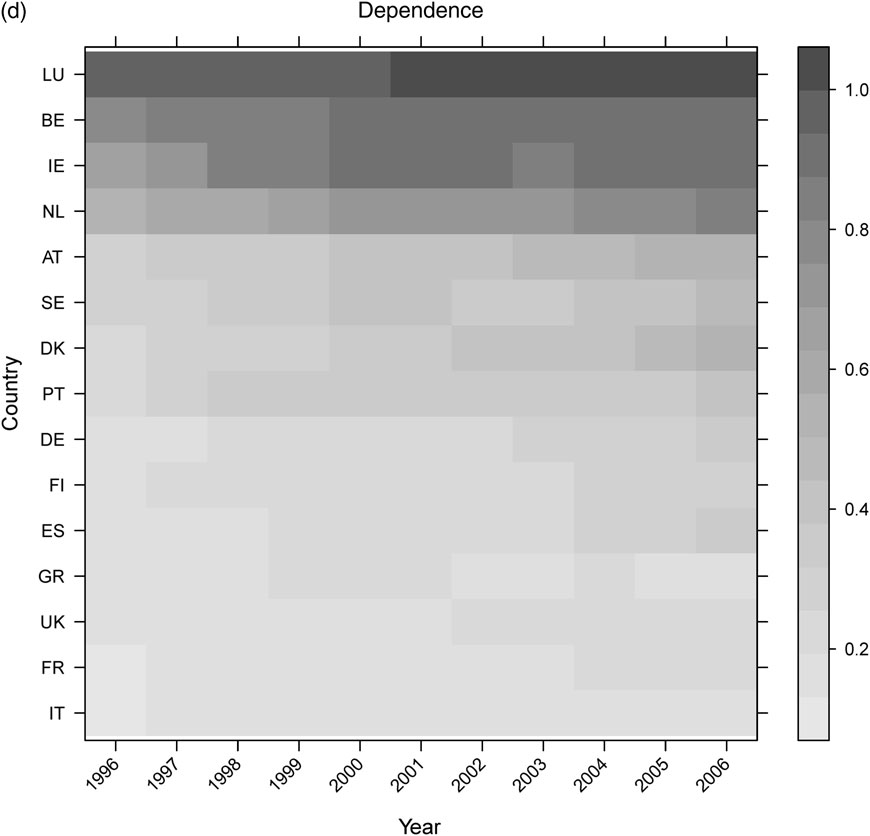
The concept of economic dependence has been studied from two perspectives based on the inclusive concept of interdependence. The first is the economist’s view, the second is that of International Relations Theory (Baldwin, Reference Baldwin1980; Wallace, Reference Wallace1986). In the latter, the notion of interdependence has been applied to capture the concept of import vulnerability. Therefore, scores are computed by dividing current account debits of goods and services by GDP.
Policy-responsiveness model (support)
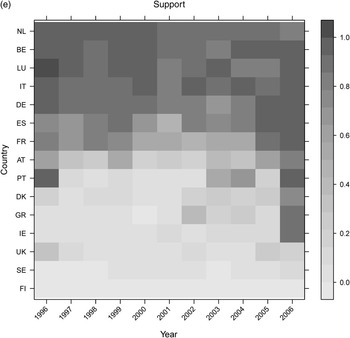
The data on national public opinion about cooperation in defence is taken from the Eurobarometer Survey Series 1995–2005. The question asked was: ‘For defence and foreign affairs, do you think that decisions should be made by the (Nationality) Government, or made jointly within the European Union?’ Public support scores take the percentage figure for those preferring cooperation minus the percentage figure for those being against it. In order to account for response delay, public opinion is lagged by 1 year, a value work on policy responsiveness has found to be reasonable (e.g. Eichenberg and Stoll, Reference Eichenberg and Stoll2003; Jacobs and Page, Reference Jacobs and Page2005; Soroka and Wlezien, Reference Soroka and Wlezien2005).
Market-competition model (competitiveness)
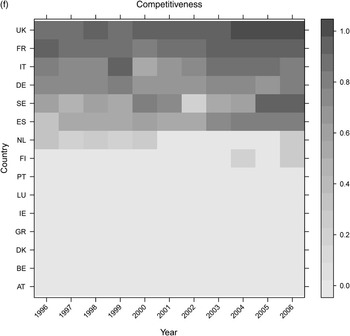
Average defence company size is the indicator for the competitiveness of a country’s domestic armaments industry. It is computed by summing up the arms sales of all defence companies listed by the Stockholm International Peace Research Institute based on size, and divides it by their number, reflecting an average ability to capture export market shares and acquire foreign companies (Stockholm International Peace Research Institute, 1997–2007). All current dollar sales figures have been converted to constant 2000 US$.
The fuzzy-set QCA approach
The core idea behind QCA is that most social science theory is based on set relations, which are always asymmetric, as opposed to correlation-based methods, which are inherently symmetric. For example, the hypothesis that some causal condition x 1 led to outcome y has two implications. First, the fact that y was also brought about by some other causal condition x 2 does not invalidate the initial hypothesis. In set-relational terms, x 1 is a subset of the set of conditions that led to y. Second, the connection between x 1 and y is asymmetric. Were one to investigate the correlation between conditions and outcome, the fact that x 2 also led to y would undermine the correlation between x 1 and y, although this was not part of the original argument.
The verbal nature in which most social science theory is formulated, however, entails explicit connections between causes and outcome that require the decomposition of correlational statements into set relationships. This can be achieved in two ways. The first proceeds from the existence of an outcome shared by the units of analysis to the shared conditions hypothesized to be causally connected. Here, the outcome is a subset of the larger set of cases with the same causal conditions, and is thus suitable for tests of necessity. The second is to proceed from shared causal conditions of cases, or their combination, to a shared outcome. This strategy is consistent with arguments about sufficiency, where instances of the causes are a subset of instances of the outcome (Ragin, Reference Ragin2008). Expressed in set-relational language, this article tests whether any of the six individual conditions, or some combination thereof, represents a sufficient causal path to a high rate of membership in cooperative armaments fora.
While set relations provide the logic, the idea of fuzziness extends them in ways useful for social research. The social sciences are often described as ‘soft’ because they deal with concepts marked by imprecision and uncertainty. Fuzzy sets differ from conventional probabilistic thinking in that they substitute uncertainty associated with randomness by uncertainty associated with characteristic imprecision (Clark et al., Reference Clark, Larson, Mordeson, Potter and Wierman2008: 31). A fuzzy set A is defined by a set of ordered pairs, so that,

where μA(x) is the membership function that specifies the degree μA in the interval between 0 and 1 to which every x∈A belongs to A. Those elements with μA = 1 have full membership in A, whereas those with μA = 0 have full non-membership. At μA = 0.5 – the cross-over that determines whether a case is more in (>0.5) than out (<0.5) – set membership is most ambiguous. In this sense, a fuzzy-set membership score can more precisely be regarded as a continuous measure, purposefully calibrated along three thresholds so as to match the logic of the underlying concept in a qualitative as well as a quantitative way (Ragin, Reference Ragin2008: 30). The membership function translates all elements of the base variable into fuzzy-set membership scores.Footnote 15 In order to fuzzify all base variables, conditions, and outcome, I use the logistic function
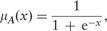
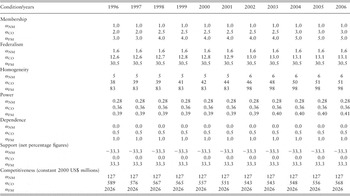
where x is the log odds of membership scaled in relation to the cross-over.Footnote 16 Thresholds for full non-membership, the cross-over, and full membership were set at μA = 0.05, μA = 0.5, and μA = 0.95. This was not implemented in a mechanistic fashion. When assigning membership scores to longitudinal data, it is important to distinguish between base variables in which quantitative trends shift the qualitative meaning of membership scores and those where they do not, since trends in the measures of tendency or spread used for calibration may lead to inconsistencies between the fuzzified conditions and the qualitative meaning of their underlying concepts. A recalibration may therefore be required.Footnote 17 A net public support rate of 0%, for example, remains the cross-over in which the indicator is at its most ambiguous level. When politicians do not perceive public pressure in either direction, they have no incentive to act. Trends in the range or central tendency of the base variable are not qualitatively linked to set membership scores, and thresholds are externally defined. Conversely, country membership rates in armaments fora tend to grow over time. This necessitates a re-calibration of membership scores. Here, thresholds are defined internally. Re-calibrations were implemented for the outcome and all conditions except support and dependence.Footnote 18
Analysis and results
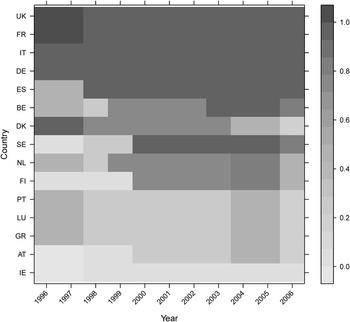
The data set contains 165 observations. Figure 1 presents the fuzzified outcome set in a level plot ordered according to membership score row sums across years. Darker panels indicate high membership, whereas brighter panels indicate low membership.Footnote 19 At the top are the United Kingdom, France, Germany, Italy, and Spain, followed by Belgium, Denmark, Sweden, the Netherlands, and Finland, with a majority of membership scores still exceeding the cross-over.
Membership scores in a set of countries with high rate of forum Membership

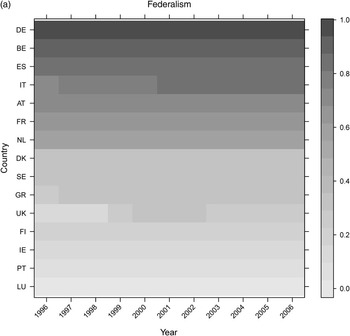
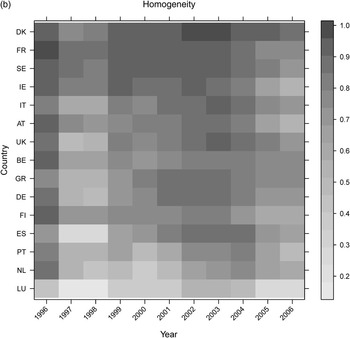
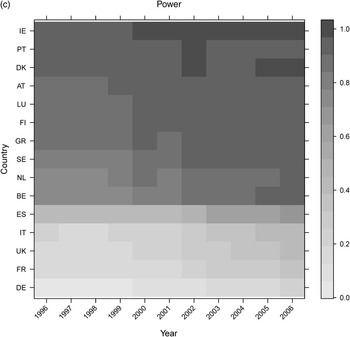
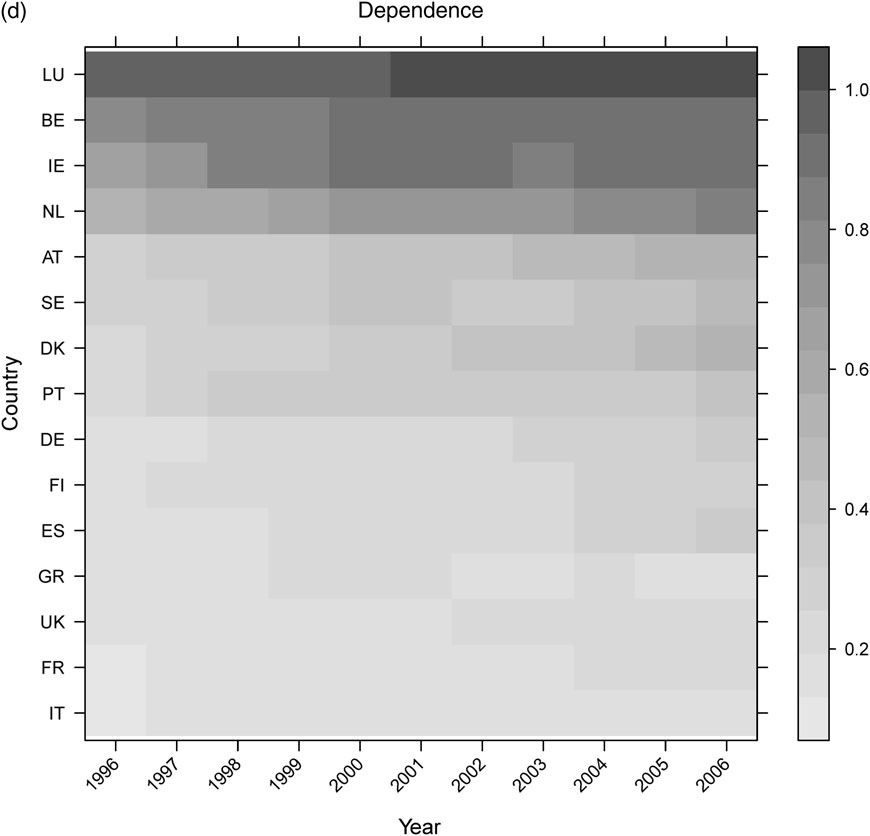
Figure 2 presents the respective membership scores for each condition, country, and year. The pattern of shading shows pronounced temporal fluctuations for homogeneity (2b), support (2e), and competitiveness (2f). Conversely, structural conditions that are expected to remain relatively stable, such as federalism (2a), show only minor shifts or even none at all.
Fuzzy-set membership scores of causal conditions

Continued

Continued

Continued
Continued

Continued

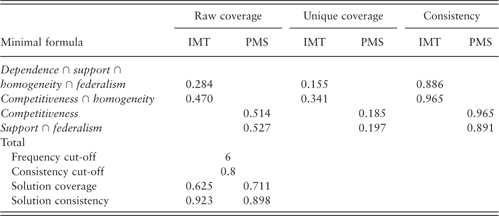
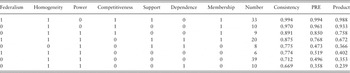
The results of the minimization procedure are presented in Table 1.Footnote 20 At a frequency cut-off of six cases and a consistency threshold of 80%, two distinct pathways to the outcome have been found under the intermediate solution, and two under the parsimonious solution.Footnote 21 In none is evidence found for the existence of balancing or bandwagoning behaviour as argued by Art (Reference Art2006), Layne (Reference Layne2006), or Jervis (Reference Jervis2005). I will assess the intermediate solution first.Footnote 22 Following standard set notation, the symbol ‘∩’ denotes intersection and takes the minimum value in combinations of sets, ‘∪’ stands for union and takes the maximum value, and ‘⊆’ indicates the subset relation.Footnote 23 The two paths are the following with:
Intermediate (IMT) and parsimonious solution (PMS)Footnote a
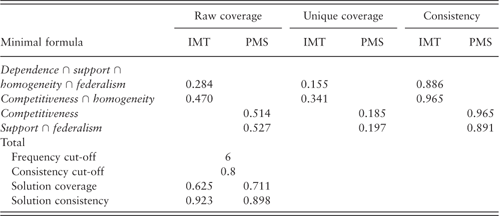
a Simplifying assumptions for intermediate solution: present = (federalism, homogeneity, dependence, support, competitiveness); absent = (power).
(Dependence ∩ support ∩ homogeneity ∩ federalism) ∪
(Competitiveness ∩ homogeneity) ⊆ membership
The first path intersects the security-dependence model, the policy-responsiveness model, the homogeneity-trust model, and the constitutional culture model, while the second integrates the market-competition model with the homogeneity-trust model. In the subsequent discussion, I will refer to the former as ‘Complex Predisposition’, denoted by CP. It combines specific structural conditions that are relatively time invariant, such as a country’s constitutional culture, and may also be responsible for similar state policy choices in other domains, with factors that have a more immediate bearing, such as public support. The latter will be referred to as ‘Partners-for-Profit’, denoted by PfP, because it is a combination of a country’s economic strategy resulting from its industry’s position and the dependence on competent partners to realize it.
At about 88%, the consistency of CP approximates a perfect subset relationship at a significant level, given the large number of observations. PfP even shows a consistency score of about 96%, a value at which a perfect subset relationship is virtually achieved. It is almost always sufficient with respect to a high rate of membership. At a joint value of 92%, this indicates that the two paths are also highly consistent over time.
However, consistency often works against coverage, which provides a measure of the empirical weight of the set-relational connection.Footnote 24 Despite displaying high consistency scores, coverage for both solutions is far from trivial. The raw score of CP, which does not take into account the overlap of variation in the outcome also accounted for by PfP, is about 28%. This indicates an empirical magnitude that can certainly be considered substantial. PfP has a raw score of 47%, which means that the sum of outcome membership scores of the subset-consistent observations is almost covered by half. Given the higher consistency score, this underlines the higher empirical importance of PfP all the more. When treated as alternative paths, both solutions have a joint coverage score of about 62%.
The relative empirical weight of PfP becomes even more pronounced when unique coverage scores are taken into account. As some cases conform to more than one combination of conditions, assessing unique coverage provides a way of disentangling their respective relative importance (Ragin, Reference Ragin2008: 63). The results show that almost half of the coverage that is due to CP is in fact covered by PfP, but only about a quarter of PfP’s coverage is also due to CP. This suggests that the less complex combination may indeed be the empirically more important one. A qualitative investigation of this result is impossible within the scope of this article, but it certainly provides some general indication as to which combinatorial pathway may guide more detailed case analyses focusing on empirical weight. Countries with the potential to expand their prime systems export market share may find it easier to enter into such agreements with preferentially or functionally homogeneous countries. In essence, what economic cooperation in security matters requires is a fair portion of confidence in partners’ professional integrity and technical ability. It then comes as no surprise to see the Swedish Ministry of Defence (2004: 19) seeking to cooperate only with ‘the most important countries as regards the international skills we need for our equipment supply’. Figure 3 visualizes the intermediate solution in panels a and b. Panel b in fact attests to Sweden’s increasingly methodical involvement in armaments cooperation after the 1990s. In the case of Austria, the principle of neutrality clearly was an issue during the 1990s, but has been gradually hollowed out in recent years, politically as well as economically.Footnote 25
Intermediate Solution (a and b) and Parsimonious Solution (c and d)

CP presents a less simple path. High economic dependence indicates a low reservation point for international cooperation, which integrates with a propensity to delegate authority, here in the form of an indirect transfer of control over national armaments acquisition. When these conditions are supplemented by public support for joint action and preferential or functional homogeneity, the requirements for cooperation in an area as sensitive as armaments cooperation may be fulfilled. Though the two paths are quite disparate, the commonality of homogeneity is noticeable. In fact, it was the only condition in tests of necessity with a sufficiently high consistency level of 86%.
Without this component, the empirical relevance of the remaining conditions may decline sharply. This can be tested by choosing a parsimonious solution instead of an intermediate one. Not only could the plausibility of the argument be significantly undermined, but coverage may also approach triviality, depending on the overlap of the subset-consistent cases in both solutions. That requires a less conservative strategy as far as the incorporation of logical remainders is concerned.Footnote 26
In fact, only 10 of the 64 logically possible combinations contain over 90% of the data, and 48 of them hold no observations at all. A useful strategy in such a situation is to allow for counterfactual cases (Fearon, Reference Fearon1991; Tetlock and Belkin, Reference Tetlock and Belkin1996; Ragin, Reference Ragin2008). In contrast to the intermediate solution, a parsimonious solution takes easy as well as difficult counterfactuals into account. However, as each condition was hypothesized to contribute individually to the outcome without foreclosing combinations, causal implausibilities should not arise. For instance, the influence of business interests on policy is as likely in the absence of public support as it is in its presence (e.g. Jacobs and Page, Reference Jacobs and Page2005).
When allowing for easy as well as difficult counterfactuals, competitiveness is the reduction to PfP, but only in 30 of the 165 cases was homogeneity the constraining condition, resulting in similarity of the two paths as graphically revealed in panels b and c of Figure 3. Although the gains from cooperation may be reduced without homogeneity because additional collective control would be required to offset the absence of relational trust, this essentially means that business is the dominant component in the subset relation. As the UK Ministry of Defence (2005: 32) underlines, ‘[e]xports are an important part of the defence economic landscape’.Footnote 27 Alternatively, support ∩ federalism is the reduction to CP.Footnote 28 This result lends weight to arguments that have been made by a number of scholars on the combined effect of public opinion and constitutional culture. Risse (Reference Risse1991) as well as Soroka and Wlezien (Reference Soroka and Wlezien2005), for example, emphasize that the effect of public opinion on policy appears to be conditional on a country’s constitutional design through which it is filtered.
Conclusion
Which conditions are relevant in explaining why governments join international agreements in an area as potentially threatening to core national interests as armaments? Using fuzzy set qualitative comparative analysis, this article identified two distinct paths to cooperation in the EU for the years 1996–2006 that represent sufficient causal combinations. Equifinality involves diversity, and the results confirmed this fact through two distinct paths under which countries have joined formal agreements. Foremost among the reasons for states to do so were economic motives. This is reflected in the defence industrial strategies of many European governments. Technological advancement and the consolidation of the US armaments industry have put pressure on European countries to strengthen their defence industrial base if important export market shares are not to be lost. In addition, a competitive industrial base maintains and develops important technological skills, and generates employment and balance of payments benefits. However, the international division of production, the harmonization of weapons export procedures, and the sharing of knowledge are risky strategies, so participating governments want to make sure that their partners have the technological ability and professional integrity to create the theoretical basis for successful cooperation.
Alternatively, countries seem to enter into cooperation for reasons other than economically driven motives. A constitutional culture marked by federalist structures predisposes them to share control more willingly, and combines with public support for joint European action in defence matters, an open economy, and homogeneity to produce the conditions sufficient for active cooperation. These two diverse paths confirmed the advantages of applying a data-driven identification of relevant conditions. While five of the six perspectives received support to different degrees, in none of the combinations of conditions was a country’s power differential in relation to the US component. Although this must not be interpreted as hard evidence against a Realist logic behind intergovernmental armaments cooperation in Europe, it certainly reduces its explanatory traction.
Intergovernmental cooperation on armaments is increasingly prioritized in European capitals. Initiatives inside and outside the EU framework will further shape the development of the European defence market on both the supply and the demand side in the years to come. Ongoing discussions about the incorporation of OCCAR into the European Defence Agency attest to this dynamic, which will not only affect those countries that have formed the population of this analysis. Pressures to restructure armaments procurement have also been high in Central and Eastern European countries. Their armed forces participate in international military missions along with Western European neighbours, but economic history did not produce the conditions conducive to the emergence of an internationally competitive armaments industry that could contribute much to EU-wide restructuring efforts apart from acting as vital export markets or niche system suppliers. In short, Central and East European governments are no ideal partners for profit. Whether they will choose to align themselves more closely with the United States, as Poland did in 2003 when it set the seal on one of the largest single military contracts negotiated in Europe after the end of the Cold War, involving the procurement of 48 Lockheed Martin F-16s instead of Saab’s Gripen and Dassault’s Mirage, or to participate readily in European fora may thus partly depend on the alternative combination of conditions identified in this article.
Acknowledgements
Earlier versions of this article were presented at two CIS workshops in October 2008 and February 2009, and at the 2010 Annual Conference of the Swiss Political Science Association. For helpful comments I am grateful to Gary Goertz, Mark Daniel Jäger, Dirk Leuffen, Wilhelm Mirow, Bianca Sarbu, Kaspar Schiltz, Frank Schimmelfennig, Guido Schwellnus, Manuel Suter, the three anonymous reviewers, and Andreas Wenger.
Appendix
Partial truth tableFootnote a

a Outcome (membership) coded 1 if number ⩾ 6 and consistency ⩾ 0.8; ordered according to consistency.
Recalibration valuesFootnote a

a Full non-membership threshold α NM corresponds to 5th percentile of A, cross-over α CO to the mean of A, and the full membership threshold α FM to the 95th percentile of A, except dependence and support which are externally defined.
 . Cooperation involves cost reductions, but generally no cost efficiencies.