Children's externalizing problems include aggression and other antisocial behaviors, negative emotions like anger and defiance, and poor regulation of impulses. One developmental model of conduct disorder and antisocial behavior includes dual pathways, defined by age of onset (childhood vs. adolescence; Moffitt, Reference Moffitt1993). The two subtypes differ in etiology and developmental course, at least for males who are more likely than females to have these problems (e.g., Coie & Dodge, Reference Coie, Dodge, Damon and Eisenberg1998; Offord et al., Reference Offord, Boyle, Szatmari, Rae-Grant, Links and Cadman1987). “Childhood-onset type” of conduct disorder is diagnosed in children who meet criteria prior to age 10. They are at risk for a severe, persistent course of the disorder, and for psychological, academic, and social maladjustment (e.g., Loeber, Stouthammer-Loeber, & White, Reference Loeber, Stouthammer-Loeber and White1999).
Both clinically diagnosed antisocial behavior and subclinical problems are present in early childhood (see Denham et al., Reference Denham, Workman, Cole, Weissbrod, Kendziora and Zahn-Waxler2000). It is important, then, to study the range of disruptive behaviors and factors that reinforce a young child's vulnerability. Both biological and socialization processes have been implicated in the early onset of antisocial behaviors (Moffitt, Reference Moffitt1993). Less is known about early social–cognitive processes or internal representations that may both reflect and guide children's behaviors. In addition, because mostly boys have been studied, less is known about antisocial behavior, cognitions, and emotions in girls. Numbers of antisocial females have increased in recent years (e.g., Putallaz & Bierman, Reference Putallaz and Bierman2004). This underscores the need for research on the origins, antecedents, and developmental trajectories for antisocial girls (Zahn-Waxler, Crick, Shirtcliff, & Woods, Reference Zahn-Waxler, Crick, Shirtcliff, Woods and Cicchetti2006).
This study focuses on the development of internal representations of conflict and distress in young boys and girls with a range of disruptive behavior problems. It examines social–emotional themes in children's narratives and symbolic play, and whether these themes predict children's developmental trajectories for behavior problems over a period of 4–5 years. Three groups of children are compared: (a) children who remain free of problems, (b) children whose problems continue or worsen, and (c) children whose problems improve. This design uses a developmental psychopathology approach, examining processes over time that may help to explain adaptive and maladaptive developmental outcomes in children who vary in risk (Cicchetti, Reference Cicchetti1993).
Because stable antisocial patterns are often already present in childhood, it is important to examine antecedents of disruptive problems as early as the preschool years. Disruptive behaviors may be associated with maladaptive ideas and feelings about interpersonal conflict and distress. These views, in turn, may contribute to the course and form of problems over time. Such internal processes are difficult to assess, as children with externalizing problems often have difficulty reporting their inner states. This is particularly true with young children because of limitations in attention, language, and meta-cognitive skills needed to organize and describe their thoughts (Zahn-Waxler et al., Reference Zahn-Waxler, Cole, Richardson, Friedman, Michel and Belouad1994).
Conceptualization and Measurement of Children's Representations
Features of the child's inner world revealed in story narratives are viewed as “internalizations,” a concept parallel to internal working models in attachment theory (Bowlby, Reference Bowlby1973) and schemas or scripts in cognitive theory (Schank & Abelson, Reference Schank and Abelson1977). Shields, Ryan, and Cicchetti (Reference Shields, Ryan and Cicchetti2001) have conceptualized representations as “cognitive–affective mental structures that contain information about others, oneself, and expected patterns of social interactions” (p. 321). These theoretical perspectives share the view that internal mental structures trigger emotional and behavioral responses and thus affect the way children respond to new situations (Bretherton & Munholland, Reference Bretherton, Munholland, Cassidy and Shaver1999). Representations are thought to develop from real events, including experiences with caregivers and emotions in close relationships that create different interpersonal expectations and working models. We have adopted this view in our study of the narratives and symbolic play of young boys and girls who vary in early aggressive, disruptive behaviors. A method that examines children's behaviors, language, and emotions during symbolic play has shown potential for gaining access to children's representations of their social–emotional worlds as early as the preschool years. Standardized story stems allow children to complete stories using play materials and miniature figures that represent family members, playmates and siblings (Bretherton, Oppenheim, Buchsbaum, Emde, & the MacArthur Narrative Group, 1990; Robinson, Mantz-Simmons, Macfie, & the MacArthur Narrative Group, 1992).
Development of Social Behaviors and Representations From Early to Middle Childhood
We focused on children's representations themes from late preschool to early elementary school. This is a period of challenge and change in children's transition to formal schooling, a widened network of peers, and decreased time with the family. We asked how changes during this time period are reflected in children's representations of their interpersonal lives. We examined two broad themes relevant to externalizing problems and positive adaptation, namely, aggression toward others and caring for others. From preschool to elementary school there are normative changes in these patterns (Coie & Dodge, Reference Coie, Dodge, Damon and Eisenberg1998; Eisenberg & Fabes, Reference Eisenberg, Fabes, Damon and Eisenberg1998). Physical aggression is most common during the preschool years and decreases as children move toward middle childhood. Verbal and indirect forms of aggression become more prominent over time as children establish greater impulse control and more socially acceptable forms of expression. As children grow older they also establish social affiliations and friendships, show greater accountability and remorse for misdeeds, and show more prosocial behaviors. These signs of social maturity and internalization of responsibility also are associated with less aggression. Paralleling these changes, extrapunitive emotions like anger decrease with age (Hubbard, Reference Hubbard2001) whereas intropunitive emotions like sadness and guilt increase (Glassberg & Aboud, Reference Glassberg and Aboud1982; Zahn-Waxler, Reference Zahn-Waxler and Davidson2000).
Children's representations might be expected to show similar developmental processes, based on the view that they both develop from real events and affect responses to new situations. However, representations are also the product of imagination and fantasy, so symbolic activities are not likely to be exact, veridical reflections of children's real lives, for example, a child may restrain from actual physical aggression but still privately harbor aggressive thoughts and feelings. Moreover, the normative, adaptive developmental progressions described above do not characterize all children. Variations would be expected in their representations as well as their realities. Here we consider two such factors, that is, risk for behavior problems and gender of the child.
Representations as a Function of Risk and Gender of Child
Narrative themes of children at risk (e.g., children who are maltreated, anxious, or aggressive) often reflect troubled interpersonal relationships and negative self-views (e.g., Macfie, Cicchetti, & Toth, Reference Macfie, Cicchetti and Toth2001; Macfie et al., Reference Macfie, Toth, Rogosch, Robinson, Emde and Cicchetti1999; Oppenheim, Emde, Hasson, & Warren, Reference Oppenheim, Emde, Hasson and Warren1997; Solomonica-Levi, Yirmiya, Eral, Samet, & Oppenheim, Reference Solomonica-Levi, Yirmiya, Erel, Samet and Oppenheim2001; Toth, Cicchetti, Macfie, & Emde, Reference Toth, Cicchetti, Macfie and Emde1997; Warren, Oppenheim, & Emde, Reference Warren, Oppenheim and Emde1996). Hostile themes of aggression and destruction in children's narratives have been linked to social, emotional, and behavioral problems (e.g., von Klitzing, Kelsay, Emde, Robinson, & Schmitz, Reference von Klitzing, Kelsay, Emde, Robinson and Schmitz2000; Warren et al., Reference Warren, Oppenheim and Emde1996; Zahn-Waxler, Schmitz, Fulker, Robinson, & Emde, Reference Zahn-Waxler, Schmitz, Fulker, Robinson and Emde1996). Caring themes such as empathy and affiliation, in contrast, have been linked to adaptive functioning, including self-regulation, self-esteem, and academic and social competence (e.g., Toth, Cicchetti, Macfie, Rogosch, & Maughan, Reference Toth, Cicchetti, Macfie, Rogosch and Maughan2000). Young girls express more prosocial themes, affiliation, and affection than boys (e.g., Buckner & Fivush, Reference Buckner and Fivush1998; Zahn-Waxler et al., Reference Zahn-Waxler, Cole, Richardson, Friedman, Michel and Belouad1994; Zahn-Waxler et al. Reference Zahn-Waxler, Schmitz, Fulker, Robinson and Emde1996), and boys express more aggression (e.g., von Klitzing et al., Reference von Klitzing, Kelsay, Emde, Robinson and Schmitz2000, Zahn-Waxler et al., Reference Zahn-Waxler, Cole, Richardson, Friedman, Michel and Belouad1994).
Although there has been some longitudinal research (e.g., Oppenheim, et al., Reference Oppenheim, Emde, Hasson and Warren1997), nothing is known about differences in the development of narrative themes that might help to understand individual differences related to risk for psychopathology and gender of child. Our work examines (a) the development of children's aggressive and caring themes from preschool to elementary school and (b) whether individual and group differences in these processes predict different developmental trajectories for young boys and girls who vary in disruptive behaviors.
Assessment of Aggressive and Caring Themes in Children's Narratives
Typically, representations of older children, adolescents, and adults have been studied in the form of verbal narratives. That is, language is the primary source of information about their inner interpersonal worlds. For younger children a broadened definition that includes physical actions may provide a more developmentally appropriate, comprehensive assessment. Young children also express emotions during narrative play that may provide important clues about the meaning of interpersonal conflict and distress events. Because young children use multiple modalities when they “tell” a story, we examined behavioral, verbal, and affective components separately. This also was done to maintain conventional distinctions in the literatures on antisocial and prosocial development. Naturalistic and experimental research on acts of aggression traditionally has distinguished between physical and verbal forms. Such distinctions have helped to explain different developmental patterns for different kinds of aggression (e.g., Coie & Dodge, Reference Coie, Dodge, Damon and Eisenberg1998), the nature of aggression in disruptive behavior problems and related externalizing problems (e.g., Cairns, Cairns, Neckerman, Ferguson, & Gariepy, Reference Cairns, Cairns, Neckerman, Ferguson and Gariepy1989; Campbell, Reference Campbell1990), and gender differences in forms of aggression (e.g., Putallaz & Bierman, Reference Putallaz and Bierman2004; Crick, Casas, & Mosher, Reference Crick, Casas and Mosher1997).
We further distinguished between verbal aggression that does and does not contain language about physical violence. Although verbal aggression is more developmentally advanced than physical aggression, this may not be true of verbal aggression that contains references to physical violence. One other form of aggression involving greater regulation and restraint was examined, namely, postural aggression or threatening gestures that stop short of actual physical harm.
The importance of distinguishing between words and deeds, that is, between language and actions, has also been emphasized in research on prosocial and moral development (Eisenberg & Fabes, Reference Eisenberg, Fabes, Damon and Eisenberg1998). We maintain this distinction here also, focusing on behavioral and verbal expressions of three kinds of caring themes: prosocial concern, reparation for wrongdoing, and affiliation. Finally, we assessed two emotions commonly associated with aggressive and caring patterns respectively, that is, anger and sadness (Rothbart, Ahadi, & Hershey, Reference Rothbart, Ahadi and Hershey1994; Zahn-Waxler, Reference Zahn-Waxler1993).
We considered children's responses to two types of hypothetical dilemmas, which represent two types of situations encountered in real life. One type was interpersonal conflict where individuals are involved in physical fights, verbal arguments, and other antisocial acts. These situations can be viewed as interpersonal stressors likely to evoke hostility and aggression, also referred to as fight-or-flight responses. The other type was interpersonal distress where individuals experience fear, injury, or sorrow in the presence of another. These situations can be viewed as interpersonal stressors likely to call for caring actions, friendliness, and tender emotions such as sympathy and sadness (a common feature of empathic concern). Such responses to stressors have also been referred to as tend-and-befriend responses (Taylor et al., Reference Taylor, Klein, Lewis, Gruenwald, Gurang and Updegraff2000). We used the two types of situations to elicit both aggressive and caring themes and to compare children's responses in the two types of situations. Although either type of theme can occur during conflict or distress, aggressive themes would be expected to be more common during conflict and caring themes during distress.
Predictions and Expectations
Children with different developmental trajectories for behavior problems over the 4- to 5-year period studied were predicted to differ on their aggressive and caring narrative themes.
1. Children who are free of problems (no-problem group). Children in the no-problem group were expected to show the most “prototypic” narrative themes, that is, themes that most closely paralleled normative developmental progressions and gender differences seen in real life. This included increases with age in less forceful, more modulated aggression, including nonviolent verbal aggression. It also included increases in patterns of internalization reflected in caring for others (prosocial, reparation, affiliation) and sadness. Developmental predictions regarding physical aggression and anger were less straightforward. Although they are known to decrease over time in real life, they could be present in representations (even in normally developing children) where it is safer to express physical force and hostility. There was no precedent in the literature for developmental predictions about postural aggression. Gender differences also were expected: (a) more hostility in boys (physical aggression and anger), (b) more modulated aggression in girls (nonviolent verbal aggression, postural threats), and (c) more caring patterns and sadness in girls.
2. Children whose disruptive behavior problems continue or worsen over time (stable/worsen group). The predicted gender differences in the no-problem group were expected to be stronger, that is, exaggerated, in the stable/worsen group. Troubled boys were expected to show even more physically aggressive themes and anger in their narratives relative to the no-problem group. Moreover, their physical aggression and anger were expected to remain at higher levels than that of the normally developing children. Troubled girls, in contrast, were expected to show heightened levels of aggression more typical of girls, relative to children without problems, that is, more modulated aggression. These interactions of gender and risk for psychopathology were anticipated based on a growing literature indicating that males and females with similar problems sometimes express aspects of these problems in more extreme ways that are consistent with their gender roles (Zahn-Waxler et al., Reference Zahn-Waxler, Crick, Shirtcliff, Woods and Cicchetti2006). We also expected boys, but not girls, in the stable/worsen group to be low on caring themes and sadness. Although expectations regarding caring themes were less clear, previous research found that young disruptive girls were quite high on prosocial themes relative to all other groups of children (Zahn-Waxler et al., Reference Zahn-Waxler, Cole, Richardson, Friedman, Michel and Belouad1994).
3. Children whose problems improve over time (improve group). These children share characteristics with both other groups. They have problems initially, but come to more closely resemble children without problems over time. Although there is no strong precedent for directional predictions, it is plausible to propose that their improvement might be foretold by narrative themes more similar to those of no-problem children than those in the stable/worsen group.
Method
Sample and recruitment
Participants and screening
This study was part of a longitudinal investigation of the development of children with early disruptive behavior problems. Participants were recruited from a major urban community through newspaper announcements and flyers to preschools and daycare providers in demographically diverse zip codes. To optimize the range of problems, some announcements targeted hard to manage preschoolers (aggressive, noncompliant, overactive); the rest simply recruited preschoolers. Parents were initially screened by phone with a brief questionnaire about their interest and whether the child had difficulties beyond the scope of the study. Children with severe mental or physical disabilities (e.g., severe sensorimotor or orthopedic handicaps, autism, and mental retardation) were excluded. At the end of this interview, plans were made for a contact with the other parent and for a first visit during which screening continued.
At the first visit, the mother completed consent forms and two behavior rating scales describing the child's behavior during the past 12 months: the Child Behavior Check List, Parent Version (CBCL; Achenbach, Reference Achenbach1991) and the Eyberg Child Behavior Inventory (ECBI; Eyberg & Robinson, Reference Eyberg and Robinson1983). Two rating scales: the Teacher Report Form (TRF) of the CBCL (Achenbach, Reference Achenbach1991) and the Preschool Behavior Questionnaire (PBQ; Behar & Stringfield, Reference Behar and Stringfield1974) were mailed to the teacher when the child had been in care for at least 3 months. Five children were not enrolled in any program. During a second visit, the McCarthy Scales of Children's Abilities (McCarthy, Reference McCarthy1970) was administered. Children who scored in the subaverage range on the general cognitive index (<70) of the McCarthy Scales of Children's Abilities were not included.
Of the cases participating in one or both of these sessions, eight did not continue. Three children had significant cognitive delays, one father refused to consent, and the remainder withdrew. Participants who continued through Time 1 (T1) had three more sessions that year. Three sessions were conducted 2 years later (T2) and two sessions were conducted 4 years later (T3). The present study uses assessments of behavior problems at each of the three time points and narrative data collected at T1 and T2. The PBQ and ECBI were collected only at T1 to aid in the initial classification of risk. The CBCL and TRF were given at all three time points and in addition, children completed the Youth Self-Report at T3 (Achenbach, Reference Achenbach1991).
Demographic description of participants
As a result, 82 4- to 5-year-old children (51 boys, 31 girls) were enrolled in the project (mean age = 4.7 years, SD = 0.29). The socioeconomic status (SES) distribution, using the Hollingshead formula, indicated that most (93.9%) were middle to upper middle class with a mean Hollingshead of 54.5. At least one parent was employed in all but one case. The ethnic composition was 81.7% Caucasian, 7.3% African American, and 11% other or mixed background.
Risk classification
Initially, three groups of preschool children were distinguished: clinical, subclinical, and within the normal range. The variety of problems in preschoolers is predictive of chronic behavior problems (Campbell, Reference Campbell1990) so we used total problem behavior scores. (Recall that children with problems entered the study because parents and/or teachers found the child to be aggressive, disruptive, and oppositional). The cross-situational scope of behavior problems is also highly predictive (Campbell, Reference Campbell1990) so we used scores from two parent and two teacher rating scales. The CBCL and TRF were the primary instruments, whereas the ECBI and PBQ were used to fine-tune the classification process.
Thus, risk classification was based on a multistep process. First, CBCL total behavior problems were used to identify children whose mother reported difficulties that were in the clinical range. Preschoolers who scored ≥70 T, that is, 2 SD above the norm, were designated as at high risk. Preschoolers who scored ≥60 T and <70 T, that is, 1 SD above the norm but not in the clinical range, were designated as at moderate risk. We used 60 T rather than 63 T, which is the subclinical cutoff for the CBCL because this best captured the range of moderate-risk children referred to the study by virtue of their disruptive behaviors. On a second pass, we used the TRF to identify any children who were moderate or low risk, according to the mother, but as high risk by the teacher. Because standardization of the TRF had not been completed for this age group, raw total behavior scores were used. The 85th percentile (total behavior problem score > 29) was used as the clinical cutoff. On a third pass, children who either scored more than 1 SD above the norms for the ECBI (intensity score > 126) or the PBQ (total score > 14) or who repeatedly caused concern to staff were moved from the low-risk to the moderate-risk group. Four children moved into the moderate-risk group based on the ECBI total intensity score (M = 141.5) and two did so based on staff concerns.
The resulting distribution across levels of behavioral risk was 31 high risk (20 boys, 11 girls), 28 moderate risk (20 boys, 8 girls), and 23 low risk (11 boys, 12 girls). Analyses of variance (ANOVAs) for age, SES, and general intellectual functioning, and chi squares for demographic characteristics, including ethnicity indicated no group differences. At T2, 77 children (47 boys, 30 girls) remained in the sample. Their average age was 7.04 years. At T3, 69 children (43 boys, 26 girls) remained in the sample with an average age of 9.22 years. Comparisons of children who remained in the sample at the latter two age points with those who did not, indicated no significant differences between the two groups on the study variables at the previous time points.
We then determined three developmental trajectories for behavior problems from T1 to T3. This made it possible to examine whether and how children's early narrative themes, including how they changed (or did not change) from T1 to T2, predicted later behavior problem outcomes. To maintain sufficient sample size it was necessary to combine the initial moderate and high-risk groups. Three groups of children were identified: children with no problems throughout the study (no problem group, N = 14), children who had problems initially (1 SD or more from the norm) and continued to have problems by T3, as well as children who developed problems by T3 (stable/worsen group, N = 30); and children who began with problems but dropped below 1 SD by T3 (improve group, N = 25). For T2 and T3, children were defined as having problems if they were 1 SD or more above the norm based on either mother or teacher reports. For T3, Youth Self-Reports were also included. The study retention rate from T1 to T3 was 84%. These three groups did not differ on overall measures of verbal IQ, or on subscales scores (verbal, vocabulary, fluency) or on demographic characteristics. There were also no gender differences.
Procedures and measures
The narrative task was administered during the first research session both at T1 and T2. Testing began after children had ample time to become acquainted with staff members and to become familiar with their surroundings. Experimenters and coders were graduate-level research assistants with developmental training, who were uninformed about the risk status of each child.
Children's responses to hypothetical interpersonal conflicts and distress dilemmas were elicited through a story–stem completion task (Zahn-Waxler et al., Reference Zahn-Waxler, Cole, Richardson, Friedman, Michel and Belouad1994). Using miniature figures and play materials, the experimenter started a story and asked the child to complete it (i.e., to “show and tell what happens next”). Some dilemmas were developed by the MacArthur Narratives Group (e.g., Bretherton et al., Reference Bretherton, Oppenheim, Buchsbaum and Emde1990; Robinson et al., Reference Robinson, Mantz-Simmons and Macfie1992), and some were designed for this study. Order of presentation was randomly determined and all stories were presented to each child in the same order. Fourteen stories were grouped into seven conflict dilemmas (e.g., two playmates fight; mother and father argue) and seven distress dilemmas (e.g., parents leave children to go on vacation; a child trips and is injured). The procedure was videotaped. Appendix A lists each of the story stems used. Full examples of a distress dilemma and a conflict dilemma are given next.
Distress dilemma—Personal injury
The characters include four dolls (mother, father, two children). The examiner says “Here's mommy and daddy. Mark and Chris (for boys) or Mary and Christy (for girls). They're walking to the store to get ice cream. Mark/Mary is riding his/her bike. Oh, no, he/she fell off!” (concerned voice). The examiner then enacts the doll's distress “Ow, I hurt my knee. I fell off my bike!” The examiner then says to the child “Show me and tell what happens now.” Later she gives a prompt, “And what happens about the hurt?”
Conflict dilemma—Peer aggression
The characters include two same-gender dolls. The examiner says “Mark/Mary and Scott/Sarah are yelling at each other” (angry tone of voice throughout). Mark/Mary: “Uh huh!” Scott/Sarah:“Nuh uh!” (children push, shove, and slap). Mark/Mary: “Uh huh!” Scott/Sarah: “Nuh uh.” Mark/Mary: “Oh shut up!” (pushes Scott/Sarah down and Scott/Sarah says “That really hurt!). The examiner then says “Show me what happens now” and later prompts “What happens about the fight?”
Aggressive and caring themes were coded on two separate dimensions: physical actions/postures “enacted” by dolls and verbalizations “expressed” by dolls. They were rated from videotapes on a 5-point scale ranging from none (0) to extreme (4). Frequency, intensity, and duration of the actions were used to make these judgments. Parallel aggressive and caring themes based on verbal content were coded from transcripts, according to a similar 5-point rating scale ranging from none (0) to extreme (4).
Aggressive themes
1. Aggressive, physical acts: behavioral enactments of physical aggression: pushing, hitting (e.g., one doll hits another doll, one doll pushes another doll off a cliff).
2. Aggressive, physical words: use of language to describe acts of physical aggression (e.g., “he pounded him into the ground.” “He's going to kill him.” “shut up or I'll beat you up”).
3. Aggressive statements: verbal descriptions of aggression that exclude physical acts, that is, purely verbal aggression (e.g., “I'm mad at you.” “He hates her.” “I won't like you anymore).
4. Aggressive postures: use of intimidating postures and gestures that stop short of physical harm (e.g., one doll stomps up and down or leans into another during an argument).
Caring themes
1. Prosocial behaviors: behavioral prosocial acts that include helping, sharing, comforting and other attempts to relieve another's distress (e.g., hugs, takes to hospital).
2. Prosocial statements: verbal descriptions of prosocial acts (e.g., “Mary put a band-aid on Scott.” “It's too bad that your uncle died.” “Let me help you up.”).
3. Reparative behaviors (in conflict dilemmas only): prosocial actions where the perpetrator makes amends for an aggressive act; or repairs a breach in a relationship (e.g., aggressor hugs victim after hitting him, or takes turns sharing bike after a fight).
4. Reparative statements (in conflict dilemmas only): verbal descriptions of efforts to undo physical or psychological harm (“I'm sorry I hit you.” “Sorry I said I hated you.”).
5. Affiliative behaviors: behaviors that reflect affection and friendly interactions unrelated to conflict or distress (e.g., hold hands, dances, eat together).
6. Affiliative statements: verbal descriptions of affection and friendliness, same as 5 (e.g., “Let's dance.” “Let's hold hands.”).
Emotion expressions
Children's anger and sadness were rated with Global Affect Scales during each dilemma, on a 0- to 6-point scale, ranging from absence of emotion to strong and sustained occurrences for much of the segment. Coding was based on children's facial expressions and vocal cues (Cole, Zahn-Waxler, Fox, Usher, Welsh, Reference Cole, Zahn-Waxler, Fox, Usher and Welsh1996).
1. Anger: child shows meanness, irritation, annoyance (e.g., harsh tone of voice, jutting the jaw, tightening lips, glare or hard stare).
2. Sadness: child shows tearfulness and wistfulness (e.g., down-turned facial expression, sympathy face, drop in voice pitch).
Ratings for all variables were summed across stories within each of the two types of dilemmas and mean scores were used for statistical analyses. There were separate teams of coders for (a) behaviors, (b) verbalizations, and (c) emotions. Kappa was used for reliabilities. For behavioral codes, kappa values ranged from .64 to .91 at T1 and .71 to .83 at T2. Kappas for verbal codes ranged from .74 to .88 at T1 and from .87 to .92 at T2. For emotions, kappas for anger were .72 at T1 and .66 at T2. The kappa value for sadness at T2 was .70. Sadness was too infrequent at T1 in the reliability sample to calculate the kappa. Agreement for sadness at T1 was 94%. There was consistency in how children responded to conflict and distress dilemmas, with correlations moderate to strong in magnitude at both T1 (average r = .52) and T2 (average r = .62).
Results
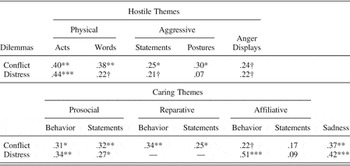
We used correlations to examine whether developmental continuities from 4–5 to 7 years of age could be seen in children's responses to hypothetical conflict and distress dilemmas. The correlations between these T1 and T2 measures are presented in Table 1. Sixty-six percent of the correlations were significant, with correlations that were low to moderate in magnitude.
Continuity from 5 to 7 years: Correlations between Time 1 and Time 2

† p < .10. *p < .05.
** p < .01.
*** p < .001.
We then used a series of multivariate analyses of variance (MANOVAs) to examine hostile and caring themes from T1 and T2 in boys and girls in relation to behavior outcomes by T3. A four-way (2 × 2 × 2 × 3) MANOVA was conducted for each dependent variable with two between-subjects factors and two within-subjects factors. Between-subjects factors were behavior problem outcome (no problem, improve, and stable/worsen) and gender of child (boy, girl). Within-subjects factors were time (4–5 years, 7 years), and dilemma type (distress, conflict). All post hoc follow-up tests were based on Bonferroni corrections. Tests were two tailed except for one where there was a very strong precedent in the literature regarding direction, that is, more physical aggression for boys.
All main effects of dilemma type are presented first to simplify presentation of primary analyses and to frame the context for subsequent analyses and interpretations. Aggressive themes were more frequent in conflict than distress dilemmas: for physical aggression, F (1, 63) = 71.06, p < .001; for aggressive, physical words, F (1, 61) = 39.52, p < .001; for aggressive statements, F (1, 61) = 123.50, p < .001; for aggressive postures, F (1, 63) = 76.83, p < .001; and for angry expressions, F (1, 62) = 86.54, p < .001. Caring themes were more common in distress than in conflict dilemmas: for prosocial behaviors, F (1, 63) = 139.41, p < .001; for prosocial statements, F (1, 61) = 94.81, p < .001; for affiliative behavior, F (1, 62) = 132.74, p < .001; and for affiliative statements, F (1, 61) = 157.12, p < .001. Reparative acts and behaviors could not be examined, because they only occur in the context of transgressions, which are exclusive to conflict dilemmas. Sadness was equally likely in conflict and distress dilemmas. These robust differences for dilemma type confirm that hostile themes were prototypic in conflict situations, whereas caring themes were prototypic in distress situations. At the same time, there were significant correlations between responses to conflict and distress dilemmas suggest generalized response styles for some children. Correlations were moderate to strong in magnitude at both T1 (average r = .52) and T2 (average r = .62). Interactions involving dilemma type are described in the MANOVAs that follow.
Aggressive themes and anger
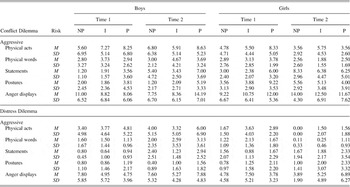
Means and standard deviations for hostile themes and anger are presented in Table 2.
Means and standard deviations of aggressive themes by age, gender of child, and behavior problem outcome

Note: NP, no-problem group; I, improved group; P, problem group.
Aggressive, physical acts
Acts of physical aggression did not change with age, nor did they predict later behavior problem outcomes. Boys showed more physical acts of aggression than girls, F (1, 63) = 4.14, p < .05.
Aggressive, physical words
Physically aggressive language did not predict later behavior problem outcomes. There was an interaction of Gender of Child × Time, F (1, 61) = 7.97, p < .01. Boys use of aggressive physical words increased from T1 to T2, t (41) = −2.32, p < .05, whereas girls showed a decrease over time, t (24) = 3.55, p < .005.
Aggressive statements
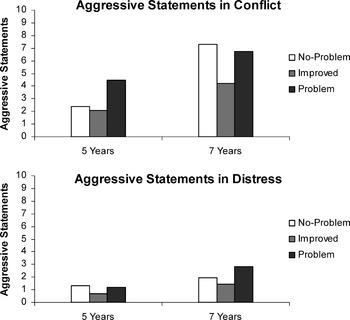
Behavior problem outcome, time, and gender of child main effects were found for purely verbal aggression, F (2, 61) = 4.49, p < .025, F (1, 61) = 32.76, p < .001, and F (1, 61) = 3.98, p = .05, respectively, for the three factors. Girls made more aggressive statements than boys. The other two main effects are considered within the context of a three-way interaction of Behavior Problem Outcome × Time × Dilemma Type, F (2, 61) = 3.24, p < .05 (see Figure 1). In conflict dilemmas, aggressive statements increased over time for the no-problem group and the improve group, t (13) = −6.15, p < .001, and t (28) = −3.28, p < .01, but not the stable/worsen group. Although children in the stable/worsen group showed levels of verbal aggression similar to the other groups at T2, they did not increase with age because they were higher than the other groups at T1. This was not a ceiling effect, as none of the groups were near the top of the rating scale by T2. Verbal aggression did not change with age for any group in distress dilemmas.
Means of aggressive statements by age, dilemma, and behavior problem outcome.

Aggressive postures
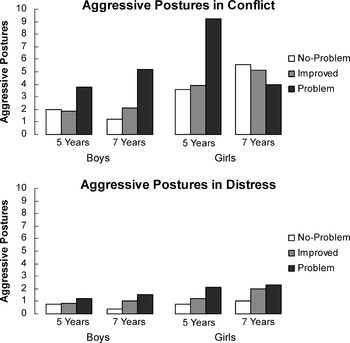
Main effects of behavior problem outcome and gender of child were found for threatening postures, F (2, 63) = 6.00, p < .005, and F (1, 63) = 11.78, p = .001, respectively. Children in the stable/worsen group showed the highest levels of aggressive posturing, and girls engaged in more posturing than boys. There were two three-way interactions, one for Behavior Problem Outcome × Time × Gender of Child, F (2, 63) = 4.17, p < .025, and one for Behavior Problem Outcome × Time × Dilemma Type, F (2, 63) = 4.97, p < .01. These interactions were subsumed under a four-way interaction of Behavior Problem Outcome × Time × Gender of Child × Dilemma Type, F (2, 63) = 10.04, p = .001 (see Figure 2). To interpret the four-way interaction, we compared change from T1 to T2 separately for boys and girls in each of the three problem groups. The only group that changed with age was girls in the stable/worsen group, who showed a marked decrease in aggressive postures, t (8) = 3.63, p < .01. Figure 2 indicates that aggressive postures for the stable/worsen girls were much higher than for other children at T1, but by T2 these girls were similar all other groups. There were no differences for distress dilemmas.
Means of aggressive postures by age, gender, dilemma, and behavior problem outcome.

Anger
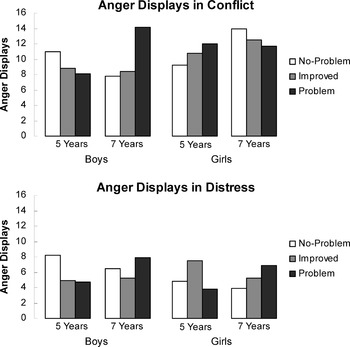
There was a four-way interaction of Behavior Problem Outcomes × Gender of Child × Time × Dilemma Type, F (2, 62) = 6.62, p < .005. Anger increased with age only for boys in the stable/worsen group for both types of dilemmas but more for distress, t (15) = −3.43, p < .01 than conflict, t (15) = −2.54, p < .10 (see Figure 3).
Means of angry expressions by age, gender, dilemma, and behavior problem outcome.

Caring themes and sadness
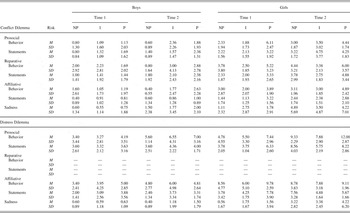
Means and standard deviations for caring themes and sadness are presented in Table 3.
Means and standard deviations of caring themes by age, gender of child, and behavior problem outcome

Note: NP, no-problem group; I, improved group; P, problem group.
Prosocial behavior
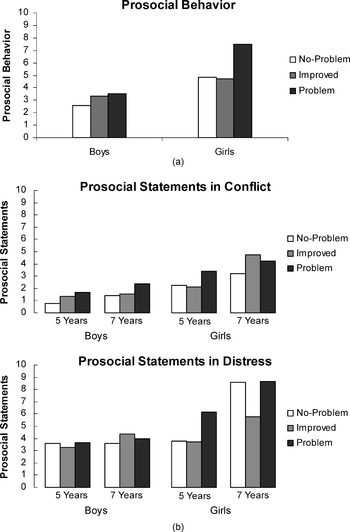
There were main effects of behavior problem outcome, time, and gender of Child, F (2, 63) = 6.50, p < .005, F (1, 63) = 22.65, p < .001, and F (1, 63) = 30.45, p < .001, respectively. Prosocial behaviors increased from 5 to 7 years of age in all groups, were most frequent in children in the stable/worsen group, and were more prevalent in girls than boys. The main effects of behavior problem outcome and gender of child were qualified by an interaction, F (2, 63) = 3.43, p < .05. Girls in the stable/worsen group showed more prosocial behavior than boys and girls in all of the other groups (ps < .001 to < .05; see Figure 4a). An interaction of Time × Dilemma Type, F (1, 63) = 25.67, p < .001 showed that prosocial behavior increased with age in distress, t (68) = −6.58, p < .001, but not to conflict, t (68) = −1.85 dilemmas.
(a) Means of prosocial behavior by age, gender, dilemma, and behavior problem outcome and (b) means of prosocial statements by age, gender, dilemma, and behavior problem outcome.

Prosocial statements
For prosocial statements there were main effects of time and gender of child. Prosocial statements increased over time, F (1, 61) = 21.33, p < .001 and girls made more prosocial statements than boys, F (1, 61) =32.70, p < .001. There was a three-way interaction of Behavior Problem Outcomes × Gender of Child × Dilemma Type, F (2, 61) = 3.30, p < .05, which was subsumed by a four-way interaction of Behavior Problem Outcome × Time × Gender of Child × and Dilemma Type, F (2, 61) = 3.62, p < .05. To interpret the interaction we compared change from 5 to 7 years, separately for boys and girls in each of the behavior problem outcome groups and for each dilemma type (see Figure 4b). For conflict dilemmas, prosocial statements did not change with age for any of the subgroups. For distress dilemmas, only two groups showed increases with age in prosocial statements, girls in the no-problem group, t (8) = −3.42, p < .01 and girls in the improve group, t (8) = −4.32, p < .01. Although girls in the stable/worsen group also showed high levels of prosocial statements at T2, they did not show a significant increase from T1 to T2 as did other two groups of girls, because the stable/worsen group was already high at T1.
Reparative behavior and statements (conflict dilemmas only)
Reparative statements increased with age, F (1, 61) = 7.64, p < .01. Girls engaged in more reparation than boys, F (1, 63) = 10.63, p < .005 for reparative behavior and F (1, 61) = 9.19, p < .005 for reparative statements.
Affiliative behavior
Girls enacted more affiliative behaviors than boys, F (1, 62) = 23.56, p < .001. There was a three-way interaction of Behavior Problem Outcome × Time × Dilemma Type, F (2, 62) = 3.29, p < .05. Bonferroni tests failed to detect group differences.
Affiliative statements
Girls made more affiliative statements than boys, F (1, 61) = 36.57, p < .001. There was an effect of behavior problem outcome, F (2, 61) = 4.20, p < .025. Follow-up tests with Bonferroni corrections failed to detect significant group differences here as well.
Sadness
Sadness increased with age, F (1, 62) = 12.08, p = .001. Girls were more likely to display sadness than boys, F (1, 62) = 7.72, p < .01. There was an interaction of Time × Gender of Child, F (1, 62) = 3.22, p < .05. Sadness increased for both boys and girls, but this age increase was more pronounced for girls, t (25) = −3.22, p < .005 than boys, t (41) = –2.23, p < .05.
Follow-up analyses
The analytic strategy used in this study was based on an approach that first categorized three groups of children on developmental trajectories for behavior problems and then compared these groups on their narrative profiles. Overall, the three groups identified in the person-centered analytic framework provided the most informative approach for data analysis and interpretation. However, the grouping may not have been optimal for detecting hypothesized group differences of higher physical aggression and lower reparation for aggression in the stable/worsen group (particularly boys) than for the other two groups. There were 30 children in the stable/worsen group or 42% of the entire sample. We questioned whether a more stringent cutoff for behavior problems at T3 would identify children with more severe problems, and whether this smaller group would confirm the predictions. We selected children in the top 33% of problems on three Achenbach scales (total behavior problems, externalizing problems, and aggression) and compared them with the remaining children on their overall narrative scores for physical aggression and reparation. For further measurement precision, we controlled on levels of earlier problems. Although this differs from the main analytic approach where behavior problem status was determined by classification at each of the three time points, it achieves the same goal of taking into account children's functioning at earlier time points.
In distress dilemmas only, children in the top 33% of problems engaged in more physical acts of aggression, F (1, 65) = 6.53, p < .025, F (1, 65) = 9.82, p < .01, and F (1, 65) = 8.61, p < .005 for total problems, externalizing problems, and aggression, respectively. Children in the top 33% also used more physically aggressive words in the distress dilemmas than their less disruptive counterparts, F (1, 65) = 6.36, p < .025 for externalizing scale, and F (1, 65) = 7.01, p = .01 for aggression. Children in the top 33% used fewer reparative words than the remaining children in the conflict dilemmas, F (1, 63) = 4.33, p < .05, F (1, 63) = 4.85, p < .05, and F (1, 63) = 3.74, p = .058 for total problems, externalizing problems, and aggression, respectively.
Discussion
Children's aggressive and caring narrative themes at 4–5 and 7 years of age predicted different developmental trajectories by age 9 for children without problems, children whose behavior problems continued or worsened with age, and those whose behavior problems improved. Narratives of children without problems reflected themes that often paralleled normative developmental transitions and gender differences observed in real-life situations. Children whose problems continued or worsened over time showed less adaptive narrative themes and there were important gender differences as well. Boys and girls whose problems continued or worsened over time sometimes expressed extremes of prototypic gender differences, that is, hostile and forceful aggressive themes were especially common in the boys whereas less forceful, more modulated aggressive themes and certain caring themes were especially common in the girls. Themes of children whose problems improved most closely resembled those of children without problems.
Gender differences and gender stereotypes in forms of psychopathology
For almost all disorders, and also at subclinical levels there is either a male preponderance (e.g., autism, Asperger syndrome, attention-deficit/hyperactivity disorder, conduct disorder) or a female preponderance (e.g., major depression, dysthymia, eating disorders, and anxiety disorders; Zahn-Waxler et al., Reference Zahn-Waxler, Crick, Shirtcliff, Woods and Cicchetti2006). In addition, and as we have seen here, males and females with similar problems sometimes manifest aspects of these problems (or representations of these problems) in different ways. A growing body of literature indicates that gender-role stereotypes or exaggerations of masculine qualities (e.g., impulsive, aggressive, uncaring) and feminine qualities (submissive, unassertive, socially sensitive) are reflected not only in the types of problems males and females tend to develop but also in different forms of expressions of the same problems (Zahn-Waxler et al., Reference Zahn-Waxler, Crick, Shirtcliff, Woods and Cicchetti2006). Rutter, Caspi, and Moffitt (Reference Rutter, Caspi and Moffitt2003) have proposed that the study of these gender differences can provide an important means to study causal mechanisms and unravel the complex etiologies that characterize different forms of emotional and behavioral problems.
Normative transitions and differences in narrative themes of boys and girls without problems
To understand the differences in boys and girls who remain troubled, we begin with a discussion of normative development and gender differences seen in the themes of children without problems as a comparative base. We also note instances in which the responses of children in the two problem groups parallel those of the nonproblem group. Several narrative themes of children free from problems over a period of 4–5 years reflected a progression toward more mature, adaptive ways of dealing with conflict and distress. Purely verbal aggression, prosocial caring themes, and expressions of internalized distress (i.e., sadness) increased over time in the no-problem group. The other caring themes (affiliation and reparation for aggression) were mainly explained by gender of child rather than as a developmental phenomenon as girls showed substantially more affiliation and reparation than boys at both 5 and 7 years of age. This was true for the two problem groups as well. Acts of physical aggression and anger did not decrease with age during symbolic play for children without problems, as has been seen in children's real life encounters. A degree of physical aggression in symbolic play may be a way of letting off steam in a safe setting. Aggressive language that included physical violence actually increased with age for boys and decreased with age for girls, irrespective of problem status. Girls showed more modulated aggression than boys (i.e., purely verbal aggression and postural threats). Mature, adaptive social themes, then, are seen normatively more in girls than boys. Had we combined both types of verbal aggression, the gender differences would not have been seen.
Narrative themes of boys and girls with stable or worsening problems
Narratives of children whose problems continued or worsened over time differed in a number of respects from those of children without problems. Boys whose behavior problems remained stable or worsened with age had shown increases in anger over time and they were the only group of children to do so. Follow-up analyses based on a more stringent cutoff for characterizing externalizing problems at T3 indicated that the most disruptive children at T3 were mostly boys whose narrative themes at the earlier time points had shown the most physical aggression and the least remorse and reparation for wrongdoing. Like the other boys, they were low on caring themes compared with girls.
If pretend play makes the expression of hostile actions and feelings more acceptable, it did so here in a selective manner—for boys in general and for disruptive boys in particular. For boys who remained troubled, their increased anger as they grew older occurred most strongly in story situations involving interpersonal distress, that is, where someone is sad, frightened, lonely, or in pain; in short, situations that call for empathy and concern for others. Active disregard for others under such circumstances may reflect the development of an internalized pattern of callousness that could maintain antisocial, disruptive behaviors over time. These findings also illustrate the value of distinguishing between conflict and distress dilemmas. Knowing what is normative for each type of dilemma can facilitate interpretation of nonprototypic, sometimes context-inappropriate responses.
The narrative profile of girls whose disruptive problems continued over time was quite different from that of boys who remained disruptive. It included early nonviolent verbal aggression (like other girls) and heightened use of aggressive posturing (compared to all other groups). Girls who remained troubled also showed heightened use of prosocial themes (compared to all other groups) and were similar to other girls on other aspects of caring and internalizing emotion (affiliation, reparation, and sadness). The confluence of these patterns bespeaks a conflictual interior world for young aggressive girls regarding the inhibition of aggression and assumption of a social role that involves caring for others.
The more modulated forms of aggression for girls who remain troubled, including the early physical postures and gestures that stopped short of infliction of harm, may reflect a form of precocity; for these patterns occur earlier in time than would be expectedly normatively in conflict situations. It is as if these girls whose problems continue are already practicing restraint in their symbolic play. Pure verbal aggression, more common in girls than boys in all three groups, may be more developmentally advanced but may also have its own negative consequences. It can be psychologically damaging and pose threats to interpersonal relationships, which are especially salient in the lives of girls (Rudolph & Conley, Reference Rudolph and Conley2005). Although relational aggression, known to be more common in girls than boys from an early age (Crick et al., Reference Crick, Casas and Mosher1997), was not assessed directly, the more pure form of verbal aggression often had a relational component.
Interpersonal sensitivity reflected in the prosocial themes of girls whose problems remain, along with reluctance to show physical force even in symbolic play (compared with troubled boys) raises the possibility that at some later time point in development these girls may begin to diverge from troubled boys in the nature of their problems. It may be that disruptive girls more than boys experience distress over misbehaviors likely to meet with parental and societal disapproval, but that this distress is transitory. However, it is also possible that young disruptive girls internalize these socialization messages over time in ways that both lessen their antisocial trajectories relative to boys and possibly increase risk for internalizing problems in early to midadolescence when substantial gender differences in depression and anxiety emerge.
The socialization literature indicates that parents have higher expectations for mature interpersonal behavior in young girls than boys and show greater disapproval toward girls' anger and aggression than boys, even at a quite early age (Zahn-Waxler & Polanichka, Reference Zahn-Waxler, Polanichka, Putallaz and Bierman2004). Stated another way, there is greater tolerance, acceptance, and reinforcement of forceful aggression in boys than girls. Disruptive girls' greater social sensitivity and fear of harm-doing at the representational level also may lead to preoccupations and a sense of being at fault that become early harbingers of later internalizing problems like anxiety and depression. These early signs may become more full-blown symptoms in adolescence when other biological, social, and societal stressors come into play, especially for girls. Externalizing problems are more often comorbid with such internalizing problems in females than males (Loeber & Keenan, Reference Loeber and Keenan1994), and there are indications that disruptive behavior problems are more likely to predict later depression and anxiety in girls than boys (e.g., Zahn-Waxler, Park, Essex, Slattery, & Cole, Reference Zahn-Waxler, Park, Essex, Slattery and Cole2005). Longitudinal studies are needed that follow children into and through adolescence while also specifically assessing socialization experiences.
Narratives of boys and girls for whom problems improved over time
The narratives of the group of children whose problems improved over time were quite similar to those of children who were free from problems. It would be tempting to conclude that something about their representations per se contributed to the diminution of these children's problems over time, especially given that the differences in narratives were present earlier in time than the end points used to determine trajectories of problems. This is particularly so for findings where children initially appear similar (e.g., on levels of anger), but where there is then a divergence on terms of problem status over time. Recall that children who remained troubled showed increased anger over time, whereas those who improved did not. Although differences in children's internalized representations (more positive for children whose problems improved than for those whose problems continued or worsened) may play some role, other factors may be implicated and causality cannot be inferred automatically.
The focus of our study was to describe linkages between narrative development and behavior problem trajectories, not necessarily to “prove” a definitive causal role. Because this is the first study to examine simultaneously narrative development in children with different levels of behavior problems, considering also changes in narrative themes that precede different developmental pathways, thorough description alone can be seen as a sufficient goal. These pathways have multiple determinants and we studied one possible set of factors. Other factors (e.g., socialization, biological, cognitive) also would be expected to influence the developmental course of children's behavior problems. It is not possibly to measure adequately all the potential causal variables in one study. Further research that incorporates socialization and constitutional factors is needed to determine more definitively if and how these representations influence children's social interactions and emotional and behavioral functioning over time.
Caveats and limitations
Several limitations merit attention. (a) The construction of the groups studied was based on information available at a time when there was little research on the behavior problems of very young children. (b) The sample size was relatively small at the onset and there was attrition over time, which further limits the strength of the conclusions that can be drawn. (c) The need to combine the two groups of children with moderate and severe problems may have reduced methodological and analytic precision. (d) The method used to construct the person-centered analytic approach with three trajectory groups worked well for the most part, but not for two hypotheses where confirmation required a more stringent cutoff. (e) The coding of narratives was based solely on content and did not include assessment of organizational and structural features or possible defensive processes that might be particularly important in narrative research pertaining to psychopathology and clinical issues (Oppenheim, Reference Oppenheim2006). (f) Although the three groups followed over time did not differ on initial measures presumed to be most relevant to the study, it is possible that they differed in other unknown ways. (g) The findings are based on middle to upper middle class, predominantly Caucasian sample. Because most research on children with disruptive behavior problems is based on lower SES samples, it can be useful to obtain information about children who are more advantaged but still continue to have clinical and subclinical problems. However, this does restrict generalizations to this sociodemographic group. One might conjecture, for example, that young disruptive girls from impoverished, violent environments where there are fewer socialization messages that encourage prosociality, might be less likely to show prosocial themes in the ways seen in the more advantaged, troubled girls in the present study.
Summary and Conclusions
This study provides information about the development of internal representations in boys and girls varying in risk for externalizing psychopathology. Results highlight the roles of both risk and gender of child as important factors associated with the child's representational world and its development in early and middle childhood. The gender-stereotyped representations of boys and girls who continued to have externalizing problems over time in this study may provide clues about possible different developmental trajectories in the long term. Taylor et al. (Reference Taylor, Klein, Lewis, Gruenwald, Gurang and Updegraff2000) have argued that models of responses to interpersonal stressors have tended to focus on male prototypic patterns likely to occur in conflict situations, that is, fight–flight reactions. They have developed another model thought to be more characteristic of females' responses to stressors, particularly in circumstances of distress, that is, tend-and-befriend reactions. The use of both conflict and distress dilemmas allowed us to explore the kinds of interpersonal stressors likely to evoke these gender prototypic patterns. Gender-based diatheses were seen in the hypothetical conflict and distress stressors with boys showing more extreme, angry, forceful aggressive (i.e., fight) themes and girls showing more prosocial (i.e., tend-and-befriend) themes. Sometimes these gender differences appeared in interaction with developmental changes, for example, as children grew older, boys used more physically violent language, whereas girls used less over time. Sometimes the differences appeared in interactions with risk, for example, for children whose problems remained, boys showed more extreme hostile themes, whereas girls showed more extreme prosocial themes. We have not fully explained why boys and girls with similar levels of problems differ in their representations or what the developmental consequences might be. However, we have offered some initial ideas and they support the premise of Rutter et al. (Reference Rutter, Caspi and Moffitt2003) that the study of gender differences can help to inform the origins, etiologies, and developmental trajectories of different types of emotional and behavioral problems.
Although both antisocial boys and girls could benefit from efforts to change how they think about solving interpersonal problems, the approaches may need to be tailored to the gender differences observed. Boys more often appear to feel overly empowered to inflict physical harm, whereas girls more often shy away from direct confrontation. Both groups would benefit from learning more appropriate ways of dealing with conflict and asserting themselves, in ways that become incorporated both in their representations and their behaviors. Gender differences in serious antisocial behavior may begin early in development as preschool boys and girls start to form distinctive interpersonal subcultures (Maccoby, Reference Maccoby2002). Much of the literature on what is presumed to be normative antisocial and prosocial behavior comes from research where problem behaviors are not assessed. Increased use of developmental psychopathology research designs would help to differentiate normative gender differences from those that are present in boys or girls where exaggerated gender stereotypic responses may reflect deviance. What we have seen here is how different ideas about hostile and caring interactions may begin to take hold in different ways in the minds of boys and girls at varying degrees of risk as they move forward in development and their social relationships assume even greater salience for adaptive and maladaptive functioning.
Appendix A: List of Story Stems for Conflict and Distress Dilemmas
Conflict dilemmas
1. Parental conflict—child watches mother and father argue over lost checkbook
2. Child noncompliance—mother tells child to put toys away and child refuses
3. Child aggression—two children fight over toy wagon and one pushes the other off
4. Moral conflict—child must break a rule to help injured friend
5. Child disobeys mother's rule—leaves the yard to go play ball with a friend
6. Child aggression—two children yell, slap, and push each other—one falls down
7. Group aggression—child trips over a ball and falls, hears other children laughing
Distress dilemmas
1. Personal injury—child falls off wagon and hurts knee
2. Nighttime fear—frightened child hears strange noises outside and runs from bedroom
3. Sad mother—child watches mother cry while viewing photos of her dead brother
4. Separation–departure—parents leave children with grandmother for a week's vacation
5. Separation–reunion—parents return home (does separation distress continue?)
6. Exclusion—mother and father are affectionate—tell child they want to be alone in living room
7. Angry mother—mother is generally fed up, leaves house, and child watches from window