INTRODUCTION
An effective global network of protected areas (PAs) is vital for the protection of biodiversity and the benefits that intact nature provides (Pimm et al. Reference Pimm, Russell, Gittleman and Brooks1995; Balmford et al. Reference Balmford, Bruner, Cooper, Costanza, Farber, Green, Jenkins, Jefferiss, Jessamy, Madden, Munro, Myers, Naeem, Paavola, Rayment, Rosendo, Roughgarden, Trumper and Turner2002; Rodrigues et al. Reference Rodrigues, Akcakaya, Andelman, Bakarr, Boitani, Brooks, Chanson, Fishpool, Fonseca, Gaston, Hoffmann, Marquet, Pilgrim, Pressey, Schipper, Sechrest, Stuart, Underhill, Waller, Watts and Yan2004). However, the success of PAs depends on integrating them with local human communities in order to reduce conflicts and mitigate impacts originating from buffer zones (Anthony Reference Anthony2007). Interactions between people and PAs are known to be influenced by perceptions that communities have towards conservation projects and PAs (Ormsby & Kaplin Reference Ormsby and Kaplin2005). Thus, the relationship between PAs and local residents must be clearly understood in order to achieve PA conservation goals (Newmark et al. Reference Newmark, Leonard, Sariko and Gamassa1993; Ormsby & Kaplin Reference Ormsby and Kaplin2005).
The adoption of frameworks to address factors that influence perceptions towards PAs may help incorporate local communities’ expectations into PA planning and management, increasing PA effectiveness over the long term (Brandon & Wells Reference Brandon and Wells1992; Newmark et al. Reference Newmark, Leonard, Sariko and Gamassa1993; Fiallo & Jacobson Reference Fiallo and Jacobson1995). Many factors may influence perceptions and attitudes toward PAs, including history of PA management (Ormsby & Kaplin Reference Ormsby and Kaplin2005; Allendorf Reference Allendorf2007), benefits received from the PA (Bauer Reference Bauer2003; Ormsby & Kaplin Reference Ormsby and Kaplin2005), relationships with PA staff (Ite Reference Ite1996; Ormsby & Kaplin Reference Ormsby and Kaplin2005), size of the area (Allendorf Reference Allendorf2007), residents’ age (Anthony Reference Anthony2007) and time of residence in the area (Newmark et al. Reference Newmark, Leonard, Sariko and Gamassa1993).
In developing countries, most studies on the relations between people and PAs have been in Africa (Infield Reference Infield1988; Gillingham & Lee Reference Gillingham and Lee1999; Bauer Reference Bauer2003; Ormsby & Kaplin Reference Ormsby and Kaplin2005; Anthony Reference Anthony2007), with few studies performed in Asia (Heinen Reference Heinen1993; Walpole & Goodwin Reference Walpole and Goodwin2001; Allendorf et al. Reference Allendorf, Swe, Htut, Aung, Allendorf, Hayek, Leimgruber and Wemmer2006; Allendorf Reference Allendorf2007) and South America (Fiallo & Jacobson Reference Fiallo and Jacobson1995; Naughton-Treves et al. Reference Naughton-Treves, Alvares-Berrios, Brandon, Bruner, Holland, Ponce, Saenz, Suarez and Treves2006).
People-park interactions are poorly studied in Brazil and there is no published research for the entire Cerrado region, the second largest Neotropical domain and also the world's richest and most threatened tropical savannah (Klink & Machado Reference Klink and Machado2005). Biological importance of the Cerrado savannahs is high, reflected in high levels of plant endemism and high species richness of invertebrates, fishes, reptiles, amphibians and birds (Myers et al. Reference Myers, Mittermeier, Mittermeier, Fonseca and Kent2000; Oliveira & Marquis Reference Oliveira and Marquis2002; da Silva & Bates Reference da Silva and Bates2002; Klink & Machado Reference Klink and Machado2005). However, agricultural expansion and human migration to central Brazil have caused high rates of habitat loss and severe changes in the Cerrado landscape during the last decades. Over half of the Cerrado has already been cleared or transformed (Machado et al. Reference Machado, Neto, Pereira, Caldas, Gonçalves, Santos, Tabor and Steininger2004), and conservation efforts are modest, with only 2.2% of the Cerrado area under legal protection (Klink & Machado Reference Klink and Machado2005).
Tocantins state, in the northern region of Brazil, congregates important Cerrado-Amazônia transition areas and some of the largest blocks of Cerrado remnants (Machado et al. Reference Machado, Neto, Pereira, Caldas, Gonçalves, Santos, Tabor and Steininger2004). The state has 5.7% of its total area preserved as restricted-use PAs (IUCN categories I to III), one of the highest percentages of Cerrado conserved areas among Brazilian states. Besides their importance and potential for biodiversity conservation, PAs in Tocantins state face increasing threats owing to anthropogenic fires, cattle raising and agriculture expansion, as observed in other Cerrado areas (Klink & Machado Reference Klink and Machado2005). Attempts to conserve biodiversity and at the same time promote local communities’ development become especially challenging in highly biodiverse PAs subjected to significant pressure over natural resources and financial limitations to support management (Anthony Reference Anthony2007).
Inadequate implementation of PAs is particularly acute in developing countries, where many forces combine to threaten these areas, including poverty, landlessness, exhaustion of natural resources and overpopulation. PAs in the Cerrado also generally lack effective management and protection. Moreover, PAs in grassland ecosystems, such as the Cerrado savannahs, may be the most at risk since these regions have particularly high human population growth rates, which are associated with higher deforestation rates (Wittemyer et al. Reference Wittemyer, Elsen, Bean, Coleman, Burton and Brashares2008).
PAs under Tocantins state administration were created in the last decade without any kind of participatory approach, and nowadays, despite some efforts to inform and engage local populations in PA management, local residents still live, exploit resources and claim for land rights within these areas, in a scenario of increasing people-park conflicts. Conflicting land-use practices compromise the achievement of conservation goals and PA management, especially due to agriculture, anthropogenic fires, illegal hunting and cattle raising, both within PAs and in their buffer zones.
Moreover, despite being managed by the same institution, each PA is subjected to a unique environmental and social context, determined by PA history, size, ecosystems, category of protection, buffer-zone land use and others (more details in Methods). Therefore, instead of adopting a single ‘one size fits all’ strategy, effective outreach depends on previous understanding of local communities’ relationships with each PA.
This paper analyses the perceptions of local residents with respect to four restricted-use PAs in Tocantins state, in order to define priority of actions for PA managers and policy makers and identify opportunities to enhance local support for biodiversity conservation goals of these areas. The main research questions were: (1) What is the degree of local community awareness of the existence and goals of the PAs? (2) How do residents perceive the impact of PAs in their livelihoods? (3) Which of the factors (age group, gender, time of residency, occupation and site-related issues) influence local communities’ perceptions of PAs?
METHODS
Study site
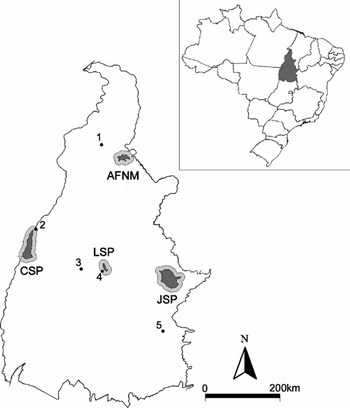
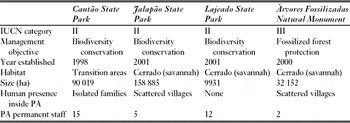
Four PAs located at different regions in the state were chosen in order to achieve a broad representation of human perceptions of PAs in different contexts, including habitat, history, size and degree of legal access for communities (Fig. 1, Table 1).
Location of Tocantins state in Brazil. Expanded view illustrates the studied PAs and their buffer zones. CSP = Cantão State Park, LSP = Lajeado State Park, JSP = Jalapão State Park and AFNM = Árvores Fossilizadas Natural Monument. Numbers represent major Tocantins cities (1 = Araguaína, 2 = Caseara, 3 = Paraíso do Tocantins, 4 = Palmas and 5 = Dianópolis).

Summary description of PAs studied in Northern Brazil.

All areas were created in the last decade and are managed by the Tocantins State Nature Institute (NATURATINS). Cantão State Park (CSP) is located in Western Tocantins, in the transition zone between the Cerrado savannah and the Amazon forest. It is bounded by three major rivers (Araguaia, Coco and Javaés) and adjacent to the world's largest fluvial island (Ilha do Bananal). Araguaia River is one of the largest Brazilian rivers that still remains free of significant human impacts, such as hydroelectric dams or high levels of pollution. Main economic activities are irrigated agriculture, cattle raising and fishing. Local communities are sparsely distributed along CSP buffer zone, in small villages or settlements where mean human density is around 0.9 inhabitants km−2 (IBGE [Instituto Brasileiro de Geografia e Estatística (Brazilian Institute of Geography and Statistics)] Reference IBGE2000). Park staff and local organizations support sustainable community activities, such as sustainable agriculture and handicraft making, while initiatives on environmental education are also being developed, mainly related to fire prevention during the dry season.
Jalapão State Park (JSP), in Eastern Tocantins, is part of the Jalapão-Mangabeiras biodiversity corridor, which holds the largest tracts of natural remnants and the largest PAs in Central Brazil, altogether protecting almost 1600 km2, and also making this region extremely important to the conservation of Cerrado biodiversity. The JSP region consists of extensive quartzitic sand depressions resulting from erosion of isolated arenitic plateaus of the Serra Geral and Chapada das Mangabeiras, and is drained by the headwaters of the Tocantins and São Francisco river basins (SEPLAN [Secretaria de Planejamento (Secretary of Planning)] 2003). Vegetation is typical of the Cerrado and is dominated by extensive campos sujos (scrub grasslands) and open savannah interspersed by veredas (wet grasslands with Mauritia flexuosa palm trees) and gallery forests (Oliveira-Filho & Ratter Reference Oliveira-Filho, Ratter, Oliveira and Marquis2002; SEPLAN 2003). Communities around JSP comprise small towns and rural settlements. PA boundaries include areas traditionally occupied by local communities, who are requesting changes in the PA design in order to avoid land-use restrictions. Human population density in the region is approximately 0.6 inhabitants km−2 (IBGE Reference IBGE2000), and the local economy is based on subsistence agriculture, extensive cattle raising and, more recently, handicraft making and tourism (SEPLAN 2003; Schmidt et al. Reference Schmidt, Figueiredo and Scariot2007). Several capacity building and integrated conservation-development projects were implemented in the JSP region by governmental and non-governmental institutions to improve handicraft design and production, tourist reception and sustainable exploitation of local products. Outreach activities are developed by the PA staff on a regular basis, especially in rural settlements and local schools.
Lajeado State Park (LSP) is the smallest PA surveyed and is located in the central portion of the state, close to its capital city (Palmas). It is composed of typical Cerrado vegetation, with wooded savannahs (cerrado sensu strictu) and forested habitats (gallery forests, see Oliveira-Filho & Ratter Reference Oliveira-Filho, Ratter, Oliveira and Marquis2002) distributed along plateaus with mean altitudes of 500 m. LSP protects most of the headwaters that supply the city of Palmas (178 000 inhabitants; IBGE Reference IBGE2007). Local communities occupy small towns and farms around LSP, but urban pressure from the capital city has caused landscape change over the last two decades. Mean human density in the region is approximately 36 inhabitant km−2 (IBGE Reference IBGE2000), one of the highest levels among PA buffer zones in the state. Agriculture and cattle raising are the main activities in the area. Despite its privileged location, LSP still remains closed to public visitation and there are minor and isolated community outreach activities.
Arvores Fossilizadas Natural Monument (AFNM) is the only PA in this study that formally allows human settlements and private properties inside its boundaries. It was created in the northern portion of the state to protect a petrified forest that represents the most important Permian tropical-subtropical floristic record in the Southern Hemisphere (Dias-Brito et al. Reference Dias-Brito, Rohn, Castro, Dias, Rössler, Winge, Schobbenhaus, Berbert-Born, Queiroz, Campos, Souza and Fernandes2007). The AFNM region includes natural units interrupted by large cattle farms. Mean human density is approximately one inhabitant km−2 (IBGE Reference IBGE2000). Natural areas are dominated by cerrado vegetation, although riparian forests and some small patches of semi-deciduous forests also occur. Local communities are distributed in small villages or rural settlements, and the economy is based on subsistence agriculture and cattle raising.
In all cases, PA boundary definition and establishment were conducted without local community participation, based mainly on biophysical information. Nowadays, management councils represent formal mechanisms of community involvement in PA planning and management. The management council is a legally instituted mechanism adopted in the administration of Brazilian PAs that provides a discussion forum on PA management for many segments of civil society, agencies, research institutions and private companies. In Brazil, these councils usually represent the main arena for participatory involvement in PA management. In the council, agreements, rules and direction of the actions to be undertaken are established, thereby reducing conflicts and impacts, aiming at sustainability and conservation of available resources by means of a shared process of management. The establishment of management councils involves preparatory meetings that are followed up by open election of representatives from local communities and other sectors or institutions that are in some way related to PAs. In Tocantins state, management councils have been established in CSP and JSP, even though participation is still modest and occasional.
Financial resources for all PA management are scarce; however CSP and LSP receive additional resources from compensatory measures (LSP) and Amazon conservation programmes (CSP) and have better area:staff ratios (827 ha per person in LSP and 6001 ha per person in CSP) when compared to AFNM (16 076 ha per person) and JSP (31 777 ha per person).
Sampling procedure
Perceptions of local people living adjacent to the four PAs were assessed through standardized interviews of both men and women over 18 years old, conducted between April 2007 and March 2008. In total, 275 local inhabitants were interviewed, all living within a 12-km radius of the PAs.
Perceptions were analysed in order to better understand the beliefs, values and interactions between local communities and Tocantins state PAs (Appendix 1, see Supplementary material at URL http://www.ncl.ac.uk/icef/EC_Supplement.htm). PAs have increasingly become the means by which many people see, understand, experience and use the parts of the world that are often called nature and the environment (West et al. Reference West, Igoe and Brockington2006). It is widely accepted that perceptions have a direct effect on residents’ attitudes towards PAs (Allendorf Reference Allendorf, Swe, Htut, Aung, Allendorf, Hayek, Leimgruber and Wemmer2006), and individual or group interviews have been largely applied to evaluate these (Ite Reference Ite1996; Bauer Reference Bauer2003; Ormsby & Kaplin Reference Ormsby and Kaplin2005; Anthony Reference Anthony2007).
The questionnaire included closed and open-ended questions and was divided in two major sections: sociodemographic variables (age, gender, duration of residency in the area and occupation) and PA perceptions (Appendix 1, see Supplementary material at URL http://www.ncl.ac.uk/icef/EC_Supplement.htm). Open questions examined the various dimensions of respondents’ perceptions and enabled us to cross-check responses (as in Infield Reference Infield1988; Bauer Reference Bauer2003).
The first and second questions assessed respondents’ knowledge and awareness about the PA and represented important background to the interview. Question three aimed to assess the PA's value to local people (conservation value, financial value or other values). Questions four and five analysed how residents perceive the impacts of PA creation on their lives (either positive, negative or neutral). The final question concerned residents’ perceptions of their relationship with PA staff, since previous studies suggested that this may have a strong influence on the relationships between people and PAs (Newmark et al. Reference Newmark, Leonard, Sariko and Gamassa1993; Ormsby & Kaplin Reference Ormsby and Kaplin2005).
We adopted a proportional random sampling design (as in Newmark et al. Reference Newmark, Leonard, Sariko and Gamassa1993). Village population defined the number of interviews and we visited most villages located around the PAs. There were no precise estimates of population size for each site, so we employed demographic data from municipalities and PAs to define for the number of interviews in each area. In the main municipalities where PAs were situated, populations ranged between 1800 in JSP (IBGE Reference IBGE2007) and 7800 in AFNM (IBGE Reference IBGE2007), and population numbers inside PAs varied from zero in LSP to 1000 inhabitants in JSP (SEPLAN 2003).
Interviews were conducted by one of the three members of the research team, after a brief introduction explaining the form and purpose of the interview. Residents were approached in their households and interviews usually took from 30 minutes to an hour.
Field research was focused on villages, towns or rural settlements according to the context found in each PA buffer zone. For example, interviews in JSP were mainly applied to local communities living in settlements scattered inside and outside PA boundaries, including areas that were isolated and difficult to reach, while most interviews from LSP were conducted in farms and towns around the PA, including the state capital city.
Data analyses
Results are presented in relative frequencies (%) that were based upon the number of people surveyed in each area and the total number of interviewees for all questions. Analyses were performed to verify which factors were important in defining people's perception of PAs. Two main groups of factors were considered: social aspects (age group, gender, time of residency in the area and occupation) and PA context.
We analysed data with STATISTICA 6. Pearson chi-square tests (notation: χ2df) applied to all combinations of independent and dependent variables at the p < 0.05 significance level. Independent variables were: age group, gender, length of residency in the area, occupation and PA. For analyses, occupations were separated into direct (mainly handicraft making, agriculture and cattle raising) and indirect use of natural resources (mainly tourism-related services). Dependent variables were the answers to the perceptional questions. Answers to open questions were used for qualitative interpretation.
RESULTS
Characteristics of surveyed communities
Mean age was similar among respondents of all PAs, and length of residence was higher in JSP and AFNM (Table 2). The majority of respondents were female, mainly because most men were busy in the field or towns during the day, while women were at home. However, since perceptions were not dependent on gender (all χ2 results non-significant, over 0.05), this bias has not affected survey results.
Respondents’ profile related to each PA and in total. CSP = Cantão State Park; JSP = Jalapão State Park; LSP = Lajeado State Park; AFNM = Árvores Fossilizadas Natural Monument.

Occupation varied substantially among the PAs. JSP presented the highest level of ‘direct use’ occupations, followed by AFNM, indicating that these communities were significantly more dependent on natural resources than those in CSP and LSP. The short distance between LSP and the capital city of Tocantins state may explain the low percentages of ‘direct use’ occupations observed in communities around this park.
Residents’ perceptions of PAs
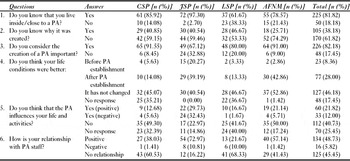
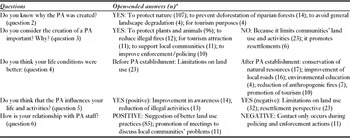
Most respondents knew that they lived inside or adjacent to a PA (Table 3, question 1) and considered its creation important (Table 3, question 3) for conservation and economic purposes (Table 4, question 3), although most of them did not know the reasons why the PA was created (Table 3, question 2). There were differences in the responses of each PA community for questions one (χ23 = 29.59, p = 0.00) and three (χ23 = 21.42, p = 0.00). People living next to JSP presented the highest level of awareness of the existence of the PA (97%) while LSP had the lowest level (62%). A great majority of people from CSP and AFNM (91%) stated that they considered the creation of a PA important, while this response was observed for only 67% of JSP interviewees.
Respondents’ perceptions within each PA and in total (responses to questions in Appendix 1, see Supplementary material at URL http://www.ncl.ac.uk/icef/EC_Supplement.htm). CSP = Cantão State Park; JSP = Jalapão State Park; LSP = Lajeado State Park; AFNM = Árvores Fossilizadas Natural Monument.

Responses to open-ended questions concerning community perceptions of Tocantins PAs. *Respondents may have answered more than one reason to justify their perceptions.

In general, life conditions had not changed for almost half of the respondents after PA establishment (Table 3, question 4). Limitations on land use were the main reason for recognizing better life conditions before the PA, while conservation issues, tourism and local roads improvement were responsible for improving life conditions after PA creation (Table 4, question 4). Respondents views as to whether better life conditions existed before or after PA establishment varied significantly among PAs (Table 3), being higher for JSP, followed by AFNM. Perceptions also differed among PAs for question five (χ28 = 62.26, p = 0.00), with the proportion of respondents stating that the PA affected their life and activities being highest in JSP followed by AFNM (Table 3). This suggests that the creation of PAs has impacted (positively or negatively) the JSP and AFNM communities more than to those living nearby CSP and LSP.
When asked ‘How is your relationship with PA staff?’, only 6% of all respondents answered ‘negative’ stating that contact with PA staff only occurred during policing and enforcement actions (Table 4, question 6). Responses varied substantially among PAs (Table 3), with communities in JSP and LSP perceiving the more negative relationships with PA staff (over 10% of the interviewees), while many respondents (over 60%) did not have any kind of contact with CSP and LSP staff (Table 3, question 6).
Factors influencing PA perceptions
Perceptions were not significantly dependent on age or gender. However, perceptions were related to the respondent's length of residency and occupation. Long-term residents (people who had resided in the PA region for over 20 years) were more likely to acknowledge the existence of a nearby PA (χ22 = 11.09, p = 0.04), recognize better life conditions after PA establishment (χ26 = 30.70, p = 0.00) and consider their relationship with PA staff to be positive (χ24 = 32.46, p = 0.00).
‘Direct-use’ respondents were more aware that they lived nearby a PA (χ21 = 7.80, p = 0.01), were less likely to consider the creation of PAs as important (χ21 = 7.59, p = 0.01) and stated that the PA affected their lives and activities (χ23 = 23.09, p = 0.00). Answers to all questions (except question two) varied significantly among PAs.
DISCUSSION
PA awareness
There were higher levels of PA awareness in JSP and CSP when compared to LSP and AFNM. Several factors may affect the degree of knowledge of the PAs among residents, including attendance at meetings, interaction with PA staff, village proximity to PA boundaries, participation in programmes such as community development and education efforts, PA visitation and informal community discussions (Ormsby & Kaplin Reference Ormsby and Kaplin2005).
There are two factors that distinguish JSP and CSP from the other studied PAs and may help explain awareness, namely the existence of formal mechanisms of community participation in park management (management councils) and the greater development of tourism and research activities in those areas. Management councils, as previously stated, are one of the most powerful tools to ensure community involvement in PA issues and, even though their functioning is still precarious, they may be responsible for the higher awareness levels and some positive perceptions found in JSP and CSP. Management councils may potentially reduce conflicts and improve people-park relationships. However, to achieve these goals, management councils must represent community diversity and interests and be effectively the main forum for PA decision making. In Tocantins PAs, many management issues are not openly discussed within these councils, with management counsellors being solely informed about the latest developments in the PA and not actively participating in the decision process. Thus, a lack of effective participation in decisions may be interpreted as a major limitation to the effectiveness of PA participatory planning.
Tourism and research are also activities that promote awareness and possibly income generation for local populations. These factors may also contribute to positive perceptions concerning PAs. Tourism has become a major economic driver for JSP communities in the last decade, especially through the production and selling of art and crafts made of capim-dourado (Syngonanthus nitens), a herbaceous species (Poales: Eriocaulaceae) that is used locally to make purses, hats, bowls and a variety of handicrafts. The traditional use of S. nitens was incorporated into integrated conservation-development projects to simultaneously improve local population income and promote grasslands conservation and fire management practices.
In CSP, local residents work as guides and boatmen for tourists, fishers and researchers, most attracted to region owing to the diversity and productivity of aquatic ecosystems in the Araguaia basin.
Awareness may also be owing to the presence of human settlements inside CSP and JSP and the anguish residents feel about this situation, since most of them do not have any kind of formal land tenure and lack clear information on the conduction of the main processes concerning PA establishment and management. One of the respondents from JSP stated that, ‘The park is good as long as I do not have to leave my place’ (Local resident from JSP, Tocantins, personal communication April 2007, translation). This is a perception that is also expressed in answers given for questions three and five (Table 4), where resettlement issues are presented as reasons for negative attitudes towards PAs.
Most respondents in all PAs did not know why each PA was established in the first place. This seems to be a common trend in other areas (Fiallo & Jacobson Reference Fiallo and Jacobson1995; Gillingham & Lee Reference Gillingham and Lee1999; Ormsby & Kaplin Reference Ormsby and Kaplin2005), and may be responsible for erroneous assumptions and negative attitudes towards PAs (Ormsby & Kaplin Reference Ormsby and Kaplin2005). The establishment of management councils in AFNM and LSP, and also the implementation of outreach community activities, may help reduce these information gaps and misunderstandings about PAs goals and conservation values.
PA impact on residents’ livelihoods
PAs are usually viewed as negatively impacting the livelihoods of local communities through loss of rights, exclusion from natural resources and displacement from traditional lands (Peluso Reference Peluso1993; Adams et al. Reference Adams, Aveling, Brockington, Dickson, Elliott, Hutton, Roe, Vira and Wolmer2004; Cernea & Schmidt-Soltau Reference Cernea and Schmidt-Soltau2006). Communities whose livelihoods depend on the direct exploitation of local natural resources often come into conflict with PAs (Anthony Reference Anthony2007). However, PAs may also benefit rural inhabitants by providing access to road networks, employment, foreign aid, increasingly scarce ecosystem services and areas of safety during strife (Scherl et al. Reference Scherl, Wilson, Wild, Blockhus, Franks, McNeely and McShane2004).
In the present study, dependence on natural resources has strongly influenced residents’ perception of PAs. In communities living adjacent or inside JSP (where proportions of direct use occupation were extremely high), a higher proportion of respondents stated that the PA negatively affected their life and activities, mainly owing to restrictions on harvesting, cattle raising and agriculture. Traditionally, PA regulations do not allow any kind of direct use activity inside restricted-use PA boundaries. However, as long as communities are still living in these areas, alternative approaches must be found to minimize resource use conflicts and human impacts on natural environments. Such approaches may include the identification of sustainable income opportunities, capacity building and the employment of local residents in conservation and PA management activities.
Conversely, a significant portion of people from JSP and AFNM (39% and 43%, respectively) also recognized better life conditions after PA establishment, maybe because both areas are situated in very poor regions where PA funding and integrated conservation and development projects represent direct and indirect benefits for local communities. This important finding should be better explored to minimize negative perceptions in all PAs, by stressing direct links between PAs and community gains, and also emphasizing non-economic benefits, such as the improvement of communication and health services and better road networks in JSP, or the conservation of the main water sources of Palmas promoted by LSP.
Moreover, several respondents that perceived better life conditions after PA establishment or positive influences from the PA on their lives and activities related it to the improvement in people's awareness concerning biodiversity conservation and a reduction in illegal activities, such as anthropogenic fires and hunting.
Fire is widely used to clear land and encourage new pasture growth, and considered one of the major problems that Brazilian reserves face today. Although the Cerrado is a fire-adapted domain and must burn on a regular basis, uncontrolled fires during the dry season can cause severe damage to its environments, including changes in flora composition, soil impoverishment, depletion of water sources and reduction of populations of some animal species. Illegal fires represent the most significant human impact on Tocantins PAs and may be a good indicator of community awareness and engagement in PA management and conservation.
Hunting is also still a common practice in most Brazilian PAs. Although hunting may be a source of food for some families in Tocantins PAs, in most cases, it represents a cultural habit. Deer, tapirs, wild pigs and armadillos are the main targets, and it is believed that their populations are severely depleted by decades of hunting in some of these areas (SEPLAN 2003).
Any strategy to reduce these impacts must include prevention actions (such as firebreaks) and continuous outreach activities. Management and communication initiatives should explore the finding that some local residents perceived the positive benefits that PAs promotes as reducing human impacts on biodiversity.
Perceptions and length of residency
Length of residency also apparently influenced local communities’ perceptions of PAs. Newmark et al. (Reference Newmark, Leonard, Sariko and Gamassa1993) suggested that long-term residents are probably more likely to have been adversely affected by PA establishment than short-term inhabitants. However, we identified higher proportions of positive perceptions among long-term residents (>20 years), especially related to staff interactions and better life conditions after PA establishment. Long-term residents lived in these areas when they were pristine and isolated from urban centres, without any infrastructure, transport or other facilities. Therefore, they tended to be more aware of some of the positive impacts of PA establishment, including health, education and transport services. Moreover, while short-term residents apparently do not show strong attachments to the area, long-term residents tend to know, value and even have an affectionate relationship with local wildlife and natural environments, favouring support for PA conservation goals.
Relationship with PA staff
The great majority of the respondents from LSP and CSP did not have any kind of contact with PA staff, while 10% of those in JSP and LSP stated they had negative relations with PA staff. Although proportions of negative perceptions may be considered modest, lack of contact or solely negative interactions between PA staff and local residents should be avoided, as this has been responsible for creating conflict and widening people-park splits in different studies (Newmark et al. Reference Newmark, Leonard, Sariko and Gamassa1993; Fiallo & Jacobson Reference Fiallo and Jacobson1995; Ormsby & Kaplin Reference Ormsby and Kaplin2005; Allendorf Reference Allendorf, Swe, Htut, Aung, Allendorf, Hayek, Leimgruber and Wemmer2006). A continuous environmental education programme and regular outreach activities are essential to reduce this lack of interaction between local people and PA staff. It also importantly reduces negative perceptions owing to misunderstanding of the PA staff's role and poor understanding of PA limits, rules and natural values.
Suggesting better land-use practices (such as fire management, sustainable agriculture and water use) and promoting meetings to discuss local communities’ problems were identified as the main activities developed by staff from Tocantins PAs. In AFNM, one of the respondents stated that,’After the establishment of the Natural Monument, children are being involved in environmental programmes, we are getting more information about the area and the illegal extraction of fossils has been significantly reduced’ (Local resident from AFNM, Tocantins, personal communication July 2007, translation). This is an important example of how education and public relations programmes may serve to improve people-park interactions and reduce PA impacts, complementing enforcement activities.
Resettlement issues
Although we did not directly investigate resettlement issues, they were raised by several interviewees from JSP and CSP, indicating that resettlement is an important factor influencing attitudes and perceptions towards these PAs. Compulsory displacements and compensation initiatives have failed time and again to solve conflicts between reserves and local communities and have created greater impoverishment and negative attitudes towards PAs, especially when resulting from a top-down non-participatory approach (Cernea & Schmidt-Soltau Reference Cernea and Schmidt-Soltau2006).
In JSP, Tocantins government and non-governmental organizations conducted a survey during 2007 to discuss and propose alternatives to resettlement and possible PA boundary changes to ensure community permanence in some areas. The study involved the local communities and has thus generated great expectations among residents. However, to date a consensual solution has not been achieved and mistrust and communication gaps exist concerning how final decisions will be made and instigated by the state government.
Some successful examples, such as the resettlement process in Grande Sertão Veredas National Park, another reserve in the Brazilian Cerrado, could be used as reference for Tocantins PAs. In this area, local residents participated in the relocation process, which lasted for 10 years and resulted in the designation of formal ownership of the land for local families relocated outside PA boundaries.
CONCLUSIONS
Residents’ perceptions of PAs in Tocantins state were generally positive or neutral, despite modest community engagement in PA management and related benefits, and the persistence of conflicts regarding natural resources exploitation and settlements inside PAs.
Although surveyed areas present several similarities (political jurisdiction, ecosystem types, establishment period and management institution), local people's relationships were remarkably distinct among PAs. This suggests that characteristics such as area, management goals, history and community aspects may have been responsible for shaping people-park relations in a very complex and singular way, reinforcing the need to understand each site-community context before the design and implementation of conservation-development projects.
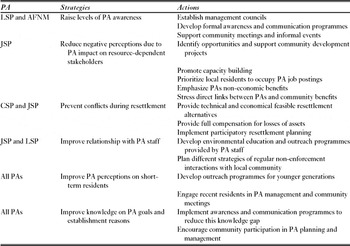
Based on our findings and discussions with PA staff and residents, we propose some strategies and actions to improve people-park relations in Tocantins PAs (Table 5). Outreach programmes and formal mechanisms of community engagement should be implemented in order to achieve better PA awareness among local people, especially in LSP and AFNM (Table 5), and improve communication between residents and PAs, generally hampered both by lack of trust and the social and cultural differences between staff and local communities (Hough Reference Hough1988). To reduce negative perceptions of resource-dependent stakeholders from JSP, several actions may be implemented, such as employment benefits, local capacity building and sustainable development projects (Table 5). Direct links between PAs and community benefits should be emphasized, especially non-economic benefits, which may depend less on outside intervention and may be more effective in strengthening the relationship between residents and PAs over the long term (Infield Reference Infield2001; Kuriyan Reference Kuriyan2002; Bauer Reference Bauer2003; Allendorf Reference Allendorf2007). We suggest that formal programmes and regular interaction with local people may improve relationships with PA staff in JSP, LSP and CSP. Finally, in Tocantins state PAs that still have settlements inside their boundaries, community relocation and compensation must occur through a careful participatory process, in order to avoid significant changes in local perceptions and attitudes towards PAs (Table 5).
Recommended strategies and actions to improve people-park relations in Tocantins PAs.

Our findings may also guide PA establishment and management policies in the Cerrado. Results from Tocantins PAs demonstrate that management must address local residents’ concerns, and community issues should be effectively integrated into management strategies. Higher levels of participatory planning may enhance local support for PA biodiversity conservation goals and reduce widely distributed conflicts between people and PAs in the Cerrado, such as low levels of awareness, poor community participation and misunderstanding of PA boundaries and regulations.
ACKNOWLEDGEMENTS
We thank Elivania Reis for help in the field trip surveys, and Cristiano Nogueira and Vânia Pivello for reading earlier versions of the manuscript. Conservation International and NATURATINS provided support during field trips, and CNPq, CAPES and NGC provided financial support.