



1 Introduction
A basic problem in the theory of ordered vector spaces is to characterize their order isomorphisms. These are the bijective maps that preserve the order in both directions. In many cases, these maps are necessarily affine, and we would like to know under which conditions this is so.
The earliest rigidity results in this area were by Alexandrov [Reference Alexandrov1, Reference Alexandrov2] and Zeeman [Reference Zeeman33]. Their motivation came from Special Relativity, and so they were interested in the Lorentz cone, although Alexandrov later broadened his result to general finite-dimensional cones. This work was extended in [Reference Artstein-Avidan and Slomka6, Reference Lemmens, Van Gaans and Van Imhoff14, Reference Noll and Schäffer22, Reference Noll and Schäffer23, Reference Rothaus27, Reference van Imhoff and Roelands30]. The techniques used in these papers rely on the existence of extreme rays of the cone defining the order, and work well when there are many such rays. However, many interesting cones have few or no extreme rays, and here the techniques break down.
The approach taken in this article is to study the dual space and the dual cone. It is convenient to restrict our attention to vector spaces that are ordered by an Archimedean cone and have an order unit, the so-called order-unit spaces. The advantage of this is that under these assumptions the dual cone has a cross section, called the state space, which is compact in the weak* topology. By the Krein–Milman theorem, therefore, the state space has extreme points, the pure states. We call the closure of the set of pure states the pure state space F. One can represent points of the original vector space V as continuous functions on the pure state space satisfying certain constraints. These constraints are given by the affine dependencies carried by F, in other words, the nonzero signed measures
$\mu $
 carried by this set such that

Our first theorem shows that the existence of an order isomorphism between two complete order-unit spaces implies that they are linearly isomorphic. Actually, the result holds even when the isomorphism is only between certain subsets of the spaces. A subset X of a partially ordered space is said to be upper if
$x\in X$
 whenever
$y\in X$
 and
$y \le x$
 . We use the notation
$(V, C, u)$
 to denote an order-unit space V with Archimedean cone C and order unit u.
Theorem 1.1 Let
$(V, C, u)$
 and
$(V', C', u')$
 be two order-unit spaces, each of which is complete under its respective order-unit norm. If there is an order isomorphism between upper sets
$X \subset V$
 and
$X' \subset V'$
 , then there is a linear order-isomorphism between V and
$V'$
 .
The following example shows that some assumptions on the ordered vector spaces are necessary for this result to hold. Let
$(\Omega , \Sigma , \mu )$
 be a measure space, and take
$p\in (1, \infty )$
 . The map
$f \mapsto |f|^p \operatorname {\mathrm {sign}} f$
 is an order isomorphism between the spaces
$L^p(\Omega , \Sigma , \mu )$
 and
$L^1(\Omega , \Sigma , \mu )$
 . Here,
$\operatorname {\mathrm {sign}} x$
 denotes the sign of x. However, there is no linear order isomorphism between these two spaces if the dimension is infinite. Note that, in this case, neither of the spaces is an order-unit space. This example is contained in [Reference Leung and Tang15]. In the same paper, it was shown that the conclusion of Theorem 1.1 is true for certain Banach lattices, without assuming that there is an order unit.
Our next theorem concerns the question of when all order isomorphisms between complete order-unit spaces are affine. For some spaces, this is not the case; for example, there are many non-affine order isomorphisms from the real line with its usual order to itself. This example generalizes to the product of the real line with any ordered vector space – take a non-affine order isomorphism on the real line and the identity on the complement. We introduce the following condition.
Condition 1.2 Every pure state is contained in the closure of the union of the supports of the affine dependencies carried by F.
A subset X of a partially order space is said to be directed downward if, for every x and y in X, there exists z in X such that
$z\le x$
 and
$z\le y$
 . Note that an order-unit space is itself directed downward, as is its closed cone and its open cone.
Theorem 1.3 Let V and
$V'$
 be two complete order-unit spaces, containing non-empty upper sets U and
$U'$
 , respectively. If V satisfies Condition 1.2, then every order isomorphism between U and
$U'$
 is affine. Conversely, if there exists an order isomorphism between U and
$U'$
 , every such isomorphism is affine, and U is directed downward, then Condition 1.2 holds for V.
The additional assumption of downward directedness is necessary in the converse direction because sometimes all order isomorphisms may be affine for reasons more to do with the structure of the domain than the geometry of the space. An example of this is the half space
$U := \{(x,y,z) \mid x + y + z \ge 0\}$
 in
$\mathbb {R}^3$
 with the product order. We show in Proposition 9.4 that, even though
$\mathbb {R}^3$
 does not satisfy Condition 1.2, all order isomorphisms from this half-space to itself are affine.
Other situations where the domain affects the nature of the order isomorphisms have been studied in [Reference Mori19, Reference Roelands and Wortel26, Reference Šemrl28]. Work on order anti-morphisms [Reference Lemmens, Roelands and Wortel13, Reference Roelands and Tiersma25, Reference Walsh31] between cones fits within this framework – these maps may be thought of as order isomorphisms between the positive and negative cones.
From Theorem 1.3, we may recover a known result about the space
$B(\mathcal {H})_{sa}$
 of bounded self-adjoint operators on a Hilbert space
$\mathcal {H}$
 , ordered by the cone of those that are positive semi-definite.
Corollary 1.4 Let
$\mathcal {H}$
 be a Hilbert space of dimension at least two, and let U,
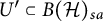
$U' \subset B(\mathcal {H})_{sa}$
 be upper sets. Then every order-isomorphism
$\phi \colon U \to U'$
 is affine.
This result was proved in [Reference Molnár17] when the sets are either the closed cone or whole space, and more generally in [Reference Lemmens, Van Gaans and Van Imhoff14]. In understanding how it follows from Theorem 1.3, I benefited from discussions with Floris Claassens, Bas Lemmens, Mark Roelands, and Marten Wortel.
The situation where there are no affine dependencies at all carried by the pure state space occurs precisely when the state space is a Bauer simplex (see [Reference Alfsen3, Theorem II.4.1]). An equivalent condition is that the ordered vector space is of the form
$C(K)$
 , the space of continuous real-valued functions on a compact Hausdorff space K. Our techniques allow us to prove the following. We use
$\operatorname {\mathrm {int}}$
 to denote the interior of a set.
Theorem 1.5 Let
$(V, C, u)$
 be an order-unit space that is complete under its order-unit norm. There is an order isomorphism between
$\operatorname {\mathrm {int}} C$
 and V if and only if the state space of V is a Bauer simplex.
A corollary of this result was conjectured by Molnár in [Reference Molnár18].
Corollary 1.6 Let
$\mathcal {A}$
 be a unital
$C^*$
 -algebra. Then, there is an order isomorphism between the cone
$\mathcal {A}_+^{-1}$
 of invertible positive elements and the space
$\mathcal {A}_{\mathrm {sa}}$
 of self-adjoint elements if and only if
$\mathcal {A}$
 is commutative.
Proof We use that a unital
$C^*$
 -algebra is commutative if and only if its state space is a Bauer simplex (see Corollary 2.4 of [Reference Asimow and Ellis7]).
In [Reference Molnár18], Molnár settled the case of the algebra
$B(\mathcal {H})$
 of bounded operators on a Hilbert space
$\mathcal {H}$
 , and also of the finite-dimensional non-commutative
$C^*$
 -algebras.
The content of the present article is as follows. After recalling some background material in Section 2, we prove the easier direction of Theorem 1.3 in Section 3. In Section 4, we study the order ideals of the cone of an order-unit space. We use a purely order-theoretic notion of ideal, which is appropriate here because we are interested in maps that are not assumed to preserve any linear structure. In Section 5, we examine how these ideals behave under order isomorphisms. The main outcome is that there is a homeomorphism induced between the pure state spaces of the domain and the image. This generalizes Kaplansky’s theorem [Reference Kaplansky11] concerning the space
$C(K)$
 of continuous real-valued functions on a compact space K. In a follow-up paper [Reference Kaplansky12], Kaplansky determined the form of the order isomorphisms on
$C(K)$
 that are continuous in the supremum norm topology. He showed that associated with each pure state is a function that determines how that coordinate is transformed. We find that a similar expression holds in our setting (see Proposition 5.6). In Section 6, we restrict our attention to order isomorphisms on a cone where the induced homeomorphism is the identity map, and show that, for each pure state in the support of an affine dependency, the transformation map is affine. We use this in Section 7 to show that in the general case the coordinate transformation associated with a pure state in the support of an affine dependency is homogeneous of some degree. In Section 8, we show that an order isomorphism all of whose coordinate transformations are homogeneous is Gateaux differentiable, and we prove Theorem 1.1. We complete the proofs of Theorems 1.3 and 1.5 in Section 9. Finally, in Section 10, we provide some examples, including a proof of Corollary 1.4.
2 Preliminaries
A useful reference for this section is Alfsen’s book [Reference Alfsen3].
2.1 Order-unit spaces
Let V be a real vector space. A cone C in V is a subset that is closed under addition and under multiplication by nonnegative real numbers and satisfies
$C \cap -C = \{0\}$
 . Such a cone induces a partial order
$\le $
 on V when we set
$x\le y$
 whenever
$y - x \in C$
 . An ordered vector space is a vector space with a partial order determined in this way from a cone.
An ordered vector space V is said to be Archimedean if
$x \le 0$
 whenever
$x \in V$
 and
$y\in C$
 satisfy
$n x \le y$
 , for all
$n\in \mathbb {N}$
 . In finite dimension, this is equivalent to the cone being closed. An order unit is an element u of the cone such that, for each
$x \in V,$
 there is a
$\lambda>0$
 such that
$x \le \lambda u$
 . When V is equipped with an Archimedean cone C and an order unit u, it becomes an order-unit space
$(V, C, u)$
 . The following norm is called the order-unit norm:

When V has the topology induced by this norm, the cone C is closed and has non-empty interior, which we denote by
$\operatorname {\mathrm {int}} C$
 . Indeed, the interior is exactly the set of order units of V. By a complete order-unit space, we mean one that is complete with respect to its order-unit norm.
Let V and
$V'$
 be two ordered vector spaces. A map
$\phi $
 from a subset X of V to a subset
$X'$
 of
$V'$
 is said to be isotone or order preserving if
$x\le y$
 , for two elements x and y of X, implies that
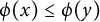
$\phi (x) \le \phi (y)$
 . If
$\phi $
 is bijective and both it and its inverse are order preserving, then
$\phi $
 is said to be an order isomorphism between X and
$X'$
 .
Lemma 2.1 Let
$\phi \colon C \to C'$
 be an order isomorphism between the cones of two order-unit spaces. Then, there exist order units u and
$u'$
 in C and
$C'$
 , respectively, such that
$\phi (u) = u'$
 .
Proof Let v and
$v'$
 be order units of C and
$C'$
 , respectively. Choose
$\lambda> 0$
 such that
$u := \lambda v \ge \phi ^{-1}(v')$
 . Observe that u is an order unit of C. Since
$u' := \phi (u) \ge v'$
 , we also have that
$u'$
 is an order unit of
$C'$
 .
A map
$\phi \colon X \to V'$
 is said to be affine if

whenever
$\{x_i\}_i$
 and
$\{\lambda _i\}_i$
 are finite collections of, respectively, elements of X and real numbers such that
$\sum _i \lambda _i x_i \in X$
 and
$\sum _i \lambda _i = 1$
 . If
$\phi $
 is defined on the whole of V, then it is affine if and only if it is of the form
$\phi (x) := c + T(x)$
 , with
$c \in V'$
 and T a linear map from V to
$V'$
 . If the set X is convex, then
$\phi $
 is affine if and only if it preserves convex combinations, that is, if

The following facts will be useful: the composition of two affine maps is affine; the image of a convex set under an affine map is convex; if an affine map is injective and its domain is convex, then the inverse map defined on the image is affine. Also note that in an ordered vector space, a set that is upper and directed downward is convex.
2.2 The dual space
Let
$(V, C, u)$
 be an order-unit space endowed with the topology coming from its order-unit norm, and denote by
$V^*$
 the topological dual space. In other words,
$V^*$
 is the space of continuous real-valued functionals on V. The weak* topology on
$V^*$
 is the coarsest topology such that each element of V, considered as a function on
$V^*$
 , is continuous. It is characterized by the following convergence criterion: a net
$y_\alpha $
 in
$V^*$
 converges to an element y of
$V^*$
 if and only if
$y_\alpha (x)$
 converges to
$y(x)$
 for all x in V. The dual cone
$C^*$
 of C is the subset of
$V^*$
 consisting of positive functionals, that is,

The cross-section

is compact in the weak* topology. The elements of this set are called the states of V. The extreme points of K are called the pure states, and they play an important role. An extreme point of K is an element e such that there is no line segment contained in K with e in its relative interior. By the Krein–Milman theorem, K is guaranteed to have extreme points – indeed, it is the closed convex hull of the set of these points. We denote by
$\partial _e K$
 the set of pure states. The closure of the set of pure states is called the pure state space, and we denote it
$F := \operatorname {\mathrm {cl}} \partial _e K$
 . Here,
$\operatorname {\mathrm {cl}}$
 denotes the topological closure of a set. We have that
$x\in V$
 is in C if and only if
$p(x) \ge 0$
 , for all states p.
2.3 Choquet representation
We denote by
${A}(K)$
 the set of affine real-valued functions on K that are continuous in the weak* topology. Every element of
${A}(K)$
 can be extended to a continuous linear functional on the whole of
$V^*$
 if and only if V is complete in the order-unit norm (see [Reference Alfsen3, Theorem II.1.8]).
The support
$\operatorname {\mathrm {supp}}\mu $
 of a measure
$\mu $
 on a measurable topological space
$\Omega $
 is the largest subset of
$\Omega $
 having the property that every open neighborhood of each of its points has positive measure. The support of a measure is always closed. The support of a signed measure
$\mu $
 is defined to be
$\operatorname {\mathrm {supp}} \mu := \operatorname {\mathrm {supp}}\mu ^+ \cup \operatorname {\mathrm {supp}}\mu ^-$
 , where
$\mu = \mu ^+ - \mu ^-$
 is the Jordan decomposition. We say that a measure is carried by a measurable set X if the complement of X has measure zero.
A measure
$\mu $
 on K is said to represent a point
$y\in K$
 if the barycenter formula holds for all
$g\in {A}(K)$
 , that is,

By taking g to be the constant function
$1$
 , we see that any measure representing a point must be a probability measure, that is, have total mass
$1$
 . The Choquet–Bishop–de Leeuw theorem states that every point in K can be represented by a probability boundary measure, that is, a measure of total mass
$1$
 that is maximal with respect to a certain partial order on the set of measures on K. The details of this partial order are not important to us – we will only need that every boundary measure is carried by the pure state space
$F := \operatorname {\mathrm {cl}} \partial _e K$
 (see [Reference Alfsen3, Proposition I.4.6]).
2.4 Affine dependencies
A nonzero signed measure
$\mu $
 on K is said to be an affine dependency if

Observe that, if
$\mu _1$
 and
$\mu _2$
 are distinct probability measures carried by K representing the same point
$y\in K$
 , then
$\mu _1 - \mu _2$
 is an affine dependency. In fact, by considering the Jordan decomposition of an affine dependency, it is easy to see that all affine dependencies arise in this way, up to a scalar factor.
The following lemma establishes a criterion for when a function defined on F is the restriction of an element of V. This result is known (see the remark on page 108 of [Reference Alfsen3]), but we give an explicit proof for convenience.
Lemma 2.2 Assume that V is a complete order-unit space. Let
$f \colon F \to \mathbb {R}$
 be a continuous function such that
$\mu (f) = 0$
 for every affine dependency carried by the pure state space F. Then, there exists a unique element g of V such that
$g(p) = f(p)$
 for all
$p\in F$
 .
Proof For all
$x \in K$
 , define

where
$\mu _x$
 is any probability measure on F representing the point x. First, we show that the choice of representing measure is not important. Suppose that
$x \in K$
 can be represented by two different measures
$\mu _x$
 and
$\mu ^{\prime }_x$
 on F. Observe that
$\mu _x - \mu ^{\prime }_x$
 is an affine dependency, and so
$(\mu _x - \mu ^{\prime }_x)(f) = 0$
 . Therefore,

Thus, it does not matter whether we integrate with respect to
$\mu _x$
 or
$\mu ^{\prime }_x$
 .
We wish to show that g is continuous. Let
$x_\alpha $
 be a net in K converging to a limit
$x \in K$
 . By taking a subnet if necessary, we may assume that
$g(x_\alpha )$
 converges to some limit. For each
$\alpha $
 , choose a probability measure
$\mu _{x_\alpha }$
 on F representing
$x_\alpha $
 . Since F is compact, there is a subnet
$\mu _{x_\beta }$
 of this net of measures converging to a limiting probability measure
$\mu $
 . By evaluating along the net
$x_\beta $
 an arbitrary continuous affine function on K, we see that
$\mu $
 represents x. The map f is continuous, and so we deduce that
$g(x_\alpha )$
 converges to
$g(x)$
 .
To show that g is affine, let
$x_1$
 and
$x_2$
 be two points in K, represented, respectively, by probability measures
$\mu _{x_1}$
 and
$\mu _{x_2}$
 on F. Each convex combination
$(1 - \lambda ) x_1 + \lambda x_2$
 , with
$\lambda \in [0, 1]$
 , of these two points can be represented by the same convex combination
$(1 - \lambda ) \mu _{x_1} + \lambda \mu _{x_2}$
 of the measures. Since integrals are linear in the measure, we see that g is an affine function on K.
We have shown that g is well-defined, continuous, and affine on K; hence, it is the restriction to K of an element of V. Here, we are using that V is complete in its order-unit norm. The uniqueness follows from the fact that the pure state space F separates V.
2.5 Extension of positive maps
For a proof of the following proposition, see, for example, (5, Lemma 1.26). Note that the assumption in that version that
$C'$
 is Archimedean is not needed here because we are assuming positive homogeneity.
Proposition 2.3 Let
$(V, C)$
 and
$(V', C')$
 be two ordered vector spaces, and let
$\phi \colon C \to C'$
 be an additive and positively homogeneous map between their cones. Assume that C generates V. Then,
$\phi $
 can be extended in a unique way to an order-preserving linear map from V to
$V'$
 .
2.6 The Pettis integral
Let
$f \colon X\to V$
 be a function from a measure space
$(X,\Sigma ,\mu )$
 to a topological vector space V admitting a dual space
$V^*$
 that separates points. We say that f is Pettis integrable if
$y\circ f$
 is Lebesgue integrable for each
$y\in V^\ast $
 and there exists an element v of V satisfying

The point v is called the Pettis integral of f. See [Reference Musiał20] for more information about this integral.
3 The existence of non-linear order isomorphisms
In this section, we show that non-affine order isomorphisms exist when Condition 1.2 is not satisfied. Throughout the section, we assume that V is an order-unit space that is complete under its order-unit norm. Recall that F is the weak* closure of the set of extreme points
$\partial _e K$
 of the state space K.
Let L be the weak* closure of the union of the supports of the affine dependencies carried by F, that is,

Clearly, L is a subset of F. Condition 1.2 is that the two sets are equal.
A Tychonoff space is a topological space in which each closed set can be separated by a continuous real-valued function from any point that it does not contain. More precisely, in a Tychonoff space, if A is a closed set, and x is a point not in A, then there exists a real-valued continuous function on the space that takes the value
$0$
 on all of A, and the value
$1$
 at x. Tychonoff spaces are also called “completely regular” or
$T_{3\frac {1}{2}}$
 . A compact Hausdorff space is always Tychonoff.
Lemma 3.1 Let X be a non-empty subset of V that is upper and directed downward. If Condition 1.2 does not hold, that is, if
$L \neq F$
 , then there exists an order isomorphism from X to itself that is not affine.
Proof By conjugating with translations if necessary, we may assume without loss of generality that
$0$
 is an element of X.
Let
$w\in F$
 lie outside L. Since F is a compact Hausdorff space, it is Tychonoff. So, there exists a continuous function
$s \colon F \to \mathbb {R}$
 that separates w from L; in fact, we may choose s to take the value
$0$
 on all of L, the value
$1$
 at w, and values in
$[0, 1]$
 everywhere else.
Choose a continuous function
$\Gamma \colon [0,1] \times [-\infty , \infty ] \to [-\infty , \infty ]$
 with the following properties. We require that, for each
$y \in [0,1]$
 , the map
$\Gamma (y, \cdot )$
 is an order isomorphism of
$[-\infty , \infty ]$
 and agrees with the identity map outside the interval
$[1, 2]$
 . We furthermore require that
$\Gamma (0, \cdot )$
 is the identity map, and that
$\Gamma (1, \cdot )$
 is non-affine in the interval
$[1,2]$
 .
Let g be in V. The map
$f \colon F \to \mathbb {R}$
 defined by
$f(p) := \Gamma (s(p), g(p))$
 is continuous. Let
$\mu $
 be an affine dependency carried by F. The support of
$\mu $
 is a subset of L, and on this set the function s takes the value
$0$
 . Using then that
$\Gamma (0, \cdot )$
 is the identity map, we get that
$\mu (f) = \mu (g) = 0$
 . Applying Lemma 2.2, we see that there is an element of V agreeing with f on F. We denote this element
$\phi g$
 . This defines a map
$\phi $
 from V to itself.
For each
$y\in [0, 1]$
 , define the function
$\bar \Gamma (y, \cdot )$
 to be the inverse of
$\Gamma (y, \cdot )$
 . Let
$y_n$
 be a sequence in
$[0, 1]$
 converging to y in the same set, and let
$x_n$
 be a sequence in
$[-\infty , \infty ]$
 converging to
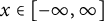
$x\in [-\infty , \infty ]$
 . Writing
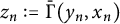
$z_n := \bar \Gamma (y_n, x_n)$
 , we have
$x_n = \Gamma (y_n, z_n)$
 , for all
$n\in \mathbb {N}$
 . If any subsequence of
$z_n$
 converges to a limit
$z\in [-\infty , \infty ]$
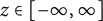 , then
$x = \Gamma (y, z)$
 , which is equivalent to
$z = \bar \Gamma (y, x)$
 . We conclude that
$z_n$
 converges to
$\bar \Gamma (y, x)$
 , which shows that
$\bar \Gamma $
 is continuous. Note that
$\bar \Gamma $
 also satisfies all the other assumptions we made on
$\Gamma $
 .
Analogously to how we defined
$\phi $
 , we can define a map
$\bar \phi \colon V \to V$
 such that

We deduce that

Since, for each
$g\in V$
 , both g and
$(\bar \phi \circ \phi ) g$
 are continuous and affine on K, the barycenter formula holds for both, and we conclude that the two functions agree on all of K, and hence represent the same element of V. Similar reasoning shows that
$(\phi \circ \bar \phi ) g$
 always equals g. We have shown that the maps
$\bar \phi $
 and
$\phi $
 are inverse to one another. It is clear that both
$\phi $
 and
$\bar \phi $
 are order preserving.
Let
$f\in X$
 . Since X is directed downward and contains
$0$
 , there is an element g of X such that
$g \le 0$
 and
$g \le f$
 . Note that g is a fixed point of
$\phi $
 . It follows that
$g \le \phi f$
 , and we deduce that
$\phi f$
 is in X, since this set is upper. This establishes that
$\phi $
 leaves the set X invariant. A similar argument shows that the same is true for
$\phi ^{-1} = \bar \phi $
 . The restriction of
$\phi $
 to X is the order isomorphism we require.
It remains to show that this restriction is not affine. To prove this, observe that u and
$2u$
 are in X, and that
$\phi \big ((1-\lambda ) u + 2 \lambda u \big )(w) = \Gamma (1, 1 + \lambda )$
 is not affine in
$\lambda $
 in the range
$\lambda \in [0,1]$
 .
4 Order ideals in cones
Our goal now is to study order isomorphisms between subsets of complete order-unit spaces. Since initially we have no other information about such maps than that they preserve the order structure, it will be necessary to start by considering some purely order-theoretic notions.
Let P be a partially ordered set. This means that P is equipped with a partial order, in other words, a binary relation
$\le $
 that is reflexive, antisymmetric, and transitive. A subset U of P is said to be lower if
$x\in P$
 is in U whenever
$y\in U$
 and
$x \le y$
 . It is said to be directed upward if, for every x and y in U, there exists z in U such that
$x\le z$
 and
$y\le z$
 . The subset U is an ideal if it is non-empty, lower, and directed upward. An ideal in a partially ordered set P is called proper if it does not equal the whole of P.
Let
$(V, C, u)$
 be a complete order-unit space. We denote by
$\mathcal {I}$
 the set of all proper ideals of the cone C. Our strategy will be to study an order isomorphism between the cones of two order-unit spaces by examining its behavior on the ideals of the cones. In particular, we are interested in ideals such as
$\{x\in C \mid \langle y, x \rangle < \lambda \}$
 , where y is a pure state and
$\lambda>0$
 . However, in general, the ideals of C can be quite complicated. Note the result of Namioka and Saeki [Reference Namioka and Saeki21] who proved that, for some compact spaces X, there are order isomorphisms on the cone
$C(X)^{+}$
 of nonnegative real-valued functions on X that do not preserve the strictly-less-than relation. Consequently, this strict relation cannot be defined in terms of the relation
$\le $
 . So, the ideals
$\{x\in C \mid \langle y, x \rangle < \lambda \}$
 are not necessarily mapped to similar such ideals by order isomorphisms.
For every ideal
$I \in \mathcal {I}$
 , we define
$\sup I$
 to be the pointwise supremum of the elements of I, considered as functions on the state space K. The function
$\sup I$
 is nonnegative and lower semicontinuous on K. Less obviously, it is also affine. This is because the map
$\alpha \mapsto \alpha $
 on I is a non-decreasing net of functions, and hence converges pointwise, necessarily to an affine function since each term is affine. Here, we are allowing infinite values, so what we mean by an affine function is a function
$f\colon K \to \mathbb {R} \cup \{\infty \}$
 satisfying

Lemma 4.1 Let g be a nonnegative continuous affine real-valued function on K, and let I be an ideal of C such that
$g(y) < \sup I(y)$
 , for all
$y \in K$
 . Then, g is in I.
Proof Since I is an ideal, it is directed upward, and so the map
$I \to V$
 defined by
$\alpha \mapsto \alpha - g$
 is a net in V. Observe that this net is non-decreasing. Hence, it converges pointwise on K to its supremum
$\sup I - g$
 . Moreover, the infimum of
$\alpha - g$
 over K converges to the infimum of
$\sup I - g$
 , which is positive, since this function is positive and lower semicontinuous and has a compact domain (see Lemma 2.1 of [Reference Walsh32]). So, we may choose
$\alpha \in I$
 large enough that
$\alpha - g$
 is positive on all of K, in other words,
$\alpha> g$
 . Since I is lower, we deduce that
$g \in I$
 .
A consequence of this lemma is that the supremum of any proper ideal of C is not identically infinity.
For each pure state y and
$\lambda \ge 0$
 , we denote by
$L_{y, \lambda }$
 the function on K that takes the value
$\lambda $
 at y, and the value infinity everywhere else. We also define
$\mathcal {I}_{y, \lambda }$
 to be the set of proper ideals I of C such that
$\sup I = L_{y, \lambda }$
 .
Lemma 4.2 Let y be a pure state, and let
$\lambda> 0$
 . Then,
$I := \{ x \in C \mid \langle y, x \rangle < \lambda \}$
 is a proper ideal of C, and
$I \in \mathcal {I}_{y, \lambda }$
 .
Proof The set I is clearly lower and is non-empty because it contains
$0$
 . It is proper because it does not contain
$\lambda u$
 . It is also directed upward, since
$L_{y, \lambda }$
 is a lower semicontinuous affine function on K – see the proof of Corollary I.1.4 of Alfsen [Reference Alfsen3]. Again from the same corollary, there is a non-decreasing net of elements of I converging pointwise on K to
$L_{y, \lambda }$
 . Therefore,
$\sup I$
 is greater than or equal to
$L_{y, \lambda }$
 . The opposite inequality is obvious.
Lemma 4.3 Let
$I_1$
 and
$I_2$
 be ideals of C such that
$\sup I_1(y) < \sup I_2(y)$
 , for all
$y\in K,$
 such that
$\sup I_2(y)$
 is finite. Then
$I_1 \subset I_2$
 .
Proof Let
$g \in I_1$
 . For each
$y\in K$
 , we have that
$g(y)$
 is finite and less than or equal to
$\sup I_1(y)$
 , and hence strictly less than
$\sup I_2(y)$
 . So, by Lemma 4.1, g is in
$I_2$
 .
The subset relation
$\subset $
 is a partial order on
$\mathcal {I}$
 . It turns out that we can tell using only this partial order whether an element of
$\mathcal {I}$
 lies in some set
$\mathcal {I}_{y, \lambda }$
 , with y a pure state and
$\lambda \ge 0$
 . We can even tell, given two ideals each lying in a set of this form, whether the associated pure states are the same. This is the content of the next two lemmas.
Lemma 4.4 Let
$I_1 \in \mathcal {I}_{y_1, \lambda _1}$
 and
$I_2 \in \mathcal {I}_{y_2, \lambda _2}$
 , where
$y_1$
 and
$y_2$
 are pure states, and
$\lambda _1$
 and
$\lambda _2$
 are nonnegative real numbers. Then,
$y_1 = y_2$
 if and only if there is an element of
$\mathcal {I}$
 containing both
$I_1$
 and
$I_2$
 .
Proof Assume that
$y_1 = y_2 =: y$
 . Take a positive real number
$\lambda $
 strictly greater than both
$\lambda _1$
 and
$\lambda _2$
 . By Lemma 4.2, there is a proper ideal in
$\mathcal {I}_{y, \lambda }$
 , and by Lemma 4.3, this ideal contains both
$I_1$
 and
$I_2$
 .
Now assume that
$y_1$
 and
$y_2$
 differ, and that there is an ideal I containing both
$I_1$
 and
$I_2$
 . So,
$\sup I$
 is greater than or equal to both
$\sup I_1 = L_{y_1, \lambda _1}$
 and
$\sup I_2 = L_{y_2, \lambda _2}$
 , and hence takes the value
$\infty $
 everywhere on the state space K. This shows that I is the whole of C, and so not proper.
For each ideal
$I\in \mathcal {I}$
 , denote by
$I^\uparrow $
 the set of ideals in
$\mathcal {I}$
 that contain I.
Lemma 4.5 A proper ideal I is in
$\mathcal {I}_{y, \lambda }$
 for some pure state y and
$\lambda \ge 0$
 if and only if
$I^\uparrow $
 is directed upward under the subset relation.
Proof Assume that I is in
$\mathcal {I}_{y, \lambda }$
 , with y a pure state and
$\lambda \ge 0$
 , and let
$I_1$
 and
$I_2$
 be proper ideals containing I. So, both
$\sup I_1$
 and
$\sup I_2$
 are greater than or equal to
$\sup I$
 . It follows that
$I_1 \in \mathcal {I}_{y, \lambda _1}$
 and
$I_2 \in \mathcal {I}_{y, \lambda _2}$
 , where
$\lambda _1$
 and
$\lambda _2$
 are nonnegative real numbers greater than or equal to
$\lambda $
 . By Lemma 4.4, there exists a proper ideal containing both
$I_1$
 and
$I_2$
 . We have shown that
$I^\uparrow $
 is directed upward.
Now assume that I is a proper ideal such that
$I^\uparrow $
 is directed upward. Let
$y_1$
 and
$y_2$
 be pure states of K where
$\sup I$
 takes nonnegative finite values
$\lambda _1$
 and
$\lambda _2$
 , respectively. Take
$\lambda ^{\prime }_1> \lambda _1$
 and
$\lambda ^{\prime }_2> \lambda _2$
 . By Lemma 4.2, there exist proper ideals
$I_1 \in \mathcal {I}_{y_1, \lambda ^{\prime }_1}$
 and
$I_2 \in \mathcal {I}_{y_2, \lambda ^{\prime }_2}$
 . Both of these ideals contain I, by Lemma 4.3, and so are in
$I^\uparrow $
 . Since
$I^\uparrow $
 is directed upward, it has as an element a proper ideal containing both
$I_1$
 and
$I_2$
 . By Lemma 4.4, we get that
$y_1 = y_2$
 . We have shown that
$\sup I$
 is finite at only a single pure state, and since it is lower semicontinuous and affine it follows that it takes the form
$L_{y, \lambda }$
 , with
$y = y_1 = y_2$
 and
$\lambda = \lambda _1 = \lambda _2$
 . We deduce that I is in
$\mathcal {I}_{y, \lambda }$
 .
The following lemma gives two criteria, one necessary and the other sufficient, for an element of C to be contained in any of the ideals in
$\mathcal {I}_{y, \lambda }$
 .
Lemma 4.6 Let g be a nonnegative continuous affine real-valued function on K, and let I be an ideal in
$\mathcal {I}_{y, \lambda }$
 , with y a pure state, and
$\lambda $
 a nonnegative real number. If
$g(y) < \lambda $
 , then
$g\in I$
 . If
$g(y)> \lambda $
 , then
$g \not \in I$
 .
Proof The first part follows from Lemma 4.1. The second part follows directly from the definition of
$\mathcal {I}_{y, \lambda }$
 .
5 The behaviour of order ideals under order isomorphisms
In this section, we study order isomorphisms by examining what they do to the ideals considered in the previous section.
We assume that we have an order isomorphism
$\phi $
 between the cones C and
$C'$
 of order-unit spaces V and
$V'$
 , respectively. Both spaces are assumed to be complete under their order-unit norms. Recall that we are using F to denote the weak* closure of the set of extreme points of the state space K of the cone C. Observe that F is compact. We use similar notation concerning the cone
$C'$
 .
Lemma 5.1 There exists a bijection
$\Phi $
 between the pure states of V and those of
$V'$
 such that if I is an ideal in
$\mathcal {I}_{y, \lambda }$
 , with y a pure state and
$\lambda $
 a nonnegative real number, then
$\phi I$
 is an ideal in
$\mathcal {I}_{\Phi y, \lambda '}$
 , where
$\lambda '$
 is some nonnegative real number.
Proof Lemma 4.5 characterizes the proper ideals having the property that they lie in
$\mathcal {I}_{y, \lambda }$
 , for some pure state y and
$\lambda \ge 0$
 . This characterization is purely in terms of the order structure on C. A similar characterization holds for the cone
$C'$
 . It follows that a proper ideal is in
$\mathcal {I}_{y, \lambda }$
 , with y a pure state of V and
$\lambda \ge 0$
 , if and only if its image is in
$\mathcal {I}_{y', \lambda '}$
 for some pure state
$y'$
 of
$V'$
 , and some
$\lambda ' \ge 0$
 .
Combining this with Lemma 4.4, we get that if two ideals
$I_1$
 and
$I_2$
 lie in
$\mathcal {I}_{y, \lambda _1}$
 and
$\mathcal {I}_{y, \lambda _2}$
 , respectively, then there exists a pure state
$y'$
 of
$V'$
 such that their images lie in
$\mathcal {I}_{y', \lambda ^{\prime }_1}$
 and
$\mathcal {I}_{y', \lambda ^{\prime }_2}$
 , respectively, where
$\lambda ^{\prime }_1$
 and
$\lambda ^{\prime }_2$
 are nonnegative real numbers. We define the map
$\Phi $
 so that
$\Phi y := y'$
 . We do this for each pure state y of V.
Applying the same considerations to the inverse map
$\phi ^{-1}$
 , we see that
$\Phi $
 is a bijection from the pure states of V to those of
$V'$
 .
Lemma 5.2 Let
$x_\alpha $
 be a net of pure states of V converging to a point x of F, and assume that
$\Phi x_\alpha $
 converges to a point z of
$F'$
 . If
$g_1$
 and
$g_2$
 in C are such that
$g_1(x) < g_2(x)$
 , then
$\phi g_1 (z) \le \phi g_2 (z)$
 .
Proof Choose a positive number
$\lambda $
 such that
$g_1(x) < \lambda < g_2(x)$
 . By Lemma 4.2, we can find a net of proper ideals
$I_\alpha $
 , defined on the same directed set as
$x_\alpha $
 , such that
$\sup I_\alpha = L_{x_\alpha , \lambda }$
 for all
$\alpha $
 . Note that, for
$\alpha $
 large enough,
$g_1(x_\alpha ) < \lambda < g_2(x_\alpha )$
 , and so, by Lemma 4.6,
$I_\alpha $
 contains
$g_1$
 but does not contain
$g_2$
 . So, for
$\alpha $
 large enough, the ideal
$\phi I_\alpha $
 contains
$\phi g_1$
 but not
$\phi g_2$
 . By Lemma 5.1, for each
$\alpha $
 , the ideal
$\phi I_\alpha $
 is an element of
$\mathcal {I}_{\Phi x_\alpha , \lambda ^{\prime }_\alpha }$
 , with
$\lambda ^{\prime }_\alpha \ge 0$
 . We deduce using Lemma 4.6 that

for
$\alpha $
 large enough. Taking the limit as
$\alpha $
 tends to infinity, we get the result.
A set Z of functions defined on a set X is said to separate points if, for every pair of distinct points x and y in X, there exists a function f in Z such that
$f(x)$
 differs from
$f(y)$
 .
Lemma 5.3 If
$x_\alpha $
 is a net of pure states of V that converges to a limit in F, then
$\Phi (x_\alpha )$
 converges to a limit in
$F'$
 .
Proof Denote the limit of
$x_\alpha $
 by x. Since
$F'$
 is compact, it suffices to show that
$\Phi (x_\alpha )$
 has at most one limit point. Assume for the sake of contradiction that there are two distinct limit points y and z, and take subnets
$y_\beta $
 and
$z_\gamma $
 of
$x_\alpha $
 such that
$\Phi (y_\beta )$
 and
$\Phi (z_\gamma )$
 converge to y and z, respectively. The set
$C'$
 separates
$K'$
 , and so there exists an element h of
$C'$
 that takes distinct values on y and z. Switch y and z if necessary and choose
$\lambda> 0$
 so that
$h(y) < \lambda < h(z)$
 . For
$\rho>0$
 large enough,

are in
$C'$
 , where
$u'$
 is the order unit of
$V'$
 . Observe that
$g_1(y) < g_2(y)$
 and
$g_1(z)> g_2(z)$
 . We apply Lemma 5.2 to the map
$\phi ^{-1}$
 twice, once for each of these inequalities. This gives that
$\phi ^{-1} g_1(x) = \phi ^{-1} g_2(x)$
 .
Let

The function
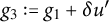
$g_3 := g_1 + \delta u'$
 is in
$C'$
 and satisfies the relations
$g_3(y) < g_2(y)$
 and
$g_3(z)> g_2(z)$
 . Using the same reasoning as before, we get that
$\phi ^{-1} g_3$
 and
$\phi ^{-1} g_2$
 agree at x.
Let
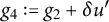
$g_4 := g_2 + \delta u'$
 . Again,
$\phi ^{-1} g_3$
 and
$\phi ^{-1} g_4$
 agree at x. Continuing in this manner, we see that the functions
$\phi ^{-1} (g_1 + n\delta u')$
 all take the same value at x, independently of
$n\in \mathbb {N}$
 . But every element of
$C'$
 lies below
$g_1 + n\delta u'$
 for some value of
$n\in \mathbb {N}$
 , and
$\phi ^{-1}$
 is an order isomorphism between
$C'$
 and C. It follows that no element of C takes a value strictly greater than
$\phi ^{-1} g_1(x)$
 at x, which is absurd.
A regular topological space is one in which each closed set can be separated by neighborhoods from each point that it does not contain. More precisely, a topological space is regular if, given a closed set G and any point x not in G, there exist a neighborhood of x and a neighborhood of G that are disjoint. Every compact Hausdorff space is regular.
Recall the following theorem from [Reference Bourbaki8, Section 8.5, p. 81]. Let
$f\colon A \to Y$
 be a mapping from a dense subset A of a topological space X into a regular Hausdorff space Y. Then, f can be extended continuously to the whole of X if and only if, for each
$x\in X$
 , we have that
$f(y)$
 converges in Y as y tends to x while remaining in A. The continuous extension is of course unique, if it exists.
Proposition 5.4 The mapping
$\Phi $
 extends in a unique way to a homeomorphism between F and
$F'$
 . This extension, which we again denote by
$\Phi $
 , has the property that, if
$g_1(x) < g_2(x)$
 for some
$x\in F$
 and
$g_1$
 and
$g_2$
 in C, then
$\phi g_1 (\Phi x) \le \phi g_2 (\Phi x)$
 .
Proof From Lemma 5.3 and the theorem from [Reference Bourbaki8] mentioned above, we get that
$\Phi $
 extends in a unique way to a continuous mapping between F and
$F'$
 . Similar reasoning shows that the inverse mapping
$\Phi ^{-1}$
 also extends to a continuous mapping, this time between
$F'$
 and F, and it is easy to see that this extension is the inverse of the extension of
$\Phi $
 . Thus, the extension of
$\Phi $
 is a homeomorphism.
The second part is proved by applying Lemma 5.2 to any net of pure states of V converging to x.
We will need to know how the homeomorphism induced by a product of order isomorphisms is related to those induced by the factors.
Lemma 5.5 Let C,
$C'$
 , and
$C"$
 be the cones of complete order-unit spaces, and let
$\phi \colon C \to C'$
 and
$\phi ' \colon C' \to C"$
 be order isomorphisms. Let
$\Phi \colon F \to F'$
 and
$\Phi ' \colon F' \to F"$
 , respectively, be the homeomorphisms they induce, and let
$\Phi " \colon F \to F"$
 be the homeomorphism induced by
$\phi ' \circ \phi $
 . Then,
$\Phi " = \Phi ' \circ \Phi $
 .
Proof Let x be a pure state of V, and choose
$\lambda> 0$
 . By Lemma 4.2,
$\mathcal {I}_{x, \lambda }$
 contains an ideal I. Applying Lemma 5.1 to the maps
$\phi $
 and
$\phi '$
 , we get that
$\phi ' \circ \phi (I)$
 is in
$\mathcal {I}_{(\Phi ' \circ \Phi ) x, \lambda '}$
 , for some
$\lambda ' \ge 0$
 . Applying the same lemma to the map
$\phi ' \circ \phi $
 gives that
$\phi ' \circ \phi (I)$
 is also in
$\mathcal {I}_{\Phi " x, \lambda "}$
 , for some
$\lambda " \ge 0$
 . This implies that
$\Phi ' \circ \Phi $
 and
$\Phi "$
 agree at x, and hence on the set of pure states of V, since x was arbitrary. Finally, we extend the conclusion to the whole of F using Proposition 5.4.
For each
$p\in F$
 and
$x\in \mathbb {R}_{\ge 0}$
 , define

where
$q := \Phi (p)$
 and u is the order unit of V.
Observe that
$\Lambda _p(0) = 0$
 , since the origin is the only element of a cone to be less than or equal to every other element, and hence must be preserved under order isomorphisms between cones. It is also clear that
$\Lambda _p$
 is non-decreasing. A final property that we will need is that
$\Lambda _p$
 is unbounded. To see this, let
$y\ge 0$
 , and choose
$x\ge 0$
 such that
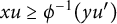
$xu \ge \phi ^{-1}(y u')$
 , where
$u'$
 is the order unit of
$V'$
 . Then,
$\phi (xu) \ge y u'$
 and so
$\Lambda _p(x) \ge y$
 .
We call these functions the coordinate transformations of
$\phi $
 because they govern how the q-coordinate of
$\phi (f)$
 depends on the p-coordinate of
$f\in C$
 , as can be seen from the following proposition.
Proposition 5.6 Let
$\phi \colon C \to C'$
 be an order isomorphism between the cones of two complete order-unit spaces V and
$V'$
 . Denote by
$\Phi $
 the induced homeomorphism between F and
$F'$
 . Let
$p\in F$
 , and write
$q := \Phi (p)$
 . Let
$f\in C$
 . If
$\Lambda _p$
 is continuous at
$f(p)$
 , then

Proof Consider first the case where
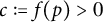
$c := f(p)> 0$
 . Take
$\epsilon \in (0, c)$
 , and let
$g_1 := (c - \epsilon )u$
 and
$g_2 := (c + \epsilon )u$
 . Observe that
$g_1(p) < f(p) < g_2(p)$
 . So, by Proposition 5.4,
$\phi g_1(q) \le \phi f(q) \le \phi g_2(q)$
 , which is equivalent to
$\Lambda _p(c - \epsilon ) \le \phi f(q) \le \Lambda _p(c + \epsilon )$
 . Letting
$\epsilon $
 approach zero and using the continuity of
$\Lambda _p$
 gives the result.
The case where
$f(p) = 0$
 is similar, only now
$\epsilon $
 is taken in
$(0, \infty )$
 and the lower bounds are disregarded.
6 The case when the induced homeomorphism is the identity map
We consider first the special case of an order isomorphism
$\phi $
 having as domain and image the cone C of the same complete order-unit space
$(V, C, u)$
 , and such that the coordinate homeomorphism induced by
$\phi $
 is the identity map. The analysis in the general case will later rely on these results.
6.1 Smoothing
Our method will involve differentiating the order isomorphism. To ensure that this is possible, we will first smooth it by convoluting it with a sufficiently smooth function.
Let
$\Xi \colon \mathbb {R} \to \mathbb {R}_{\ge 0}$
 be a function of differentiability class
$C^2$
 , that takes the value
$0$
 outside the interval
$[0,1]$
 , and whose integral over this interval is equal to
$1$
 . Fix
$\alpha>0$
 . Recall that we are denoting by u the order unit of the space V. Define the smoothed map
$\bar \phi $
 using the following Pettis integral:

See Section 2 for a definition of the Pettis integral. To show that this integral is well-defined, we use that the first factor in the integrand is isotone in t.
Lemma 6.1 Let
$f \in C$
 and
$\alpha>0$
 , and define the function
$V^* \to \mathbb {R}$
 ,
$y \mapsto I(y)$
 ,

This integral is well-defined, for each
$y\in V^*$
 . The function I is continuous on the dual cone
$C^*$
 in the weak* topology.
Proof For each y in
$V^*$
 define the function

Observe that, when
$y\in C^*$
 , the function
$h_y$
 is isotone. Recall that every isotone real-valued function on a closed interval is Lebesgue integrable, and that the product of two integrable functions is integrable, provided that one of them is bounded. It follows that
$h_y(\cdot ) \Xi (\cdot )$
 is integrable when
$y\in C^*$
 . The same must then be true for all
$y\in V^*$
 , because
$C^*$
 generates
$V^*$
 , in the sense that
$V^* = C^* - C^*$
 . Hence, the integral in the statement of the lemma is well-defined.
Let
$y_\beta $
 be a net in
$C^*$
 converging in the weak* topology to a point
$y \in C^*$
 . Take any
$\epsilon>0$
 . For
$x\in [0,1]$
 , define

Note that
$\sigma (0) = 0$
 and
$\sigma (1) = 1$
 . Partition
$[0, 1]$
 into a finite number of intervals
$[x_i, x_{i+1}]$
 , such that
$\sigma (x_{i+1}) - \sigma (x_i) < \epsilon $
 , for each i.
Observe that
$h_{y_\beta }$
 converges pointwise to
$h_y$
 , as
$\beta $
 tends to infinity. So, for
$\beta $
 large enough,
$h_{y_\beta }(x_i)$
 is within
$\epsilon $
 of
$h_{y}(x_i)$
 , for all i. Using this and that
$h_{y}$
 and all the
$h_{y_\beta }$
 are non-decreasing, we get

So,

where
$M := h_y(1) - h_y(0)$
 . We conclude that
$I(y_\beta )$
 converges to
$I(y)$
 .
Lemma 6.2 The Pettis integral in (3) is well-defined.
Proof It was shown in Lemma 6.1 that the function from
$[0, 1]$
 to
$\mathbb {R}$
 defined by

is integrable, for each y in
$V^*$
 , and moreover that the function I in the statement of that lemma is continuous on
$C^*$
 . It is clear that I is a linear functional on
$V^*$
 .
Since I is weak* continuous and affine on K, and V is complete, there is an element of v of V such that
$\langle y,{v} \rangle = I(y)$
 , for all
$y \in K$
 . This equation extends to all y in
$V^*$
 , since both sides are linear in y.
The smoothed map
$\bar \phi $
 is an order-preserving map from C to itself, but is not necessarily bijective. As in the case of
$\phi $
 itself, the map
$\bar \phi $
 may be described in terms of how it transforms coordinates. The smoothing however gives us stronger properties of these transformations. For each
$p\in F$
 , define the following function from
$\mathbb {R}_{\ge 0}$
 to
$\mathbb {R}_{\ge 0}$
 :

This function is obviously non-decreasing.
Lemma 6.3 For each
$p\in F$
 , the map
$\bar \Lambda _p$
 satisfies

Moreover, each of the maps
$\bar \Lambda _p$
 is differentiable on
$(0, \infty )$
 .
Proof Fix
$p\in F$
 and
$f\in C$
 . By Proposition 5.6, for all except a countable number of values of
$t \in \mathbb {R}_{\ge 0}$
 ,

Here, we are using the assumption that the homeomorphism
$\Phi $
 induced on the pure state space is the identity. Multiplying by
$\Xi (t)$
 and integrating from
$0$
 to
$1$
 , we get (5).
Next, we calculate the derivative of
$\bar \Lambda _p$
 . Fix
$x> 0$
 , and let
$\delta \in \mathbb {R}$
 be sufficiently close to zero that
$x + \delta> 0$
 . We have

Note that we have extended the range of integration to the whole of the real line. We may do this even though
$\Lambda _p$
 is undefined for negative arguments because
$\Xi $
 takes the value zero whenever such a negative argument occurs. For clarity, we use the convention that
$\Lambda _p$
 takes the value zero on the negative halfline.
Make the change of variables
$\tau := t + \delta / \alpha $
 to obtain

Subtracting
$\bar \Lambda _p(x)$
 , dividing by
$\delta $
 , and taking the limit as
$\delta $
 tends to zero gives, by the dominated convergence theorem,

We conclude that
$\bar \Lambda _p$
 is differentiable.
6.2 Differentiating the smoothed map
Recall that Taylor’s theorem [Reference Aliprantis and Border4, p. 604] implies the following. Let f be a real-valued function that is twice differentiable on an interval
$I \subset \mathbb {R}$
 , and assume that
$|f"(x)| \le M$
 on I. Then,
$f(x) = f(a) + f'(a) (x - a) + R(x, a)$
 , for all x and a in I, with the remainder term satisfying

Define D to be the set of functions g on the pure state space F such that there exists a point
$h \in \operatorname {\mathrm {int}} C$
 with

Lemma 6.4 Let
$h \in \operatorname {\mathrm {int}} C$
 and
$g \in D$
 be related as in (8), and let
$f\in V$
 . Then,

and the convergence is uniform in p.
Proof From Lemma 6.3, we get

which establishes the first part of the lemma.
It remains to show that the convergence is uniform. In the same way we established (7), one can show that the second derivative of
$\bar \Lambda _p$
 exists and is given by

Observe the following facts. Firstly, the second derivative
$\Xi "$
 is bounded on
$[0,1]$
 and is zero outside this interval. Secondly,
$\Lambda _p$
 is non-decreasing, for each
$p\in F$
 . Thirdly, for fixed
$x>0$
 , the map
$p \mapsto \Lambda _p(x + \alpha )$
 is continuous, and hence bounded on F. We conclude that
$\bar \Lambda ^{\prime \prime }_p$
 is bounded uniformly in p on every compact interval of
$(0,\infty )$
 .
Let I be a compact interval of
$(0, \infty )$
 containing
$\{h(p) \mid p \in F\}$
 in its interior. So, I also contains
$\{h(p) + \delta f(p) \mid p \in F\}$
 , for
$\delta $
 small enough. Let
$M>0$
 be such that
$|\bar \Lambda ^{\prime \prime }_p(x)| \le M$
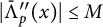 for all
$x\in I$
 and
$p\in F$
 . Taylor’s theorem tells us that

where the remainder term satisfies
$|R(x, a)| \le M (x - a)^2 /2$
 . Taking
$a = h(p)$
 and
$x = h(p) + \delta f(p)$
 gives

for all
$p\in F$
 , and
$\delta $
 small enough. The required uniform convergence now follows on applying Lemma 6.3.
Lemma 6.5 Let
$v_\alpha $
 be a net of points in V, such that
$v_\alpha (\cdot )$
 converges uniformly on F to a limit
$f \colon F \to \mathbb {R}$
 . Then,
$v_\alpha $
 converges in the order-unit norm to a point v of V such that
$v(\cdot ) = f(\cdot )$
 on F.
Proof For each
$x \in K$
 , there exists a probability measure
$\mu _x$
 on F representing x. In particular,

It follows that
$v_\alpha $
 converges uniformly on K to some function, which is necessarily affine and continuous, and hence an element of V.
Lemma 6.6 Let
$f\in V$
 and
$g\in D$
 . Then, there is a point v of V satisfying
$v(p) = f(p) g(p)$
 , for all
$p\in F$
 .
Proof Let h be the point in the open cone
$\operatorname {\mathrm {int}} C$
 such that g satisfies (8). For all
$\delta \in \mathbb {R}$
 close enough to zero that
$h + \delta f$
 lies in C, let

By Lemma 6.4,
$h_\delta $
 converges uniformly on F to
$f g$
 , as
$\delta $
 tends to zero. The existence of a point v with the required property now follows upon applying Lemma 6.5.
6.3 A quotient of the pure state space
We will define a quotient of the pure state space F by considering elements whose transformation functions are affine with the same slope to be equivalent. In other words, we define a relation
$\sim $
 on F, where
$p \sim q$
 if either
$p = q$
 , or there are real numbers
$\alpha $
 ,
$\beta $
 , and
$\lambda $
 such that
$\bar \Lambda _p(x) = \alpha + \lambda x$
 and
$\bar \Lambda _q(x) = \beta + \lambda x$
 , for all
$x> 0$
 . We denote by
$F^{\sim } := F / {\sim }$
 the topological quotient of F by this relation. Observe that every element of D is constant on each equivalence class of
$\sim $
 , and hence may be considered to be a function on
$F^{\sim }$
 . This function is moreover continuous. Indeed, taking f in Lemma 6.6 to be the unit u, we see that every element of D agrees with some element of V on F and is hence continuous on this set, which implies that it is continuous on the quotient.
Lemma 6.7 Let p and q be points of F such that
$p\not \sim q$
 . Then, there is a function in D that takes distinct values at p and q.
Proof If there exists
$t \in (0, \infty )$
 such that
$\bar \Lambda ^{\prime }_p(t)$
 and
$\bar \Lambda ^{\prime }_q(t)$
 differ, then the requirement of the lemma is satisfied by setting
$h := tu$
 , where u is the unit, and defining an element of D according to (8). So, we assume that
$\bar \Lambda ^{\prime }_p$
 and
$\bar \Lambda ^{\prime }_q$
 agree on all of
$(0, \infty )$
 . Combining this with the assumption of the lemma, we get that
$\bar \Lambda ^{\prime }_p$
 and
$\bar \Lambda ^{\prime }_q$
 are not constant.
Since
$\operatorname {\mathrm {int}} C$
 separates F, it contains an element f such that
$f(p)$
 differs from
$f(q)$
 . By switching labels if necessary, we may assume that
$f(p) < f(q)$
 . Choose x and y in
$(0, \infty )$
 , with
$x < y$
 , such that
$\bar \Lambda ^{\prime }_p(x) \neq \bar \Lambda ^{\prime }_q(y)$
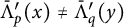 and

Then, the point

is an element of
$\operatorname {\mathrm {int}} C$
 since it is obtained from f by multiplying by a positive scalar and adding a positive multiple of the unit u. Observing that
$h(p) = x$
 and
$h(q) = y$
 , we get the required element of D using (8).
Lemma 6.8 The quotient
$F^{\sim }$
 is compact and Hausdorff.
Proof The compactness follows immediately from the compactness of F.
Let p and q be distinct elements of
$F^{\sim }$
 . By Lemma 6.7, there is an element g of D such that
$g(p)$
 and
$g(q)$
 are distinct. The map g is a continuous function on
$F^{\sim }$
 . Take neighborhoods in
$\mathbb {R}$
 of
$g(p)$
 and
$g(q)$
 , respectively, that are disjoint from one another. The preimages of these neighborhoods under g are disjoint neighborhoods of p and q, respectively. This shows that
$F^{\sim }$
 is Hausdorff.
The space
$C(X, \mathbb {R})$
 of continuous real-valued functions on a compact Hausdorff space X is an algebra of functions, that is, it is a linear space of functions that is closed under pointwise multiplication. Recall that a subalgebra of an algebra is a vector subspace that is closed under multiplication. The Stone–Weierstrass theorem states the following. Assume X is a compact Hausdorff space and A is a subalgebra of
$C(X, \mathbb {R})$
 that contains a nonzero constant function. Then, A is uniformly dense in
$C(X, \mathbb {R})$
 if and only if it separates points of X. See [Reference Aliprantis and Border4, Section 9.2] for more details.
Lemma 6.9 Let
$\mu $
 be an affine dependency of the space V that is carried by F. Then, the pushforward
$\mu _*$
 of
$\mu $
 to
$F^{\sim }$
 by the quotient map is the zero measure.
Proof By Lemma 6.8, the quotient
$F^{\sim }$
 is a compact Hausdorff space. Observe that each element of D is constant on each equivalence class of F. So, such functions may be considered to be continuous functions on
$F^{\sim }$
 .
Let P denote the set of functions that can be written as finite sums of finite products of elements of D and constant functions. In other words, P is the set of functions of the form

where
$n \ge 1$
 , each
$m_i \ge 0$
 , each
$f^i_j$
 is in D, and each
$c_i$
 is in
$\mathbb {R}$
 . If
$m_i$
 is zero for some i, then the associated term is a constant function. Note that P is a vector subspace of
$C(F^{\sim }, \mathbb {R})$
 that is closed under multiplication – in other words, it is a subalgebra. Furthermore, it separates
$F^{\sim }$
 since it contains the set D, which is separating by Lemma 6.7. So, by the Stone–Weierstrass theorem, P is uniformly dense in
$C(F^{\sim }, \mathbb {R})$
 .
Let
$f \in P$
 . It follows from repeated application of Lemma 6.6 that there is an element of V that agrees with f on F. We denote this element again by f.
Since
$\mu $
 is an affine dependency,
$\mu (f)= 0$
 . We deduce that its pushforward satisfies
$\mu _*(f) = 0$
 , where f is now considered to be a function on the quotient space
$F^{\sim }$
 . Since this is true for any f in a uniformly dense subset of
$C(F^{\sim }, \mathbb {R})$
 , we see that
$\mu _*$
 is zero.
6.4 Linearity when the induced homeomorphism is the identity map
We will need that the coordinate transformation functions of the smoothed map converge nearly everywhere to those of the original map, as the parameter
$\alpha $
 , which governs the scale over which the smoothing happens, tends to zero.
Lemma 6.10 Let
$p\in F$
 , and let
$x \in (0, \infty )$
 be such that
$\Lambda _p$
 is continuous at x. Then,
$\bar \Lambda _p(x)$
 converges to
$\Lambda _p(x)$
 , as
$\alpha $
 tends to zero.
Proof Since
$\Lambda _p$
 is non-decreasing,
$\Lambda _p(x) \le \Lambda _p(x + \alpha t) \le \Lambda _p(x + \alpha )$
 , for
$t\in [0,1]$
 . Using these bounds in (4), and that the area under
$\Xi $
 in the interval
$[0,1]$
 is
$1$
 , we get that
$\Lambda _p(x) \le \bar \Lambda _p(x) \le \Lambda _p(x + \alpha )$
 . Letting
$\alpha $
 approach zero gives the result.
Lemma 6.11 Let
$x> 0$
 . The map
$F \to \mathbb {R}_{\ge 0}$
 ,
$q \mapsto \bar \Lambda _q(x)$
 is continuous.
Proof Taking
$f = xu$
 in Lemma 6.1, we get that
$\bar \phi (xu)(q)$
 is continuous in q on F, since this set is a subset of
$C^*$
 . By Lemma 6.3, this quantity equals
$\bar \Lambda _q(x)$
 .
Recall that we are assuming in this section that
$\Phi $
 is the identity map.
Lemma 6.12 If
$p \in F$
 is in the support of some affine dependency carried by F, then
$\Lambda _p$
 is affine on
$(0, \infty )$
 .
Proof Let
$r \in F$
 be such that
$\Lambda _r$
 is not affine on
$(0, \infty )$
 . Recall that, given any choice of
$\alpha>0$
 , we have defined in (3) a smoothed map
$\bar \phi $
 . By Lemma 6.10,
$\bar \Lambda _r$
 converges pointwise to
$\Lambda _r$
 , as
$\alpha $
 tends to zero, everywhere on
$(0, \infty )$
 except at a countable number of points. If
$\bar \Lambda _r$
 were affine for all
$\alpha> 0$
 , then this would imply that
$\Lambda _r$
 was affine on all but a countable number of points of
$(0, \infty )$
 , and hence on all of
$(0, \infty )$
 , since
$\Lambda _r$
 is non-decreasing. We conclude that there is some
$\alpha $
 for which
$\bar \Lambda _r$
 is not affine. Fix this
$\alpha $
 .
Take the quotient
$F^{\sim }$
 of F as above, by considering elements p and q to be equivalent if they are equal, or if the maps
$\bar \Lambda _p$
 and
$\bar \Lambda _q$
 are affine on
$(0, \infty )$
 with the same slope. Let
$\mu $
 be an affine dependency of the space V that is carried by F. By Lemma 6.9, its pushforward
$\mu _*$
 to
$F^{\sim }$
 is zero.
By Lemma 6.11, there is an open neighborhood N of r such that
$\bar \Lambda _p$
 is not affine for any
$p\in N$
 . Each element of N lies in an equivalence class consisting of a single point, and so the quotient map is a bijection between N and its image
$N^\sim $
 . This implies that the restrictions to N of
$\mu $
 and
$\mu _*$
 , respectively, are equal. Hence,
$|\mu |[N] = 0$
 . It follows that r is not in the support of
$\mu $
 .
The following is the main result of this section.
Recall that we are considering a complete order-unit space V, and we are denoting by F its pure state space, and by L the closure of the union of the supports of the affine dependencies carried by F (see (1)).
Lemma 6.13 Let
$\phi \colon C \to C$
 be an order isomorphism on the cone C of a complete order-unit space V. Assume that the homeomorphism
$\Phi $
 induced by
$\phi $
 on the pure state space is the identity map. Let
$p\in L$
 be such that

Then, the coordinate transformation
$\Lambda _p$
 is homogeneous of degree
$1$
 .
Proof By assumption, there is a net
$p_\beta $
 in F converging to p such that each
$p_\beta $
 is in the support of an affine dependency carried by F. By Lemma 6.12, for each
$\beta $
 , the map
$\Lambda _{p_\beta }$
 is affine on
$(0,\infty )$
 . Using that
$\Lambda _{p_\beta }$
 converges pointwise to
$\Lambda _p$
 , we get that
$\Lambda _p$
 is affine on
$(0,\infty )$
 . This, combined with (9), implies that it is homogeneous of degree
$1$
 .
7 Homogeneity of the coordinate transformations
In this section, we return to considering a general order isomorphism
$\phi $
 between the cones C and
$C'$
 of complete order-unit spaces V and
$V'$
 , respectively. We establish that each of the coordinate transformations
$\Lambda _p$
 ;
$p\in L$
 is homogeneous of some degree, possibly different from one. We will strengthen this conclusion later, with Lemma 9.1. Recall that F is the pure state space of V, and L is as defined in (1).
For each
$\lambda>0$
 , define the homogeneity defect map:

Here,
$M_\lambda $
 means multiplication by the scalar
$\lambda $
 . The map
$\Delta _\lambda $
 measures how far away from being homogeneous the map
$\phi $
 is. Indeed, if
$\phi $
 is homogeneous of degree
$1$
 , then
$\Delta _\lambda $
 is simply multiplication by
$\lambda $
 . In any case,
$\Delta _\lambda $
 is an order isomorphism from C to itself. For each
$\lambda>0$
 and
$p \in F$
 , denote by
$\Phi ^{(\lambda )}$
 the homeomorphism on F induced by
$\Delta _\lambda $
 , and denote by
$\Lambda ^{(\lambda )}_p$
 the pth-coordinate transformation function as defined in (2). These maps are related to one another by Proposition 5.6.
The first lemma of this section shows that the main result of the previous section applies to the homogeneity defect map.
Lemma 7.1 For all
$\lambda> 0$
 , the homeomorphism
$\Phi ^{(\lambda )}$
 on F induced by the defect map
$\Delta _\lambda $
 is the identity map. Moreover,
$\Lambda ^{(\lambda )}_p$
 is homogeneous of degree
$1$
 , for each
$p\in L$
 .
Proof Observe that the homeomorphism on F induced by
$M_\lambda $
 is the identity map, and by Lemma 5.5, the homeomorphisms induced by
$\phi $
 and
$\phi ^{-1}$
 , respectively, are inverses. The first part then follows using Lemma 5.5 again.
To prove the second part, fix
$p \in L$
 . Consider first the case where
$0 < \lambda \le 1$
 . Observe that in this case
$M_\lambda (g) \le g$
 , for all
$g\in C'$
 , and so
$\Delta _\lambda (f) \le f$
 , for all
$f\in C$
 . We deduce that
$\Lambda ^{(\lambda )}_p(x) \le x$
 , for all
$x\ge 0$
 . This implies that (9) holds. So, by Lemma 6.13, we get that
$\Lambda ^{(\lambda )}_p$
 is homogeneous of degree
$1$
 .
When
$\lambda \ge 1$
 , we apply the same argument to
$\Delta _{1 / \lambda }$
 , to get that
$\Lambda ^{(1/\lambda )}_p$
 is homogeneous of degree
$1$
 , and then use that
$\Delta _\lambda = (\Delta _{1 / \lambda })^{-1}$
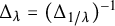 , and so
$\Lambda ^{(\lambda )}_p$
 is the inverse of
$\Lambda ^{(1/\lambda )}_p$
 , and hence homogeneous of degree
$1$
 .
Lemma 7.2 For each
$p\in L$
 , the coordinate transformation
$\Lambda _p$
 is homogeneous of some degree
$\alpha (p)> 0$
 .
Proof For each
$\lambda>0$
 , define the homogeneity defect map as in (10). By Lemma 7.1, the associated coordinate transformation maps can be written

where
$\rho \colon (0, \infty ) \to \mathbb {R}_{\ge 0}$
 is some function.
Note that, for all positive
$\lambda $
 and
$\lambda '$
 , we have
$\Delta _{\lambda } \circ \Delta _{\lambda '} = \Delta _{\lambda \lambda '}$
 . The homeomorphism induced by each of
$\Delta _{\lambda }$
 ,
$\Delta _{\lambda '}$
 , and
$\Delta _{\lambda \lambda '}$
 is the identity map, and the coordinate transformations
$\Lambda ^{(\lambda )}_p$
 ,
$\Lambda ^{(\lambda ')}_p$
 , and
$\Lambda ^{(\lambda \lambda ')}_p$
 are all continuous on
$(0, \infty )$
 . So, from Proposition 5.6, we get that
$\Lambda ^{(\lambda )}_p \circ \Lambda ^{(\lambda ')}_p = \Lambda ^{(\lambda \lambda ')}_p$
 . It follows that
$\rho ({\lambda }) \rho ({\lambda '}) = \rho ({\lambda \lambda '})$
 . The function
$\rho $
 is non-decreasing on its domain
$(0, \infty )$
 . Clearly,
$\rho $
 cannot be identically zero, because
$\Delta _1$
 is the identity map and hence
$\rho (1)=1$
 . According to [Reference Kannappan10, Theorem 1.49], the only other possibility is that
$\rho (\lambda ) = \lambda ^c$
 , for all
$\lambda>0$
 , where c is a nonnegative real number.
Observe that
$\phi \circ \Delta _\lambda = M_\lambda \circ \phi $
 , for each
$\lambda> 0$
 . We deduce that

Recall that
$\Lambda _p$
 is non-decreasing and unbounded, but not necessarily continuous. By evaluating both sides of this equation at a point x where
$\Lambda _p$
 is positive and continuous, taking
$\lambda \neq 1$
 , we see that c cannot be zero.
Substituting
$\gamma := \lambda ^c$
 , we get

This shows that
$\Lambda _p$
 is homogeneous of degree
$1/c$
 .
8 Differentiating order isomorphisms
As before, we assume that
$(V, C, u)$
 and
$(V', C', u')$
 are complete order-unit spaces. Recall that F is the pure state space of V, and L is as defined in (1), and that analogous notation is used concerning
$V'$
 .
Suppose a map
$\phi \colon X \to V'$
 is defined in a neighborhood
$X \subset V$
 of a point
$h \in V$
 . The Gateaux derivative of
$\phi $
 at h in the direction
$f \in V$
 is defined to be

provided the limit exists. We are using here the norm topology on
$V'$
 .
The next lemma provides a way of obtaining a linear order isomorphism between the spaces V and
$V'$
 , provided there is a sufficiently regular order isomorphism between their cones.
Lemma 8.1 Let
$\phi \colon C \to C'$
 be an order isomorphism, such that
$\phi (u) = u'$
 . Denote by
$\Phi $
 the homeomorphism it induces from F to
$F'$
 . Assume that each coordinate transformation
$\Lambda _p$
 ;
$p\in F$
 is homogeneous of some degree
$\alpha (p)> 0$
 . Then,
$\phi $
 is Gateaux differentiable at u, and its derivative in the direction
$f\in V$
 is given by

where
$p := \Phi ^{-1}(q)$
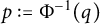 . The map
$f \to d\phi (u; f)$
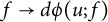 is a linear order isomorphism from V to
$V'$
 , and it induces the same homeomorphism between F and
$F'$
 as
$\phi $
 , namely,
$\Phi $
 .
Proof Fix
$f\in V$
 . For each
$p\in F$
 , we have that
$\Lambda _p(1) = 1$
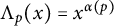
 , and so
$\Lambda _p(x) = x^{\alpha (p)}$
 , for all
$x\in \mathbb {R}_{\ge 0}$
 . Since
$\phi (2 u)$
 is continuous on
$F'$
 , and
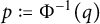
$\phi (2 u)(q) = 2^{\alpha (p)}$
 , for each
$q\in F'$
 , where
$p := \Phi ^{-1}(q)$
 , we see that
$\alpha $
 is continuous on F, and hence bounded. This implies that the second derivative of
$\Lambda _p$
 is bounded uniformly in p in an interval neighborhood
$I \subset (0, \infty )$
 of
$1$
 , that is, there exists
$M> 0$
 such that

Taylor’s theorem gives that, for
$p\in F$
 and
$\delta $
 small enough,

with the remainder term satisfying
$|R(\delta , p, f(p))| \le M \delta ^2 f(p)^2 /2$
 .
This shows that the limit in the definition of the Gateaux derivative converges uniformly on
$F'$
 to
$\alpha (p) f(p)$
 . By Lemma 6.5, this means that the Gateaux derivative
$d\phi (u; f)$
 exists and has the required form.
The map
$\mathcal {D} \colon f \mapsto d\phi (u; f)$
 is obviously linear and order preserving.
Consider the inverse
$\phi ^{-1}$
 of
$\phi $
 . Each of the coordinate transformations
$\Lambda ^{\prime }_q$
 , with
$q\in F'$
 , of this map is also homogeneous, this time of degree
$1/\alpha (p)$
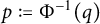
 , where
$p := \Phi ^{-1}(q)$
 . Using the same reasoning as for
$\phi $
 , we get that the Gateaux derivative of
$\phi ^{-1}$
 at the order unit
$u'$
 in the direction
$f \in V'$
 is given by

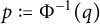
where
$p := \Phi ^{-1}(q)$
 . From this expression, we see that the map
$f \mapsto d\phi ^{-1}(u'; f)$
 is also linear and order preserving. Moreover, it is the inverse of the map
$\mathcal {D}$
 . Hence,
$\mathcal {D}$
 is a linear order isomorphism between V and
$V'$
 .
It remains to show that the homeomorphism
$\Phi ^{\mathcal {D}}$
 induced by
$\mathcal {D}$
 is the same as that induced by
$\phi $
 . Let p be a pure state of V, and choose
$\lambda>0$
 . By Lemma 4.2, the set
$\mathcal {I}_{p, \lambda }$
 contains an ideal I, satisfying
$\sup I = L_{p, \lambda }$
 . Since
$\mathcal {D}$
 is an order isomorphism, it maps I to an ideal
$I'$
 of
$C'$
 . We see from the explicit formula for
$\mathcal {D}$
 that
$\sup I'$
 takes the value
$\alpha (p) \lambda $
 at
$\Phi (p)$
 and the value infinity everywhere else. So,
$I'$
 is in
$\mathcal {I}_{\Phi (p), \alpha (p) \lambda }$
 . It follows using Lemma 5.1 that
$\Phi ^{\mathcal {D}}(p) = \Phi (p)$
 . Since this holds for an arbitrary pure state of V, the pure states are dense in F, and
$\Phi ^{\mathcal {D}}$
 and
$\Phi $
 are continuous, the conclusion follows.
A normal topological space is one in which every two disjoint closed sets have disjoint open neighborhoods. Every compact Hausdorff space is normal. Recall that Tietze’s extension theorem states that every continuous real-valued function defined on a closed subset of a normal topological space can be extended to a continuous function on the whole space, and, moreover, that if the function is bounded, then the extended function can be chosen to have the same bounds.
We are now ready to prove Theorem 1.1.
Proof of Theorem 1.1
Without loss of generality, we may assume that the domain of
$\phi $
 is C and the co-domain is
$C'$
 – if this is not the case, then choose some element f of X and consider the map
$g \mapsto \phi (f + g) - \phi (f)$
 from C to
$C'$
 . By Lemma 2.1, we can choose order units u and
$u'$
 of V and
$V'$
 , respectively, such that
$\phi (u) = u'$
 .
Recall that we are using L to denote the closure of the union of the supports of the affine dependencies of V carried by F. By Lemma 7.2, for each
$p\in L$
 , the coordinate transformation
$\Lambda _p$
 is homogeneous of some positive degree. Likewise, the coordinate transformation
$\Lambda ^{\prime }_q$
 of the inverse map
$\phi ^{-1}$
 is homogeneous of positive degree, for each
$q\in L'$
 , where
$L'$
 is defined analogously to L. Observe that
$\Lambda _p$
 and
$\Lambda ^{\prime }_q$
 are inverses when
$q = \Phi (p)$
 . It follows that
$\Lambda _p$
 is homogeneous of positive degree for all
$p\in \Phi ^{-1}(L')$
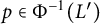 . Therefore, we can write

where
$\alpha $
 is a positive function.
By considering the image under
$\phi $
 of
$2u$
 , where u is the unit, we see that
$\alpha $
 is continuous on
$L \cup \Phi ^{-1}(L')$
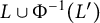 . Since L and
$L'$
 are compact,
$\alpha $
 is bounded above and below by positive numbers on this set.
By Tietze’s extension theorem, we may extend
$\alpha $
 to a continuous function on the whole of F. We reuse the symbol
$\alpha $
 to denote this extended map. The extension can be chosen to be bounded above and below by positive numbers.
Let
$h\in C$
 , and consider the function
$f \colon F' \to \mathbb {R}$
 defined by

where p and q are related by
$q = \Phi (p)$
 . The function f is continuous. Moreover, by Proposition 5.6, it agrees with
$\phi (h)$
 on
$L'$
 , and so
$\mu (f) = 0$
 , for each affine dependency
$\mu $
 of
$V'$
 carried by
$F'$
 . Applying Lemma 2.2, we get that there is an element
$g_h$
 of
$V'$
 such that
$g_h(q) = f(q)$
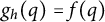 , for all
$q\in F'$
 . Since
$g_h$
 takes nonnegative values on
$F'$
 , it is an element of
$C'$
 .
Define the map
$\kappa \colon C \to C'$
 by setting
$\kappa (h) := g_h$
 , for all
$h\in C$
 . This map is clearly order preserving. Similar reasoning to that in the previous paragraph shows that one may define a map from
$C'$
 to C having coordinate transformations

where
$p = \Phi ^{-1}(q)$
 . This map is the inverse of
$\kappa $
 and is also order preserving. Hence,
$\kappa $
 is an order isomorphism. Observe that
$\kappa (u) = u'$
 . It only remains to apply Lemma 8.1 to get that there is a linear order isomorphism between V and
$V'$
 .
9 Affineness of order isomorphisms
In this section, we complete the proofs of Theorems 1.3 and 1.5.
First, we sharpen Lemma 7.2 to say that the degree of homogeneity of the coordinate transformation maps is actually
$1$
 , for elements of L.
Lemma 9.1 Let
$\phi \colon C \to C'$
 be an order isomorphism between the cones of two complete order-unit spaces V and
$V'$
 . Then, for each
$p\in L$
 , the coordinate transformation
$\Lambda _p$
 is homogeneous of degree
$1$
 .
Proof By Theorem 1.1, there is a linear order isomorphism
$\mathcal {D}$
 from
$V'$
 to V. Moreover, the order isomorphism
$\mathcal {D}$
 exhibited in the proof of that theorem induces the same homeomorphism between
$F'$
 and F as
$\phi ^{-1}$
 . By Lemma 5.5, this homeomorphism is the inverse of the one
$\Phi $
 induced by
$\phi $
 between F and
$F'$
 .
Consider the map
$\vartheta := \mathcal {D} \circ \phi $
 . This is an order isomorphism from C to itself, and, by Lemma 5.5, the homeomorphism it induces on F is the identity map. By Lemma 7.2, each of the coordinate transformations
$\Lambda _p$
 ;
$p\in L$
 of
$\phi $
 is homogeneous of some positive degree. Furthermore, every coordinate transformation
$\Lambda ^{\mathcal {D}}_q$
 ;
$q\in F'$
 of
$\mathcal {D}$
 is homogeneous of degree
$1$
 . Let
$\Lambda ^\vartheta _p$
 ;
$p\in F$
 be the coordinate transformations of
$\vartheta $
 . Observe that, for each
$p\in L$
 , we have
$\Lambda ^\vartheta _p = \Lambda ^{\mathcal {D}}_q \circ \Lambda _p$
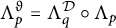 , where
$q := \Phi (p)$
 , and hence the coordinate transformation
$\Lambda ^\vartheta _p$
 is homogeneous of the same degree as
$\Lambda _p$
 . This implies that (9) holds, and Lemma 6.13 is therefore applicable. We deduce that, for all
$p\in L$
 , the transformation
$\Lambda ^\vartheta _p$
 is homogeneous of degree
$1$
 , and hence so is
$\Lambda _p$
 .
The next lemma generalizes our results about isomorphisms between cones to isomorphisms between upper sets.
Lemma 9.2 Let V and
$V'$
 be two complete order-unit spaces, and let
$\phi \colon U \to U'$
 be an order isomorphism between non-empty upper sets
$U \subset V$
 and
$U' \subset V'$
 . Then, there exists a homeomorphism
$\Phi $
 between F and
$F'$
 such that, for each
$p\in L$
 , the following holds: there exists an increasing affine function
$a \colon \mathbb {R} \to \mathbb {R}$
 satisfying
$\phi (f)(q) = a(f(p))$
 , for all
$f \in U$
 , where
$q := \Phi (p)$
 .
Proof Let
$z\in U$
 . The map

is an order isomorphism from the cone C of V to the cone
$C'$
 of
$V'$
 . Let
$\Phi $
 be the homeomorphism from F to
$F'$
 that this induces.
Let
$p\in L$
 , and write
$q := \Phi (p)$
 . From Lemma 9.1, the coordinate transformation
$\Lambda _p$
 of
$\vartheta _z$
 is homogeneous of degree
$1$
 . This means that there is some
$\lambda>0$
 such that
$\vartheta _z(f)(q) = \lambda f(p)$
 , for all
$f\in C$
 . Note that, for all
$f \ge z$
 ,

and so,

where
$a \colon \mathbb {R} \to \mathbb {R}$
 is defined to be
$a(x) := \lambda x + c$
 , with
$c := -\lambda z(p) + \phi (z)(q)$
 .
Now let w be another point of U, and define
$\vartheta _w$
 in a similar way to how we defined
$\vartheta _z$
 . Again, we get a homeomorphism from F to
$F'$
 , taking p to some element
$q'$
 of
$F'$
 . As before, we have
$\phi (f)(q') = a'(f(p))$
 , for all
$f \ge w$
 , where
$a'$
 is some increasing affine function from
$\mathbb {R}$
 to itself.
Since V is an order-unit space, it has an element x that is greater than both z and w. Consider the set
$X := \{f \in V \mid f \ge x\}$
 . Every point f of this set satisfies both
$f \ge z$
 and
$f\ge w$
 . Its image is
$\phi (X) = \{g \in V' \mid g \ge \phi (x)\}$
 . For g in
$\phi (X)$
 , both
$g(q)$
 and
$g(q')$
 only depend on
$\phi ^{-1}(g)(p)$
 . By varying g within
$\phi (X)$
 , we see that q and
$q'$
 are equal. Comparing the expressions for
$\phi (\cdot )(q)$
 and
$\phi (\cdot )(q')$
 on X then gives that the two affine functions a and
$a'$
 are equal.
We have shown that the homeomorphism
$\Phi $
 and the affine function a do not depend on the choice of z. We conclude that the equation
$\phi (f)(q) = a(f(p))$
 holds for all
$f\in U$
 .
We can now prove the other half of Theorem 1.3.
Lemma 9.3 Let V and
$V'$
 be two complete order-unit spaces, and let
$\phi \colon U \to U'$
 be an order isomorphism between non-empty upper sets
$U \subset V$
 and
$U' \subset V'$
 . Assume that V satisfies Condition 1.2. Then,
$\phi $
 is affine.
Proof Let
$\{\lambda _i\}_i$
 and
$\{f_i\}_i$
 be finite collections of real numbers and elements of U, respectively, such that
$\sum _i \lambda _i = 1$
 and
$\sum _i \lambda _i f_i \in U$
 .
Denote by
$\Phi $
 the homeomorphism from F to
$F'$
 given by Lemma 9.2. Let
$q\in F'$
 , and let
$p \in F$
 be such that
$q = \Phi (p)$
 . By assumption, p is in L. So, by Lemma 9.2 again, there exists an increasing affine function
$a \colon \mathbb {R} \to \mathbb {R}$
 such that
$\phi (h)(q) = a(h(p))$
 , for all
$h\in U$
 . Therefore,

Since this is true for all
$q\in F'$
 , we deduce that

We have shown that
$\phi $
 is an affine map.
Finally, we can prove Theorems 1.3 and 1.5.
Proof of Theorem 1.3
If Condition 1.2 holds, then Lemma 9.3 shows that every order isomorphism between U and
$U'$
 is affine.
Assume now that U is directed downward, that all order isomorphisms between U and
$U'$
 are affine, and that there exists an order isomorphism
$\vartheta $
 between U and
$U'$
 , which is of course necessarily affine. If Condition 1.2 does not hold for the space V, then by Lemma 3.1, there exists an order isomorphism
$\phi $
 from U to itself that is not affine. In this case, the composition
$\vartheta \circ \phi $
 is an order isomorphism between U and
$U'$
 that is not affine. We conclude that Condition 1.2 holds for V.
Proof of Theorem 1.5
Denote by F the closure of the set of pure states, and by L the closure of the union of the supports of the affine dependencies carried by F, as in (1).
Assume that the state space is not a Bauer simplex, and let
$\phi $
 be an order isomorphism between
$\operatorname {\mathrm {int}} C$
 and a non-empty upper subset U of V. We must show that U does not equal V. Since the state space is not a Bauer simplex, there exists an element p of L. Let
$\Phi $
 be the homeomorphism on F given by Lemma 9.2, and write
$q := \Phi (p)$
 . According to the same lemma, there is an increasing affine function
$a \colon \mathbb {R} \to \mathbb {R}$
 such that
$\phi (f)(q) = a(f(p))$
 , for all
$f\in \operatorname {\mathrm {int}} C$
 . Observe that
$f(p)$
 is positive for all
$f\in \operatorname {\mathrm {int}} C$
 . It follows that
$\phi (f)(q)$
 is bounded below by
$a(0)$
 as f varies in
$\operatorname {\mathrm {int}} C$
 , which means that the map
$g \mapsto g(q)$
 is bounded below on U. Since this map is not bounded below on V, we deduce that U and V differ.
Now assume that the state space is a Bauer simplex, that is, that the set of affine dependencies carried by F is empty. Define the map
$\phi \colon \operatorname {\mathrm {int}} C \to V$
 ,
$x\mapsto \phi (x)$
 by

Since, for each
$x\in \operatorname {\mathrm {int}} C$
 , the function
$\phi (x)(\cdot )$
 is continuous on F, we have by Lemma 2.2 that
$\phi (x)$
 is a well-defined element of V. It is clear that
$\phi $
 is order preserving. Similar reasoning shows that the coordinate-wise exponential function defined on V is also well-defined and order preserving. Since this function is the inverse of
$\phi $
 , the proof is complete.
The following proposition was mentioned in the introduction as an example where rigidity may occur even in spaces where Condition 1.2 does not hold, if the domain of the map is not directed downward.
Proposition 9.4 Consider
$\mathbb {R}^3$
 with the product order and order unit
$(1,1,1)$
 . All order isomorphisms from the half-space
$H :=\{(x,y,z) \mid x + y + z \ge 0\}$
 to itself are affine.
Proof We first consider the two-dimensional problem, that is, we study the order isomorphisms of the set
$H_2 := \{(x,y) \mid x + y \ge 0\}$
 in the space
$\mathbb {R}^2$
 . Let
$\phi $
 be such a map. For each
$a\in H_2$
 , denote by
$U_a$
 the set of elements of
$H_2$
 that are greater than or equal to a. If a is a point of
$H_2$
 , then the restriction of
$\phi $
 to
$U_a$
 is an order isomorphism between
$U_a$
 and
$U_{\phi (a)}$
 . Such maps are known to be of the form
$(x, y) \mapsto P(\phi _1(x), \phi _2(y))$
 , where P is a permutation of the coordinates, and
$\phi _1$
 and
$\phi _2$
 are order isomorphisms between upper sets of
$\mathbb {R}$
 . Note that, for a and
$a'$
 in
$H_2$
 , the intersection of the sets
$U_a$
 and
$U_{a'}$
 has non-empty interior. So, we see that when a is varied over
$H_2$
 , all the permutations obtained are the same, and we can write
$\phi (x, y) = P(\phi _1(x), \phi _2(y))$
 , with
$\phi _1$
 and
$\phi _2$
 being order isomorphisms of
$\mathbb {R}$
 . Since
$\phi $
 preserves the set
$\big \{(x, -x) \mid x\in \mathbb {R} \big \}$
 , we have that
$\phi _1(x) = -\phi _2(-x)$
 , for all
$x\in \mathbb {R}$
 .
Returning to the three-dimensional case, we use similar reasoning to show that every order isomorphism
$\phi $
 from H to itself can be written in the form
$\phi (x, y, z) = P(\phi _1(x), \phi _2(y), \phi _3(z))$
 , where P is a permutation of the three coordinates and
$\phi _i$
 ;
$1\le i\le 3$
 are order isomorphisms of
$\mathbb {R}$
 such that
$\phi _1(x) + \phi _2(y) + \phi _3(z) = 0$
 whenever
$x + y + z = 0$
 . Without loss of generality, we may assume that P is the identity permutation, and that
$\phi (o) = o$
 , where o is the origin.
The map
$\phi $
 then acts as an order isomorphism on the set of points
$(x, y, z) \in H$
 such that
$z = 0$
 . Applying the two-dimensional result of the first paragraph, we get that
$\phi _1(x) = -\phi _2(-x)$
 , for all
$x\in \mathbb {R}$
 . Similar considerations lead us to conclude that
$\phi _1(x) = -\phi _3(-x)$
 , for all
$x\in \mathbb {R}$
 , and we deduce that
$\phi _2 = \phi _3$
 on
$\mathbb {R}$
 . By reasoning in a similar way about the other coordinates, we see that
$\phi _1 = \phi _2 = \phi _3$
 .
We now evaluate
$\phi $
 at the point
$(\alpha + \beta , -\alpha , -\beta )$
 , with
$\alpha $
 and
$\beta $
 in
$\mathbb {R}$
 . From our results so far,
$\phi _1(\alpha + \beta ) = \phi _1(\alpha ) + \phi _1(\beta )$
 . So,
$\phi $
 is additive. Since it is also monotonically increasing, it follows that it is linear (see [Reference Kannappan10, Theorem 1.2]). Likewise, the same is true for
$\phi _2$
 and
$\phi _3$
 . We have proved that
$\phi $
 is affine.
10 Examples
In this section, we see how our results apply to some examples.
Example 10.1 (Cone over the unit ball of a Banach space)
Let V be the direct sum of a real Banach space
$(X, ||\cdot ||)$
 , of dimension greater than
$1$
 , and the real line
$\mathbb {R}$
 , and take as the cone the set
$\{(x, \alpha ) \mid ||x|| \le \alpha \}$
 . We take
$(0, 1)$
 to be the order unit. The dual space is
$X^* \oplus \mathbb {R}$
 , and the dual cone is
$\{(y, \alpha ) \in X^* \oplus \mathbb {R} \mid ||y|| \le \alpha \}$
 . So, the state space is
$B^* \times \{1\}$
 , a copy of the dual unit ball
$B^*$
 .
If
$p := (x_1, 1)$
 and
$q := (x_2, 1)$
 are pure states such that
$x_1$
 and
$x_2$
 are linearly independent, then, writing
$r := (-x_1, 1)$
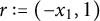 and
$s := (-x_2, 1)$
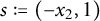 , we have that
$\delta _p - \delta _q + \delta _r - \delta _s$
 is an affine dependency, whose support is composed of four points. Here,
$\delta _x$
 represents an atom of unit mass at a point x. Thus, every pure state appears in the support of some affine dependency carried by the pure state space, and so Condition 1.2 holds.
This example with
$C([0,1])$
 as the Banach space was mentioned in [Reference Lemmens, Van Gaans and Van Imhoff14] as one that could not be handled with current techniques (see the remark after the proof of Theorem 1.1 in that paper).
Example 10.2 (Finite-dimensional cones)
We say that a finite-dimensional ordered vector space has no one-dimensional factors if it is not linearly order isomorphic to a space of the form
$V := V_1 \oplus \mathbb {R}$
 with cone
$C_1 \times [0, \infty )$
 , where
$(V_1, C_1)$
 is an ordered vector space and
$\oplus $
 denotes the direct sum of two vector spaces. Note that a space has no one-dimensional factors if and only if the same is true for its dual.
Proposition 10.3 A finite-dimensional ordered vector space
$(V, C)$
 satisfies Condition 1.2 if and only if it has no one-dimensional factors.
Proof Let p be a pure state. If p is not isolated in the set of pure states, then it can be expressed as a linear combination of other pure states and is thus in the support of an affine dependency carried by the pure state space. Indeed, this affine dependency consists of a finite number of atoms. On the other hand, if p is isolated and in the support of an affine dependency carried by the pure state space, then the dependency has an atom on p, which combined with Carathéodory’s theorem [Reference Aliprantis and Border4, p. 184] implies that p can again be written as a linear combination of other pure states. We deduce that every element of the set L, as defined in (1), is in the support of an atomic affine dependency carried by the pure state space. So, Condition 1.2 is equivalent to every pure state being a linear combination of other pure states. This is equivalent to the dual space
$V^*$
 having no one-dimensional factors, which in turn is equivalent to V having no one-dimensional factors.
Example 10.4 (The Lorentz cone)
Consider, in particular, the space
$\mathcal {L} := (\mathbb {R}^3, \Lambda , u)$
 , which is three-dimensional Euclidean space endowed with the Lorentz cone

and the order unit
$u := (0, 1)$
 . The state space here is the disk
$K_{\mathcal {L}} := \{(x, 1) \mid ||x||_2 \le 1\}$
 in the dual space, and the set of pure states is its boundary circle
$\partial _e K_{\mathcal {L}}$
 . This example is a special case of Example 10.1.
Example 10.5 (The cone of nonnegative continuous functions)
Let X be a compact Hausdorff space, and let
$C(X)$
 be the space of continuous real-valued functions on X. We use the pointwise order, which means that the relevant cone is the cone
$C^+(X)$
 of nonnegative continuous functions. The dual space is the space of signed Radon measures on X. The states are the probability measures, and the pure states are the Dirac masses. There are no affine dependencies carried by the pure state space at all, and so Condition 1.2 does not hold.
Example 10.6 (Piece-of-string-in-a-cone)
Consider the space
$C([0,1], \mathcal {L})$
 of continuous maps from the interval
$[0,1]$
 to the three-dimensional space
$\mathcal {L}$
 ordered by the Lorentz cone (see Example 10.4 above). The order we take is the pointwise order, and the cone is the set
$C([0,1], \Lambda )$
 of continuous maps into the Lorentz cone. Each point of this cone describes the configuration of an elastic string lying in the Lorentz cone.
The dual space is the space
$M([0,1], \mathcal {L}^*)$
 of regular Borel vector measures on
$[0,1]$
 with values in
$\mathcal {L}^*$
 that are of bounded variation (see [Reference Singer29, Lemma 1.6, p. 193]). Here,
$\mathcal {L}^*$
 denotes the dual space of
$\mathcal {L}$
 . The set of pure states in this case can be identified with the Cartesian product
$[0,1] \times \partial _e K_{\mathcal {L}}$
 , with the product topology. Here,
$\partial _e K_{\mathcal {L}}$
 is the set of pure states of the space
$\mathcal {L}$
 . Each copy of
$\partial _e K_{\mathcal {L}}$
 has the same affine dependencies as
$\partial _e K_{\mathcal {L}}$
 , and so
$C([0,1], \mathcal {L})$
 satisfies Condition 1.2.
An interesting variant of this example occurs when one of the endpoints of the string is constrained to lie on the axis of the Lorentz cone, that is, we consider the subspace of
$C([0,1], \mathcal {L})$
 consisting of those elements
$x(\cdot )$
 satisfying
$x(0) \in \{0\} \times \mathbb {R} \subset \mathcal {L}$
 . The dual space is now a quotient of the dual space of
$C([0,1], \mathcal {L})$
 . In particular, the pure state space can be obtained from that of
$C([0,1], \mathcal {L})$
 by collapsing one end of the cylinder
$[0,1] \times \partial _e K_{\mathcal {L}}$
 to a point. There are no affine dependencies with mass on this point that consist only of a finite number of atoms. However, there are affine dependencies consisting of a countable number of atoms that have the collapsed point in their support.
The following example shows why it is necessary to consider the closure of the union of the supports of the affine dependencies, rather than just the union.
Example 10.7 Let
$\omega _1$
 denote the first uncountable ordinal. The set
$\Omega := \omega _1 + 1$
 contains all the ordinals up to and including
$\omega _1$
 and is compact when given its order topology (see [Reference Aliprantis and Border4, Section 2.37]). The space
$C(\Omega , \mathcal {L})$
 satisfies Condition 1.2 for the same reason that
$C([0,1], \mathcal {L})$
 does (see Example 10.6).
Consider now the subspace Q of
$C(\Omega , \mathcal {L})$
 obtained by requiring the
$\omega _1$
 coordinate to be on the axis of the Lorentz cone, that is,

Similarly to the variant of the previous example, the set of pure states can be identified with the quotient of the product
$\Omega \times \partial _e K_{\mathcal {L}}$
 obtained when one copy of
$\partial _e K_{\mathcal {L}}$
 , namely,
$\{\omega _1\}\times \partial _e K_{\mathcal {L}}$
 , is collapsed to a point, which we denote by
$\overline \omega _1$
 . This quotient is a closed subset of the state space of Q. The point
$\overline \omega _1$
 is not isolated in the set of pure states, and each of the other pure states, that is, each point of
$(\Omega \backslash \{ \omega _1 \} )\times \partial _e K_{\mathcal {L}}$
 , is in the support of an affine dependency consisting of a finite number of atoms. We conclude that Q satisfies Condition 1.2.
However,
$\overline \omega _1$
 is not itself in the support of any affine dependency, as the following proposition shows.
Proposition 10.8 The pure state
$\overline \omega _1$
 is not in the support of any affine dependency.
Proof Note that, if
$\mu $
 is a measure on
$\Omega $
 and
$x \in \Omega $
 is the least element of the support of
$\mu $
 , then
$[0, x + 1)$
 is an open neighborhood of x, and so
$x = [0, x + 1) \cap \operatorname {\mathrm {supp}}\mu $
 has positive mass, and hence there is an atom at x. It follows that any measure on
$\Omega $
 with no atoms must be zero, or stated another way, every measure on
$\Omega $
 consists entirely of atoms. The number of atoms, of course, must be countable.
Let
$\mu $
 be an affine dependency carried by the pure state space F of Q, and consider its positive and negative parts
$\mu _+$
 and
$\mu _-$
 , respectively. Denote by
$\mu _*$
 the push forward of
$|\mu |:= \mu ^- + \mu ^+$
 by the projection map
$\pi \colon F \to \Omega $
 . Let M be the supremum of the set
$\operatorname {\mathrm {supp}}\mu _* \backslash \{\omega _1\}$
 . Note that M is a countable ordinal and so is strictly less than
$\omega _1$
 .
Let
$\mu _+$
 and
$\mu _-$
 have atoms of mass
$m_+$
 and
$m_-$
 at
$\overline \omega _1$
 , respectively. The measures
$\mu _+$
 and
$\mu _-$
 are mutually singular, and so at least one of
$m_+$
 and
$m_-$
 is zero. We denote by
$u := (0, 1)$
 the order unit of the space
$\mathcal {L}$
 . The function taking the value
$0$
 on
$[0, M]$
 and the value u on
$[M + 1, \omega _1]$
 is continuous, and so is an element of Q. It therefore gives rise to a continuous function on the pure state space. The integral of this function with respect to
$\mu $
 is
$m_+ - m_-$
 , and so this quantity is zero. We conclude that
$\mu $
 does not have an atom at
$\overline \omega _1$
 , and hence that
$\mu _*$
 does not have an atom at
$\omega _1 = \pi (\overline \omega _1)$
 .
We have shown that
$(M, \omega _1]$
 does not intersect the support of
$\mu _*$
 . It follows that
$\pi ^{-1}(M, \omega _1]$
 has measure zero with respect to the affine dependency
$\mu $
 . Since this set is an open set containing
$\overline \omega _1$
 , we see that
$\overline \omega _1$
 is not in the support of
$\mu $
 .
Example 10.9 (Bounded operators on a Hilbert space)
Let
$B(\mathcal {H})_{\mathrm {sa}}$
 be the space of bounded self-adjoint linear operators on a Hilbert space
$\mathcal {H}$
 . The cone in this case is the cone
$B(\mathcal {H})_{\mathrm {sa}}^+$
 of positive semi-definite elements of
$B(\mathcal {H})_{\mathrm {sa}}$
 , that is, the elements A such that
$\langle Ax,{x} \rangle \ge 0$
 , for all
$x\in \mathcal {H}$
 . Recall that a vector state is a function of the form
$A \mapsto \omega _x(A) := \langle Ax,{x} \rangle $
 , for
$A\in B(\mathcal {H})_{\mathrm {sa}}$
 , where x is a unit vector in
$\mathcal {H}$
 . It is known (see Theorem 4.3.9 and Exercises 4.6.68 and 4.6.69 of [Reference Kadison and Ringrose9]) that every vector state is a pure state, and that the set of vector states is dense in the pure state space. Note however that when the dimension of
$\mathcal {H}$
 is infinite, there exist pure states that are not vector states, and the set of pure states is not closed. Let x and y be linearly independent unit vectors in
$\mathcal {H}$
 . Observe that the following algebraic relation holds:

Defining the unit vectors

we see that the signed measure consisting of atoms of weight
$||x + y||^2$
 on
$\omega _{w}$
 and
$||x - y||^2$
 on
$\omega _{z}$
 , and atoms of weight
$-2$
 on
$\omega _x$
 and
$\omega _y$
 , is an affine dependency. We conclude that every vector state is in the support of an affine dependency, and, since these are dense in the pure state space, that Condition 1.2 holds. This completes the proof of Corollary 1.4.
Example 10.10 (The Poulsen simplex)
Poulsen [Reference Poulsen24] has constructed a metrizable Choquet simplex where the set of pure states is dense. Later, it was shown [Reference Lindenstrauss, Olsen and Sternfeld16] that this is the only metrizable Choquet simplex (with more than one point) having this property, up to affine homeomorphisms. The Poulsen simplex has many interesting properties, including the fact that its set of pure states is homeomorphic to the Hilbert space
$\ell _2$
 .
Let V be the space of continuous affine real-valued functions on the Poulsen simplex, and take the usual partial order on this space. The constant function
$1$
 is an order unit. The state space of V can be identified with the Poulsen simplex itself.
Consider any point x of the Poulsen simplex K, and let
$y\in K$
 be any other point. Define
$z := (x + y) / 2$
 . The signed measure

is an affine dependency carried by the state space K, which in the case of the Poulsen simplex is also the pure state space F. So, an arbitrary x is in the union of the supports of the affine dependencies carried by F, and hence Condition 1.2 holds.
List of symbols



