Introduction
Laryngopharyngeal reflux (LPR) is common in otolaryngology practice; 4–10 per cent of patients present to out-patient departments with LPR.Reference Koufman1 Laryngopharyngeal reflux commonly causes dysphonia, with 50 per cent of LPR patients presenting with this disorder.Reference Koufman, Amin and Panetti2 Diagnosis of LPR can be difficult. Twenty-four hour pH monitoring provides the greatest reliability, but it has around a 10 per cent rejection rate by patients.Reference Koufman1 The reflux symptom index also has a place in LPR diagnosis, with scores greater than 13 considered diagnostic.Reference Belafsky, Postma and Koufman3 The scoring is based on patient self-assessments (using a questionnaire) of symptoms associated with LPR. The treatment of LPR, as with gastroesophageal reflux, is with proton pump inhibitors (PPIs). However, there is some debate as to the ideal treatment regimen. In addition, two systematic reviews reported a lack of evidence supporting the use of PPIs in LPR.Reference Sen, Georgalas and Bhattacharyya4, Reference Karkos and Wilson5
Despite the prevalence of LPR in otolaryngology and the frequency of voice complaints, only a few studies have compared voice parameters in patients with LPR following treatment with PPIs.Reference Shaw, Searl, Young and Miner6–Reference Park, Shim, Hwang, Cho, Joo and Cho11 These studies used a combination of voice parameters from subjective questionnaires, such as the voice handicap index, and acoustic voice data. The results are inconclusive. One study failed to identify a subjective improvement in voice,Reference Fass, Noelck, Willis, Navarro-Rodriguez, Wilson and Powers10 and two studies revealed no change in acoustic voice data in LPR patients undergoing treatment.Reference Hamdan, Sharara, Younes and Fuleihan8, Reference Fass, Noelck, Willis, Navarro-Rodriguez, Wilson and Powers10
Our preferred subjective patient voice assessment is the voice symptom scale, but this has not been utilised in previous studies. This questionnaire has three main components: emotional responses, physical symptoms and voice impairment. The voice symptom scale has been assessed against the voice handicap index and the former provided the most robust data.Reference Wilson, Webb, Carding, Steen, MacKenzie and Deary12
This study aimed to identify whether patients diagnosed with LPR benefitted from PPI treatment according to their subjective ratings of their symptoms using the voice symptom scale questionnaire.
Materials and methods
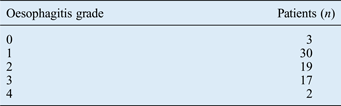
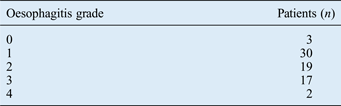
A prospective study was carried out on patients who attended a voice clinic for dysphonia between 2004 and 2007. All patients included in the study had been diagnosed with LPR (with a reflux symptom index over 13 in accordance with the findings reported by Belafsky et al. Reference Belafsky, Postma and Koufman3) and had received treatment for it. The patients were seen by an ENT consultant or registrar and the same speech and language therapist. Our diagnosis of LPR was made based on the patient's history, laryngeal examination using videostroboscopy and fibre-optic oesophagoscopy findings. Table I shows the oesophagoscopy findings for patients that agreed to the procedure.
Oesophagoscopy findings
Laryngopharyngeal reflux treatment consisted of twice daily PPI for three months (lansoprazole 30 mg). Every patient that attends the voice clinic completes a voice symptom scale questionnaire and reflux symptom index as standard. Patients are followed up at three-month intervals. Voice symptom scale and reflux symptom index data are collected at each visit; it was these data that were assessed for the current study. Patients were only included if they had attended at least one follow up (at three months).
The scores of the individual questionnaires for each patient were compared pre and post (at three months and/or six months where the data were available) LPR treatment using the Wilcoxon rank test.
Results
A total of 74 patients with data available from at least 2 visits (the initial visit and the 3-month follow up) had a reflux symptom index score of over 13. Voice symptom scale score data from 2 visits were available for all 74 patients. Reflux symptom index and voice symptom scale data from three visits (the initial visit, and follow ups at three and six months) were available for 34 of these patients.
Reflux symptom index results
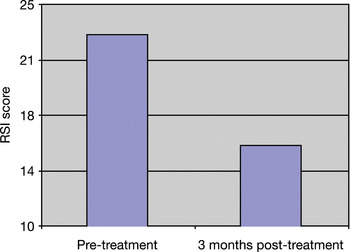
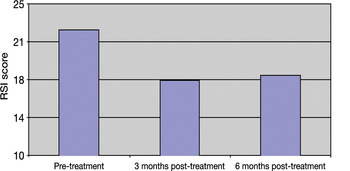
The median pre-treatment reflux symptom index score for all patients (n = 74) was 23 (range 13–38) and the median post-treatment score at 3 months was 15.5 (range 0–37), which was a statistically significant reduction (p < 0.001) (Figure 1). Of the 74 patients, 55 had a lower reflux symptom index score at 3 months. The median pre-treatment score for those patients seen at both 3 months and 6 months (n = 34) was 22.5 (range 14–35) and the post-treatment score at 6 months was 18 (range 0–37), which was a statistically significant reduction (p < 0.001) (Figure 2). Of these 34 patients, 24 had a lower score at 6 months.
Reflux symptom index scores at pre-treatment and three months post-treatment. RSI = reflux symptom index

Reflux symptom index scores at pre-treatment, and at three months and six months post-treatment. RSI = reflux symptom index

Voice symptom scale results
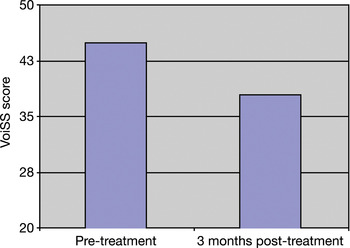
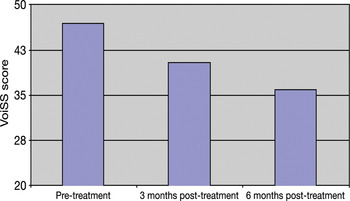
The median pre-treatment total voice symptom scale score for all patients (n = 74) was 45 (range 13–100) and the median post-treatment total score at 3 months was 38 (range 4–106), which was a statistically significant reduction (p < 0.0001) (Figure 3). Of the 74 patients, 50 showed improvement in their voice symptom scale score. The median pre-treatment total score for those patients seen at both 3 months and 6 months (n = 34) was 47 (range 27–89) and the total score at 6 months post-treatment was 36 (range 14–91), which was a significant reduction (p < 0.005) (Figure 4). Of these 34 patients, 23 showed improvement in their total voice symptom scale score at 6 months post-treatment.
Voice symptom scale scores at pre-treatment and three months post-treatment. VoiSS = voice symptom scale

Voice symptom scale scores at pre-treatment, and at three months and six months post-treatment. VoiSS = voice symptom scale

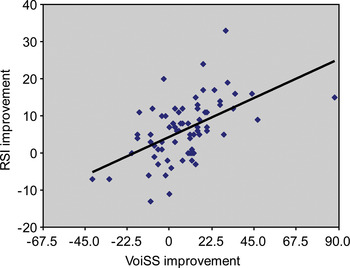
There was a statistically significant correlation between the improvement in reflux symptom index scores and the improvement in voice symptom scale scores (p < 0.05, r = 0.53) (Figure 5).
Correlation between reflux symptom index scores and voice symptom scale scores. RSI = reflux symptom index; VoiSS = voice symptom scale

Discussion
Laryngopharyngeal reflux is common to otolaryngologists. An affected patient will commonly present with voice problems. Numerous studies have shown that treating LPR with PPIs results in an improvement in the patient's reflux symptom index score. However, the reflux symptom index was not specifically designed for the assessment of voice, and there are other effective means of subjectively assessing voice. There are two main subjective voice assessment questionnaires that are completed by the patient: the voice handicap index and the voice symptom scale. The voice symptom scale has been assessed against the voice handicap index and was found to provide more thorough, robust data.Reference Wilson, Webb, Carding, Steen, MacKenzie and Deary12
As dysphonia is a common complaint of LPR, the assessment of voice outcomes for patients receiving treatment is important. The voice symptom scale results of the current study support previous work using other subjective voice assessments that found PPIs improved dysphonia symptoms in LPR patients. There was also a correlation between improvements in reflux symptom index scores and improvements in voice symptom scale scores, which further suggests that the improvement in dysphonic symptoms was a result of the LPR treatment.
It is interesting that less than half of the patients attended a further follow up at six months. For the patients that did attend at six months, voice symptom scale scores continued to improve; however, there was a slight deterioration in their reflux symptom index scores. Hence, it cannot be presumed that all those that did not attend improved. There were likely to be some patients whose symptoms did not improve or may even have worsened despite treatment. It is certainly our experience that patients are not always compliant in terms of taking their medications, and are less than judicious with their use. This may be because of the medication side effects, which can be intolerable. Furthermore, general practitioners are occasionally unhappy to prescribe PPIs in twice daily dosing or sometimes even to continue with long-term prescribing of these medications. All of these factors can result in either the return of symptoms or the failure to adequately treat the underlying problem. Therefore, the recalcitrant patient often requires time to determine if these factors are important. If not, the next step after reassessing the diagnosis would be to prescribe additional anti-reflux treatment, such as Gaviscon® Advance three times daily and/or ranitidine at night. Occasionally patients require referral to our gastroenterology colleagues for further assessment and possibly even surgery (Nissen fundoplication).
As all patients in the current study underwent speech therapy at the same time as anti-reflux treatment, it is difficult to tease out which treatment had the greatest effect on symptom improvement. All patients were offered voice therapy. Following the assessment of each patient, a management plan was designed to meet the needs of each individual. The therapy plans included both direct and indirect therapy approaches such as: voice education, voice care advice, lifestyle and diet advice for reflux, vocal technique, and voice exercises. Patients attended therapy sessions for the number of times necessary to meet the individual's outcome objective. All patients were offered both medical treatment and speech and language therapy as it was not felt ethical to offer only one type of treatment to half of the patients and the other treatment type to the remaining half. To our knowledge, no studies have focused specifically on speech and language therapy alone using the reflux symptom index as the outcome measure. However, two studies investigated voice therapy and reflux symptoms, and both reported that voice therapy enhanced the medical treatment given to patients.Reference Park, Shim, Hwang, Cho, Joo and Cho11, Reference Vashani, Murugesh, Hattiangadi, Gore, Keer and Ramesh13
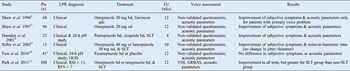
There is only a small amount of literature on the assessment of voice that focuses specifically on patients with LPR. There were a total of six previously published studies on voice characteristic assessment in patients with LPR that had been treated with a PPI. These studies and their data are displayed in Table II.
Summary of previous findings

*Twenty-four patients were treated, 17 received a placebo. Pts = patients; LPR = laryngopharyngeal reflux; FU = follow up; wks = weeks; bd = twice daily; qds = four times daily; od = once daily; h = hour; SLT = speech and language therapy; OGD = oesophagogastroduodenoscopy; RSI = reflux symptom index score; RFS = reflux finding score; VHI = voice handicap index; GRBAS = grade, roughness, breathiness, asthenia, strain scale
Only one of the previous studies found no improvement in patients’ voice symptoms.Reference Fass, Noelck, Willis, Navarro-Rodriguez, Wilson and Powers10 That study compared a placebo against PPI treatment and used patient diaries to assess voice use, effort and fatigue. The authors found no difference between the two groups. It is not clear how the figures for the patient diary data were derived so it is difficult to comment on the usefulness of this method in assessing voice. The Laryngopharyngeal Reflux Health-Related Quality of Life Questionnaire was also used in that study, and although an improvement was seen in the one voice-related question of this questionnaire, there was no difference compared with the placebo group. The only other real criticism of the study relates to the division of patients; 17 were in the placebo group and 24 were in the treatment group, which is unlikely to be a random split. It would be interesting to know about the ‘missing’ patients.
• Approximately 50 per cent of patients with laryngopharyngeal reflux (LPR) have voice problems
• Some studies have shown improvements in acoustic measurements of voice with LPR treatment
• In this study, proton pump inhibitors and speech therapy led to improved reflux symptom index and voice symptom scale scores
• Reflux symptom index improvement correlated with voice symptom scale improvement
Most of the previous studies, which together report the results of over 300 patients, showed an improvement in patients’ voice post-treatment. We acknowledge that LPR remains an area of controversy in terms of its existence, diagnosis and treatment. Nevertheless, the results from our study and those of others provide useful information regarding the potential benefits of PPI treatment for dysphonic patients with LPR.
Conclusion
Laryngopharyngeal reflux is a significant factor in the development of voice disorders. The treatment of LPR with PPIs and speech and language therapy can lead to improvements in patient-reported symptoms that are measurable with the voice symptom scale. Improvements in the voice symptom scale correlated with improvements in the reflux symptom index.