Introduction
Research consistently reports decreased prevalence rates of anxiety and depressive disorders across the adult life span (Goncalves and Byrne, Reference Goncalves and Byrne2013) with a prevalence 2%–15% for anxiety (Flint, Reference Flint1994; Trollor et al., Reference Trollor, Anderson, Sachdev, Brodaty and Andrews2007; Wolitzky-Taylor et al., Reference Wolitzky-Taylor, Castriotta, Lenze, Stanley and Craske2010) and 2%–4% for depressive disorders (Beekman et al., Reference Beekman, Copeland and Prince1999) among older adults. This is in comparison to prevalence of 18% for anxiety disorders and 8%–10% for depression in middle-aged adults (Kessler et al., Reference Kessler, Chiu, Demler and Walters2005). There are a number of proposed explanations for the reduced prevalence of anxiety and depression disorders in later life, including cohort effects (Goncalves and Byrne, Reference Goncalves and Byrne2013), problems with assessment methods (O’Conner and Parslow, Reference O’Conner and Parslow2009) and improved emotion regulation skills in later life (Carstensen and Mikels, Reference Carstensen and Mikels2005; Gross, Reference Gross, Lewis, Haviland-Jones and Barrett2008). There is also an emerging evidence that older adults experience different symptoms of anxiety and depression than younger adults (Christensen et al., Reference Christensen1999; Mezuk and Kendler, Reference Mezuk and Kendler2012), that these differences lead to both differences in prevalence rates for these disorders captured in national surveys and may also lead to lower recognition of anxiety and depression in older adults by individuals and professionals (Shah et al., Reference Shah, McNiece and Majeed2001).
Examples of age-related differences in symptom expression include findings that anhedonia is more common in geriatric depression than excessive tearfulness or sadness (Gallo et al., Reference Gallo, Anthony and Muthen1994; Gum et al., Reference Gum, McDougal, McIlvane and Mingo2010), and apathy is more commonly reported than dysphoria (Adams, Reference Adams2001). There is also research that appetite loss, hypochondriasis and psychomotor slowing are more commonly experienced in geriatric depression compared with hypersomnia that typifies middle-aged depression (Fiske et al., Reference Fiske, Wetherell and Gatz2009; Hybels et al., Reference Hybels, Landerman and Blazer2012). Similarly, older adults with GAD have been reported to worry about different topics than younger adults, with younger adults more likely to report worrying about interpersonal relations, school/work and finances and older adults more likely to report worry about the health and welfare of loved ones (Goncalves and Byrne, Reference Goncalves and Byrne2013). In addition, older adults with GAD are more likely to report difficulty with concentrating, feeling dizzy or faint, and experiencing nausea or diarrhea when worried compared to younger adults with GAD (Goncalves and Byrne, Reference Goncalves and Byrne2013). Similarly, in social phobia, some research has reported that older adults endorse more anxiety when asking for help, attending medical appointments, forgetting information in front of others, using technology in front of others, and socializing as a single person with couples (Ciliberti et al., Reference Ciliberti, Gould, Smith, Chorney and Edelstein2011). Fear of falling is also a commonly reported specific phobia in older adults that can develop in older adulthood (Wolitzky-Taylor et al., Reference Wolitzky-Taylor, Castriotta, Lenze, Stanley and Craske2010; Mohlman et al., Reference Mohlman2012). It is possible that these differences between identification and experience of anxiety and depression between younger and older adults reflect qualitatively different mental health experience across the age-span.
Previous investigations comparing symptoms across the lifespan have focused on symptom profiles of single disorders, rather than examining comorbid diagnoses. Given that comorbidity is common in treatment-seeking older individuals (Byers et al., Reference Byers, Yaffe, Covinsky, Friedman and Bruce2010) with 48% of those with depression meeting criteria for a secondary anxiety disorder, and 26% of those with an anxiety disorder meeting criteria for a secondary mood disorder (Beekman et al., Reference Beekman, de Beurs, van Balkom, Deeg, van Dyck and Van Tilburg2000), this is an important limitation. In addition, few studies have examined the difference between younger and older adults within the same study, more frequently comparing clinically anxious and depressed older adults to an older control or sub-threshold sample, limiting the direct comparison of age-related differences. Further research is therefore needed, that compares the frequency of symptoms of comorbid anxiety and mood disorders in clinical populations of younger and older adults.
More recently, it has also been suggested that older adults might use different labels or descriptions to younger adults to describe depressed mood and worry and this may contribute to under identification of anxiety and depression by professionals and individuals themselves (Wetherell et al., Reference Wetherell2009; Bryant, Reference Bryant2010; Wolitzky-Taylor et al., Reference Wolitzky-Taylor, Castriotta, Lenze, Stanley and Craske2010). It has previously been reported that older adults are less likely to endorse sadness as a symptom of depression, but it is unclear if they would be more likely to endorse alternatives such as flatness or feeling down. Little research has examined this issue, but it has been shown that older adults with GAD or Social Phobia are less likely to admit that their worry or fear is excessive or uncontrollable (Montario et al., Reference Montario, Nuevo, Marquez, Izal and Losada2003; Karlsson et al., Reference Karlsson2009), and are more likely to describe worry as concern (Wolitzky-Taylor et al., Reference Wolitzky-Taylor, Castriotta, Lenze, Stanley and Craske2010). A recent study with older Hispanic adults used a checklist to examine differences in the way that older Hispanics described their worry and found that they rarely endorsed common idioms used in Western cultures to describe anxiety (e.g. stress or nervous) and reported fewer somatic symptoms (Letamendi et al., Reference Letamendi2013). Therefore, more research is needed to better understand the differences in the way symptoms of anxiety and depression are experienced and described in older populations.
This study aimed to examine differences in anxiety and depressive symptoms in an older and younger Australian treatment-seeking clinical sample. We first aimed to assess age-related differences in the symptom profiles for GAD, Social Phobia, Specific Phobia, Major Depression (MDD), and Dysthymia. Second, we aimed to assess whether older and younger adults with these anxiety and mood disorders differed in their descriptions of their worry or low mood using a symptom checklist. We hypothesized that older adults would show some differences to younger adults in terms of the types of situations/stimuli that would elicit anxiety, along with different content of worry to younger adults replicating previous findings. We also hypothesized that older adults would show a different symptom profiles for MDD, being more likely to endorse anhedonia than low mood, but similar profiles for GAD, Social Phobia and Specific Phobia. Finally, we hypothesized that there would be some differences in the terms used by older and younger adults to describe their anxiety and depressive symptoms such as older adults being more likely to use the word concerned to describe worry, and less likely to use the words sad and down to describe low mood.
Methods
Participants
This study included 107 clinical participants comprising an older and younger sample. Forty-seven treatment-seeking older adults (age range 60–84 years, M = 67.08, SD = 5.55, 60% female) were recruited from the screening phase for entry in to a randomized control trial for the treatment of comorbid anxiety and depression in late life. All participants met the Diagnostic and Statistical Manual for Mental Disorders– 4th edition (DSM-IV) criteria for an anxiety disorder and a unipolar mood disorder diagnosed using a semi-structured clinical interview (see below), with either the anxiety or mood disorder being the primary or most interfering problem. The most common primary disorder was GAD (34%), followed by MDD (32%). The percentage of the sample that met criteria somewhere in their diagnostic profile for the following disorders was: GAD (70%), Social phobia (47%), Specific phobia (42%), MDD (66%), and Dysthymia (17%), with older adults meeting criteria for an average of 3.17 disorders (SD = 1.32). In addition, older participants were included if they had scores above 82 on the Addenbrooke Cognitive Examination Revised (Mioshi et al., Reference Mioshi, Dawson, Mitchell, Arnold and Hodges2006) which indicates the absence of dementia. The older sample was mostly married (47.1%), divorced (31.1%), or widowed (9.8%).
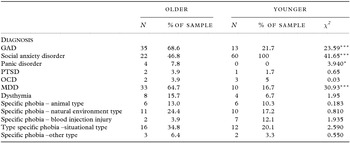
A sample of 60 younger treatment-seeking adults (age range 18–44 years, M = 29.45, SD = 7.40, 50% female) was recruited from the screening phase for a randomized control trial for the treatment of social phobia. All participants met criteria for primary Social Phobia (100%), with most meeting criteria for comorbid disorders (GAD 22%, Specific Phobia 12%, MDD 17%, Dysthymia 7%). Participants met 1.72 disorders on average (SD = 1.08). This sample was mostly single (76%) or married (22%). Diagnostic information for both samples is provided in Table 1.
Prevalence of individual disorders in participants’ diagnostic disorder profile

Note: *p < 0.05, ***p < 0.001; GAD = Generalized Anxiety Disorder; MDD = Major Depressive Disorder; OCD = Obsessive Compulsive Disorder; PTSD = Posttraumatic Stress Disorder.
Measures
Anxiety Disorders Interview Schedule (ADIS-IV; DeNardo et al., Reference DeNardo, Brown and Barlow1994): The ADIS is a semi-structured clinical interview for diagnosing DSM-IV anxiety and related disorders including depression. Interviews were conducted by post-graduate psychology students with specialist training in administering the ADIS who received regular supervision on all diagnostic decisions. The information collected from the ADIS was used in two ways; first, to identify the presence of DSM-IV disorders and to indicate clinical severity of each disorder overall according to a Clinical Severity Rating (0–8) where severity ratings of >3 indicate presence of a disorder. Second, because we were interested in examining differences in symptom profiles, we also compared symptom patterns between age groups within the disorders. The format of the ADIS is that the administrator assesses the presence of each criteria within a disorder, often by obtaining how much the situation causes fear or distress, and avoidance using a 0–8 rating scale. Diagnostic thresholds for each symptoms were considered to be met or present if they were rated >3 by individuals in the relevant severity/distress/avoidance ratings. Differences in symptoms profiles were examined by comparing symptoms across the younger and older groups. For example, worry topics were compared for those with a diagnosis of in GAD, and differences in feared and avoided social situations were compared for those with a Social Phobia diagnosis.
Mental Health Descriptor Words: Two lists of common words used to describe anxiety and depressive symptoms were developed based on symptoms described in the DSM-IV, from existing anxiety and depression rating scales, and from typical free responses older adults use to describe anxiety or low mood during diagnostic interviews in our clinic. The anxiety list included 15 words such as worry, nervous, concerned, and scared, and had an adequate internal consistency (Cronbach's α: total sample = 0.70, younger = 0.69, older = 0.68). The depressive list included 19 words such as sad, flat, and unmotivated, and had an adequate internal consistency (Cronbach's α: total sample = 0.73, younger = 0.78, older = 0.63). Similar to the method used in the study of Letamendi et al. (Reference Letamendi2013), symptoms descriptors were read out by the interviewer and participants were asked to indicate which words they would use to describe their worry or anxiety, followed by sadness or feeling down.
Procedure
Ethics approval for this study was gained from the relevant Institutional Human Ethics Committee. Participants gave informed written consent to participate and completed demographic information, and self-report questionnaires prior to the interview. Older adult participants then completed the cognitive screener for dementia. All participants then completed the ADIS as part of the screening process for entry into the respective treatment trials. At the start of this interview, participants completed the descriptor words task, giving verbal responses to the interviewer.
Results
Demographics
As expected there were significant demographic differences between the cohort of younger and older samples. The older sample was significantly less educated than the younger sample, χ 2 (4) = 29.21, p < 0.001, and were also significantly more likely to be married, χ 2 (5) = 56.3, p < 0.01 (52% vs. 22%) and less likely to be working full time, χ 2 (2) = 13.52, p < 0.005, compared to the younger sample (13% vs. 87%). There were no significant differences between the groups on gender or the proportion of participants born overseas.
Worry content and symptom profiles
First, we examined the differences in mental health symptom profiles reported by older and younger adults on the ADIS to assess whether older adults endorsed different topics of anxiety, or different symptoms to younger adults. Symptom profiles were compared between older and younger participants with a diagnosed Social Phobia (Generalized), GAD, Specific Phobia, MDD or Dysthymic Disorder anywhere in their diagnostic profile.
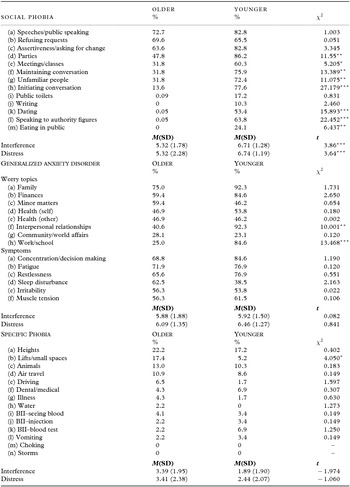
Social Phobia: The most commonly feared situations endorsed by both older and younger adults with Social Phobia were similar, with both age groups endorsing public speaking, being assertive, refusing requests, and attending parties. Younger adults also commonly reported fearing initiating and maintaining conversations and talking to unfamiliar people. Older adults were significantly less likely to report being fearful of attending parties, meetings and classes, initiating and maintaining conversations, talking to unfamiliar people, dating, talking to people in authority and eating in front of others compared to younger adults, with very low rates of endorsement for many of these areas. Older adults also reported significantly less interference and distress as a result of their social anxiety overall. See Table 2.
Symptom profiles for social phobia, generalized anxiety disorder and specific phobia

Note: BII = Blood/Injection/Injury Phobia *p < 0.05, **p < 0.01, ***p < 0.001.
GAD: Older adults diagnosed with GAD most commonly reported being worried about family, finances, and minor matters, whereas younger adults most commonly reported worrying about interpersonal matters, work, finances and family. Older adults were significantly less likely to endorse worrying about work/school and interpersonal matters compared with younger adults. Older and younger adults did not differ significantly on the behavioral symptoms of GAD, or on the severity of interference and distress endorsed. See Table 2.
Specific Phobia: Age differences in Specific Phobias were examined in terms of the presence of a specific phobia, specific situations endorsed, as well as the diagnostic subtypes. Older adults most commonly endorsed specific phobias of heights, lifts/small spaces, animals and air travel, similarly younger adults most commonly endorsed fears of heights, animals, air travel and dental/medical procedures; however, the only significant difference was for a fear of lifts/small spaces with older adults more likely to endorse this phobia. Younger and older adults did not differ significantly on the presence of a phobia (χ 2 (1) = 2.439, p = 0.118), the subtype of phobia endorsed, or on the interference or distress caused. See Tables 1 and 2.
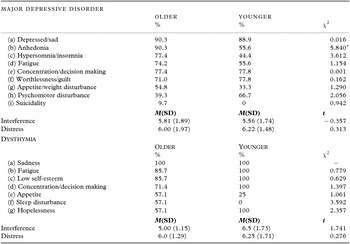
MDD: Older adults with MDD were significantly more likely to endorse anhedonia than were younger adults; however, there was no difference in the endorsement of sad or depressed mood between groups. There were no significant differences between the groups on any other symptoms endorsed for MDD, although sleep disturbance was close to significance with older adults reporting more sleep disturbance (p = 0.057). There were no significant differences between age groups for the interference or distress caused by their mood disorder. See Table 3.
Symptom profiles for mood disorders

*p < 0.05, **p < 0.01, ***p < 0.001.
Dysthymia: There were no differences in the symptom profiles between younger and older adults, although the report that older adults had more sleep disturbance was close to significant (p = 0.058). There was no significant difference in the distress or interference reported between the age groups. See Table 3.
Mental health descriptions
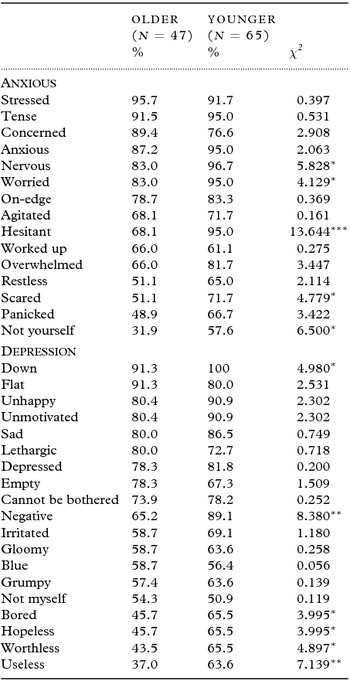
Chi-squared (χ 2) analyses were conducted to compare the frequency of endorsed anxiety and depression descriptor words in the young and old samples. Results for the anxiety and depressive descriptor words are summarized in Table 4. Despite the number of descriptor words provided for both anxiety and depression, there were few significant differences in the frequency that older and younger participants used to describe their symptoms. As shown in Table 4, terms suggestive of cognitive anxiety symptoms (stressed, tense, anxious, nervous, worried) were endorsed more frequently than terms suggestive of somatic anxiety symptoms (scared, panicked, restless, agitated) by both age groups. Older adults most commonly reported using the words stressed, tense, and concerned to describe their anxiety, whereas younger adults most commonly reported using the terms hesitant, anxious, tense, worried, and nervous. Older adults were significantly less likely to use the words nervous, worried, hesitant, scared, and being not yourself.
Frequency of anxiety and mood descriptors in the younger and older sample

*p < 0.05, **p < 0.01, ***p < 0.001.
For depressive symptoms (as shown in Table 4), among both age groups, the word depressed was endorsed less frequently than alternatives such as down, flat, unhappy, unmotivated, and sad. Older adults were most likely to use the words down and flat to describe their mood symptoms, whereas younger adults were most likely to use the words down, unhappy, and unmotivated. Younger adults were significantly more likely to use the words down, negative, bored, worthless, hopeless, and useless than older adults. Interestingly, some of the words that were chosen for their presumed pertinence to later life – “grumpy”, “irritated” – did not differ significantly in rates of endorsement across age groups.
Discussion
The first aim of this study was to assess whether there were age-related differences in the symptom profiles for anxiety and unipolar mood disorders between an older and younger treatment-seeking sample. Starting with Social Phobia, the results indicated that older adults with Social Phobia most commonly reported being fearful of public speaking, being assertive and refusing requests. These findings are similar to what is observed in younger adults and what has been found in previous studies with older adults (Ciliberti et al., Reference Ciliberti, Gould, Smith, Chorney and Edelstein2011). Older adults, however, tended to report experiencing significant anxiety in fewer social situations compared to younger adults, with very few older adults reporting any fear using public toilets, writing or eating in public, dating, or speaking to authority figures. Some of these differences may result from the fact that many older adults encounter fewer or a narrower range of social situations than do younger adults (e.g. not as likely on average, to date, attend meetings, or take classes). Also consistent with previous studies (Gretarsdottir et al., Reference Gretarsdottir, Woodruff-Borden, Meeks and Depp2004; Ciliberti et al., Reference Ciliberti, Gould, Smith, Chorney and Edelstein2011) older adults reported significantly less interference and distress from their social anxiety compared to younger adults. This finding may be related to the narrowing of situations in which anxiety is experienced, hence reducing the distress and interference caused by the disorder. These results confirm previous findings that the presentation of social phobia changes across the lifespan.
In this study, older adults with GAD reported that they worried most about family, finances, and minor matters, and were significantly less likely to report worrying about work/school and interpersonal matters compared to younger adults, consistent with previous findings (Goncalves and Byrne, Reference Goncalves and Byrne2013). These differences in worry topics are likely to reflect differences in the lifestyle circumstances in which fewer older adults are typically working or studying, and may have formed more long-term stable relationships which are, therefore less of a source of interpersonal worry. Interestingly, there were no differences in behavioral symptoms experienced as part of GAD such as restlessness, sleep disturbance, or irritability, and no reported difference in the level of interference or distress caused by the disorder, suggesting that although the topics of worry vary, the experience of excessive worry is similar across the lifespan. It is important to note that previous studies have found that older adults are less likely to report worries as excessive or uncontrollable. In this study, we only examined the profiles of individuals who met full diagnostic criteria for GAD (which includes the criteria that their worries were excessive and uncontrollable) and so we could not test this claim. It is not clear whether older adults who deny that worry is excessive or uncontrollable should be considered subclinical, or if they have a variant of GAD (perhaps more typical in older adults) which causes clinical interference despite this criterion being met, or perhaps they should be considered to have an Anxiety Disorder Otherwise Not Specified disorder in which full criteria of GAD are not met but the worry still causes significant clinical interference. It is important that large scale epidemiological studies examine whether the prevalence of Anxiety and Mood Disorder Not Otherwise Specified disorders (now called Other Specified Anxiety/Mood Disorder in DSM-5) are more frequent in older adults.
The most commonly reported phobia subtypes in both the older and younger adult age groups were situational type and natural environment type phobias replicating previous results (Grenier et al., Reference Grenier2011); however, there were no significant differences in the prevalence of these phobia subtypes between the age groups. Comparing each feared situations assessed in the ADIS Specific Phobia section, both age groups most commonly reported a fear of heights, with a fear of animals also being relatively common, however, there were no overall differences reported for the level of distress or interference caused by the phobia. Interestingly, older adults were significantly more likely to meet criteria for a Specific Phobia of lifts/small spaces. This finding is interesting and needs to be investigated further. It is not clear whether this is a fear that is more likely to develop later in life or be more intractable. Given the physical mobility issues that can present in later life, a lift phobia may be particularly problematic for older adults who are less physically able to use the stairs.
Regarding the mood disorders, older adults were more likely than younger adults to report anhedonia as a symptom of MDD replicating previous results. There was also a trend toward significance for older adults to report more sleep disturbance as a symptom of both MDD and Dysthymia. However, there were no other differences in symptom profiles including for endorsement of feeling sad contrary to previous findings (Gallo et al., Reference Gallo, Anthony and Muthen1994). These differences may be accounted for by the fact that in this study the clinicians administering the ADIS were well trained to query possible depressed mood further rather than relying on a yes/no response to a screening question about sadness per se, but to also consider reports of flatness, not feeling themselves etc. As discussed below, sadness was commonly reported by both younger and older adults, although both age groups preferred to describe their low mood using other descriptors.
The final aim of the study was to assess whether older and younger adults differed in their description of anxiety and depression symptoms. Only one study to date has previously done something similar to investigate differences in Hispanic older adults (Letamendi et al., Reference Letamendi2013). We found that there were significant differences between the words used by older and younger adults to describe anxiety and low mood. Older adults most commonly use the words stressed, tense, and concerned to describe their anxiety symptoms, whereas younger adults most commonly use anxious, worried, tense, hesitant, and nervous. Older adults’ preference for words that are more general, less specific to anxiety and might be seen to be less severe (i.e. tense or stress) and might result in excessive worry or anxiety generally being missed by professionals. It is not known why older adults preferred to use these terms rather than worried, anxious, or nervous, which were more commonly used in our younger sample. It is perhaps a cohort effect with these terms being more popular in this age group, or perhaps the change in terminology reflects a reluctant to admit excessive worry. More research is needed to confirm these findings, but suggest that professionals need to be careful in assessing worry in older adults, and to follow up with any indication of poorer psychological well-being raised by a patient.
Older and younger adults endorsed similar words to describe their depressed mood, with down being the most common descriptor in both age groups (although we found that older adults were significantly less likely to endorse down compared to younger adults, 91.3% vs. 100%). Older adults most frequently described their low mood as feeling down or flat, while younger adults most frequently described their mood as being down, unhappy or unmotivated. Contrary to previous findings that depressed older adults are less likely to report feeling sad (Gallo et al., Reference Gallo, Anthony and Muthen1994), we found no significant differences between the endorsement of the word sad to describe depressed feelings in our younger and older sample, or the endorsement of sad or depressed mood during the ADIS. In addition, we found that younger adults were significantly more likely to endorse the following descriptors for low mood: negative, bored, hopeless, worthless and useless than older adults, with negative being one of the most common terms used by younger adults. Therefore, our results suggest there are some age groups differences in the language used by older and younger adults, and clinicians should assess broadly for depressed mood. Further, given that DSM Criteria A for MDD (DSM-IV and DSM-5) requires the presence of either sadness/depressed mood or loss of pleasure/interest, our findings that older adults are more likely to report anhedonia reinforces the importance of applying the Criteria A either/or rule when making diagnostic decisions about MDD in older adults in particular.
Limitations of this study need to be considered. Although recruited from the same university clinic, one important limitation is that the younger and older adult samples were recruited from treatment trials targeting different disorders. The younger sample all had Social Phobia as their primary disorder and were not required to have a comorbid mood disorder, although 23% did also have a mood disorder, whereas the older adults all had both a mood and anxiety disorder with either category of disorder being primary. Future research would benefit from using a more heterogeneous sample of younger adults for comparison. Due to the small numbers of participants diagnosed with post-traumatic stress disorder, obsessive compulsive disorder, and panic disorder with or without agoraphobia, we could not examine differences in symptom profiles for these disorders, and there is scope for future research to further examine age-related differences in these conditions. Unfortunately, this study did not measure other specific phobias or fears, such as a fear of falling, which are often found to be more prevalent in older adult samples (Wolitzky-Taylor et al., Reference Wolitzky-Taylor, Castriotta, Lenze, Stanley and Craske2010; Mohlman et al., Reference Mohlman2012) thus the topics of worry and fears examined in this study do not represent an exhaustive list. Finally, differences in symptom profiles and worry topics were only examined for individuals who met full criteria for a disorder; therefore, these results may not generalize to individuals with subclinical symptoms.
Based on these findings, clinicians need to be aware that older adults might describe different symptom profiles for anxiety and mood disorders and use language to describe their anxiety and depression symptoms using terms that downplay the severity of the problem, for example using the term concern, stress, or tense to describe worry, or to report anhedonia rather than sadness. Similarly, both younger and older adults prefer to describe their low mood as feeling down, flat, unhappy, and unmotivated, as well as sad, and so clinicians need to take care to assess for low mood rigorously. It is also important to note that some terms are more or less likely to be used in different countries and cultural groups. A good example of this is the term blah, which is used colloquially in the United States of America but is not commonly used in Australia. Therefore, clinicians need to assess symptoms broadly and to follow up with any report or indication of poor psychological well-being or dissatisfaction particularly with older adults.
Conflict of interest
None.
Author's roles
Wuthrich lead the project and contributed to all aspects including contributing to the design, development of the measures, completing the ethics application, collecting the data, analyzing and interpreting the data and writing the manuscript.
Johnco contributed to the design of the project, collecting the data, analyzing and interpreting the data and writing the manuscript.
Wetherell continued to the design of the project, interpretation of the results and writing the manuscript.