Although most children experience a relatively benign transition to adolescence, there are a subset who manifest psychological difficulties and behavioral maladaptations when faced with the transitional challenges that accompany adolescence (Cicchetti & Rogosch, Reference Cicchetti and Rogosch2002). The consequences are particularly deleterious for those children living in adverse conditions and those with greater stressful life experiences (Ge, Lorenz, Conger, Elder, & Simons, Reference Ge, Lorenz, Conger, Elder and Simons1994; Ge, Natsuaki, & Conger, Reference Ge, Natsuaki and Conger2006). Indeed, negative life events have been linked prospectively with increased depressive symptoms in children, adolescents, and adults, even when their initial symptom levels were statistically controlled (Cohen, Burt, & Bjorck, Reference Cohen, Burt and Bjorck1987; Compas, Howell, Phares, Williams, & Giunta, Reference Compas, Howell, Phares, Williams and Giunta1989; Ge, Conger, & Elder, Reference Ge, Conger and Elder2001; Nolen-Hoeksema, Seligman, & Girgus, Reference Nolen-Hoeksema, Seligman and Girgus1992; Pine, Cohen, Johnson, & Brook, Reference Pine, Cohen, Johnson and Brook2002). The convergence across numerous studies in finding the deleterious health effect of negative life events on depression has been remarkable, although modest in its effect size (Kessler, Reference Kessler1997).
Life events, however, are not equally stressful to all people. The effects appear to vary considerably across people with different levels of social support or other available coping resources (Cohen & Wills, Reference Cohen and Wills1985; Compas, Connor-Smith, Saltzman, Thomsen, & Wadsworth, Reference Compas, Connor-Smith, Saltzman, Thomsen and Wadsworth2001; Monroe & Simons, Reference Monroe and Simons1991; Wheaton, Reference Wheaton1983). This theoretical insight has given rise to a stress-buffering prediction that greater social support, perceived or tangible, emotional or instrumental, would attenuate the association between negative life events and risk for development of depression (Cohen & Wills, Reference Cohen and Wills1985; Compas et al., Reference Compas, Connor-Smith, Saltzman, Thomsen and Wadsworth2001; Monroe & Simons, Reference Monroe and Simons1991; Wheaton, Reference Wheaton1983). Specifically, this stress-buffering hypothesis states that, when faced with troubling life events, individuals with greater support from family, friends, or community are less likely to become depressed than those with lower levels of support (House, Landis, & Umberson, Reference House, Landis and Umberson1988). Social support is conceptualized to serve a protective function by promoting adaptive behavior or neuroendocrine responses in the face of stress (Luthar, Cicchetti, & Becker, Reference Luthar, Cicchetti and Becker2000; Masten, Reference Masten2001). This enhanced adaptive efficacy is expected to buffer the potentially long-term deleterious health effects of stress.
Despite the theoretical appeal of the stress-buffering hypothesis, surprisingly few studies have empirically demonstrated its prospective significance, even for data with sufficient power (Burton, Stice, & Seeley, Reference Burton, Stice and Seeley2004). The lack of prospective findings has led some investigators to suggest that the stress-buffering hypothesis should be shelved in favor of other alternative perspectives (Burton et al., Reference Burton, Stice and Seeley2004; Wade & Kendler, Reference Wade and Kendler2000). This suggestion is premature, however, given its theoretical significance and utility in informing preventive intervention (Thompson & Ontai, Reference Thompson and Ontai2000). This study represents another attempt to evaluate the stress-buffering hypothesis by examining its prospective significance with longitudinal data collected among a relatively large sample of adolescent siblings.
One of the possible reasons for the absence of prospective stress-buffering effects in previous studies may involve the way in which social support was operationalized. Social support was originally conceived as an environmental variable, a resource that resides outside the individual (Cassel, Reference Cassel1976; Cobb, Reference Cobb1976). Although perceived availability of support has been linked to physical and mental health, subjective evaluation of social support by self-report does not necessarily correspond to the reports of social support by others (Cutrona, Reference Cutrona1989). There also is considerable interpretive ambiguity when a single informant is used to rate both predictor and criterion, possibly producing spurious associations between them that may be due to response style and/or personality characteristics. This issue of shared methods variance becomes particularly serious when symptoms of depression are the outcome variable under investigation, because depressed individuals are not only more likely to be biased in their evaluation of themselves and others (Beck, Reference Beck1967), but also prone to transacting with their environment in ways that reduce their access to supportive resources. Depressed children and adolescents, in particular, have been found to discount their parents' supportive behaviors and misapprehend their parents' supportive affect (Downey & Walker, Reference Downey and Walker1992; Sanders, Dadds, Johnson, & Cash, Reference Sanders, Dadds, Johnston and Cash1992). Therefore, operationalizing social support by reports other than the recipient's appraisal provides a more objective measure of support and may help to alleviate these concerns (DuBois, Felner, Brand, Adan, & Evans, Reference DuBois, Felner, Brand, Adan and Evans1992; Jackson & Warren, Reference Jackson and Warren2000). In this study, we used parental reports about their closeness to adolescents to circumvent the shared methods variance problem of using single informant.
Rather than a broad construct, social support appears better operationalized in relevant and specific contexts with developmental consideration. For example, secure attachment to caregivers has been shown to buffer an elevation of stress hormones in situations that usually elicit stress in infants (Gunnar, Reference Gunnar and Nelson2000). Whereas spousal support is a more important form of social support for married adults (Conger, Rueter, & Elder, Reference Conger, Rueter and Elder1999), parental warmth and support appear to be more pertinent to school-age children and adolescents (Ge, Conger, Lorenz, & Simons, Reference Ge, Conger, Lorenz and Simons1994; Jackson & Warren, Reference Jackson and Warren2000). In fact, specific properties of family support that may promote resilience to the disruptive effects of adversity have been clearly articulated (see Masten & Schaffer, Reference Masten, Schaffer, Clerk-Stewart and Dunn2006). A close relationship with one or both parents, in particular, has been identified as an important source of support for adolescents (Belle, Reference Belle1989; Collins, Reference Collins1997). Indeed, Sarason, Pierce, and Sarason (Reference Sarason, Pierce, Sarason, Sarason, Sarason and Pierce1990) have drawn parallels between the concept of attachment in childhood and social support in adulthood. Arguing from an interactional view, these authors maintained that a secure relationship with caregivers helps form working models of other people as available, resourceful, and supportive. Such a construal permits a “secure base” for exploration that would enhance coping capacities and resilience.
Consistent with this view, Ge, Lorenz, et al. (Reference Ge, Conger, Lorenz and Simons1994) showed that observed maternal warmth and support moderated the effects of negative life changes on adolescent mental health trajectories. Other researchers also observed that living with warm, caring, communicative, understanding, and supportive parents altered or moderated the negative impact of life stress on adolescents (Gore & Aseltine, Reference Gore and Aseltine1995; Wills & Cleary, Reference Wills and Cleary1996; Wills, Vaccaro, & McNamara, Reference Wills, Vaccaro and McNamara1992). By anchoring the broad concept of social support in specific terms of parental closeness, this study moves one step closer to identifying specific source of social support that have the potential to buffer the adverse effects of life events. In this study, we expected children who have a close relationship with one or both parents during the time of duress to be less likely to manifest symptoms of depression.
The lack of significant prospective findings for stress-buffering effects in early studies may also be due to the way in which life events was indexed. Previous stress research focused on the gross effects of life events by aggregating life events obtained from a checklist into a single measure of life stress (see Dohrenwend & Dohrenwend, Reference Dohrenwend, Dohrenwend, Dohrenwend and Dohrenwend1974). This nonspecific approach, however, may obscure which facets of events are particularly detrimental to individuals (Kessler & Magee, Reference Kessler, Magee, Avison and Gotlib1994). In fact, it has been well demonstrated that different types of stressful life events appear to affect mental health differentially (e.g., Cicchetti & Rogosch, Reference Cicchetti and Rogosch2002; Ge et al., Reference Ge, Natsuaki and Conger2006; Hammen & Mayol, Reference Hammen and Mayol1982; Kessler & McLeod, Reference Kessler and McLeod1984; Nazroo, Edwards, & Brown, Reference Nazroo, Edwards and Brown1997; Paykel, Reference Paykel and Depue1979; Rudolph et al., Reference Rudolph, Hammen, Burge, Lindberg, Herzberg and Daley2000).
A careful examination of the type of life events is particularly important when investigating the links between social support and life events. Cohen and Wills (Reference Cohen and Wills1985) maintained that the buffering effect of social support should be viewed as a function of the match between the specific need engendered by the stressor and the type of social support that is likely to play a role as a moderator, for different aspects of social support appear to be most crucial for buffering different kinds of stressors. In line with this conceptualization, Cutrona and Russell (Reference Cutrona, Russell, Sarason, Sarason and Pierce1990) proposed a theory of “optimal matching,” whereby types of challenge that life events pose are matched with types of social support. Consistent with this line of reasoning, Gore and Aseltine (Reference Gore and Aseltine1995) showed that social support offered from particular members of social network tends to be effective only in matched genres of stressors. For instance, friendship is an effective source of support in peer-related stressors, but not for stressors centered on family issues.
In keeping with this “matching” proposition, we were particularly interested in distinguishing two types of life events, that is, personal and family events. We expected closeness with mothers and fathers to attenuate adverse effects of negative life events experienced by adolescents personally as well as those shared by his/her family, as Gore and Aseltine (Reference Gore and Aseltine1995) have demonstrated that adolescents who felt loved and cared by parents did not show elevated depressed mood when experiencing multiple personal stresses. Their finding was not based on prospective data, however. In this study, we used a prospective design to test the buffering hypothesis by disaggregating personal from family negative life events.
A rigorous test of the stress-buffering hypothesis also requires that attention be paid to the role of genes. Genetic influences on depression have been well documented (McGuffin & Katz, Reference McGuffin and Katz1989). Researchers have shown that life events, presumably occurring at random, were not chance occurrences. Significant genetic influences on exposures to life events, especially controllable events, have been demonstrated (Bolinskey, Neale, Jacobson, Prescott, & Kendler, Reference Bolinskey, Neale, Jacobson, Prescott and Kendler2004; Kendler, Kessler, Neale, Heath, & Eaves, Reference Kendler, Kessler, Neale, Heath and Eaves1993; Plomin, Pedersen, Lichtenstein, McClearn, & Nesselroade, Reference Plomin, Pedersen, Lichtenstein, McClearn and Nesselroade1990; Saudino, Pedersen, Lichtenstein, McClearn, & Plomin, Reference Saudino, Pedersen, Lichtenstein, McClearn and Plomin1997; Thapar & McGuffin, Reference Thapar and McGuffin1996). Similarly, the effects of global social support (Kessler, Heath, Kendler, Neale, & Eaves, Reference Kessler, Heath, Kendler, Neale and Eaves1992) and parent–child relationships (Pike & Plomin, Reference Pike and Plomin1997; Plomin, Reiss, Hetherington, & Howe, Reference Plomin, Reiss, Hetherington and Howe1994) on adjustment outcomes were partially traced to genetic influences. Because of such findings, the precision of inferences for the effects of negative life events and buffering effects of support would be substantially enhanced with a genetically informed design. This, unfortunately, has not been the case in previous studies because many genetically informed studies have not directly measured life events and social support. Data collected by the NEAD project, with directly measured life events and family process variables in a genetically sensitive design, provides a rare opportunity to rigorously test the buffering hypothesis. The central goal of this report, therefore, was to examine the buffering hypothesis whereby parental closeness moderates the longitudinal impact of negative life events on depressive symptoms using a sample of adolescent siblings from a genetically informed study.
Analytical Plan
To test a prospective stress-buffering effect using a sibling sample, we employed a multilevel modeling approach developed by Guo and Wang (Reference Guo and Wang2002). This modeling strategy has several obvious advantages: First, siblings are nested in a family and are, thus, not independent observations. Multilevel model effectively handles nested data by treating individuals and families as Level 1 and Level 2 units, respectively. By doing so, this procedure models buffering effects while estimating within-pair sibling, or intraclass correlations (ICC), accounting for clustering of data in estimating standard errors of the regression coefficients (Raudenbush & Bryk, Reference Raudenbush and Bryk2002). Second, siblings vary systematically in their genetic relatedness, ranging from monozygotic (MZ) twins who share 100% of their genes to siblings in a reconstituted family who share no genetic relatedness. When applied to a genetically informative design, this modeling approach allows estimation of varying ICCs by genetic relatedness of siblings. Third, using multilevel analyses in sibling studies significantly increases one's analytical power (Krull, Reference Krull2007).
In this study, we applied a multilevel model in the following form (see Guo & Wang, Reference Guo and Wang2002, for more detailed explanations):

where Y ij is the outcome variable, depressive symptoms at Time 2 (T2), for individual i in sibling pair j; β0 is the intercept; and β1x 1ij through βpx pij are the fixed effect of depressive symptoms at Time 1 (T1), stressful life events and closeness with parents at T1, and gender and age of the child. In this model, u j is the pair-specific random effect, and e ij is the individual-specific random effect. To take different types of siblings into consideration, we denoted (t), where t = m, d, f i, f d, h, and c, to represent MZ twins, dizygotic (DZ) twins, full sibling in nondivorced families, full siblings, half siblings, and genetically unrelated siblings in stepfamilies, respectively. The ICCs were obtained from ρ = σ2u(t)/(σ2u(t) + σ2e(t)) by different sibling types.
In the following analyses, we first present descriptive statistics and simple bivariate correlations. We then report ICCs by types of sibling pairs. Finally, we present results based on the abovementioned multilevel model to evaluate the stress-buffering hypothesis by examining the conditional effects of the stress and closeness to parents. Although some cross-sectional studies have found gender differences in stress-moderation function of social support (e.g., Jackson & Warren, Reference Jackson and Warren2000), more recent large-scale longitudinal study showed substantial similarities between the sexes (Meadows, Reference Meadows2007; see also Umberson, Chen, House, Hopkins, & Slaten, Reference Umberson, Chen, House, Hopkins and Slaten1996). We thus analyzed males and females together also for the consideration of statistical power.
Method
Sample and procedures
The present investigation is based on the NEAD Project. NEAD is a longitudinal study that initially assessed 720 same-gender twin and sibling pairs from a nationwide sample of two-parent families, including both nondivorced and stepfamilies, with a pair of adolescent siblings no more than 4 years apart in age (Reiss, Neiderhiser, Hetherington, & Plomin, Reference Reiss, Neiderhiser, Hetherington and Plomin2000). The parents of children in stepfamilies had to be married at least 5 years before data collection to ensure that none of the families were in the unstable early phases of family formation. The nondivorced families with full siblings were recruited through random digit dialing (RDD) of 10,000 telephone numbers throughout the United States. Except for a small subsample of the other types of siblings who were also recruited through the RDD procedures, most of the other types of siblings were recruited through a national market survey of 675,000 households. The 720 families were primarily middle class (average family income range = $25,000–$35,000/year, 12% earned <$20,000/year, and 32% earned >$50,000/year). The upward skew in the distribution of family income is likely because of sampling of two-parent households. Ninety-four percent of the mothers and 93% of the fathers were Caucasian, with average years of education of 13.6 and 14.0, respectively.
The NEAD sample consisted of six types of siblings: MZ twins, DZ twins, full siblings living in nondivorced families, full siblings, half siblings, and genetically unrelated siblings in stepfamilies. The zygosity of the twins was rated in terms of physical similarity (e.g., eye and hair color) by the interviewers and parents as well as by self-reports with a modified version of a zygosity questionnaire for adolescents (Nichols & Bilbro, Reference Nichols and Bilbro1966). The accuracy rate for this zygosity assigning method has been shown to be more than 90% accurate when compared to DNA tests (Nichols & Bilbro, Reference Nichols and Bilbro1966; Spitz, Moutier, Reed, Busnel, & Marchaland, Reference Spitz, Moutier, Reed, Busnel and Marchaland1996). If any differences in physical characteristics of the twins were identified, or if people were never confused about the twin's identity, the twin pair was classified as DZ. Twelve twin pairs were excluded from the following analyses because they could not be classified as either MZ or DZ with certainty.
During the T1 assessment, the sample consisted of 708 sibling pairs, including 93 MZ twin pairs (47 brother–brother pairs, 46 sister–sister pairs), 99 DZ twin pairs (50 brother–brother pairs, 49 sister–sister pairs), 95 full siblings living in nondivorced families (48 brother–brother pairs, 47 sister–sister pairs), 182 full siblings living in stepfamilies (86 brother–brother pairs, 96 sister–sister pairs), 109 half siblings in stepfamilies (60 brother–brother pairs, 49 sister–sister pairs), and 130 genetically unrelated siblings living in stepfamilies (74 brother–brother pairs, 56 sister–sister pairs). The follow-up study (T2) was conducted 3 years later. To be eligible for the follow-up, the participating families were required to fulfill two criteria: (a) the parents lived together, and (b) the two siblings also had to be resident in the household at least half of the time. These sampling criteria ensured that family interactions and activities measured at T2 addressed family environment within the household. Forty-two families were eliminated because of parental divorce, 3 to the death of a parent, and 243 to at least one of the children leaving home. The majority (94%) of eligible families agreed to participate. The sample size at T2 was 395 sibling pairs.
This study was based on data from siblings who participated in both waves of data collection and who provided the complete information regarding depressive symptoms at T2. These selection criteria resulted in 756 individuals from 378 sibling pairs (190 brother–brother pairs, 188 sister–sister pairs) in the analytical data set. The number of sibling pairs by type of siblings is as follows: 60 MZ twin pairs (26 brother–brother pairs, 34 sister–sister pairs), 71 DZ twin pairs (35 brother–brother pairs, 36 sister–sister pairs), 56 full sibling pairs living in nondivorced families (30 brother–brother pairs, 26 sister–sister pairs), 91 full sibling pairs in stepfamilies (44 brother–brother pairs, 47 sister–sister pairs), 56 stepsibling pairs (33 brother–brother pairs, 23 sister–sister pairs), and 44 genetically unrelated sibling pairs in reconstituted families (22 brother–brother pairs, 22 sister–sister pairs). The average ages at T1 and T2 were 13.55 (SD = 1.99) and 16.15 (SD = 2.09) for Sibling 1, and 12.08 (SD = 1.90) and 14.68 (SD = 1.86) for Sibling 2.
There were no mean differences between those families that participated in T2 and those families that did not in terms of socioeconomic status, income, parental education, marital duration, and gender of the siblings. However, at T1, children from families that dropped out by T2 had slightly higher depressive symptoms, lower parent–child closeness, and higher levels of personal and family life events than children who participated in both waves. It is important for readers to keep in mind this sampling bias upon the interpretation of the present results.
Measures
Depressive symptoms
At the T2 data collection, each sibling responded to the Child Depression Inventory (CDI; Kovacs, Reference Kovacs1985), which consisted of 27 items pertaining to various signs of depression within the past 2 weeks. Mothers and fathers also completed a comparable version of the CDI for each child. The range of reliabilities across waves and reporters was between .72 and 87. Consistent with previous reports (Achenbach, Mcconaughy, & Howell, Reference Achenbach, Mcconaughy and Howell1987), the correlations across three raters (i.e., child, mother, and father) ranged from .28 to .53. To capture a broader spectrum of depressive symptoms, we combined child, mother, and father reports of depressive symptoms at T2 to create a composite of depressive symptoms at T2. Aggregation of multiple reporters' ratings has been encouraged in previous studies based on NEAD (for more details, see Reiss et al., Reference Reiss, Neiderhiser, Hetherington and Plomin2000).
Given that depression is relatively stable over time, concurrent associations between social support and depressive symptoms at T1 may cause a spurious link between social support at T1 and depressive symptoms at T2. We included self-report CDI at T1 in the model to statistically control for preexisting levels of depressive symptoms in the prediction of subsequent symptoms.
Parent–child closeness
At the T1 data collection, mothers and fathers independently responded to a subscale of Parent–Child Relationship Scale (Hetherington & Clingempeel, Reference Hetherington and Clingempeel1992) to indicate their levels of closeness with each of their children. The sample items include “how close are you to your child?,” “how loving are you to your child?,” “how much does your child understand you?,” and “how much do your child enjoy spending time alone with you?” Parents recorded their response by using a 5-point Likert scale, ranging from 1 = not at all to 5 = very much. Higher scores indicate higher levels of parent–child closeness. Internal consistencies of this scale averaged .88. This measure has been utilized in previous studies using NEAD (Plomin et al., Reference Plomin, Reiss, Hetherington and Howe1994; Reiss et al., Reference Reiss, Neiderhiser, Hetherington and Plomin2000).
Stressful life events
At T1, each sibling was asked to indicate whether he or she had encountered any of the 91 listed stressful life events in the past 12 months. Of 91 listed events, 34 were related to stressful life events that happened to a family (e.g., a family member was a victim of crime, a family member moved away from home, a family member died) and 40 were pertained to personal events that have occurred to the respondent him/herself (e.g., did much worse in school than expected, had problems with drugs, quit or lost a job, got into trouble with the law). The correlation between family and personal events was .68 (see Table 1), suggesting that inclusion of both measures in one equation could potentially cause multicollinearity problems. In the following analyses, we examined these categories of events separately unless noted.
Means, standard deviations, and bivariate correlations among the study variables

Note: N = 756 (378 sibling pairs). a0 = boys, 1 = girls. *p < .05. **p < .01.
Results
Descriptive statistics
The means, standard deviations, and bivariate correlations of the study variables are presented in Table 1. The coefficients presented in Table 1 are based on a sample that pooled both siblings together. The results showed that all the correlations were in the expected directions. Specifically, depressive symptoms were moderately stable over the 3-year interval between data collections (r = .44, p < .01). Life events, both personal and family events, were concurrently associated with depressive symptoms (rs = .21 and .13, p < .01, respectively). However, only personal life events, not family events, were significantly associated with T2 depressive symptoms (r = .16, p < .01). As expected, there were negative associations between maternal closeness and depressive symptoms at T1 (r = −.09. p < .01) and T2 (r = −.19, p < .01). A similar pattern was found for paternal closeness (rs = −.10 and −.17, p < .01, for T1 and T2 depressive symptoms, respectively). As with other studies (e.g., Ge, Lorenz, et al., Reference Ge, Lorenz, Conger, Elder and Simons1994), girls had higher depressive symptoms at both waves than boys (rs = .09 and .10, p < .01).
Multilevel modeling analyses
Within-sibling ICCs
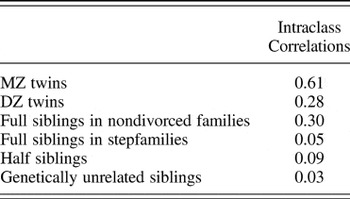
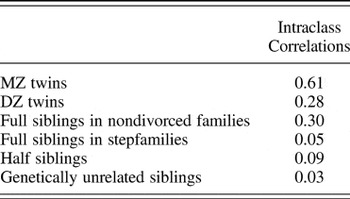
When all types of sibling were pooled for analysis, the zero-order correlation between sibling pairs' depressive symptoms at T2 was 0.20 (p < .01). However, the magnitude of such within-sibling-pair correlation is likely to vary depending on genetic relatedness of sibling pairs (i.e., MZ twins, DZ twins, full siblings in intact and divorced families, half siblings, and unrelated siblings). Table 2 provides ICCs between siblings for depressive symptoms at T2 by sibling type. These estimates were calculated from random effects in the unconditional model where depressive symptoms at T2 were the dependent variable. An important feature of this unconditional model was that we allowed variance components to vary by genetic relatedness of siblings. That is, each type of siblings was allowed to have different variance components. As expected, the coefficient estimates indicated that the strength of ICCs varied systematically by genetic relatedness, with the highest magnitude of coefficient for MZ twins who share 100% of genetic make-up.Footnote 1 These results suggest that it is important to take into account varying between-cluster variance by genetic relatedness. We thus proceeded with multilevel modeling analyses that allowed estimating varying variance components for siblings with different degree of genetic relatedness.
Within-sibling intraclass correlations for depressive symptoms at Time 2
Testing the stress-buffering hypothesis
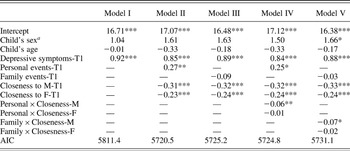
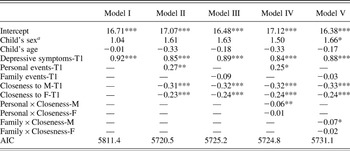
We performed a series of multilevel modeling analyses with SAS PROC MIXED to test the effects of stressful life events and parental closeness. The results for the fixed effects from multilevel modeling are summarized in Table 3. Age was centered at 9 years, the youngest age in the current sample. Other predictors were centered at their means to simplify the interpretation of the intercepts. The models presented in Table 3 were designed to examine whether stressful life events and closeness with parents exerted a prospective impact on adolescent depressive symptoms, after controlling for variations in initial levels of depressive symptoms (T1), gender, and age. Model 1 can be viewed as a baseline model where gender, age, and T1 depressive symptoms are the predictors. As expected, we found significant continuity in depressive symptoms, as T1 depressive symptoms exerted substantial influence on the variation of depressive symptoms at T2 (β = .92, p < .001). There were no significant gender and age differences in depressive symptoms at T2 after controlling for initial depressive symptoms (T1).
Main and moderating effects of personal and family life events and parent–child closeness on depressive symptoms at Time 2
Note: M, mother. F, father. Age is centered at 9 years old. All predictors are centered at their means, unless noted.
a0 = boys, 1 = girls.
*p < .05. **p < .01. ***p < .001.
As mentioned earlier, we separately estimated the effects of personal and family events to avoid multicollinearity problems. Models 2 and 3 examined the main effects of personal and family events, and closeness with parents. As shown in Model 2, the increase in the number of personal life events at T1 significantly increased depressive symptoms at T2 (β = .27, p < .01), after initial levels of depressive symptoms were held constant. There were also significant main effects of closeness with mothers and fathers, both of which operated to reduce the level of depressive symptoms at T2 (βs = −.31 and −.23, p < .001 for closeness with mothers and fathers, respectively). The results of Model 3 indicated family events did not show any significant prospective effects on depressive symptoms after accounting for depressive symptoms at T1, age, and gender of the child. However, closeness with mothers and fathers at T1 were again significantly associated with depressive symptoms at Time 2 (βs = −.32 and −.24, p < .001, for closeness with mothers and fathers, respectively).
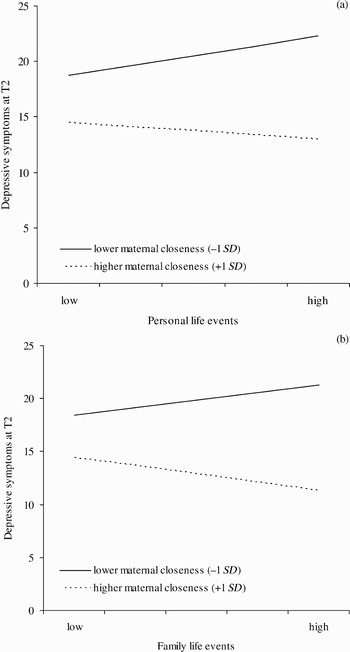
Models 4 and 5 tested the stress-buffering hypothesis for personal and family life events, respectively. The results in Model 4 indicated that there was a modest, yet significant statistical interaction between personal life events and maternal closeness (β = −.06, p < .01), suggesting that greater degree of closeness with mothers significantly reduced the adverse effect of experiencing personal life events on depressive symptoms at T2. The interaction is graphically presented in Figure 1a where the two lines representing higher (1 SD above the sample mean) and lower maternal closeness (1 SD below the sample mean). Children who were less close to their mothers responded more negatively to personal life events than children with higher levels of closeness with their mothers. Unlike what we observed for maternal closeness, closeness with fathers did not emerge as a significant moderator of the prospective link between personal events and depressive symptoms.
The longitudinal effects of (a) personal and (b) family life events on depressive symptoms, moderated by mother–child closeness. These slopes were calculated based on main and interaction effects of life events and mother–child closeness, controlled for baseline depressive symptoms at T1, child's age, and gender.

A similar pattern of results emerged for family life events. Despite the fact that family life events did not show significant main effect on subsequent depressive symptoms, we found a significant statistical interaction between family life events and closeness with mothers (β = −.07, p < .05, in Model 5). This finding suggests that close relationship with mother reduced the adverse effect of family stressful life events on subsequent depressive symptoms. We depicted this statistical interaction in Figure 1b. As shown in the figure, family life events did not exert strong prospective effects on depressive symptoms among children who felt higher levels of closeness with their mothers. In contrast, children with lower mother–child closeness reacted negatively to family life events. Again, closeness with father did not emerge as a significant moderator.
Discussion
Mental health trajectories are highly influenced by the dynamic interplay between risk-producing environment, individual vulnerability to adversity and stressors, and an individual's social resources at particular developmental stage (Cassel, Reference Cassel1976; Compas et al., Reference Compas, Connor-Smith, Saltzman, Thomsen and Wadsworth2001; Kaufman et al., Reference Kaufman, Yang, Douglas-Palumberi, Houshyar, Lipschitz and Krystal2004; Monroe & Simons, Reference Monroe and Simons1991). Adolescence represents a particularly vulnerable phase of development. This developmental period is marked by rapid physical growth, psychological changes, and social transitions. With their expanding roles into a more complex social world that exposes them to an increasing number of life stressors, there is a pressing need to protect growing adolescents against the adverse effects of life stressors. Intervention-oriented researchers have long been interested in whether positive resources, such as social support, aid this group in navigating stressful life transition (Cassel, Reference Cassel1976; Cobb, Reference Cobb1976). These interests led to the formulation of the stress-buffering hypothesis that social support serves a protective role during times of stress through an enhancement of adaptive coping behavior (Cohen & Wills, Reference Cohen and Wills1985). Previous tests for the stress-buffering hypothesis, however, largely failed to detect its prospective significance of social support in moderating the adverse stress effect (Burton et al., Reference Burton, Stice and Seeley2004; Wade & Kendler, Reference Wade and Kendler2000). The present study represented another attempt to examine this theoretically important hypothesis by addressing a number of issues that remain unresolved in the investigation of stress-buffering role of social support.
Consistent with previous research (Ge et al., Reference Ge, Natsuaki and Conger2006; Ge, Lorenz, et al., Reference Ge, Lorenz, Conger, Elder and Simons1994; Lewinsohn, Allen, Seeley, & Gotlib, Reference Lewinsohn, Allen, Seeley and Gotlib1999), we found that negative life events occurring in both personal and family domains were significantly associated with increased symptoms of depression among adolescents. This finding, again, confirms the postulation that it is the cumulative adverse effect of multiple life events that putatively place adolescents at increased risk for the development of depression (Kessler, Reference Kessler1997). The finding of the significant prospective effect of life events, particularly those occurring in the personal domain, is of great importance, given that the statistical significance remained after initial levels of depressive symptoms were statistically controlled. The similar prospective effects of major life events were reported by DuBois et al. (Reference DuBois, Felner, Brand, Adan and Evans1992), who employed the same analytical strategy. This prospective finding provides further evidence for the etiological significance of stressors (Grant et al., Reference Grant, Compas, Stuhlmacher, Thurm, McMahon and Halpert2003; Kessler, Reference Kessler1997).
We found that closeness with both mothers and fathers were significantly and prospectively associated with reduced levels of depressive symptoms. The finding of a significant prospective main effect suggests that closeness to parents, as a form of social support, not only serves a protective or buffering function against the adverse effect of stressful life events, but also directly enhances adolescent mental health both in the presence and absence of stress. The result converges with previous studies that indicate that parent–child relationships characterized by the absence of warmth and supportiveness and by high levels of hostility and conflict are associated with both subdiagnostic depressive symptomatology and diagnosable depressive disorder (Ge, Conger, et al., Reference Ge, Lorenz, Conger, Elder and Simons1994; Ge, Lorenz, et al., Reference Ge, Lorenz, Conger, Elder and Simons1994; Sheeber, Davis, Leve, Hops, & Tildesley, Reference Sheeber, Davis, Leve, Hops and Tildesley2007). The finding of main effects has significant practical implications: intervention aimed at enhancing parent–child relationship quality would directly reduce subsequent depressive symptoms, even in the absence of stressors. The divergence between our results and that of Burton et al. (Reference Burton, Stice and Seeley2004), who did not find a significant prospective main effect for parental social support might be due to differences in measures: whereas adolescent-perceived social support was used by Burton et al. (Reference Burton, Stice and Seeley2004), this study employed parent-reported closeness. Nonetheless, the present study is fairly consistent with Stice, Ragan, and Randall (Reference Stice, Ragan and Randall2004), Wills and Cleary (Reference Wills and Cleary1996), and Windle (Reference Windle1992), who showed that parental support is a significant prospective influence on adolescent maladjustment.
Of greatest importance to the present study and consistent with the stress-buffering hypothesis were the significant interactions between maternal closeness and both personal and family life events in predicting subsequent depressive symptoms. In support of the stress-buffering hypothesis, closeness with mothers emerged as a significant moderator that served to reduce the adverse effects of both personal and family negative life events. Consistent with previous study on depressive symptoms (Ge, Lorenz, et al., Reference Ge, Lorenz, Conger, Elder and Simons1994), the current results highlight the central role played by mother–adolescent relationships in combating stress effects in different domains of adolescent lives. Finding of buffering effect implies that interventions aimed at enhancing mother–child relationship would help reduce the effects of stressors.
The finding of a significant buffering role of mother–child closeness is consistent with the current emphasis on the importance of relationships in adolescent development (Collins, Reference Collins1997). The results from the present investigation suggest the importance of protective environment in moderating the effect of risk, as individuals vulnerable to stressors tended sustain higher risks of compromised mental health under stressful and pathogenic conditions, but relatively low risk within supportive and protective environment. The support for the stress-buffering hypothesis also provides a glimpse into the picture how supportive relationships with mothers serve to promote positive adaptation during or following exposure to stressors or adversity. Masten and Schafer (2006) have documented various ways in which family environment may have beneficial effects on mental health in the context of stressful life experiences. The challenge for future work will be to clarify specific mechanisms whereby closeness with mothers helps promote resilience and coping skills to prepare children to combat life stressors.
Although closeness with father had a significant main effect on subsequent depressive symptoms, it did not moderate the effect of life stressors. The lack of significant findings for a moderating role of paternal closeness suggests that closeness with mothers may have had greater salience in moderating the stress effects. Although the result is consistent with a number of previous studies suggesting the greater salience of maternal warmth and support (e.g., Ge, Lorenz, et al., Reference Ge, Lorenz, Conger, Elder and Simons1994), exactly why mothers take such a greater pertinence in this stage of life is not entirely clear. One possible explanation is that compared to fathers, mothers have more acute awareness of adolescent's changes and experiences (Collins & Russell, Reference Collins and Russell1991). Such responsiveness and attention, which fathers may lag behind, may be particularly helpful for adolescents during stressful times. Further investigations are certainly of need to understand the mechanisms of differences in mother–child and father–child relationships.
It is important to emphasize that this study examined the stress-buffering hypothesis by using a methodologically stronger design: first, the use of genetically informative data allowed us to estimate ICCs between sibling pairs with varying degree of genetic relatedness, as all the study constructs have previously been shown to have certain degrees of genetic loading (Kendler et al., Reference Kendler, Kessler, Neale, Heath and Eaves1993; Kessler et al., Reference Kessler, Heath, Kendler, Neale and Eaves1992). By carefully modeling the genetic relatedness between the siblings and nestedness of family composition (i.e., children are nested within the same parents), this study shows the utility of genetically informative designs to answer the questions of environmental influences (e.g., social support).
Second, by using parent-reported closeness as an independent variable and depressive symptoms based on reports from multiple informants as a dependent variable, this study avoided, at least in part, shared methods variance problems. Use of parental reports of closeness is particularly important in this regard, as depressed people tend to be biased in their evaluation of others (Beck, Reference Beck1967) and are prone to eschewing available supports (Downey & Walker, Reference Downey and Walker1992; Sanders et al., Reference Sanders, Dadds, Johnston and Cash1992). Third, the longitudinal nature of the sample allows this study to control for initial symptom levels in estimating the prospective significance of stress-buffering hypothesis. Although no longitudinal design adequately evinces causal mechanisms, it, at least, clarifies the temporal sequence among the variables and avoids potential confounds. These methodological strengths boosted our confidence in the robustness of the results reported here.
Operationalizing social support in terms of parent–child closeness raised an important issue regarding the conditions under which we may be most able to detect buffering effects. One reason for finding significant prospective stress-buffering effects in this study is that we examined this hypothesis in a more developmentally relevant and specific context. Traditionally, investigators of the stress-buffering hypothesis focused on either structure or function of social support. A structural approach emphasized aspects such as social network size, network members (family members, confidants, spouse, or sources of conflict), whereas a functional approach tended to concern with aspects that are beneficial to individuals in stressful situations, such as relationship characteristics, opportunity for nurturance, or reassurance of worth (Cutrona & Russell, Reference Cutrona, Russell, Sarason, Sarason and Pierce1990; Weiss, Reference Weiss and Rubin1974). This study attended to both structural and functional aspects by focusing on maternal and paternal closeness to adolescents. We chose to focus on closeness to parents because of (a) the demonstrated significance of relationship contexts in insulating individuals from deleterious health effects (Collins, Reference Collins1997; House et al., Reference House, Landis and Umberson1988), (b) the importance of parents as source of support to growing individuals at this developmental stage (Ge, Lorenz, et al., Reference Ge, Lorenz, Conger, Elder and Simons1994; Gore & Aseltine, Reference Gore and Aseltine1995), and (c) the emotional, as opposed to material, nature of parental closeness that is expected to have relatively long-term significance to developing adolescents.
Several limitations of this study need to be noted. First, as with all studies, results may not be generalized beyond the population represented by the present sample, which was largely White, working-, and middle-class. In addition, although the NEAD Project was designed to encompass diversity of family structures (including step families), it included neither single-parent families nor families with siblings of opposite gender. With increased complexity in family structures and diversified ethnic/cultural backgrounds in contemporary society, it is necessary to follow up the present findings with other racial and cultural groups and family structures with heterogeneous socioeconomic characteristics. Second, the measure of social support used in this study tapped essentially onto emotional support. However, given that parents' social support can be complex, a measure that assesses emotional as well as tangible support is recommended in future efforts in replicating our results. Third, maternal and paternal closeness in this study was based on perceptions of parents, rather than observable behaviors. Having direct observational data on relationship characteristics between parents and adolescents, independently rated by coders, would have provided a more independent and dynamic perspective on this phenomenon. Fourth, by the design of the study, only about 56% of the original sample participated in the longitudinal study (T2). Increase in sample size would have increased the analytical power significantly. Fifth, although the prospective effects of the interaction between life events and maternal closeness were statistically significant, the magnitude of coefficients was small. This limitation is important when translating the present results to a prevention/intervention framework. It should be emphasized, however, that because of complexity in human behaviors and emotions, effects size are necessarily small in outcomes with multiple determinants (Ahadi & Diener, Reference Ahadi and Diener1989). Sixth and finally, the current investigation is based on only two waves of data. More detailed analysis of changes in depressive symptoms over time, such as curvilinear changes in developmental trajectories with respect to age and long-term effects of stress and social support requires additional follow-ups.
Despite of these aforementioned limitations, this study provides fairly solid data for demonstrating that adolescent depression is most likely to occur in family contexts characterized by deficits in parental provision of support and frequent encounter to family and personal stressful life events. The study also offers robust data for identifying maternal closeness as playing a significant role in buffering adverse effect of stressful life events on adolescents. The finding that this family process variable helps adolescents overcome adversity suggests that fostering parental, particularly maternal, social support is an important venue for preventive intervention for adolescent depression (Thompson & Ontai, Reference Thompson and Ontai2000), especially among adolescents whose lives are frequently exposed to stressful life events.