INTRODUCTION
Since the 1970s, community-based natural resource management (CBNRM) has become a formal approach in biodiversity conservation (Dearden et al. Reference Dearden, Bennett and Johnston2005). This has sought to compensate for the classical conservation model based on the exclusion of local communities in the designation, governance and management of natural protected areas (PAs) (Adams & Hutton Reference Adams and Hutton2007). The exclusion of humans and their activities, through clear demarcation of designated no-go areas and strict land and resource use regulations, has for some time been regarded as legitimate in the face of the tremendous assaults on natural ecosystems. (The Nature Conservancy 1995; Brandon et al. Reference Brandon, Redford and Sanderson1998; Salafsky & Wollenberg Reference Salafsky and Wollenberg2000; Bruner et al. Reference Bruner, Gullison, Rice and da Fonseca2001; Reid et al. Reference Reid, Mooney, Cropper, Capistrano, Carpenter, Chopra, Dasgupta, Dietz, Kumar Duraiappah, Kasperson, Leemans, May, McMichael, Pingali, Samper, Scholes, Watson, Zakri, Shidong, Ash, Bennett, Kumar, Lee, Raudsepp-Hearne, Simons, Thonell and Zurez2005; UNESCO 2008).
Around 13% of the Earth's land area is under some form of protection, at least on paper (Dugelby & Libby Reference Dugelby, Libby, Brandon, Redford and Sanderson2003; Fischer Reference Fischer2008). In many cases the classical top-down exclusive conservation management model has been locally challenged and resisted, thereby strongly reducing its success (Holmes Reference Holmes2007). Factors in conservation failure are multi-fold and include the complex interplay of ecological processes, which cannot fully operate in restricted areas (Bengtsson et al. Reference Bengtsson, Angelstam, Elmqvist, Emanuelsson, Folke, Ihse, Moberg and Nystrom2003), the discontinuity of cultural practices, which contributed to preserve biodiversity (Nabhan Reference Nabhan1997; Schultz et al. Reference Schultz, Folke and Olsson2007), the spatial transfer and intensification of ecosystem degradation outside PAs (DeFries et al. Reference DeFries, Hansen, Newton and Hansen2005), or governance and management failures related to top-down externally driven excluding conservation regimes (Gbadegesin & Ayileka Reference Gbadegesin and Ayileka2000; Wilshusen et al. Reference Wilshusen, Brechin, Fortwangler and West2002; Adams & Hutton Reference Adams and Hutton2007; Holmes Reference Holmes2007).
Against this backdrop, CBNRM seeks to embrace notions of sustainable development and community participation (Sanderson & Bird Reference Sanderson, Bird, Brandon, Redford and Sanderson1998), based on the premises that it promotes democratic decision-making, increases the legitimacy of conservation actors and facilitates knowledge sharing and exchange (Stoll-Kleemann & O'Riordan Reference Stoll-Kleemann and O'Riordan2002). Active community engagement has become viewed as a multipurpose panacea, which is thought to, among other things, foster local ownership and common purpose, enhance PA acceptance, and facilitate the emergence of cooperative, adaptive, accountable and consensual conservation management (Fabricius & Koch Reference Fabricius and Koch2004; White et al. Reference White, Fischer, Hansen, Varjopuro, Young and Adamescu2005). As such, community-based participation can be performed to pursue different overall goals, for instance participation for its own sake, to improve conservation results or to foster local (sustainable) development. It is important to realize that there might be substantial overlap between these goals, for example to facilitate a transfer of decision-making power. There may also be important discrepancies; for example the goal of fostering local empowerment or development might not necessarily be compatible with sustainable natural resource use (which may include fairness and justice aspects of local livelihoods for primarily conservation rather than social ends, or have strict conservation requirements which may not always be compatible with biodiversity primacy) (O'Riordan Reference O'Riordan, O'Riordan and Stoll-Kleemann2002; Berghöfer & Berghöfer Reference Berghöfer, Berghöfer, Stoll-Kleemann and Welp2006).
Yet effective community participation is by no means easy to define or to achieve. In this paper, we allow the managers themselves to define and explain the processes involved. Nevertheless most BR managers are confronted with tremendous difficulties to effective implementation in a context of chronic lack of financial, technical and human resources, critical power asymmetries between conservation institutions and local actors, or structural obstacles such as poverty, corruption or weak governance. Thus, despite the promises of participatory conservation, the decline in biodiversity within officially designated areas remains rife (Wilshusen et al. Reference Wilshusen, Brechin, Fortwangler and West2002), illustrated by the recent explosion in violence in the Mananara-Nord Biosphere Reserve in Madagascar (Butler Reference Butler2009).
Uphoff (Reference Uphoff1998) argued that CBNRM should be the starting point from the micro level where resource use and management occurs, to address wider conservation issues, such as species extinction and the biophysical and societal drivers for it. Here, communities work in partnership with conservation institutions and are not necessarily the main decision-makers. We therefore envisage CBNRM as an overall framework for strategies that seek to reconcile local development with global conservation goals, hence the underlying philosophy of UNESCO Biosphere Reserves (BRs). The notion of ‘community participation’ is central to the concept of the BR. It prescribes whether local actors affected by the creation and management of the PA may participate in its management, on which terms and to what extent (Delli Priscoli Reference Delli Priscoli, Solberg and Miina1997; Pretty Reference Pretty1995, Reference Pretty2003; Stoll-Kleemann & Welp Reference Stoll-Kleemann and Welp2008).
We here evaluate the rationale behind ‘community participation’ as a means to achieve the wider goals of community-based conservation in a UNESCO BR. Through the analysis of data from two parallel surveys, in total involving managers of 276 BRs worldwide, we aimed to investigate (1) respondents’ perceptions on the relevance of participation in management activities, (2) the extent of community participation in decision-making and implementation, and (3) self-assessment of management effectiveness in achieving the BR goals of biodiversity conservation and sustainable development. We first introduce the BR concept and its approaches to community participation, and then present the two global surveys, their rationale and methodology. Selected results are described, and the empirical results of the two surveys are discussed in terms of the motivations of BR managers to support community participation and the extent to which community participation in BR management may serve the wider goals of CBNRM. We conclude that there remains a profound ambiguity over the linkage between notions of sustainable development and active community participation through effective management procedures.
UNESCO BIOSPHERE RESERVES AS A LEARNING LABORATORY FOR COMMUNITY-BASED NATURAL RESOURCE MANAGEMENT
According to Batisse (Reference Batisse1993, p. 3), UNESCO's Man and the Biosphere (MaB) programme was ‘the first deliberate international effort to identify ways and means of sustainable development of terrestrial ecosystems’. One of its major achievements was the BR concept, born in the early 1970s. BRs have three equally important aims, namely (1) conservation (contributing to conservation of landscapes, ecosystems, species and genetic variation); (2) sustainable development; and (3) logistic support for research and education. The achievement of these ambitious goals is based on a zonation system, which hierarchies and restricts land and resource use (Stoll-Kleemann & Job Reference Stoll-Kleemann and Job2008). Ishwaran et al. (Reference Ishwaran, Persic and Hoang Tri2008) identified three main phases in the conceptualization of BRs and their goals. From the early 1970s to 1984, the original focus lay on conservation of, and research on, PAs, which were selected for the significance and representativeness of the ecosystem they comprised. This model primarily appealed to high-income countries, where the majority of the first generation BRs were located. From 1984, the Action Plan for Biosphere Reserves (UNESCO 1984) formulated the notion of buffer and transition zones more explicitly, and emphasized the goal of sustainable natural resource use, with community participation as a key method to achieve this. Yet we claim here that the precise envelope of ‘sustainable development’, so central to the emerging theme of the modern BR, was not made clear in the management guidelines for BRs. This shift to inclusive conservation was later enshrined in the Seville Strategy (UNESCO 1996), which promoted the adaptive management of each biosphere reserve essentially as a ‘pact’ between the local community and society as a whole. The emphasis on a partnership approach is based on the conviction that BRs and their local communities are better equipped to respond to external political, economic and social pressures. For example, Objective II.1 of the Seville Strategy and the statutory framework of the World Network of Biosphere Reserves (WNBR) states that BRs should endeavour to, ‘survey the interests of the various stakeholders and fully involve them in planning and decision-making regarding the management and use of the reserve’ (UNESCO 1996).
The Madrid Action Plan, which entered into force in 2008, formulated specific targets, success indicators with associated time lines and responsibilities along with a whole series of actions related to community participation in BRs. The WNBR today comprises 553 sites in 107 countries (UNESCO 2008). All BRs share, at least in principle, the same rationales, overall goals and designation and assessment criteria. However, since not all BRs comply with post-Seville standards, the WNBR encompasses a range of management approaches, from more conventional top-down biodiversity conservation to multi-stakeholder arrangements and community-led management (Ishwaran et al. Reference Ishwaran, Persic and Hoang Tri2008; Stoll-Kleemann & Welp Reference Stoll-Kleemann and Welp2008; Schultz & Lundholm Reference Schultz and Lundholm2010). Moreover, the explicit emphasis on research and monitoring provides a stimulus and privileged context for the analysis of the intricate drivers and processes of ecosystem degradation and conservation from co-evolutionary ecological and societal perspectives. We addressed a key gap in current data on BR management, namely the explicit perception of BR managers on the relevance of community participation, as well as their self-evaluation of the outcomes of participatory activities. Information on this topic may provide critical insight into why community participation is / is not performed. We believe this to be a critical first step in understanding to which extent BR managers embrace CBNRM in their work.
METHODS
The two parallel global surveys presented in this paper both aimed at systematically collecting sufficient data from the WNBR to enable statistically representative analyses of the perception and opinions of responding managers concerning the important factors affecting BR governance and management. The first survey took place within the broader framework of the Governance of Biodiversity (GoBi) Project (http://www.biodiversitygovernance.de/), a large-scale study of factors influencing the success or failure of BR management. The second survey was undertaken by researchers at the Stockholm Resilience Centre, and focused on the extent of participation by different stakeholder groups in BR management and the BRs’ self-evaluated management effectiveness (Schultz et al. Reference Schultz, Duit, Folke and Schultz2009).
We synthesized the results of these parallel surveys to further our understanding of what makes community participation in management and decision-making of BRs more or less effective in relation to biodiversity conservation and development. Using a larger data set, we aimed to take a step beyond single case studies in the search for more generic principles and patterns of participation and effectiveness.
The GoBi survey
The methodological approach we used is based on the Governance of Biodiversity (GoBi) Research Project. We present selected results from a global survey of experts in the management of BRs around the world. Detailed, locally specific data were collected on existing management situations, and associated relevant legal, institutional, social economic and ecological aspects. For this purpose, we carried out structured interviews over the telephone in English, French, Spanish and German. Where direct interviews were not possible, questionnaires were sent electronically or by post (with translations in Chinese, French, German, Russian and Spanish). These questionnaires comprised five types of questions.
(1) General questions on the respondent and the specific BR, such as governance type, BR size and the number of people living in the particular BR (the interviewees were asked about these numbers, because there is a lack of reliable data on BRs in general and on BRs in developing countries in particular; see Bertzky & Stoll-Kleemann Reference Bertzky and Stoll-Kleemann2009).
(2) Open questions on governance and management constraints, as well as existing threats to the particular BRs.
(3) Given statements on specific success and failure factors in BR management and governance, respondents were asked to assess their degree of agreement on an ordinal scale from 1 = ‘I don't agree’ to 10 = ‘I fully agree’.
(4) Follow-up open questions to clarify why specific factors were or were not judged relevant, and with what associated results. In the telephone interviews questions were left open-ended and we captured closed answers via shorthand notes in the database. Respondents who, rather than give an interview, completed the questionnaire, were provided with a range of possible answers, including ‘other’.
(5) Respondents were asked to rank given threats to biodiversity.
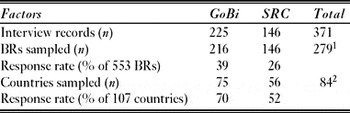
We surveyed 225 managers from 216 UNESCO BRs in 75 countries. Most data for both surveys were collected throughout 2006, with some additional responses obtained as late as autumn 2008. The response rates in terms of BR numbers reached and of countries belonging to the WNBR were exceptionally high for a survey of this nature (Table 1). The survey data were complemented by an in-depth literature review on concepts and approaches of adaptive community management and empirical findings from research on participatory conservation.
Response rate and coverage of the GoBi and SRC (Schultz et al. Reference Schultz, Duit, Folke and Schultz2009) surveys. 1Including 84 BRs that participated in both surveys. 2Including 47 BRs that participated in both surveys.

We focused on the parts of the survey that explicitly addressed the issue of community participation, namely three questions from the global telephone survey. Respondents were asked to assess the extent of their agreement with the statement ‘Active community participation is relevant in our management concept’ on an ordinal scale (where 1 = ‘I don't agree’ and 10 = ‘I fully agree’). Respondents were then asked two further follow-up open questions, namely ‘Why is/is not participation relevant in your management concept?’ and ‘What does actually result from the community participation?’ Answers to these last two questions were allocated to the following categories: (1) ‘improved acceptance, part of the BR concept, to consider traditional knowledge, lack of resources, counterproductive, not relevant and other responses’; (2) ‘no results yet, improved conservation success, improved acceptance, reduced conservation success and other responses’. The data collected for both surveys were incorporated into a SPSS database for statistical analyses.
As the data were not normally distributed, we calculated the Spearman correlation coefficient to analyse the direction and strength of the relationship between given answers on ‘Active community participation is relevant in our management concept’ and the number of residents, as well as BR size. In addition, we used analysis of variance to analyse the effect of governance type, region and official UNESCO BR designation date versus given answers on ‘Active community participation is relevant in our management concept’. We categorized the designation date as ‘before/during 1984’, ‘1985–1994’, and ‘1995 onwards’(Ishwaran et al. Reference Ishwaran, Persic and Hoang Tri2008). We used ANOVA with Scheffe post hoc test to analyse significant differences in the mean values of given answers on community participation against the discriminators governance type, region and designation date.
The Stockholm Resilience Centre (SRC) survey
The overarching goal of this survey was to assess to what extent the ambitions and recommendations of UNESCO's statutory framework are realized on the ground in BRs, and how participation and learning relate to self-estimated effectiveness in reaching the BRs’ objectives (Schultz & Lundholm Reference Schultz and Lundholm2010). In order to get comparable information from a large set of cases, a self-administered questionnaire was developed, targeting BR coordinators, directors and managers. The questionnaire was tested, revised and uploaded for on-line access in English, French, Spanish and Chinese (via URL http://www.surveymonkey.com). An introductory letter with a link to the survey was sent via e-mail to the responsible director, coordinator or manager of 407 BRs that had identifiable and working e-mail addresses. Hard copies were distributed extensively at the 3rd World Congress of Biosphere Reserves (Madrid, February 2008) in an attempt to target 124 of the (at the time) 531 BRs could not be reached by e-mail. The online survey was open 15 January–20 June 2008 and reminders were sent out twice during this period. The World Congress generated 65 hard copy responses, and the e-mails achieved 107 responses. Duplicate responses from the same BRs, sent in by national coordinators for example, were removed from the data set. The response rates for the SRC survey are lower than those obtained by the GoBi survey, but remain high (see Table 1).
Several questions in the survey were related to community participation. The survey contained multiple-choice questions on what actors were represented in the coordinating team and the advisory board, what actors were involved in design and implementation of goals, projects, monitoring and day-to-day management of ecosystems, and what actors were informed regularly about issues related to the BR (Fig. A1 in Appendix 1, see supplementary material at Journals.cambridge.org/ENC). There was one multiple-choice question on challenges experienced when trying to involve different groups, and one question about the outcomes of involvement in terms of participants’ support for BR management. One section of the questionnaire concerned self-evaluation of effectiveness. Here, respondents were first asked to illustrate how they monitored progress in each of the seven objectives (open-ended question). Then, they were asked to rate the performance of their BR in reaching each objective on a scale of 1–10 (Fig. A2 in Appendix 1, see supplementary material at Journals.cambridge.org/ENC). In addition, they were asked to rank sufficiency of a range of assets, including support from local inhabitants, on a scale of 1–10.
To establish what BR managers’ perceptions were about the effectiveness of stakeholder involvement, the extent of participation of different groups were used as independent variables, and perceived support from different groups were used as dependent variables. To estimate the relative impact of participation of different stakeholder groups on self-evaluated performance of BR management, two indexes were constructed for each stakeholder group, reflecting the degree of participation in decision-making processes (including representation in the coordination team, representation in the steering committee, goal-setting and project design) and in implementation processes (including implementation of projects, day-to-day management and monitoring of biodiversity). Although not an absolute measure of participation, these two indexes give a reasonably accurate picture of relative differences in the participation of various stakeholder groups. One of the stakeholder groups analysed in the survey was local resource users and inhabitants, here referred to as ‘communities’. The extent of participation of local communities in BR management and activities was then estimated by relating these indexes to data on (1) perceived support from various groups, and (2) self-evaluated effectiveness in reaching goals related to biodiversity conservation and sustainable development (for a more detailed description of the results obtained see Schultz & Lundholm Reference Schultz and Lundholm2010).
RESULTS
The GoBi survey
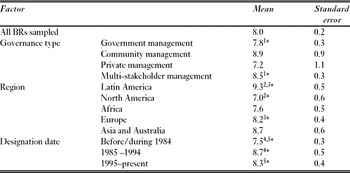
GoBi survey respondents ranked the importance of community participation as 8.0 ± 0.2 (on an ordinal scale where 1 = ‘I don't agree’ and 10 = ‘I fully agree’). This implies many respondents consider community participation to be critical to effective biodiversity management. At regional level however, significant differences emerged; Latin America ranked ‘community participation’ most highly (9.3 ± 0.5), followed by Asia and Australia, Europe, Africa and lastly North America (Table 2).
Perception of the relevance of ‘community participation’ versus governance type, region and designation date. Mean values of given answers are depicted and significant differences (post hoc test, Scheffe) are highlighted. *Significance level α = 0.10. 1, 2, 3, 4, 5 Variable pairs are marked where significant differences appear.

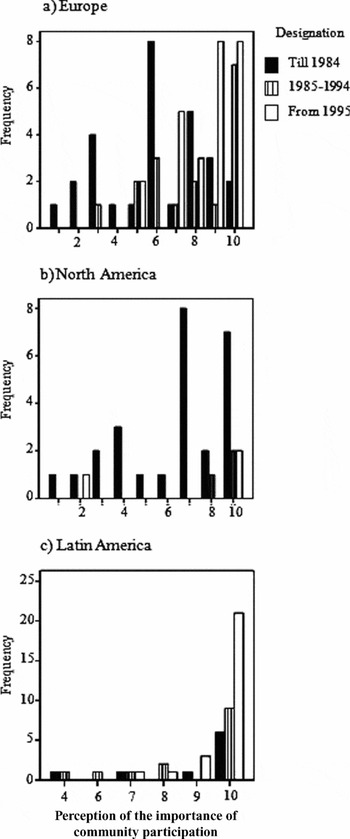
Having established that our database showed significant variance, post hoc tests were computed to identify whether statistically significant differences existed across the response patterns (Table 2). We found the two categories included under governance type differed, with responses attached to ‘multi-stakeholder governance’ being related to a higher perceived relevance for community participation (8.5 ± 0.3) than responses attached to ‘government management’ (7.8 ± 0.3). A statistically significant difference was also found when comparing the response patterns at regional level, with atypically high responses from Latin America (9.3 ± 0.5) differing markedly with those from North America (7.0 ± 0.6) and Europe (8.2 ± 0.4). We also found that respondents from BRs with a designation date before/during 1984 ranked the importance of community participation significantly lower than respondents from BRs in each of the other two designation phase categories (1985–1994 and 1995-till present) (Fig. 1).
Perception of the importance of community participation versus BR designation date (before/during 1984, 1985–1994 or 1995 onwards) in (a) Europe, (b) North America and (c) Latin America. The horizontal scale depicts the degree of agreement of respondents to the statement: ‘Active community participation is relevant in our management concept’, with answers ranging from 1 (I do not agree) to 10 (I fully agree). Please note the horizontal scales only show answers given by respondents, and are thus not linear.

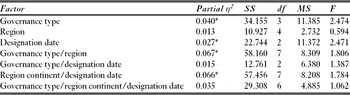
Further, to establish which factors could play a role either alone or in combination with the perception of the relevance of community participation, we performed a series of statistical variance tests on the the GoBi survey data (Table 3). We undertook an analysis of variance on a number of variables, which revealed that (1) the governance type (spilt between the four categories of public, multi-stakeholder, private and community management) and (2) the designation date influenced the respondents'valuation of the relevance of community participation, although the explained variance was low (4% for governance type and 3% for designation date). When combined with regional factors, both achieved slightly higher explained variance (7%).
Analysis of variance between perception of the relevance of community participation and governance type, region and official UNESCO designation date. *Significance level α = 0.10.

Within the GoBi survey, the relationship between response patterns and both BR areal extent and BR population size was explored using the Spearman correlation coefficient. We found positive correlations between perception of the importance of community participation and both BR population size (0.26; p = 0.01) and BR area (0.34; p = 0.01). This suggests that managers perceive community participation to be of increasing importance in more highly populated BRs.
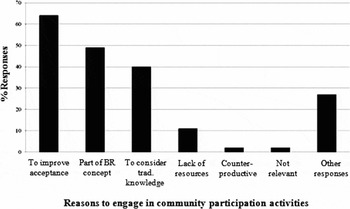
Despite significant disparities, the GoBi survey data provide evidence that community participation is seen as a key element of the BR concept. The overall goals invoked to explain the importance of community participation included facilitation of social acceptance of the BR and incorporation of local knowledge and capacities, while the primary reason invoked for a lack of participation activities was insufficient resources, although there was also a few stated community participation was counterproductive or irrelevant (Fig. 2). Respondents generally stated that when community participation activities had been carried out for some time, they tended to improve both conservation success and local acceptance of the BR, although a few respondents claimed that participation had led to decreased conservation success (Fig. 3).
Reasons invoked by respondents for engaging in community participation activities. Responses are given in percentages of total answers, whereby multiple responses were possible.

Respondents’ perception of the results of community participation activities. Responses are given in percentages of total answers, whereby multiple responses were possible.

The SRC survey
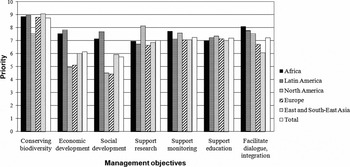
In the SRC survey, respondents were asked to rank BR management objectives by priority. Overall, managers'priorities were first to conserve biodiversity, followed by facilitating dialogue and integration, and supporting monitoring, education and research, with economic and social development be deemed least important (Fig. 4). Almost all objectives were ranked higher than the overall average by respondents from Latin America, Africa and Europe. In contrast, respondents from North America gave lower than overall mean scores for biodiversity conservation, economic and social development, and higher than average scores for supporting monitoring, education and research, and facilitating dialogue and integration (Fig. 4). In broad agreement with the data from the GoBi survey, BR managers from Africa and Latin America ranked ‘facilitating dialogue and collaboration’ more highly than other regions (8.1 and 7.8, respectively).
Respondents ranked priority in management objectives, on an ordinal scale where 1 = lowest priority and 10 = highest priority.

The prioritization of management objectives was also analysed with respect to the BR's official UNESCO designation phase. BRs designated or revised after 1995 placed a higher priority on the goals of stimulating economic (ranked 7.1 as opposed to 5.1 for pre-1995 BRs) and social (6.5 as opposed to 4.9 for pre-1995 BRs) development and a slightly higher priority on the objective of facilitating dialogue and collaboration (7.5) than BRs designated pre-1995 (6.9). Moreover, when comparing the indexes of participation in decision-making for communities, there was a BRs designated or revised after 1995 differed significantly from older BRs (on average, this stakeholder group was participating in one additional decision-making process; index was 2.8 as opposed to 1.8 pre-1995, p = 0.005).
Regarding the challenges experienced by BR managers in efforts to involve different stakeholder groups, the choice ‘We have reached unsatisfactory compromises’ was least popular with respondents (7.3%), whereas ‘Time consuming’ (57.7%) and ‘People have not been interested to participate’ (30.9%) were the most commonly selected statements. The questionnaire specifically asked,‘Do you have reason to believe that the groups involved in BR activities have increased or decreased their support for biodiversity conservation as a result of their involvement?’ Almost 80% of respondents selected the responses ‘most groups have significantly’ or ‘somewhat increased their support for biodiversity management’. An additional 14% considered that involvement had not had any effect, and only one respondent reported that support had decreased somewhat as a result of involvement (n = 134). A logistic regression analysis revealed that community participation in implementation processes has a substantial effect (b = 0.35, t = 3.18, p < 0.003) on the level of perceived support from ‘People living in the BR’. Including this stakeholder group in one additional implementation process in the BR raises the BR's ranking of its perceived support from local inhabitants by 0.35 points on the 1–10 support scale. A similar but slightly weaker effect was observed for community participation in decision-making processes (b = 0.28, t = 2.53, p < 0.015).
A further logistic regression model was used for the survey question ‘In your BR, is there any project where the objectives of conservation and development have been integrated to produce a satisfactory outcome?’, which was designed to measure the presence of at least one example of successful integration of developmental and conservational goals. Most indicators of participation were not related to successful integration of development and conservation. However, the level of participation by local communities in implementation processes seemed to have a positive effect on the likelihood of successful conservation-development integration. On average, including communities in one additional implementation process increases the likelihood of a successful integration project in that BR by about 1.4 times. When analysing the impact of stakeholder participation on self-assessed effectiveness in reaching the sustainable development goal of BRs, a small, but statistically significant, positive impact was attributed to the involvement of local resource users and inhabitants. This impact was not mirrored when relating participation to conservation effectiveness; however, neither did participation affect this goal negatively.
DISCUSSION
The two global surveys indicate that managers believe community participation plays an important role in BR management. Despite some disparity in the responses, this view is often linked to the assertion that conservation in BR should be inclusive, with community participation being viewed as a significant component both in the acceptance of the BR and/or the success of its conservation programmes. What is less clear is where managers stand on the effectiveness of community participation in the furtherance of sustainable development objectives. We restricted the present analyses to the perceptions of BR managers and did not address those of participating communities, which certainly would be needed to capture a more complete picture of the role of participatory processes in BR management. The GoBi Project also collected data from communities and their inhabitants on their perceptions of involvement in BR designation and management processes as part of longer in-depth case studies using participatory appraisal methods. The results showed that local people felt they should be more involved in BR design and management and that perceptions may differ considerably between managers and local inhabitants in the same BR (Fritz-Vietta & Stoll-Kleemann Reference Fritz-Vietta and Stoll-Kleemann2008; Stoll-Kleemann & Welp Reference Stoll-Kleemann and Welp2008; Mehring & Stoll-Kleemann (Reference Mehring, Stoll-Kleemann, Tscharntke, Leuschner, Veldkamp, Faust, Guhardja and Bidin2010); Schliep & Stoll-Kleemann Reference Schliep and Stoll-Kleemann2010).
However, both surveys provide evidence for an effective shift, at least in the explicit discourse on what is an ‘appropriate’ conservation approach. In both datasets this shift is more apparent in respondents who represent later BR generations, in particular post-1995 Seville Strategy. We have used the timing of BR official UNESCO designation as a proxy for changes in the approaches to community participation. More important than the timing itself would be to adequately capture the rate and scale of this shift towards participatory conservation in BR management. Our analyses have nevertheless revealed a number of other explanatory factors which significantly influence variance in perceptions of the importance of community participation.
(1) When governance involves multi-stakeholders, community participation is rated more highly.
(2) Regional discrepancies exist, with Latin American BR managers clearly valuing community participation more highly than both North American and European BR managers.
(3) There is a significant positive correlation between responses and BR area and population size, which suggests that community participation is perceived as more valuable in larger and more highly populated BRs.
The results suggest that respondents have, to a substantial degree, internalized and appropriated the notion that conservation programmes within BRs need to actively and meaningfully involve local communities. The quantified scores, together with accompanying qualitative comments, suggest a number of underlying motives in fostering community participation. Some respondents clearly asserted the intrinsic right of local communities to participate in decisions affecting their livelihood and way of life, and emphasized the importance of channelling traditional knowledge, while others viewed participation as merely a means of facilitating conservation (but not necessarily sustainable development) programmes. There may be significant dissonance between the answers survey participants provided, representing both the ‘officially accepted viewed’ and their personal conviction; the overt endorsement of the participatory approach may be no more than ‘politically correct’. However, whether respondents sincerely adopted participation or merely saw it as an unavoidable component of BR management, both surveys supported the claim that inclusive conservation, including CBNRM, is the current dominant narrative and conceptualization within the WNBR (see Bouamrane Reference Bouamrane2007).
A number of authors have critically analysed the creation and transformation of myths and narratives in conservation approaches to make explicit some of their underlying motives. For example, Campbell (Reference Campbell2002), focusing on Costa Rica, and Adams and Hutton (Reference Adams and Hutton2007) emphasized how management approaches and strategies are shaped and transformed by the way conservation is framed through time. Depending on the dominant discourse, local communities are alternatively perceived as major threats to biodiversity, or as benevolent knowledgeable stewards (Agrawal & Gibson Reference Agrawal and Gibson1999), perceptions which in turn justify hindering or promoting participatory approaches. Wilshusen et al. (Reference Wilshusen, Brechin, Fortwangler and West2002) pointedly analysed that a major flaw in these narratives is that they tend to be binary, thereby leading to an oversimplified polarization of the debate.
Berkes (Reference Berkes2004) asked for sufficient information to understand and explain both success and failure in CBRNM endeavours across PAs. This should be both locally specific and at the same time sufficiently generic to enable cross-regional and global comparisons. Bertzky and Stoll-Kleemann (Reference Bertzky and Stoll-Kleemann2009) highlighted the paucity of meaningful freely accessible socioecological monitoring data on the performance of PAs that would enable comparative evaluations at regional or global scale. Hockings (Reference Hockings2003) and McShane and O'Connor (Reference McShane, O'Connor, Redford and Fearn2007) believed that the lack of adequate assessments on effectiveness of conservation programmes reflects a reluctance to report failures or difficulties, which might endanger the continuation of such programmes. This is a critical point which needs to be taken into consideration in evaluating the data collected by both surveys presented here. Indeed, both surveys are based on the assumption that respondents provided a fair, informed and transparent self-assessment of the role of community participation in BR management. The quality of self-assessment depends on a range of factors. These include the availability and quality of socioecological monitoring, the quality of the management system itself (for example the capacity to process and integrate available monitoring data and adapt management goals and strategies accordingly), the attitude towards, and goals for, reporting and evaluation, as well as the degree of personal and/or corporate freedom respondents have in being open and critical about the actual situation they face. While we successfully collected valuable information on the overt opinions of BR respondents and explicit guiding discourse, we have little control of the degree of transparency and the underlying intentions respondents have in communicating their experiences.
Pullin and Knight (Reference Pullin and Knight2009) stated that conservation actors are increasingly submitted to societal scrutiny, and to demands for increased accountability. In agreement with Lotze-Campen et al. (Reference Lotze-Campen, Reusswig and Stoll-Kleemann2008), we emphasize for the need to raise comparable data to allow systematic review of conservation performance, while Stoll-Kleemann (Reference Stoll-Kleemann2005) argued that to better understand the challenges and opportunities of biodiversity conservation, the perceptions, judgements and experience of PAs managers should be taken into consideration. The two surveys we presented are a step in this direction, although these data cannot answer precisely whether the evidenced shift towards an inclusive management approach in BRs has been associated with improved conservation. Indeed, we collected contradictory data on self-evaluated effectiveness of community participation in conservation. Within the GoBi survey, the majority of responses linked community participation with improved BR acceptance and conservation. This was, however, modulated in both surveys by the perception of important drawbacks in the successful implementation of participatory activities, including lack of resources, lack of interest from local communities, unsatisfactory or counterproductive results. It should be noted here that BRs are not structured participation experiments with controls. Isolated scarcely-populated BRs might lack communities to involve, but still be successful in conserving biodiversity. Conversely, BRs situated in areas with rapid population increase might be excellent facilitators of participation and still have problems reaching conservation goals.
Beyond the expressed opinions of BR managers regarding community participation, its justification and its associated outcomes, it is important to note that conservation actors often face significant constraints regarding the overall approach they are to endorse and implement on the ground. Indeed, whether participation is desirable and degree of influence afforded local communities are often decided within regional and/or national policies and management strategies. These, in turn, often follow international legal-normative frameworks that nation states opted to ratify (for example the Convention on Biological Diversity). Ironically, top-down guidelines on community participation might be imposed on conservation actors, with little or no consultation and, more often than not, without providing adequate resources and capacity building for a meaningful engagement. Moreover, a key challenge in BR management is that the associated governance system and power of managers is weak, especially outside the legally-protected core zones (Stoll-Kleemann Reference Stoll-Kleemann, Kleinn, Yang, Weyerhäuser and Stark2006; Ishwaran et al. Reference Ishwaran, Persic and Hoang Tri2008).
Despite the vastness of the conservation task itself, and restricted mandate, enforcement power and implementation means, BR managers face the additional imperatives of endorsing participatory and sustainable development approaches. For some critiques, this simply leads to unrealistic and unfair demands on conservation actors, and endangers the conservation endeavour itself. Here, the assumption that conservation and local development might be compatible is seen as questionable, if not flawed, while the task of conservation actors should not include the solving of structural societal problems such as pervasive poverty, inequity or power asymmetries (for example Fischer Reference Fischer2008; see Adams et al. Reference Adams, Avelling, Brockington, Dickson, Elliott, Hutton, Roe, Vira and Wolmer1994 for a review). For Adams and Hutton (Reference Adams and Hutton2007) and Campbell (Reference Campbell2002), however, the resurgence of exclusive approaches marks a refusal to acknowledge the highly political dimension of conservation management.
CONCLUSIONS AND RECOMMENDATIONS
Analysis of data on community participation in conservation within the WNBR, derived from two parallel global surveys, points to an effective shift in the conservation paradigm towards a more inclusive approach, associated with CBNRM. This is particularly the case in the assessments from respondents from third generation BRs, designated after the Seville Strategy, in multi-stakeholder management settings, and has been positively correlated with either BR area or population size. This may be related to critical discrepancies between official approval of participatory goals, and hence the broad societal transformations its effective implementation would imply, and between the resources (be they financial or in time or capabilities in management) CBNRM would ideally require, compared with those actually at the disposal of BR managers.
Despite the limitation of their mandate and implementation means, we believe that BR managers, by adjusting and revisiting their practices, have some power and responsibilities in actively supporting small, but critical, transformations at local scale, which can contribute to the broader goals of CBNRM (Olsson et al. Reference Olsson, Folke and Hahn2004; Pullin & Knight Reference Pullin and Knight2009; Stoll-Kleemann & O'Riordan Reference Stoll-Kleemann and O'Riordan2002; Twyman Reference Twyman2000; Wilshusen et al. Reference Wilshusen, Brechin, Fortwangler and West2002).
In particular, we believe BR managers can:
(1) foster social learning and knowledge exchange within the BR and between BRs,
(2) inspire and coordinate collective action that is coherent with the dual goal of local development and conservation and may be compatible and coordinated with that of other actors (outside the BR),
(3) push for healthy, accountable, adaptive and participatory governance within the BR itself,
(4) foster transparent, empathic, responsible institutional communication to local population,
(5) embody and promote positive leadership,
(6) recognize and harness the effective power of local communities,
(7) cooperatively shape local customary regulations on resource use, and
(8) foster systematic reviews of conservation performance.
However, effective conservation-based performance and effective sustainable development delivery appear to be inadequately linked in managers’ minds and actions. This, we consider a critical deficiency since this interconnection is at the core of the third generation BR concept. This distinction between the role of active community participation in delivering conservation objectives, as well as sustainability outcomes, deserves far more attention in further research. It is unclear whether there is any consensus in managers’ views on the nature and role of the sustainable development package of objectives and values (see Adger & Jordan Reference Adger and Jordan2009 for a review) for the flourishing livelihoods of BR communities, let alone concerning the effective conservation of species, habitats and land use. We identified limited ability on the part of BR managers to address sustainable development as an operational concept in their commitment to effective CBNRM. Achieving conservation objectives from a participatory engagement is one outcome of the current evolution of the BR journey. Achieving sustainable development for the betterment of both ecology and society in the BR landscape is quite another.
ACKNOWLEDGEMENTS
We are in debt with all respondents of both surveys from the World Network of UNESCO Biosphere Reserves, who generously agreed to share their time and invaluable experience with us. The GoBi project is funded by the Bosch Foundation. The SRC survey project was funded by The Swedish Research Council for Environment, Agricultural Sciences and Spatial Planning, Formas. We also thank Professor Tim O'Riordan and an anonymous reviewer for their comments, which greatly improved this article.