Introduction
Cocaine addiction is a debilitating chronically relapsing disorder that is characterized by persistent and compulsive drug-seeking despite harmful consequences (APA, 1994). Cocaine is the most commonly used stimulant drug in Europe and the United States (EMCDDA, 2014; UNODC, 2014) and current lifetime prevalence rates in the populations are estimated at 4.2% in Europe and 14.3% in the United States (EMCDDA, 2014; NSDUH, 2014). Despite the high addiction liability of cocaine (Nutt et al. Reference Nutt, King, Saulsbury and Blakemore2007), only a relatively small fraction of users (5–6%) made the transition from controlled drug use to drug dependence within the first year of use, whereas 15–16% developed dependency in the long term (Wagner & Anthony, Reference Wagner and Anthony2002).
Converging evidence points to a complex interplay of inherited genetic predispositions and environmental, social, and neurobiological factors contributing to the vulnerability to develop an addiction (Kreek et al. Reference Kreek, Nielsen, Butelman and LaForge2005; Kendler et al. Reference Kendler, Myers and Prescott2007). It has been postulated that chronic drug use is associated with neuroadaptations in fronto-limbic brain circuits mediating reward, motivation, and memory processes, presumably resulting in behavioural inflexibility such as disrupted self-control and compulsive drug use (Goldstein & Volkow, Reference Goldstein and Volkow2011). However, the emerging concept of addiction endophenotypes also highlights the role of pre-existing psychological, cognitive, and neurobiological factors that may render an individual more susceptible to initiate drug use and develop an addiction (Ersche et al. Reference Ersche, Turton, Chamberlain, Muller, Bullmore and Robbins2012, Reference Ersche, Jones, Williams, Smith, Bullmore and Robbins2013; Mahoney & Olmstead, Reference Mahoney and Olmstead2013). Important and somewhat conceptually overlapping key factors implicated in the initiation and maintenance of drug use are maladaptive decision-making, increased impulsivity propensities, and implicit cognitive processes such as attentional bias and implicit memory associations (Field et al. Reference Field, Schoenmakers and Wiers2008; Lucantonio et al. Reference Lucantonio, Stalnaker, Shaham, Niv and Schoenbaum2012; Marhe et al. Reference Marhe, Waters, van de Wetering and Franken2013; Stevens et al. Reference Stevens, Verdejo-Garcia, Goudriann, Royers, Dom and Vanderplasschen2014; Wiers & Stacy, Reference Wiers and Stacy2006). Overall, drug users attribute excessive attention to drug-related stimuli, rate them more positively than non-users, and exhibit reduced inhibitory control and increased impulsivity, leading to harmful compulsive drug use despite the occurrence of negative consequences. To what extent impaired decision-making and increased impulsivity are drug-induced, pre-existing vulnerability factors, or a combination of both is, however, not entirely clear so far.
Decision-making refers to the ability to select an optimal course of action from multiple options, requiring ongoing updating and integrating of the value of present and potential actions (Fellows, Reference Fellows2004; Lucantonio et al. Reference Lucantonio, Stalnaker, Shaham, Niv and Schoenbaum2012). Prior studies have consistently shown that dependent cocaine users exhibit disadvantageous decision-making strategies in tasks such as the Iowa Gambling task (IGT) and preferences for smaller immediate over larger but delayed rewards as measured with the Delay Discounting task (DD; Bechara et al. Reference Bechara, Dolan and Hindes2002; Verdejo-Garcia et al. Reference Verdejo-Garcia, Benbrook, Funderburk, David, Cadet and Bolla2007; Hulka et al. Reference Hulka, Eisenegger, Preller, Vonmoos, Jenni, Bendrick, Baumgartner, Seifritz and Quednow2014; Kjome et al. Reference Kjome, Lane, Schmitz, Green, Ma, Prasla, Swann and Moeller2010). Impulsivity, a multi-faceted concept, is generally defined as a predisposed tendency toward rapid and unplanned reaction patterns without much foresight regarding possible consequences (Moeller et al. Reference Moeller, Barratt, Dougherty, Schmitz and Swann2001a ). Impulsive tendencies or trait impulsivity is generally assessed with self-report questionnaires, such as the Barratt Impulsiveness Scale (BIS-11), which presumably focus on stable personality characteristics (Patton et al. Reference Patton, Stanford and Barratt1995; Stevens et al. Reference Stevens, Verdejo-Garcia, Goudriann, Royers, Dom and Vanderplasschen2014). Although self-report measures can provide valuable information, they can be limited if the subject lacks insight or answers in a socially desirable manner (Moeller et al. Reference Moeller, Barratt, Dougherty, Schmitz and Swann2001a ). Therefore, using an experimental approach to complement self-report measures of impulsivity with behavioural performance measures is essential. Behavioural or neurocognitive impulsivity has been proposed to include the two main components of impulsive action representing motor impulsivity and impulsive choice reflecting more cognitive parts of impulsivity (Winstanley et al. Reference Winstanley, Olausson, Taylor and Jentsch2010). Impulsive action is generally measured with tasks assessing the ability to inhibit motor responses [e.g. Stop-Signal, Stroop, Go/No-go, and sustained attention tasks such as the Rapid Visual Processing (RVP)], while impulsive choice is either assessed with tasks quantifying the ability to tolerate delay of gratification such as the DD or with tasks measuring responses to reward and loss contingencies such as assessed in the IGT (Winstanley et al. Reference Winstanley, Olausson, Taylor and Jentsch2010; Stevens et al. Reference Stevens, Verdejo-Garcia, Goudriann, Royers, Dom and Vanderplasschen2014). It has been suggested that impulsive action might be more associated with the development of cocaine addiction, while impulsive choice may contribute specifically to relapse of cocaine use (Winstanley et al. Reference Winstanley, Olausson, Taylor and Jentsch2010). However, this hypothesis has been recently challenged as we did not find elevated motor impulsivity in cocaine dependence (Vonmoos et al. Reference Vonmoos, Hulka, Preller, Jenni, Schulz, Baumgartner and Quednow2013b ), while especially DD – a prototype of impulsive choice – has been proposed as a critical risk factor for the development of drug addiction as well (MacKillop, Reference MacKillop2013).
Elevated trait impulsivity has consistently been reported for dependent and recreational stimulant users (Reske et al. Reference Reske, Delis and Paulus2011; Vonmoos et al. Reference Vonmoos, Hulka, Preller, Jenni, Schulz, Baumgartner and Quednow2013b ), whereas results on behavioural impulsivity are somewhat mixed: some studies found dependent (Perry & Carroll Reference Perry and Carroll2008; Verdejo-Garcia et al. Reference Verdejo-Garcia, Lawrence and Clark2008; Ersche et al. Reference Ersche, Turton, Pradhan, Bullmore and Robbins2010) and recreational cocaine users (CU) (Colzato et al. Reference Colzato, van den Wildenberg and Hommel2007) to be impaired in Stop-Signal or Go/No-go tasks, whereas we recently concluded from data of a large sample of relatively pure CU that neither dependent nor recreational cocaine use was associated with impairment in the Stop-Signal task (Vonmoos et al. Reference Vonmoos, Hulka, Preller, Jenni, Schulz, Baumgartner and Quednow2013b ). However, the inconsistent results regarding performance in Stop-Signal tasks may be explained by different task designs and parameter calculation procedures as well as different exclusion criteria of polytoxic drug use and psychiatric comorbidities (Vonmoos et al. Reference Vonmoos, Hulka, Preller, Jenni, Schulz, Baumgartner and Quednow2013b ).
Importantly, impaired decision-making and social cognition in CU have been associated with worse self-reported real-life functioning (Cunha et al. Reference Cunha, Bechara, de Andrade and Nicastri2011; Preller et al. Reference Preller, Hulka, Vonmoos, Jenni, Baumgartner, Seifritz, Dziobek and Quednow2014) and more frequent drug relapse and treatment attrition (Bechara, Reference Bechara2003; Aharonovich et al. Reference Aharonovich, Hasin, Brooks, Liu, Bisaga and Nunes2006; Verdejo-Garcia et al. Reference Verdejo-Garcia, Albein-Urios, Martinez-Gonzalez, Civit, de la Torre and Lozano2014). Moreover, elevated levels of impulsivity have been associated with an increased risk to initiate and continue drug use and a greater likelihood of relapse (for review see Stevens et al. Reference Stevens, Verdejo-Garcia, Goudriann, Royers, Dom and Vanderplasschen2014). Considering the impact of impaired decision-making and elevated impulsivity on real-life functioning and treatment outcome, it is important to better understand if the different facets of impulsivity are stable antecedent vulnerability factors – predisposing individuals to develop and maintain cocaine addiction – or rather drug-induced consequences. Moreover, it is not clear whether these behavioural deviances are reversible when drug use is reduced or completely ceased. Recently, we reported that CU, who had substantially increased cocaine use over the course of 1 year, exhibited worse cognitive performance compared to baseline, whereas those who decreased or ceased their cocaine use showed substantially improved cognitive performance, suggesting that cognitive impairment is partially cocaine-induced but also reversible (Vonmoos et al. Reference Vonmoos, Hulka, Preller, Minder, Baumgartner and Quednow2014).
The primary goal of the present investigation was, thus, to determine which specific decision-making and impulsivity components are stable (addiction endophenotypes) v. variable (drug-induced) markers of cocaine use disorder over the time-course of one year. For this purpose, we conducted a longitudinal study assessing trait impulsivity with the BIS-11, impulsive action with the RVP response bias B″, and impulsive choice with the main IGT and DD parameters, at baseline and after 1 year. CU of the Zurich Cocaine Cognition Study (ZuCo2St) were categorized as decreasers, increasers, or equal users after the 1-year follow-up based on a toxicological quantification of cocaine levels in hair samples. With regard to the BIS-11 and DD, we expected that scores would remain stable over the two assessments because the BIS-11 is regarded as a trait measure and also discounting preferences appear to be relatively stable over time (for review see MacKillop, Reference MacKillop2013). For the RVP B″ we expected stable results as none of the few existing previous studies with CU displayed a substantial cocaine-associated effect on this parameter (Ersche et al. Reference Ersche, Barnes, Jones, Morein-Zamir, Robbins and Bullmore2011; Vonmoos et al. Reference Vonmoos, Hulka, Preller, Jenni, Schulz, Baumgartner and Quednow2013b ). By contrast, we expected that the IGT performance would improve with decreased cocaine use and worsen with increased cocaine use as prior studies reported dose-dependent relationships between cocaine use and IGT performance (Verdejo-Garcia et al. Reference Verdejo-Garcia, Benbrook, Funderburk, David, Cadet and Bolla2007).
Materials and method
Participants
The eligible baseline sample of the ZuCo2St comprised 234 participants [138 CU, 96 healthy psychostimulant-naive controls (HC)] (Vonmoos et al. Reference Vonmoos, Hulka, Preller, Jenni, Baumgartner, Stohler, Bolla and Quednow2013a ; Hulka et al. Reference Hulka, Eisenegger, Preller, Vonmoos, Jenni, Bendrick, Baumgartner, Seifritz and Quednow2014; Preller et al. Reference Preller, Hulka, Vonmoos, Jenni, Baumgartner, Seifritz, Dziobek and Quednow2014). One hundred and thirty-two subjects [79 CU (57.3% of baseline), 53 HC (55.2%)] participated in the 1-year-follow-up. Hereof, 57 CU and 48 matched HC could be included in the longitudinal analysis (for details see Supplementary Method S1).
At baseline, exclusion criteria for all participants were clinically significant somatic diseases, neurological disorders, head injuries, family history of schizophrenia, obsessive compulsive disorder, or bipolar disorder, or any medication affecting the CNS. Further exclusion criteria for CU were opioid use, polytoxic drug use patterns, or DSM-IV Axis I psychiatric disorders (except for cocaine, nicotine, and alcohol abuse/dependence, former affective disorders, and attention deficit hyperactivity disorder). At baseline, all CU met the following inclusion criteria: cocaine as primary drug of choice, cocaine use >0.5 g/month, and abstinence duration of <6 months. Exclusion criteria for HC were DSM-IV Axis I psychiatric disorders (excluding nicotine dependence) and regular illegal drug use (>15 lifetime occasions, except occasional cannabis use).
Participants were asked to abstain from illegal substances for >72 h and from alcohol for >24 h. Compliance was controlled by urine screens (semi-quantitative enzyme multiplied immunoassay method) and 6-month hair toxicology (Vonmoos et al. Reference Vonmoos, Hulka, Preller, Jenni, Baumgartner, Stohler, Bolla and Quednow2013a ). The study was approved by the Cantonal Ethics Committee of Zurich. All participants provided written informed-consent statements and were compensated for their participation.
Cocaine user groups
Cocaine user groups were determined based on a combination of absolute (±0.5 ng/mg cocaine) (Bush Reference Bush2008; Cooper et al. Reference Cooper, Kronstrand and Kintz2012) and relative (>10% increase/decrease in the robust hair toxicology parameter cocainetotal) (Hoelzle et al. Reference Hoelzle, Scheufler, Uhl, Sachs and Thieme2008) changes in cocaine concentration in the hair samples between baseline and follow-up. CU who met both criteria were categorized as increasers or decreasers accordingly, whereas CU who met none or only one criterion were classified as equal users. Accordingly, CU were divided into three equally sized groups: Whereas 19 CU with increased cocaine use and 19 CU with decreased cocaine use met the according change criteria, a third group of 19 CU displayed equal cocaine use and met neither the cut-off-criteria for increased nor decreased cocaine use [increaser: mean±s.d. + 30.4 ± 61.9 ng/mg (+297%), range +0.5 to +268.5 ng/mg (+20% to +5374%); decreaser: −10.6 ± 26.7 ng/mg (−72%), −116.9 to −0.6 ng/mg (−100% to −12%); equal user: −0.1 ± 0.5 ng/mg (−2%), −1.9 to +0.5 ng/mg (−100% to +720%)].
Procedure
The test procedure was similar in both test sessions. The Structured Clinical Interview for DSM-IV Axis I disorders (SCID-I; APA, 1994) was conducted by trained psychologists. Drug use was assessed by means of a structured and standardized interview for psychotropic drug consumption (Quednow et al. Reference Quednow, Kuhn, Hoenig, Maier and Wagner2004). For matching reasons, pre-morbid verbal intelligence was measured with a German version of a multiple choice vocabulary intelligence test (MWT-B; Lehrl, Reference Lehrl1999). Attention deficit hyperactivity disorder (ADHD) symptoms were assessed with the ADHD Self-Rating Scale (ADHD-SR; Roesler et al. Reference Roesler, Retz, Retz-Junginger, Thome, Supprian, Nissen, Stieglitz, Blocher, Hengesch and Trott2004), and symptoms of depression with the Beck Depression Inventory (BDI; Beck et al. Reference Beck, Ward, Mendelson, Mock and Erbaugh1961). Smoking severity was assessed with the Fagerström Test of Nicotine Dependence (FTND; Heatherton et al. Reference Heatherton, Kozlowski, Frecker and Fagerstrom1991) and craving for cocaine with the Brief Cocaine Craving Questionnaire (CCQ; Sussner et al. Reference Sussner, Smelson, Rodrigues, Kline, Losonczy and Ziedonis2006). Smoking intensity and cocaine craving were assessed to control for their potential acute effects on test performance (Franken, Reference Franken2003). Trait impulsivity was assessed with the BIS-11 (Patton et al. Reference Patton, Stanford and Barratt1995). The two components of cognitive impulsivity impulsive action and impulsive choice were measured by means of the response bias B’ (an analogue to the response bias beta from the signal detection theory; Green & Swets, Reference Green and Swets1966) drawn from the sustained attention task RVP of the Cambridge Automated Neuropsychological Test Battery (CANTAB; Elliott et al. Reference Elliott, Sahakian, McKay, Herrod, Robbins and Paykel1996) as well as the discounting rate described by parameter k from the DD task (Kirby et al. Reference Kirby, Petry and Bickel1999), and the IGT parameter total ratio (number of good cards – number of bad cards) (Bechara et al. Reference Bechara, Dolan and Hindes2002), respectively. At follow-up, a parallel test version was used for the IGT. Detailed task descriptions for the RVP, IGT, and DD can be found in Supplementary Method S2.
Statistical analysis
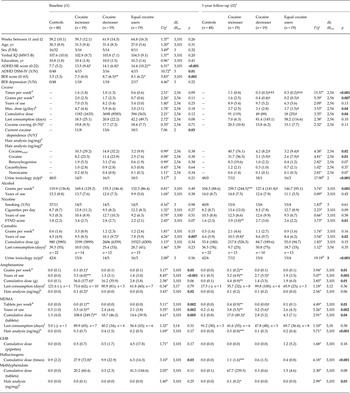
Statistical analyses regarding demographic data and drug use patterns (Table 1) as well as baseline test scores were performed with SPSS Statistics 19.0 (IBM, Switzerland). Frequency data were analysed by means of Pearson's χ2 test and quantitative data by analyses of variance (ANOVA) or Student's t tests. All other analyses derived from the xtmixed command in Stata 12.1 for Macintosh (StataCorp. 2011). Regression modelling involved a series of linear multilevel models (also known as linear mixed, random-effects, or random-coefficient models) (Tabachnik & Fidell, Reference Tabachnik and Fidell2006; Gelman & Hill, Reference Gelman and Hill2007; Locascio & Atri, Reference Locascio and Atri2011).
Demographic data and pattern of drug use

Values given are means and standard deviations.
Significant p values are shown in bold.
a ANOVA (all groups, with significant Sidak post-hoc test v. control group: *p < 0.05; **p < 0.01; ***p < 0.001; v. cocaine increasers: †p < 0.05).
b χ² test (all groups/cocaine users only) for frequency data.
c ANOVA (cocaine users only, with significant Sidak post-hoc test v. cocaine increasers: †p < 0.05; †††p < 0.001).
d Average use during the last 6 months.
e Craving for cocaine was assessed by the CCQ.
f Last consumption is averaged only for persons who used the drug in the last 6 months.
g Urine toxicology (neg/pos) is based on cut-off value for cocaine = 150 ng/ml and for tetrahydrocannabinol = 50 ng/ml (Substance Abuse and Mental Health Services Administration, 2008). The χ² test for cocaine includes only cocaine users, the χ² test for cannabis includes all groups.
h Hair samples were voluntary and data are missing for three controls.
i Parameters at follow-up refer to the 1-year period between t1 and t2.
j SCID-I diagnosis according to DSM-IV criteria (APA, 1994).
k Self-reported maximum dose of cocaine within 24 h (in grams).
All dependent variables were divided by their respective standard deviations to aid in model interpretation. Predictors evaluated were: group (increasers, decreasers, equal users, controls), time (dummy variable with levels baseline and follow-up), group × time interaction, female sex, age (in 10-year steps), level of education (years), age of onset of cocaine use (in 5-year steps), verbal IQ (in steps of 5), amount of Swiss francs available in the last 12 months (ordinal variable with levels 0–15000, 15000–30000, 30000–60000, 60000–90000, 90000–120000, >120000), FTND score (divided by standard deviation), smoker (yes/no), ADHD-SR score (divided by standard deviation), adult ADHD (yes/no, DSM-IV criteria), BDI score (divided by standard deviation), BDI depression (yes/no, cut-off ≥18), CCQ score (divided by standard deviation), years of cocaine use, cumulative cocaine use in grams (transformed by natural logarithm because of violation of normality distribution), cocaine in hair samples (pg/mg), positive urine screen for cocaine (yes/no), and cocaine level in urine toxicology (ng/ml, log-transformed). Continuous predictors were centred on their grand means. In addition to some of the predictors (see above), the dependent variable DD k total was log-transformed as well (further details of the statistical analysis are given in Supplementary Method S3).
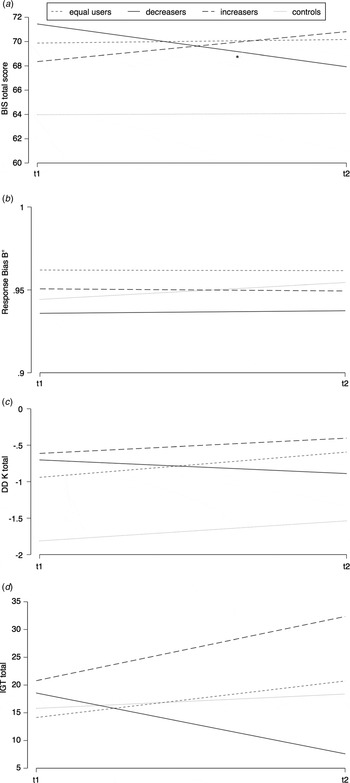
Fig. 1 shows the effects of group and time for the four main dependent variables, even if the main effects and/or interactions of group and time were not statistically significant in the final models that are reported in Table 2. In such cases, these effects were added to the final model and the figures were derived from these extended models.
Predicted values for baseline (t1) and follow-up (t2) are shown. (a) Development of Barratt Impulsiveness Scale (BIS-11) total scores within 1 year. Control group data in raw values (predicted data are not available because this group was dropped from the regression model due to collinearity). Group × time interaction (increaser × decreaser) p < 0.01. *p < 0.05 time effect for cocaine decreasers. (b) Development of the Rapid Visual Processing task (RVP) response bias B″ within 1 year. (c) Development of delay discounting (DD) parameter k within 1 year. Control group data in raw values (predicted data are not available because this group was dropped from the regression model due to collinearity). (d) Development of the Iowa Gambling task (IGT) total ratio within 1 year. Group × time interaction (increaser × decreaser) p < 0.05.

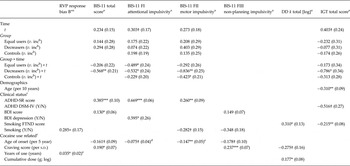
Coefficients (standard errors) of final multilevel regression models with standardized dependent variables

RVP, Rapid Visual Processing task; BIS-11, Barratt Impulsiveness Scale; DD, delay discounting task; IGT, Iowa Gambling task; BDI, Beck Depression Inventory; FTND, Fagerström Test of Nicotine Dependence; ADHD, attention deficit hyperactivity disorder.
Significance levels: †p < 0.10; *p < 0.05; **p < 0 .01; ***p < 0 .001.
a All dependent variables divided by standard deviation.
b Increasers.
c Values at baseline (t1).
d No longer significant when excluding controls.
e Only trend-level significant when excluding controls.
The table shows all coefficients that are relevant for the final models. Principally, final models included only predictors at p < 0.10. However, in case of any significant interaction effects (group × time), the table additionally displays the single terms (group, time).
Results
Demographic and clinical characteristics and drug use
The four groups did not significantly differ regarding age, sex distribution, verbal IQ, years of education, smoking status, and length of interval between the two study assessments (Table 1). Moreover, all three CU groups showed similar BDI (p Sidak post-hoc > 0.97) and ADHD-SR (p Sidak post-hoc > 0.99) sum scores, but exhibited distinctively higher values than HC (p BDI = 0.08 – 0.006, p ADHD-SR = 0.03 – 0.007).
At baseline, all three CU groups did not display significant differences in the self-reported cocaine use parameters and hair concentrations. However, the increaser and decreaser groups clearly featured a stronger current and cumulative cocaine use than the equal user group although the differences were not statistically significant. Furthermore and in accordance with the inclusion criteria, the data showed a clear domination of cocaine compared to other illegal drug use. At follow-up, increasers had a three- to four-fold higher cocaine concentration in the hair samples compared to the baseline value, whereas decreasers’ values dropped by about three quarters, while the equal users’ values remained relatively stable.
Impulsivity and decision-making scores
BIS-11
At baseline, a combined CU group (including increasers, decreasers, and equal users) differed significantly from the HC group in the total score (T 103 = 2.98, p < 0.01) and all three subscales FI–FII (T 103 = 2.32 – 2.83, p = 0.02 – 0.006) as previously shown in Vonmoos et al. (Reference Vonmoos, Hulka, Preller, Jenni, Schulz, Baumgartner and Quednow2013b ). The most striking finding was the significant group × time interaction (p < 0.01) in the BIS-11 total score with increasers showing a trend for elevated self-reported impulsivity over time (p = 0.12), whereas decreasers displayed significantly reduced self-reported impulsivity within 1 year (p < 0.05). Equal users’ (p = 0.86) and HCs’ total scores remained comparatively stable (Fig. 1a ; a p value for HC is not available because this group was dropped from the regression model due to collinearity). Table 2 shows that this pattern of significant group × time interactions (increaser v. decreaser) can also be seen in the BIS-11 primary subscales FI (attentional impulsiveness, p < 0.05) and FII (motor impulsiveness, p < 0.01). Whereas none of the groups revealed significant time effects in attentional impulsiveness (p dec = 0.17, p inc = 0.08, p equal = 0.28, p HC = 0.48), decreasers showed a significant reduction in the self-reported motor impulsiveness (p dec < 0.01, p inc = 0.13, p equal = 0.92, p HC = 0.18). For the BIS-11 subscale FIII (non-planning impulsiveness) no significant group × time interaction (increaser v. decreaser) was found (p = 0.15).
Additionally, BIS-11 total, attentional, and motor impulsiveness scores correlated strongly with ADHD-SR sum scores (all p < 0.002). Furthermore, BIS-11 total, attentional, and non-planning scores were positively associated with BDI depression (all p < 0.05). BIS-11 total (p < 0.05) and non-planning scores (p < 0.001) positively covaried with craving scores, and a later age of cocaine onset was linked to reduced motor impulsiveness (p < 0.01). However, this latter effect was no longer significant when controls were excluded from the analysis.
RVP response bias B″
For B″, no baseline differences between CU and HC occurred (T 103 = − 1.04, p = 0.30) (see also Vonmoos et al. Reference Vonmoos, Hulka, Preller, Jenni, Schulz, Baumgartner and Quednow2013b ) and in the longitudinal analysis there was no significant effect regarding group, time, or their interaction. The only significant finding was a weak positive association with duration of cocaine use (p < 0.05), which was no longer significant when excluding the control group from the analysis (Table 2, Fig. 1b ).
DD k total
At baseline, CU and HC strongly differed regarding k total (T 103 = − 3.40, p < 0.001), as shown before (Hulka et al. Reference Hulka, Eisenegger, Preller, Vonmoos, Jenni, Bendrick, Baumgartner, Seifritz and Quednow2014). Longitudinally, k total showed no statistically significant group and/or time effects. However, a 100% increase in the cumulative lifetime dose of cocaine was associated with roughly a 20% decline in scores of the ability to delay gratification – i.e. to forego immediate smaller in favour of delayed larger rewards. Moreover, a 100% raise in the FTND score was associated with a 30% decrease in scores for delayed gratification (Table 2, Fig. 1c ).
IGT total ratio
Baseline scores of the IGT total ratio did not differ between CU and HC (T 102 = 0.72, p = 0.47). In the longitudinal analysis, a significant group × time interaction was found for the IGT total ratio (p < 0.05, Table 2, Fig. 1d , for a detailed distribution of IGT scores for each group at t1 and t2 see Supplementary Fig. S1). Without any statistically significant main effect of group, decreasers’ scores fell during the 1-year-interval (p = 0.11), whereas those of the increasers improved (p = 0.09). Concretely, this means that decreasers chose significantly fewer favourable cards at follow-up. Equal users (p = 0.34) and HC (p = 0.54) total ratio scores remained fairly stable. Age (p < 0.01), an ADHD diagnosis (p < 0.10), and positive smoking status (p < 0.01) were related to decreases in IGT performance of roughly 1/3 s.d.
Test–retest reliability
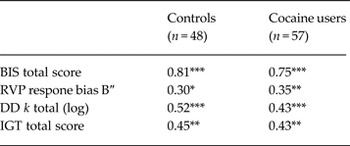
In three of the four main variables, HC displayed slightly higher test–retest reliability scores than the combined CU group (Table 3) but the differences were not significant (z < 0.80, p > 0.20). Moreover, the BIS-11 total score showed a remarkably strong test-retest reliability, whereas the response bias B’ featured the smallest but nonetheless significant test-retest reliability in HC and CU.
One-year test–retest reliability between baseline and 1-year follow-up in controls and cocaine users

BIS, Barratt Impulsiveness Scale; RVP, Rapid Visual Processing task; DD, delay discounting task; IGT, Iowa Gambling task.
Pearson's product-moment correlation.
Significance levels: *p < 0.05, **p < 0.01, ***p < 0 .001.
Discussion
The present longitudinal study investigated to what extent impaired decision-making and elevated impulsivity levels in CU may represent stable and pre-existing addiction endophenotypes v. variable state markers depending on the quantity of cocaine used. The most striking finding was that self-reported levels of impulsivity strongly covaried with changing cocaine use patterns. Accordingly, CU who substantially decreased their cocaine intake within one year reported significantly lower levels of impulsive behaviour, whereas CU who increased their consumption reported by trend higher levels of subjectively perceived impulsivity. By contrast, cognitive impulsivity measures capturing impulsive action (response bias B’) and impulsive choice (delay discounting) did not significantly differ with increasing or decreasing cocaine use over the course of one year. Contrary to our expectations, CU who decreased their cocaine intake during the 1-year interval chose fewer favourable cards in the IGT at the second study assessment, whereas CU who increased their consumption showed a slightly improved performance. Nonetheless, there seemed to be a linkage between worse decision-making at baseline and a subsequently increased cocaine use pattern suggesting that impaired decision-making might indeed be a risk factor for increasing cocaine use.
The results of the present study are somewhat surprising and call some existing assumptions into question. The BIS has been regarded to reflect a relatively stable trait component of subjectively experienced impulsivity levels (Stevens et al. Reference Stevens, Verdejo-Garcia, Goudriann, Royers, Dom and Vanderplasschen2014). However, our results revealed that CU who increased their consumption over the time-course of 1 year perceived themselves by trend as more impulsive, whereas CU who decreased their use rated themselves as less impulsive. Although the BIS reliably differentiated CU from HC, and, thus, might overall reflect a trait component, it is not as stable in drug using populations as previously assumed. Therefore, the BIS may be useful to assess how subjectively perceived levels of impulsiveness in CU covary with drug consumption. Moreover, Littlefield et al. (Reference Littlefield, Sher and Wood2009) have also provided evidence that impulsivity measures assessed in questionnaires change over time. Previously, we have already shown that BIS ratings were elevated in dependent CU using substantially higher amounts of cocaine than in recreational CU with a much less pronounced cocaine use pattern (Vonmoos et al. Reference Vonmoos, Hulka, Preller, Jenni, Schulz, Baumgartner and Quednow2013b ). It is noteworthy that differences (Δ t2–t1) in self-reported impulsivity between the two testing sessions did not significantly correlate with changes in cognitive impulsivity tasks (CU: r < 0.30, p > 0.05; HC: r < −0.30, p > 0.05; total sample: r < −0.15, p > 0.25). This finding is in line with prior studies conducted in our laboratory where trait impulsivity was only weakly correlated with behavioural impulsivity task measures (Quednow et al. Reference Quednow, Kuhn, Hoppe, Westheide, Maier, Daum and Wagner2007; Vonmoos et al. Reference Vonmoos, Hulka, Preller, Jenni, Schulz, Baumgartner and Quednow2013b ; Hulka et al. Reference Hulka, Eisenegger, Preller, Vonmoos, Jenni, Bendrick, Baumgartner, Seifritz and Quednow2014) and, thus, underlines the multi-faceted concept of the impulsivity construct. The reasons why users, who changed their cocaine use pattern, perceived their impulsivity levels to be more or less pronounced, remains to be determined in further investigations. One could speculate though that the subjective recognition of changes in impulsivity is more sensitive than the behavioural measures or that specific facets of impulsivity were not covered by our behavioural tasks. Alternatively, CUs’ personal thoughts, attitudes, and intentions to change their cocaine use might have influenced subjectively reported impulsivity levels. Accordingly, increasers may be more concerned with their loss of control over drug intake and/or may also experience more aversive consequences due to their increased cocaine use fostering worries. Decreasers on the other hand may have perceived themselves as less impulsive because they had a desire to reduce their cocaine use and made a conscious effort to control their impulsivity. Correspondingly, research on attentional bias modification and substance use has shown that individuals who express a desire to reduce their use respond much better to treatment and show less impulsivity (Wiers & Stacy, Reference Wiers and Stacy2006). Moreover, it has been shown that increased impulsivity in the BIS is associated with more treatment dropouts and shorter treatment duration in CU (Moeller et al. Reference Moeller, Dougherty, Barratt, Schmitz, Swann and Grabowski2001b ; Patkar et al. Reference Patkar, Murray, Mannelli, Gottheil, Weinstein and Vergare2004). Therefore, treatment approaches should foster awareness in CU that they often act impulsively and without foresight for negative consequences, but that these cognitive-behavioural tendencies can be reduced with mindfulness-based and other cognitive-behavioural relapse prevention strategies (Dakwar & Levin, Reference Dakwar and Levin2013).
It is also noteworthy that self-reported attentional and motor impulsivity were significantly associated with more pronounced ADHD symptoms. These results are in line with findings from our cross-sectional study (Vonmoos et al. Reference Vonmoos, Hulka, Preller, Jenni, Schulz, Baumgartner and Quednow2013b ) as well as with previous studies postulating a substantial comorbidity of ADHD with substance use disorders (van Emmerik-van Oortmerssen et al. Reference van Emmerik-van Oortmerssen, van de Glind, van den Brink, Smit, Crunelle, Swets and Schoevers2012). Unfortunately, we omitted to assess the ADHD-SR questionnaire at the follow-up test session and are therefore not able to directly analyse the covariation of changes in ADHD symptoms with changes of impulsivity measures.
In the present study, temporal discounting preferences as measured by DD did not vary with increased or decreased cocaine use, which is in line with previous propositions that intertemporal discounting preferences reflect a stable aspect of personality and can be considered as a trait marker (Odum Reference Odum2011a , Reference Odum b ). A growing body of evidence corroborates our finding by showing that individual discounting preferences in adolescents and adults are relatively stable over numerous time intervals ranging from 1 week to multiple years (for review see MacKillop, Reference MacKillop2013). In addition, more pronounced delay discounting preferences have been suggested to be predictive of the initiation and escalation of drug use (Ersche et al. Reference Ersche, Turton, Chamberlain, Muller, Bullmore and Robbins2012, Reference Ersche, Turton, Pradhan, Bullmore and Robbins2013; Mahoney & Olmstead, Reference Mahoney and Olmstead2013) as well as poor treatment responses in human CU (Washio et al. Reference Washio, Higgins, Heil, McKerchar, Badger, Skelly and Dantona2011). Furthermore, a prospective study yielded evidence that stronger tendencies to prefer immediate smaller over larger but later available amounts are associated with negative outcomes in the financial, academic, and health domains (Mischel et al. Reference Mischel, Ayduk, Berman, Casey, Gotlib, Jonides, Kross, Teslovich, Wilson, Zayas and Shoda2011). Altogether, the results of the present study and prior findings suggest that more pronounced delay discounting rates may be regarded as a relatively stable addiction endophenotype increasing the risk to initiate and maintain drug use (Odum Reference Odum2011a , Reference Odum b ; MacKillop, Reference MacKillop2013).
Impulsive action measured by the RVP response bias B″ was not significantly shifted in our CU and did not covary with changing drug use patterns. These findings are consistent with the previously published results from the cross-sectional part of the ZuCo2St showing that neither recreational nor dependent CU differed from controls regarding RVP B″ and Stop-Signal task performance (Vonmoos et al. Reference Vonmoos, Hulka, Preller, Jenni, Schulz, Baumgartner and Quednow2013b ). Accordingly, the ecological validity of the RVP response bias B’ regarding the measurement of addiction-related impulsive action might be questioned.
The finding that CU who decreased their consumption chose fewer favourable cards in the IGT at the second assessment is somewhat puzzling. In the cross-sectional analysis published previously (Hulka et al. Reference Hulka, Eisenegger, Preller, Vonmoos, Jenni, Bendrick, Baumgartner, Seifritz and Quednow2014), we found that although dependent CU performed slightly worse than HC, the effect was not as pronounced as shown in previous studies (Bechara et al. Reference Bechara, Dolan and Hindes2002; Verdejo-Garcia et al. Reference Verdejo-Garcia, Benbrook, Funderburk, David, Cadet and Bolla2007; Kjome et al. Reference Kjome, Lane, Schmitz, Green, Ma, Prasla, Swann and Moeller2010). We speculated that these differences might be explained by the fact that we paid our participants with real money according to their performance, which is in contrast to most prior studies reporting substantial differences between CU and HC. In line with our hypothesis are the results obtained in another study conducted by Vadhan et al. (Reference Vadhan, Hart, Haney, van Gorp and Foltin2009) where CU were paid in real money and also did not perform significantly worse than HC in the IGT, suggesting that motivational factors may influence IGT performance in drug users. It is further noteworthy that while cocaine use patterns did not significantly differ between the user groups at baseline, decreasers had a higher cumulative cocaine usage than equal users and increasers. Therefore, we cannot fully rule out that decreasers were overall more impaired in their IGT performance due to their more pronounced cocaine use, which may not have been detected in the baseline assessment because of low statistical power.
There are some limitations inherent to this study: first, the sample sizes are relatively small for multilevel analyses. However, the data were also analysed with mixed design analyses of covariance yielding comparable results (not reported here). Second, in addition to the increased cocaine consumption, increasers also drank more alcohol than decreasers and tested positive for recent cocaine use more frequently than decreasers. However, the rise in weekly alcohol use was based on an increased alcohol intake in only three of 19 cocaine increasers and excluding these subjects did not alter the main results. Third, although the group assignment of increasers, decreasers, and equal users was based on objective hair toxicology capturing the past 6 months, for the first 6 months of the time interval we had to rely on self-reported drug measures. Fourth, although our sample consisted of CU with relatively little polytoxic drug use, it should be mentioned that at baseline, cocaine increasers used low but significantly higher amounts of MDMA (0.04 v. 0.01 tablet per week) and used amphetamine (3.3 v. 1.3 years) for a longer period than decreasers. Furthermore, at follow-up cocaine increasers revealed a slightly higher use of MDMA and methylphenidate compared to baseline and had an additional augmentation in weekly alcohol use. Whereas the change in MDMA use was less than half a tablet per week, the difference in methylphenidate consumption was explained by a single individual. However, exclusion of the single methylphenidate user did not change the main results in separate analyses. Thus, although changes in other drugs should be considered as a contributing factor to our results, it seems reasonable that compared to the strong increase in cocaine use, the effect of changed use of other drugs is likely rather small. Fifth, our CU groups differed from controls regarding ADHD and depressive symptoms, which is in accordance with the current literature (Swendsen & Merikangas, Reference Swendsen and Merikangas2000; Wilson, Reference Wilson2007). However, we tried to overcome this constraint by introducing these variables in the multilevel regression analyses.
These 1-year longitudinal data indicate for the first time that self-reported impulsivity and impulsive choice requiring the integration of risk, reward, and loss contingencies (as measured with the IGT) covary with changing cocaine use, while a response bias measure and delay discounting preferences remain largely unaffected. Accordingly, self-reported impulsivity and gambling decision-making measures are less suitable for predicting the risk to develop a cocaine use disorder but might be used to monitor treatment success. By contrast, the preference for immediate smaller rewards over larger delayed rewards seems to be a stable trait marker for cocaine use and, thus, may represent a suitable endophenotype for stimulant addiction.
Supplementary material
For supplementary material accompanying this paper visit http://dx.doi.org/10.1017/S0033291715001063
Acknowledgements
We are grateful to Daniela Jenni, Kathrin Küpeli, and Franziska Minder for excellent support of recruitment and assessment of the participants. The study was supported by grants from the Swiss National Science Foundation (SNSF; grant No. PP00P1-123516/1 and PP00P1-146326/1) and the Olga Mayenfisch Foundation.
Declaration of Interest
None.