Introduction
The Shine Jinst region of southwestern Mongolia has been the focus of various tectonic, stratigraphic, and paleontological studies (Minjin et al., Reference Minjin, Sersmaa, Undarya, Gereltsetseg, Naymsuren, Bolortsetseg and Tumenbayar2001; Wang et al., Reference Wang, Weddige and Minjin2005; Lamb et al., Reference Lamb, Badarch, Navratil and Poier2008; Gibson et al., Reference Gibson, Myrow, Macdonald, Minjin and Gehrels2013), although investigation of age diagnostic microfauna is in its early stages. In-depth studies of the conodont succession in the Shine Jinst region have potential to greatly increase the understanding of the geologic history of the area. Conodonts have previously been observed in several formations in the area, aiding in age determination for Ordovician strata (Minjin et al., Reference Minjin, Sersmaa, Undarya, Gereltsetseg, Naymsuren, Bolortsetseg and Tumenbayar2001) and Devonian and Carboniferous strata (Aristov and Nyamsuren, Reference Aristov and Nyamsuren1998; Minjin et al., Reference Minjin, Sersmaa, Undarya, Gereltsetseg, Naymsuren, Bolortsetseg and Tumenbayar2001; Wang et al., Reference Wang, Weddige and Minjin2005). Little has been reported on conodonts from the Upper Ordovician–Silurian. Two formations, the Zalaa and Sharchuluut, have been generally assigned to this age (Minjin et al., Reference Minjin, Sersmaa, Undarya, Gereltsetseg, Naymsuren, Bolortsetseg and Tumenbayar2001). Conodonts have not previously been reported from the Zalaa formation, and a slightly younger Silurian conodont fauna than the one described herein has been observed from the Sharchuluut Formation at Sharchuluut, although no detailed record or images of the fauna were provided (Minjin et al., Reference Minjin, Sersmaa, Undarya, Gereltsetseg, Naymsuren, Bolortsetseg and Tumenbayar2001). Herein, Silurian conodonts from the Shine Jinst region at Yamaan Us (Fig. 1) are described and constrain the age of the upper Zalaa and lower Sharchuluut formations to the middle Llandovery. This establishes the timing of onset of the Silurian carbonate platform and supports a dynamic, open, basin-shelf marine environment for the Gobi-Altai Zone of southern Mongolia.
(1) Geologic map of the Shine Jinst region showing the location of Yamaan Us, Pulkovo1942 datum updated to Monref97 GPS coordinates. (2) The Zalaa Formation overlain by the Sharchuluut Formation at Yamaan Us. Dashed line=formation contact, ‒ 0=0 m in Figure 2.

Geologic setting
Central Asia formed as an amalgamation of various geologic units that accreted throughout the Paleozoic and Mesozoic (Badarch et al., Reference Badarch, Cunningham and Windley2002; Cocks and Torsvik, Reference Cocks and Torsvik2007; Lamb et al., Reference Lamb, Badarch, Navratil and Poier2008; Krӧner et al., Reference Kröner, Lehmann, Schulmann, Demoux, Lexa, Tomurhuu, Štípská, Liu and Wingate2010; Guy et al., Reference Guy, Schulmann, Clauer, Hasalová, Seltmann, Armstrong, Lexa and Benedictol2014). These units are typically defined as geologically unique terranes or larger tectonic zones. Badarch et al. (Reference Badarch, Cunningham and Windley2002) divided Mongolia into 44 terranes, differentiable by rock type and other geologic characteristics, and bounded by fault zones. The Zalaa and Sharchuluut formations are within the Gobi Altai and Mandalovoo terranes. The Gobi Altai Terrane was classified as a back-arc basin that formed adjacent to the island arc of the Mandalovoo Terrane, which accreted to the Siberian Craton by the end of the Devonian. A more general tectonic scheme was proposed by Krӧner et al. (Reference Kröner, Lehmann, Schulmann, Demoux, Lexa, Tomurhuu, Štípská, Liu and Wingate2010) in which four tectonic zones based on lithostratigraphic and paleontological descriptions were recognized. The study area is located in the Gobi-Altai Zone, an early Paleozoic passive margin sequence, which is bounded by the Main Mongolian Lineament to the north and the Trans-Altai Fault to the south. Gibson et al. (Reference Gibson, Myrow, Macdonald, Minjin and Gehrels2013) classified the Gobi-Altai Zone as a cratonic Ordovician-Carboniferous basin.
The Zalaa Formation consists of thin, trilobite-rich, carbonate beds in shale, grading into crinoidal carbonates interbedded with green shale. The carbonate beds contain abundant crinoids, trilobites, ostracodes, brachiopods, and orthocone nautiloids, as well as corals and bryozoans (Minjin et al., Reference Minjin, Sersmaa, Undarya, Gereltsetseg, Naymsuren, Bolortsetseg and Tumenbayar2001). Based on the ages of surrounding units, the Zalaa Formation is considered Ordovician to early Silurian.
The Sharchuluut Formation mainly consists of massive carbonates that, at Yamaan Us, conformably overlie the Zalaa Formation with the boundary located at the base of the persistent carbonates. At the type Sharchuluut (Rozman and Minjin, Reference Rozman and Minjin1988), ~30 km southeast of Yamaan Us spring, two members are recognized, the lower Govi Member composed of green sandstones, siltstones, and yellow limestones containing crinoids, brachiopods, trilobites, corals, stromatoperoids, bryozoans, conodonts, and gastropods, which is considered early–mid Llandoverian based on brachiopod and coral remains; and the upper Yamaan Us Member composed of lower green siltstones, and upper red-brown, gray limestones containing crinoids and brachiopods of late Llandovery–early Wenlock age (Minjin et al., Reference Minjin, Sersmaa, Undarya, Gereltsetseg, Naymsuren, Bolortsetseg and Tumenbayar2001). At Yamaan Us, the Sharchuluut consists of white, gray, red-brown limestones and green siltstones with crinoids, stromatoporoids, corals, bryozoans, chitinozoans, conodonts, and upper Llandovery–lower Wenlock tabulates (Minjin et al., Reference Minjin, Sersmaa, Undarya, Gereltsetseg, Naymsuren, Bolortsetseg and Tumenbayar2001).
Material and methods
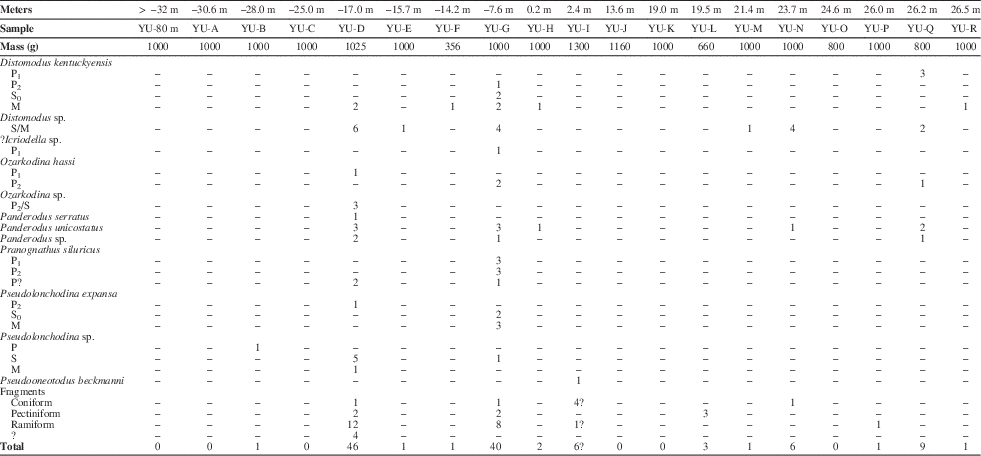
Sixty meters of the upper Zalaa and lower Sharchuluut formations were measured and described across the contact; 19 carbonate samples were collected (Table 1; Fig. 2) and processed for conodonts using a buffered 10% formic acid solution, and lithium metatungstate for heavy liquid separation of the remaining residue. Conodonts were then picked from the processed sample and imaged using a scanning electron microscope. The Zalaa and Sharchuluut formations were sampled at Yamaan Us (section “Yamaan Us-2” of Minjin et al., Reference Minjin, Sersmaa, Undarya, Gereltsetseg, Naymsuren, Bolortsetseg and Tumenbayar2001) in the western portion of the Shine Jinst region (Fig. 1). The measured section began in the upper Zalaa Formation (Fig. 2). The lower 32 m of the section consisted of green-gray shales with fossiliferous carbonate interbeds and lenses. Carbonates are typically green, weathering to grayish brown, and contain crinoids, trilobites, brachiopods, and orthoconic nautiloids. Overlying this shale unit, the Zalaa grades from green shales to pink and white, weathering to yellow-brown, recrystallized crinoidal grainstones interbedded with red and green shales. This transitions back to green-gray shale with interbedded greenish gray and reddish brown, weathering to red-brown, carbonates for ~5.5 m. The base of the Sharchuluut is recognized by the persistent carbonates consisting of reddish brown crinoidal grainstone with rare shale (Figs. 1b, 2). Conodonts were found throughout the section, although never in great abundance. Additional fauna in the thin carbonate beds included ostracodes, proetid trilobites, rhynchonellid brachiopods, and monoplacophorans. The thicker carbonates in the uppermost Zalaa and lower Sharchuluut contained abundant crinoidal remains.
Stratigraphic section of Yamaan Us showing carbonate samples processed for conodont recovery. Sample names begin with YU- followed by a letter.
Conodont specimens and sample data from Yamaan Us. Sample names correspond to Figure 2. Sample YU-80 is located 80 m below ‒32 m.
Results and discussion
Conodont fauna, age, and zonation
Thirteen samples produced conodonts with yields ranging from 1 to 46 specimens per kilogram. The remaining samples were barren. Seven species representing six genera were identified from the 13 samples; these include Distomodus kentuckyensis Branson and Branson, Reference Branson and Branson1947, Ozarkodina hassi (Pollock, Rexroad, and Nicoll, Reference Pollock, Rexroad and Nicoll1970), Panderodus serratus Rexroad, Reference Rexroad1967, Panderodus unicostatus (Branson and Mehl, Reference Branson and Mehl1933a), Pranognathus siluricus (Pollock, Rexroad, and Nicoll, Reference Pollock, Rexroad and Nicoll1970), Pseudolonchodina expansa (Armstrong, Reference Armstrong1990), and Pseudooneotodus beckmanni (Bischoff and Sannemann, Reference Bischoff and Sannemann1958); Icriodella was tentatively identified.
The conodont taxa recovered from the Zalaa and Sharchuluut formations occur in lower Silurian (Llandovery) strata worldwide. Pseudolonchodina (Aspelundia) expansa was first used as the nominate species of the basal Llandovery biozone of the Greenland slope facies (Armstrong, Reference Armstrong1990). In Latvia, the Ps. expansa biozone was found to correlate with the upper cyphus to upper leptotheca graptolite biozones that correspond to the late Rhuddanian through early Aeronian (Loydell et al., Reference Loydell, Männik and Nestor2003). In more recent global zonation schemes (Cramer et al., Reference Cramer, Brett, Melchin, Männik, Kleffner, McLaughlin, Loydell, Munnecke, Jeppsson, Corradini, Brunton and Saltzman2011; Melchin et al., Reference Melchin, Sadler and Cramer2012), there is a degree of uncertainty concerning the correlation of the expansa Zone to the graptolite zonation, although it is still found to span the Rhuddanian-Aeronian boundary. Pseudolonchodina expansa has also been reported from Canada (Zhang and Barnes, Reference Zhang and Barnes2002), Alaska (Dumoulin et al., Reference Dumoulin, Bradley, Harris and Repetski1997), Estonia (for references, see Männik and Malkowski, Reference Männik and Malkowski1998), Poland (Männik and Malkowski, Reference Männik and Malkowski1998), Russia (Männik et al., Reference Männik, Bogolepova, Põldvere and Gubanov2009), Australia (Simpson and Talent, Reference Simpson and Talent1995), and Spain (Sarmiento et al., Reference Sarmiento, Méndez-Bedia, Aramburu, Arbizu and Truyols1994).
The Distomodus kentuckyensis Zone is commonly assigned to the strata below the first occurrence of Pseudolonchodina expansa, making D. kentuckyensis the lowermost Rhuddanian biozone in the global zonation scheme compiled by Cramer et al. (Reference Cramer, Brett, Melchin, Männik, Kleffner, McLaughlin, Loydell, Munnecke, Jeppsson, Corradini, Brunton and Saltzman2011). Distomodus kentuckyensis has been reported from North America (for references, see Zhang and Barnes, Reference Zhang and Barnes2002), the United Kingdom (Aldridge, Reference Aldridge1972, Reference Aldridge2002), Sweden (Dahlqvist and Bergström, Reference Dahlqvist and Bergström2005), Norway (Aldridge and Mohamed, Reference Aldridge and Mohamed1982), and Russia (Zhang and Barnes, Reference Zhang and Barnes2007b). It frequently ranges from the lowest Rhuddanian into the Aeronian. Distomodus kentuckyensis has been recorded across the Ordovician-Silurian boundary in Sweden (Bergström et al., Reference Bergström, Eriksson, Young and Widmark2012), and terminates before the first appearance of D. staurognathoides (WalliserReference Walliser1964) (see Stott and von Bitter, Reference Stott and von Bitter1999; see synonymy for additional references).
Ozarkodina hassi is a characteristic species of the Distomodus kentuckyensis Zone (Aldridge, Reference Aldridge1972; McCracken and Barnes, Reference McCracken and Barnes1981). The first occurrence of O. hassi [and/or O. oldhamensis (Rexroad, Reference Rexroad1967)] was considered to be indicative of the Ordovician-Silurian boundary by McCracken and Barnes (Reference McCracken and Barnes1981), and O. hassi is the nominate species of the lowest Llandovery biozone from Anticosti Island (Zhang and Barnes, Reference Zhang and Barnes2002), as well as from Sweden (Bergström et al., Reference Bergström, Eriksson, Young and Widmark2012). Bergström et al. (Reference Bergström, Eriksson, Young and Widmark2012) reported occurrences of O. hassi in the latest Ordovician, across the Ordovician-Silurian boundary, and into the Telychian. Ozarkodina hassi also occurs in North America (for references, see Zhang and Barnes, Reference Zhang and Barnes2002), the United Kingdom (Aldridge, Reference Aldridge1972, Reference Aldridge2002), and Norway (Aldridge and Mohamed, Reference Aldridge and Mohamed1982).
Pranognathus siluricus has only been reported from Aeronian strata (Pollock et al. Reference Pollock, Rexroad and Nicoll1970; Aldridge, Reference Aldridge1972; Uyeno and Barnes, Reference Uyeno and Barnes1983; Dahlqvist and Bergström, Reference Dahlqvist and Bergström2005). It was first recognized by Pollock et al. (Reference Pollock, Rexroad and Nicoll1970) as Aphelognathus siluricus from northern Michigan and Ontario. It has since been documented in the United Kingdom (Aldridge, Reference Aldridge1972), Canada (Uyeno and Barnes, Reference Uyeno and Barnes1983; Stott and von Bitter,Reference Stott and von Bitter1999), Sweden (Dahlqvist and Bergström, Reference Dahlqvist and Bergström2005), and Russia (for references, see Dahlqvist and Bergström, Reference Dahlqvist and Bergström2005). The first appearance of Pr. siluricus in the Welsh Borderland (Aldridge, Reference Aldridge1972) occurs within the same sample as the first appearance of Pranognathus tenuis (Aldridge, Reference Aldridge1972), at the base of the Pr. tenuis Zone (Cramer et al., Reference Cramer, Brett, Melchin, Männik, Kleffner, McLaughlin, Loydell, Munnecke, Jeppsson, Corradini, Brunton and Saltzman2011). In central Sweden (Dahlqvist and Bergström, Reference Dahlqvist and Bergström2005) and Ontario (Stott and von Bitter, Reference Stott and von Bitter1999), Pr. siluricus and Pr. tenuis also coincide, and both have been shown to terminate below the Distomodus staurognathoides datum (Stott and von Bitter, Reference Stott and von Bitter1999).
Panderodus and Pseudooneotodus are long-ranging, simple coniform genera that are frequently found in Silurian strata. Panderodus serratus ranges from the Ordovician to the Ludlow (Mellgren, Reference Mellgren2010), and Panderodus unicostatus and Pseudooneotodus beckmanni range from the Ordovician to the Lower Devonian (Zhang and Barnes, Reference Zhang and Barnes2002; Corradini, Reference Corradini2007; Zhang, Reference Zhang2011, Reference Zhang2013); as such, these taxa are of little use for age constraint.
Distomodus kentuckyensis and Ozarkodina hassi occur before the first appearance of Pseudolonchodina expansa, and range to the middle Aeronian or higher. The range of Pranognathus siluricus has been shown to be mid-Aeronian B3 through C1 zones (Stott and von Bitter, Reference Stott and von Bitter1999). This corresponds to the Pr. tenuis Zone of Cramer et al. (Reference Cramer, Brett, Melchin, Männik, Kleffner, McLaughlin, Loydell, Munnecke, Jeppsson, Corradini, Brunton and Saltzman2011), which marks the upper boundary of the Ps. expansa Zone. Pseudolonchodina expansa has been found to occur above the D. staurognathoides datum (Männik, Reference Männik2007), which marks the upper boundary of the Pr. tenuis Zone (Cramer et al., Reference Cramer, Brett, Melchin, Männik, Kleffner, McLaughlin, Loydell, Munnecke, Jeppsson, Corradini, Brunton and Saltzman2011), therefore the range of Ps. expansa can overlap with that of Pr. siluricus. Pranognathus siluricus has not been reported to occur below the first appearance of Pr. tenuis, therefore it is most likely that the range of Pr. siluricus begins at or within the Pr. tenuis Zone.
At Yamaan Us the lowermost sample within the upper Zalaa Formation to contain diagnostic conodonts (YU-D) contains Pranognathus siluricus. This is indicative of the Pr. tenuis Zone at that level. No diagnostic conodonts were recovered from below YU-D to further constrain the lower part of the section. Taxa with a first appearance above the Pr. tenuis Zone (i.e., Distomodus staurognathoides) were not found in the studied section. The uppermost samples in the lower Sharchuluut (YU-Q and YU-R) contain elements of Distomodus kentuckyensis, therefore the lower Sharchuluut is restricted to a zone below the D. staurognathoides first appearance datum. The highest zone below the D. staurognathoides Zone is the Pr. tenuis Zone, recognized in the lowest diagnostic sample of the upper Zalaa. This restricts the uppermost Zalaa and lower Sharchuluut formations to the Pr. tenuis Zone, indicative of a late-middle to early-late Aeronian age for the onset of the Silurian carbonate platform within the Gobi-Altai Zone.
Paleoenvironment
Marine faunas such as Late Ordovician conodonts can be used to interpret paleolatitude (Bergström, Reference Bergström1990). Llandovery conodonts frequently occur in areas located at tropical paleolatitudes (i.e., Laurentia and Baltica) although this does not display provincialism because little is known about high-latitude faunas. The Silurian conodont faunas that have been recorded in areas of higher paleolatitudes are similar to typical Llandovery fauna (Lehnert et al., Reference Lehnert, Bergström, Benedetto and Vaccari1999). Llandovery conodonts have been found to be more useful for interpreting depth rather than latitude (Sarmiento et al., Reference Sarmiento, Méndez-Bedia, Aramburu, Arbizu and Truyols1994; Lehnert et al., Reference Lehnert, Bergström, Benedetto and Vaccari1999; Dahlqvist and Bergström, Reference Dahlqvist and Bergström2005), and display environmental preference corresponding to facies depth. Because the sample size of the Yamaan Us fauna is small, true relative abundance of taxa is difficult to determine and the paleoecological interpretation must be general.
Ozarkodina hassi is generally considered to prefer shallower water (Idris, Reference Idris1984; Armstrong, Reference Armstrong1990; Aldridge, Reference Aldridge2002; Dahlqvist and Bergström, Reference Dahlqvist and Bergström2005). In contrast, Pseudolonchodina is most abundant in deeper water slope facies (Armstrong, Reference Armstrong1990; Aldridge, Reference Aldridge2002; Dahlqvist and Bergström, Reference Dahlqvist and Bergström2005). Species of Distomodus have also been considered to prefer shallower water (Aldridge, Reference Aldridge2002), although D. kentuckyensis was found to occur in both shallow and deep water facies by Idris (Reference Idris1984), and Distomodus was considered characteristic of moderate depth by Dahlqvist and Bergström (Reference Dahlqvist and Bergström2005). Because the present fauna is typical of both deep and shallow water facies, deposition most likely occurred at moderate depth in a dynamic environment. This is supported by the lithology and associated fauna of the upper Zalaa where the shale and thin carbonates mark the transition from a deep shelf-basin to shallower shelf setting. The cosmopolitan nature of the fauna also indicates connection and circulation with the open ocean, thus, in light of the present conodont fauna, the Zalaa and Sharchuluut formations were deposited in an open basin-shelf environment.
Systematic paleontology
Apparatus notation is based on that of Purnell et al. (Reference Purnell, Donoghue and Aldridge2000), although terms to describe orientation (e.g., anterior, posterior, inner, outer, upper, and lower) are used conventionally (Sweet, Reference Sweet1981, Reference Sweet1988) and do not refer to true biological orientation. Descriptions are based on both Yamaan Us specimens and works cited herein. The collection is stored at the Research Center for Stratigraphy and Paleontology of the Mongolian University of Science and Technology. Figured specimens are identified with call numbers CND/09-01–CND/09-28.
Family Balognathidae Hass, Reference Hass1959
Genus Pranognathus Männik and Aldridge, Reference Männik and Aldridge1989
Type Species
Amorphognathus tenuis Aldridge, Reference Aldridge1972.
Pranognathus siluricus (Pollock, Rexroad, and Nicoll, Reference Pollock, Rexroad and Nicoll1970)
Scanning electron microscope images of Llandovery conodonts from the upper Zalaa and lower Sharchuluut formations at Yamaan Us. Collection stored at the Research Center for Stratigraphy and Paleontology of the Mongolian University of Science and Technology, with call numbers CND/09-01–CND/09-28. Call numbers are followed by sample name: (1–7)Distomodus kentuckyensis; (1, 2) P1 elements, upper views (a), lower views (b); (1) CND/09-01, YU-Q; (2) CND/09-02, YU-Q; (3) P1 element, upper view, CND/09-03, YU-Q; (4) P2 element, posterior view (a), anterior view (b), CND/09-04, YU-G; (5) S0 element, posterior view (a), lateral view (b), CND/09-05, YU-G; (6) M element, outer lateral view, CND/09-06, YU-F; (7) M element, outer lateral view (a), oblique inner lateral view (b), outline indicating view in Fig. 3.7c, magnification of Fig. 3.7b to show striations (c), CND/09-07, YU-G. (8)Distomodus sp., S element, inner lateral view (a), outline indicating view in Fig. 3.8b, magnification of Fig. 3.8a to show striations (b), CND/09-08, YU-D. (9)Pseudooneotodus beckmanni, upper view (a), oblique lower view (b), CND/09-09, YU-I. (10)Panderodus serratus, lateral view, CND/09-10, YU-D. (11)Panderodus unicostatus, lateral view, CND/09-11, YU-N. (12, 13)Panderodus sp., lateral view; (12) CND/09-12, YU-D; (13) CND/09-13, YU-G. (14)Icriodella sp., P1 element, upper view (a), lower view (b), CND/09-14, YU-G. (15–18)Pseudolonchodina expansa; (15) S0 element, oblique lower view, CND/09-15, YU-G; (16) S0 element, posterior view, CND/09-16, YU-G; (17) P2 element, posterior view, CND/09-17, YU-D; (18) M element, inner lateral view, CND/09-18, YU-G. (19)Pseudolonchodina sp., S element, lateral view, CND/09-19, YU-D. (20–24)Pranognathus siluricus; (20) P2 element, outer lateral view (a), inner lateral view (b), CND/09-20, YU-G; (21) P2 element, upper view, CND/09-21, YU-G; (22) P1 element, lower view, CND/09-22, YU-G; (23, 24) P1 elements, lateral views (a), upper views (b); (23) CND/09-23, YU-G; (24) CND/09-24, YU-G. (25)Ozarkodina sp., P2/S element, lateral view, CND/09-25, YU-D. (26–28)Ozarkodina hassi; (26, 27) P2 elements, lateral views; (26) CND/09-26, YU-Q; (27) CND/09-27, YU-G; (28) P1 element, lateral view (a), upper view (b), CND/09-28, YU-D. Scale bars=100 µm.
1970 Aphelognathus siluricus Pollock, Rexroad, and Nicoll, p. 749, pl. 114, figs. 1–4.
1972 Aphelognathus siluricus; Aldridge, p. 165, pl. 3, fig. 3.
1977 Llandoverygnathus siluricus; Cooper, p. 1064, pl. 1, figs. 2–4, 8–10, pl. 2, figs. 4, 7 (see for synonymy).
1981 Pterospathodus siluricus; Uyeno in Uyeno and Barnes, pl. 1, fig. 1.
1983 Pterospathodus siluricus; Uyeno in Uyeno and Barnes, p. 25, pl. 1, figs. 7–13.
1989 Pranognathus siluricus; Männik and Aldridge, p. 904.
2005 Pranognathus siluricus; Dahlqvist and Bergström, p. 16, fig. 12c–e.
Holotype
Aphelognathus siluricus (P1 element), Indiana University/Indiana Geological Survey 12511, Neahga Shale, locality 16, sample 6, Niagara Falls, Ontario, Canada (Pollock et al. Reference Pollock, Rexroad and Nicoll1970, pl. 114, fig. 2).
Occurrence
Pranognathus siluricus has only been described from Aeronian strata (Aldridge, Reference Aldridge1972; Cooper, Reference Cooper1977; Uyeno and Barnes, Reference Uyeno and Barnes1983; Dahlqvist and Bergström, Reference Dahlqvist and Bergström2005) corresponding to the Pr. tenuis Zone of Cramer et al. (Reference Cramer, Brett, Melchin, Männik, Kleffner, McLaughlin, Loydell, Munnecke, Jeppsson, Corradini, Brunton and Saltzman2011). Pranognathus siluricus terminates below the Distomodus staurognathoides datum (Stott and von Bitter, Reference Stott and von Bitter1999).
Description
P1 element: Blade is slightly arched, widens at the base, and consists of a slightly larger cusp and typically 11–14 subequal, subrounded denticles that form an arch in lateral view. In oral view, the posterior process is offset, and small, unornamented, offset lateral processes are visible. Entire aboral surface is deeply excavated (Pollock et al., Reference Pollock, Rexroad and Nicoll1970; Aldridge, Reference Aldridge1972).
P2 element: Blade consists of a short, stout central cusp with denticulate anterior and posterior processes, equal or unequal in length, which are downwardly directed and flare to create a wide base. Denticles are either discrete or almost entirely fused to the apices. A low ridge directed anteriorly on the outer lateral face of the cusp can be considered a third or rudimentary process that is usually unornamented, as in the Yamaan Us specimens, but can be serrated. Occasionally a small, serrated ridge forms on the posterior inner lateral face. Entire aboral surface is wide and deeply excavated (Aldridge, Reference Aldridge1972).
Remarks
Pranognathus siluricus was first described by Pollock et al. (Reference Pollock, Rexroad and Nicoll1970) as a species of Aphelognathus Branson, Mehl, and Branson, Reference Branson, Mehl and Branson1951, which is an Ordovician taxon. Cooper (Reference Cooper1977) placed A. siluricus in Llandoverygnathus Walliser, Reference Walliser1972, which was considered a junior synonym to Pterospathodus WalliserReference Walliser1964, by Klapper and Murphy (Reference Klapper and Murphy1975) and Barrick and Klapper (Reference Barrick and Klapper1976). Uyeno in Uyeno and Barnes (Reference Uyeno and Barnes1981) therefore assigned the taxon to Pterospathodus. Männik and Aldridge (Reference Männik and Aldridge1989) then described Pranognathus, a newly recognized genus encompassing three previously described taxa with potential ancestry to Pterospathodus, including Aphelognathus siluricus, Amorphognathus tenuis Aldridge, Reference Aldridge1972, and Pterospathodus posteritenius Uyeno and Barnes, Reference Uyeno and Barnes1983.
Uyeno and Barnes (Reference Uyeno and Barnes1983) described the P1 element of Pranognathus siluricus as having a basal margin flare only on the outer side, and compared this with Pterospathodus celloni (WalliserReference Walliser1964,) that exhibits lateral flares on both sides. This description of Pr. siluricus differs from the description of the holotype by Pollock et al. (Reference Pollock, Rexroad and Nicoll1970) that specifically describes flares on both lateral faces. Cooper (Reference Cooper1977) and Männik (Reference Männik1998) discussed that P elements of Pranognathus differ from Pterospathodus in having a wide, deep basal cavity. When compared with the holotype of Pt. celloni, Pr. siluricus has a wider, deeper basal cavity. Pranognathus siluricus can have less prominent lateral processes, although there is variation in shape and extension. This can be seen in the Yamaan Us specimens (Fig. 3.23, 3.24).
Family Distomodontidae Klapper, Reference Klapper1981
Genus Distomodus Branson and Branson, Reference Branson and Branson1947
Type species
Distomodus kentuckyensis Branson and Branson, Reference Branson and Branson1947.
Distomodus kentuckyensis Branson and Branson, Reference Branson and Branson1947
1947 Distomodus kentuckyensis Branson and Branson, p. 553, pl. 81, figs. 21–23, 27, 29–33, 36–41.
1996 Distomodus kentuckyensis; Bergström and Bergström, fig. 9D, 9E, 9H?.
2002 Distomodus kentuckyensis; Zhang and Barnes, p. 13, fig. 14.18–14.26 (see for synonymy).
2005 Distomodus kentuckyensis; Dahlqvist and Bergström, p. 16, fig. 12(l).
2007b Distomodus kentuckyensis; Zhang and Barnes, p. 507, fig. 9.17–9.21.
2012 Distomodus kentuckyensis; Bergström et al., fig. 7G.
Holotype
Distomodus kentuckyensis (M element), University of Missouri C675-1, locality 1970, Brassfield Formation, Madison County, Kentucky, USA (Branson and Branson, Reference Branson and Branson1947, pl. 81, figs. 40, 41).
Occurrence
Occurs globally in the Distomodus kentuckyensis assemblage Zone that is typically correlated with early Rhuddanian to late, although not latest, Rhuddanian strata (Cramer et al., Reference Cramer, Brett, Melchin, Männik, Kleffner, McLaughlin, Loydell, Munnecke, Jeppsson, Corradini, Brunton and Saltzman2011). Distomodus kentuckyensis typically ranges from the lowest Rhuddanian through the Aeronian (Dahlqvist and Bergström, Reference Dahlqvist and Bergström2005), although it has been documented in the latest Ordovician across the Ordovician-Silurian boundary (Bergström et al., Reference Bergström, Eriksson, Young and Widmark2012), and terminates at the D. staurognathoides datum (Stott and von Bitter, Reference Stott and von Bitter1999).
Description
P1 element: Platform outline is generally cruciform, with a slight curve in the transverse axis concave toward the posterior. Longitudinal processes typically more elongate than lateral processes. All processes develop irregular, coalesced nodes and ridges. Entire aboral surface is deeply excavated (Rexroad, Reference Rexroad1967).
P2 element: Cusp is straight or slightly recurved, with a sharp anterior margin and a rounded or angular posterior margin. A single process extends from the anterior base of the cusp, directed downward, can be twisted laterally, and bears subround to laterally compressed, partially fused denticles. Posterior-lateral base of the cusp flares broadly, creating an expanded shallow basal cavity that is deepest under the cusp and extends under the anterior process (Rexroad, Reference Rexroad1967).
M element: Cusp is straight or curved, increasing in convexity toward the inner side of the base, with sharp or blunt anterior and posterior margins; specimens from Yamaan Us typically show a sharp anterior margin on the inner lateral side; straight anterior process extends downward from the cusp to a sharp point; anterior and posterior processes can bear one or two small, compressed denticles; basal cavity is wide and deep beneath the cusp, and extends as grooves beneath both processes (Branson and Branson, Reference Branson and Branson1947; Rexroad, Reference Rexroad1967; Zhang and Barnes, Reference Zhang and Barnes2002). Some specimens from Yamaan Us have an outer lateral costa (Fig. 3.6); anterior and posterior costae were described previously by Rexroad (Reference Rexroad1967).
S0 element: Symmetrical element nearly triangular in cross section. Curved cusp can be slightly twisted, and bears two lateral and one posterior costae that give rise to downward-directed, denticulate lateral and posterior processes. Cusp is deeply excavated; basal cavity extends under the processes (Rexroad, Reference Rexroad1967; Aldridge, Reference Aldridge1972).
Remarks
P1 elements recovered are fragmented, yet display the anterior, posterior, and lateral processes. Specimens illustrated in Figure 3.1 and 3.2 might be pieces of a single element.
Cooper (Reference Cooper1977) discussed the difference between Distomodus kentuckyensis and D. staurognathoides that can be seen in the P elements. The P1 elements are easily distinguished because D. kentuckyensis will only have four processes whereas D. staurognathoides will have five or more. The recovered elements are fragmented, making classification based on the number of processes difficult, yet ornamentation of the processes show distinct differences between the two taxa. Distomodus staurognathoides typically displays an irregular network of ridges, and some processes develop a carina with discrete nodes (see Bischoff, Reference Bischoff1986); specimens figured by Aldridge (Reference Aldridge1972) show rows of well-developed denticles on reduced platforms. Distomodus kentuckyensis develops more robust ornamentation of irregular nodes that can coalesce to form ridges (see Zhang and Barnes, Reference Zhang and Barnes2002 for Pa element synonymy).
The S and M elements of Distomodus kentuckyensis and D. staurognathoides from Anticosti Island were distinguished by patterns in microstriations by Zhang and Barnes (Reference Zhang and Barnes2002). The striations in D. staurognathoides are more regular and pronounced, whereas those in D. kentuckyensis are discontinuous and of low relief. The microstriations of D. kentuckyensis specimens from Yamaan Us are comparable to those recovered from Anticosti Island (Fig. 3.7c).
Distomodus sp.
Remarks
Several fragmented S elements of Distomodus sp. were recovered. Some specimens (e.g., Fig. 3.8) might be unique Distomodus elements. They have clear microstriations but are not comparable to either D. kentuckyensis or D. staurognathoides striations from Anticosti Island (Zhang and Barnes, Reference Zhang and Barnes2002). The striations are more pronounced than those of D. kentuckyensis but are not as regular as D. staurognathoides. It is unlikely that D. staurognathoides occurs in this section, because it does not occur with D. kentuckyensis. These fragments are too broken to confidently identify as D. kentuckyensis.
Family Icriodellidae Sweet, Reference Sweet1988
Genus Icriodella Rhodes, Reference Rhodes1953
Type species
Icriodella superba Rhodes, Reference Rhodes1953.
Occurrence
Middle Ordovician to Llandovery (Klapper and Bergström, Reference Klapper and Bergström1981).
?Icriodella sp.
Remarks
Platform elements with two distinct rows of denticles and a deeply excavated aboral surface are characteristic of the genus Icriodella (Rhodes, Reference Rhodes1953; Klapper and Bergström, Reference Klapper and Bergström1981). The specimen from Yamaan Us is a P1 element consisting of two rows of elliptical denticles with an asymmetrical cusp connected by thin ridges, and a deeply excavated base, which conforms to genus Icriodella.
Family Panderodontidae Lindstrӧm, Reference Lindström1970
Genus Panderodus Ethington, Reference Ethington1959
Type species
Paltodus unicostatus Branson and Mehl, Reference Branson and Mehl1933a.
Panderodus serratus Rexroad, Reference Rexroad1967
1967 Panderodus unicostatus serratus Rexroad, p. 47, pl. 4, figs. 3, 4.
1988 Panderodus serratus; Nowlan et al., p. 23, pl. 8, figs. 5–7 (see for synonymy).
1997 Panderodus serratus; Jeppsson, p. 107, fig. 7.4.
2002 Panderodus serratus; Aldridge, pl. 4, fig. 18.
2002 Panderodus serratus; Loydell et al., fig. 4g, h, k.
2006 Panderodus serratus; Valentine et al., p. 230, fig. 11c, d.
2010 Panderodus serratus; Wang and Aldridge, pl. 5, figs. 18–32.
?2013 Panderodus serratus; Jarochowska et al., fig. 2.18.
Holotype
Panderodus unicostatus serratus, Indiana University/Indiana Geological Survey 10063, locality 3, sample 10, Brassfield Formation, Madison County, Kentucky, USA (Rexroad, Reference Rexroad1967, pl. 4, fig. 3).
Occurrence
Middle Ordovician to Ludlow (Mellgren, Reference Mellgren2010).
Remarks
Serrated Panderodus elements, which develop denticles along the posterior margin, have been considered various species. Rexroad (Reference Rexroad1967) considered Pa. serratus a subspecies of Pa. unicostatus, noting the only difference being denticulation on the posterior margin. Cooper (Reference Cooper1975) considered Pa. serratus a multi-element apparatus consisting of denticulate and adenticulate coniform elements. Nowlan and Barnes (Reference Nowlan and Barnes1981), McCracken and Barnes (Reference McCracken and Barnes1981), and Nowlan et al. (Reference Nowlan, McCracken and Chatterton1988) classified Pa. serratus as a form taxon that might be a possible variant of Pa. gracilis (Branson and Mehl, Reference Branson and Mehl1933b). For further discussion and references concerning serrate Panderodus elements, see Mellgren (Reference Mellgren2010).
Panderodus unicostatus (Branson and Mehl, Reference Branson and Mehl1933a)
1933a Paltodus unicostatus Branson and Mehl, p. 42, pl. 3, fig. 3.
1976 Panderodus unicostatus; Cooper, p. 213, pl. 1, figs. 1–7, 22.
1977 Panderodus unicostatus; Barrick, p. 56, pl. 3, figs. 1, 2, 5, 6.
1995 Panderodus unicostatus; Simpson and Talent, p. 118, pl. 2, figs. 1–32 (see for synonymy).
1997 Panderodus unicostatus; Jeppsson, fig. 7.3.
2002 Panderodus unicostatus; Zhang and Barnes, p. 32, fig. 15. 1–15.24 (see for synonymy).
2002 Panderodus unicostatus; Pyle and Barnes, p. 86, pl. 20, figs. 15, 16.
2003 Panderodus unicostatus; Pyle and Barnes, fig. 17.20– 17.23.
2005 Panderodus unicostatus; Dahlqvist and Bergström, p. 16, fig. 12n, o.
2006 Panderodus unicostatus; Valentine et al., p. 230, figs. 10p, 11a–b (see for synonymy).
2007a Panderodus unicostatus; Zhang and Barnes, fig. 10.16– 10.22.
2007b Panderodus unicostatus; Zhang and Barnes, fig. 8.21– 8.28.
2009 Panderodus unicostatus; Corriga and Corradini, fig. 6O.
2009 Panderodus unicostatus; Munnecke and Männik, fig. 5X–Z.
2010 Panderodus unicostatus; Corradini and Corriga, pl. 1, figs. 19, 20.
2010 Panderodus unicostatus; Wang and Aldridge, pl. 6, figs. 1–18.
2011 Panderodus unicostatus; Zhang, fig. 17.26–17.31.
2012 Panderodus unicostatus; Slavík and Carls, fig. 3V.
2013 Panderodus unicostatus; Jarochowska et al., fig. 2.17.
2013 Panderodus unicostatus; Zhang, fig. 10.8–10.14.
2014 Panderodus unicostatus; Harris et al., fig. 8D, E.
2014 Panderodus unicostatus; Sullivan et al., figs. 6.5, 6.6, 7.17–7.19.
2014 Panderodus unicostatus; Zhang and Pell, figs. 6.9–6.14, 10.14, 10.16.
Cotypes
Paltodus unicostatus, University of Missouri C153-3, Bainbridge Formation, Lithium, Missouri, USA (Branson and Mehl, Reference Branson and Mehl1933a, pl. 3, fig. 3).
Occurrence
Occurs globally from the Upper Ordovician to Early Devonian (Zhang and Barnes, Reference Zhang and Barnes2002; Zhang, Reference Zhang2011, Reference Zhang2013).
Description
Panderodus unicostatus has previously been described by Cooper (Reference Cooper1976), and Barrick (Reference Barrick1977).
Remarks
The recovered elements of Panderodus unicostatus range from rounded and circular in cross section, to compressed with lenticular cross sections. The compressed specimens are densely striated at the base; striations extend the length of the cusp along the sides of a longitudinal, posterior-lateral groove that extends from a notch in the posterior edge of the base. The rounded specimens display a similar striation pattern, and have a costa that begins at the top of the basal striations.
Panderodus sp.
Remarks
Simple cone specimens are placed in Panderodus sp. because of their general shape or presence of the longitudinal groove. The specimen in Figure 3.12 is more robust and has coarser, more abundant striations than Pa. unicostatus. The specimen in Figure 3.13 has striation patterns and longitudinal groove similar to those in specimens of Pa. unicostatus, athough it has sharp anterolateral margins and a subtriangular cross section.
Family Prioniodinidae Bassler, Reference Bassler1925
Genus Pseudolonchodina Zhou, Zhai, and Xian, Reference Zhou, Zhai and Xian1981
Type Species
Pseudolonchodina irregularis Zhou, Zhai, and Xian, Reference Zhou, Zhai and Xian1981.
Remarks
Based on the observations of Simpson and Talent (Reference Simpson and Talent1995) and Wang and Aldridge (Reference Wang and Aldridge2010), Aspelundia Savage, Reference Savage1985 is a junior synonym of Pseudolonchodina. Thus, Pseudolonchodina takes precedence.
Pseudolonchodina expansa (Armstrong, Reference Armstrong1990)
1990 Aspelundia expansa Armstrong, p. 50, pl. 3, figs. 13–20.
1995 Pseudolonchodina expansa; Simpson and Talent, p. 111, pl. 1, fig. 3 (see for synonymy).
1997 Aspelundia expansa; Dumoulin et al., fig. 4BB–DD.
1998 Aspelundia expansa; Männik and Malkowski, pl. 1, figs. 34–35.
2002 Oulodus? expansus; Zhang and Barnes, p. 21, fig. 10.1–10.14 (see for synonymy).
2003 Aspelundia expansa; Loydell et al., fig. 14z, aa.
2007a Aspelundia expansa; Zhang and Barnes, fig. 12.14– 12.17.
2009 Aspelundia? expansa; Männik et al., fig. 5bb, cc.
2010 Aspelundia? expansa; Loydell et al., fig. 9c, d, h.
?2010 ?Pseudolonchodina expansa; Wang and Aldridge, p. 82, pl. 20, fig. 1.
Holotype
Aspelundia expansa (P2 element), MGUH 17.687, sample GGU 216837, Cape Schuchert Formation, Kap Schuchert, Washington Land, western North Greenland (Armstrong, Reference Armstrong1990, pl. 3, fig. 13).
Occurrence
Occurs globally. First occurrence marks the base of the Pseudolonchodina (Aspelundia) expansa Zone that spans the upper Rhuddanian to lower Aeronian (Loydell et al., Reference Loydell, Männik and Nestor2003). Occurrences have been found to range into the Distomodus staurognathoides Zone (Männik, Reference Männik2007) and to the mid-Telychian (Zhang and Barnes, Reference Zhang and Barnes2002).
Description
P2 element: Consists of a cusp and two lateral denticulate processes. Outer lateral process is straight and downturned, forming a 100° angle with the inner lateral edge of the cusp, bearing 4–10 compressed denticles; inner lateral process is shorter, twisted anteriorly, and bears up to 10 compressed denticles, and occasionally a short unornamented, inward-directed projection beneath the first proximal denticles (Armstrong, Reference Armstrong1990); processes are incomplete in Yamaan Us specimen. Cusp is usually the same width as the denticles, laterally compressed with a flattened, lenticular cross section, and inclined toward the inner lateral process. Wide basal cavity, rounded in aboral view, expands broadly under the cusp; posterior edge is upturned and inclined toward the inner lateral process, and tapers into narrow grooves under the processes (Armstrong, Reference Armstrong1990).
M element: Cusp is large, laterally compressed, with a sharp anterior and rounded posterior edge. It is inwardly twisted, inclined posteriorly, and slightly separated from the denticles on the posterior process. Posterior process is inwardly bowed and bears 6–8 compressed, posteriorly inclined denticles. Basal cavity is shallowly excavated and upturned on the inner side, where it flares laterally beneath the posterior edge of the cusp and process (Armstrong, Reference Armstrong1990). Occasionally specimens with an anterior process are known to occur (Simpson and Talent, Reference Simpson and Talent1995); this does not occur in the Mongolian fauna, nor was it described in the Greenland fauna (Armstrong, Reference Armstrong1990).
S0 element: Cusp is oval in cross section and highly inclined toward the posterior. Compressed lateral processes of equal length extend downward from the anterolateral edges of the cusp, creating an angle of 160° between the lower edges in posterior view, and bow posteriorly, each bearing up to five partially fused, compressed denticles. Basal cavity is laterally expanded, extends posteriorly as a broad groove under the cusp, and laterally as narrow grooves under the processes (Armstrong, Reference Armstrong1990).
Remarks
Elements of Pseudolonchodina expansa have a broad basal cavity and widely spaced denticles, distinguished from elements of Ps. fluegeli, which have a narrow basal cavity and a greater number of more closely packed denticles (Simpson and Talent, Reference Simpson and Talent1995).
Pseudolonchondia sp.
Remarks
Several fragments are placed within Pseudolonchodina because of general outline or the presence of the characteristic basal flare under the cusp, although they do not fully conform to species diagnoses or descriptions. The figured S element has a basal flare characteristic of Pseudolonchodina although the element is straighter, much more compressed and denticles are more closely packed than typical Pseudolonchodina S elements.
Family Pseudooneotodidae Wang and Aldridge, Reference Wang and Aldridge2010
Genus Pseudooneotodus Drygant, Reference Drygant1974
Type species
Oneotodus? beckmanni Bischoff and Sannemann, Reference Bischoff and Sannemann1958.
Pseudooneotodus beckmanni (Bischoff and Sannemann, Reference Bischoff and Sannemann1958)
1958 Oneotodus? beckmanni Bischoff and Sannemann, p. 98, pl. 15, figs. 22–25.
1984 Pseudooneotodus beckmanni; Idris, pl. 1, fig. 21.
1999 Pseudooneotodus beckmanni; Sarmiento et al., p. 760, fig. 3.11.
2007 Pseudooneotodus beckmanni; Corradini, p. 142, pl. 1, figs. 1–7 (see for synonymy).
2007a Pseudooneotodus beckmanni; Zhang and Barnes, fig. 10.5.
2007b Pseudooneotodus beckmanni; Zhang and Barnes, fig. 10.29.
2009 Pseudooneotodus beckmanni; Berkyová, fig. 10A–D.
2009 Pseudooneotodus beckmanni; Corradini et al., fig. 3d.
2009 Pseudooneotodus beckmanni; Corriga and Corradini, fig. 6D, E.
2010 Pseudooneotodus beckmanni; Corradini and Corriga, pl. 1, fig. 21.
2010 Pseudooneotodus beckmanni; Wang and Aldridge, p. 32, pl. 2, figs. 19–26.
2011 Pseudooneotodus beckmanni; Corriga et al., fig. 5.12.
2011 Pseudooneotodus beckmanni; Zhang, fig. 17.7.
2011 Pseudooneotodus beckmanni; Zhang et al., fig. 13.9.
2012 Pseudooneotodus beckmanni; Corriga et al., fig. 5.4.
2012 Pseudooneotodus beckmanni; Slavík and Carls, fig. 3U, DD.
2013 Pseudooneotodus beckmanni; Zhang, fig. 10.16.
2014 Pseudooneotodus beckmanni; Corriga et al., fig. 5L.
2014 Pseudooneotodus beckmanni; Gutiérrez-Marco et al., fig. 5b, c.
2014 Pseudooneotodus beckmanni; Zhang and Pell, fig. 6.8.
Holotype
Oneotodus? beckmanni, BiSa 1958/85 (Bischoff and Sannemann, Reference Bischoff and Sannemann1958, pl. 15, fig. 25).
Occurrence
Globally occurring; long ranging from Upper Ordovician to Lower Devonian (Corradini, Reference Corradini2007).
Description
Pseudooneotodus beckmanni is a stout conical element with a single-tipped apex that curves posteriorly. Aboral surface is deeply excavated. The basal outline has been shown to vary, ranging from circular, oval, or subtriangular to other forms (Cooper, Reference Cooper1977).
Remarks
For a discussion of the taxon, refer to Corradini (Reference Corradini2007).
Family Spathognathodontidae Hass, Reference Hass1959
Genus Ozarkodina Branson and Mehl, Reference Branson and Mehl1933a
Type species
Ozarkodina typica Branson and Mehl, Reference Branson and Mehl1933a.
Ozarkodina hassi (Pollock, Rexroad, and Nicoll, Reference Pollock, Rexroad and Nicoll1970)
1970 Spathognathodus hassi Pollock, Rexroad, and Nicoll, p. 760, pl. 111, figs. 8–12.
1991 Ozarkodina hassi; Leatham, pl. III, figs. 3, 6, 7, 10, 13, 16, 18, 21.
2002 Ozarkodina hassi; Aldridge, pl. 4, fig. 1.
2002 Ozarkodina hassi; Zhang and Barnes, p. 28, fig. 13.31– 13.37 (see for synonymy).
2003 Ozarkodina hassi; Pyle and Barnes, figs. 14.30, 17.10– 17.14.
?2010 Ozarkodina aff. hassi; Wang and Aldridge, p. 90, pl. 23, figs. 15–27.
2012 Ozarkodina hassi; Bergström et al., fig. 7H, I.
2014 Ozarkodina hassi; Zhang and Pell, fig. 8.5–8.7.
Holotype
Spathognathodus hassi (P1 element), Indiana University/Indiana Geological Survey 12610, Manitoulin Dolomite, locality 7, sample 2, Manitoulin Island, Ontario, Canada (Pollock et al., Reference Pollock, Rexroad and Nicoll1970, pl. 111, fig. 9).
Occurrence
Occurs globally within the Distomodus kentuckyensis Zone, spaning the Rhuddanian, and ranging to the upper Aeronian (Aldridge, Reference Aldridge1972; Zhang and Barnes, Reference Zhang and Barnes2002). Bergström et al. (Reference Bergström, Eriksson, Young and Widmark2012) documented a range for O. hassi from the Late Ordovician, across the Ordovician-Silurian boundary, and into the Telychian.
Description
P1 element: Typically a prominent cusp is present; large specimens can show widening due to overgrowth by denticles (McCracken and Barnes, Reference McCracken and Barnes1981); specimens have previously been shown to lack a prominent cusp (e.g., Nowlan et al., Reference Nowlan, McCracken and Chatterton1988, p. 17, pl. 5, fig. 18). Denticles are laterally compressed and almost entirely fused to the apices; anterior denticles are slightly longer and thinner than posterior denticles, and tend to incline anteriorly on the anterior end. Basal cavity flares laterally under the cusp, and is slightly asymmetrical and rounded in oral view, although in aboral view tapers anteriorly and posteriorly where it meets the basal margin (Pollock et al., Reference Pollock, Rexroad and Nicoll1970).
P2 element: Cusp is high and wide compared to denticles, and width can increase by overgrowth of short proximal denticles. Denticles gradually decrease in height away from the cusp, and are laterally compressed and almost entirely fused except for the triangular apices. Posterior denticles are significantly shorter than anterior denticles. Posterior process, bearing fewer denticles, is shorter than the anterior process. Basal cavity flares laterally under the cusp and extends as a shallow groove under the processes. Aboral margin is typically straight, but can be slightly arched (McCracken and Barnes, Reference McCracken and Barnes1981; Cooper, Reference Cooper1975). Cusp and denticles incline posteriorly. Some specimens vary from this description in that they have a longer posterior process with more denticles than the anterior process (Fig. 3.27).
Ozarkodina sp.
Remarks
Three specimens of Ozarkodina sp. were recovered. Elements are bowed downward, with a large central cusp inclined toward the posterior; denticles incline posteriorly, and extend up the sides of the cusp; deeply excavated basal cavity extends the length of the element. These specimens are placed within Ozarkodina based on the shape of the cusp, growth of denticles surrounding the cusp, and the excavated basal cavity. Specimens are fragmented and, due to the lack of full denticles and posteriormost and anteriormost processes, a specific apparatus position is left open, comparable to both P2 and S.
Acknowledgments
We thank N. Sullivan, U. Bold, C. Minjin, C. Soja, and P. Myrow for assistance with organization and execution of field work for this study, and C. Corradini, M. Kleffner, and the editors for their helpful comments on the manuscript. We also acknowledge the KECK Geology Consortium and the Geneseo Foundation for financial support.