To understand this book—the focus of which is accurately portrayed by its title, and in particular its subtitle—readers should be aware of two current trends.
The first, which is specific to economics, is that in the modern teaching and practice of the discipline, the history of economic thought plays a relatively limited role. Students and practitioners certainly acknowledge their intellectual predecessors, but there is a tendency to focus on the more recent iterations of an idea—a sort of tacit deployment of the concept of a sufficient statistic. This is partially the result of the fact that some older intellectual contributions tend to be nested in newer ones, as happens when an economist writes down a mathematical model that depends upon an assumption, and a subsequent economist relaxes that assumption to make a more general model. A good example is the work of Kenneth Arrow and Gerard Debreu, which constitutes a more sophisticated version of the contributions of Léon Walras. Regardless, the fact remains that mainstream economics does not typically involve tracing a modern idea back to its progenitors, especially if they existed prior to the Classical school of Adam Smith and his successors. How often does an economics student come across a reference to a Greek philosopher in a textbook or syllabus?
The second trend is the feeling among many people in the Muslim community that there is widespread, global animosity toward Muslims, and that one manifestation of that animosity is a desire to downplay the contribution of Islamic scholars to modern science, especially the Muslim intellectuals who operated during the pre-Renaissance era, a period in which Western scholarship was experiencing a relative slump. Like many scientific claims, the accuracy of Muslims’ perceptions of intellectual discrimination is an open empirical question; however, far less controversial is the notion that Muslims do feel that it is true, and a reading of the book suggests that its author, Abdul Azim Islahi, sympathizes with such a view.
To a modern, practicing economist who does not specialize in the history of economic thought, the two most important chapters are 2 (“Phases of the Development of Economic Thought in Islam”) and 8 (“Links between Muslim Economic Thought and the Mainstream Economics”).
In the second chapter, Islahi divides the intellectual progression into three components: an early formation period, in which scholars focused their attention on the divine scriptures of the Quran and the Sunnah (the verbally transmitted record of the teachings of the Prophet Muhammad); a second phase, in which Muslims began to translate the works of the Greeks into Arabic and to analyze them with their modern tools; and a final phase, in which the Arabic improvements and evolutions of the Greek works were translated into European languages, paving the way for their use by non-Muslim scholars. This division is significant because it points to a potential gap in the knowledge of any scholar who might—due to ignorance or otherwise—decide to jump from the contributions of ancient Greece straight to the European Renaissance and Enlightenment, or, as is more common, simply start with Adam Smith: the Quran and Sunnah, both of which contain important economic theories. We return to this point below in the context of modern economics.
Chapters 3 to 6 actually spell out the contributions of Muslim scholars, including value theory, the market mechanism, monetary theory, and public finance. While these chapters are likely fascinating to economists who enjoy the history of economic thought, most mainstream economists will find them as interesting as reading about the economics contributions of Aristotle, David Hume, or John Stuart Mill.
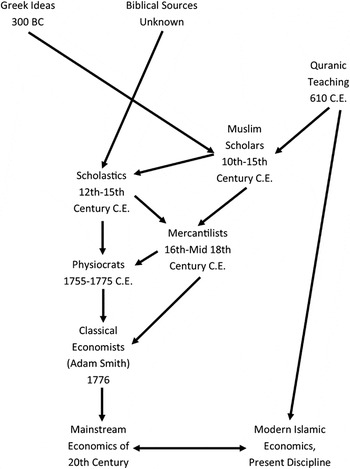
Chapter 8 is where, in my opinion, the rubber truly meets the road, and the content should capture the interest of a broad audience. Islahi discusses the place of Muslim scholars in the family tree of mainstream economics, and he presents a pictorial representation (Figure 1).
Interaction and Influence of Islamic Economics from Beginning up to the Modern Period
Source: Figure 8.3 (p. 87)

Accompanying the figure is the following passage:
The fact that scholastic scholars got Greek ideas through the medium of the Muslim scholars and based their ideas on Greek philosophy and its commentary presented by Muslim philosophers, and the fact that mercantilism came as a result of Muslim influence, the contribution of the Muslim scholars deserves a place in development of mainstream economics. And they must be rehabilitated for the sake of doctrinal continuity and objectivity, academic honesty and justice. (p. 84)
He goes on to say: “Borrowing by the scholastic philosophers from the Muslim scholars in the economic field is the least recognized fact in spite of convincing circumstantial evidences. The main reason could be that the scholastic scholars never cited the Islamic sources in their discourse on economic issues” (pp. 86–88).
Islahi proceeds to analyze potential reasons for these omissions. Unsurprisingly, there is good evidence to suggest that, in the era of Crusades, a denigrating view of Islam and Muslims was a factor. However, borrowing without acknowledgment was apparently an accepted and general practice among scholastics. Moreover, taking a longer horizon, it is worth noting that if casual observation is anything to go by, contemporary mainstream economists exhibit as little knowledge of pre-Adam Smith non-Islamic contributions as they do of the pre-Adam Smith Islamic ones: i.e., none.
Therefore, one of the book’s primary themes is giving credit where it is due and where it has been historically denied: Muslim scholars who contributed to economics. The book’s other primary contribution is the exposition of the economic theories that originate in the Quran and Sunnah. In the wake of the global financial crisis of 2008, this is particularly good timing, as Islam has much to say about two of the current “hot topics” in economics.
The first is financial reform. The branch of Islamic economics most familiar to laypeople is Islamic banking. Islam prohibits the leveraging and complex financial derivatives that had a role to play in the 2008 crash, and it forces all participants in a financial transaction to share in the risk. When adhered to precisely, such rules can significantly diminish the systemic risk that modern banks face. For this reason, Islamic finance has been increasing in popularity globally, not just among Muslims who are seeking to observe their religion’s tenets, but also among non-Muslims who see it as a potentially superior alternative to conventional banking.
The second hot topic is inequality, both within nations and between them. The French economist Thomas Piketty recently attracted huge international acclaim with his book Capital in the 21 st Century. One of its most controversial conclusions has been the recommendation that a 2% wealth tax be imposed globally as an effective means for tackling the allegedly widening gap between rich and poor. A quick Google search reveals why many Muslims regard this as reinventing the wheel: a 2.5% almsgiving tax on wealth is obligatory for Muslims, with a primary goal being the redistribution of such funds to the poor and needy.
For those who wish to dig deeper into what Islam has to say about important topics such as these and beyond, Islahi’s book is a valuable resource. It is especially rewarding for those who wish to trace how principles of Islamic economics were absorbed by Muslim scholars, and how they played a role in modern, mainstream economics. Islahi is a master of the subject, and his arguments are compelling. Islahi also avoids letting his faith cloud his deductive ability when addressing a non-Muslim audience: many Muslims fall into the trap of allowing their love of Islam to blunt their ability to critically analyze the contributions of Muslims, leading them to overly effusive praise. Islahi is careful to present his arguments in an objective manner, and at no point is the reader left feeling that he or she is being led on a merry dance toward a predetermined conclusion that Muslim scholars are all-knowing.
Readers will be left with two takeaways from this book. First, the contribution of Muslim scholars to modern economics is underacknowledged in a manner that goes beyond the broad-based underacknowledgment of the antecedents of Classical economics. Second, regardless of one’s religious persuasion, the Quran and the Sunnah contain novel economic principles that merit consideration by all policymakers.