As adults, we recognize that other people possess different knowledge bases, which reflect diverse areas of expertise. That knowledge of expertise serves as a useful filter for incoming information and drives cognitive and linguistic inferences. In cognitive development, children are dependent on verbal information from others; assessment of expertise may have an important role in learning, allowing children to separate reliable information from information that is suspect. There is mounting evidence that children approach learning from other people with a degree of skeptical evaluation (for an overview, see Gelman, Reference Gelman2009).
These issues are of interest when considering language development. Membership in a linguistic community should generally guarantee reasonable proficiency with language without specialized training or unusual experiences, so one might expect children's acceptance of linguistic input to be extremely robust. On the other hand, language stands in a highly arbitrary relation to the world; there is little about one's linguistic knowledge that would allow one to predict the meaning of an unfamiliar word that is heard out of context. This means that the learner must rely heavily on the trustworthiness of the speaker she is exposed to. Sensitivity to cues about a speaker's reliability might therefore prove to be especially useful (Clément, Koenig & Harris, Reference Clément, Koenig and Harris2004; Harris, Reference Harris2007; Koenig, Clément & Harris, Reference Koenig, Clément and Harris2004).
Recently, researchers in cognitive and language development have focused on the importance of such expertise in word learning, with a particular focus on how children learn information from reliable and unreliable speakers. Preschoolers appear capable of using the speakers' history of reliability to make inferences about their extension of novel labels (e.g. Corriveau & Harris, Reference Corriveau and Harris2009; Koenig et al., Reference Koenig, Clément and Harris2004; Koenig & Harris, Reference Koenig and Harris2005). Four-year-olds also assume that adults tend to be reliable by default (e.g. Corriveau, Meints & Harris, Reference Corriveau, Meints and Harris2009; Jaswal & Neely, Reference Jaswal and Neely2006), but recognize environments in which other speakers (e.g. children) are more reliable (VanderBorght & Jaswal, Reference VanderBorght and Jaswal2009).
These studies have focused on situations in which children had to determine the label for a novel object when a reliable and unreliable speaker each offered a different label for that object. In this article, we extend children's inferences about speaker reliability to another lexical inference, focusing on the disambiguation task, in which children are shown two objects – one familiar and one novel – and are asked to give a speaker an object indicated by a novel label. In several demonstrations of versions of this procedure, preschoolers reliably give the speaker the novel object (e.g. Markman & Wachtel, Reference Markman and Wachtel1988; Merriman & Bowman, Reference Merriman and Bowman1989).
Diesendruck, Carmel and Markson (Reference Diesendruck, Carmel and Markson2010) investigated the role of speaker reliability in children's inferences about the disambiguation task. They introduced preschoolers to a puppet who first labeled familiar objects appropriately or inappropriately. After this familiarization, pairs of new familiar and novel objects were shown to the child, and the puppet requested an object by labeling it with a novel word. They found that children were more likely to choose the novel object when the puppet was a reliable speaker than an unreliable one. They suggested that responses to the disambiguation task result from children making inferences about the speaker's intentions – if she intended the child to give her the known object, she would have used a familiar label (see also Diesendruck & Markson, Reference Diesendruck and Markson2001; Diesendruck & Shemer, Reference Diesendruck and Shemer2006); when interacting with an unreliable speaker, children suspend this assumption about the speaker's intent.
The current study extends the Diesendruck et al. results in several directions. First, we wanted to examine children's eye-movements to test whether the effects of speaker reliability would be apparent during the process of children's establishing reference, and not just on the outcome of referent choice. In other words, is information about speaker reliability recruited during the normal timecourse of mapping referential expressions onto possible referents, or is it limited to a later decision phase in which children deliberate about the most appropriate referent? Recent work from adult language processing (Grodner & Sedivy, in press) suggests that evidence of speaker unreliability can lead to the suspension of real-time inferences about reference. If this is true for children in the novel-name disambiguation task, it lends credence to the notion that such inferences play a central role in children's language comprehension mechanisms.
Second, we wanted to test whether any effect of speaker reliability on the choice of referent for a novel label would be powerful enough to drive not just children's choices in the disambiguation task, but their retention of the novel labels as names for the inferred referent. Such a finding would support the idea that pragmatic inferential processes play a role in children's word learning.
To make these extensions, we used a slightly different experimental paradigm than Diesendruck et al. (Reference Diesendruck, Carmel and Markson2010) . Diesendruck and colleagues relied on a typical disambiguation task in which both a novel object and a familiar object were visible to the child. They found that preschoolers accepted the novel object more often as the referent for a novel label when the speaker was reliable. We felt that a stronger test of reliability would be to look for evidence that children reject the familiar object as a referent for the novel label. That is, when the speaker is reliable, pragmatic expectations should specifically preclude the child from inferring that the familiar object is a potential referent for a novel name, whereas no such preclusion should apply to an unreliable speaker who is not adhering to referential norms. On the other hand, there is nothing to prevent the mapping of a novel label to a novel object for either the reliable or the unreliable speaker. If any additional biases exist alongside any pragmatic or mapping constraints (for instance, a preference for the novelty of unfamiliar objects), such biases might serve to mask an effect of speaker reliability.
Our experimental paradigm has some commonalities with the task used by Markman, Wasow and Hansen (Reference Markman, Wasow and Hansen2003; see also Diesendruck & Shemer, Reference Diesendruck and Shemer2006). They showed infants aged 1 ; 6 a familiar object and an opaque bucket that contained a novel object (unseen by the child). When children were asked to find an object with a novel label, toddlers were more likely to look in the bucket than when asked to find an unspecified object (i.e. “Give me one.”). That is, the use of a novel label led to the rejection of the familiar referent more often than the use of the neutral pronominal form one. These findings suggest that the preference for a novel referent to a novel label is driven by the perceived inappropriateness of the familiar referent rather than the desire to assign a label to a novel object (e.g. Golinkoff, Mervis & Hirsh-Pasek, Reference Golinkoff, Mervis and Hirsh-Pasek1994; Merriman & Bowman, Reference Merriman and Bowman1989; Merriman, Marazita & Jarvis, Reference Merriman, Marazita, Jarvis, Tomasello and Merriman1995).
We introduced children to two adult speakers, one who established herself as a reliable labeler of familiar objects and one who established herself as an unreliable labeler, consistent with various experiments on speaker reliability (e.g. Koenig & Harris, Reference Koenig and Harris2005). Children were familiarized with an environment in which they could see only a subset of the objects that were visible to the speaker. Specifically, on each trial, two objects were visible to both the child and an adult speaker, while one was hidden so that only the adult speaker could see the object (but both interlocutors knew it was present). Two objects on each trial were always familiar, one was novel; the hidden object was either the novel object or one of the two familiar objects. When a novel object was visible, it presented a good candidate for reference for a novel label, so children should be unlikely to search the secret location for the referent. However, when the novel object was hidden, and the two familiar objects were visible, the rejection of familiar objects as potential referents should trigger a search in the hidden object location. The likelihood of initiating such a search should be dependent on the reliability of the speaker, with children showing greater acceptance of a familiar object referent for the unreliable speaker.
We also considered whether children retained the novel labels they heard during the task. Sabbagh and Baldwin (Reference Sabbagh and Baldwin2001) found that preschoolers were more likely to retain novel labels for novel objects when a speaker displayed certainty about that object's label than when a speaker was hesitant and uncertain about the meaning of a novel word (see also Sabbagh, Wdowiak & Ottaway, Reference Sabbagh, Wdowiak and Ottaway2003). Sabbagh and Shafman (Reference Sabbagh and Shafman2009) suggested that children do encode their experiences with such hesitant speakers, but do not form a representation of the mapping between the label and referent. Most studies that explicitly contrast a reliable and unreliable speaker, however, do not measure whether children retain this information differently. One exception (Koenig & Woodward, Reference Koenig and Woodward2010) found that two-year-olds' memory for the reference of novel labels generated by a reliable speaker was superior to that of an unreliable speaker, but both were relatively fragile. We extend this finding by presenting children with memory tests about particular inferences they made during their interaction with the speakers. Our goal was to see how well they remembered the inferences they made based on the reliable and unreliable speakers' utterances.
EXPERIMENT
METHODS
Participants
The final sample consisted of 48 children, divided into three groups, older three-year-olds (n=16, 6 girls, 10 boys, M=43·81 months, Range: 41–47 months), young four-year-olds (n=16, 5 girls, 11 boys, M=51·31 months, Range: 48–54 months), and older four-year-olds (n=16, 6 girls, 10 boys, M=57·12 months, Range: 55–59 months). One additional child (a three-year-old) was tested, but not included because that child showed a response bias (see below). Children were recruited from birth records in a suburban area. Children spoke English as or as if it were their native language. No information about race or ethnicity was recorded and no formal measure of socioeconomic status was administered, but most children were Caucasian and from middle-class backgrounds.
Materials
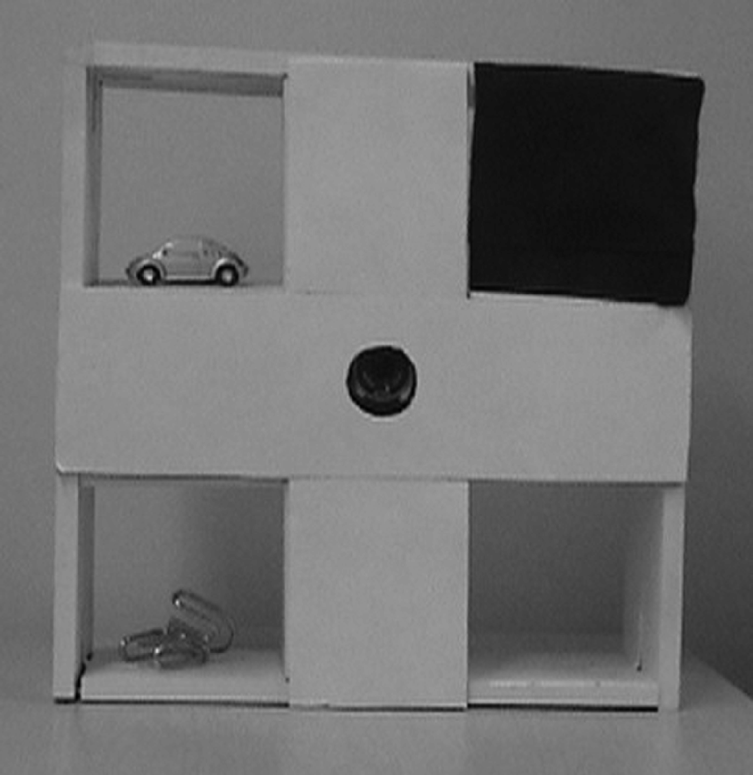
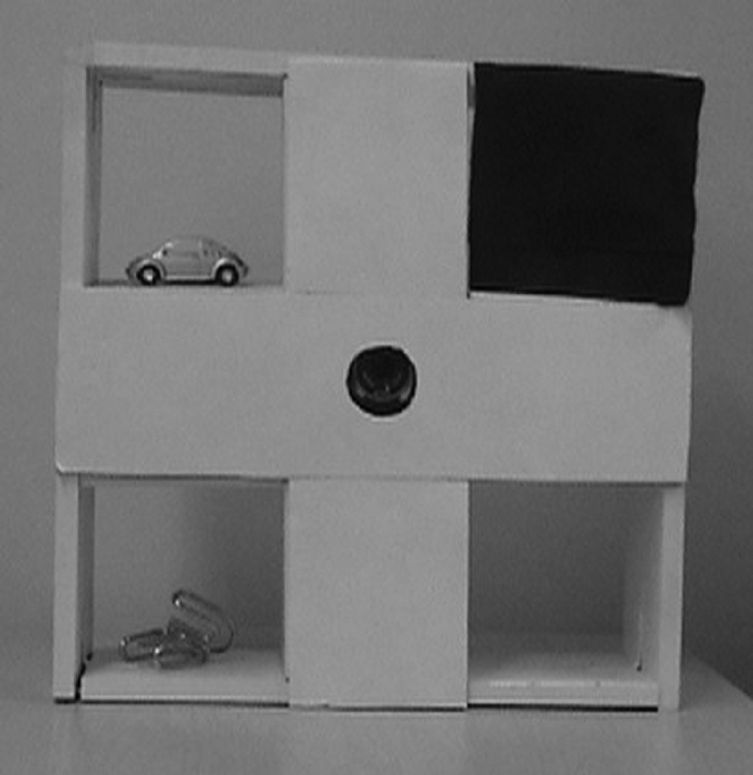
We used a box with four square openings −14 cm on each side (shown in Figure 1). Each opening could be accessible to both the child and the experimenter. One opening was designated as the secret place – it was obscured from the child's point of view by a curtain, which was attached by Velcro over the opening. This made its contents visually inaccessible to the child, but the child could easily reach into the opening to retrieve the object. The location of the secret place was counterbalanced across participants.
Apparatus used in the experiment to show children objects and a ‘secret place’. Children were first shown that the speaker had access to the contents of all four locations, while they only had access to three. In this experiment, objects were placed in two of the common ground locations, so they were visually accessible to both the speaker and the child. One object was also placed in the secret place, so it was accessible to the speaker, but not the child. This placement was made clear to the child on each trial. This figure shows an example of the objects in a ‘novel visible’ trial.
Twelve familiar objects pretested to be labeled easily by children were used during the training. Four sets of three objects were used during the test phase. Each set contained two other familiar objects and one novel object (an object that we pretested to be unfamiliar to children such that they would not generate a label consistently, e.g. half of a garlic press). Two additional novel objects were used during the post-test.
Procedure
Children initially sat on the side of the box with one opening covered, while the experimenter sat on the other side. A camera was hidden inside the center of the box to record the responses and eye-movements. Three experimenters participated: a male experimenter who was familiar to the children, and two female confederates, whom the child had never met.
The experimenter introduced the children to the openings, explaining that one of the locations was the secret place. He placed an object in one of the openings visible to both him and the child, and asked the child to retrieve it. He then placed an object in the secret place, and asked the child to retrieve the object from the secret place. This ensured that children felt comfortable retrieving objects from any of the locations including the secret place, and that they recognized that the person on the other side of the box could see the contents of the secret place, even though they could not.
Reliable trials
The experimenter then moved away from the table and one of the confederates (the reliable speaker) entered and sat across from the child. The experimenter said: “This is my friend <name>. I should tell you something about my friend. She knows the right words for things, so she is going to use the right words for the things she is going to show you. Let's see what she does.”
Six familiar objects were brought out one at a time, and placed in one of the openings. The location was pseudo-randomly counterbalanced so that each of these objects could appear in a variety of locations, including the secret place. The reliable speaker asked the child to retrieve these objects by their appropriate label and place it in another location (outside of the box). After each object was removed from the box, the experimenter asked: “Did she use the right word for that thing?” If the child answered incorrectly, he or she received corrective feedback.
Then the test phase began, which consisted of two trials in counterbalanced order: for each trial, the reliable speaker took some objects out of a paper bag, saying: “Now, I'm going to take out three things. One of them goes here <placing object in a location visible to both confederate and child>, one of them goes here <another location visible to both confederate and child>, and one of them goes in the secret place.” Care was taken to ensure that children never saw the object that went into the secret place on each trial. Each set of three objects contained two familiar objects and one novel object. In novel hidden trials, a novel object was placed in the secret place, and in novel visible trials, one of the familiar objects was placed there instead, leaving the novel object visible to the child. Note that one opening (never the secret place) was left unoccupied on each trial. The reliable speaker then used a novel word to ask for an object. For instance, on one trial she said: “Now, I'm thinking about one of these things, and I want you to get the one I'm thinking of. I'm thinking of the blicket. Can you get the blicket?” The experimenter provided corrective feedback if children reached before all the objects were in place, or if they reached for more than one object.
Unreliable trials
After these two trials, the reliable speaker left, and the second confederate entered (the unreliable speaker). The experimenter introduced this person in a similar manner: He said: “She doesn't know all the right words for things, so she might use the wrong words for some of the things she is going to show you. Let's see what she does.” Another six familiar objects were used in the training, and this speaker referred to each of them using a different novel word. The experimenter asked the child after each familiar object was labeled: “Did she use the right word for that thing?” Corrective feedback was provided if necessary. The same two test trials were given, using different sets of objects and different novel words.
Half the children were introduced to the reliable speaker first and half the children were introduced to the unreliable speaker first. Half the children were given the novel visible trial first for each speaker; the other half received the novel hidden trial first. One child (a young three-year-old) always chose the object in the lower left corner of the box, regardless of trial. We did not include this child's data as we suspected that this child was not attending to the task.
Post-test
We then examined whether children associated the novel label they had heard on a particular test trial with the novel object used during that trial. We focused on only the novel visible trials because on the novel hidden trials, children only saw the novel object if they searched for it in the secret place. This meant that not all children observed the novel object on those trials. In contrast, on the novel visible trials, children always saw the novel object and heard a novel label spoken by either a reliable or unreliable speaker. The question we wanted to ask with the post-test was whether children thought the novel object used on those trials was associated with the novel word they heard the speaker utter or was unlabeled, and whether children were more likely to consider the object unlabeled on the trial administered by the unreliable speaker.
In the post-test, the two confederates left the room, and the experimenter removed the curtain from the box. He emphasized that the secret place was no longer secret. He then took out four objects, and placed one in each opening: Two were the novel objects used in the two novel visible trials, and two were novel objects that had not been used previously. He then asked children to give him three objects in turn, using three different novel words. One was a completely novel word, the other two were the words used by the reliable and unreliable speakers in the novel visible trials. The order of the questions and the locations of the objects were counterbalanced.
RESULTS
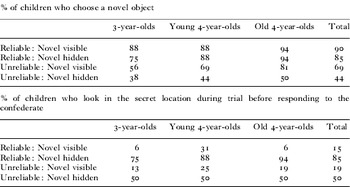
We coded the number of times children chose the novel objects in response to the confederates' novel labels across the trials. Preliminary chi-squared analyses showed no effects of participants' gender and no significant differences in performance when the reliable or unreliable speaker was the first to ask questions. Preliminary linear-by-linear association analysis revealed no significant effects of trial order. For neither the reliable nor unreliable speaker did the frequency with which children chose the novel object in response to a trial differ with age (all linear-by-linear association χ2(1, N=48)-values <2·21, all p-values n.s.). We also coded the percentage of time children looked in the secret place, regardless of whether they chose the object inside as a referent. For neither speaker did the frequency with which children searched in the secret place on either trial differ with age (all linear-by-linear association χ2(1, N=48)-values <2·21, all p-values n.s.). Thus, we collapsed these data (on object choice and search behavior) across age. These results are shown in Table 1.
Responses to experiment across the four trial and three age groups (for all age groups, n=16)

In response to the reliable speaker's request for an object with a novel label, children chose the novel object 90% of the time when that object was visible to them (i.e. the novel visible trials). On these trials, they rarely looked in the secret place (they did so only 15% of the time). On the trials in which the reliable speaker asked for an object with a novel label and the novel object was hidden in the secret place (the novel hidden trials), children searched in the secret place 85% of the time and chose the novel object that was there whenever they looked in it (i.e. 85% of the time). There was no difference in children's choice of a novel object across these two trials (McNemar χ2(1, N=48)=0·13, n.s.), but the frequency with which children looked in the secret place did differ (McNemar χ2(1, N=48)=34·23, p<0·001).
In response to the unreliable speaker's request for an object with a novel label, children chose the novel object 69% of the time when it was visible to them (i.e. the novel visible trials). Similar to their treatment of the reliable speaker, they did not often search in the secret place (only 19% of the time, not significantly different from the reliable speaker (McNemar χ2(1, N=48)=0·13, n.s.)). On the novel hidden trials, children were more likely to look in the secret place than on the novel visible trial (they did so on exactly half of these trials) (McNemar χ2(1, N=48)=10·32, p=0·001). Children, however, were significantly less likely to choose the novel object as the referent of the unreliable speaker's novel label than in the novel visible trial – they did so only 44% of the time (McNemar χ2(1, N=48)=5·50, p<0·05).
Critically, responses on both trials differed between the reliable and unreliable speaker. Children chose the novel object more often when responding to the reliable speaker than the unreliable speaker on the novel visible trials (90% vs. 69% of the time) (McNemar χ2(1, N=48)=5·79, p<0·05). Children also chose the novel object more often for the reliable than unreliable speaker on the novel hidden trials (85% vs. 44% of the time) (McNemar χ2(1, N=48)=16·41, p<0·001). On the novel hidden trials, children were more likely to look in the secret place when interacting with the reliable than the unreliable confederate (85% vs. 50% of the time) (McNemar χ2(1, N=48)=13·47, p<0·001). We did not find this difference on the novel visible trials.
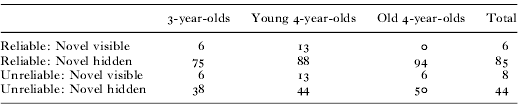
Because the camera was positioned in the center of the apparatus in which the objects were placed, we were also able to track the children's eye-movements. We coded which of the four locations in the apparatus children first looked at after hearing the speaker utter the novel label. These data are shown in Table 2. For neither speaker did the frequency with which children first look at the secret location on either trial differ with age, all linear-by-linear association (χ2(1, N=48)-values <2·21, all p-values n.s.). Thus, we combined these data across age.
Percentage of children who looked at the secret place after hearing the confederate utter the novel label across the four trials and three age groups (for all age groups, n=16)
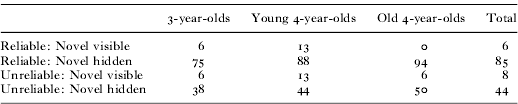
Children rarely looked first at the secret location in response to either the reliable or unreliable speaker on the novel visible trial (6% and 8% of the time, respectively, not significantly different). Where children did differ was on the novel hidden trial. There, they looked at the secret place 85% of the time after hearing the reliable speaker's novel label, compared to only 44% of the time in response to the unreliable speaker's label (McNemar χ2(1, N=48)=16·41, p<0·001).
Finally, we examined how well children retained the meaning of these novel words in response to both speakers. In the post-test, we considered how often children chose the object they saw on the novel visible trials when asked to give an object using the reliable and unreliable speaker's labels. Data from 12 children were not included – 2 generated responses that could not be coded, and 10 because of experimental error. Of the remaining 36 children, they chose the object they saw paired with the reliable speaker's label 39% of the time, significantly more often than chance (25%) (Binomial test, p<0·05). In contrast, responses were at chance in response to the unreliable speaker's label (25%) (Binomial test, n.s.). Overall, responses to a completely novel word were at chance (61%), but showed differences among the age groups. The three-year-olds were less likely to choose a completely novel object than the older children (Fisher's Exact Test (one-tailed), p<0·05). The four-year-olds picked one of the two other novel objects when asked to interpret a completely novel label 74% of the time, significantly different from chance (Binomial test, p<0·05). No other differences among the age groups were found. This suggests that the four-year-olds did recall the labels and associated them with the novel objects in response to the reliable speaker more so than those generated by the unreliable speaker.
DISCUSSION
Our investigation examined preschoolers' inferences on a version of the disambiguation task. Children observed two familiar objects and a novel one, and either the novel object or one of the familiar objects was hidden from the child (but visible to the speaker). When children interacted with a speaker who previously was shown to be a reliable labeler of familiar objects, children chose the novel object as the referent of her label regardless of whether that object was visible or hidden. When the novel object was visible to them, children rarely looked first at the secret location, or even searched inside to reveal its contents. When only familiar objects were visible, children usually looked first at the secret place and often searched inside it to determine its contents (a novel object, which was always their choice when they looked in the secret location). In this case, children appear to reject the visible familiar objects as referents for the reliable speaker's label.
When children interacted with a speaker who generated inaccurate labels for familiar objects, they were more likely to choose a familiar object as the referent of that speaker's novel label regardless of whether a novel object was visible or hidden. Further, when the novel object was hidden (i.e. only familiar objects were visible), children were less likely to look first or search in the secret place in response to the unreliable speaker than the reliable one. This suggests that children were less likely to reject the familiar objects as referents for the unreliable speaker's label. Moreover, reliability information was not only coded in the child's decision to map novel labels onto referents; their eye-movements in response to the reliable and unreliable speaker's novel labels differed when only familiar objects were visible. This suggests that children incorporated their knowledge of speaker reliability as they interacted with the speaker, not just when they were asked to make a final assessment of the speaker's referent. Finally, children were able to remember the novel label generated by the reliable speaker more often than chance. This was not the case for the unreliable speaker, and by the age of four, children also recognized that completely novel words were more likely to refer to completely novel objects.
How do these data relate to explanations of the disambiguation task? There have been two competing explanations of performance on the disambiguation task. Markman and Wachtel (Reference Markman and Wachtel1988; Markman, Reference Markman1989; see also Jaswal, Reference Jaswal2010) argued that there are particular mapping constraints on word learning that act as a default in which children avoid multiple labels for the same referent-type. Other researchers have suggested that responses on this task stem from children's understanding of the speaker's intentionality and the pragmatics of the utterance. If the speaker wanted the familiar object, she would have used a more familiar label – given that she did not, the novel label must refer to the novel object (e.g. Baldwin & Moses, Reference Baldwin and Moses1996; Bloom, Reference Bloom2000; Tomasello, Reference Tomasello1999). This latter view relies heavily on Clark's (Reference Clark and MacWhinney1987; Reference Clark1988) principle of contrast: the meaning of individual words contrasts with one another, and speakers choose words that maximize their meaning, consistent with Grice's (Reference Grice, Cole and Morgan1975) assumption of informativeness. On this view, the inference is, at core, an inference about a speaker's intended meaning based on expectations of the speaker's linguistic behavior.
The finding that children differ on the standard disambiguation task procedure based on speaker reliability (Diesendruck et al., Reference Diesendruck, Carmel and Markson2010) suggests that children are constructing different pragmatic environments with the reliable and unreliable speakers. We would expect that children would have different expectations about these speakers' referential behavior, resulting in different hypotheses about the likely referent of a novel label. The results of our study are generally consistent with this account. In contrast, if the familiar preference for a novel object in the standard disambiguation task is due to a child-internal lexical constraint rather than a set of expectations about the speaker's intent, then it is more difficult to see why children would behave differently when presented with an unreliable speaker. The lexical constraint view does not posit an obvious causal link between the behavior of the speaker and the child's interpretation of the novel label. One would have to argue that encountering an unreliable speaker is broadly disruptive, so children suspend whatever usual mechanisms they recruit to establish the reference of a novel label, such as independently held constraints against mapping more than one meaning to a single label.
It's not clear whether a speaker's lexical unreliability generates such globally disruptive effects. There is evidence that unreliability in one aspect of language can impact the learning of other aspects of the language. For example, there is some evidence that the labeling unreliability of a speaker has effects that extend beyond the lexical domain. Corriveau, Pickard and Harris (Reference Corriveau, Pickard and Harris2011) found that preschoolers introduced to a lexically unreliable speaker showed less learning of novel irregular past tense forms than those introduced to a speaker with typical labeling behaviors (but see Jaswal, McKercher & VanderBorght, Reference Jaswal, McKercher and VanderBourght2008). These data suggest that children are making more than lexical inferences based on registering a speaker's lexical reliability. Moreover, Simeone and Sobel (Reference Simeone and Sobel2010) demonstrated that older four-year-olds learned novel lexical items differently from individuals with intact lexical knowledge, but who violated or did not violate subject−verb agreement (they were more likely to use the latter's information). These data all suggest that children learn differently from speakers based on one aspect of their linguistic competence, which might generalize to other aspects of linguistic competence. However, these effects might well all be mediated by expectations the child has about the speaker's probable linguistic behavior, rather than a disruption of some child-internal learning mechanism. At present, it remains difficult to distinguish conclusively between the lexical versus pragmatic explanation of the disambiguation effect. The overall pattern of evidence does seem easier to explain, however, under a pragmatic account.
Finally, in the current study we found that the effect of reliability generalized to children's ability to retain the mapping they made from label to referent. When children heard and assigned reference to novel labels from a reliable speaker, they were more likely to retain that assignment than when the speaker showed a history of generating unreliable information. These results parallel work by Sabbagh and colleagues (Sabbagh & Baldwin, Reference Sabbagh and Baldwin2001; Sabbagh et al., Reference Sabbagh, Wdowiak and Ottaway2003), who showed that preschoolers were more likely to retain a novel label that was generated when a speaker displayed signs of certainty than when the same speaker displayed signs of uncertainty, as well as by Koenig and Woodward (Reference Koenig and Woodward2010), who found similar results with two-year-olds. This is the only aspect of our procedure in which we found differences among the age groups. While three- and four-year-olds both remembered the inference they made about the reliable speaker's novel label better than chance expectations, only four-year-olds appeared to maintain that reference, and selected other another novel object when given a new novel label. This suggests that between the ages of 2 ; 0 and 4 ; 0, children's representation of the semantic relation between label and referent might be less fragile. Of course, we did not introduce much of a delay between the inference trials and the memory post-test. A question is whether introducing such a delay would affect responses.
A final open question from these data is to specify the kind of atypical behavior on the part of a speaker that triggers a child's sense that the usual lexical inferences may not apply. In these experiments, the unreliable speaker violated conventions of object labeling by using incorrect nouns. Given that the tendency to map novel names to novel objects is posited to be a type of pragmatic inference, it would be revealing to see whether violation of pragmatic norms would also lead to a suspension of the inference. For instance, Grodner and Sedivy (in press) found that adults treat adjectives as offering contrastive information, but when the speaker was identified as anomalous, hearers were more likely to entertain the idea that the adjective was referring to a non-contrasting object, even though using the adjective to refer to this object would result in a redundant description. A similar issue would be to consider the relation between the nature of the training that results in one speaker being considered reliable or unreliable and the nature of the inference the child is asked to make based on that reliability. Across these experiments, children were asked to make a lexical inference based on one speaker revealing evidence of an intact lexicon and the other showing atypical lexical choice. Would other kinds of errors in a speaker's language produce the same violation of pragmatic expectations in young children? We are currently investigating this possibility.