


Introduction
Research suggests that about 25% of the population suffers from a fear of specific dental procedures, whereas about 4% fulfil the criteria for dental phobia (Oosterink et al., Reference Oosterink, de Jongh and Hoogstraten2009). Because the resultant avoidance of dental treatment could have considerable impact on both oral and general health (Schuller et al., Reference Schuller, Willumsen and Holst2003), timely management of dental phobia is central to improving dental attendance and quality of life.
Recently, virtual reality exposure therapy (VRET) involving exposure to an individual's fear-provoking objects and situations using a computer-generated environment in a well-controlled graded manner (Krijn et al., Reference Krijn, Emmelkamp, Biemond, de Wilde de Ligny, Schuemie and van der Mast2004), has gained acceptance in the treatment of a wide variety of fears and specific phobias. To date, there are no controlled studies investigating the effect of VRET in treatment of dental phobia. The purpose of the present study was to determine the feasibility, in terms of safety and efficacy, of applying VRET for the treatment of dental phobia.
Method
Participants and design
The study protocol was approved by the ethical board of SEGi University, Malaysia (reference: EC01/14-01) in accordance with American Psychological Association code of research conduct. Participants were recruited from the out-patient service of the Oral Health Centre of SEGi University. Patients who had not visited the dentist during the past 12 months, or reported anxiety and avoidance of dental procedures or both, were screened for the presence of dental phobia using the Modified Dental Anxiety Scale (MDAS). Patients with a MDAS score ≥ 15 and who provided informed consent, were interviewed using the Phobia Checklist (Oosterink et al., Reference Oosterink, de Jongh and Hoogstraten2009), and screened for inclusion and exclusion criteria (see online Fig. 1). Eligible participants (n = 10) were randomized (1:1 allocation ratio) to either the VRET condition or an informational pamphlet (IP) control condition.
Safety of using VRET was evaluated by determining any adverse events or symptom exacerbation after intervention. A non-concurrent multiple-baseline design across subjects was used to evaluate the efficacy of the interventions. The total duration of study was 14 weeks for all participants, with different baseline and follow-up durations. Participants from both groups were randomly assigned to one of the baseline periods (5, 6, 7, 8 and 9 weeks) after which the interventions were administered. After the intervention, all participants were followed up weekly until 14 weeks, and finally at 6 months (see online Table 1).
The outcome measures of interest in this study were state anxiety, measured using a Visual Analogue Scale-Anxiety (VAS-A), dental trait anxiety, indexed by both the Modified Dental Anxiety Scale (MDAS) and the Dental Fear Scale (DFS), and a Behavioural Avoidance Test (BAT) (Raghav et al., Reference Raghav, Van Wijk, Abdullah, Islam, Bernatchez and De Jongh2016) (see online Table 2). The MDAS, DFS and VAS-A were recorded weekly during baseline, before and after the intervention, until 14 weeks after the intervention, and finally at 6-month follow-up. The BAT was administered twice: pre- and post-intervention (see online Table 3).
During the VRET intervention, participants were asked to rate their anxiety repeatedly from 0 to 10, on the Subjective Unit of Distress Scale (SUDS) (Raghav et al., Reference Raghav, Van Wijk, Abdullah, Islam, Bernatchez and De Jongh2016). Each situational cue was repeatedly administered until the participant reported a SUDS score ≤ 2, after which the next cue was introduced. Participants’ heart rate was continuously monitored during VRET using a wrist-worn heart rate monitor. Post-VRET, the participants were observed for 15 min to preclude any adverse events, and were assessed for their quality of VR experience as well as their intentions to undergo VR therapy in future and revisiting for their dental treatment (see online Tables 2 and 3).
At 6-month follow-up all participants were re-evaluated for dental phobia using the Phobia Checklist and for any symptom exacerbation. We also determined the number of participants who scheduled a dental appointment following the intervention.
Interventions
VRET interventionFootnote 1
VRET participants were seated in the dental chair and assisted in wearing the head-mounted device (HMD), and the heart rate (HR) wristband. The baseline HR was recorded for 10 min. The VR environment consisted of a three-dimensional (3D) stereoscopic scene of a virtual dental operatory. The participants were able to see their own virtual counterpart (participant avatar) and a virtual Caucasoid dentist avatar. After orienting the participants with VR environment for two minutes, situational cues enacted by the dentist avatar were introduced in the following order:
(1) Sitting passively on the dental chair (no tools).
(2) Inspection of the oral cavity using mouth mirror.
(3) Introduction of an injection.
(4) Introduction of drill without sound.
(5) Introduction of drill with sound.
Through scenarios 2 to 5, participants were requested to keep their mouth open. All participants received the therapy in one session.
Informational pamphlet group
The Informational Pamphlet (IP) contained standardized information compiled from the Academy of General Dentistry factsheet on dental anxiety. IP participants were seated in the same area where they completed the self-reported measures, and were given time to review the pamphlet in detail and ask the researcher questions related to their dental anxiety. More details about the VRET and the IP are reported elsewhere (Raghav et al., Reference Raghav, Van Wijk, Abdullah, Islam, Bernatchez and De Jongh2016).
Analytic strategy
Safety of using VRET was evaluated by noting any adverse events following therapy and any symptom exacerbation during the follow-up. Efficacy of VRET was compared with IP, by performing a visual analysis for the dependent measures VAS-A, MDAS and DFS prior to, during and after interventions and measuring changes relative to the baseline phase (Lane and Gast, Reference Lane and Gast2014). BAT scores and BAT steps within the treatment conditions were evaluated with a paired t-test. The trends of mean scores of HR of the different VR scenarios were graphically plotted. Descriptive statistics were used to describe presence, realism and cyber sickness (nausea) experienced by the participants during the VRET session.
Results
All participants completed the study except one (IP participant), who did not respond to the mailed questionnaire after the ninth week of the study.
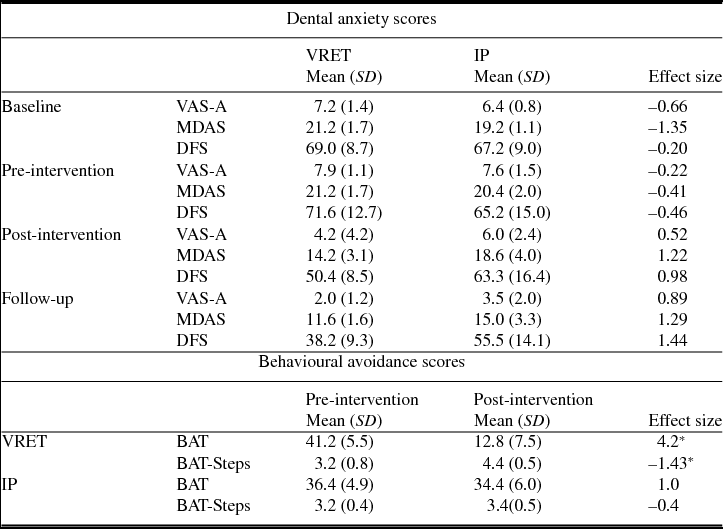
Mean scores, standard deviations and effect sizes, for the total sample and both conditions, on all variables and all measurements, are presented in Table 1.
Mean scores, standard deviations and between subgroups effect sizes for the total sample, on all variables

*p < 0.05. VRET, virtual reality exposure therapy; IP, informational pamphlet; VAS-A, Visual Analogue Scale-Anxiety; MDAS, Modified Dental Anxiety Scale; DFS, Dental Fear Scale; BAT, Behavioural Avoidance Test; BAT-steps, Behavioural Avoidance Test-Steps.
Safety of VRET
No adverse events or symptom exacerbation were reported post-therapy. In addition, no participant dropped out in the VRET group.
Analyses for state anxiety and dental trait anxiety
Visual analysis suggests that VRET was associated with a greater reduction of VAS-A, MDAS and DFS scores compared with IP (see online Tables 4–6 and online Figs 2–4).
We performed a post-hoc intention-to-treat analysis on the dependent measures and alpha was set at 5%. A MANOVA showed a significant main effect of time, but no significant interaction between time and group. Subsequent univariate testing showed a significant decrease in mean score for the VAS-A, MDAS and DFS from pre-intervention to post-intervention. A significant condition by time interaction effect was found for MDAS and DFS resulting from the fact that MDAS and DFS scores showed a stronger decrease in the VRET condition. Independent-samples t-tests for mean VAS-A, MDAS and DFS scores revealed no significant differences between the groups. However, some of the comparisons showed quite large effect sizes in favour of the VRET group, in particular at follow-up (Table 1).
Behavioral avoidance
A paired-samples t-test comparing the pre- and post-intervention BAT scores, and number of steps the patient was able to tolerate, revealed statistically significant differences between pre- and post-scores with large Cohen's d effect sizes respectively in the VRET condition (Table 1) compared with the IP condition.
Heart rate measurement
Confrontation with the increasingly more anxiety-eliciting stimuli during VRET did not cause any apparent acceleration in mean HR during therapy (see online Fig. 5).
Virtual reality experience
All participants in the VRET condition experienced cybersickness (nausea), except one. However, all participants experienced moderate presence and realism and expressed their intentions to undergo similar therapy in the future, and to revisit the dental surgery for treatment.
Presence of dental phobia
At 6-month follow-up, of the nine treatment completers, six (four from VRET group and two from IP group) participants no longer met the diagnostic criteria of dental phobia.
Dental attendance
Although all VRET participants showed their interest, four out of five scheduled appointments and underwent treatment, but none of the IP participants scheduled a dental treatment appointment following the intervention.
Discussion
This is the first controlled study that evaluated safety and efficacy of using VRET in dental phobic individuals. Conducting such a pilot study was important to determine any difficulties in timing of measurements and limitations of VRET prior to commissioning the randomized controlled trial. We measured both subjective and objective fear response of the VRET participants in the present report to determine the feasibility for conducting a randomized controlled trial.
The results suggest that VRET is a safe and acceptable treatment for dental phobia as we found no apparent increase in patients’ heart rate and no participant dropped out during VRET. No symptom exacerbation was reported post-VRET. Furthermore, VRET was associated with a significant reduction in state anxiety, dental trait anxiety, and behavioural avoidance. It appeared that 6 months after the VRET intervention, the number of participants who no longer met the criteria of dental phobia was higher in the VRET group compared with the IP group. The findings of self-reported measures were substantiated by the majority of VRET participants (four out of five) scheduling appointments and undergoing dental procedures, such as scaling followed by extractions and fillings.
The significant decrease in behavioural avoidance observed in VRET participants is corroborated by the finding that more participants scheduled dental appointments within the 6-months follow-up after the intervention.
Reduction in anxiety within the VRET group could be attributed to the satisfactory presence experienced by the participants during the intervention. It is assumed that VRET facilitates emotional processing by activation of people's underlying fear structure through controlled confrontations with their fearful stimuli without aversive outcomes, and that one learns that the fear is unfounded, thereby adjusting negative, irrational predictions (Craske et al., Reference Craske, Treanor, Conway, Zbozinek and Vervliet2014). This explanation is supported by the finding that a participant who experienced lower VR presence during VRET showed no reduction in dental trait anxiety at the end of the study.
Some limitations of this study should be mentioned. Firstly, a majority of participants who underwent VRET experienced cyber sickness (nausea) post-session, indicating the importance of putting effort into reducing cyber sickness to increase the applicability of VRET. Secondly, the study had a limited follow-up of 6 months, and a small sample size, clearly restricting the generalizability of the study results. Lastly, the use of Caucasoid dentist avatars in a Malaysian population could be a potential limitation.
In conclusion, the results of this multiple baseline study are a first indication that the use of VRET is a safe and an effective treatment for dental phobia.
Acknowledgements
The present study uses the license of a commercial product developed by Virtual Simulations Inc. The authors thank Datuk Prof. Dr. Fawzia Abdullah, Dean, Faculty of Dentistry, SEGi University, Malaysia and Professor Dr Md. Nurul. Islam, Deputy Dean, Faculty of Dentistry, SEGi University, Malaysia for their encouragement and support during the study period.
Author contributions: K.R. and A.d.J. conceptualized the idea. K.R. gave therapy to the patients assisted by R.S. K.R. wrote the initial draft. A.d.J. and A.v.W. participated in the design and contributed to the statistical analysis. All the authors read the draft, provided feedback and approved the final manuscript. K.R. is the guarantor of the paper.
Competing interests: There are no known conflicts of interest associated with this publication.
Funding: None.
Supplementary material
To view supplementary material for this article, please visit https://doi.org/10.1017/S1352465817000534




Comments
No Comments have been published for this article.