1. Introduction
Typological differences involving the noun phrase have received some attention in the literature (Rijkhoff Reference Rijkhoff2002, Cinque Reference Cinque2005, among others). However, typological distinctions among noun phrases within the Germanic language family have not been discussed in detail. With East Germanic extinct, this paper explores some of these differences between North and West Germanic, and provides an account for them.
In this paper, I focus on three typological differences between the North Germanic DP and the West Germanic DP. It is well known that the North Germanic languages have suffixal definite determiners, but the West Germanic languages do not (see, among others, Delsing Reference Delsing1993 and Julien Reference Julien2005b). This difference is illustrated with Norwegian for North Germanic in 1a and German for West Germanic in 1b.
(1)


In some North Germanic languages, this suffixal determiner may lead to instances of double definiteness where two determiner elements are present, the suffixal determiner and a free-standing one.
Another much-discussed topic in Germanic linguistics is the inflections on prenominal adjectives. Although this is often not fully acknowledged in other work (for example, Schoorlemmer Reference Schoorlemmer2009, Leu Reference Leu2015), Harbert (Reference Harbert2007) points out that there is a difference between the two language families. Illustrating with possessives, Norwegian has weak endings but German strong ones.
(2)

The third difference has received less attention. Determiners such as demonstratives and free-standing articles can co-occur in North Germanic but not West Germanic (Julien Reference Julien2005b, Vangsnes Reference Vangsnes1999, among others):
(3)

In addition to the doubly-filled definite DP, 3a also shows the two above-mentioned properties, a suffixal definite determiner on the noun and a weak adjective ending. In other words, all four elements related to definiteness can occur in North Germanic at the same time.
In this paper, I claim that the properties in 1-3 cluster together in that these three distinctions have to do with definiteness. However, this semantic property is shown to manifest itself in different morpho-syntactic ways in the two language families. Grouping these three differences into one more general distinction, I propose that definiteness involves multiple subcomponents (see Lyons Reference Lyons1999, Julien Reference Julien2002, Reference Julien2005b, Anderssen Reference Anderssen2005, and Lohrmann Reference Lohrmann2010). Interpreted as features, these components originate low in the structure and may move to D. While West Germanic spells all these components out together in D, North Germanic realizes them separately in different positions. For the most part, I focus on the standard languages in these two language families: Danish, Icelandic, Norwegian, and Swedish for North Germanic, and Dutch, German, and Yiddish for West Germanic. In addition, dialectal variants are briefly discussed where relevant.
The paper is organized as follows: Section 2 provides the typological data in more detail. Section 3 lays out my assumptions about the structural positions of determiners. I show that definiteness has subcomponents and provide the general underlying structure. Section 4 is dedicated to the main proposal deriving the three differences between North and West Germanic. In section 5, I refine the analysis of North Germanic. Section 6 discusses some apparent instances of doubly-filled definite DPs in West Germanic. The conclusion forms section 7.
2. Data
In this section, I discuss in more detail the different ways semantic definiteness manifests itself morphosyntactically in North and West Germanic. I start with a very well-known and much discussed topic, namely, the suffixal definite determiner and double definiteness. North Germanic has, with the notable exception of West Jutlandic, suffixal definite determiners in simple, unmodified DPs as already illustrated in the introduction.Footnote 1 In addition, these suffixal determiners can also appear in more complex noun phrases in North Germanic, namely, when certain modifiers (such as adjectives) are present. In these cases, the presence of the suffixal determiner may yield cases of double definiteness in Norwegian, Swedish, and Faroese but not in Danish and Icelandic (for detailed discussion, see Delsing Reference Delsing1993, Julien Reference Julien2005b, and many others). In these instances, there are two definite determiner elements present in the noun phrase—a free-standing determiner preceding the adjective and a suffixal one on the noun, as in 4a. In its West Germanic counterpart in 4b, there is only one free-standing determiner on the left.
(4)

To account for this difference, one could suggest that West Germanic does not have a low position that accommodates (suffixal) determiners or that this language family simply lacks suffixal determiners as vocabulary items. I return to these ideas in section 5.2 below.
2.1. Adjective Endings
Prenominal adjectives have inflections in Germanic. There are two sets of endings, traditionally called “strong” and “weak”, with the former set being larger than the latter. As is well known, the inflectional ending occurs depending on the context the adjective appears in. In general, an adjective with a weak ending follows a definite article, as shown in 4 above, and an adjective with a strong ending follows an indefinite article, as shown in 5 (for more details, see, among many others, Julien Reference Julien2005b, Schoorlemmer Reference Schoorlemmer2009, Leu Reference Leu2015, Roehrs Reference Roehrs2015).
(5)

Both adjectives in 4 have a weak ending, and both adjectives in 5 have a strong ending. As a result, Norwegian and German examples are often assumed to have a similar structure and are given similar accounts (for example, Schoorlemmer Reference Schoorlemmer2009, Leu Reference Leu2015). However, Harbert (Reference Harbert2007:135) points out that Swedish and German actually differ. In fact, Roehrs (Reference Roehrs2015) argues that the two language families instantiated by Swedish and German differ from one another more generally.Footnote 2 Besides the possessive constructions illustrated in the introduction, this distinction also becomes evident in a number of other contexts. To give one more example, this difference can also be observed with vocatives. As in example 2, North Germanic has a weak ending but West Germanic a strong one (Roehrs & Julien Reference Roehrs and Julien2014; see also Julien Reference Julien2016):
(6)

It is proposed in Roehrs Reference Roehrs2015 that the adjective inflections in North Germanic are determined by the (in-)definiteness of the DP. In particular, weak endings occur inside definite DPs. In contrast, for West Germanic, a lexical account was proposed. Under this account, certain determiners trigger Impoverishment, which brings about a weak ending on the adjective (for details, see Roehrs & Julien Reference Roehrs and Julien2014, Roehrs Reference Roehrs2015). In both language families, the strong inflections form the elsewhere case; that is, they occur when the relevant condition for the weak endings is absent. Given these different accounts (semantic versus lexical), the prediction is that the North Germanic languages would behave consistently with regard to the occurrence of the weak endings but the West Germanic languages would not.
This prediction is borne out. As far as I am aware, in all North Germanic languages, adjectives inside definite DPs exhibit weak inflections, whereas in the West Germanic languages the endings vary. For instance, a reviewer points out that Swiss German differs from German: While German adjectives have a strong ending after certain possessive pronouns, Swiss German adjectives show a weak ending (data provided by the reviewer; see also Leu Reference Leu2015:128):
(7)

This variation fits well with the lexical account of West Germanic. Assuming that weak endings are the result of Impoverishment triggered by certain lexical elements, one can claim that the German possessive pronoun does not trigger Impoverishment but its Swiss German counterpart does. For other examples showing differences within the West Germanic languages, see the discussion of German and Yiddish in Roehrs Reference Roehrs2015.
2.2. Doubly-Filled Definite DP
The third difference is also known but less often discussed in detail. The North Germanic languages tolerate two determiner elements in the left periphery of the noun phrase (Vangsnes Reference Vangsnes1999, Julien Reference Julien2005b, among others), whereas this is impossible in the West Germanic languages. The co-occurrence of the two elements in North Germanic can be observed in two contexts. First, possessive pronominals may precede a free-standing definite article, as shown in 8a.
(8)

Besides Danish, this is also possible in Swedish (Delsing Reference Delsing1993:200) and in many regional varieties (for instance, in Lappträsk Swedish, see Vangsnes Reference Vangsnes1999:157).Footnote 3 Note that Saxon Genitives can also be followed by a definite article in North Germanic but not in West Germanic (9a is from Delsing Reference Delsing2003:26; see the same work for regional varieties in North Germanic that show the same distribution).Footnote 4
(9)

Second, in addition to possessives, a free-standing definite article can also be preceded by a demonstrative in North Germanic, as in 10a, but not in West Germanic, as in 10b.
(10)

Besides Norwegian, this is also possible in Danish (Julien Reference Julien2005b:113), Swedish (Delsing Reference Delsing1993:138), and many regional varieties (such as Lappträsk Swedish, see Vangsnes Reference Vangsnes1999:158). Furthermore, this pattern is marginally possible in Icelandic (Thráinsson Reference Thráinsson2007:113). These North Germanic constructions occur with superlative adjectives (as in Swedish, Delsing Reference Delsing1993:138), but are sometimes also possible with positive forms of the adjective (for example, in Danish, see 14b below). It has also been pointed out that discourse topicality seems to be a relevant factor in Danish (Leu Reference Leu2015:30).
As pointed out by a reviewer, sequences such as in 10b are perhaps not entirely ungrammatical in West Germanic. The reason is presumably that diese ‘these’ can co-occur with die ‘the’ under comma intonation, as in 11a. Note in this respect that the adverbial element da ‘there’ can intervene between diese and die. Importantly, da cannot follow diese if die is absent, as in 11b, but has to follow the entire nominal, as in 11c.
(11)

It appears then as if the sequence in 11a involves two nominals, one of them forming an appositive. Thus, the availability of this pattern presumably makes the grammaticality judgment in 10b less sharp.
It is also worth pointing out that, while reported in several works on different North Germanic languages, the grammatical counterpart of 10b has, as far as I know, not been reported in West Germanic at all. In addition, I have not found any examples on the internet. This is different for sequences such as German diese meine Freunde ‘these friends of mine’, which have been mentioned even in prescriptive works such as Duden (2007:235) and are quite frequent on the internet. In section 6.1, it is proposed that diese and meine are in different phrasal positions inside the same nominal, consistent with the claim that West Germanic does not have doubly-filled definite DPs. Not surprisingly, this sequence is also possible in North Germanic (for example, Norwegian denne min nyeste artikkel ‘this newest article of mine’ lit. ‘this my newest article’; see Julien Reference Julien2005b:111).Footnote 5
The general pattern in 8a, 9a, and 10a is often analyzed in terms of a doubly-filled definite DP in North Germanic, with the possessive or demonstrative in Spec, DP and the article in D (see Giusti Reference Giusti and Haegeman1997, Reference Giusti and Cinque2002; Roehrs Reference Roehrs2010). Given this analysis, the absence of these patterns in West Germanic is unlikely to follow from a purely structural account as that language family also has a DP-layer. In order to capture the lack of co-occurrence of determiners in 8b, 9b, and 10b, one could either assume some kind of Doubly-filled DP Filter for West Germanic (as in Abney Reference Abney1987:271; Giusti 1997:109, Reference Giusti and Cinque2002:70) or follow the functional account of Haspelmath (Reference Haspelmath1999).
Here, I pursue neither of those two types of explanation for the third difference between North and West Germanic.Footnote 6 Rather, I argue for a different proposal that relates all three typological distinctions above. Notice that all these differences have to do with definite determiners, or definiteness more generally. It appears as if definiteness is distributed over several positions in North Germanic, but not in West Germanic. Slightly different versions of this idea have already been expressed for North Germanic (see section 3 below). Comparing North and West Germanic, it is clear that in North Germanic there are more ways to convey definiteness than in West Germanic. In the course of this paper, I show that there is also variation between the North Germanic languages in the way they show definiteness. In contrast, the West Germanic languages typically have one determiner element and, as such, they are much more homogenous in their definiteness marking. These general differences fall out from the account below.
3. Assumptions
In this section, I lay out my assumptions about the structural positions of determiners and the different subcomponents of definiteness. I also provide the general underlying structure of the DP.
3.1. General Structural Assumptions About Determiner Elements
I begin by briefly reviewing the structural size of definite articles, demonstratives, and possessives. Traditionally, it is assumed that definite articles are in D, but demonstratives and possessives are in Spec, DP. In many languages though, including the West Germanic languages, the three above-mentioned determiners are in complementary distribution; that is, only one of these elements can appear. To explain this restriction, it is sometimes assumed that these elements compete for the same position in the noun phrase, that is, D. However, I have shown for North Germanic above that demonstratives or possessives can precede the definite article. This means that structurally, demonstratives and prenominal possessives are in a higher position than definite articles. Indeed, definite articles cannot precede demonstratives or possessives at all:Footnote 7
(12)

Furthermore, while articles cannot occur with modifiers, as shown in 13a, demonstratives can occur with reinforcers, as in 13b. As is well documented, possessives can be quite complex, as in 13c.
(13)

Given these two sets of facts, it is usually assumed that articles, as heads, are in D, whereas demonstratives and possessives, as phrases, are in Spec, DP. This accounts for both the restrictions in distribution and the difference in complexity of the elements. I follow this structural dichotomy for both North and West Germanic in this paper.
Interestingly, Julien (Reference Julien2005b:109ff) makes a third type of structural proposal for demonstratives, namely, that in North Germanic examples such as 14, these elements are in a position above the DP (the data are from Julien Reference Julien2005b:113).
(14)

Crucially, with nouns having human (or human-like) reference, 3rd person pronouns can replace the demonstratives in the Danish examples in 14.Footnote 8 As pointed out by Johannessen (Reference Johannessen2008:173–174), the noun in 15a must have a suffixal determiner, and the free-standing determiner must be present in 15b (the data are from Strahan Reference Strahan2008:212–213).
(15)

Notice that if ham ‘him’ is left out in 15, the resulting strings are still grammatical definite DPs. In contrast, it is not possible to freely leave out the demonstratives in 14 without making further changes to yield grammatical definite DPs.
Both Johannessen (Reference Johannessen2008) and Strahan (Reference Strahan2008) analyze the pronouns in 15 as a certain kind of demonstrative (see English them guys) and conclude that these demonstratives are followed by regular DPs (also Julien Reference Julien2005b:125–126). Given the differences between 14 and 15, I follow Julien (Reference Julien2005b) in that the demonstratives in 15 are in a position higher than the DP. However, unlike Julien, I argue that the demonstratives in 14 are inside the DP. This accounts for the differences between 14 and 15: Unlike 15a, 14a may not contain the suffixal determiner, and unlike 15b, 14b may optionally contain the free-standing one (I return to 14 in section 5, where these facts are explained in more detail). Since the demonstratives in 15 are outside the DP proper, I assume that they have nothing to do with the definiteness features of the DP per se (for some more remarks, see section 6.1).
3.2. Subcomponents of Definiteness
As discussed by Lyons (Reference Lyons1999), Julien (Reference Julien2002, Reference Julien2005b), Anderssen (Reference Anderssen2005), and Lohrmann (Reference Lohrmann2010), the semantic concept of definiteness involves different subcomponents. Here I discuss four, which are relevant for the current discussion, namely, inclusiveness, specificity, presuppositionality, and deixis. Let me begin with inclusivity. Considering the two coordinated noun phrases in Norwegian given in 16, it becomes clear that a free-standing determiner can be present in both conjuncts, as in 16a, or just in the first one, as in 16b.
(16)

These two options are related to a difference in meaning. Specifically, when two free-standing determiners are present, as in 16a, the coordinated noun phrase refers to two people. When the second determiner is missing, as in 16b, the noun phrase refers to one person. Julien (Reference Julien2002, Reference Julien2005b) and Anderssen (Reference Anderssen2005) propose that the free-standing determiner expresses uniqueness. In order to accommodate nominals in the plural, Julien (Reference Julien2005b:38) restates uniqueness more generally as inclusiveness. Lyons (Reference Lyons1999:11) points out that “[inclusiveness] reference is to the totality of the objects or mass in the context which satisfy the description.” At the end of this subsection, I summarize all the definitions of the definiteness components and provide some brief comments. Note already here that “description” involves an adjective and/or a noun.
The second component of definiteness is specificity. As a starting point, consider the data in 17. The examples show that in Norwegian, the suffixal determiner must appear in certain contexts, as in 17a, but not in others, as in 17b. In the latter case, there seems to be some variation: Some speakers allow the suffixal determiner to be present, but others disprefer its presence.
(17)

Note that the DP the white man is specific in 17a (that is, the white man who ate an ice-cream) but generic in 17b (that is, the white man in general). Julien (Reference Julien2002, Reference Julien2005b) and Anderssen (Reference Anderssen2005) observe that the suffixal determiner is obligatory in specificity contexts but optional in generic noun phrases. Thus, the contrast between 17a and 17b suggests that the suffixal determiner is related to specificity. One can define specificity by stating that it is possible for the hearer to identify the object(s)/mass in the context that satisfies the description (see Lyons Reference Lyons1999:5–6).
The next component of definiteness is presuppositionality. Again, consider the data below. In Norwegian, the definite quantifier hvert ‘each/every’ can be followed by an adjective with either a weak or strong ending, as shown in 18a and 18b, respectively.
(18)

Vangsnes (Reference Vangsnes1999:83) points out that a weak ending occurs on the adjective when hvert is presuppositional, that is, when it presupposes the existence of a set of objects, such as unripe apples in 18a. In contrast, a strong ending appears on the adjective when hvert is nonpresup-positional, as in 18b. To convey this difference in English, hvert in 18a and 18b is glossed as each and every, respectively. Lohrmann (Reference Lohrmann2010) also proposes that weak inflections on adjectives in Norwegian are related to—what I refer to here as—presuppositionality. In other words, it is taken as given information that there is at least one object/some mass in the context that satisfies the description. This definition is similar to Pesetsky’s (1987) notion of D(iscourse)-linking.
The final component of definiteness relevant for my purposes is deixis. Consider the examples in 19.
(19)

Following Hawkins (Reference Hawkins1978), Lyons (Reference Lyons1999:18) points out that the difference between examples with a demonstrative, such as 19a, and those with a definite article, such as 19b, is that the former (but not the latter) involves a contrast between the actual referent and another potential referent/referents. In other words, 19a involves a context with several engines, whereas 19b may involve a situation with just one. Furthermore, according to Lyons (Reference Lyons1999), the entity referred to in 19a (that is, the engine) must be given in the linguistic or nonlinguistic context. The situation is different for 19b, where the entity can be absent but inferred on the basis of world knowledge (that is, cars have engines).
Summarizing Lyons’ discussion so far, demonstratives are deictic elements involving a contrastive choice between potential referents. This choice associates a certain object(s)/mass that satisfies the description with a spatio-temporal context.
Recall from section 2.2 that demonstratives and possessives in North Germanic have a similar (albeit not identical) distribution when it comes to their co-occurrence with a following definite article. Below, I show that demonstratives and possessives are related through the categories of deixis and person: Deixis is prototypically instantiated by demon-stratives, whereas person prototypically involves personal pronominals. However, demonstratives can also express the category person and personal pronominals—deixis.
Beginning with deixis, it is well known that demonstratives involve deixis. Personal pronouns, including possessives, have a certain affinity to demonstratives in this respect. Kaplan (1989:490–491) observes that deictic elements (in Kaplan’s terminology indexicals) are context-sensitive elements. There are two subtypes: i) true demonstratives (such as that, he, his, etc.), which typically require some kind of pointing, and ii) pure deictic elements (such as I, my, etc.), which do not require an associated pointing but depend on the utterance context. Note that the 3rd person elements in the first subtype and the 1st/2nd person elements in the second subtype share a property: They all are context-sensitive elements. To be clear, personal pronominals such as he, his, I, and my are also taken to be deictic elements.
To illustrate the deictic nature of pronouns and, especially, possessive pronominals, consider the following two examples:
(20)

Lyons (Reference Lyons1999:29) points out that (stressed) pronouns are like demonstratives in the relevant way, namely, with a pointing gesture, the 3rd person pronoun in 20a and its related possessive pronominal in 20b can be used as demonstratives. In other words, 3rd person personal pronominals can also be deictic (Vangsnes Reference Vangsnes1999:113).
Turning to person, it is well known that personal pronouns, including possessives, are categorized by the category person: 1st person involves the speaker, 2nd person the addressee, and 3rd person neither of the two. Lyons (Reference Lyons1999:18–19) states that demonstratives are categorized by the category person as well. For instance, English this connects an entity to the speaker (1st person), whereas that locates an entity to the nonspeaker (2nd and 3rd person). If deixis and person are indeed related, then one might expect that with three grammatical persons, there are also tripartite deictic systems in the world’s languages. This case can be made for the Germanic languages.
Lyons (Reference Lyons1999:19) observes that demonstratives in certain relative clauses in English are unmarked for proximity:Footnote 9
(21)

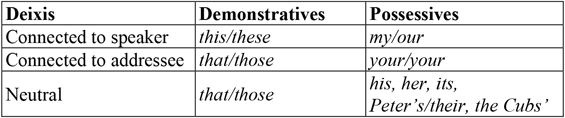
Thus, one can state that certain instances of demonstratives are neutral as regards speaker or addressee. Considering her biscuits in 21a, 3rd person possessives can be neutral in proximity as well. This relatedness of deixis and person is summarized in table 1 using English examples.
Deixis of demonstratives and possessives.

Given table 1, it should be clear that deixis is a complex notion. The latter can be broken down into different subtypes, describable by the features [SPEAKER, ADDRESSEE]: Connected to the speaker involves [+SPEAKER, -ADDRESSEE], connected to the addressee is [-SPEAKER, +ADDRESSEE], and neutral presumably has no specifications [SPEAKER, ADDRESSEE]. For the most part, I abstract away from these details and simply refer to this as deixis. Furthermore, I distinguish demonstratives and possessives by the categorial feature [±POSS], where a positive marking in front of [POSS] indicates the presence of an additional meaning component that is related to establishing a possessive relation.
Let me now summarize the above discussion by repeating the definitions of the definiteness components in 22. I analyze the four semantic components as the abstract features [DEIXIS], [INCLUSIVENESS], [PRESUPPOSITIONALITY], and [SPECIFICITY].
(22)

The term description in 22 refers to properties ascribed to an object/mass by the relevant noun and/or adjective(s). These elements are part of the complement of the definite element, the latter being simplified for current purposes as DEF: [DEF [Adj [N ]]].Footnote 10
3.3 Underlying Syntactic Structure
It has been claimed as early as Taraldsen 1990:428 that the suffixal determiner originates in a D-type position below prenominal adjectives, and that there is a second D-type position above adjectives. This claim has been made more explicit and formal by Julien (Reference Julien2002, Reference Julien2005b), who provides good arguments that in certain Scandinavian languages, the low determiner position contains the suffixal determiner, that is, [SPEC] (see also Schoorlemmer Reference Schoorlemmer2012). Roehrs (Reference Roehrs2009) adds to this discussion, arguing that determiners move from the low determiner position to the higher one. This affords him an account of the different interpretations of adjectives with regard to (non)restrictiveness (see note 10) and explains certain inflectional patterns of the noun phrase in German. Nykiel (Reference Nykiel2015) also employs determiner movement in his discussion of the Definiteness Cycle in the history of English. Schoorlemmer (Reference Schoorlemmer2009) exploits the two determiner positions in his account of concord inside the DP, which is based on the operation Agree. Furthermore, assuming a low position of [INCL] and [PRES] allows for a fairly simple account of weak adjective endings in Roehrs Reference Roehrs2015.
With this in mind, I assume a low base position for all definite elements or, more accurately, different subcomponents of definiteness, as shown in 23.
(23)

Following above-mentioned authors, this phrasal level is below that of adjectives. In Roehrs Reference Roehrs2013, this position is referred to as the head Def of a Definiteness Phrase (DefP). I propose that all components for definiteness are base-generated in Def in both North and West Germanic. I label the structural layer of the adjective as AgrP and with Cinque (Reference Cinque2005) and others, I assume that adjectives are located in the specifier position of AgrP.
Besides the above-mentioned evidence for a low position of definiteness (components), I show in section 5.3 that the interaction between demonstratives/possessives and suffixal determiners indicates a low position of [DEIX]. Similarly, the derivation of simple, unmodified DPs in Scandinavian in section 5.2 provides more evidence that [INCL] is low in the structure. Thus, I conclude that there is evidence in North Germanic that all definiteness features start out in a low position. Note also that if the aforementioned analysis successfully derives the interpretation of adjectives as regards (non)restrictiveness, it provides an argument that definiteness originates low in the West Germanic structure as well. Assuming that all definiteness features are base-generated low in West Germanic also yields a parsimonious starting point, which I take to be an attractive feature of the proposal.
4. Main Proposal: North Germanic Versus West Germanic
In this section, I start off with some general claims and assumptions. Following that, I turn to the specific proposals for North and West Germanic.
4.1. General Claims
In the previous section, I proposed that there are four definiteness features relevant for the explanation of the data in section 2. I assume that the presence of these definiteness features has to do with the semantics involved.Footnote 11 In other words, the presence of certain features brings about a corresponding interpretation of the DP. For instance, in a context involving deixis, the feature [DEIX] is present; in a context without deixis, it is not. Under this view, these features are syntactically (but not semantically) optional, which implies that they are independent of each other.
This can clearly be seen in North Germanic. Certain vocatives in Norwegian show that despite the absence of a free-standing article (that is, [INCL]), the adjective is weak (as in, dumme idioten ‘stupid idiot’; see 6a). In fact, even with the suffixal determiner (that is, [SPEC]) absent, the adjective is still weak (as in dumme idiot ‘stupid idiot’). I assume the feature [PRES] to cause the weak ending on the adjective (see Roehrs & Julien Reference Roehrs and Julien2014). That certain definiteness features can be left out while another such feature is still expressed by the adjective ending suggests that definiteness features occur independently of each other. Moreover, the presence of adjectives or nouns inside the DP has no influence on the presence of definiteness features and vice versa. Adjectives make this clear with regard to the feature [PRES].
As discussed in detail in Roehrs Reference Roehrs2015, [PRES] is present in all DPs with presuppositional semantics. Note that the feature [PRES] manifests itself as the weak ending on adjectives only. However, if the adjective is absent, [PRES] can still be present in the structure, but it will remain overtly unrealized. Conversely, adjectives with a strong ending do not involve [PRES]. That adjectives do not cause features, including [PRES], to be present has a more general consequence. Given the optional presence of adjectives, [PRES] is unlikely to be part of a checking/valuing relation, which requires two participants: a probe (the inflected adjective) and a goal (an element involving [PRES]). Consequently, I assume that all definiteness components are [+interpretable]; that is, although abstract semantic features may be present in the derivation, they do not have to be valued/checked and may remain overtly unrealized.
To take stock of the discussion thus far, I assume that the presence of the definiteness features is due to the semantics involved. Furthermore, these features are independent of each other and independent of other elements. They are spelled out unless there is an interfering factor such as lack of structure (for example, absence of adjectives) or a surface filter (see section 5.3). This means that the presence of the definiteness features may be obscured by morphosyntactic restrictions or subsequent operations.
Chomsky (Reference Chomsky1995) states that functional heads (for instance, Agr) and lexical items (for instance, airplane) are “collections of features.” With this in mind, I propose that the main difference between the two language families lies in the way the (collection of) definiteness features may be arranged. Rather than collection, I use the more specific term bundle (which seems to have become the common term now). For clarity, let us say that a feature bundle is like a set: Both may contain elements, or members. A singleton set contains one member and, analogously, one may state that a simple bundle consists of one feature. In contrast, a multi-member set contains several members and, similarly, one can say that a complex bundle consists of multiple features. This dichotomy of simple versus complex feature bundles forms the main proposal of this paper that derives the three typological differences between North German and West Germanic.
Specifically, North Germanic has several simple feature bundles as in 23 above, where each bundle contains one feature. In contrast, West Germanic has one complex feature bundle containing all relevant features. Thus, in West Germanic, the definiteness features on Def are arranged in a different way.Footnote 12 Given this basic proposal, I show that in North Germanic, certain bundles can move leading to multiple spell-outs of definiteness. In contrast, in West Germanic, individual features inside a complex bundle do not move. Rather, only the entire bundle moves yielding one spell-out of definiteness.
In the following sections, I flesh out the proposal that definiteness is distributed over several positions in North Germanic. As has become clear, this is not a new line of investigation. However, the details of the current proposal are different and allow a straightforward account of the three typological distinctions between North and West Germanic.
4.2. North Germanic
I propose that in North Germanic, these four features are organized into four different, individual feature bundles, such that each feature bundle is simple, that is, it consists of only one definiteness feature. As discussed in the previous section, these bundles originate on the head Def. Illustrating with noun phrases containing an adjective first, I propose that [+DEIX] and [+INCL] move to D, but [+PRES] and [+SPEC] stay in situ (I turn to simple, unmodified DPs in section 5.2):Footnote 13
(24)

Semantically, definite articles have been interpreted as iota operators signifying uniqueness/inclusiveness (Sharvy Reference Sharvy1980). Having analyzed definiteness as involving several components, let us assume that [+INCL] is akin to the iota operator. As is well known, operators move to the left periphery. With this in mind, I propose that [+INCL] moves to take the highest scope position in the DP (see also Roehrs Reference Roehrs2015).Footnote 14
To the extent that they are present, these different feature bundles are spelled out in North Germanic individually. The relevant vocabulary insertion rules are illustrated with Norwegian elements in the neuter gender in the singular (to distinguish between demonstratives and possessives, recall that I assume the categorial feature [±POSS]).
(25)

Consider the basic derivation of a Norwegian DP in 26 below. While 25a,b appear as independent words in the DP-layer, 25c surfaces on the adjective stem in Spec, AgrP, and 25d shows up on the head noun, which has undergone partial raising (for example, Julien Reference Julien2005b). As a reminder, the relevant definiteness features are on D or Def.
(26)

The same type of spell-outs holds for Swedish. Danish has no separate spell-out for [+SPEC].Footnote 15 Icelandic is like Danish (recall though that these deictic nominals are only marginally possible in Icelandic).
As pointed out in section 3.1, the article cannot precede the demonstrative (or possessive), as shown in 27.
(27)

In the current system, this string cannot be generated: There is no phrasal layer between D and AgrP. In other words, definiteness features, and consequently their spell-outs, cannot occur between D and AgrP. This holds for North and West Germanic alike.
Turning to contexts without deixis, Norwegian and Swedish have the same derivation as 26 above except that they do not spell out 25a,a’, which leads to 28a below. Similarly, Danish only spells out 25b and 25c resulting in 28b. For Icelandic, one needs to make a difference between—what is often labeled—the written versus common variety. The written variety is like Danish; that is, vocabulary items of the type 25b and 25c are spelled out. In contrast, in the common variety, items of the type 25c and 25d are spelled out, as in 28c.Footnote 16
(28)

To be clear, given individual feature bundles, definiteness features in North Germanic receive separate spell-outs. On the one hand, this allows for multiple exponents of definiteness in one noun phrase; on the other hand, it allows for variation in the way the North Germanic languages construct their definite noun phrases. This variation is particularly clear when an adjective is present, as just seen. In other words, although inflected adjectives are generally held to be optional, they influence the syntactic distribution of definite elements (see section 5.2 for more details). As I show in the next section, West Germanic is different: The West Germanic languages typically display one determiner element, which makes them fairly homogenous in their definiteness marking.
4.3. West Germanic
I propose that in West Germanic, all these features are part of a complex feature bundle, namely, [+DEIX, +INCL, +PRES, +SPEC]. This bundle moves from Def to D:
(29)

The derivation in 29 shows all four definiteness features inside a single bundle. However, other options are possible as well. For instance, in contexts without deixis, the complex feature bundle is [+INCL, +PRES, +SPEC]. In other words, as in Norwegian, the relevant definiteness features are present in the derivation depending on the semantics; but unlike in Norwegian, here they are all part of one complex feature bundle.
Turning to the vocabulary insertion rules, recall that there are no separate overt realizations of [+PRES] and [+SPEC] in West Germanic.Footnote 17 Consequently, I only provide vocabulary items for [+DEIX] and [+INCL]. The latter are illustrated here with German elements in the neuter gender singular:
(30)

In the typical cases, the derivation involves [+DEIX] and/or [+INCL], both part of one feature bundle in the tree representation. The lexical inventory in West Germanic has vocabulary items for either of these features, as in 30a,a’ versus 30b. Recall that two determiners cannot co-occur. Note now that unlike in North Germanic, in West Germanic there is only one feature bundle (albeit complex) present in the derivation.
As one of the basic tenets of Distributed Morphology (Halle & Marantz Reference Halle and Marantz1994), all the features of the vocabulary item must match those of the terminal head (recall again that for simplicity’s sake, I do not include case, number, and gender features). Vocabulary Insertion is regulated in such a way that the more specific vocabulary item, as in 30a,a’, preempts the insertion of the less specific item, as in 30b. As such, determiners compete for insertion under the complex feature bundle, with one of them winning out. This competition explains why there can be only one determiner in West Germanic. In North Germanic, there are different feature bundles and there is no competition for insertion, allowing multiple definiteness elements to surface.
To be clear then, I assume that one instance of Vocabulary Insertion spells out a feature/features inside one bundle but not inside two bundles. This means that one feature bundle in West Germanic involves one instance of Vocabulary Insertion, but several feature bundles in North Germanic may result in several instances of Vocabulary Insertion yielding multiple overt manifestations of definiteness (components). Finally, adjectives have no influence on the syntactic distribution of determiners in West Germanic. This is different in North Germanic. As discussed in the previous subsection, the adjective leads to the separation of definiteness features in the Scandinavian languages, which are spelled out in language-specific ways.
5. Three Refinements of the Proposal for North Germanic
5.1 Optional Free-Standing Determiners
Note that when an adjective and a demonstrative/possessive are present, the intervening, free-standing article is optional:
(31)

It is usually assumed that the semantics of demonstratives equals the semantics of definite articles plus deixis. With the discussion in section 3.2 in mind, the semantics of demonstratives can be defined as the sum of the totality of the relevant elements considered (the definite article’s inclusiveness) plus the contrastive choice between them (deixis). Comparing these two elements, one notices that the demonstrative is a stronger, more specific element than the definite article; in other words, a contrastive choice out of a totality stands in opposition to a totality.
A choice is typically made between several elements. As such, I assume that the contrastive choice denoted by a deictic element actually implies the very presence of the set of all relevant elements. In other words, the feature [+INCL] itself is not a subcomponent of [+DEIX]. Rather, its semantics is implied by the deixis. This implication makes [+INCL] semantically redundant when [+DEIX] is already present. However, cases of semantic overdetermination are known (for instance, German diese meine Freunde ‘these friends of mine’, which involves two definite determiner elements; see also section 6.1). I assume then that although semantically redundant in deictic contexts, [+INCL] can be optionally present in the derivation.
I now return to the data in 31. One can state now that while 32a,b are the same in terms of their basic semantics, if [+INCL] is present, it is spelled out by the article.
(32)

A reviewer points out that cases such as 33 do not imply that Kari is my only teacher. Such sentences only mean that she bears a teacher-relation to the speaker. In other words, there is no claim about uniqueness of the teacher here.
(33)

Recall that uniqueness was reformulated as inclusiveness, and that inclusiveness is implied by the deictic element. I tentatively suggest that this implication by the possessive in 33 is cancelled in predicative contexts.Footnote 18
5.2 Simple, Unmodified DPs
It has been noted that when the adjective is absent in a noun phrase with a demonstrative or possessive, the free-standing article must be absent too:
(34)

In other words, cases of doubly-filled definite DPs only occur with modified noun phrases.
In section 4.2, I discussed the cases where an adjective is present. In that scenario, the relevant definiteness features move to D across the adjective. These features are spelled out in the DP-level. As for 34, where the adjective is absent, I propose that definiteness features do not move to D. Remaining in Def, definiteness features are, for all intents and purposes, in the highest (scopal) position in the noun phrase:
(35)
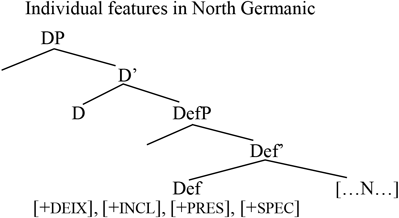
One of the main insights of Longobardi Reference Longobardi1994 is the requirement that D of the DP-level be filled. This yields individual referentiality. Julien (Reference Julien2005b) extends this requirement to Spec, DP. In other words, the DP-level must be filled by an element, either in Spec, DP or in D. I assume then with Julien that DefP moves to Spec, DP (see note 16 on Icelandic). In contrast, note again that when an adjective is present, the relevant features have to move to D. As a result, the features will be in the highest scopal position and the DP-level will be filled by the determiner element(s).
Continuing the discussion of simple, unmodified DPs, notice that in the structure in 35, there is only one head position (Def) that contains definiteness features. I propose that there is no free-standing article in unmodified DPs as that free-standing article is inserted as a suffix. Furthermore, following Leu Reference Leu2015 and Roehrs Reference Roehrs2013, I assume that demonstratives also involve suffixal elements at a certain point in the derivation. In other words, I revise 25a and 25b above as 36a and 36b, respectively.
(36)

Both the free-standing article and the demonstrative may undergo d-support (see Roehrs Reference Roehrs2013 and references cited therein). In analogy to do-support in English, this is a last resort operation that licenses suffixal elements resulting in the free-standing forms (that is, det and dette). This operation applies when no other relevant element can support these suffixal elements. Specifically, if the suffixal determiner is in Def, it is supported by the noun, which has undergone partial raising to Def. In contrast, if the suffixal determiner is in D, it cannot be supported by the noun.Footnote 19 Rather, it undergoes d-support. As for the demonstrative, it always undergoes d-support: Located in higher phrasal positions, either Spec, DefP or Spec, DP, the noun cannot support it.
Note that treating demonstratives and definite articles in this way immediately captures their diachronic and synchronic relatedness. Furthermore, this type of analysis can be claimed for all Germanic languages including West Germanic (for example, German d-ieser ‘this’ and d-er ‘the’). If so, then the low position of the suffixal determiner in North Germanic is not due to the suffixal nature of the determiner per se but rather to the partially raised noun in this language family.
Let us consider the derivation in more detail. As shown in 37, in DPs with deixis, 36a or 36a’ is spelled out as an independent element. In addition, Norwegian and (colloquial) Swedish also have 36b or 36d spelled out on the raised noun (again, DefP moves to Spec, DP, not shown in 37). Danish, Icelandic, and (written) Swedish do not realize 36b or 36d; that is, these languages do not display a suffixal determiner in such cases (I discuss the presence versus absence of the suffixal determiner in the next subsection). Finally, 36c is not spelled out in simple DPs as there is no adjective. In 37, {X} = [+DEIX], [+INCL], [+PRES], [+SPEC].
(37)

This type of account can be naturally extended to other data: Besides accounting for 34, the proposal also explains nondeictic simple, unmodified DPs in both North and West Germanic:
(38)

The derivation is like 37 above. Specifically, while 36a or 36a’ are not spelled out, Norwegian, Swedish, written and common Icelandic realize either 36b or 36d.Footnote 20 Danish spells out 36b (as it has no vocabulary item for 36d). Making the relevant lexical adjustments, all these spell-outs result in the pattern in 38a. As for German, the suffixal determiner is spelled out in Def. As the head noun stays in a lower position, the suffixal determiner in German undergoes d-support.
The question arises why there cannot be a free-standing article in Def in North Germanic if [+INCL] has remained in situ. For instance, this could yield det hus ‘the house’, which is ungrammatical under the relevant interpretation in the North Germanic languages. This restriction follows from the natural assumption that a head position can only have one overt spell-out in it. The partially raised noun supports a suffix in Def; d-support, as a last-resort option, does not apply. This prevents a free-standing article from occurring in Def. In other words, while several features may be present in one position (for example, in Def), only a suffixal determiner will be in that head position. Note now that if one were to assume that [+INCL] is base-generated in D, it would be hard to rule out the ungrammatical reading of det hus ‘the house’, as the suffixal determiner in D would be supported by d-. The same goes for *det hus-et ‘the house’, where a suffixal determiner supported by d- would spell out [+INCL] in D and another suffixal determiner would realize [+SPEC] in Def. To the extent that the above proposal is correct, it supports the argument that [+INCL] is generated low in the structure. This argument is derived from the discussion of simple, unmodified DPs.
Furthermore, there is another interesting consequence. If the relevant definiteness features are in one position (in all cases in West Germanic and in simple, unmodified DPs in North Germanic), then only one determiner surfaces, but the noun phrase can have different semantics. Empirically, it is indeed the case that simple, unmodified DPs such as huset and das Haus have only one determiner but can appear in different semantic contexts; for instance, they can be definite specific but also generic in interpretation. Thus, abstracting away from the (surfacing) suffixal determiner in North Germanic, simple, unmodified DPs pattern the same in West and North Germanic. The typological difference between the two language families only becomes apparent when other elements are present in the noun phrase.
To recapitulate the discussion of the occurrence of only one determiner in simple, nondeictic DPs, I have proposed for West Germanic that vocabulary items generally compete for insertion under one complex feature bundle (see section 4.3). As for North Germanic, I have proposed that terminal heads can only have one spell-out despite the presence of other definiteness feature bundles.
Overall, the following picture for North Germanic emerges. There is only one spell-out per position: Demonstratives are in Spec, DP if [+DEIX] has moved to the DP-level, or in Spec, DefP if it has not; free-standing articles surface in D, inflected adjectives are in Spec, AgrP, and the suffixal determiner appears in Def supported by the partially raised noun. Thus, with the exception of adjectives, which are in Spec, AgrP but manifest [+PRES] in Def (but see note 14), all features are spelled out in a local fashion, that is, in the structural layer where they are present.
5.3. Interaction of Deictic Elements and Suffixal Determiner
There are more instances where features are present but not spelled out. Unlike above, where a head can only involve one overt vocabulary item, features in cases discussed in this section are not spelled out due to a proposed, language-specific surface restriction. Such a restriction is well known from clausal syntax. For example, the embedded CP contains one element in Standard German in 39a, wann ‘when’, but two elements in Bavarian German in 39b, wann dass ‘when (that)’. The latter instance is often referred to as a doubly-filled CP (Haegeman Reference Haegeman1994:383).
(39)

The semantics of these two examples is the same. What is interesting to note now is that the stronger, semantically more specific element wann is present in each case, but the weaker item dass may be absent. Furthermore, in 39b both elements occur in the same local domain: wann in Spec, CP and dass in C. To account for the absence of dass in 39a, it has been proposed (see Haegeman Reference Haegeman1994) that 39a is subject to a Doubly-Filled Comp (that is, CP) Filter, which deletes dass on the surface. This surface restriction accounts for the intolerance of some languages to having two overt elements in the CP-level.Footnote 21
In what follows, I extend this type of surface account to some variation in the North Germanic DP (see Abney Reference Abney1987, Giusti Reference Giusti and Haegeman1997, Reference Giusti and Cinque2002). This language family has instances of doubly-filled definite DPs. However, certain varieties of North Germanic do not (and pattern on the surface with West Germanic). It should be kept in mind that the relevant examples have the same semantics, and that in each case, the semantically stronger element (the demonstrative or the possessive) licenses the deletion of the semantically weaker element (the definite determiner).
This type of surface restriction manifests itself in three ways. First, while postnominal possessive pronominals generally co-occur with a suffixal determiner on the noun, prenominal possessives only do in some languages (Vangsnes Reference Vangsnes1999:149, 157). In 40 and 41, one can see that the a-examples with a postnominal possessive pattern the same, but the b-examples with a prenominal possessive do not.
(40)

(41)

Note already here that Lappträsk Swedish also contains a free-standing article in 41b. I relate the presence of that article to the presence of the suffixal determiner in 41b at the end of this section.
Doubly-filled definite DPs show that both [+DEIX] and [+INCL] can be present in the derivation. In 40a and 41a, [+INCL] has moved to D, whereas [+DEIX, +POSS] has stayed low in the structure (see section 5.1 again). Recalling partial N-raising, these assumptions explain the distribution of the possessives. As for 40b and 41b, Julien (Reference Julien2005a) proposes that on their way to the DP-level, possessives move through the specifier of the intermediate phrase containing the suffixal determiner, which I have labeled DefP here. This intermediate stop of the possessive is argued to prevent the appearance of the suffixal determiner in Norwegian (see also Vangsnes Reference Vangsnes1999:124–127; strictly speaking, this is a Doubly-filled DefP Filter, or more generally, a Doubly-filled XP Filter).Footnote 22 Given the presence of the suffixal determiner in 41b, I assume that this filter does not apply in Lappträsk Swedish, which accounts for the difference between the b-examples.
Second, the restriction on the presence of both the strong and the weak element also applies to demonstratives and suffixal determiners. While in Norwegian and (colloquial) Swedish a demonstrative and a suffixal determiner co-occur, as in 42a, in Icelandic, Danish, and (written) Swedish they do not (Vangsnes Reference Vangsnes1999:122), as in 42b.
(42)

The above type of account can be extended to demonstratives. Assuming a low base position of demonstratives ([+DEIX, -POSS]), Icelandic demon-stratives prevent the suffixal determiner from occurring in Def (see Vangsnes Reference Vangsnes1999:123). In contrast, Norwegian does not have this restriction.
Third, the Doubly-filled XP Filter also accounts for the contrast between Norwegian demonstratives and prenominal possessives. The difference between 42a (a demonstrative co-occurring with a suffixal determiner) and 40b (a prenominal possessive without a suffixal determiner) seems to be more general. Demonstratives in Norwegian also co-occur with a free-standing article, as in 10a, but possessives do not (see note 3). Put differently, whereas Norwegian demonstratives (may) occur with suffixal and free-standing articles, Norwegian prenominal possessives co-occur with neither. Relating the presence/absence of a free-standing article to the presence/absence of a suffixal determiner, one can state that the contrast described above also results from a surface constraint. I suggest that a Doubly-Filled XP Filter holds for Norwegian possessives (but not demonstratives), and it applies in both DefP and DP. In contrast, this filter does not apply in Lappträsk Swedish or Danish, which allows demonstratives and prenominal possessives to co-occur with suffixal determiners and free-standing articles on surface (with the minor qualification that Danish has no spell-out for [+SPEC]).
To be clear, the three cases in which the Doubly-Filled Comp Filter applies employ a language-specific filter, a restriction that holds on the surface only. Definiteness features are present but wind up not being overtly realized at the end. More generally, note that this type of account is based on a local relation between the possessive or demonstrative on the one hand and the suffixal determiner in Def on the other. This local relation only holds if possessives and demonstratives are base-generated low in the structure. Thus, there is evidence that [+DEIX] also originates low in the structure. Finally, this type of filter is not at work in West Germanic at all, as there are no doubly-filled definite DPs to begin with.
6. Apparent Doubly-Filled Definite DPs in West Germanic
In this section, I discuss two cases that appear to be instances of doubly-filled definite DPs in the West Germanic languages. It is shown that they do not pose a problem for the account.
6.1. Pre-Determiners
As is well known, all Germanic languages have the general distribution in 43a and with some qualifications also those in 43b–d.Footnote 23
(43)

All these nominal elements, including the peripheral ones, show concord (Bayer 2015). Compare the nominal in the nominative in 44a to the one in the dative in 44b.
(44)

Given the fact that all these elements share the same agreement features, I assume that they are part of the same nominal domain. Recall that I argued above that demonstratives and possessives are in Spec, DP. Consequently, 43b–d cannot involve doubly-filled DPs. I assume that alle in these cases is in a position above DP. On parity of assumptions, this means that 43a does not involve a doubly-filled DP either. This makes the data in 43 consistent with the analysis of West Germanic above.
Furthermore, it is well known from definiteness effects that besides diese ‘these’ and meine ‘my’, all(e) is also a semantically definite element. This might raise another question with respect to West Germanic. For these languages, I have proposed that they have only one spell-out of definiteness. Now, I just proposed that these peripheral elements are above the DP-level. I assume then that just like the Scandinavian personal-pronoun demonstratives in section 3.1, all(e) in 43a–c and all(e) diese in 43d make their own, independent features visible intensifying certain semantic aspects of the DP below them. This view is consistent with the often-made claim that referential properties are determined at the DP-level (and not in a structurally higher position).
Interestingly, these peripheral elements are subject to certain ordering restrictions. First, demonstratives precede possessive pronouns:
(45)

Second, when alle ‘all’ is added, it precedes the demonstrative and possessive pronoun:
(46)

It is not immediately clear if diese and alle are adjoined to DP or appear in specifier positions of phrases above the DP-level. If the nature of these ordering restrictions is semantic, adjunction would be a plausible analysis. Alternatively, if no straightforward semantic reason can be found, one could propose that there are more phrases on top of the DP whose heads impose selectional requirements on their complements. Here I do not make the choice. Either way, these elements are above the DP-level.
6.2. A Third Possessive Construction
Besides simple possessive pronouns and Saxon Genitives, North and West Germanic also have—what is sometimes called—possessor doubling constructions, as shown in 47.
(47)

There are many different accounts of these possessives. This is not the place to discuss them in detail; rather, I show that some of these accounts are compatible with the above analysis.
With North Germanic tolerating doubly-filled DPs, the possessor in 47a could be in Spec, DP and the possessive pronoun in D (although I believe that the pronoun is not in a head position). In order to maintain the generalization that West Germanic lacks doubly-filled definite DPs, one has to state something different for 47b. There are several options. First, following Abney (Reference Abney1987:84–85), one could assume that both the possessor and possessive pronoun form a constituent and are located in Spec, DP, as in 48a. Alternatively, one could follow ideas in Grohmann & Haegeman 2003, suggesting that only the possessor is in PossP—which in this case is part of the extended projection of the noun—and that it subsequently moves to a higher position. Later, its trace is spelled out as the possessive pronoun (->). Glossing over some of the details in Grohmann & Haegeman 2003, this alternative is schematically represented in 48b.
(48)

Note that these two types of accounts are compatible with the claim that West Germanic does not tolerate doubly-filled definite DPs.
However, there is one type of construction that seems to compromise that claim. As discussed by Corver & van Koppen (Reference Corver and van Koppen2010), the possessor doubling construction can contain—what appears to be—a definite article between the possessor and the possessive pronoun. This is the case in some Dutch dialects:
(49)

As these authors explicitly state, the appearance of this article element is only possible when the noun is elided. Their overall conclusion is that the article element in 49 has nothing to do with definiteness. Rather, it is a gender marker (Corver & van Koppen Reference Corver and van Koppen2010:116).Footnote 24 Thus, while this might be a case of a doubly-filled DP in West Germanic, this distribution is compatible with the current account, which only rules out multiple manifestations of definiteness components in the West Germanic DP. Note that 49 would be completely unexpected if West Germanic employed a (general) Doubly-Filled Comp Filter in the DP (recall that only certain North Germanic varieties employ this filter).
Examples like 49 are also possible in German, as in 50a. However, this pattern appears to be grammaticalized, as becomes evident in dative contexts, where one finds a clear contrast between the construction involving ellipsis, as in 50b, and the one without ellipsis, as in 5°c.
(50)

Given this and other restrictions, I conclude that 50a is not part of the current, productive grammar in German.
To sum up both subsections, I discussed two types of data that might be taken to show that West Germanic has doubly-filled definite DPs after all. However, upon closer examination, these data are not conclusive and can be given a different account compatible with the current analysis.
7. Conclusion
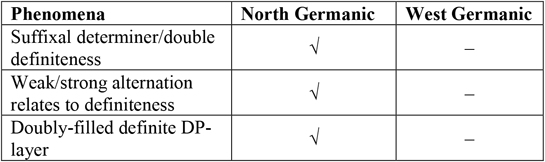
The main empirical differences between North and West Germanic discussed in this paper are summarized in table 2.
Differences between North and West Germanic.

By arguing that these three differences have to do with definiteness, one can subsume them under a single, more general distinction and show that these three properties cluster together. Under the view that definiteness consists of several components, the three typological differences derive from the way definiteness is distributed over the DP. Specifically, the differences follow from the presence of individual, simple feature bundles in North Germanic versus one complex feature bundle in West Germanic. Features can only move as a bundle; consequently, features in simple bundles move separately and thus can be overtly realized in different positions. In contrast, features within a complex bundle move together and thus are always realized in the same position.
In an ideal linguistic world, the morphosyntax would map onto the semantics in a one-to-one way. However, one of the conclusions of this paper is that what is visible on the surface might not be underlyingly present in the semantics (for example, the reinterpretation of the definite article in Dutch elliptic constructions as a gender marker). Conversely, what is underlyingly present due to the given semantics may not be visible on the surface. In the latter case, the presence of some definiteness features might be obscured as these features are not overtly realized due to structural restrictions or surface filters.
This kind of typological work sometimes reveals that a certain feature is entirely absent from one language group, while being present only in some members of the other group. This type of situation is found in West Germanic and North Germanic, and is marked by “–” versus “√” in table 2. For instance, while West Germanic disallows (surfacing) suffixal determiners, not all North Germanic languages allow them (such as West Jutlandic). The language-specific absence of this property in the latter language group must then involve an additional, different restriction presumably holding only on the surface. I leave the details of some of these language family-internal differences for feature research.