Introduction
Tonsillitis is caused by the inflammation of the pharyngeal tonsils, and its recurrence is most common during childhood, which could be a consequence of a polymicrobial infection.Reference Taylan, Ozcan, Mumcuoğlu, Baran, Özcan and Akdoğan1,Reference Jensen, Fagö-Olsen, Sørensen and Kilian2 Acute tonsillitis is the infection of tonsils, triggered by bacteria or viruses which may lead to peritonsillar abscess. Chronic tonsillitis is a tenacious infection of the tonsils that could result in tonsil stones.Reference Bakar, McKimm, Haque, Majumder and Haque3
One of the most common operative procedures in the field of ENT surgery is tonsillectomy, which is performed for recurrent tonsillitis, obstructive sleep apnoea or for the management of snoring. Tonsillectomy is quite a painful procedure that can lead to complications such as dehydration and bleeding. These complications may lead to extended periods of follow up, which may hamper the patients’ day-to-day activities, especially for adults.Reference Powell, O'Hara, Carrie and Wilson4,Reference Anmolsingh, Ali, Edmiston, Mirza, Rocke and Ranganathan5 The post-tonsillectomy pain usually persists for 7–10 days, but this varies with intensity and duration which can be moderate-to-severe. The operating surgeon and the procedure employed play a vital role in influencing the extent and duration of the complications. Surgical methods such as partial tonsillectomy, bipolar cautery and plasma field dissection, including the use of drugs directed towards alleviating post-surgery complications, have limited success rates.Reference McKerrow, Clarke and Gleeson6–Reference Chettri, Jayagandhi, Konyak, Sobita, Singh and Singh10 Thus, the quest for alternative methods to control post-tonsillectomy pain and improve healing has become an area of interest in the field of otolaryngology.Reference Shelton, Ishii, Mella, Chew, Winterbottom and Walijee11,Reference Kim, Choi, Park, Kim, Kim and Park12
Platelet-rich plasma is a fraction of the autologous blood plasma with higher platelet concentration when compared with baseline. Since the 1980s, it has been used to treat wounds in several clinical situations.Reference Chettri, Jayagandhi, Konyak, Sobita, Singh and Singh10,Reference Mehta and Watson13–Reference Kara, Erdoğan, Altinişik, Aylanç, Güçlü and Dereköy15 It serves as a local growth factor with properties that initiate wound healing. There is a lack of studies regarding the utility of platelet-rich plasma in the post-operative healing of open mucosal wounds. Therefore, the aim of this study was to evaluate the ability of topical application of autologous platelet-rich plasma in reducing post-tonsillectomy pain to hasten the healing process, thereby allowing the patients to return to routine.
Materials and methods
Trial design
This randomised controlled study (registration number: CTRI/2019/01/017292) included 56 patients, aged 18–45 years who presented with the signs and symptoms of chronic tonsillitis and were scheduled to undergo tonsillectomy. The study was conducted at a tertiary care centre between November 2017 and May 2019 after obtaining approval from the institutional ethics committee. The doctor who assessed the patients was blinded with respect to all outcomes.
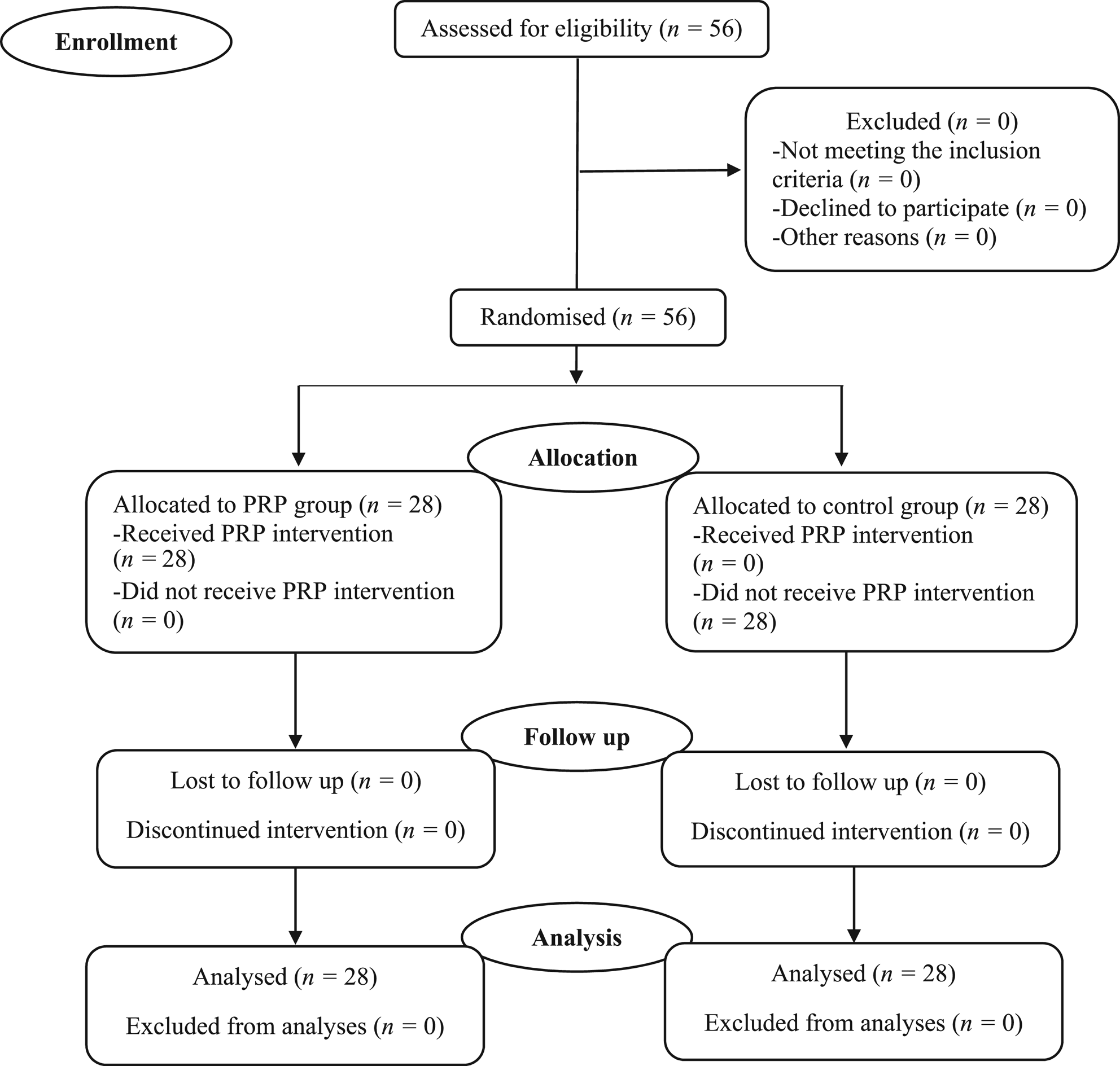
The sample size was calculated using the proportion formula as per Sidman et al.Reference Sidman, Lander and Finkelstein16 The visual analogue scale (VAS) score of day 3 was considered, and the effect size (Cohen's D) was calculated as 0.872. Therefore, considering this effect size along with a power of 90 per cent and a significance level of 5 per cent, the total sample size for this study was calculated as 56. Patients with a history of odynophagia, dysphagia, chronic throat pain for reasons other than tonsillitis, bleeding disorders, disease or abnormality of the temporomandibular joint, uncontrolled systemic diseases, and those undergoing tonsillectomy for reasons other than tonsillitis were excluded from the study. The Consolidated Standards of Reporting Trials (‘CONSORT’) diagram for our study is depicted in Figure 1.
Consolidated Standards of Reporting Trials (‘CONSORT’) diagram for this study. PRP = platelet-rich plasma

Randomisation
The 56 patients were randomised into 2 groups by a computer-generated block random table with a block size of 8. The research protocol was explained, and informed consent was obtained from all the participants in the study. All patients underwent clinical examination after which they were subjected to the basic pre-operative blood investigations as part of routine workup.
Intervention
Patients underwent tonsillectomy under general anaesthesia with endotracheal intubation. Patients were placed in the ‘Sister Rose’ position such that both the head and neck were in extended position.
Prior to surgery, the enlargement of tonsils was evaluated for all the patients and classified as per the most well-known and accepted grading system proposed by BrodskyReference Brodsky17, known as the Brodsky grading scale. Tonsils situated in the tonsillar fossae without any impingement on the oropharyngeal airway were categorised as grade 0; tonsils just outside the tonsillar fossae with less than or equal to 25 per cent obstruction of the airway were grade 1; tonsils with 26–50 per cent obstruction of the airway were grade 2; tonsils with 51–75 per cent obstruction of the airway were grade 3; and tonsils with equal to or more than 75 per cent obstruction of the airway were grade 4.
Group 1 patients (n = 28) were subjected to the intervention (i.e. platelet-rich plasma group). Under aseptic conditions, at the time of intravenous cannula insertion, 10 ml of blood sample with 1 ml of anti-coagulant (citrate phosphate dextrose adenine) was collected from platelet-rich plasma group patients, 3 hours prior to surgery. The collected blood sample was left undisturbed for 1 hour at room temperature. The sample was then subjected to soft spin centrifugation (1000 rpm for 10 minutes), separating it into 3 layers, namely the bottom-most red blood cells layer, intermediate buffy coat platelet-rich plasma layer and the top-most platelet-poor plasma layer. The top-most and intermediate layers were carefully aspirated into another container and left undisturbed for 1 hour. The sample was spun at 3000 rpm for 10 minutes allowing the platelet-rich plasma to settle down. It was aseptically aspirated and used for the study. The effectiveness of platelet-rich plasma is dependent on temperature, type of container, centrifugation speed and anti-coagulant used.Reference Kara, Erdoğan, Altinişik, Aylanç, Güçlü and Dereköy15,Reference Dhurat and Sukesh18,Reference Ehrenfest, Rasmusson and Albrektsson19
Following the surgery, 1 ml of platelet-rich plasma was topically applied on each of the tonsillar fossae for 5 minutes. The platelet-rich plasma used was four times the plasma concentration of the whole blood. During the surgery, care was taken to refrain from usage of the suction catheter in the tonsillar fossae during emergence from anaesthesia.
Group 2 patients (n = 28) did not receive any application of platelet-rich plasma (i.e. control group).
Outcomes
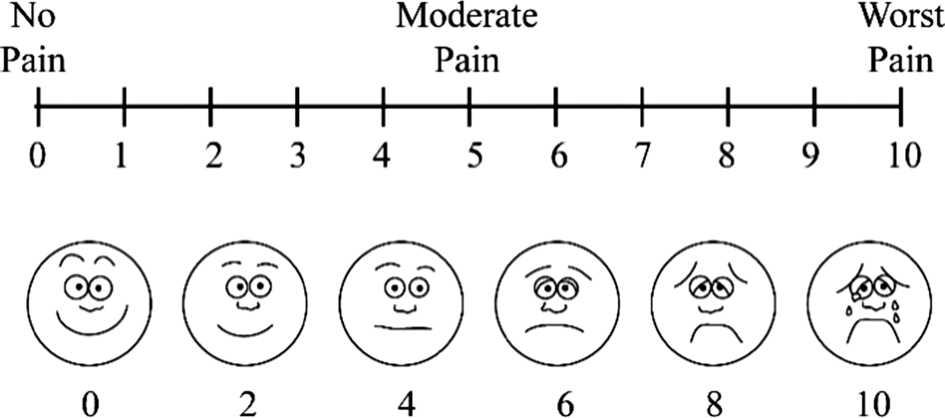
The primary outcome was to assess the pain levels of patients, which was measured using the VAS (Figure 2).Reference Gabr, Harhash, Fouly, Kamel and Eldwebes20 Healing of tonsillar fossae was subjectively assessed one-week post-tonsillectomy. Based on the surface of the raw area, less than 25 per cent was categorised as grade 1, 25–50 per cent was grade 2, 50–75 per cent was grade 3 and more than 75 per cent was grade 4.
Visual analogue scale score from 0 to 10.

The secondary outcome was to assess the time taken by patients to return to their normal activities post-tonsillectomy. The investigator who assessed outcomes was blinded in this study.
Statistical analysis
The data was analysed using R (version 386 3.6.0) and SPSS® (version 16) statistical software. Continuous variables are represented as mean ± standard deviation. Categorical variables are represented as frequency (per cent). The association between mean differences was analysed by performing an independent t-test. The chi-square test was used to analyse the association between qualitative variables between the two groups. The level of significance was assessed at p ≤ 0.05.
Results
The mean age group of patients in the platelet-rich plasma group was 26.89 ± 5.5 years and in the control group was 27.86 ± 6.5 years, and the difference between the groups was insignificant (p = 0.717). The platelet-rich plasma group included 15 (53.57 per cent) males and 13 (46.42) females, and the control group included 10 (35.7 per cent) males and 18 (64.3 per cent) females. The difference between the two groups based on gender was insignificant (p = 0.282).
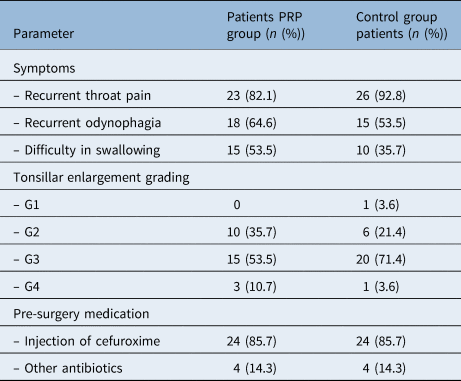
The majority of the patients in group 1 (23, 82.1 per cent) complained of recurrent throat pain prior to tonsillectomy in comparison with 26 patients (92.8 per cent) in group 2. About 19 (67.85 per cent) patients experienced overlapping symptoms and 9 patients (32.14 per cent) experienced only a single symptom in both the study groups. Grade 3 tonsillar enlargement was predominant in both groups, with 15 (53.5 per cent) patients in the platelet-rich plasma group and 20 (71.4 per cent) patients in the control group.
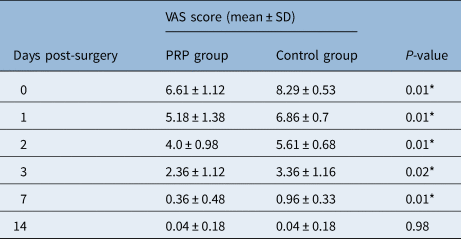
As per the hospital protocol, all the patients undergoing tonsillectomy received one dose of 1.5 g intravenous cefuroxime in the morning and the second dose in the evening, on the day of surgery. At the time of hospital admission, all patients were examined for symptoms of tonsillitis. A greater number of patients had grade 3 tonsils in both the groups. The number of patients receiving intravenous cefuroxime were 24 (85.7 per cent) in the platelet-rich plasma group and 24 (85.7 per cent) in the control group. Since the rest of the patients were already given antibiotics, it was continued even after surgery (Table 1). The VAS score was compared between the two groups and a significant difference was noted from day 0 to day 7 (p < 0.05; Table 2).
Distribution of the study population based on symptoms, tonsillar enlargement grading and pre-surgery medication

PRP = platelet-rich plasma
Comparison of VAS score between PRP and control groups

Day 0 represents the day of surgery. *Significant result. VAS = visual analogue scale; SD = standard deviation; PRP = platelet-rich plasma
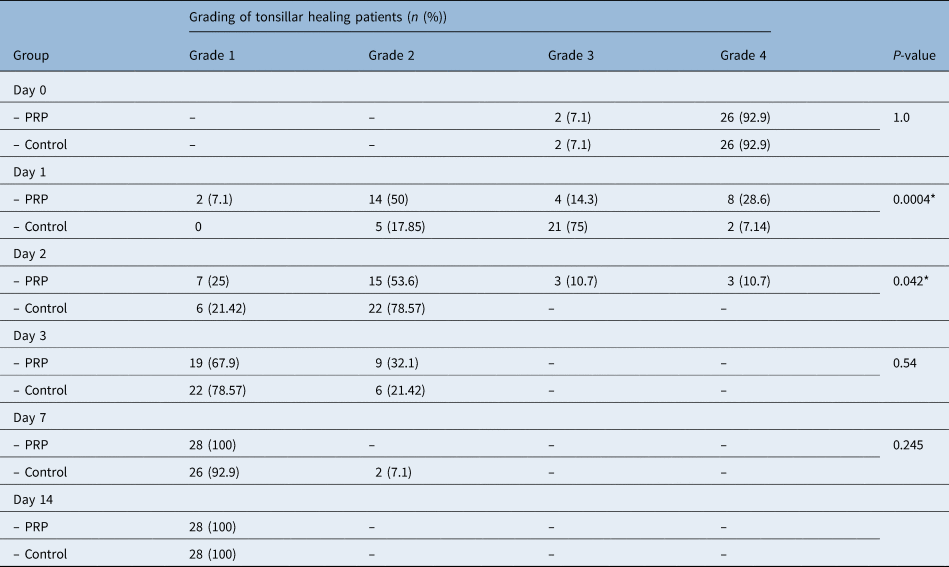
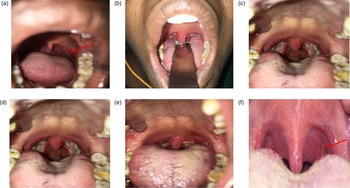
Healing of the tonsillar fossae was assessed from day 0 to day 14 post-tonsillectomy. On day 0, 26 (92.9 per cent) patients in both the groups were classified as grade 4 healing. On day 1, 14 (50 per cent) patients in the platelet-rich plasma group and 21 (75 per cent) patients in the control group were classified as grade 2 and grade 3 healing, respectively. This was statistically significant (p = 0.0004). On day 2, statistically significant results were observed (p = 0.042) with 15 (53.6 per cent) patients in the platelet-rich plasma group under grade 2 as compared with 22 (78.57 per cent) patients in the control group. On day 3, 19 (67.9 per cent) patients in the platelet-rich plasma group and 22 (78.57 per cent) patients in the control group were classified as grade 1. All the patients were categorised as grade 1 healing on day 14 post-tonsillectomy (Table 3). Clinical photographs depicting the healing of tonsillar fossae post-tonsillectomy are shown in Figure 3.
Assessment of healing post-tonsillectomy

Day 0 represents the day of surgery. *Significant result. PRP = platelet-rich plasma
Images showing clinical representation of tonsillar fossae healing on: (a) day 0, (b) day 1, (c) day 2, (d) day 3, (e) day 7 and (f) day 14 post-tonsillectomy. The arrows point to the tonsil region.

Post-tonsillectomy, 24 (85.71 per cent) patients in the platelet-rich plasma group and 23 (82.1 per cent) patients in the control group returned to their normal routine after 1 week, whereas the remaining participants returned in about 2 weeks. However, the difference between the patients in both the groups for the time taken to return to their normal routine was insignificant (p = 1.0). There was no post-operative haemorrhage noted in any patients in the study (including both the platelet-rich plasma and control groups). Moreover, haemorrhage is not one of the variables in our study.
Discussion
Tonsillectomy is one of the most frequently performed surgical procedures worldwide. Unlike other surgical procedures, the mucosal surface post-tonsillectomy is left uncovered to heal, which is extremely challenging to manage.Reference Kara, Erdoğan, Altinişik, Aylanç, Güçlü and Dereköy15 The quest for an ideal substance that can accentuate wound healing, minimise morbidity, is reasonably priced and has minimal adverse effects is still under way.Reference Chettri, Jayagandhi, Konyak, Sobita, Singh and Singh10
In the current study, autologous platelet-rich plasma was used to improve wound healing post-tonsillectomy. Platelet-rich plasma contains a number of proteins that play a crucial role in the primary clot formation following the process of wound healing, namely adhesive proteins, angiogenic factors, clotting factors, immune mediators and growth factors such as platelet-derived growth factors, transforming growth factor β, epidermal growth factors, vascular endothelial growth factors, insulin like growth factors and fibroblast growth factors.Reference Pavlovic, Ciric, Jovanovic and Stojanovic21 Autologous platelet-rich plasma was a vital component of the study, which has aided in preventing any anti-platelet antibodies or hypersensitivity reactions that could have occurred if lyophilised donor platelets were employed. Autologous platelet-rich plasma is also associated with cost-effectiveness, representing an economical use of resources where initial screening and cross-matching tests are not required. The commercially available platelet-rich plasma kits cost approximately 899–5000 rupees in India based on various manufacturing companies.22 Pure platelet-rich plasma,Reference Ehrenfest, Rasmusson and Albrektsson19 which consists of only platelets, was used in our study, and since it was prepared at the hospital without the use of commercial kits, it was economically viable for the patients.
A study conducted by Haynesworth et al.Reference Haynesworth, Kadiyala, Liang and Bruder23 reported the proliferation and differentiation of adult mesenchymal cells to be directly proportional to the platelet concentration by obtaining an adequate cellular response at a four to five-fold increase in the platelet concentration. A four-fold increase in the platelet concentration was used in the study. The advantages of using platelet-rich plasma are the ease of preparation and usage, the requirement of a small amount of blood sample (5–10 ml), lesser preparation time and ease of administration via a syringe or in a gel like form.Reference Kaur and Puneet24 It is these features of platelet-rich plasma that have made it an extremely viable biomaterial.
The role of platelet-rich plasma in tertiary care centres is to be emphasised in countries like India with a developing economy.Reference Chettri, Jayagandhi, Konyak, Sobita, Singh and Singh10 The mean VAS score was consistently low in the platelet-rich plasma group in comparison with the control group, with a significant decrease in pain observed up to day 7 post-tonsillectomy (p < 0.05). Similar observations were also reported in a study conducted by Kütük and Özdaş,Reference Kütük and Özdaş25 where a significant decrease in pain was observed up to 10 days post-tonsillectomy. In a study carried out by Eldin,Reference Eldin26 a significant decrease in pain was observed only up to day 3 post-tonsillectomy. Kara et al.Reference Kara, Erdoğan, Altinişik, Aylanç, Güçlü and Dereköy15 reported a significant decrease in pain post-tonsillectomy on days 0, 1, 2, 5 and 6, whereas Sidman et al.Reference Sidman, Lander and Finkelstein16 concluded there was an insignificant reduction in pain observed 10 days post-tonsillectomy, which is contradictory to our results.
In our study, we administered antibiotic prophylaxis and intravenous cefuroxime before and after surgery for both the groups, but we were unable to validate if the usage of antibiotics had an effect on reducing morbidity. This is a controversial observation with studies supporting both the perspectives.Reference Piltcher and Scarton27–Reference Tshifularo and Monama30
On assessing the healing of the tonsillar fossae, significant changes were witnessed only on day 2 and day 3 post-tonsillectomy (p < 0.05). Similar observations were reported by Kara et al.Reference Kara, Erdoğan, Altinişik, Aylanç, Güçlü and Dereköy15 only after 5 days post-tonsillectomy, using autologous serum in the study. Most of the patients in both the groups resumed their routine activities a week post-tonsillectomy with similar observations recorded by Sidman et al.Reference Sidman, Lander and Finkelstein16
The strength of this study is that we are the first to report the application of platelet-rich plasma to reduce post-tonsillectomy pain and morbidity in South India. There is a paucity of studies using platelet-rich plasma therapy for adult tonsillectomy patients. However, the findings from our study emphasise the potential role of platelet-rich plasma in boosting the recovery rate of post-tonsillectomy patients. Since autologous platelet-rich plasma was used, this again emphasises it as being a safer technique for the patients’ speedy recovery.
• This study involved the topical application of autologous platelet-rich plasma on the tonsil beads during tonsillectomy
• Pain levels and the healing process post-tonsillectomy were evaluated
• There was a significant decrease in the mean pain score up to day 7 post-tonsillectomy
• There was a significant decrease in the tonsillar fossae healing on days 2 and 3 post-tonsillectomy
• The majority of the patients returned to normal routine after a week post-tonsillectomy
Limitations of this study were the smaller size considered and inability to assess the utility of multiple platelet-rich plasma concentrations. Future studies including larger sample sizes, varying the platelet-rich plasma concentrations and employing different surgical techniques to diminish complications associated with post-tonsillectomy should be considered, which could thereby allow the patients the earliest return to their regular routine.
Conclusion
The peri-operative administration of platelet-rich plasma on tonsillar fossae was observed to be effective in reducing inflammation and accelerating tonsillar fossa healing by enhancing the proliferation of epithelial cells. The application of platelet-rich plasma reduced morbidity without causing any side effects, thereby allowing patients the earliest return to their regular routine. The need for further medication post-surgery could also be reduced due to the healing abilities of platelet-rich plasma. It therefore plays an important role in reducing patients' symptoms and the incidence of bleeding. Application of platelet-rich plasma more than once during surgery could also hasten the healing process, but further studies are required to confirm this.
Competing interests
None declared