

Faced with severe financial pressures, the English National Health Service (NHS) has hit national headlines over several winters for all the wrong reasons (Box 1). However, such discussions are by no means new, from annual debates about the ‘winter crisis’ in the late 1990s to more recent concerns that seasonal ‘surges’ in activity can happen at any time. Typically, coverage focusses on Accident and Emergency (A&E) and on access targets in hospital services, as these are the most visible parts of the NHS from the point of view of the public/media, and pressures here are often seen as a sign that the overall system is over-heating. Many accounts also concentrate on older patients, who have more than 2 million unplanned admissions a year, accounting for 68% of hospital emergency bed days and the use of more than 51,000 acute beds at any one time (Imison et al., Reference Imison, Poteliakhoff and Thompson2012: 2). According to a recent study by the National Audit Office (2018: 4), there were 5.8 million emergency admissions to English hospitals in 2016–2017 (an increase of 2.1% from 2015–2016). Within these figures, 65% of hospital emergency bed days were occupied by patients aged 65 and over, while 53% of the growth in emergency admissions between 2013–2014 and 2016–2017 came from people aged 65 and over. While there has been lots of work to shift care closer to home, to integrate health and social care in the community and to support people with long-term conditions to manage their own health and well-being at home, pressures on hospital services remain intense.
Google image search for ‘NHS crisis headlines’

Whenever there is a crisis in acute care, the assumption seems to be that a significant number of older patients are in hospital when they could be cared for elsewhere:
‘Half a million elderly people a year are being unnecessarily admitted to hospital as emergency patients because of stark failings in community care’ (Wright, Reference Wright2013).
‘Elderly people would need to spend less time in hospital if care in England were better organised’ (Triggle, Reference Triggle2012).
‘Every year millions of patients seek emergency help in hospital when they could have been cared for much closer to home’ (Prynne, Reference Prynne2014).
In one sense, this is entirely understandable. Hospital beds are expensive resources for which demand frequently outstrips supply and it is clearly important that they are used to best effect. Equally, being admitted to hospital can have a significant negative impact on older people’s quality of life (in terms of the risk of hospital-acquired infections, distress and a loss of independence, etc.), and so admissions should only take place if absolutely needed. However, behind some of the headlines above lie some more problematic assumptions, and such claims often mask a number of underlying questions: are older people really admitted to hospital unnecessarily? If so, how significant is this problem? Who decides what constitutes an unnecessary admission, and how is this defined? Are there preventative measures which could make better use of scarce public resources?
Against this background, this study seeks to explore scope for reducing potentially avoidable admissions by more fully understanding the experiences of older people and their families, and of front-line staff. As we argue, these are neglected resources, and this research makes a significant and original contribution to the literature and to policy debate by shedding light on this (often hidden) expertise. Too often, potential ‘solutions’ have been devised from the perspective of national policy makers, managers and researchers, without adequately understanding the perspectives of older people and front-line staff. Within this, it is the perspective of older people which seems to be particularly lacking, despite broader policies promoting greater user involvement in care services (Thwaites et al., Reference Thwaites, Glasby, le Mesurier and Littlechild2015). In contrast, we believe that the issue of emergency admissions is complex and multi-faceted, and that an equally nuanced response is required.
Methods
Building on a previous pilot (Glasby and Littlechild, Reference Glasby and Littlechild2000, Reference Glasby and Littlechild2001; Littlechild and Glasby, Reference Littlechild and Glasby2000, Reference Littlechild and Glasby2001) and on key gaps in the literature, this study explores the rate/cause of potentially avoidable emergency hospital admissions for older people from different perspectives; identifies scope for prevention, drawing in particular on the lived experience of older people; and contributes to ongoing attempts to understand and reduce the number of emergency admissions. Initially, a structured literature review was undertaken to investigate the rate of ‘in/appropriate’Footnote 1 emergency admissions of older people in the United Kingdom, key definitions and potential solutions (Thwaites et al., Reference Thwaites, Glasby, le Mesurier and Littlechild2015). This revealed that there is limited research in this area (despite strongly worded statements in national policy/the media); that the rate of ‘inappropriate’ admissions varies significantly depending on the individual study and the approach adopted (from 0% to over 30% admissions); and that most studies fail to engage meaningfully with older people and front-line staff. While previous studies have tended to review medical notes retrospectively, approaches which engage practitioners and older people have the potential to consider a number of additional questions/perspectives:
∙ Whilst a retrospective review of medical notes may deem an admission ‘inappropriate’ in an ideal setting, engaging with practitioners enables us to understand whether admissions were felt to be preventable within the context of local services.
∙ Labelling admissions as ‘appropriate’ or ‘inappropriate’ only tells us so much without engaging with older people and their families to understand the events that led up to admission, potential alternatives and longer-term outcomes (i.e. putting the admission in a broader context).
Overall, this review concluded that the present study may be the first meaningful attempt (both in the United Kingdom and internationally) to calculate a rate of ‘inappropriate’ admissions whilst involving older people and front-line practitioners in such debates. At a time when national policy has proclaimed a mantra of ‘nothing about me without me’, this lack of patient/staff engagement feels a major shortcoming and a lost opportunity to access the lived experience of older people and the tacit knowledge of practitioners.
Interviews/focus groups with local professionals
To redress this imbalance, our study focussed on the views of older people and front-line staff in three hospital Trusts across England, chosen to provide a mix of different socio-economic characteristics and to reflect a significant degree of clinical engagement in seeking to reduce emergency admissions. Despite lots of work over time to try to reduce emergency admissions, all Trusts were experiencing large numbers of older people being admitted each year, similar to the key messages highlighted by the National Audit Office (2018) above. In each site, we carried out around 15 telephone interviews with local clinicians/managers who had been identified by a local lead clinician as playing a key role in older people’s services. Participants were asked how many admissions they saw which could have been avoided, what alternatives to hospital exist and what could be done to reduce ‘inappropriate’ admissions. Later on, three focus groups – one per Trust – were held with a multi-disciplinary group of front-line staff. Participants were given three vignettes created from the narratives of patients and their carers, and asked to consider whether each admission was necessary, what might have been done differently and what the older person’s overall experience might have been.
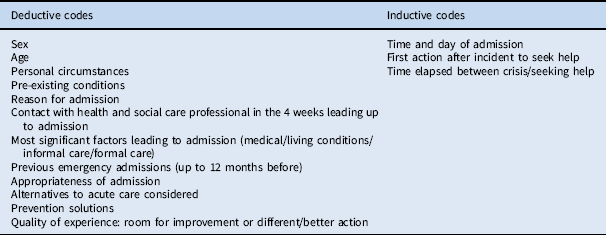
Interviews/focus groups were audio-recorded and transcribed. Transcripts were initially read and coded, using NVIVO data analysis software, by two members of the research team, one working on the telephone interviews, and the other on the focus groups. Transcripts were coded using a coding frame that consisted of the respective interview questions (informed by the study’s research objectives). Table 1 provides a description of the full range of initial codes, as well as additional themes that began to emerge from the data. Thematic analysis (Braun and Clarke, Reference Braun and Clarke2006; Robson, Reference Robson2011) was used to identify recurring threads of meaning in the data, and common themes identified by the full research team.
Codes used in analysis of interviews and focus groups with professionals

Interviews with older people
The key component of our research was interviews with a proposed sample of 120 older people with recent experience of emergency admission, exploring people’s experiences of admission and whether there was scope to avoid hospital by doing anything differently. The population from which samples were drawn was patients aged 65 and over admitted as emergencies (non-elective admission admitted at least overnight) during a given 4 week period to each case study hospital site.Footnote 2 Each Trust then wrote to every eligible older person 4–6 weeks after their discharge with details of the study and what it would entail, asking them to contact the research team via a short form and pre-paid envelope if they wished to participate. For ethical reasons, Trusts did not write to people receiving end-of-life care and people assessed by a local clinician as unable to give informed consent and with no relevant person to act as a potential consultee. Where a local clinician felt that an older person could not to consent to take part, the Trust identified a relevant family member or carer as a possible consultee under the Mental Capacity Act. Trusts continued to write to eligible older people until up to 40 older people per site had agreed to take part, at which point the Trust was contacted and the research team informed further potential participants who contacted us that our sample size had been reached. We do not have broader data on the number of people admitted during this period or the number of invites sent out, as a condition of our ethical approval was that we only receive data relating to individuals who had actively consented to participate.
When the research team received replies from older people wishing to take part, they contacted them to arrange a time/location for an interview, gave people an accessible information sheet and sought written consent to take part. In addition to this, participants also completed a satisfaction form at the end of their interview to state whether they felt comfortable with what had occurred. At each stage they were informed of their right to withdraw data from the study, or to withdraw entirely, without consequence for their treatment.
Interviews were based on a semi-structured topic guide, together with four visual aids to prompt discussion around the factors which may have influenced the admission: medical, social, formal support and informal support. These were laminated A4 sheets with words and pictures on that we could show to the older person (if appropriate) and ask them to talk about whether the factors they represented were significant to their admission. These were words, photos and cartoon images focused on ‘medical condition’ (images of different medical practitioners and procedures), ‘formal support’ (images of care workers, meals-on-wheels, a social worker, etc.), ‘informal support’ (images of friends, neighbours, family, etc.) and ‘social/living conditions’ (housing, living alone, feeling isolated, etc.). These images were used flexibly so that all interviews covered the same underlying topics, whilst also enabling interviewers to draw on these additional resources as necessary to suit the circumstances and individual. Participants were able to have someone of their choosing with them if they wished, and it was made clear (in writing and in the verbal introduction to interviews) that interviews could be stopped or that the participant could withdraw at any time. Interviews were recorded, transcribed and coded.
Our study began with some pre-defined codes from our overall research questions, and was therefore broadly deductive in approach: we wanted to find out whether older people defined their admission as ‘appropriate’ or not and to hear about possible preventative approaches. However, we also wanted to allow interviewees to explore their own experiences with us; hence leaving room for more inductive coding of the data. Whereas our staff interviews were designed to provide an initial overview of the local context and key service issues (and could therefore be appropriately analysed using thematic analysis), our interviews with older people generated a much larger and richer data set, thereby necessitating a different approach. Following Gale et al. (Reference Gale2013), we used the ‘Framework Method’ and Excel to help us manage this process. Thirty transcripts were coded initially with two team members looking for pre-defined codes, while also considering whether other significant themes appeared to be emerging that required coding. Once coded, this initial analytic framework was discussed by the full team, with codes refined, added or excluded through in-depth discussion of the data and process of coding (Table 2). As Gale et al. (Reference Gale2013: 122) note, this is time-consuming, but brings out a variety of perspectives about the data and allows these to be explored and potentially incorporated into the final analysis. Once agreed the analytic framework is then applied to the full data set: thus, we worked through the entire set of transcripts, ensuring interviewees’ responses were coded according to the framework.
Codes used in analysis of interviews with older people

As stated above, our approach was broadly deductive, as this study arose from previous exploratory work and literature which resulted in us having research questions which required specific answers around ‘appropriateness’ and prevention. By allowing a more flexible approach to the data, however, we produced other important codes we had not pre-defined around, for example, time/day of the week of admission and time elapsed before seeking help. These codes, along with participant variables such as sex, age and living circumstances, provided responses which could be counted and indeed, part of our aim was to provide a rate of ‘appropriateness’ of admission as defined by the sample of older people to compare with the rate given by professionals in our study and in other research, thereby adding the patient voice to this research on rates of ‘inappropriateness’. We therefore set our approach apart from Gale et al. (Reference Gale2013: 122) at this point, as they do not advocate the quantifying of qualitative data. By quantifying some of our data, we are not suggesting its generalisability, but wish to provide an overall sense of our data: what our sample looked like and what the views of participants were, as well as which variables and codes interacted with one another in potentially significant ways. We use descriptive statistics only to present our data in another way – not simply through qualitative quotes – and agree with Fielding (Reference Fielding2001: 228) that ‘preliminary analysis [of an interview transcript] may benefit from quantitative methods such as frequency counts of occurrences of certain phrases or words or the codes you have assigned to your data’. The data were therefore coded numerically using SPSS with simple numerical codes, for example, 1=‘Yes’ and 2=‘No’ or by applying numbers to different health conditions or reasons for admissions (e.g. 1=‘Heart condition’ and 2=‘Diabetes’). Space was left within these numerical codes to represent the complexity of participants’ lives by using, for example, ‘other’ or ‘multiple concerns’ which were also given numerical codes. We maintained the ability to look across the sample for key patterns but also to refer back to individuals by ensuring the individual’s case code was included on Excel and SPSS datasheets.
While the main focus was on older people themselves, we included the perspective of carers when older people were deemed unable to consent to participate, or when an interviewee chose to have a carer present and sought their opinion during interview. In practice, only a small number of consultees were interviewed, most caring for someone with dementia. These people were therefore a small, but nevertheless important, group as they provide insights into the experiences of people with dementia, who are a significant but under-researched group among the more general older population (Carmody et al., Reference Carmody, Traynor and Marchetti2015).
Staff surveys
Mirroring patient interviews, an email survey was sent to the general practitioner (GP), social worker and/or hospital doctor of each older person taking part, asking whether they thought the admission in question was ‘appropriate’, key causes of admission and possible scope for prevention. A local administrator in each site assisted in locating the hospital doctor who worked with participating older people; and details for GPs/social workers were requested from the older people during interviews. Given the complexities of identifying, contacting and recruiting these potential participants, we anticipated that we would achieve low numbers here, but believed that it was nonetheless important to access this perspective wherever possible. Surveys were analysed by comparing answers provided by the professionals with those of the patients to a similar question and exploring the similarities and differences between them.
Advice and research ethics
This project aimed to include the voices of older people at all stages, working with an Older Person’s Reference Group throughout. Agewell is ‘a social enterprise led by older people for the benefit of older people’ and its members were actively involved in commenting on draft documentation, piloting materials and reviewing vignettes developed for focus groups. In addition, we worked with a ‘Sounding Board’ of leading local and national bodies (Agewell, NHS Confederation, Association of Directors of Adult Social Services, Age UK, Social Care Institute for Excellence). This group advised us on the feasibility of our proposed approach, helping to place emerging findings in a broader context and advising on future dissemination/implementation. The study received sponsorship from the University of Birmingham research ethics service and a favourable ethical approval from the Coventry and Warwickshire NHS Research Ethics Committee, as well as support from the Thames Valley & South Midlands NIHR Clinical Research Network and the local Research and Development offices in each case study site.
Results I: local context and multi-disciplinary perspectives
Forty professionals were interviewed from a range of backgrounds (Table 3). Though we invited representatives from adult social care in each site, none responded.
Interviewees

A&E=Accident and Emergency; GP=general practitioner.
Perceptions of ‘inappropriate’ admissions
As an introductory question, we asked participants roughly what percentage of older people need not have been admitted had alternative services been available (Table 4). This was not limited to a specific period of time (e.g. the period when older participants were admitted), but was about perceived avoidable admissions in general. This was intended to evoke a very rough ‘guesstimate’, and we anticipated that the extent to which local colleagues agreed with each other (or not) might be more important than the actual figures cited. Overall, we were struck by a significant variation in responses (this was true within sites as well as across sites, as well as within disciplines). While it might be difficult for some participants to engage with such a question (hence the number of people who replied ‘don’t know’), the discrepancy in responses remains of interest: if one person feels that nearly all admissions are ‘appropriate’, while another feels that half could be avoided, there may be some fairly fundamental (and potentially incompatible) differences of opinion. If there is no consensus on the nature or extent of the ‘problem’, then agreeing a shared ‘solution’ may be impossible. It was also interesting to note that such a significant proportion of staff felt unable to say how many admissions may not be needed, which is perhaps surprising given the importance of these issues and the prominence of these debates in policy/the media.
Estimates of the proportion of emergency admissions of older people to acute hospital that might have been avoided had alternatives been available

Figures add up to more than 40 if a small number of people were unsure of a precise figure and gave two potential answers (or if they distinguished between estimates for older people admitted under different circumstances and therefore gave two figures).
Several respondents distinguished between ‘medical’ and ‘social’ admissions. Whereas the former seemed to refer to those who needed particular clinical interventions (e.g. admissions for surgery and other intensive medical interventions), ‘social admissions’ seemed to be those that were caused at least in part by a breakdown in family care or shortfall in community services. While some medical intervention might be needed (particularly to alleviate a flare up of an underlying chronic condition) and access to diagnostic technologies might be required, there was a sense that this input did not necessarily have to be in hospital. There were also concerns expressed about the risks of being admitted to hospital (such as infection, or loss of mobility, confidence and independence), with ‘social admissions’, potentially not worth the risk.
However, others felt that this was an over-simplification, with a potentially fragile balance between an older person’s health, environment and support networks:
‘People talk about social admissions…, but it’s often a mixture of social [factors linked to] a change in medical condition. So a social crisis might be precipitated by, say, a broken wrist, because they could manage fine with the zimmer-frame when they had both hands but now they’ve broken their wrist, they can’t use the frame and they can’t get to the toilet on time; and suddenly the carer can’t cope. It’s more common to have a mix of minor medical niggles and a social crisis: that’s very common’ (Consultant Geriatrician).
So-called ‘social admissions’ were seen to be increasing, and seemed to be resented by some as a waste of scarce hospital resources. In particular, there was a perceived shortfall in the availability of social care, and a belief that some admissions were caused by deficiencies in community support:
‘A lot of our patients come for longstanding conditions, they’re coming to us to help them sort out their social support, really’ (OT).
Older patients were felt to be remarkably resilient in the face of adversity, and often reluctant to seek help until absolutely necessary. There was little support for the notion that older people use hospital as a ‘first port of call’:
‘I think that often elderly people don’t seek assistance until they can no longer cope with what they’ve got, and I guess that’s the way they’ve been brought up’ (Consultant ED).
Despite this, some people were admitted with conditions that participants felt could be treated elsewhere, including urinary tract infections; minor fractures/bruising resulting from falls; shortness of breath; delirium/dementia; changes in health as a consequence of changes in medication; and conditions requiring palliative care. However, participants acknowledged that each of these conditions, although sometimes relatively straightforward medically, might involve a complex mix of social and psychological factors well beyond the capacity or expertise of acute care to deal with alone.
Alternatives
Over time, each site had developed a plethora of initiatives to divert older patients away from hospital, with three main models:
∙ ‘Rapid Response’ initiatives, usually led by occupational therapists (OTs) or physiotherapists, and including nurses, community matrons, care assistants and rehabilitation assistants. These seek to respond within a few hours of referral with a view to preventing the need for hospital.
∙ ‘Discharge to assess’ teams, which provide a thorough assessment at home for older people who have been seen in A&E and not felt to require admission.
∙ Specialist community teams, including community respiratory services, community falls services and community intravenous (IV) teams. These are primarily nurse-led and provide care which might once have been given in hospital.
Key to good care was felt to be a broad understanding of the physical, mental and social problems older people face in the context of their daily lives; teamwork; and a detailed knowledge of local resources outside hospital. Particularly significant was access to consultant geriatricians, whose skills and experience could also ‘trickle down’ in order to complement and build the skills of other staff. However, this expertise was felt to be in short supply:
‘We can’t see every older patient who comes to hospital – 30,000 patients aged over 75 come to us a year – so we are tickling the surface really’ (Consultant Geriatrician).
Above all, participants felt local alternatives to hospital could be fragmented and difficult to access (both for NHS staff and older people):
‘People just don’t know where to go. If you’re from a healthcare background, you may have a small chance, but other than that, they’ve absolutely no idea where to begin… There’s a massive assumption that the elderly person can pick up the phone or has a computer… And once you get through… the telephone waiting time is horrendous. We have clocked up 90 minutes of waiting’ (OT).
Practical suggestions
When asked about ways of improving future services, there were three common themes:
1. Expansion of community services: upstream, there was a strong call for better access to health and social care in the community, including an expansion of social care (which was seen as chronically understaffed and underfunded). There were also calls for greater availability of diagnostic technologies, blood transfusions and IV antibiotics in community settings.
2. Good assessment and post-assessment decision-making: access to senior decision makers with expertise in working with older people and detailed local knowledge was felt to be paramount. Geriatricians were seen as important (but scarce) resources in this respect, as were other practitioners (e.g. OTs). Some participants felt that more easily accessible care plans could help professionals who came in contact with the older person during a crisis to make better decisions and help avoid a hospital admission.
3. Discharge to assess: downstream, there was a call for some patients to go home without an admission, but with a thorough assessment of needs to follow shortly afterwards. There was also a desire for more social care services, as well as better liaison between health and social care so that patients could be discharged more quickly and with the right levels of care in place.
Multi-disciplinary focus groups
One focus group was held in each site, with a total of 22 people (Table 5). Fifteen had also taken part in the telephone interviews, and seven were participating for the first time.
Focus group participants

GP=general practitioner; OT=occupational therapist.
The aim of the focus groups was to explore the issue of ‘in/appropriate’ emergency admissions by examining the experiences of individual patients through three case studies, based on extracts from interviews with patients in our study. Each was chosen because it depicted a key theme raised in a number of our interviews (e.g. being admitted to hospital after a fall). Each focus group was presented with the same three case studies, and there was general agreement that these were familiar scenarios which staff might regularly encounter in their own hospital.

There was unanimous agreement that Mr GFootnote 3 did not need to be admitted. Participants felt that the response received might well depend on who first arrived at the scene, with less experienced paramedics more likely to take Mr G to hospital without seeking alternatives. Once in A&E, the knowledge/expertise of the person who assessed Mr G might determine what happened next, with early access to a geriatrician desirable. One geriatrician commented that staff without experience of older people and their conditions are sometimes ‘frightened’ and are more likely to be risk-adverse and admit people because of their seeming frailty. The day/time of arrival was also identified as significant, with several participants not surprised that he was admitted having arrived at A&E around 4 pm (with some services not available after 5 pm in some sites). Everyone was concerned about Mr G’s four-night stay in hospital. One group talked about him being ‘driven into the “deeper hospital”’ and their belief that ‘every ward move puts a day on your length of stay’.

Everyone agreed that Mariam’s second admission was ‘appropriate’ at the time, but may have been a result of inadequate investigation during her previous visit. All felt the final admission was a reaction to a crisis which to some extent was predictable, as Mariam and her family were increasingly struggling to cope. Although Mariam’s admission was primarily medical, participants wondered whether she should have had a comprehensive medical assessment, a shorter stay and subsequent support at home by services such as rapid response, a mental health home treatment team or the voluntary sector. Overall, Mariam’s story was seen as a prime example of a ‘silo mentality’:
‘I think this really highlights how unjoined up the system is because you come in and you get what looks like a reasonably good medical outcome for what was happening… But it’s not joined up in any way with the chronic disease and the psychiatric aspects of it and the social aspects… It solved a problem but it wasn’t holistic was it?’ [Consultant, Acute Medical Unit (AMU)].
While Mariam’s care in hospital was felt to be good and her health seemed to be improving, there was concern about potential lack of support in the community before admission and little evidence of co-operation between services upon discharge. Participants were also worried that Mariam’s family still felt isolated and confused at the end of the case study.

Opinions were mixed about the ‘appropriateness’ of this admission. Some people felt that Mrs F could have received support from specialist community services, such as a respiratory nurse – and this view was supported by Mrs F herself:
‘There isn’t any real alternative. It’s not an emergency in the sense of emergency. But you’re not given any other choice. You either sit at home or suffer, or you go to hospital I suppose.’
Other people disagreed:
‘Well, yeah, but it’s very hard to make a call. I mean, you and I, if we were stood next to her and she couldn’t breathe in the middle of the night, we would send her to hospital’ (Consultant AMU).
Groups were concerned about the extent to which Mrs F had a proactive care plan, which set out how best to respond in an emergency:
‘It doesn’t sound to me like that loop has been closed… Let’s assume she needed to come to hospital; she’s come, she’s got better, she’s gone home. But what’s been done to stop her coming next time?’ (Consultant Geriatrician).
While Mrs F said that she would have preferred to go to ‘a more local, smaller, cottage-style hospital’, some staff felt the emergency care she may have needed would not be available in such a unit. In terms of Mrs F’s experiences of health services, most participants thought the quality of care appeared good at the time of admission, but wondered whether Mrs F now knew of possible alternatives to hospital and whether a future re-admission may still be likely.
Results II: older people’s experiences
Overall, 104Footnote 4 people were interviewed, including 91 older people and 13 family members acting as consultees. Fifty-one of our participants were men and 53 were women. While Table 6 summarises the age of our sample, there are two key issues to note (see below for further discussion). First, despite the fact that one of our sites was a multi-ethnic inner-city area, the majority of the sample was white (101 out of 104 people). Second, the vast majority of people were living with someone else (64%) or in a setting which ensured they had professional help around them (around 10%), with only 26% of our sample living alone.
Age range of participants

Pre-existing conditions
As Table 7 suggests, our sample came from a spectrum of situations, from full health to living with a single condition to living with a series of multiple and potentially deteriorating conditions. Whatever their prior health, 46 people had no contact with health and social care professionals in the four weeks leading up to admission. Another 45 continued to have their regular interaction with services during this time. While six of these people were admitted as emergencies after planned visits or appointments, there is no indication from the remaining 39 people that the likelihood of a subsequent crisis had been identified during these contacts. This means that only 11 people in our sample had one-off or unusual contact in the 4 weeks before admission.
Pre-existing conditions and contact in 4 weeks before admission

Seeking help
Twenty-four people (23%) called 999 as their first course of action, with the majority doing something else rather than turning straight to the emergency services. Overall, similar numbers of people dialled 999 (23%), contacted a daytime GP (22%) or sought help via 111/a call centre (21%) (Table 8). In around 13% cases, someone else called 999 or 111 on the older person’s behalf. Very few people went to a walk in centre (one person), went direct to A&E (three people) or contacted an out-of-hours GP (four people).
First action after the event to seek help

A&E=Accident and Emergency.
In terms of the speed of seeking help and the relationship with living circumstances (Table 9), 59% of those living alone sought immediate help, compared to 75% of those living with a spouse. Eighteen per cent of those living alone left it more than 1 day or overnight to see if their condition improved on its own, while 10% of those with a spouse waited this long. Thus, living with a spouse might encourage one to seek help quicker than when living alone, perhaps because there is someone else to help make this decision or because another person can dial 999 if the older person is incapacitated.
Participants’ living arrangements and time elapsed before seeking help

While the majority of people sought help immediately, there were still significant numbers of people living alone who delayed. For example, one woman in her 90s had a bout of shingles, but then also fell downstairs. She did not seek help and it was only when her daughter visited that the woman was admitted to hospital. Other people talked about trying to avoid dialling 999 if at all possible (‘just gritted my teeth and waited till I saw a doctor’) or about being conscious of being perceived as a burden on the health service:
‘But I did feel as well – I know having [a] heart problem, whatever, I thought if I’d have had that x-ray and they detected it wasn’t a heart attack, I could have come home… Instead of taking beds up.’
A similar sentiment was raised by a consultee who felt that his mother had often stayed in hospital for too long:
‘Yeah, you get her home more quickly. So, yes, but maybe there’s underlying things there, we’re still testing and you don’t know and things might be taking time their side, but it’s just a general feeling of, yeah, this bed blocking as they call it in the press.’
Although only a one-off comment, this use of jargon such as ‘bed-blocking’ and a reference to how these issues are discussed ‘in the press’ raises at least the possibility that some attitudes to hospital admission might be influenced in part by the policy and media debates discussed at the start of this paper. Rather than being admitted to hospital unnecessarily, therefore, some older people seem to have delayed seeking help as much as possible, perhaps having internalised broader debates around ‘appropriate’ usage of NHS resources.
Day/time of admission
Nearly one-third of our sample was admitted during ‘office hours’, with just over another third admitted at weekends or between 5 pm and midnight, and around 16% admitted very late at night/early in the morning (between midnight and 9 am) (Figure 1).
Day of the week and time of admission.

‘Appropriateness’
The vast majority of participants (91; just under 88%) felt that hospital was the most ‘appropriate’ place for them (Table 10), with only nine people feeling that hospital was not the right place for them. This suggests a rate of ‘inappropriate’ admission (defined by older people themselves) at just under 9%. In terms of these nine people, even these cases seem more complex than simply being ‘inappropriate’: one person seems to have been unable to stop bleeding, one person was diagnosed with a stroke, one person had chest pains, one person was ‘fighting for breath’ and had a previous heart condition, and one person died shortly after their interview (although we do not know if this was connected to their initial hospital admission). Even though these nine older people felt that hospital was not required, there seem few clear cut, easy answers.
Whether patients felt hospital was the best and most appropriate place for them to be at the time of admission

The views of GPs/hospital doctors
Although our main focus was on the experience of older people, we also sought the views of a GP, hospital doctor and social worker (if applicable) as to their opinion of the ‘appropriateness’ of the older person’s admission(s). In total, we received survey responses from 32 GPs and 13 hospital doctors (which was a much better response than we were expecting from busy professionals some time after the admissions in question). However, none of our participants was in current contact with a social worker, and this may be a significant finding in itself (see below). In every case where an older people felt their admission was ‘appropriate’ and where we have data from a GP or hospital doctor, all parties agree that admission was needed. From the policy/media debates described above, we might have expected cases where an older person felt they needed to be in hospital, but where a health professional disagreed. However, we did not find a single case of this.
Unfortunately we only have two cases (out of a possible nine) where the older person felt admission was unnecessary and where we have a view from a health professional (a GP in both cases). Interestingly, both disagree with the older person, stating that nothing could have been done to prevent admission. Thus, the responses we have from health professionals suggest that none of the admissions in our study were ‘inappropriate’ from their point of view.
People with dementia
A minority of participants had dementia, and a consultee gave an interview on their behalf. These consultees felt that admission was ‘appropriate’, except in one case where a consultee felt her husband’s condition had deteriorated in hospital and they were not any closer to finding a clear answer as to why he was collapsing. All consultees felt that nothing could have prevented admission, except in one case where the admission in question was a readmission and the consultee wondered whether the previous hospital stay could have dealt with her husband’s concerns (which were not specific to his dementia). Despite this, consultees felt that hospital staff were not well trained in supporting people with dementia, and that admissions could be influenced by a lack of awareness of dementia within A&E and the potential for older people with dementia to be admitted in part as a precaution. Often, the older person in question went on to have a long stay, which consultees felt was not always beneficial:
‘I don’t think that week in that particular ward did him any favours, and particularly when at the end of the week I was no wiser, and he was no better.’
‘I think the dementia ward is good. But I think the rehab unit, if they’ve got dementia, they give up on them.’
Once older people had a diagnosis of dementia, a number of consultees felt that access to social care was very limited:
‘Well, I went on to social services… We’ve still not heard [six weeks later]. I wanted a home visit because… we’re coping at the moment but I need somebody to come and see….’
Scope for prevention
In our initial pilot, older people suggested a key distinction between ‘inappropriate’ admissions (whether the person needs the services provided in hospital) and the notion of preventable admissions. Even where an admission is medically ‘appropriate’, there may still have been scope for a different course of action at an earlier stage to prevent the person’s health from deteriorating to the stage where hospital is required. While only nine participants felt that their admission was ‘inappropriate’, we were also keen to explore older people’s views as to the scope for prevention. The majority of our sample – 59 people (almost 57%) – felt that nothing could have prevented the admission (Table 11). Overall, the largest preventative category from across our sample was a ‘better earlier response’. This group of 12 people included:
∙ Six people who felt that an earlier diagnosis of their problem and/or subsequent planned treatment would have prevented admission – thereby saving subsequent distress and making better use of scarce NHS resources.
∙ Three people felt that an earlier A&E attendance should have resolved their concern and that it was not used well enough by staff to do so (e.g. as a result of failing to conduct a thorough assessment and/or not listening to the person’s concerns fully).
∙ Three people feel that a previous hospital admission could have resolved their health problems, preventing the need for subsequent admission.
What could have prevented the admission (cross-tabulated with whether participants felt hospital was the best place for them)

‘Individual action’ was the next largest category (mentioned by 11 people), including people saying they should have taken more exercise over the years, drunk less alcohol or taken their GP up on the offer of tests to check the state of their health at various stages in the past. For us, such responses may be more to do with broader debates about public health and lifestyle choices than genuinely/direct preventative measures, and we cannot know whether such longer-term changes would have prevented admission or not. The next largest category (five people) was access to a GP or other community services. In the illustrative example below, the older person pointed out that she found getting appointments with her GP very difficult, despite her chronic health condition, and sometimes ended up in hospital because she could not access the right services:
‘If I could get an appointment with my doctor… But it’s just impossible. Even though I’m a renal patient, I’m prone to urine infection and I was admitted once because I couldn’t access my GP to get the antibiotics. So they have to take me in to do intravenous.’
A review of medications – where incorrect medications were felt to have been given and/or where medications were perceived to be interacting in ways which produced an unwanted reaction in the patient – was suggested by three people as a possible preventative measure. Two people also felt that more general access to advice could have prevented them from being admitted to hospital in a crisis, as they would have been better able to manage their own conditions.
GP/hospital doctor responses
Although all 45 GPs and hospital doctors who took part felt that admission was ‘appropriate’, eight suggested measures which might have prevented the person’s medical condition from deteriorating to the stage where admission was required (see Box 2). With a quicker response, better communication and/or the better availability of social support, it is possible that some admissions – deemed ‘appropriate’ on the day they took place – could nonetheless have been prevented. However, there seem to be few easy answers, and even the cases in Box 2 involve an array of different circumstances and possible service solutions. Nor do the professionals always agree. While there may be some scope for prevention, it seems more complex than the policy and media debates highlighted above.
GP and hospital doctor preventative suggestions

Discussion
We set out to understand the ‘appropriateness’ of older people’s hospital admissions, looking at the issue from different perspectives, identifying where there may be scope for prevention and contributing to key policy/practice debates. These issues are longstanding, complex and contested and, as the literature review revealed, there is relatively little previous literature, providing only limited insights (Thwaites et al., Reference Thwaites, Glasby, le Mesurier and Littlechild2015). This research makes a unique contribution by engaging older people in a meaningful way to gather their longer-term perspective on their hospital admission, together with their views around scope for prevention. While this makes a significant service contribution, it also makes an academic contribution by helping to re-frame a longstanding policy issue, challenging the narratives put forward in policy/media debates.
In making these claims, a key limitation is the extent to which the findings can be generalised across other parts of the country. Our three case study sites were not chosen because they were ‘representative’ of hospitals in England, but rather to provide a range of different characteristics in the sample population (in terms of levels of deprivation, ethnicity and rural/urban catchment areas). There is also a risk with a study like this that we might attract a sample of highly engaged and/or relatively healthy older patients who are not representative of the make-up of the local older population. As the participants in this research study were self-selecting, the research team had no influence over who agreed to take part. However, as we outline above, we went to significant lengths to ensure that as many different people as possible could take part and to try to prevent particular groups (e.g. people with dementia) from being excluded from the study. Certainly, our sample included a diverse range of ages and a range of pre-existing health problems, including a significant proportion of people with multiple conditions – so it did not feel as if we were only recruiting people who were primarily healthy to begin with. All the professionals in the focus groups also thought that our case studies were familiar scenarios which they might have encountered in their own hospitals, which suggests our findings may have wider relevance. The advice of Agewell and of national partners from our Sounding Board has also confirmed that the themes we identified were not just confined to our three case study sites or to more engaged, healthier older people. While we can only comment on the perspectives and experiences of people who chose to participate, therefore, we still feel that the study has significant insights to offer – not least because it has engaged directly with older people, their families and front-line staff directly affected by issues that have often been discussed in policy and media debates without such engagement.
With these caveats in mind, many local professionals perceived ‘inappropriate’ emergency admissions to be an issue, but with little consensus as to the extent of the problem. Whilst some drew a simple distinction between ‘medical’ and ‘social’ admissions, most were aware of a more complex mix of factors at play. This was re-inforced via our focus groups, where detailed multi-disciplinary debates revealed the complexity inherent in discussions of emergency admissions and the wide range of issues at stake – even in admissions that were deemed ‘appropriate’. Local services to divert older people from hospital were many and varied, but had apparently developed piecemeal over time and were seen as lacking the capacity and accessibility to respond quickly and well. The perceived shortage of adult social care was also felt strongly by many participants. In contrast, the key to admission prevention was seen to be access to specialist staff (for example, geriatricians) with an understanding of the complexity of the needs of older people. Key players from our interviews with older people seemed to be GPs and the ambulance service, who had a role in a significant number of admissions and/or (in the case of GPs) had sometimes seen the older person in recent weeks before admission.
The vast majority of older people thought their admission to hospital had been ‘appropriate’, and only nine felt that they did not need to be admitted (a rate of ‘inappropriate’ admission defined by the older people themselves at just under 9%). In contrast, all 45 health professionals commenting on specific older people felt that admission was required (a rate of ‘inappropriate’ admissions from a medical perspective of 0%). Although we can only comment on the experience and perspectives of the people who chose to take part in our research, we found no evidence that a large number of admissions perceived to be ‘inappropriate’ were taking place in our sample, or that older people were accessing hospital too readily. Indeed, our impression was of people keen to explore other options to admissions and sometimes delaying seeking help, perhaps because of fear of being perceived as being a burden on scarce resources.
Despite admissions being seen as ‘appropriate’, about a quarter of older participants could identify earlier action which might have prevented admission, mainly to do with earlier intervention following previous health assessments or earlier access to their GP. However, suggested responses (by both older people and professionals) were complex and multi-faceted, and there were no simple solutions. This seems to run counter to some of the suggestions in recent media debates, where apparently clear-cut problems and solutions are presented with what we would see as insufficient nuance and local context.
In addition to these key conclusions, there are three broader themes which emerged. First, despite the perceived low level of the rate of ‘inappropriate’ admissions, there was still a sense that hospital remained a ‘default’ option in many cases. Whilst there were a wide range of preventative services available in the community, there was doubt from local professionals as to whether these were really viable alternatives to hospital, particularly in rapid timescales. Although hospital could provide access to specialist assessment and treatment, there were also concerns that, once an older person is admitted, there may be some impact on their confidence and independence which may have a detrimental effect on their psychological and physical well-being.
Second, there was an overwhelming view that social care services were underfunded and insufficient, a view supported by the President of the Royal College of Surgeons in England, who wrote to the Chancellor in March 2016, asking for further funding for social care and outlining the impact that gaps in social care can have on timely hospital discharge (BBC, 2016). While some extra funding for social care has since been provided by the government, this is widely believed to be insufficient, and there have been sustained calls for a long-term solution to the funding of adult social care (see e.g. https://www.local.gov.uk/about/campaigns/towards-sustainable-adult-social-care-and-support-system). Against this backdrop, the absence of social care in this study seems highly significant. As detailed above, no older people talked about being in regular contact with a social worker, and we found it difficult to recruit social care staff to the study. It is possible that this may be because of national funding/service pressures; because of a sense of emergency admission being an NHS rather than a social care priority; and/or because emergency admission is a key threshold and social care services may become more involved afterwards. It is also possible that people in contact with social care did not choose to participate for some reason, or that (given the majority of our sample did not live alone) that family members may have been providing informal care, potentially making them less likely to be referred to social care. Whatever the explanation/s, the issue of emergency admissions can only be addressed by health and social care services working together, and further exploration of the role of appropriately funded adult social care services is needed in future policy and research.
Third, this study raises broader questions about the needs of ‘seldom heard’ groups. By paying careful attention to including the experiences of older people with dementia, we heard concerns that many hospital staff are not adequately trained to work with people with dementia and that ongoing social care support is difficult to access. In terms of ethnicity, we remain concerned about the small number of people from minority ethnic communities taking part in this research, despite the multi-ethnic make-up of one of our sites in particular. In an effort to be inclusive, our introductory letters offered the opportunity to receive further information in community languages and to participate with an interpreter provided, but the majority of our participants were nonetheless ‘White UK’. Our previous experience is that working with specialist voluntary/community organisations can help overcome these potential issues, and that these agencies are often much better at engaging older people from minority ethnic groups than some public services and University researchers (Ellins et al., Reference Ellins, Glasby, Tanner, McIver, Davidson, Littlechild, Snelling, Miller, Hall and Spence2012). Any future research may therefore need a specific outreach focus to gather the views of older people from more marginalised groups whose voices are seldom heard.
Summary
Contrary to popular opinion, the study found that older people and their doctors felt that admissions were appropriate. Rather than seeking help too readily, some of the older people concerned delayed asking for support and only ended up at hospital as a very last resort, possibly due to concerns about being seen as a burden on scarce public resources. While older people and front-line staff identified a number of suggestions to improve services in future, there seemed few clear cut, easy answers to the longstanding dilemma of how best to reduce emergency admissions. Overall, we conclude that older people with experience of emergency admissions and front-line staff are key resources when seeking to understand and reduce emergency hospital admissions, and we should not neglect this vital expertise.
Acknowledgements
This research was funded by the NIHR Research for Patient Benefit Programme (PB-PG-0712-28045). The views expressed are those of the authors and not necessarily those of the NHS, the NIHR or the Department of Health. The full research includes a ‘Social Care TV’ video summary, a full research report and a good practice guide, available online via the University of Birmingham. The authors are grateful to the clinical experts who advised and supported this research (Sally Jones, David Oliver, Natalie Powell and Iain Wilkinson) and to our Sounding Board members (NHS Confederation, Association of Directors of Adult Social Services, Age UK, Social Care Institute for Excellence and Agewell).