INTRODUCTION
Emotional processing has been posited as a universal psychotherapy process that is considered essential for change in both experiential and cognitive behavioral treatments (Castonguay et al., Reference Castonguay, Goldfried and Wiser1996; Greenberg et al., Reference Greenberg, Rice and Elliott1993). Emotional processing has been defined as the degree to which clients orient to their inner experience (emotions, thoughts) and use it as information in solving their problems (Greenberg, Reference Greenberg2002; Greenberg & Safran, Reference Greenberg and Safran1984; Reference Greenberg and Safran1987; Greenberg & Pascuale-Leone, Reference Greenberg, Pascual-Leone, Neimeyer and Mahoney1995; Klein et al., Reference Klein, Mathieu and Gendlin1969; Watson & Bedard, Reference Watson and Bedard2006). Clients generally achieve greater depth of emotional exploration over the course of therapy sessions. These phases begin with clients attending to their emotions, acknowledging the information that they contain, becoming aware of the related thoughts and beliefs, giving voice to them, and thus deepening overall understanding. In the highest stages of emotional processing, new meanings emerge, and the upsetting feelings or experiences are used to help solve their problems (Greenberg & Safran, Reference Greenberg and Safran1987).
An Emotion Episode (EE) is a segment of therapy in which a client experiences an emotion in response to a current or past situation. The Experiencing Scale (EXP) measures the degree to which clients orient to, symbolize, and use internal experience as information in the solving of their problems (Klein et al., Reference Klein, Mathieu and Gendlin1969). Examining EXP during Emotion Episodes (EEs) provides an operational measure of emotional processing (Greenberg & Korman, Reference Greenberg and Korman1993; Korman, Reference Korman1991) and has demonstrated a relationship between levels of emotional processing (EXP) across sessions and outcome (Klein et al., Reference Klein, Mathieu-Coughlan, Kiesler, Greenberg and Pinsof1986; Luborsky et al., Reference Luborsky, Chandler and Auerbach1970; Orlinsky & Howard, 1978; Watson & Bedard, Reference Watson and Bedard2006). More successful clients show overall improvement and exhibit higher EXP ratings (Gendlin et al., Reference Gendlin, Beebe, Cassens and Schlien1968; Rice & Greenberg, Reference Rice and Greenberg1984). Greater increases in emotional processing over the course of both experiential and cognitive behavioral therapy are associated with greater post-treatment reductions in symptomatology (Feldman et al., Reference Feldman, Harley and Kerrigan2009; Hunt, Reference Hunt1998; Pos et al., Reference Pos, Greenberg and Goldman2003).
Although self-reported emotional processing has been associated with lower distress among cancer patients (Stanton et al., Reference Stanton, Danoff-Burg and Cameron2000), very little is known about its role during therapy. We sought to address this gap by examining in-session emotional processing during two therapeutic interventions administered to women newly diagnosed with gynecological cancer. Gynecological cancer is challenging because of its poor prognosis, difficult treatment regimens, and adverse treatment side effects (e.g., Hwang et al., Reference Hwang, Cho and Yoo2016). As a result, distress is relatively prevalent and persistent. Rates have been variable, with between 19 and 52% of women reporting moderate to severe levels of anxiety during and after treatment (Watts et al., Reference Watts, Prescott and Mason2015) and up to 45% of women reporting clinically relevant levels of depression (Hipkins et al., Reference Hipkins, Whitworth and Tarrier2004; Norton et al., Reference Norton, Manne and Rubin2004; Watts et al., Reference Watts, Prescott and Mason2015).
To reduce emotional distress among these patients, we developed and evaluated two types of brief therapy for women diagnosed with gynecological cancer: a prescriptive, cognitive behavioral intervention, labeled the Coping and Communication skills Intervention (CCI), and a client-centered, experiential intervention, labeled Supportive Counseling (SC). Both have shown efficacy in a prior randomized clinical study (Manne et al., Reference Manne, Winkel and Rubin2008). In this subsequent trial, the original interventions were enhanced by adding one session, increasing the CCI's focus on coping with disease progression and adding more skill practice, and fostering more emotional expression and development of session themes and goals for the work in SC.
The primary goal was to characterize levels of emotional processing during EEs using the EXP at three timepoints during therapy (i.e., early, middle, and late sessions). We examined levels of EXP, correlates of EXP, changes in the depth of EXP across sessions, and differences between two types of therapy, CCI and SC, in terms of average levels of EXP and increases over sessions. Based on prior work (Pascual-Leone, Reference Pascual-Leone2009; Pos et al., Reference Pos, Greenberg and Goldman2003), we proposed that EXP would increase over sessions as patients learned coping skills (CCI) or achieved a better understanding of their emotional reactions (SC). Because the goal of SC was to explore and understand emotional reactions to cancer, we predicted that average EXP and the rate of increase over sessions would be greater in SC compared with CCI. This prediction was based on research suggesting that clients' emotional processing is higher in experiential therapy than in cognitive behavioral treatment (Watson & Bedard, Reference Watson and Bedard2006). Additionally, we examined EXP in cancer- and non-cancer-related EEs. We proposed that emotional processing when discussing emotions evoked by a cancer experience may be more important.
The second aim was to examine whether EXP was associated with intermediate therapy outcomes such as perceived progress with treatment. Based on prior literature suggesting that experiencing is associated with positive perceptions of the therapy process (Fitzpatrick et al., Reference Fitzpatrick, Peternelli and Stalikas1999), we proposed that women with higher levels of EXP and/or increases in EXP across sessions would report greater perceived progress.
METHOD
Participants and Procedures
The current study utilized data from a multisite randomized clinical trial (RCT) evaluating the efficacy of two individual psychotherapy interventions: CCI versus SC and “usual care” (UC). The inclusion criteria for the RCT were: (1) > 18 years; (2) diagnosed with gynecological cancer within the past six months at the time of recruitment to the study; (3) a Karnofsky Performance Status score of > 80 or an Eastern Cooperative Oncology Group (ECOG) score of 0 or 1; (4) lived within a 2-hour commuting distance from the recruitment center; (5) English-speaking; and (6) no hearing impairment. Eligible women were identified and mailed a letter describing the study. Research assistants contacted eligible women either in person or by phone to explain the study. Interested women signed an informed consent document approved by the institutional review board at each site. Participants completed a baseline survey and were randomly assigned to CCI, SC, or UC. Participants were paid $15 for completing the baseline survey and incrementally for each session attended. Psychotherapy session data were obtained from the first and sixth of seven psychotherapy sessions, as well as a third midpoint session. Procedures for selection of the mid-session are described below.
We utilized baseline survey and session data from participants who attended at least six therapy sessions. Of 245 women who completed a baseline survey and were randomized to either CCI or SC, 201 completed 7 sessions and were eligible for inclusion. Of the 44 women not included, 41 dropped out before completing 6 sessions, and 3 were excluded because complete EXP data were not available.
Models of Therapy
The CCI and SC interventions both consisted of seven hour-long individual sessions. CCI session content was structured and focused on enhancing coping and communication skills related to cancer. Each session focused on specific content (e.g., relaxation, communication, managing worry about the future). Sessions included didactic content, in-session practice, and home assignments; techniques were based on cognitive behavioral interventions. SC sessions focused on enhancing psychological adaptation within a supportive context; techniques were based on supportive counseling interventions (Novalis et al., Reference Novalis, Rojcewicz and Peele1993) and emotion-focused therapy (Elliott et al., Reference Elliott, Watson and Goldman2004). They included empathy, reflection, exploration of experience, and encouragement of emotional expression. SC therapists formulated ongoing themes and goals for the work, but coping skills were not presented.
Pre-Intervention Measures
Demographic and Medical Information
Demographic data were obtained on the baseline survey, including age, race, income, education level, and marital status. Medical chart review captured primary cancer diagnosis, cancer stage, type of treatment, and time from diagnosis at the baseline survey.
Self-Reported Functional Impairment
The 26-item functional status subscale of the Cancer Rehabilitation Evaluation System (Schag et al., Reference Schag, Ganz and Heinrich1991) (CARES) was used to assess physical symptoms (scale range, 0–104). The values of Cronbach's alpha were 0.93, 0.93, 0.92, and 0.93 at times 1, 2, 3, and 4, respectively.
Dispositional Emotional Expressivity
The Emotional Expressiveness Questionnaire (EEQ) (King & Emmons, Reference King and Emmons1990) assessed patients' tendency to express a variety of positive and negative emotions. The scale consists of 16 items rated on a 5-point Likert-type scale ranging from 0 (“never”) to 4 (“always”). Scores range from 0 to 64, with higher scores indicating a greater tendency toward emotional expression. Internal consistency in this study was 0.71.
Depressive Symptoms
Depressive symptoms were assessed using the Beck Depression Inventory (BDI) (Beck et al., Reference Beck, Ward and Mendelson1961). Internal consistency in this study was 0.82.
Cancer-Related Distress
The Impact of Events Scale (IES) (Horowitz et al., Reference Horowitz, Wilner and Alvarez1979) was used to assess distress symptoms specific to the cancer experience. The scale contains 15 items and is comprised of two subscales: intrusions, which assesses the frequency and severity of intrusive thoughts and feelings about cancer; and avoidance, which assesses the frequency and intensity of efforts to avoid reminders and thoughts about the cancer experience. The scale has been utilized in research with medically ill populations (Hobbie et al., Reference Hobbie, Stuber and Meeske2000), including cancer patients (Epping-Jordan et al., Reference Epping-Jordan, Compas and Howell1994). Internal consistency in this study was 0.90.
Post-Session Progress
Session Progress
After each session, patients rated six items from the Session Progress Scale of the Therapy Session Report (Kolden, Reference Kolden1991). The items evaluated overall perception of the session, perceived progress, therapist helpfulness, the degree to which the patient experienced a change or shift, or wanted to take a new course of action as a result of the session. Items were reverse-coded, so that higher scores indicate greater progress. In the current study, internal consistency ranged from 0.70 (session 1) to 0.79 (session 7).
Psychotherapeutic Process Measures
The Experiencing Scale
The EXP measures clients' working engagement and processing during therapy (Klein et al., Reference Klein, Mathieu and Gendlin1969). This scale is widely considered the “gold standard” of experiential processing and remains one of the most extensively studied and validated measures of in-session process in psychotherapy research. EXP was rated from EEs, which were identified using the emotion episode coding system (Greenberg & Korman, Reference Greenberg and Korman1993; Korman, Reference Korman1998). More details regarding EE coding are provided by Myers Virtue and colleagues (Reference Myers Virtue, Manne and Darabos2015). Using transcripts and accompanying videos, each EE within a session was rated on a 7-point scale in terms of participant awareness of, and exploration and reflection on, their inner experience to achieve self-understanding and problem resolution (Klein et al., Reference Klein, Mathieu and Gendlin1969). Every EE is given a mode EXP rating and a peak EXP rating. The mode characterizes the average scale level for the EE-coded segment. The peak EXP is given to the highest level of processing reached within that EE, even if momentarily. The mode EXP for each session was calculated from the average mode across the EEs in that session (sum of mode scores/total no. of EEs). The peak EXP for each session was calculated from the average peak across the EEs (sum of peak scores/total no. of EEs).
Sessions 1 and 6 were selected for EXP coding. The third session was selected between sessions 2 and 5 based on the client's rating of emotions experienced during the session using the Positive and Negative Affect Schedule (PANAS) (Watson et al., Reference Watson, Clark and Tellegen1988). The session with the highest total affect rating on the PANAS was selected for coding. For this study, we categorized the situation of the EE as cancer-related (i.e., pertaining to the patient's cancer diagnosis or treatment, or the impact of cancer) or non-cancer-related. Thus, for the first two aims, the following six EXP variables were used: total EXP peak and mode, EXP for cancer-related EE peak and mode, and EXP for non-cancer-related EE peak and mode.
EXP and EE Training
Training in EEs was provided prior to and throughout the study. EE ratings were completed by four research assistants, who were extensively trained by the criterion coders, the second author (SV), or a postdoctoral fellow. Coders read the EE coding manual, practice-coded two sessions with one of the criterion coders, and then practice-coded a minimum of five transcribed sessions on their own until reaching a minimum of 80% fidelity with the criterion coders. Fidelity drift was evaluated by having one-third of all cases rated by the criterion coders. Differences in ratings were discussed and resolved between the primary coder and the criterion coders. All sessions (session 1, session 6, and the midpoint session) within each drift case were coded by the coder and criterion coders. Agreement between primary and criterion coders was 90.6%. Raters also agreed 96% of the time on whether the EE was cancer- or non-cancer-related.
Training in EXP coding was provided prior to and throughout the study. EXP ratings were completed by seven research assistants who were extensively trained by the criterion coders, the second author (SV), or the postdoctoral fellow. Coders read the EXP manual (Klein et al., Reference Klein, Mathieu and Gendlin1969), listened to the manual training tapes, practiced coding segments in the training tapes, and then coded a set of “master EEs” that were previously coded by SV. Coders were considered reliable when agreement with regard to mode and peak EXP ratings reached 80%. Fidelity drift was evaluated similarly to EE coding. Reliability between primary coders and criterion coders for mode and peak ratings was excellent (κmode = 0.813, κpeak = 0.784).
Analytic Approach
Growth curve models for the six EXP outcomes were conducted using “mixed” with STATA (v. 14). In these analyses, EXP was predicted to be a function of time in weeks since baseline assessment, therapy type, and the interaction between therapy type and time. Because there was variability in the middle session, we used individual specific time intervals. Models were developed by sequentially testing linear and then quadratic fixed effects of time. However, because there was no significant quadratic effect, the final model only included the linear effect of time. All analyses included covariates race/ethnicity, education level, marital status, age, baseline functional impairment, metastatic status, baseline depression, and baseline cancer distress.
For the analysis of session progress, growth curve models were generated using all seven timepoints. Session progress was predicted to be a function of time in weeks since baseline assessment, average EXP over sessions, and the interaction between time and average EXP. For the moderation analysis, the main effect of therapy type and the two- and three-way interactions of therapy type were included in the models. Significant interactions were decomposed using simple effects analysis, in which we examined the effects of time for patients who were one standard deviation above and below the mean.
RESULTS
Sample Characteristics
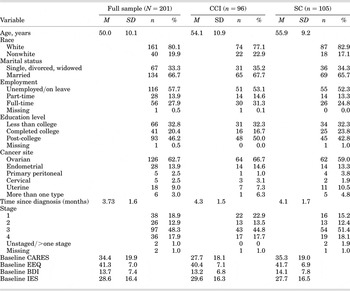
Sample characteristics are shown in Table 1. The mean age was 50 years (SD = 10.1). Most were Caucasian (80%), married (66.7%), and had a college or higher education (67%). The most common gynecological cancer diagnosis was ovarian cancer (62.7%). The majority had advanced-stage disease (66%). There were no differences between conditions.
Baseline characteristics of the study sample

CCI = Coping and Communication-enhancing Intervention; SC = Supportive Counseling Intervention; CARES = Cancer Rehabilitation Evaluation System; EEQ = Emotional Expressivity Questionnaire; BDI = Beck Depression Inventory; IES = Impact of Events Scale.
Aim 1: Characterization of the EXP
Descriptive Information and Correlates
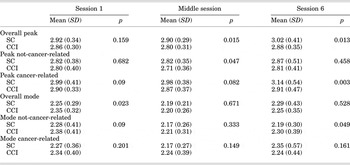
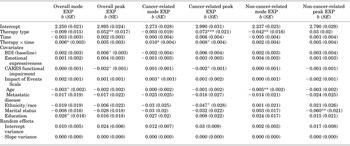
Descriptive information for EXP is shown in Table 2. Patients in CCI and SC had average peak and mode EXP ratings that hovered between 2 and 3, indicating that they were recounting events in their life with a reference to their feelings. Between 2 and 10% of patients had EXP ratings at a level of 4, 5, or 6, indicating higher stages of emotional processing, particularly when peak EXP for cancer-related EEs in the sixth session was evaluated. Thus, a small proportion of patients engaged in a deeper exploration of the meaning of their feelings and experiences. Correlates of EXP are shown in Table 3. Younger age, greater baseline depressive symptoms, and greater baseline cancer distress were associated with higher EXP.
Descriptive information regarding the EXP ratings over sessions

SC = Supportive Counseling; CCI = Coping and Communication Intervention.
Predicting EXP change as a function of time and treatment condition

+ p < 0.10; * p < 0.05; ** p < 0.01; *** p < 0.001.
BDI = Beck Depression Inventory; CARES = Cancer Rehabilitation Evaluation System; therapy type is coded 1 = SC, –1 = CCI; ethnicity/race is coded white = 1, not white = –1; education is coded post-high school = 1, high school or less = –1; marital status is coded married = 1, not married = –1; metastatic disease is coded metastasis = 1, no metastasis = –1. Time, BDI, CARES, IES, and age were grand-mean centered.
Differences in the EXP Between CCI and SC
Comparisons between SC and CCI indicated that overall peak EXP was higher in SC for session 6. Cancer-related peak EXP and non-cancer-related peak EXP was higher in SC for the middle session. The opposite pattern was seen for mode EXP. Overall mode EXP and mode non-cancer-related EXP were higher in CCI than SC (p < 0.05). Comparisons between overall cancer- and non-cancer-related EXP were calculated (but not displayed in the table). Cancer-related peak EXP was significantly higher than non-cancer-related EXP for all three sessions (p < 0.001).
Changes in the EXP Across Sessions
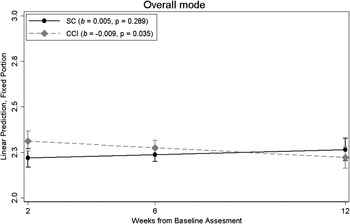
The analysis evaluating changes in EXP over time are shown in Table 3. For overall peak EXP, the main effects for group, time, and group × time interaction were not significant. For overall mode EXP, there was a significant group × time effect (p = 0.026). Figure 1 illustrates the change in mode EXP. Analysis of the simple slopes of SC and CCI show that, over time, EXP mode did not significantly change for patients in SC (b = 0.005, p = 0.289). In CCI, the overall mode EXP decreased significantly, with an average decline of 0.009 points per week (b = 0.009, p = 0.035). After 12 weeks, this resulted in a difference of –0.045 points between CCI and SC. However, this difference was not significant.
Changes in overall EXP mode.

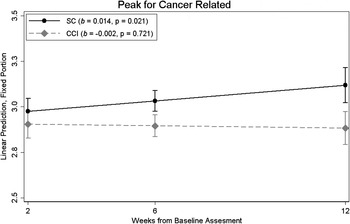
For cancer-related peak EXP (Figure 2), the group × time interaction was marginally significant (p < 0.10). The main effect of group was not significant. The time effect was significant (p < 0.05), and the group × time effect was marginally significant (p = 0.08). Figure 2 illustrates the change in peak cancer-related EXP for the two groups. An examination of the simple slopes indicated that peak cancer-related EXP did not significantly change over time in CCI (b = –0.002, p = 0.721), but increased significantly in SC, with an average increase of 0.014 points every week (b = 0.014, p = 0.02). After 12 weeks, this resulted in a significant difference of 0.236 points between the two groups, with patients in SC reporting higher cancer-related peak EXP. The group difference at 12 weeks represents a medium effect size (Cohen's d = 0.491).
Changes in cancer-related EXP peak.

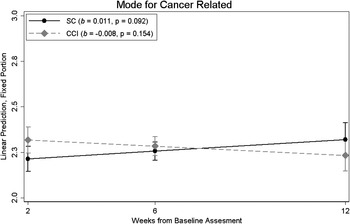
For cancer-related mode EXP (Figure 3), the main effects for time and group were not significant. The group × time interaction was significant (p < 0.05). However, examination of the simple slopes revealed that, although the group × time interaction indicated that the two groups differed from each other, they were not statistically different from zero. This suggests that, over time, cancer-related mode EXP did not change significantly among patients in either group. For non-cancer-related peak and mode EXP, there was not a significant effect of group, time, or group × time for either peak or mode non-cancer-related EXP.
Changes in cancer-related EXP mode.

Aim 2: EXP As a Predictor of Session Progress
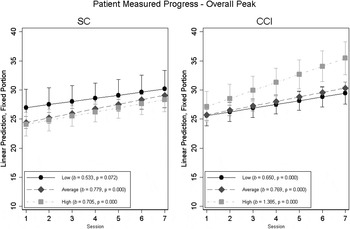
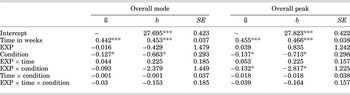
To simplify the analyses, we focused on overall EXP and did not examine cancer- or non-cancer-related EXP. We used a basic growth curve model in which time, EXP, and the time × EXP interaction were used to predict progress. Race, marital status, education, baseline emotional expressiveness, functional impairment, baseline depression, and baseline cancer distress were utilized as covariates. There was a significant positive slope for time. For each week, there was almost a 0.5 increase in progress, which represented a strong effect size (β = 0.444). No other variables significantly predicted session progress in models for both overall mode and peak EXP. We expanded the growth model to evaluate the moderating role of treatment group. The same covariates were included. Table 4 presents the results. Including treatment group in the growth model resulted in a significant main effect for group (overall mode β = 0.127, overall peak β = 0.137). There was a significant interaction between overall peak EXP and group (β = 0.132). To further investigate the relationship among group, EXP, and session progress, values of EXP were converted into categorical variables representing three groups separated by one SD from the mean. In SC, patients with low, average, and high overall peak EXP did not have significantly different improvements in session progress. In CCI, patients with high overall peak EXP scores reported a greater rate of progress versus patients who had average or low overall peak EXP. Analysis of the simple slopes reveal that patients with high overall peak EXP reported increased patient progress at a rate of 1.385 points per week (p < 0.01). This increase is more than two times higher than patients with an average (b = 0.769, p < 0.01) or low (b = 0.650, p < 0.01) overall peak (see Figure 4). After seven sessions, this resulted in a significant difference between patients with high overall peak EXP versus average and low. These results were the same as those for overall mode EXP. In SC, patients with low, average, and high overall mode EXP reported increases in session progress at a similar rate. In CCI, patients with high overall mode EXP improved at a faster rate than patients with average and low. However, this rate was not statistically significant.
Associations between peak EXP and patient-rated session progress.

Moderated growth model results predicting patient-measured session progress as a function of overall EXP mode/peak, time in weeks, and treatment condition

* p < 0.05; ** p < 0.01; *** p < 0.001.
Covariates not presented in this table are: ethnicity/race, education, marital status, metastatic disease, baseline BDI, CARES, IES, and age. Time is measured in weeks; therapy type is coded 1 = SC, –1 = CCI; time and overall mode were grand-mean centered; BDI = Beck Depression Inventory.
DISCUSSION
This study used a novel approach—application of the EXP scale—to understand levels of emotional processing during emotional episodes in individual therapy with recently diagnosed gynecological cancer patients. The first aim was to characterize overall EXP during sessions. Peak EXP ratings among participants averaged between 2.7 and 3.1, indicating that women discussed external events that occurred, their emotional reactions, and their private experiences in sessions. Mode EXP ratings ranged between 2.17 and 2.38, suggesting that, for the most part, women discussed personal events but didn't explicitly refer to feelings, reactions, or emotional experiences. Between 2 and 10% of patients had EXP ratings at a level of 4, 5, or 6, indicating higher stages of emotional processing, particularly when peak EXP for cancer-related EEs in the sixth session was evaluated. Thus, a small proportion of patients engaged in a deeper exploration of the meaning of their feelings and experiences. Although these findings suggest that emotional processing levels are not high, they are similar to EXP levels reported in studies of cognitive and interpersonal therapy (e.g., Castonguay et al., Reference Castonguay, Goldfried and Wiser1996; Watson & Bedard, Reference Watson and Bedard2006; Wiser & Goldfried, Reference Wiser and Goldfried1993). Interestingly, overall peak EXP was significantly higher for cancer-related EEs than for non-cancer-related ones. Given that the primary focus of both therapies was coping with the cancer experience, our results suggest that patients were able to more deeply process their cancer-related inner feelings and experiences. In terms of correlates, medical variables were not associated with experiencing. Younger age and higher distress were associated with higher EXP. These findings are consistent with prior work which found that more distressed women tended to express more EEs during sessions, regardless of self-reported levels of emotional expressivity (Myers Virtue et al., Reference Myers Virtue, Manne and Darabos2015). The therapy environment may provide a safe place in which to express distress or negative emotions that women are experiencing. The tendency for more EEs among distressed women may have allowed for more opportunity to engage in higher processing.
Results regarding differences between SC and CCI for the overall, cancer-related, and non-cancer-related EXP were mostly consistent with our predictions when peak EXP was evaluated. Consistent with the goals of SC, overall peak EXP was higher in the middle and later sessions among patients in SC, as well as for cancer-related EXP in the later session. The findings suggest that women in SC were able to achieve a higher level of processing during the middle and later sessions, and cancer-related EEs in the later session. These findings are consistent with prior work (Watson & Bedard, Reference Watson and Bedard2006). The mode EXP was higher in CCI in the first session, indicating that, on average, women in CCI engaged in higher processing during the first session, but this pattern was not maintained across the middle and later sessions.
The patterns of change over time in EXP were more complex. There was no evidence of change over time in overall peak EXP. While overall mode EXP decreased in the CCI condition, these changes were not different from SC at the end of treatment. Cancer-related peak EXP illustrated more interesting findings. Peak cancer-related EXP didn't significantly change over time in CCI, but increased significantly in SC. Taken together, the pattern of results suggests that peak experiencing was higher and increased more in SC when participants were discussing cancer-related emotions. These findings are consistent with the goals of this therapy, but provide a more nuanced picture.
The reason why the EXP is important is that it is considered a core ingredient of successful therapy. Our findings were surprising, because EXP was only associated with progress in one therapy condition. Progress in therapy improved over time, as expected, but EXP only had a role in perceived therapy progress in CCI. For women in CCI, those with high overall peak EXP reported increased progress at a rate two times higher than patients who had average or low overall peak. A similar pattern was observed for mode EXP. Our results suggest that the role of the EXP was as a moderator of therapeutic progress in the cognitive behavioral therapy. Thus, women who engaged in greater processing of the meaning of the emotional responses they discussed during cognitive behavioral sessions reported significantly more progress in therapy. Cognitive behavioral treatments may be more helpful to patients who are able to utilize the skills they learn to deepen their understanding of their reactions.
There is evidence that higher EXP scores are linked to treatment outcomes in experiential treatment (Pos et al., Reference Pos, Greenberg and Goldman2003). In the present study, average and high levels of EXP were associated with progress, but the association was not significant. A possible reason is the length of treatment. Studies linking emotional processing to treatment outcomes have included longer treatment courses (16 to 20 sessions). Connecting in-depth processing to treatment goals and ultimately to progress for patients may take more than seven sessions. Our treatment consisted of seven in-person sessions. On the other hand, the women in the CCI condition were taught direct coping skills and may have been able to apply those skills when high levels of processing were achieved, but there was not time to delve further into integrating those inner experiences. Another possible explanation is that delving into the meaning of emotions without learning skills to manage them in session is not considered helpful by women who are very newly diagnosed with a life-threatening cancer.
LIMITATIONS AND IMPLICATIONS OF THE STUDY
There are limitations to the current study. First, the majority of women were Caucasian, well-educated, diagnosed with ovarian cancer, and diagnosed with advanced disease. Patterns of EXP may differ among women diagnosed with early-stage disease. Second, the majority was not seeking psychotherapy and was not clinically depressed. Findings may differ for depressed cancer patients seeking psychotherapy. Third, we only assessed EXP during sessions 1 and 6, and in a middle session with the highest emotion. It is possible that different patterns may have emerged in middle sessions with lower emotion arousal or in the last session. Finally, the treatments were offered as part of a clinical trial where the sessions were recorded and closely supervised. It is not clear if the same findings would be seen outside of a research study.
Despite these limitations, there are important implications from the study. Women are able to attend to their emotions and personal experience, particularly when discussing cancer-related issues during both short-term supportive counseling and a short-term prescriptive coping skills intervention. In the CCI condition, higher levels of processing were associated with greater progress, suggesting that it may play an important role in treatment outcomes. Clinicians working with this population may consider how to utilize patients' emotional experiencing in a productive way in cognitive behavioral treatments.
DISCLOSURES
The authors hereby state that they have nothing to disclose.
ACKNOWLEDGMENTS
We would like to acknowledge project managers Tina Gajda, Sara Frederick, Shira Hichenberg, and Kristen Sorice, assistant project manager Jaime Betancourt, and research study assistants Joanna Crincoli, Lauren Faust, Sloan Harrison, Travis Logan, Glynnis McDonnell, Arielle Schwerd, Marie Plaisime, and Caitlin Scally. We would also like to thank our coders—Katie Darabos, Danielle Ryan, Jason Samlin, Alyssa Levy-Dougherty, Thomas D'Agostino, and Kristen Sorice. We would also like to thank the study participants, their oncologists, and the clinical teams at Rutgers Cancer Institute of New Jersey, Memorial Sloan Kettering Cancer Center, Fox Chase Cancer Center, The Hospital of the University of Pennsylvania, Thomas Jefferson University, Morristown Medical Center, and Cooper University Hospital. This work was funded by NIH grant number R01 CA085566 to Sharon Manne with the National Cancer Institute.