Early twenty-first-century Lancashire was in the news regularly as a significant place for royalty. In 2016, a “compassionate Prince Harry” met with flood victims in the county and thanked troops for their rescue efforts in dealing with the worst storms in living memory.Footnote 1 The queen had struck a more optimistic note the previous year, when she was in Lancaster, touring the castle to celebrate 750 years of the creation of the duchy.Footnote 2 Three years earlier, in 2012, Prince Charles declared that Burnley was his “number one priority” in a series of visits designed to champion local business regeneration and youth action projects.Footnote 3 Television, internet, and press coverage of all these events displayed a familiar mix of informality and official ceremonial perfected over generations of royal visits and tours in Britain and across the world. The queen's Lancaster itinerary was the most formal, but there was orchestrated informality and an up-to-date festive atmosphere, as well.Footnote 4 The monarch's smiling wave got the approval of the assembled crowds who were tweeting and blogging about the event, while the presence of children lining the royal route added to the relaxed mood of celebration. The idea of a people-friendly monarchy was even more to the fore when Prince William and his then fiancée, Kate Middleton, visited Blackburn in 2011. The couple moved briskly into a version of the royal walkabout, meeting and greeting disabled youngsters and cheerfully working the crowds.Footnote 5
One hundred years earlier in 1913, British royalty had also visited Lancashire when George V and Queen Mary made a series of extended trips across the industrial heartlands of England and Wales. These visits pioneered an informal style of monarchy that has become a central feature of royalty's contemporary public performance. But in 1913 it was experimental and innovatory, in sharp contrast to the ceremonial that dominated the king and queen's public appearances at home and across the British Empire. The political and social reference points for their visits were very different from those of today. Fresh from their coronation in 1911 and the Delhi Durbar in India, the king and queen faced multiple domestic pressures back in Britain: a recent constitutional crisis, large-scale industrial unrest, suffragette protests, and the threat of civil war in Ireland. So, for eight days in the summer of 1913 in Lancashire, the king donned a lightweight suit and a brown bowler hat and the queen wore serviceable clothes in a carefully orchestrated effort to present themselves to Britain's industrial working class.Footnote 6 Lunching in a pub, the royal couple were serenaded by mill girls and brass bands; they toured countless factories and took tea in working-class homes.
These early twentieth-century tours marked a new departure for the British monarchy—in its political ambitions and in its relationship with mass audiences—that reshaped the public performance of royalty and influenced the idea and practice of democracy itself. This article examines the dynamic interrelationship between the crown's exercise of political authority and its use of modern ritual, arguing that the constitutional story of the modern monarchy is inseparable from its decorative and ceremonial functions. The shifting and fraught position of the crown in relation to cabinet government, party politics, and the mass electorate before 1914, together with the much wider threats posed by labor militancy, the suffrage struggle, and resurgent republicanism, meant that George V and his advisors invested in new styles of royal accessibility. Confronted by these challenges, the monarchy adopted modes of communication that projected a different relationship between sovereign and people.
Historians of the twentieth-century British monarchy have tended to separate the crown's “efficient” role from its “dignified” functions, to quote from Walter Bagehot, in ways that preclude an examination of the ongoing connections between royal politics and ritual symbolism.Footnote 7 David Cannadine's pioneering arguments about the demise of the “effective political power” of sovereignty and the concomitant rise of a late Victorian monarchy that was increasingly “splendid, public and popular” was concerned to examine the interplay between the crown's exercise of “hard” as opposed to “soft” power.Footnote 8 But in practice his arguments set a trend toward the thematic separation of the crown's varied functions, in ways that reflect the distinctive subspecialisms of modern scholarship.
Constitutional historians and political biographers, led by Vernon Bogdanor, have focused on a modernizing narrative, in which the crown surrendered “power and partisanship,” replacing it with more “neutral and detached” influence that stood above the fray of mass politics.Footnote 9 Frank Prochaska, in contrast, has shown how the monarchy was “active in its own defence.” Faced with declining political power and with the sporadic challenges of republicanism, “royal bounty” in the shape of a welfare monarchy in large part guaranteed the institution's survival throughout the twentieth century.Footnote 10 Social and cultural historians have tracked the ceremonial appeal of the monarchy via the royals’ cultivation of and pursuit by the media, and later by their involvement in celebrity culture.Footnote 11 However, these three features of the crown's performance were almost always mutually dependent rather than separable. The emphasis on new forms of display was not simply compensatory for a loss of real political power by the crown, which was the functionalist gist of Cannadine's original thesis. Nor was royal munificence a strategy for “enticing the working classes into the royal camp,” as Prochaska has argued.Footnote 12 The key was the expansive version of democracy pioneered by the king and his advisors, which embraced political, social, and cultural traditions of inclusiveness in their conservative and traditionalist forms.
William Kuhn was right in this respect, if not in others, when he emphasized that the modern monarchy “appeared to be allied … to Britain's democratic system.”Footnote 13 But Kuhn's argument raises a further question: What type of democratic traditions and political languages defined the monarchy under George V? My arguments here are fourfold. First, in ideological terms, the British monarchy forged a distinctively paternalistic version of democracy, drawing on the resources of nineteenth-century Toryism and philanthropy. In the years before 1914, this discourse revived a vision of the organic community and the reciprocal connection between classes, confronting socialist and republican philosophies of power and conflict. Second, Buckingham Palace began to generate a different relationship to class-based and nationalist political struggles, foregrounding the king as conciliator. This new role was evident in George V's personal involvement in the serious prewar industrial disputes and in the conflict over Irish home rule, though not in his reaction to women's suffrage. The king's strongly held Conservative views were no barrier to his newly assumed arbitrarial position, because the Tory-patrician outlook of both the king and queen enabled them to forge the idea and practice of a modern, socially cohesive monarchy. Third, this combination of factors gradually crystallized the institutional position of the crown as above and outside politics, in a situation where the king had been badly bruised by the recent constitutional crisis. Finally, the monarchy generated new styles of ceremonial performance, projecting an image of cultural democracy in its appeal to audiences that was enhanced by a reinvigorated mass media.
Comparisons with other monarchies are instructive; none of the other major European dynasties embarked on similar experiments in accessibility before 1914. Tsarist Russia, imperial Germany, and the Austro-Hungarian Empire responded to the democratic and socialist challenges to their regimes by reaffirming autocracy, emphasizing royal charisma, and often highlighting aggressive forms of monarchical nationalism, reinforcing this with stiff court ritual and ceremonial.Footnote 14 In Belgium, Albert I and Queen Elisabeth did work to establish “sympathetic contact with the people” via the queen's active philanthropy and the king's interest in industrial conditions.Footnote 15
In the first part of the article, I show how in Britain the impact of the dramatic constitutional crisis that confronted George V and his advisors over the powers wielded by the House of Lords in the opening years of his reign threw up major challenges for the crown as well as for Edwardian Conservatism and Liberalism. The exercise of the royal prerogative brought into sharp focus the bigger question of the sovereign's constitutional powers, in a situation where the functioning of high politics was being challenged by a much wider spectrum of forces. The decision of the king and his advisors to promote the crown as conciliatory and extra-political was one response to these events.
There were continuities in this respect with earlier regimes, as well as notable changes. As Dorothy Thompson has argued, Queen Victoria frequently projected a public image of the crown as mediating between different political interests, despite her early overt Whig sympathies, which later became emphatically Conservative and imperialist.Footnote 16 The Chartist movement addressed petitions to the monarch, who was construed as “on the side of the people” in paternalistic terms, despite the queen's own personal belief in fixed social hierarchies. The commercial marketing of Victoria and Prince Albert as an idealized domestic couple for middle-class consumption added to the sense that the royal family was at the centre of an imagined national community, cemented by a bond of intimacy between sovereign and people.Footnote 17 In a different way, the late eighteenth-century monarchy under George III was humanized by an emphasis on the king's vulnerability; as Marilyn Morris has demonstrated, his domestic virtues and down-to-earth manner encouraged forms of “active loyalism” that were partly distinct from party politics.Footnote 18
However, the differences between these earlier forms of royal symbolism and the situation facing the crown in the years before 1914 were marked. George V and his advisors were confronted by the triple challenges of mature working-class industrial politics, a rapidly shifting party-political system, and a range of new or transformed media cultures—all of which had implications for the survival of the monarchy in its nineteenth-century forms. These factors were kaleidoscoped together in ways that produced a crisis moment or conjuncture for the monarchy, as George Dangerfield argued in his pioneering account of the death of “Liberal England.”Footnote 19
One immediate response was the royal visits of 1912 and 1913, discussed in the second part of the article. The industrial tours taken together provide evidence of a major shift in the performance of monarchy. The initial itinerary, which covered Cardiff, the mining districts and steel works of the South Wales coalfield, and Bristol in June 1912, was followed by a visit to Yorkshire less than two weeks later. Both were a learning curve for the king and queen and their advisors. The more extensive tour of Lancashire the following year, which covered not just the cotton towns but Liverpool and Manchester, as well, showed a consolidation of the experience gained in South Wales and Yorkshire.
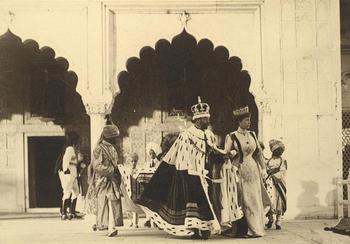
I analyze these tours together because their underlying paradigm about democracy, class, and royal accessibility remained broadly similar, even though the political and industrial cultures in each of the areas varied considerably. George V invested heavily in a formal, ceremonial monarchy throughout his reign, both at home and across the empire. His personal decision to visit India as emperor soon after his accession culminated in the sumptuous Durbar of 1911, which saw the king and queen, crowned and robed, enter a massive amphitheater to receive homage from the Indian princes. The following day, the royal couple appeared at Red Fort to receive half a million people (figure 1). These traditional displays of authority have attracted much more historical attention than the seemingly mundane industrial visits made at home,Footnote 20 but the informal appearances by George V were just as significant for the British monarchy.
George V and Queen Mary at Red Fort, Delhi, 13 December 1911. Photographer unknown. Royal Collection Trust/© Her Majesty Queen Elizabeth II 2018.

The domestic itineraries took place not in London but in Britain's industrial centers. They were redolent with the class symbolism, identified not only with large-scale industrial production and organized labor but often with radical and socialist politics, as well. Parts of industrial Lancashire were a provincial base of popular conservatism, epitomized by an image of the “Tory in clogs,” where the language of “altar, throne, and cottage” had occupied a prominent place in local civic life since the mid-nineteenth century.Footnote 21 But the king and queen's appearance in South Wales represented a deliberate engagement with the politics of radical laborism and socialism. After the Tonypandy riots of 1910 and 1911, the royal family might well have chosen to avoid the South Wales coalfield; instead, the king and queen decided to visit this stronghold of socialism. It was an attempt to associate the monarchy with working-class life and community that suggested an alternative vision of “the people” in its conservative forms.
A key element in this mix of royalty and democracy was the proliferating forms of the media. Newsreels and the mass-circulation daily press and local papers that covered the industrial tours for audiences in Britain and across the empire had been reshaping the face of British royalty since the late nineteenth century. John Plunkett has argued that Queen Victoria was Britain's “first media monarch,” pioneering experiments in publicity and royal accessibility. However, Plunkett has assumed an evolutionary sense of modern media development while ignoring the interconnections between the queen's publicity impact and her political and constitutional position, which is my focus with George V.Footnote 22
On all the industrial visits, the relationship between sovereign and people was mediated by publicity. This was driven by journalists’ search for readers in a market where royalty was acknowledged to sell newspaper copy and to pull audiences into the burgeoning picture palaces. But it was also a product of the media's active commitment to a more personalized and intimate idea of sovereignty that was shaped by new forms of human-interest journalism and by newsreel demands to get “close up” to royalty, literally and symbolically. Media coverage of the tours also raises questions about how an industrial public reacted to these experiments in royal accessibility. The final part of the article investigates how the newsreels encouraged local audiences to view the monarchy as both media spectacle and entertainment.
Royal Conservatism: Hereditary Privilege and Political Conciliation
George V wrote in his diary on 18 May 1910: “I gave an audience to the Prime Minister, we had a long talk … [about] the present political situation.”Footnote 23 This was the king's first cryptic entry in his diary, made less than two weeks after his accession, about what he quickly began to refer to as “the political crisis.” Thereafter, his entries on the subject became more frequent and more anxious.Footnote 24 Domestic politics, centered on the clash between Asquith's Liberal government and the House of Lords over the latter's legislative powers, dominated the first two years of the king's reign. Even Queen Mary, who always maintained outward composure in the face of public events, was unsettled by the crisis. “We certainly have had the most awfully bad luck since George succeeded,” she confided to her aunt in Germany, “such momentous questions, such difficulties on all sides, & such impossible people to deal with.”Footnote 25
The clash between the elected government and the hereditary upper house gathered pace with the defiant rejection in the Lords of Lloyd George's “People's Budget” of 1909 and ended with the passing of the Parliament Act, 1911, substantially limiting the powers of the non-elected chamber.Footnote 26 For the crown, the crisis turned on the king's use of his residual powers, especially his handling of the royal prerogative, under political pressure from the government to create new peers and thwart the inbuilt Conservative majority in the upper house. Such action potentially compromised the monarch's role and made a mockery of the sovereign as the fount of honor and the apogee of the social hierarchy. For the king, the dilemma also touched on the hereditary principle governing both the monarchy and the peerage, because any attack on the powers of the Lords was implicitly an attack on the principle of a hereditary monarchy itself.Footnote 27 Amid the welter of constitutional abstractions, radical posturing, and downright snobbery, the whole affair exposed what Lord Crewe, Liberal leader in the Lords, called the “ground of the King's personal action”—in other words, the political preferences of the king himself.Footnote 28
Accounts of the major twists and turns in events are well rehearsed, as is the king's constitutional role in them. What is less understood is how they acted as a catalyst for George V and his advisors to forge a different route for the British monarchy in relation to high politics and government on the one hand and to develop a more culturally democratic style of popular display on the other. To explain this, I need to unpack first the king and queen's respective personalities and their political views. In particular, I want to address the character of their conservatism and the belief systems of those who surrounded them as friends, courtiers, and advisors. This is because, as the constitutional lawyer Sir William Anson had insisted in his résumé of the royal prerogative in 1896, the monarch was not a “mere instrument” but a “human being” who was “enabled to express if not to enforce an opinion.”Footnote 29 In endorsing Anson's point, my aim is not to reassert the centrality of personal rule or royal agency in political history. It is to argue that in any assessment of changes to the modern British monarchy and to early twentieth-century political culture, the character of the sovereign and the court need to be actively interrogated.
The personalities of George V and Queen Mary have become the subject of myth. The couple have been cast as among the last committed Victorians, who fought a continual rearguard action against the twentieth century on manners, morals, and humanity. Part of this image was generated by the king himself in his later years, as he sought to preserve a traditional public face for the monarchy, confronted by rapid social change. But it was also set in motion by self-professed neologists (including his eldest son, the Prince of Wales), who caricatured the king as representing a version of Englishness that was quintessentially middlebrow, anti-intellectual, and backward looking.Footnote 30 Such an assessment contains elements of truth, but it also massively simplifies George V's personality and beliefs.
George V was what Cannadine has called “the unexpected king,” the second son who only became his father's heir on the death of his elder brother, the Duke of Clarence.Footnote 31 As a result, a sense of his own unpreparedness for the role remained with him, especially in the early years. He was undoubtedly inexperienced and in some senses under-qualified for the job. His father, Edward VII, had granted him access to cabinet papers as Prince of Wales, and he had been given a modicum of political education by the Cambridge academic J. R. Tanner, who had encouraged him to read Bagehot and aspects of constitutional law.Footnote 32 But some of the king's shortcomings were presentational rather than intellectual, and they concerned his lack of charisma, a problem that was exacerbated by his slight build. “The King! Not … of commanding presence; scarcely regal from the point of view of stature,” noted a Yorkshire journalist, as George V met local colliers on the 1912 Yorkshire tour.Footnote 33
But the king learned on the job; he listened to advice and for the most part that advice was sound—at least from the monarchy's point of view. In his role as advisor and counselor, Sir Arthur Bigge, Lord Stamfordham, who quickly became the king's sole private secretary (after the Liberal-leaning Francis Knollys was forcibly retired), was paramount. Not only was Stamfordham a stout defender of the constitutional authority of the crown but he also acted as a crucial mediator between the king and conservative political interests.Footnote 34 Equally influential was the king's friend, “Eddy,” the Earl of Derby, who masterminded the public display of monarchy on the 1913 Lancashire tour. A lord mayor of Liverpool and a large local landowner, Derby was a key player in the city's working-class Unionist politics.Footnote 35 Both Stamfordham and Derby were long-standing courtiers who were originally from military backgrounds and they were cautious, modernizing Conservatives. Derby was convinced that the monarchy needed to communicate with the people in ways that acknowledged the demands of public opinion and the realities of mass society.Footnote 36 In these social relationships, George V displayed a flexibility and willingness to change that belied his reputation for obduracy.
Finally, the king loved, respected, and was faithful to his wife. Their marriage was a relationship of companionship and domesticity, in sharp contrast to the behavior of the king's adulterous father and his long-suffering mother, Queen Alexandra.Footnote 37 Love in this context needs an interpretative gloss. For both George V and Queen Mary, it was certainly about an emotionally supportive partnership, but one that had political consequences for the monarchy and crystalized its modern gendered character. For the king, love manifested itself as a royal husband's devotion to his wife, while in return he relied on her continual support and advice in his role as head of state. For the queen, love also meant access to the informal structures of power, for which she had been groomed by Queen Victoria and by her own Cambridge family.Footnote 38 Queen Mary deferred to her husband publicly, and she subsumed much of her life to his, but she was the king's intellectual superior, having been better educated, and because of this she had access to state papers and political discussions.Footnote 39 This access mattered, because it meant that the queen played an active part in many of the critical decisions facing the monarchy in the early twentieth century. In particular, Queen Mary consolidated and extended its modern matriarchal character that had been pioneered by Queen Victoria.
It was well known in elite circles that George V and Queen Mary were committed Tories. This was in no sense unconstitutional, because it was only much later in the twentieth century that the political opinions of the monarch were concealed in order to further strengthen the idea of royal impartiality.Footnote 40 Lloyd George, whose relationship with the royal family was often fraught, put his objections to the couple on record in a letter to his wife from Balmoral in September 1911. “The whole atmosphere reeks with Toryism … The King is hostile to the bone to all who are working to lift the workman out of the mire. So is the Queen.”Footnote 41 But the chancellor's condemnation of the couple's politics raises a question: What type of conservatism or Conservatism did the king and queen profess?
Political historians of early twentieth-century Britain give very little clue to an answer because, except for the constitutional issue, they are largely silent on the way royal belief systems intersected with broader currents of contemporary politics. In the recent rethinking of the crisis of Conservatism in the years before 1914, the role of the monarchy has been conspicuously absent. Historians have tracked conservative thinkers’ search for a collectivist social philosophy as a riposte to “new liberalism,” based on a reevaluation of traditional Tory ideas of the organic nation and the reconciliation of conflictual class interests.Footnote 42 But these philosophies coexisted alongside more traditional and paternalist modes of thought and practice, emphasizing Unionism as the party of the dominant social order and extolling the virtues of church, state, and monarchy alike.Footnote 43 This mixture of political and intellectual traditions influenced the king and queen's own outlook. The couple's stress on the importance of philanthropy and practical religion, together with their views about the resolution of industrial and political conflict, provide a key to the early twentieth-century character of royal conservatism.
Philanthropy and right-minded compassion, cemented by a strong commitment to the voluntary principle of charitable giving, were central to the value system of the king and queen, as they had been for Queen Victoria and Edward VII. This idea of social reciprocity had deep roots in nineteenth-century, one-nation Conservatism. Royal philanthropy was center stage on the industrial tours, where the king and queen inspected miners’ cottages and championed the cause of disabled children. Broad-church Anglicanism, especially the idea of practical religion working in the world, complemented the king and queen's pragmatic approach to social problems. Cosmo Lang, who was bishop of Stepney and then archbishop of York before 1914, acted as the couple's regular advisor.Footnote 44 Lang credited himself with suggesting the industrial visits to the king and queen in 1912 when he “urged the importance” of their “coming into contact with the masses” of the “people.”Footnote 45 George V needed to “go to see them” and “move about with as little ceremony as possible through their own towns, villages and workshops.”Footnote 46
Prochaska has shown that “assisting the poor” was a royal prerogative, and it continued as a foundational principle for the British monarchy throughout the twentieth century.Footnote 47 But he has also argued that there was a political rationale for the exercise of “royal bounty”; the monarchy's sponsorship of charitable giving was an indirect way of responding to the combined threat of socialism and militant, organized labor. Charity was a way of “squaring deference with democracy,” Prochaska has emphasized, and it was designed to draw the working class into the royal orbit.Footnote 48 This argument, though suggestive, is based on scanty empirical evidence; it also presupposes a strategy that was overtly political. Instead, I argue that both philanthropy and the industrial tours consolidated the public face of monarchy as disinterested and nonpartisan in its relationship with mass and high politics.
Evidence of the monarchy's redefined public role comes from the king's efforts to mediate in the industrial conflicts between 1911 and 1914 and his attempts to intervene in Irish politics. “The King means to try his hand at conciliation,” Lloyd George noted in May 1910.Footnote 49 The chancellor's reaction was more than a tad cynical, but the king received regular advice from many in his circle who were enthusiastic about a conciliatory role for the monarchy. The absence of a written constitution specifying the crown's functions in a modern state meant that in practice there was always leeway for fresh interpretations of the king's involvement in public affairs.
George V's position as a potential conciliator was on display during the transport and coal strikes of 1911 and 1912 respectively, high points in the so-called great unrest that marked a major escalation of industrial and labor militancy. The 1911 transport strikes, running parallel with the crisis in high politics, threatened a confrontation in the form of a general strike.Footnote 50 James Thompson has argued that the political and economic controversy about the causes of industrial discontent amounted to a full-scale “condition of England” debate, paralleling earlier anxieties in the 1840s and 1880s.Footnote 51 Anxious conversations across the political spectrum about the gulf between classes, the role of the churches, and the need for industrial arbitration touched directly on the paternalist preoccupations of the king himself.
“I trust that the Government [will induce] strike leaders and masters to come to terms,” the alarmed courtier Fritz Ponsonby wrote to Home Secretary Winston Churchill in August 1911, at the height of the railway workers dispute.Footnote 52 Churchill sent the king regular updates about the precariousness of the industrial situation and about progress toward a settlement, while William Dudley Ward, Liberal deputy chief whip and treasurer of the household, advised Buckingham Palace on negotiations between the unions and employers that had been opened by Lloyd George and the Labour Party leader, Ramsay Macdonald.Footnote 53 The Royal Archives reveal the king emerging almost as an embryonic fourth party in the tripartite discussions between capital, labor, and the state.Footnote 54
As negotiations on the national rail strike reached a successful conclusion, Churchill suggested that the king issue a public statement expressing his satisfaction that the dispute had ended and that a spirit of goodwill prevailed.Footnote 55 George V's public endorsement of conciliation was also to the fore in his dialogue with Sir George Askwith, the first Chairman of the Industrial Council, who became Buckingham Palace's eyes and ears about labor relations.Footnote 56 Askwith worked at the Labour Department of the Board of Trade, and the Council (set up by the government in 1911 as a response to the industrial unrest) was a prototype for state-led arbitration.Footnote 57 Having successfully settled the Liverpool transport strike, the king called Askwith to Balmoral, where he knighted him for his services. But Askwith noted a contradiction in the king's political stance; though George V was outwardly complimentary about efforts to broker industrial peace, in private the king held quite different views, for he “was bent on repression & does not appear to think much of the Council.”Footnote 58 The king's responses point to a marked discrepancy between his public statements and his privately held views.
The Irish Home Rule crisis provoked a similarly contradictory reaction from the king. Controversially, George V and Stamfordham took the initiative from Prime Minister Asquith and the government in August 1913, after the Home Rule Bill had been introduced in Parliament and passed in the Commons but rejected by the Lords. Their lengthy memorandum, submitted to Asquith in the king's own hand, pointed out that the government was “drifting” on the Irish question. The danger of civil war was real and imminent, they insisted, given the threats of the hardline Unionist opponent of Home Rule, Sir Edward Carson, and his paramilitary Ulster Volunteer Force. The king was under pressure to side either with the Ulster Protestants or to endorse Home Rule.Footnote 59 His response was to propose a conference between all parties to consider the whole issue of Irish devolution which might be settled “by agreement,” rather than “on Party lines.”Footnote 60 In the opening speech to the conference, hosted at Buckingham Palace in July 1914, the king justified his intervention as a “new departure,” because Ireland faced the prospect of civil war. Calling for a “spirit of generous compromise” to avoid “fratricidal strife,” once again the king committed the monarchy publicly to rapprochement and moderation on one of the most divisive political issues of the day, though in private he was much more sympathetic to the Unionist cause.Footnote 61
George V's biographers have celebrated the king's “gift” for political conciliation, but in reality the story was more complex.Footnote 62 His strongly held Conservative opinions on strikes and unionized labor meant that he was often personally opposed to compromise and certainly to the political empowerment of the industrial working class. Similarly, his privately held views about Ireland were far from impartial.Footnote 63 Despite his own personal position, the king committed the monarchy to a course that was to define it across the twentieth century as an institution that was socially engaged but avowedly politically neutral. Conservative politicians gave this idea of royal neutrality their own distinctive gloss. The newspaper owner and Tory diehard Sir George Armstrong put it starkly: though the king had been placed “above Party and political considerations,” it was now clear that “the Unionist Party” was “the bulwark” that stood between “the Monarchy and the advancing tide of Republicanism and Social Democracy.”Footnote 64
What drove the crown's public commitment to impartiality was the legacy of the constitutional crisis and the desire never again to become identified as “Partisan” in any future party-political dispute or conflict of class interests.Footnote 65 Stamfordham believed it was the lesson they had all learned painfully from recent events, when the king had been compromised by being forced into the political arena.Footnote 66 It was one of the principal factors that propelled George V and his advisors to embark on a different path that foregrounded the monarchy's explicitly democratic performance.
There was one political contest, however, where the king and queen did not feel the need to demonstrate public impartiality; that was in their response to the women's suffrage struggle. Campaigners deliberately targeted the royal family repeatedly after 1910 as part of their high visibility, direct-action tactics. The most dramatic example was the death of suffragette Emily Davison, who threw herself at the king's horse at the Epsom Derby in 1913. The following year, debutante Mary Blomfield disrupted a Buckingham Palace court when, instead of curtseying to the king, she went down on her knees to protest about the force-feeding of imprisoned suffragettes.Footnote 67 On the tour of South Wales, at Llandaff, Helen Craggs, of the Women's Social and Political Union, rushed the royal party and made directly for Home Secretary Reginald McKenna.Footnote 68 Royal reactions to these incidents both in public and in private were censorious and disapproving in the extreme. Queen Mary wrote about “those horrid suffragettes,” while the king protested, “I don't know what we are coming to.”Footnote 69
The methods of the women's suffrage campaigns tested the limits of the new royal approach to political inclusivity. As Lisa Tickner has demonstrated, the “spectacle of women” associated with these forms of mass protest politics drew on performance and media tactics self-consciously designed to target and disrupt a whole range of establishment centers of power: Parliament and the governing classes, as well as the monarchy.Footnote 70 Women's greater involvement in public life and even feminism was strongly supported by two of Queen Victoria's daughters, Princess Helena and Princess Louise.Footnote 71 Queen Mary herself was committed to an ameliorative approach to enhancing women's social position, which she endorsed during the First World War, striking surprising alliances with two leading Labour and trade unionists, Mary Macarthur and Margaret Bondfield.Footnote 72 Her patronage of the Queen's Work for Women Fund confirmed public perceptions that she spoke to her “fellow women” in a language of personal involvement.Footnote 73
But like many of their class and caste, the king and queen felt threatened by the disruptive tactics evidenced by militant suffrage campaigners—many of whom were from upper-class backgrounds. They saw suffrage militancy both as an affront to the type of gendered complementarity that now defined their vision of the British monarchy and also to the standards of protocol and decorum that shaped the royal approach to public life. Their negative reaction contrasted sharply with their public endorsement of working-class culture on the industrial tours. Ultimately, the king and queen's calculation was that feminist demands were less likely to lead to civil war or revolution than the threats from industrial militants and from Sinn Feiners, where the whole political and social order was perceived to be at risk.
Democratic Sovereigns in South Wales, Yorkshire, and Lancashire
When the specially fitted royal train pulled out of Paddington station on 25 June 1912 en route for Cardiff on the visit to South Wales, advance coverage had been heavily trailed to journalists. From the outset, Buckingham Palace briefed the press about the tours, underlining the careful attention to publicity from the start. “Their Majesties” would “tour the mining districts,” a royal “first” for a reigning monarch, announced the South Wales Daily News, as the Welsh part of the tour was expanded to three days.Footnote 74 All this coverage suggests that the initiative for the tours came from the king and his advisors. But on this count the evidence is less than transparent, revealing much about concealment on the issues of publicity and royal self-promotion. George V's personal preference, after returning from India in February 1912, was for a series of state or official visits to European courts. But Asquith and the cabinet advised him that foreign travel would have to be postponed because of the deteriorating situation at home.Footnote 75
Access to material held in the Royal Archives potentially makes it possible to dig deeper into the intentions of the king and his advisors during these crisis years before 1914. The records covering the constitutional crisis are profuse, tracking royal reactions week by week.Footnote 76 But in the case of the industrial tours, there are no traces of Buckingham Palace's involvement in planning the visit to Wales, only one surviving printed program of the Yorkshire itinerary, and some brief correspondence between Derby and Stamfordham about the Lancashire trip.Footnote 77 The archive shows a paucity of information and reveals that retrospectively Buckingham Palace weeded out from the files the genesis of these experiments in the democratic presentation of monarchy. This later destruction of correspondence dealing with the industrial tours by the king and his staff may have been deliberate.Footnote 78 In her account of the royal trip to Yorkshire, Catherine Bailey has suggested that the reason for this was that the political establishment and the king viewed the tours as highly sensitive, given growing social tensions.Footnote 79 My reading places more emphasis on the positive and active role of the king and his advisors, who did not wish to divulge their ideas for a democratic monarchy as their aim was to preserve the traditional aura of sovereignty while major shifts in policy were underway.
Overwhelmingly across all three tours, both the press and the palace were at pains to stress one key political message: “loyal Democracy.” But here journalists sounded a mildly critical note from the start. Democracy now required active personal involvement from the king in the life of his subjects, unmediated by protocol and officialdom.Footnote 80 Too much care was given to surrounding royalty with “persons of distinction,” but what was really needed now was for the king and queen to meet the people face to face “in their homes and at work,” as Archbishop Lang had advised. This was a royal and patrician version of democracy that avoided its egalitarian connotations in favor of a relationship of mutual dependence between sovereign and people that was supposedly direct and spontaneous. Patrick Joyce has distinguished between the socially exclusive register of “class” and the more inclusive and universalizing category of “populism,” with its connotations of social reconciliation and human fellowship, in nineteenth- and early twentieth-century political discourse.Footnote 81 Throughout the tours, it was the Conservative version of this language that was on display, mirroring the personally held views of the king and queen.
The boundaries of this philosophy were significant. Along with the absence of any reference to political and social equality, there was little acknowledgment of the type of contemporary knowledge associated with new liberalism and its intellectuals; there was nothing of the insights from Charles Booth or H. Llwellyn Smith on the relationship between poverty and unemployment. Nor was there any admission that working-class life was changing as a result of the combined forces of production and leisure. The king was familiar with some of this research and writing, but it was not reflected in the approach to “the people” that dominated on the tours.Footnote 82
“There is no desire nearer my heart than that all classes of my people should be united in one common weal for the common good.”Footnote 83 The king hammered home the theme in all his prewar visits to pitheads, mills, and factories. Once again, it confirmed him in his role of conciliator, with the crown as a symbol of national unity. Prosperity, underwritten by greater cooperation between industrialists, managers, and men, was the keynote of the king's speech at Cardiff's City Hall, where he replied to a loyal address from the local Chamber of Commerce and the Railway and Coalowners Association. He went on to single out the mines, the focus of the recent bitter industrial disputes in Wales, where he hoped for “increased safety and improved conditions” and more “goodwill.”Footnote 84
The royal message of social and industrial rapprochement was advertised to royalists and empire loyalists across the world.Footnote 85 As the tours gained momentum, full reports and eye-catching photographs of the king and queen visiting the British working class in mines and factories became a staple feature of empire news. Simon Potter has shown how a modern, imperial press system promoted generalized images of the British world for home and dominion readers alike.Footnote 86 The Imperial Press Conference of 1909 substantially reduced press cable rates to most parts of the empire, with a corresponding increase in the amount of home news sent out from Britain.Footnote 87 The public doings of the king and queen were always a regular item of empire news, but international reporting of them on the industrial tours showed how coverage extended well beyond their appearances on state occasions and permeated deep into British social and industrial life.
On all the tours, the democratic message was cemented by an infrastructure of practical arrangements that guaranteed the display of royalty to the people. Some of the practices used to present monarchy were extremely well established, but the tours included ceremonial innovations, as well, because what was at stake was the representational capacity of monarchy in a mass society. For official ceremonies, there were tried and tested arrangements. When the king laid the foundation stone of the new Welsh National Museum in Cardiff's Cathays Park, it was carried out on a special nine-foot raised platform so that the crowds could witness the event.Footnote 88 Similar displays, with the ubiquitous red carpet festooned with flowers and Union Flags, were erected in most sizable towns to receive the royal couple, while the file-past of local civic dignitaries was a standard feature at local stopping points. But less formal encounters demanded a change of routine.
On tour, the royal party traveled mainly by car rather than by carriage; the new mode of transport was redolent with modernity and practical efficiency rather than traditional ceremonial. Because there had been complaints that many people did not recognize them, Derby asked Stamfordham if the royal couple could be distinguished clearly from their entourage in the motorcade.Footnote 89 Stamfordham pointed out that the royal car had been specially remodeled for the Lancashire visit, with more windows and less wood trim to aid visibility. Derby pressed the point again, asking if it would be possible for the king and queen to sit in the back seat of the motor so as to display themselves more effectively.Footnote 90
Dress and the deportment of the royal body were also used self-consciously by the king and queen to consolidate the idea of an accessible monarchy. George V was conservative in his dress to the point of obsession.Footnote 91 It was all the more significant, therefore, that the king deliberately dressed down on the tours, in a lounge suit and bowler rather than a frock coat and top hat or military uniform. Though the king and the queen did not actually wave to the assembled crowds (this familiar royal gesture was not introduced until the 1930s), photographs and local newsreels showed George V repeatedly doffing his hat to acknowledge the cheering and clapping, while Queen Mary nodded and smiled her approval.Footnote 92
This populist strategy involved monarchy facing down the opposition by deliberately advertising its presence in the industrial strongholds of socialism. It was a high-risk tactic, especially in the South Wales Rhondda coalfield, which had seen miners fight hand to hand with the police over lockouts and strikebreakers. As soon as the royal visit was made public, Keir Hardie, the local MP for Merthyr Tydfil and Aberdare, sprang into action. A prophetic, evangelical orator and pamphleteer, Hardie was no mean republican polemicist, either. He had mounted regular attacks on the monarchy and the royal family since the 1890s.Footnote 93 With the royal couple on their way to South Wales, Hardie published a provocative, rhetorical “open letter” to the king in the Merthyr Pioneer that was given nationwide coverage. Suspicious of the reasons behind the tour, believing the king would only see an airbrushed version of local working-class life, and criticizing the unnecessary extravagance, Hardie cheekily urged George V to “take your stand boldly on the side of the workers.”Footnote 94
Hardie's advance protest was by no means an isolated incident. In the Welsh valleys, socialist councilors adopted the language of concerned ratepayers in an attempt to block local public money being used to fund the trip. A major bone of contention was the king and queen's planned visit to the iron and steel works of Guest, Kean, and Nettlefolds as part of their itinerary at Dowlais in the Rhondda. According to Hardie, the firm was a “starvation” wage employer, combining poor working conditions with a committed anti-strike policy.Footnote 95 There were rumors that strike action was planned at the plant to coincide with the royal visit to embarrass the king and queen.Footnote 96
The royal visit to Nettlefolds was contentious; it revealed how contemporary industrial politics was never far from the surface in the monarchy's new approach to mass society. When Queen Mary noted in letters to her aunt their “marvellous reception” in the “mining districts … right in the heart of Keir Hardie's constituency who will not have liked it!” she was registering her combative stance on socialism and republicanism.Footnote 97 But what was also notable about the tours was the way that Hardie's protests and loyalist displays in support of the monarchy were not wholly distinct. Republican and royalist politics alike took their cue from mass public participation; both were fostered by technologies of publicity aimed at popular audiences.
Throughout the tours the royal couple noted how warmly they had been welcomed “in the most radical parts” of the country, a theme that was endorsed by the local Conservative press aimed at a working-class readership.Footnote 98 As the tours went on there were signs of conciliation and rapprochement both from organized labor and from the king himself. On the Lancashire visit, when the king and queen arrived at Earlstown, near St. Helens, one of the first displays they saw was a banner with the words “Labour Welcomes You” hung across the street between the Junior Labour Club and the headquarters of the Women's Labour League.Footnote 99 In “Democratic Nelson,” a radical textile town that later was dubbed one of Britain's “Little Moscows,” the king went out of his way to meet the local Labour and trade-unionist MP, Albert Smith.Footnote 100
The royal approach to tackling socialism head on was complemented by efforts to identify the king and queen with the supposedly neutral policies of paternalistic employers. This was to the fore in the Lancashire visit. “Pilks,” Pilkington Brothers glass works in St. Helens, was one of the most technologically advanced and the largest glass manufacturer in the world. A heavily capitalized family business, it boasted security of employment for the largely skilled workforce, high rates of pay, and welfare provision, complemented by strict labor discipline.Footnote 101 The king endorsed Pilkington's plant on his tour of the firm when he started the engine of the new 6,000-horsepower turbo generator, which the queen christened “King George.”Footnote 102 Contemporary newsreel, specially recorded for the occasion by local cinematographers, showed the king and queen closely associated with Pilkington's advanced technology. After shots of a brief presentation of the management, the camera cut to the royal party mounted on a mechanized trolley moving through the factory and inspecting the glass polishing process.Footnote 103 Automation was visually paramount and no workers were present in the clip.
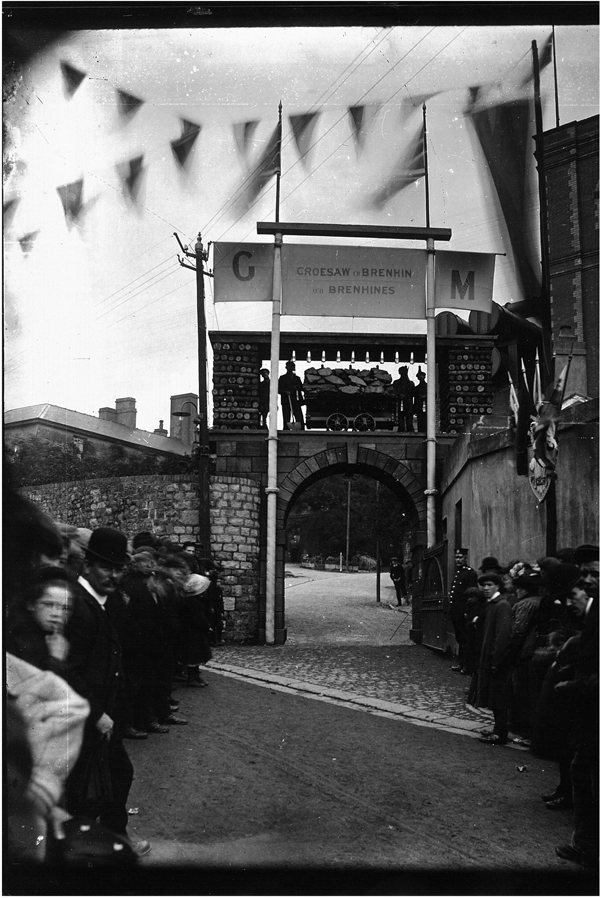
These royal visits to factories and mines were commemorated in visual displays that associated the king and queen with the raw materials of British industrialization. In the Rhondda Valley, the most spectacular example was the specially erected coal arch at the Dowlais Works, Merthyr Tydfil, built from local steam coal to celebrate the visit and not demolished until the 1950s (figure 2). Contemporary photographs show an elaborately bricked and vaulted structure designed by the works’ craftsmen, displaying the colliers with their safety lamps, mandrils (heavy picks), and spades, with the welcome message to the king and queen in Welsh. Walking through the arch, so as to endorse the tools and products of heavy manual labor, the royal visitors were entertained to a sequence of national songs, two of them performed in Welsh by the Lewis Merthyr Silver Band and by the Penywern (Dowlais) Male Voice Party.Footnote 104 Similar types of decorative and sound spectacle were repeated in Yorkshire and in Lancashire; at Horrockses mill in Preston, there was a triumphal welcome arch of cotton bales made from sixty tons of raw cotton.Footnote 105 In Yorkshire the previous year, mill girls had serenaded the queen with the ballad “Kind Is My Mary” as she toured a factory and they spun the yarn.Footnote 106 One consequence of the royal visits was that the king and queen became associated with a version of industrial modernity that was at once politically combative, technologically advanced, and socially conciliatory.
Dowlais Coal Arch, 27 June 1912. Photographer unknown. Copyright Merthyr Tydfil Public Libraries, Merthyr Tydfil.

To what extent were these experiments in democratic monarchy new? The industrial tours drew on much older ideas of the royal progress and the traveling court that were central to the itinerant displays of medieval and early modern European rulers.Footnote 107 But comparisons with nineteenth-century royal visits to the industrial areas of Britain are more revealing. The young Princess Victoria had been sent on a “grand tour of the north” in 1835, after her earlier “royal progresses” through England and Wales. But though these visits were driven by political calculation, they had more to do with Hanoverian family feuding.Footnote 108 More relevant for comparison were Queen Victoria's three appearances in Manchester and Salford in 1851, 1857, and 1894, the third to open the Manchester Ship Canal. Here the scheme was to give royal recognition to industrial Britain and its population as the “workshop of the world,” especially in the early 1850s in the aftermath of Chartism.Footnote 109 The public performance of the queen on the early visits was co-opted into local civic pageantry and resplendent municipal Liberalism. The Manchester Corporation played a leading role in what Simon Gunn has identified as a series of delicate reciprocal gestures between the monarchy and the leaders of bourgeois industrial society.Footnote 110 The same was largely true of Edward VII's visits to Manchester in 1905 and 1909, which consolidated earlier municipal rituals with little sense of the king and his advisors responding to the challenges posed by mass democratic politics.Footnote 111 George V and Queen Mary did drive in state through Manchester and Liverpool at the end of their Lancashire tour, but this ceremonial was in sharp contrast to the political message of royal informality that was the mainstay of all their trips.
Making Monarchy Real and Human
Promoting the king and queen's encounters with working-class people required the constant support of favorable publicity. Regional and national journalists worked hard to set the agenda for these experiments in royal accessibility, under the watchful eye of Buckingham Palace. By the time of the Lancashire tour, Derby was asking Stamfordham for three motors to travel with the royal procession to accommodate journalists. There were also hints of informal press censorship. Derby assured the palace that a committee of chief newspaper correspondents guaranteed there would be “nothing in the papers” about the way “the Press have been treated,” a hint that some form of control had been exerted over the news corps.Footnote 112
Press involvement was not simply about royal coverage. It also focused media attention on the most effective reporting styles to promote the monarchy to mass audiences. This meant emphasizing the human-interest aspect of royalty—“deepening the personal note,” as the Birmingham Gazette put it, making constitutional monarchy “real” rather than “cold” and “disinterested.”Footnote 113 Linda Colley has demonstrated how the earlier consolidation of the crown under George III was aided by an increasingly sophisticated infrastructure of communications in the shape of the national and regional press.Footnote 114 In the late nineteenth century, this established network of publicity was augmented by the impact of innovative reporting styles that sought to dramatize the impact of royalty for readers and audiences.
The human-interest genre has been associated with what the pioneer of the form, W. T. Stead, called “the personal note,” which foregrounded formulaic renderings of human emotions and collapsed the cultural distance between audiences and the news text.Footnote 115 Journalistic coverage of leading members of the royal family actively stimulated human-interest stories, as newspaper conglomerates sought to streamline and recompose their readerships in the interest of capturing greater market share.Footnote 116 Human-interest news has been understood conventionally to involve a “depoliticization” of sections of the press compared to mid-Victorian journalism,Footnote 117 but this argument fails to recognize how such reporting shifted the political message rather than simply marginalizing it. What distinguished press reports of the king and queen on the industrial tours was the way that satisfying the perceived human-interest demand among readers was linked to an agenda of popular cultural politics—a philosophy of sovereignty updated for modern times. One result was that the personalities of the royal couple made headline news.
From the day the trip to Wales was announced, journalists began to build up advance profiles of the king and queen via easily identifiable, pared-down character traits. This type of personality sketch was a distinctive feature of the new journalism, especially in women's magazines that prized intimacy and fidelity.Footnote 118 George V and Queen Mary were well known to a national and empire public, but previous journalistic copy and visual coverage of the couple mostly centered on formal, officially sanctioned profiles intended for specific state occasions. These productions included a mass of coronation souvenir booklets and photographs of the king and queen as resplendent hierophants crowned and robed at the Durbar (figure 1, above), as well as iconic images of the king on the new coinage and on the first postage stamps of the reign.Footnote 119 In these textual sequences, the royal body was variously depicted as majestic or gracious, or as the human embodiment of imperial power; it was rarely informal.
On the industrial visits, emphasis was on a much more intimate style of royal iconography that was accessible for readers and viewers. Now the royal couple lost their hierarchical personas and became characters who were inserted into the world of everyday life. Referencing the king's earlier career in the Royal Navy, he was portrayed as an uncomplicated sailor who was as home-loving as the queen. His forthright naval outlook, practical manner, and lack of “side” meant that he was more “familiar with the life of the masses” than many courtiers supposed.Footnote 120 Queen Mary, insisted the Yorkshire Observer, was “essentially a housewife,” who also had a well-known feminine sympathy with soldiers and nurses.Footnote 121
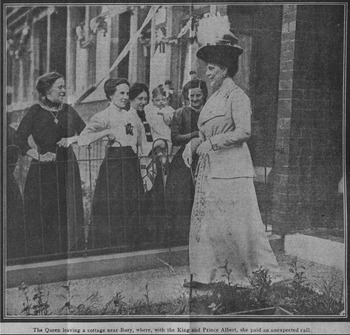
Coverage of the unassuming home life of George V and Queen Mary was not confined to popular journalism. Lord Esher, the consummate courtier who observed the king and queen at close quarters as constable of Windsor Castle, enthused that the royal palaces were now “a home for children” and that “the queen knits of an evening.”Footnote 122 What distinguished journalists’ interest in the domestic habits of the monarchy was not just that the couple endorsed a return to orderly propriety after the excesses of the previous decade, but that this was seen to reinforce royalty's personal bond with their working-class subjects, especially in the home. On the tours, the staged centerpieces of this popular domestication of monarchy were the king and queen's visits to workers’ cottages to take tea with the residents and inspect “the intimate lives of the people”Footnote 123 (figure 3).
“The Queen Leaving a Cottage near Bury,” Daily Mirror (London), 14 July 1913, 9, RA NEWS/CC/GV/1913/LXVI/246, Royal Archives/© Her Majesty Queen Elizabeth II 2018. ©Mirrorpix.

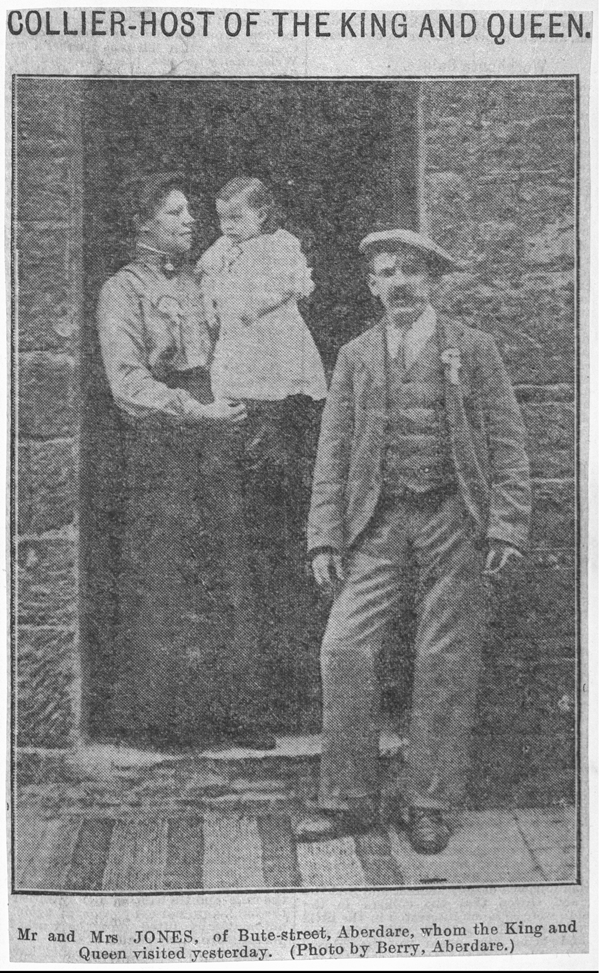
It is worth examining in detail one of these prototypical encounters in South Wales, because it reveals what was new about the form, in terms of both royal protocol and news reporting. In Bute Street, Aberdare, Mr. and Mrs. Jones and their baby daughter, Edna May, played “collier host” to the king and queen in their front parlor.Footnote 124 With the sense of a royal scoop, the press revealed that “what happened” in the cottage was best told by Mrs. Jones herself.Footnote 125 Direct speech of the Joneses in conversation with the king and queen followed, a staple feature of the human-interest genre. “Where is the family?” asked Queen Mary, entering the cottage. “Welcome, your Majesties,” replied Mrs. Jones. Cups of tea and biscuits were served, with the queen putting the milk in herself. “Sugar, your Majesty?” “I never take sugar in my tea,” laughed the queen. While these pleasantries were ongoing, the king spent time with Mr. Jones, asking about the colliers’ wages. Then the queen looked over the parlor ornaments, inspected the bedrooms, and accepted a bouquet from baby. When the monarchs departed, the miner's home was renamed “Queen Mary Cottage,” with royal endorsement. The press concluded that the stories about the unaffected home life of the royal family were “nothing but the truth.” To confirm verisimilitude, the event was commemorated with a photograph of the couple, plus baby Edna, proudly posing outside their home after the event (figure 4).
“Collier-Host of the King and Queen,” South Wales Daily News, 28 June 1912, 7. Photograph, Joseph Berry, Aberdare, RA NEWS/CC/GV/1912/XLVI/1167, Royal Archives/© Her Majesty Queen Elizabeth II 2018. ©Mirrorpix.

Visits made by nineteenth- and early twentieth-century British royalty to the homes of servants and retainers were usually private, more often than not taking place on their estates, such as at Sandringham and Balmoral. These much more publicly advertised appearances by George V and Queen Mary in working-class homes combined traditions of elite charitable visiting with the power of a media event. Both the scale and coverage of the organized royal visits inside workers’ cottages and terraces marked out the tours as innovatory. They also indicated how Buckingham Palace authorized the release of the accompanying news stories to journalists, although evidence of that practice has been concealed. The message was that the king and queen identified with their working-class subjects and that the bond between crown and people was personal and human. Two further incidents consolidated this process of imagined royal empathy: the king and queen's support for children and their role in the Cadeby mining accident. In both cases, press reports of the royal couples’ emotional and affective responses to disability and disaster were influenced by the resources of popular pathos and working-class sentiment.
The physical presence of children and young people featured prominently across all the tours. Stamfordham wrote to Derby in preparation for the Lancashire trip stressing how important it was for the king to meet the “rising generation.”Footnote 126 Careful preparation went into making young people visible on the visits. More often than not, local schools were closed for the day or half-day, with children given the chance to attend the celebrations. Log books of elementary-school teachers recorded the appearance of the royals as “red letter” days—the occasion for a lesson in British history, focused on the monarchy.Footnote 127 At North Hume Secondary School in Manchester, boys were taken by tram to a specially erected stand in Platt Fields, the large municipal park in Fallowfield, to watch the procession.Footnote 128
All these events involved the physical massification of lines or crowds of young people in spectacular visual displays. The numbers testified to the power of mass society co-opted into the service of royal and imperial propaganda. In Liverpool, sixty thousand children would greet the king and queen at Everton Football Club's ground with an exhibition of physical and marching exercises, their formation as a “living Union Jack,” and the singing of “Rule, Britannia!” Some 75,500 pupils were to be accommodated in stands in Manchester, with a further 125,000 each receiving a fancy box of chocolates, decorated with portraits of the king and queen.Footnote 129 For their part, the royals devoted time and energy to meeting local children en route. Municipal authorities had made a practice of distributing gifts to young people in celebration of royal events since the early nineteenth century, but what was new on the tours was the king and queen's active involvement in meeting children and the time and effort they devoted to the task.
Sick and disabled children were singled out for special attention, continuing a tradition that had begun with Queen Charlotte, consort of George III.Footnote 130 This may have had an added personal dimension for the king and queen, because their youngest son, Prince John, suffered from epilepsy, although this fact was not widely known as he lived in increasing seclusion on the Sandringham Estate.Footnote 131 The press story that ran locally in Cardiff centered on “lame Cyril.” Four-year-old Cyril Galliford “required a set of leg irons,” but his parents were too poor to buy them.Footnote 132 Journalists reported how the queen learned about Cyril's case, called it to the attention of the Church Army, and the equipment was thus “speedily forthcoming.” As the royal party passed along Cardiff's High Street, a small white card in a shop window caught the queen's attention with the words, “Lame Cyril thanks the Queen for his boots.” Cyril thereupon appeared at the window, and Queen Mary smiled back at the boy.Footnote 133 In Dewsbury the following month, it was the king's turn to sponsor a “little cripple boy,” John Wroe, who “hobbled” forward “on a pair of wooden legs” given to him by the monarch. As the local press insisted, a “touch of Royal sympathy … always appeals to people whether of high or low degree.”Footnote 134 Local stories of this kind drew on traditions of working-class sentimentality that had been a staple feature of nineteenth-century popular ballads and music-hall turns. On the tours, these incidents associated royalty with the idea of universalized human sympathy for the physically disadvantaged, an understanding that was central to the concept of charity itself.
A different dramatization of royal empathy was on display when an industrial mining disaster confronted the king and queen in Yorkshire. On the first full day of the visit the king went down a mine at Elsecar Main Colliery, owned by his host, Earl Fitzwilliam.Footnote 135 With as little ceremony as possible, the king entered the cage that took him down the mineshaft. In a very small hot space, half-a-mile down the coal face, he met two miners at work, clad in only vests and trousers with their arms “black and muscular.”Footnote 136 Journalists covered this dramatic masculine encounter between the aristocrats of heavy, industrial labor and the sovereign in full, including again the king's direct speech when he said to the miners, “Let me have one of your picks,” together with the miners’ delighted response, “He knew where to find the soft [coal]” and “The King is like us.”Footnote 137
Elsecar was by the standards of the day a model pit. Its reputation for safety, its ties to the local aristocratic landowner, and its ethos of responsibility between colliers and the Fitzwilliam family were all endorsed by the king's presence.Footnote 138 The nearby Denaby and Cadeby mines were very different. Typical of a new system of corporate mine ownership, the syndicate of West Midlands prospectors placed much greater emphasis on productivity and profit than Earl Fitzwilliam. Among the deepest pits in the country, the company had constructed some of the worst slums in the North of England to house the miners and their families.Footnote 139 On the morning after the successful royal visit to Elsecar, there were a series of explosions at Cadeby pit with considerable loss of life and serious injuries.
That evening the royal couple motored over to Cadeby.Footnote 140 Later the same night, a dramatic torchlight procession of nearly thirty thousand well-wishers, including many miners, arrived in the grounds of Wentworth Woodhouse, where the king and queen were staying as guests of the Fitzwilliams. Emerging from the darkness and lit by the torch-bearers, the royal party came out onto the portico to hear hymns and patriotic singing from a local Sheffield choir. In an emotional atmosphere, part of the crowd surged forward through the police cordon to get closer to the king and queen. Signaling for them to come nearer, the king reflected on the very dark shadow that the “terrible disaster at Cadeby” had cast over “our visit to the West Riding.” But he said that, despite his grief, he felt that he and the queen were “among friends,” an endorsement of the local mining community that drew applause from the crowd.
The Cadeby disaster provided a dramatic opportunity for public intellectuals and the press to speculate on the future relationship between the monarchy and the industrial working class, at a moment of heightened political tension.Footnote 141 The Daily Mirror revealed how the German emperor soon after followed the example set by the king at Cadeby. The kaiser's visit to the Krupp steel and armaments works at Essen in August 1912 had been marred by a mining explosion in the nearby coalfield, with heavy loss of life. Heeding King George's actions in Yorkshire, the emperor immediately toured the area, meeting widows of the disaster and visiting the local hospital.Footnote 142
Reporting of the Cadeby accident was notable for its heightened emotional coverage. Journalists described the mise-en-scène using language that embraced the traditions of working-class culture, especially melodrama and sentimentality, grounded in the gritty spaces of the industrial North of England and anchored by bonds of solidarity and friendship. The cultural argument carried by the reporting style was that, with their strained faces and suppressed tears, the king and queen were drawn into this world by their empathy and spontaneous feeling. It would be wrong to overstate the impact of these early experiments in royal reality drama. Endorsement of the industrial visits was led by the Conservative press, while, given the paucity of the royal records, it is unclear if the performances were orchestrated by the king and his advisors. What is evident is that press reporting throughout the tours worked to create an emotional economy in which the monarch was pledged to the mass of the people through affective ties of mutual dependence.
All of which raises the question of how these displays of patrician democracy were received by audiences in the towns and villages where the king and queen made their appearances. There is no surviving record of how local people responded to the tours. Detailed reactions from those who met or saw the king and queen close up are preserved in the diaries and letters of troops and nurses when royalty visited the Western Front during the First World War.Footnote 143 In the absence of direct testimony in the years before 1914, it is possible to read the context and content of the specially recorded newsreels shown to the public en route for what they tell historians about how viewers were positioned in relation to these screenings of royalty. Such a textual and contextual approach needs to be distinguished from work on audiences as revealed by oral history and popular memory, but it does provide significant pointers to the popular cultural forces actively shaping the new democratic style of monarchy.Footnote 144
The royal family were top billing as a newsreel item in the years before 1914, a period that witnessed the transition of British cinemas from fairs, music halls, and “penny gaffs” to the burgeoning picture palaces.Footnote 145 The king and queen had already been filmed extensively for their coronation and for the Durbar, and they were enthusiastic viewers of their own image on camera, as were the tsar and the kaiser.Footnote 146 As soon as the South Wales trip got underway, local distributors announced that newsreel coverage of the royal events of the day would be screened each evening in Cardiff.Footnote 147 This set a trend that was expanded on the Yorkshire and Lancashire tours, where northern photo and newsreel companies vied to show their record of proceedings. Hibbert's Pictures of Bradford employed six operators to process the footage and get it into the picture palaces “on the same day.”Footnote 148 The Liverpool-based brothers Frederick and John Weisker, who converted music halls into cinemas, were instrumental in filming and screening parts of the Lancashire tour across the county.Footnote 149
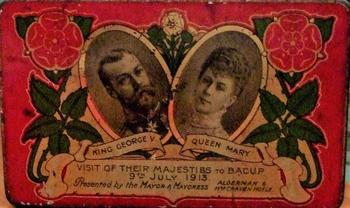
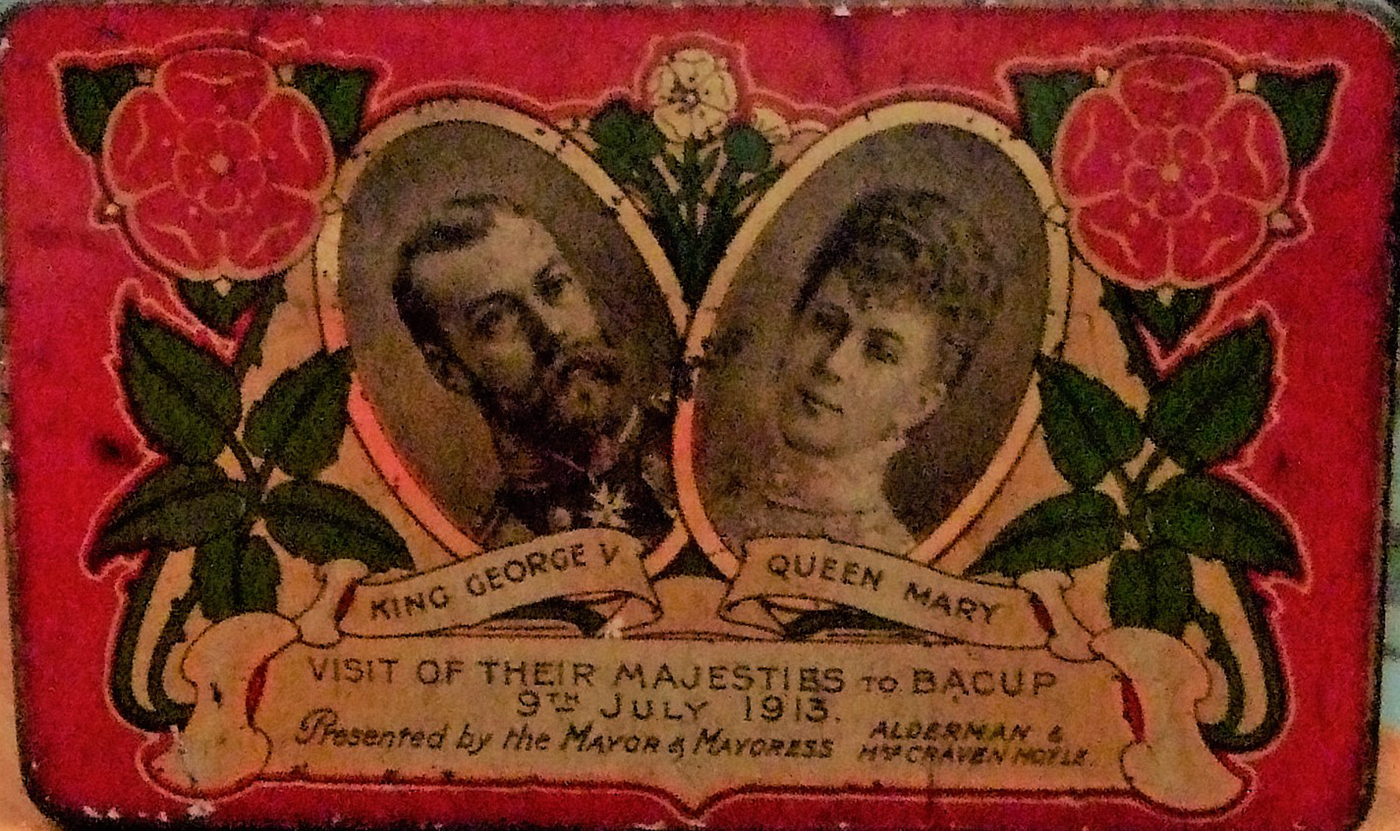
Cinema audiences for these “news topicals,” as they were called, were treated to a powerful visual localism that anchored monarchy in the spaces, streets, and towns of the industrial North. With shows often screened almost immediately after the royal visit had taken place, the picture-going public were given the experience of immediacy of access to the royal image as both news and entertainment. Filmed footage of the tours always featured recognizable establishing shots of the local civic and commercial landscape at every stopping-off point. The newsreel record of the royal visit to Blackpool on 8 July 1913 opened with middle-distance views of the town hall, then panned to nearby shops and scenes of the seaside promenade.Footnote 150 The visual argument was that monarchy was an integral, albeit temporary, part of the area, rather than being understood to be above or beyond it. This social message was echoed in memorabilia presented to and collected by locals to commemorate the tours. Countless mugs, medals, and other souvenirs carrying images of the king and queen were struck to celebrate the Lancashire visit; in almost every case, these items foregrounded inscriptions that highlighted the local environment. “To Commemorate the Visit of Their Majesties to Padiham,” read the wreathed script on one side of a white Staffordshire mug, with colored, coronation-style images of the royal couple dominating the reverse.Footnote 151 Bacup's commemorative choice was a red tin chocolate box from Cadbury's, Bournville, presented by the town's mayor and mayoress, carrying inset images of the king and queen framed by Lancashire roses and bearing the simple inscription “Visit of Their Majesties to Bacup” (figure 5).
Visit of Their Majesties to Bacup, 9 July 1913, vintage Cadbury Bournville tin. Photograph by permission of David Pierce.
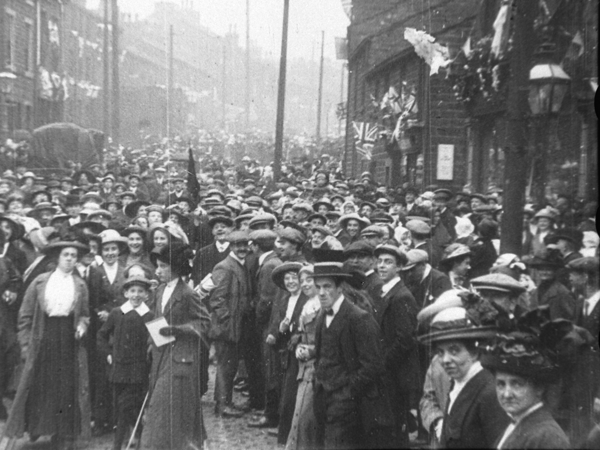
Throughout the newsreel coverage, “the people” quite as much as the king and queen collectively dominated the visual frame as crowds and massed spectators. Such a focus was not specific to royalty; shots of “crowd splendor” profiling varied collections of humanity, from working people at the factory gate to football supporters, were a recurrent feature of early actuality film.Footnote 152 Almost everywhere in newsreel coverage of the Lancashire tour, audiences saw the royal party framed by a deep backdrop of spectators, as in the record of the visit to Bacup, where animated crowds, framed by the local streetscape decorated with Union Flags and bunting, looked directly at the cameraFootnote 153 (figure 6). At least one film, of the royal visit to Atherton, featured only crowd scenes; the king and queen did not appear at all.Footnote 154 Similar techniques privileging everyday faces in the crowd had been used in newsreel coverage of Edward VII's funeral three years earlier.Footnote 155
Royal Visit to Bacup, 9 July 1913, producer, Lama Films, film no. 5985. Photograph by permission of North West Film Archive, Manchester Metropolitan University.

Film historians have argued convincingly that there was a pragmatic reason for the repeated emphasis on the faces of industrial mass society from local newsreel distributors: audiences expected to see themselves on camera, and this was what motivated them to pay for picture-palace tickets.Footnote 156 But in the local newsreels covering the royal visits, a cultural argument was also at work. The visual narrative emphasized that the king and queen were only imaginable in conjunction with the people, who provided their necessary endorsement in a mass society. This form of modern populism was innovatory, and it was underwritten by the resources of contemporary media technology.
Newsreels covering the tours screened images of the royal family as part of an evening or afternoon of popular entertainment for those who bought seats in the cinemas. Estimates of the size and composition of the prewar cinema-going public are extremely vague, but pricing generally catered for cheapness and accessibility in a similar way to the music hall.Footnote 157 Newsreels shown in these picture-house settings involved the significant cultural work of repositioning the British monarchy in the popular imagination, because they placed royalty in spaces predominantly associated with entertainment. For example, “filled houses” in the local cinema at Accrington in July 1913 were attributed not just to footage of the king's recent visit to the town but also to the pull of the feature films that were part of the same show that night, especially the thriller “The Incriminating Handkerchief,” a tale of drugs and romantic abduction.Footnote 158 Audience encounters with the monarchy on film did not see the king and queen as stand-alone news items, in ways that preserved charisma as a result of their separation from other forms of reportage. Royalty were included as part of the bill of fare of popular entertainment. The implication of shows of this kind was that the king and queen were part of the audience's experience of consumption and leisure.
Conclusion
Historians and cultural commentators have variously defined 1910 as a watershed marking the beginning of the end for “Liberal England”Footnote 159—the year, according to Virginia Woolf, that “human character changed,” and a period that ushered in “the working-class century in Britain.”Footnote 160 My article has charted a different version of this eventful moment: when the British monarchy began to remake itself as a people's monarchy in the face of considerable odds. The beginnings were not auspicious, as the crown was deeply implicated in the intense political and social turbulence before the First World War that pressed hard on the nineteenth-century constitutional settlement of limited franchise and an even more restricted sense of cultural entitlement. The crisis in liberalism, challenges posed by militant laborism and socialism, and the Irish emergency all demanded a response from the king and his advisors, because the monarchy still remained in part a political function of the state.
A key argument of this article is that the idea and practice of the twentieth-century monarchy as politically detached, socially conciliatory, and philanthropic on the one hand, and the crown's cultural performance as accessible and informal on the other, were interconnected developments. The three industrial tours were driven by George V and his advisors in their efforts to reposition the crown after the constitutional debacle and the wider ongoing political crisis. The appearance of a relatively dressed-down, people-friendly monarchy, coexisting alongside traditional forms of royal ceremonial, was one significant result.
Royal responses to this prewar crisis highlight a missing piece in the history of modern Conservatism and cultural populism. The “people's century” was marked by the full entry of the working class into mass politics and the national culture, but twentieth-century democracy took many and varied forms, and not all of them were conventionally progressive. The message of “patrician democracy” promoted by George V and Queen Mary on tour drew heavily on Victorian traditions of one-nation conservatism and on the mutual, personal obligations between sovereign and subjects that were cemented by Anglicanism, charitable giving, and patriotism. In the early years of the twentieth century, this political repertoire was reinvigorated by the popular press and newsreels, which positioned royalty and the people in a new, more personal and intimate relationship.
Human-interest journalism and the close-up focus of the newsreel camera began to transform royalty's public performances and the way audiences viewed them. Splendor and ceremony remained, as the history of interwar royal marriages, jubilees, and coronations showed, but it was enhanced by innovatory techniques of promotion and publicity developed on the prewar tours, with long-term consequences for the monarchy and for British public life. The practice of royal informality finessed on the industrial tours was consolidated by the king and his family in the face of more extreme political pressures exerted during the First World War. Subsequently, the idea of a publicly accessible and quasi-democratic monarchy was embedded in an unwritten social contract between crown and people, with the media positioned as crucial brokers. But that compact was always inherently unstable. At flashpoints across the twentieth century, mass populism turned from approval to censure, highlighting how human interest in the monarchy fostered by publicity had the capacity to morph into critical exposure of the flaws and failings of royal individuals.
George V and Queen Mary were a partnership who together pioneered a new royal style across the British world. But that new style required the constant orchestration of consent from the people, and it was subject to regular political and cultural challenges. The republican politics that reached a crescendo during the First World War drew rhetorically on an assumed, critical intimacy with the man whom Keir Hardie contemptuously maintained would have been a “street corner loafer” had he not been born royal.Footnote 161 Informal appearances of royalty in wartime at the Western Front and in their visits to hospitals and factories provoked the widest range of responses from those who saw or met them—from reverence and respect to envy and scorn. When the monarchy began to be observed close up, people's feelings were unpredictable and often uncontrolled. Press and newsreel coverage that probed royal personalities and rendered them redolent with “human character” was less than reverential. It had the potential to turn monarchy into an item of consumption and entertainment for viewing and reading publics across the world. Edward, Prince of Wales, was the first royal to experience the full glare of this democratic scrutiny, but it was set in motion by his parents under very different circumstances in the years before 1914.