Introduction
Neither the origins nor the author of the Ḥamzanāma or Qiṣṣa-yi Ḥamza (Book/Story of Ḥamza) are known.Footnote 1 On the strength of Bahār's suggestion (Reference Bahār1942, vol. 1: 285–6), G.M. Meredith-Owens argued that the Ḥamzanāma was based on the Maghāzī-yi Ḥamza (Holy Wars of Ḥamza) which, according to the anonymous author of the Tārīkh-i Sīstān (History of Sistan; ed. Bahār 1935: 169–70, and translated by Milton Gold in 1976, p. 135), related Ḥamza b. ʿAbd-Allāh (Atrak or Ādharak) the Kharijite's expeditions to Sarandīb, Chīn, Māchīn, Turkistān, and Rūm, and which was later transferred to Ḥamza b. ʿAbd al-Muṭṭalib, the Prophet Muḥammad's paternal uncle who was acceptable to all Muslims (Meredith-Owens Reference Meredith-Owens2012; Lang and Meredith-Owens Reference Lang and Meredith-Owens1959: 475–7). This view, however, has been called into question as it is not corroborated by textual evidence (Pritchett Reference Pritchett1991: 3; Marzolph Reference Marzolph and Jullien2011: 75; Kondo Reference Kondo2019: 7; cf. Sabri Reference Sabri2011: 30). The Ḥamzanāma is no less fanciful than the Maghāzī-yi Ḥamza, for apart from his death at Uḥud in 625, it gives no historical account of its eponymous hero.
A seventeenth-century professional storyteller, ʿAbd al-Nabī Fakhr al-Zamānī Qazwīnī, compiled a manual for storytellers, the Ṭirāz al-akhbār (completed in 1631/32) in Mughal India.Footnote 2 In the introduction to this important work, he relates the origin myths of the Ḥamzanāma. He reports that one day, an ʿAbbāsid caliph became sick. To cure his illness, an Arab sage invented the story of Ḥamza, which ended every day on a cliffhanger (Fakhr al-Zamānī 2013: 19–20). According to Fakhr al-Zamānī (2013: 20–21) and Sabri (Reference Sabri2011: 32), the story of Ḥamza had similar therapeutic effects on Masʿūd of Ghazna (r. 1030–1041), who recovered from illness by listening to the recitation of the Ḥamzanāma for four months; but the story continued for another two months. Thus, the Ḥamzanāma was seen from its mythological inception as an oral “performative” (Khan Reference Khan, Orsini and Schofield2015: 198; Reference Khan2019a: 114) story that was given in successive instalments with cliffhanger endings or as oral serial narrative, probably reflecting Fakhr al-Zamānī's own performance style.Footnote 3
Fakhr al-Zamānī also provides information about legendary storytellers of the Ḥamzanāma, among whom Zayn al-ʿĀbidīn Takaltū Khān merits our attention for the following reason (Fakhr al-Zamānī 2013: 21–2): Takaltū Khān, who served Shah Ismāʿīl I (r. 1501–24) or his son Shah Ṭahmāsp (r. 1524–76; Khan Reference Khan and Korangy2017: 26) wrote two books about Amīr Ḥamza: the Īrajnāma (Book of Īraj) and the Nūr al-Dahrnāma (Book of Nūr al-Dahr).Footnote 4 Shah Ismāʿīl's fascination with the story of Ḥamza was so great that he named his two sons after its characters: Ṭahmāsp and Alqāṣ (Sabri Reference Sabri2011: 33; Khan Reference Khan and Korangy2017: 27).
While Takaltū Khān was a courtly storyteller, many were popular performers who told stories at coffeehouses in the Safavid period, especially in the reign of Shah ʿAbbās I (r. 1588–1629) onwards.Footnote 5 The poet Mīrzā Muḥammad Ṭāhir Naṣrābādī documented poems recited in coffeehouses during the reign of Shah ʿAbbās II (r. 1642–66) in his famous Tadhkira (biographical notices of poets), from which we can infer that both the Ḥamzanāma and the Shāhnāma (Book of Kings) were in the popular repertories of storytellers.Footnote 6 To give examples of others who recited the Ḥamzanāma, Mīrzā Muḥammad, a storyteller (qiṣṣa-khwān), performed the Qiṣṣa-yi Ḥamza in coffeehouses and later went to India where he spent most of his life and eventually died (Naṣrābādī Reference Naṣrābādī and Dastgirdī1939: 401). Storytellers like him were instrumental in transmitting the Ḥamzanāma to India.Footnote 7 Ḥusaynā Ṣabūḥī was originally a vagabond dervish and came to perform both the Qiṣṣa-yi Ḥamza and the Shāhnāma after entering a khān's service (Naṣrābādī Reference Naṣrābādī and Dastgirdī1939: 357). In his Tadhkira-yi Maykhāna (Wine Tavern), Fakhr al-Zamānī mentions Mawlānā Muḥammad Ṭanbūra who knew the Qiṣṣa-yi Ḥamza well (qiṣṣa-dān-i khūb) and was a talented shāhnāma-khwān (Shāhnāma reciter; Fakhr al-Zamānī 1961: 914; Khan Reference Khan2019b: 11–12). As storytellers such as Ḥusaynā Ṣabūḥī and Ṭanbūra illustrate, the two works were performed in a predominantly oral environment. The Qiṣṣa-yi Ḥamza was seen from the very beginning as oral serial narrative whereas the Shāhnāma became acclimatized to an oral milieu by the Safavid period (1501–1736).
As Julia Rubanovich (Reference Rubanovich, Melville and van den Berg2012a: 22) has shown, the Shāhnāma infiltrated folk literature such as dāstāns or popular romances by the fifteenth century. Modern naqqāls (storytellers) claim that their craft, naqqālī (storytelling) originated in the Safavid period.Footnote 8 According to a prominent naqqāl, Murshid ʿAbbās Zarīrī (1909–71), Shah Ismāʿīl appointed dervishes to propagate Twelver Shiism. The dervishes were divided into 17 lineages (silsila), and each developed a particular manner of performance, specializing in certain types of narrative or addressed to a specific audience. To attract the audience's attention, they were obliged to tell heroic tales, which gradually became a separate genre (Dūstkhwāh Reference Dūstkhwāh1966: 73–4; Afshari Reference Afshari and Utas2021: 425). Zarīrī's testimony is now partly confirmed by the discovery of a late Safavid ṭūmār (a prose narrative text that was written and transmitted by naqqāls) of the Shāhnāma (completed in 1722/23; Ṭūmār-i naqqālī-yi shāhnāma; Āydinlū Reference Āydinlū2010: 39; Reference Āydinlū2011; Reference Āydinlū2012).Footnote 9 The Shāhnāma as transmitted by naqqāls is both truncated and expanded;Footnote 10 truncated because it ends with the reign of Bahman or before that of Alexander; and expanded because it comprises both Firdawsī's Shāhnāma and later epics, such as the Garshāspnāma (Book of Garshāsp; Asadī Reference Asadī Ṭūsī and Yaghmā’ī1938 [1975] (abbreviated as GN)), the Barzūnāma (Book of Barzū), the Sāmnāma (Book of Sām), the Bahmannāma (Book of Bahman), the Farāmarznāma (Book of Farāmarz) and the like, most of which focus on members of Rustam's family whom Firdawsī has left out of his Shāhnāma.Footnote 11 Naqqāls’ renderings are a popularized or “romanticized” version of the Shāhnāma in prose, occasionally interspersed with verse quotations. In terms of their form, they are similar to popular romances (dāstāns) that are defined as “fictional prose narratives with common structural and thematic characteristics rooted in the tradition of oral storytelling” (Rubanovich Reference Rubanovich2015a), and which relate “the heroic-romantic adventures of their eponymous heroes, often with a religious Islamic emphasis” (Rubanovich Reference Rubanovich and Reichl2012b: 653). These descriptions can equally apply to the naqqālī version of the Shāhnāma to the point of its being identified as a qiṣṣa or dāstān in the Indian subcontinent (Khan Reference Khan2019a: 136).Footnote 12 Both the Qiṣṣa-yi Ḥamza and the naqqālī (ṭūmār) version of the Shāhnāma have oral storytelling as the common denominator that will warrant the comparative study of the two works.
Following an overview of the Ḥamzanāma that has been little-studied in the field of Persian literature, with the admirable exceptions of Marzolph (Reference Marzolph and Jullien2011) and Sabri (Reference Sabri2011), we will compare Ḥamza with Rustam to consider how the two heroes resemble and differ from each other. Their differences in particular will lead us to study Ḥamza's singularity as a hero.
1. Overview of the Ḥamzanāma
In order to offer an overview of the Ḥamzanāma, we have provisionally divided the text into the following fourteen chapters:
-
Chapter 1: Births of Ḥamza and ʿAmr the ʿayyār (trickster; pp. 12–30)
-
Chapter 2: Ḥamza meets Nūshīrawān, King of Persia (pp. 30–111)
-
Chapter 3: The story of Landhūr, King of Sarandīb (pp. 111–58)
-
Chapter 4: Ḥamza's expeditions to Greece, Rūm, and Egypt (pp. 158–83)
-
Chapter 5: Battle with Zūbīn-i Kāwūs, King of Mughulistān (pp. 183–208)
-
Chapter 6: Ḥamza's adventures in Mt. Qāf (pp. 209–57)
-
Chapter 7: Battle with Bahman-i Kāwūs, King of Kūhistān (pp. 257–98)
-
Chapter 8: Ḥamza's faked death (pp. 299–326)
-
Chapter 9: Deaths of Ḥamza's family members (pp. 327–51)
-
Chapter 10: Battle with Qaymaz, King of Khāwar (pp. 351–90)
-
Chapter 11: Nūshīrawān becomes a dervish (pp. 390–422)
-
Chapter 12: Battle in Mt Alburz (pp. 423–83)
-
Chapter 13: Ḥamza's expeditions to the Land of Darkness (pp. 484–540)
-
Chapter 14: Ḥamza's martyrdom (pp. 540–49)
A quick glance at these chapters shows that the Ḥamzanāma has intertextual relations with the Shāhnāma, the Persian Epic Cycle, and the Islamic Alexander tradition, while containing elements of ʿayyārī (trickery). Let us begin with the Shāhnāma that provides a narrative framework for the text. The Ḥamzanāma is set in the reign of Nūshīrawān with the good and evil viziers, Buzurjmihr and Bakhtak, respectively. ʿAmr, Ḥamza's companion, is cursorily mentioned in Firdawsī's Shāhnāma, albeit in the reign of Hurmuzd. According to Firdawsī's account, a new cavalry force appears from Arabia under the command of generals such as ʿAbbās and ʿAmrū (chu ʿAbbās-u chun ʿAmrū-shān pīshraw/suwārān-u gardan-farāzān-i naw; vol. VII, p. 489, v. 293).Footnote 13 The episode of Buzurjmihr's interpretation of a king's dream by way of which he finds his way into court is common to both the Shāhnāma and the Ḥamzanāma, with the only difference being the king's identity: Nūshīrawān in the former (vol. VII, pp. 167–77, vs. 981–1076), as opposed to Nūshīrawān's father Qubād in the latter (pp. 22–3, chapter 1).
The Ḥamzanāma also exhibits some similarities with the Shāhnāma and the Persian Epic Cycle on a deeper, thematic level. As Dick Davis (Reference Davis1992: 35–96) has discussed at length, one of the underlying themes of the Shāhnāma is the conflict between king and hero. Chapter 2 brings this into relief through the agency of jealous courtiers who turn Nūshīrawān against Ḥamza (pp. 78–85). They urge Nūshīrawān to banish Ḥamza to a remote place such as India (chapter 3), Greece, Rūm, or Egypt (chapter 4), hoping that he will be killed by Landhūr, the monstrous king of Sarandīb, or by rebellious tributaries. Their attempts also echo that of King Żaḥḥāk, who commands Garshāsp to get rid of a rebel in India in the Garshāspnāma (GN, pp. 63–125, chapter 2). When the courtiers fail in these schemes, Bakhtak instigates Nūshīrawān to make Ḥamza fight against Zūbīn-i Kāwūs, King of Mughulistān (chapter 5). In chapter 7, Nūshīrawān's (or, more precisely, his retinue's) hostility towards Ḥamza decisively takes on a political aspect. Ḥamza marries Mihrnigār, daughter of Nūshīrawān, who gives birth to a son, Qubād-i Shahriyār (on this union, see below). As soon as Zūbīn hears this news, he writes to Nūshīrawān that Ḥamza will revolt to seat his son on the throne. Being of Persian royal descent, Qubād indeed has the potential to usurp Nūshīrawān's sovereign power. Ḥamza in fact proclaims that Qubād is king of the seven climes (pp. 273–5). The birth of Qubād thus serves as a crucial plot device to justify the war between Nūshīrawān and Ḥamza, which continues well into chapters 8, 9, 10, 12, 13, and 14.
The contents of chapter 11 remind one of the descriptions of Jamshīd in his later years in the Garshāspnāma. Pursued by Żaḥḥāk, Jamshīd takes flight to Zābulistān in a miserable manner and eventually marries the princess, giving rise to the house of Garshāsp (GN, pp. 21–63). Chapter 12 is very loosely constructed, with a series of episodes (or rather instalments) including an abandoned newborn baby (pp. 423–4) like Dārāb in the Shāhnāma (vol. V, pp. 488–90, vs. 10–39) and Dārāb and Iskandar in the Dārābnāma (Rubanovich Reference Rubanovich and Rubanovich2015b: 215–17), Ḥamza's search for his kidnapped son (pp. 428–32), and Nūshīrawān's blinding of Buzurjmihr (p. 483). A story that is similar to the latter narrative is found in the Shāhnāma (vol. VII, p. 381, vs. 3599), though in a completely different context.
The influence of the Islamic Alexander tradition is also found in the Ḥamzanāma. According to Ulrich Marzolph (Reference Marzolph and Jullien2011: 74), the Ḥamzanāma is adapted to the rich soil of Persian literature and “to some extent, can be read as an Islamicized Persian version of the Alexander Romance”, for which he gives the following three reasons (Marzolph Reference Marzolph and Jullien2011: 76). First, like Alexander, Ḥamza “conquers more or less the whole world”. Second, he destroys a magic mechanism (ṭilism) built by the sorcerer Zoroaster, whereas Alexander burns the Zoroastrian scriptures. Third, just as Alexander marries Princess Roxana, daughter of Dārā, Ḥamza is wed to Princess Mihrnigār, daughter of Nūshīrawān.
Ḥamza is not a self-acknowledged conqueror like Alexander; he is forced to fight wars by his enemies, including Nūshīrawān and Bakhtak. Only in chapter 13 does he voluntarily fight the cannibals and conquer the Land of Darkness. In destroying Zoroaster's magic mechanism, Ḥamza indeed emulates Alexander. He even burns a book found beside Zoroaster's body (pp. 527–30). As Marzolph has pointed out (Reference Marzolph and Jullien2011: 78–9; cf. Amir-Moezzi Reference Amir-Moezzi2005), Ḥamza's union with the Persian princess seems to reflect the third Imam Ḥusayn's marriage to Shahrbānū, daughter of Yazdegird III (r. 632–651), the last Sasanian king, at least in the popular beliefs of Twelver Shiites. This marriage establishes a link between “pre-Islamic Persia and Imamism” (Amir-Moezzi Reference Amir-Moezzi2005). We may add to Marzolph's list that chapter 6 brings to mind the Alexander Romance (q.v. Iskandarnāma) as it recounts how Ḥamza routs the dīws (demons) to liberate the Golden City for the parīs (fairies), marries a parī with whom he has a daughter called Qurayshī, and who keeps him in Mt. Qāf for eighteen years.Footnote 14 In his desperate attempts to return to the world of humans, Ḥamza is helped by the prophet Khiżr at critical moments (pp. 215–16, 226, 236–7, 251).Footnote 15
Throughout the story, Ḥamza is accompanied by ʿAmr-i ʿUmayya-yi Dhamrī, the ʿayyār or tricksterFootnote 16 – as Marzolph (Reference Marzolph2018: 70) puts it, ʿAmr is Ḥamza's alter ego. He does all kinds of things that Ḥamza cannot. He acts as Ḥamza's deputy, messenger, scout, spy, or rescuer. He is a thief who steals enemies’ broken daggers in battle or their golden goblets in banquet. He disguises himself as a merchant, dervish, or rope-dancer, as appropriate. He has no scruples about lies or deception. He often drugs people, including Ḥamza. He is agile in war, fighting with a paper shield and arrows without feathers or arrowheads, jumping from place to place, and burning infidels. ʿAyyārī is one of the salient features of popular romances, the earliest of which is the Samak-i ʿAyyār.Footnote 17 The co-existence of motifs and themes from the Shāhnāma and other heroic epics, the Islamic Alexander tradition, and ʿayyārī in part explains the popularity of the Ḥamzanāma across the Islamicate world.Footnote 18 It has everything that the audience would expect from oral storytelling. It is, as it were, an all-in-one romance.Footnote 19
2. Ḥamza as Rustam's double
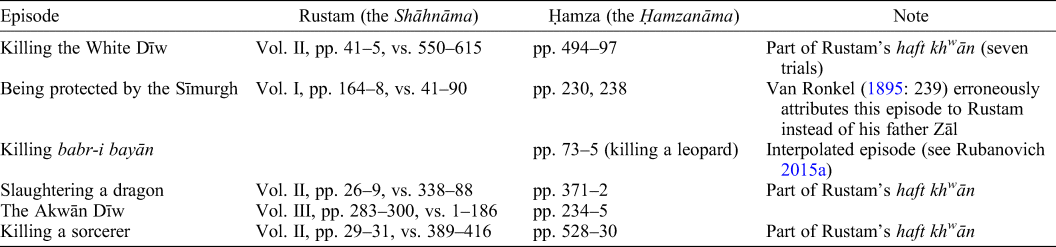
In his pioneering study on the Ḥamzanāma, van Ronkel (Reference Van Ronkel1895: 238–40) compared Ḥamza with Rustam to refute Jules Mohl (Firdawsī 1838–78, ed. and tr., intro: lxxvii, n. 1) who excluded the Ṣāḥibqirānnāma, a versified story of Ḥamza b. ʿAbd al-Muṭṭalib (Ṣafā Reference Ṣafā1946: 379) from his consideration of the Persian national epic because its subject matter had nothing to do with the national. Van Ronkel's comparison resulted in many parallels between the two heroes (see Table 1).
Van Ronkel's comparison between Ḥamza and Rustam

Based on these parallels, van Ronkel (Reference Van Ronkel1895: 240) concludes that Ḥamza is Rustam's copy and his story is not unrelated to the Iranian national epic.
More recently and probably independently of van Ronkel, William Hanaway Jr. (Reference Hanaway1970: 197–8, 199–201) also found similarities between the two heroes. In addition to the episodes of the Sīmurgh (Hanaway Reference Hanaway1970: 197–8) and the Akwān Dīw (Hanaway Reference Hanaway1970: 199–201) already indicated by van Ronkel, Hanaway's findings include the following, all of which concern the story of Rustam and Suhrāb whose influence on the text is palpable (see below, esp. n. 24). First, just as Suhrāb asks Hujīr to show him Rustam among the Iranian champions (vol. II, pp. 157–66, vs. 489–602), Zūbīn, and then Bahman, both of whom are Ḥamza's potential enemies, command Bakhtak to point out Ḥamza among the arriving warriors (pp. 190, 392). Second, overpowered by his son Suhrāb, Rustam prays to God for help (vol. II, p. 184, vs. 836–46). Similarly, Ḥamza asks for God's help to defeat his own son ʿUmar (p. 271). Third, like Suhrāb (vol. II, p. 127, n. 4), Ḥamza has difficulty finding a suitable horse (pp. 37–40).
Contrary to van Ronkel, who wished to see Ḥamza as an integral part of the national epic, Hanaway tries to separate him from heroic epic, playing down the similarities between Rustam and Ḥamza:
From these four [sic.] examples one could imagine that Ḥamza was deliberately modelled after Rostam. This is only superficially true, for in essence Ḥamza is an entirely different kind of man in an entirely different situation. Ḥamza is a hero, but the story of Ḥamza is not a heroic or epic story, but rather a romance. It is to Persianize Ḥamza that he is made to go through some of the same motions as Rostam, but the resemblance ends there (Hanaway Reference Hanaway1970: 201).
Hanaway raises two issues here. On the one hand, he contradicts himself by rejecting Rustam as Ḥamza's model while affirming the resemblance between them that is used to Persianize Ḥamza; on the other, he asserts that the hero of a romance is “an entirely different man in an entirely different situation” from the one of a heroic epic. When combined with both van Ronkel's study and our contribution which will be shown below, Hanaway's discoveries strongly suggest that Ḥamza is, even if not deliberately, modelled after Rustam, which in turn serves to Persianize Ḥamza. As noted in the introduction, the generic distinction between heroic epics and popular romances tends to dissolve when it is seen in the context of oral tradition. Exceptional storytellers (e.g. Ḥusaynā Ṣabūḥī and Ṭanbūra) freely and easily crossed the border, prompting the cross-fertilization of the two genres that then coalesce into “epic romance[s] in prose” (Rubanovich Reference Rubanovich, Melville and van den Berg2012a: 11), a term applicable to both dāstāns and ṭūmārs. In what follows, we will supplement the earlier scholarship on the parallelism between Ḥamza and Rustam from a fresh perspective.Footnote 20
Ḥamza is frequently referred to as jahān pahlawān, pahlawān-i jahān (world champion) or jahāngīr (world conqueror, which is also the name of one of Rustam's grandsons). Although such epithets as “world champion” and “world conqueror” can be applied to any hero, they are in fact a contracted form of the following full epithet: jahān pahlawān-i khusraw-i kayhān-u tājbakhsh-i sulṭān (the world champion of the king of the world and the crown-bestower to sultans, pp. 46, 61, 79, 195, 295, 380, 521). The word tājbaksh or crown-bestower particularly is an unmistakable epithet of Rustam although it is Islamicized by the word sulṭān.Footnote 21 It was traditionally associated with Rustam's bringing Kay Qubād to the throne and his rescue of Kay Kāwūs from Hāmāwarān and Māzandarān, but this assumption has now been questioned.Footnote 22 In the Shāhnāma the epithet tājbaksh is almost exclusively used for Rustam: chu āmad bi shahr andarūn tājbakhsh/khurūshī bar āward chun ra‘d rakhsh (when tājbakhsh [=Rustam] entered the city, Rakhsh neighed like thunder, vol. II, p. 39, v. 523); ham angāh khurūshī bar āward rakhsh/bikhandīd shādān dil-i tājbakhsh (when Rakhsh neighed, the heart of tājbakhsh [=Rustam] smiled rejoicing, vol. V, p. 400, v. 1271).Footnote 23 In spite of its rare occurrences in the Shāhnāma, the word tājbakhsh is frequently used in the naqqālī tradition. In Murshid ʿAbbās Zarīrī's account of the story of Rustam and Suhrāb (Zarīrī Reference Zarīrī and Dūstkhwāh1990: 164), Tahmīna says to Suhrāb: bāb-i tu rustam-i tājbakhsh, jahān pahlawān-i haft iqlīm ast! (Your father is Rustam the crown-bestower and world champion of the seven climes!). In oral performances, Zarīrī introduces Rustam as gav-i tājbakhsh, rustam-i jahān pahlawān (crown-bestowing paladin, Rustam the world champion) or yal-i pahlawān, rustam-i tājbakhsh (brave warrior, Rustam the crown-bestower; Zarīrī Reference Zarīrī and Dūstkhwāh1990: 391, 394). Elsewhere, tājbakhsh is interchangeable with Rustam: Tahmīna baʿd az raftan-i tājbakhsh mashghūl bi taʿlīm-u tarbiyyat-i kūdak-i khud shud (After the crown-bestower had left, Tahmīna became busy educating her own child; Zarīrī Reference Zarīrī and Dūstkhwāh1990: 410). Thus, the word tājbakhsh alone would suffice to make the audience think of Rustam. Nevertheless, to ensure that Ḥamza is strongly associated with Rustam, the narrator introduces Rustam-i Pīltan (elephant-bodied Rustam) as one of Ḥamza's sons. The word pīltan is also Rustam's epithet as in buzurgān-i lashkar shudand anjuman/chu dastān-u chun rustam-i pīltan (dignitaries of the army such as Dastān and the elephant-bodied Rustam gathered together, vol. III, p. 139, v. 548). The epithet pīltan is far more frequently used on its own, with more than 50 examples: yakī majlis ārāst bā pīltan/rad-u mawbad-u khusraw-i rāyzan ([the king] held an assembly with Pīltan [=Rustam], champions, priests, and chief councilors; vol. III, p. 29, v. 45). This is a case of overdetermination in which multiple factors operate to equate Ḥamza with Rustam. Indeed, Ḥamza is made to appear almost identical to Rustam in more than one way. In addition to the arms given him by prophets, Ḥamza inherits the weapons and furniture passed down in Rustam's family. Ḥamza sits on Rustam's grandfather Sām's throne, and uses both Garshāsp's shield and Sām's mace (pp. 120, 299, 355, 387, 449, 452, 517).
The association of Ḥamza with Rustam can also be seen on the level of individual episodes, most noticeably taken from the story of Rustam and Suhrāb and Rustam's haft khwān.Footnote 24 As Hanaway has noted (see above), just like Rustam, Ḥamza unknowingly fights his own son ʿUmar (p. 271). What has escaped Hanaway is the fact that Ḥamza's combat with his sons and grandsons is repeated six times (pp. 270–71, 378–9, 418–20, 420, 425–7, 436–7) and all end happily. This episode is firmly established as a rite of passage among Ḥamza's sons or grandsons in the story. Badiʿ al-Zamān, for example, is instructed to try his strength with Ḥamza by Qurayshī, the half-human and half-fairy daughter of Ḥamza when he leaves Mt Qāf for the world of humans (p. 425).
A powerful hero poses a narrative problem to the storyteller, for he inevitably brings the story to a close by defeating the enemy with ease. To solve the problem, the storyteller must devise a strategy for continuing his performance while making full use of the hero's potential. Firdawsī shows an exemplary model in his handling of Rustam. In earlier parts of the reign of Kay Khusraw in the Shāhnāma, the Iranian army suffers defeat twice in Rustam's absence. Kay Khusraw summons Rustam who immediately departs from Zābulistān. Firdawsī, however, delays his arrival to create suspense. Both the Iranians and the Turanians count the days until Rustam arrives, obviously for opposite reasons; while the Turanians are well aware that their victory is temporary and can be squashed once Rustam joins the enemy, the Iranians await Rustam as the saviour. Even after Rustam joins the Iranians at long last, he refuses to fight because Rakhsh is tired after the long journey (vol. III, pp. 105–82, vs. 1–1266). Seeing, however, an Iranian warrior killed by the Turanian champion Ashkabūs, Rustam appears in the battleground on foot and defeats him. This confuses the Turanians, who are unsure of the identity of the foot soldier, and their uncertainty is further deepened for dramatic effect (vol. III, pp. 182–90, vs. 1267–1407).Footnote 25
This story has been reworked and expanded by naqqāls, who also keep Rustam from fighting by separating him from his horse and augmenting it with the motif of haft khwān.Footnote 26 In the longer Barzūnāma, for example, Rakhsh is stolen by the enemy and nowhere can the horse be found. Zāl calls down the Sīmurgh to enquire about Rakhsh. The Sīmurgh predicts that only Jahānbakhsh, Rustam's grandson, can discover Rakhsh if he goes through the haft khwān or seven trials (Haft Lashkar, pp. 393–4). Jahānbakhsh then undergoes the haft khwān and returns with Rakhsh (Haft Lashkar, pp. 411–28). As soon as Rustam gets Rakhsh back, he defeats the Turanians (Haft Lashkar, pp. 428–54). Once Rustam joins the battle, he is sure to defeat the enemy and inevitably brings the story to an end. The absence of Rustam is a prerequisite to the continuation of the story, while enabling many subplots or counterplots to be woven into the storyline. The same logic is at work in the Ḥamzanāma. When Ḥamza is absent from the war, his companions are overwhelmed by the powerful enemy (pp. 306–11, 337–40, 398–9, 466–9) and his hometown, Mecca, is besieged (pp. 54–5). The moment he returns, he subdues the enemy. His return is at times foreshadowed by a nightmare (pp. 54–5, 306–12).
To return to the haft khwān, which Jahānbakhsh undergoes to retrieve Rakhsh and on which both Rustam and Isfandiyār embark in the Shāhnāma – Rustam to rescue King Kāwūs (vol. II, pp. 21–45, vs. 275–615) and Isfandiyār to release his sisters (vol. V, pp. 219–89, vs. 1–849) – Ḥamza also undertakes a kind of haft khwān on his way to Madā’in (p. 73) or Kūhistān (p. 275). On each occasion, there are two ways to the destination. One is shorter though it comes with a fierce leopard (pp. 73–5) or giant ants (pp. 275–6; cf. Marzolph Reference Marzolph and Jullien2011: 77). Like Rustam, Isfandiyār, and Jahānbakhsh, who reach a fork in the road, Ḥamza naturally takes the shorter way and confronts the evil creatures. However, instead of a series of seven trials, which lead to a magic mechanism that protects King Siyāmak's tomb in the longer Barzūnāma (Haft Lashkar, pp. 420–23),Footnote 27 the Ḥamzanāma recounts only what appears to be the equivalent of a single trial in the series without any rescue mission. This can be taken as a vestige of the haft khwān. As is clear from van Ronkel's observation (see Table 1 above), Rustam's haft khwān is deconstructed in the Ḥamzanāma. Some trials are recounted randomly as discrete episodes.
In oral tradition the survival of a given story depends entirely on the audience's preference, which was quite conservative in nature: they would not listen to anything even remotely unfamiliar.Footnote 28 To Persianize Ḥamza or make him acceptable to the audience, the storyteller needed to use the figure of Rustam, whom members of the audience would instantly recognize and whose stories they were so fond of. As a result, Rustam came to feature in the main repertories of storytellers.
3. “De-Persianizing” Ḥamza
The similarities between the two heroes, however, are there to lay bare their differences, shedding light on the singularity of Ḥamza as a “de-Persianized” Islamic hero.
The Islamic Alexander tradition plays no part in Rustam's tales. As far as we are aware, Rustam does not go to India to defeat a rebel and explore its marvels and wonders. This is not so surprising, as Firdawsī did not recount Rustam's campaign against India, and storytellers, including epic poets who came after Firdawsī, generally respected his storylines. As Molé (Reference Molé1953: 379–80) pointed out more than half a century ago, it is in the later epics that the influence of the Alexander Romance becomes dominant, starting with the Garshāspnāma, followed by the Farāmarznāma, and many others. In an oral version of the Shāhnāma, Rustam travels to the Maghrib where he defeats monsters with elephantine earsFootnote 29 as well as Māzandarān in which he vanquishes Siyāhrang, son of the White Dīw whom he has killed in the Shāhnāma (see above, Table 1).Footnote 30
While we have formed our theory of Ḥamza as being a near-equivalent of Rustam based on some of his epithets, another epithet of Rustam's is given to Ḥamza's enemy. Tahamtan, again Rustam's famous epithet in the Shāhnāma, is used as the name of the enemy who is taken prisoner by Rustam-i Pīltan, son of Ḥamza (p. 382). Similarly, Isfandiyār's epithet in the Shāhnāma, rūīntan, which literally means “bronze-bodied”, has become the name of a tribe who actually use their bare heads as shields (pp. 353–4). In the Persian epic tradition, the personification of an epithet is attested quite early (Alishan Reference Alishan1989: 22). The name of Sām's father Narīmān was once one of Kǝrǝsāspa's (Garshāsp's) epithets in the Avesta. Its Avestan form was naire.manah (of manly mind; Skjærvø Reference Skjærvø2011). Over the long course of transmission, it lost its original meaning and became the name of a separate hero. Probably because of this unusual origin, Narīmān has virtually no story of his own.Footnote 31 It is likely that the epithet tahamtan underwent a similar process in which it was dissociated from Rustam in the course of cross-cultural dissemination.Footnote 32 Although Rustam is closely related with Zābul in the Shāhnāma, Zābulī warriors such as Mardumafkan-i Zābulī and his seven brothers appear as the enemy in the Ḥamzanāma (pp. 195–6). Rustam's companions, including Bīzhan, Gustaham, and Farīburz, son of Kay Kāwūs, have become Ḥamza's enemies. The same is true of some ancient Iranian kings and heroes: Kāwūs, Bahman, Bahrām, Qārin-i Dīwband, and Ardashīr-i Bābakān.Footnote 33
The fate of these Iranian kings and heroes, all familiar to the audience, is one of the most important factors to differentiate Ḥamza from Rustam. Ḥamza converts them to Islam; only when they fail to embrace Islam are they killed. Whereas Rustam is engaged in warfare at the behest of whimsical kings such as Kay Kāwūs, Ḥamza ultimately fights for the cause of Islam; he is depicted as a great Jihadist.Footnote 34 No matter how evil or wicked his opponent may be, he forgives and welcomes him to his army once the infidel converts to Islam; consequently, his army comes to consist of cosmopolitan warriors, ranging from Arabs to Indians and from Greeks and Egyptians to Zābulīs (pp. 392–4). This would explain in part why the Ḥamzanāma was so successful in the Islamicate world, allowing storytellers to add their regional champions and heroes to Ḥamza's army to strike a chord with their audiences (cf. Marzolph Reference Marzolph and Jullien2011: 76).
Whether in combat or in banquet, Ḥamza differs from Rustam in that he is not invincible. Strictly speaking, Rustam is not as invincible as Garshāsp. He is defeated four times in Firdawsī's Shāhnāma according to Asadī of Ṭūs who composed the Garshāspnāma (GN, p. 19; cf. Yamamoto Reference Yamamoto2003: 118, n. 35). In the naqqālī tradition, however, he is almost unbeatable. Ḥamza, by contrast, is wounded or drugged as many as fifteen times in the story (pp. 144, 167, 169, 177–8, 201, 215, 220, 230, 256, 319, 344–6, 373–4, 397–8, 462, 472). Ḥamza is struck twice on the head by the enemy who has removed ʿAmr from behind him (pp. 201, 256). Having drunk the poisonous water of a river and lost consciousness, he falls into a swamp from which he is unable to escape (p. 220). Drugged and sewn in a cow hide, Ḥamza is strung from a gibbet. Qārin commands his men to shoot arrows at Ḥamza, and even invites Nūshīrawān to come and see Ḥamza tortured (pp. 346–47). Worst of all, Nūshīrawān's wife Ādharangīz, who is in love with Ḥamza, decides to take him prisoner by drugging him. Though she tells him how she feels, she is rejected by Ḥamza for whom she is mother-in-law. He remains bound in fetters until ‘Amr comes to rescue him (pp. 397–400). This is so unheroic and even disgraceful for an epic hero that it almost violates the principles of jawānmardī.
In Persian the term jawānmardī literally means “being a young man” and by extension connotes “manliness, bravery, generosity, and chivalry” (Hanaway Reference Hanaway1970: 130; Gaillard Reference Gaillard1987: 17, 22, 43–4; Zakeri Reference Zakeri1995: 316–17; Zenhari Reference Zenhari2014: 46–8, 51–2). It is the ideals that Persian popular romances portray through the actions of principal characters (Hanaway Reference Hanaway1970: 129, 145; Gaillard Reference Gaillard1987: 41). It also dictates how heroes should conduct themselves in a naqqālī version of the story of Rustam and Suhrāb. Tahmīna throws a merchant to the ground and sits on his chest to hack his head off. The merchant asks for her pardon, to which Tahmīna replies: “As long as you are jawānmard (manly or chivalrous) and do not act cowardly (nāmardī nakunī), I will forgive you” (Zarīrī Reference Zarīrī and Dūstkhwāh1990: 62). Jawānmardī can be an inherent quality of a hero. A soldier is struck by Suhrāb so hard that he faints. After he comes to his senses, he says to Suhrāb: “A sign of jawānmardī (generosity) emanates from your countenance. If I acted ignorantly, please forgive me for your jawānmardī's sake” (Zarīrī Reference Zarīrī and Dūstkhwāh1990: 117). After his uncle is murdered, Suhrāb raids the Iranian camp. Rustam tells him to call for the murderer in the battleground, saying “If your uncle's murderer is Iranian and jawānmard (manly or chivalrous), he will present himself to you in the battleground” (Zarīrī Reference Zarīrī and Dūstkhwāh1990: 238). It is Rustam who has killed Suhrāb's uncle. In this narrative, however, he pretends to be Rustam's spear-bearer and deceives Suhrāb by appealing to his jawānmardī.
In popular romances, notably in the Samak-e ʿAyyār, the terms jawānmardī and ʿayyārī are used interchangeably (Hanaway Reference Hanaway1970: 152–4; Gaillard Reference Gaillard1987: 48–9; Zakeri Reference Zakeri1995: 318), but they differ from each other in some respects.Footnote 35 First, jawānmardān do not engage themselves in ʿayyārī, which can be considered a profession (Gaillard Reference Gaillard1987: 27, 52; cf. Hanaway Reference Hanaway1970: 154). Second, theoretical treaties on jawānmardī do not refer to ʿayyārī (Gaillard Reference Gaillard1987: 52). Third, jawānmardī is the ideal state to which ʿayyārs should aspire and of which Samak is a perfect example (Gaillard Reference Gaillard1987: 52–3). The naqqālī version of the story of Rustam and Suhrāb, as we have just seen, is inspired by such principles of jawānmardī, although it makes no mention of ʿayyārs, with only one exception (Zarīrī Reference Zarīrī and Dūstkhwāh1990: 324). In contrast to the oral Shāhnāma tradition, the Ḥamzanāma offers innumerable instances of ‘ayyārī as embodied by ʿAmr-i Umayya-yi Dhamrī, but it does not allude to the code of jawānmardī, which is symptomatic of the de-Persianization of the story.Footnote 36
Speaking of disgrace or dishonour (nājawānmardī), we must mention the ways Ḥamza's family members are killed. Following a wild ass that jumps into the river, Badīʿ al-Zamān is drowned (p. 537). Drunk, Umar b. Ḥamza is killed by Zūbīn's sister Gulfahr who cannot consummate her love for him (pp. 329–30). During a respite from the war, Nūshīrawān orders an ʿayyār to bring the head of whomever he encounters every evening. The ʿayyār goes to the Arabian camp, finds Qubād asleep, and simply cuts off his head (pp. 338–9). Qubād's mother Mihrnigār also dies a humiliating death. While Ḥamza and his companions are busy fighting with Shaddād, Mihrnigār is left alone. When Zūbīn sees her all by herself, he leads his army and gradually approaches her as he fights. Mihrnigār shoots arrows at Zūbīn. Furious, Zūbīn decides to kill her and indeed strikes her in the chest with a dagger. After her death, Ḥamza remains insane for 21 days (pp. 341–2). On the twenty-first day, the prophet Abraham appears in a dream, saying agar zinda mānī ān chunān zanān khudā-yi taʿālā tu-rā bīshtar khwāhad dād (If you remain alive, God Most High will grant you more of such women, p. 342).
When it comes to shameful deaths, we cannot forget how Ḥamza himself is killed. After defeating the army of infidels single-handedly, Ḥamza victoriously heads back to Mecca. On his way home, however, he comes across Hind, princess of Rūm, who has gathered a huge army and joined hands with Hurmuz to seek revenge on Ḥamza for the death of her son, Būr-i Hind. She destroys Ashqar, Ḥamza's steed. Ḥamza falls to the ground. As he tries to jump up, Hind decapitates him, mutilates his dead body, and chews on his liver (p. 545). At this crucial moment the text has some lacunas, leaving us to wonder how Ḥamza has become so weak as to be killed by a woman in such a wretched manner. Rustam, Ḥamza's counterpart in the Shāhnāma, is killed by his half-brother Shaghād who plotted against him by digging deadly pits. Rustam falls with Rakhsh into one of the pits at the bottom of which spears, javelins, and sharp swords are struck (vol. V, p. 445, vs. 76–81, pp. 451–5, vs. 152–205). Whether his death is heroic is a matter for discussion, but a sense of impending tragedy has been built up through the narrative of his combats with Isfandiyār in the reign of Gushtāsp. After Rustam is severely wounded by Isfandiyār, Zāl summons the Sīmurgh, who heals his wounds and tells him how to kill Isfandiyār while warning him that whoever spills the prince's blood is doomed to die (vol. V, pp. 397–405, vs. 1237–1317). Firdawsī thus makes his death intelligible to the audience by relating it back to his killing of Isfandiyār. The narrator of the Ḥamzanāma, on the other hand, seems to be utterly unconcerned with making a tragedy out of Ḥamza's death.
Ḥamza's unheroic death reflects the actual history on which the Ḥamzanāma is based (Ibn Iṣḥāq 1955: 131–2, 283, 299, 375–6, 385–7, 553). At the end of the story, the narrator decisively shifts his frame of reference to Islamic traditions that celebrate Ḥamza's death, or more precisely his martyrdom, while at the same time transforming its nājawānmard (unmanly, coward, or mean) aspects into a positive sign of God's action. According to Ibn Iṣḥāq (1955: 375), Ḥamza was killed by Jubayr b. Muṭʿim's Abyssinian slave named Waḥshī who is partially replaced by Hind in the Ḥamzanāma, underscoring the misery of his death to glorify God. The more disgraceful Ḥamza's death is, the more compassionate God will become. Ḥamza's humiliation is in inverse proportion to God's mercy and benevolence. Thus, Ḥamza sits on a throne in Heaven, guided by the Angels Gabriel, Michael, and Isrāfīl who instruct the Prophet Muḥammad to forgive Hind (p. 546). Devoid of any tragic overtones, death is here simply presented as the condition of possible salvation.
Conclusion
According to Pritchett (Reference Pritchett1991: 3), Ḥamza's life is “seen through very Persian eyes” in the Ḥamzanāma. In a sense, this study is an attempt to specify what these “very Persian eyes” mean. The Persian epic tradition provides the narrative framework for the Ḥamzanāma, bestows some of Rustam's epithets on Ḥamza, and transfers the former's narrative functions to the latter. While it establishes the continuity with the Ḥamzanāma, its influence is simultaneously weakened elsewhere: another epithet of Rustam's is used as the name of Ḥamza's enemy; the split between the ideals of jawānmardī and ʿayyārī represents a phase of the “de-Persianization” of the narrative; and Ḥamza's and his family's undignified deaths are incongruous to the spirit of the Shāhnāma, which stresses the narrative's Islamic origin.
Although Ḥamza's unheroic features have been emphasized, they can be positively taken as a vastly different narrative strategy deployed by the teller of the Ḥamzanāma. A superhero like Rustam cannot entertain the audience as his actions are predictable: by beating everyone, he brings the story to an end. Firdawsī contrived to postpone Rustam's appearance in the story, which is one way of dealing with a superhero. The teller of the Ḥamzanāma, by contrast, chose to make his hero more vulnerable and human. Every time Ḥamza is drugged or taken captive, he can keep the audience in suspense, giving the storyteller an impetus to continue his performance. Indeed, no other hero can rival Ḥamza in his capacity to excite storytellers’ desire to recite.Footnote 37 Were it not for the intervention of death as an extrinsic factor, the story of Ḥamza would continue almost indefinitely. Ḥamza's death is the boundary imposed on the storyteller's narrative drive from outside.