


1. INTRODUCTION
It is generally acknowledged that a fair proportion of what are traditionally described as ‘segmental’ phenomena in phonology are conditioned by prosodic structure. Prosodic conditioning takes two main forms. It can define the domain within which adjacent positions show some kind of segmental interaction, such as assimilation or a phonotactic restriction. Or it can define a specific domain position to which some segmental property is bound – the property is ‘placed’ with respect to that domain.Footnote 2
The prosodic domain that is perhaps most familiarly credited with conditioning segmental phonology is the syllable. Examples of segmental phenomena that have been analysed as involving adjacency within the syllable include the spreading of pharyngealisation in Arabic (van der Hulst & Smith Reference Hulst, Smith, van der Hulst and Smith1982), nasalisation in Secoya, Tucano and Yoruba (Botma Reference Botma2004: Chapter 3) and phonotactics in English (Selkirk Reference Selkirk, van der Hulst and Smith1982). Examples of phenomena that have been treated as being placed with respect to the syllable include s-debuccalisation in central American Spanish (Harris Reference Harris1983), the cross-linguistically common process of l-vocalisation, and non-rhoticity. In non-rhotic English, historical r weakens to a glide or zero before a consonant or at the end of a word, as in card and car.Footnote 3 According to a by-now standard analysis, these two contexts can be subsumed under a single syllabic position, namely the coda (references to follow). In non-rhotic systems, r can thus be said to be placed in onsets.
Over the years, syllabic analyses have been applied to an impressively wide range of segmental phenomena. Recently, however, the whole approach has come under attack from two sides: there are phenomena for which the domain defined by established syllabic analyses is arguably too broad, while for certain others it is too narrow.
The first criticism involves segmental effects that are claimed to be more locally conditioned than is suggested by analyses based on syllabic constituency. The relevant phonological contexts, it has been argued, are not prosodically defined. Rather they are defined linearly in terms of immediately adjacent segments and word boundaries, whose ability to support particular segmental properties depends on the relative robustness with which they allow auditory-acoustic cues to be projected onto the speech signal (see Steriade Reference Steriade1999, Reference Steriade, Hume and Johnson2001; Blevins Reference Blevins, Féry and van de Vijver2003; Jun Reference Jun, Hayes, Kirchner and Steriade2004).
The second criticism involves segmental effects that can be shown to have a broader prosodic scope than is implied by syllabic analyses. As I will try to show here, non-rhoticity is one of a collection of r-related phenomena in English that illustrate this point. Some of these ‘wide-domain’ effects have to do with the placement of r itself: it appears in positions that can be specified syllabically only by enriching prosodic theory in undesirable ways. Others have to do with the ability of r to exert an assimilatory influence on adjacent segments, particularly coronal consonants and preceding stressed vowels. The central claim of this paper is that specifying the domain of both of these types of effect requires explicit reference not to the syllable but rather to the foot and the word.
The paper has dual descriptive and theoretical goals: to provide a clearer picture of the prosodic milieu within which r operates in English, and thereby to further our understanding of the interaction between prosodic structure and segmental phonology. The aspects of this interaction that I am most concerned with here are essentially representational. What is the precise scope of the domain within which r-effects are to be found? What do these effects – and in particular the distributional asymmetry inherent in non-rhoticity – reveal about the internal structure of the domain? It will also be necessary to say something about the nature of r itself: what it is about this consonant that allows it to operate over spans larger than the segment? I will have little to say about how segment–prosody interactions are best derived. The representational conclusions I reach are in principle compatible with any model of derivation, be it cast in terms of input-oriented rules or output-oriented constraints.
It has been acknowledged for some time that the foot plays at least some role in conditioning segmental regularities (see for example Kiparsky Reference Kiparsky1979, Yip Reference Yip1980, Nespor & Vogel Reference Nespor and Vogel1986, Harris Reference Harris1994, Davis & Cho Reference Davis and Cho2003). Evidence is accumulating in support of the conclusion that this role is much more extensive than was originally thought, encompassing segmental phenomena that were formerly attributed to syllabic conditioning. The scope of this evidence reaches far beyond English and the collection of r-related effects to be discussed here (see for example Harris Reference Harris1997, Reference Harris2004; González Reference González, Miestamo and Wälchi2007). Pressing the case for the foot as a segmental domain does not amount to denying that the syllable has any role to play in segmental phonology – still less to denying that it exists at all. Feet are after all composed of syllables. The point is just that the syllable's importance as a domain of segmental activity has been over-played.
To get an initial idea of how r-effects in English can extend beyond the core coda context, consider ‘broad’ non-rhotic dialects in which r weakens not just in the familiar ‘narrow’ non-rhotic positions (word-finally or before a consonant) but also before an unstressed vowel, as in very, sheriff, Carolina. Consonant weakening in general is cross-linguistically widespread in this position (see Harris Reference Harris1997, Harris & Urua Reference Harris and Urua2001). Other examples from English, to be discussed below, include h-deletion and t-lenition. In the face of data of this sort, a coda-based analysis can only be maintained by treating the intervocalic consonant as a coda too, by allowing it to be either ambisyllabic or exclusively affiliated with the syllable to its left. In the case of broad non-rhoticity, coda weakening thereby affects historical r in very just as in car and card. This syllabification can be described as at best highly marked. I will argue below that in fact it is not only unnecessary but also makes wrong predictions about phenomena beyond those for which it was initially designed.
In any event, an analysis of broad non-rhoticity based on the foot and word is at once simpler and more general than one based on the coda. In the broad system, the context where r is retained can be described as initial in the foot or word. This analysis is simpler in that it dispenses with the special derivational and representational machinery needed for ambisyllabicity. It is more general in that it connects the specific case of non-rhoticity with a range of other segmental phenomena in English, including the other r-related effects to be discussed here.
The presentation runs as follows. In Section 2, I present a wide-domain analysis of non-rhoticity. I show how the extension of non-rhoticity to intervocalic position can be analysed in terms of the foot and word without having to resort to ambisyllabicity. I argue that the wide-domain analysis cannot be reinterpreted in terms of some more locally defined notion of prominence. In subsequent sections, I describe how the location of r within the foot or word conditions the assimilatory impact it exerts on preceding vowels (Section 3) and coronal consonants (Section 4). Section 5 concludes with a summary of the main findings and some reflections on why the foot is especially suitable as a vehicle for segmental phonology.
2. SYLLABIC VERSUS WIDE-DOMAIN ANALYSES OF SEGMENTAL LICENSING
There are recurrent asymmetries in the way segmental effects are placed within prosodic domains. Imbalances of this sort have been described in terms of conditions or constraints that allow particular feature specifications to be licensed in certain prosodic positions but not others (Itô Reference Itô1986, Goldsmith Reference Goldsmith1989, Harris Reference Harris1997, van der Hulst Reference Hulst2006). Within syllables, there is a clear segmental bias leftwards, with onsets typically licensing more consonant contrasts than codas. Non-rhoticity is one of a range of segmental effects in English that have been assumed to reflect this syllable-internal asymmetry. However, I will argue here that the relevant domain for these effects is wider than this and that the licensing bias is instead due to the left-dominant nature of the trochaic foot.
In this section, I provide a detailed description of three types of system in English that are distinguished on the basis of the phonological conditions under which historical r can appear (Section 2.1). I note how non-rhoticity occurs under the same conditions that control the deletion of h and the lenition of t (Section 2.2). I set out reasons for rejecting a syllabic analysis of these phenomena (Section 2.3) and present an alternative analysis based on the foot and word (Section 2.4).
Three r systems
The familiar distinction between rhotic and non-rhotic dialects of English is illustrated by the systems labelled R1 and R2 in (1) below. Although these systems are well documented, it is worth spelling out their distributional differences in rather more detail than is usual in published descriptions. This is especially necessary in the case of details relating to stress and word position, since these will enable us to undertake an accurate comparison with the much less well documented system R3. R3 is the broad non-rhotic system mentioned in the introduction and to be described in more detail below.
R1, R2 and R3 by no means exhaust the set of attested r-systems in English (although their geographical coverage is pretty extensive). The point of comparing these particular systems is to highlight the role that prosodic domain structure plays in conditioning broad non-rhoticity. The systems can be distinguished on the basis of the phonological contexts where r-deletion is attested. It needs to be stressed that ‘attested’ here does not necessarily mean categorically so, since the process is famously variable in certain speech communities. One of the most important lessons we have learnt from sociolinguistic studies of these communities is that variable does not mean grammatically unsystematic.
In (1), a plus sign indicates a consonantal reflex of historical r, while a minus indicates a (categorically or variably) vocalised or deleted reflex. The consonantal reflex most typically involves some form of tongue tip or blade constriction (see for example Delattre & Freeman Reference Delattre and Freeman1968, Zhou et al. Reference Zhou, Espy-Wilson, Tiede, Boyce, Holland and Choe2008, Mielke, Baker & Archangeli Reference Mielke, Baker, Archangeli, D'Imperio, Fougeron, Kühnert and Vallée2010, Lawson, Scobbie & Stuart-Smith Reference Lawson, Scobbie and Stuart-Smith2011). Other constriction locations are regionally attested, including uvular (Wells Reference Wells1982, vol 2: 368ff.) and labio-dental (a variant reportedly on the rise in England, according to Williams & Kerswill (Reference Williams, Kerswill, Foulkes and Docherty1999) and Foulkes & Docherty (Reference Foulkes and Docherty2000)). Each data row in (1) exemplifies a particular phonological environment, defined by segmental context, stress and word position (square brackets [ and ] stand for word-initial and word-final boundaries respectively, and a double-vertical line || for a prosodic-phrase boundary).
(1)


In all three of the systems represented here, historical r is preserved word-initially (see (1a–b)) or after a consonant (see (1c)).Footnote 4 The systems are distinguished on the basis of what has happened to r after vowels (see (1d–j)).
R1 is the basic rhotic system. Here r is preserved in all the phonological contexts where it was historically present. It appears before a vowel, in (1a–g), before a consonant, in (1h–i), and at the end of a prosodic phrase, in (1j).
R2 represents the best documented non-rhotic system in English, where r is preserved prevocalically, as in (1a–g), but suppressed preconsonantally, (1h–i), or when word- and phrase-final, (1j). The preserved r may occur word-initially, as in (1a–b), after another consonant, (1c), or after a vowel, (1d–g). The version of R2 represented here has linking r; that is, word-final r shows up when a following word begins with a vowel (as in (1f–g)).Footnote 5 (Not all non-rhotic systems share this characteristic, a point we return to presently.)
The broad outlines of the geographical distribution of the different systems are reasonably well established. The heartlands of rhotic R1 lie in Scotland, Ireland, most of North America, parts of the west and south of England and parts of the Caribbean. For non-rhotic R2, the core areas are the English-speaking southern hemisphere, parts of the eastern and southern United States, parts of the Caribbean and most of England (see Wells Reference Wells1982). The variability mentioned above reflects the fact that this distribution is in a state of flux in certain regions. Rhoticity is in the ascendant in the United States (Labov, Ash & Boberg Reference Labov, Ash and Boberg2006) but in retreat in England (Trudgill Reference Trudgill1999). Non-rhoticity is reportedly gaining a foothold in the rhotic redoubt of Scotland (Stuart-Smith Reference Stuart-Smith, Corbett, McClure and Stuart-Smith2003, Reference Stuart-Smith2007).
Under a standard syllabic analysis, the specific contexts that together host non-rhoticity in R2 are unified under the coda (see for example Kahn Reference Kahn1976, Mohanan Reference Mohanan1986, McCarthy Reference McCarthy1993). That is, the only location where historical r is retained in this system is a syllable onset; this includes the cross-word context, where linking r is assumed to syllabify into an onset when a vowel follows (as in (1f–g)). The coda analysis has been applied to a wide range of other languages exhibiting categorical or variable non-rhoticity, including central American Spanish (Harris Reference Harris1983), Danish (Torp Reference Torp, van de Velde and van Hout2001), Dutch (van den Heuvel & Cucchiarini Reference Heuvel, Cucchiarini, van de Velde and van Hout2001), German (Wiese Reference Wiese, van de Velde and van Hout2001) and Quebec French (Sankoff, Blondeau & Charity Reference Sankoff, Blondeau, Charity, van de Velde and van Hout2001).
A wide range of other segmental effects are subject to the same conditions as non-rhoticity and are standardly treated in the same coda terms. Examples include l-vocalisation in English (Wells Reference Wells1982, vol 1: 258ff.), s-debuccalisation, liquid-vocalisation and nasal depalatalisation in central American Spanish (Harris Reference Harris1983) and obstruent devoicing in a whole range of languages (see Lombardi Reference Lombardi1999 for discussion and references). Indeed, it was the ability to subsume the preconsonantal and word-final contexts under a single syllabic position that provided one of the main motives for integrating syllable structure into phonological representations in the first place (Kahn Reference Kahn1976, Selkirk Reference Selkirk, van der Hulst and Smith1982, Harris Reference Harris1983).
There is in fact a third phonological context that often acts in unison with preconsonantal and word-final positions. It involves a combination of conditions that seems somewhat unwieldy when defined in linear terms: intervocalic, where the second vowel is either (i) unstressed within the same word or (ii) in a different word, in which case stress is irrelevant. This context is illustrated in (1e–g) by R3, the broad non-rhotic system.
Broad non-rhoticity is a historically recognised feature of African American Vernacular English (AAVE; Wolfram Reference Wolfram1969, Morgan Reference Morgan, Bronstein, Shaver and Stevens1970, Labov Reference Labov1972, Myhill Reference Myhill1988, Bailey & Thomas Reference Bailey, Thomas, Mufwene, Rickford, Bailey and Baugh1998, Thomas Reference Thomas2007, Wilkerson Reference Wilkerson2008). It also occurs in old-fashioned upper-class British English and in some southern white speech in the United States (Bailey Reference Bailey1969, Wells Reference Wells1982, vol 3: 543–544); however, I have not come across descriptions that are detailed enough to allow us to gauge the extent to which the phonological distribution of r in these varieties is the same as in AAVE.
Like narrow non-rhotic R2, the broad system suppresses r preconsonantally (see (1h, i)) and phrase-finally (see (1j)). In most of the works just cited, the context that extends R3 beyond narrow non-rhoticity is described simply as intervocalic. The exception is Wilkerson (Reference Wilkerson2008), whose variationist study of Mississippi AAVE speakers explicitly acknowledges that stress is also implicated. She notes that intervocalic r is variably deleted when the following vowel is unstressed (as in Carolina) but invariably preserved when the vowel is stressed (as in parade) (Wilkerson Reference Wilkerson2008: Chapter 4). This distinction is brought out in data rows (1d–e). A comparison with rows (1f–g) confirms that the stress condition only operates word-internally: when the following vowel falls in the next word, r deletes regardless of stress.
The combined effects of word position and stress on broad non-rhoticity in AAVE are illustrated in more detail in (2). The examples here are drawn from the works just cited as well as from my own observations.
(2)
(a) Historical r retained
(i)
r Corinne, around, Shirelles(ii)
r Leroy, rerun, Tyrone (tǽ:ròwn)
(b) Historical r deleted
(i)
r Carolina, Florida, hurricane, during, parent, very, majority(ii)
r different, natural(iii) Vr]
guitar and, October in, after it(iv) Vr]
here I, before I, linger on

The examples in (2b.iii–iv) show how system R3 lacks cross-word linking r, regardless of whether the following vowel bears stress or not. The other examples show how it is only when a following vowel occurs within the same word that stress conditions deletion: r drops if the vowel is unstressed (as in (2b.i–ii)) but is retained if the vowel bears any kind of stress, be it primary (as in (2a.i)) or secondary (as in (2a.ii)).
To summarise: Non-rhoticity in English figures in three linearly defined environments: (i) before a consonant, (ii) at the end of a prosodic phrase and (iii) before an unstressed vowel within the same word. Together, (i) and (ii) define narrow non-rhoticity, while broad non-rhoticity subsumes all three environments.
h, t
The broad set of environments just identified is by no means peculiar to non-rhoticity. Other segmental effects that are sensitive to essentially the same set of conditions in English include the defective distribution of h in standard pronunciation, the lenition of t in various dialects and aspiration in plosives.
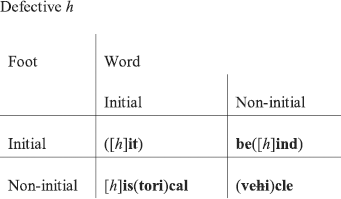
The pattern for h in standard English is illustrated in (3) (see Borowsky Reference Borowsky1986, Harris Reference Harris1994, Davis & Cho Reference Davis and Cho2003). Besides appearing word-initially (see (3a, b)), the consonant can appear internally before a stressed vowel (see (3c)). However, just like r in non-rhotic systems, h is barred from appearing preconsonantally and word-finally (see (3e–f), where an asterisk indicates an absence of examples). There are varieties in which h can appear in all of the positions in (3) (see Harris Reference Harris1994). Moreover, just like r in non-rhotic system R3 in (1), h is also barred from appearing before an unstressed vowel (see (3d)).
(3)
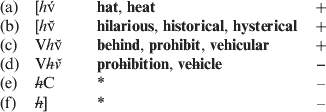
As for t-lenition, the situation is summarised in (4), where we can compare glottalling system T1 with tapping system T2.
(4)
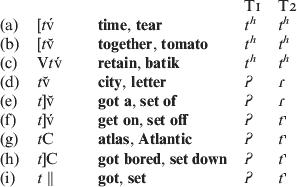
T1 is well established in Great Britain, T2 in North America, Australia and parts of Ireland (see Wells Reference Wells1982, Harris Reference Harris1994 and the relevant chapters in Schneider et al. Reference Schneider, Burridge, Kortmann, Mesthrie and Upton2004). In both systems, t (like all voiceless stops) occurs as an aspirated plosive word-initially (as in (4a, b)) and before a stressed vowel within the same word (as in (4c)). Elsewhere, it appears in system T1 as a glottal stop and in system T2 as either a tap or an unreleased stop. The elsewhere set of conditions includes the familiar preconsonantal and word-final positions (see (4g–i)). And it includes prevocalic position where the vowel occurs either within the same word, in which case it must be unstressed (as in (4d)), or in the following word, in which case stress is irrelevant (see (4e, f)).
Dispensing with ambisyllabicity
Given the proven ability of the coda-based analysis to capture the recurrent combination of preconsonantal and word-final environments, it is not surprising that phonologists felt encouraged to extend it to the broader, prevocalic context just reviewed. The only way of achieving this is through resyllabification. Under basic, unmarked syllabification, a single intervocalic consonant belongs exclusively to the onset of the second syllable, in accordance with the onset-first principle. Under resyllabification, this consonant is captured into the coda of the first syllable (see for example Kahn Reference Kahn1976, Selkirk Reference Selkirk, van der Hulst and Smith1982, Borowsky Reference Borowsky1986, Wells Reference Wells1990, Hammond Reference Hammond1999). Depending on the particular version of the analysis, the consonant either loses its basic affiliation to the second syllable (crisp capture as in (5b)) or retains it, in which case it becomes ambisyllabic (sloppy capture as in (5c)).
(5)

In what follows, I will use coda capture as a cover term for both (5b) and (5c). Ambisyllabicity is the more widely adopted version, and for that reason it is the one I will refer to more often here. Unless explicitly indicated to the contrary, all of the criticisms to be levelled at ambisyllabicity below apply equally to crisp capture.
Ambisyllabicity succeeds in unifying intervocalic position with preconsonantal and word-final positions, defining a single context where, for example, r and h can be deleted and t glottalled. In earlier analyses, coda capture takes the form of a transformational rule (Kahn Reference Kahn1976, Selkirk Reference Selkirk, van der Hulst and Smith1982). Because of this, the very term ‘capture’, like ‘resyllabification’, retains a certain procedural flavour. However, the same representational result can be achieved non-procedurally. In an analysis based on ranked output constraints, it is achieved by allowing an ambisyllabic parse of VCV to be judged more optimal than an onset-only parse. How ambisyllabicity is derived is irrelevant here, however. What is at issue is the status of the device itself.
It needs to be borne in mind that ambisyllabicity, whether implemented by rule or constraint, represents a considerable enrichment of syllabic theory. Any model of syllabification must acknowledge onset-only as the basic parse of VCV. Apart from anything else, that is the syllabification required for the considerable proportion of the world's languages that lack codas altogether. As a null hypothesis, we may take onset-only to be the only universally possible parse. The claim that syllabic theory must also accommodate an ambisyllabic analysis of VCV can thus be described a research hypothesis. Under normal circumstances, the onus would be on advocates of a theory with coda capture to adduce evidence that would force us to reject the simpler theory without it. This point is of such scientific generality that it might seem odd to be reiterating it here. However, ambisyllabicity in particular and resyllabification in general are widely used as though they had pretheoretical observational validity. For this reason, it is worth spelling out why the null hypothesis in this case should not be rejected. We can keep this brief, since the arguments have been presented in more detail elsewhere (see especially Harris Reference Harris1994, Reference Harris2004; Jensen Reference Jensen2000; Bermúdez-Otero Reference Bermúdez-Otero, Oostendorp, Ewen, Hume and Rice2011).
An observationally adequate formulation of coda capture has to make reference to stress in some way or another. For example, resyllabification must be prevented from applying where the following vowel is stressed within the same word, so as not to incorrectly produce r-deletion in forms such as carouse, h-deletion in behind, and t-glottalling/tapping in retain. In earlier analyses, this was achieved by building values for the feature [stress] directly into the relevant rules (as in Kahn Reference Kahn1976 for example). Updated in more recent prosodic terms, where stress is treated as the phonetic expression of metrical structure, this means that ambisyllabicity needs to be specified as sensitive to foot structure (the formulation explicitly adopted by Borowsky Reference Borowsky1986 for example). However, the very reference to the foot suggests that ambisyllabicity is superfluous, at least as a device for specifying the context for segmental regularities. It is much simpler to characterise the relevant context directly in terms of the foot, without having to engage the additional representational and derivational machinery needed for resyllabification. For example, h in standard English can be described as being retained when it is initial in a foot but suppressed when it is not; compare pro(hibit) with (prohi)(bition) (here and below, feet are indicated by parentheses).
It might be countered that ambisyllabicity is motivated by facts that are quite independent of the segmental effects under discussion here – in particular, by evidence relating to weight and native-speaker judgements on syllabification. But here too the case for ambisyllabicity is far from convincing.
Consider first the weight evidence. Ambisyllabicity has the general effect of increasing the weight of a captor syllable. One specific result of this is to render all stressed syllables heavy in English. This is often presented as the main independent motivation for coda capture (see Kahn Reference Kahn1976, Borowsky Reference Borowsky1986 and Wells Reference Wells1990 for example). It amounts to the claim the stress-to-weight principle is active in English in the same way as it is in quantity-determined languages such as Italian and Norwegian. Since some captor syllables are already heavy, resyllabification potentially creates super-heavy syllables (such as the pawd of powder). In some ambisyllabic analyses, coda capture is blocked under these circumstances to avoid over-weight (see Giegerich Reference Giegerich1992, Hammond Reference Hammond1999). However, as we will see presently, this brings its own problems. In fact, since some captor syllables are themselves already super-heavy, resyllabification can also create extra-super-heavies (such as the powlt of poultry). This is quite unlike the situation in canonical quantity-determined languages, where vowels are consistently short in closed syllables. Depending on the nature of the consonant, many of the brand new super-heavies are not even independently attested in English itself. The nearest equivalent sequences are VVC and VVCC in word-final position (as in loud, mount), but here the absolute final consonant behaves extrasyllabically and extrametrically rather than as a coda (see Hayes Reference Hayes1982, Harris & Gussmann Reference Harris and Gussmann2002).
A second specific weight consequence of ambisyllabicity is the creation of heavy unstressed syllables. One of the phonological contexts where the segmental patterns reviewed above occur is between unstressed syllables, as in broadly non-rhotic different (see (2b.ii)) and the tapped or glottalled t in vanity. To accommodate these data, an ambisyllabic analysis must allow the intervocalic consonant to be captured by the preceding unstressed syllable, thereby rendering it heavy. Again this is quite unlike what is found in canonical quantity-determined languages, where there is a rigid correlation between weight and stress: all stressed syllables are heavy, and all unstressed syllables are light.
In response, it might be proposed that, while superheavy syllables are tightly restricted at an underlying level in English, they are freely allowed at some more superficial (perhaps late lexical or postlexical) level. On this analysis, the effects of coda capture are visible only later in derivation or in particular prosodic or morphological domains (see Myers Reference Myers1987). As with ambisyllabicity itself, increasing the power of syllable theory in this way cannot be taken as a null hypothesis. There is no compelling reason to abandon the more restrictive assumption that the same set of syllabic structures is preserved across all domains.
As noted above, the creation of novel super-heavy syllables through resyllabification could be prevented by making coda capture sensitive to the weight of the captor syllable, such that it applies only after short vowels (as proposed by Giegerich Reference Giegerich1992 and Hammond Reference Hammond1999 for example). However, this undermines the segmental analyses for which ambisyllabicity was originally designed. It predicts that phenomena such as r-deletion, h-deletion and t-glottalling/tapping should be sensitive to the weight of the preceding syllable. This is incorrect: t-glottalling/tapping, for example, applies regardless of whether the preceding vowel is short (e.g. city) or long (e.g. liter).
Another weight-related motivation sometimes given for ambisyllabicity is the traditional claim that short stressed vowels in English are ‘checked’, i.e. only occur in closed syllables (see for example Kreidler Reference Kreidler2003). This supposedly explains why these vowels cannot appear in absolute word-final position (*si, *pε, etc.). The idea is that stressed i, for example, occurs in a closed syllable not just in sit but also, thanks to ambisyllabicity, in city. The validity of this analysis is undermined by the extrametrical behaviour of final consonants in English, which have little or no influence on the length of a preceding vowel (hence short sit versus long seat). In any event, the ungrammaticality of *si, *pε, etc. is now known to be motivated by word-minimality considerations that have everything to do with feet and nothing to do with syllabification: being monomoraic, such forms are too small to be feet and are thus also too small to be words (see McCarthy & Prince Reference McCarthy and Prince1986).
The ambisyllabic version of coda capture implies that English has weight-bearing geminate consonants. The geminates have to be considered covert; that is, they show no phonetic evidence of extra duration, unlike the overt equivalents in Italian and Norwegian. This assumption is not in itself necessarily problematic. What is problematic, however, is the prediction that such consonants should exhibit the well-established property of geminate inalterability (Hayes Reference Hayes1986, Schein & Steriade Reference Schein and Steriade1986). But the main segmental motivation for coda capture is precisely to manoeuvre consonants into a position where they do get altered – by weakening or deleting them.
Using coda capture to alter intervocalic consonants becomes still less attractive when we compare consonant weakening with vowel reduction. There are good reasons to suppose that the two types of process are related. Vowels typically undergo reduction in prosodically non-prominent positions and resist it in prominent syllables. But allowing an intervocalic consonant to be ambisyllabic destroys the parallel between reduction and weakening: the consonant undergoes weakening in a prominent syllable, the very location where vowels resist reduction.
What of the suggestion that ambisyllabicity reflects speakers' intuitions about syllabification? The intuitions are supposedly revealed in metaphonological tasks where subjects are required to repeat or transpose syllables or insert pause-breaks between them. Ambisyllabicity is claimed to be reflected in responses such as pity being chunked as pit plus ti (see for example Fallows Reference Fallows1981, Giegerich Reference Giegerich1992, Hammond & Dupoux Reference Hammond, Dupoux, Durand and Laks1996, Rubach Reference Rubach1996, Barry, Klein & Köser Reference Barry, Klein and Köser1999). The experimental methodology behind these tasks is flawed, however, because subjects' responses are naturally guided by explicit exposure to some prior definition of the syllable. The exposure can occur through previous experience (most likely in education), in which case the validity of the assumed definition is unverifiable. Or the exposure can occur through some training procedure specific to the experiment, in which case the results are prejudiced by the methodology.
In any event, pause-break tasks almost certainly reveal more about feet and words than about syllables. There are good grounds for assuming that the smallest utterable unit of language is the minimal phonological word (see Bloomfield Reference Bloomfield1933: 178). This is likely to be the unit that corresponds to the individual chunks produced by speakers in repetition and pause-break tests. In English, as in many other languages, the minimal word consists of a single bimoraic foot (again see McCarthy & Prince Reference McCarthy and Prince1986). Against this background, it is hardly surprising that an English speaker should choose pit rather than pi as the first chunk of pity. Being monomoraic, pi is too small to form a foot and therefore too small to form a minimal utterable word of English.
The suggestion that ‘syllabification’ experiments are in fact tapping into implicit knowledge of foot structure is strengthened by the finding that, in many such studies (including the ones just cited), subjects' judgements are heavily influenced by word stress. In particular, an intervocalic consonant is most consistently chunked with the following vowel when that vowel is stressed. In Fallows' (Reference Fallows1981) study, for example, subjects were much more consistent in packaging an intervocalic consonant with a following vowel in words of the pattern machíne, becáuse, cigár than in words of the pattern méasure, lémon, rábbit. Chunk boundaries are thus more obvious when they coincide with foot boundaries.Footnote 6
In speech production, language-specific phonological restrictions can of course be suppressed (for example by trained phoneticians, as Sapir (Reference Sapir1933) observed). There is after all no phonetic injunction against uttering pi in isolation; indeed it is phonologically well-formed in languages where words can be monomoraic. An utterance produced under these conditions, however, no longer reveals anything about the phonology of English.
I conclude that coda-capturing intervocalic consonants, whether crisply or ambisyllabically, is empirically unmotivated. In any event, there is a simpler alternative: to specify the relevant environment in terms of the foot and word.
A wide-domain analysis of r, h, t
Let us now consider in more detail how an analysis based on the foot/word applies to broad non-rhoticity and the other segmental patterns just discussed. Following a generally accepted analysis, I assume that the metrical foot in English takes the form of a minimally bimoraic trochee (Hayes Reference Hayes1982, Reference Hayes1995). One question on which there is less than general agreement is whether the English foot can be larger than two moras. As we will see, this question has a bearing on how the wide-domain analysis is implemented.
It has already been argued elsewhere that certain segmental phenomena in English previously analysed in syllabic terms are better treated in terms of the foot and word. The parallel between h and aspiration in systems such as those described in Section 2.2 provides one example. The distribution can be expressed in terms of the foot/word, without having to resort to ambisyllabicity (see Harris Reference Harris1994, Davis & Cho Reference Davis and Cho2003). Specifically, h and aspirated plosives can appear initially in the foot or word but not elsewhere.
The same foot/word analysis can now be applied to broad non-rhoticity, as illustrated in (6).
(6) Broad non-rhoticity
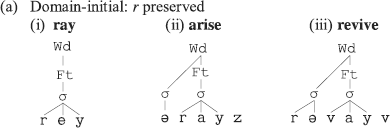
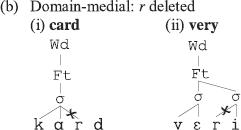
The domain-initial condition under which r is retained in a broad non-rhotic system can be satisfied by the foot alone (as in (6a.ii)), or by the word alone (as in (6a.iii)), or by both domains simultaneously (as in (6a.i)). Elsewhere, r is deleted (indicated by delinking in (6b)). The parallel with h and aspiration is spelt out in (7) and (8) (where, as before, feet are indicated by parentheses).
(7)
(8)
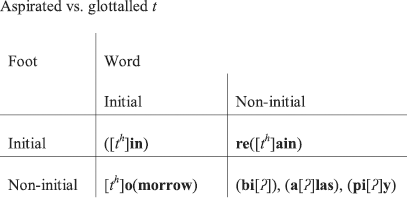
To summarise: When not initial in the foot or word, r is suppressed in a broad non-rhotic system, h is deleted and t is glottalled (or tapped). All of these processes can be broadly characterised as weakening. The patterns in (6), (7) and (8) thus illustrate the generally acknowledged point that domain-initial position is segmentally strong: this is where consonants withstand lenition or deletion, where segments resist temporal compression and where contrasts tend to be preserved (see for example Lass & Anderson Reference Lass and Anderson1975, Escure Reference Escure1977, Pierrehumbert & Talkin Reference Pierrehumbert, Talkin, Docherty and Ladd1992, Beckman Reference Beckman1998, Keating et al. Reference Keating, Cho, Fougeron and Hsu2004, White & Turk Reference White and Turk2010). Non-initial positions, on the other hand, are weak: processes affecting consonants in this context typically involve lenition or deletion and are often neutralising.
What is the representational scope of the distinction we are drawing here between initial position and non-initial position? Within the foot, the strength asymmetry in consonants evidently reflects trochaic structure and is thus related to the well-established segmental asymmetry between strong, stressed vowels and weak, unstressed vowels. This suggests a segmentally motivated split within the foot between a strong and a weak sector, marked ‘S’ and ‘W’ in (9).
(9)
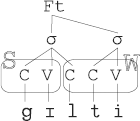
The strong sector consists of the initial CV of the foot, while the weak sector consists of any other positions. It is not immediately obvious that this split can or even should be defined in terms of syllable structure. Note how it cuts across metrically motivated syllable divisions. The weak sector potentially contains not only an unstressed nucleus together with its consonant margins but also any coda that closes the stressed syllable (thereby making it heavy). The justification for allocating the internal coda to the weak sector is its well-known propensity to host neutralisation.
The question of whether segmental sectors within the foot should be syllabically defined also arises when we are faced with a process that targets only certain positions within the weak sector. For example, in order to distinguish narrow non-rhoticity from broad, it is necessary to refer to the presence and identity of the segment following the r-deletion site. In a narrow non-rhotic system, the segment that excludes a preceding r is a consonant (see the R2 data in (1h–i) above). It is debatable whether consonant here is to be interpreted syllabically or not. Under a traditional syllabic interpretation, it refers to a coda position (though not a captured one, note). Alternatively, it can be identified by means of prosodic licensing relations between syllabic positions (see for example Scheer Reference Scheer2004). Under an interpretation that either plays down or rejects the syllabic dimension altogether, preconsonantal position can be viewed as a weak segmental licensing context on the grounds that the consonant potentially obscures auditory-perceptual cues to the identity of any preceding consonant, including r (see Steriade Reference Steriade1999, Blevins Reference Blevins, Féry and van de Vijver2003).
We need to consider whether an approach based on localised licensing by cue can be extended beyond the preconsonantal aspect of non-rhoticity to the stress-related conditioning it exhibits in the broad system. That is, might not the deletion of r in words such as very and different be attributed locally to the lack of prominence on the immediately following vowel rather than to location within some wider prosodic domain? Gestures in the production of r are known to be more extreme before vowels bearing greater stress prominence than before those with less (Mullooly Reference Mullooly2003, Reference Mullooly2004). This leads to the reasonable expectation that cues to the identity of r will be more robust before stress. The disappearance of r from unstressed positions in broad non-rhoticity would then be treated as the phonologisation of this local effect.
However, there are at least two reasons for favouring a wide-domain account of stress-conditioned non-rhoticity over one based on local cue licensing.
First, an empirical point: an account based on local prominence cannot on its own capture the distributional details of non-rhoticity. It is not correct to say of the broad non-rhotic system that r resists deletion whenever it precedes a vowel with stress prominence. This is evident from a comparison of (2a) with (2b.iii–iv): r withstands deletion before a stressed vowel only when the vowel occurs within the same word. The same point can be made about aspiration and t-lenition (compare (4c) with (4f)): t is aspirated in retain but lenited in but Ian. Distributional facts such as these are most straightforwardly captured by taking domain structure into account.
Second, a more general conceptual point: defining stress prominence in purely local terms is problematic. The traditional way of thinking of prominence is to ascribe to it a set of primary phonetic exponents, defined in terms of loudness, duration and pitch, which can have secondary segmental effects, such as vowel reduction or consonant lenition. This is an essentially derivational view: surface quality effects are determined by an underlying stress relation. Even some professedly non-derivational approaches incorporate this view. It is inherent in the notion that certain phonological constraints require output forms to be segmentally faithful to their inputs specifically in positions bearing stress prominence (see for example Crosswhite Reference Crosswhite2001). From an authentically output-oriented perspective, however, the relation among all of the apparently diverse properties associated with prominence must be regarded as non-directional. That is, differences in segmental quality are as much a part of the expression of prominence as properties related to loudness, duration and pitch. According to this view, constraints regulate how all of these properties co-vary in output.
It is still of course necessary to have some way of defining the positions where particular specifications for each of these properties congregate. A linear cover-term such as [stress] is unsuitable for this purpose: its close association with only a subset of the properties in question means that its use is intrinsically derivational. The only serious alternative is to characterise prominence relations in terms of wider prosodic domains such as the foot or word. For example, specifications for segmental quality, loudness, duration and pitch can be defined as co-occurring within the strong sector of a foot. And (unlike ambisyllabicity) the foot has metrical credentials that are quite independent of the segmental regularities it plays host to.
Having staked out the territory over which strength asymmetries within the foot and word operate, we are faced with the following question: Should the structural descriptions of individual weakening processes be defined positively in terms of where they do occur within this domain or negatively in terms of where they do not? This would be a purely empirical question, were it not for the fact that the answer depends to some extent on the particular version of metrical theory we adopt. We can see this when we compare two different draft statements of the conditions under which broad non-rhoticity occurs:
- (10)
(a) r is deleted in the weak sector of a foot
(b) r is preserved word- or foot-initially but deleted elsewhere
In Optimality Theory, (10a) would be implemented as a positional markedness analysis (see Zoll Reference Zoll1998), in which a constraint banning r from weak positions is highly ranked. (10b) would be implemented as a positional faithfulness analysis (cf. Beckman Reference Beckman1998): a general constraint banning r from all environments is outranked by a constraint requiring r to be preserved in strong positions.
The statement in (10a) correctly accounts for examples such as Carolina and car, where historical r occurs in the weak sector of a foot. But what of examples such as different, natural, etc., which contain sequences of two unstressed syllables? Since broad non-rhoticity suppresses intervocalic r here too, (10a) will only be right if we assume feet in English can be unbounded or ternary (see Burzio Reference Burzio1994). In that case, the weak sector of the foot will extend over two syllables, as in (different). On the other hand, if we assume feet are maximally binary (see Hammond Reference Hammond1999), (10a) is incorrect: r is not just deleted in the weak sector of a foot – as in (very) – but also in an unfooted syllable – as in (diffe)rent. In that case, we need to opt for some version of (10b), the positional faithfulness account.
Under maximal foot binarity, a positional faithfulness account is needed not just for broad non-rhoticity but also for the other English weakening processes discussed above. For example, t-lenition occurs not just when the consonant occurs in the weak sector of a foot – as in (city) – but also when it falls outside a foot – as in (vani)ty. Although this would be the analysis required for English, we should note that a positional faithfulness approach is not forced on us by maximal foot binarity. There are languages for which some version of the positional markedness analysis in (10a) is appropriate.
In Ibibio, for example, consonant lenition applies exclusively in the weak sector of a foot (Harris & Urua Reference Harris and Urua2001). In this language, the stem (root + suffix) in most verb paradigms conforms to a templatic shape consisting of a bisyllabic trochee (Akinlabi & Urua Reference Akinlabi and Urua2002). When a singleton consonant occurs within the weak sector of this trochee, it is subject to lenition; hence an input form such as /(séé-ké)/ ‘not look’ shows up as sééγé. A CV suffix can be extra-pedal if the foot is already saturated. In that case, the suffix consonant resists weakening; for example, input /(dáápá-ké)/ ‘not dream’ shows up as dáápáké rather than *dáápáγé.
Identifying the foot and word as the sites where the segmental patterns in (6), (7) and (8) occur confirms the close affinity between these two domains. The affinity is well established on the basis of factors quite independent of segmental phonology, most notably the phenomenon of word minimality alluded to in the previous section (see McCarthy & Prince Reference McCarthy and Prince1986). The two domains overlap, but can they be unified for the purposes of the wide-domain analysis? An advantage claimed for ambisyllabicity is that it defines a unique prosodic environment for segmental effects of the type under discussion here. It might be objected that, in having to invoke the foot–word conjunction, a wide-domain approach fails in this respect.
Davis & Cho (2002) tackle this question by allowing for a modification of trochaic foot design. The evidence that appears to require the foot-word conjunction comes from forms such as revive, historical and tomato, where r and h resist deletion and t resists lenition (see again (6), (7) and (8) above). These examples show that word-initial position acts as strong even in the absence of stress. In most metrical theory, a word-initial unstressed syllable is assumed to remain unfooted in a trochaic system (Hayes Reference Hayes1995, Hammond Reference Hammond1999), as depicted in (11a). Davis & Cho adopt an alternative analysis, proposed by Jensen (Reference Jensen2000), in which a word-initial unstressed syllable can be incorporated along with a following trochee into a ‘superfoot’, notated as Ft′ in the representation of revive in (11b).
(11)
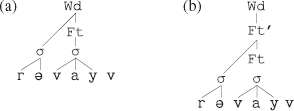
The representation in (11b) allows for a succinct statement of the conditions under which h and aspiration in English appear: they are restricted to foot-initial position.
Simplifying the statement of wide-domain conditions in this way comes at the cost of enriching the inventory of foot types, a cost that some might find too high. However, even if we settle for the apparent awkwardness of the foot-word conjunction, we should not lose sight of the advantages that the wide-domain approach enjoys over one based on ambisyllabicity. It is important to bear in mind that, as autonomous metrical and morphological entities, the foot and word are fully motivated by evidence that is quitendependent of segmental phonology. Ambisyllabicity, on the other hand, has no real motivation beyond the segmental facts for which it was originally devised, as we saw above. Unlike the foot and word, the device cannot adequately accommodate prosodic phenomena involving weight and stress.
To the best of my knowledge, the distributional parallel in English between broad non-rhoticity on the one hand and h and aspiration on the other has not been noted before. Once we acknowledge the importance of the foot as a segmental domain, the parallel emerges quite clearly. Moreover, adopting a wide-domain perspective on non-rhoticity opens up connections with a range of other r-related phenomena in English, none of which readily submit to syllabic analysis. One of these, to which we now turn, has to do with the influence historical r exerts on preceding vowels.
VOWELS BEFORE r
There is a strong tendency for vowel contrasts to neutralise before historical r in English, with individual dialects displaying the effect to different extents. Here we review the various merger patterns (Section 3.1) and consider why r – and liquids in general – can have such a destabilising influence on preceding vowels (Section 3.2).
Vowel mergers before r
The most far-reaching impact of pre-r vowel merger in English is to be observed in absolute word-final position. Essentially the same patterns of merger are found preconsonantally (with results such as earn = urn, horse = hoarse). The arrays in (12) illustrate different patterns of merger in three areas of the vowel system. As in Wells (Reference Wells1982), the lexical incidence of each historical vowel is indicated by a capitalised head-word.
(12)
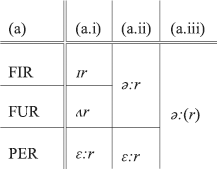
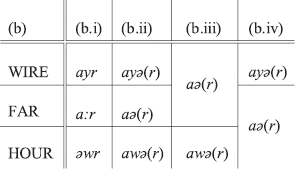
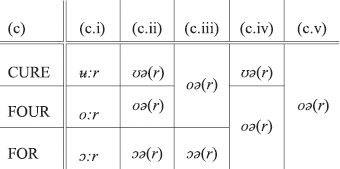
The r transcriptions in (12) are to be interpreted broadly (ər, for example, is typically realised as a fully rhotacised vowel). We will return to the phonetic details presently. The parenthesised r transcriptions indicate that vowel merger has left its mark on both rhotic and non-rhotic dialects.Footnote 7
The sub-systems represented in (12) occur in various combinations in particular dialects. They do not exhaust the set of pre-r merger patterns in English, but they do give a fair idea of the extent to which vowel contrasts collapse in this context. Moreover, the precise qualities of the merged vowels vary within each of the systems. For example, in system (12a.iii) the merged reflex of FIR/FUR/PER varies extensively between relatively close and relatively open; in system (12c.v), the merged reflex of CURE/FOUR/FOR in non-rhotic dialects can occur with an off-glide (oə) or without (oː).
Details of the geographical distribution of the particular patterns represented in (12) can be gleaned from Kurath & McDavid (Reference Kurath and McDavid1961: Chapter 4), Wells (Reference Wells1982, vol 1: 153ff.) and Schneider et al. (Reference Schneider, Burridge, Kortmann, Mesthrie and Upton2004) . Sub-system (i) in each of (12a–c) is represented by traditional Scottish English (as described by Aitken Reference Aitken and Trudgill1984 for example). This makes a good reference system, since it has preserved not only historical r but also a near-maximal system of vowels before it.
The different patterns in (12) are arranged according to the area of vowel space that has been affected by merger before historical r. In (12a), centralisation has merged originally short non-round non-low vowels.Footnote 8 In (12b), the loss of the up-glide in diphthongs with a low onset (WIRE, HOUR) has led to mergers with the low vowel of FAR. The changes responsible for the patterns in (12c) have targeted the back round area of the system, producing merger through lowering historically high POOR and/or raising originally low-mid FOR.
Pre-r vowel merger is not restricted to word-final and preconsonantal positions. In many dialects, it extends to r in the onset of an unstressed syllable. A general idea of the extent of merger in this environment can be gained by focusing on the particular vowel classes represented in (13).
(13)
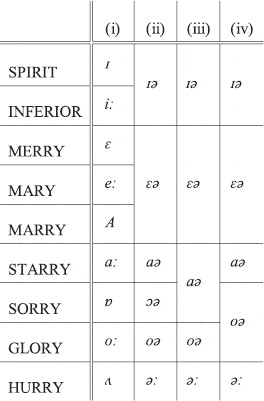
The extent of merger can be gauged by once more taking Scottish English as a reference system (see (13.i)). Various patterns of merger are illustrated by systems (ii), (iii) and (iv) in (13), all well-established in North America (again see Chapter 4 in Kurath & McDavid Reference Kurath and McDavid1961 for details). Cross-cutting the systems represented here are mergers involving other vowel classes in the same environment, including FURY, DOWRY, PIRATE. Unsurprisingly, these mergers affect rhotic and narrow non-rhotic systems alike, since this is one of the environments where r is retained in both R1 and R2 (see (1e) above).Footnote 9
The reference to stress as a conditioning factor in the mergers illustrated in (13) indicates that, as with broad non-rhoticity, the domain of pre-r vowel neutralisation is larger than the syllable. Specifically, pre-r vowel contrasts potentially collapse when historical Vr is contained within a foot, as in (four) = (for) and (merry) = (marry).
Long-distance resonance effects in liquids
What is it about r in English that allows it to exert such a heavy neutralising influence on preceding vowels? The influence is evidently assimilatory: the overall impression we gain from the mergers in (12) and (13) is that r has somehow invaded the qualitative space of the vowel to its left. Historical l often exhibits similar behaviour. In London English, for example, there is extensive vowel neutralisation before vocalised l, producing mergers such as pool = pull = Paul, steel = still (see Sivertsen Reference Sivertsen1960, Wells Reference Wells1982, vol 2: 313ff.). In this respect, liquids are quite unlike other postvocalic consonants in English; plosives, for example, do not condition large-scale neutralisation of preceding vowel contrasts.
The assimilatory impact of liquids on preceding vowels is evidently related to the fact that consonants of this type are produced with more than one articulatory gesture. In addition to a tongue-blade gesture (traditionally regarded as the ‘primary’ place characteristic), there are gestures involving the tongue dorsum and root and, at least in some accents of English, the lips (see for example Delattre & Freeman Reference Delattre and Freeman1968, McMahon, Foulkes & Tollfree Reference McMahon, Foulkes and Tollfree1994, Alwan, Narayanan & Haker Reference Alwan, Narayanan and Haker1997, Narayanan, Alwan & Haker Reference Narayanan, Alwan and Haker1997, Walsh Dickey Reference Walsh Dickey1997, Gick Reference Gick1999, Docherty & Foulkes Reference Docherty, Foulkes, van de Velde and van Hout2001, Gick et al. Reference Gick, Campbell, Oh and Tamburri-Watt2006, Campbell et al. Reference Campbell, Gick, Wilson and Vatikiotis-Bateson2010, Scobbie & Pouplier Reference Scobbie and Pouplier2010).
Articulatory studies of liquids show that stricture tightness and inter-gestural coordination differ from one phonological position to another. Word-initially before a vowel, the tongue-blade stricture tends to be tight and closely synchronised with other gestures. Word-finally after a vowel, the blade stricture is looser and the gestures out of phase (see Krakow Reference Krakow1999 and Gick et al. Reference Gick, Campbell, Oh and Tamburri-Watt2006 for discussion and references). There is a strong tendency for the dorsal gesture in this position to precede the apical (Sproat & Fujimura Reference Sproat and Fujimura1993, Browman & Goldstein Reference Browman, Goldstein, Bell-Berti and Lawrence1995, Gick Reference Gick1999, Campbell et al. Reference Campbell, Gick, Wilson and Vatikiotis-Bateson2010).Footnote 10
Any diachronic magnification of the postvocalic articulatory configurations reported in these studies will create the conditions for just the kind of phonologically entrenched r-patterns discussed in the preceding sections. Non-rhoticity will result if the inherent looseness of the liquid's tongue-blade stricture in this position is allowed to increase to the point of vocalisation. Additionally or independently, vocalic merger will result if the inherent early phasing of the liquid's dorsal gesture in this position is allowed to increase to an extent where it interferes with the dorsal gesture of a preceding vowel (see Marshall Denton's (Reference Marshall Denton, van de Velde and van Hout2001) reconstruction of pre-r vowel changes in early West Germanic).
This diachronic account is consistent with the development of off-glides in historical Vr sequences. The schwa off-glide illustrated in (12) and (13) can be viewed as a reflex of the liquid's dorsal component and as the sole synchronic residue of r in non-rhotic systems. A similar account can be given for the w-glide outcome of l-vocalisation.
What was traditionally treated as the secondary articulation of a liquid produces a resonance that can typically be identified as either clear (produced by a front-dorsal gesture) or dark (back-dorsal, possibly enhanced by lip rounding). The clear–dark distinction can act as an important auditory-perceptual cue to liquids, particularly in dialects of English where it correlates reliably with the contrast between r and l (see Kelly & Local Reference Kelly and Local1986). In some dialects (predominant in North America and the north of England), r is consistently clear, while l is dark. In others (in the Caribbean and parts of Ireland for example), it is r that is dark, while l is clear. The contrast is measurable in terms of the frequency of the second formant, with darker resonance being associated with lower F2 values. In word-initial position, Carter (Reference Carter1999) found mean F2 values for r to be significantly higher than for l in one north-of-England system (southeast Lancashire), while the reverse relation held in one Irish English system (Tyrone).
In standard feature theory, resonance differences in liquids are only granted phonological status if they are phonemically distinctive (as in Russian or Irish, for example). However, down-playing the status of liquid resonance in this way sits uneasily with its proven perceptual usefulness and with the far-reaching influence it can have on neighbouring vowels. This behaviour strongly suggests that the resonances should be considered an integral part of the phonological representation of liquids – even in languages where it might not count as phonemically contrastive. In fact a good case can be made for saying that the difference between clear and dark resonance is the primary means of distinguishing l from r in many dialects of English (see Kelly & Local Reference Kelly and Local1986).
There are various alternative ways of integrating resonance characteristics into the phonological representation of liquids. The auditorily motivated difference between clear and dark resonance can be directly coded in terms of acoustically defined features, such as [acute] versus [grave] in Jakobson, Fant & Halle's (Reference Jakobson, Fant and Halle1962) classification. Equivalently, in models in which vowel space is classified in terms of the monovalent components [A], [I] and [U], clear corresponds to [I] and dark to [U] (see Backley Reference Backley2011 for discussion and references). With articulatory features, the difference can be represented geometrically: while coronality in liquids is specified under a C-Place node, clear versus dark can be coded by distinct Dorsal specifications under V-Place (Ní Chiosáin & Padgett Reference Ní Chiosáin and Padgett1993, Ní Chiosáin Reference Ní Chiosáin1994, Walsh Dickey Reference Walsh Dickey1997). In Articulatory Phonology, each of the tongue and lip manoeuvres that contribute to the production of clear or dark resonance is represented on an individual track within an overall gestural score (Browman & Goldstein Reference Browman, Goldstein, Bell-Berti and Lawrence1995, Gick Reference Gick1999). In all of these approaches, the smearing behaviour of liquid resonance can be captured by allowing it to spread or leech into a neighbouring vowel.
The coarticulatory influence that the resonance component of liquids exerts on neighbouring sounds is reported to extend over considerable distances (Hawkins & Slater Reference Hawkins and Slater1994, Heid & Hawkins Reference Heid and Hawkins2000). Moreover, this smearing effect can be exploited in speech perception (Kelly & Local Reference Kelly and Local1986, Whalen Reference Whalen1990). West (Reference West1999) has shown that listeners can recover the l–r contrast when the liquids are replaced by noise in VCV sequences. Auditory-acoustic cues to the identification of r have a longer reach than corresponding l cues: r remains more reliably identifiable than l as progressively longer stretches of the surrounding context are obscured.
In the context of the present paper, it is significant that Kelly & Local (Reference Kelly and Local1986) suggest the foot as the relevant domain over which these long-distance perceptual effects operate. At first glance, however, this claim appears not to have been supported by subsequent research. The VCV stimuli used in the West (Reference West1999) study include both foot-internal liquids (e.g. mallow, marrow) and foot-initials (e.g. alive, arrive). Although these two conditions are not distinguished in her reported results, the alive/arrive examples suggest that liquid resonance can jump foot boundaries. Moreover, the studies by Hawkins and colleagues demonstrate that liquid resonance can extend over distances very much longer than VCV (Hawkins & Slater Reference Hawkins and Slater1994, Heid & Hawkins Reference Heid and Hawkins2000).
Nevertheless, three considerations allow us to conclude that if liquid resonance smear is to have any long-term neutralising impact on neighbouring vowels it is within the foot that it will be felt most keenly. Firstly, although the smearing effect reaches over considerable distances, it understandably dissipates the further it extends from the source segment (Heid & Hawkins Reference Heid and Hawkins2000). The effect will thus be most strongly manifested on immediately adjacent vowels. Secondly, although the smearing effect is bidirectional, any enduring neutralising impact is more likely to be anticipatory than progressive. This is because of the inter-gestural phasing relation mentioned above: the dorsal gesture responsible for a liquid's resonance characteristic typically precedes the coronal gesture. The left-biased bidirectionality is similar to that reported for the spreading of emphatic resonance in Arabic (see Zawaydeh & de Jong Reference Zawaydeh, Jong, Hassan and Heselwood2011) . Thirdly, any neutralising effect will be most dramatic where the vowel on the liquid's left is in a stressed nucleus (as in carry as opposed to arrive), since that is otherwise the locus of full contrastivity in English vowels (including before historical r). The potential for neutralising effects on neighbouring unstressed nuclei is negligible, since most dialects support only a two- or three-way vowel contrast in that position anyway.
Together, these three considerations would explain why the first vowel in a  r
 sequence is particularly susceptible to neutralisation, the results of which we see in systems (ii), (iii) and (iv) in (13). And the domain that encompasses r – as well as VrC and Vr], the other neutralising contexts – is the foot.
RHOTIC–DENTAL INTERACTIONS IN IRISH ENGLISH
r and coronals
In English, r interacts in various ways with neighbouring consonants, in particular coronals. The phonological context within which some of these interactions take place can be only loosely described in linear-segmental terms. On closer inspection, they turn out to be sensitive to prosodic domain structure.
By way of a brief initial illustration of this point, consider the distribution of the sequence sr in English. In most modern varieties, this is disallowed in word-initial position (except in a handful of loan words such as Sri Lanka). It is, however, allowed when the consonants are separated by a foot/word boundary, as in dysrhythmia, misrule, pass rate. Initial sr was once generally licit in English but by the last century was restricted to a few regional dialects in England and the United States (Wright Reference Wright1905, Reese Reference Reese1941). In this position, historical sr has more generally given way to ʃr (in shrimp, shred, etc.), indicating that r has exerted some kind of assimilatory influence on the fricative, but only when the two consonants are prosodically adjacent.
We turn now to two more detailed examples where r interacts in a prosodically sensitive manner with neighbouring coronals. Both processes involve r and dental consonants in Irish English, one affecting non-continuants (Section 4.2), the other continuants (Section 4.3). In both cases, the domain within which the interactions occur can be shown to be the foot/word.
Dentalisation
In most varieties of English, the non-continuant coronals t, d, n, l are generally alveolar but assimilate to a following dental fricative, yielding  in width for example. In some traditional Old-World dialects, the same consonants also show up as dentals before r or rhotic schwa, e.g. in trip, drip, matter, ladder. In the present day, pre-r dentalisation is almost exclusively found in Irish English, although it was once also prevalent in northern England (see Maguire Reference Maguire2012). The Irish English system I use to illustrate the pattern here is the northern one described by for example Gregg (Reference Gregg and Adams1964) and Harris (Reference Harris1985).
In northern Irish English, the plosives t and d dentalise before an r within the same syllable onset (see (14a)). Under these circumstances the r, elsewhere realised as an approximant, appears as a tap.
(14)
(a) trip [
ɾ]ipdrip [ɾ]iptrain [
ɾ]aindrain [ɾ]ainpetrolpe[
ɾ]olbedragglebr[ɾ]aggle(b) matterma[
ɚ] mannerma[ɚ]ladderla[
ɚ] pillarpi[ɚ]


All of the coronal non-continuants, including sonorants, dentalise before an unstressed rhotic schwa (see (14b)).
The alveolar–dental difference is an example of a ‘derived contrast’: while it is not lexically distinctive, it is nevertheless surface-contrastive at the word level (Harris Reference Harris1990). This is because dentalisation is blocked when a level-2 morpheme boundary intervenes between the target of the process and a potential trigger.Footnote 11 Note how the monomorphemic examples in (15a) have dentals, while the examples containing level-2 suffixes in (15b) have alveolars.
(15)
(a) Dental (b) Alveolar
matterma[
]erfatterfa[t]erladderla[
]ersaddersa[d]ermannerma[
]erplannerpla[n]erpillarpi[
]arfillerfi[l]er
The level-2 blocking effect is also seen when a compound boundary separates an r from a preceding coronal; hence the alveolars in for example ha[t] rack, su[n] rise, be[d] rock. Dentalisation thus underapplies in forms derived by level-2 morphology: rather than obeying the phonological dictates of dentalisation, level-2 forms prefer to be segmentally faithful to their bases (see Benua Reference Benua1997, Bermúdez-Otero & McMahon Reference Bermúdez-Otero, McMahon, Aarts and McMahon2006). For example, lou[d]er preserves the alveolar present in its base lou[d].
To summarise: The trigger for dentalisation must be (i) a rhotic segment of some kind and (ii) right-adjacent to a non-continuant coronal target. At first sight, it might seem odd that the trigger can either be a consonant (as in trip) or an unstressed vowel (as in letter). However, the reference to stress alerts us to the fact that the domain of dentalisation must involve the foot in some way or another. As illustrated by the underlined sequences in (16a), dentalisation occurs when the target and trigger are adjacent within a foot. As the level-2 compounds in (16c) show, it fails when the target and trigger are separated by a foot boundary.
(16) Dental
(a) (track), (dream)
(matter), (ladder), (manner), (pillar)
(b) tre(mendous), Dro(more)
ɾəmóɚAlveolar
(c) (hat)(rack), (bed)(room), (sun)(rise), (bull)(ring)
As illustrated by the forms in (16b), the process also applies if the target and trigger are adjacent within a word-initial unstressed syllable. If such syllables are treated as part of a super-foot, as per the Davis & Cho (Reference Davis and Cho2003) analysis outlined above, we can say that the target and trigger of dentalisation must be adjacent within the foot. If, on the other hand, these syllables are deemed to be unfooted (as notated in (16b)), we can say that the target and trigger of dentalisation must not be separated by a foot or word boundary. In the case of level-2 suffixes, the foot/word boundary established at the right edge of the base evidently acts as a barrier to dentalisation; hence the alveolars in for example (fatt)-er, (madd)-er.
As to the process itself, dentalisation might look like a case of articulatory dissimilation, given that a dental consonant requires a more advanced tongue-tip position than r. However, viewed in auditory-acoustic terms, the process shows itself to be assimilatory. Impressionistically, dental t, d, n, l can be described as darker than their alveolar counterparts. The dark resonance can be attributed to a secondary back-dorsal gesture. This is in all likelihood mechanically connected to the fact that the dentals are produced with laminal articulation (see Ladefoged & Maddieson Reference Ladefoged and Maddieson1996: 20ff.). In other words, the dental non-continuants are velarised or ‘broad’ (to borrow a term traditionally applied to the same sounds in Irish Gaelic).
Recalling from Section 3.2 that r in Irish English is also dark, we can now view dentalisation as a case of assimilation: a dental non-continuant anticipates the dark resonance of a following rhotic. Compared to undarkened alveolars, this effect would be expected to correlate acoustically with a skewing of energy towards the lower end of the spectrum – quantifiable as a lowering of the spectral centre of gravity (the average frequency of a spectrum weighted by spectral power). A lowering of F2, the measure employed in the Carter (Reference Carter1999) study mentioned in Section 3.2, would contribute to this overall effect.
A preliminary study of the consonants in question, produced by one Irish-English speaker (a young adult male from County Down), suggests that the dentals do indeed have a lower centre of spectral gravity than their alveolar counterparts. Measurements were made of the spectral transition from a vowel to a following coronal stop before r or rhotic schwa in 30 tokens equally divided between words with a level-2 morpheme boundary (e.g. voter, the expected alveolar condition) and those without (e.g. motor, the expected dental condition). The words were matched according to the preceding vowel (motor–voter, litter–fitter, etc.). Measuring centre of gravity at the final pitch period of the preceding vowel produced mean values of 447 Hz for voter-type tokens and 396 Hz for motor-type tokens. The difference is significant (p = .02, two-tailed t-test), its directionality confirming that, for this speaker, dental stops typically have a bottom-heavier spectrum than alveolars. Although these preliminary results are no more than suggestive, they nevertheless indicate that measuring spectral centre of gravity is a viable way of getting a quantitative handle on the impressionistic notion of darkening.
Putting together the segmental and prosodic aspects of the analysis of dentalisation developed here produces representations such as those in (17). In the [A–I–U] model mentioned above in Section 3.2, a skewing of energy towards the lower end of the acoustic spectrum is the phonetic expression of the feature [U] or [rump] (Harris & Lindsey Reference Harris, Lindsey, Burton-Roberts, Carr and Docherty2000). Darkening is represented as the spreading of [rump] from a rhotic onto a preceding non-continuant (specified in (17) by the feature [abrupt]).
(17)
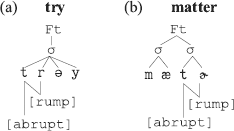
As depicted in (17), the segments that participate in dentalisation are adjacent within the foot.
ðər
If r's darkening influence on non-continuants points to an affinity with dentality, there are other phenomena, this time involving dental continuants, that seem to point in the opposite direction. Historical r is deleted after voiceless θ (as in three, through) in certain varieties of English (Wells Reference Wells1982, vol 3: 543–544). One of these is northern Irish English, where an antagonism between dentals and rhotics is further suggested by the behaviour of voiced ð. As illustrated in (18), this elides before rhotic schwa.
(18) mothermʌɚ northernnɔɚn
weatherwæɚ togethertəɡæɚ
The background to ð-deletion in northern Irish English is the well-known idiosyncratic phonological distribution of the consonant in English at large. In most varieties of English, ð in lexical-category words can appear word-finally (as in bathe, smooth) and intervocalically (as in mother, weather). It occurs initially only in (typically unaccented) function words (such as the, that, though). In fact the intervocalic specification needs to be refined: the second vowel has to be unstressed. A by-now familiar theme, this: yet again the foot makes an appearance in the structural description of a segmental regularity.
The defective phonological distribution of ð in lexical-category words in standard English is highlighted when we compare it with its voiceless congener:
(19) θ ð
Non-foot-initial
(a) VC] bath, toothbathe, teethe
(b) VC
ether, brotheleither, motherFoot-initial
(c) [C
think, three *(d) VC
athwart, cathartic *
In standard English, θ can occur anywhere within a foot – finally (as in (19a)), medially (as in (19b)) or initially (as in (19c–d)). In contrast, ð is barred from foot-initial position in lexical-category words.
The historical background to ð's defective distribution in standard English is well established (see for example Jespersen Reference Jespersen1909: 199). Like the other voiced fricatives in English, ð was originally no more than a positional variant of its more widely distributed voiceless counterpart. In Old English, fricatives were predictably voiced in a position that is loosely described in the historical literature as intervocalic; in fact, as the distribution in (19) shows, the position is more accurately described as intervocalic within a foot. This is the context that hosted the early spirantisation of dər >ðər, the main source of intervocalic ð in modern English (see Jespersen Reference Jespersen1909, Maguire Reference Maguire2012). Two developments led to a phonemic split between θ and ð. One involved the loss of final unstressed vowels under certain conditions. This had the effect of leaving ð exposed at the end of words, where it now came to contrast with θ (as in bathe versus bath). The other development involved the large-scale borrowing of words (mostly learned items from Greek) containing intervocalic θ, resulting in a word-internal contrast with ð (as in ether versus either).
Northern Irish English follows the general English pattern of allowing voiced dental fricatives to appear foot-finally (as in (19a)).Footnote 12 It is in foot-medial position that the ð-deletion process illustrated in (18) above occurs. Against the historical background just outlined, it is hard to tell whether the process is attributable to some specific antagonism between ð and rhotics, or whether it is part of some more general tendency for consonants to lenite foot-medially. The general English syncope of unstressed vowels just alluded to left r untouched. The upshot is that the bulk of morphemes with intervocalic ð in modern English have some reflex of historical r in the second syllable (rhotic or non-rhotic schwa, depending on the dialect). Words in which present-day ð occurs before some originally non-rhotic unstressed vowel (and for most dialects that boils down to i or i) almost always contain a level-2 morpheme boundary (smoothie, for example). Northern Irish English ð-deletion does not occur in this environment. Indeed, just as with dentalisation, ð-deletion fails even when a rhotic trigger is present but is separated from its potential target by a level-2 boundary (as in bather, smoother). In short, there are no clean examples of simplex morphemes containing intervocalic ð that would allow us to determine whether the appearance of r in the structural description of ð-deletion is a matter of historical accident.
Nevertheless, whatever the original motivation for ð-deletion, the synchronic legacy of the consonant's special history is that in northern Irish English the ban on ðɚ operates within the foot.
CONCLUSION
In English, r is subject to both of the types of prosodic conditioning described at the outset of this paper. Some of the effects associated with the consonant are prosodically placed, while others involve prosodically defined adjacency. In all of the cases examined here, the relevant prosodic domain turns out to be the foot or word.
Non-rhoticity is an example of a prosodically placed effect. In a broad non-rhotic system, r is only licensed in a position that is initial in the foot/word (e.g. in red, around, result); elsewhere it deletes (e.g. in car, very, different). The distribution of r in this system parallels that of certain other placed properties in English, including h and aspiration.
The other effects examined here involve prosodic adjacency, with r influencing neighbouring segments, in particular preceding vowels and coronal consonants. Historical r has had a profound neutralising impact on vowels that precede it within the same foot, with different systems showing various combinations of this effect word-finally (e.g. sure=shore), preconsonantally (e.g. earn=urn) and prevocalically (merry=marry=Mary). In Irish English, r dentalises any coronal non-continuant that precedes it within the same foot (e.g. in train, drip, matter, manner). Also in some varieties of Irish English, ð deletes before rhotic schwa within the same foot (e.g. in mother, together).
The ability to exert a neutralising influence on preceding vowels is also found with l. The shared behaviour can be attributed to the fact that liquids possess resonance properties that are relatively mobile and independent of their ‘primary’ coronal component.
The range of r-effects investigated here is quite diverse. What unites them, besides a shared connection with r itself, is the prosodic milieu within which they operate. The structural description of each of the effects makes crucial reference to the foot.
Earlier work on prosodic phonology took great care to show that every level of the prosodic hierarchy is capable of conditioning segmental phonology (Nespor & Vogel Reference Nespor and Vogel1986). Are we to read any significance into the fact that, of all levels, it is the foot that figures most prominently in the segmental patterns investigated above? The answer, I think, is yes. The patterns all revolve around a particular set of consonants in English, but they can be added to a growing database of different phenomena in different languages that confirms just what an important role the foot plays as a segmental domain.
The foot was originally conceived of as a unit dedicated to the metrical organisation of stress prominence. However, it is becoming increasingly clear that it can also act as a vehicle for segmental information. The prosodic placement of r, h and aspiration in English illustrates a general leftward bias in the way this information is packaged. The bias coincides with the trochaic pattern of accentual prominence found in the majority of stress languages. It also occurs in languages that lack stress but nevertheless use foot-sized domains for other purposes, including tone and canonical morphological shapes (see for example Akinlabi & Urua Reference Akinlabi and Urua2002, Pearce Reference Pearce2006, González Reference González, Miestamo and Wälchi2007, Itô & Mester Reference Itô, Mester, Grijzenhout and Kabak2009). All of this strongly suggests that the segmental asymmetries are themselves part and parcel of some more general entity of prominence. The placement of particular segmental properties at prosodically defined points in phonological strings has the potential to provide demarcating cues to morphosyntactic domain structure, in the same way that fixed word stress can. In supporting an alternating pattern of prominences, the prosodic domain best suited to serving this function is the trochaic foot.


