

Trends in Science Performance, Participation, and Motivation
Science underpins research, development and innovation in all aspects of society, from business through to health and national security (Australian Academy of Science, 2006). Science adds to the body of intellectual capital on which society relies to improve, develop and transform (Office of the Chief Scientist, 2012). Technological innovations that improve national health and prosperity emanate from scientific research and development (Office of the Chief Scientist, 2012). Performance and participation in science at school is a fundamental platform for these wide-ranging benefits. By implication, under-performance and under-participation in science compromises these potential yields.
There are, however, worrying trends in science performance and participation for many nations (particularly ‘Western’ nations). For example, enrolments of Australian senior school students in science subjects are in a long-term declining trend in absolute numbers and as a proportion of the total student cohort. In the period 1992 to 2010, senior school enrolments declined in biology, chemistry, and physics (Office of the Chief Scientist, 2012). Although Australian students do well in international testing, their science performance remains generally unchanged, while the performance of other nations (including regional neighbours) is increasing.
In work by Goodrum, Druhan, and Abbs (Reference Goodrum, Druhan and Abbs2012), it is evident that senior school students who have chosen to not study science do not hold future aspirations for science; nor do they have a career interest in science. When asked how relevant and valuable science is, these senior school students report a lack of personal relevance and little connection of science to their future (Goodrum et al., Reference Goodrum, Druhan and Abbs2012; see also Lyons & Quinn, Reference Lyons and Quinn2010). In contrast, for the students studying science in senior school, career relevance, broader future relevance, and subjective valuing are major reasons they have opted to continue with science (Goodrum et al., Reference Goodrum, Druhan and Abbs2012). Another barrier to studying science is its perceived difficulty, which Lyons and Quinn (Reference Lyons and Quinn2010) relate to a valuing of science such that there is not a perceived value of science relative to the cost/difficulty of studying it.
Following from these findings, two observations can be made. First, valuing of science is a major influence on subsequent participation and engagement. Second, students’ future orientation towards science is also clearly relevant. To the extent that these may hamper science participation and performance in school and beyond, it is important to (a) enhance students’ valuing of science and (b) foster more positive future aspirations regarding science. The present study explores a goal-setting strategy as one means to foster growth in students’ valuing of and future aspirations in science.
Goal Setting and PB Goals
One promising line of research demonstrating gains in motivation factors such as valuing and aspirations has focused on students’ goal setting. Goals play an important role in students’ academic development, including in their motivation (Anderman & Wolters, Reference Anderman, Wolters, Alexander and Winne2006; Elliot, Reference Elliot, Elliot and Dweck2005; Linnenbrink-Garcia, Tyson, & Patall, Reference Linnenbrink-Garcia, Tyson and Patall2008; Maehr & Zusho, Reference Maehr, Zusho, Wentzel and Wigfield2009). In identifying major contributions to students’ learning, Hattie (Reference Hattie2009) reported that goals attain an average effect size of .50; thereby suggesting goals as a viable direction for educational practice (see also Carver & Scheier, Reference Carver and Scheier1996; Elliot, Reference Elliot, Elliot and Dweck2005; Locke & Latham, Reference Locke and Latham2002). Hattie (Reference Hattie2012) subsequently identified the potential benefits of growth-related goals, proposing them as an important area for future goals research. Various goal constructs have been proposed in psycho-educational research, including goal setting, personal achievement goals, and achievement goal structures (Anderman & Wolters, Reference Anderman, Wolters, Alexander and Winne2006; Maehr & Zusho, Reference Maehr, Zusho, Wentzel and Wigfield2009). With particular interest in growth goals, the present study investigates the former (goal setting), with specific focus on personal best (PB) goal setting and its role in improving students’ valuing of and aspirations in science.
PB goals are defined as specific, challenging, competitively self-referenced targets towards which students strive to match or better a previous best. Examples of such PB targets include increased learning on a task compared with a prior task and better performance on a test than in a previous test (Martin, Reference Martin2006, Reference Martin2011; Martin & Liem, Reference Martin and Liem2010; Yu & Martin, Reference Yu and Martin2014). Thus, there are some key elements to PB goals: difficulty is intrinsically as high as or higher than that of a previous best; there is a specific target at which students aim; and, there is a focus on attaining a standard that is set in relation to one's own previous attainment.
PB Goals and Motivational Outcomes in the Present Study
For numerous reasons, PB goals have the potential to motivate students (see Locke & Latham, Reference Locke and Latham2002, and Martin, Reference Martin2006, Reference Martin2011, for reviews of these goal-setting mechanisms). First, students are engaged and enjoy tasks when levels of challenge optimally exceed their level of skill. Second, PB goals help a student direct their attention and efforts towards goal-relevant tasks that are important for optimal learning. Third, through self-competition, PB goals energise students and lead to richer immersion and greater engagement with a given learning task. Fourth, PB goals create dissonance between current and desired attainment and students tend to be motivated to close such gaps. Collectively, these components have been identified as important means by which students can better engage with and be better motivated in a given learning task, activity, or pursuit (Martin & Liem, Reference Martin and Liem2010). By implication, there is a basis for investigating the role of PB goal-setting in a science education course and its effects on motivation that in the present study takes the forms of science valuing and science aspirations.
Prior PB and Growth Goals Research
A small number of correlational studies have investigated PB goals and students’ academic outcomes (for related research into other growth goals, see Elliot, Murayama, Kobeisy, & Lichtenfeld, in press; and Elliot, Murayama, & Pekrun, Reference Elliot, Murayama and Pekrun2011). Martin (Reference Martin2006) showed that PB goals positively predict students’ educational attainment aspirations, enjoyment of school, class participation, and perseverance. In longitudinal work, Martin and Liem (Reference Martin and Liem2010) found that PB goals predict later literacy achievement, numeracy achievement, motivation, and engagement. Another longitudinal study found that PB goals significantly predict deep learning and academic flow (Liem, Ginns, Martin, Stone, & Herrett, Reference Liem, Ginns, Martin, Stone and Herrett2012). In research among Chinese students, Yu and Martin (Reference Yu and Martin2014) found a positive role for PB goals on students’ academic engagement. Research among students with attention-deficit/hyperactivity disorder (ADHD) has also shown positive links between PB goals and their academic outcomes (Martin, Reference Martin2012, Reference Martin2013).
Few experimental studies have examined growth goal setting — and none in relation to its effects on motivation. Early work by Slavin (Reference Slavin1980) showed that when students set targets that exceeded their prior level of achievement, they outperformed students in a control group. Subsequently, however, Beady, Slavin, and Fennesy (Reference Beady, Slavin and Fennessey1981) did not demonstrate this effect. In more recent work, Martin and Elliot (Reference Martin and Elliot2014) applied a pre-post experimental design to explore the effect of PB goal setting on mathematics achievement. They found a significant gain in mathematics achievement for the PB goal-setting group (treatment group), but not for the control group that did not set a PB goal. Although prior growth goal-setting work has been somewhat promising in relation to achievement, there is a need to extend the research to explore whether PB goal setting can also lead to growth in motivation. Given the calls for greater attention to students’ motivation in science (as well as STEM more broadly; see Martin, Anderson, Bobis, Way, & Vellar, Reference Martin, Anderson, Bobis, Way and Vellar2012; Thomson, De Bortoli, Nicholas, Hillman, & Buckley, Reference Thomson, De Bortoli, Nicholas, Hillman and Buckley2010; Watt et al., Reference Watt, Shapka, Morris, Durik, Keating and Eccles2012), the present study does so in relation to valuing of and aspirations in science.
Museums as Sites for Student Engagement
The study was conducted in a medical science museum. Museums are environments that can supplement and augment students’ motivation, engagement, and learning (Schwan, Grajal, & Lewalter, Reference Schwan, Grajal and Lewalter2014). According to Gardner (Reference Gardner1991), museums have “the potential to engage students, to teach them, to stimulate their understanding . . . to help them assume responsibility for their own future learning” (p. 202). In other work, Falk and Dierking (Reference Falk and Dierking1997) showed that trips to museums and similar informal environments were associated with long-term recall of science content. A recent review of science engagement and learning in informal settings found that museums play a major role (Bell, Lewenstein, Shouse, & Feder, Reference Bell, Lewenstein, Shouse and Feder2009). Museums are, therefore, a popular, well-established and legitimate site for science learning and engagement. This study's location in a medical science museum enabled a focus on biology, anatomy, and health as the topic domains of interest.
Notwithstanding their potential to promote students’ motivation, engagement, and learning, we also point out that there is debate as to the best ways to promote learning and engagement in museums (see Schwan et al., Reference Schwan, Grajal and Lewalter2014, for a review), with research questioning the learning yields of some approaches to museum-based education (e.g., Cox-Petersen, Marsh, Kisiel, & Melber, Reference Cox-Petersen, Marsh, Kisiel and Melber2003). We therefore suggest a need to better understand ways of going about education programs in museums that can optimise motivation, engagement, and learning. The present investigation into PB goal setting was one such opportunity to explore in a more nuanced way (i.e., by way of a goal-setting intervention) particular approaches to museum education that might optimise motivation relevant to the subject matter under focus.
Aims of the Present Research
There is growing concern about school students’ science participation and performance. Motivational issues relating to valuing of and aspirations in science have been identified as barriers to students’ engagement with science. Some previous work has identified goals — and PB goals in particular — as a means to boost student motivation. To date, all research into PB goals and motivation has been correlational. The present study expands on this body of work through an experimental study that seeks to assess the role of PB goal setting in students’ science (viz. biology, anatomy, health) valuing and aspirations. This museum-based study applied a pre/post treatment/control group experimental design in which one group of students set a PB learning goal in a self-paced science education program (treatment group), while another group did not set a learning goal in this education program (control group). Science valuing and science aspirations were the dependent measures, and of particular interest was whether pursuing a PB learning goal is associated with subsequent gains in science valuing and science aspirations. Based on prior positive effects of PB goals in motivational outcomes, we hypothesised that the PB goal-setting group (treatment) would demonstrate greater gains in science valuing and science aspirations.
Method
Sample
Participants were N = 71 elementary and secondary school students participating in a self-paced science education program in Sydney, Australia. The treatment group comprised N = 41 students who set a PB learning goal prior to commencing the self-paced program. The control group comprised N = 30 students who did not set a PB goal prior to commencing the program. For the treatment group: 27% were female, 73% were male; 44% were elementary school students, 56% were secondary school students. For the control group: 13% were female, 87% were male; 63% were elementary school students, 37% were secondary school students. There were no significant differences between treatment and control groups in gender representation, χ2(1) = 1.89, p = .169 (with a difference between observed and expected cell sizes for males and females within treatment and control groups of no more than n = 2) and school stage representation (elementary/primary, secondary school), χ2(1) = .26, p = .634 (with a difference between observed and expected cell sizes for elementary and secondary school students within treatment and control groups of no more than n = 3). Treatment and control groups were also administered the Personal Best Goal Scale (Martin, Reference Martin2006; Martin & Liem, Reference Martin and Liem2010; described below) and no prior (pre-test) differences existed in students’ PB goal orientations, Mann-Whitney U = 657, p = .623. Taken together, these preliminary tests suggest equivalence on a number of variables across treatment and control groups prior to participating in the self-paced science education program.
Procedure
The self-paced science education program is a school vacation program hosted by a medical science museum located in a major research-intensive university in Sydney, Australia. The program is advertised to all secondary schools in the state of New South Wales via email, with follow-up advertisements on Facebook, Twitter and mainstream media (including major radio stations). Elementary students learn of the program via secondary schools they are part of (e.g., schools comprising upper elementary and secondary students), older siblings, mainstream and alternative media, and social network channels. The program is for elementary (or primary) and secondary school-aged students aimed at increasing their knowledge of health, disease, anatomy, and human biology. To attract interest for recruitment, in addition to focusing on health awareness and the human body, there is a novel aspect to the educational program that involves a contemporary popular theme of ‘zombies’ that students find fun and engaging as they participate in the educational program (this involves identifying some ‘symptoms’ of ‘zombies’ as a light-hearted juxtaposition to symptoms of actual illnesses, such as influenza). The program is a self-paced one where participants visit various stations in the museum to learn about health, illness, health prevention, anatomy, body systems, and human biology. There are 10 information and activity stations, each providing reading material, images, diagrams, minor activities (e.g., assemble a basic model of a human brain), and models describing different illnesses, health practices, and body systems. Participants were allowed to choose in which order to visit each of the 10 stations.
Participating students were those accompanied by parents/guardians on arrival and thus from whom informed consent could be obtained. The program was offered on each of 10 school vacation days and each day was predesignated as either the PB goal-setting group (treatment) or the no goal-setting group (control); hence treatment and control group sizes were different due to different attendee numbers on different days. Prior to commencing the education program itself, all students completed a brief online pre-test survey (comprising the science valuing and aspirations items — described below) and quiz on facts and information contained in the education program. When participants finished the education program, they completed a brief online post-test survey (comprising the same science valuing and aspirations items) and quiz (comprising the same quiz items as the pre-test).
Following the pre-test survey and quiz, the treatment (PB) group students received their quiz scores and were asked to set a PB learning goal for the post-test quiz (‘Can we encourage you to set a Personal Best [PB] target score for the brief quiz we will ask you to do after you complete the course?’). They were also advised to remember this PB goal as they did the course (‘Now you have set this PB target, can we encourage you to remember this target while you do the course?’). Following the pre-test survey and quiz, the control group students were not asked to set a PB target (but they were aware there would be a post-test survey and quiz). Participants could take as long as they needed for the program; the program's duration typically ranged between 1 and 2 hours. Both groups were given a small workbook in which they could record information and complete a table to categorise various diseases and symptoms as they progressed through the 10 stations in the program. All other materials were at each of the 10 information and activity stations.
Materials
The measures administered for this study comprised science valuing and science aspirations items, the PB Scale, a brief quiz, and basic demographics (as well as some additional scales of interest to the museum and of relevance to another research project).
Science aspirations and science valuing were the dependent measures of interest in this study. Science aspirations were represented by two items adapted from the educational aspirations scale previously validated by Green and colleagues (Reference Green, Liem, Martin, Colmar, Marsh and McInerney2012), as follows: ‘I’m happy to study science subjects that involve human biology until I finish school’ and ‘A career in science areas that involve human biology would be good’ rated by students on a 1 (strongly disagree) to 7 (strongly agree) scale. A science aspirations scale was formed by finding the average of the two items (Cronbach's alphas: pre-test = .77, post-test = .71). Science valuing was represented by two items adapted from the valuing school scale of the Motivation and Engagement Scale (MES; Martin, Reference Martin2010), as follows: ‘I believe medical and science research is very important’ and ‘Learning in science subjects that involve human biology is important’ rated by students on a 1 (strongly disagree) to 7 (strongly agree) scale. Cronbach's alphas were as follows: pre-test = .68, post-test = .66. This is in the range of what is considered minimally acceptable (DeVellis, Reference DeVellis1991), particularly for a two-item scale, and so a science valuing scale was formed by finding the average of the two items.
Students in the treatment and control groups also responded to the PB Scale (Martin & Liem, Reference Martin and Liem2010). This was to ensure there were no pre-test differences in participants’ tendency to pursue PB goals. To assess PB goals, the PB Scale (Martin & Liem, Reference Martin and Liem2010) was administered (four items; e.g., ‘When I do my schoolwork I try to do it better than I’ve done before’). Items were rated by students on a 1 (strongly disagree) to 7 (strongly agree) scale. Reliability for the PB Scale was high (Cronbach's alpha = .90).
The brief quiz comprised 14 items and was administered just prior to commencing the education program (pre-test) and again as students completed the education program (post-test). The 14 items were true/false questions based on facts and information contained in the science education program (e.g., ‘Cells such as T-cells and B-cells are what the body uses to fight off foreign invaders’ [True] and ‘Bacteria, fungi, parasites and viruses are all infective agents spread through plant-based food’ [False]). The test items covered: disease, disease prevention, body systems, health promotion and hygiene. For this study of science valuing and science aspirations, the test itself was not the focus, but was the means to invoke the PB goal-setting learning condition with a view to exploring changes in science motivation. In addition, a software failure meant that not all quiz data were captured for each participant, thus limiting our capacity to include these data in analyses.
Data Analysis
Analyses focused on determining the nature and extent of gains or declines in science valuing and aspirations as a function of group (treatment = PB goal setting, control = no goal setting) membership. Preliminary analyses indicated that some of the dependent measures were not normally distributed and that there existed some inequality in variances between treatment and control groups. For example, kurtosis for pre-test science valuing was 4.12 alongside a skewness of −1.77. Also, variances for the two groups on pre-test science aspirations were significantly different, F = 4.48, p < .05. This indicated that non-parametric tests were appropriate (Minium, Reference Minium1978). Thus, testing for the effect of PB goal setting on students’ motivation gains entailed using the non-parametric sign test for each of treatment and control groups (Minium, Reference Minium1978) with pre-test science motivation (valuing and aspirations) and post-test science motivation as the paired dependent measures to compare for each group.
Results
It was first important to establish treatment/control group equivalence in pre-test science valuing and aspirations. Based on the Mann-Whitney U test (non-parametric counterpart to the independent samples t test), no significant difference was observed between the treatment (PB goal) group and the control group for pre-test science valuing, U = 669.00, p = .551 and pre-test science aspirations, U = 749.50, p = .115.
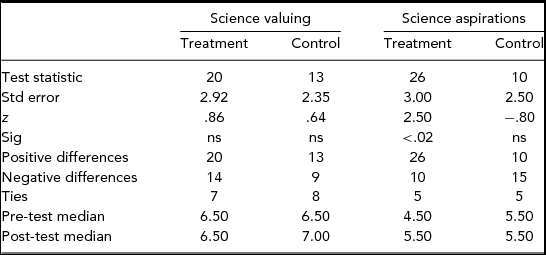
The sign test was conducted separately for treatment and control groups. Results are presented in Table 1. There was a significant treatment effect such that the PB goal-setting group demonstrated significantly greater gains in science aspirations than the no goal-setting control group between pre-test and post-test, z = 2.50, p < .05 (treatment) and z = −.80, p = .424 (control), d = .34 (i.e., small-to-medium effect size for comparative gain scores; Cohen, Reference Cohen1988). However, there were no significant changes between pre- and post-testing on science valuing for both treatment group, z = .86, p = .392 and control group, z = .64, p = .523, d = .18 (for comparative gain scores).
Paired Sign Tests: Effect of PB Goal Setting on Motivation Gains
Discussion
This study was conducted to assess the role of PB goal setting in science motivation growth. The study applied an experimental design to test whether setting a PB learning goal for a self-paced museum-based science education program would be associated with greater science valuing and aspirations by the end of the program. As hypothesised, the treatment group (PB goal setting) demonstrated greater growth in science aspirations (but not in science valuing) than the control group between pre- and post-testing. This provides support for the proposition that PB learning goals are associated with motivational growth in students’ lives.
Notable Findings and Applied Relevance
Whereas the bulk of prior PB goals research has been correlational and all the growth goal-setting experimental work has focused on achievement, the present study involved an experimental goal-setting task relevant to motivation (specifically, the valuing of and future aspirations in science). This represents an extension of previous research, and the positive finding observed for PB goal setting and gains in science aspirations provides some support for the validity of the growth concept underpinning PB goals.
These PB goal-setting findings may provide one insight into ways to promote motivation in science. There are known declines in science enrolments, participation, and performance (Office of the Chief Scientist, 2012). These declines have been linked to issues of motivation in the forms of valuing and future aspirations (Goodrum et al., Reference Goodrum, Druhan and Abbs2012; Lyons & Quinn, Reference Lyons and Quinn2010). The present findings demonstrating a positive effect of PB goal setting on motivation growth may expand our knowledge of how to confront some of these troubling trends. Indeed, following theoretical perspectives on intention (e.g., theory of planned behaviour; see Ajzen, Reference Ajzen1991) and support for the predictive validity of intention (e.g., Armitage & Conner, Reference Armitage and Conner2001), the present study of PB goal setting and future aspirations is promising.
We also note the site of the present study: a medical science museum. Museums are recognised as learning environments that can engage and motivate students (Gardner, Reference Gardner1991; Schwan et al., Reference Schwan, Grajal and Lewalter2014). They can also enhance short- and long-term learning (Falk & Dierking, Reference Falk and Dierking1997). It is relevant to note that there is ongoing debate as to the best ways to promote learning and engagement in museums, with research questioning the learning yields for some approaches to museum-based education (Cox-Petersen et al., Reference Cox-Petersen, Marsh, Kisiel and Melber2003). At the outset of the study, we thus identified the need to better understand ways of going about education programs in museums that optimise motivation, engagement, and learning. The present investigation into PB goal setting was one such effort and suggests there may be a place for goal setting in these museum programs — particularly if those programs are predominantly self-paced, informal, and unstructured (as many are; Schwan et al., Reference Schwan, Grajal and Lewalter2014).
It was interesting to find that PB goal setting did not yield significant gains in valuing of science. Instead, it appeared that both treatment and control groups improved in their valuing. It may be the case that the museum program as a whole is associated with a positive trend in valuing. Our findings thus suggest that there may be some approaches to museum-based education that more directly impact upon outcomes (e.g., PB goal setting for science aspirations) whereas other outcomes (e.g., valuing of science) are subject to the broader experience of museum education and not particular strategies operationalised within it. This is an area for further investigation.
Also for further investigation is the precise means by which PB learning goals yield effects on science aspirations. In the introduction, we identified numerous reasons why PB goals have the potential to motivate students. These include heightened enjoyment, enhanced goal-relevant attention and effort, and the energising function of self-competition that leads to richer immersion and greater engagement (see Locke & Latham, Reference Locke and Latham2002, and Martin, Reference Martin2006, Reference Martin2011, for reviews of these goal-setting mechanisms). Intervention efforts seeking to promote adaptive goal setting and its motivational outcomes would benefit from better understanding of how one or more of these mechanisms best explain the goal-setting effects derived here.
Also on the topic of intervention, Yu and Martin (Reference Yu and Martin2014) have identified practical strategies for fostering PB goals in students’ academic lives. For example, it has been suggested that educators can encourage students to consider process- and outcome-oriented PB goals. Process PB goals include spending a few extra minutes on a difficult science problem than one normally would, reading an extra draft of one's science practical report than previously, and participating more in science class activities than is usually the case. Outcome PB goals include performing better in this week's science quiz than last week's quiz, and performing better on the end-of-year science exam compared to the half-yearly exam (Martin, Reference Martin2011, Reference Martin2013; see also www.lifelongachievement.com for PB goal worksheets for students and teachers).
Beyond concrete strategies for students and teachers, PB goals may also have relevance to current debate about policy and value-added approaches to student learning and assessment. Because value-added models focus on growth in student learning and achievement (Anderman, Anderman, Yough, & Gimbert, Reference Anderman, Anderman, Yough and Gimbert2010; Anderman, Gimbert, O’Connell, & Riegel, Reference Anderman, Gimbert, O’Connell and Riegel2014), PB goals may constitute an approach well aligned with value-added assessment. There has been significant focus on fostering student-level growth, along with an emphasis on drill, skill development, teacher and school effectiveness, and related issues (Harris, Reference Harris2011; Masters, Reference Masters2013). Alongside these important factors that promote academic growth (Hattie, Reference Hattie2009), the current findings on PB goal setting also suggest this approach as a viable avenue for bringing about students’ growth.
Limitations
To contextualise the present findings there are some limitations important to consider and that hold implications for future research and practice. First, students participating in the study were self-selected and thus already interested in science to the extent that they would attend the museum. Having said this, however, many of these students were attending for the ‘zombie’ component and so were not attending for a science education course per se. Furthermore, if anything, this may have yielded a modest ceiling effect in valuing and aspirations at pre-test and thus the significant gains derived here are all the more notable. Second, a larger sample may yield normally distributed dependent measures and equivalences in group variance and thus open up the opportunity to conduct parametric analyses that can build more factors into the one analytic approach (e.g., analysis of covariance with group, gender, and school level as main and interaction effects; Winer, Brown, & Michels, Reference Winer, Brown and Michels1991). Third, it is possible that disproportionate representation of secondary school students in the treatment group may have led to the significant effect for science aspirations. We therefore tested for differences between elementary and secondary school students on pre- and post-test aspirations within each of treatment and control groups. We found no significant difference in aspirations between elementary and secondary school students in the treatment group (pre-test: Mann-Whitney U = 165, p = .265; post-test Mann-Whitney U = 202, p = .894) and the control group (pre-test: Mann-Whitney U = 60, p = .057; post-test Mann-Whitney U = 128, p = .328). It therefore seems that the aspirations effect is not due to disproportionate representation of secondary school students in the treatment group. Fourth, although this study is beneficial for museum educational programming (thus, a desirable end in itself), there is a need to test the generality of the PB goal-setting intervention in science classrooms. Fifth, the study would be enhanced by an additional treatment condition that taught students how to pursue the PB goals that they set to determine if this yielded more marked PB goal-setting effects. Finally, there is a need to also include a treatment condition that asks students to set other goals, such as performance goals (see Elliot, Reference Elliot, Elliot and Dweck2005), to determine the predictive role of PB goals relative to other forms of goal setting.
Conclusion
There has been growing concern about school students’ science participation and performance. Motivation — including valuing and aspirations — has been identified as a key to improvements in this area. Situated in a museum context, the present study showed that a PB goal-setting manipulation led to a significant increase in students’ science aspirations. On the basis of these results, we conclude that PB goal setting is associated with domain-specific growth. Findings hold implications for researchers seeking to identify factors that better foster motivation in science, and for science educators and museum practitioners who are responsible for attending to the development of each student's motivation, engagement, and learning.
Acknowledgments
Thanks are extended to Emma Burns and Marianne Mansour for data collection and the Australian Research Council for funding.