

In his academic autobiography written late in his career, “founder and patron saint of the modern Area Studies movement” (Honey Reference Honey2001, 269) John K. Fairbank commented rather acerbically on the expectations for new China scholars at the beginning of his career:
If I had been properly trained, I could never have put together the combination of approaches I made to China. Language training would have taken all my time. So would thesis research in a well-developed field. I would never have had time for first-hand “area” experience through casual travel. My combination of approaches was possible only because I was entirely on my own, not under anyone's direction. (quoted in Honey Reference Honey2001, 270)
Such a heroic, pioneering stance is much less of an option in today's more highly professionalized academic scene than it was in the 1930s when Fairbank was starting out. But the pull between “proper training” and “area experience” continues to be a difficult one to negotiate for Asian studies scholars—not to mention the related tensions between linguistic facility and disciplinary groundedness and between research focus and institutional setting.
One of the problems is that such divisions, as well as stemming from indispensable but contradictory requirements of the academic process itself, always have histories, histories in which later reforms tend to overlay rather than replace earlier paradigms. In the China field in which Fairbank worked, I would posit at least three overlapping divisions that are still current: between the “old-fashioned” sinology and the area studies that “replaced” it (and that is now becoming “old-fashioned” in its turn); between the philological, text-based approach characteristic of sinology and the social science methodologies that “superseded” it (with a like disclaimer); and between what could be broadly characterized as a “humanistic” approach to the Chinese language and the “scientific” linguistic methodologies that exist in uneasy cohabitation with it.
In all three cases, it is the attitude toward the Chinese language, particularly in its canonical “classical” written form, that serves as the touchstone for self-identification and the drawing of academic boundary lines. So how does the classical Chinese written language work? Is it, as claimed, for example, by a well-known and influential pair of philosophers (Ames and Rosemont Reference Ames and Rosemont1999, 289–90), “unique … being sharply distinct not only from all other non-Sinitic languages but from spoken Chinese as well (ancient and modern)”? Or does it, as asserted in the most closely argued treatment of the origins of Chinese writing in recent years (Boltz Reference Boltz1994), operate in exactly the same way as all other historically attested writing systems, such as Sumerian cuneiform, Egyptian hieroglyphs, or the recently deciphered Mayan writing system?
Such arguments tend to center around the notion of “ideograph” (also called “ideogram”)—that is, a written symbol that represents an idea—and whether or not that term may legitimately be applied to Chinese characters. Debates on the “ideograph” have a long history, going back in the United States at least to Peter S. du Ponceau (Reference Du Ponceau1838), who was reacting to notions widely held in seventeenth- and eighteenth-century European scholarship by minds of the stature of Francis Bacon and Gottfried Leibniz. The notion of ideograph has proved of limited use in understanding how Sumerian cuneiform worked, even less so for Egyptian hieroglyphs, and has been actively misleading in delaying for some decades the successful decipherment of Mayan writing (see Coe Reference Coe1992). However, in Chinese studies and related fields, this term and the conceptions of Chinese writing lying behind it still have many adherents.
The most recent extended treatment of the case for the ideograph is an article by philosopher Chad Hansen that appeared in the Journal of Asian Studies (JAS) entitled “Chinese Ideographs and Western Ideas” (1993a). Hansen had previously argued that the disagreement over whether the correct term for characterizing Chinese characters should be “ideograph” or the linguists' suggested alternative “logograph”—the latter term first put forward by Du Ponceau in his 1838 monograph—was a distinction without a difference, commenting that he found it “hard to understand the passion and intensity of their [i.e., the linguists'] arguments on the choice of a word to denote a range of languages that includes exactly one!” (1983, 179). The main thrust of Hansen's arguments and comparable claims by other scholars will be dealt with in the body of this paper. But what is intriguing, and somewhat disturbing as far as the field of Chinese studies is concerned, is the highly negative reaction that Hansen's article provoked.
In the correspondence column of the following issue of the journal, linguist J. Marshall Unger expressed surprise that JAS had seen fit to publish Hansen's article, classing its “central claim”—that “Chinese characters are ideograms”—as on a par with “scientific creationism” as a serious explanation (Reference Unger J. Marshall1993, 949). In reply, Hansen recommended Unger's earlier article on the “notion of ideogram” (Unger Reference Unger J. Marshall1990) to readers interested in pursuing the case of those he dubbed the “prohibitionists,” defined as those who “urge us to avoid the word ‘ideograph’ entirely—either as an oxymoron or as a scientifically falsified theory” (Hansen Reference Hansen1993a, 375). Hansen went on to reflect that Unger's article and his reply to Hansen “vividly illustrate how different the perspectives, assumptions and methods of our respective disciplines are.” Quoting Zhuangzi to identify the paradox of the whole debate as “[i]f someone of your persuasion decides, being already of your persuasion, how can he decide?” (Hansen Reference Hansen1993b, 954), he applauded JAS for its role in helping the “mixed scholarly community” of an interdisciplinary field such as Asian studies to face what he termed this kind of “Zhuangzi situation” (955).
To those familiar with the long roll call of sinological literature on this topic, the arguments and the rhetoric on both sides carried a depressing air of déjà vu. Almost sixty years before, mostly in the pages of the journal T'oung Pao, a debate between historian Herrlee Glessner Creel and linguist Peter A. Boodberg had rehearsed very similar opposing views. Boodberg, in responding to Creel's opening article “On the Nature of Chinese Ideography” (Reference Creel1936), drew the battle lines very clearly, in a footnote used as one of the epigraphs to Hansen's 1993 article:
Apart from the author's impossible thesis, one must deplore the general tendency manifest throughout his article (and, alas, too prominently figuring in Sinological research on this continent) of insisting that the Chinese in the development of their writing, as in the evolution of many other of their cultural complexes, followed some mysterious esoteric principles that set them apart from the rest of the human race. (1937, 330–31 n. 2)
In response, Creel expressed puzzlement that there should, in fact, be any disagreement between them, calling on Boodberg's article, as well as earlier work by Bernhard Karlgren, in support of his claim that “anciently as now” the symbols of the Chinese writing system “corresponded to sounds having so little variety that the meaning could be made clear only with the help of ideographs” (Reference Creel1938, 267). Creel nevertheless acknowledged his “surprise” that Boodberg saw his own work as “opposing rather than confirming” this ideographic hypothesis (1938, 271–72), remarking with a dry wit,
Yet from repeated mention of my name in his paper in connection with adverse criticism, and his reference to my works as “most ineffectual,” “impossible thesis,” and “utterly phantastic theory,” it is difficult to avoid the conclusion that he conceives himself as disagreeing with me. (1938, 272; footnotes omitted)
A reader coming to these debates for the first time may justly wonder why differences of opinion on the substantive issues involved have been rehearsed again and again without seeming to reach resolution. Why is it that the “ideographers” and the “prohibitionists,” to use the terms of the Hansen-Unger debate, or the “epigraphists” and the “phoneticians,” in those of the Creel-Boodberg debate, seem unable to reach agreement? What is it about the term “ideograph” that arouses such passions? Why are there always so clearly two sides with such deep-rooted differences? And what does this say about the makeup of Chinese studies, or, as Hansen implies, about the interdisciplinary field of Asian studies more generally? And what indeed might possibly be the use of reopening this whole can of worms once again?
A recent paper by David Lurie examines what he dubs the “Critique of the Ideographic Myth,” “an intervention by linguists into the broader discourses of Asian Studies” (Reference Lurie2006, 265). In his view, the crux of the debate lies in a disciplinary turf war whereby “[l]inguistics lays claim to special scientific forms of knowledge … but … struggles with both humanistic and social scientific disciplines for authority over language” (265–66). An attempt to dissolve this cross-disciplinary impasse is made in Bob Hodge and Kam Louie's application of the insights of cultural studies to Chinese studies, The Politics of Chinese Language and Culture (1998), a book written in large part in order to take on the deep-seated ideologies relating to the study of China such as those involved in the ideograph debate.
Hodge and Louie set out from a useful distinction between Sinology and what they call Sinologism. “Sinology,” as they point out, is now more commonly known in English-speaking circles as “Chinese studies”—although, like the broader “Asian studies,” it is normally considered to be an interdisciplinary field rather than the “discipline” they characterize it as being. “Sinologism,” in contrast, they define as a “branch of ‘orientalism’” (cf. Said Reference Said1978), “a set of knowledges and assumptions about the study of China” (1998, 13). Their definition of this “ism” is worth quoting, as it identifies many of the tendencies that have vitiated the long-running debates about the nature of the Chinese language:
[T]he China constructed by Sinologism is not simply a Western invention. The key assumptions of Sinologism are partial truths, which makes it especially important to address them and disentangle them from the forms in which they are packaged in classic Sinology. Sinologism takes major tendencies within Chinese culture and turns them into absolute values, essential truths about Chineseness or ‘sinicity’: an ideology above dispute, not a set of provisional, contested hypotheses and generalisations in need themselves of further examination and enquiry. (13)
Hodge and Louie go on to critique the complex of values commonly associated with the Chinese language in popular discourse, identifying an “ideology of language” whose “most important assumption is that there is only one form of the Chinese language, with different methods of encoding it” (75). They suggest a classification that would replace the notion of a “single Chinese language” by an “ordered set” of different forms of “Chinese,” whereby the upper term of each division is taken to possess more “social value” than its lower counterpart, and likewise more leftward sets take precedence over those to the right (76):
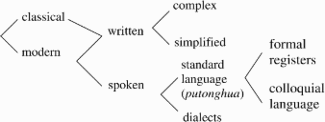
This is not to be regarded as an objective descriptive typology, but rather as a classification “laden with ideological values” (Hodge and Louie Reference Hodge and Louie1998, 76). Such a schema provides a useful way of thinking through the ideologies attached to the Chinese writing system, one that could easily be extended into looking at other languages that have traditionally used or still use Chinese characters in their writing systems. All such ideological schemas grow out of actual usage at particular historical periods: in other words, they are based on historically and applicationally contingent understandings of the nature of Chinese characters as a writing system, understandings that cannot merely be dismissed as “mistaken.” The intellectual justification of such classifications, one not clearly articulated even by Hodge and Louie, is the same as that at issue in the debates cited earlier: whether Chinese characters exist as a meaningful system separately from their relationship to any particular form of a language. This is not just an intellectual claim about the nature of Chinese characters and, by implication, writing systems in general, but an ideological stance that conforms to Hodge and Louie's definition of Sinologism.
The positive answer to this claim, I would suggest, ascribes a false independence to Chinese characters as, in effect, a language in themselves, a claim based on arguments about the nature of their construction as written forms. In this paper, I will put forward the opposing claim that, in actual usage, Chinese characters are and always have been interpreted in relation to a particular language, and in this function, the principles of a character's composition are irrelevant to its interpretation. In other words, once Chinese characters become used as elements of a script in order to represent a particular language, their interpretation is determined by their connection to specific units of that language, not by any “inherent” meaning they may seem to possess in themselves.
The issues here are not simply complex in themselves, but highly ideologically loaded within Chinese studies and Asian studies more broadly, as the exchanges cited earlier show very clearly. What I will attempt in this article is an examination of various discourses within Chinese studies exhibiting the particular form of Sinologism that I have dubbed character fetishization (漢字崇拜主義 hànzì chōngbàizhǔyì)—that is, an exaggerated status given to Chinese characters in the interpretation of Chinese language, thought, and culture. This status is used to buttress ideological claims about the Chinese language that basically come down to positing the uniqueness of the Chinese worldview and its incommensurable differences from a supposed Western worldview. Such claims have deep historical roots, and are inseparable not only from the kinds of cross-cultural ideological constructs identified by Edward Said in the misrepresentation of the “East” by the “West” as “Orientalism,” but also from the reverse process, more recently dubbed “Occidentalism” (Buruma and Margalit Reference Buruma and Margalit2004).
The notion of character fetishization is not intended for use as an identity label—I see no point in branding some scholars as “fetishists” and others as “anti-fetishists”—but rather aims to characterize a discursive process, the creation of a kind of “uniqueness” for the Chinese situation that both operates through and reinforces a series of half truths. Both sides of the debates cited earlier, it seems to me, have at times become trapped in discourses of character fetishization, whether they are defending or attacking its main positions, to the detriment of our understanding of the substantive issues involved, as well as to the harmony of the field.
Discourses of character fetishization will be explored in this paper in relation to two of the three broad fields of humanistic studies in China that many sinologists have traditionally moved across—literature (文 wén), history (史 shĭ), and philosophy (哲 zhé)—using two main examples: the literary theorizing of James Liu, and the linguistic philosophizing of Chad Hansen. My characterization of the work of these scholars in such “-izing” terms is not intended to sound pejorative, but rather to stress the discursive, process-like nature of their separate theoretical and descriptive enterprises. In seeking to untangle the complex issues involved, I will call on foundational work by Ferdinand de Saussure and C. S. Peirce in relation to the nature of language and sign systems, as well insights of scholars coming from within Chinese studies such as George A. Kennedy, A. C. Graham, and William G. Boltz, all of whom provide ways of thinking through the relevant descriptive and theoretical challenges.
An additional exploration of these discourses, which would seem to have congealed into rigid positions on both sides of the “ideograph” debates, will be given by one further example: the work of Roger T. Ames and Henry Rosemont, Jr., in a recent translation of that seminal philosophical, historical, and literary text, the Analects of Confucius (Ames and Rosemont Reference Ames and Rosemont1999). I will concentrate particularly on how Ames and Rosemont define key philosophical terms through the structure of the characters that represent them, and will show how this kind of “argument from characters” is in fact unnecessary, and that the genuine insights they show into the nature of these terms are by their own arguments actually based on the evidence of the text rather than on the writing system as such.
The current study shares similar aims with Haun Saussy's monograph Great Walls of Discourse and Other Adventures in Cultural China (which the title of this paper glances at)—a fascinating exploration of the “career of China as an object of knowledge” (Reference Saussy2001, 1) that traces ideas about the Chinese language in the West from the pioneering reports of the Jesuits in the late sixteenth century up to contemporary postmodernism—as well as nicely complementing Lurie's examination of the “Critique of the Ideographic Myth” referred to earlier. Here I take a more focused linguistic point of view than either of these scholars, trying to bring together insights from various sources within and beyond Chinese studies in order to provide a more rounded picture of the puzzle of the “ideograph,” various aspects of which, it seems to me, have been neglected by both sides in the debates. Although it should be obvious that I do believe many of the current understandings about Chinese characters to be mistaken, my overall intention is not to reinforce hostility between two “camps,” but rather to suggest ways in which the passions of the debate can be defused, and the relevant issues understood from a more comprehensive point of view.
A dispassionate examination of this debate, which to outsiders may seem like just so much hot air and spilled ink, is valuable for both Chinese studies and the broader field of Asian studies for at least two reasons. First, it suggests that such issues can become so divisive within a field partly because scholars on both sides are—often without realizing it—arguing about different things, caught up in misunderstandings that have deep historical roots and that can persist through successive scholarly generations. Second, it shows how such debates can become a site for disciplinary anxieties over what is or should be the purpose of a whole scholarly enterprise, and since language is one of the key determiners separating area studies from the more “mainstream” disciplines, this is an issue with broad resonances for the field of Asian studies as a whole.
The Foundation Stone of the Debate: “Characters Real”
[I]t is the use of China, and the kingdoms of the High Levant, to write in characters real, which express neither letters nor words in gross, but things or notions; insomuch as countries and provinces, which understand not one another's language, can nevertheless read one another's writings, because the characters are accepted more generally than the languages do extend; and therefore they have a vast multitude of characters, as many, I suppose, as radical words.
—Francis Bacon (Reference Bacon1605, 82–83)One of the loci classici of myths about the Chinese written language can be found in the works of English philosopher Francis Bacon. This foundational myth of Sinologism is the idea that so appealed to seventeenth- and eighteenth-century scholars such as Bacon and Leibniz, watching with alarm the decline of Latin as the common language of scholarship in Europe, that Chinese represented a sort of universal language. This claim contains at least two half truths, each of which is taken up in different ways by two recent scholars. Philosopher Chad Hansen characterizes the written language as follows:
Written Chinese has no alphabet. Each character has a one-syllable pronunciation. The character was viewed as the basic unit of language and was the natural focus of interest for anyone who was literate in ancient China. The characters provided a shared mode of communication among the different Chinese languages since it did not represent any particular pronunciation. Thus, as in China today, people speak different languages but write and read “the same.”
[Hansen's endnote:] Chinese language in archaic times, as at present, differed not only in pronunciation but in grammar and idiom. These differences tended to show up as discernible differences in written style. (1983, 47, 179)
The first half-truth, as expressed by Hansen, is that in traditional China, “as in China today, people speak different languages but write and read ‘the same.’” Even Hansen's scare quotes around “the same,” referring us to an endnote, do not really soften his claim in any significant way, recognizing merely “discernible differences in written style.” This seeming concession disguises the raw fact that in modern Chinese, the written language is a register of one particular “Chinese language,” that is, Mandarin. A Cantonese speaker, for example, when learning the standard written form, is obliged to learn a new language, admittedly one related to his or her own (see Bauer Reference Bauer1988), but with significant differences in vocabulary and grammar, alongside the perhaps more obvious differences in pronunciation concealed by the non-phonemic writing system. The situation in imperial China was, if anything, more stark, where the written standard, now known as wenyanwen, or “written language,” was based on none of the contemporary spoken languages, but rather was what Karlgren characterizes as a “syncretic dialect” (Reference Karlgren1926, 31) based on a group of written texts of the period around 300 bce, whose mastery required a long period of education for the elite class who could afford it. The modern written standard, baihuawen, or “vernacular language,” has also been heavily influenced by this earlier standard in phraseology and, to a certain extent, in grammar. Thus the advantages of this supposed “universal language,” even if its range has shrunk from Bacon's “countries and provinces” to Hansen's “China today,” would appear to be severely circumscribed ones.
The second half truth persists in a form perhaps even closer to Bacon's original formulation of Chinese written symbols as “characters real, which express neither letters nor words in gross, but Things or Notions,” as shown in the following statement by literary theorist James Liu:
[A]lthough traditional Chinese etymology postulates “six scripts” (liushu) … two of these concern variant forms and phonetic loans, so that actually there are only four kinds of characters: simple pictograms, simple ideograms, composite ideograms, and composite phonograms. These characters are not arbitrary signs representing what Saussure calls the “sound-images of words,” as are the letters of a phonetic script. In the terminology of C. S. Peirce, the simple pictograms are icons, because they resemble their referents. For example, the simple pictogram 日 (ancient form  ) is an icon for the sun; it is not a sign representing the sound of the word ri … whose archaic pronunciation has been reconstructed as niet.
Liu's claim that “the simple pictograms are icons, because they resemble their referents” is, after all, surely much the same as Bacon's notion of “characters real,” that is, symbols or descriptions of reality, a description that Liu simply dresses up in modern semiotic terminology. This, together with Liu's related claim that “characters are not arbitrary signs … as are the letters of a phonetic script,” takes some disentangling, and shows how complex the issues involved are, as well as how careful we need to be in our formulations.
The notion of a sign, in the terminology of Peirce most commonly in use, divides into three main types: icons, which resemble their referents; indexes or indices, which are spatially or causally contiguous to their referents; and symbols, which are related only by convention to their referents (Peirce Reference Peirce, Harthorne, Weiss and Burks1931–58, 2.275). Saussure, although using slightly different terminology (Reference Saussure and Wade1916, 68)—for Saussure, “symbol” was roughly equivalent to Peirce's “index,” while Peirce's “symbol” corresponds to Saussure's “sign”—claimed that linguistic signs were mainly of the third type: symbols. However, in order to characterize their essential nature, he chose the term arbitraire, a “false friend” that is commonly and misleadingly translated as “arbitrary.” In fact, as with many concepts in the new intellectual territory being mapped out by Saussure, this term collapses two distinctions into one: his arbitraire does not equate to English “arbitrary,” with its connotations of meaningless or reasonless, but rather to “conventional” on the one hand, and “unmotivated” on the other.
All three types of sign are conventional: that is, they are established within and only interpretable by a particular community of sign users. However, among these three types, icons and indices are motivated because they have an independent connection to their referents, while symbols are unmotivated because their only connection to their referents is the social convention that links them. If we are talking about ordinary signs such as road signs or warning signs, we can easily find examples of all three kinds: the icon of a car on a high-angled line that denotes a steep ascent or descent; the index of a jagged lightning bolt that refers to electricity; or the symbol of a circle with a line across it (often superimposed on an icon or index) that means “no . …” The relationship here is between the sign and its referent, a feature of the experiential world that is not necessarily mediated through language, although of course it may be. Such signs may thus be used across different language communities, but precisely because they are not linked to a particular language, they are limited to easily recognizable features of the experiential world or those that have a close link to material action.
However, as soon as language becomes involved in sign interpretation, something that allows a much wider range of meanings to be expressed, the relationship between sign and referent becomes transformed into a relationship between the sign and a unit of the language. To take one of Liu's examples, the circle with a dot, which he says is “an icon for the sun”: it is doubtless true that those who initially devised this character did so on the basis of the iconic relationship between its shape and that of the sun. But as soon as this picture came to be used as a graph—that is, a visual form that is part of a writing system—in order to function as part of that writing system, it must represent some unit of a language. In other words, it must refer in the first instance not to the outside world, but rather to a particular sound-shape and/or word-shape.
This is a complex point that requires further probing. First of all, how do we know that this character means “the sun”? Precisely because in modern Mandarin, it “has the reading,” as the traditional phraseology would have it, rì, one of whose meanings is “sun.” This is not the secondary fact that Liu implies it to be, but rather is crucial to the sign's interpretation. If for the moment we accept Liu's logic, we would have the following equivalence between sign and referent:
日 is in an iconic relationship with that bright circular object in the daylight sky.
Alongside this, there is in fact another meaning that attaches to the graph 日, a meaning that appears in the earliest texts, that of “day.” This would give us the further equivalence between sign and referent:
日 is in an indexical relationship with the period of time it takes for that bright circular object to cross the daylight sky.
You will note that in each case, the referent has deliberately been expressed using a clumsy paraphrase in order to bring out the paradox of Liu's argument: that in providing the interpretation of this sign, he unhesitatingly uses an actual word of a language. In this case, of course, because he is writing for an English-speaking readership, he does not use any form of Chinese or other languages that have traditionally used Chinese characters, but rather the linguistically and culturally very distant English, a language for which the iconic referent “sun” is appropriate, but in which the indexical referent “day” corresponds to an entirely different word. So where does this leave Liu's argument?
We can avoid such apparent paradoxes by recognizing that 日, unlike our road sign examples, was from its earliest uses linked to an actual word of a language, the “archaic Chinese” word that Liu gives as niet, borrowed into Japanese as nichi (its on or “sound” reading), with the graph also linked to the native Japanese word hi (its kun or “interpretation” reading), and so on with its Korean and Vietnamese analogues. Such an argument was also put forward by Boodberg in his critique of Creel's ideographic interpretation of Chinese characters:
Signs used in writing, however ambiguous, stylized, or symbolic, represent words. If we associate with a graph several related words, unable to determine which of them it is supposed to represent exactly, this does not mean that the graph represents the “idea” or “concept” behind those words. … Linguistic science deals first and last with the word, its only reality. The “disembodied word” which is generally what is meant by “idea” or “concept” does not exist for the linguist. (1937, 332 n. 5)
This may seem to be, on the one hand, an instance of a linguist unilaterally drawing his own academic boundary lines, and on the other, simply pushing the problem further on into the realms of philosophy—if a word does not represent an “idea,” then how can it possibly have any meaning?—and indeed, Creel criticizes it on both these grounds.
There are two trajectories along which we need to resolve this impasse: the nature of the reading process, and the nature of linguistic meaning. First, giving a “reading” to a Chinese character, using the traditional phraseology of sinology, simultaneously does two things: it identifies how that graph is to be read out in connected text, and it identifies the word or word element to which that graph corresponds. In technical linguistic terminology, Chinese characters as graphs correspond both to the smallest unit of sound that can be comfortably pronounced in isolation, the syllable, and also in most cases to the smallest meaningful combination of speech sounds, the morpheme. In Old Chinese (also called “Archaic Chinese,” as in Liu's usage), the stage of the language when the writing system was devised, the majority of morphemes corresponded to single syllables and, at the same time, to independently functioning words—thus the “monosyllabic” tag often applied to Chinese. It was this double characteristic that allowed the system to work as well as it did, because each written character could be interpreted as both a spoken syllable and a grammatical word. There were also at this stage of the language some instances in which a morpheme corresponded to more than one syllable, something far more common in modern Chinese, but the way the writing system dealt with this situation, as we will see, in fact provides further confirmation for this claim.
However, when this system was borrowed for other languages, it could not work, except with major modifications, for languages such as Korean and Japanese that did not share this syllable = morpheme = word feature, and even for languages such as Vietnamese that did. The speakers of these languages, as we have seen, adopted two basic strategies in order to adapt Chinese characters to their own use: they borrowed the word along with its graph, modifying its pronunciation to the phonology of the borrowing language, as in the niet > nichi example earlier; alternatively, they used the graph to represent a native word, a word either of similar meaning to the Chinese original (as in the Japanese example of the “kun” reading of 日 as hi), or of similar sound (as in the example of the characters whose simplified forms eventually gave rise to the Japanese syllabary, the kana: e.g., 世 Ch. shì, せ Jp. se). In either case, the transfer was made from a word or word element in one language to a word or word element in the other: at no stage did the process take place directly through ideas.
This is a claim that may seem absurd to those non-linguists—and a fair number of linguists as well!—for whom “meaning” and “idea” are synonyms. In order to justify it, we must to move on to our second trajectory of explanation—the nature of linguistic meaning. The traditional view in the European tradition stemming from Aristotle is that the elements of a language are only meaningful insofar as they are symbols for ideas, and that while these symbols may differ from language to language, the underlying ideas are the same for all humankind (Cook Reference Cook1938, 115). Saussure's radical move was to replace this absolute notion of idea with the relative notion of meaning or “signification” as a relationship between concept and sound (Reference Saussure and Wade1916, 104), and to argue that each language defines its own “ideas” through a mutual delimitation of concept and sound. The implication of Saussure's position is that there are in fact no preexisting ideas to which words, or graphs, may attach themselves—there are only sounds and concepts mutually delimited into meanings. Thus the concepts that any language expresses are precisely those for which it possesses delimited phonic expressions.
To come back to the example of 日, “sun,” the most economical explanation is not, pace Liu, that it is an icon, nor in the meaning “day” an index, but rather that it is a graph for the word whose reading in modern Chinese is rì, whose Old Chinese form had those two meanings (and likewise for its Korean, Japanese, and Vietnamese analogues). If we look at how it is actually used in connected discourse, this is perfectly clear. It appears in such combinations as rìluò, “sun fall—sunset,” rìshí, “sun eat—solar eclipse,” dì sān rì, “number three day—the third day,” is reduplicated to give rìrì, “every day—daily,” and so on. All of these functions are features not of the character but of the morpheme rì,—in Boodberg's terms, of the word functioning in a particular language. Trying to argue from the nature of the character to the meaning of the word is thus putting the cart before the horse: despite recent Western theoretical arguments about the priority of writing over speech that have been eagerly seized upon by certain sinologists (see the discussion of Derrida later), the Chinese writing system, like all writing systems, is a representation of the spoken language, not vice versa.
The linguist George A. Kennedy, in his introduction to working with classical Chinese texts, describes these complex relationships with characteristic care and precision:
The units of Chinese writing are called graphs. The sounds attached to a graph are called its readings. The reading or readings may vary greatly with the dialect of the reader, and the phonetic representation of that reading will vary greatly again according to the system of romanization used. In this Guide each graph introduced is provided with the conventional reading given in the work itself, spelled in capital letters. This gives a maximum of general information about the sound for that graph. In the space following, the student will insert the proper reading in the dialect of his choice, and in the system of romanization preferred by him. Graphs through their readings represent syllables of speech that are words or parts of words. These should be written with lower-case letters. When the student has filled in a reading for his dialect, he has represented a morpheme in his dialect. This morpheme can then be defined by one or more English equivalents enclosed in single quotation marks. … The morphemes in the Chinese name of the work, in accordance with the above, are entered as
1 辭 ZI [cí] N ‘a phrase, a word’
2 海 HOJ [hăi] N ‘sea’
(Kennedy Reference Kennedy1953, 1–2)Note that Kennedy does not once refer to the graphic shape of the characters, though he is careful to stress the range of pronunciations that can be attached to them. Kennedy thus emphasizes the sound connections of the characters while in effect dismissing as irrelevant the graphic features that have caused the most excitement among Chinese and Western scholars.
Challenging Orientalism: Critiquing the Logocentric Occidental
Western philosophers, with their logocentric bias, have usually regarded Chinese written characters as arbitrary signs. Even Saussure, who recognized that the Chinese written system is not phonetic, still thought that each written character was a sign that represented a spoken word. This opinion is demonstrably incorrect and also contradicts traditional Chinese views ….In general, whereas Western thinkers concerned with the nature of language conceived of writing as a representation of spoken language, which was in turn conceived of as an intermediary between the world and human beings, the Chinese saw a direct relationship between writing and the world, without the necessary intermediacy of spoken language. It is therefore misleading to call Chinese characters logograms or logographs, as some scholars do, apart from the fact that it sometimes requires two characters to write one word.
—James Liu (Reference Liu1988, 17–18)Both Liu and Hansen broaden their critique of Western “misconceptions” of the nature of Chinese characters into an attack on the Western conceptions of language that lie behind them. Liu bolsters his attack on Saussure by using Jacques Derrida's (Reference Derrida and Spivak1974) critique of the whole tradition of Western philosophy as “logocentric.” If we read Saussure with an understanding of the context in which he was writing (see useful commentaries by Harris Reference Harris1987; Thibault Reference Thibault1997), it becomes clear that Derrida's attack on Saussure for the sin of “logocentrism,” the fetishization of language, in the particular form of “phonocentrism,” the fetishization of speech over writing, is a strategic and out-of-context distortion of Saussure's views. Certainly it is possible to argue that Saussure had not completely thought through his views on the relationship between the spoken and written forms of language, but to replace a supposed priority of speech with a priority of writing does not look like progress; in the Chinese context, it plays right into the existing misconceptions about the nature of Chinese characters already identified earlier.
We need to be careful here to draw a distinction between what is shown by a careful linguistic analysis of the Chinese language and its writing system—most of which analyses, of course, ultimately derive from traditional Chinese scholarship—and more fanciful ideas about the language also current in the Chinese tradition. It is no real contradiction, nor, in such a culturally loaded area as language should it seem surprising, to note that from the earliest major work on the Chinese writing system, Xu Shen's Shuōwén Jiězì (100 ce), hardnosed analyses and fanciful mythmaking have existed side by side. In the Shuōwén, as it is usually abbreviated, Xu Shen put forward a classification of six principles of character formation, the so-called liùshū, of which various versions had been in existence since at least a century before Xu Shen's time. In his study of the origins and development of the Chinese writing system, Boltz points out that Xu's liùshū should be regarded not as an explanation of how the characters were originally derived, but rather of how they were to be understood in terms of current (Han dynasty) use—or even, more speculatively, as a set of instructions for how new characters should be derived (Boltz Reference Boltz1994, 143, 147).
In fact, Xu's listing of then-current characters shows clearly that it was only a minority of characters that fell into the categories that have so excited the imaginations of latter-day sinologists. These character types, translated by Liu as “simple pictograms, and simple and composite ideograms” (in Xu's terms, xiàngxíng, “imitate shape”; zhĭshì, “indicate thing”; and huìyì, “combine meanings”), have from the Shuōwén onward occupied the least space in the character dictionaries, the majority falling into the category that Liu translates as “composite phonograms” (xíngshēng, “form [and] sound”), where one part of the character is another character used exclusively for its sound value.
It is worthwhile briefly exploring the principles on which the “composite phonograms” were formed, a principle that finds almost exact equivalents in historically comparable writing forms such as Egyptian hieroglyphs and Sumerian cuneiform (Boltz Reference Boltz1994, chap. 3). The key here is one of the categories of characters that Liu, very significantly, dismisses as irrelevant: the “phonetic loan,” or jiǎjiè (“borrowing”). The principle of use of this category is a simple one, and again is closely related to one of the characteristics of Old Chinese. Although, as Karlgren points out, Chinese “already at a very early stage lost its faculty of forming new words by means of derivative affixes” (Reference Karlgren1926, 31), it still showed remnants of this morphological process in the form of alternations, as a result of some earlier process of affixing, in doublets such as chuán, “to pass on,” and zhuàn, “that which is passed on—commentary, biography,” and cháng, “long,” and zhǎng, “to become long—to grow.” Because in most cases the context would make clear which word was intended, the most economical principle was to write both with the same character, a strategy that continues to this day with the chuán/zhuàn 傳 and cháng/zhǎng 長 doublets.
This doublet principle also extended to words that were morphologically unrelated but had similar pronunciations. Many of the more abstract or grammatical words in Old Chinese were represented by these sorts of phonetic loans: the character for jī, “basket,” 其, was borrowed for the pronoun qí, “his/her/its/their”; zhī, “go,” 之, for the subordinative particle zhī “… 's, of. …”; lái, “wheat,” 來, for lái, “come,” and so on. Numbers of such characters were later confirmed in their borrowed senses, with the original words represented by a variant of the original character “expanded” by the addition of a semantic “determinative”: thus 箕 jī, “basket,” with the “bamboo” determinative 竹, and 萊 lái, “wheat” with the “grass” determinative 艹.
What is significant here is the extent to which the phonological characteristics of the language were utilized from the very beginning in devising written forms. The use of sound in devising characters goes beyond even such well-known cases, affecting even the huìyì type of character (Liu's “compound ideograms”), whose construction is traditionally thought to have no direct relationship to their pronunciation at all (Boltz Reference Boltz1994, chap. 2–3; Boodberg Reference Boodberg1937). Boltz states his own position very strongly: “at no time did any of the graphs that were invented stand for ideas directly; they always primarily represented the sounds of a language, and meaning only as it was associated with those sounds” (1994, 59)—a nice reversal of Liu's priorities! The key to Boltz's argument is the existence of two types of character variation in the early script. The first is the familiar jiǎjiè or “borrowing” discussed earlier, characterized by Boltz as a paronomastic method, that is, using an “established graph” to stand for a “semantically unrelated but phonetically similar or identical word” (Boltz Reference Boltz1994, 61). Alongside this type of variation, where the sound was similar or constant but the meaning changed, was another kind—not recognized as one of the liùshū and largely disguised by subsequent developments in the writing system—that Boltz dubs parasemantic, where a particular graph “may be used to write a second word the meaning of which is readily suggested by the depictive quality of the graph itself” (62).
Take the character 口: according to Boltz, this was originally used paronomastically not only to represent the word kŏu, “mouth,” but also the semantically related word míng, “to call, to name.” In the first case, the process of jiǎjiè “borrowing” is still clearly recognizable in the contemporary script, with 口 kŏu, “mouth,” used as a phonetic in characters such as 扣 kòu, “button up, buckle,” with the semantic determinative 手/扌 shŏu, “hand,” and 叩 kou, “to knock,” with the semantic determinative, now obsolete as an independent character, of a kneeling man. In the second case, the original character 口 has itself been supplemented with the phonetic determinative 夕 to give 名 míng, “call, name,” where the phonetic is an abbreviated form of 明 míng, “bright,” the original character also used parasemantically to represent related words such as 鳴 míng, “bird call,” with 鳥 niǎo, “bird,” as the semantic determinative, and 命 mìng, “order” with the semantic determinative 令 lìng, “order.”
The significance of this for the ideograph debate is that such analyses largely dispose of the huìyì “composite ideogram” category as an independent type—although I remain less convinced than Boltz that all cases can be explained this way. Such a reinterpretation would grievously undercut many discourses of character fetishization, since this is the very category on which the creators of such accounts are most wont to spread themselves, even willy-nilly dragging many xíngshēng “composite phonograms” into that class. Boltz again puts the matter quite bluntly:
There is no way a character can be “invented” by putting together constituent elements none of which is intended to have any phonetic function. … When characters occur with two or more constituent parts, and none appears to be phonophoric [i.e., “sound-bearing,” “phonetic”], we must assume that there is a phonetic element in the character somewhere that we have not yet uncovered. … As a rule, we cannot but insist that “phonetic-less” characters simply do not exist. (1994: 72)
[Boltz's footnote:] Many of the “classic” cases of this kind of thing—characters constituted of two or more elements allegedly based only on the meaning of the elements, not the sound—are, after careful analysis, explicable as phonetic compounds.
If Boltz's argument is accepted, it has the effect of demonstrating that Chinese characters do not, after all, constitute a special case, because they clearly followed the same principles as all the other writing systems in the world.
The Two Heavyweight Contenders: “Ideograph” versus “Logograph”
The characterisation of Chinese as pictographic or ideographic is under nearly constant attack from Chinese linguists who seem to prefer the term logographic. It is hard to understand the passion and intensity of their arguments on the choice of a word to denote a range of languages that includes exactly one! In any case, we need not find any way to resolve the issue. What is important for the present argument is that Chinese themselves view their own written language as conventional representations of the semantic content, that is, pictures or diagrams.
—Chad Hansen (Reference Hansen1983, 179 n. 25)In the quotation given at the beginning of the previous section, Liu claims that it is “misleading to call Chinese characters logograms or logographs” since they do not in fact represent words; while in the foregoing quotation, Hansen seems irritated by the insistence of “Chinese linguists” on preferring the word “logographic” over “pictographic” or “ideographic,” though it is unclear whether he is referring to the language or its script. Presumably unaware of the clear historical parallels of the Chinese writing system with those of Egypt and Sumer, he remarks dismissively, “It is hard to understand the passion and intensity of their arguments on the choice of a word to denote a range of languages that includes exactly one!” He then states sweepingly, “What is important for the present argument is that the Chinese themselves view their own written language as conventional representations of the semantic content, that is, pictures or diagrams.” These “Chinese themselves” apparently do not include Xu Shen, whose liùshū, “six character types,” would thus effectively be reduced to sānshū, “three character types”—that is, in Liu's renderings, only pictograms, simple ideograms, and composite ideograms. This seems to be replacing the supposed phonocentrism of Western linguists with a serious case of phonophobia, by refusing to acknowledge that sound plays any part in the formation of Chinese characters at all.
Further evidence that sound has always played a crucial role in the interpretation of Chinese characters comes in two essays by Kennedy: “The Monosyllabic Myth” (1951) and “The Butterfly Case” (Reference Kennedy and Li1955). Kennedy notes a surprising fact about the graphs for the names of insects in Chinese as far back as we can trace: that none of them are pictograms. This would seem, on the face of it, an inexplicable fact: surely insects are among those features of the natural world that would most easily lend themselves to being represented by pictograms? Well, the other surprising fact noted by Kennedy is that, in all of these cases, the names of insects have two syllables. Thus, in their modern Mandarin forms, zhīzhū, “spider,” xīshuài, “cricket,” húdié, “butterfly,” and so on. Now this type of fact, dismissed by Liu as a side issue—“apart from the fact that it sometimes requires two characters to write one word”—is immensely significant, because it provides a negative confirmation of the principle that works for the majority of words in Chinese: that is, the equation of one syllable = one morpheme. To return to Liu's original example, why could the word rì, “sun, day,” be represented by what looks like an icon of the sun? Precisely because this morpheme had only one syllable, and therefore could be easily read out from a single character as such. And so why could the word zhīzhū, “spider” not be represented by an icon of the insect? Because it had two syllables, and thus could only be represented by two other existing characters with similar sounds, in this case 知 zhī, “know,” and 朱 zhū, “cinnibar,” used simply for their sound value, with the addition of an “insect” determinative 虫 to each, thus 蜘蛛.
Nonetheless, it could be claimed that what scholars such as Liu and Hansen are arguing for is simply an acknowledgment of traditional Chinese views about the nature of the characters. It is true, as Kennedy points out, that certain features of the script do lend themselves to mythmaking of this sort: as in the case of the Chinese scholar who indulged in “false etymologizing” with regard to the word xīshuài, “cricket,” inventing two separate insects on the basis of the two separate characters, and remarking gravely that “the crics eat … the stems while the kets eat the leaves” (Kennedy Reference Kennedy and Li1951, 116). I think we should be skeptical as to whether the “traditional Chinese views” were in fact as Liu represents them, at least across the board; what scholars such as Liu and Hansen fail to do, however, is draw a distinction between describing and mythmaking, either in their sources or in their own work.
Moreover, these misunderstandings about the nature of Chinese characters are not simply confined to describing how the language works, they are used as a basis for all sorts of larger philosophical claims. For example, in the main passage to which the foregoing footnote is appended (Hansen Reference Hansen1983, 47), Hansen draws what seems a plausible distinction between a model of language based on “reflections on our ability to master an inflected phonemic language,” presumably Greek as the mother language of Western philosophy, and what we would come up with if our “model of language were non-phonemic, that is, ‘pictographic’ or ‘ideographic.’” On the face of it, Hansen here is comparing apples and pears: “inflected” refers to a type of language such as Latin or Greek, which appears in a familiar, if not quite satisfactory, typology alongside “isolating” (Chinese or Vietnamese), “agglutinative” (Korean or Japanese), and so on, while “pictographic” and “ideographic” refer to principles of composition of written symbols, principles that, as we have seen, apply in the case of hieroglyphs and cuneiform as well as Chinese characters.
But in the case of “phonemic” and “non-phonemic,” Hansen is comparing apples and non-apples: there is no such thing as a “non-phonemic” language—all human languages contain phonemes, that is, distinctive speech sounds that can be put together into meaningful combinations. What Hansen is presumably trying to get at is a distinction between a phonemic writing system, such as the alphabetic script used to write Greek or English, where (combinations of) graphs represent single phonemes, and a syllabic/morphemic script such as Chinese, where the graphs represent single syllables (combinations of phonemes) that are, in most if not all cases, also morphemes (meaningful combinations of phonemes). If we accept, as I have argued, that the principles of a character's composition are irrelevant to its interpretation as a unit of written language, the function of pictographic or ideographic characters is completely comparable to that of phonetic loans or composite phonograms in this regard.
The work of fellow philosopher A. C. Graham lays several of Liu and Hansen's bugbears to rest:
Classical Chinese is a language of mainly monosyllabic words, each syllable with its own written character, organised by word-order and the placing and function of grammatical particles. The script is not, as used to be supposed, ideographic; different monosyllabic words, however near they approach synonymity, are written with different graphs, and particles like other words have their own graphs. The combination of graphic wealth with phonetic poverty has the result that the etymology of a word and its relation to similar sounding monosyllables is displayed in the structure of the graph rather than of the vocable. (Reference Graham and Graham1989, 389)
Graham accounts for the downgrading of sound in favor of meaning on the part of scholars such as Liu and Hansen, insofar as it derives from traditional Chinese thinking on language, by noting that the “combination of graphic wealth [in the character] with phonetic poverty [in the syllable]” explains why Chinese scholars are apt to draw conclusions about the nature of the language from the structure of the graph, forgetting that it is the underlying meaning of the syllable/morpheme that is responsible for any insights character shape may give us.
The grand claims of Liu's and Hansen's “Sinologism”—though of course, I am not presuming to characterize all or even most of their work as such—contrasted with the careful and nuanced explanations of Kennedy's and Graham's “Sinology,” show very well how difficult for Chinese studies are the problems of understanding the Chinese language. On the one hand, the facts themselves are complex and not easy to get right; on the other, there is what often seems like a compulsion not to be interested in establishing facts, but rather in perpetuating myths. Both Liu and Hansen are quite legitimately concerned to combat what they see as distorted Western views of Chinese language and thought, but in their anxiety to redress the balance, they fall into the trap of what has been referred to in relation to Chinese scholars as “reactive relativism” (McDonald Reference McDonald2002), by trying to show that Chinese is everything that Western languages are not.
But whatever the specific motivation of scholars like Liu and Hansen within and beyond Chinese studies for putting forward their points of view, their arguments are able to draw on a whole reservoir of character fetishization discourse that has become, to some extent, the common sense of the field. Furthermore, because scholars critiquing these tendencies, such as Boodberg and Kennedy, and more recently John DeFrancis (Reference DeFrancis1984, Reference DeFrancis1989) and J. Marshall Unger (Reference Unger J. Marshall2004), have tended to take a dismissive, if not polemical, tone toward such arguments, the effect of the ensuing debates seems to have been largely one of drawing battle lines between the linguists and the non-linguists within the field. Rather than adding yet another name to this long and dismal list, I would like to end the present discussion on a more positive note by carrying out an analysis of one recent work calling on the kinds of arguments identified here and showing that, on its own terms, it does not need to argue from the nature of the characters in order to successfully make its points about the meaning of the text.
A Site for Reconciliation: “Trusting” the Evidence of the Text
Xin, which we have translated as “making good on one's word,” has been described by Ezra Pound, following his teacher Ernest Fenellosa, as a picture of “a man standing by his word.” No small number of scholars have excoriated Pound for his philological flights of fancy, but every Sinologist must analyze this particular character in the same way: the character for “person,” 人, stands to the left of the character for “speaking” or “words,” 言. Modern research has shown that the Shuowen is mistaken in classifying xin under the huiyi 會意 “ideographic compound” category of Chinese graphs; ren 人 is almost surely the phonetic in xin. But the excellence of the philological detective work on this graph in no way invalidates the importance of the fact that every reader of the Analects confronts visually “person” standing by “words” or “speech.”
—Roger T. Ames and Henry Rosemont, Jr. (1999, 53)Ames and Rosemont's “philosophical translation” of the Analects spends some time, as do many such translations, giving a glossary of the key philosophical terms used in the work, and how they should be understood and thus rendered into English. Their explanation of the character 信 xìn, “trust,” just quoted, shows them siding very strongly with the “ideographic” interpretation of Chinese characters. The twists and turns of this passage show Ames and Rosemont determined to have their rhetorical cake and eat it. Phrases such as “every sinologist must analyze this particular character in the same way” are immediately contradicted when they go on to specifically mention sinologists who have analyzed it quite differently, as a phonetic compound. And as for their sweeping claim that “every reader of the Analects confronts visually” the character in the way they have analyzed it, if this interpretation is in fact the case for contemporary readers of Chinese, there should surely be some psycholinguistic evidence they can call upon to support this contention (Ames and Rosemont cite no such evidence).
However, in a different context, Ames and Rosemont show that they do not need to call on discourses of character fetishization to justify their understanding of the text. This can clearly be seen in their discussion of the key semantic field of “change” in classical Chinese, based on their interpretation of the passage from the Analects translated by James Legge as “If for three years he does not alter from the way of his father, he may be called filial,” but by themselves as “A person who for three years refrains from reforming the ways of his late father can be called a filial son” (Ames and Rosemont Reference Ames and Rosemont1999, 280). Their justification for this interpretation is given in an explanation that is worth quoting at length:
The emphasis in this passage as we understand it is on reforming the ways of the father only after having fully embodied and understood them, and then only with due deliberation. Our translation implies that the son must first honor the ritual traditions seriously, but must then reappropriate them for himself, and in the course of time, attune them to make them appropriate to his own particular circumstances.
Philology will not entirely settle the matter, for gai 改 has been conventionally rendered “to change,” “to alter,” “to correct,” “to amend” or “to reform,” and the negative wu 無 can thus equally be linked to gai as “does not alter,” “makes no change,” or “refrains from reforming.” We hedge and say philology will not [sic] “not entirely” decide the case because translating gai as “change” in this instance is within the semantic tolerance, although it might not be sufficiently specific to convey the intended meaning. That is, “change” is very real in the “eventful” world of classical China, and hence is expressed in many different ways, gai being only one of them. A translation of this passage needs to distinguish among several different senses: 1) bian 變 is to change gradually across time, 2) yi 易 is to change one thing for another, 3) hua 化 is to transform utterly where A becomes B, 4) qian 遷 is to change from one place to another, and 5) gai 改 is to correct or reform or improve on x on the basis of some other standard or model y. (1999, 280–81)
Ames and Rosemont's interpretation here is an exemplary instance of traditional philological exegesis, whether of the European or Chinese stripe, as well as, dare I say it, of a social semiotic analysis of the Hodge and Louie kind. It is semiotic, in the sense introduced and strongly insisted on by Saussure, that words only have meanings in contrast to each other (Saussure Reference Saussure and Wade1916, 107–20): it is therefore impossible to understand the particular force of gai in Chinese without knowing the other terms with which it is in contrast. It is social because it extends the semiotic explication toward an understanding of the society that Confucius was describing or envisaging: in terms of Ames and Rosemont's own explanation, in the way that philosophy gives us access to “different “worlds” with which we can come to terms” (1999, 315). Furthermore, we can note that here, in contrast to the earlier example quoted, the translators make absolutely no reference to the form of the relevant characters: a character-based “inductive” explanation is simply not necessary.
This suggests more generally that Ames and Rosemont are gilding the lily in calling on character-based analyses in other contexts. If their explanations are grounded in a detailed understanding of the text, and the system of terms defined and contrasted therein, then there is simply no necessity for them to go any further. And given their uneasiness in the face of conflicting evidence, as shown in the case of xin 信, it would seem that their dependence on what has here been dubbed a discourse of “character fetishization” has more to do with their predetermination to see “the classical Chinese written language” as “unique” (Ames and Rosemont Reference Ames and Rosemont1999, 289), using a term that, like the earlier use of “inscrutable” for China itself (cf. Hansen Reference Hansen1983, 13), would seem to have become almost indexical for the Chinese language.
The notion of an “inscrutable China” and its contribution to Western thinking has been subjected to trenchant critique in a recent article by Rey Chow in which she points out how Derrida, through the misunderstood notion of Chinese writing in his early work, casts “Chinese writing as the metaphor for difference from Western phonocentrism” (Reference Chow2001, 70). She broadens her critique of what may seem merely an intellectual gambit on the part of an iconoclastic Western philosopher into a conclusion with implications for the sorts of discourses examined here, as well as for the broader fields of Chinese studies and Asian studies:
Translated into the context of high theory and philosophy, “inscrutable Chinese” is no longer simply the enigmatic exterior of the oriental but also an entire language and culture reduced to (sur)face, image and ideogram. … The face of the Chinese person and the face of Chinese writing thus converge in what must now be seen as a composite verbal stereotype—the other face—that stigmatizes another culture as at once corporeally and linguistically intractable. (72)
Applying Chow's critique to the discourses of character fetishization examined in this paper, the paradox emerges that such discourses stem not from philosophers like Derrida or poets like Pound (Fenellosa and Pound Reference Fenellosa and Pound1920), whose relative ignorance of the Chinese language allows them to reshape it in their own desired or required “image,” but rather from scholars like Hansen, Liu, Ames, and Rosemont, who have dedicated their professional lives to learning about and trying to come to grips with the genuine differences between “home” and “the other.” Even would-be iconoclasts like Hodge and Louie, in their own analyses, end up reproducing the very ideology they are attempting to deconstruct, reaffirming the centrality of Chinese characters as “semantic primes … that determine—and control—all other meanings expressible in the language” (McDonald Reference McDonald2000, 216).
It is this paradox that brings us back to the importance of identifying and critiquing both the discursive processes and underlying premises of character fetishization in Chinese studies. As noted at the beginning of the essay, this term is not intended for use as an identity label, nor as a slur to discredit particular scholars. All of the scholars critiqued in this essay have made valid and substantive contributions to their different areas of Chinese studies, but their partial dependence on discourses of character fetishization has had the effect of drawing a line beyond which critical discussion cannot proceed: to repeat Hodge and Louie's formulation—one that, ironically, also applies to their own work—such a dependence “takes major tendencies within Chinese culture and turns them into absolute values … not a set of provisional, contested hypotheses and generalisations in need themselves of further examination and enquiry” (1998, 13).
Zhan Xuzuo and Zhu Liangzhi (Reference Zhan and Liangzhi1995) trace the historical process by which Chinese characters, to quote the English subtitle of their article, have been used to “verify beliefs and ideologies” throughout the history of the traditional Chinese polity. It is this very role of “verification” that some scholars in Chinese studies see as a continuing one for Chinese characters, a role that allows their promoters to preserve the notions of “inscrutability” and “uniqueness” that have been an inherent part of Western sinology since its beginnings. If we can understand the substantive issues involved in how Chinese characters work, as this paper has tried to do, a crucial question still remains. Will there be the willingness within the field, among the linguists, the philosophers, the historians, the literary theorists, and everyone else, to discard the exaggerated status ascribed to the characters both positively and negatively and see cultural China as “distinctive” rather than “unique,” as “interpretable” rather than “inscrutable”? This paper has tried to suggest some of the ways out of the current intellectual standoff, but ultimately the question is one that only the field as a whole can decide.
Acknowledgments
An initial version of this paper was presented at the International Convention of Asia Scholars hosted by the National University of Singapore in 2003 in a panel organized by James St. Andre. Later versions benefited greatly from comments by Daniel Kane, Victor Mair, Jane Orton, David Kelly, Judith Farquhar, Gao Yihong, He Wei, Qian Jun, and the Peking University Linguistics Circle. I would also like to thank the four anonymous reviewers for JAS for their cogent criticism, and former JAS editor Kenneth M. George, whose suggestions were both enlightening and supportive.


