Introduction
People aged 65 years and older are the fastest growing population in the developed world. With the increase of life expectancy the number of people with dementia is also on the rise. A large proportion of these elderly people, many aged 80 years and older, live in the community and depend on their family members for assistance with activities of daily living (Ross-Sheriff and Swigonski, Reference Ross-Sheriff and Swigonski2009). One characteristic of dementia is wandering, particularly common among those with Alzheimer's disease (Scarmeas et al., Reference Scarmeas2007). Considering that wandering is a potentially life-threatening behavior, with increased risk of getting lost, falling, injury, and death, for family caregivers it is an added stressor given their already demanding situation (Georges et al., Reference Georges, Jansen, Jackson, Meyrieux, Sadowska and Selmes2008). This may be further complicated by the fact that often the caregivers themselves are old and in poor health (Papastavrou et al., Reference Papastavrou, Kalokerinou, Papacostas, Tsangari and Sourtzi2007).
The use of electronic tracking technologies, such as Global Positioning Systems (GPS), can enhance the personal safety of older people by alerting caregivers to potential dangers or adverse events (Robinson et al., Reference Robinson2006; Reference Robinson2007a). At the same time the use of GPS for people with dementia raises ethical concerns since it may be perceived as stigmatizing, dehumanizing and threatening personal autonomy (Counsel and Care, 2001; Wey, Reference Wey2007). Opponents also warn that the use of electronic devices could diminish human contact between older people and their environments (Keating et al., Reference Keating, Nayeem, Gilmartin and O'Keeffe2005).
A recent review of non-pharmacological interventions for wandering among people with dementia in domestic settings found no randomized controlled trials that prove or disprove the efficacy of electronic tracking (Herman et al., 2009), and cites only two studies (McShane et al., Reference McShane, Gedling, Kenwad, Kenward, Hope and Jacoby1998; Miskelly, Reference Miskelly2004) and one U.S.-based project (www.projectlifesaver.org) that use electronic tracking to locate people. However, Robinson et al. (Reference Robinson2007b) argue that it is important to understand the views of people with dementia on the acceptability of such interventions prior to evaluating their effectiveness through complex randomized controlled trials.
Attitudes of family and professional caregivers towards the use of electronic tracking vary (Landau et al., Reference Landau, Werner, Auslander, Shoval and Heinik2009). In one study, the person with dementia was ranked third among nine figures who might make the decision whether to use GPS tracking devices. This seems to indicate that respondents question the cognitive ability of people with dementia and undermine their autonomy and privacy (Landau et al., in press). The finding that, overall, the most appropriate person to make this decision is the spouse, followed by the most involved family caregiver, raises some concerns. The empirical evidence shows that family caregivers incorrectly predict patients’ end-of-life treatment preferences in about one third of cases (Moorman et al., Reference Moorman, Hauser and Carr2009), and there are doubts regarding the spouse's capacity to make difficult decisions in end-of-life issues due to their own poor health (Lautrette et al., Reference Lautrette, Ciroldi, Ksibi and Azoulay2006).
The issue of using advanced tracking technologies such as GPS is part of a wider debate on the acceptability of assistive technology for older people. Essen (Reference Essen2008) interviewed 18 community-dwelling elders who accepted an invitation to participate in a telemonitoring service in their homes. Most of the participants (16 out of 17) perceived electronic surveillance as liberating and as protecting their privacy, since it enabled them to continue living in their own home rather than moving to a nursing home. McCreadie and Tinker (Reference McCreadie and Tinker2005) suggest that the acceptability of assistive technologies depends on the interaction between a “felt need” for assistance, the recognition of “product quality” and its availability and cost. Other studies show the need to minimize the size, weight and visibility of devices to reduce stigmatization (Landau et al., Reference Landau, Auslander, Werner, Shoval and Heinik2010; Robinson et al., Reference Robinson, Brittain, Lindsay, Jackson and Olivier2009).
The data presented here were collected as part of a larger study carried out by a bi-national, interdisciplinary research team comprising social work, ethics, geography, psychiatry and psychology researchers from Germany and Israel (for details, see Shoval et al., Reference Shoval2008). In the larger ongoing study we are examining samples of people with dementia, patients with mild cognitive impairment and cognitively intact elderly regarding their experience of using GPS for tracking. In this paper we report on attitudes toward the use of GPS tracking for people with dementia and factors related to decision-making on its use among currently cognitively intact older people who are not being tracked by GPS.
This study was approved by the Ethics Committee for the Protection of Human Subjects of the Hebrew University of Jerusalem.
Methods
Study participants
The current study is based on data collected from individuals 65 years old or older. Data were collected from cognitively intact older people from two sources. Forty-two participants (29 females and 13 males) completed a structured questionnaire, and 23 participants took part in two focus groups. The convenience sample of participants living in the community who completed the questionnaire was recruited mainly through senior clubs and other sources accessible to the researchers. These senior clubs are intended to provide services to cognitively intact elders. Although we did not formally measure the cognitive ability of the participants, our informants (such as social club facilitators) recognized them not only as older people without a diagnosis of dementia or depression, but also as independent individuals who managed their own finances and held active social lives. The mean age of these participants was 70.2 years (SD = 7.4; range 60 to 87). None was a caregiver of people with dementia. Eight participants had a family member with dementia; however, these were not people who inhabited the same household.
Considering the size of our convenience sample, and in order to enrich our data, we decided to collect additional data from focus groups of cognitively intact older people residing in independent facilities. Focus groups have been used to gather information and the views of patients, professionals and caregivers on issues such as assistive technology and end-of-life care (Fisk et al., Reference Fisk, Beattie, Donelly, Byszewsky and Molnar2007; Robinson et al., Reference Robinson2007a). The focus groups were conducted in two different settings. The suggestion to participate voluntarily in a discussion on the use of tracking devices was offered to the residents in independent living facilities as part of their local social activities. In order to ensure that all participants were cognitively intact, the researchers explained the aim of the study and the inclusion criteria to a contact person in each of the two settings. The contact person who was familiar with all the persons in their setting was in charge of inviting only cognitively intact individuals to the focus group. The first focus group was comprised of ten women and one man with an age range of 79 to 92 years (M = 84.9, SD = 4.25) living in an upscale retirement home. The second group was comprised of seven men and five women with an age range from 73 to 95 years (M = 83.3, SD = 6.8) living in a more modest home.
Data sources and instruments
The analyses in this study are based on two main data sources, one quantitative and the second qualitative. First, a structured questionnaire was used to measure attitudes toward the use of GPS for tracking persons with dementia. The instrument and its characteristics have been described in detail in a previous manuscript (Landau et al., Reference Landau, Werner, Auslander, Shoval and Heinik2009). Briefly, the instrument includes three main parts.
(i) Attitudes towards electronic tracking for people with dementia
The introduction to the questionnaire includes a detailed description of GPS technology. After reading the description, participants are asked to rate 23 items on a 4-point Likert scale ranging from 1 = “do not agree at all” to 4 = “very much agree.” The items represent five attitude factors toward the tracking of people with dementia: (1) respect for patient’ autonomy (5 items; e.g. “An individual has the right to choose not to be tracked”; “Patients’ will is more important than the families’ welfare”) (α = 0.79); (2) oppose use of the device (5 items; e.g. “Tracking devices should not be used as it harms patients’ privacy”; “Tracking devices should not be used since they do not solve other risky situations”) (α = 0.75); (3) use for caregivers’ peace of mind (3 items; e.g. “Use the tracking device as it will reduce the family's worry for the safety of the individual”) (α = 0.74); (4) use for patients’ safety (5 items: e.g. “Use the device as it protects patients from risks”; “Use and lock on wrist if patients have serious judgment problems and tend to wander, even if the patients do not agree”) (α = 0.82), and (5) support restricted use (5 items; e.g. “Tracking devices should only be used if there are no other alternatives”; “Use of a tracking device should be mandatory only when patients got lost more than twice”) (α = 0.70). In the present study the internal consistency of each of the five factors was as follows: (1) respect elders’ autonomy (α = 0.66); (2) oppose use of the device (α = 0.81); (3) support use for caregivers’ peace of mind (α = 0.56); (4) support use for patients’ safety (α = 0.76); (5) support restricted use (α = 0.60).
(ii) Who should make the decision regarding the use of GPS for people with dementia?
Utilizing a 4-point Likert scale ranging from 1 = “do not agree at all” to 4 = “very much agree”, study participants were asked to rate the persons who should be involved in the decision regarding the use of the GPS device. The choices were: (1) the person with dementia, (2) his or her spouse, (3) his or her children, (4) the family member who is most involved in the care of the person with dementia, (5) the family physician, (6) a psychiatrist, geriatrician or neurologist, (7) the person with dementia's legal guardian, (8) a social worker, or (9) a multi-disciplinary professional team, including a family member.
(iii) Tracking device characteristics
Utilizing a 4-point Likert scale ranging from 1 = “not important at all” to 4 = “very important”, participants were asked to rate the importance of ten different device characteristics, including: (1) the weight of the device, (2) its ease of use and operation, (3) ease of fitting device parts, (4) comfort of use, (5) mechanism of reminder to take the device, (6) possibility to fit the device for people who do not use cellular technology, (7) visibility of device, (8) possibility to lock the device on elder's wrist, (9) size of the device, and (10) design of device.
The second source of data, qualitative, was collected from two focus group discussions conducted with cognitively intact older people. Participants received an indepth explanation of the characteristics of electronic tracking using GPS systems: the need to carry a device and a watch by persons with dementia that will provide exact information about their location in real time, and the availability of online information about their outdoor mobility to persons permitted to track them, including their family members.
Procedures
Following informed consent from the individual participants in the sample, they were asked to complete a self-report questionnaire. Questionnaires were either self completed or completed with the assistance of a research assistant if the elder needed assistance in reading the items and completing the scales. Further, in one senior club questionnaires were completed in a group setting with a research assistant reading each item and group members completing as they went along. Considering that prior to and during the completion of the questionnaires no discussion was developed, this procedure could not influence the respondents’ opinion. Regarding the focus groups, both were facilitated by the same researcher-moderator. The discussions in the focus groups were tape-recorded and subsequently transcribed. The meetings lasted approximately one and a half hours.
Data analyses
Quantitative data analyses
Owing to the relatively small sample size, descriptive and non-parametric analyses for identifying patterns of associations and ranks were employed. In the first stage, means and standard deviations of the main study variables were calculated including the participants’ attitudes toward the use of a GPS device, the identity of the preferred persons to make the decision regarding use of GPS for tracking people with dementia, and the importance of the device characteristics. Considering the ordinal nature of the variables, Friedman's test was used to examine if there were significant differences between the five attitude factors, differences among decision- making persons and among device characteristics. The non-parametric Wilcoxon test, with Bonferonni correction, was used to examine differences between each possible pair of items. Next, Spearman's correlations between attitudes factors and device characteristics as well as decision making figures were examined.
Qualitative data analyses
Focus group data analysis included several steps. The analysis used the thematic framework approach suggested by Ritchie and Spencer (Reference Ritchie, Spencer, Bryman and Burgess1994) which is both deductive (“top-down” approach) and inductive (“bottom-up” approach). First, the transcripts were read through to obtain a sense of the discussions as a whole. Then, major themes that evolved in the discussions in the groups were identified and categorized independently by two of the researchers. Next, the themes were analyzed and compared between the two groups. All data were coded openly by two of the researchers and discrepancies in interpretation were discussed.
Results
Cognitively intact older people's attitudes toward the use of GPS for persons with dementia
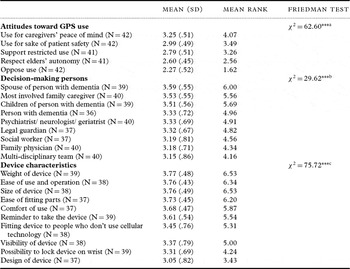
Means and standard deviations as well as mean ranks of the five attitude factors are shown in Table 1. Significant differences between these factors were found. The highest scored factor was support for the use of the device for caregivers’ peace of mind and the lowest was opposing use of GPS for tracking people with dementia. Non-parametric paired samples Wilcoxon tests between item pairs were conducted with significant results set at the 0.005 level following Bonferonni's correction.
Mean ranks and Friedman test for main study variables

***p < 0.001; aFriedman's test is based on 41 cases.bFriedman's test is based on 34 cases; cFriedman's test is based on 35 cases.
The results revealed significantly lower scores for opposing use of the GPS device when compared to: use for caregivers’ peace of mind (Z = 5.36, p < 0.001), respecting elders’ autonomy (Z = 3.63. p < 0.001), supporting restricted use of the device (Z = 4.53, p < 0.001), and use for the sake of patient safety (Z = 4.97, p < 0.001). Significantly higher scores were found for use of the GPS device for caregivers’ peace of mind when compared to respecting patients’ autonomy (Z = 4.38, p < 0.001), supporting restricted use of the device (Z = 4.34, p < 0.001), and for the sake of patient safety (Z = 3.28, p < 0.001). Finally, support for the use of GPS device for the sake of patient safety was found to score higher than respecting patients’ autonomy (Z = 3.39, p < 0.001).
Findings from the focus groups provide an additional perspective and reflect the voice of cognitively intact older people regarding their views about the use of GPS for people with dementia. Despite differences in their socioeconomic background and mean age, there were no major differences between the views of participants in the two groups.
At the beginning of the meetings, the participants were concerned as to how the diagnosis regarding dementia is determined. They discussed the question of how many “signs” – such as forgetting things or getting lost – are necessary to reach the conclusion that a person has dementia. Further, the wish for privacy was weighed against the possibility of risky behavior. Some participants claimed that people with dementia must give their permission to be tracked and that their wishes need to be respected. Some felt that they should be allowed to keep their secrets. Other participants maintained that once a physician has diagnosed dementia, patients’ privacy can no longer be maintained.
One participant said that her privacy overrides any possible risks that she might encounter from her actions. Others put more weight on the importance of protecting people with dementia if they believed there was a potential for risk to the individual. Some participants thought that if people with dementia refuse to use a GPS device they should not be allowed to leave their home. One woman said: “Human rights are very important. Everybody agrees with this. But the moment a person becomes ill [with dementia], all these things fall.” Some cognitively intact older people in the focus groups claimed that if the tracking device for people with dementia was used, it would actually provide people with dementia more autonomy as they could freely leave home. Still other participants thought that people with dementia do not necessarily need a GPS device; they need someone to escort them in all their outdoor activities.
Decision-making persons
Means and standard deviations of the rankings of each of the nine potential decision-making persons regarding use of a GPS device for tracking people with dementia are found in Table 1. As the findings show, the persons deemed most appropriate to decide whether to use electronic tracking for people with dementia were the patient's spouse, followed by the family member most involved in the patient's care, the patients’ children and the patients themselves, respectively. Friedman's test showed overall significant differences between the decision making figures.
Non-parametric paired-samples Wilcoxon tests between item pairs were conducted with significant results set at the 0.001 level following Bonferonni's correction. Results revealed that the patient's spouse was perceived as significantly more appropriate than the family physician (Z = 3.25, p < 0.001). Further, given that the lowest ranking was above 3, it seems that all the figures were perceived as important in the decision making process. However, among the professional caregivers physicians specializing in psychiatry, neurology and geriatrics were ranked higher than other professionals.
Focus group participants had varying views regarding the decision making about the use of GPS for people with dementia. Some thought that the family should consult the family physician and act according to his or her recommendations. Others thought that the decision should be made by the patient's family members. Most seemed to negate the right to autonomy for people with dementia claiming that: “If you are sick [with dementia], you are not the same individual as before, and therefore you can no longer be asked your wishes regarding the use of GPS.”
Tracking device characteristics
Means and standard deviations of the importance of each of the ten device characteristics as rated by the study participants are found in Table 1. The most important characteristic was weight of the device and the least important characteristic was its design. Non-parametric Wilcoxon tests between item pairs were conducted with significant results set at the 0.001 level following Bonferonni's correction.
According to our findings, the participants of the study thought that the design of the GPS device is significantly less important than: size of the device (Z = 4.01, p < 0.001), weight of the device (Z = 4.01, p < 0.001), comfort of the device (Z = 3.69, p < 0.001), ease of use of the device (Z = 4.25, p < 0.001), ease of fitting device parts (Z = 3.99, p < 0.001) and a reminder mechanism (Z = 3.47, p < 0.001). The possibility to lock the device on the patient's wrist was also found to be significantly less important than: size of the device (Z = 3.18, p < 0.001), weight of the device (Z = 3.18, p < 0.001), ease of use (Z = 3.66, p < 0.001) and ease of fitting device parts (Z = 4.12, p < 0.001).
Correlations between attitudes towards use of GPS and decision-making figures
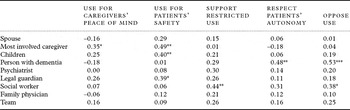
In the next stage of the analyses we examined whether attitudes toward the use of the GPS device were related to preferences regarding decision-making persons using Spearman's correlation (Table 2).
Spearman correlations between attitudes and decision-making persons

*p < 0.05; **p < 0.01; ***p < 0.001.
The analyses showed that support for the use of the device for the sake of patient safety was positively associated with three decision-making persons in the decision making process: the most involved caregivers, patients’ children and legal guardians. Support for the use of the device for caregivers’ peace of mind was positively correlated with preference of the most involved caregiver as decision-maker. Supporting restricted use of the GPS device was positively correlated with favoring the involvement of a social worker in the decision. The factor of respecting patients’ autonomy was positively correlated with the importance attached to the involvement of the person with dementia in the decision. Finally, objection to the use of the device was found to be positively correlated with the importance attached to the person with dementia and the social worker.
Discussion
One finding of the present study is the considerable support of the use of a GPS tracking device. Similar results were found in studies with family caregivers (Miskelly, Reference Miskelly2004). Because of the participants’ closeness in age to people with dementia, and the variation of their attitudes regarding the use of tracking devices for people with dementia, the findings that the highest scored factor was support for the use of the device for the sake of caregivers’ peace of mind, and that respect for patient's autonomy scored only fourth among the factors, are notable. These results are in contrast to assertions that older people either prefer or at least similarly value autonomy and privacy in comparison to their safety (Robinson et al., Reference Robinson2007a).
Another inference emerging from this study is the perception held by cognitively intact older people regarding the place of family caregivers in the care of people with dementia. The participants’ higher support for the use of the device for the sake of caregivers’ peace of mind than their support of the device for the sake of patient safety seems to reflect their empathy and concern for the caregivers’ well-being.
The finding that the decision regarding the use of tracking devices should be an intra-family decision is in accord with findings from our previous study on the attitudes of family and professional caregivers (Landau et al., Reference Landau, Werner, Auslander, Shoval and Heinik2009). Apparently, the participants were also considering the patients’ family interests (Brudney, Reference Brudney2009).
The findings from focus groups also show a variance in participants’ attitudes. Even those who stressed they have “nothing to hide” opposed the idea of tracking because they thought that their activities are nobody else's business. Yet, despite strong objection to the use of a GPS tracking device by some of the participants, “signs” of risky behavior, formal diagnosis of dementia or an incident of getting lost were arguments that led the majority of the participants – as in the sample – to prefer the use of the device. According to opinions voiced here, when people with dementia lack appropriate judgment, get lost or show other behaviors signaling some kind of a personality change, their rights for privacy and for freedom of movement may be denied.
In addition, a definite line was drawn between the participating cognitively intact older people and people with dementia. Probably based on previous knowledge about people with dementia (Delazer et al., Reference Delazer2009), the participants clearly differentiated between “us” and “them.”
The correlational data distinguish between two patterns of attitudes toward the use of GPS devices. Participants who favored the most involved caregiver as one of the decision-makers also strongly supported the use of tracking devices for both caregivers’ peace of mind and patients’ safety; participants favoring the patient as decision-maker tended also to favor patients’ autonomy and opposed the use of tracking devices. While bi-modal responses were found in the study of Rialle et al. (Reference Rialle, Ollivet, Guigui and Herve2008) on the views of family caregivers of people with dementia, the majority of the present sample favored the first pattern: supporting the use of tracking devices and preferring the most involved caregiver, most frequently the patient's spouse as decision-maker. The preference of the sample for physicians – specialists in psychiatry, neurology and geriatrics – in comparison to other professional caregivers to be involved in the decision regarding the use of tracking devices seems to reflect the sample's belief that these professions are more knowledgeable about dementia.
With regard to the GPS device characteristics, the findings are congruent with those of McCreadie and Tinker (Reference McCreadie and Tinker2005): weight, ease of use and operation, and size are essential.
Conclusions
The findings emerging from this study should be considered in light of the relatively small convenience sample on which it is based. Accordingly, the statistics reported were used mainly to reveal some tendencies and relations and cannot be seen as representing all the cognitively intact older people. However, the fact that there were no significant differences between the attitudes expressed by participants in the sample and in the focus groups provides more validity to the results.
In general, cognitively intact older people are in favor of the idea of tracking people with dementia. They support the use of GPS electronic devices, particularly for the sake of caregivers’ peace of mind when dementia is either formally diagnosed or its signs are evident. The sample clearly prefers the safety and protection of people with dementia, even if it means disregard for their autonomy and privacy.
Although some of the participants showed strong feelings for the autonomy of people with dementia and objection to the idea of tracking them, the majority seems to perceive the question of whether to use tracking devices as a family issue where the best interests of both the patients and their family caregivers have to be taken into account. These findings are consistent with recent literature emphasizing the need for family-level conversations and decision-making at the end of life, preferably with the assistance of professional caregivers (e.g. Elliott et al., Reference Elliott, Gessert and Peden-McAlpine2008; Ryan, Reference Ryan2009).
Family-centered formal and structured meetings between family members and professionals may be the best way to facilitate family decision-making on the use of tracking devices (Lautrette et al., Reference Lautrette, Ciroldi, Ksibi and Azoulay2006). Social workers’ skills in assessing the needs of people with dementia and those of their family may help other professionals in the decision-making process and lead to the development of family-friendly policies (Kelly et al., Reference Kelly, Reinhart and Brooks-Danso2008).
Even though the recruitment of older people for research is rather challenging, and of people with dementia apparently even more so, given the differentiation made by the cognitively intact older people in this study between themselves and people with dementia, future research efforts should focus on hearing the authentic voices of people with dementia regarding their attitudes toward the use of tracking devices for them.
Conflict of interest
None.
Description of authors’ roles
Ruth Landau formulated the research question, designed the study, participated in carrying it out and analyzing the data, and wrote the paper. Shirli Werner was responsible for the statistical analysis of the data, participated in carrying out the study and assisted with the revision of the paper. Gail K. Auslander supervised the statistical analysis and reviewed the paper. Noam Shoval critically reviewed the text. Jeremia Heinik critically reviewed the text and assisted with the revision of the paper.
Acknowledgments
Support for this project was provided by the German Federal Ministry of Education and Research (BMBF) within the framework of German-Israeli Project Cooperation (DIP).