


Introduction
Inspired by Habermas’ concept of the public sphere, debates on the European Public Sphere (EPS) have long centred on the possibility of a transnational communicative space in which European citizens engage with shared political issues beyond national boundaries (Risse and Van de Steeg, Reference Risse and Van de Steeg2003). In the absence of a pan-European media system, however, most scholarship has conceptualised the EPS as an outcome of the Europeanisation of national public spheres, whereby national media simultaneously addresses European issues and applies comparable relevance criteria in their coverage (see, for instance, Risse, Reference Risse and Risse2015; Koopmans and Statham, Reference Koopmans and Statham2010). From this perspective, communicative integration is expected to emerge not through a single European arena, but through convergent patterns of interpretation across national media.
A substantial body of research has therefore examined the Europeanisation of media discourse, focusing on the visibility of European Union (EU) actors, the synchronisation of media agendas, and the prominence of European issues in national news coverage (Pfetsch et al., Reference Pfetsch, Adam and Eschner2008). While these studies have significantly advanced our understanding of how Europe enters national public debates, they often equate Europeanisation with increased salience or parallel attention. Yet, as has been repeatedly noted, the mere presence of European topics does not necessarily imply convergence in how those issues are interpreted, evaluated, or politically situated. National media may talk about Europe at the same time while still producing fundamentally different narratives about authority, responsibility, and political agency.
This limitation becomes particularly salient in times of crisis. Crises are frequently portrayed as catalysts of Europeanisation, as they intensify the visibility of EU-level governance and expose national publics to shared constraints and policy responses (Bee and Chrona, Reference Bee and Chrona2020). The Eurozone crisis dramatically increased the salience of European economic governance across member states, especially in countries subjected to external conditionality and austerity. Existing research has shown that EU institutions and European economic rules became more prominent in national media during this period, reinforcing expectations of crisis-driven convergence in public discourse (Santos and Nina, Reference Nina and Pinto2023). However, whether heightened exposure to European authority translates into convergent narrative interpretations remains an open question.
A key source of ambiguity in the literature lies in how media convergence itself is conceptualised. Most studies ask whether national media converge but rarely specify how or in which direction such convergence occurs. We argue that convergence must be analytically disaggregated. From the perspective of the EPS, convergence that reinforces EU-centred interpretations of political authority and responsibility has very different implications from patterns that merely reflect parallel attention or shared problem salience (e.g., Fortunato et al., Reference Fortunato, Juhl and Williams2025; Sorace, Reference Sorace2025).
To address this gap, we distinguish between two analytically distinct forms of media convergence. Relational convergence refers to cross-national similarity in media narratives, capturing whether national public spheres move closer to one another in how European economic issues are framed. Directional convergence, by contrast, captures within-country reorientation along the national–EU axis, assessing whether media narratives increasingly locate authority, responsibility, and problem-solving capacity at the European level. We posit that these two forms of convergence allows for a more precise assessment of whether crisis-induced Europeanisation strengthens the communicative foundations of an EPS or merely exposes persistent interpretative fragmentation.
Empirically, the study examines press coverage in Portugal, Spain, and Ireland—three debtor countries profoundly affected by the Eurozone crisis. The crisis is treated not as an assumed driver of Europeanisation, but as a critical juncture that simultaneously imposed shared constraints and activated domestic political contestation. This makes it a demanding test case for assessing whether national media narratives converge, and whether any convergence follows a centripetal, EU-centred trajectory.
Methodologically, we rely on a comparative framing approach that captures narrative interpretation across five core dimensions—Problem, Cause, Responsibility, Consequences, and Solution—and operationalises convergence through an original composite indicator of narrative orientation. By moving beyond issue salience and actor visibility, this design allows for the systematic examination of both cross-national similarity and within-country shifts in narrative orientation over time. In doing so, we offer an innovative yet theory-driven framework capable of assessing not only whether Europeanisation occurs, but how it reshapes the interpretative structure of national media discourse under conditions of systemic stress.
The article proceeds as follows. The next section reviews the literature on Europeanisation, media framing, and the EPS, and develops the theoretical expectations guiding the analysis. This is followed by a presentation of the data, methods, and operationalisation strategy. The empirical findings are then presented and discussed in relation to the hypotheses. The concluding section reflects on the implications of the findings for understanding crisis-driven Europeanisation and the communicative foundations of democratic governance in the EU.
Europeanisation, media and the European public sphere
The notion of an EPS has long occupied a central place in debates on the democratic legitimacy of the EU. Initially articulated in a Habermasian register, it refers to the idea that democratic governance beyond the nation-state requires a communicative space in which citizens can observe, interpret, and contest common political problems (Habermas, Reference Habermas1996). Analytically, however, research has progressively shifted away from normative expectations of a fully-fledged transnational arena towards a more empirically grounded concern with the degree to which public communication in Europe becomes sufficiently integrated to sustain shared reference points and comparable interpretations across member states (Risse, Reference Risse and Risse2015; Koopmans and Statham, Reference Koopmans and Statham2010).
However, a core structural constraint shapes this debate. Despite deep economic and political integration, the European media system remains overwhelmingly national, with limited reach for genuinely pan-European outlets (Peters et al., Reference Peters, Sifft, Wimmel, Brüggemann and Kleinen-Von Königslöw2005; Brüggemann et al., Reference Brüggemann, Sifft, von Königslöw, Peters and Wimmel2006; Pfetsch et al., Reference Pfetsch, Adam and Eschner2008). As a result, the most influential strand of scholarship does not conceptualise the EPS as a substitute for national arenas, but rather as an emergent property of the Europeanisation of national public spheres. From this perspective, communicative integration can only occur insofar as national media systems become interconnected through shared discursive practices and interpretative frameworks (Risse and Van de Steeg, Reference Risse and Van de Steeg2003).
This communicative understanding of Europeanisation reflects a broader reorientation in the literature. Rather than equating Europeanisation with institutional integration or elite interaction, scholars increasingly conceptualise it as a process unfolding within public discourse (Eder and Kantner, Reference Eder, Kantner and Bach2000; Van de Steeg, Reference Van de Steeg2002). Europeanisation, in this sense, refers to the extent to which EU-level governance becomes publicly visible, intelligible, and contestable within domestic communicative spaces. National media therefore play a pivotal role, not merely as channels of information, but as institutionalised arenas in which the meaning of multilevel governance is constructed for national publics (Koopmans and Statham, Reference Koopmans and Statham2010).
As noted in the Introduction, Europeanisation cannot be reduced to the mere visibility of the EU in domestic news coverage (Peters et al., Reference Peters, Sifft, Wimmel, Brüggemann and Kleinen-Von Königslöw2005; Brüggemann et al., Reference Brüggemann, Sifft, von Königslöw, Peters and Wimmel2006). While these indicators capture whether the EU enters national agendas, subsequent research has highlighted their analytical limitations. Visibility alone does not reveal how political authority, responsibility, and problem-solving capacity are interpreted, nor does it indicate whether national publics are exposed to comparable understandings of Europeanised issues (Pfetsch et al., Reference Pfetsch, Adam and Eschner2008).
Consequently, scholarship has increasingly stressed that Europeanisation hinges on the circulation of shared meaning structures across national public spheres. Shared meaning structures do not imply normative agreement or consensus, but rather the availability of comparable interpretative reference points through which Europeanised problems are understood. From this standpoint, communicative integration requires more than parallel attention to EU topics; it depends on whether national media provide convergent interpretative frameworks through which Europeanised problems are understood (Pfetsch et al., Reference Pfetsch, Adam and Eschner2008; Risse, Reference Risse and Risse2015). Such frameworks enable citizens in different member states to recognise similar problem definitions, identify comparable loci of authority, and attribute responsibility in analogous ways within a system characterised by dispersed and often opaque governance.
Within this analytical framework, national media are treated as key mediators of multilevel governance. Because political authority in the EU is horizontally and vertically dispersed, and this distribution of authority is often opaque to citizens (Börzel and Risse, Reference Börzel, Risse and Risse2020), national media play a crucial role in translating supranational rules, constraints, and decision-making processes into publicly intelligible narratives anchored in domestic political contexts (Koopmans and Statham, Reference Koopmans and Statham2010). In doing so, they may facilitate the circulation of shared meaning structures across countries, but they may also obstruct communicative integration by re-nationalising responsibility, problem definitions, or solutions (Pfetsch et al., Reference Pfetsch, Adam and Eschner2008).
Europeanisation is therefore commonly conceptualised as encompassing both horizontal and vertical dimensions. Horizontally, it involves cross-national synchronisation and mutual observation among national public spheres, whereby publics in different countries are exposed to similar issues and discursive repertoires (Peters et al., Reference Peters, Sifft, Wimmel, Brüggemann and Kleinen-Von Königslöw2005; Brüggemann et al., Reference Brüggemann, Sifft, von Königslöw, Peters and Wimmel2006). Vertically, it concerns the linkage between domestic public communication and supranational authority, as national debates increasingly reference EU institutions, rules, and governance arrangements as meaningful sources of constraint or agency (Risse, Reference Risse and Risse2015). Treating Europeanisation as a purely horizontal phenomenon would thus overlook a defining feature of EU governance: the need to render supranational authority publicly intelligible within nationally bounded communicative spaces.
From this analytical standpoint, convergence in national media narratives emerges as a central—though contested—indicator of Europeanisation. If national media interpret Europeanised problems through increasingly similar meaning structures, particularly regarding where authority, responsibility, and problem-solving capacity are located, communicative integration across national public spheres becomes more plausible, even in the absence of pan-European media (Pfetsch et al., Reference Pfetsch, Adam and Eschner2008; Risse, Reference Risse and Risse2015). Conversely, if national narratives remain fragmented or increasingly re-nationalised, the communicative conditions for an EPS remain weak.
Despite broad agreement that communicative convergence is central to the Europeanisation of public spheres, existing research has relied on heterogeneous and sometimes incompatible criteria to assess it. This conceptual ambiguity has made it difficult to assess not only whether convergence occurs, but also what convergence substantively entails for the emergence of an EPS (Pfetsch et al., Reference Pfetsch, Adam and Eschner2008; Parrilla Guix, Reference Parrilla Guix2022).
Taken together, this body of research establishes national media narratives as a fundamental analytical site for studying Europeanisation and public communication in the EU. At the same time, it reveals persistent uncertainty regarding how communicative integration should be conceptualised and measured. Clarifying how meaning is constructed in media discourse—and how convergence should be understood in interpretative rather than merely descriptive terms—therefore remains a central challenge for research on the EPS. The next section addresses this challenge by examining how media meaning-making has been theorised through framing, narratives, and interpretative orientation.
Frames, narratives and narrative orientation in media
To assess how national media contribute to the Europeanisation of public discourse, it is necessary to clarify the conceptual tools through which media meaning-making has been analysed. This research builds on Entman’s (Reference Entman1993) conception of framing, understood as the process through which the media select certain aspects of reality and make them salient in ways that promote specific problem definitions, causal interpretations, moral evaluations, and treatment recommendations (de Vreese, Reference de Vreese2005). Rather than treating these functions as discrete frames, we conceptualise them as complementary components of a unified interpretative framework, operationalised in this study as five framing dimensions through which economic developments in the EU are rendered meaningful in media coverage (Reference Parrilla Guix2022).
Following Entman’s (Reference Entman1993) framing model, these functions are operationalised as five framing dimensions: Problem, Cause, Responsibility, Consequences, and Solution. The Problem dimension defines the nature of the economic issue, shaping the overall narrative logic by indicating whether economic developments are portrayed primarily as financial, political, or social, and understood in national or European terms. The Cause dimension identifies the origins of these problems, distinguishing between domestic policy failures, global market dynamics, and EU-level governance. The Responsibility dimension attributes political accountability to specific actors, whether national governments or supranational institutions. The Consequence dimension, in turn, captures the expected or perceived effects of economic developments. The Solution dimension identifies the level at which policy responses are located by distinguishing between national strategies and European forms of coordination.Footnote 1
Framing analysis is particularly well suited to capturing this substantive dimension of communication because it reveals how media define problems, attribute causes, distribute responsibility, and articulate solutions, thereby structuring political meaning and rendering governance arrangements intelligible in public discourse (Koopmans and Statham, Reference Koopmans and Statham2010). Within this analytical framework, subframes operationalise the five framing dimensions. They specify how individual framing functions are instantiated in concrete media texts—for example, whether responsibility for economic outcomes is attributed to national governments or EU institutions, or whether solutions are framed at the domestic or supranational level. As analytically bounded and mutually exclusive categories, subframes provide the link between framing as an interpretative process and its empirical operationalisation, enabling systematic comparison across countries and time (Matthes, Reference Matthes2009; Pfetsch et al., Reference Pfetsch, Adam and Eschner2008).
However, analysing framing functions in isolation risks fragmenting interpretation and obscuring the broader meaning structures that give coherence and direction to media discourse over time. To address this limitation, it is therefore necessary to distinguish analytically between frames and narratives.
Frames operate at the level of interpretative functions, whereas narratives integrate these functions into a coherent and temporally consistent account of political reality (Eder and Kantner, Reference Eder, Kantner and Bach2000). Narratives link problem definitions, causal attributions, responsibility assignments, and solutions into intelligible storylines that provide continuity to public discourse. This narrative perspective has been central to research on European public communication, because it highlights how shared narratives may foster mutual recognition and communicative integration across national public spheres (Risse and Van de Steeg, Reference Risse and Van de Steeg2003).
Building on the distinction between frames and narratives, this study advances the concept of narrative orientation as a central analytical category for assessing convergence in Europeanised media discourse. It captures the overall direction of media narratives by identifying where political authority, responsibility, and problem-solving capacity are discursively located. Whereas framing dimensions explain how political meaning is constructed, narrative orientation specifies where political agency is situated within systems of multilevel governance, shifting the analytical focus from interpretative mechanisms to shared interpretative reference points.
Importantly, narrative orientation is multilevel rather than evaluative. Media narratives may locate authority at the European level while remaining critical of EU institutions, just as they may emphasise national responsibility without endorsing domestic political actors. This distinction, highlighted in research on European public communication and political legitimation, allows convergence to be conceptualised as interpretative alignment rather than normative agreement (Pfetsch et al., Reference Pfetsch, Adam and Eschner2008; Risse, Reference Risse and Risse2015; Moury and Freire, Reference Moury and Freire2013).
By distinguishing between framing and narrative orientation, this study avoids treating individual framing dimensions as the object of convergence. Instead, convergence is assessed at the level of narrative orientation, which captures the discursive location of political authority and responsibility. From the perspective of the EPS, convergence in narrative orientation constitutes a minimal condition of communicative integration, insofar as it enables nationally bounded publics to recognise comparable loci of political authority and responsibility despite the absence of a fully transnational media arena. This clarification directly addresses long-standing conceptual disagreements in the literature over how to operationalise convergence and what convergence substantively entails (Van de Steeg, Reference Van de Steeg2002; Koopmans and Erbe, Reference Koopmans and Erbe2004; Parrilla Guix, Reference Parrilla Guix2022).
Recent scholarship has reinforced the relevance of media narratives for understanding political authority and contestation in contemporary Europe. Fortunato et al. (Reference Fortunato, Juhl and Williams2025) show that media narratives structure crisis interpretation and political accountability, while Sorace (Reference Sorace2025) highlights how narrative constructions sustain or challenge political authority under conditions of uncertainty. Yet despite this renewed interest, convergence continues to be treated as a relational phenomenon, leaving open the question of whether it reflects mere similarity or a directional alignment in how political authority and responsibility are discursively located.
In sum, framing provides the analytical foundation for examining how media construct political meaning, but narrative orientation constitutes the substantive level at which Europeanisation and convergence can be meaningfully assessed. This distinction provides the conceptual basis for distinguishing between relational and directional convergence, developed in the next section.
Convergence, crisis: relational and directional dynamics
Convergence has become a central concept in research on the Europeanisation of national public spheres, yet its meaning remains theoretically ambiguous. Much of the literature implicitly equates convergence with increasing similarity across national media systems, without specifying what exactly converges or why such convergence matters for democratic communication in the EU. As a result, convergence is often treated as a descriptive outcome rather than a theoretically differentiated process.
Most comparative media research conceptualises convergence in relational terms. From this perspective, convergence occurs when national media increasingly resemble one another in terms of issue salience, framing patterns, or narrative configurations (Peters et al., Reference Peters, Sifft, Wimmel, Brüggemann and Kleinen-Von Königslöw2005; Brüggemann et al., Reference Brüggemann, Sifft, von Königslöw, Peters and Wimmel2006; Pfetsch et al., Reference Pfetsch, Adam and Eschner2008). Empirically, relational convergence is typically assessed by examining whether countries discuss similar topics at the same time and employ similar interpretative repertoires (Bee and Chrona, Reference Bee and Chrona2020). This strand of research captures an important aspect of Europeanisation—namely, the extent to which national public spheres become mutually oriented and exposed to similar discursive inputs.
However, relational convergence is silent about the substantive direction of media narratives. National media may become more similar while simultaneously reinforcing nationally centred interpretations, or it may converge around EU-centred understandings of political authority and responsibility. From the perspective of the EPS, we argue that these trajectories have fundamentally different implications.
To that end, we introduce a second, analytically distinct dimension: directional convergence, which we conceptualise as movements along the national–EU axis according to where media narratives locate political authority, responsibility, and problem-solving capacity. Whereas narrative orientation captures the discursive location of governance at a given point in time, directional convergence examines how that orientation changes over time. Rather than asking only whether national media become more alike, it asks whether media narratives within each country shift in a common direction along the national–EU axis. Accordingly, convergence is understood not simply as similarity, but as directional alignment in narrative orientation. Table 1 illustrates the distinction between a Nationally centred and EU-centred narratives using illustrative quotes from the coded corpus.
Illustrative quotes from the coded corpus for each subframe

Table 1. Long description
A table with five columns: Problem, Cause, Responsibility, Consequences, and Solution. The table has multiple rows, each containing a quote related to the respective category. The Problem column includes quotes about banking and finances, welfare and taxes, deficit, sovereign debt and inflation, European economic competition, and Brexit. The Cause column has quotes about national and EU causes. The Responsibility column lists quotes about national and EU responsibility. The Consequences column includes quotes about national and European level consequences. The Solution column contains quotes about European solidarity and solutions without EU assistance. Each row provides an illustrative quote from the coded corpus, highlighting different aspects of media narratives.
This conceptualisation builds on scholarship that understands Europeanisation as the circulation of shared meaning structures, rather than the mere visibility of EU topics (Pfetsch et al., Reference Pfetsch, Adam and Eschner2008; Risse, Reference Risse and Risse2015). From this standpoint, convergence is assessed not through identical content or uniform frames, but through the extent to which national media locate political authority, responsibility, and problem-solving capacity in comparable ways. Directional convergence thus captures the location of political authority and responsibility without implying identical narratives or the disappearance of national specificities. Conversely, shifts towards nationally bounded interpretations are understood as processes of divergence or re-nationalisation.
This distinction between relational and directional convergence becomes particularly relevant in the context of crisis reporting. Periods of crisis occupy a distinctive place in research on political communication and Europeanisation because they constitute critical junctures in which established interpretative frameworks are destabilised and competing narratives seek to define responsibility, causality, and authority (Widmaier et al., Reference Widmaier, Blyth and Seabrooke2007).
From a communicative perspective, crises intensify public demand for interpretative guidance and heighten citizens’ reliance on media coverage to make sense of complex and uncertain developments (van Dalen et al., Reference van Dalen, Svensson, Kalogeropoulos, Albæk and de Vreese2019). National media therefore play an enhanced mediating role, translating crisis dynamics into publicly intelligible narratives and structuring how political authority and accountability are understood. Periods of crisis are therefore particularly well suited to examining shifts in narrative orientation, revealing whether national media increasingly locate political authority at the European level or reinforce nationally bounded interpretations (Pfetsch et al., Reference Pfetsch, Adam and Eschner2008; Kantner, Reference Kantner2015). Remarkably, however, crises do not mechanically produce Europeanisation or convergence. While some studies suggest that heightened conflict may foster cross-national synchronisation and shared attention to EU issues (Pfetsch et al., Reference Pfetsch, Adam and Eschner2008; Bee and Chrona, Reference Bee and Chrona2020), others highlight the persistence of fragmentation, re-nationalisation, and asymmetric attributions of blame (Nina and Belchior, Reference Nina and Maria Belchior2025). Crises should therefore be conceptualised as enabling conditions for communicative integration—not as deterministic drivers of convergence. Within this framework, convergence is best understood as a facilitating condition rather than a guarantee of an EPS. In the absence of a pan-European media system, communicative integration depends on whether national public spheres become interconnected through shared narrative orientations. When media increasingly locate political authority at the European level, it may reduce interpretative distance between national publics and generate common reference points for understanding Europeanised problems (Peters et al., Reference Peters, Sifft, Wimmel, Brüggemann and Kleinen-Von Königslöw2005; Brüggemann et al., Reference Brüggemann, Sifft, von Königslöw, Peters and Wimmel2006; Pfetsch et al., Reference Pfetsch, Adam and Eschner2008).
At the same time, communicative centrality should not be equated with normative legitimation. The growing prominence of the EU in media narratives during crises does not necessarily imply support for European integration. Research shows that references to supranational authority may serve strategic purposes, such as blame-shifting or the justification of domestic policy choices (Moury and Freire, Reference Moury and Freire2013; Moury and Standring, Reference Moury and Standring2017), while EU-centred narratives remain critical, ambivalent, or conflictual (Bee and Chrona, Reference Bee and Chrona2020; Sorace, Reference Sorace2025). Likewise, scholarship on EU politicisation suggests that greater EU salience may intensify contestation and social differentiation rather than consensus (Kuhn, Reference Kuhn2015). Evidence from Portugal similarly shows that crisis-driven Europeanisation does not automatically generate communicative integration, reinforcing the need for comparative analyses across national contexts (Nina, Reference Nina and Pinto2023).
Taken together, the distinction between relational and directional convergence, combined with the understanding of crises as enabling but non-deterministic conditions, suggests that convergence should be analysed along two analytically distinct dimensions: cross-national similarity (relational convergence) and within-country shifts in narrative orientations (directional convergence). These dimensions motivate the following hypotheses:
Hypothesis 1. National media narratives in Portugal, Spain, and Ireland converge cross-nationally following the onset of the economic crisis.
Hypothesis 2. Within countries, national media narratives shift towards a more EU-centred narrative orientation following the onset of the economic crisis.
While both hypotheses capture distinct dimensions of convergence, the second is theoretically more consequential for the emergence of an EPS, because it addresses changes in the location of political authority within media narratives. Importantly, neither hypothesis assumes normative support for European integration; instead, both concern the communicative organisation of public interpretation. Accordingly, the empirical strategy operationalises narrative orientation as the discursive locus of governance and evaluates convergence both as cross-national similarity and as within-country directional change over time.
Empirical strategy
Data and case selection
The analysis focuses on the period from 2002 to 2016, enabling a comparison between two analytically distinct phases: the pre-crisis period (2002–2009) and the post-crisis period (2011–2016). The pre-crisis phase begins with the 2002 legislative elections, coinciding with the full implementation of the euro as a common currency, and concludes in 2009, marked by the institutional consolidation of Economic and Monetary Union following the Lisbon Treaty. The post-crisis phase encompasses elections held during the sovereign debt crisis as well as those conducted after the conclusion of financial assistance programmes. Within this temporal framework, the study analyses media coverage during the electoral campaigns of fourteen legislative elections held in three Eurozone debtor countries: Ireland, Portugal, and Spain.Footnote 2
This temporal design is consistent with research showing that Europeanisation processes unfold primarily within national public spheres, with national media acting as the main conduit through which European issues are interpreted and contested (Peters et al., Reference Peters, Sifft, Wimmel, Brüggemann and Kleinen-Von Königslöw2005; Brüggemann et al., Reference Brüggemann, Sifft, von Königslöw, Peters and Wimmel2006; Risse, Reference Risse and Risse2015). Periods of heightened conflict and political contestation, such as economic crises, when supranational governance becomes particularly salient (Kantner, Reference Kantner2015) are expected to create the conditions for the intensification of Europeanisation dynamics.
Rather than adopting a synchronic design centred on EU-level events, the study follows a non-synchronic, election-centred approach, treating national electoral campaigns as moments of heightened economic salience and intensified media scrutiny. During elections, economic conditions frequently become central to political competition and voter evaluations (Vavreck, Reference Vavreck2009), while media coverage plays a key role in shaping public interpretations of economic problems and policy responses under conditions of uncertainty (Sanders et al., Reference Sanders, Clarke, Stewart and Whiteley2001; van Dalen et al., Reference van Dalen, Svensson, Kalogeropoulos, Albæk and de Vreese2019). Accordingly, for each election, the empirical window comprises the fifteen days preceding polling day, capturing the peak of campaign-related economic coverage.
The empirical focus on Portugal, Spain, and Ireland is theoretically motivated. All three countries experienced substantial EU involvement in domestic economic governance during the sovereign debt crisis, through financial assistance programmes, policy conditionality, and intensified supranational coordination. These developments increased the visibility of EU-level decision-making within national political debates and rendered the multilevel distribution of authority particularly salient (Santos and Nina, Reference Nina and Pinto2023). Importantly, the selection of these cases does not presuppose convergence. On the contrary, strong domestic incentives for blame attribution and re-nationalisation during periods of economic hardship make them a demanding test for convergence in media narratives. At the same time, despite the social and economic costs associated with austerity, these countries have displayed relatively stable pro-European orientations at both elite and mass levels, without persistent shifts towards structurally dominant Euroscepticism (Teperoglou and Belchior, Reference Teperoglou and Maria Belchior2024). They also differ in economic trajectories, political–institutional arrangements, and media systems, introducing meaningful contextual variation for comparative analysis
Within each country, the analysis focuses on two national quality newspapers: The Irish Independent and The Irish Times (Ireland), Público and Diário de Notícias (Portugal), and El País and El Mundo (Spain). These outlets were selected because they are widely recognised as agenda-setting newspapers within their respective media systems and are commonly used in comparative research on political communication and economic news coverage (e.g., Peter and de Vreese, Reference Peter and de Vreese2004). Compared to tabloids, quality newspapers devote more sustained attention to economic affairs and tend to articulate interpretive frames that structure elite-level debates on policy and governance, making them particularly suitable for the analysis of economic narratives during periods of crisis.
The news content was manually coded based on articles collected through the ERC-funded MAPLE Project.Footnote 3 The dataset consists of economic news articles published in the economic sections of the selected newspapers during the fifteen days preceding each legislative election between 2002 and 2016. This strategy yields a total of 6070 articles: 2647 from Ireland, 1694 from Portugal, and 1729 from Spain. Editorials and opinion pieces were excluded to capture dominant news narratives rather than individual or institutional commentary.
For analytical purposes, articles were aggregated at the country level rather than disaggregated by individual outlet. This approach reflects the study’s interest in national public-sphere dynamics and aligns with evidence that mainstream quality newspapers tend to reproduce broadly shared, elite-driven narratives (van Dalen et al., Reference van Dalen, Svensson, Kalogeropoulos, Albæk and de Vreese2019). Aggregation at the national level therefore facilitates the identification of cross-national patterns in framing and narrative convergence at the level of national public spheres.
Framing approach and unit of analysis
The analytical framework builds on Entman’s (Reference Entman1993) conception of framing as the process through which media select and emphasise certain aspects of reality in ways that promote particular interpretative schemas. Rather than conceiving frames as fixed or thematic entities, Entman conceptualises framing as a structured meaning-making process composed of four core functions: problem definition, causal attribution, moral evaluation, and treatment recommendation. These functions are understood not as discrete frames, but as analytically distinct components of a unified interpretative architecture.
Building on this functional understanding, the present study operationalises framing through five framing dimensions—Problem, Cause, Responsibility, Consequences, and Solution—which together structure how economic developments are rendered meaningful in news coverage. This specification adapts Entman’s framework to the study of multilevel economic governance, where the identification of responsible actors and the articulation of consequences constitute analytically salient extensions of causal interpretation and evaluation. Framing dimensions are therefore not treated as independent analytical outcomes, but as complementary interpretative functions that jointly constitute a coherent narrative structure.
Framing dimensions are treated as complementary components of a single narrative architecture, each capturing a distinct interpretative function within the framing process. The Problem dimension establishes the interpretative starting point by defining the nature of the economic crisis and whether its origins are portrayed as supranational or domestic. The Cause dimension specifies how causal responsibility is constructed, distinguishing between EU-level mechanisms—such as fiscal rules or coordination frameworks—and domestic policy failures. The Responsibility dimension identifies the political actors held accountable, shaping perceptions of political agency and blame. The Consequences dimension determines whether the effects of economic developments are framed as supranational and interdependent or as nationally bounded. Finally, the Solution dimension captures the level at which corrective action is proposed, distinguishing between supranational coordination and domestic reform.
These dimensions organise the substantive content of media narratives. However, they do not, in themselves, indicate whether European economic issues are interpreted primarily at the national or at the EU level. This distinction becomes observable only at the level of subframes, which specify how problems, causes, responsibilities, consequences, and solutions are concretely articulated in national media discourse.
Accordingly, each framing dimension is disaggregated into a set of mutually exclusive subframes (see Codebook, Online Appendix 1), capturing the specific interpretative options available when reporting on European economic issues. For example, economic problems may be defined in terms of domestic policy failures, global market dynamics, or supranational constraints; responsibility may be attributed to national governments or EU institutions; and proposed solutions may emphasise national policy adjustment or EU-level coordinationFootnote 4 .
Codification and reliability
The unit of analysis is the individual news article, and each was coded for the presence of subframes across five framing dimensions using a standardised coding scheme.
Consistent with prior research on framing in news discourse (e.g., de Vreese et al., Reference de Vreese, Peter and Semetko2001), the coding scheme accommodates the multidimensional nature of journalistic texts. While subframes within a given dimension are mutually exclusive, allowing only one positive coding per dimension, multiple framing dimensions may co-occur within the same article. This design allows the analysis to capture complex and layered framing patterns without fragmenting the unit of analysis or imposing artificial simplification.
To ensure comparability across countries, all coders worked from a common codebook and inter-coder reliability tests were conducted to ensure conceptual equivalence and consistent application of the coding scheme across linguistic contexts. To assess reliability, both intra-coder and inter-coder reliability tests were performed using random subsamples of the data. For intra-coder reliability, each coder recoded a randomly selected 10% subsample approximately two months after the initial coding. Inter-coder reliability was assessed by having the second coder independently code a different random 10% subsample of the corpus.
Reliability was evaluated using Krippendorff’s alpha, which is appropriate for nominal data and uneven category distributions. The results indicate high levels of coding consistency. Intra-coder reliability ranged from α = 0.852 for the Cause dimension to α = 0.968 for the Solution dimension. Inter-coder reliability ranged from α = 0.789 for the Problem dimension to α = 0.943 for the Solution dimension. All values exceed the commonly accepted threshold of α = 0.70 for content analysis, indicating robust coding reliability.
Index and convergence measurement
To operationalise convergence in a manner consistent with the theoretical emphasis on shared meaning structures and interpretative reference points, all subframes identified through the coding process were recoded according to their narrative orientation. Conceptually, narrative orientation refers to the discursive locus of political agency and responsibility in systems of multilevel governance; empirically, it is operationalised through a rule-based recoding of subframes into EU-centred (centripetal) versus nationally centred (centrifugal) interpretations grounded in the codebook definitions (see Appendix 4).
This recoding draws directly on the original codebook, which specifies the substantive content of each subframe across the five framing dimensions. As a result, subframes were classified into two mutually exclusive categories. Centripetal subframes locate economic authority, responsibility, constraint, or problem-solving capacity at the European level, referring to EU institutions, supranational rules, fiscal frameworks, coordination mechanisms, or collective European processes. Centrifugal subframes, by contrast, foreground domestic actors, national institutions, or nationally bounded policy choices, situating economic governance primarily within the nation-state.
Based on this, we operationalise narrative orientation through a continuous Convergence Index (CI), which captures the relative prevalence of EU-versus national-level interpretations in media coverage. The CI is calculated separately for each country, each framing dimension, and each time period. For a given country, framing dimension, and period, the index is defined as:
 $CI = {{EU} \over {EU + National}}$
where EU denotes the number of EU-centred (centripetal) subframes and National the number of nationally centred (centrifugal) subframes. The index ranges from 0 to 1, with values closer to 0 indicating predominantly nationally oriented narratives and values closer to 1 indicating predominantly EU-centred narrative orientations.
When required for descriptive and comparative purposes, the CI is examined at two analytical levels. First, it can be analysed separately for each framing dimension, allowing the identification of substantively distinct patterns in how problems, causes, responsibility, consequences, and solutions are oriented across levels of governance. Second, the CI is aggregated across the five framing dimensions by computing their arithmetic mean, yielding a summary measure of overall narrative orientation for each country in each period. All framing dimensions are weighted equally, reflecting the analytical premise—derived from Entman’s (Reference Entman1993) framing model—that these interpretative functions are complementary and jointly constitutive of media meaning-making.
We conceptualise convergence as a dynamic process unfolding over time rather than as a static condition and is inferred from temporal and cross-national patterns in CI values. On this basis, two analytically distinct forms of convergence are assessed, corresponding directly to the two hypotheses advanced in the theoretical section.
The first form of convergence concerns cross-national similarity in narrative orientation and corresponds directly to Hypothesis 1 (relational convergence). Relational convergence is examined by analysing changes in the dispersion of CI values across national media systems. Empirically, this involves calculating cross-national distances between the CI scores of Portugal, Spain, and Ireland for each framing dimension and period, using absolute differences. A reduction in these distances in the post-crisis period indicates increased similarity in narrative orientation across national media, regardless of whether narratives are predominantly nationally or EU-oriented.
The second form of convergence concerns directional shifts in narrative orientation over time within countries and corresponds directly to Hypothesis 2. This form of convergence is examined by observing changes in CI values between the pre-crisis and post-crisis periods for each country. Increases in CI values indicate movement towards more EU-centred interpretations of economic governance, whereas decreases indicate re-nationalisation.
Finally, because the CI relies on proportional rather than absolute counts, it is independent of variation in the overall volume of media coverage across countries and periods. It captures changes in how economic issues are interpreted in media discourse rather than differences in coverage intensity. This operationalisation aligns with recent approaches that conceptualise convergence as a relational and distributional phenomenon, assessed through relative proximity and orientation rather than narrative identity (Fortunato et al., Reference Fortunato, Juhl and Williams2025; Sorace, Reference Sorace2025).
Results and discussion
To provide a descriptive overview of how economic issues were framed in national media in Portugal, Spain, and Ireland before and after the Eurozone crisis, Figure 1 presents the relative salience of the five framing dimensions across countries and periods.
Framing dimensions in economic news coverage before and after the Eurozone crisis (aggregate and country-level).
Note: Values represent the percentage of news articles containing each framing dimension. Framing categories are not mutually exclusive. The top panel displays aggregate patterns across countries, while the bottom panels report country-level distributions for Spain, Portugal, and Ireland.

Two broad similarities emerge across the three national media systems. First, the post-crisis period is marked by a substantial increase in the salience of both Problem and Responsibility framing in all countries. Responsibility attribution follows a comparable trajectory, increasing in Portugal, Spain, and in Ireland. This pattern indicates that the Eurozone crisis coincided with a shared reinforcement of diagnostic and accountability-oriented framing, consistent with prior research showing that crisis contexts intensify journalistic attention to problem definition and blame attribution (Bellucci, Reference Bellucci2014; Hobolt and Tilley, Reference Hobolt and Tilley2014).
Second, although the Solution dimension remains one of the least frequent framing functions overall, it exhibits the most pronounced relative growth following the onset of the crisis—particularly in Spain. In Portugal and Ireland, by contrast, the rise in Solution framing is considerably more limited. These results suggest that crisis can expand media attention to policy responses and institutional remedies, even if such framing remains secondary to diagnosis and accountability (Salgado et al., Reference Salgado, Nienstedt, Schneider and Robert2015).
National media also diverge in how responsibility is articulated within broader narrative structures. Spanish newspapers combine heightened responsibility attribution with a comparatively stronger emphasis on Solution framing, whereas Portuguese coverage pairs strong responsibility attribution with sustained attention to Consequences. Irish coverage, by contrast, displays greater overall stability, maintaining a more balanced distribution across framing dimensions and less pronounced reallocation over time. These patterns suggest that, although the crisis reinforced accountability-oriented framing across cases, national media systems continued to organise economic narratives in differentiated ways rather than converging towards a uniform framing configuration.
Further cross-national divergence emerges in the Cause and Consequences dimensions. While Cause framing shows relatively limited variation over time in all three countries, Consequences framing follows markedly different trajectories after the crisis. This, however, masks substantial variation: in Spain, Consequences framing increases, while it remains broadly stable in Portugal and declines in Ireland. Similar combinations of modest aggregate decline and pronounced national differentiation in consequence-oriented reporting have been identified in comparative research on media coverage of economic crises (Nienstedt et al., Reference Nienstedt, Kepplinger, Quiring and Picard.2015).
These patterns indicate that the Eurozone crisis coincided with a broad reconfiguration of how economic news was framed in national media in Portugal, Spain, and Ireland. Across all three cases, post-crisis reporting increasingly foregrounds problem identification and responsibility attribution, alongside a more visible—though still secondary—role for solution-oriented framing. As argued above, however, assessing narrative convergence requires moving beyond framing salience to examine interpretative orientation directly. The following sections address this by testing relational convergence across countries (Hypothesis 1) and directional convergence within countries over time (Hypothesis 2).
Relational convergence
Our first hypothesis posits that national media coverage of European economic issues in Portugal, Spain, and Ireland becomes more convergent following the onset of the Eurozone crisis.
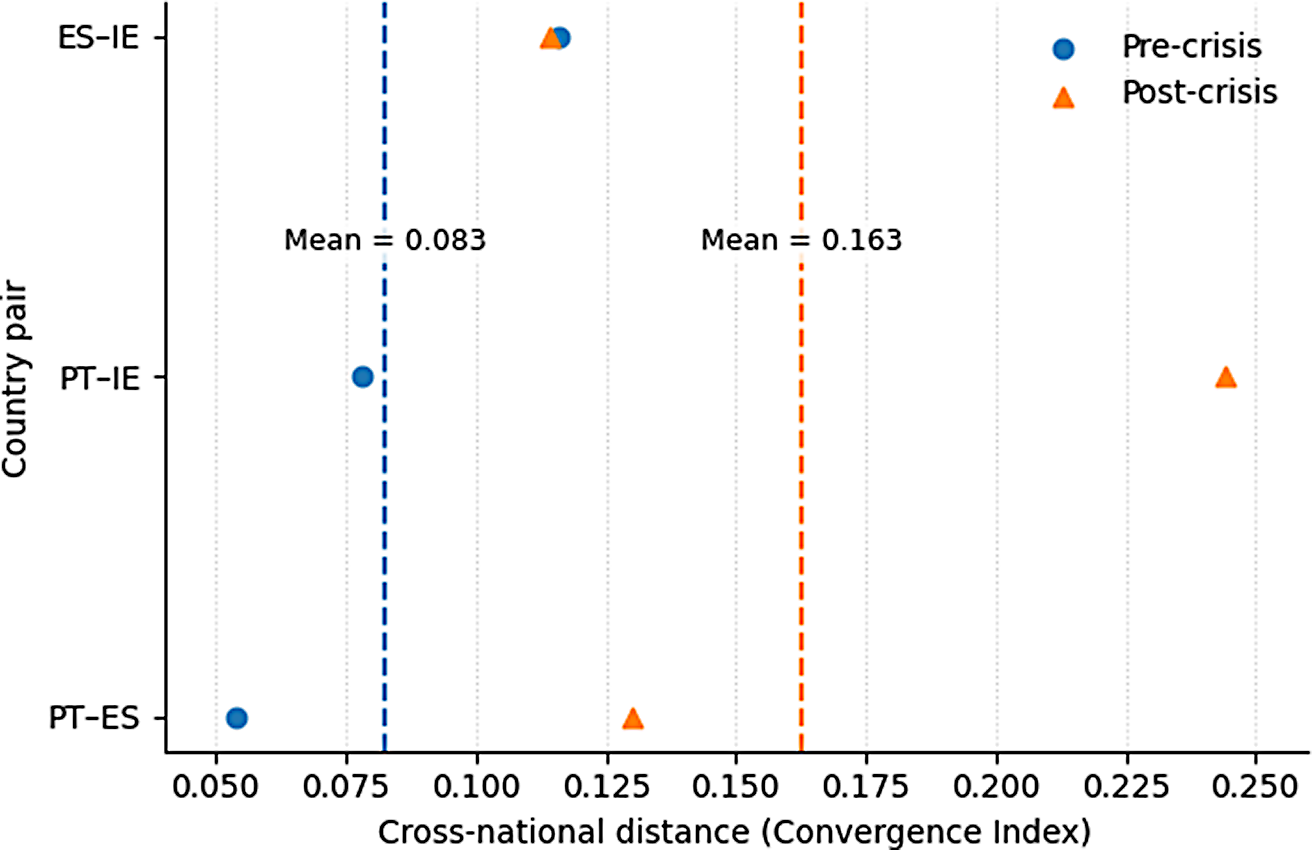
To test this hypothesis, we rely on the CI calculated for each country. Figure 2 reports the absolute pairwise distances in CI between Portugal, Spain, and Ireland before and after the Eurozone crisis, as well as the mean cross-national distance for each period. Contrary to expectations, the results do not indicate increased relational convergence following the crisis. Instead, cross-national dispersion increases in the post-crisis period. At the aggregate level, the mean cross-national distance rises from 0.083 in the pre-crisis period to 0.163 post-crisis, indicating a clear widening of the gap between national media.
Cross-national distances in narrative orientation before and after the Eurozone crisis.
Note: Points represent absolute pairwise distances between countries. CI scores (Portugal–Spain, Portugal–Ireland, and Spain–Ireland). Dashed and dotted vertical lines denote the mean cross-national distance in each period.

A closer examination of pairwise distances reveals that this increase in dispersion is unevenly distributed. The most pronounced divergence occurs between Portugal and Ireland, where the distance increases sharply from 0.078 to 0.244. A substantial, though less marked, increase is also observed between Portugal and Spain (from 0.054 to 0.130). By contrast, the distance between Spain and Ireland remains virtually unchanged across periods (0.116 pre-crisis; 0.114 post-crisis), suggesting relative stability in their mutual narrative positioning. These patterns indicate that the absence of relational convergence does not result from uniform inertia across cases, but from divergent national trajectories. While Spanish and Irish media maintain broadly similar narrative orientations relative to one another, Portuguese media follow a distinct post-crisis trajectory, contributing disproportionately to the overall increase in cross-national dispersion.
Taken together, these findings suggest that the Eurozone crisis did not generate a generalised pattern of relational convergence across national media systems. Although all three countries faced similar economic constraints, their media narratives did not move closer in aggregate terms. Instead, convergence appears selective rather than systemic, limited to specific country pairs rather than extending across the full set of cases. Accordingly, Hypothesis 1 is not supported at the aggregate level, though evidence of stability between Spain and Ireland points to partial and uneven convergence dynamics.
Importantly, the absence of relational convergence should not be interpreted as narrative stagnation. On the contrary, media narratives evolved substantially in all three countries, but in different directions and to varying degrees. Whether these divergent trajectories nonetheless reveal a common directional movement towards EU-centred interpretations is examined next, in the test of Hypothesis 2.
Directional convergence
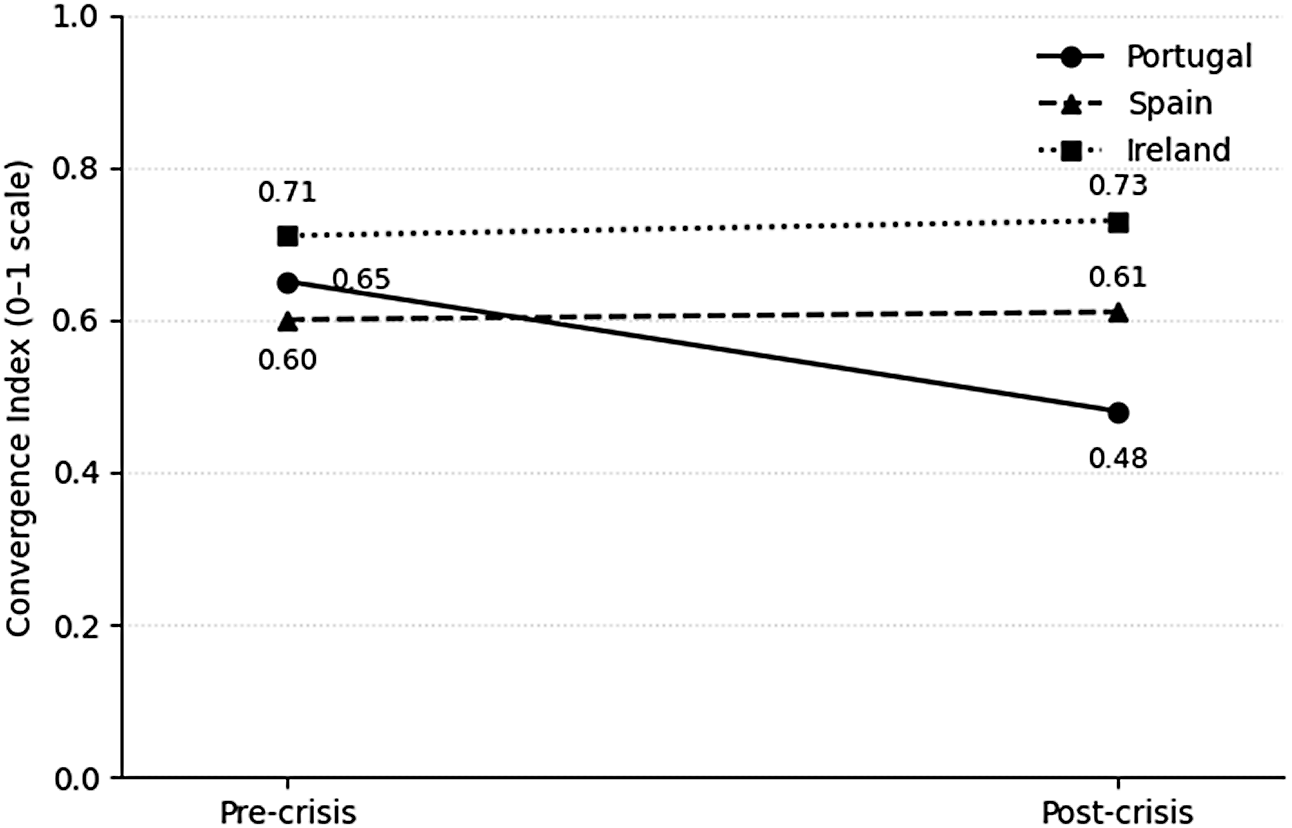
Hypothesis 2 shifts the analytical focus from cross-national proximity to within-country change in narrative orientation. Figure 3 provides the main test of Hypothesis 2 by comparing each country’s CI between the pre-crisis and post-crisis periods. Higher CI values indicate a more EU-centred (centripetal) narrative orientation, whereas lower values indicate a more nationally centred (centrifugal) orientation.
Directional change in narrative orientation across countries before and after the Eurozone crisis.
Note: The CI ranges from 0 (fully nationally oriented narratives) to 1 (fully EU-centred narratives).

Figure 3 reveals heterogeneous directional trajectories across the three countries. In Spain, the CI increases from 0.598 to 0.614, indicating a modest movement towards more EU-centred narratives. An example of this shift can be found when El País reported in 2008 that Prime-Minister Zapatero was insisting that the Spanish economy remained on a solid footing while assuring that the reforms promoted by the government were going to sustain economic growth, which contrasts with the coverage in 2016 from El Mundo that the EU attributed part of Spain’s recovery to the extraordinary measures taken by the European Central Bank. Although the magnitude of this change is limited, it is consistent with the expectation formulated in our second hypothesis. Ireland follows a similar trajectory: despite a higher pre-crisis baseline, the CI increases from 0.714 to 0.728 in the post-crisis period, pointing to a comparable—if moderate—centripetal shift. For instance, in 2007 the Irish Independent was reporting that the Taoiseach insisted that Ireland’s strong economic performance reflected years of prudent fiscal management and successful government policies. The tune seemingly changed since, as in 2017, the Irish Times reported that government officials were acknowledging that the country’s economic recovery remained closely tied to measures agreed with European partners. By contrast, Portugal exhibits a marked decline in CI, from 0.652 in the pre-crisis period to 0.484 post-crisis, indicating a substantial shift towards more nationally oriented narratives. Rather than reinforcing EU-centred interpretations, Portuguese media increasingly re-anchor European economic issues at the domestic level in the aftermath of the crisis, a pattern previously identified in analyses of crisis-related discourse in Portugal (Moury and Freire, Reference Moury and Freire2013). To illustrate this shift, Diário de Notícias reported in 2009 that the recovery of the eurozone’s major economies was expected to create new opportunities for Portuguese exports, according to forecasts made by the European Commission while in 2015 Público was reporting that economists were arguing that the recovery of the Portuguese economy was going to depend on the then next government’s ability to continue with reforms and maintain fiscal discipline.
Taken together, these results indicate that the Eurozone crisis did not generate a uniform centripetal convergence across national media in these countries. Instead, directional convergence is observed selectively, applying to Spain and Ireland but not to Portugal. In substantive terms, Hypothesis 2 is therefore partially supported.
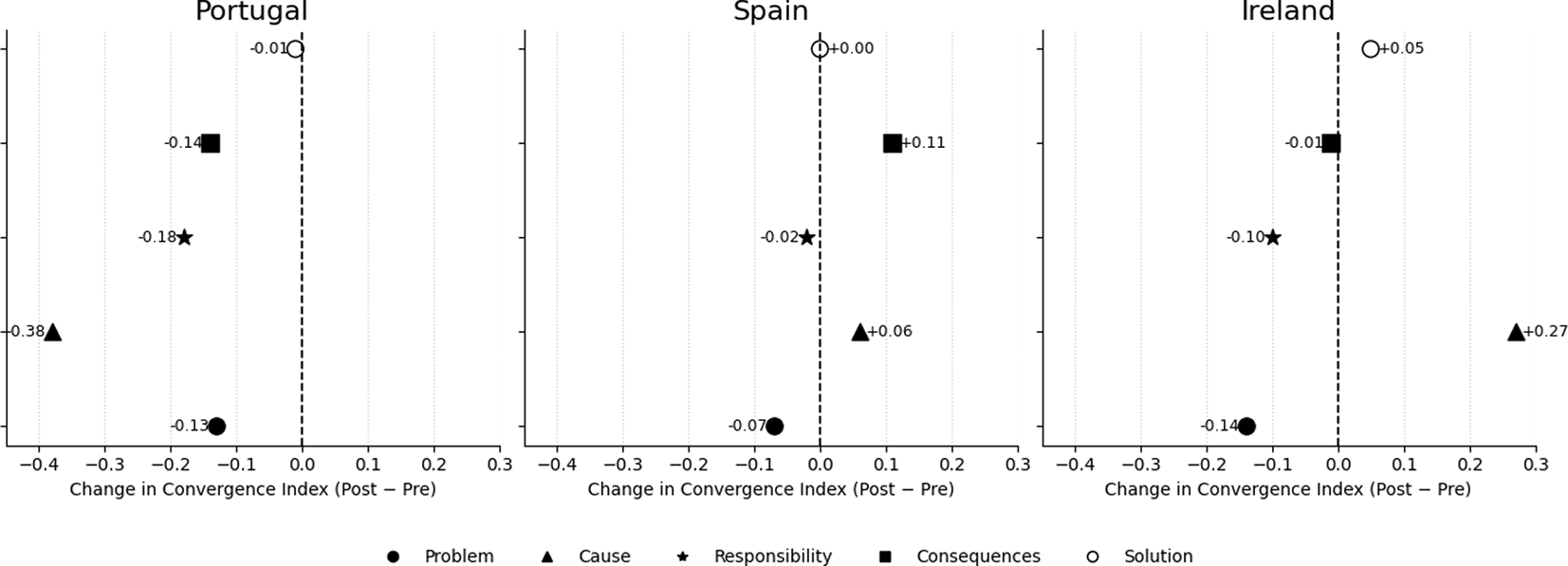
To better understand the mechanisms underlying these aggregate movements, Figure 4 decomposes aggregate changes in the index into their constituent framing dimensions, allowing a more fine-grained interpretation of the mechanisms underlying the observed directional shifts. Rather than constituting an additional test of Hypothesis 2, this analysis clarifies how different interpretative functions contribute to national trajectories of Europeanisation or re-nationalisation.
Dimension-level directional change in narrative orientation by country.
Note: Values report within-country change in the CI (post-crisis minus pre-crisis). Positive values indicate shifts towards more EU-centred narratives; negative values indicate re-nationalisation.

Figure 4. Long description
Panel A: Scatter plot for Portugal. The x-axis represents the change in convergence index (post-pre) ranging from -0.4 to 0.3. The y-axis is not labeled. Different symbols represent problem, cause, responsibility, consequences, and solution. Panel B: Scatter plot for Spain. The x-axis represents the change in convergence index (post-pre) ranging from -0.4 to 0.3. The y-axis is not labeled. Different symbols represent problem, cause, responsibility, consequences, and solution. Panel C: Scatter plot for Ireland. The x-axis represents the change in convergence index (post-pre) ranging from -0.4 to 0.3. The y-axis is not labeled. Different symbols represent problem, cause, responsibility, consequences, and solution.
In Portugal, the post-crisis CI decline is broad-based, with negative changes observed across all five framing dimensions. The strongest re-nationalisation occurs in the Cause (−0.38) and Responsibility (−0.18) dimensions, suggesting that post-crisis coverage increasingly attributes the origins of economic problems and responsibility for outcomes to national actors and institutions. This tendency in the Portuguese press challenges earlier accounts, such as Moury and Standring’s (Reference Moury and Standring2017), who noted the absence of “blame-shifting” to international levels in Portugal during the crisis. It also resonates with recent findings by Nina and Belchior (2025), who show that, while the EU was more frequently held responsible than domestic actors, this tendency weakened during the crisis, with national-level attribution becoming more salient in Portugal and Spain.
In Spain, the relative stability of the aggregate CI masks a mixed and internally differentiated dimensional configuration. While the Problem (−0.07) and Responsibility (−0.02) dimensions exhibit slight re-nationalisation, these shifts are counterbalanced by EU-centring in the Cause (+0.06) and, more clearly, Consequences (+0.11) dimensions. The Solution dimension remains unchanged. This pattern suggests a narrative structure in which responsibility attribution remains politically contested at the national level, while explanations of economic constraints and assessments of their consequences are increasingly situated within a European framework. Such a configuration is consistent with research highlighting the coexistence of national blame attribution and supranational causal interpretation in multilevel governance contexts (Bellucci, Reference Bellucci2014; Hobolt and Tilley, Reference Hobolt and Tilley2014). The net effect is a modest but positive directional movement towards EU-centred narratives.
Ireland displays the most consistent centripetal pattern, albeit of limited magnitude. The post-crisis increase in CI is driven primarily by EU-centring in the Cause (+0.27) and Solution (+0.05) dimensions, while the remaining dimensions show either marginal change or slight re-nationalisation. This configuration suggests a narrative logic in which both explanations of economic developments and proposed policy responses are increasingly located at the European level, even as problem definition and responsibility attribution remain comparatively stable. This pattern is consistent with previous findings indicating that, during the Eurozone crisis, problem-solving capacity and responsibility for economic management were predominantly attributed to the EU or to the Eurozone collectively (Salgado et al., Reference Salgado, Nienstedt, Schneider and Robert2015; Nienstedt et al., Reference Nienstedt, Kepplinger, Quiring and Picard.2015).
Taken together, the evidence from Figures 3 and 4 shows that directional convergence is neither uniform nor automatic. While Spanish and Irish media exhibit modest centripetal shifts in narrative orientation, Portuguese coverage follows a contrasting trajectory marked by systematic re-nationalisation. Rather than pointing to a single crisis-driven dynamic, these patterns suggest that the interpretative direction of media narratives under shared economic constraints remains contingent on domestic political contexts and crisis experiences.
Conclusion
This study examined whether national media in Portugal, Spain, and Ireland converged in their framing of European economic issues before and after the Eurozone crisis, and whether such convergence—where observed—followed a centripetal trajectory, placing the EU at the centre of interpretation. Focusing on five core framing dimensions—Problem, Cause, Responsibility, Consequences, and Solution—the analysis moved beyond issue and actor salience to assess whether Europeanised economic issues were interpreted through shared narrative logics.
Convergence was theorised along two analytically distinct dimensions. Relational convergence referred to cross-national similarity in media narratives arising from shared constraints and crisis-related conditionalities. Directional convergence, in turn, captured within-country reorientation along the national–EU axis, indicating shifts in how media narratives locate political authority, responsibility, and problem-solving capacity. By analytically distinguishing between relational and directional convergence, the article addressed a persistent conceptual ambiguity in the literature on Europeanisation and clarified how different forms of narrative change relate—unevenly and conditionally—to the communicative conditions of an EPS.
Our findings show that the Eurozone crisis coincided with a shared reconfiguration of media coverage across the three national media, most notably through a heightened emphasis on diagnostic and accountability-oriented framing. In this sense, the crisis functioned as a moment of intensified interpretative demand, reinforcing the role of the media as key mediators of political meaning under conditions of uncertainty. However, this common restructuring of coverage did not translate into a systemic reduction of cross-national distance in narrative orientation. On the contrary, relational convergence was not observed at the aggregate level. Cross-national dispersion in narrative orientation increased in the post-crisis period, indicating that exposure to shared constraints and EU-level interventions was insufficient to generate communicative alignment across national public spheres. Relational convergence thus appears contingent and uneven, with the crisis operating as an enabling condition for narrative change rather than as a uniform driver of convergence.
At the same time, the findings confirm that convergence cannot be assessed solely in relational terms. When attention shifts to these within-country dynamics, a more differentiated picture emerges. Directional convergence towards EU-centred narratives occurred selectively rather than uniformly. Spanish and Irish media displayed modest centripetal shifts in narrative orientation following the onset of the crisis, whereas Portuguese coverage followed a contrasting trajectory characterised by systematic re-nationalisation. These divergent paths underline that crises do not produce uniform narrative change. Instead, they operate as conditional moments that intensify the need for interpretation while leaving the direction of narrative reorientation contingent on domestic political contexts, political economies, and established patterns of responsibility attribution.
From the perspective of the EPS, these findings suggest that crisis moments should not be understood as automatic engines of communicative integration. While crises may heighten the salience of EU-level authority and constraint, they do not necessarily generate stable or cumulative convergence in how national publics interpret multilevel governance. Directional convergence towards EU-centred narratives may contribute to shared interpretative reference points across national public spheres, but such convergence remains uneven, fragile, and reversible. Communicative integration, therefore, cannot be inferred simply from increased attention to the EU or from parallel media agendas across countries. An EPS requires not only shared topics, but shared interpretative frameworks through which authority, responsibility, and political solutions are understood. Crises may bring these interpretative dynamics to the surface, but they do not, by themselves, generate such alignment.
The main contribution of this study lies in demonstrating that the relationship between crisis and Europeanisation is fundamentally mediated by narrative interpretation. By disentangling relational similarity from directional change, the analysis shows that convergence is neither linear nor cumulative, but a differentiated and non-linear dynamic. Rather than confirming crisis-driven accounts of inevitable Europeanisation, the findings reveal how moments of systemic stress simultaneously activate centripetal and centrifugal forces in public discourse, producing uneven and often divergent narrative responses across national contexts. In doing so, the article advances a more precise conceptualisation of media convergence and refines how the communicative foundations of an EPS should be understood under conditions of systemic stress.
Supplementary material
The supplementary material for this article can be found at https://doi.org/10.1017/S1755773926100721
Data availability statement
Data is available at: https://zenodo.org/records/17019266.
Funding statement
This work was partially supported by the MAPLE Project (Grant Agreement nº 682125) funded by the European Research Council and by the INCITE-DEM Project (Grand Agreement 101094258) funded by the European Commission.
Competing interests
The authors declare to have no conflict of interest.
Use of AI
During the preparation of this work, the authors made use of ChatGPT for the purposes of language editing and proofreading.




 Open access

