

Introduction
Small ruminants and especially goats play an important role in the economies of rural smallholder families in Mali. Goat milk is an important source of protein for rural populations in the region of Kayes and particularly in the fight against child malnutrition. In recent years, the Institute of Rural Economy of Mali through the Programme “Small Ruminants” conducted research activities to introduce the Guéra goats in rural areas with a view to improve milk production of local goats.
The Guéra goats widely found in Mauritania was introduced at the Agricultural Research Station in Kayes Mali in 1998. This goat breed is raised for its high milk performance (Traoré, Nantoumé and Diarra, Reference Traoré, Nantoumé and Diarra2005). According to the Mauritanian farmers, the origin of this breed is the Canary Islands (Spain). Information about its genetic potential in Mali is sparse. The present research will contribute to a better understanding of the genetic characteristics of Guéra and Sahel goats, through analysis of α S1 casein gene.
In the past few years, α S1 casein gene in ruminants and especially in goats has been used as a tool for genetic characterization (Ramunno et al., Reference Ramunno, Longobardi, Pappalardo, Rando, Di Gregorio, Cosenza, Mariani, Pastore and Masina2001; Angiolillo et al., Reference Angiolillo, Yahyaoui, Sanchez, Pilla and Folch2002; Feligini et al., Reference Feligini, Frati, Cubrik, Brambilla, Parma, Curik, Greppi and Enne2005). This gene is part of the lactoproteins (α S1, α S2, β, κ casein, α lactalbumin and β lactoglobulin), which has been used in several studies to identify genotypes of animals and their links to milk performances (Boulanger, Grosclaude and Mahe, Reference Boulanger, Grosclaude and Mahe1984; Grosclaude et al., Reference Grosclaude, Mahe, Brignon, Di stasio and Jeunet1987). Today, several alleles of these genes have been identified and characterized in different species and breeds. For the α S1 casein gene in goats, seven alleles (A, B, C, D, E, F and O) with four levels of casein synthesis: 3.6 g/l for strong alleles (A, B and C), 1.6 g/l for the allele E, 0.6 g/l for low alleles (D and F) and 0 in goats with the allele null (0), were identified (Grosclaude et al., Reference Grosclaude, Mahe, Brignon, Di stasio and Jeunet1987).
In Alpine goats, it has been found that the goats with genotype AA produce significantly less milk than those with genotypes AE, AF, EE and FF, the highest milk yield being observed in goats with EE genotype (Barbieri et al., Reference Barbieri, Manfredi, Elsen, Ricordeau, Bouillon, Grosclaude, Mahe and Bibe1995). At birth, kids with genotype AA had an average weight significantly lower than those with AE and EF genotypes.
Alleles A, B and C are recognized to be the ancestral types carried nucleotide substitutions, whereas allele E is from an insertion of 458 bp nucleotides at the last exon of the gene (Martin, Reference Martin1993). F allele is characterized through epitasis abnormalities in form of deletions of 37 amino acid residues (Barbieri et al., Reference Barbieri, Manfredi, Elsen, Ricordeau, Bouillon, Grosclaude, Mahe and Bibe1995).
Studies on genetic characterization of casein gene complex in West African goats (Red Sokoto, West African Dwarf Nigeria, West African Dwarf Cameroon and Borno) were carried out by Caroli et al. (Reference Caroli, Chiatti, Chessa, Rignanese, Ibeagha-awemu and Erhardt2007). The four casein genes α S1, β, α S2 and κ were typed at the DNA level. A polymerase chain reaction (PCR) single-strand conformation polymorphism method was implemented for the identification of CSN1S1*F allele simultaneously with A/0(1), B/E, N and the new allele (CSN1S1*B’). The investigations showed a high frequency of CSN1S1*B’ in all the population.
Vacca et al. (Reference Vacca, Ouled Ahmed Ben Ali, Carcangiu, Pazzola and Dettori2009) investigated on genetic diversity at the four casein genes in the Arbi goat, a native goat breed from Tunisia. The most frequent allele at the CSN1S1 locus was B, followed by A and 01. Analysis on α S1 gene were carried out in a dairy goat herd (Saanen and Alpine) in Southeastern region of Brazil (Soares et al., Reference Soares, Rodrigues, Mognol, Ribeiro, Silva and Brancalhão2009). Three different regions of the α S1 casein gene (CSN1S1) were investigated to determine the frequencies of major alleles for null, low, intermediate and high milk protein expression. Allele E was the most frequent in both Saanen (0.35) and Alpine (0.48) breeds followed with F allele (0.30).
Information on casein genes by Guéra goat is rare. The relatively high milk yield in Guéra goat, 1–3 litres, in 142 days of lactation length (Traoré, Nantoumé and Diarra, Reference Traoré, Nantoumé and Diarra2005), could be better understood through molecular genetics analysis. The objective of the investigations was to analyse the genetic polymorphism of α S1 casein in Guéra and Sahel goats and to determine the genetic diversity in the studied populations. The present study was focused on identifying the B and E alleles of the CSN1S1 gene using allele specifics primers.
Materials and methods
Materials
Descriptive characteristics of the breeds
Guéra goat
In this study, 53 Guéra goats were randomly sampled from the experimental herd of the Regional Center for Agronomic Research in Kayes (Mali). The breed is characterized by a great diversity in coat colour (uniform: white, brown, black, etc. or pied). It is distinguished through its long hair. The average weight of mature males and females are 44 and 36 kg, respectively (Traoré, Nantoumé and Diarra, Reference Traoré, Nantoumé and Diarra2007).
Sahel goat
During the study 48 Sahel goats were also randomly sampled in farmer's herds in Ségala in the region of Kayes (Mali). This breed is raised in the Sahelian zone of West Africa. It is found from Mali to Chad. It is kept for its milk and meat. The Sahel goat appears in various coat colours: uniform white, brown, black or pied. The average weight of mature males and females are 35 and 25 kg, respectively (Nantoumé, Traoré and Diarra, Reference Nantoumé, Traoré and Diarra2005).
Methods
Sampling and DNA extraction
Blood samples from 53 Guéra goats and 48 Sahel goats were collected using confetti paper type Whatman 903 for molecular genetic analysis.
DNA was extracted from blood on confetti paper using the Truett et al. (Reference Truett, Heeger, Mynett, Truett, Walken and Warmen2000) protocol. For alkaline lysis, a solution of 25 mM NaOH, 0.2 mM disodium EDTA, pH 12 was used. The precipitation of DNA molecules was obtained with absolute ethanol in the presence of potassium acetate (8 M, pH 7.4). A solution of neutralization (40 mM Tris–HCl, pH 5) was also used to stabilize DNA. Final DNA was obtained using 70 percent ethanol by washing.
DNA concentrations ranging between 18 and 58 ng/μl measured with a spectrometer (Eppendorf Bio Photometer) at 260 and 280 nm, were used for PCR.
Allelic specific amplification by PCR for identification of B and E alleles
For the PCR, 50 ng of genomic DNA was amplified in a reaction volume of 30 µl using 150 nM primer, 50 mM KCL, 10 mM Tris–HCl (pH 8.3), 2.5 mM MgCl2, 200 µM dNTPs and 1.25 U Taq polymerase (Invitrogen).
Primers were selected according to the study of Feligini et al. (Reference Feligini, Frati, Cubrik, Brambilla, Parma, Curik, Greppi and Enne2005) for the identification of B alleles (90 bp) and/or E (550 bp) at the locus CSN1S1 (exon 19). The accession number of gene at the Genbank is X72221.
The thermocycler thermal-type PTC-200 (M) Research was used for amplification with the following programme: initial denaturation at 94 °C for 3 min, denaturation at 94 °C for 45 s by 25 cycles, hybridizing at 59 °C for 45 s, extension at 72 °C for 1 min, final extension at 72 °C for 5 min and the conservation at 4 °C.
The PCR products were migrated in 2 percent agarose gel (BDH electran), for 60 min at 100 V. Ethidium bromide (1 µM) was used to reveal the bands.
Statistical analysis
The frequencies of B and E alleles were calculated using the formula:
 $${\rm pB} = \left[{\rm 2\lpar BB\rpar } + \lpar {\rm BE}\rpar \right]/ 2N{\rm\comma \; }$$
 $${\rm qE} =\left[{\rm 2\lpar EE\rpar } + \lpar {\rm BE}\rpar \right]/ 2N\comma \;$$
where pB and qE are the frequencies of B and E alleles, BB and EE are the genotypes and N is the total number.
The heterozygous rates (observed and expected) were evaluated assuming that the herds were in genetic equilibrium of Hardy–Weinberg.
The observed heterozygosity (Ho) = 1/N Σ Hi, where N is the total number of loci,
Hi is the heterozygosity at the locus i.
The expected heterozygosity (He) = 1 − (f12 + f22 + …+ fk2) = 1 − Σ f2, where f are frequencies f1, f2,…,fk.
Total heterozygosity (HT) = 1 − (f1T 2 + f2T 2 + …fkT 2) = 1 − Σ fT 2, where, fT is the total frequency.
The genetic diversity index was calculated using FST (HT − He)/HT, where FST is the genetic diversity indice, HT is the total heterozygosity and He is the expected heterozygosity.
Results
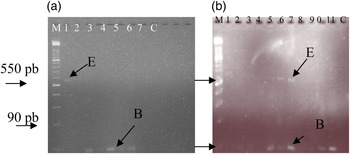
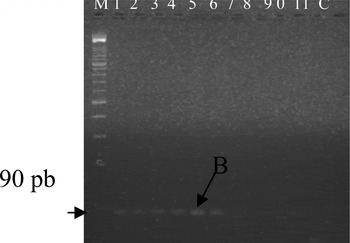
Three genotypes (BB, BE and EE) were observed in Guéra goats samples (Figure 1a and b), whereas only genotype (BB) was observed in Sahel goat samples (Figure 2).
(a) Amplification of the α S1 casein gene (E 19) in 2 percent agarose gel for Guéra goat; M: marker 14; lane 1: EE lanes 2–7: BB lane C: negatif control. (b) Amplification of the α S1 casein gene (E 19) in 2 percent agarose gel for Guéra goat; M: marker 14; lanes 6 et 7: BE lanes 5; 8; 9; 10; 11: BB line C: negatif control.

Amplification of the α S1 casein gene (E 19) in 2 percent agarose gel for Sahel goat; M: marker 14; lanes 1 à 6: BB; lanes 7; 8; 9; 10: negatifs lane C: negatif control.

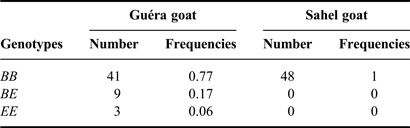
In the Guéra goat, homozygous BB (41 animals) was the most frequent genotype (0.77) followed by the heterozygous BE (nine animals) with 0.17 and the homozygous EE (three animals) with 0.06. In Sahel goat, all animals (48) were homozygous BB.
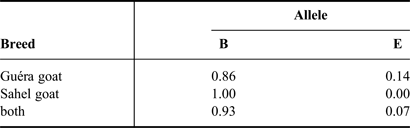
The genotypic and allelic frequencies in the two breeds are shown in Tables 1a and 1b.
Genotype frequencies at the locus αS1 casein (exon 19) in Guéra and Sahel goat

Allele frequencies at the locus αS1 casein (exon 19) in Guéra and Sahel goat

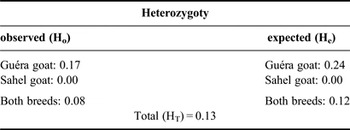
The frequency of allele B in the two breeds and that of E is given in Table 2.
Observed, expected and total heterozgosity at the locus αS1 casein (exon 19) in Guéra and Sahel goat

Different heterozygosity rates were evaluated. The genetic diversity index (FST) in the two breeds was low (0.07).
Discussion
Previous studies (Missohou, Talaki and Maman Laminou, Reference Missohou, Talaki and Maman Laminou2006) on the casein gene on African goat breeds including those of West Africa have shown that the allelic frequencies were low and the most identified allele were A and B (strong allele). Further investigations (Caroli et al., Reference Caroli, Chiatti, Chessa, Rignanese, Ibeagha-awemu and Erhardt2007) on the casein group genes using four breeds or varieties of goats in Africa, namely the Sokoto red goat (Nigeria), the Borno goat (Nigeria), the Nigerian and Cameroon dwarf goat, showed that the A and B alleles were more frequent with a predominance of B allele (0.37). A new allele, named CSN1S1*B’, was identified with a high frequency in all populations, ranging from 0.295 (West African Dwarf Cameroon) to 0.405 (Borno). The intermediate E allele was also observed with a very low frequency of 0.01 in Sokoto red goats.
In our study, the results obtained in the Sahel goats were expected. They indicate the non-introduction of exotic breeds in the studied herd in Ségala (Kayes). In contrast, the Guéra goats introduced in Africa for several decades, from Spain was subject of many questions relating its wide range of milk performances observed at the Agricultural Research Center in Kayes (Mali). The study made on the Guéra goat breed by Traoré, Nantoumé and Diarra (Reference Traoré, Nantoumé and Diarra2005) showed an average daily milk quantity of 1.9 litres ranging from 1 to 3 litres, with a total milk production of 262 litres in 142 days. The milk protein percentage was estimated to 3.9 percent (Traoré, Nantoumé and Diarra, Reference Traoré, Nantoumé and Diarra2005).
It appears that the Guéra goat carried the allele (E) with a frequency of 0.14. This allele is widely identified in some European dairy goats (Feligini et al., Reference Feligini, Frati, Cubrik, Brambilla, Parma, Curik, Greppi and Enne2005) such as the Alpine goat and in the Red Sokoto at a low frequency (Caroli et al., Reference Caroli, Chiatti, Chessa, Rignanese, Ibeagha-awemu and Erhardt2007). The allelic frequency of E in our study is higher than those reported by Missohou, Talaki and Maman Laminou (Reference Missohou, Talaki and Maman Laminou2006) with 0.11.
Studies on Spanish dairy goats, especially those of the Canary Islands breeds showed a high frequency of the allele E (Jordana et al., Reference Jordana, Amills, Diaz, Angulo, Serradilla and Sanchez1996). A phylogeny relationship between the Guéra goat and Spanish goat breed was not investigated in the present study. However, the relatively high milk production of Guéra could be explained by the presence of the allele E in this breed. The genetic diversity observed was low, due to relatively low heterozygosity rate. The absence of the E allele in Sahel goats is largely responsible for these low values (0.07). It would be interesting to carry out further studies including other populations of Sahel goat in Mali to confirm the absence of E allele.
Allele B was predominant in both breeds. The methodology used in the present study cannot identify the difference between alleles B and B’ of CSN1S1 like by Caroli et al. (Reference Caroli, Chiatti, Chessa, Rignanese, Ibeagha-awemu and Erhardt2007). More investigations using other methodology (PCR–SSCP, PCR–RFLP and DNA sequencing) are necessary to better genetic characterization of Malian goat breeds.
Conclusions
Genetic diversity is very important for animal breeding. Our study revealed polymorphism in α S1 casein gene in Guéra goat. Allele B and the intermediate allele E were found in this breed. For the Sahel goat, no polymorphism was identified, B was the unique allele. The heterozygosity rates and the genetic diversity index (FST) in the two breeds were low.
The presence of allele E in Guéra goats could explain the relatively high milk production of this breed and its origin in the Canary Islands. The information obtained for Guéra goat regarding the α S1 casein gene might be used in genetic improvement schemes of local goats in Mali.
Acknowledgements
The authors express their gratitude to “Institut d'Economie Rurale du Mali” for the help and support of this research.