INTRODUCTION
The sea urchin Strongylocentrotus intermedius is native to the coast of Hokkaido of Japan and Far East Russia (Agatsuma, Reference Agatsuma and Lawrence2013) and was introduced into China from Japan for aquaculture in 1989 (Chang et al., Reference Chang, Ding, Song and Yang2004). It is one of the most popular seafoods in the Japanese market (Agatsuma et al., Reference Agatsuma, Sakai, Andrew and Lawrence2004; Kayaba et al., Reference Kayaba, Tsuji, Hoshikawa, Kikuchi, Kawabata, Otaki and Watanabe2012). Increasing market demand has generated intense interest in aquaculture of this species in both China and Japan. The annual production of sea urchins was already 6791 tonnes in China in 2014 (Zhao, Reference Zhao2015). Gonads are the only edible part of sea urchins (Keesing & Hall, Reference Keesing and Hall1998), which indicates their commercial value. Thus, improvement of gonad production and quality of market size (test greater than or equal to 4 cm) has become a research interest in its aquaculture (e.g. Lawrence et al., Reference Lawrence, Cao, Chang, Wang, Ye, Lawrence and Watts2009, Reference Lawrence, Chang, Cao, Lawrence and Watts2011).
Feeding regimes are an important concern for improving gonad production and quality of sea urchins in land-based aquaculture. Insufficient feeding causes adverse growth and gonad production, while redundant feeding results in feed waste and water pollution (McBride et al., Reference McBride, Lawrence, Lawrence and Mulligan1999). Although an optimal sea-based feeding regime of sea urchins was established by James & Siikavuopio (Reference James and Siikavuopio2012), aquaculturalists still feed sea urchins ad libitum in land-based aquaculture, because no efficient intermittent feeding regime has been established to effectively support growth, gonad production and quality of juvenile, small and large sea urchins (McCarron et al., Reference McCarron, Burnell and Mouzakitis2009; Zhao et al., Reference Zhao, Zhang, Chang, Zhou, Song and Luo2013; Cárcamo, Reference Cárcamo2015).
McCarron et al. (Reference McCarron, Burnell and Mouzakitis2009) found that a weekly macroalgae feeding/fasting regime did not efficiently support the growth of the sea urchin Paracentrotus lividus. This failure might be due to a too long intermittent duration. However, a subsequent study by Zhao et al. (Reference Zhao, Zhang, Chang, Zhou, Song and Luo2013) showed that even a diel intermittent feeding regime of macroalgae cannot effectively support the growth and gonad production of the sea urchin S. intermedius. This suggests that macroalgae probably cannot effectively support the growth and gonad production of sea urchins regardless of how short the intermittent duration is. Formulated feeds have been well documented to effectively support gonad production in a number of sea urchin species (e.g. Pearce et al., Reference Pearce, Daggett and Robinson2002; Lawrence et al., Reference Lawrence, Chang, Cao, Lawrence and Watts2011) and have been widely used in the sustainable aquaculture of sea urchins (Lawrence & Lawrence, Reference Lawrence, Lawrence, Lawrence and Guzmán2004). Thus, it is likely that formulated feed probably supports an effective intermittent feeding regime for the sea urchins. Considering the information of the previous studies (McCarron et al., Reference McCarron, Burnell and Mouzakitis2009; Zhao et al., Reference Zhao, Zhang, Chang, Zhou, Song and Luo2013), we hypothesize that both formulated feed and relatively short intermittent duration are essential to establish an effective intermittent feeding regime for sea urchins in land-based facilities.
Sea urchin gonads consist of two types of cells, storage cells and reproductive cells. The percentage of each type of cells in gonads has significant effects on the production and quality of gonads throughout the reproductive cycle (James & Siikavuopio, Reference James and Siikavuopio2011). The reproductive cycle has been divided into four stages, which are inter-gametogenesis, pre-gametogenesis, gametogenesis and spawning, respectively (James & Siikavuopio, Reference James and Siikavuopio2011). The gonad performance (e.g. gonad colour, texture and sweetness) is generally excellent before gametogenesis, but becomes bitter after gametogenesis (Unuma, Reference Unuma, Yokota, Matranga and Smolenicka2002; Unuma & Walker, Reference Unuma, Walker, Harris, Böttger, Walker and Lesser2010; Kayaba et al., Reference Kayaba, Tsuji, Hoshikawa, Kikuchi, Kawabata, Otaki and Watanabe2012). Therefore, inhibiting gametogenesis has been proposed to maintain the gonad quality of sea urchins in aquaculture (Unuma & Walker, Reference Unuma, Walker, Harris, Böttger, Walker and Lesser2010). Limited food availability has a negative effect on the roe of sea urchins to produce reproductive cells (James & Siikavuopio, Reference James and Siikavuopio2011). Further, when the starvation period is prolonged, the quantity of the reproductive cells decreased and the development is also delayed (Li et al., Reference Li, Qin and Xin2007). Thus, an optimal intermittent feeding regime probably inhibits gonad development and consequently maintains gonad performance of sea urchins.
The aims of our study were to investigate (1) whether all the traits (test diameter, test height, body weight, gonad weight, gonad index, gonad moisture, L*, a* and b*) of sea urchins in continuous and intermittent feeding regimes show a significant increase from the initial conditions; (2) whether intermittent feeding regimes significantly affect growth, gonad production and quality of S. intermedius compared with the continuous feeding regime; (3) whether intermittent feeding inhibits the gonad development and consequently maintains gonad performance of S. intermedius; (4) whether an optimal intermittent feeding regime can be established for the land-based aquaculture of S. intermedius.
MATERIALS AND METHODS
Sea urchins
Sea urchins with a test diameter about 5 cm were bought from Dalian Bilong Seafood Co., Ltd (38°49′5″N 121°23′17″E) and then transported to the Key Laboratory of Mariculture & Stock Enhancement in North China's Sea, Ministry of Agriculture, Dalian Ocean University (38°51′59″N 121°32′55″E) on 13 November 2014. Sea urchins were cultured in the laboratory, fed kelp Saccharina japonica ad libitum for 2 weeks to acclimatize the laboratory environment and then fasted 2 weeks to uniform nutritional status before the experiment began on 12 December 2014. Before the experiment, 10 sea urchins selected randomly were measured for test diameter, height and body weight, and were subsequently dissected to measure gonad weight, gonad moisture, lightness (L*), redness (a*) and yellowness (b*).
Feeding regimes
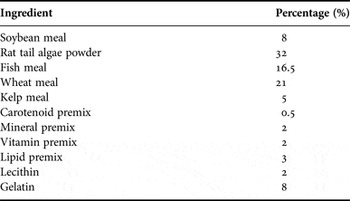
Formulated feed was prepared at the Key Laboratory of Mariculture & Stock Enhancement in North China's Sea, Ministry of Agriculture, Dalian Ocean University. The composition of the formulated feed is presented in Table 1. Four feeding regimes were used: fasting half day and then feeding half day (S0.5), fasting 1 day and then feeding 1 day (S1), fasting 2 days and then feeding 2 days (S2), and continuous feeding (S0). Formulated feed was provided at daybreak and taken out at almost the same time of the next day with new formulated feed provided for sea urchins in the groups of S0, S1 and S2. Our previous study showed that there was no significant difference in food consumption, body weight and gonad production between nocturnal and diurnal feeding regimes of S. intermedius (Zhao et al., Reference Zhao, Zhang, Chang, Zhou, Song and Luo2013). For the individuals in the group of S0.5, therefore, formulated feed was provided into each cage at nightfall and taken out at next daybreak, although feeding S. intermedius in the morning is also reasonable.
Composition of the formulated feed (dry weight).

At the beginning of experiment, 40 sea urchins were haphazardly selected for the four groups and randomly allocated to 40 individual cylindrical plastic cages (10 cm in diameter, 15 cm high). Their test diameter, height and body weight were measured using digital vernier caliper (Mahr, MarCal 16EW, Germany) and electronic balance (G&G, JJ500, USA), respectively. All individuals were held in the laboratory under natural photoperiod and at seawater temperature 9–12°C, 30–33‰ salinity and pH 7.9–8.1 for the duration of the 8-week experiment.
Test diameter, test height, body weight
At the end of this experiment, test diameter, test height and body weight of all individuals were measured.
Total food consumption and feed conversion ratio
Sea urchins in each feeding regime were fed a formulated feed ad libitum with a known weight. Uneaten formulated feed was collected, weighed, dried for 4 days at 80°C and then reweighed. The daily food consumption (FI) was calculated according to Zhu (Reference Zhu2005) and Zhao et al. (Reference Zhao, Feng, Wei, Zhang, Sun and Chang2016) with a few revisions:
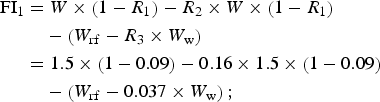 $$\eqalign{{\rm FI}_1 & = W \times \left(1 - R_1 \right) - R_2 \times W \times \left(1 - R_1 \right) \cr &\quad- \left(W_{{\rm rf}} - R_3 \times W_{\rm w} \right) \cr & = 1.5 \times \left(1-0.09\right) - 0.16{\rm} \times1.5 \times \left(1-0.09\right) \cr &\quad - \left(W_{{\rm rf}} - 0.037 \times W_{\rm w} \right);} $$
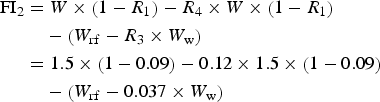 $$\eqalign{{\rm FI}_2 & = W \times \left(1 - R_1 \right) - R_4 \times W \times \left(1 - R_1 \right) \cr&\quad - \left(W_{{\rm rf}} - R_3 \times W_{\rm w} \right) \cr & = 1.5 \times \left(1-0.09\right) - 0.12{\rm} \times 1.5 \times \left(1-0.09\right) \cr &\quad - \left(W_{{\rm rf}} - 0.037 \times W_{\rm w} \right)} $$
FI1 = food consumption (g) of sea urchins in S0, S1 and S2; FI2 = food consumption (g) of sea urchins in S0.5; W rf = weight of uneaten feed after drying; W w = weight of seawater present in the uneaten feed; W = amount of feed provided = 1.5 g; R 1 = water content rate of the formulated feed = 0.09; R 2 = formulated feed loss rate of S0, S1 and S2 = 0.16; R 3 = rate of residual elements of seawater after drying = 0.037; R 4 = the formulated feed loss rate of S0.5 = 0.12.
Feed conversion ratio (FCR) was calculated as follows:
 $${\rm FCR} (\% ) = {\rm FI}/\left( {W2 - W1} \right) \times 100$$
W2 = final body weight; W1 = initial body weight; FI = food consumption (g)
Gonad weight and moisture
After dissection, five gonads were collected and their wet weights were measured using an electronic balance. One gonad of each individual was dried for 4 days at 80°C to measure gonad moisture. Gonad moisture was calculated according to the following formula:
 $${\rm GM}\,\left(\% \right) = \left({\rm GW} - {\rm DW}\right)/{\rm GW} \times 100,$$
GM = gonad moisture, GW = wet weight of gonad, DW = dried weight of gonad.
Gonad colour and sweetness
Gonad colour of sea urchins was objectively measured by the L*, a* and b* values (L* = lightness, a* = redness, b* = yellowness) using PANTONE Color Cue ® 2 (Carlstadt, NJ. USA) under the standard light of D65. The subjective assessment of gonad colour and sweetness were evaluated under standard light of D65 by 6 persons who were familiar with colour and sweetness analysis of sea urchin gonads. The ranking method was slightly revised from Pearce et al. (Reference Pearce, Daggett and Robinson2002):
-
Gonad colour (rating 1–4):
-
1 = bright yellow or orange
-
2 = paler yellow or orange, mustard
-
3 = yellow- brown, orange – brown, red – brown, cream
-
4 = any other colour (e.g. dark brown, grey)
-
-
Gonad sweetness (rating 1–5):
-
1 = sweet
-
2 = slightly sweet
-
3 = not sweet, not bitter
-
4 = slightly bitter
-
5 = bitter
-
Crude protein content of gonads
The crude protein content of gonads was determined using Semi-micro Kjeldahl nitrogen, which was fully described by Chen et al. (Reference Chen, Shi, Wang and Zhang2008).
Development of gonad reproductive stage
Paraffin sections were made and examined using a microscope (Nikon Eclipse 50i, Japan) according to Ren et al. (Reference Ren, Tian and Liang2007). Gonad development was divided into four stages as follows (for example, Walker et al., Reference Walker, Unuma, Lesser and Lawrence2007; James & Siikavuopio, Reference James and Siikavuopio2011):
-
Stage I: Inter-gametogenesis: This stage occurs after spawning. The gonads look empty even though residual reproductive cells are still in them. At the end of this stage, NP cells increase and reproductive cells begin to appear around the edges of the gonad.
-
Stage II: Pre-gametogenesis: At this stage, reproductive cells continue to increase in both size and number, and are relatively clearly appearing around the periphery of the gonads.
-
Stage III: Gametogenesis: During this stage, the reproductive cells are developing steadily, occupying the centre of the gonad gradually and extremely clear while NP cells are decreasing in number and size.
-
Stage IV: Spawning and pre-spawning: At this stage, the centre of gonad is full of reproductive cells while NP cells are completely exhausted. At the end of this stage, all or some of the reproductive cells will be released from the gonad. Spawning will occur.
Statistical analysis
Before statistical analysis, the data was tested for homogeneity of variance and normal distribution. An independent-samples T test was used to compare the differences of all experimental traits between the final and initial conditions. A one-way ANOVA was used to analyse the differences in all experimental traits of sea urchins fed different regimes. Duncan's multiple comparisons were performed when significant differences were found. The stage frequency of gonad development was analysed using Kruskal–Wallis H test. All data analyses were performed using SPSS 17.0 statistical software. A probability level of P < 0.05 was considered significant.
RESULTS
Survival
One S. intermedius died in both S1 and S2, while no individuals died in S0 and S0.5 during the experimental period of 8 weeks.
Comparison of the final conditions to the initial conditions
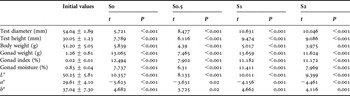
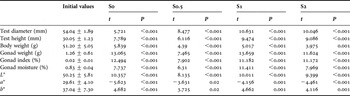
All experimental traits except a* (including test diameter, test height, body weight, gonad weight, gonad index, gonad moisture, L* and b*) of S. intermedius in the four feeding regimes showed significant increase compared with their initial conditions (P < 0.05, Table 2). Compared with the initial conditions, a* significantly decreased in sea urchins of all experimental groups (P < 0.05, Table 2).
Statistical results of t-test to analyse the differences of experimental traits between the final and initial conditions (mean ± SD).
Test diameter, test height, body weight
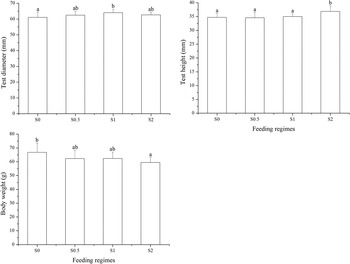
Feeding regimes significantly affected test diameter, test height and body weight of S. intermedius (P < 0.05, Figure 1). Test diameter of S. intermedius in S0 was significantly less than that of individuals in S1 (P < 0.05, Figure 1). Test height of S. intermedius in S2 was significantly higher than those in other groups (P < 0.05, Figure 1). Body weight of S. intermedius in S0 was significantly greater than that in S2 (P < 0.05, Figure 1), but not in S0.5 and S1 (P > 0.05, Figure 1).
Test diameter, test height and body weight of Strongylocentrotus intermedius in the four feeding regimes fed a formulated feed (mean ± SD). Different letters (a and b) above the bars represent a significant difference between groups (P < 0.05).

Total food consumption and feed conversion ratio
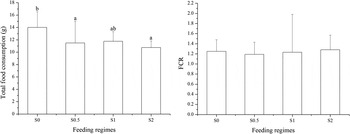
Total food consumption of S. intermedius in S0 was significantly greater than those in S0.5 and S2 (P < 0.05, Figure 2). However, there was no significant difference of feed conversion ratio (FCR) among the four groups (P > 0.05, Figure 2).
Total food consumption and feed conversion ratio of Strongylocentrotus intermedius in the four feeding regimes fed a formulated feed (mean ± SD). Different letters (a and b) above the bars represent a significant difference between groups (P < 0.05).

Gonad weight and moisture
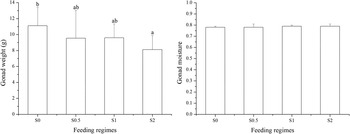
Gonad weight of S. intermedius in S2 was significantly less than those in S0 (P < 0.05, Figure 3). However, gonad moisture showed no significant difference among the four experimental groups (P > 0.05, Figure 3).
Gonad weight and moisture of Strongylocentrotus intermedius in the four feeding regimes fed a formulated feed (mean ± SD). Different letters (a and b) above the bars represent a significant difference between groups (P < 0.05).

Gonad colour and sweetness
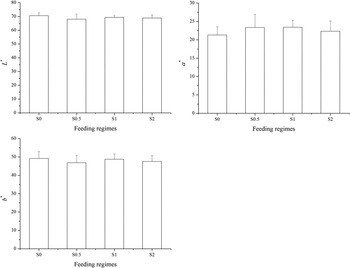
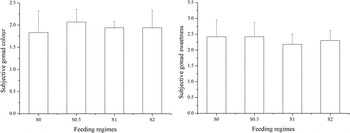
Neither objective nor subjective assessments of gonad colour and sweetness showed significant differences among the four experimental groups (P > 0.05, Figures 4 & 5).
The objective assessment including L*, a* and b* of Strongylocentrotus intermedius in the four feeding regimes fed a formulated feed (mean ± SD).

The subjective assessment including colour and sweetness of Strongylocentrotus intermedius in the four feeding regimes fed a formulated feed (mean ± SD).

Crude protein content of gonads
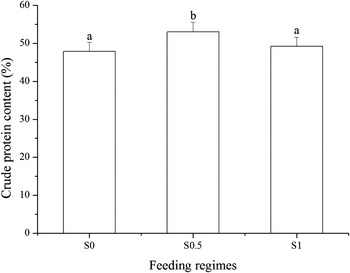
Feeding regimes significantly affected the crude protein content of gonads. Crude protein contents of S. intermedius in S0.5 was significantly higher than those in S0 and S1 (P < 0.05, Figure 6).
The crude protein content of Strongylocentrotus intermedius in the four feeding regimes fed a formulated feed (mean ± SD). Different letters (a and b) above the bars represent a significant difference between groups (P < 0.05).

Gonad development
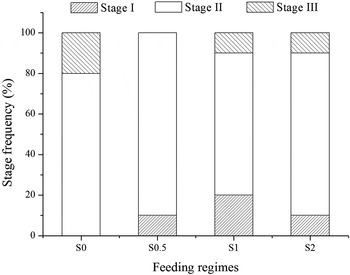
The 10 individuals in initial conditions included eight individuals with gonad development at stage I and two individuals at stage II.
At the end of the experiment, feeding regime did not significantly affect the stage frequency of gonad development, although there were obvious differences in the stage frequency of S. intermedius in different feeding regimes (P > 0.05, Figure 7).
Frequency of stages of gonad development of Strongylocentrotus intermedius in the four feeding regimes fed a formulated feed. Note: group S0 and S0.5 contained 10 individuals (N = 10) while group S1 and S2 contained nine individuals (N = 9).

Gonad development was presented as males and females together, although it might be different between males and females.
DISCUSSION
Growth and gonad production are the two most critical concerns in sea urchin aquaculture. Macroalgae feeding with weekly intermittent duration did not significantly support growth and gonad production in adult sea urchins P. lividus (McCarron et al., Reference McCarron, Burnell and Mouzakitis2009). Even for juvenile sea urchins (Loxechinus albus) fed algal food, relatively long intermittent duration did not efficiently support their growth (Cárcamo, Reference Cárcamo2015). In the present study, compared with the initial conditions, formulated feed with relatively short intermittent durations (0.5–2 days) significantly supported both growth and gonad production of S. intermedius. This clearly indicates the efficiency of formulated feed (Chang et al., Reference Chang, Lawrence, Cao and Lawrence2005; Lawrence et al., Reference Lawrence, Chang, Cao, Lawrence and Watts2011) and the importance of relatively short intermittent durations to support growth and gonad production of S. intermedius.
To establish an optimal intermittent feeding regime, we compared a suite of commercially important traits of S. intermedius fed at different frequencies. Both body and gonad weights of S. intermedius in S2 were significantly less than those in S0, while those in S0.5 and S1 did not show any significant difference to S0. This indicates that the feeding regime of S2 (feeding/fasting every 2 days) is relatively long and cannot effectively support growth and gonad production of S. intermedius. This result is consistent with the previous finding that long-term intermittent feeding of macroalgae cannot effectively support growth and gonad production of sea urchins (McCarron et al., Reference McCarron, Burnell and Mouzakitis2009). A reasonable explanation is that relatively long-term food restriction stopped the gonad growth of sea urchins (McCarron et al., Reference McCarron, Burnell and Mouzakitis2009; James & Siikavuopio, Reference James and Siikavuopio2012).
To save formulated feed and thus avoid potential waste is one of the key reasons to establish an optimal intermittent feeding regime. In the present study, S. intermedius in S0.5 consumed significantly less formulated feed than those in S0, although not significantly less than those in S1. This result is consistent with previous findings that intermittent feeding can significantly reduce the food consumption of sea urchins (Zhao et al., Reference Zhao, Zhang, Chang, Zhou, Song and Luo2013). A possible reasonable explanation is that food consumption is directly related to the frequency of feeding (Lawrence et al., Reference Lawrence, Plank and Lawrence2003). The food conversion factor is equally important to determine the aquaculture profitability compared with the increase in size of sea urchins (James & Siikavuopio, Reference James and Siikavuopio2012). In this study, the FCR results showed no significant difference among the four experimental groups. Significantly higher food consumption with equal growth and FCR of S. intermedius compared with group S0.5 clearly suggests that a continuous feeding regime is probably unnecessary for sea urchin aquaculture.
In addition to somatic and gonadal growth, gonad quality is crucial for the commercial value of sea urchins. Gonad quality mainly constitutes gonad colour, flavour, texture and nutrient components. To further evaluate the efficiency of S0.5 and S1, we comparatively investigated their effects on gonad quality of S. intermedius. Gonad colour and sweetness showed no significant difference among the feeding regimes. This result is consistent with the finding of McCarron et al. (Reference McCarron, Burnell and Mouzakitis2009) that L*, a* and b* (L* = lightness, a* = redness, b* = yellowness) were not significantly different between the large sea urchins fed continuously and intermittently.
Compensatory growth had never been found in sea urchins, although it has been well documented in other marine animals (e.g. Ali et al., Reference Ali, Nicieza and Wootton2003; Cai et al., Reference Cai, Duan and Wei2009). Protein is one of the most important nutrient components in sea urchin feed (Watts et al., Reference Watts, Lawrence, Lawrence and Lawrence2013). In the present study, we found that S. intermedius in S0.5 showed significantly greater crude protein content in their gonads than those in S0 and S1. This indicates that S0.5 is a suitable intermittent feeding regime to promote compensatory growth of gonad protein in sea urchins. Because S0.5 and S1 showed no significant difference on other experimental traits except crude protein content, we conclude that S0.5 (fasting half day and then feeding half day) is the optimal intermittent feeding regime for S. intermedius fed a formulated feed. This justified our assumption that both formulated feed and relatively short intermittent duration are essential to establish an optimal intermittent feeding regime for land-based culture of sea urchins. Notably, the current study did not compare the effects between nocturnal and diurnal feeding, because our previous study showed that there was no significant difference in food consumption, body weight and gonad production between nocturnal and diurnal feeding regimes of S. intermedius (Zhao et al., Reference Zhao, Zhang, Chang, Zhou, Song and Luo2013).
Feeding regime did not significantly affect the stage frequency of gonad development. But we found obvious differences in gonad development of S. intermedius in different feeding regimes. For example, stage I was not found in S. intermedius fed continuously compared with those fed intermittently. This indicates there was a trend for slower but no significant difference in gonad development of S. intermedius fed intermittently. This result was consistent with a previous finding that limited feed availability has a negative effect on the reproductive cycle (James & Siikavuopio, Reference James and Siikavuopio2011). The lack of significance in our study probably results from the relatively short experimental duration of 8 weeks (James, Reference James2007). Because of the relationship between gonad development and performances (Unuma & Walker, Reference Unuma, Walker, Harris, Böttger, Walker and Lesser2010; Kayaba et al., Reference Kayaba, Tsuji, Hoshikawa, Kikuchi, Kawabata, Otaki and Watanabe2012), this also partly explains why feeding regimes did not significantly affect gonad colour and sweetness in the present study.
To be noted, the present study focused on only one size class of S. intermedius (54.90 ± 2.28 mm of test diameter). Previous studies showed that there were significant size-specific effects from intermittent feed regimes (McCarron et al., Reference McCarron, Burnell and Mouzakitis2009; James & Siikavuopio, Reference James and Siikavuopio2012; Zhao et al., Reference Zhao, Zhang, Chang, Zhou, Song and Luo2013). Thus, further studies should be carried out to investigate the effects of short-term continuous and intermittent feeding regimes on food consumption, growth, gonad production and quality of sea urchins of relatively small sizes.
In conclusion, (1) compared with initial conditions, all involved traits except a* (test diameter, test height, body weight, gonad weight, gonad index, gonad moisture, L* and b*) showed a significant increase at the end of the experiments; (2) only the longest term feeding regime tested in this trial (S2) significantly negatively affected growth and gonad production of S. intermedius fed a formulated feed; (3) there was a trend but this was not significant for inhibiting gonad development of S. intermedius in intermittent feeding regimes and there was no change in the gonad colour and sweetness; (4) the results of the current study indicate that the optimal intermittent feeding regime for S. intermedius fed a formulated feed is S0.5 (fasting half day and then feeding half day) in a land-based system. To our knowledge, the present study is the first report of finding an effective intermittent feeding regime for land-based cultured sea urchins of relatively large size, and thus has direct application potential in the field of aquaculture.
ACKNOWLEDGEMENTS
We thank Lunchao Hu and Chenchen Jing for assistance. All authors do not have any conflict of interest.
FINANCIAL SUPPORT
This work was supported by a research project granted by Liaoning Department of Education (L2015087) and the Chinese National 863 Project (2012AA10A412).