Introduction
Surgical draping for head and neck procedures can be difficult because of the need for both anaesthetic and surgical access.Reference Landsman and Allora1–Reference Tuerk6 Major neck operations often involve head drapes. In cases such as tracheostomy or laryngectomy, the anaesthetist is required to withdraw the endotracheal tube during surgery. When the head drape covers the mouth, access to the endotracheal tube is difficult. This limits control of the endotracheal tube during manipulation and risks the sterility of the operative field.
We report a new technique of draping for major neck operations that permits easy access to the endotracheal tube and maintains operative sterility at all times.
Technique
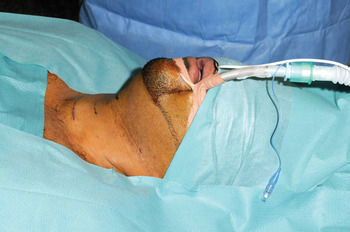
Following routine skin preparation, the patient's head is enclosed in a head drape that excludes the endotracheal tube. This is facilitated by briefly disconnecting the endotracheal tube from the anaesthetic circuit while the head drape is being applied. The head drape controls the patient's hair and preserves the sterility of the postero-superior surgical field (Figure 1).
The first head drape is placed cranial to the mouth and excludes the endotracheal tube.

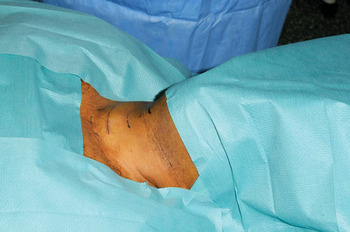
A second adhesive drape is then placed at the level of the mandible in order to cover the endotracheal tube and the mouth (Figure 2). This drape preserves the sterility of the antero-superior surgical field.
The second, adhesive head drape is placed across the chin to cover both the mouth and the endotracheal tube.

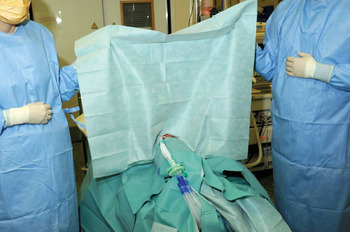
When the endotracheal tube needs to be manipulated or withdrawn intra-operatively, the second drape can be lifted with ease (Figure 3). This permits easy access to the endotracheal tube and mouth while preserving an aseptic operative field.
The second head drape can be lifted intra-operatively to access the endotracheal tube. The airway can be adjusted and withdrawn at any stage, while maintaining sterility of the operative field.

Conclusion
Surgical draping for major neck operations can limit the anaesthetist's access to the airway and compromise sterility of the surgical field during endotracheal tube manipulation. The draping technique we report avoids these problems by separating the anaesthetic and surgical fields while providing ample space for both. We have been using this technique for a number of years and have found it to be highly effective.