



1. Introduction
Stellar Intensity Interferometry (SII), first demonstrated by Hanbury Brown & Twiss (Hanbury Brown 1956; Hanbury Brown & Twiss 1956) and implemented at the Narrabri Observatory (Hanbury Brown et al. 1974), measures correlations in the intensity fluctuations of light collected by separated telescopes. SII is more robust against atmospheric turbulence and optical imperfections than Amplitude Interferometry, allowing observations at short optical wavelengths and over long baselines ( $\gt100~m$) (Dravins et al. 2012). Imaging Atmospheric Cherenkov Telescopes (IACTs), designed for very-high-energy (VHE;
 $E\gt100~GeV$) gamma-ray observations, are built in arrays of telescopes with large light-collecting areas and photodetectors with nanosecond-level timing resolution, making them naturally well suited for the implementation of a cost-effective SII. In the recent years, VERITAS (Abeysekara et al. 2020), MAGIC (Acciari et al. 2020; Abe et al. 2024) and H.E.S.S (Zmija et al. 2024) collaborations have all demonstrated successful angular size measurements of massive stars using this technique.
2. The MAGIC+LST-1 SII
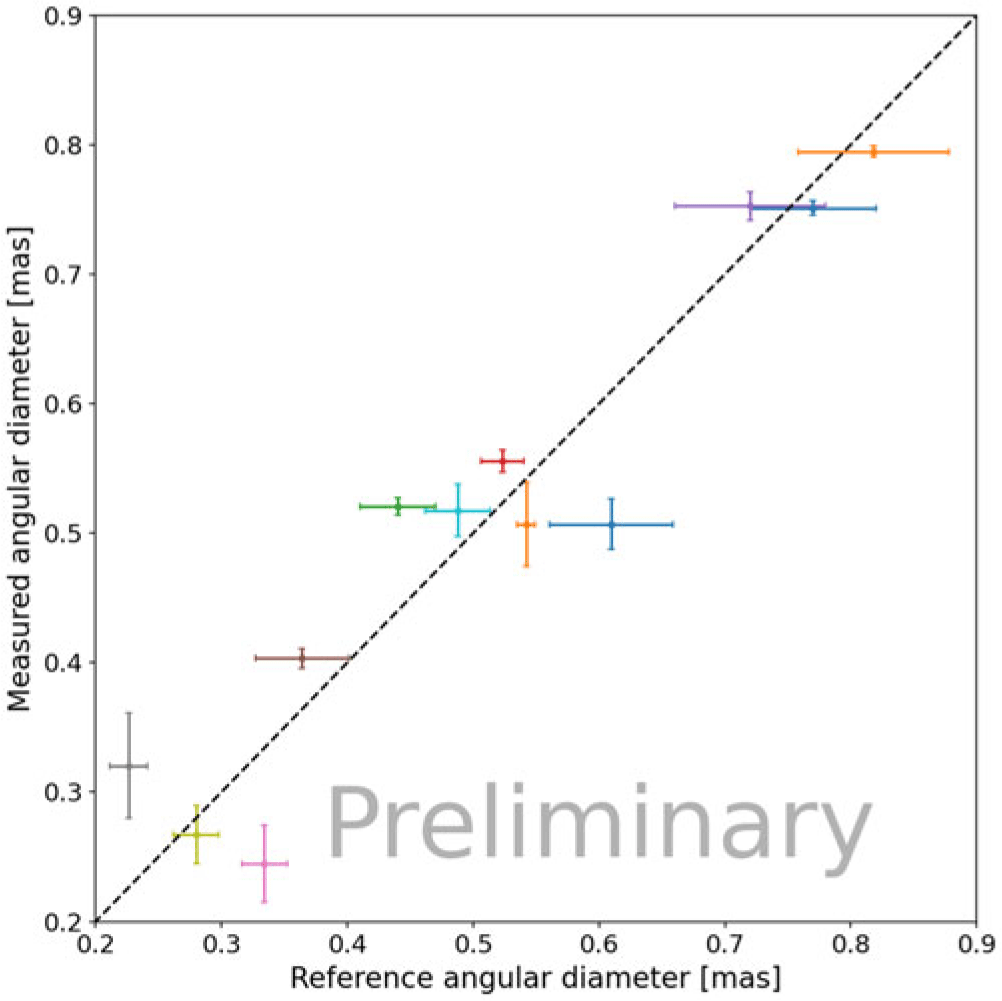
The MAGIC telescopes are a system of two IACTs of 17 m mirror dish diameter, with a separation of 87 m, located at the Roque de los Muchachos Observatory (ORM) in La Palma, Spain. Technical modifications were implemented to enable intensity interferometry observations and, since the system was fully commissioned in 2022, the MAGIC SII has been regularly observing during full Moon periods when the night-sky background light is too intense for VHE observations (Abe et al. 2024). The Large-Sized Telescopes (LSTs) will be the largest IACTs of the Cherenkov Telescope Array Observatory (CTAO), with a mirror dish diameter of 23 m. LST-1 is the first LST built in the CTAO North site at the ORM, with a separation of 95 m and 147 m to MAGIC-II and MAGIC-I respectively. The technical modifications described in Cifuentes et al. (2024), have allowed the LST-1 to perform SII observations jointly with MAGIC, since 2024. The SII observing mode has no impact on the VHE observations, but has rather effectively increased the scientific duty cycle of both MAGIC and CTAO LST-1. Observations with the MAGIC+LST-1 SII are carried out regularly during full Moon periods, mainly targeting calibration stars for the commissioning of the instrument (see preliminary results for calibration stars on Figure 1), and some scientific targets such as the Be star  $\gamma$ Cas.
Measurements of the stellar angular diameter of 12 calibration stars, assuming a uniform disk profile, with the MAGIC+LST-1 SII. The measurements are represented as a function of their reference values from MAGIC SII (Blue band), when available, or from CHARA (Near-Infrared) otherwise. For the MAGIC+LST-1 SII, only statistical errors are shown.

3. Resolving Be stars with SII
Optical interferometry has become a key technique to study the effects of rapid rotation in stars and their circumstellar environments (van Belle 2012; Rivinius et al. 2013). Nevertheless, the presence of a decretion disk around active Be stars makes it very challenging to directly measure the photospheric oblateness of these objects with Amplitude Interferometry, due to the non-negligible contribution of the disk at the wavelengths where amplitude interferometers operate. The capability of SII to observe at short optical wavelengths (425-26 nm in the case of MAGIC+LST-1 SII), where the disk contribution is less significant, makes it a promising technique to resolve the photospheres of Be stars.
3.1.
 $\gamma$ Cas results with the MAGIC+LST-1 SII

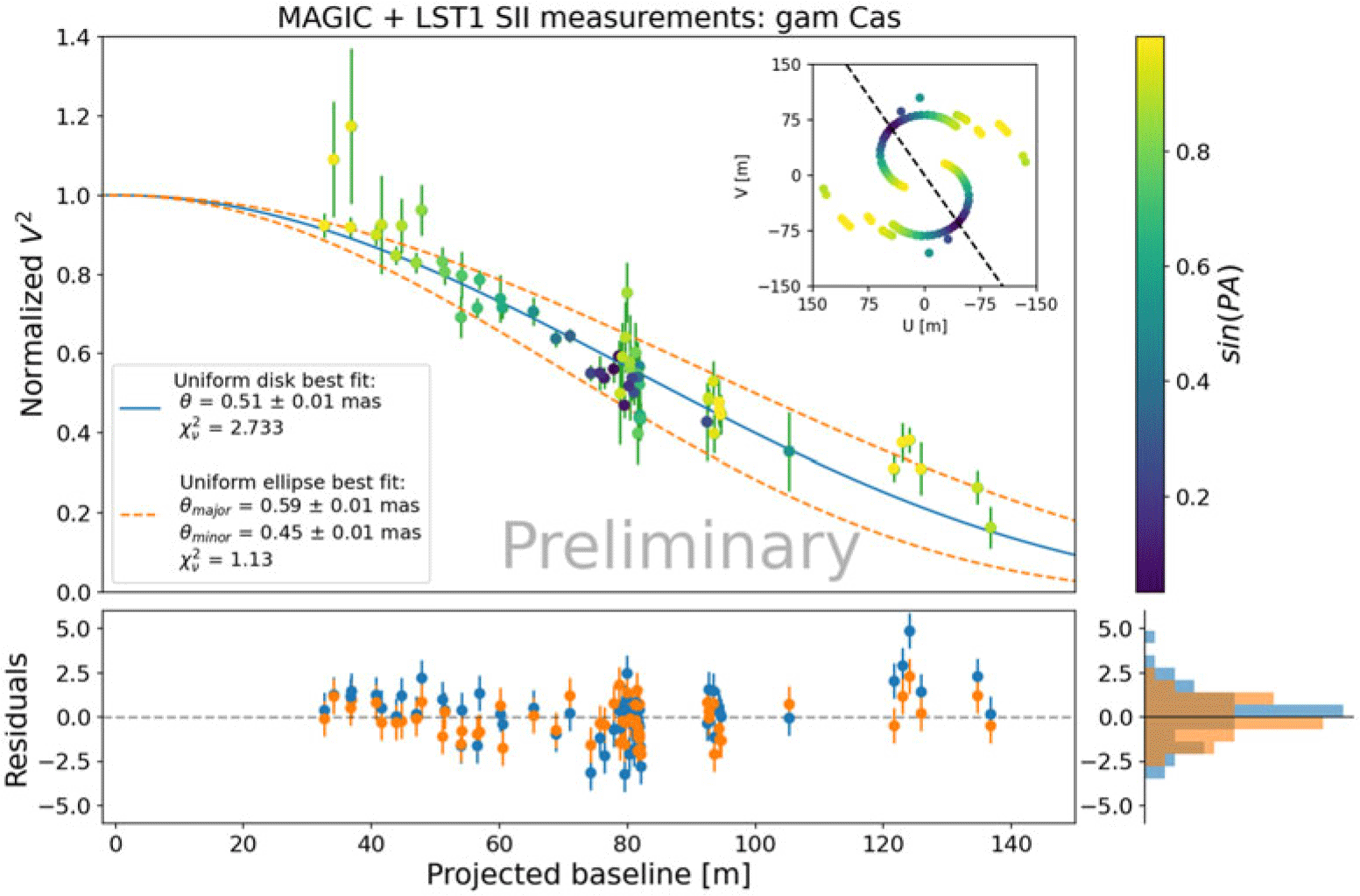
The Be star  $\gamma$ Cas (HD 5394, type B0.5IVe) has been observed with the MAGIC SII since 2022 and with the MAGIC+LST-1 SII since 2024. Preliminary results from the analysis of the MAGIC+LST-1 SII 2024 observations (see Figure 2), show that a uniform ellipse model is preferred over a uniform disk model, with a 3% statistical uncertainty on the axial ratio, consistent with a close-to-critical rotation velocity. Our preliminary best-fit values for the uniform ellipse model show a very good agreement with independent results obtained with the VERITAS SII (Archer et al. 2025), as shown in Table 1.
Measurements of  $\gamma$ Cas with the MAGIC+LST-1 SII. Normalized squared visibilities are shown as a function of the baseline. The best fit for the uniform disk (blue) and uniform ellipse (orange) models are shown as well as the residuals for each fit (using the same colors). The color code of the visibility points indicates the position angle of each baseline, as shown on the inner figure showing the UV-plane coverage. The reduced
 $\chi ^2$ as well as the residuals show a preference for the uniform ellipse model.

Best-fit parameters for the uniform ellipse model of  $\gamma$ Cas obtained with two IACT-based SII systems: MAGIC+LST-1 SII and VERITAS SII.

Table 1 Long description
A table comparing best-fit parameters for the uniform ellipse model of γ Cas using two IACT-based SII systems. The table has 2 columns and 4 rows. Column headers are Parameter, MAGIC+LST-1 SII, and VERITAS SII. Row 1: θmaj (mas), 0.59 ± 0.01 (stat), 0.55 ± 0.03 (stat) ±0.03 (sys). Row 2: θmin/θmaj, 0.76 ± 0.02 (stat), 0.78 ± 0.02 (stat) ±0.01 (sys). Row 3: Equatorial position angle (deg), 34 ± 3 (stat), 26 ± 5 (stat) ±7 (sys).
Although the uniform ellipse model provides a good first approximation, it fails to describe the full complexity of  $\gamma$ Cas’ photosphere, neglecting observable features such as the gravity darkening (von Zeipel 1924; Espinosa Lara & Rieutord 2011). Combining the MAGIC+LST1 SII results with those inferred from spectroscopic data, we aim to provide a more complete description of its photosphere in a future publication (in progress).
4. Future Prospects
Thanks to the improved sensitivity, angular resolution and UV-plane coverage enabled by the addition of LST-1 to the MAGIC SII, we are also exploring the possibility of resolving massive close binaries with the MAGIC+LST-1 SII. Simulations for Spica ( $\alpha$ Vir), a B1 III-IV + B2 V binary with a period of 4.0145 days and a maximum separation of 1.5 mas (Herbison-Evans & Cramer 1969; Tkachenko et al. 2016), show that we could constrain the angular separation, position angle and angular diameters of both components in just a few observing nights (Raiola et al. 2025). Further improvements are expected, as the remaining three LSTs of the CTAO North array will be added to the MAGIC+LST-1 SII, once they are operational. With 15 independent baselines of up to 260m the MAGIC+4LSTs SII will have an unprecedented angular resolution of 0.15 mas, together with an improved sensitivity and very dense UV-plane coverage (Jiménez Martínez et al. 2025).
A more dramatic breakthrough in sensitivity could be achieved by implementing an advanced IACT-based SII system, such as the “I3T concept” (Gori et al. 2021) or, more specifically for MAGIC and the CTAO LSTs: “The Butterfly’s Eye Camera for IACTs”, in which segments of the IACT mirror would be focused onto different pixels of its camera (J. Cortina et al., submitted).
5. Conclusions
The MAGIC+LST-1 SII provides a great tool for studying massive stars, thanks to its high angular resolution and sensitivity to blue wavelengths. Since the addition of LST-1 to the MAGIC SII, we have been able to increase the scientific capabilities of the system, allowing for the study of more complex systems than before, such as Be stars and massive close binaries. Preliminary results for  $\gamma$ Cas are very promising, showing the capabilities of our system to resolve the photosphere of Be stars with active decretion disks.
The addition of the remaining LSTs of CTAO North will greatly enhance the capabilities of the system in the near future, opening the possibility of studying a wider variety of targets. To increase the sensitivity of the system even more, further technical upgrades are under study.
Acknowledgements
The MAGIC collaboration would like to thank the Instituto de Astrofísica de Canarias for the excellent working conditions at the Observatorio del Roque de los Muchachos in La Palma. The financial support of the German BMBF, MPG and HGF; the Italian INFN and INAF; the Swiss National Fund SNF; the grants PID2019-104114RB-C31, PID2019-104114RB-C32, PID2019-104114RB-C33, PID2019-105510GB-C31, PID2019-107847RB-C41, PID2019-107847RB-C42, PID2019-107847RB-C44, PID2019-107988GB-C22, PID2022-136828NB-C41, PID2022-137810NB-C22, PID2022-138172NB-C41, PID2022-138172NB-C42, PID2022-138172NB-C43, PID2022-139117NB-C41, PID2022-139117NB-C42, PID2022-139117NB-C43, PID2022-139117NB-C44 funded by the Spanish MCIN/AEI/ 10.13039/501100011033 and “ERDF A way of making Europe”; the Indian Department of Atomic Energy; the Japanese ICRR, the University of Tokyo, JSPS, and MEXT; the Bulgarian Ministry of Education and Science, National RI Roadmap Project DO1-400/18.12.2020 and the Academy of Finland grant nr. 320045 is gratefully acknowledged. This work was also been supported by Centros de Excelencia “Severo Ochoa” y Unidades “María de Maeztu” program of the Spanish MCIN/AEI/ 10.13039/501100011033 (CEX2019-000920-S, CEX2019-000918-M, CEX2021-001131-S) and by the CERCA institution and grants 2021SGR00426 and 2021SGR00773 of the Generalitat de Catalunya; by the Croatian Science Foundation (HrZZ) Project IP-2022-10-4595 and the University of Rijeka Project uniri-prirod-18-48; by the Deutsche Forschungsgemeinschaft (SFB1491) and by the Lamarr-Institute for Machine Learning and Artificial Intelligence; by the Polish Ministry Of Education and Science grant No. 2021/WK/08; and by the Brazilian MCTIC, CNPq and FAPERJ.
The CTAO-LST project gratefully acknowledge financial support from the following agencies and organizations:
Conselho Nacional de Desenvolvimento Científico e Tecnológico (CNPq) Grant 309053/2022-6 and Fundação de Amparo à Pesquisa do Estado do Rio de Janeiro (FAPERJ) Grants E-26/200.532/2023 and E-26/211.342/2021, Fundação de Amparo à Pesquisa do Estado de São Paulo (FAPESP), Fundação de Apoio à Ciência, Tecnologia e Inovação do Paraná - Fundação Araucária, Ministry of Science, Technology, Innovations and Communications (MCTIC), Brasil; Ministry of Education and Science, National RI Roadmap Project DO1-153/28.08.2018, Bulgaria; Croatian Science Foundation (HrZZ) Project IP-2022-10-4595, Rudjer Boskovic Institute, University of Osijek, University of Rijeka, University of Split, Faculty of Electrical Engineering, Mechanical Engineering and Naval Architecture, University of Zagreb, Faculty of Electrical Engineering and Computing, Croatia; Ministry of Education, Youth and Sports, MEYS LM2023047, EU/MEYS CZ.02.1.01/0.0/0.0/16_013/0001403, CZ.02.1.01/0.0/0.0/18_046/0016007, CZ.02.1.01/0.0/0.0/16_019/0000754, CZ.02.01.01/00/22_008/0004632 and CZ.02.01.01/00/23_015/0008197 Czech Republic; CNRS-IN2P3, the French Programme d’investissements d’avenir and the Enigmass Labex, This work has been done thanks to the facilities offered by the Univ. Savoie Mont Blanc - CNRS/IN2P3 MUST computing center, France; Max Planck Society, German Bundesministerium für Forschung, Technologie und Raumfahrt (Verbundforschung/ErUM), the Deutsche Forschungsgemeinschaft (SFB 1491) and the Lamarr-Institute for Machine Learning and Artificial Intelligence, Germany; Istituto Nazionale di Astrofisica (INAF), Istituto Nazionale di Fisica Nucleare (INFN), Italian Ministry for University and Research (MUR), and the financial support from the European Union – Next Generation EU under the project IR0000012 - CTA+ (CUP C53C22000430006), announcement N.3264 on 28/12/2021: “Rafforzamento e creazione di IR nell’ambito del Piano Nazionale di Ripresa e Resilienza (PNRR)”; ICRR, University of Tokyo, JSPS, MEXT, Japan; JST SPRING - JPMJSP2108; Narodowe Centrum Nauki, grant number 2023/50/A/ST9/00254, Poland; The Spanish groups acknowledge the Spanish Ministry of Science and Innovation and the Spanish Research State Agency (AEI) through the government budget lines PGE2022/28.06.000X.711.04, 28.06.000X.411.01 and 28.06.000X.711.04 of PGE 2023, 2024 and 2025, and grants PID2019-104114RB-C31, PID2019-107847RB-C44, PID2019-105510GB-C31, PID2019-104114RB-C33, PID2019-107847RB-C43, PID2019-107847RB-C42, PID2019-107988GB-C22, PID2021-124581OB-I00, PID2021-125331NB-I00, PID2022-136828NB-C41, PID2022-137810NB-C22, PID2022-138172NB-C41, PID2022-138172NB-C42, PID2022-138172NB-C43, PID2022-139117NB-C41, PID2022-139117NB-C42, PID2022-139117NB-C43, PID2022-139117NB-C44, PID2022-136828NB-C42, PID2024-155316NB-I00, PDC2023-145839-I00 funded by the Spanish MCIN/AEI/10.13039/501100011033 and by ERDF/EU and NextGenerationEU PRTR; CSIC PIE 202350E189; the “Centro de Excelencia Severo Ochoa” program through grants no. CEX2020-001007-S, CEX2021-001131-S, CEX2024-001442-S; the “Unidad de Excelencia María de Maeztu” program through grants no. CEX2019-000918-M, CEX2020-001058-M; the “Ramón y Cajal” program through grants RYC2021-032991-I funded by MICIN/AEI/10.13039/501100011033 and the European Union “NextGenerationEU”/PRTR and RYC2020-028639-I; the “Juan de la Cierva-Incorporación” program through grant no. IJC2019-040315-I and “Juan de la Cierva-formación” through grant JDC2022-049705-I; the “Viera y Clavijo” postdoctoral program of Universidad de La Laguna, funded by the Agencia Canaria de Investigación, Innovación y Sociedad de la Información. They also acknowledge the “Atracción de Talento” program of Comunidad de Madrid through grant no. 2019-T2/TIC-12900; “MAD4SPACE: Desarrollo de tecnologías habilitadoras para estudios del espacio en la Comunidad de Madrid” (TEC-2024/TEC-182) project, Doctorado Industrial (IND2024/TIC34250) and Ayudas para la contratación de personal investigador predoctoral en formación (PIPF-2023/TEC-29694) funded by Comunidad de Madrid; the La Caixa Banking Foundation, grant no. LCF/BQ/PI21/11830030; Junta de Andalucía under Plan Complementario de I+D+I (Ref. AST22_0001) and Plan Andaluz de Investigación, Desarrollo e Innovación as research group FQM-322; Project ref. AST22_00001_9 with funding from NextGenerationEU funds; the “Ministerio de Ciencia, Innovación y Universidades” and its “Plan de Recuperación, Transformación y Resiliencia”; “Consejería de Universidad, Investigación e Innovación” of the regional government of Andalucía and “Consejo Superior de Investigaciones Científicas”, Grant CNS2023-144504 funded by MICIU/AEI/10.13039/501100011033 and by the European Union NextGenerationEU/PRTR, the European Union’s Recovery and Resilience Facility-Next Generation, in the framework of the General Invitation of the Spanish Government’s public business entity Red.es to participate in talent attraction and retention programmes within Investment 4 of Component 19 of the Recovery, Transformation and Resilience Plan; Junta de Andalucía under Plan Complementario de I+D+I (Ref. AST22_00001), Plan Andaluz de Investigación, Desarrollo e Innovación (Ref. FQM-322). “Programa Operativo de Crecimiento Inteligente” FEDER 2014-2020 (Ref. ESFRI-2017-IAC-12), Ministerio de Ciencia e Innovación, 15% co-financed by Consejería de Economía, Industria, Comercio y Conocimiento del Gobierno de Canarias; the “CERCA” program and the grants 2021SGR00426 and 2021SGR00679, all funded by the Generalitat de Catalunya; and the European Union’s NextGenerationEU (PRTR-C17.I1). This work is funded/Co-funded by the European Union (ERC, MicroStars, 101076533). This research used the computing and storage resources provided by the Port d’Informació Científica (PIC) data center. State Secretariat for Education, Research and Innovation (SERI) and Swiss National Science Foundation (SNSF), Switzerland; The research leading to these results has received funding from the European Union’s Seventh Framework Programme (FP7/2007-2013) under grant agreements No 262053 and No 317446; This project is receiving funding from the European Union’s Horizon 2020 research and innovation programs under agreement No 676134; ESCAPE - The European Science Cluster of Astronomy & Particle Physics ESFRI Research Infrastructures has received funding from the European Union’s Horizon 2020 research and innovation programme under Grant Agreement no. 824064.
Full Author List: CTAO-LST Project
K. Abe $^{1}$, S. Abe
 $^{2}$, A. Abhishek
 $^{3}$, F. Acero
 $^{4,5}$, A. Aguasca-Cabot
 $^{6}$, I. Agudo
 $^{7}$, C. Alispach
 $^{8}$, D. Ambrosino
 $^{9}$, F. Ambrosino
 $^{10}$, L. A. Antonelli
 $^{10}$, C. Aramo
 $^{9}$, A. Arbet-Engels
 $^{11}$, C. Arcaro
 $^{12}$, T.T.H. Arnesen
 $^{13}$, P. Aubert
 $^{14}$, A. Baktash
 $^{15}$, M. Balbo
 $^{8}$, A. Bamba
 $^{16}$, A. Baquero Larriva
 $^{17,18}$, U. Barres de Almeida
 $^{19}$, J. A. Barrio
 $^{17}$, L. Barrios Jiménez
 $^{13}$, I. Batkovic
 $^{12}$, J. Baxter
 $^{2}$, J. Becerra González
 $^{13}$, J. Bernete
 $^{20}$, A. Berti
 $^{11}$, E. Bissaldi
 $^{21}$, O. Blanch
 $^{22}$, G. Bonnoli
 $^{23}$, P. Bordas
 $^{6}$, A. Briscioli
 $^{24}$, G. Brunelli
 $^{25,26}$, J. Buces
 $^{17}$, A. Bulgarelli
 $^{25}$, I. Burelli
 $^{27}$, L. Burmistrov
 $^{28}$, M. Cardillo
 $^{29}$, S. Caroff
 $^{14}$, A. Carosi
 $^{10}$, R. Carraro
 $^{10}$, F. Cassol
 $^{24}$, D. Cerasole
 $^{30}$, A. Cerviño Cortínez
 $^{17}$, Y. Chai
 $^{11}$, G. Chon
 $^{11}$, L. Chytka
 $^{31}$, G. M. Cicciari
 $^{32,33}$, J. L. Contreras
 $^{17}$, J. Cortina
 $^{20}$, H. Costantini
 $^{24}$, M. Croisonnier
 $^{22}$, M. Dalchenko
 $^{28}$, G. D’Amico
 $^{22}$, P. Da Vela
 $^{25}$, F. Dazzi
 $^{10}$, A. De Angelis
 $^{12}$, M. de Bony de Lavergne
 $^{34}$, R. Del Burgo
 $^{9}$, C. Delgado
 $^{20}$, J. Delgado Mengual
 $^{35}$, D. della Volpe
 $^{28}$, B. De Lotto
 $^{27}$, L. Del Peral
 $^{36}$, R. de Menezes
 $^{37}$, G. De Palma
 $^{21}$, V. de Souza
 $^{38}$, C. Díaz
 $^{20}$, L. Di Bella
 $^{39}$, A. Di Piano
 $^{25}$, F. Di Pierro
 $^{37}$, R. Di Tria
 $^{30}$, L. Di Venere
 $^{40}$, D. Dominis Prester
 $^{41}$, A. Donini
 $^{10}$, D. Dorner
 $^{42}$, L. Eisenberger
 $^{42}$, D. Elsässer
 $^{39}$, G. Emery
 $^{7}$, L. Feligioni
 $^{24}$, F. Ferrarotto
 $^{43}$, A. Fiasson
 $^{14,44}$, L. Foffano
 $^{29}$, Y. Fukazawa
 $^{45}$, S. Gallozzi
 $^{10}$, R. Garcia López
 $^{13}$, S. Garcia Soto
 $^{20}$, C. Gasbarra
 $^{46}$, D. Gasparrini
 $^{46}$, J. Giesbrecht Paiva
 $^{19}$, N. Giglietto
 $^{21}$, F. Giordano
 $^{30}$, N. Godinovic
 $^{47}$, T. Gradetzke
 $^{39}$, R. Grau
 $^{22}$, J. Green
 $^{11}$, G. Grolleron
 $^{14}$, S. Gunji
 $^{48}$, P. Günther
 $^{42}$, J. Hackfeld
 $^{49}$, D. Hadasch
 $^{50}$, M. Hashizume
 $^{45}$, T. Hassan
 $^{20}$, K. Hayashi
 $^{51,2}$, L. Heckmann
 $^{11,52}$, M. Heller
 $^{28}$, J. Herrera Llorente
 $^{13}$, N. Hiroshima
 $^{2}$, D. Hoffmann
 $^{24}$, D. Horns
 $^{15}$, J. Houles
 $^{24}$, D. Hrupec
 $^{53}$, R. Imazawa
 $^{45}$, T. Inada
 $^{2}$, S. Inoue
 $^{54,2}$, K. Ioka
 $^{55}$, M. Iori
 $^{43}$, T. Itokawa
 $^{2}$, A. Iuliano
 $^{9}$, J. Jahanvi
 $^{27}$, I. Jimenez Martinez
 $^{11}$, J. Jimenez Quiles
 $^{22}$, I. Jorge Rodrigo
 $^{20}$, J. Jurysek
 $^{56}$, M. Kagaya
 $^{51,2}$, V. Karas
 $^{57}$, H. Katagiri
 $^{58}$, D. Kerszberg
 $^{22,59}$, T. Kiyomoto
 $^{60}$, Y. Kobayashi
 $^{2}$, K. Kohri
 $^{61}$, P. Kornecki
 $^{7}$, H. Kubo
 $^{2}$, J. Kushida
 $^{1}$, B. Lacave
 $^{28}$, M. Lainez
 $^{17}$, A. Lamastra
 $^{10}$, L. Lemoigne
 $^{14}$, M. Linhoff
 $^{39}$, S. Lombardi
 $^{10}$, F. Longo
 $^{62}$, R. López-Coto
 $^{7}$, A. López-Oramas
 $^{13}$, S. Loporchio
 $^{30}$, J. Lozano Bahilo
 $^{36}$, F. Lucarelli
 $^{10}$, H. Luciani
 $^{62}$, P. L. Luque-Escamilla
 $^{63}$, M. Makariev
 $^{64}$, M. Mallamaci
 $^{32,33}$, D. Mandat
 $^{56}$, K. Mannheim
 $^{42}$, F. Marini
 $^{12}$, M. Mariotti
 $^{12}$, P. Marquez
 $^{65}$, G. Marsella
 $^{33,32}$, J. Martí
 $^{63}$, D. Martin
 $^{17}$, O. Martinez
 $^{66,67}$, G. Martínez
 $^{20}$, M. Martínez
 $^{22}$, M. Massa
 $^{3}$, D. Mazin
 $^{2,11}$, J. Méndez-Gallego
 $^{7}$, S. Menon
 $^{10,68}$, E. Mestre Guillen
 $^{69}$, D. Miceli
 $^{12}$, T. Miener
 $^{17}$, J. M. Miranda
 $^{66}$, M. Molero Gonzalez
 $^{13}$, E. Molina
 $^{13}$, T. Montaruli
 $^{28}$, A. Moralejo
 $^{22}$, A. Morselli
 $^{46}$, V. Moya
 $^{17}$, A. L. Müller
 $^{56}$, H. Muraishi
 $^{70}$, S. Nagataki
 $^{71}$, T. Nakamori
 $^{48}$, A. Neronov
 $^{72}$, D. Nieto Castaño
 $^{17}$, M. Nievas Rosillo
 $^{13}$, L. Nikolic
 $^{3}$, K. Noda
 $^{54,2}$, V. Novotny
 $^{73}$, S. Nozaki
 $^{2}$, M. Ohishi
 $^{2}$, A. Okumura
 $^{74,75}$, R. Orito
 $^{76}$, L. Orsini
 $^{3}$, J. Otero-Santos
 $^{12}$, P. Ottanelli
 $^{77}$, M. Palatiello
 $^{10}$, G. Panebianco
 $^{25}$, D. Paneque
 $^{11}$, R. Paoletti
 $^{3}$, J. M. Paredes
 $^{6}$, M. Pech
 $^{56,31}$, M. Pecimotika
 $^{22}$, M. Peresano
 $^{11}$, F. Perrotta
 $^{78}$, F. Pfeifle
 $^{42}$, M. Pihet
 $^{7}$, G. Pirola
 $^{11}$, C. Plard
 $^{14}$, F. Podobnik
 $^{3}$, M. Polo
 $^{20}$, C. Pozo-Gonzaléz
 $^{7}$, E. Prandini
 $^{12}$, S. Rainò
 $^{30}$, R. Rando
 $^{12}$, W. Rhode
 $^{39}$, M. Ribó
 $^{6}$, G. Rodriguez Fernandez
 $^{46}$, M. D. Rodríguez Frías
 $^{36}$, A. Roy
 $^{45}$, A. Ruina
 $^{12}$, E. Ruiz-Velasco
 $^{14}$, T. Saito
 $^{2}$, S. Sakurai
 $^{2}$, D. A. Sanchez
 $^{14}$, H. Sano
 $^{79,2}$, E. Santos Moura
 $^{38}$, T. Šarić
 $^{47}$, Y. Sato
 $^{80}$, F. G. Saturni
 $^{10}$, V. Savchenko
 $^{72}$, F. Schiavone
 $^{30}$, F. Schussler
 $^{34}$, T. Schweizer
 $^{11}$, M. Seglar Arroyo
 $^{22}$, G. Silvestri
 $^{12}$, A. Simongini
 $^{10,68}$, J. Sitarek
 $^{81}$, V. Sliusar
 $^{8}$, I. Sofia
 $^{37}$, J. Strišković
 $^{53}$, M. Strzys
 $^{2}$, Y. Suda
 $^{45}$, A. Sunny
 $^{10,68}$, H. Tajima
 $^{74}$, M. Takahashi
 $^{74}$, R. Takeishi
 $^{2}$, S. J. Tanaka
 $^{80}$, D. Tateishi
 $^{60}$, T. Tavernier
 $^{56}$, P. Temnikov
 $^{64}$, Y. Terada
 $^{60}$, K. Terauchi
 $^{82}$, T. Terzic
 $^{41}$, M. Teshima
 $^{11,2}$, M. Tluczykont
 $^{15}$, T. Tomura
 $^{2}$, D. F. Torres
 $^{50}$, F. Tramonti
 $^{3}$, P. Travnicek
 $^{56}$, G. Tripodo
 $^{33}$, A. Tutone
 $^{10}$, M. Vacula
 $^{31}$, M. Vázquez Acosta
 $^{13}$, G. Verna
 $^{3}$, I. Viale
 $^{12}$, A. Viana
 $^{38}$, A. Vigliano
 $^{27}$, C. F. Vigorito
 $^{37,83}$, E. Visentin
 $^{37,83}$, V. Vitale
 $^{46}$, G. Voutsinas
 $^{28}$, I. Vovk
 $^{2}$, T. Vuillaume
 $^{14}$, R. Walter
 $^{8}$, T. Yamamoto
 $^{84}$, R. Yamazaki
 $^{80}$, Y. Yao
 $^{1}$, T. Yoshida
 $^{58}$, T. Yoshikoshi
 $^{2}$, W. Zhang
 $^{50}$, N. Zywucka
 $^{81}$
 $^{1}$Department of Physics, Tokai University, 4-1-1, Kita-Kaname, Hiratsuka, Kanagawa 259-1292, Japan.
 $^{2}$Institute for Cosmic Ray Research, University of Tokyo, 5-1-5, Kashiwa-no-ha, Kashiwa, Chiba 277-8582, Japan.
 $^{3}$INFN and Università degli Studi di Siena, Dipartimento di Scienze Fisiche, della Terra e dell’Ambiente (DSFTA), Sezione di Fisica, Via Roma 56, 53100 Siena, Italy.
 $^{4}$Université Paris-Saclay, Université Paris Cité, CEA, CNRS, AIM, F-91191 Gif-sur-Yvette Cedex, France.
 $^{5}$FSLAC IRL 2009, CNRS/IAC, La Laguna, Tenerife, Spain.
 $^{6}$Departament de Física Quàntica i Astrofísica, Institut de Ciències del Cosmos, Universitat de Barcelona, IEEC-UB, Martí i Franquès, 1, 08028, Barcelona, Spain.
 $^{7}$Instituto de Astrofísica de Andalucía-CSIC, Glorieta de la Astronomía s/n, 18008, Granada, Spain.
 $^{8}$Department of Astronomy, University of Geneva, Chemin d’Ecogia 16, CH-1290 Versoix, Switzerland.
 $^{9}$INFN Sezione di Napoli, Via Cintia, ed. G, 80126 Napoli, Italy.
 $^{10}$INAF - Osservatorio Astronomico di Roma, Via di Frascati 33, 00040, Monteporzio Catone, Italy.
 $^{11}$Max-Planck-Institut für Physik, Boltzmannstraße 8, 85748 Garching bei München, Germany.
 $^{12}$INFN Sezione di Padova and Università degli Studi di Padova, Via Marzolo 8, 35131 Padova, Italy.
 $^{13}$Instituto de Astrofísica de Canarias and Departamento de Astrofísica, Universidad de La Laguna, C. Vía Láctea, s/n, 38205 La Laguna, Santa Cruz de Tenerife, Spain.
 $^{14}$Univ. Savoie Mont Blanc, CNRS, Laboratoire d’Annecy de Physique des Particules - IN2P3, 74000 Annecy, France.
 $^{15}$Universität Hamburg, Institut für Experimentalphysik, Luruper Chaussee 149, 22761 Hamburg, Germany.
 $^{16}$Graduate School of Science, University of Tokyo, 7-3-1 Hongo, Bunkyo-ku, Tokyo 113-0033, Japan.
 $^{17}$IPARCOS-UCM, Instituto de Física de Partículas y del Cosmos, and EMFTEL Department, Universidad Complutense de Madrid, Plaza de Ciencias, 1. Ciudad Universitaria, 28040 Madrid, Spain.
 $^{18}$Faculty of Science and Technology, Universidad del Azuay, Cuenca, Ecuador.
 $^{19}$Centro Brasileiro de Pesquisas Físicas, Rua Xavier Sigaud 150, RJ 22290-180, Rio de Janeiro, Brazil.
 $^{20}$CIEMAT, Avda. Complutense 40, 28040 Madrid, Spain.
 $^{21}$INFN Sezione di Bari and Politecnico di Bari, via Orabona 4, 70124 Bari, Italy.
 $^{22}$Institut de Fisica d’Altes Energies (IFAE), The Barcelona Institute of Science and Technology, Campus UAB, 08193 Bellaterra (Barcelona), Spain.
 $^{23}$INAF - Osservatorio Astronomico di Brera, Via Brera 28, 20121 Milano, Italy.
 $^{24}$Aix Marseille Univ, CNRS/IN2P3, CPPM, Marseille, France.
 $^{25}$INAF - Osservatorio di Astrofisica e Scienza dello spazio di Bologna, Via Piero Gobetti 93/3, 40129 Bologna, Italy.
 $^{26}$Dipartimento di Fisica e Astronomia (DIFA) Augusto Righi, Università di Bologna, via Gobetti 93/2, I-40129 Bologna, Italy.
 $^{27}$INFN Sezione di Trieste and Università degli studi di Udine, via delle scienze 206, 33100 Udine, Italy.
 $^{28}$University of Geneva - Département de physique nucléaire et corpusculaire, 24 Quai Ernest Ansernet, 1211 Genève 4, Switzerland.
 $^{29}$INAF - Istituto di Astrofisica e Planetologia Spaziali (IAPS), Via del Fosso del Cavaliere 100, 00133 Roma, Italy.
 $^{30}$INFN Sezione di Bari and Università di Bari, via Orabona 4, 70126 Bari, Italy.
 $^{31}$Palacky University Olomouc, Faculty of Science, 17. listopadu 1192/12, 771 46 Olomouc, Czech Republic.
 $^{32}$Dipartimento di Fisica e Chimica ’E. Segrè’ Università degli Studi di Palermo, via delle Scienze, 90128 Palermo, Italy.
 $^{33}$INFN Sezione di Catania, Via S. Sofia 64, 95123 Catania, Italy.
 $^{34}$IRFU, CEA, Université Paris-Saclay, Bât 141, 91191 Gif-sur-Yvette, France.
 $^{35}$Port d’Informació Científica, Edifici D, Carrer de l’Albareda, 08193 Bellaterrra (Cerdanyola del Vallès), Spain.
 $^{36}$University of Alcalá UAH, Departamento de Physics and Mathematics, Pza. San Diego, 28801, Alcalá de Henares, Madrid, Spain.
 $^{37}$INFN Sezione di Torino, Via P. Giuria 1, 10125 Torino, Italy.
 $^{38}$Instituto de Física de Sao Carlos, Universidade de Sao Paulo, Av. Trabalhador Sao-carlense, 400—CEP 13566-590, Sao Carlos, SP, Brazil
 $^{39}$Department of Physics, TU Dortmund University, Otto-Hahn-Str. 4, 44227 Dortmund, Germany.
 $^{40}$INFN Sezione di Bari, via Orabona 4, 70125, Bari, Italy.
 $^{41}$University of Rijeka, Department of Physics, Radmile Matejcic 2, 51000 Rijeka, Croatia.
 $^{42}$Institute for Theoretical Physics and Astrophysics, Universität Würzburg, Campus Hubland Nord, Emil-Fischer-Str. 31, 97074 Würzburg, Germany.
 $^{43}$INFN Sezione di Roma La Sapienza, P.le Aldo Moro, 2 - 00185 Rome, Italy.
 $^{44}$ILANCE, CNRS – University of Tokyo International Research Laboratory, University of Tokyo, 5-1-5 Kashiwa-no-Ha Kashiwa City, Chiba 277-8582, Japan.
 $^{45}$Physics Program, Graduate School of Advanced Science and Engineering, Hiroshima University, 1-3-1 Kagamiyama, Higashi-Hiroshima City, Hiroshima, 739-8526, Japan.
 $^{46}$INFN Sezione di Roma Tor Vergata, Via della Ricerca Scientifica 1, 00133 Rome, Italy.
 $^{47}$University of Split, FESB, R. Boškovića 32, 21000 Split, Croatia.
 $^{48}$Department of Physics, Yamagata University, 1-4-12 Kojirakawa-machi, Yamagata-shi, 990-8560, Japan.
 $^{49}$Institut für Theoretische Physik, Lehrstuhl IV: Plasma-Astroteilchenphysik, Ruhr-Universität Bochum, Universitätsstraße 150, 44801 Bochum, Germany.
 $^{50}$Institute of Space Sciences (ICE, CSIC), and Institut d’Estudis Espacials de Catalunya (IEEC), and Institució Catalana de Recerca I Estudis Avançats (ICREA), Campus UAB, Carrer de Can Magrans, s/n 08193 Bellatera, Spain.
 $^{51}$Sendai College, National Institute of Technology, 4-16-1 Ayashi-Chuo, Aoba-ku, Sendai city, Miyagi 989-3128, Japan.
 $^{52}$Université Paris Cité, CNRS, Astroparticule et Cosmologie, F-75013 Paris, France.
 $^{53}$Josip Juraj Strossmayer University of Osijek, Department of Physics, Trg Ljudevita Gaja 6, 31000 Osijek, Croatia.
 $^{54}$Chiba University, 1-33, Yayoicho, Inage-ku, Chiba-shi, Chiba, 263-8522 Japan.
 $^{55}$Kitashirakawa Oiwakecho, Sakyo Ward, Kyoto, 606-8502, Japan.
 $^{56}$FZU - Institute of Physics of the Czech Academy of Sciences, Na Slovance 1999/2, 182 21 Praha 8, Czech Republic.
 $^{57}$Astronomical Institute of the Czech Academy of Sciences, Bocni II 1401 - 14100 Prague, Czech Republic.
 $^{58}$Faculty of Science, Ibaraki University, 2 Chome-1-1 Bunkyo, Mito, Ibaraki 310-0056, Japan.
 $^{59}$Sorbonne Université, CNRS/IN2P3, Laboratoire de Physique Nucléaire et de Hautes Energies, LPNHE, 4 place Jussieu, 75005 Paris, France.
 $^{60}$Graduate School of Science and Engineering, Saitama University, 255 Simo-Ohkubo, Sakura-ku, Saitama city, Saitama 338-8570, Japan.
 $^{61}$Institute of Particle and Nuclear Studies, KEK (High Energy Accelerator Research Organization), 1-1 Oho, Tsukuba, 305-0801, Japan.
 $^{62}$INFN Sezione di Trieste and Università degli Studi di Trieste, Via Valerio 2 I, 34127 Trieste, Italy.
 $^{63}$Escuela Politécnica Superior de Jaén, Universidad de Jaén, Campus Las Lagunillas s/n, Edif. A3, 23071 Jaén, Spain.
 $^{64}$Institute for Nuclear Research and Nuclear Energy, Bulgarian Academy of Sciences, 72 boul. Tsarigradsko chaussee, 1784 Sofia, Bulgaria.
 $^{65}$Institut de Fisica d’Altes Energies (IFAE), The Barcelona Institute of Science and Technology, Campus UAB, 08193 Bellaterra (Barcelona), Spain.
 $^{66}$Grupo de Electronica, Universidad Complutense de Madrid, Av. Complutense s/n, 28040 Madrid, Spain.
 $^{67}$E.S.CC. Experimentales y Tecnología (Departamento de Biología y Geología, Física y Química Inorgánica) - Universidad Rey Juan Carlos.
 $^{68}$Macroarea di Scienze MMFFNN, Università di Roma Tor Vergata, Via della Ricerca Scientifica 1, 00133 Rome, Italy.
 $^{69}$Institute of Space Sciences (ICE, CSIC), Campus UAB, Carrer de Can Magrans, s/n 08193 Bellatera, Spain.
 $^{70}$School of Allied Health Sciences, Kitasato University, Sagamihara, Kanagawa 228-8555, Japan.
 $^{71}$RIKEN, Institute of Physical and Chemical Research, 2-1 Hirosawa, Wako, Saitama, 351-0198, Japan.
 $^{72}$Laboratory for High Energy Physics, École Polytechnique Fédérale, CH-1015 Lausanne, Switzerland.
 $^{73}$Charles University, Institute of Particle and Nuclear Physics, V Holešovičkách 2, 180 00 Prague 8, Czech Republic.
 $^{74}$Institute for Space-Earth Environmental Research, Nagoya University, Chikusa-ku, Nagoya 464-8601, Japan.
 $^{75}$Kobayashi-Maskawa Institute (KMI) for the Origin of Particles and the Universe, Nagoya University, Chikusa-ku, Nagoya 464-8602, Japan.
 $^{76}$Graduate School of Technology, Industrial and Social Sciences, Tokushima University, 2-1 Minamijosanjima,Tokushima, 770-8506, Japan.
 $^{77}$INFN Sezione di Pisa, Edificio C – Polo Fibonacci, Largo Bruno Pontecorvo 3, 56127 Pisa, Italy.
 $^{78}$Istituto Nazionale di Astrofisica - Osservatorio Astronomico di Capodimonte, Via Moiariello 16, 80131 Napoli (Italy).
 $^{79}$Gifu University, Faculty of Engineering, 1-1 Yanagido, Gifu 501-1193, Japan.
 $^{80}$Department of Physical Sciences, Aoyama Gakuin University, Fuchinobe, Sagamihara, Kanagawa, 252-5258, Japan.
 $^{81}$Faculty of Physics and Applied Informatics, University of Lodz, ul. Pomorska 149-153, 90-236 Lodz, Poland.
 $^{82}$Division of Physics and Astronomy, Graduate School of Science, Kyoto University, Sakyo-ku, Kyoto, 606-8502, Japan.
 $^{83}$Dipartimento di Fisica - Universitá degli Studi di Torino, Via Pietro Giuria 1 - 10125 Torino, Italy.
 $^{84}$Department of Physics, Konan University, 8-9-1 Okamoto, Higashinada-ku Kobe 658-8501, Japan.
Full Author List: MAGIC collaboration
K. Abe $^{1}$, S. Abe
 $^{2}$, J. Abhir
 $^{3}$, A. Abhishek
 $^{4}$, V. A. Acciari
 $^{5}$, A. Aguasca-Cabot
 $^{6}$, I. Agudo
 $^{7}$, T. Aniello
 $^{8}$, S. Ansoldi
 $^{9,40}$, L. A. Antonelli
 $^{8}$, A. Arbet Engels
 $^{10}$, C. Arcaro
 $^{11}$, T. T. H. Arnesen
 $^{12}$, A. Babić
 $^{13}$, C. Bakshi
 $^{14}$, U. Barres de Almeida
 $^{15}$, J. A. Barrio
 $^{16}$, L. Barrios-Jiménez
 $^{12}$, I. Batković
 $^{11}$, J. Baxter
 $^{2}$, J. Becerra González
 $^{12}$, W. Bednarek
 $^{17}$, E. Bernardini
 $^{11}$, J. Bernete
 $^{18}$, A. Berti
 $^{10}$, J. Besenrieder
 $^{10}$, C. Bigongiari
 $^{8}$, A. Biland
 $^{3}$, O. Blanch
 $^{5}$, G. Bonnoli
 $^{8}$, Ž. Bošnjak
 $^{13}$, E. Bronzini
 $^{8}$, I. Burelli
 $^{5}$, A. Campoy-Ordaz
 $^{19}$, A. Carosi
 $^{8}$, R. Carosi
 $^{20}$, M. Carretero-Castrillo
 $^{6}$, A. J. Castro-Tirado
 $^{7}$, D. Cerasole
 $^{21}$, G. Ceribella
 $^{10}$, A. Cerviño
 $^{16}$, Y. Chai
 $^{2}$, A. Chilingarian
 $^{22}$, G. Chon
 $^{10}$, A. Cifuentes Santos
 $^{18}$, E. Colombo
 $^{5}$, J. L. Contreras
 $^{16}$, J. Cortina
 $^{18}$, S. Covino
 $^{8,41}$, G. D’Amico
 $^{23}$, P. Da Vela
 $^{8}$, F. Dazzi
 $^{8}$, A. De Angelis
 $^{11}$, B. De Lotto
 $^{9}$, R. de Menezes
 $^{15}$, M. Delfino
 $^{5,42}$, J. Delgado
 $^{5,42}$, C. Delgado Mendez
 $^{18}$, F. Di Pierro
 $^{24}$, R. Di Tria
 $^{21}$, L. Di Venere
 $^{21}$, A. Dinesh
 $^{16}$, D. Dominis Prester
 $^{25}$, A. Donini
 $^{8}$, D. Dorner
 $^{26}$, M. Doro
 $^{11}$, L. Eisenberger
 $^{26}$, D. Elsaesser
 $^{27}$, J. Escudero
 $^{7}$, A. Fattorini
 $^{27}$, L. Foffano
 $^{8}$, L. Font
 $^{19}$, F. Frías García-Lago
 $^{12}$, S. Fröse
 $^{27}$, Y. Fukazawa
 $^{28}$, R. J. García López
 $^{12}$, S. García Soto
 $^{18}$, M. Garczarczyk
 $^{29}$, S. Gasparyan
 $^{30}$, M. Gaug
 $^{19}$, J. G. Giesbrecht Paiva
 $^{15}$, N. Giglietto
 $^{21}$, F. Giordano
 $^{21}$, P. Gliwny
 $^{17}$, N. Godinović
 $^{31}$, T. Gradetzke
 $^{27}$, R. Grau
 $^{2}$, D. Green
 $^{10}$, J. G. Green
 $^{10}$, P. Günther
 $^{26}$, A. Hahn
 $^{10}$, G. Harutyunyan
 $^{30}$, M. Hashizume
 $^{28}$, T. Hassan
 $^{18}$, J. Herrera Llorente
 $^{12}$, D. Hrupec
 $^{32}$, D. Israyelyan
 $^{30}$, T. Itokawa
 $^{2}$, J. Jahanvi
 $^{9}$, I. Jiménez Martínez
 $^{10}$, J. Jiménez Quiles
 $^{5}$, J. Jormanainen
 $^{33}$, S. Kankkunen
 $^{33}$, T. Kayanoki
 $^{28}$, M. Khachatryan
 $^{30}$, G. W. Kluge
 $^{23,43}$, J. Konrad
 $^{27}$, P. M. Kouch
 $^{33}$, G. Koziol
 $^{34}$, H. Kubo
 $^{2}$, J. Kushida
 $^{1}$, M. Láinez
 $^{16}$, A. Lamastra
 $^{8}$, E. Lindfors
 $^{33}$, S. Lombardi
 $^{8}$, F. Longo
 $^{9,44}$, R. López-Coto
 $^{7}$, M. López-Moya
 $^{16}$, A. López-Oramas
 $^{12}$, S. Loporchio
 $^{21}$, L. Lulić
 $^{25}$, E. Lyard
 $^{34}$, P. Majumdar
 $^{14}$, M. Makariev
 $^{35}$, M. Mallamaci
 $^{36}$, G. Maneva
 $^{35}$, M. Manganaro
 $^{25}$, S. Mangano
 $^{18}$, K. Mannheim
 $^{26}$, S. Marchesi
 $^{8}$, M. Mariotti
 $^{11}$, M. Martínez
 $^{5}$, P. Maruševec
 $^{13}$, A. Mas-Aguilar
 $^{16}$, D. Mazin
 $^{2,45}$, S. Menchiari
 $^{7}$, J. Méndez Gallego
 $^{7}$, S. Menon
 $^{8,46}$, D. Miceli
 $^{11}$, J. M. Miranda
 $^{4}$, R. Mirzoyan
 $^{10}$, M. Molero González
 $^{12}$, E. Molina
 $^{12}$, H. A. Mondal
 $^{2}$, A. Moralejo
 $^{5}$, C. Nanci
 $^{8}$, L. Nava
 $^{8}$, A. Negro
 $^{24}$, V. Neustroev
 $^{37}$, M. Nievas Rosillo
 $^{12}$, C. Nigro
 $^{5}$, L. Nikolić
 $^{4}$, K. Nilsson
 $^{33}$, S. Nozaki
 $^{2}$, A. Okumura
 $^{38}$, J. Otero-Santos
 $^{11}$, S. Paiano
 $^{8}$, D. Paneque
 $^{10}$, R. Paoletti
 $^{4}$, J. M. Paredes
 $^{6}$, M. Peresano
 $^{10}$, M. Persic
 $^{9,47}$, M. Pihet
 $^{7}$, G. Pirola
 $^{10}$, F. Podobnik
 $^{4}$, P. G. Prada Moroni
 $^{20}$, E. Prandini
 $^{11}$, A. Raiola
 $^{34}$, W. Rhode
 $^{27}$, M. Ribó
 $^{6}$, J. Rico
 $^{5}$, A. Roy
 $^{28}$, A. Ruina
 $^{11}$, N. Sahakyan
 $^{30}$, F. G. Saturni
 $^{8}$, F. Schiavone
 $^{21}$, K. Schmitz
 $^{27}$, F. Schmuckermaier
 $^{10}$, J. L. Schubert
 $^{27}$, M. Schulze
 $^{29}$, T. Schweizer
 $^{10}$, A. Sciaccaluga
 $^{8}$, G. Silvestri
 $^{11}$, A. Simongini
 $^{8}$, J. Sitarek
 $^{17}$, V. Sliusar
 $^{34}$, D. Sobczynska
 $^{17}$, A. Stamerra
 $^{8}$, L. Stanic
 $^{3}$, J. Strišković
 $^{32}$, D. Strom
 $^{10}$, M. Strzys
 $^{2}$, Y. Suda
 $^{28}$, M. Takahashi
 $^{38}$, R. Takeishi
 $^{2}$, J. Tartera Barberà
 $^{5}$, P. Temnikov
 $^{35}$, T. Terzić
 $^{25}$, M. Teshima
 $^{10,48}$, A. Tutone
 $^{8}$, S. Ubach
 $^{19}$, J. van Scherpenberg
 $^{10}$, M. Vazquez Acosta
 $^{12}$, S. Ventura
 $^{4}$, G. Verna
 $^{4}$, I. Viale
 $^{24}$, A. Vigliano
 $^{9}$, C. F. Vigorito
 $^{24}$, E. Visentin
 $^{24}$, V. Vitale
 $^{39}$, M. Vorbrugg
 $^{26}$, I. Vovk
 $^{2}$, R. Walter
 $^{34}$, C. Walther
 $^{27}$, F. Wersig
 $^{27}$, P. K. H. Yeung
 $^{2}$,
 $^{1}$Japanese MAGIC Group: Department of Physics, Tokai University, Hiratsuka, 259-1292 Kanagawa, Japan
 $^{2}$Japanese MAGIC Group: Institute for Cosmic Ray Research (ICRR), The University of Tokyo, Kashiwa, 277-8582 Chiba, Japan
 $^{3}$ETH Zürich, CH-8093 Zürich, Switzerland
 $^{4}$Università di Siena and INFN Pisa, I-53100 Siena, Italy
 $^{5}$Institut de Física d’Altes Energies (IFAE), The Barcelona Institute of Science and Technology (BIST), E-08193 Bellaterra (Barcelona), Spain
 $^{6}$Universitat de Barcelona, ICCUB, IEEC-UB, E-08028 Barcelona, Spain
 $^{7}$Instituto de Astrofísica de Andalucía-CSIC, Glorieta de la Astronomía s/n, 18008, Granada, Spain
 $^{8}$National Institute for Astrophysics (INAF), I-00136 Rome, Italy
 $^{9}$Università di Udine and INFN Trieste, I-33100 Udine, Italy
 $^{10}$Max-Planck-Institut für Physik, D-85748 Garching, Germany
 $^{11}$Università di Padova and INFN, I-35131 Padova, Italy
 $^{12}$Instituto de Astrofísica de Canarias and Dpto. de Astrofísica, Universidad de La Laguna, E-38200, La Laguna, Tenerife, Spain
 $^{13}$Croatian MAGIC Group: University of Zagreb, Faculty of Electrical Engineering and Computing (FER), 10000 Zagreb, Croatia
 $^{14}$Saha Institute of Nuclear Physics, A CI of Homi Bhabha National Institute, Kolkata 700064, West Bengal, India
 $^{15}$Centro Brasileiro de Pesquisas Físicas (CBPF), 22290-180 URCA, Rio de Janeiro (RJ), Brazil
 $^{16}$IPARCOS Institute and EMFTEL Department, Universidad Complutense de Madrid, E-28040 Madrid, Spain
 $^{17}$University of Lodz, Faculty of Physics and Applied Informatics, Department of Astrophysics, 90-236 Lodz, Poland
 $^{18}$Centro de Investigaciones Energéticas, Medioambientales y Tecnológicas, E-28040 Madrid, Spain
 $^{19}$Departament de Física, and CERES-IEEC, Universitat Autònoma de Barcelona, E-08193 Bellaterra, Spain
 $^{20}$Università di Pisa and INFN Pisa, I-56126 Pisa, Italy
 $^{21}$INFN MAGIC Group: INFN Sezione di Bari and Dipartimento Interateneo di Fisica dell’Università e del Politecnico di Bari, I-70125 Bari, Italy
 $^{22}$Armenian MAGIC Group: A. Alikhanyan National Science Laboratory, 0036 Yerevan, Armenia
 $^{23}$Department for Physics and Technology, University of Bergen, Norway
 $^{24}$INFN MAGIC Group: INFN Sezione di Torino and Università degli Studi di Torino, I-10125 Torino, Italy
 $^{25}$Croatian MAGIC Group: University of Rijeka, Faculty of Physics, 51000 Rijeka, Croatia
 $^{26}$Universität Würzburg, D-97074 Würzburg, Germany
 $^{27}$Technische Universität Dortmund, D-44221 Dortmund, Germany
 $^{28}$Japanese MAGIC Group: Physics Program, Graduate School of Advanced Science and Engineering, Hiroshima University, 739-8526 Hiroshima, Japan
 $^{29}$Deutsches Elektronen-Synchrotron (DESY), D-15738 Zeuthen, Germany
 $^{30}$Armenian MAGIC Group: ICRANet-Armenia, 0019 Yerevan, Armenia
 $^{31}$Croatian MAGIC Group: University of Split, Faculty of Electrical Engineering, Mechanical Engineering and Naval Architecture (FESB), 21000 Split, Croatia
 $^{32}$Croatian MAGIC Group: Josip Juraj Strossmayer University of Osijek, Department of Physics, 31000 Osijek, Croatia
 $^{33}$Finnish MAGIC Group: Finnish Centre for Astronomy with ESO, Department of Physics and Astronomy, University of Turku, FI-20014 Turku, Finland
 $^{34}$University of Geneva, Chemin d’Ecogia 16, CH-1290 Versoix, Switzerland
 $^{35}$Inst. for Nucl. Research and Nucl. Energy, Bulgarian Academy of Sciences, BG-1784 Sofia, Bulgaria
 $^{36}$INFN MAGIC Group: INFN Sezione di Catania and Dipartimento di Fisica e Astronomia, University of Catania, I-95123 Catania, Italy
 $^{37}$Finnish MAGIC Group: Space Physics and Astronomy Research Unit, University of Oulu, FI-90014 Oulu, Finland
 $^{38}$Japanese MAGIC Group: Institute for Space-Earth Environmental Research and Kobayashi-Maskawa Institute for the Origin of Particles and the Universe, Nagoya University, 464-6801 Nagoya, Japan
 $^{39}$INFN MAGIC Group: INFN Roma Tor Vergata, I-00133 Roma, Italy
 $^{40}$also at International Center for Relativistic Astrophysics (ICRA), Rome, Italy
 $^{41}$also at Como Lake centre for AstroPhysics (CLAP), DiSAT, Università dell?Insubria, via Valleggio 11, 22100 Como, Italy.
 $^{42}$also at Port d’Informació Científica (PIC), E-08193 Bellaterra (Barcelona), Spain
 $^{43}$also at Department of Physics, University of Oslo, Norway
 $^{44}$also at Dipartimento di Fisica, Università di Trieste, I-34127 Trieste, Italy
 $^{45}$Max-Planck-Institut für Physik, D-85748 Garching, Germany
 $^{46}$Please also add ’Dipartimento di Fisica, Università di Roma Tor Vergata, Via della Ricerca Scientifica, 1, Roma I-00133, Italy’
 $^{47}$also at INAF Padova
 $^{48}$Japanese MAGIC Group: Institute for Cosmic Ray Research (ICRR), The University of Tokyo, Kashiwa, 277-8582 Chiba, Japan
 γ
 χ2

 γ


