


1. Introduction
A close relationship exists between monetary policy and international trade. Domestic monetary stimulus can enhance export opportunities for trading partners, just as contractionary policy can reduce them. Foreign exchange controls for balance of payments purposes can impede exports.Footnote 1 Central bank intervention in foreign exchange markets may, under some conditions, stimulate exports and retard imports or vice-versa, depending on the direction of intervention.
In the past few years, these issues have moved to center stage because of the foreign exchange policies of China. China has regularly intervened in international exchange markets to prevent the RMBFootnote 2 from appreciating relative to other currencies, and over the same period has developed large global and bilateral trade surpluses. Numerous public officials and commentators argue that China has engaged in impermissible ‘currency manipulation’. President Obama stated in October, 2008, for example, that China's current trade surplus is ‘directly related to its manipulation of its currency's value’. He concurrently promised to ‘beef up US enforcement efforts against unfair trade practices’.Footnote 3 Various proposals for action against China have been put forward in Washington over the past few years, running the gamut from insisting that the Treasury Department designate China as a ‘currency manipulator’ and refer the matter to the International Monetary Fund (IMF), requiring the United States Trade Representative to bring a formal complaint to the World Trade Organization (WTO), to treating China's alleged currency manipulation as a source of dumping or countervailable subsidies that would permit the imposition of antidumping or countervailing duties on Chinese imports that ‘materially injure’ competing US industries.
The prominence of the current rift over China's exchange market intervention offers an opportunity for a careful assessment of the connection between exchange rate policy and trade policy. Although we will devote considerable attention to the particulars of China's situation, we wish to emphasize that this is not simply a paper about this potentially transitory source of international tension. Rather, we seek to clarify more broadly the relationship between exchange rate policy and international trade, as well as the question of what content can be given to the concept of ‘currency manipulation’ as a measure that may impair the commitments made in trade agreements. The analysis goes to the proper relationship between IMF obligations and WTO obligations, to the question whether trade measures have a role in the enforcement of IMF obligations, and to the broader question whether trade measures are an appropriate response to exchange market policies that purportedly impair commitments under trade agreements.
Our conclusions raise questions about much of what has been said by political actors in Washington and by other academic commentators. The IMF and the WTO were not intended to foreclose nations from pursuing sensible macroeconomic and development policies. Accordingly, as we explain below, the question whether China's policies clash with the pertinent rules of the IMF and WTO depends importantly on the intention behind China's policies – are they undertaken for the purpose of promoting net exports, or in the pursuit of some other macroeconomic or development objectives? China has plausible arguments, buttressed by a number of academic commentators, that its currency practices make good sense from a macroeconomic or development perspective, and are not motivated by the objectives that international law would condemn. We question whether either the IMF or the WTO would have any convincing basis for rejecting these arguments.
Likewise, we question calls for WTO involvement on the grounds that China's currency practices are the economic equivalent of trade policies that are prohibited under WTO law. In a recent paper arguing for increased WTO disciplines over currency manipulation, Mattoo and Subramanian (Reference Mattoo and Subramanian2009) state: ‘There are compelling reasons for the WTO to address exchange rate undervaluation … An undervalued exchange rate is both an import tax and an export subsidy and is hence the most mercantilist policy imaginable’. (p. 1139, emphasis in the original). Mattoo and Subramanian proceed to argue that a country engaged in deliberate currency manipulation should be treated much as it would be if it imposed import tariffs in violation of GATT tariff bindings, or conferred export subsidies in violation of WTO rules prohibiting them. A similar view was expressed in recent congressional testimony regarding China's exchange rate policy by C. Fred Bergsten, Director of the Peterson Institute for International Economics (Bergsten, Reference Bergsten2007):Footnote 4
[T]he administration (with as many other countries as it can mobilize) should also take a new multilateral initiative on the trade side by filing a World Trade Organization (WTO) case against China's currency intervention as a ‘frustration of trade commitments’ or as an export subsidy. As Fed Chairman Ben Bernanke indicated in his highly publicized speech in Beijing last December, in connection with the first Strategic Economic Dialogue, China's exchange rate intervention clearly represents an effective subsidy (to exports, as well as an import barrier) in economic terms. It should be addressed as such.
We argue below, however, that such efforts to translate currency market intervention into mercantilist trade policy equivalents rest on shaky premises. For instance in a flexible-price world, the imposition of an across-the-board (unexpected and permanent) tax on imports and subsidy to exports is indeed equivalent to a devaluation of the exchange rate, but the assertion that this represents a mercantilist policy is incorrect – in fact, with flexible prices, policy intervention that takes this form has no impact at all on trade (or any other real economic magnitudes). And when prices are taken to be ‘sticky’ so that a devaluation of the exchange rate may have real trade effects, the identification of the particular form of trade policy intervention that would have equivalent effect to the devaluation hinges critically on details of the invoicing decisions of firms, and under reasonable conditions includes no role for export subsidies whatsoever.
These observations (and others to be developed below) raise serious concerns about the ability of any international institution to identify the trade effects of China's currency market intervention with any confidence. This problem raises deeper concerns about WTO involvement with currency practices, and with proposed unilateral responses to China's policies. The only provision of WTO law specifically relating to currency practices is to be found in Article XV(4), concerning ‘exchange action’ that would ‘frustrate the intent’ of GATT. To discern whether the intent of GATT is frustrated, it is necessary to ascertain whether currency practices in fact have effects that are equivalent to the effects of measures that GATT/WTO law prohibits, an issue on which any complaining nation has the burden of proof. We doubt that this burden can be met given the uncertainties associated with any effort to identify the trade effects of currency practices. In addition, if a WTO member declines to modify a policy found to constitute a violation, aggrieved members are permitted to respond by withdrawing trade concessions that are ‘equivalent’ to the offending practice. The dispute resolution process proceeds in the shadow of this retaliatory rule, and we question whether it can function effectively when there is no sound basis for calibrating the retaliatory option. The rough analogy is to a legal dispute in which the lawyers wish to conduct settlement negotiations but the damages to which the plaintiff would be entitled after a trial are completely arbitrary and unpredictable. Finally, the types of unilateral countermeasures permitted under WTO law against ‘unfair trade practices’ (namely, countervailing and antidumping duties, both of which have been proposed as a response to current Chinese policies) are allowed only to the extent necessary to offset the effects of the unfair practice. If the effects of that practice are unknowable as a practical matter, however, there is no basis for calibrating (or constraining) the magnitude of the unilateral countermeasures.
In the analysis to follow, we develop these and a number of additional economic and legal points about the policies that have been proposed to counter China's current practices. In brief, we have little objection to raising the matter at the IMF, but doubt that anything useful would come from such action. We generally question the utility of bringing the matter to the WTO for a variety of reasons, and view the unilateral options as worrisome economically and problematic legally.
Section 2 provides some further background on China's current policies and the criticisms that have been leveled against them. Section 3 considers the question whether China's policies violate the rules of the IMF. Section 4 addresses the challenges of identifying the trade effects of China's currency policies. Section 5 provides some further analysis of various proposals for multilateral or unilateral trade measures against China. Section 6 offers a brief conclusion. The more technical aspects of our economic analysis are included in an Appendix.
2. Chinese policy and its critics
Governments have intervened in foreign exchange markets for decades. In any system of fixed exchange rates, the price of a currency in terms of other currencies set by the government (termed the ‘peg’) may prove inconsistent with the market valuation of the currency. As a result, exchange traders may demand more of it than the available supply at the fixed rate, or vice-versa. When such pressures become substantial, governments must either revalue the currency, or intervene in the exchange market by buying the currency (to soak up an excess supply) or selling the currency (to relieve an excess demand). The need for intervention diminishes greatly, of course, when currencies are allowed to ‘float’ against each other in accordance with free market forces. Most of the major currencies, including the dollar, the Euro, the yen and the British pound, now float.
Notwithstanding China's enormous and growing role in world trade, the RMB does not float. It was pegged from 1994 until mid-2005 at a constant rate of 8.28 RMB to the dollar. In response to pressures for upward revaluation, China shifted in 2005 to a policy of loosely pegging the RMB to a basket of major currencies. Following this shift in policy the RMB has appreciated against the dollar, and the current RMB/dollar exchange rate (as of March, 2010) stands at roughly 6.83. Notwithstanding the recent appreciation against the dollar, however, a ‘blue ribbon panel’ report to the Obama administration concluded that the RMB is still ‘substantially undervalued’.Footnote 5 Over the same period, the RMB generally depreciated against the Euro, falling from 10.06 in June 2005 to 10.79 in June 2008. With the sharp depreciation of the Euro due to recent financial crises, however, the RMB has appreciated and the RMB/Euro exchange rate presently stands at 9.12 (as of March 2010).
Throughout this period, China has intervened actively in foreign exchange markets to prevent the RMB from appreciating faster, selling RMB and buying other major currencies (mostly dollars). As a result of this policy, its foreign exchange reserves grew from $403 billion at the end of 2003 to over $1.5 trillion at the end of 2007.Footnote 6 Reports suggest that its reserves had grown to roughly $2.4 trillion by December, 2009.Footnote 7
The effect of such exchange market intervention on international trade, and on measures of net trade flows such as the trade surplus or deficit, is a matter of some theoretical and empirical controversy, as will become clear in Section 4. For now, we start with an obvious and politically salient fact. If a government intervenes in exchange markets to drive down the price of its currency in relation to other major currencies, and all else remains equal, its exports can become cheaper on world markets (it may take fewer units of foreign currency to buy them) and its imports can become more expensive in its domestic market (it may take more units of domestic currency to purchase foreign goods). Following this simple observation, it is often suggested that the policy pursued by China must increase its exports and decrease its imports.
One obvious difficulty with this account is that it ignores the effect of exchange rate movements on other prices in the global economy (i.e., other things may not be equal). Indeed, it is possible to imagine that other prices adjust to offset completely the exchange rate movement, as we will discuss in Section 4. An effect on trade from exchange market intervention thus requires not simply a movement in the nominal exchange rate, but a change in the real exchange rate – the nominal rate adjusted for the purchasing power of currencies.Footnote 8 The extent to which exchange market intervention will affect real exchange rates is an empirical question, depending on such factors as the ability of other prices to adjust and the speed by which adjustment takes place.
Another difficulty with the simple argument above is that it implicitly presumes that all traded goods are invoiced in the currency of the country that produces them. In fact, exporters may price their goods in the currencies of the markets into which they sell, or perhaps in some third currency (such as dollars or Euros). The effect of exchange market intervention in these scenarios becomes more subtle and complex.
Section 4 will have much more to say about such matters. For the moment, however, suffice it to say that China's foreign exchange policies have been accompanied by dramatic changes in its international trade position (whether those policies have caused those changes is, to be sure, another question). China's global trade surplus rose slowly (and unevenly) from $16.7 billion in 1995 to $32.1 billion in 2004. But in 2005 its global surplus more than tripled to $102 billion, followed by another 75% increase in 2006 to $177.5 billionFootnote 9 and another 48% increase to about $290 billion in 2008.Footnote 10 The surplus has fluctuated and declined somewhat during the recent global economic crisis, but remains considerable.
Bilateral trade statistics are also striking. China's trade surplus with the United States rose steadily from $33.8 billion in 1995 to $226.8 billion in 2009. The latter figure reflects US imports from China in the amount of $296.4 billion and exports of only $69.6 billion.Footnote 11 China's trade surplus with Europe follows a rather similar pattern, reaching 149.6 billion Euros in 2008.Footnote 12 In light of these figures, it is no surprise that ministers on both sides of the Atlantic have expressed concern about China's policies and have urged China to allow the RMB to appreciate.Footnote 13
These concerns are voiced by more than just politicians and their industry constituencies. Both Paul Krugman and C. Fred Bergsten of the Peterson Institute for International Economics have recently suggested that the RMB must appreciate approximately 25–40% against the dollar to correct current global imbalances, and urged the United States to take multilateral and if necessary unilateral action to pressure China to change its ways.Footnote 14 Lael Brainard of the Brookings Institution has also been critical of China's policies,Footnote 15 as has the prominent international economist Michael Mussa, now based at the Peterson Institute.Footnote 16
Thus, from the Administration to Congress to the think tanks, the debate in Washington seems not to be over the existence of a problem or its potential seriousness, but over the best policy response. We next turn to consideration of the possible responses.
3. Chinese policy in relation to IMF law
The IMF was conceived primarily to assist in the management of a system of fixed exchange rates.Footnote 17 But its obligations have always gone considerably beyond that function. It was recognized at the time of the founding of the IMF that unilateral exchange market intervention might have worrisome consequences for other members. Accordingly, Article IV(l)(iii) of the Articles of Agreement of the IMF provides in pertinent part: ‘each member shall … avoid manipulating exchange rates or the international monetary system in order to prevent effective balance of payments adjustment or to gain an unfair competitive advantage over other members’. The Articles did not define the term ‘manipulation’, however, or the term ‘unfair competitive advantage’, and for decades the Fund provided little guidance as to the meaning of these concepts.
In response to calls for more specificity within the IMF, a June 2007 decision of the IMF Executive Board (IMF, 2007b) provided some interpretative analysis. Annex IV of that decision defines ‘manipulation’ as ‘policies that are targeted at – and actually affect – the level of an exchange rate’. Moreover, manipulation may ‘cause the exchange rate to move or may prevent such movement’. Regarding the concept of unfair advantage, the Annex to the decision goes on to state that:
[A] member will only be considered to be manipulating exchange rates in order to gain an unfair advantage over other members if the Fund determines both that: (A) the member is engaged in these policies for the purpose of securing fundamental exchange rate misalignment in the form of an undervalued exchange rate and (B) the purpose of securing such misalignment is to increase net exports. Thus, a touchstone for manipulation is an effort to influence the balance of trade. A determination whether such an effort has been undertaken is to be based on an objective assessment … based on all available evidence, including consultation with the member concerned. Any representation made by the member regarding the purpose of its policies will be given the benefit of any reasonable doubt.
As noted in the above-quoted passage, ‘manipulation’ also requires a ‘fundamental misalignment’. In IMF (2007a), the term ‘fundamental misalignment’ is explained in this way:
When the underlying current account is not in equilibrium (which may be due to exchange rate policiesFootnote 18 but also to unsustainable domestic policies or to market imperfections), the exchange rate is ‘fundamentally misaligned’. In other words, fundamental exchange rate misalignment, an important indicator of external instability under the 2007 decision, is a deviation of the real effective exchange rate from its equilibrium level, that is, the level consistent with a current account (stripped of cyclical and other temporary factors) in line with economic fundamentals.
A companion staff paper to the 2007 Board decision (IMF, 2007c) further describes ‘fundamental misalignment’ as a situation where ‘the underlying current account’ differs from the ‘equilibrium current account’ and the discrepancy is ‘significant’. That is, the real exchange rate must be such that the balance of payments situation facing a member is significantly at odds with the situation that it would face from some long-term macroeconomic equilibrium perspective.Footnote 19
In sum, before an IMF member may be found to have engaged in illegal currency manipulation to affect the balance of trade, it must have deliberately affected the exchange rate to a degree sufficient to cause ‘fundamental misalignment’, and must have done so for the ‘purpose’ of increasing net exports. Regarding the purpose of its policies, members' representations are given ‘the benefit of any reasonable doubt’.
In light of the attention to the possibility of ‘manipulation’ under IMF law, the natural place for the resolution of disputes over currency manipulation would seem to be the IMF. How do China's policies fare in relation to IMF rules? On the question of ‘fundamental misalignment’, China's critics will point to its large current account surplus and to its accumulation of over $2 trillion in foreign exchange reserves as it has sold RMB to prevent its appreciation. Various models of equilibrium exchange rates may be used to suggest the extent of the resulting misalignment (such as those used as the basis for Fred Bergsten's statements noted earlier about the extent of undervaluation). Indeed, it is clear that the potential problem of misalignment has been the subject of discussion with China within the IMF already, although the details are not public. It does appear that the staff has suggested to China that its currency suffers from misalignment, but had not (as of 2006) attempted to quantify its extent.Footnote 20 Let us assume arguendo, then, that a case for fundamental misalignment can be made (although we do not doubt the prospect of dissenting arguments, see McKinnon, Reference McKinnon2009).
The more difficult hurdle concerns the purpose of China's policies. Chinese officials of course deny that they are manipulating the RMB exchange rate to increase net exports, and can offer various alternative accounts of their motivations. Such alternative accounts, entitled to the ‘benefit of any reasonable doubt’ as noted above, are supported by the work of some prominent academics. McKinnon (Reference McKinnon2006, Reference McKinnon2009), for example, has argued forcefully in favor of China's peg between the RMB and the dollar, suggesting that China's policies have created an anchor for its monetary policy that has in turn controlled inflation within the Chinese economy effectively and created a favorable environment for steady economic growth. Likewise, a recent report from UNCTAD defended China's currency policies, and suggested that rapid appreciation would be a threat to the stability of China and the region. It argues that China's domestic consumption is rising rapidly already, and that even with the de facto currency peg, its unit labor costs are rising more than elsewhere, reducing China's competitiveness.Footnote 21 It will be difficult to reject such arguments under the ‘reasonable doubt’ standard that the IMF itself embraces – the issue is not whether China's stated rationale for policy is sound as a policy matter, only whether it is sincere. More generally, it is exceedingly difficult (and awkward) for an international institution to make an adverse judgment about the ‘purpose’ of a sovereign government, and indeed it is questionable whether the attribution of purpose to a government is even a coherent exercise in this case. As remarked in Goldstein and Lardy (Reference Goldstein and Lardy2008: 40), ‘[t]he concept of currency manipulation itself is ill-defined and non-operational since many government policies affect exchange rates and the intent of these policies cannot be identified clearly’. In our view, therefore, the claim that China has engaged in currency manipulation in violation of IMF law is dubious and quite possibly impossible to prove regardless of the merits.
It is also clear that the IMF is ill-equipped as a practical matter to pressure China to change its conduct, even if it could manage to adjudicate a violation, because it lacks both an effective enforcement mechanismFootnote 22 and a credible penalty for violations.Footnote 23 With particular regard to the above-noted obligations under IMF Article IV, Article IV(3) provides that the Fund ‘shall oversee the international monetary system in order to ensure its effective operation, and shall oversee the compliance of each member with its obligations under [Article IV(1)]’. The oversight of each member's policies pursuant to this language is known as ‘bilateral surveillance’. In practice, bilateral surveillance involves an assessment of the policies of each member by the IMF staff, followed by consultations between the IMF and the monetary authorities of the member. The staff will convey to the member the results of its analysis on issues such as whether a fundamental misalignment exists, sometimes on a qualitative and sometimes on a quantitative basis.Footnote 24 The history of bilateral surveillance suggests a strong emphasis in the IMF on the avoidance of confrontation, at least when powerful countries are involved. The 2007 Board decision emphasizes that ‘[d]ialogue and persuasion are key pillars of effective surveillance’. The Fund's ‘assessments and advice are intended to assist that member in making policy choices, and to enable other members to discuss these policy choices with that member’. Plainly, the conception of the process is far from that of an adversarial dispute process, and much more grounded on the objectives of persuasion and consensus. Indeed, Michael Mussa reports that the number of bilateral consultations pursuant to Article IV since its ratification is in excess of forty thousand. Yet, ‘in none of these consultations has the Executive Board ever concluded that a member was out of compliance with its obligations regarding its exchange rate policies or any other matter’.Footnote 25
Likewise, the IMF has little practical leverage over a nation such as China. In principle, members of the IMF can be punished for violations through a curtailment of their access to the resources of the Fund, suspension from membership, or even expulsion,Footnote 26 but there is no hint in the 2007 Board decision that such sanctions will enter the surveillance process in any serious way and no history of them being employed against ostensible violators of Article IV(l)(iii), as Mussa indicates. In modern IMF practice, the primary coercive device is the threat that a member may be cut off from IMF borrowings if it does not pursue the appropriate policies (the controversial practice of ‘conditionality’ in IMF lending). A country such as China, however, with trillions of dollars in foreign exchange reserves, has no need to borrow from the IMF and no serious prospect of such a need in the foreseeable future. As Hector Torres suggests, such countries ‘feel insulated from the Fund's criticism’.Footnote 27
In sum, if one were to believe that exchange market intervention by China is the source of an important ‘problem’, the IMF as it presently operates seems an unlikely solution. The weak legal standards under Article IV, the emphasis on non-confrontational consensus building within the IMF, and the absence of credible sanctions for disregarding IMF advice lead us to doubt that the IMF can do much to influence the behavior of a member such as China.
4. The trade policy equivalents of currency manipulation
Because the prospects for successful challenge to China's policies at the IMF seem poor, and because the primary political objection to China's policies is the allegation that they distort international trade flows, it is unsurprising that China's critics should explore the possibility of a trade policy response. Section 5 will assess the various options in some detail. Before proceeding to that task, however, we first consider an issue that cuts across all of them – the relationship between China's currency practices and various policy instruments that are addressed within the legal framework of the WTO.
This issue is not an abstract curiosum, but a matter that goes to the core of any trade policy response under international law. All of the potential arguments before the WTO, in particular, rest in one way or another on a claim that Chinese practices undermine the WTO bargain. That bargain, of course, focuses on border instruments and related domestic instruments that affect imports and exports. A claim that currency practices undermine the WTO bargain is, therefore, a claim that such practices have real trade effects equivalent to those of explicitly prohibited (or constrained) border or domestic policy instruments. Likewise, any use of unilateral countermeasures relating to dumping and subsidization must necessarily rest on a determination that Chinese currency policy amounts to dumping or subsidization. It is thus important to determine whether these sorts of policy equivalence claims have a solid foundation.
Related, various trade policy options require (or may require) not merely that the qualitative effects of currency practices on trade be identified, but that they be quantified with reasonable accuracy. Such quantification is plainly necessary to calibrate unilateral countermeasures under WTO law. It is also necessary for the purpose of defining the retaliatory option against China, should it resist compliance with any WTO adjudication against it. Hence, it is important to ask whether the trade effects of Chinese policy can be measured with reasonable precision.
Finally, although perhaps less central as a legal matter, the welfare effects of Chinese policy seem relevant to the policy debate. Before any nation embarks on the uncertain and perhaps risky path of challenging China's practices unilaterally or in a multilateral forum, it seems important to reflect on the question whether China's practices undermine or enhance the economic welfare of its trading partners.
For all of these reasons, we now proceed to examine the relationship between exchange market intervention and trade, with particular emphasis on the question whether an ‘undervaluation’ due to exchange market intervention can be readily translated into an equivalent package of import tariffs and export subsidies. As shall be seen, that translation is hardly straightforward.
4.1 Currency misalignment and trade commitments: a note on expectations
We begin with a simple but important point about the relationship between currency ‘misalignment’ and the WTO bargain: misalignment may not impair the bargain if it is consistent with the reasonable expectations of trade negotiators. To illustrate, consider the question whether the exchange practices of China can be deemed to impair the market access (tariff) concessions made by China when it acceded to the WTO in 2001. Those concessions resulted from a give-and-take process culminating in a mutually acceptable bargain, pursuant to which all parties had expectations of future market access. At the time of that bargain, China's RMB peg to the dollar had been in place for years, and since then the RMB has only appreciated. Under these circumstances, how can it fairly be said that the market access expectations of China's trading partners have been frustrated, even assuming (perhaps erroneously as we argue below) that China's exchange policy creates the equivalent of an additional import tariff? One might just as well argue that China's trading partners should have expected the peg to continue, and that any additional market access due to the appreciation of the RMB or eventual abandonment of the peg would be windfall.
Much the same thing may be said about the notion that China's practices constitute an unacceptable export subsidy. To the degree that China's policy of a peg was well known to negotiators in 2001 and could be anticipated to continue, and no issues or concerns about it were raised as part of the accession process, the notion that it should be actionable on the grounds that it is ‘equivalent to’ an illegal export subsidy loses considerable force.
To be sure, other plausible stories may exist as to what the negotiators may have expected. We simply wish to point out that there is no automatic or consistent relationship between ‘misalignment’ as measured by international monetary economists and the extent to which currency market intervention may undermine the bargain associated with an international trade agreement. Calculations of misalignment by the IMF or other economic commentators,Footnote 28 being designed for a completely different purpose, do nothing to capture the degree to which some portion of the misalignment could be deemed to frustrate expectations, or otherwise be inconsistent with the commitments that a nation makes when it accedes to the WTO.
4.2 Assessing the tariff/export subsidy equivalence claim
Putting to the side the question of what was expected or unexpected on the part of trade negotiators, we now turn to the core issue in this section – to what extent is currency intervention to achieve devaluation (or to prevent appreciation) equivalent to a package of across-the-board import tariffs and export subsidies that, if introduced explicitly, would likely violate WTO commitments? As we next illustrate, the translation is much more difficult and problematic than some commentators have acknowledged. Below we provide an informal discussion of the key points. A more formal treatment is found in the Appendix.
We focus on the hypothetical problem of translating a given devaluation of the Chinese RMB into an equivalent package of real commercial policies. In actuality, of course, China has not devalued the RMB, but has at most restrained its appreciation. For the points we make below, this distinction is immaterial, and for simplicity we focus on the case of a devaluation.
4.2.1 Currency intervention in standard trade models
In this subsection, we develop the implications of standard trade models of the kind typically used in the economic analysis of trade agreements (see, for example, the models surveyed in Bagwell and Staiger, Reference Bagwell and Staiger2002: Ch. 2). These models assume that all prices are fully flexible, an assumption that in effect captures the ‘long run’. We turn to a ‘sticky-price’ environment in the next subsection.
The justification for the flexible-price assumption when used in the economic analysis of trade agreements is not a belief that all prices are fully flexible at every moment in time. Rather, it is justified by the notion that trade agreements are primarily designed to address longer-term international problems that arise and persist over horizons for which a flexible-price assumption seems reasonable, such as the desire by nations to obtain long-term improvements in their access to foreign markets. Put differently, the ‘GATT clock’ ticks in years or even decades, not at business cycle frequencies, and at this frequency most prices are likely to be flexible. Of course, trade agreements may build in flexibility to allow governments to respond to shorter-term cyclical pressures (such as the GATT ‘escape clause’), but such provisions by and large contemplate temporary deviations from a longer-term bargain.
Our basic approach is as follows. First, we ask whether exchange market intervention can be translated into equivalent trade policy measures – e.g., when a nation intervenes in exchange markets to prevent the appreciation of its currency, what is the effect on the world economy, and what trade policy/real (non-monetary) policy would have the equivalent effect? As noted above, to keep our analysis simple and focused on the main points, we take as our measure of exchange market intervention a devaluation of the intervening country's currency, brought about by an increase in its money supply, and we suppose for purposes of illustration that there are just two countries in the world economy (‘US’ and ‘China’) who produce and trade just two goods and face no transport costs between them. The points we make do not depend on this abstraction.Footnote 29 And second, once we have identified the equivalent trade policy, we consider at a general level what response to that policy might seem appropriate given the logic of existing international trade agreements and the mechanisms that they have devised for the control of trade policy externalities.
In a flexible-price world, what trade policies would exactly replicate the effects of a currency devaluation? The answer to this question is a general and well-known result in international economics (dating back to Keynes, Reference Keynes1931: 195, who first argued the point in a sticky-wage environment). As we show formally in the Appendix, the effects of a devaluation can be replicated by the introduction of a uniform (as well as unexpected and permanent) ad valorem export subsidy on all export goods and an import tariff on all imported goods.Footnote 30
At first blush, this policy-equivalence result seems to support the argument that exchange market intervention to lower the value of the domestic currency justifies a trade policy response. An increase in tariffs in the WTO system may well cause tariffs to exceed tariff ceilings (‘bindings’ in WTO parlance) that have been negotiated by the importing nation. Any time an importing nation raises tariffs above its negotiated bindings, it violates WTO law unless it provides some acceptable form of trade compensation (as in the course of tariff renegotiations under GATT Article XXVIII). Likewise, export subsidies are generally prohibited under WTO law outside of the agricultural sector. On the surface, therefore, a devaluation seems equivalent to a set of policies that would represent an infringement of WTO obligations.
But before we conclude that a devaluation should be seen as a violation of WTO commitments, we must consider the implications of price flexibility. In fact, on that assumption, a devaluation – as well as the equivalent uniform tariff-cum-subsidy – has no real effect on any economic magnitudes for China or any of its trading partners. This well-known proposition simply reflects the ‘long-run neutrality’ of money in a setting in which all prices are fully flexible.
Intuitively, real effects require changes in relative prices. But when prices are flexible, a devaluation can be thought of as simply a change in the monetary unit of account. Imagine, for example, that the Chinese government announced that henceforth and immediately every RMB will be worth two RMB. Let every price in the Chinese economy adjust to this change by doubling (including all wages, etc.), while the exchange rate between the RMB and every foreign currency falls by half (each RMB now buys half as many units of foreign currency). In this scenario, every Chinese actor would have exactly twice as many RMB to spend, and everything would cost exactly twice as much. But all relative prices would remain constant, and no individual would have any reason to alter their economic behavior.Footnote 31
This explains why a devaluation has no real effects in this setting. But how is it that the (equivalent) uniform tariff-cum-subsidy package could create no distortions at all and have no real effects when this package is composed of policies that, taken separately, would each distort trade and have real effects, even in the flexible-price environment that we have assumed here? The point is demonstrated formally in the Appendix, but, intuitively, import tariffs and export subsidies push in opposite directions in terms of their impacts on the production and consumption decisions of actors in an economy. As a general matter, the export subsidy encourages resources to migrate toward the export sector, and it discourages domestic consumption of the export good relative to the import good; an import tariff encourages resources to migrate toward the import competing sector, and it discourages domestic consumption of the import good relative to the export good. When the two policies are of equal magnitude (and when the introduction of these policies is unexpected and permanent so that there are no intertemporal effects either), their effects exactly cancel each other.
This discussion points to two potential errors in equating a devaluation with tariff increases and export subsidies that would violate WTO rules. A first potential error comes from singling out a particular component of the equivalent trade-policy package (e.g., export subsidies), and suggesting that countries should be able to respond to that component alone. The error here is that a single component of a policy package (say, an export subsidy) can have effects when used by itself that are very different (or even disappear altogether) when that policy instrument is combined with others in a larger policy package.
As an analogy, suppose that the United States were to impose a new ad valorem sales tax of 10% on the purchase of automobiles, a product for which the United States is a net importer. It is well known that the introduction of such a sales tax would have exactly the same effect as would the introduction of a 10% tariff on imported automobiles combined with a 10% tax on the domestic production of automobiles within the United States. Nevertheless, armed with this equivalence result, it would clearly be misguided to think that the United States sales tax on automobiles should be deemed to violate its tariff binding on imported automobiles. To the contrary, the tax does not alter the competitive conditions between imported and domestic products, and would in fact be legal under WTO law as long as it did not discriminate between domestic and imported goods.Footnote 32
A second potential error is more subtle: even if each component of the equivalent trade-policy package is included, it would be wrong to argue that countries should be able to respond to each component policy (i.e., export subsidies and import tariffs) in the same way that they would be allowed to respond in the WTO to each of these policies when used in isolation. This is because, unlike the uniform export subsidies and import tariffs, which as we have seen above neutralize each other in a flexible-price world and therefore have no real effects, the countervailing duty and tariff responses that would be permissible under WTO law if each of these policies were viewed in isolation can be shown to have real effects because they reinforce – rather than neutralize – each other, and hence cannot be viewed as offsetting actions in response to a devaluation in this environment.Footnote 33 In other words, even though a uniform tariff and export subsidy policy will have no trade impact because the two policies cancel each other out, a set of countermeasures in the form of retaliatory tariffs and countervailing duties would most definitely have real effects. The general lesson is that the appropriate response to a devaluation – or, more fundamentally, to exchange rate misalignment – must be judged in light of the overall impact of the equivalent trade-policy package.
In summary, the flexible-price environment explored here suggests an important reason to be skeptical that currency market intervention necessarily impairs WTO commitments. The simple analogy between currency intervention and the ‘mercantilist’ policies of tariffs and export subsidies can result in misleading conclusions; and an unqualified statement that a devaluation acts like an export subsidy and hence should be countervailable under WTO rules is certainly unwarranted.
A remaining question is whether the introduction of sticky prices into standard trade models will resurrect the case for a presumption that fundamental exchange rate misalignment violates WTO commitments. As we next demonstrate, the answer to this question appears to be ‘No’.
4.2.2 Currency intervention when prices are sticky
In the previous section, we considered a flexible-price world in which exchange rate intervention has no real effects. But governments that systematically engage in prolonged exchange rate intervention clearly believe that their intervention serves some purpose, and thus some effects can be presumed and the question then becomes: What is the nature of these real effects and what response do they warrant?
We now consider the possibility of exchange market intervention in an environment of sticky prices, an assumption that plausibly captures the ‘short run’. As might be anticipated, when prices are sticky, devaluations can have real effects. The macroeconomic literature that concerns itself with exchange-rate movements in a sticky-price world has focused on three different stylized assumptions with regard to the currency in which producers invoice their products: ‘producer currency pricing’ (PCP), in which all producers set their prices in their own currency; ‘local currency pricing’ (LCP), in which all producers set their prices in the currency of the consumers to which they sell; and ‘dollar pricing’ (DP), in which all exporters set their prices in a ‘vehicle’ currency, such as dollars.Footnote 34 Below we consider each invoicing assumption in turn.
In a setting where devaluations have real effects, the formal translation of a devaluation into equivalent trade policy intervention naturally becomes more complex than in the flexible-price world considered in the previous section, and so we now introduce a key further simplification. In particular, in this sticky-price environment, we ignore any implications that a devaluation might have on a country's trade balance and instead focus only on the implications of the devaluation for trade volumes, that is the volume of imports and/or the volume of exports. Formally, in the Appendix we accomplish this by imposing a restriction of balanced trade across countries.Footnote 35 Admittedly, a more complete analysis would begin with a model that allows for an impact of exchange rate policy on trade balances in this sticky-price setting, and would then characterize the trade policy package that would have the equivalent effect to a devaluation in the model.Footnote 36 But as we demonstrate below, even our simplified setting is sufficient to establish an important and basic point: the trade policy equivalent to a devaluation hinges critically on the invoicing practices of firms. And, clearly, a more complete analysis that models the impact of exchange rate policy on trade balances in a sticky-price environment is unlikely to overturn this basic point.Footnote 37
We therefore proceed to consider each invoicing assumption (PCP, LCP, and DP) in turn, assuming sticky prices but maintaining all other features of the two-country two-good model analyzed above, and we now impose as well that trade is balanced. Again, our goal is to identify the trade policy package that is equivalent to the exchange market intervention, and to consider what the proper response to that trade policy package might be given the logic of international trade agreements. Before proceeding, however, we must confront the following conceptual question: What assumption about prices (i.e., sticky or flexible) is to be made when evaluating the impact of the equivalent trade policies?
One possible approach is to maintain the assumption of fully flexible prices when evaluating the impacts of trade policy. Under this approach, we would seek to identify the combination of trade policies which, if introduced in the flexible-price environment of the previous section, would have exactly the same impact as a devaluation in a sticky-price environment. One might defend this approach on the grounds that, although exchange rate movements occur at a frequency for which a sticky-price assumption seems plausible, the relative infrequency of trade policy changes suggests that a flexible-price assumption is more appropriate for evaluating their effects. Moreover, we are interested in the equivalence results for the purpose of assessing the proper WTO response to a devaluation, and, as we have discussed above, the time frame for action within the WTO is typically a period of years over which a flexible price assumption is perhaps more plausible. It is immediate, though, that, if one adopts this approach, an important implication follows: a devaluation with real effects cannot be deemed equivalent to a uniform tariff-cum-subsidy, as some commentators suggest, because as we have already seen the introduction of such a trade policy package has no real effects in a flexible-price world.
An alternative approach is to adopt the sticky-price assumption when evaluating the impacts of trade policy and when searching for trade policies which would have equivalent effects to a devaluation under sticky prices. Under this approach, we seek to identify the combination of trade policies which, if introduced into the same sticky-price environment as the devaluation, would have exactly the same impact as the devaluation. We will focus our analysis below on this approach, because it is the only approach that can possibly deliver the equivalence of a devaluation to a uniform tariff-cum-subsidy when the devaluation has real effects, and because a main focus of our analysis in this section is to scrutinize the oft-stated equivalence between a devaluation and a uniform tariff-cum-subsidy and to assess the robustness of this equivalence in the presence of sticky prices under the various assumptions about the currency of invoicing. But it should be kept in mind that, in light of the conceptual question raised above, the equivalence between a devaluation and a uniform tariff-cum-subsidy in a sticky-price environment is even more tenuous and subject to qualification than our subsequent analysis suggests.
Producer currency pricing When prices are fully flexible, it does not matter in which currency a producer invoices its products. But when prices are sticky and must be set before the relevant exchange rate level is realized, the currency of invoicing is important. We begin our sticky-price analysis by adopting the assumption (most prominently utilized by Obstfeld and Rogoff, Reference Obstfeld and Rogoff1995, Reference Obstfeld and Rogoff1996) that producers invoice their products in their own currency (‘producer currency pricing’, or PCP).Footnote 38 Throughout we will consider the impact of exchange rate movements that are unanticipated by all agents, so when we refer to a devaluation this should be interpreted to mean that the level of the exchange rate turns out to be lower than that anticipated at the time when prices were set. Similarly, in light of our discussion above and our decision to adopt the sticky-price assumption when evaluating the impacts of trade policy and searching for trade policies which would have equivalent effects to a devaluation under sticky prices, the equivalent trade policies should also be interpreted as changes in trade policies relative to those anticipated at the time when prices were set.Footnote 39
The formal analysis is contained in the Appendix, and here we simply give the basic intuition. Producers set their prices in their home currency, such that their returns from sales – when translated into a common currency – are the same everywhere, and the ‘law of one price’ therefore holds. An unanticipated devaluation of the RMB then occurs, so that the price of the US export rises in RMB, and the price of the Chinese export falls in dollars. The ratio of the price of the US good to the Chinese good thus rises in any common currency, inducing consumers in both the United States and China to respond with some expenditure switching between the two goods (toward the purchase of the Chinese good).
As shown in the Appendix, it is possible to replicate this outcome with a uniform tariff-cum-subsidy combination imposed by China. But the effects of such a policy package differ in two important ways from the standard effects that protectionist policies such as import tariffs and export subsidies are thought to have. First, the prices of each good across the two markets remain equalized in any currency (there is no wedge driven between them). Therefore, the traditional inefficiency (dead weight loss) associated with protectionist trade policy that drives a wedge between the relative prices faced by producers and consumers in different countries is not present under the expenditure-switching effects of a devaluation. And, second, notice that, from the perspective of China, the terms of trade deteriorate (the world market price of the good that China exports falls relative to the world market price of the good that it imports in any common currency): this effect runs counter to the direction of the terms-of-trade externality that is traditionally associated with inefficient trade policy protection.Footnote 40 Hence, while the equivalence between a devaluation and a uniform tariff-cum-subsidy remains valid in the presence of sticky prices under the PCP assumption, the application of this equivalence to serve as a guide for WTO action is not straightforward, because the nature of the international problems created by the devaluation are not analogous to the international problems traditionally addressed by trade agreements.
A number of additional observations are also relevant. For one, note that the deterioration of China's terms of trade represents a terms-of-trade improvement for the United States, and in trade models where governments are assumed to act as national income maximizers, the US terms-of-trade improvement caused by the Chinese devaluation would represent a welfare gain for the United States. Moreover, a further implication of the PCP assumption in the presence of sticky prices is that the implicit export subsidy associated with the hypothetical devaluation of the RMB is captured completely by consumers in the rest of the world. That is, when prices are sticky and the PCP assumption holds, none of the implicit export subsidy associated with a devaluation is collected by the exporters. This simply reflects the fact that, under the PCP assumption, exports are invoiced in the currency of the producer prior to the realization of the exchange rate, and so, if the producer's currency is subsequently devalued, it is the foreign consumers who experience the drop in price (in their own currency).Footnote 41 This observation may have some significant legal implications that we will consider in Section 5.
Local currency pricing We next continue our sticky-price analysis by adopting the assumption (utilized, for example, by Betts and Devereux, Reference Betts and Devereux2000) that producers invoice their products in the currency of the consumers to which they sell (‘local currency pricing’, or LCP).Footnote 42 In combination with the assumption that firms pre-set prices before they know the exchange rate at which their sale will be made (and under the sticky-price assumption cannot then alter their price for these sales once the relevant exchange rate is known), the assumption of LCP implies that the law of one price will no longer hold.Footnote 43
Again we set out some intuition and basic results here, with a more formal treatment in the Appendix. Producers in this case set their export prices in the currency of their foreign customers, while setting their domestic prices in their home currency. Initially, those prices are set such that the returns expected from sales in each market are the same. But then an unanticipated devaluation occurs, and producers cannot adjust their prices. US exporters now earn fewer dollars on their Chinese sales (the RMB is worth less), while Chinese exporters now earn more RMB on their US sales (the dollar is worth more). Yet, the ratio of prices in each currency remains the same as before the devaluation because under the LCP assumption prices in each country are pre-set in the local currency prior to the realization of the exchange rate. Hence, there is no expenditure switching by consumers in this case. Finally, the terms of trade have improved for China because its exporters now earn more RMB on each sale, while US exporters earn fewer dollars.
In this setting, the equivalent trade policy turns out to be a tariff only – the improvement in China's terms of trade could be replicated with a uniform tariff on Chinese imports (not unlike standard models of ‘optimal tariffs’ for large countries). Importantly, there is no role for an export subsidy, undercutting the notion that the currency practice is equivalent to export subsidization in this setting. Notice also that the Chinese terms-of-trade improvement amounts to a worsening of the US terms of trade, which would represent a welfare loss for the United States under the conventional measure of economic welfare.
Recalling now our earlier findings under the assumption of PCP, where the equivalence between a devaluation and a uniform tariff-cum-subsidy package holds, we arrive at the following proposition: the equivalent trade policy package that would replicate the effects of a devaluation in a sticky-price environment hinges critically on whether PCP or rather LCP is the most appropriate assumption. Moreover, observe in the LCP case that, in contrast to standard tariff analysis, there are no direct trade effects (no expenditure switching) associated with either the devaluation or its equivalent real trade policy package.Footnote 44 Hence, even if one could be confident that LCP is the empirically relevant assumption, the analogy between a devaluation and an equivalent trade policy package – in this case tariffs – again provides a shaky basis for a response within the WTO, because the effects of the tariff here are quite different from those that would arise under standard tariff analysis (where expenditure switching is present).
Dollar pricing Finally, we adopt the assumption that producers invoice their products for export in dollars (‘dollar pricing’ or DP). This assumption captures the idea that world export prices tend to be set in a ‘vehicle’ currency only (see Goldberg and Tille, Reference Goldberg and Tille2006, for a review of evidence supporting this assumption). In our two-country model, the vehicle currency is necessarily the currency of one of the two trading countries, and more generally this feature need not be true (i.e., the vehicle currency could be a third-country currency). Nevertheless, our two-country setting is sufficient to illustrate the central points that arise when producers invoice in a vehicle currency, and so we proceed under the assumption that the vehicle currency is dollars.
This case is obviously a combination of the two above. US exporters are pricing in their own currency, while Chinese exporters are pricing in the local currency of their customers. The unanticipated devaluation then has no impact on the dollar earnings of US exporters on foreign sales, but increases the returns to Chinese exporters in RMB. No expenditure switching occurs in the United States (the ratio of dollar prices remains constant). All of the impact of the devaluation is felt in China, where there is some expenditure switching toward the export good.
Hence, the devaluation has no impact on the terms of trade or relative prices faced by US consumers. In this setting, the equivalent trade policy again turns out to be a tariff only: an increase in the Chinese import tariff can by itself replicate the impact on Chinese consumers while leaving the terms of trade and the relative prices faced by US consumers unaffected. And once again, an export subsidy plays no role in the equivalent trade policy package, in this case because it would have no impact on the prices faced by Chinese consumers. And finally, as before, the impact of the Chinese devaluation and its equivalent tariff are very different than would be expected from standard tariff analysis, where among other things the US terms of trade would be expected to deteriorate.
This finding for DP invoicing augments and reinforces the conclusion we drew above in the context of our analysis of LCP: characterizing the equivalent trade policy package that would replicate the effects of a devaluation in a sticky-price environment hinges critically on whether PCP, LCP, or DP is the most appropriate assumption.
4.2.3 Summary
In light of our discussion in Sections 4.2.1 and 4.2.2, we draw the following broad conclusion: whether prices are flexible or sticky, standard trade models by no means compel the conclusion that exchange rate misalignment undermines WTO commitments. Rather, the translation and interpretation of the impacts of a devaluation into an equivalent set of trade policy actions is fraught with complexity, and ultimately can only be judged once a variety of subtle conceptual and empirical questions are answered.
Not only are the qualitative effects of currency misalignment unclear but, a fortiori, the task of quantifying those effects would appear to be exceptionally daunting. Any real trade effects of China's currency practices would seem to depend heavily on the question of which prices are most flexible and have done the most to adjust, how well market actors have anticipated the Chinese exchange rate, and so on. We suspect that many of these things are unknowable as a practical matter, at least to the degree necessary to ascertain whether the practices ‘frustrate the intent’ of WTO/GATT commitments.
Finally, to the degree that policy makers care (or ought to care) about the economic welfare effects (conventionally defined) of Chinese policies, there is little basis for assuming that trading partners have been injured. It is entirely possible, again depending on empirical factors, that the net welfare impact of any real trade effects of China's exchange rate policies on the rest of the world has been neutral or even favorable.
5. Implications for multilateral and unilateral trade policy
Drawing on the analysis above, we now proceed to review and assess possible multilateral and unilateral trade policy response to China's policies. As shall be seen, the options vary considerably in their potential efficacy, in the practical challenges associated with their implementation, and in their legality under international law.Footnote 45
5.1 WTO options
A number of proposals in Washington, as well as a number of commentators,Footnote 46 advocate proceedings against China at the WTO. The possible options under WTO law are essentially three: a complaint based on GATT Article XV, a complaint predicated on the notion that Chinese practices amount to an impermissible export subsidy, and a ‘non-violation’ complaint.Footnote 47
5.1.1 GATT Article XV(4)
The relationship between the GATT/WTO and the IMF is the subject of GATT Article XV. Its focus is on the circumstances in which GATT members may use trade measures for balance of payments purposes, such as the use of quotas to constrain imports to conserve scarce foreign exchange, a practice that would violate GATT Article XI in the absence of a bona fide balance of payments problem (see GATT Article XII). Article XV was drafted to encourage and facilitate coordination between GATT and the IMF on issues such as the question whether a GATT member employing quantitative restrictions for ostensible balance of payments purposes is doing so legitimately.Footnote 48
But Article XV addresses more than just the use of trade measures for balance of payments purposes. In particular, Article XV(4) states that members ‘shall not, by exchange action, frustrate the intent of the provisions of this Agreement’. Nothing in Article XV or elsewhere in GATT provides clear guidance, however, as to what sorts of exchange practices would frustrate its intent.Footnote 49 Likewise, Article XV(4) has never been interpreted by the WTO/GATT dispute system, and no case law exists on the question of what exchange practices would frustrate the intent of GATT.
A policy that runs throughout Article XV, however, is deference to IMF rules. For example, Article XV(9) states that ‘[n]othing in this Agreement shall preclude...the use by a contracting party of exchange controls or exchange restrictions in accordance with the Articles of Agreement of the International Monetary Fund’. Similarly, a footnote to Article XV(5) notes that practices such as import licensing schemes that are undertaken as part of a system of exchange controls that is acceptable under IMF rules should not be deemed to violate GATT Article XI (concerning the prohibition of quantitative restrictions) or otherwise be considered a measure that frustrates the intent of GATT.
A threshold question, therefore, is whether an ‘exchange action’ can frustrate the intent of GATT if it is not a violation of IMF law. This question is critical in light of our earlier suggestion that the IMF would have great difficulty adjudicating China's policies to be ‘currency manipulation’, and because the WTO would almost certainly defer to the IMF on this issue if it is deemed legally relevant. GATT Article XV(2) states that in all cases addressing ‘problems concerning monetary reserves, balances of payments or foreign exchange arrangements’, GATT members must consult with the IMF and ‘shall accept all findings of statistical and other facts presented by the Fund relating to foreign exchange, monetary reserves and balances of payments, and shall accept the determination of the Fund as to whether action by a contracting party in exchange matters is in accordance with the Articles of Agreement of the International Monetary Fund’.
But perhaps a violation of GATT Article XV(4) does not require a violation of IMF law. It is possible to imagine, for example, that exchange action might ‘frustrate the intent’ of GATT even if it fell short of ‘manipulation’ for the ‘purpose’ of increasing net exports under IMF law. If the treaty text leaves open the possibility of a violation of GATT XV(4) even absent an IMF determination of currency manipulation, however, we suspect that the WTO would prove reluctant to find one. Imagine, for example, a circumstance in which the IMF does not find ‘currency manipulation’ because it cannot conclude that the ‘purpose’ of an exchange practice is to increase net exports. Suppose further that the IMF member in question defends its policy as a means to promote sensible macroeconomic objectives. It seems exceedingly unlikely that the WTO would then conclude that such policies nonetheless frustrate the intent of GATT. Nations undertake macroeconomic policies all the time that have the potential to influence trade (including, historically, some dramatic currency devaluations). These general macroeconomic policies have never even been challenged, let alone condemned, in the WTO/GATT system. If the WTO dispute process were now to rule that certain macroeconomic policies affecting trade are illegal, it would open a Pandora's box with enormous potential for political strife and tension within the system. Accordingly, we doubt that the WTO would find a violation of Article XV(4) in an exchange practice that was permissible under the applicable law of the IMF.Footnote 50
Suppose, however, that we are wrong. Assume arguendo that a WTO panel is willing to entertain arguments that currency practices frustrate the intent of GATT even absent an IMF finding of currency manipulation. Is there a sound economic basis for finding a frustration of intent? This question brings us full circle to the economic issues discussed in Section 4. To the degree that a nation such as China maintains an exchange rate peg for an extended period of time, prices may be expected to adjust and the real effects of the exchange intervention may decay to zero. Furthermore, when one recognizes that any litigation in the WTO is likely to take several years to resolve, there is even more reason to question whether important real effects would persist at the time of any adjudication. Finally, to the degree that some real effects do arise because of, for example, price rigidities, their nature and magnitude can depend on the way in which goods and services are priced and the extent to which China's policies have been anticipated, as we noted above. Given all of the complexities, could a WTO panel confidently conclude that trade effects are present to a degree that ‘frustrates the intent’ of GATT? We suspect not, especially since any complaining nation would have the burden of proof on these issues. And if a panel were to reach that conclusion nonetheless, how could the WTO system even begin to calibrate the appropriate retaliation level under its own standard of ‘equivalence’, should China balk at changing its policies?
In short, for reasons relating both to the law and to the political and economic considerations that the WTO must contemplate, an action under Article XV(4) does not seem promising.
5.1.2 Export subsidization
On the premise that government intervention to induce an undervalued exchange rate is the equivalent of an across-the-board export subsidy, some commentators have suggested that a WTO complaint might challenge China's policies as illegal export subsidization. Under the Agreement on Subsidies and Countervailing Measures (SCMs), ‘subsidies’ contingent on export performance are indeed prohibited.
It is quite unclear, however, whether exchange practices that lower the value of the national currency can qualify as a ‘subsidy’ under the treaty text. SCMs Article 1 provides that a necessary condition for the existence of a subsidy is ‘a financial contribution by a government or any public body’, or else some form of ‘income or price support’. In addition, such a measure must confer a ‘benefit’. Finally, under SCMs Article 2 the subsidy must also be ‘specific’. Let us consider each of these requirements, all of which raise potential obstacles.
The specificity requirement is met if exchange market intervention can indeed be characterized as an export subsidy – i.e., as a subsidy ‘contingent upon export performance’. Article 2.3 provides that all such subsidies are ‘specific’. Exchange market intervention, however, does not expressly confer benefits on firms ‘contingent’ on their export performance. All firms will operate in the environment of an altered exchange rate irrespective of their export performance (or whether they export at all). An argument might be advanced that an undervalued exchange rate tends to favor exporting firms if it has any real effects; and so, while not formally contingent on export performance, export stimulus resulting from an undervalued exchange rate might be deemed ‘specific’. But it could be equally argued that import-competing firms are favored as well when there are real effects of a devaluation, and so the argument for specificity is not at all obvious. On this issue, it is perhaps instructive that the US Department of Commerce recently declined to initiate a countervailing duty investigation of China's currency practices on the grounds that the petitioners ‘failed to sufficiently allege that the receipt of the excess RMB is contingent on export or export performance because receipt of the excess RMB is independent of the type of transaction or commercial activity for which the dollars are converted or of the particular company or individuals converting the dollars … Petitioners have failed to properly allege the specificity element’.Footnote 51
Another legal hurdle is the financial contribution requirement. Article 1.1 lists several types of possible ‘financial contributions’: direct transfers of funds by government, a government practice that foregoes revenue otherwise due, government provision of goods and services, or government payments to a funding mechanism to carry out one of these three functions.Footnote 52 One (unappealed) WTO panel report held that this list is exhaustive, and that government practices that are not among the enumerated items are not subsidies even if they provide an economic benefit to an industry. According to that panel, government restrictions on exports, which depress their price and allow domestic industries that use the exported products as inputs to obtain them more cheaply, cannot qualify as subsidies – they do not involve a direct transfer of funds, they do not represent revenue foregone, and they do not entail government provision of goods or services.Footnote 53
To be sure, exchange transactions by a government do entail a ‘direct transfer of funds’ to entities trading in the foreign exchange market. But these foreign exchange traders are not, in general, exporting firms.Footnote 54 Is it necessary that the government's ‘financial contribution’ be made to the purportedly subsidized entity? Nothing in the text specifically requires it. Further, it is well-settled that subsidies may arise ‘upstream’ in a chain of production, and be passed downstream in the form of lower prices from input suppliers (the softwood lumber case provides a nice example, where below market prices for timber harvesting rights are said to result in a subsidy to sawmills unaffiliated with the harvestersFootnote 55). Yet, exchange market transactions do not in general involve input suppliers either. But perhaps one might argue from the upstream subsidies cases that the financial contribution need not go directly to the subsidized entity, and that a ‘contribution’ to the sellers of foreign exchange is enough.
An alternative argument for the existence of a ‘financial contribution’ is the suggestion that the government may forego revenue as result of exchange intervention. A recent countervailing duty petition filed against Chinese imports by US producers of flexible magnets alleges that when China lowers the value of the RMB, it makes imports more expensive and thus foregoes tariff revenue when imports are elastically demanded.Footnote 56 Here too, Chinese exporters are not a direct beneficiary of any such situation – any revenue foregone is not owed to the government by them – but perhaps this difficulty can be overcome for the reason given above. The economic soundness of the suggestion that exchange practices reduce revenue, however, is open to question. Clearly, in the long run, price adjustments can eliminate any real decline in revenue. In the short run, with local currency pricing (Chinese imports priced in RMB), devaluation has no impact on Chinese tariff revenues (all ad valorem tariffs or specific tariffs yield the same revenue in RMB per unit of imports as before and all import prices in RMB remain the same). With producer currency pricing or dollar pricing, by contrast, Chinese imports do become more expensive in RMB so that consumers may buy fewer of them. But the question whether net tariff revenue rises or falls depends on the elasticity of import demand – China might well earn more tariff revenue if demand elasticity is sufficiently low on average.
Finally, even if both ‘specificity’ and a ‘financial contribution’ could be found, it remains to determine whether exchange practices confer a ‘benefit’. This issue returns us to the economic analysis of Section 4. Certainly, no benefit exists for anybody if other prices have adjusted to eliminate all real effects. Likewise, one might argue that no benefit exists if the exporter does not realize an increase in profits or income as a result of the practice, as in the case of producer currency pricing in the short run when an unanticipated devaluation allows the purchaser of the good and not the seller to realize all the gains (though see note 41). And in the case of local currency or dollar pricing, the translation of exchange rate practices into real policy equivalents does not yield anything resembling an export subsidy, as we have observed.
One can imagine exchange practices in which an export subsidy might readily be found. Suppose, for example, that a government allows exporters to exchange foreign currency earned from export sales for domestic currency, and gives them an amount of domestic currency that exceeds the fair market value of the foreign currency that they exchange. That is simply not the type of transaction at issue in the case of China, however, and for reasons given above an argument that China's practices confer an impermissible export subsidy is very much open to question.
5.1.3 Nonviolation nullification or impairment
The non-violation doctrine under WTO law allows member nations to advance claims that a foreign practice, otherwise permissible under WTO law, frustrates reasonable market access expectations associated with tariff concessions. In contrast to practices that violate WTO law, a member whose measures become the basis for a successful non-violation complaint has no obligation to withdraw the measures, but must nevertheless provide compensation or suffer a prospect of retaliation.Footnote 57
If one assumes that China's exchange market practices are having real effects that are equivalent to those of a tariff increase on Chinese imports – an assumption that is assuredly debatable given the analysis in Section 4 above – perhaps it might be argued that China's practices impair the reasonable market access expectations associated with China's negotiated tariff bindings, even if they do not otherwise violate WTO rules. For several reasons, however, it seems unlikely that the non-violation doctrine could be successfully invoked with respect to China's exchange practices.
First, the non-violation doctrine serves to fill ‘gaps’ in WTO obligations. The classic example of a non-violation claim involves the introduction of a new, WTO-legal domestic subsidy to domestic producers who compete with imports of goods that are the subject of tariff bindings. But WTO law directly addresses exchange practices that ‘frustrate the intent’ of GATT, as discussed above in connection with GATT Article XV. China would thus have a strong argument that any claim that its exchange practices upset reasonable expectations is properly adjudicated under Article XV and not as a nonviolation issue.
Second, the non-violation doctrine has been used sparingly over WTO/GATT history. The handful of successful cases, mostly many years ago, all involved new subsidy practices or changes in tariff classifications.Footnote 58 The extension of the concept to macroeconomic practices that affect market access opportunities would be a radical departure, and would raise potentially worrisome issues about how the non-violation concept could be contained properly.Footnote 59
Finally, the non-violation doctrine only protects reasonable market access expectations, and expectations are not ‘reasonable’ if the measure that ostensibly impairs them was expectable at the time of the relevant tariff negotiations. At the time of China's accession to the WTO in 2001, China pegged its currency to the dollar and the RMB has only appreciated since that time. As we argued earlier, it would be difficult for China's trading partners to make a case that they could not reasonably expect China to have continued its exchange policy after its accession.
5.2 Unilateral trade policy options
Unilateral options include, of course, the possibility of referring the matter to the IMF, or the intensification of bilateral negotiations. We have no quarrel with either approach, and instead focus here on proposals to establish standards for a unilateral finding of ‘currency manipulation’ by a trading partner, which would then become a basis for unilateral countermeasures under domestic countervailing duty or antidumping law. We also briefly consider the possibility of unilateral tariff retaliation not grounded in antidumping or countervailing duty law.
5.2.1 Countervailing duties
If Chinese currency practices are properly characterizable as export subsidies, an alternative to a WTO complaint is for an importing nation to impose countervailing duties to offset the export subsidization. The use of countervailing duties would only be permissible under WTO law in industries with respect to which national authorities have made a further determination that import-competing firms are ‘materially injured’ or threatened with such injury by the export subsidization.
We have already raised questions about the extent to which currency manipulation can be deemed equivalent to export subsidization as an economic matter, as well as questions about whether it fits within the definition of ‘subsidy’ under WTO law. In addition to those issues, a countervailing duty response must confront several others. With particular reference to the United States, US law was interpreted for many years to preclude the use of countervailing duties against exports from non-market economies. The agency charged with administering the law, the Department of Commerce, reasoned that the extensive entanglement of the government with economic activity in a non-market economy makes it impossible to identify subsidies in meaningful fashion. In 2007, however, the Department reversed its position with respect to China, and held that China's economy had developed to the point that it was possible to apply countervailing duty law.Footnote 60 The Department maintains that it has the discretion to make this change in policy, but to eliminate any legal uncertainty in that regard, various bills have been introduced on Capitol Hill that would explicitly authorize the use of countervailing duties against non-market economy exports under US law.Footnote 61
Even if domestic law allows countervailing duties against an economy such as China, however, other obstacles remain. First, for the reason relating to our discussion of subsidies' rules under WTO law, it is hardly clear that exchange practices confer ‘subsidies’ within the meaning of that term under domestic law. Again with reference to the United States, domestic countervailing duty law largely tracks WTO principles, with the term ‘subsidy’ defined in line with the SCMs Agreement. And even if domestic law were amended to apply clearly to currency manipulation, as some have proposed in Washington, a challenge to its WTO consistency would almost certainly ensue.
Second, as noted, countervailing duties are limited to situations in which subsidized import competition is causing or threatening ‘material injury’ to a competing domestic industry. That test is not trivially satisfied, and the demonstration of material injury requires a costly proceeding before competent authorities (the US International Trade Commission (ITC) in the United States) to analyze the injury question for every ‘industry’ in which countervailing duties are contemplated.
Third, a unilateral countervailing duty may do little to benefit an import-competing industry. Among other things, because a countervailing duty remedy will apply only to imports from a subsidizing nation, it will accomplish little for the import-competing industry if a highly elastic supply of imports from other countries is available at a comparable price. It is thus quite unclear how many industries would elect to bear the costs and uncertainties of pursuing a countervailing duty remedy, and unclear how many could succeed if they do.
Finally, the use of countervailing duties requires that the magnitude of any subsidy be quantified in order to establish the proper level of the duty. In light of the economic analysis in Section 4, accurate quantification of the extent to which currency practices translate into an equivalent export subsidy seems a Herculean task. The difficulties associated with that task would add further fodder to any WTO challenge that might be brought against the use of countervailing duties.
For all of these reasons, the countervailing duty option is open to serious question, although we must acknowledge one ‘countervailing’ consideration. Because countervailing duties are a unilateral policy, they can be imposed for a time without incurring any formal international sanction even if they would later prove to be illegal under WTO law. Accordingly, for at least a few initial industries, they might afford a way to ratchet up the pressure on China to relax its currency practices on at least a transitory basis.
5.2.2 Antidumping duties
Another proposal for unilateral action that has been put forward in Washington would alter US antidumping law to treat currency misalignment as a source of dumping. This legislation would empower the Department of Commerce to impose antidumping duties against imports from countries with misaligned currencies if the International Trade Commission determined that such dumped imports were causing or threatening to cause material injury to a competing domestic industry.
The effects of currency misalignment would be included in the dumping calculation as an adjustment to the price charged for merchandise in the United States. For example, one much-discussed bill provides that if a nation is found to have a ‘fundamentally misaligned’ currency, defined as a ‘sustained deviation … from its medium term equilibrium level’, if the misalignment results from certain types of government policies (such as prolonged one-way intervention in exchange markets), and if the nation in question has not adopted ‘appropriate policies’ to correct the situation within 90 days, then:
The administering authority [Department of Commerce] shall ensure a fair comparison between the export price and the normal value by adjusting the price used to establish export price or constructed export price to reflect the fundamental misalignment of the currency of the exporting country.Footnote 62
The details of how the adjustment would be performed are not specified in the legislation, but presumably the ‘export price’ would be adjusted downward by the amount of ‘misalignment’, so that when it is compared to the ‘normal value’ for purposes of calculating a dumping margin, any margin of dumping would automatically increase by the amount of ‘misalignment’. This adjustment would apparently be made regardless of how the exports are priced (in producer currency or local currency, for example), and regardless of the basis for establishing normal value (whether home market price, third-country price, or constructed value).Footnote 63
Like the countervailing duty option, this type of response to currency misalignment will have purchase only in industries where the material injury can be satisfied, and where firms are willing to bear the costs of bringing cases. Such a policy is also highly questionable under WTO law. Dumping is a firm-level behavior, whereby exporting firms offer better prices in one market (where dumping occurs) than to customers in the home or a third country market, or where sales are made below ‘cost’ (understood to be something approximating long-run average cost, not short-run variable cost). Such behavior is simply lacking under circumstances contemplated by the proposed legislation. Suppose that a Chinese firm sells a widget for 10RMB at home (F.O.B.), and sells an identical widget to the United States for 10RMB (F.O.B.). From the firm's perspective, it has realized identical amounts from each transaction, but under the proposed legislation, the ‘export price’ would be found to be less than the ‘normal value’. A finding of ‘dumping’ under these circumstances would do considerable violence to the concept of dumping, and might well be said to violate the requirement in the WTO Antidumping Agreement that a ‘fair comparison’ be made between the export price and normal value (Article 2.4).
Article 2.4 also provides that when the comparison requires a conversion of currencies (not necessary in the example above because both products are assumed to be priced in RMB), the exchange rate shall be the ‘rate of exchange on the date of sale’. This language can be read to refer to the actual exchange rate, not some counterfactual ‘medium-term equilibrium’ rate. Indeed, as we indicated in Section 4, it is questionable whether there exists any predictable and stable relationship between the exchange rate that achieves an ‘equilibrium’ trade balance, however that concept is defined, and the amount by which exchange market intervention affects the real prices of goods in international trade.
Finally, if currency misalignment is to be treated as a source of dumping, the thorny problem of quantifying the misalignment resurfaces, as under the countervailing duty option. The difficulties in performing this task convincingly would no doubt create further legal vulnerability.
5.2.3 Other unilateral options
A few proposals have surfaced in Washington for some form of across-the-board tariff retaliation against China not grounded in antidumping or countervailing duty law. Both Paul Krugman and C. Fred Bergsten have recently endorsed such policies.Footnote 64 Such action, of course, would plainly violate WTO law and provide grounds for a successful complaint to the WTO by China. Even if the WTO might eventually rule that China's currency practices somehow violated WTO commitments – which we doubt for the reasons given earlier – retaliatory action prior to such a ruling would constitute an obvious violation of the WTO Dispute Settlement Understanding (DSU). Article 22 of the DSU clearly prohibits countermeasures until a violator has been given a reasonable period of time to correct its behavior following an adverse WTO ruling. The consequences of Chinese retaliation outside the auspices of the WTO must also be considered.
6 Conclusion
Individual governments may engage in exchange rate intervention for a variety of reasons. The key question for the world trading system is how other governments and/or international economic institutions should respond to the international effects of this intervention. There are circumstances in which such intervention may have no real effects of any kind, in which case it is clear that no response is warranted. On the other hand, governments that systematically engage in prolonged exchange rate intervention clearly believe that their intervention serves some purpose, and in this case real effects can be presumed and the question then becomes: What is the nature of these real effects and what response do they warrant?
This is an exceedingly difficult question to answer with confidence, certainly from a quantitative standpoint and even to a considerable degree qualitatively. Our economic and legal analysis thus raises numerous questions about the notion that exchange rate misalignments violate WTO commitments or could reasonably form a sound basis for WTO-consistent unilateral responses. The welfare effects of currency undervaluation on other nations are also complex and dependent on a variety of considerations. It is highly misleading to equate them to the effects in isolation of tariff increases and export subsidies for the reasons we have discussed.
Appendix: Formal analysis
We refer to our two countries as ‘US’ and ‘China’, and we think of US as the ‘home’ country and China as the ‘foreign’ country. We distinguish China magnitudes with a ‘*’. Each country produces a specialized good – we denote the good produced in US by the subscript h (for ‘home’), and we denote the good produced in China by the subscript f (for ‘foreign’) – and trades with the other country in order to consume both goods. Finally, we denote by $ the local currency (dollars) in US and by ¥ the local currency (RMB) in China, with the exchange rate between the US and China currencies denoted by e and expressed as the value of the RMB in dollars (i.e., expressed as $/¥).
Flexible prices
We first consider the case where all prices are fully flexible. Here a devaluation has no real effects, because with flexible prices determined by supply and demand in real markets, nominal changes in exchange rates simply will not disturb any of these market-clearing conditions; and here a devaluation is equivalent to the imposition of a uniform tariff-cum-subsidy policy, an implication of Lerner Symmetry (Lerner, Reference Lerner1936). While nothing more really need be said in the flexible-price environment, it is nevertheless useful to develop these points in greater detail in order to set the stage for the sticky-price analysis to come. In what follows, we provide a static analysis, but this is without loss of generality in a flexible-price world because an explicitly intertemporal analysis would yield the same conclusions provided that the introduction of the tariff-cum-subsidy policy is unexpected and permanent so that it leaves intertemporal relative prices unaffected (see Razin and Svensson, Reference Razin and Svensson1983).
Let us suppose initially that there are no trade policy interventions in the world economy. In our flexible-price world, the key observation is that the price of good f in US, denominated in dollars, which we denote by P f$, will be related to the price of good f in China, denominated in RMB, which we denote by P f*¥, according to the international arbitrage condition

And, similarly, the price of good h in China, denominated in RMB, which we denote by P h*¥, will be related to the price of good h in US, denominated in dollars, which we denote by P h$, according to the international arbitrage condition

Expressions (1) and (2) are sometimes referred to as the ‘law of one price’ applied to international markets, because they indicate that producers must receive the same price for their product, when translated into a common currency, no matter where they make the sale.
In this flexible-price environment, a devaluation of the RMB – which amounts to a drop in e – brought about for example by an increase in the money supply in China, must lead to changes in the prices P f*¥, P f$, P h$ and P h*¥ which preserve the relationships in (1) and (2). But will this devaluation have real effects? As we next confirm, the answer is ‘No’, because real effects require changes in relative prices, and in this flexible-price environment the devaluation will leave all relative prices in the world economy unchanged.
To establish this, we note first that in our two-country two-good (static) world there are three relative prices that together determine all the real magnitudes in the world economy: P h$/P f$, the price of good h relative to the price of good f in US (measured in any common unit of account); P h*¥/P f*¥, the price of good h relative to the price of good f in China (measured in any common unit of account); and P h$/[e·P f*¥], the terms at which US and China trade with each other outside territorial waters, often referred to as the ‘terms of trade’ (again measured in any common unit of account). Using (1) and (2) above, it may be confirmed in the absence of trade policy interventions in the world economy that the relative prices in US and China satisfy

Expression (3) implies that the relative prices in US and China are equalized independent of changes in the exchange rate e. Moreover, (1) implies as well that the terms of trade, P h$/[e·P f*¥], is equal to the US relative price, P h$/P f$, independent of changes in the exchange rate e, and hence we may conclude that all three relative prices remain equal to each other independent of changes in the exchange rate. Finally, given the long-run neutrality of money, our flexible-price environment ensures that the devaluation of the RMB (the drop in e), brought about as we have supposed with an increase in the money supply in China, will be matched by a proportional rise in both P h*¥ and P f*¥, implying that P h*¥/P f*¥ does not change, and hence implying that the three relative prices not only remain equal to each other, but also remain unchanged in response to changes in the exchange rate e.Footnote 65 The devaluation thus leaves all three relative prices unchanged (and equal to each other under our initial no-trade-policy intervention assumption), and therefore has no real effects on the world economy.
The question we now wish to ask is: What package of trade policies, if introduced by China, would replicate the (absence of) real effects associated with a drop in e? To answer this question, we now express the international arbitrage conditions that reflect the law of one price as they must hold when China (i) offers an export subsidy to its exporters of good f, expressed in ad valorem terms as a percentage of P f$, and (ii) imposes a tariff on imports of good h, expressed in ad valorem terms as a percentage of P h$. Denoting the China export subsidy by s*f and the China import tariff by t h*, the international arbitrage conditions in this flexible-price (FP) setting become
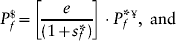
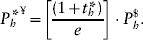
According to (FP1) and (FP2), a drop in e would require the same relative adjustments to prices – in order to ensure that the international arbitrage conditions hold – as would a uniform rise in s f* and t h* of appropriate magnitude.Footnote 66 As we next establish, this underpins the policy equivalence between a devaluation and a uniform tariff-cum-subsidy in this flexible-price setting.
Specifically, using (FP1) and (FP2), we may derive
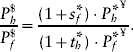
The equality between relative prices in US and China is therefore unaffected by the introduction of a uniform tariff-cum-subsidy package that satisfies s f*=t h*. Moreover, (FP1) implies that the terms of trade, which in the presence of the China import tariff and export subsidy is now given by 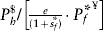 , continues to be equal to the US relative price P h$/P f$, and hence a uniform tariff-cum-subsidy maintains equality between all three relative prices. And, finally, with all three relative prices still equal to each other under the uniform tariff-cum-subsidy package introduced by China, the level of this common relative price must remain unchanged in order to continue to equilibrate supplies and demands and to ensure world market clearing. We may thus conclude that the introduction by China of a uniform tariff-cum-subsidy package replicates the (absence of) real effects associated with a drop in e. Intuitively, import tariffs and export subsidies push in opposite directions and therefore tend to neutralize each other in terms of their impacts on the production and consumption decisions of actors in an economy (t h* enters into the denominator, while s f* enters into the numerator of the relative price expression in (4)), and when applied in a uniform fashion their real effects exactly cancel out.
As noted in the text, a single component of a policy package (say, an export subsidy) can have effects by itself that are not in any way implied by the overall policy package. This can be seen by observing that, as we have argued, a uniform tariff-cum-subsidy (with s f*=t h*) has no impact on relative prices and therefore no real effects but, as (4) indicates, an export subsidy alone (with s f*>0=t h*) surely would impact relative prices and therefore would have real effects.
Also as noted in the text, the use of standard countermeasures in response to a devaluation would have real effects. To see this, we now express the international arbitrage conditions that reflect the law of one price as they must hold when (i) China offers an export subsidy s f* to its exporters of good f, (ii) in response to s f*, US imposes a countervailing duty t fCVD, (iii) China imposes a tariff t h* on imports of good h, and (iv) in response to t h*, US imposes a retaliatory tariff t fXXIII under GATT Article XXIII. With these policies in place, the international arbitrage conditions become

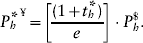
Using (5 ) and (6 ), the relative prices in US and China must now satisfy

Evidently, as can be confirmed with (7), these relative prices remain unaffected by the introduction of a uniform tariff-cum-subsidy package in China that satisfies s f*=t h*, because as we have observed in the text and emphasized above, import tariffs and export subsidies push in opposite directions and therefore tend to neutralize each other in terms of their impacts on the production and consumption decisions of actors in an economy (t h* enters into the denominator while s f* enters into the numerator of the relative price expression in (7)). By contrast, these relative prices will be affected by the US tariff responses t fXXIII and t fCVD, because these tariff responses reinforce rather than neutralize each other (both t fXXIII and t fCVD enter into the denominator of the relative price expression in (7)).
Sticky prices
We next analyze the case where prices are ‘sticky’, and consider three different stylized assumptions with regard to the currency in which producers invoice their products. Here a devaluation has real effects. In what follows, we again provide a static analysis, but this is no longer without loss of generality because we are abstracting from the real effects that a devaluation may have on the trade balance. Nevertheless, as we indicate in the text, a more complete analysis that models the impact of exchange rate policy on trade balances in a sticky-price environment is unlikely to overturn the basic points that we establish below. As we describe in the text, for the purposes of our sticky-price analysis we adopt the same assumptions on the nature of price-stickiness in the face of (surprise) change in the trade policies s f* and t h* as we do for surprise changes in the exchange rate e.
Producer currency pricing (PCP) Under the assumption that all exporting firms (in China and US) pre-set prices in their own currency (PCP) before they know the exchange rate at which their sale will be made (and under the sticky-price assumption cannot then alter their price for these sales once the level of the exchange rate is known), the pricing relationships in (FP1) and (FP2) – and therefore the law of one price – will still hold. The only difference in these pricing relationships is that, under sticky prices and the PCP assumption, P f*¥ and P h$ are now sticky (and therefore do not change in response to a devaluation), while P f$ and P h*¥ are not sticky (and therefore do change in response to a devaluation); in particular, P f$ and P h*¥ move one-to-one with the exchange rate e, and similarly P f$ moves one-to-one with s f*, while P h*¥ moves one-to-one with t h*. Hence, the incidence of changes in e, s f*, and t h* fall entirely on P f$ and P h*¥ in this sticky-price PCP setting.
Letting  denote the preset (sticky) level of the price of good f in China, denominated in RMB, and letting
 denote the preset (sticky) level of the price of good h in US, denominated in dollars, the international arbitrage conditions become
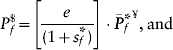
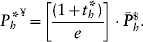
Hence, in the same way that (FP1) and (FP2) did for the flexible-price environment, (PCP1) and (PCP2) indicate that the policy equivalence between a devaluation and a uniform tariff-cum-subsidy will continue to hold in a sticky-price world when producers invoice according to PCP.
Notice that the only difference between (PCP1) and (FP1) is that, in the event of a devaluation of the RMB,  remains fixed, while P f$ adjusts to ensure that (PCP1) continues to hold. Similarly, the only difference between (PCP2) and (FP2) is that, in the event of a devaluation of the RMB,
 remains fixed while P h*¥ adjusts to ensure that (PCP2) continues to hold. This difference, though, carries with it an important implication that distinguishes the sticky-price PCP environment from the flexible-price world: in a sticky-price environment under the PCP assumption, a devaluation of the RMB (a drop in e) – or equivalently the introduction of a uniform (t h*=s f*) tariff-cum-subsidy – now raises the price of good h relative to the price of good f in both US and China, as well as the terms of trade between them, and hence has real effects.
This can be seen by using (PCP1) and (PCP2) to derive
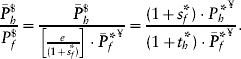
It is direct from (8) to confirm that the introduction of a uniform (t h*=s f*) tariff-cum-subsidy implies the pricing relationships
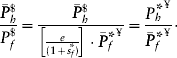
Note that the relative price in US, the terms of trade, and the relative price in China are given respectively by the first, second, and third expressions in (9). Evidently then, as (9) indicates, a devaluation (drop in e) – or equivalently the introduction of a uniform (t h*=s f*) tariff-cum-subsidy – preserves the equality across all three relative prices but raises these relative prices to a higher level (as indicated by the middle expression in (9)), and this implies a real effect. In particular, there is an ‘expenditure switching’ impact of the devaluation, as consumers in US and China respond to the increase in the price of good h relative to the price of good f by shifting expenditure away from the US export good h and toward the China export (US import) good f.
As can be confirmed from (9), the uniform tariff-cum-subsidy implied by the RMB devaluation does not introduce a wedge between relative prices in US and China. An examination of the pricing relationship in (PCP1) further reveals that the implicit export subsidy associated with the devaluation of the RMB is captured completely by consumers in the rest of the world. That is, when prices are sticky and the PCP assumption holds, none of the implicit export subsidy associated with a devaluation is collected by the exporters.
Local currency pricing (LCP) Under LCP the local prices in local currency are all sticky (and therefore do not change in response to a devaluation), but the terms of trade is affected. More specifically, under LCP the producer of good f in China sets a price invoiced in RMB for local sales (in China),  , and a price invoiced in dollars for sales in US,
 , before the realization of the exchange rate e, which means that in general
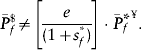
As (LCPl) indicates, under LCP the law of one price does not hold and it will generally not be true that a firm in China will earn the same from the export sale of good f to US, when translated into RMB and inclusive of the export subsidy s f*, as it does from the sale of good f in the local (China) market. Notice too that, with  pre-set before the level of e or s f* is known, the incidence of e and s f* fall completely on the Chinese exporter of good f.
Similarly, under LCP the producer of good h in US sets a price invoiced in dollars for local sales (in US),  , and a price invoiced in RMB for sales in China,
 , before the realization of the exchange rate e, which means that in general
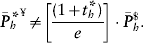
Again, the law of one price does not hold and, in this case, with  pre-set before the level of e or t h* is known, the incidence of e and t h* fall completely on the US exporter of good h.
Hence, under sticky prices and LCP, consumers in China face the relative prices

while consumers in US face the relative prices

neither of which is sensitive to a devaluation (a drop in e) or the introduction of export subsidies or import tariffs (under our assumption, recall, that the subsidies and tariffs are introduced into the same sticky-price environment as the devaluation). This indicates that, under LCP, there is no expenditure switching effect of a devaluation, as confirmed by (LCP3a) and (LCP3b). What is sensitive to a devaluation is the terms of trade, which in the case of LCP is given by
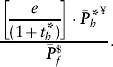
As (LCP3a) through (LCP3c) indicate, when prices are sticky and producers invoice according to LCP, a relationship between a devaluation and a real (trade) policy equivalent can again be identified. In this case, though, the effects of the devaluation (drop in e) can be replicated by an appropriate increase in t h* alone: a drop in e would have an equivalent impact on each of the relative prices in (LCP3a) through (LCP3c) as would an increase in t h* of appropriate magnitude. Evidently, when producers invoice according to LCP, there is no role for a China export subsidy s f* in the trade policy package that would replicate the effects of a devaluation. A Chinese export subsidy cannot impact the terms of trade in this setting because the incidence of s f* falls entirely on exporters from China, and so it is as if China is a ‘small’ country with respect to its export subsidy in the LCP case.
Dollar pricing (DP) Under the assumption that all exporting firms pre-set prices in dollars (DP) before they know the exchange rate at which their sale will be made (and under the sticky-price assumption cannot then alter their price for these sales once the relevant exchange rate is known), the local prices in dollars are all sticky (and hence do not change in response to a devaluation), and therefore the pricing relationship in (PCP2) will continue to hold, but the pricing relationship in (PCP1) will not: rather, for this second pricing relationship, the inequality in (LCP1) is relevant. This can be understood by noting that the assumption of DP is asymmetric: it behaves as PCP for the (dollar denominated) US, but it behaves like LCP for (RMB denominated) China.
Hence, under sticky prices and DP invoicing we have
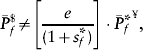
implying that the law of one price does not hold for Chinese exporters and that, with  pre-set before the level of e or s f* is known, the incidence of e and s f* fall completely on the China exporter of good f. And we have
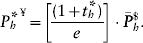
implying that the law of one price holds for US exporters and that, with  pre-set before the level of e or t h* is known, the incidence of e and t h* fall completely on P h*¥.
Evidently, under sticky prices and DP, the relative prices faced by consumers in US are insensitive to a devaluation (a drop in e) or the introduction of China export subsidies or import tariffs (under the assumption, recall again, that the subsidies and tariffs are introduced into the same sticky-price environment as the devaluation), and are given by

On the other hand, consumers in China face the relative prices

which are sensitive to a devaluation. As a result, (DP3a) implies that there will be no expenditure switching effects in the US in response to a China devaluation (a drop in e) when producers invoice according to DP, but (DP3b) implies that there will be expenditure switching effects in China. Finally, in the presence of the DP assumption, the terms of trade is given by

and so is unaffected by a devaluation.
As (DP3a) through (DP3c) indicate, when prices are sticky and producers invoice according to DP, a bridge between a devaluation and a real (trade) policy equivalent can again be forged. In this case, though, as was shown to be the case also under the LCP assumption, the effects of the devaluation (a drop in e) can be replicated simply with a proportional increase in t h*. An increase in the China export subsidy s f* cannot impact the relative price faced by consumers in China; as observed above, the incidence of s f* falls entirely on exporters from China (and for Chinese exporters the law of one price does not hold). For this reason, when prices are sticky and producers invoice according to DP, there is no role for a China export subsidy s f* in the trade policy package that would replicate the effects of a devaluation.


