INTRODUCTION
Implicit learning has been defined by Ellis (Reference Ellis1994, p. 1) as “the acquisition of knowledge about the underlying structure of a complex stimulus environment by a process that takes place naturally, simply and without conscious operations.” Similarly, according to Berry (Reference Berry1997, p. 1), implicit learning refers to “those situations where a person learns about the structure of a complex stimulus environment, without necessarily intending to do so.” Inherent in these definitions of implicit learning is the idea that it takes place without any intention to learn on the part of learners. They just “pick up” some regularity without any intention to do so. The primary interest of implicit learning research, at least from a linguistic perspective, lies in the notion that we can learn “for free” from mere exposure to input (at least assuming that we are attending to it). This is of pedagogic interest; what can be learned for free does not need to be taught directly. But it is also theoretically interesting to explore which aspects of language can be learned in this way, and how such learning might be constrained, or limited in power, especially in adults.
But when Reber (Reference Reber1967) coined the term implicit learning he had more in mind than simply learning without intention. After all, there was already a term used by memory researchers for this—incidental learning. For example, participants may be given a list of words and asked to rate them for “pleasantness.” After this exposure phase there is a surprise test of their memory for the words on the list (Hyde & Jenkins, Reference Hyde and Jenkins1969). It is assumed that any memory for the words is not a result of intentional memorization strategies, such as rehearsal; rather that the participants just picked up the words in the course of making pleasantness judgments, that is, encoded them in memory incidentally. Of course, unless one actually knows that the participants did not intentionally learn the items, incidental learning as a mental process, as opposed to merely a task instruction, is an assumption (a point we will return to in the “Discussion” section). But, returning to Reber, he was interested in a more complex form of learning, not of words, but structural regularities.
Reber exposed people to letter strings, generated by a finite-state automaton as part of a short-term memory task. After the study phase, participants were told that the strings were generated by a grammar that followed a rule system. They were then given a grammaticality judgment test on new letter strings produced by the same grammar and others that were not. Their task was to say which were rule generated and which were not. The results indicated that participants’ correct endorsement rates were significantly above chance level. This in itself was remarkable given the complexity of the grammatical system involved. But what was more remarkable was that the participants were unable to verbalize relevant knowledge. Reber concluded that their judgments were being made on the basis of unconscious knowledge of the grammar, or to adopt another traditional term from memory research, on the basis of implicit knowledge. He then coined the term implicit learning to refer to a situation in which the learning appeared to occur incidentally (the participants were not told to work out the rules of the grammar, nor were they warned about the grammaticality judgment task), and in which the resulting knowledge was unconscious. This is the working definition of implicit learning that we will adopt here, in common with psychological research on the topic since Reber. Of course, the notion that adults can acquire unconscious knowledge, particularly grammatical knowledge, is of particular interest to linguists. From a pedagogic perspective, it is implicit knowledge that is assumed to underlie fluent, automatic speaking and comprehension. And from a linguistic perspective, true linguistic competence is assumed to reside in the unconscious mind.
Reber also claimed that his participants learned the finite state grammar as an abstract rule system. To some extent this was corroborated by other studies that revealed transfer to different letters, or even modalities of presentation, such as from letter sequences to tone sequences (Altmann, Dienes, & Goode, Reference Altmann, Dienes and Goode1995), with effects being traced to the “repetition structure” of the items (Tunney & Altmann, Reference Tunney and Altmann2001). While such knowledge is certainly abstract, it is not the kind of abstract regularity that underlies much of our productive knowledge of natural language. While some work has been done on implicit learning in various aspects of natural language (e.g., on the semantic and syntactic aspects—see Williams, Reference Williams, Ritchie and Bhatia2009, and Paciorek & Williams, Reference Paciorek and Williams2015, for reviews), not much research has been carried out on implicit learning of phonological aspects of a language. This is in spite of the growing body of evidence suggesting that various aspects of speech have been found to play a significant role in the retention of a foreign accent by a second language (L2) learner (e.g., Boula de Mareüil & Vieru-Dimulescu, Reference Boula de Mareüil and Vieru-Dimulescu2006). Phonological systems, for example, contain a variety of regularities that are clearly dependent on abstract representations of the syllable (i.e. onset, nucleus, or rhyme) and phonological rules, such as final lengthening, vowel harmony, degemination, epenthesis, and stress assignment. They therefore constitute an ideal testing ground for determining whether abstract rules can be learned implicitly.
L2 ACQUISITION OF PHONOLOGY
The limited number of studies that have been carried out within the area of phonology have focused predominantly on segmental phonology (analysis of the phonemes of speech, i.e., vowels and consonants), with much less attention to the prosodic aspects. In their seminal work, Dell, Reed, Adams, and Meyer (Reference Dell, Reed, Adams and Meyer2000) examined the learning of artificial phonotactic constraints and found that the sensitivity of slips of the tongue to the sound distribution of a person’s language can be changed after exposure to an artificial distribution pattern. They investigated implicit learning of experimentally manipulated phonotactic constraint patterns and found that slip patterns reflected these induced constraints. Their participants were observed to significantly produce more errors that adhered to the induced constraints than errors that violated them. The authors concluded that this demonstrates implicit learning because there was no difference between participants who were told explicitly about the constraints and those who were not. Other studies have extended the findings in Dell et al. (Reference Dell, Reed, Adams and Meyer2000) (e.g., Goldrick, Reference Goldrick2004 and Walker & Dell, Reference Walker and Dell2006).
Onishi, Chambers, and Fisher (Reference Onishi, Chambers and Fisher2002) conducted three experiments to investigate whether adult English speakers could acquire phonotactic regularities not present in English after a brief auditory exposure. Their participants listened to CVC syllables displaying experimental restrictions on consonant position. Results of a speeded repetition task revealed rapid learning of (a) first order regularities in which consonants were restricted to either an onset or coda position (e.g., [bVp], but not *[pVb]), and (b) second order regularities in which consonant positions depended on adjacent vowels (e.g., [bAp] or [pIb], but not *[pAb] or *[bIp]). Thus, they concluded that phonotactic constraints on consonant and vowel positions appeared to be learned implicitly.
However, the possibility of learning the stress regularities of a language without awareness is also very relevant to the acquisition of L2 phonology. Research suggests that stress facilitates word memory and lexical access (Bell, Reference Bell and Hyman1977; Cutler & Norris, Reference Cutler and Norris1988), and failure by L2 learners to acquire the stress patterns of their target L2 can contribute to the perception of foreign-accentedness of their speech (Archibald, Reference Archibald1997; Peperkamp & Dupoux, Reference Peperkamp, Dupoux, Gussenhoven and Warner2002).
Chan and Leung (Reference Chan and Leung2014) performed an experiment on learning of Spanish stress patterns by Cantonese speakers. In the exposure phase they repeated auditorily presented Spanish words in the context of what appeared to be a vocabulary learning exercise. In the test phase they performed a two alternative forced choice (2FA) task in which they had to indicate which of two auditorily presented words “sounds better” where the alternatives differed only in stress placement (e.g., BUScar vs. busCAR). Awareness of the stress placement rules was assessed using an adaptation of the process dissociation procedure in which the participants were required to pronounce a written word, for example, “man.do” (where the dot indicates syllabification) “as similarly/differently to Spanish pronunciation as possible” (p. 474). Participants were classified as “unaware” of the stress placement rules if their pronunciation accuracy was equal when told to pronounce the words similarly to Spanish as opposed to differently. These “unaware” participants were found to be significantly above chance in the 2FA task suggesting that they had acquired implicit knowledge of the stress assignment rules.
There are a number of aspects of the Chan and Leung (Reference Chan and Leung2014) materials and procedure that make their results less than totally convincing. First, their materials reflected merely a simplified version of Spanish in which words ending in -o had stress on the penultimate syllable (e.g., SOplo) and words ending in -ar had stress on the final syllable (e.g., rasCAR). Hence it is not clear whether we can generalize to more natural stress rules, based for example on number and weight of syllables. Second, the fact that the 2FA test task presented the same word with differing stress would obviously have drawn attention to stress placement as the determining factor. It remains unclear whether implicit knowledge of stress rules could be demonstrated when this is not done. Third, the inclusion/exclusion task was a production task, whereas the 2FA was a judgment task. A failure to use explicit knowledge in free production may not preclude the possibility of it being used in a perceptual judgment, especially one in which the relevance of stress is emphasized. And finally, the inclusion/exclusion task was placed after the 2FA potentially reducing its sensitivity to explicit knowledge as used during the 2FA. Given these issues, further exploration of implicit learning of stress is warranted.
Another important issue is the relative importance of prosody, compared to segments, in the perception of accentedness in a foreign language. Research here has yielded inconclusive results with some researchers claiming that prosody plays a greater role (e.g., Boula de Mareüil & Vieru-Dimulescu, Reference Boula de Mareüil and Vieru-Dimulescu2006; Munro & Derwing, Reference Munro and Derwing1999), while others (e.g., Jilka, Reference Jilka2000) claim that the segmental aspects are perceived as contributing more to foreign-accentedness. It is clear, however, that both aspects play an important role in L2 pronunciation and will each need to be taken into account. Stress and syllable composition affect each other in a bidirectional way, and research needs to account for both sources of influence in L2 phonology. Latin is chosen in this study because the patterns of stress assignment are regular in the language, with weight sensitivity in which the composition of a syllable also affects the location of stress, as discussed in detail in the following text. It will be interesting to see how listeners weight each cue (i.e., whether listeners perceive a violation of the permissible syllable composition as more detrimental than a violation of the legal stress patterns). This study is original in aiming to disentangle these two sources of influence.
THE PRESENT STUDY
The present study investigates whether native speakers of Japanese can acquire implicit knowledge of the stress patterns of Latin words after brief auditory exposure.
Latin has lexical stress, the relative emphasis that may be given to certain syllables in a word. It has a fixed and regular stress system in which the location of stress is completely derivable by rule. Rules of stress assignment in Latin are as follows (Arnold & Conway, Reference Arnold and Conway1907).
1. Disyllabic words are stressed on the first syllable, for example, ámat
2. Words of three or more syllables are stressed on:
(a) The penultimate syllable if that syllable contains a long vowel, for example, vituperáːre, and
(b) The antepenultimate syllable if the penultimate syllable contains a short vowel, for example, régerem.
Latin is one of many languages in which the assignment of stress is weight sensitive (i.e., it treats certain syllable types as heavier than others; cf. Jakobson [Reference Jakobson1931] and Allen [Reference Allen1973] for more on this phenomenon). With respect to (2a), Latin treats not only long vowels (represented, as in vituperáːre, by a normal vowel followed by two triangles facing each other) as heavy, but also CVC syllables where a consonant appears in the coda of the syllable (Mester, Reference Mester1994). In stress-accent languages like English (and by definition, Latin), stress is often manifested phonetically by increased duration, intensity, and pitch within the stressed syllable (e.g., Beckman, Reference Beckman1986). Unlike the simplified Spanish system employed by Chan and Leung (Reference Chan and Leung2014) learning these rules therefore requires combining abstract notions of syllable number and weight.
Japanese constitutes a pitch accent language that contrasts words by (a) the presence or absence of a pitch accent and (b) if present, its location within the word (Beckman & Pierrehumbert, Reference Beckman and Pierrehumbert1986; Pierrehumbert & Beckman, Reference Pierrehumbert and Beckman1988; Venditti, Reference Venditti and Jun2005; see Graham, Reference Graham2014 for an overview). For example, when a pitch accent appears on the first mora in the word “kaki” it means “‘oyster” versus on the last mora to mean “fence”; accentless “kaki” means “persimmon.” Unlike in stress-accent languages, pitch is the only significant cue to accent in Japanese. Japanese has no functional analogue to lexical stress in languages like Latin or English.
In the exposure phase of the experiment, Japanese native speakers passively listened to 99 nonwords, 33 with each of the Latin stress patterns described in the preceding text (e.g., initial stress: ápit; penultimate stress: patʃápke; antepenultimate stress: etákasu). For reasons that will become apparent shortly, these nonwords were constructed from a restricted set of vowels and consonants. There was then a surprise test in which the participants heard nonwords and for each one had to indicate whether, based on the words they heard in the exposure phase, each word sounded familiar/right. The test items were a mixture of repeated (old) nonwords from the first phase and new nonwords constructed from the same consonant and vowel inventory. Half of each type obeyed the stress assignment rules and the other half did not. Our prediction was that the probability of endorsing a nonword as familiar or “sounding right” would be higher for nonwords that obeyed the stress assignment rules than those that did not. In the case of old nonwords this could merely reflect memory for the stress placement in the original nonword, but for new nonwords it would reflect sensitivity to the stress assignment rules. Partly in order to deflect the participants’ attention from stress pattern as a basis for responding, the test also included new “phonotactically illegal” nonwords composed of different vowels and consonants from the exposure items, but with legal stress. A low endorsement rate for these phonotactically illegal items would provide evidence of learning the limited consonant inventory of the language. It will also provide evidence that participants were not simply making their judgments based on stress patterns. Finally, in order to check that the results are not simply due to biases inherent in the items, a control group performed only the test phase.
The primary aim of the study is to see whether participants can acquire implicit, unconscious knowledge of stress assignment rules. We did this by requiring the participants to rate their confidence in each judgment in the test phase. Previous studies have used confidence ratings in a specific SLA context: Rebuschat (Reference Rebuschat2008), Rebuschat and Williams (Reference Rebuschat, Williams and Sun2006, Reference Rebuschat, Williams, Taatgen and van Rijn2009, Reference Rebuschat and Williams2012), Hamrick and Rebuschat (Reference Hamrick, Rebuschat, Rebuschat and Williams2012) (see Rebuschat [Reference Rebuschat2013] for an overview). Dienes and Altmann (Reference Dienes, Altmann and Berry1997) performed an artificial grammar learning experiment in which they used Cheesman and Merikle’s (Reference Cheesman and Merikle1984) definition of unconscious knowledge in terms of a “subjective threshold.” According to this criterion, people have unconscious knowledge if they lack metaknowledge about their knowledge (i.e., they do not “know that they know”). Cheesman and Merikle further postulated that a lack of metaknowledge can be revealed in two ways: (a) accurate performance when participants believe they are guessing (also known as the “guessing criterion”), and (b) the zero correlation criterion (“Chan difference” being an example of this measure)—a lack of correlation between confidence and accuracy (Chan, Reference Chan1992). These two diagnostic tests will be used in the present study in the analysis of confidence judgments. For the zero correlation criterion, we use the Chan difference measure. Specifically, the pattern of results predicted in the preceding text should be obtained even when participants claim to be guessing; that is, in the absence of any confidence as to whether the word is familiar or sounds right (even for old nonwords), or when there is no difference in their level of confidence between when they are correct or incorrect. Confidence judgments are arguably a more sensitive measure of conscious knowledge in the moment of decision making than the adapted process dissociation procedure used by Chan and Leung (Reference Chan and Leung2014).
In summary, the specific research questions were as follows: (a) Can participants acquire generalizable knowledge of abstract stress assignment rules merely from listening to individually presented words from a novel sound system? (b) Can participants simultaneously learn constraints on the segmental make up of these words? (c) Is the knowledge so acquired implicit?
METHOD
Participants
The participants in the study were 28 Japanese students from several universities in Japan. There were no age or gender restrictions on who could participate; however, all the participants who participated in the study were 19 to 24 years of age, 14 males and 14 females. Participants were all native speakers of Japanese (dialect not controlled). Twenty participated in the full experiment and the remaining eight (four males, four females) only participated in the test phase as an untrained control group (see further biographical details in Appendix A). Participants received a token fee for their participation.
Materials and Design
The experiment was conducted in two phases: an exposure phase, followed by a test phase. The exposure phase consisted of a listening exercise with 99 made-up (non-) words, 33 with each of the three Latin stress patterns. Furthermore, the nonwords only contained items from limited consonant ([p], [t], [k], [tʃ] and [s]) and vowel ([a], [e], [i], [o], [u]) inventories. Languages vary in the size of their consonant inventories, with the smallest containing around 13 consonants (see Maddieson Reference Maddieson, Dryer and Haspelmath2013 for a survey). A small consonant inventory ensures that the made-up system sounded very distinct from Latin, Japanese and English, all of which have relatively larger inventories. All consonants appeared in all positions and were combined randomly with vowels to create words according to the constraints of Latin stress. The maximum number of syllables was four (see Appendices B and C for the full list of items for each of the two phases of the experiment).
The test phase consisted of a listening exercise with 60 words in total, from five different categories:
1. Twelve items repeated from the exposure with legal stress (four for each of the three stress patterns, e.g., túke, kátepi, pukékti).
2. Another 12 repeated items from the exposure, but that incurred a violation in each of the three relevant stress pattern categories (e.g., tuké, katépi, púkekti).
3. Twelve new items with the legal (correct) stress (e.g., páko, tátikap, kaketíkko).
4. Twelve new items with illegal (incorrect) stress (e.g., katʃí, tapótʃe, sétopki).
5. Twelve new items with correct stress, but with a violation of the allowable consonant inventory (i.e., these items contained consonants other than [p], [t], [k], [tʃ] and [s]). The violation was the presence of one or more nasal consonants (n, m) in the word (e.g., nápek, tʃákuma, makékpa).
The combined total number of test items was therefore 159 (99 in the exposure phase and 60 in the test phase). As duration is an acoustic cue to stress, we reasoned that it would be problematic to include items in which a short vowel is incorrectly stressed in a heavy syllable, as the increased duration could plausibly make it perceptually closer to CVV syllables bearing legal penultimate stress. To avoid this confound, we only included CVC heavy syllables (with a short vowel and a coda consonant, instead of a long vowel) in the penultimate syllables of test words (i.e., we only included one of the two possible “heavy syllable” forms in Latin—CVC—excluding CVV syllables containing long vowels). All the items in (1), (2), (3), (4), but not (5), were recorded a second time such that a correctly stressed item is now an incorrectly stressed item, and vice versa. So for example, we had 24 new items (12 correct, 12 incorrect). We recorded all 24 with correct and incorrect stress and created two presentation lists such that one group of participants gets half with correct stress (say items 1–12) and the other half with incorrect (items 13–24) and the other group of participants had these assignments reversed. This rotation of items was to ensure that any item characteristics apart from stress that affected judgments in the test phase were cancelled out when the data were averaged over the two lists.
The test items were initially recorded using a DAT recorder in a sound-attenuated room. Recordings were done with 16-bit resolution and a sampling rate of 44.1 kHz. The first author, who is a trained phonetician, recorded all test items. A stressed syllable was acoustically more prominent than (and thus perceptually distinguishable from) unstressed syllables in the same word. All stimuli were checked independently by an expert in prosody research for the accuracy of stress production. The sound files were then segmented into individual target words, which were presented in SuperLab according to the experiment conditions described in the following text.
Procedure
Both phases of the experiment were run on a computer using SuperLab software. The participants were first told that the experiment was an investigation of how people learn words, that they would hear some words from an unfamiliar language, and that they would be asked some questions about their experience afterwards. There was no instruction to attend to or learn about the stress patterns of the nonwords, and no meaning was provided. Participants merely had to listen to the nonwords. Each participant heard the words in a unique random order, progressing from each word to the next by pressing the forward key (i.e., the right arrow key on a regular keyboard). The test phase was administered as a surprise recognition task. The sound files were again played randomly one at a time, as in the exposure phase. However, the participants were now asked to indicate with a key press whether, based on the words they heard in the exposure phase, each word “sounded right/familiar” or “sounded wrong/unfamiliar.” During the test phase, participants entered a response and a confidence rating, after which they were also required to recite what they heard into a recorder before the next item was played. There was a short beep sound indicating to participants when to begin reciting the word. The motivation for the recitals was that, because the stress patterns were quantity sensitive (i.e., depended on the segmental makeup of syllables, as described in the preceding text), it was important that all words that participants misheard, misinterpreted, and therefore recited incorrectly (in terms of segmental phonology, but not stress) were removed from the analyses. Based on the recordings all the participants recited the word patterns correctly in terms of their lexical composition, with the exception of a few errors as reported in the following text. Participants were far less systematic in reproducing the stress patterns (i.e., they were not faithfully producing the stress patterns above chance level).
Reaction times were not measured in this experiment. However, we took steps to ensure some control over participants’ response times. After entering each set of responses, the next token was automatically presented. Failure to enter their key-press and oral responses within a maximum 10-second window would also result in the next token being automatically presented. The average time taken to complete this phase of the experiment was roughly 10 minutes. Participants indicated their familiarity/sounds right responses by either pressing the “Q” key of a standard QWERTY keyboard, which was marked with an [O] “maru”—which is the Japanese equivalent of a tick—or the “P” key, marked with an X “batsu,” to indicate incorrectness for items that “sounded wrong/unfamiliar.” Participants were instructed to indicate an intended 50% confidence rating (for “guess”) with 5, a 60% with 6, and so on. A “0” represented 100% (the numbers 1–4 were covered with black tape and locked through a SuperLab function).
Following the test phase the participants were required to complete a questionnaire about their impressions of the test (e.g., what they thought the test was about and whether they used any strategies to memorize the words or work out the word patterns and whether they had worked out any rules that could explain why some test items were correct and others were not). The full questionnaire is given in Appendix G.
RESULTS
In this section we present the results for endorsement rates and the findings of the two awareness diagnostic tests, the guessing criterion and zero correlation criterion.
Performance in the Pronunciation Judgment Task
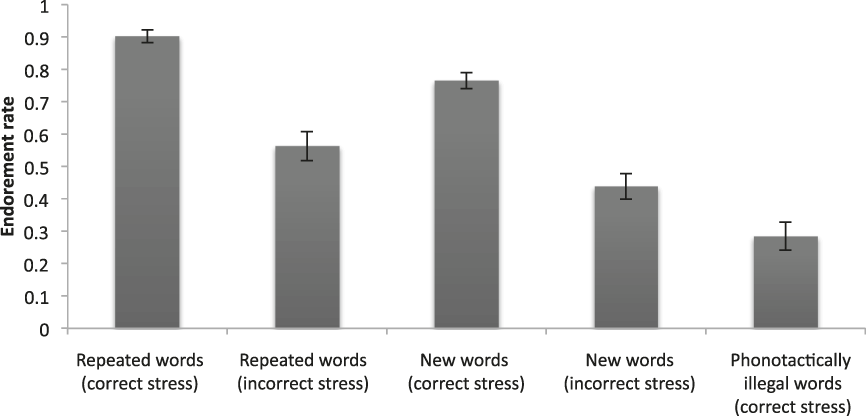
There were some lost trials (one or two) for four of the participants in some of the conditions due to program-generated errors in SuperLab. Also, based on the analysis of the recital recordings, two other items (one item each for two participants) were discarded as they were judged to be incorrectly recited. In these cases endorsement rates were calculated out of 10 or 11 items per participant, as appropriate, instead of 12. The endorsement rates as the mean in each of the five conditions are shown in Figure 1 (see Appendix D for a complete list of endorsement ratings per speaker for each word category).
Endorsement rates across five categories. Error bars represent standard errors.

Single sample t-tests were run to determine whether endorsement rates (experimental and control groups) were different from chance (50%) in each word category. For the two sets of data, endorsement rates were normally distributed as assessed by Shapiro-Wilk’s tests (p > .05), and there were no outliers in any of the datasets, as assessed by inspection of boxplots. For the experimental group, endorsement rates were significantly above chance for repeated words with correct stress, (M = .90, SD = .09); t(19) = 20.93, p < .001, and new words with correct stress, (M = .77, SD = .11); t(19) = 10.85, p < 0.001, but not different from chance for repeated words with incorrect stress, (M = .56, SD = .20); t(19) = 1.44, p = 0.16, or new words with incorrect stress, (M = .44, SD = .17); t(19) = -1.59, p = .13. Phonotactically illegal words were endorsed at a level significantly below chance, (M = .28, SD = .19); t(19) = -5.10, p < .001. The controls did not perform statistically significantly different from chance in any of the five categories: repeated words with correct stress, (M = .46, SD = .06), t(7) = -1.84, p = .11; new words with correct stress, (M = .44, SD = .18), t(7) = -1.0, p = .35; repeated words with incorrect stress, (M = 0.49, SD = 0.09), t(7) = -.31, p = .76; new words with incorrect stress, (M = .51, SD = .07), t(7) = .42, p = .69; and phonotactically illegal words, (M = .45, SD = .08), t(7) = -1.92, p = .10.
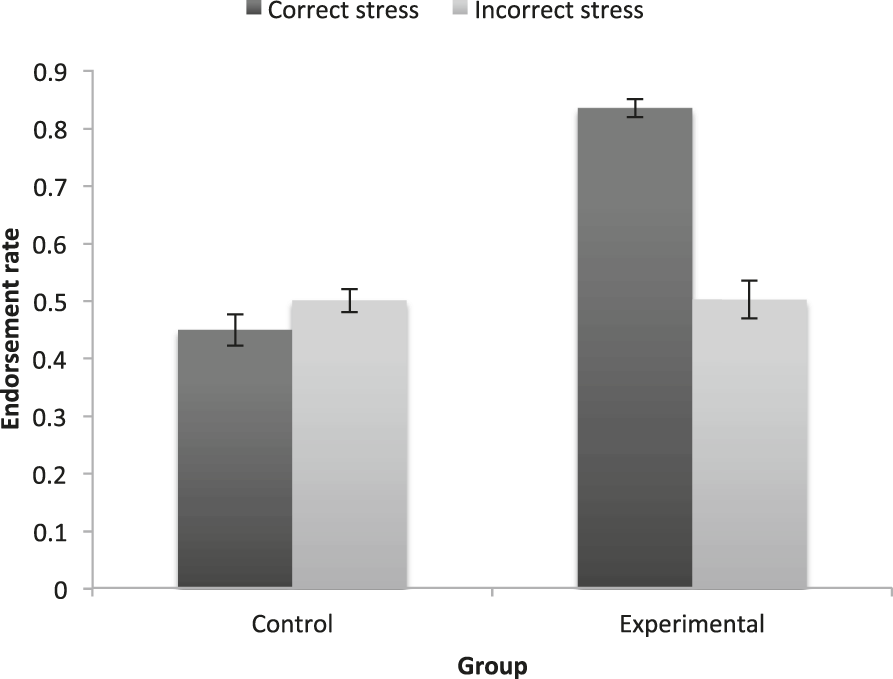
A mixed factorial ANOVA was conducted on the data from the four phonotactically legal conditions in which repetition (repeated vs. new) and stress (correct vs. incorrect) were within-subjects factors, and presentation list (rotation vs. no rotation) and group (experimental vs. controls) were between-subjects factor. There was a significant main effect of repetition: F(1, 24) = 4.74, p < .05, ηp2 = .17 and highly significant main effects of group: F(1,24) = 29.68, p < .001, ηp2 = .60, and stress: F(1, 24) = 25.92, p < .001, ηp2 = .52. There was a significant interaction between stress and group: F(1, 24) = 48.60, p <.001, ηp2 = .67. As can be seen in Figure 1, correctly stressed words were endorsed more often than incorrectly stressed words, and the effect was of similar magnitude for repeated and new words. This effect was only observed in the experimental group, as the controls were not found to be making any discrimination on the basis of stress, as can be seen in Figure 2.
Estimated marginal mean endorsement rate of correctly vs. incorrectly stressed items by the two groups. Error bars represent standard errors.

There was also a significant interaction between repetition and group: F(1, 24) = 4.71, p < .05, ηp2 = .16. The experimental group endorsed repeated items at a significantly higher rate than new items, while the controls did not make this distinction. There was no main effect of or any significant interactions involving presentation list.
An additional ANOVA with new words (phonotactically legal words with correct stress) and new phonotactically illegal words with correct stress as the within-subjects factor and group as a between-subjects factor showed that the difference between the two word types was highly significant: F(1, 26) = 25.24, p < .001, ηp2 = .49. However, there was also an interaction between this category and group: F (1, 26) = 27.71, p < .001, ηp2 = .52. Phonotactically illegal words were endorsed at a much lower rate than new words with correct stress (as can be seen in Figure 1), but only by listeners in the experimental group. The controls were not making any such distinction.
CONFIDENCE RATINGS
Guessing Criterion
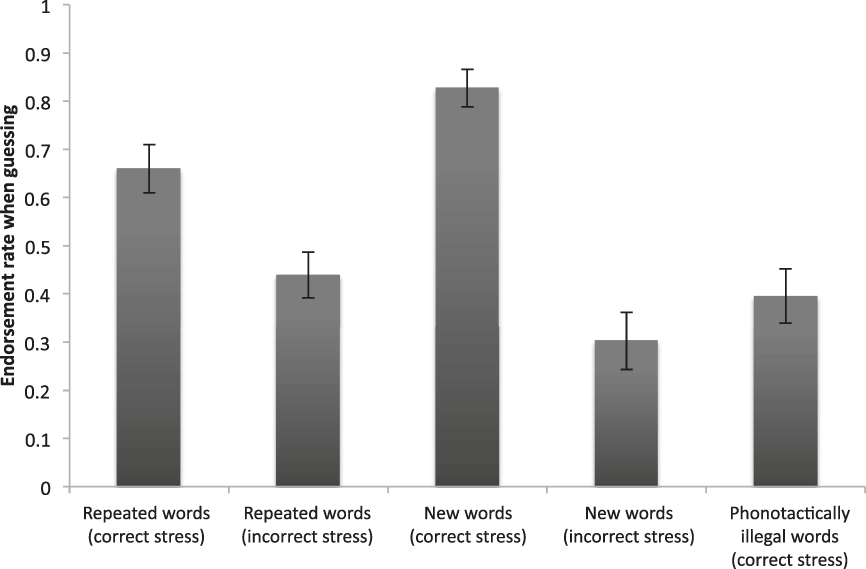
The proportion of responses that were guesses in each condition was 0.24 for repeated words with correct stress, 0.31 for repeated words with incorrect stress, 0.29 for new words with correct stress, 0.47 for new words with incorrect stress, and 0.25 for phonotactically illegal words. The mean endorsement rate for guess responses in each condition is shown in Figure 3.
Participants’ endorsement rates when they reported that they were guessing. Error bars represent standard errors.

The data from three participants were excluded from these analyses because of no guess responses in one of the conditions (the repeated words with correct stress in all cases); see Appendix E for a complete list of Guess Criterion ratings per speaker for each word category.
An ANOVA was conducted in the same way as for the overall endorsement rates. This time there was no main effect of repetition, F < 1.0. But there was a highly significant main effect of stress, F(1, 15) = 79.33, p < .001, ηp2 = .84, and a significant interaction between repetition and stress, F(1, 15) = 10.82, p < .01, ηp2 = .42. As can also be seen in Figure 3, the effect of stress was larger for the new words than the repeated words. However, individual comparisons showed that the effect of stress was significant both for the repeated words, F(1, 15) = 21.70, p < .001, ηp2 = .59, and the new words, F(1, 15) = 49.62, p < .001, ηp2 = .77.
A separate analysis was conducted on the contrast between the phonotactically illegal words with correct stress and the new words with correct stress. The difference in endorsement rates was highly significant, F(1, 15) = 67.12, p < .001, ηp2 = .82.
Zero Correlation Criterion
Given that the main issue is the effect of conscious knowledge of stress rules rather than the actual familiarity of the words, then the relevant notion of “accuracy” is whether the stress pattern of the word corresponds to the trained stress rules; that is, endorsing correctly stressed words and rejecting incorrectly stressed words regardless of whether they are old or new.
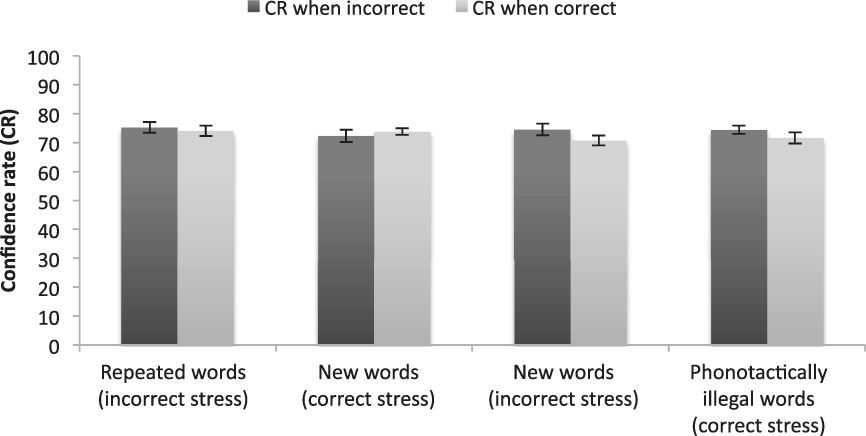
For the repeated words (incorrect stress) condition, inaccurate and accurate responses were made with a confidence of 75% and 74%, respectively, a nonsignificant difference, (M = 1.16, SD = 12.10), t(19) = .43, p = .67). The repeated words (correct stress) category is not included in this analysis because of the participants’ very high endorsement (and thus high accuracy) rates for these items. More specifically, as can be seen in Appendix D, six out of twenty participants had no inaccurate judgements, and all the others (except s17) endorsed these items over 80% of the time (i.e. less than 20% inaccurate judgements). For the new words (correct stress) confidence was 71% for incorrect decisions and 74% for correct decisions, also a nonsignificant difference, (M = -2.55, SD = 8.98, t(18) = -1.24, p = .23). For the new words (incorrect stress) confidence was at 75% for incorrect decisions and 71% for correct decisions, a nonsignificant difference, (M = 3.79, SD = 10.87, t(19) = 1.56, p = .14. For the phonotactically illegal words (correctly stressed), confidence was at 74% for incorrect decisions and 72% for correct ones; this difference was also not significant, (M = 2.78, SD = 8.15), t(19) = 1.53, p = .14. These ratings are summarized in Figure 4 (see Appendix F for a complete list of Zero Correlation ratings per speaker for each word category).
Average confidence ratings (CR) over the participants’ accurate and inaccurate judgments in the four relevant word categories. Error bars represent standard errors.

Postexperiment Questionnaire
In the postexperiment questionnaire, none of the participants reported basing their judgments on stress assignment (which they understood as more acoustic prominence or emphasis in one syllable in a word relative to another syllable in that word). This is a concept Japanese speakers are familiar with given their native language uses this device to contrast words in a way English does not, as explained previously. With regard to the repeated nonwords, as expected, some of the participants (11 out of 20) reported that they believed they had heard some of the nonwords before. However, they could not identify any changes in the stress pattern of those nonwords, suggesting that they were unable to describe (and were therefore possibly unaware of) the stress reassignments in nonwords that were otherwise identical to the ones they were trained on. For the phonotactically illegal nonwords category, participants reported using a number of lexical strategies including making analogies to other languages that they know (e.g., four of them reported that these words sound like Russian, and five others said they considered whether these items would be compatible to their native Japanese phonology and were more likely to reject those that were not). However, the participants did not report using any strategies to work out stress as they were unaware that this was the phenomenon being tested. Moreover, the fact that the untrained controls did not appear to perform statistically significantly above chance level suggests that the source of the knowledge acquired by the trained participants lies within the training phase of the experiment and is not likely to be due to external influences. Furthermore, these results did not change when the control group of eight participants was compared with various combinations of eight participants randomly selected from the test group, suggesting that small sample size did not play a significant role.
DISCUSSION
The overall results clearly show that the participants learned about both the segmental structure of the words they had received in training and their stress patterns. First, they appeared to have good memory for the repeated words that they had actually heard, as shown by the significantly higher endorsement rate for repeated words over new words, regardless of whether their stress pattern was correct or not. At the same time, they also showed sensitivity to whether the stress pattern of the word was correct or not, regardless of whether the word was repeated or new, as shown by the highly significant main effect of stress in the ANOVA. The effect of stress was equivalent for repeated and new words, as shown by the lack of an interaction between repetition and stress (although in numerical terms the effect of stress match was larger for old than new words, 88% vs. 77%). It appears from this data, therefore, that the participants were not so much remembering the stress patterns of words that they had heard, but rather had induced the rules of stress assignment in this sound system, and were able to apply these rules to repeated and new words with equal effectiveness.
The results also provide strong evidence that the participants were able to learn the constraints on the segmental inventory of the sound system, as shown by the very low endorsement rate for the phonotactically illegal, but correctly stressed, test items. Endorsement rates for the illegal items were significantly below chance and significantly lower than the correctly stressed new words. The low endorsement rate for these words, despite bearing the correct stress, shows that the participants were not simply basing their decisions on the stress patterning of the words.
The overall pattern of results appears to suggest that participants acquired knowledge of the segmental phonology and the prosodic system as two distinct but interrelated phenomena. Hence, endorsement rates for incorrectly stressed repeated words were still significantly above chance, presumably because of their familiar segmental structure, but new words with incorrect stress were endorsed at a lower rate, and similarly to correctly stressed phonotactically illegal words. More specifically, the fact that they rejected items that incurred a single violation in either of the two aspects of stress assignment regularities and segment inventory constraints shows that they have acquired knowledge of the structural relationship between both levels of representation in the sound system. However, the results also suggest that segmental learning in this case was likely stronger than prosodic learning (because new illegal but correctly stressed items showed a low endorsement rate). This suggests the possibility of a ranking of cues: where segment phonology is ranked more highly or at least is acquired earlier relative to the prosodic aspects (specifically, stress, in this case). This finding corroborates Ulbrich & Mennen (Reference Ulbrich and Mennen2015) who found later development in the L2 prosody of learners, compared to earlier consolidation in their production of segments. While prosody plays a crucial role in Japanese in marking lexical contrasts, this is to a relatively lesser extent than nonsegmental means of marking contrast. Thus it is arguable that prosody may be less important for these Japanese than it would for speakers of tone languages like Chinese where prosody plays the central role.
The analyses of the confidence ratings suggested that test performance was a reflection of unconscious knowledge, at least in relation to prosodic regularities. Even when they said they were guessing, participants were endorsing correctly stressed items significantly more than incorrectly stressed items, regardless of whether they were repeated or new. Moreover, there was no difference in overall confidence between accurate and inaccurate decisions, both on repeated and new nonwords. These results provide strong evidence that participants were drawing on veridical implicit knowledge of the prosodic rules to make their judgments. Interestingly, when only guess responses were considered there was no main effect of repetition—endorsement rates for repeated nonwords were at the same level as new words. This appears to suggest that the ability to indicate whether nonwords, as defined at the level of segmental phonology, had occurred before was dependent upon explicit, as opposed to implicit, knowledge. This seems to be a plausible explanation because recognition memory is traditionally taken as a “direct” test of memory, and a reflection of explicit, declarative knowledge. In contrast, changes in endorsement rates due to the correctness of stress assignment appear to reflect unconscious knowledge of the stress assignment rules. The postexperiment questionnaire corroborates these conclusions. Whereas just more than half of the participants were aware of the distinction between old and new words, none of them appeared to be aware of the variations in stress placement.
Given that in this study we have only measured awareness of knowledge as a product of learning, strictly speaking we cannot make strong claims about the role of conscious knowledge during the learning process, for to do so is to conflate the nature of the product of learning with the nature of the learning process. The exposure phase task only required the participants to listen to the nonwords, so we do not know what other processes may have been occurring, for instance, to what extent the participants noticed the stress pattern of each nonword, or indeed started to make comparisons of stress patterns across nonwords. The relationship between different types of input processing and learning outcomes would be a worthwhile avenue for further exploration. Our essential claim, therefore, is that exposure resulted in knowledge of stress placement regularities that could affect responses without conscious intent, which we take to be indicative of implicit knowledge. Although logically speaking this does not mean that some level of awareness of those regularities could not have arisen during exposure, it could be argued that if such knowledge had crystallized to any extent participants would have used it in the test, which would have been evident in the confidence ratings and verbal report. Thus, it seems likely that conscious knowledge of the regularity did not influence learning, and that the learning process was implicit, but this remains conjecture without direct evidence of the processes that were actually occurring during exposure.
Given the nature of the exposure task there are also remaining questions about generalizability to real-life listening situations. Our participants were required to listen to individually presented nonwords. This situation is clearly far removed from listening to meaningful continuous speech, and so it remains to be seen whether second language learners can be shown to acquire implicit knowledge of stress rules in naturalistic listening situations. However, there appears to be no principled reason why the addition of surrounding words or meaning should interfere with the extraction of stress regularities, provided that the words can be segmented in the first place, which is the only situation to which our results can speak.
With regard to future work in this area it would be interesting to examine the importance of the relationship between L1 and L2 prosodic systems by including speakers of various L1s, and it would also be worthwhile to examine the implicit learning of other prosodic features such as intonation and speech rhythm.
CONCLUSION
Taken together, these results indicate that after a brief auditory experience, speakers of a nonstress language, like Japanese, can indeed extract patterns of regularity in a lexical stress system. Natural languages have certain regularities that make them more learnable and that aid speech processing. Stress is one of those regularities, and the findings corroborate studies by others such as Onishi et al. (Reference Onishi, Chambers and Fisher2002) and Chan and Leung (Reference Chan and Leung2014) that humans can learn regularities that are not present in their first language. The Japanese in this study could not have had any significant prior knowledge because the study included only those participants who have never studied a language with the precise stress pattern of Latin. Although English, to which the participants had some exposure, follows the Latinate stress pattern for regular nouns, the systems are fundamentally different in that Latin has fixed, predictable stress and English does not. Moreover, in the self-reports, none of the participants reported having made any analogy of the task to English.
The ability of humans to build new representations from exposure is clearly not restricted to languages, however. The results here are congruent with a host of other studies that have examined people’s ability to detect sequential regularities from stimuli, which could be letter strings, image displays, musical tones, and so on. Where it differs, however, is that in the present case we obtained seamless generalization of the underlying rule system to new items. There was no evidence of the “transfer decrement” noted by Pacton, Perruchet, Fayol, and Cleeremans (Reference Pacton, Perruchet, Fayol and Cleeremans2001) in the context of learning orthotactic regularities in natural language, even after massive exposure. We conclude that, at least in the domain of stress assignment, it is possible to acquire generalizable abstract implicit knowledge.
APPENDIX A
BIOGRAPHICAL INFORMATION FOR THE PARTICIPANTS IN THE STUDY

Appendices B and C are lists of test words per category for each phase of the experiment
APPENDIX B
WORD LIST FOR EXPOSURE PHASE

APPENDIX C
WORD LIST FOR TEST PHASE

APPENDIX D
ENDORSEMENTS RATINGS FOR EACH WORD CATEGORY

APPENDIX E
RATINGS FOR GUESSING CRITERION

APPENDIX F
RATINGS FOR ZERO CORRELATION CRITERION

APPENDIX G
BACKGROUND QUESTIONNAIRE
The following questionnaire was administered in Japanese, the native language of the participants.
Project Title or ID:
Name of Investigator:
1. Native language: Japanese (any dialect). Please inform the researcher if Japanese is not your native language.
2. What do you think this experiment is about?
3. Did you use any strategy to memorize the words or to work out the word patterns?
a. Do you have any feeling about why some words were correct and others were not?
b. How confident are you about this response? Please elaborate the best you can.
If you answered YES to 3a, please proceed to Q4; if you answered NO, please proceed to Q5.
4. Referring to 3a, when did you start having this feeling?
- during the second listening task (test)_____________________________
- while filling out this questionnaire_______________________________
5. Have you worked out any rules that can explain why some test items were correct and others were not? Yes/No.
6. If YES to Q5, then please say when you worked out these rules and what they were.
7. Besides Japanese, do you know any other language(s)? Yes/No. If YES please proceed to Q8, if NO, please proceed to Q12.
8. How proficient are you in this language? Please provide the scores of any recent proficient assessment tests you have taken (e.g., TOEIC or TOEFL score). __________
9. Self-evaluation (please indicate your level of proficiency with one of the following): A1—Just began; A2—Basic; B1—lower intermediate; B2—high intermediate; C1—advanced.
10. Language 1________ Language 2__________ Language 3_________Others________
11. Have you had pronunciation training for any of the foreign languages you speak? Yes/No.
12. Did you experience any problems reading the words on the computer during the experiment? Yes/No.
13. Do you have any known speech deficiency (speaking or hearing difficulty that might have affected your performance in this experiment)? Yes/No