INTRODUCTION
The human population is growing and will continue to grow at the expense of natural resources (Balmford et al. Reference Balmford, Green and Phalan2012). Inevitably, this trend affects all types of ecosystems, causing habitat loss, biological invasions, pollution and overexploitation of natural resources. These changes in turn lead to species extinctions and a loss of the ecosystem services that species provide (Pimm & Raven Reference Pimm and Raven2000; Hoffman et al. Reference Hoffmann, Hilton-Taylor, Angulo, Böhm, Brooks, Butchart, Carpenter, Chanson, Collen and Cox2010; Laurance et al. Reference Laurance, Useche, Rendeiro, Kalka, Bradshaw, Sloan, Laurance, Campbell, Abernethy and Alvarez2012; Pimm et al. Reference Pimm, Jenkins, Abell, Brooks, Gittleman, Joppa, Raven, Roberts and Sexton2014).
Extinctions are also caused by the general tendency for protected areas (PAs) to be established all around the globe without giving enough importance to species’ distributions or their ecological needs. More specifically, PAs are typically located in residual places where the potential for extractive uses is low (Pressey et al. Reference Pressey, Visconti and Ferraro2015). The dominantly residual nature of PAs is one reason why species continue to go extinct, even when most countries have increased the number and extent of established PAs over the past 10 years (Watson et al. Reference Watson, Dudley, Segan and Hockings2014). Such PA networks are not capable of properly representing biodiversity (see Rodrigues et al. Reference Rodrigues, Andelman, Bakarr, Boitani, Brooks, Cowling, Fishpool, Da Fonseca, Gaston and Hoffmann2004, Reference Rodrigues, Brooks, Butchart, Chanson, Cox, Hoffmann and Stuart2014; Venter et al. Reference Venter, Fuller, Segan, Carwardine, Brooks, Butchart, Di Marco, Iwamura, Joseph and O'Grady2014; Nori & Loyola Reference Nori and Loyola2015; Nori et al. Reference Nori, Lemes, Urbina-Cardona, Baldo, Lescano and Loyola2015, Reference Nori, Torres, Lescano, Cordier, Periago and Baldo2016a), and in fact tend to represent the species and ecosystems least in need of conservation intervention (Pressey et al. Reference Pressey, Visconti and Ferraro2015). In addition, the effectiveness of established PAs strongly depends on their management, which is highly variable among countries (Mascia et al. Reference Mascia, Pailler, Krithivasan, Roshchanka, Burns, Mlotha, Murray and Peng2014; Watson et al. Reference Watson, Dudley, Segan and Hockings2014).
Due to the relative ineffectiveness of existing PAs, the identification of priority areas for nature conservation has become extremely important (Margules & Pressey Reference Margules and Pressey2000; Kremen et al. Reference Kremen, Cameron, Moilanen, Phillips, Thomas, Beentje, Dransfield, Fisher, Glaw and Good2008; Loyola et al. Reference Loyola, Lemes, Nabout, Trindade-Filho, Sagnori, Dobrovolski and Diniz-Filho2012). To address these challenges, different conservation planning schemes have been developed over the last decade (e.g. Ciarleglio et al. Reference Ciarleglio, Barnes and Sarkar2008, Reference Ciarleglio, Wesley Barnes and Sarkar2009; Sarkar & Illoldi-Rangel Reference Sarkar and Illoldi-Rangel2010; Moilanen et al. Reference Moilanen, Pouzols, Meller, Veach, Arponen, Leppänen and Kujala2014). Conservation planning helps to identify the most important sites for conservation by considering the most serious threats to biodiversity, such as the effects of global climate change on species distributions (e.g. Carroll et al. Reference Carroll, Dunk and Moilanen2010; Groves et al. Reference Groves, Game, Anderson, Cross, Enquist, Ferdaña, Girvetz, Gondor, Hall and Higgins2012; Loyola et al. Reference Loyola, Lemes, Nabout, Trindade-Filho, Sagnori, Dobrovolski and Diniz-Filho2012). Conservation planning also helps to reconcile conservation with human activities, such as by minimizing conservation requirements in those areas that are most suitable for agricultural practices. Nevertheless, in several countries, conservation decision makers do not take advantage of these techniques, leading to suboptimal conservation decisions with consequent inefficient use of funds and continued exposure of species to threats.
Argentina is one of these countries where the advances in conservation planning have not yet been absorbed into policy. Consequently, the most unproductive regions of the country, such as the Puna or Andean ecoregions, hold a large number of PAs, while productive ecoregions, such as the Chaco or Pampas ecoregions, have only a few small, isolated PAs located in the areas least suitable for extractive uses (see Fig. S1, available online; Burkart Reference Burkart, Brown, Ortiz Martinez, Acerbi and Corcuera2006; Nori et al. Reference Nori, Lescano, Illoldi-Rangel, Frutos, Cabrera and Leynaud2013; IUCN & UNEP 2015; Nori et al. Reference Nori, Torres, Lescano, Cordier, Periago and Baldo2016a) with strong management problems (Burkart Reference Burkart, Brown, Ortiz Martinez, Acerbi and Corcuera2006; DeFries et al. Reference DeFries, Karanth and Pareeth2010). Administration of PAs in Argentina is divided into six political regions, with north-western Argentina (NWA) being one of the most important and diverse. The region has five federal provinces, covering an area of 470,000 km2 and five ecoregions (sensu Olson et al. Reference Olson, Dinerstein, Wikramanayake, Burgess, George, Powell, Underwood, Jennifer, Itoua and Strand2001; for details, see Appendix S1). NWA also displays a residual pattern of PA establishment; in fact, the Chaco portion of NWA has one of the highest deforestation rates in the world while having only 5% of the PAs established in the region (Grau & Gasparri Reference Gasparri and Grau2009; Hoyos et al. Reference Hoyos, Cingolani, Zak, Vaieretti, Gorla and Cabido2013; Grau et al. Reference Grau, Torres, Gasparri, Blendinger, Marinaro and Macchi2015; Nori et al. Reference Nori, Torres, Lescano, Cordier, Periago and Baldo2016a). In contrast, most PAs in NWA are located in the Puna ecoregion, an extensive but extremely unproductive plain located at more than 3500 m of altitude.
Among vertebrates, reptiles are very diverse in NWA, with not only a large number of species (n = 138; almost 40% of all reptiles in the country), but also high levels of endemism (Abdala et al. Reference Abdala, Acosta, Acosta, Álvarez, Avila, Blanco, Bonino, Boretto, Brancatelli and Breitman2012; Giraudo et al. Reference Giraudo, Arzamendia, Bellini, Bessa, Cinthia, Cardozo, Chiaraviglio, Costanzo, Eduardo, Di Cola and Di Pietro2012; Szumik et al. Reference Szumik, Aagesen, Casagranda, Arzamendia, Baldo, Claps, Cuezzo, Diaz Gomez and Di Giacomo2012). Additionally, reptiles are rather homogeneously distributed in the region, with at a least five species inhabiting each ecoregion (Abdala et al. Reference Abdala, Acosta, Acosta, Álvarez, Avila, Blanco, Bonino, Boretto, Brancatelli and Breitman2012). In this sense, it is expected that reptiles could represent a good focal group for the selection of priority conservation areas in NWA. However, it is also important to consider that the pattern of reptile species richness could be incongruent with the patterns exhibited for other vertebrates (Powney et al. Reference Powney, Grenyer, Orme, Owens and Meiri2010). Furthermore, reptiles are generally among the vertebrates that are most threatened by global climate change (Sinervo et al. Reference Sinervo, Méndez-de-la-Cruz, Miles, Heulin, Bastiaans, Villagrán-Santa Cruz, Lara-Resendiz, Martínez-Méndez, Calderón-Espinosa and Meza-Lázaro2010) and agricultural practices (Gibbons et al. Reference Gibbons, Scott, Ryan, Buhlmann, Tuberville, Metts, Greene, Mills, Leiden, Poppy and Winne2000). Particularly in NWA, reptiles are highly exposed to climate change (Nori et al. Reference Nori, Moreno Azócar, Cruz, Bonino and Leynaud2016b) and/or threatened by land-use changes (Torres et al. Reference Torres, Gasparri, Blendinger and Grau2014).
There is a clear need for well-informed decisions to support the conservation of species and ecosystems in NWA. The aim of this paper is to determine priority areas for conservation in NWA, considering the potential effects of climate change and regional land-use changes on the distribution of reptile species in the region.
MATERIALS AND METHODS
Study area
The north-west region of Argentina comprises five political provinces (Catamarca, Jujuy, Salta, Santiago del Estero and Tucumán). The study area is described in Appendix S1.
Species’ occurrence records and distributions
Most species’ records (83%) were obtained from the herpetological collection of the Fundación Miguel Lillo and field trips conducted by the authors between 2012 and 2014. We complemented our database with records from herpetological collections of the Universidad Nacional de Salta, Museo Argentino de Ciencias Naturales and relevant literature. We compiled 2692 occurrence records for 102 species of reptiles (Table S1 and Table S2). These species correspond to 81% of the total number of lizards and snakes occurring in NWA, including 89% of the reptiles classified as threatened or data deficient in the region (Abdala et al. Reference Abdala, Acosta, Acosta, Álvarez, Avila, Blanco, Bonino, Boretto, Brancatelli and Breitman2012; Giraudo et al. Reference Giraudo, Arzamendia, Bellini, Bessa, Cinthia, Cardozo, Chiaraviglio, Costanzo, Eduardo, Di Cola and Di Pietro2012).
Considering the amount of data and the characteristics of each species’ occurrences, distributional ranges were included in land prioritization models in three different ways. First, we were able to generate species distribution models (SDMs) in order to characterize the ranges of 51 species. This methodology was applied only for the species that met the following criteria: (1) having at least 15 independent occurrence records; (2) not marginally distributed in NWA (see Thuiller et al. Reference Thuiller, Brotons, Araujo and Lavorel2004); and (3) with distribution models of high performance (true skill statistic >0.7) in at least one repetition (see ‘Species distribution models’ section for details). Second, the distributions of 27 species (most of them microendemic), for which the number of records was not sufficient to generate SDMs, were characterized based on a minimum convex polygon performed with the available information. All of these distributions were supervised and validated by recognized experts of each taxonomic group. Third, for the remaining 24 species that, on the advice of experts, had too few records to generate minimum convex polygons, we used raw records in the prioritization, with the Species of Special Interest feature of Zonation software (for details, see Moilanen et al. Reference Moilanen, Pouzols, Meller, Veach, Arponen, Leppänen and Kujala2014 and Table S2).
Climatic data
We used 20 variables for both current and future climate conditions (available from www.worldclim.org for present conditions). Environmental data were at a spatial resolution of 0.5 arc minutes (c. 1 km). We conducted a pairwise Pearson correlation between all of the climatic variables and then selected five of them for which we did not detect strong collinearity (retaining those with r <0.75). We retained the following variables: diurnal range in temperature, temperature seasonality, temperature annual range, mean temperature of warmest quarter, precipitation of warmest quarter and altitude. These variables were downloaded at present and future hypothetical conditions (year 2050). Given the uncertainties associated with SDMs (Diniz-Filho et al. Reference Diniz-Filho, Bini, Rangel, Loyola, Hof, Nogues-Bravo and Araújo2009), we selected three global circulation models (INMCM4, CCSM4 and GFDL-CM3) for the concentration trajectory Representative Concentration Pathways (RCP) 4.5 of the year 2050. All of these models were included in the last report of the Intergovernmental Panel on Climate Change (www.ipcc.ch/report/ar5/).
Species distribution models
SDMs sought to establish statistical relationships between environmental variables and species presence. The models were calibrated with current climate variables and then projected to the same variables in order to estimate the potential distributions of species under current climatic conditions (Franklin Reference Franklin2009). The same models were also projected to the same variables under future scenarios in order to study the geographic responses of the species to climate change (Ladle & Whittaker Reference Ladle and Whittaker2011).
Since alternative SDM methods have different levels of accuracy under different circumstances and there is no single ‘best’ method (Araújo & New Reference Araújo and New2007), we combined two different algorithms into an ensemble model. We used surface range envelope (SRE; Busby Reference Busby, Margules and Austin1991) and MaxEnt (Phillips et al. Reference Phillips, Anderson and Schapire2006) to model species’ distributions, firstly because they have been indicated to be accurate approaches when working with presence-only datasets (i.e. without real absence data of species; Varela et al. Reference Varela, Mateo, García-Valdés and Fernández-González2014), and secondly, because we needed a standardized approach in order to model many sets of records with different characteristics (e.g. varying numbers and densities of records), we decided to include a very simple envelope method (SRE) and a complex learning machine method (MaxEnt) in the ensemble in order to combine the insights from methods of different complexities (Rangel & Loyola Reference Rangel and Loyola2012; Merow et al. Reference Merow, Smith, Edwards, Guisan, McMahon, Normand, Thuiller, Wüest, Zimmermann and Elith2014). We built all of the models using biomod2 (Thuiller et al. Reference Thuiller, Georges and Engler2013).
We randomly divided the data for each species into 75% of records for model calibration and 25% for model evaluation. We weighed pseudo-absences in order to achieve a prevalence of 0.5. The definition of the calibration area has important implications in model calibration and evaluation (Barve et al. Reference Barve, Barve, Jiménez-Valverde, Lira-Noriega, Maher, Peterson, Soberón and Villalobos2011), so we decided to generate pseudo-absences more than 10 km and no more than 2000 km away from the presences in order to minimize the inclusion of pseudo-absences in areas that are not accessible by the species. To evaluate model performance, we calculated sensitivity and specificity based on the probability threshold for which their sum is maximized. Then, we calculated the true skill statistic in order to assess the performance of each model (Liu et al. Reference Liu, White and Newell2011).
We ran the models for each method (and each species) three times, each time using different sets of pseudo-absences and random sets of 75% of the presences. Then, each model was projected into four different climate scenarios (i.e. current conditions and the three future scenarios for the year 2050). A total of six projections were generated for each species for current time models (two algorithms for SDMs, one current climate scenario and three replicates), and a total of 18 projections were generated for each species for future climate scenarios (two algorithms for SDMs, three global circulation models and three replicates; 2 × 3 × 3 = 18). Finally, for each species, we grouped all projections and generated final ensembles as a weighted mean of those projections (six for the present and 18 for the future) with true skills statistics >0.7. Final ensembles for each species – one for current and one for future conditions – were converted into binary maps using the maximum value of suitability as the threshold, which accepts an omission rate of 10% at current conditions. We selected a threshold based on a fixed omission rate because our SDMs were built from presence-only data.
Definition of priority areas for conservation
We used Zonation 4.0.0b to identify priority areas for the conservation of reptiles in NWA (Moilanen et al. Reference Moilanen, Pouzols, Meller, Veach, Arponen, Leppänen and Kujala2014). Zonation software established a hierarchical prioritization of areas of the study region, allowing for the identification of the most important areas for the conservation of species based on their distributions and different cost variables. We ran our analyses using the Additive Benefit Function of Zonation, which assigns conservation values to each cell based on the sum of weighted occurrences of all species (for details, see Di Minin et al. Reference Di Minin, Veach, Lehtomäki, Pouzols and Moilanen2014).
We assigned weights for species based on their conservation status (Abadala et al. Reference Abdala, Acosta, Acosta, Álvarez, Avila, Blanco, Bonino, Boretto, Brancatelli and Breitman2012; Giraudo et al. Reference Giraudo, Arzamendia, Bellini, Bessa, Cinthia, Cardozo, Chiaraviglio, Costanzo, Eduardo, Di Cola and Di Pietro2012) as follows: 1 for species assigned as least concern (LC), 1.5 (i.e. 50% more weight) for those assigned as vulnerable (VU) and data deficient (DD); and 2 (i.e. 100% more weight) for endangered (EN) species. No species is currently classified as critically endangered (CR). Given the low suitability of reptiles in highly modified areas, we assigned negative weights to areas currently occupied by: (a) crops, (b) human populations and (c) mining and oil extraction activities. This prevented the software from assigning high conservation values to those areas.
In order to determine areas occupied by crops, we used a detailed map of the current land use of the study area and generated a binary raster, discriminating pixels with more than 70% of their area covered by crops in 2011 (see Fig. S1, current crops; for more details, see Volante et al. Reference Volante, Mosciaro, Gavier-Pizarro and Paruelo2016). We also incorporated a continuous raster of human population densities from http://neo.sci.gsfc.nasa.gov/ (Schneider et al. Reference Schneider, Friedl and Potere2009). Mining and oil extraction sites in the study area were identified from the Instituto Geográfico Nacional Argentino (IGN). First, we generated vector maps containing all of the available sites for mines and oil wells listed by the IGN (see http://www.ign.gob.ar/sig – file ‘Actividades Humanas’). From this vector file, we were able to generate a continuous raster (varying between 0 and 1) containing the density of these sites in a 20-km radius of each pixel. We assigned negative weights to these features in a way such that the sum of the positive and negative weighted features was zero, allowing for a balanced solution in the prioritization (Moilanen et al. Reference Moilanen, Anderson, Eigenbrod, Heinemeyer, Roy, Gillings, Armsworth, Gaston and Thomas2011; Faleiro & Loyola Reference Faleiro and Loyola2013). All of the variables were used at a spatial resolution of 0.5 arc minutes.
Given that climate and land-use changes determine species distributions (Garcia et al. Reference Garcia, Cabeza, Rahbek and Araújo2014), we incorporated the potential effect of climate change on species’ distributions in a conservative way, using both current and future potential distributions for the identification of priority areas for conservation. To develop this scenario, we used the Interaction File function in Zonation in order to give high conservation priority to those cells in which species are predicted to be present under both current and future climates (for details, see Faleiro et al. Reference Faleiro, Machado and Loyola2013; Lemes & Loyola Reference Lemes and Loyola2013). Future potential distributions were only considered for those (51) species for which we were able to build SDMs. We reclassified our final prioritization into binary maps showing the top 17% and 25% priority cells in NWA (the first threshold was that suggested in Aichi Targets; CBI 2010; Woodley et al. Reference Woodley, Bertzky and Crawhall2012). We then calculated species representations for each threshold, considering: (a) all species and (b) only threatened (VU and EN) and DD species.
RESULTS
A total of 182 projections (60% of all models, 84% from MaxEnt and 40% from SRE) had values for the true skills statistic higher than 0.7 and were included in the final ensembles. Model ensembles were therefore built upon models with relatively accurate projections. These projections had average values of the true skills statistic of 0.88 for MaxEnt models and 0.84 for SRE models (see final binary maps for current and future condition in Appendix S2).
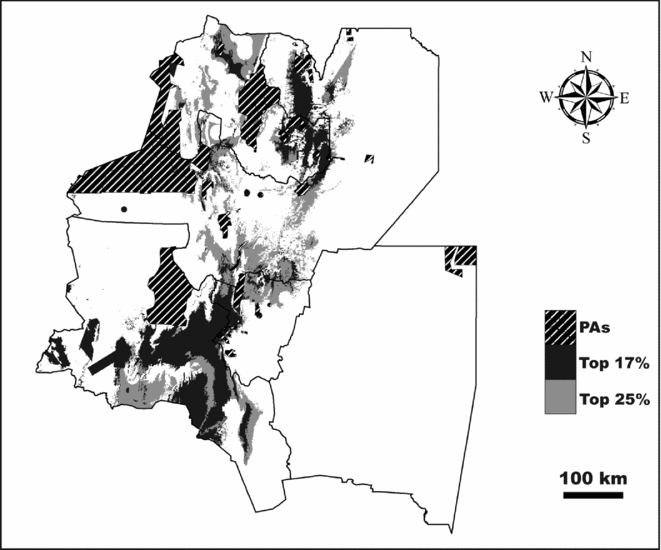
Geographically, priority areas for conservation (considering the top 17% of the territory) cover a large portion of the central-north and central-south of NWA (Fig. 1). These areas are within the Yungas (29% of the priority areas) and Monte ecoregions (39% of the priority areas) and are mainly located in transition zones with the Gran Chaco ecoregion (12% of the priority areas). A total of 14% of the Puna ecoregion was also represented in priority areas. Only 5% of the priority areas are located in the Andean Steppe ecoregion.
Maps of the current protected areas of the region (striped) and potential expansion areas identified in our spatial prioritization scheme. Dark grey areas correspond to the best 17% of the region (including already-established PAs) for investing in conservation actions. Light grey areas correspond to priority areas ranging from the best 17% to the best 25% of the region. Black lines are the limits of the five political provinces of north-western Argentina. PA = protected area.

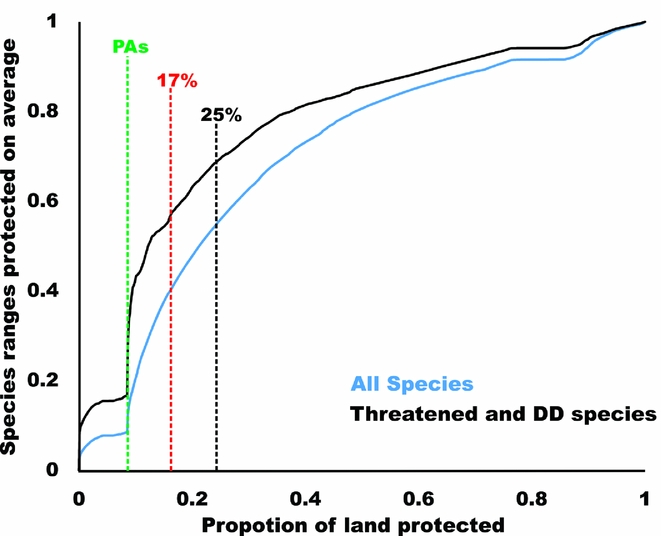
Already-established PAs cover 9% of NWA and are mainly located in the Puna ecoregion (64% of the protected surface of the study area), with only 5% of the PAs located in the Chaco ecoregion. PAs represent, on average, 15% of the distributions of all species (more than 55% of the species with less than 5% of their distributions represented) and 22% of the distributions of threatened (VU and EN) and DD species (Fig. 2).
Performance curves of our spatial prioritization scheme, showing the proportions of available grid cells that are protected and their corresponding representations, considering all species together, and only threatened species and DD species. DD = data deficient; PA = protected area.
Considering our prioritization, by protecting an additional 8% of the territory, the average representation of PAs would increase considerably, covering on average 43% of species distributions (with only 11% of the species with less than 10% of their distributions represented and 20% of the species with less than a quarter of their distributions represented) and 58% of threatened (VU and EN) and DD species distributions (Fig. 2). When the highest 25% priority of the territory is selected, the average representation is 57% considering all species and 69% for threatened (VU and EN) and DD species (Fig. 2).
DISCUSSION
This is the first study in Argentina to identify priority areas for conservation considering human modifications to land cover and the potential effect of global climate change on species distributions. Worryingly, PAs in NWA repeat the common pattern reported over recent years (e.g. Pressey et al. Reference Pressey, Whish, Barrett and Watts2002; Devillers et al. Reference Devillers, Pressey, Grech, Kittinger, Edgar, Ward and Watson2015), characterized by a biased protection of environments, with substantial under-representation of the most threatened areas in productive regions (Pressey et al. Reference Pressey, Visconti and Ferraro2015).
The low equitability in the representation of the different environments of the region is perhaps one of the reasons our results identified a very poor representation of reptile species in existing PAs. In fact, with 9% of the territory falling inside existing PAs, average representation of species distributions is only 15%, with most of them very poorly represented (less than 5% of their distributions for most of the species). However, it would be possible to represent more species (along with higher percentages of their geographic distributions) with just an 8% increase in protection; this would elevate average species representation fourfold.
Most priority areas are located in the Yungas and Monte ecoregions. The larger parts of these ecoregions are not suitable for intensive agriculture, although mining, extraction of oil and wood and extensive livestock grazing threaten species in these ecoregions (Brown et al. Reference Brown, Martinez Ortiz, Acerbi and Corcuera2006). In general, these activities do not require large proportions of land (in the case of mining and oil extraction) and do not generate great changes in land cover (in the case of extensive grazing and selective logging), leading to less conflict between human development and conservation than that observed in areas under intensive production.
Given its great potential for agriculture, priority areas in the Gran Chaco ecoregion and its transition zones with the Yungas and Monte ecoregions are the most vulnerable. Deforestation rates in these regions are among the highest worldwide (Hoyos et al. Reference Hoyos, Cingolani, Zak, Vaieretti, Gorla and Cabido2013; Frate et al. Reference Frate, Acosta, Cabido, Hoyos and Carranza2015). Conservation actions in these priority areas are urgently needed, given that, as time passes, conservation possibilities will drastically decrease (Fuller et al. Reference Fuller, Sánchez-Cordero, Illoldi-Rangel, Linaje and Sarkar2007; Nori et al. Reference Nori, Lescano, Illoldi-Rangel, Frutos, Cabrera and Leynaud2013).
In some of the present ecoregions that are poorly influenced by extractive activities, such as Monte or Puna, the number of species is exceptionally high for reptiles compared to other terrestrial vertebrates groups, such as mammals or birds. The pattern is the opposite in the Gran Chaco (i.e. lower reptile species richness than for other vertebrate groups; e.g. birds), which is the most threatened region of NWA (Abdala et al. Reference Abdala, Acosta, Acosta, Álvarez, Avila, Blanco, Bonino, Boretto, Brancatelli and Breitman2012; Giraudo et al. Reference Giraudo, Arzamendia, Bellini, Bessa, Cinthia, Cardozo, Chiaraviglio, Costanzo, Eduardo, Di Cola and Di Pietro2012). This incongruence in patterns of species richness between reptiles and other vertebrate groups (Powney et al. Reference Powney, Grenyer, Orme, Owens and Meiri2010) could be the main reason as to why the Gran Chaco ecoregion is poorly represented in priority areas for reptiles, and consequently why priority areas do not match geographically with the region where most conservation actions are needed (Hoyos et al. Reference Hoyos, Cingolani, Zak, Vaieretti, Gorla and Cabido2013; Frate et al. Reference Frate, Acosta, Cabido, Hoyos and Carranza2015; Nori et al. Reference Nori, Torres, Lescano, Cordier, Periago and Baldo2016a). For this particular political region, reptiles might not be the best taxon to use as a focal group for the selection of priority conservation areas. The selection of accurate focal groups is an essential step in conservation planning (Hermoso et al. Reference Hermoso, Januchowski-Hartley and Pressey2013). More studies including and evaluating other taxa are needed in order to guide effective decisions about new PAs.
While our results pinpoint potentially important areas in order to efficiently expand the PA network in NWA, our analyses are limited mainly because of information shortfalls. Firstly, our database contained distributional records from 1980 up to the present date. Although we avoided areas with threatening human activities in the prioritization, predicted species distributions could be biased, given that some models were generated using old records from sites that are no longer inhabited. Other important limitations were the impossibility of generating SDMs for 50% of the included species (for which we considered no effect of climate change in their distributions), and the infeasibility of calibrating SDMs using distributional records from the entire ranges of some species (see Thuiller et al. Reference Thuiller, Brotons, Araujo and Lavorel2004). The use of a single (intermediate) greenhouse gas concentration trajectory also meant that implementation of a different RCP could significantly alter our predictions of future distributions (Diniz-Filho et al. Reference Diniz-Filho, Bini, Rangel, Loyola, Hof, Nogues-Bravo and Araújo2009).
Most priority areas identified in our study are located in the uplands. This result reflects the focus of the prioritization on the potential effects of climate change on species’ distributions. In addition, in NWA, high-altitude areas and the species that are found there are the most exposed to climate change (Nori et al. Reference Nori, Moreno Azócar, Cruz, Bonino and Leynaud2016b) and many species are involved, including several endemics (Szumik et al. Reference Szumik, Aagesen, Casagranda, Arzamendia, Baldo, Claps, Cuezzo, Diaz Gomez and Di Giacomo2012). While climate and land-use changes jeopardize the existence of many species in NWA, comprehensive conservation planning is still needed. Using reptiles as a focal group is a first step, but more research and, especially, more political will is needed in order to advance the conservation agenda in the region.
ACKNOWLEDGEMENTS
We thank Town Peterson, two anonymous reviewers and Nicholas Polunin for their comments on the manuscript. JN and GCL's work was funded by FONCYT and SECYT-UNC. RL's research has been constantly funded by CNPq (grants #308532/2014-7, 479959/2013-7, 407094/2013-0 and 563621/2010-9), O Boticário Group Foundation for Nature Protection (grant #PROG_0008_2013) and CNCFlora. This paper is a contribution of the Brazilian Network on Global Climate Change Research funded by CNPq (grant #437167/2016-0) and FINEP (grant #01.13.0353.00). RLP acknowledges the support of the Australian Research Council.
Supplementary material
For supplementary material accompanying this paper, visit https://doi.org/10.1017/S0376892917000285