Introduction
The striped flea beetle, Phyllotreta striolata (Fabricius) (Coleoptera: Chrysomelidae), is one of the two dominant flea beetle species that damage canola (oil seed rape) (Brassica Linnaeus, Brassicaceae) on the Canadian prairies (Olfert et al. Reference Olfert, Ross, Elliott and Soroka2017; Soroka et al. Reference Soroka, Grenkow, Otani and Gavloski2018). The most recent estimates available indicate annual losses due to Phyllotreta Chevrolat damage of up to US$ 300 million in North America (Knodel and Olson Reference Knodel and Olson2002). Phyllotreta overwinter as adults in soil and under leaf litter (Westdal and Romanow Reference Westdal and Romanow1972). Adults emerge from hibernation in spring and cause injury by defoliating canola plants during their early seedling stages (Westdal and Romanow Reference Westdal and Romanow1972). Canola plants are most vulnerable to Phyllotreta damage during cotyledon and early true leaf stages, typically within the first two weeks after plant emergence (Lamb Reference Lamb1984; Knodel Reference Knodel and Reddy2017). In early summer, Phyllotreta lay eggs (up to 25 eggs per female) in moist soil near canola plants, and the resulting larvae feed on canola roots (Westdal and Romanow Reference Westdal and Romanow1972; Knodel Reference Knodel and Reddy2017). Bracken and Bucher (Reference Bracken and Bucher1986) estimated a seed yield loss of 5% when larval densities exceeded 0.16/cm2.
There are few studies describing rearing procedures for Phyllotreta. In Canada, Kinoshita et al. (Reference Kinoshita, Svec, Harris and McEwen1979) reared crucifer flea beetles (Phyllotreta cruciferae (Goeze)) in the laboratory at approximately 24 °C, 65% relative humidity, and 16:8-hour light:dark photoperiod and studied their natural history. The procedure developed by Kinoshita et al. (Reference Kinoshita, Svec, Harris and McEwen1979) required a hibernation period to initiate the colony and was labour-intensive. Burgess and Wiens (Reference Burgess and Wiens1976) reared striped flea beetles under greenhouse conditions on horseradish (Armoracia rusticana Gaertner, Meyer, and Scherbius (Brassicaceae)) plants at 18−24 °C and with a daily minimum photoperiod of 15 hours. This method produced only a small number of insects. In China, Wang et al. (Reference Wang, Jian-Wei, Jian-Yu and Shi-Xi2008) and Xian et al. (Reference Xian, Sun, Xiu-Ling and Hua2009) reared striped flea beetles from a single initial collection using Chinese flowering cabbage (Brassica rapa var. parachinensis (Bailey) Hanelt (Brassicaceae)) and radish (Raphanus raphanistrum subsp. sativus (Linnaeus) Domin (Brassicaceae)) at 25 ± 1 °C, and 12-hour photoperiod. Although Wang et al. (Reference Wang, Jian-Wei, Jian-Yu and Shi-Xi2008) and Xian et al. (Reference Xian, Sun, Xiu-Ling and Hua2009) were successful in producing immature stages, their methods were labour-intensive compared to the methods described in this paper.
Having the capability to efficiently rear flea beetles under laboratory conditions is essential to support future research on how to effectively manage this economically important canola pest. In this study, we describe two new methods to continuously rear striped flea beetles in the laboratory. The voucher specimens from this study were deposited in the Wallis–Roughley Museum of Entomology at the University of Manitoba (Winnipeg, Manitoba, Canada).
Method 1: Facilitating the retrieval of eggs and adult stages
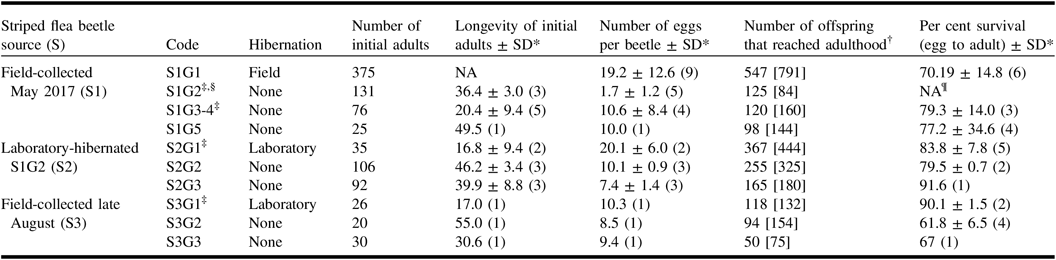
A colony of striped flea beetles was established from three different sources (S) of beetles. To determine the viability of rearing methods, multiple generations (G) of flea beetles were produced from each source. The first source (S1G1) consisted of adult beetles collected with sweep nets from canola fields at the University of Manitoba in May 2017. These adults had undergone natural hibernation in the field, and individuals from a subset of this source (n = 375; Table 1) were reared for four generations in the laboratory without hibernation (S1G2−5). Another subset of individuals from S1G2 (Table 1) underwent hibernation under laboratory conditions and became a second source of beetles (S2G1), which produced two further generations in the laboratory without hibernation (S2G2−3). The third source of beetles consisted of adult individuals collected in the same location as S1, but in late August 2017 (S3G1). These beetles also underwent hibernation under laboratory conditions, and produced two additional generations under laboratory conditions without hibernation (S3G2−3) (Table 1). For practical reasons, these three initial groups of beetles used in our experiments were treated as different sources, although they were collected from the same area and they may have limited genetic variability. However, since there are no biotypes reported yet for striped flea beetles and our results are in line with previous attempts to rear Phyllotreta, we suggest that our rearing methods will apply well to striped flea beetles collected in other regions of North America.
Longevity of initial adults (in days), number of eggs per adult (both sexes combined), and egg-to-adult survival (number and per cent) observed for striped flea beetle reared using method 1.

Note: Adult emergence from the pupal stage was checked once every three days, and adult survivorship was checked once a week; therefore, estimates of longevity are only approximate (see text for more details).
* Number of replicate cages in parentheses.
† Combined number for all cages; total number of eggs used in the cages to produce these adults shown in brackets.
‡ Oviposition tubs were infested with fungal pathogens.
§ BugDorm cages were infested with aphids and diamondback moth larvae, which resulted in non-periodical removal of emerging adult beetles.
¶ The emerged beetles were a mixture of generations three and four, with a combined 138.8 ± 20.7% (SD) emergence.
Codes: S, source population (1–3); G, generation number (1–5; mixed generations for S1G3–4); SD, standard deviation.
To achieve hibernation under laboratory conditions, we adapted the method developed by Kinoshita et al. (Reference Kinoshita, Svec, Harris and McEwen1979) for crucifer flea beetles. The first step was a pre-hibernation of adult beetles for a period of one month at 16:8-hour light:dark photoperiod and 19:7 °C in a growth chamber (Model 1818 Incubator; Thermo Electron Corporation, Marietta, Ohio, United States of America). Adult beetles were housed in 4-L glass jars (n = 100−1000 individuals) with 5 cm of wet peat moss in the bottom covered by 5 cm of dry peat moss (Sunshine Peat Moss; Sungro Horticulture, Agawam, Massachusetts, United States of America). Two to three Napa cabbage leaves (Brassica rapa subsp. pekinensis (Loureiro) Hanelt (Brassicaceae)) were provided as food (all leaves were air-dried for four hours prior to use to limit moisture build-up), and the top of the jar was covered with a lid which had a 9-cm-diameter hole covered with a fine mesh of no-see-um netting (with a 0.7-mm-diameter openings) to allow ventilation. Jars were periodically checked, and new leaves were added as necessary (approximately in two-week intervals). The second step, true hibernation, was achieved by removing the cabbage leaves, covering the jars with black cloth (to ensure darkness was maintained during manipulation) and placing them at 5 °C in darkness for 34–45 days. Kinoshita et al. (Reference Kinoshita, Svec, Harris and McEwen1979) recommended a minimum period of a month for successful laboratory hibernation of crucifer flea beetles, and we adopted successfully this period for striped flea beetles. Further studies should be conducted to determine if shorter or longer hibernation periods are also suitable for this species.
To obtain immature flea beetles, unsexed adults (n = 12–56 per tub) were placed into oviposition tubs and provided a single Napa cabbage leaf. For oviposition, commercially available Bug Tub containers (hereon tubs; Bug Tub, Calgary, Alberta, Canada) were used. These plastic containers (12 cm top diameter, 10.5 cm bottom diameter, 15 cm height) had 60 rows with 24 perforations per row on the sides to allow ventilation. Tub lids had 24 1-cm holes covered with a fine cotton-polyester mesh for additional ventilation. A circular hole (6 cm diameter) was made on the bottom of each tub and was covered with two layers of cheesecloth (with openings of approximately 1 mm). Each oviposition tub was then placed on top of a small plastic cup (10.5 cm diameter, 7 cm height) containing moist soil and covered with two layers of brown paper towel, cut into circular pieces to fit the circumference of the cup. The soil consisted of a mix of sand, top soil from agricultural fields, and potting mix (Sunshine LA4; Sungro Horticulture Distribution, Agawam, Massachusetts, United States of America) in equal proportions. The brown paper towel was sprayed twice with a spray bottle to dampen the soil mix. This design allowed females in the oviposition tubs to pass their ovipositors through the cheesecloth and lay their eggs onto the wet paper towels. Oviposition tubs were maintained in growth chambers (see above) at 24 °C, 60% relative humidity, and 16:8-hour light:dark photoperiod under diffused fluorescent lighting on the side walls (two tubes per wall, 34 W, 4100 K; Sylvania Hg Pentron). The temperature and relative humidity was measured using a HOBO U23 Pro V2 temperature/RH data logger (Onset, Bourne, Massachusetts, United States of America) placed on the middle shelf of the chamber. The bottom plastic cups were inspected three times per week under a stereomicroscope, and the numbers of eggs and larvae found on the paper towel were recorded. Napa cabbage leaves were also checked for flea beetle eggs and larvae once per week, and their numbers were recorded separately.
Eggs laid on paper towels and on cabbage leaves were removed with a camel-hair paint brush and transferred to canola plants at the cotyledon stage, which were grown in round plastic pots (14 cm diameter and 10.5 cm height) at 24 °C and 60% relative humidity with the moist soil mix. These pots were then placed in a fine mesh rearing cage (width 47.5 cm, length 47.5 cm, height 47.5 cm; BugDorm, Taichung, Taiwan). Each rearing cage housed one to four pots (approximately 50 plants per pot). A maximum of 50 eggs were placed into each pot to avoid larval overcrowding. These cages were placed in a walk-in growth chamber at 24 °C, 60% relative humidity, and 16:8-hour light:dark photoperiod under un-diffused fluorescent lighting (16 tubes per bench, 54 W, half 4100 K and half 5000 K; Sylvania Hg Pentron). The temperature and relative humidity measurements were recorded with the HOBO units mentioned before. Each cage was checked three times a week for adult emergence, and each pot within the cage was sprinkled with 50 mL water to the canola foliage (water quantities were occasionally reduced to avoid overwatering). Adult beetles were counted, removed, and subsets of them were transferred into oviposition tubs.
To quantify beetle production using method 1, we estimated the number of eggs and larvae produced per adult beetle (regardless of sex) by dividing the total number of eggs counted per tub by the number of beetles initially added to each tub. The pre-oviposition period was estimated as the time between adult introduction and the first observation of eggs in the tubs. Adult longevity was calculated by adding the total number of days in which beetles were observed alive for the last time (from the initial date of transfer to the oviposition tub, i.e., 1–3-day-old adults) to half of the number of days between the last interval in which they were observed alive and when they were found dead (because adults were checked about once a week; half of this period was usually 3.5 days). The estimate of longevity and pre-oviposition is only used as an illustration of the viability of the rearing method due to the uncertainty on the exact day of adult emergence and death. The development time was estimated as the time between egg introduction to the larval rearing cages (the eggs were up to three days old) and the first observation of adults in the cages. Egg to adult survivorship was calculated by dividing the number of offspring that reached adulthood in each cage by the total number of eggs used in the cages to produce these adults (Table 1).
Method 1 allowed continuous rearing of flea beetles from May 2017 to March 2018, including five S1, three S2, and three S3 generations. The pre-oviposition period for method 1 ranged from 3 to 14 days. Ninety-five per cent of the immature stages collected in oviposition tubs were eggs, and 5% were larvae. Among the total number of eggs and larvae collected (n = 11 139), 97% (n = 10 805) were collected on the paper towel, and 3% (n = 334) were found on the Napa cabbage leaves. A negligible number of eggs were collected on cheesecloth. The development period ranged from 26 to 33 days, irrespective of the source of beetle collection, slightly less than the 36-day development period for crucifer flea beetles reported by Kinoshita et al. (Reference Kinoshita, Svec, Harris and McEwen1979) at the same temperature.
Field-collected S1G1 adults (naturally hibernated under field conditions) and laboratory-reared S2G1 adults (laboratory-hibernated) produced similar number of eggs per adult (Table 1). Field-collected S3G1 adults in late August, which were subsequently laboratory-hibernated, produced approximately half the number of eggs produced by S1G1 and S2G1 adults (Table 1). The non-hibernated adults from all the three sources (S1G3-4, S1G5, S2G2, S2G3, S3G2, and S3G3) produced approximately half the number of eggs produced by the hibernated adults except for S1G2 adults (Table 1). Adult longevity ranged from 17 to 55 days and adults from S1G2, S1G5, S2G2, S2G3, S3G2, and S3G3 generally lived for at least 30 days, with the highest longevity being 55 days. The longevity for S1G1 adults was not calculated as these beetles were field-collected and the age of the beetles was not known. Egg to adult survivorship ranged from 62% to 90% among different sources and generations with an average emergence of 78 ± 10.0% (mean ± standard deviation) (Table 1). We estimated the sex ratio of flea beetles reared under method 1 from a subset of beetles preserved after death in 70% ETOH, obtaining (female:male) 1.7:1.0 (n = 32), 1.3:1.0 (n = 58), 1.1:1.0 (n = 27), and 1.6:1.0 (n = 21), for S1G3–4, S2G2, S2G3, and S3G3, respectively. These ratios are slightly female-biased but very close to the 1.1:1.0 (n = 108) sex ratio observed for field-collected striped flea beetles (S1G1, this study) and the 1.2:1.0 sex ratio (n = 2136) reported for field-collected crucifer flea beetles (Ulmer and Dosdall Reference Ulmer and Dosdall2006).
We encountered two problems during the development and testing of this method. A fungal infection was observed in some beetles reared in oviposition tubs of the S1G2, S1G3-4, S2G1, and S3G1 populations, and may have reduced egg survivorship and adult longevity. We believe the fungal infection was caused by excess moisture. Drying the Napa cabbage leaves for about four hours and freezing the oviposition tubs for about an hour in a −20 °C freezer prior to use helped in reducing the frequency of fungal infestations. S1G2 larval cages also became infested with aphids (Hemiptera: Aphidae) and diamondback moth (Plutella xylostella (Linnaeus); Lepidoptera: Plutellidae), and as a result, adult striped flea beetles could not be removed from the cages as frequently as they should have been without causing further contamination. Consequently, S1G1 adults completed a second generation while in rearing cages. Since the number of adults obtained in these cages was a combination of beetles from generations two and three, this resulted in a combined adult emergence of 138% (see footnote in Table 1).
Desiccation is one of the main factors limiting egg hatching in other Phyllotreta species, both in laboratory and field conditions (Chittenden and Marsh Reference Chittenden and Marsh1920; Westdal and Romanow Reference Westdal and Romanow1972). We attribute much of the success of our method to the presence of damp soil and wet paper towel that prevented egg desiccation. Further, this method allows easy access to eggs and larvae on the paper towel and the Napa cabbage leaf, enabling us to collect them for use in experiments. A similar approach was used to produce eggs of the potato flea beetle (Epitrix cucumeris (Harris); Chrysomelidae: Galerucinae) in the United States of America (Hoerner and Gillette Reference Hoerner and Gillette1928; Anderson and Walker Reference Anderson and Walker1934). We note that after the initial reduction in the number of eggs produced per beetle in the first generation (probably due to suboptimal humidity conditions in the oviposition tubs), egg production in subsequent generations stabilised to approximately 10 eggs per adult, allowing the colony to increase in size and to supply ample quantities of beetles for experiments.
Method 2: Bulk rearing to facilitate the retrieval of adults
For this method, 100–150 newly emerged (under three days), unsexed adult flea beetles from S1G3−4 (n = 1 cage), S2G3 (n = 1 cage), and S3G3 (n = 1 cage) were placed in BugDorm cages, each containing two to four pots of canola at cotyledon stage, planted as previously described. Each week, pots from the adult cages (without adults) were transferred to new cages for the development of immature stages and adult emergence. The cages were monitored three times a week, and the number of adults produced was assessed. Plants were watered following the watering regime described for method 1. The observation and maintenance of these cages continued until no emergence was observed (typically four weeks after the first observed adult emergence).
Once the beetles were placed in the cage, they started feeding on the canola leaves, and we observed them mating in a few instances. The number of these adult beetles started to noticeably decline after four weeks. The adults housed in the cages laid eggs in the soil, and both larval and pupal stages developed undisturbed in the same pots. A new generation of adults emerged in the cages after approximately 25–30 days, resulting in a 5.8-fold (S1G3−4), 9.0-fold (S2G3), and 7.5-fold (S3G3) increase in the numbers of adults. These increase rates were comparable to the 8.6-fold increase of crucifer flea beetles reared in laboratory conditions by Kinoshita et al. (Reference Kinoshita, Svec, Harris and McEwen1979) and higher than the non-increasing small populations of striped flea beetles maintained in laboratory by Burgess and Wiens (Reference Burgess and Wiens1976). Using method 2 we reared approximately seven generations of beetles until we discontinued the colony for logistical reasons. In May 2018, a new colony from field-collected adult flea beetles was started, and it is currently in its 10th generation, without hibernation and with sustained numbers. A sample of this colony showed a sex ratio of 1.1:1.0 (female:male; n = 49; sexed on March 2019), suggesting that this method also maintains a stable sex ratio.
Our two rearing methods facilitated continuous production of striped flea beetles from May 2017 to March 2018 and resulted in consistently increasing populations, demonstrating long-term potential. Striped flea beetles collected in the spring can be reared in laboratory conditions with or without hibernation, although hibernated adults produced more eggs than non-hibernated adults. An initial hibernation of a colony is particularly critical if the beetles used to initiate the colony are collected during late August or early September. Each method can be used to produce adults, but only method 1 allows one to easily obtain eggs and larvae. If only adult beetles are required, method 2 is substantially less labour-intensive and is recommended. It is also recommended to add field-collected beetles to the colony every year, preferably from different areas, to avoid the potential development of an atypical laboratory strain of flea beetles. Preliminary assessments indicate that these two methodologies (with minor changes) can also be used to rear crucifer flea beetles (work in progress).
Acknowledgements
This research was funded by grants from the Canola Agronomic Research Programme of the Canola Council of Canada (project number AIP-P353, activity number 2-2015-17) and the National Science and Engineering Research Council Discovery Grant Programme (project number 418678-2012) to A.C. Costamagna. Laboratory assistance was provided by L. Irwin, C. Blad, T.F. Silva Guimarães, D. Holder, S. Zul Gambari, D. Geverink, C. Almdal, I. Samaranayake, A.R. Martinez, and M. Baschuk. We would also like to thank S. Desai, J. Bannerman, R. Lamb, and H. Cárcamo for their advice throughout this study.